Feeds:
Posts
Comments

Archive for the ‘Memoir’ Category

August 21, 2011

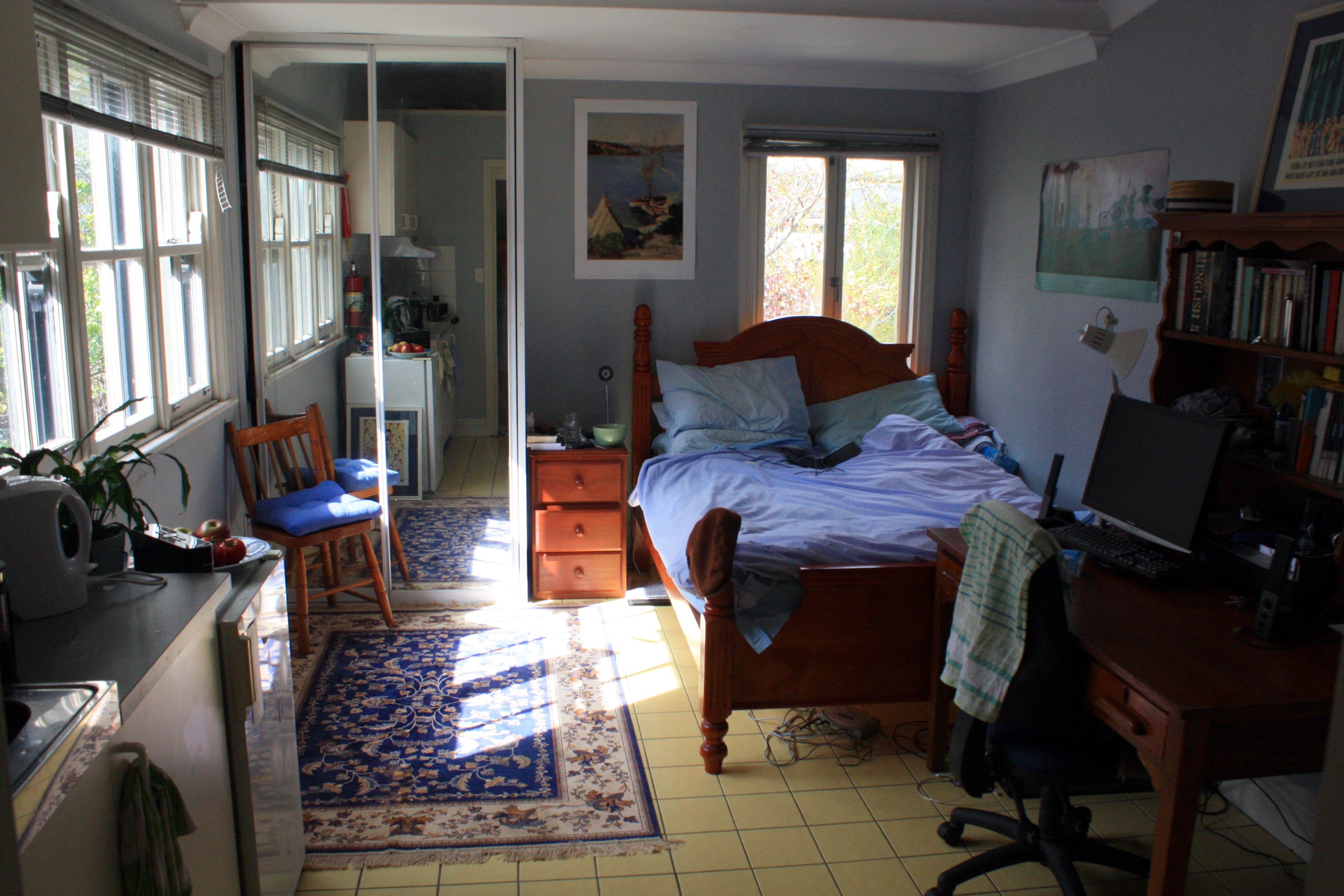
It’s a grey day, but I’m bathed in abundant natural light. The morning sun, having shifted across the Dijon mustard tiles and the royal blue Persian rug, now hides behind the clouds yesterday was supposed to bring. Outside my wide, elevated, east and south-facing windows, is a peaceful expanse of back yards and flourishing trees; their branches gearing up for spring. Being at the back of the building, the traffic sounds reach me like a distant, muffled wind. It’s peaceful enough that the birdsong is paramount, and my little old fridge keeps largely to itself.

I moved here just yesterday, to this sweet little studio in Glebe, and already I’m in love with the place. After a month of searching, considering many options, of sharing or flying solo, I inspected this place last Saturday morning and instantly saw the potential. I had actually come to inspect this unit the week before, yet in a moment of folly wrote the address down as Glebe Point Road and found myself wandering into someone’s house. Having missed the inspection time, I was ready to give it up for dead. When no one subsequently applied, I was further inclined to pass pre-emptive judgement that the place was, in fact, undesirable. Yet my at times insatiable curiosity got the better of me, and thank goodness it did.

The previous situation, a large, friendly share-house on Queen’s Park, had been good in every regard with the exception of its outlook. The room, whilst nice in itself, faced onto a brick wall which made it oppressively gloomy during the day. The neighbours’ front door was also a short distance from my window, and their constant comings and goings, their children’s tendency to practice recorder badly and bounce basketballs outside on the path, and their recent acquisition of a small, yappy dog were driving me bonkers. When I returned from visiting my brother in Brisbane, where I had slept on a wide, comfortable, solid wood queen-sized bed in a room gold with morning sunlight and myriad magpies singing like squeaky swings outside the window, I knew instantly that I could wait no longer. I had to get out, and so I did, fleeing briefly to the ancestral home so I might find a new place at leisure, without the pressure of having to fix a departure date. The Workers’ Socialist Democratic Republic Paradise (hereafter, WSDRP) as our family home is known, proved again to be both wonderfully welcoming and convenient in a time of transition.

Today is my birthday and it is very pleasing to wake up in such a lovely place. Even the onset of heavy weather only fills me with a greater sense of romance. There is nothing quite so well suited to making a place feel homely, than to sit reading by a rain-lashed window. The move here was very smooth, and my regular helper and good friend Paul again deserves my great thanks for his efforts in driving me and my belongings. I ought also to thank the Holden Commodore, which impressed me with its capacity – especially when I slotted my half-sized fridge across the back seat; a fridge, incidentally, which my much-missed French Nana gave to me in 1993 when she moved into my old room at the WSDRP. It still works like a charm, despite having been left on in the laundry for the last six years to form a vast, solid-core iceblock around the small freezer compartment. Paul helped me to load and unload the car, whilst I did all the carrying work. My zeal, pace, energy and efficiency, earned me the nicknames Conan the Removalist and The Removalator. There is definitely something to be said for keeping fit and developing one’s upper body strength!

Moving into a place has always been one of my very favourite activities, whilst, conversely, moving out is one of the least enjoyable. This move had in fact begun on Wednesday, the day I signed the lease. After finishing teaching at one, I went straight to Surry Hills to purchase a bed and a desk, the core furniture I lacked, having lived since returning from England in furnished houses. I was in something of a hurry to do so as I was signing the lease in Concord at three o’clock, and I wanted the furniture delivered later that afternoon. It made sense to have the furniture delivered directly to the new address, and thus obviate the need for a removal truck, which I would not otherwise require.

The range of furniture available in the store proved disappointingly small. The business had relocated from Bronte, and, having been to their previous store, which covered three storeys, I had expected a wide range of beds and desks. Yet instead I found a single storey, quite sparsely stocked. It was in this that I was unexpectedly and unknowingly fortunate. The choices lay at either end of the  scale and, remembering one of my favourite Chinese proverbs, “The bitter taste of poor quality lingers long after the sweetness of a good bargain,” I knew I would regret the cheaper, aesthetically poor choice. After all, what had been lacking in my last place was aesthetics.

So it was that, after wandering around the shop floor, stepping repeatedly past the big, grey-beard drowsy dog, I knew I had no choice but to buy the solid and stylish wooden queen bed I had been eyeing for the last five minutes.  Not far from it was a wonderfully weathered old wooden desk of epic size, yet slender legged and not too brutish. The one seemed the natural corollary to the other, so I mentioned my interest and cut a deal with the chap, who gave me a very nice discount. On top of this, he promised he would deliver at six thirty, and since I was to be his sole helper in unloading the goods, he would not charge for the delivery. It was, after all, a sweet bargain, but for quality.

I took a train to Burwood and walked out to Concord to sign the lease. It rained all the way – which one of my Korean students tells me is a good sign when moving house. As someone who loves the rain, I felt quite content as I returned via a long and congested bus-ride down Parramatta Road to Glebe. The brake-lights hung through the humid window in a world as sullen and grey as lamb fat. I felt an oddly peaceful eagerness, knowing I had time to kill before the delivery.

Here’s a poem I once wrote about Parramatta Road in 2005, which I throw in here by way of diversion.


Parramatta Road

These tired shops will never bring

slow-walking couples, blithe and entwined,

such is the hustle, the bash and the hiss;

heaves of freight, rubber and metal,

rolling petroleum, fog of exhaust.

And,

every morning,

as the bitumen warms,

as this smeared, groaning gully

fills freshly with urgent trumpets,

this stretched fan-belt girdle,

this gasoline funnel, this road

is like Christ risen

on a noose.

_________________________

Having arrived at the apartment and determined which keys were which, I found it ever so slightly smaller than I remembered. I realised now that the bed was not going to fit where I had originally intended it to go, and felt a momentary uncertainty about my decision both to purchase such a large bed and to rent this flat in the first place. I became concerned about sleeping in the same space as a fridge. Were they not prone to groaning and rumbling throughout the night? Was I not someone who could not bear the almost inaudible hum of a device on standby; someone with a phobia of ticking clocks – who on earth wishes to hear their life disappearing like that? Would sleeping with a fridge be impossible? Would it unnerve me, disturb me, send me bats? I pushed this fear aside. The space was very nice, with great light; it was clean, peaceful and harmonious, and I trusted my ability to make it very nice indeed. Sleeping with a fridge, bah! If it bugged me, I could always turn it off at night and no doubt all would keep til the morrow.

With two hours to kill, I set off for Vinnies on Glebe Point Road and proceeded to buy up all the floral granny plates I could find. I also bought some cups, saucers, mugs, glasses, a milk jug, silver sugar bowl and a large painted tray with a lacquered fruit fresco as its base. Using this tray, I carried my collection of crockery and utensils back through the rain to the apartment. After washing and stacking it on the sink, I sat down to read The Butcher’s Wife by Li Ang; a gripping, yet very visceral novel which I would recommend, though not without reservations.

At six thirty the chap was outside with the furniture. Together we brought the various parts of the bed in without any difficulty. The desk however, being all of one piece, proved more of an obstacle. Unable to fit through the door, the only option was to haul it up through the back window. What followed was equal parts comic and heroic. With me at the top hauling on the ropes, and the chap from the store standing below on a piece of backyard furniture and trying to hold the desk steady over his head, we managed to get it through the back window after much straining. Sadly, in my wrestle to drag the desk through, I cracked the glass of one of the window panes.

Come Saturday, I finally had the chance to put everything in order and decorate my new home. It took only two hours to order the furniture, put books on shelves, hang clothes, fill drawers, make the bed, lay the rug, stock the kitchen cupboards and bathroom cabinet, and set up my computer. The next few hours were then spent decorating; arranging photographic prints, hanging poster reproductions of artworks, deciding which tea-towels to display…

And so here I am on Sunday morning, feeling almost indecently pleased with myself. The birds are singing, the light is glorious, the outlook soothing, the drizzle calming, the bed exceedingly comfortable. In such a short space of time I have already recovered a long-lost sense of equilibrium. The absence of pressure or interruption, the freedom from other agendas, the serenity of complete overlordship over one’s domain, have flooded me with relief. For years previously I had lived alone in apartments and houses, and it had always given me a far stronger sense of self. The last time I lived alone was in Glebe, just eight doors down the road from my current address. Indeed, if I look out the back window, I can see the balcony of my old flat. That was famously given the nickname “Cornieworld”, and it was a most excellent place in which I wrote a great deal, including my second-last novel. Funnily enough, the above poem was also written whilst living there. I was extremely happy in Cornieworld, though I stayed only a year as my growing disappointment with John Howard’s Australia inclined me to move back to Cambridge.

Since 2006 I have shared houses with others, and whilst this has been largely a pleasurable experience, I have not in all that time felt entirely at home. Even in the most relaxed and friendly of households, there is a need to keep up appearances. Even with the most open-minded and casual people, there is an awareness that one is observed in one’s own home. Occasional inconveniences and disturbances occur that are beyond one’s control; the bathroom is busy, the stove-top full, the oven in use, the kitchen is full of people when one is really not in the mood for conversation, and does not wish to be seen looking so tired and frumpy. All these things take their toll, and despite the good company of housemates, it is not possible to choose at which times one has this company.

Already, just one day into my new house, on the first day of the 39th year of my life, I feel transformed. There is no one above me and no one below me, for despite being on the second floor, below is the laundry and a store-room. I can step as heavily as I please, play music loudly, speak without fear of being overheard, and nor do I seem to hear anyone else. My new, old furniture looks magnificent; the pot plants, the rug, the photographs, the book spines, the tea-towels, cups and saucers, the wooden chair, the bedside table, the trio of soft toys, Bilby, Platty and Bünchen sitting beside me, all fill me with a sense of wholeness.

When I said I was moving back to Glebe, my old friend Simon, knowing how much I love the area, said “Ah, you’re going home!” And, for the first time in years, I really do feel as though I am at home. And that little old friend of mine, that ever durable, long-lasting fridge, makes barely a sound at all.

Happy days indeed! Cornieworld 2 is born!

Read Full Post »

It was late afternoon when I climbed into the back of the jeep in Siliguri, having paid a mere 92 rupees ($2.25 Australian) for my seat. After settling in and stretching my legs on the surprisingly comfortable bench, I was soon forced to shuffle over to make room for someone else. It seemed that, in fact, 92 rupees bought only half a seat. This was going to be a fun ride.

I had flown into Bagdogra airport that afternoon, one of the few destinations in West Bengal for  budget airlines. The flight was stunning. Heading east from Delhi, the plane’s path tracked the line of the Himalayas, bathed as they were in bright sunshine; below, the yellow dust and fecund green of the great Gangetic plain lay dry, flat and ancient.

From Bagdogra, I had taken an autorickshaw into Siliguri – the nearest major town, situated roughly twenty minutes away. The drive took me past tea plantations and the roadside workshops of countless cottage industries; carpenters, woodcutters, masons, banana sellers. It was a lush and moist landscape; a welcome sight after the dusty dryness of Rajasthan and the baking heat of Delhi.

It took roughly half an hour for the jeep to fill and we set off immediately afterwards; around four in the afternoon. There were thirteen people inside: four across the front seat, four in the middle, including a pedigree Pekinese called Nora, and four huddled into the back with me. They were an interesting mix of Bengalis, Gorkhas and assorted other ethnicities. Already, just waiting around in Siliguri, I had noticed quite a number of people with very Asiatic features; some passably Chinese and others who struck me as ethnically Nepalese or Tibetan. A young Gorkha couple sat opposite me, the lady wearing a gorgeous bright blue sari, and something told me they were newlyweds. They had an air of amorous conspiracy that made one want to wish them well. I sat quietly in the back, smiling and nodding to everyone, then got on with listening to my iPod and shooting video through the open window.

After half an hour driving through a forest flashing with sunset, we reached the foothills of the Himalayan mountains. The road narrowed and began to wind, and very rapidly, the landscape changed in character. The dry, bright green and yellow-leaved forest had been cleared from the slopes and terraces to make room for tea and wheat. The rich soil was dotted with quaint, modest dwellings amidst fields made tropical by the occasional spray of banana leaves. Behind it all, the sharp rise of the mountains halted in a nightcap of fog.

Soon our driver brought us to a roadside bungalow, crowded about with other jeeps. He pulled in and hopped out, muttered something, then set off with his henchman into the bungalow. I climbed out from the back of the jeep, walked over and peered inside. It was a diner of sorts and, despite having stood around in Siliguri for half an hour before our departure, it seemed our driver was about to have his dinner. I shrugged and smiled at the ways of the world, then followed the lady with the dog as she wandered off down the road.

The slope rose sharply to the left of our heading; huddled with squat, dark and damp tea-bushes. Even here, at less than six hundred metres elevation, mist had begun to creep down in the cooling mountain shadow. A few workers were still in the fields, though they seemed, at this time of day, to be merely passing through. I took some photos, watched the men waiting by the jeeps, then sat down on the roadside to stare into the valley below.

I was soon roused by the sounds of an argument. It seemed our driver had finally returned to the vehicle after forty minutes and something was up. I assumed it was the length of the delay causing trouble, as none of the passengers had wanted to eat and were all waiting to leave. I wandered back over and stood to the side, watching. Despite not understanding what was being said, with the argument being conducted mostly in Hindi, Gorkha and Bengali, I soon determined that the dog cage of the Pekinese had fallen from the roof of the vehicle at some point on our journey and now seemed irretrievably lost.

The driver and his henchman were very defensive at first, almost dismissive. Yet, when the argument was joined by several other passengers, who cornered the driver and his sidekick to press their demands for justice, the response changed dramatically. One chap in particular, a very tall man with Han Chinese features, took up the lady’s cause and argued a strong case against the driver. I could only determine this from his gestures, from his tone and air of authority, yet whatever he was saying, he was saying it very well. It was his championing of her cause that really got the driver scared. Being lectured in his native Gorkha tongue seemed to turn the tables on him, and, when he realised that he might be held financially accountable, he seemed to panic. He ran across to all the other jeep drivers, asking if any had seen a dog-box. He got on the phone, frantically calling people in Siliguri to see if the dog box had been left behind there. I gleaned from occasional English usages that the box was valued at around 2500 rupees, almost 75 dollars; a princely sum for any working-class Indian. Needless to say, the dog box was not to be found.

With all the passengers now deeply restless, we finally piled back into the jeep and set off again. The tall man had been sitting next to the driver in the front seat, and so he was for the rest of the journey. The multi-ethic, multi-linguistic debate had not stopped at all, but continued for another hour in the vehicle. I was impressed by the quiet dignity of the woman whose cage had been lost. She never raised her voice, and spoke with a polite and stern measure. The driver went very quiet; clearly downtrodden and pondering his liability. I began to feel sorry for him as it was a debt he could never afford to pay, and I doubted his bosses were likely to take responsibility. I still wonder whether or not he was ever held to the debt, or indeed, if the box was found.

Meanwhile, I returned to my iPod and stared through the jeep’s back window. Now almost five thirty, the equatorial sun was in rapid descent and, as the elevation rose sharply, we entered the mist and cloud. The mountain road was potholed and open to a steep slope; crisscrossing it at various points ran the tracks of the so-called toy train; a narrow-gauge steam-engine which began operating in 1881. It was now merely a tourist attraction and slowly chugged its way from Siliguri to Darjeeling. The journey could take up to ten hours, and I’d read that it moved so slowly it was possible to hop off and shop, then catch up and hop back on.

The darkness settled in rapidly, as did the mist. By six o’clock, we were driving through a cold, white fog, backlit with the last reflected light of the sky. Through the back of the jeep, the road swung and wended, and soon the headlights of other jeeps began to sweep across the bends in the road. As the night took hold, we reached the half-way mark; entering the town of Kurseong. It was little more than a single strip of houses and shops, backed against the rising slope of the mountain. The wooden doors and stock bins of the shop-fronts sat tight on the railway tracks; barbers, grocers, cobblers, knitwear vendors, chai wallahs, and the ubiquitous general stores of India. Everything was just a little shabby like the road; damp and plundered daily by the weather.

The main, and seemingly only street, was clogged with traffic and we slowed to a crawl. I watched bearers carrying huge loads alongside us; straps hoisted up around their foreheads to take the strain on the heads. I watched a young man being shaved in a faded pale-blue barbershop; his face padded softly with a large sponge. A young Gorkha man did his hair in the window, checking and re-checking his fringe. The moustached hot-food seller behind a glass case full of samosas eyed the jeeps suspiciously, wondering why we stared yet did not stop to eat. It was clear that we had entered a different ethnic zone. This was the beginning of Gorkha-land, something broadly proclaimed in neat, functional graffiti on various walls.

We soon edged past the toy train’s shed; the only place where the town appeared to spread out across the small, flat ridge along the slope. As we left the town, the shops and houses rapidly thinned until there were no permanent dwellings on the roadside. In their place sprang up a line of small wooden stalls; mostly covered in fruit and vegetables; lit only by oil lamps and candles. It had an ancient quality about it; such oil lamps and tapers have been lighting market stalls for thousands of years. The heavily shadowed faces that peered in chiaroscuro were mostly local Gorkha people, yet occasionally the darker-toned, heavier features of the Bengalis were apparent.

With Kurseong behind us, the road became once more a potholed, narrow curve around the mountain. I went into an even quieter mood, skipping the more upbeat tunes on my iPod and settling instead for more meditative music. Beethoven, Mendelssohn, Bach, Chinese traditional musicians, Pink Floyd. I felt a great welling of emotion within me as I stared through the scratched glass of the back window, watching the swinging headlights from those following. I was missing a girl I had farewelled in Rishikesh; I was missing the lost possibilities of a girl; I was missing something so utterly different to where I now was, that I felt only the loss but not the desire for what was lost. For in truth, nothing had prepared me for the beauty of this ride. That it could be so uncomfortable, so cramped, so cold, so dark and so much longer than expected, and yet, so compellingly beautiful, was a fortunate paradox.

When my iPod randomly offered up “This is Hardcore” by Pulp, this new, sad mood reached its zenith. The brooding, almost menacing creep of the keyboard – melancholy tinged with anxiety – the sexy noir of the lyrics, the sadness of a loss from which there is no return – all these elements were apparent. As the lengthy song reached its quiet break before concluding, I was overcome with emotion.

“This is the eye of the storm.

It’s what men in stained raincoats pay for.

But in here, it is pure, yeah.

Oh this is the end of the line.

I’ve seen the story line

played out so many times before…”

Indeed, I whispered to myself. “This is hardcore. There is no way back for you.”

And the jeep drove on through the thick fog; spotlighted in the sway of those jeeps that followed. The train tracks that had for so long, resolutely stuck to the side of the road, now seemed regularly to cross it, from one side to the other. Then, just as the tracks settled once again against the inner slope, we caught up with the train. Its steam engine chugged and puffed, and as we passed, the driver let out a great whistle; an ancient train in a more ancient land, singing like a lost soul in the heavy fog. Unexpected, and, in the dark, unseen by the others, I began quietly to shed tears.

Read Full Post »

Dirk thanked the man for the soup. He picked up the spoon, stirred the soup, then took a sip. It was hot, it was sour. It tasted like a real hot and sour soup.

Loud voices came from across to Dirk’s right. There was a table of five young locals, slightly obscured in a back corner of the restaurant. All Dirk could see was the backs of two men. They sounded drunk, but seemed to be having a good time. Fair enough, he thought. The people around here worked very hard. He was glad they got a chance to unwind.

Dirk stirred the soup and let go the spoon. It was very hot, so he turned his attention to his chai. He’d been spoiled for chai in Darjeeling, and this one was OK, but nothing special. There was too much milk and it tasted disappointingly bland. The chai in Darjeeling, along with the street food, had been the best he’d found in India. He picked up the soup spoon again. The dumplings hadn’t arrived yet. All in good time.

Outside the rapid sunset was in its final phase. The touristy streets of McLeod Ganj were already a good deal colder. The day had been quite remarkable; a blazing morning then an afternoon sun-shower, followed by a double rainbow from the valley to the snowcaps. Once the rainbows had gone, Dirk had stayed to watch the play of light and dark clouds, stretched across the rocky peaks. The altitude of the view, the contrast of the green grassed hills before the grey, snow-dusted strata of the peaks had erased his inner disquiet. Before such natural drama he could not but feel reassuringly small. He had come here to work on his patience; to get back his concentration. Not one for meditation or yoga, he was teaching himself to sit and watch.

Dirk sat and watched the drunk Tibetans. In India, people always stared at him and often approached him, but he was inclined to watch much more cautiously; sidelong glances, subtle flicks. Apart from wanting to avoid attracting attention, he was wary of offending anyone.

Two more customers entered the restaurant; a pair of Tibetan monks. They wore the deep maroon robes so prevalent in this home away from home for the Dalai Lama. Dirk felt reassured about his choice of restaurant. The new arrivals stayed in the front entrance area, near the counter, with two small wooden tables. The wooden chairs honked on the tiles as they sat down. Dirk watched them surreptitiously. He was fascinated by the local people; Tibetans, Nepalese and Ghorkas, Indians of the Himachal region, darker skinned migrants from the great Gangetic plain, all here, in the cool, clean mountains. How vast and diverse India was!

The voices of the drunken group grew louder. One of the men was clearly angry about something and banged his fist on the table, rattling the plates. They were more drunk than Dirk had originally suspected. Something was up with someone, and their mood had an urgent air.

Dirk turned away, took a sip of his soup and heard a great shout, accompanied by a crash. One of the young men was on his feet, swinging wildly, and suddenly all the others were engaged. The angry man’s chair flew back on the floor as he lunged across the table at his companions. A glass hit the deck and smashed across the tiles. The table jostled as the men all surged to defend themselves.

The angry young man – the most handsome of the bunch – tall, black-haired and with fine features now distorted by rage, threw a wild punch across the table that was dodged by his would-be victim. Another man grabbed the lunging arm and held it firm, helped a moment later by the target. The angry man was shouting loudly now; a drunken voice full of wild, impassioned rage. He was livid and convulsed with violence. The two other men got hold of his other arm, and, resisting, he thrashed about in their midst, held awkwardly across the table.

The salt cellar now hit the floor and smashed, and a moment later, another glass. The restaurant owners rushed around the corner, having been slow to react at the first crash. They saw as clearly as Dirk did how dangerous the situation was, and did not venture in, but stood watching. Dirk stood up in his chair and moved closer to the wall. He pulled the chair across in front of him and placed his back against the cold plaster. He picked up his soup and continued to sip it, watching the struggle unfold.

All the men were shouting, insisting that the man stop fighting. For a moment it seemed he might do so, and slackened slightly in their grip. Then, after a few seconds’ pause, he erupted again, thrashing his body to break free. It was a clumsy situation, with two men on one side of the table holding his right arm, and two men opposite holding his left. The angry man bent his body forward and rammed his head into the table in protest. Sweeping it from side to side, he managed not only to cut himself, but to send the remaining condiments to the floor.

Slicked now as it was with soy sauce, his feet slid on the tiles and he went down kicking, held up by the other four men. The restaurant owners were saying nothing. They must have seen how little could be done. It was simply a matter of getting the man outside without further harm to the restaurant. Yet, he was strong as an ox, and even with four men holding him, the slippery floor, the table and chairs all about made him difficult to control. They tried now to drag him towards the door, moving thus in Dirk’s direction. Dirk put his soup down and placed his hands firmly on the chair in front of him. If trouble should come his way, he wanted to be ready to defend himself. He tried to keep his face as impassive as possible; looking neither shocked nor curious. The last thing he wanted was to provoke this fellow in anyway.

Again the man tried to thrash his way out of the grasp of the four men. His eyes were red with anger and alcohol, his mouth contorted and chin hung with spittle, blood lined the crease of his frowns. He went down again, sliding to his knees, and this time took one of his minders with him. Another chair went down, and the table next to where they had been seated took a hit, sending another glass soy-sauce container to the floor. It too smashed, adding to the shards and the slipperiness. The man who had fallen cut himself on the glass and shouted angrily. He picked himself up and looked at his hand, then slammed his shoulder into the source of his woes.

The wild-man took the hit in the ribs and seemed to lose his wind momentarily. The other men holding him were talking all the while; angry and soothing, panicked and surprised. Clearly nothing they said was working, for his anger did not diminish.

They now had a good hold of him again, and were keeping him on his feet. They shifted him forward, legs kicking out at the tables. Soon they were onto dry floor, away from the tangle of chairs and tables. The angry man looked ahead at Dirk, whom he was now approaching. He stared straight into his eyes, his rage seemingly magnified, and shouted:

“Foreign devil!”

Dirk stood flat and square against the wall and let no emotion cross his face. He did not want eye-contact with the man, but he needed to know exactly what he was doing and was compelled to watch him closely. Finally his captors got him past Dirk’s table and into the entrance area. The Tibetan monks had vanished; having slipped out whilst Dirk’s eyes were elsewhere. The owners of the restaurant, three local men, stood calmly shaking their heads. They seemed more disappointed than anything else; clearly they were wise to human nature.

The group of drunken men now spilled out onto the street. The shouts continued for a moment longer, accompanied by scuffles, then vanished into the quickly cooling night. Perhaps the air would work to heal their tempers. Dirk wondered about the offence and scale of regret.

He looked at the owners and shrugged. He felt sorry for them and had a strange desire to apologise, but merely smiled in sympathy, shaking his head. The demon drink, he thought. The demon drink. He had witnessed such rages before, and had some years ago given up on alcohol as the source of too many woes. Having worked for several years as a barman, he had seen too much folly and bravado to have any time for alcoholics.

The owners moved in to begin the clean up. They worked slowly, almost timidly, still shaken by the incident. No one returned to offer recompense, nor assist with the mess. Dirk stepped forward to offer his help, but one of the men waved him back to his chair.

“Your soup is cold,” was all he said. “This is our problem.”

Dirk hovered a moment, then bent to pick up a chair and straighten a table. The man smiled at him and shook his head, before another man appeared with his dumplings.

“Eat,” said the man. “Eat.”

Cold air blew in from the doorway as the Tibetan monks returned. Dirk felt the wind go right through him, to the sadness he had been trying to fill with majesty. In the night, with the view now invisible, he must instead fill the hole with food.

He sat down and began once more to eat.

Read Full Post »

“You are hardcore, you make me hard. You name the drama and I’ll play the part.” – Pulp, This is Hardcore


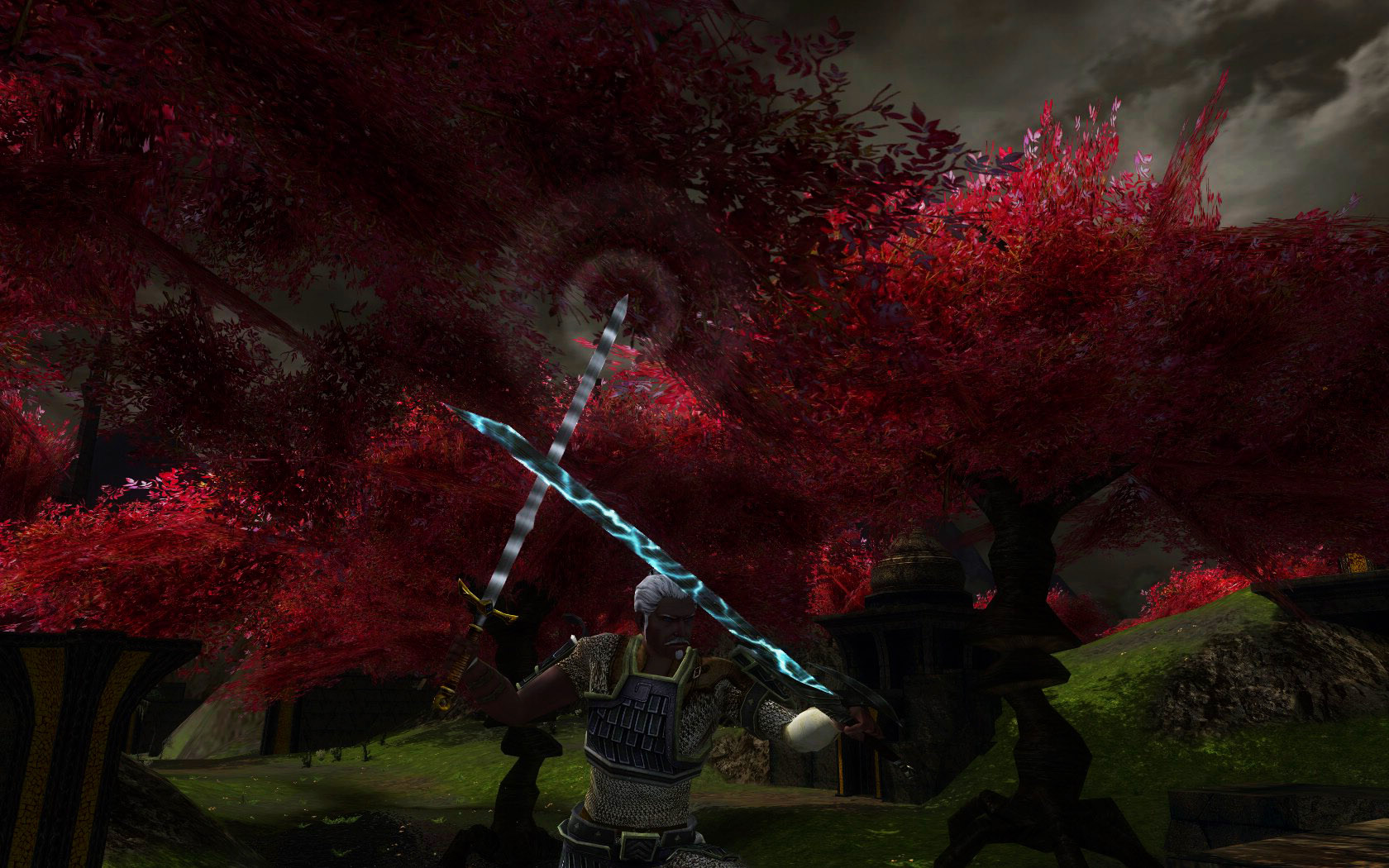
So it was that the bug got me. I fell into my computer screen like a man tumbling into his own soul. When I sat down with a steaming bowl of coffee, slipped on the wireless headset and logged in, I was gone for all money. There was no television show, social occasion, book, magazine, song, meal or girl that was capable of luring me away from the widescreen world of Xen’drik. Apart from standing up every half hour to rearrange the pillows and stretch, there was little incentive to leave my ergonomic chair.
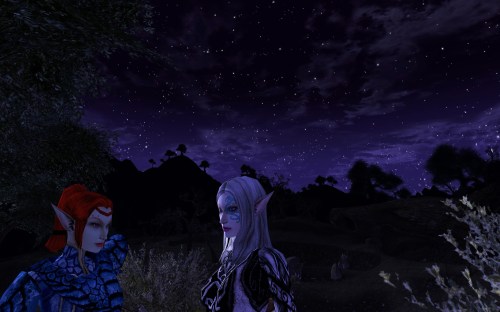
This business of stretching became an important part of staying in top gaming shape. If I wanted to be on the ball, if I wanted to be at my sharpest, I needed to be comfortable and alert, with good mouse and keyboard position and a comfortable, supportive posture. Sitting in a chair for a very long time can have some debilitating effects on one’s body, and I began to develop a syndrome which I called “Chair-leg.” It was the continuous pressure on the back of my thighs which caused them to stiffen and take against me and I was forced to institute a regime of exercises, rather like those advised on long flights. Often I would lean against the window sill and work the hamstrings and thighs, all the while conversing with other players or watching the social panel for an appropriate group to appear.

Yet, even with these exercises, the cumulative effect of staying up all night and pushing myself to new heights of effort, whilst remaining professional throughout, caused my body a great deal of distress. When I went running, in the real world, my legs would take twice as long to loosen, my chest heaved with fatigue and my joints seemed without suspension. I would struggle through the first fifteen minutes before my muscles finally reached a more fluid state, after which I felt as though I had cleaned the slate to some degree. My body still worked, it was just a good deal slower to start.

The good news was that, in game, I was becoming better by the minute. Hallifax Bender might not have been the best character build, but I knew his capabilities so well from so much solo play, that it was often Hallifax left picking up the soul-stones and bringing the party back to life from a near wipe.

Hallifax was Mr Versatile; he was the classic jack of all trades and master of none and his inventory was full of fixes for difficult situations; potions, wands, scrolls, elixirs. Hallifax could outsprint just about anything; he could hide, sneak, heal, and buff, or fight, charm, hold, disorient, blind, mesmerise and confuse his enemies. He was relatively durable and die-hard to boot, which meant, if knocked unconscious, rather than bleeding to death he would automatically stabilise and eventually come around with 1 remaining hit-point. How often Hallifax picked himself up off the floor of a battle and crept away to live another day, I cannot say, but he certainly came to be appreciated on many occasions, much to my pleasure.

When I sat down each night at my computer, it was usually with a great sense of expectation. In the first phase of my addiction to group play, I was happy to run any quests at all on account of their being largely new to me. After about a month, however, I began to lead my own groups, encouraged to some degree by having regular team-mates like Holz Amboss, Hallifax’s bard buddy. Being in charge of the group was a real buzz, especially as I’d like to think I was a good boss. I tried to be as democratic as possible and to show consideration to new players; just as I was happy to take advice from other players who knew the quests better than me, often, in effect, putting them in charge. The fact was that people out there needed my help and I needed theirs. Total strangers, though they did not know it, were depending on me, just as I was depending on them. Without each other, we couldn’t complete most of the game, so it was, in effect, necessary not only to put a party together, but to find good people and work with them as much as possible.

Before continuing the narrative of my fall into runaway addiction, I should like to digress a while to examine the pleasures and the mechanics of group play in Dungeons & Dragons Online (DDO). The game is not especially different to other MMOs in its basic structural elements, so the system will no doubt seem very familiar.

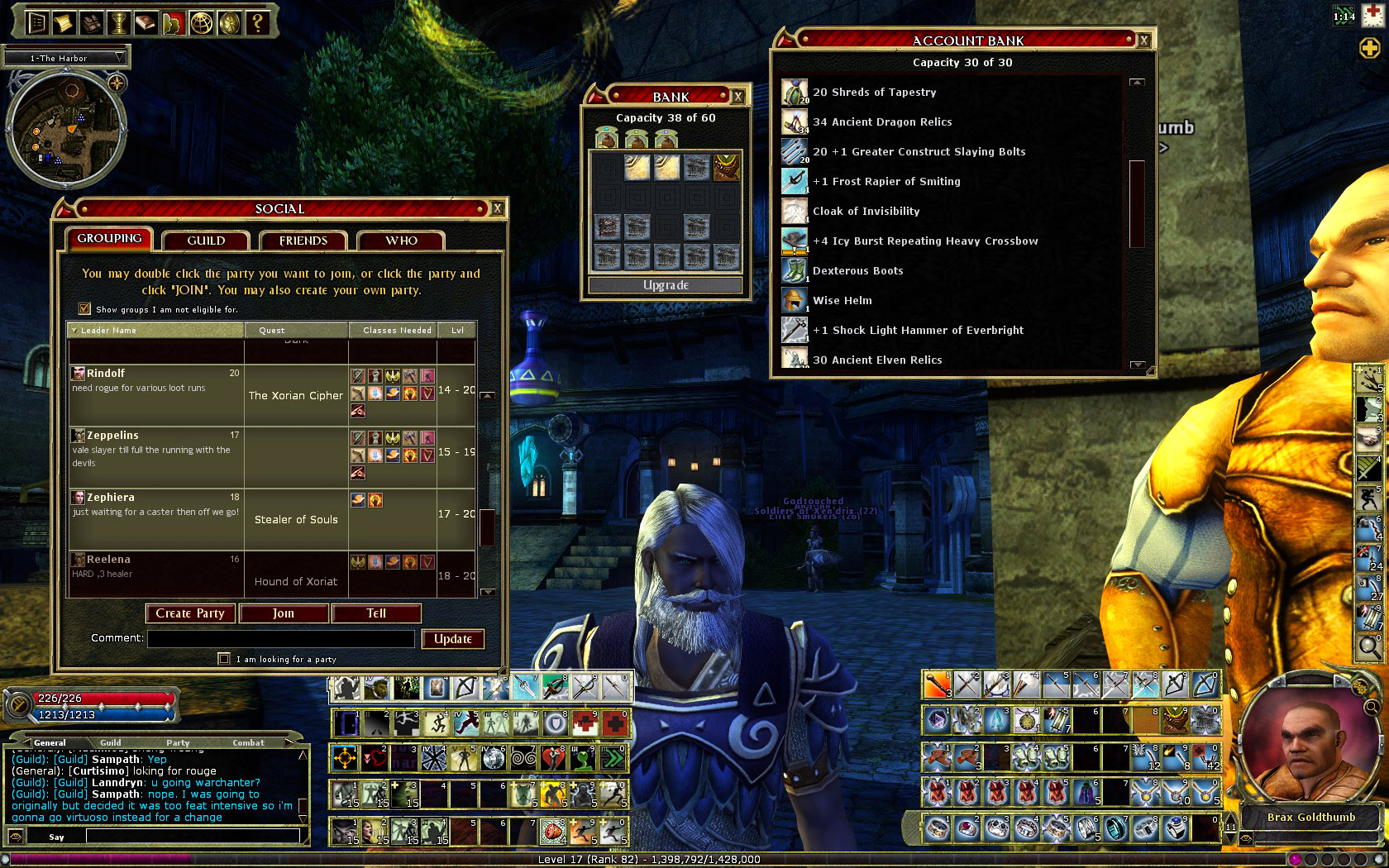
It is difficult, across many time zones and, with differing social and work obligations, to organise a solid, regular group to play with in an MMO. This means that most players wind up in PuGs (Pick-up Groups) which have come together through an LFM (Looking for men). This means, in effect, that one player puts up an advertisement on the game’s social panel designating the task at hand, be it a quest, series of quests, wilderness exploration, or a raid. The player specifies the level range for the characters, the types of classes they are looking for – tanks, healer, casters, ranged etc – the difficulty level and, ideally, some further information either to entice or discourage particular players.

These additional statements can often be rather abrupt, ranging from the negative “No noobs,” to the positive, “all welcome!” I perennially used the line “Team Players” and often included my own SNZ – “Strictly No Zergs.” Zergs, of course, being those who rush ahead, either spoiling everyone’s fun by killing everything first, or getting killed themselves and costing the rest of the group in experience points and the need for a rescue mission. Requests for players might also be very specific, such as: “Need Wizard with Ooze Puppet”, “Monk with high wisdom” or “Must have boots.” Some players prefer native speakers of a particular language, usually English or Chinese in my experience, whilst others prefer only to have players with microphones. Either way, a well-written advertisement can make a big difference in avoiding ambiguity and bringing in players quickly.
Any player who sees the advertisement can simply click on it to join the party, at which point a request will be sent to the group leader. It is then up to the party leader to decide whether or not they wish to have the person on board. The ideal party is one with a balance of classes, though the best balance may vary considerably with the nature of the quest. Most groups, however, require a healer and a couple of melee builds to take the heat, and many quests can be done without the added bonus of a rogue, caster or buffer.

Once a few players have joined, particularly if a healer has joined already, the ranks can fill very quickly. More experienced players will simply make directly for the location of the task, but some will require directions or even escort. A good group leader should always ask the new recruits a) if they can hear, read and understand his or her communications and b) whether or not they know where they need to go.

Often groups will undertake missions without a full party or will start before everyone is present. Depending on the difficulty of the mission, it might be possible even to solo it – if you know you can take the heat, head on in with a hireling. Yet most higher level quests on, for example, Elite difficulty level, will require a solid group with a dedicated healer, trap monkey, caster and some hardcore DPS.

Putting a good group together should be a simple enough task, but it often proves very difficult to get good help. All too often, despite several thousand people being logged in on the server, there are simply no healers available within the level range of the group. This shortage of healers was almost always the largest obstacle, though it could also be difficult to find a good wizard or sorcerer. Even rogues, who are usually plentiful, could be difficult to come by. This despite the fact that multi-class characters with a rogue “splash” – ie. one or more levels of rogue with trap skills maxed through cross-class skill allocation at levelling – could more often than not, if built correctly, handle all the traps anyway. Many quest runs can be significantly delayed whilst the group waits to fill, or waits for that important missing element. This is much less of a problem at low levels, where hirelings will suffice, but at high levels, the failure to attract a healer can lead to abandonment of the plan altogether.
One problem for me being in Australia was time-zoning. The quietest time on the servers, when marketplace instances could drop from 5 to 2 (a system for regulating overcrowding with large simultaneous server populations) were between 1800 and midnight. If I played between the hours of midnight and the middle of the afternoon, however, when America was awake, I had far less trouble. It was a commonplace to have people join the group who had just woken up. “Mornin’ y’all.”

Some players would begin playing very early. “It’s five thirty. Another cold morning here in Philly. Just got the wife off to work. Got a pot of steaming coffee and ready to roll.” Often the more friendly and talkative players would speak about where they were; the weather, the view, the temperature, the politics. It was always fascinating to hear amusing local anecdotes or to imagine the spaces these people inhabited. Players would also often have to vacate their seats in emergencies, such as when their dog did something crazy or a knock came at the door. This could be either amusing and team-building or highly annoying, depending on the nature and length of the interruption. Most of the time, fortunately, grouping was a positive experience; especially when players were professional, positive and relatively relaxed about things.
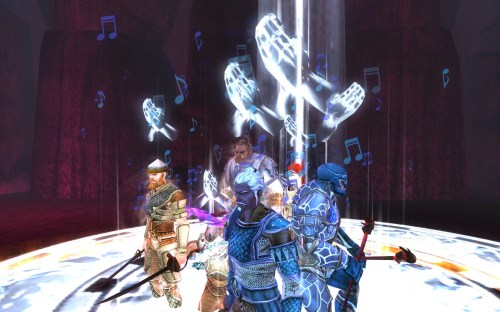
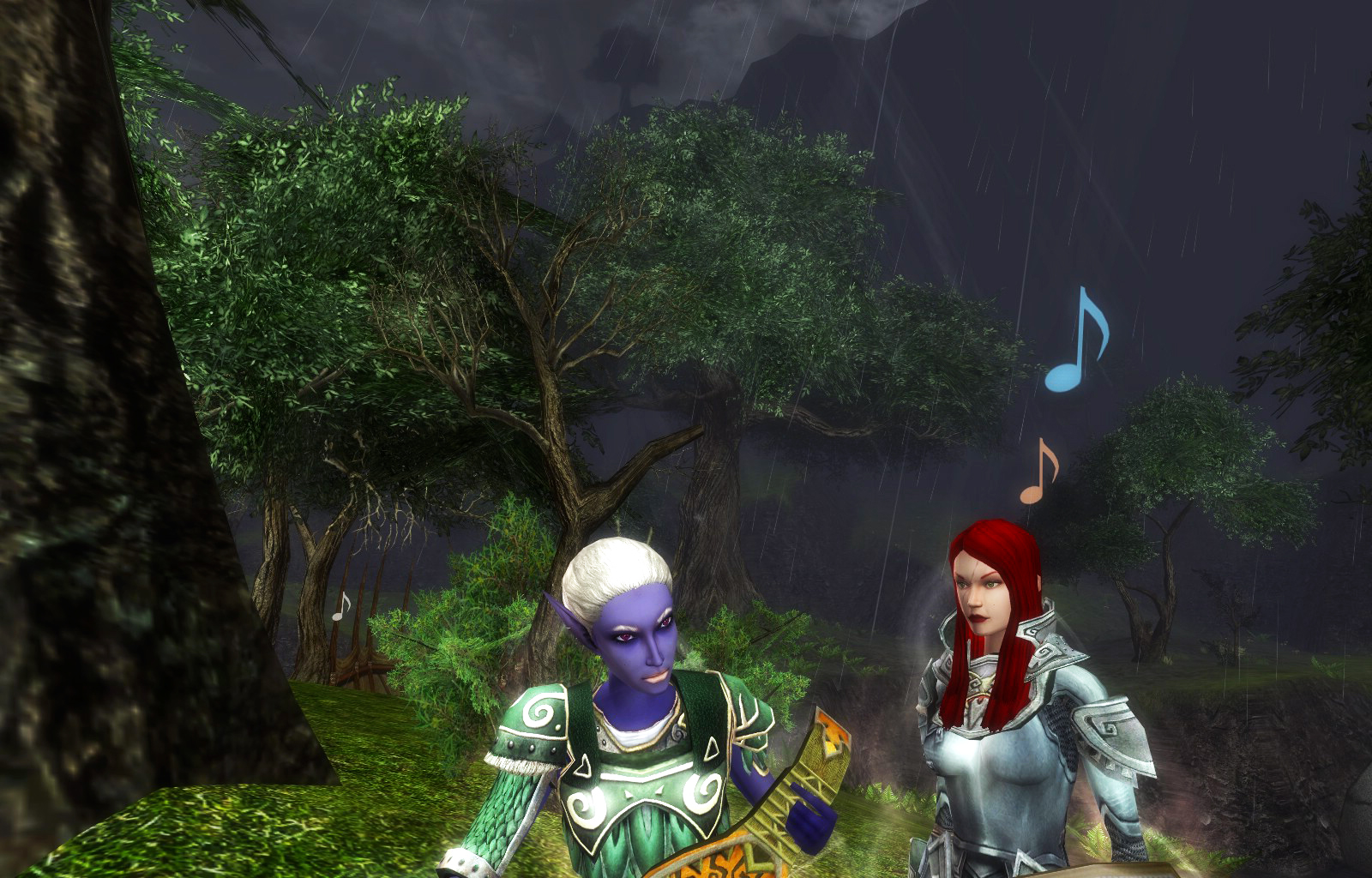
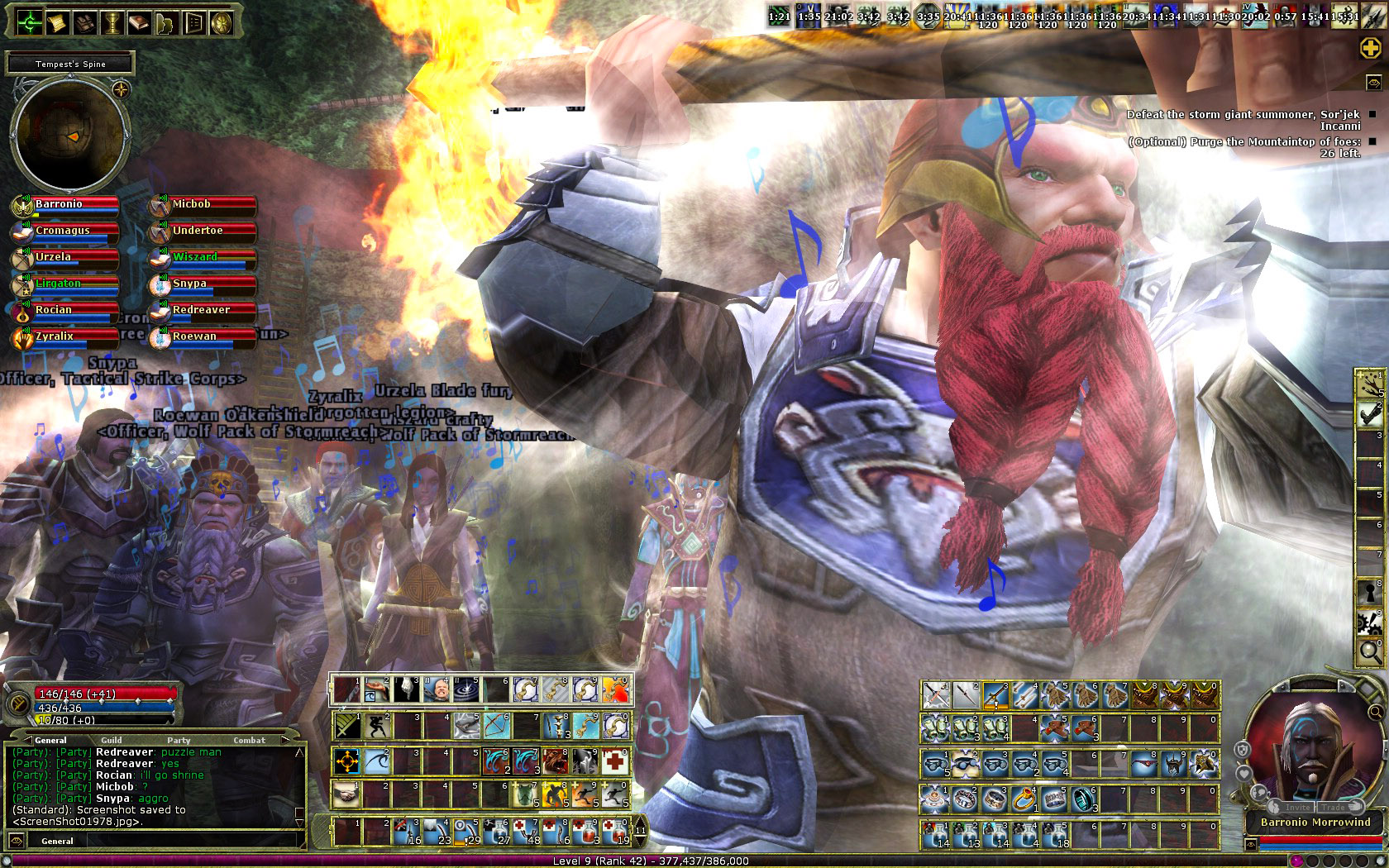
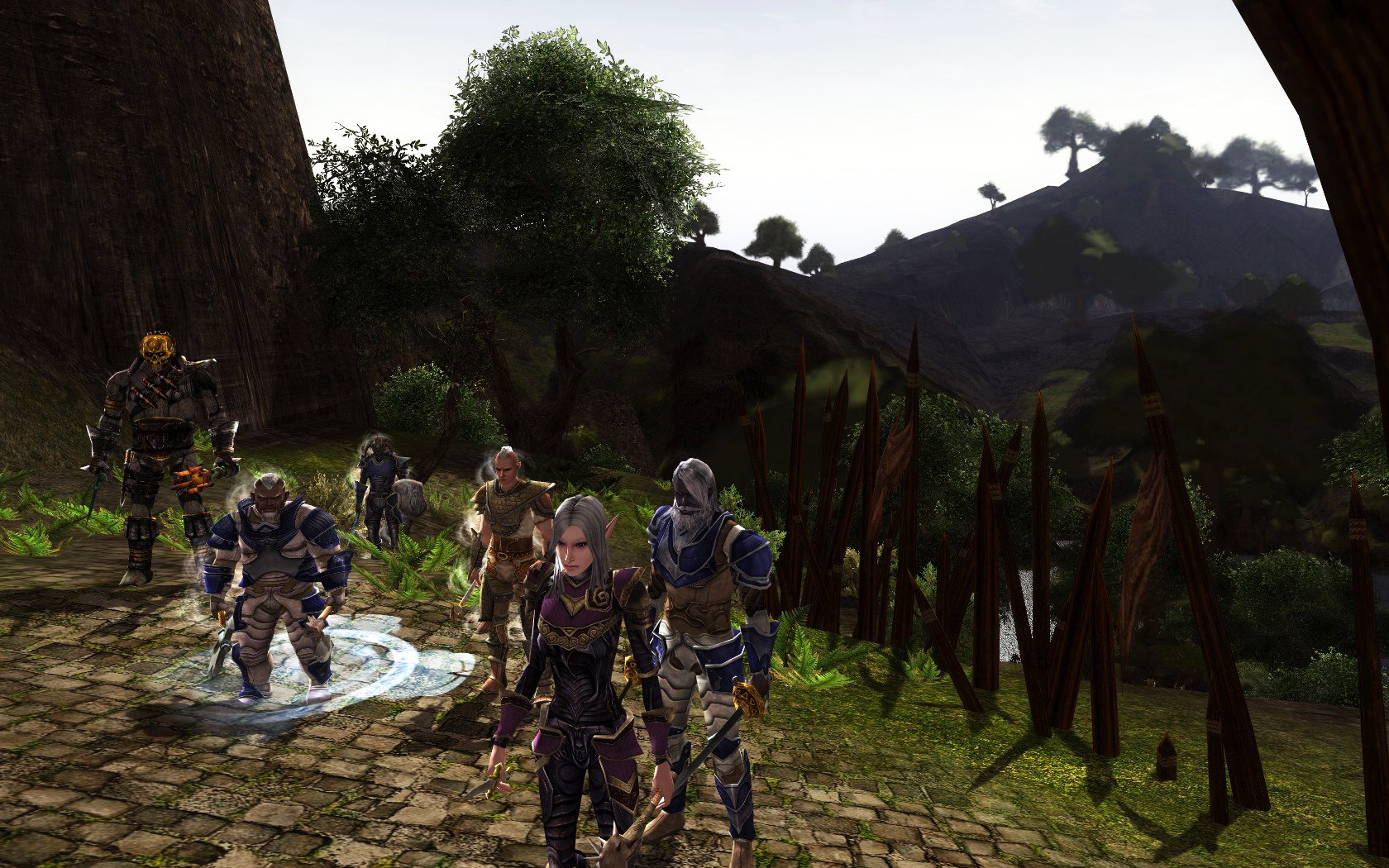
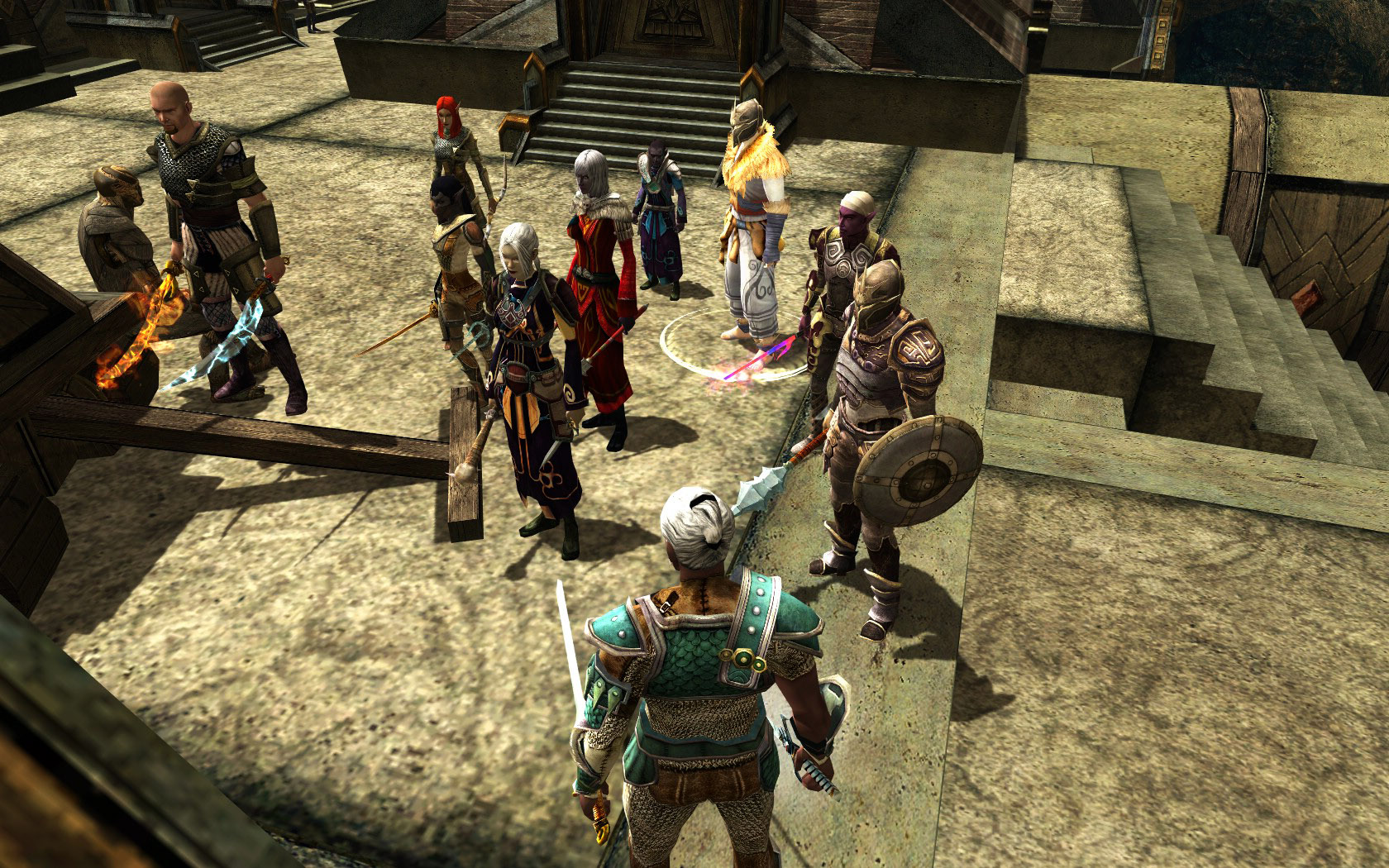
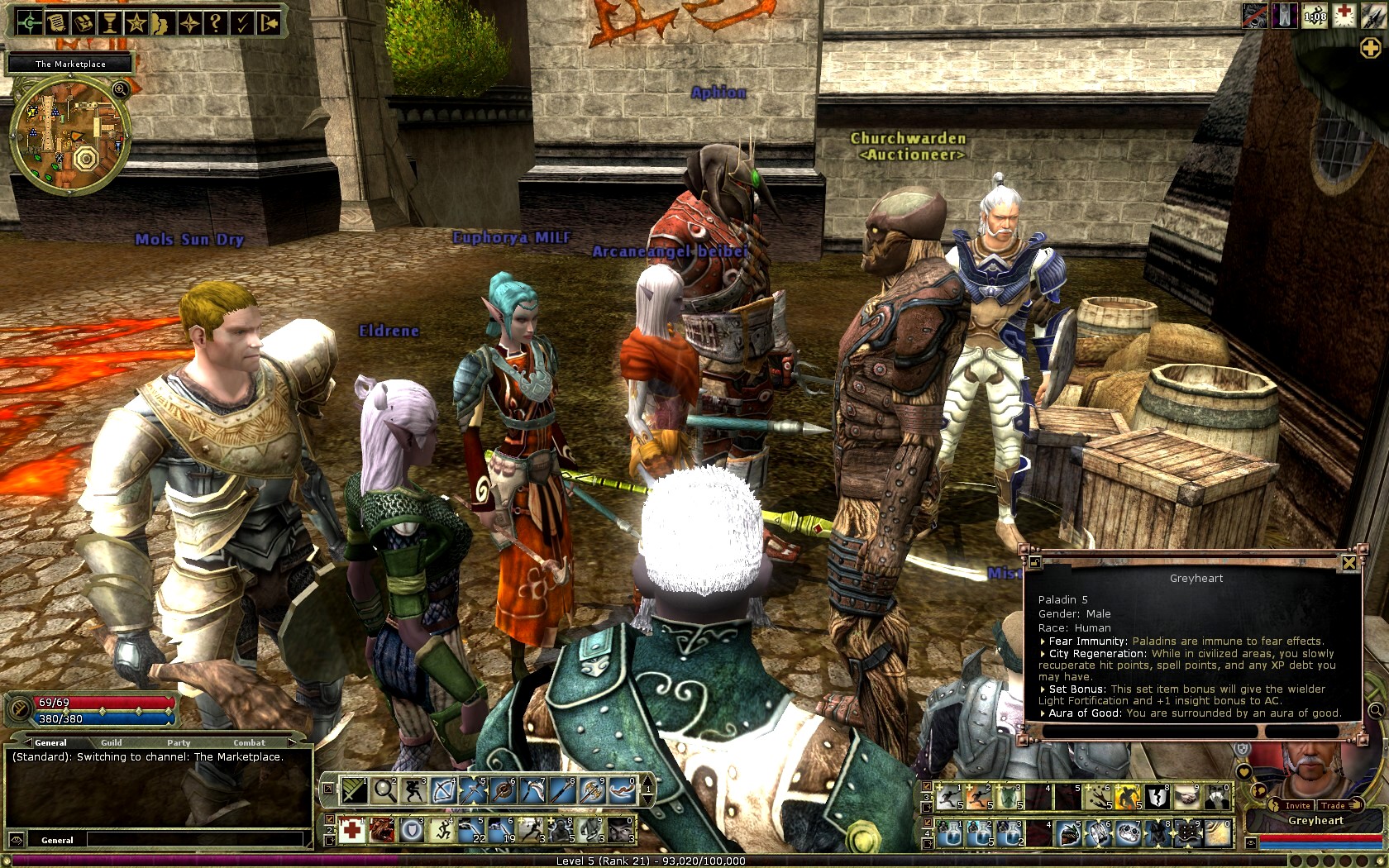
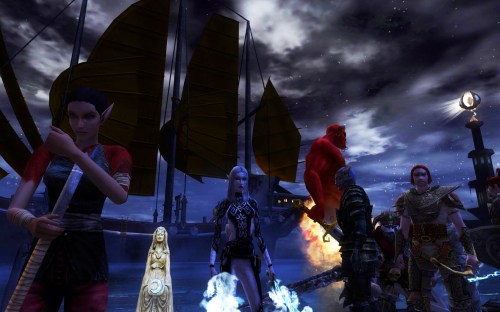
The above image shows Yardley “the Scissors” Bruce in a random group of not especially well-dressed adventurers, being buffed by the healer and bard. Buffs are, of course, positive spell effects, skill bonuses and the like, which can either effect individuals or the entire group. A well-buffed group, particularly where specific magic defences are required, can make for a far more polished run. Being faster and stronger, having increased immunity and durability, being harder to hit and hitting a hell of a lot harder usually makes life considerably easier. Yet, beyond this, it also brings the group together and creates camaraderie. Just as everyone loves a good healer, so everyone loves to be well-buffed just prior to commencing the run. It instils the players with confidence, provokes thanks all round, and has an effect not entirely unlike sharing a meal together.

Group play is what makes MMOs, but grouping is a real mixed bag and raid groups, where up to twelve people need to coordinate their actions, are ripe for catastrophe. Raids can be rather intimidating as they have an air of exclusivity about them. More experienced players are especially keen not to see a raid go pear-shaped, and the LFMs are often brutally honest about what is expected. Inevitably, there is a first time for everything, but carrying noobs is not the average raid-runner’s favourite hobby. With so many players in the same team and such potential for miscommunication and confusion, the main principle is to stay together; if you don’t know where to go, follow someone who looks like they do.
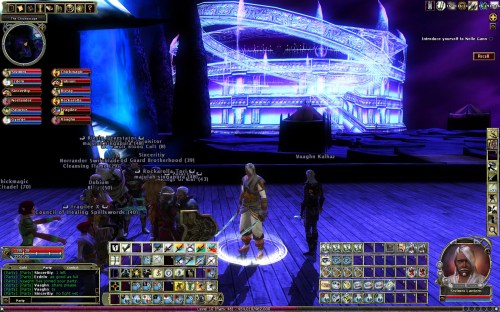
The best groups are those that communicate and the best means of communication is a headset and microphone. Many players don’t use them and many players have very limited or no English, so it isn’t always possible to communicate via speech, or even text. Some players will abuse the mike to converse continually and often rather tiresomely about whatever is on their mind or the minutiae of the game, which can be terribly immersion-breaking. Having said that, there was nothing quite like the amusing banter that could take place. I’ve had some uproariously funny conversations with people who were drunk, stoned or high on coke; people who were cool, intellectual, nerdy, hip; people from Spain, Israel, the UK, Brazil, China, Singapore, France, Canada, Korea… I ran several times with a comically stereotypical scotch-swilling Scotsman, who had the decency to play a dwarf barbarian and spoke with a gruff and bantering brogue, with US soldiers at their base at Guam, with bored English housewives, with pot-smoking US college students, with Greek travel agents, a female Turkish IT student. The game could be quite fantastically social.
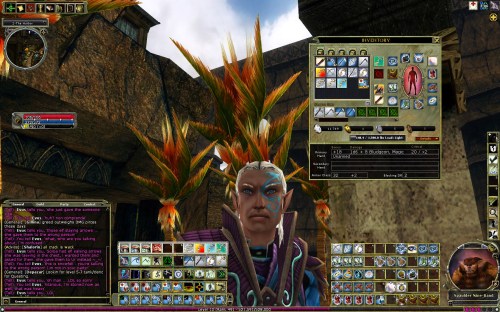
On the whole, however, people having and using microphones is a positive thing, especially where the other players are intelligent and know what they are doing.

A good leader will take control of the group and ensure that everyone works together; giving directions, delegating tasks, ensuring all players are accounted for and, occasionally disciplining those who are causing problems. A good leader will see new players as an opportunity to teach, and not as a burden on the group, especially where they are playing a trickier class, such as a rogue, healer or caster. Ideally, however, most people will know their role and how to make the most of their abilities. There is nothing quite like seeing how effectively a completely random group of people can perform together.

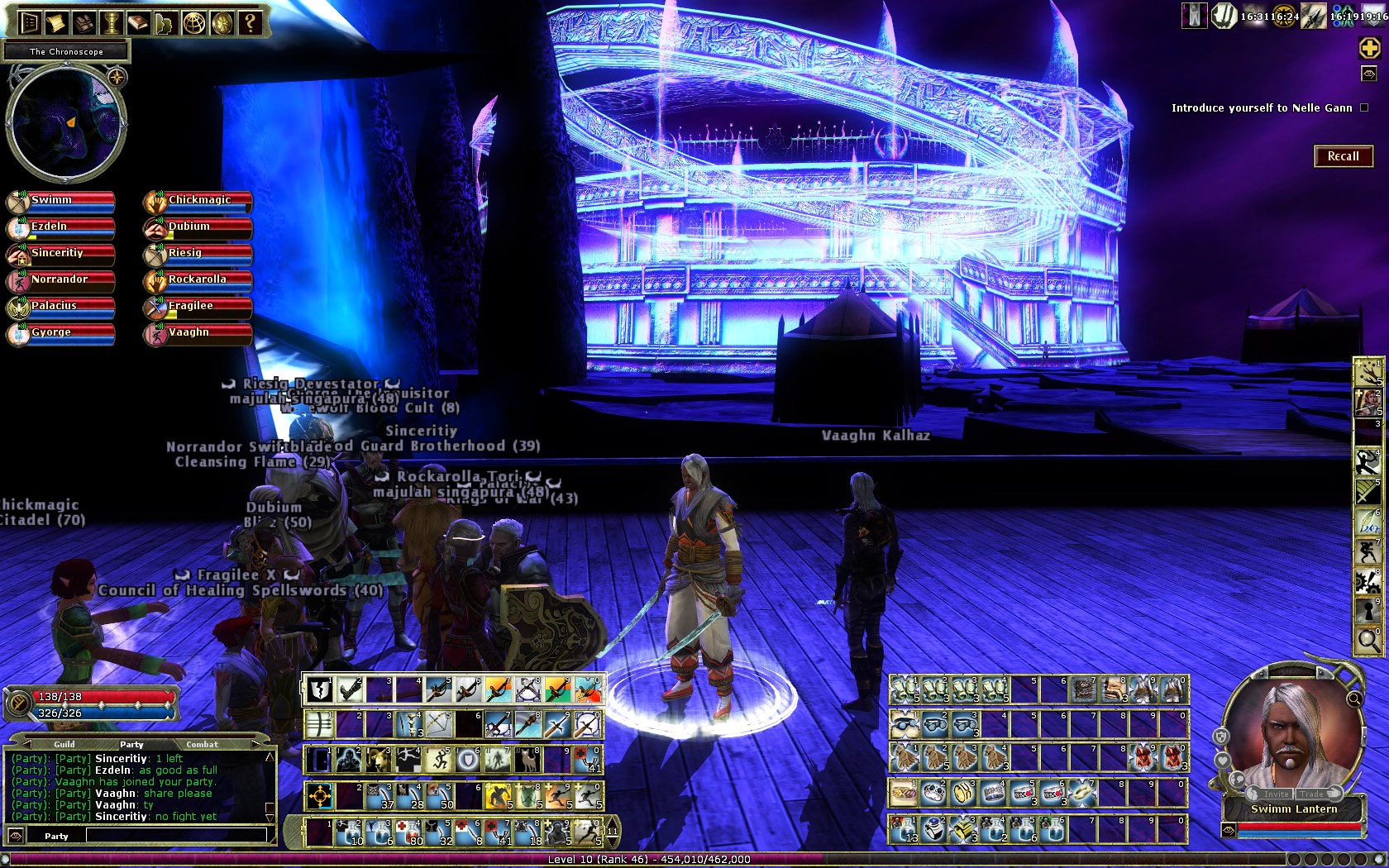
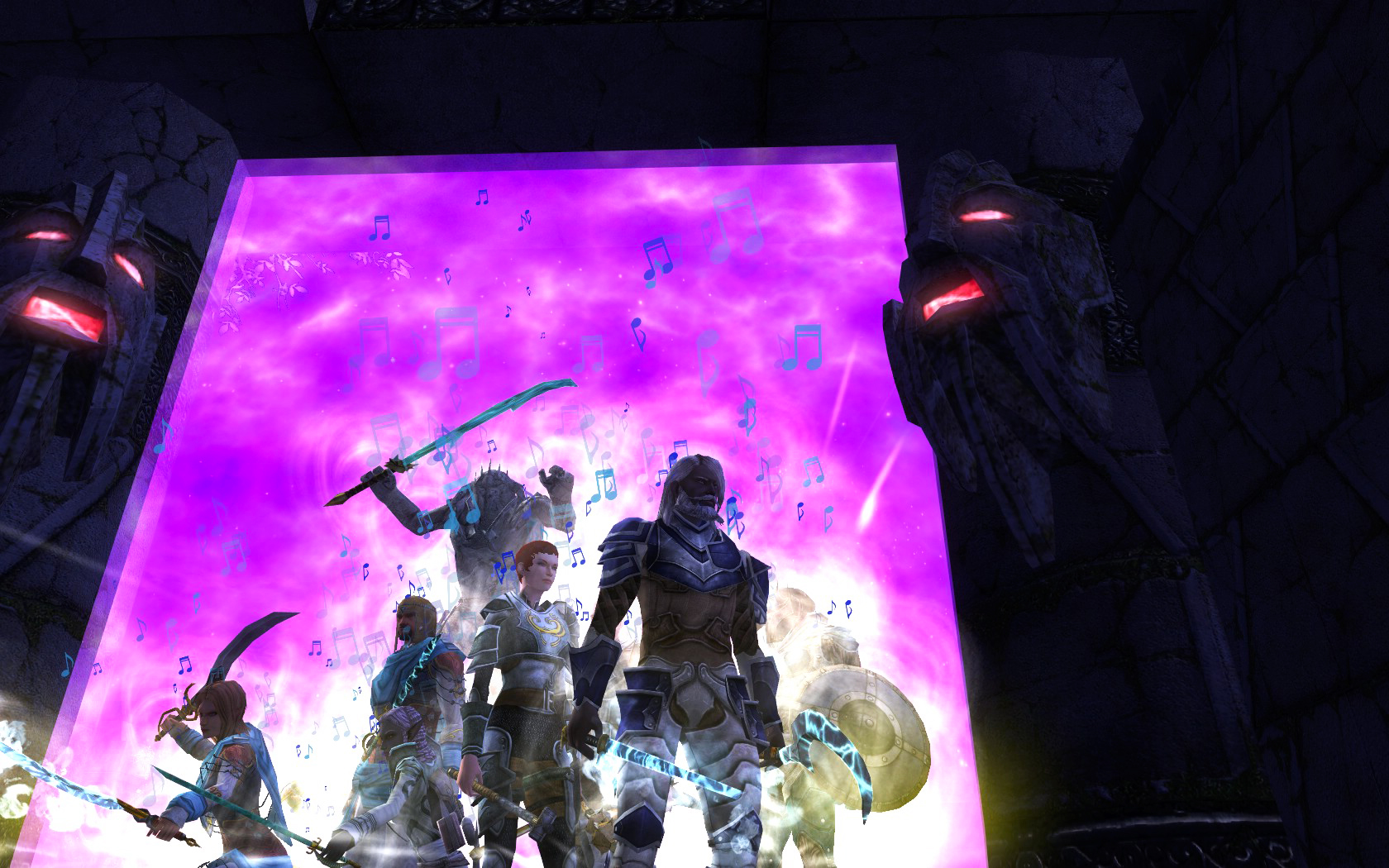
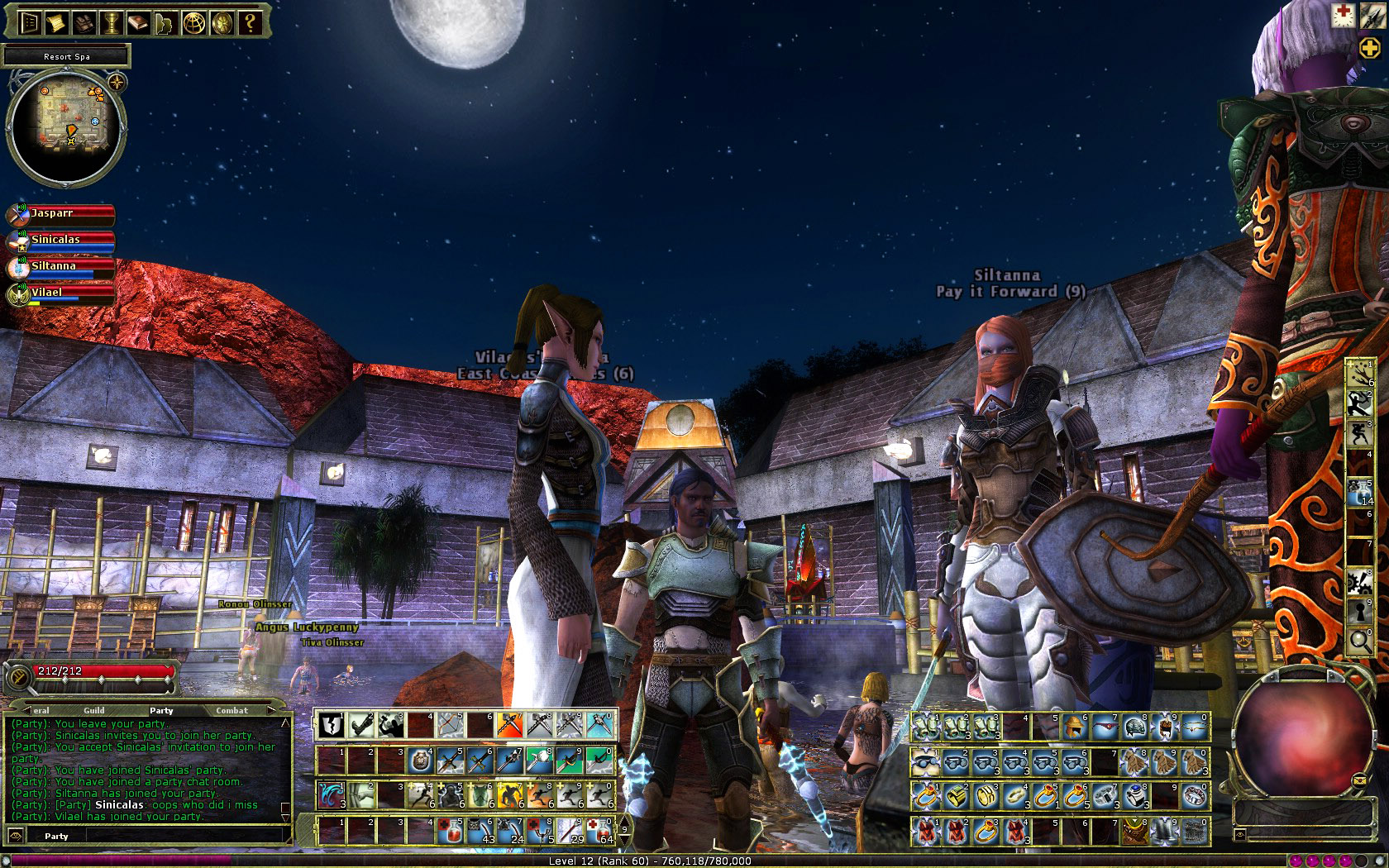
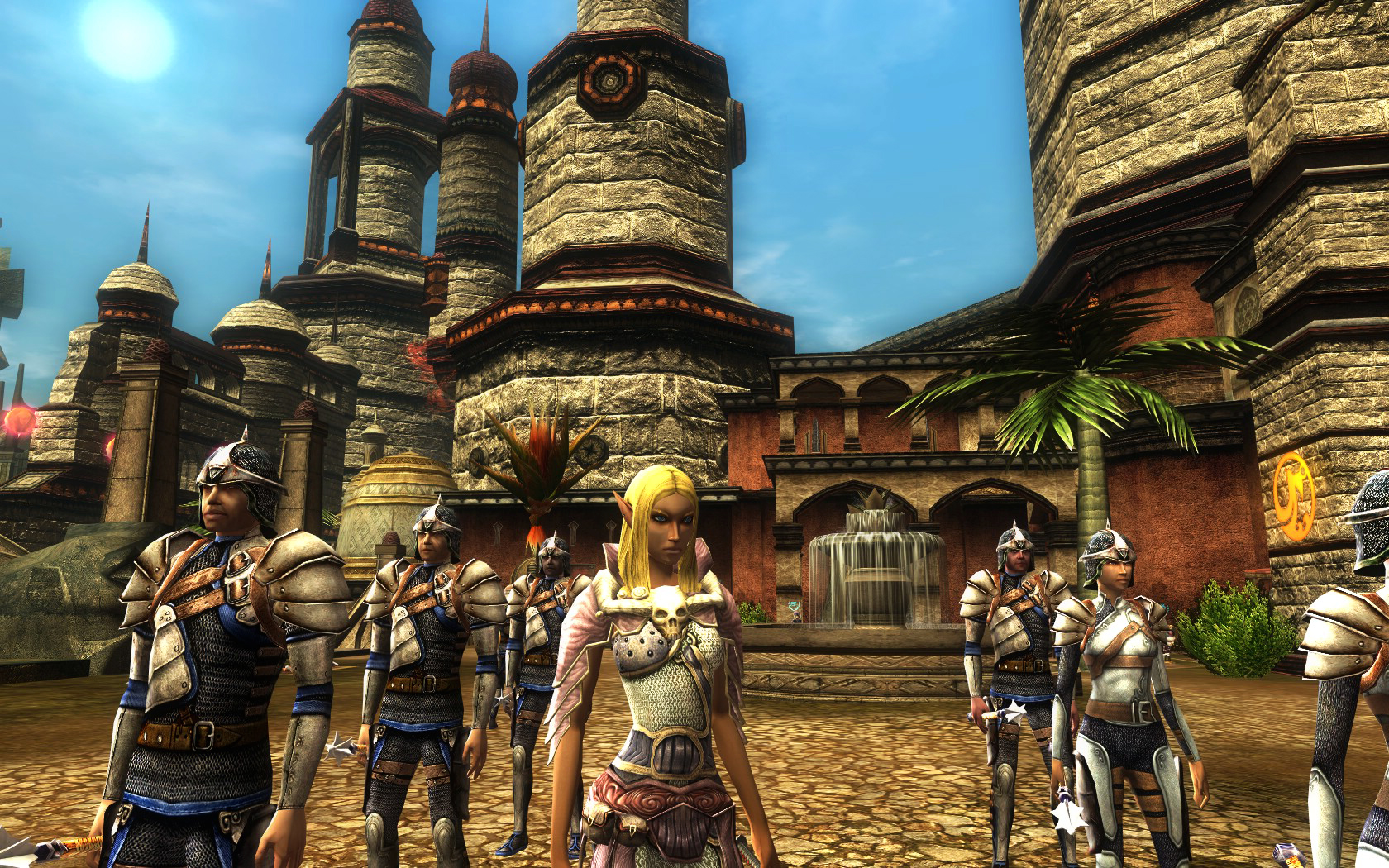
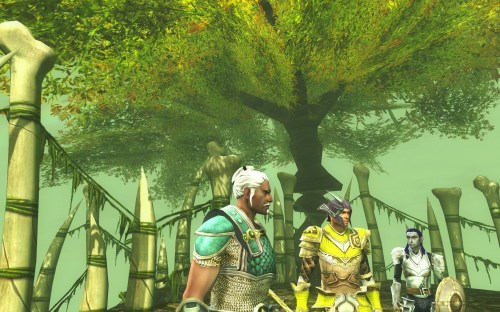
Take a look at the above picture. Each of these individuals is a human player, sitting in front of a computer, somewhere in the world. If I remember correctly, this group contained players from Korea, the US, China, Brazil and myself, from Australia. I’m the chap with the long fringe, white moustache and beard on the far right of the group – Hallifax Bender, after his custom hairdo. We are in the Vale of Twilight, a high-level wilderness area with a bunch of high-level quests scattered around its geography. To enter the area, players must be at least level 12, though entering at that level, without back-up or some serious equipment would be suicide.
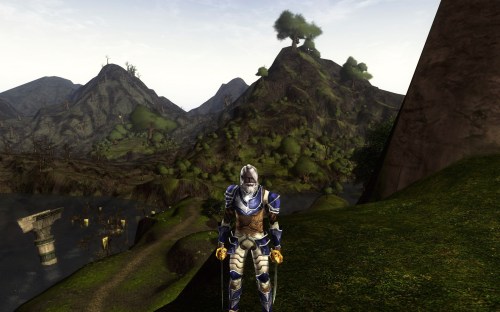
This group consists of players between level 15 and 18, which, because of the relatively slow levelling in DDO, means all have put in a considerable amount of playing time to get here. Each of these players will be very attached to their “toon”. They have played this character for potentially hundreds of hours, not only developing their build, so far as path of advancement is concerned, but also choosing equipment they felt was in some way characteristic of their personality. Some players can be very vain about the armour they wear and the weapons they wield, along with other, more permanent details such as hair style and colour, facial features, skin tone and, at a most fundamental level, chosen sex or race.

One of the joys of grouping is simply seeing who turns up. Often players will make their presence known from the start; talking or typing a lot. Often players will become apparent through their actions; be it hammering away in the front line, healing or casting to great effect. Occasionally a player can remain relatively unnoticed in a group before suddenly coming to the fore in a moment of need, or after the departure of another character of similar class who was so good as to leave them in the shadow. It can also take some players time to warm up and get into their role. It can take players time to get comfortable with the group, to know that they can voice their questions or opinions in comfort. Often when a party leader quits and logs out, the remnants of the group will stay together; making decisions in a practical, democratic fashion, electing a leader, and getting new personnel. I often had the pleasure of stepping into the role of leader; coming from the backline to the front, taking the star and calling the shots. As in real life, people appreciate good leadership, especially where one leads by example.
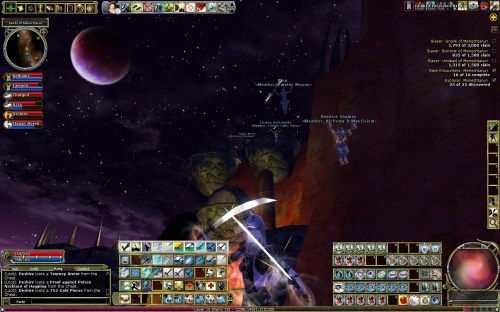
Most non-English speaking players will have sufficient English to type and can give or follow instructions without too much trouble, but there are always those who are unable to communicate in the language at all. One can only hope that they know what to do, or at least have the good sense to follow others. I have run often in completely Chinese groups, with the players speaking Mandarin to each other. It was always very interesting and presented an extra level of challenge, wherein the pressure was on to perform well and stay with the group. Often I found myself playing more sharply than ever in such situations, channelling the panic into a whirlwind performance.

Having teamed up with a bunch of strangers, having gathered together for a common purpose, having greeted each other, having shared a little conversation, there is the moment when the avatars come together for the first time. This is always interesting – to see the style, dress and build of each group member. Often players spend a little while admiring each other. “Hey man, nice armour”; “What’s that helmet, it’s cool?”; “Is that Sparkstriker you’re wielding? Nice.” When waiting, the more expressive players will use emotes to show their frame of mind throught their avatar: Dance, sit, sleep, laugh, cry, taunt, flex, threaten, wave and the like. As surnames are only displayed above the avatar itself and thus visible when characters are within sight or in the viewing window when selected, on coming together, players will also admire each other’s names where applicable.
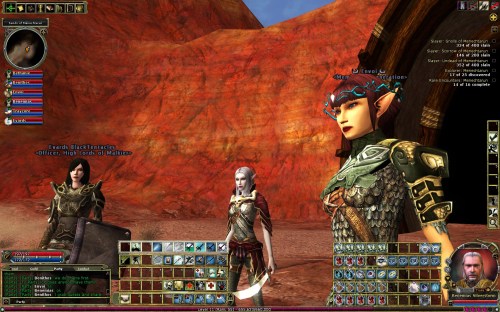
When a good group comes together, across different nations, continents and time-zones and every player is free to stay a while, it’s possible to run with the same team for positively hours on end. I made many strong in-game friendships with players with whom I’d been to hell and back. Six, seven, eight, nine hour sessions through long quest chains, raids, wilderness runs etc. It can be very sad when someone leaves after being in the party for several hours. So immersed can one become in the group dynamic that the absence of a character is as recognisable as the absence of a person. Of course, the only response is immediately to recruit someone else and hope that whoever answers the advertisement, wherever they might be, will also be a good player and a decent person.
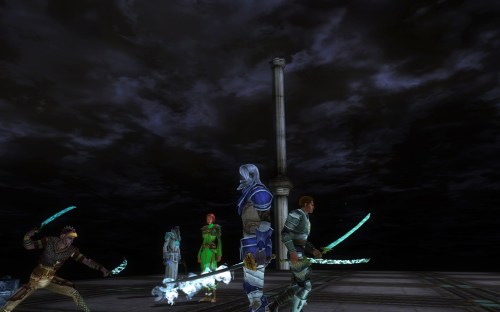
The greatest pleasure of grouping, however, is actually performing well as a group and as an individual. Good players will appear, in the game, quite literally as heroes. In tough fights, good tanks will take and handle the aggro, good healers will be quick with their remedial spells, DPS characters will slay their enemies in lightning swift, often astonishing fashion, and casters and crowd-controllers will slay, disable, disorient, stun, freeze, charm, fascinate, burn and disintegrate their enemies.
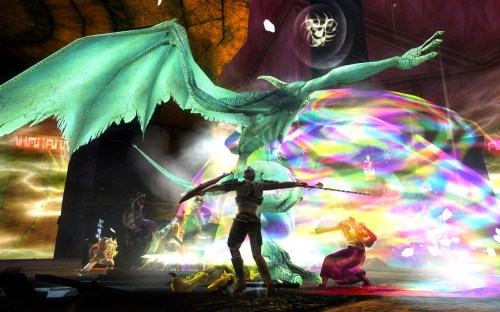
Saving the lives of other characters through quick and skilful action is one of the great joys of the game. The camaraderie that comes from a timely rescue is a wonderful thing: save someone’s skin and they will warm to you; heal someone well and they will love you; crush your enemies and see them driven before you and you will earn immense respect. I’ve often been in both situations, standing over incapacitated companions, swinging like crazy and slaying everything that came at me, or lying on the ground, my avatar unconscious, watching the blinding skill of a party member as they took the heat and dispatched our opponents.

Dungeons and Dragons Online has a dynamic combat system, where each weapon has a reach and one strikes by clicking mouse-buttons, aiming at one’s opponents. This is far superior to combat in many other MMOs where a target is selected and the attack is automatically directed at them, often repeatedly, within the timeframe of cooldowns, so that a player is not required to steer their weapons into their enemies.
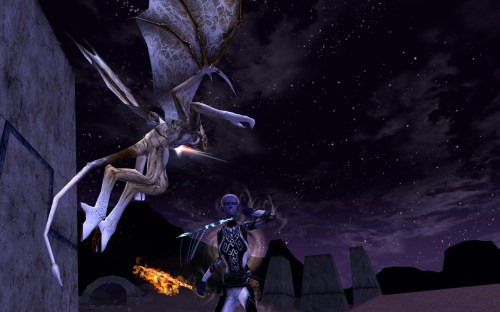
Thus, DDO is hard work – combat is exhausting as one is forced constantly to manoeuvre in battle, select opponents, and actually swing one’s weapon into them. The speed with which a player does this is paramount, as is the effectiveness of the attacks that they direct. With so many hours of practice, having rather deft fingers from 20 years of speed touch typing, and being something of a maestro on a mouse, I was often able to move and attack quite considerably faster than other players. Yet, of course, there were countless other players with both awesome skill and superior equipment and running with them was a pleasurable challenge. Good players will recognise other good players and often strong bonds can develop through this mutual respect. From the point of view of the game, it is the avatar, the embodiment of the player, one sees and respects.

It is always nice to receive compliments. The best compliment I ever received in game was simply “wow”. It was Jasparr Krait of Luskan, Fighter / Ranger / Rogue, my favourite hit-man, a dual-wielding heavy pick kensai, whose speciality was making straight for the casters, stunning them with a blow and taking them down with devastating critical hits as they stood immobilised with their heads ringing.

Whenever I played Jasparr, I felt immensely capable and regularly proved my worth by massively outstripping the rest of the group on the kill count.  After having played the game for as long as I had, I grew very bored with the rather unimpressive soundtrack provided by the game, and so I created my own. I put together a lengthy playlist on iTunes called Fantasy Backdrop, which I piped through my headphones in place of the in-game music. Mostly the soundtrack consisted of classical music, film soundtracks, such as Crouching Tiger, Hidden Dragon or House of Flying Daggers, or other fantasy games such as Baldur’s Gate, Morrowind, and Oblivion, but I also threw in a few songs which seemed appropriate to certain characters, such as Hells Bells by ACDC and The Hitman, by Queen. It was this song that was to become the signature tune of Jasparr Krait:

http://bit.ly/12MNgt

Grouping was by no means always a satisfying experience, and proved, on many occasions, to be more frustrating than it was worth. As with all internet forums and MMOs there are always trolls out there who seek to cause annoyance to other people or pick fights at the drop of a hat – just read the comments under any Youtube video. Fortunately there are not that many trolls in DDO, but they come in many shapes and sizes. Some simply step inside quests, do nothing and sit in the entrance to leech experience points. Others actively sabotage groups because they have developed some impossible to determine grudge against one of the other players for no apparent reason. Some take exception to every simple error or slight by another player and make life difficult for everyone by being unnecessarily rude about it. Others completely fail to follow instructions, can’t wait to open chests and kill half the party by setting off traps, despite clear warnings. Sure, people make mistakes, but all too often players are just plain stupid and either overestimate their ability or simply ignore advice and directions.
The very worst character I ever had the misfortune of grouping with had the awful and alarm-ringing name of Aussiegem Downunder. I shuddered to think what sort of fool would produce such a character, yet, in need of a cleric to furnish the group with heals, I accepted her request to join my group. We were running the second series of Necropolis quests and this character joined as we were entering a flooded tomb. The quest involves a lot of swimming, and some form of Underwater Action item, a Waterbreathing spell or skilful swimming between air pockets is required. I made sure that everyone in the group knew what was required through both text and spoken word.
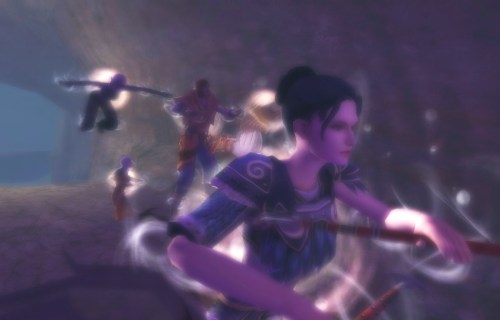
Despite this loud and clear message, as we swam through the first stretch of water, Aussiegem suddenly began to lose hit points, and then, as from nowhere, “Ping!” she was dead.

“What happened?” I asked, surprised and disappointed as her death had just cost us 10% of the experience reward. I got no response and typed the message. “What happened?” Other players simply placed “?”s in the party chat.

Aussiegem took a while to respond, but when she did, it wasn’t especially helpful. “I think I drowned.”

By this time I had already swum back and collected her soul-stone. We had no means of raising her from the dead, as she was, after all, the cleric, so I carried the stone along with me, en-route to the shrine, which was some way off. In the meantime, I asked if she had some form of Waterbreathing item or spell. I also encouraged her, as a cleric, to take the spell if she needed it when she rested at the next shrine.

Sadly, however, she didn’t seem willing to take any of this advice, and after having used the resurrection shrine and come back to life, she promptly drowned again in the next stretch of water. I couldn’t quite believe it, and was annoyed already, because in truth I could have solo’ed the quest with Jasparr and only brought other people for the rest of the series.
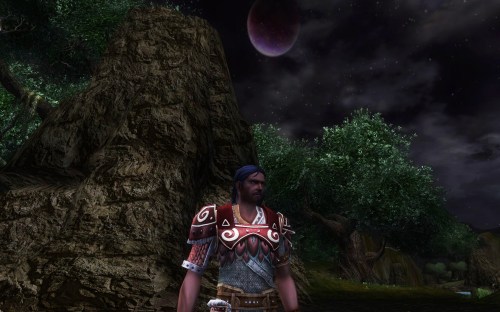
I took her back to the shrine once more.

“What happened?” I asked. This time she replied more promptly.

“I’m only playing with one arm. I got stuck.”

Oh dear, I thought, an amputee! Poor girl, must have an impossible time navigating with just the keyboard. How does she do it? I’d best go easy on her then.

The next time we swam, I stuck with her and led her to the next chamber. This time she made it, and, after the fight, there was a chest to loot. Aussiegem, to whom I now felt some slightly restored sense of sympathy, got her loot and, hey presto – she found a Ring of Underwater Action! This was quite a rare drop and, as the rest of the group can see what drops for other players from a chest, I suggested, both in speaking and in text, that she put it on immediately as it would enable her to stay underwater as long as she liked. There was no response in the party chat and I feared the worst. I retyped the message and re-iterated it over the mike, but still got no response.

Off we went again, into the next stretch of water, when suddenly, “Ping!” she drowned again.

This time I was really pissed off. No one, however much of a noob, who was a native English speaker and perfectly capable of receiving my written and spoken commands, should be capable of such a total and utter balls up.

“What the hell happened?”

“I think I drowned again,” she typed.

No shit Sherlock. “But why didn’t you put the ring on?”

“What ring?”

“The underwater action ring. You looted it from the chest two minutes ago. I told you about it. We all told you about it. Check the text.”

There was another long pause, then, after two minutes she wrote:

“I’m playing with one hand, I’ve got me baby on me lap.”

I believe I deserve some credit for the restraint I showed at this point. I was not only hugely annoyed, but also disappointed because female gamers were few and far between and most of them were excellent. Aussiegem was giving them a bad name.

“OK,” I typed in response. “Stay dead, I don’t need you. If you can’t be bothered playing the game properly, especially when playing a class that requires you to be on the ball, don’t burden groups with your half-arsed, non-existent efforts. I’m booting you as soon as this quest is done, and if you can’t work out why, it’s your own problem.”

Sure enough, I left her for dead and didn’t bother taking her back to the shrine. She still got the end reward at completion, but I wasn’t about to escort her to the chests. I booted her after completion and swore never to group with her again. When, some weeks later, I was running Jasparr out in Gianthold in another chap’s group, she joined and my heart sank. I hoped to goodness that in the weeks that had passed something might have changed, but when she died twice reaching the quest entrance, I knew we were in for a similar ride. I panicked, made an excuse, apologised to the group leader without saying a word and quit the party.

Read Full Post »
“The meek shall inherit absolutely nothing at all, if you stopped being so feeble you could have so much more.” – Pulp, The Day after the Revolution


Clearly there was something wrong with me. I was hooked on a Massively Multiplayer Online Role-playing Game (MMO), had been playing it for almost nine months, and not once, since I first signed up, had I teamed up with other players. You may wonder why anyone would solo a game that is optimised for group play, but then you’d be failing to take into account my somewhat shy nature when it comes to approaching strangers.

It wasn’t entirely true that I had never played in a group. I had briefly recruited my friend Steven to play with me for a week when I first signed up, but after his departure, I avoided grouping with any other players. It was unfortunate because, apart from the fact that it was extremely difficult to advance without grouping, as most mid to high-level quests were sufficiently challenging to require more than one player, I was also missing out on a hell of a lot of fun.

My reluctance to group was especially odd because, on the rare occasions I’d done it in other games, I’d thoroughly enjoyed it. Admittedly, however, this was not generally with strangers. At the end of 2005, before I left Sydney for Cambridge for the second time, I’d spent a good few nights staying over at my old buddy Mike’s new house. He hooked up two computers and we played some long, heavy sessions of Neverwinter Nights. It was an awesome gaming experience, for we were playing a very excellent series of modules written by a community member and posted free to www.nwvault.com called The Aeiland Saga. The game combined the very best elements of a good story, excellent challenge, exciting locations and plentiful surprises. Mike and I were enthralled to say the least, though I likely more so than he, and when it was over, I was gutted.

I also managed to get my brother on board and we too played some Neverwinter Nights modules before my departure. Firstly over a LAN connection at our folks’ place and then via the internet. Once I was back in England, we linked-up through the multiplayer server and teed-up times to play together; me lying on a double bed in my house in Sturton Street, early in the morning, and he at his desk in the spare room of his house in Brisbane, late at night. I was, of course, playing none other than Hallifax Bender, my favourite altar-ego.

I had also experienced playing in groups in World of Warcraft and this had been a largely positive experience. I’d been impressed by the willingness of completely random strangers to offer help and support, and to go out of their way to assist with something from which they had nothing to gain. Still, my group-play experiences were limited and, when I signed up to Dungeons & Dragons Online (DDO), I, in my stupidity, spent nearly nine months playing the game solo.

As a consequence of this, I’d reached an impasse. I had several characters on the Sarlona server, but none of them had advanced very far. I had managed, through many hours of blood, sweat and tears, to get Hallifax Bender to level 8 and several other characters, such as Tollande Rollmops, Bethanie Brinsett, Summer Thingis, Hondeydrop Sundew, Badajon Yarnspinner and Arnalde Holdfast to around level 5. It was, however, difficult to go much further as there were few quests in my level range that I could complete solo. What I had managed to do, however, was master the workings of the local economy, and, through the harvest and sale of collectables, my toons, despite their inadequacies, were loaded with gold pieces.

There came, at this time, a very significant update to the game which made a lot of important structural changes and introduced new features. Most prominent amongst these was a decrease in the penalty for characters of higher level completing lower-level quests, some important graphical tweaks, and the introduction of hirelings. Again, just at a point where my interest in the game was flagging, when I was spending most of my time simply buying and selling things on the auction house to make virtual money, these changes brought me right back into the game with renewed enthusiasm. The introduction of hirelings was a godsend. Hirelings could be purchased for a relatively small sum from vendors around the city of Stormreach and they gave a player the opportunity to, for example, have a cleric in the group who would heal automatically, thus freeing up the player to focus on combat. They could also be commanded via a hotbar that allowed the player to cast the hireling’s spells or use their abilities directly.

For someone in my position, who had played the game for so long as a solo-artist, having to perform all my own tasks and make continuous tactical withdrawals from combat to heal myself, this was a huge blessing. Now, with a cleric hireling in tow, healing my sorry ass every time I got hit, I found I could make much faster progress. The problem was that this still only really allowed me to take on quests at a low difficulty level and usually below my character level; partly because of the considerably greater difficulty of many mid-level quests, their length and complexity, but also because I was running toons I’d made a long time back who were not especially well thought-out.

What hirelings also did for me was to open my eyes to the far greater potential for completing quests with back-up. Within the space of a week, using hirelings had become not so much a norm as a necessity, and, though frustrated by their occasionally dodgy pathfinding and response times and restricted to one hireling per character, I began to ponder how much better a real human would be at providing such services; indeed, how much better it would be with a full-time rogue, another tank or melee build, a caster, an archer and a buffer, for example. Slowly, like the long thaw at the end of an ice-age, it was beginning to dawn on me that I should re-examine my seemingly baseless embargo on grouping. It was time to harden the fuck up, and I went out and bought a new top-shelf wireless headset. I was resolved that, the next time someone invited me to join their group, I would accept the offer.

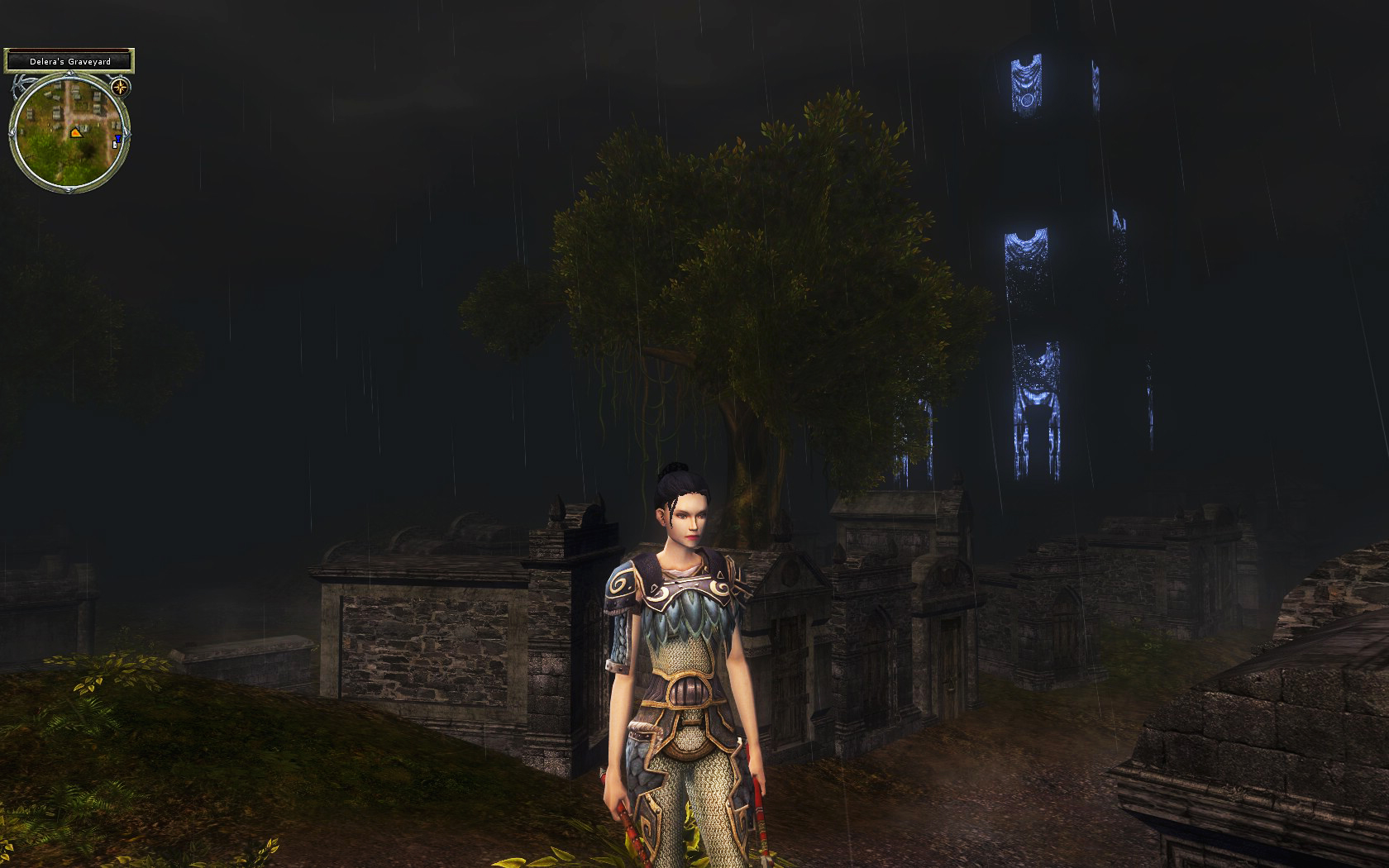
It wasn’t long before I received a cry for help. A level 16 wizard called Kalsto, who was running quests on Elite difficulty for favour – ie. the cumulative reputation from quest completion which brings in-game rewards and privileges – needed someone to pull a lever for him in part 2 of the Delera’s Tomb quest chain. There were many quests that could not be completed solo because they required different characters being in different places simultaneously and, despite the fact that hirelings could now be utilised to perform such tasks, it seems this chap was fixed in his belief that the only way around this problem was to use a human player. Thus far my experience of the Delera’s Tomb quests was entering part 1 with Hallifax Bender and getting shredded by a spectre before I made it past the first major obstacle. What had impressed me, despite the rather relentlessly bland interior of this poor dead girl’s tomb, was that the Dungeon Master’s narration was done by none other than E. Gary Gygax, the father of Dungeons & Dragons. There was even a memorial shrine to him built just around the corner in Delera’s very large graveyard, added to the game after his death (Raise Dead spell pending, we hope). Not knowing the quest at all, I felt reluctant to join with this chap as I didn’t want to screw things up for him. When I explained this, however, he assured me it was all good and that he would tell me what to do. Thankfully, he was noob-friendly!

So it was that Badajon Yarnspinner, my 6th-level Bard / Rogue / Barbarian, found himself standing inside Delera’s tomb with a master of the arcane arts. At level 16, Kalsto would receive no experience for the quests whatsoever, despite them being on elite difficulty. I too would receive nothing other than favour, on account of Kalsto’s level and the fact that I was being power-levelled, as the game called it, because I was grouped with a player four levels or more higher than myself. Kalsto buffed me in a way I’d never been buffed before: Blur, Stoneskin, Haste, Displacement, Jump, Protection from Evil and all manner of elemental resistances, and my job was simply to stay alive and keep up whilst he torched all the undead with maximised, extended Firewall spells.

I followed in his wake, marvelling at how rapidly all the spectres, wights, ghouls, ghasts, skeletons and wraiths died in his walls of fire. Kalsto would simply dance around the undead, practically untouchable behind all his buffs, luring them all into the flames. It was an awesome display of power, and we quite literally ran through each area, often simply ignoring half the trash that was not of a mind to follow us. What really got me excited, however, was that, by virtue of these quests being run on elite, all the chests were dropping far better loot than I was used to and I quickly saw that if I should stick it out, I might get a nice piece of equipment or two.

When it came to my turn to pull the lever, however, I quickly ran into trouble. Kalsto stood by the iron gate he needed to access, whilst I stood across the way in an alcove next to a large metal lever. I pulled the lever and, suddenly, a bunch of skeletons spawned and attacked me. I tried desperately to pull the lever a second and then third time, as I had been instructed, for Kalsto had to progress through a series of gates, and just managed to do so before the undead swamped me. I put up my shield and defended as best as I could, determined not to die and suffer the shame and embarrassment. I hammered and pummelled with everything I had, but I was getting smashed to bits and was forced to flee. I must have run through half the length of the vast tomb we had already traversed, healing myself and fighting to stay alive. Eventually, I managed to get into a tight corner where I could fight against one attacker at a time and was able to beat down the skeleton horde that had set upon me. When Kalsto joined me a few moments later and blasted the last remaining skeleton to pieces, I was still alive and much relieved. He was very apologetic. “Sorry man,” he wrote, “forgot about those spawns.” We were all good, and I felt oddly pleased with myself. All that solo training had done me the world of good in keeping my sorry ass alive.

I followed Kalsto through the remaining quests of the chain in search of loot, and surprised myself by being useful here and there in disarming traps and opening locks. I don’t think Kalsto was very fussed about the loot himself, but I certainly was and enjoyed picking the locks on the two extra chests after the boss fight in Thrall of the Necromancer. When it was all over and we parted ways, I was buzzing like never before. Not only had the experience been brilliantly good fun, but it also showed me just how much more of the game I could explore and enjoy with proper support. I sold and auctioned my loot, went to the tavern to rest and repair, logged out and hit the sack, exhausted but thrilled. I couldn’t get the game out of my mind and dreamed of what I might do next time I logged in.

Despite my enthusiasm, it wasn’t until two nights later, on a Tuesday, that I had the chance to play again. I was checking the post on Bethanie Brinsett, when I received a tell from a barbarian called Kazorn asking for help in running the quest Gwylan’s Stand. Again, this was a quest I did not know at all and replied stating that I was unfamiliar with it. They were desperate for a healer and said not to worry, so I agreed to join the group and met them in the city’s Elven ward, House Phiarlan. Now that I was with people my own level, and now that I was expected to heal the entire party, I found myself in a very different situation. I had no experience playing a healer in a group and soon found that I was not only running desperately short of mana, but that I had insufficient wands in my inventory. Gwylan’s is a sprawling quest, set amongst ancient ruins overrun by bugbears, minotaurs, hobgoblins trolls and evil elves, and I struggled to stay with the group. It didn’t help at all that the tanks were zerging all the time, ie. charging ahead and not waiting for everyone else, so I soon got completely lost and separated from the rest of the team. Fortunately, however, the group’s rogue, Quinthel, a nice American woman, took me under her wing and helped me find everyone else in the rather confusing collection of entrances and exits. She also gave me a bunch of healing wands to assist in my job, as I had come into the quest both low on equipment and not really understanding what was required.

Once I caught up with the other players, I devoted my efforts to healing them, but they weren’t especially happy with me. I was annoyed at this reception because they had urged me to join their group anyway, despite my reservations and despite my having told them I was unfamiliar with the quest, but I was also disappointed with myself as I wanted to do as good a job as possible. In retrospect, having later had a great deal of experience as a healer, I understood that it was entirely their fault for zerging. As many clerics write in their Bios, “I can’t heal stupid.” If you want heals, don’t run away from the healer.

What did please me very much, however, were the rewards of the quest. Not only were there six or seven good chests in it, but it paid roughly 8000 experience points, which was vastly superior to the sorts of returns I was used to. If I could make so much XP in half an hour, compared with several hours of more stressful solo slog, then surely grouping was the way forward.

After Gwylan’s I switched to Badajon and rejoined the same group. I now had the pleasure of listening to one of the other group members  slate my efforts as a cleric, unaware that I was the same player! I took it on the chin, knowing he was being unfair, but also knowing that, were I placed in the same situation again, I wouldn’t be unprepared. My worst fear of grouping had always been looking like a noob, and sure enough, I had done, but I had survived. Not only that, I had learned from the experience in a way I wouldn’t forget. No amount of solo play could have taught me as much about being a cleric.

Now, having switched to back Badajon, I looked forward to playing a character who was not quite so pivotal in the group. The chap who had slated me soon left, along with Kazorn and a couple of others, and Quinthel took over the party, recruiting further players as replacements. The plan was to run the Waterworks quest chain on elite next; something I’d solo’ed repeatedly, though not on elite, and which had taken me a hell of a long time to master. Now, again in a full group of six, with a rogue, ranger, wizard and surplus bard, though forced to use a hireling cleric owing to the difficulty of finding a real one, I finally felt as though I had arrived.

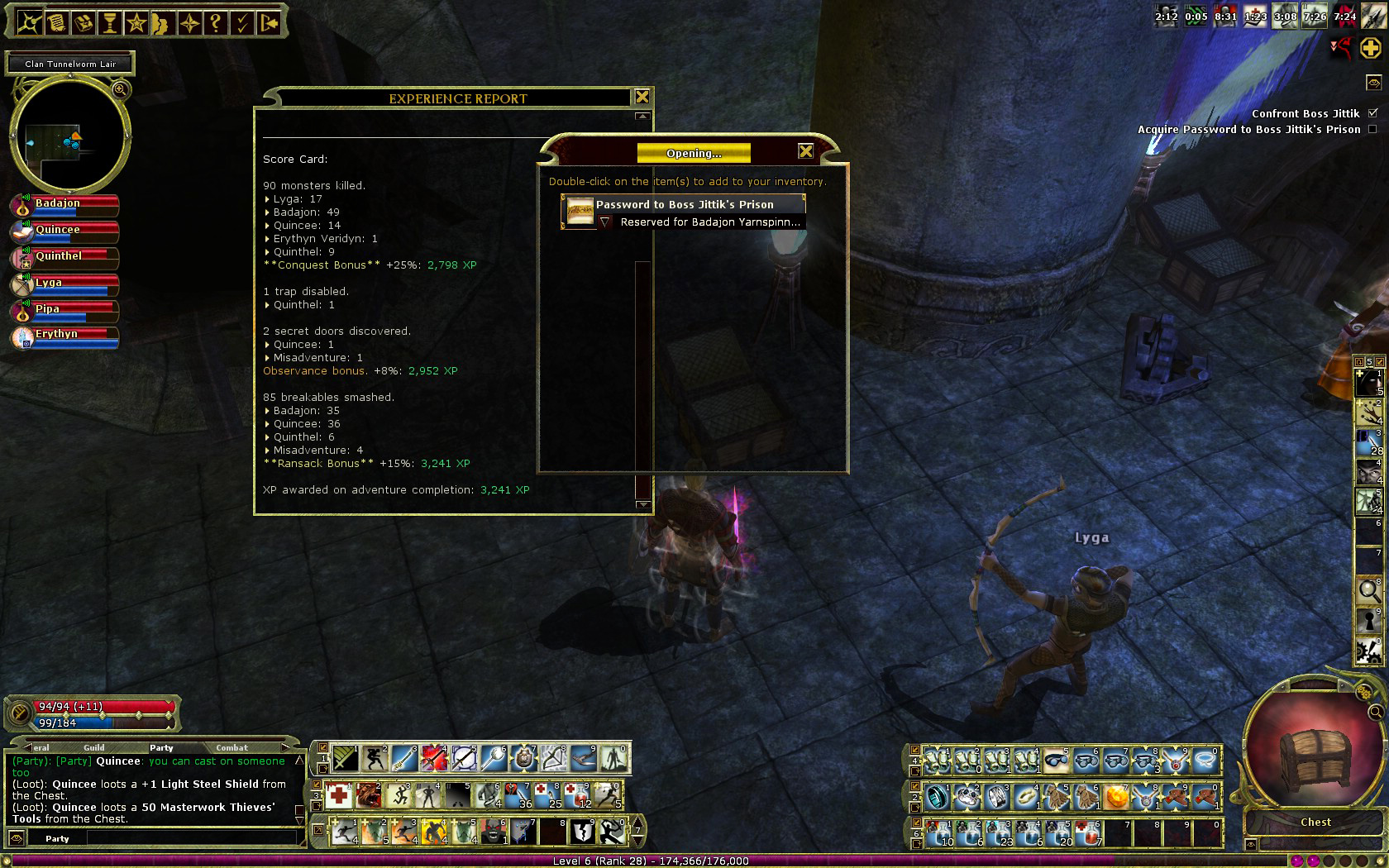
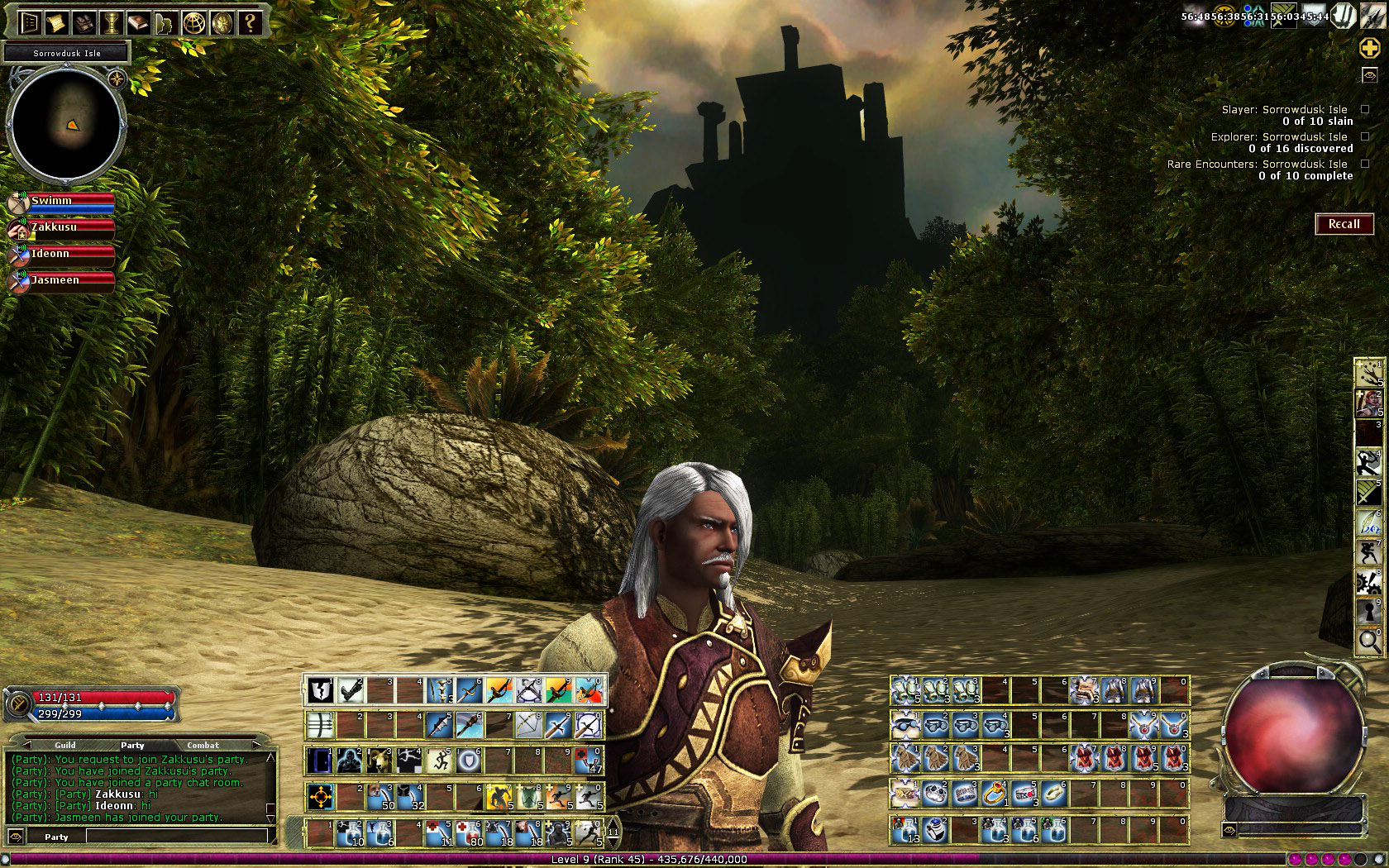
The time tag on the above screenshot says 04.57AM, Wednesday morning, May 20, 2009, and it is indicative of how utterly immersed I became on this occasion. It also shows Badajon topping the kill count by a considerable margin; not surprising considering I was the principal melee character in a group with no real tanks, but still impressive in my books for being my first group venture as a fighting build. Countless hours of solo play had taught me how best to use what I had at my disposal and now, with decent back up, I found that, when it came to fighting, I was quite formidably fast at doing what needed to be done; faster than many others. I wasn’t such a bad player after all. Woot!

What I loved most of all was the camaraderie. Never before had group play in any game been so visceral or so much fun. In a game that was played completely live, with no re-loading of saved games possible, let alone any saving of the game, everything was played out in real time. It was thus important to act fast, to act together, and to communicate. My Gwylan’s Stand experience had taught me what happened when players didn’t communicate, but this second group looked out for each other, stuck together, and no one died. There was friendly chat, jokes, exchanges of advice and information and, in the space of a very short time, I felt sentimental towards the other players. If someone fell behind or got into trouble, we went back and helped them. We praised each other’s efforts, laughed at our mistakes and were generous with things we looted and did not need. When the session finally finished at around 0530 AM, I was exhausted, but completely high on the game. Computer gaming had just achieved a level I had never really dreamed of, and it had been staring me right in the face for so damned long.

That evening was the beginning of a long, long period of sleeplessness. Once I started grouping properly, I could not countenance going back to the old ways. Being in a party made everything easier, quicker, and a hell of a lot more fun. It was a brilliant thing to talk to people over the voice-chat, or to communicate by typing. My stagnant learning curve took off like a shot and I found myself developing an intimate knowledge of quests, dungeons and wilderness areas that I never could have dreamed of achieving solo. I soon found myself chatting with people from all around the world, though the Sarlona server was largely populated by American players. I made friends with several players and ran with them repeatedly; started to recognise other player’s avatars around town, in groups, on the social panel, and thus began to feel like part of the community; a true resident of Stormreach. I was surprised by the demographic make-up of the players. Most people were in their twenties and thirties, and there were many players who had, like me, been playing Dungeons & Dragons since first edition. As totally and utterly nerdy as it might seem, it was a dream come true for a D&D tragic like me to find so many other people like-minded people, who shared the nostalgia for the game.

I soon learned that it was pointless trying to role-play in a game like this. Apart from the fact that many players had limited English, it was rather too much to expect everyone to get on board and in character, especially when parties often broke up after a single quest. To role-play would require a dedicated group of players who met regularly, and anyway, it was interesting enough meeting such a wide variety of personalities.

It wasn’t long before I saw my chance to take Hallifax forward and switched to running on him as often as possible. He was, perhaps, my strongest build and most groups liked to have a bard along to enhance their combat prowess with songs, and to buff and haste them. When Hallifax began to level rapidly, I was thrilled. He had been at the coal-face for so long; the true pioneer of most of the challenges I had faced in my solo days. After the first runs on Bethanie, it had been Hallifax who experienced most quests first and he had died countless times, finding himself hopelessly outgunned. Now, at last, surrounded by good people, Hallifax began to shine like a true champion. Other players warmed to him and would express their delight when Hallifax joined the group. No doubt this was because I was enjoying the game so much that I was always laughing and joking. Hallifax was always ready with a quip, just like all bards should be, and, just as a bard is supposed to do, I felt I regularly lifted the group’s morale. It was on Hallifax that I met one of my longest running online comrades, another Bard by the name of Holz Amboss. Holz was an Australian like myself, and a relatively new player. He was intelligent and well-spoken and always good company and we teamed up for many consecutive nights, playing well into the wee hours, laughing and joking our merry way through quests. Holz and I taught each other a lot; we filled in the gaps in each other’s knowledge, exchanged money and equipment where necessary, and always made sure that people in our group were happy and well looked after.

For the rest of that month of May and halfway into June, I played DDO at every given opportunity. I no longer cared about sleeping at all and stayed up until dawn almost every night, when there were many more players online. I advanced Hallifax to level 12, indulging in ever more challenging and interesting quests. The game was far more colourful than I’d ever imagined, with some truly classic quests and beautifully rendered areas to explore.

There were so many quests that even after six weeks of continuous group play, there was still a huge number I was yet to run. Very rapidly, the game began to consume my entire life. I doing no writing whatsoever, slumping my way through the days in a dream-like state of chronic exhaustion, keeping myself awake with killer doses of coffee and sugar, codeine, ibuprofen and paracetamol, and then trying to make up for it all every Saturday night when I stayed at my girlfriend’s house and slept for about twelve hours. I kept up running and took no time off work, but I was just making it through my lessons, teaching English as a second language. I was a walking wreck, and we were about to go to South East Asia together for a five-week holiday. I began to have terrible withdrawal fears, in advance of the coming break. Would I really be able to live without DDO? There was  only one way to find out…

Read Full Post »

“Money, it’s a gas, grab that cash with both hands and make a stash. New car, caviar, four star daydream, think I’ll buy me a football team.” – Pink Floyd, Money


Years ago, as a young man experimenting with narcotics, there was always a line I never crossed – heroin. My principal concern was that I’d like it and, let’s face it, liking heroin is not a good career move. I knew already that I had a tendency towards addiction. I’m a creature of habit and once I get a taste for something, be it music, computer games, reading, writing or running, I tend to crave it to the point of suffering withdrawal.

Despite my reservations about Massively Multiplayer Online Role-playing Games (MMOs), so far as narrative, atmosphere and game-play were concerned, I knew that were I to begin playing one, I might well be sucked in. I had watched my friend Chris struggle to extract himself from World of Warcraft (WoW) and had read sufficient anecdotal reports of the addictive qualities of Everquest (EQ), so I knew just how addictive these games could be. I had already suffered long years of devotion to games like Baldur’s Gate 2, Neverwinter Nights and Civilization III and IV, for which the craving to play was often very intense. To quit Civilization III I had had to smash the disc to pieces, though I then found I could download the entire game through Limewire in about 15 minutes and the battle went on.

Civilization IV hit me even harder  – at times I could wrestle with it for a sleepless week, in which I ghost-walked from one game to the next. When I visited my brother in Brisbane, it was traditional to start a game of Civ on the Thursday night I arrived and we almost invariably played until well after dawn, thus smashing ourselves to bits for the rest of the weekend. After a snooze and a café breakfast, we would drive home in the car, talking about how we must not play the game again that day, but if we were to do so, which civilization would we play: the Babylonians or Egyptians? By the time we were home, we had already lost the fight and fired it up immediately. Fortunately, Civilization is now long behind me.

I thus had every right to fear MMOs. This fear had particular resonance with me because, as a writer, I needed my spare time to write. It was easy enough to turn up to work and teach English without having to think too hard, however exhausted I might be, but to write required me being focussed and alert and having a clear head. I needed what I was writing to be the dominant narrative in my thoughts and not to be distracted by, for example, thinking over of the offensive strategy I planned to use against the Aztecs.

Bored with the games I’d been playing, and wanting a more lively experience, I found myself mulling over the idea of giving Dungeons and Dragons Online (DDO) another go. I thought hard about the possible implications, the time-wasting, the craving, but decided I could keep a lid on things. After all, one of my strongest qualities, in stark contrast to my ill-discipline, was the ability to discipline myself when necessary. All I needed was a set of rules, such as ensuring that I slept sufficiently, continued writing, and did no gaming during daylight hours. If I could make myself work, then play would be my well-earned reward, and I had managed, except during occasional periods of obsessive play, to maintain this balance for the last ten years. Could an MMO really be that addictive? Would I really not be able to walk away? I decided to take the risk.

So it was that, towards the end of 2008, I signed up for the ten-day free trial of DDO and sat down to play. I had, of course, played the game for a week two years ago at the time of its release, so this was really a return. When I first played it, however, it had been on a not especially powerful laptop and, in order to avoid lag, I’d had to experience it with the graphics turned down. Having recently built a seriously powerful computer to cope with my heavily pimped Oblivion, I was now able to ramp the graphics up to max. When I finally fired it up, having downloaded all the patches, it looked significantly more attractive.

The first character I created was Bethanie Brinsett, an elf rogue I intended to make a multi-class cleric. I was basing all my ideas of character creation on the types of builds I’d used in Neverwinter Nights 1 & 2, which was a good starting point in theory, but would ultimately have very different outcomes in DDO. It would be a long while before I’d learn the pros and cons of certain builds in this context, but to begin with I was impressed by certain innovations the game had made to the rules.

First and foremost was spell-casting. Rather than the old system of allowing a caster to memorise a certain number of spells, which could be cast a set number of times each per rest period, the game introduced a mana pool which allowed the caster to memorise the same number of spells as in the 3.5 edition rules, but to cast each spell as many times as desired, according to how much mana was available. The higher level the spell, the more mana it required; spells cast using metamagics such as Maximise, Empower or Extend, also cost more mana. It made casters a lot more versatile and able to cast far more often.

Another plus was that spells affecting movement, such as Expeditious Retreat, Feather Fall and Jump, became much more pivotal in this very free-flowing game. One would rarely ever make use of such spells in the pen and paper game, as the limited number of spells one could use between rest periods meant it was usually more effective to preference offensive casting and healing rather that buffs.

The game also did a good job of calculating combat movement and positioning. Especially impressive was the way the way DDO handled things like flanking, making it an advantage to move during melee. The game even mimicked all the dice-rolls, going so far as to display a D20 on the screen, which could be coloured to the player’s liking, every time a roll was made. I’d always thought that the Dungeons & Dragons rules might be too complex or unbalanced to translate to an MMO format where it was necessary to avoid having great gaps between the effectiveness of the classes, but I was to come to learn that the rules actually translated surprisingly well.

Just prior to my rejoining the game, a new starting area, the island of Korthos, had been introduced, and for the first few days I found myself running around in this snowy island and its village. The village was besieged by Suhuagin and being terrorised by an otherwise benign white dragon under the influence of an evil mind-flayer. It had all the markings of an extended tutorial, but it played rather smoothly and I quickly became engaged.

What really hooked me was the free-flowing nature of the game. Despite the fact that, unlike WoW, DDO required area transitions from one map to another, and that all quests were instanced so that only a single individual or party could undertake them, and that the world was considerably smaller, with only one major city and, admittedly quite a number of surrounding areas, it seemed like a nice compromise between the open world of the MMO and the single-player gaming experience. The avatars ran, rolled, tumbled and swung with a very pleasing fluidity. The animations were well done and the detail on characters’ faces, despite relatively limited options for customisation, were above par for MMOs, where texture detail is usually sacrificed to ensure speed in crowded areas where bulk rendering is required.

To begin with I was pretty crap. Like all noobs, I was clumsy and slow, despite being well-practised with the standard WASD movement of first-person shooters. I didn’t know how best to make use of hotbars, knew little of the game’s quirks and workarounds, had no sense of perspective and proportion and didn’t really understand the significance of items I looted. I was also completely broke and didn’t know what I should be looking for. Nor did I know what quests I ought to do, or how difficult the challenge might be. I made a lot of fundamental errors; for example, not knowing that when I died, if there was a resurrection shrine within 10 seconds running distance of where I was slain, I could run to it and click on it to come back to life.

The starter area, however, was mercifully easy and initially I made the mistake of thinking the rest of the game might be equally easy as well. Ultimately it was, but only once I knew what I was doing, had the right build and some back-up. I shudder to think of how difficult I found many low-level quests in Stormreach Harbour, even on normal difficulty level. Of course, the problem was largely that I was trying to solo them, having, in my typically shy manner, decided not to group with other players. I could have learned so much more quickly had I had the sense to team up with other people.

I did, however, manage to recruit my friend Steven for a short while. He created a rather wan-looking chap called Relwan and together we ran around Korthos. The game was certainly considerably easier with another player on hand, and I taught him what little I knew about how things worked, including giving him very had advice as to how to build his character. Still, not having progressed from the 1st edition Dungeons & Dragons rules, he was completely at sea with 3rd edition, so my advice was better than nothing. We played together over a few consecutive nights and I very much enjoyed having someone to chat with. We fought, tumbled, shrined and danced side by side, and for a brief while there I thought I thought he might stick it out. Sadly, however, Steven decided he’d had enough when the trial expired, and I was left bereft, with no company and no back up. It goes without saying that, on the back of this, I should have gotten over my issues and grouped with some other players, yet something held me back.

I don’t understand why I felt so shy. I am somewhat sociophobic and have a deep paranoia about what people think of me, so my biggest fear was being outed as a total noob, despite my countless years of Dungeons & Dragons experience in various formats. I chose instead to bide my time learning the ropes, developing an understanding of the economy, the context, the scope and what have you. Another problem was that I was afraid of not knowing the quests. I had no idea how sympathetic people would be and had seen many advertisements on the social panel with, in retrospect, rather unfriendly statements such as “Know the quest”; “no noobs” and the like. It didn’t give me confidence.

I always thought of joining groups, but just couldn’t quite bring myself to do it, even when players sent me a “tell” asking for help. And anyway, despite its frustrations, and this in the era before hirelings became available, I was very much enjoying the solo game. I thought grouping might be immersion-breaking; that, as had been the case in WoW, people would simply run through quests without explaining anything or bothering to role-play. I also feared that too few players took their gaming seriously. There were some truly awful-looking characters running about Stormreach, with ridiculous names like IKillU, DeathRage, YoMama, SmashYourFace, MeHealU and so on, that I thought these people were largely jokers. There were, of course, many very excellent looking characters, with thoughtful names and fine attire, who preferred, as I did, looking attractive or handsome rather than terrifyingly ugly. The question was, how, if I were to join random groups, would I be able to apply the shit-filter?

Ultimately, however, I was enjoying the game. Playing solo gave it the feel of a single-player game, but with the advantage of being in a living game-world with a real economy. Either way, it was working just fine for me and, by the time the ten-day trial was due to expire, I was already sufficiently hooked to sign up for a subscription. It was, to say the least, a fateful moment.

Having made a lot of mistakes with my first build, and having learned a thing or two during the trial, I decided it was time to create another character. It wasn’t long before Hallifax Bender was on the scene. Hallifax was a character I’d played in various different games – a swashbuckler in pen and paper D&D, a bard in Neverwinter Nights 1 & 2 – and this time around I made him look like a dark-skinned Norse god. I had spotted another “toon” hanging around the harbour with an enormous white beard and decided that I wanted one as well. I have always liked to play the dilettante minstrel and Hallifax Bender was my default name for such a chap.

I, as Hallifax, continued to blunder around like a fool, slowly improving my understanding of the game, enjoying the challenge, but also being constantly frustrated by my failings and inadequacies. Still determined to play the game solo, I had to use tactics and caution in every situation, and doing this for positively weeks on end actually proved to be excellent training in the game. I was forced to take things slowly, to read everything, to sneak and hide and surprise my enemies, and, wherever possible, to run to a safer position and hold my ground as best as possible. I slowly developed an intimate knowledge of all the low-level dungeons. Stormreach harbour seemed packed with quests and, to begin with, I spent all my time there. One reason for this was that I was told by a city guard that I could not access the marketplace, and thus, the other city wards, until I’d completed a certain quest chain called The Waterworks, which was proving very difficult for me. What I didn’t know was that I could have just bribed the guard! Noob.

The game continued to be a frustrating experience, but it also had me hooked. Once I’d begun, I devoted all my gaming time to DDO. I began to develop cravings to play, but during the first few months, I kept things under control and only played at night. I avoided overlong sessions and didn’t let the game get in the way of sleep. As a player, I was improving slowly but surely. Refining my tactics and knowing what to expect made a huge difference. Hallifax was hardly a killer build, as a Ranger / Sorcerer / Bard multiclass, he was too thinly spread to be very effective, but his versatility was advantageous for solo play. I mostly ran on Hallifax, but I couldn’t help myself from switching back to Bethanie here and there, nor could I resist the lure of creating new characters. I went back to a few old favourites. Arnalde Holdfast was reborn as a Paladin and Summer Thingis returned as a Ranger, though I was forced to call her Summerr on account of her first name already being taken. As the first name is the most important on a server, and all messaging and mail is addressed to the first name only, it cannot be duplicated.

I didn’t stop with Summerr, either, for I also created a rather hapless chap called Tollande Rollmops. I wanted to see if it were possible to make a purely arcane character work, one who began as a Bard, then took a level of sorcerer before advancing as a wizard. Again, I was locked into my Neverwinter Nights mindset, wherein I believed I could make such a build work and still engage as a melee combatant. Tollande proved, to all intents and purposes, to be almost entirely useless, though he later found a role as my principal auctioneer once I began to flirt with the auction house properly. Had I allocated his stats and feats correctly, he might just have worked as a versatile wizard and spell-point guru, but I was a long way from making full sense of how best to put such a build together. What I also lacked was good equipment.

The main problem I faced in the game, apart from my unwillingness to group, and some ill-planned builds, was that I had no money and was forced to use inferior equipment. It was only when I really began to get a handle on the local economy, after several months of play, that my circumstances began to improve. I figured that my fortunes might improve incrementally as I crept up in levels and slowly acquired more gold, but I could never have predicted the great leap forward that was about to come.

Only those who have played MMOs can truly understand the lure of the auction house. I suspect, however, that Wall Street traders and stockbrokers must go through a similar experience of anxiety, excitement, withdrawal, desire and lust. I lusted after gold as so many have in the past, though the money I set out to make was all, of course, virtual.

When first I began playing I had no idea as to how to make money. The one lesson I hard learned from WoW, however, was that, with the exception of vendor trash, there was potentially a market for everything. If I sold items to a shopkeeper in town, I’d get about 10% of their listed value; yet I could name any price on the auction house. For my first few months, I experimented with the auction house, putting pretty well every piece of crappy loot I found up for auction, including total rubbish like a Ring of Swimming +3 or masterwork weapons. Still, I wasn’t to know what was valuable and what wasn’t, and I priced them so thoughtfully, below purchase price, but above what I got from the vendors, that I managed to sell them. Naturally items would sell according to the laws of demand and supply, yet it takes time and experience to know what is in demand and what’s not. It also takes as long time to learn which items are genuinely rare. Interpreting the value of loot also requires an understanding of the game’s different classes. A new player who has only played a fighter is not going to understand immediately the significance of, say, a Superior Potency III Sceptre, which increases the damage of a wizard or sorcerer’s 1st to 3rd-level spells by 50%.

For the first few months that I played the game I was dirt poor. I’d pick up the crappy loot from low-level chests and sell it to the vendors and brokers for peanuts. I’d auction anything I thought might sell and made some extra pocket money. It took me almost a month just to accumulate 30k gold, which is a drop in the ocean in game terms, considering a decent weapon might sell for between 75k and 250k and possibly much higher. There were items on the auction house being sold for 12 million gold, though I didn’t actually believe anyone could have this kind of money in the game, which was, admittedly, rather naïve of me.

The turning point came with the arrival of my first Festivault. Festivault was the in-game festival which occurred around Christmas time, running for roughly six weeks. During this period, chests would also drop Gold, Silver and Copper tokens which could be exchanged with one of the festival jesters for cakes and cookies that cast spell-like effects in the same way scrolls did. The cakes and cookies, however, cast the spells as though by a high-level caster, say 10th or 15th level, thus giving them greater power, penetration and duration. They also had the advantage of being usable by any character at any level. Initially I used them myself  to assist Hallifax and co. in difficult situations, but one day, whilst checking the auction house, I noticed that certain of these cakes sold for quite remarkable prices. Or, rather, they were listed for a lot of gold, though I did not really believe anyone would spend so much for a single-use item. All the same, it was worth a shot, so I put the cake that cast Blade Barrier as a 15th level spell up for sale at 100k and waited. I didn’t have to wait long, for it was sold within an hour, and suddenly, for the first time in my four stumbling months of play, I had some halfway decent spending money.


I was already playing the game way too much, but it was Festivault that really got me hooked to DDO in a big way. My frustration with the game had been growing, largely on account of my very slow advancement and lack of money. Of course, had I bothered teaming with other players I may have learned the ropes a lot more quickly, but my shyness persisted. Festivault allowed me to buy my first weapons with magic effects on them; it allowed me to buy some decent armour and stack up on wands and potions. I knew that Festivault wouldn’t last forever, so I was reluctant to blow all the money at once and saved a few hundred thousand gold pieces for later times. When Festivault ended, however, I found myself back at square one. Yes, I had made a good deal more money than I’d dreamed of having and had significantly upgraded my equipment, but when the money finally ran out as it no doubt would, I couldn’t see how I was going to make any more of it, apart from the old slow grind.

What I did know was that experienced players had money to burn, and all I need do was find what they needed and grind it. I undertook a new study of the auction house, trawling through every listed item and noting their average prices. This was no small feat as there were countless categories and thousands of different items listed, but I was diligent, and, after all, my Festivault savings were running out rapidly. I needed to find other ways to make money – fast.

I went through my inventories to see if I had anything that might fetch a decent price, but all I had was vendor trash and nothing that seemed to be selling at any sort of decent price whatsoever. Then, one day, about two months after the end of Festivault, I looked again at the “collectables” category.

Collectables were things that spawned from different nodes throughout the game. These nodes took the form of mushrooms, clumps of moss, piles of rubbish and the like, or treasure bags dropped by monsters. From them one could harvest such things as a string of prayer beads, a sparkling dust, a lush cryptmoss, a shamanic totem, a deadly feverblanch etc. There were hundreds of different collectables which could be exchanged with collectors for items such as magic arrows, potions, wands, scrolls, or they could be used in crafting. I noticed now that many of these things were listed for quite staggering prices. A sparkling dust for example, of which I had several in my backpack, was listed at 90k. I hadn’t initially believed anyone would pay such money for them, because I knew nothing about their role in crafting. Yet, on this second look it struck me that with so many collectables listed, surely all these people who auctioned them weren’t deluded. Why hadn’t I thought of this before?

I looked in my collectables bag and noticed I had a number of items that were listed at very high prices. I put a few on offer at a price just below the current minimum and waited. Sure enough, as had been the case with the cakes and cookies, within a very short space of time there was a bite on the line and my sparkling dust sold for 85000 gold pieces. Woot!

I couldn’t believe my good fortune. Deadly feverblanch were listed at 75k each and I had 12 of them in my backpack! Within a couple of days, I’d put everything that seemed to fetch a good price, or a price at all, up for sale. When I sold a Lightning Split Soarwood for 650k, a Luminescent dust for 500k, and a Fragrant Drowshood for 250k, I knew I’d hit the big time. These more valuable collectables were that not easy to find, but nor were they all that rare. Playing as regularly as I did, I found I’d usually get one truly valuable collectable every couple of sessions.

Suddenly, within the space of a month, I had millions of gold pieces. I was now able to purchase elite equipment and blow money on potions and wands with abandon. I went on a spending spree, buying more powerful weapons and finer suits of armour. I began to collect Elven Chainmail, being especially picky about the appearance of particular suits. I might have been a noob on many levels, but my characters were starting to look a lot nicer than previously. They were also a lot more effective.

This business of making money became highly addictive. I started grinding the dungeons I knew had nodes that dropped valuable collectables. It didn’t always work out, but I could usually collect enough in a session to make several hundred thousand gold pieces. The gold fever didn’t stop with collectables either. In the marketplace were brokers to whom one could sell loot for a slightly better price than regular vendors. These people specialised in things such as jewellery or clothing, armour or weapons, and what players sold to them could be re-purchased by other players. Now with more money, and able at last to shop at these brokers, it didn’t take long to realise that people sold a lot of very valuable items to them for a pittance. Again I began to experiment. I used my still relatively limited experience of the game to judge what would be of use to particular classes, studied the prices on the auction house, and began to purchase things. It soon became another vast gravy train and again, I was making hundreds of thousands of gold every single time I logged in.

When I later began to group with other players, I learned that my auction house skills and understanding of the market were quite exceptional. Many experienced players with high-level characters had money not because they worked the auction house well, but simply through gradual accumulation and the discovery and sale of higher-level, more valuable loot. I felt immensely pleased with myself and was popular, as so often rich people are, because I was generous with my money. I bought potions and wands for clerics, scrolls for casters, dished out funds when people were low on cash and even used gold to bribe the odd player whose services were needed to join my party and abandon the second-rate group of hacks with whom they were currently grouped.

On my first run through the Cursed Crypt quest in the Necropolis with Hallifax, I miraculously pulled an extremely rare item of loot called the Scourge Choker. It was a necklace that caused the character, when struck, to enter into an increasingly powerful rage that raised strength and constitution considerably. I really ought to have kept something so rare, but when I saw that it was listed on the auction house for twelve million gold pieces, I couldn’t resist putting it up for auction. Sure enough, it sold at that price, and after the annoying and pointless auction-house tax, I received just over 8 million gold pieces in one fell swoop.

The auction house was horribly addictive. Every time I logged in I would go straight to the brokers, switch through all the instances, buy up all the good equipment and take it to the auction house. It was a thrill checking the post when I logged in to see how much money I had made. It was a challenge estimating the chance of a sale, setting prices, taking a punt on some borderline things that might just be good for a sale. It took me almost forty-five minutes just to manage my finances each time I logged in, before I actually started playing the game. Some days, I didn’t even bother doing any quests and all I cared about was the auction house and the brokers. The other problem with the auction house was that, being on an international server largely populated by American, Chinese and European players, there were far more players on between midnight and the middle of the afternoon than at night, so in order to find more bargains, it was best to log on in the morning when more players meant more instances in the marketplace – to avoid player overload in public areas – and thus, in effect, more brokers with more loot.

Eventually, after two years of play, I was so good at making money and had so much floating around on various characters, that I wanted a new challenge. I switched from the Sarlona server to Ghallanda, started a new 1st-level character called Swimm Lantern and set about levelling him and making money. I raced through Korthos in a couple of hours, made my way to Stormreach and went straight through some low-level quests, collecting everything I could find.

After selling all the junk to vendors, I managed, after a couple of hours, to accumulate around 3000 gold pieces. I took this money straight to the brokers and bought a couple of useful level 1 items people had sold: Boots of Expeditious Retreat and a Cloak of Shield. These items allowed the owner to use said spells three times per rest, and were useful to low-level players. I knew only too well that experienced players starting new characters would look straight away to buy this sort of equipment, and, paying roughly 1000 gold per item, I put them on the auction house at 15k a pop. Sure enough, they sold quickly, whilst I was out getting more loot and collectables. At the end of my first session, I was already on 25k and now able to buy a greater number of low level items to mark up on the auction house. Within three days, I had hit level 5 and made my first million. Most players to whom I told this did not believe a word of it, one even called me a liar – so, in true school playground fashion, I showed him the money, said “suck on that,” and left his shitty group.

Still, I’m getting ahead of myself. For, it was just a few months after I first began to make money, about seven months after starting to play the game, that I finally accepted the invitation to join a group. I’d thought the game was addictive before, but things were about to go to an entirely new level. The longest waking dream of my life was about to begin.

Read Full Post »
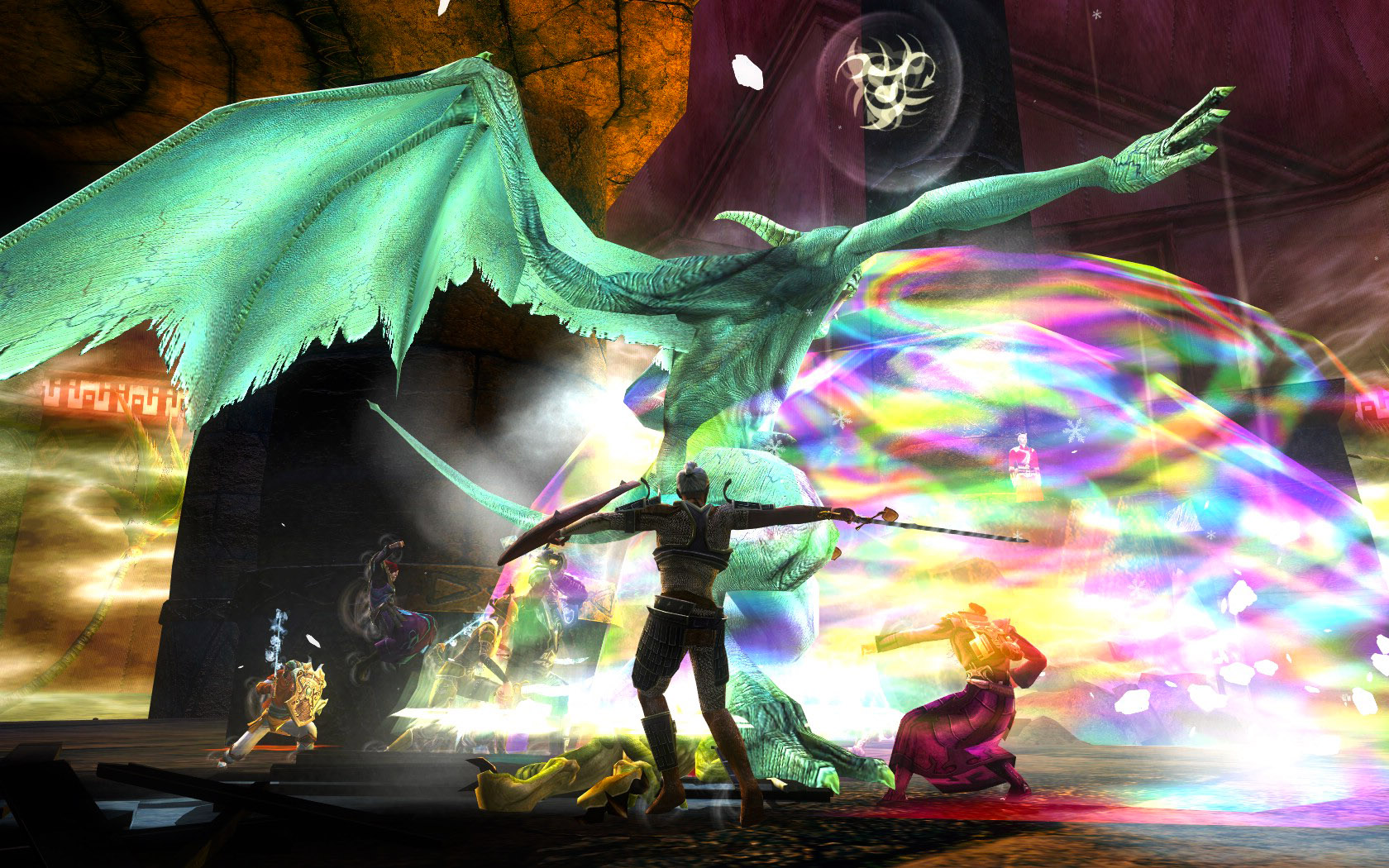
“Entertainment can sometimes be hard, when the thing that you love is the same thing that’s holding you down.” – Pulp, Party Hard

It was a simple yes or no question – “Do you wish to uninstall Dungeons and Dragons Online?” – and yet, like so many simple questions before it, it heralded a significant step in my life. I knew what had to be done, I knew that there could only be one answer to the question, yet for a moment I lingered, pondering the consequences. Could I really walk away from the City of Stormreach? Could I really abandon the members of the guild I had only recently begun – The Frozen Spine? Could I honestly leave behind the myriad pleasures of adventuring with friends and strangers in a virtual fantasy world? Would I ever see my wonderful avatars again? The likes of Hallifax Bender, Jasparr Krait of Luskan, Bethanie Brinsett, Honeydrop Sundew, Snowfell Vanish, Arnalde Holdfast, Lucessa Rainsinger, and Yardley “The Scissors” Bruce? Would I really never trade on the auction house again?

What had brought me to this decision was, however, a different set of questions. Did I really want to spend many of my waking hours thinking about characters in a virtual world? Did I really want to suffer further the anxieties of grinding, levelling, equipping my characters, searching for loot and waiting to find a decent group of people to play with? Did I really want to spend hour after hour on inventory management, arranging hotkeys, buying goods from the town pawn-vendors and selling them at profit on the auction house? Did I really want to spend another year in which I barely slept, in which I was merely a ghostly social presence on account of physical and mental exhaustion?

These activities, fun though they could be, were so time-consuming, so thought-consuming, so addictive despite being so repetitive, and ultimately, so utterly pointless, that I could not in any way justify their pursuit a moment longer. What had begun as a hugely fun, thrilling and exhilarating gaming experience then blossomed into an uproarious social experience, had ultimately become a part-time job which required most of my mental faculties, then a dreadful grind wherein I could barely think of anything else. Once I had passed the zenith of pleasure, it took a long while to reach the nadir of despair. I walked away and came back, I took holidays and tried to forget, but ultimately, the lure of the game was so great that only a significant and final step would do the job. And so it was that I pressed the “yes” button, and in an instant, my heart flooded with an unimaginable sense of relief. I felt as though I had put down a very heavy burden. And, indeed, I had.

One of the defining factors of an addiction is the persistence in doing something long past the point of it being any fun at all. The American Society of Addiction Medicine defines addiction in the following manner:

Addiction is a primary, chronic disease of brain reward, motivation, memory and related circuitry. Dysfunction in these circuits leads to characteristic biological, psychological, social and spiritual manifestations. This is reflected in the individual pursuing reward and/or relief by substance use and other behaviours. The addiction is characterized by impairment in behavioural control, craving, inability to consistently abstain, and diminished recognition of significant problems with one’s behaviours and interpersonal relationships. Like other chronic diseases, addiction can involve cycles of relapse and remission. Without treatment or engagement in recovery activities, addiction is progressive and can result in disability or premature death.

Addiction is generally seen as a physical and psychological dependence on drugs or alcohol, yet it can also be characterised as a continued pursuit of activities, despite negative consequences derived from such pursuit. Psychologists have identified many areas of addiction such as gambling, food, sex, the internet, work, exercise, television, pornography, religion, shopping and computer gaming.

I, it would seem, fell into the final category, though it was hardly the first obsession of my life. As a child I had, sure enough, been obsessed with pen and paper Dungeons & Dragons, to the extent that my brother and I once locked ourselves in my room and refused to come down to dinner as we did not wish to stop playing. Later, in early adulthood, I developed an addiction to cigarettes, alcohol and to marijuana, again with varying periods of intensity and rejection and relapse, all, fortunately, now a very long time ago.

Massively Multiplayer Online Role-playing games (hereafter MMOs) can be especially addictive, largely because there is always something to do. There is levelling to be done, there is equipment to purchase, there is loot to seek out, there is the auction house to trawl through, there are rare reagents to find… the list goes on. There are social obligations, group and guild activities, deadlines, events, and so many targets one can set for oneself that the mind boggles. Each game will have its own incentives to keep one playing. The problem is compounded if you have my habit of continually starting new characters or “toons” and running them up with some tricky, experimental build in mind.

Of course, it is also well to remember that everything is potentially very good fun, and people wouldn’t play these games if they weren’t enjoyable. The problem is the sheer amount of time and effort it takes for one to reach the endgame, if one ever gets there at all. It is estimated that players of World of Warcraft have already played for more than six million years in total. I must have spent positively thousands of hours gaming over the years, but nothing took my time away so successfully as DDO.

Much of the time it felt like great fun, though it was often difficult to tell. There is a significant difference between behaviour designed to stabilise one’s mood, and behaviour that produces genuine pleasure. Smoking cigarettes is not only about fulfilling a physical addiction, nor is it necessarily otherwise for the sake of pleasure, but it is also largely about the reassurance it brings from the anxiety of not smoking.

Similarly, people who check Facebook repeatedly often do it less for pleasure than to allay the fear of missing something, or of not being up to date. I won’t attempt to venture an opinion about addictions I have not experienced, such as heroin, suffice to say that where physical necessity is not involved, the desire to do something repeatedly is often driven by anxiety about not doing it, rather than the joy of doing it.

So how did it come to this pass? What drew me in, and what, you may be wondering, was all the fuss about? Well, allow me to explain.

I have always taken my gaming rather seriously. A little too seriously, in fact, for I was a snob about role-playing games. I felt I had a right to be so, however, having cut my teeth on 1st edition Dungeons & Dragons back in 1981, and having played a large number of early role-playing systems such as Middle Earth Role-Playing Game (MERP) / Rolemaster, Runequest and Traveller. Between us, my brother and I owned a large number of other role-playing systems, many of which we read but never played; games such as: Chill, Conan RPG, Call of Cthulu, GURPS, Palladium, Twilight 2000, Paranoia, James Bond RPG and Top Secret. We felt confident from a young age that we could sniff out a pretty decent rules system, and many games simply didn’t cut it; still, they were worth a look. D&D and MERP took the cake by a long shot, so far as rules complexity and functionality were concerned, and I was also most drawn to their themes and settings. The aesthetics of these games were essentially an offshoot of genre fantasy, yet as pioneers in the genre of fantasy role-playing, they had their own mood and style. So far as D&D was concerned, this style shifted considerably with the increased popularity of the game and the employment of better artists such as Larry Elmore, who gave the game a more air-brushed, commercial appearance, yet still retained and expanded the sense of epic fantasy.

The need to rely on the imagination with pen and paper role-playing has always been its greatest strength. Most individuals and locations are accompanied by a description, but not by a picture. Take the following example from module EX2, The Land Beyond the Magic Mirror, by Gary Gygax, first published in 1983.

“This largish room is cluttered indeed. Large, colorful rugs

lie on its hardwood floor. The walls are paneled to about

waist height, and metal brackets with strange, crystal-tipped

torches stick out of them. Several table and floor

candelabra also hold these weird torches. The couch,

chairs, tables, and other furniture are of unusual design and

workmanship. All around the wall are glass boxes that

contain dead insects, or else odd bits of brightly colored

paper stuck on a dark background, placed behind glass,

and framed with wood. Several small animals and birds are

sitting on shelves and tables. They are regarding you with

unwinking stares! In strange contrast to all of this are

numbers of crudely made weapon heads, possibly made by

cavemen, proudly displayed beside the arcane materials

and unknown insects. A large book on a table near the

windows has white pages covered with more small, colorful

bits of parchment. On either side of the windows are shelves

that, in addition to holding the small birds and animals,

contain devices that resemble sun dials stood on edge.

Nearby is a huge mirror (point of entry, possibly) fixed to

the wall. Across from it is a tall thing made of glass, wood,

and metal: a rectangular box at least 7’ tall.”

Once the Dungeon Master has read the above description to the players, a vivid image of the space in which they find themselves will take shape in their minds and they are at liberty to explore the place for clues or whatever it is they may seek. The Dungeon Master will, of course, have further information about the contents of the room, including any nasty or pleasant surprises that may be in store for the group of players, and the DM is also at liberty to embellish the scene at will. The players will also have a quite firm vision of themselves within this space, feeling anxiety and excitement in equal measure for their character who may be on the brink of finding some important information or wondrous item, being poisoned by a trap, falling through the floor, or perhaps facing an attack from the myriad dead animals about the room. As a child, I was constantly transported into these scenes which held me entirely in their grip as events slowly unfolded.

I don’t wish to go too deeply into the lure of pen and paper role-playing games, suffice to say that it is an experience I’ve never forgotten and always longed to return to. As we grew older my brother and I continued to play Dungeons and Dragons and MERP, only stopping when he left home after finishing school. Ever since I have longed to play the game whenever possible, but apart from a few sessions with friends in my final year of high school and an excellent pen and paper campaign in 1994/5 run by my friend Cody, along with the rare revival on a visit to my brother in Brisbane, the sessions have been few and far between. It is largely the difficulty of organising a game that makes it so impossible to play. It also requires a lot of time, a good large table, and a general absence of the nagging bullshit that constitutes adult life, like having to go to work, which is, let’s face it, practically a crime against humanity.

Thus it was, in this barren world without pen and paper role-playing, that I was forced to turn to computer games as a last resort. Computer games had long been an adjunct to pen and paper, yet their lack of graphical sophistication back in the 1980s made them a pretty poor substitute, especially as story elements were usually rather truncated. The first fantasy computer game that attracted my attention was called Phantasie II, which I used to play repeatedly with my friend Mike when I stayed at his house.

Though it was hardly driven by a strong narrative, its length and seemingly epic proportions made the advancement of our party of adventurers a story in itself. It was highly derivative of Dungeons and Dragons – much to our pleasure – and offered a large world to explore full of random encounters, caves, towns and the like. We were certainly very taken with it and for a while it actually superseded pen and paper gaming as a priority.

I have, elsewhere, described the circumstances under which I first encountered the 2nd edition Dungeons & Dragons computer game, Baldur’s Gate, and thus will not go into detail here.

https://tragicocomedia.wordpress.com/2011/03/23/baldurs-gate-in-paris/

My discovery of it, in the year 2000 was, however, the long-awaited moment where something faintly akin to the pen and paper experience was replicated for me in a computer game. I became mildly obsessed with playing Baldur’s Gate at first and had a difficult time walking away from it, yet ultimately, I found I could regulate my interest in it and push it back to playing a mere hour a day. Baldur’s Gate 2, however, was so utterly gripping and engrossing that I could not walk away from it. I first got hold of it late in the year 2001, two weeks prior to flying out from Cambridge to Australia for a home visit, and I basically locked down for two weeks and did nothing else. I played it all day and night, smoking roll-your-own cigarettes, drinking tea and coffee and sleeping a bare minimum to maximise gaming time. Even in two full-time weeks of gaming, I only made it halfway through the game and was forced to walk away only by the pressing need to get down to Heathrow. Upon returning from Australia, with a deliberately perverse glee, I started from the beginning again and put my PhD on hold for another month. When I finally finished the game, I felt so awfully bereft that I kept replaying it, despite its having largely lost the ability to surprise me. Even in the face of the law of diminishing returns, I was still sucked in.

After Baldur’s Gate 2, having seen just how well a computer game could be driven by a strong story, I came to expect all games to provide an equally engaging storyline. Thus, along with many other RPG enthusiasts, I keenly awaited the release of Bioware’s Neverwinter Nights, based on the 3rd edition D&D rules, when it was first announced back in 2001/02. Unfortunately, however, the storyline of Neverwinter Nights proved to be a great disappointment. It lacked intrigue, contained wooden dialogue, and the action elements of the game seemed ultimately repetitive. It was practically an advertisement for itself, a sample of what could be done with the engine, yet not a very engaging game. What the game did provide was an excellent platform from which to play Dungeons & Dragons, for Bioware, bless them, had the foresight to release the toolset with the game, so that writers and modders out there could create their own adventures using the same kit as used by the game designers. It was the community response that ultimately made the game what it should have been from the start. There was a veritable explosion of community-written modules which appeared on www.nwvault.com and elsewhere, some of which provided far superior narratives, more engaging characters, more interestingly designed locations and, in some cases, epic scope of up to 150 hours playing time. The amount of work that people put into these games out of love and the community spirit in assisting the writers and designers with play-testing and advice was astonishing. The NWN vault still holds thousands of modules, many hundreds of which are well worth playing, despite the age of the game engine.

So it was, having long been a snob about pen and paper role-playing systems, I now became a snob about computer games. I had very little interest in action-based games without a sophisticated story, though I could enjoy them as a brief diversion. When it came to the fantasy genre, however, I felt there was no room for compromise. Without a story, without a purpose, without the ability to change the world one inhabited, I felt there was no point playing. It was in this spirit, with this attitude quite firmly established, that I first encountered MMOs.

I had certainly heard plenty about MMOs since they first became broadly popular. Everquest, released in 1999, was the game making all the headlines long before World of Warcraft appeared on the scene. The nicknames which Everquest earned make play of its addictive qualities: NeverRest and EverCrack. Everquest was so time-consuming for many players and caused so many broken relationships that an online support group called EverQuest Widows was created, along with sites such as www.GamerWidow.com It became a commonplace for people to apply the suffix “aggro” to whatever called them away from the game or interrupted their attention: “wife-aggro”, “girlfriend-aggro”, “work-aggro” and, indeed, “life-aggro.”

It was clear that the emerging social and cultural phenomenon of the MMO was out of the bag once newspapers began commenting on it outside of their game review sections. Attention was initially largely focussed on people’s playing habits and the buying and selling of virtual property for real money. MMOs were not merely seen as games, but as “chat rooms with a graphical interface”. They were social experiences, and thus, to all intents and purposes, legitimate virtual worlds in which people lived parallel virtual lives.

Despite the attention given to MMOs and their apparent popularity and attractions, I was not initially interested in playing them. This was largely on account of my perception that they were not driven by strong narratives, but instead focussed on goals that were accumulative – repeating actions and quests over and again to level characters and gain items and money. It didn’t appeal to me, though I knew very little about the actual nature of the games and made rather a few too many assumptions.

When I moved back to Cambridge from Sydney in 2006 and caught up again with my old friend and colleague Chris, I found him in the grip of a heavy obsession with World of Warcraft. He and I had, some years ago, shared a strong interest in BG1 and 2 and we often discussed computer games from an objective point of view, being curious about their design and indeed potential. I was, in the case of MMOs, a little too subjective and decided they weren’t for me. However, after spending some time watching Chris play WoW, I found myself increasingly drawn to the possibilities of such a game. Most of all, its scope was very attractively broad, with a whole, vast world to explore – then consisting of two major continents. I liked the fact that travel had to be done manually – players were forced to run, fly, walk or take a ship across large tracts of land or ocean. There was a lot of variety in the terrain and nature of the encounters, though many of the quests and tasks were disappointingly dull and repetitive. I thought it was time to stop disparaging it and give it a go. Sure enough, as I began co-teaching a summer school with Chris in Pembroke College, I took a small attic room in central Cambridge with a fast broadband connection, installed the game and got underway.

It’s fair to say I was quickly hooked. Despite the absence of any strong narrative and the relatively mindless nature of all the quests and objectives, I was sucked in by the scope and free-flowing nature of the world. Most of the games I’d played previously worked on a far more restricted plane. One entered a particular area, be it a dungeon, a town, a cave, a forest or open plains, but to progress to the next map or area required a transition. There were limits to the world, limits to the map. What made WoW so interesting was that there were no limits. It was possible to continue walking in any direction until the geography literally ran out at the coastline, after which one could take a ship across the sea. When one needed to travel longer distances over land, one could hire a griffin and fly across the continent, and one would indeed fly over the land in journeys that could take five to ten minutes. It was always an excellent opportunity to make a cup of tea if I wasn’t busy being mesmerised by the beating wings of the great beast I was riding, or the landscape passing underneath.

Having said that, on the whole I found the game graphically disappointing. The female characters all had man-hands and most races looked silly rather than interesting or attractive. The scale of things was also horribly out of proportion, with avatars often being completely dwarfed by vast cobblestones or planks of wood six times wider than their bodies. I found this to be very annoying, though I should have let it go. Another thing I did not immediately warm to was the sheer number of people active in the game at any given time. I understand now that populated servers are a bonus, but with so many people running around and jumping over my head, it felt like a silly cartoon and not an immersive fantasy game. I didn’t like it either that the world could not be changed. If I finished a quest then nothing in the world was permanently effected; I could just do it again or watch countless other people do it around me. It all seemed rather pointless and meaningless, and yet, I was continually drawn back to playing.

It was when I discovered that I could make in-game money on the auction house by finding ingredients, mixing certain reagents and putting them up for sale, that the game really began to interest me. This real, living economy was something no single-player game could replicate. The other thing that held my attention was the crafting. I chose cooking and fishing for my character and spent the vast bulk of my time doing both of these activities. In fact, in a month of playing, I only made it to level 18, but I had maxed my cooking and fishing skills to their highest possible level. Whenever I got a whiff of a good catch, I’d pop out a line and sit there reeling them in. It was quite therapeutic and I learned a number of recipes either for refining reagents from the fish, or cooking them to make potions and salves that could be sold on the auction house.

It goes without saying that the principal objective of MMOs is teaming up with other players, but I hardly ever grouped at all. It was partly because I wasn’t used to it and felt rather timid, but also because, being a noob, I was afraid of the censure of more experienced players. It should have occurred to me that there were no doubt many other noobs around as well, and the few times I did team up with other players, they were kind and helpful, but I still couldn’t seem to snap out of my single-player mentality. Indeed, the only other multiplayer gaming I’d done, apart from console-based hand-to-hand combat games, was playing linked Neverwinter Nights with my friend Mike and also with my brother. That seemed a far preferable style of gaming as, despite being localised to a module with limited areas and a closed story, there was at least a strong narrative driving the adventure, which, when well-written, brought emotional engagement. I also found Neverwinter Nights to be more immersive on an atmospheric level, if only for not having random idiots jumping over me all the time as they ran around Azeroth.

So it was that World of Warcraft had me hooked, but with deep reservations. What bugged me most of all about the game was that it was impossible to multi-class. One was either a mage, a druid, a hunter and so on, and each class was restricted in the items they could use or armour they could wear. I found this awfully simplistic compared to the variety and complexity of Dungeons & Dragons and couldn’t stand the thought that no matter what I did, I’d have pretty well exactly the same build as everyone else playing the same class. It reminded me of the arbitrary silliness of 1st Edition D&D wherein a Magic-User (read Wizard) was not allowed to use any weapon other than a dagger, dart or staff and could wear no armour whatsoever. Why exactly? Could they not take combat training as well? But before the introduction of the feat system, and the freeing up of class combinations with the 3rd edition rules, this was not possible.

After a month, my reservations had mounted and I was concerned about the time I was spending online, so I walked away. What really got me to walk, however, was the release of Dungeons & Dragons Online. The game had hit the shelves a few months before and CodeMasters, who were running the servers in Europe, were offering free ten-day trials of the game. I signed up, downloaded the game and got Chris to join me in our initial trial.

I was, I have to say, initially quite impressed. The action had a nice flow to it, the combat was exciting and the strict adherence to the D&D 3.5 edition rules, with a few necessary tweaks to make the game workable, made me a lot happier with the structural aspects of the game. What I didn’t like at all was that I couldn’t seem to make any progress, largely on account of being unwilling to team up with other players. Chris dropped out quite early in the trial and I played on until the tenday expired, soloing with very limited success. Again I felt too shy to accept the random party invitations I received from other players and just skulked about the city of Stormreach in a hopelessly ineffectual manner, wondering what was wrong with me. When the ten days expired, I uninstalled the game from my laptop, went back to playing Neverwinter Nights and drooling over screenshots of The Elder Scrolls IV: Oblivion and thought that would be the end of it.

Fast forward to 2008. I had returned from the UK to Australia and was busy finishing my Masters in Creative Writing, which I had deferred for two years. I was doing my best to avoid playing any games at all, in order to focus on my writing. There were the occasionally lockdowns with Neverwinter Nights 2 and Civilization IV, but on the whole I managed to remain disciplined until I got hooked modifying Oblivion. This process seemed to open the floodgates again, and once I had finished my degree, having no immediately pressing deadlines, the craving to spend my time immersed in virtual worlds returned.

I have a hard time resisting desire once it is firmly rooted in my mind, and the desire to play computer games seems so innocuous on so many levels, that it’s easy enough to satisfy it without feeling like a heroin addict or smoker. The first true addiction I ever had to a computer game was the first iteration of Sid Meier’s Civilization, back in the early 90s. I didn’t have a computer myself and so had to head around to my friend Mike’s place to play it, but once I got hold of his computer I was very difficult to dislodge. I could sit there all night, until dawn, swilling cask wine, smoking cones and building a civilization to stand the test of time. I was, between 1993 and 1995, living with my then girlfriend Kirstin, and she became very annoyed with me for spending whole nights out without calling, because I simply could not drag myself away from the screen to use the telephone.

I repeated the same behaviour regularly at my friend Rob Curtis’ place; sitting in his front room until the sun rose and then some, unable even to bring myself to go to the toilet. And it wasn’t only the dreaded Civilization that could hold me in its thrall. When Kirstin got her first PC computer, a second-hand 486, I installed Centurion: Defender of Rome on it and, in my first game, played from 2130 one evening until 1300 the following afternoon, only leaving the chair once to go to the toilet and get a glass of water. So the pattern was established early, indeed, it had long been established in the pen and paper days when my friend Gus coined the phrase “five o’clock maniacs” aged 12, after we repeatedly stayed up all night playing Dungeons & Dragons with my brother. When Civilization III came out I was living in Rome doing a post-doc at the British School at Rome. I had submitted my PhD on the 3rd of January 2003 and flown straight there, completely exhausted after four months spent working like a dog until dawn every night and sleeping four hours a day. I had no interest in doing any more work ever again at the time, and when, a week later, I bought the Italian version of the game, all hope of a future academic career died. I had some of the greatest sessions of my life in that place, fuelled by daily visits to ruins, museums and galleries. Armed with a bottle of primitivo, I’d fire it up for positively hours on end. It seemed that when it came to gaming, I was built for immersion – for commitment to the long haul. “Close the curtains and get the heater, bro, this is a lockdown.”

And so it was, around September 2008, that, bored with games I was playing and looking for a new experience and challenge, I began to consider giving Dungeons & Dragons Online another go. After all, most MMOs take a couple of years to get up and running, so far as the in-game economy is concerned, and ironing out problems with the gameplay and interface. I figured that this one had had sufficient time to mature and that it might well be worth another look. I signed up for another ten-day trial, downloaded the game and, after an absence of just over two years, found myself back on the streets of Stormreach.

Read Full Post »

I scabbed a smoke off a Japanese traveller at Charles de Gaulle airport. Lise was standing on the other side of the glass, but I had to wait for my luggage. She looked ecstatic and a little slimmer and seeing her, I felt rested after the flight from Sydney. We motioned and blew kisses through the glass and I sucked my cigarette with the force of an old habit regained after three weeks of parties. Back in Europe, en route to England, I felt like a conquering hero.

After many kisses the first thing I did was have Lise take my photo. Selecting a point in the bright concrete ring that provides, with such airy modernity, access to the gates, I wanted to look like Bono on the cover of All that you can’t leave behind. In the fever of travel and a tad self-conscious, I lingered just long enough for one take; the backdrop, uncannily, in near perfect alignment. The photo done, we moved to the transport and waited in glee for the bus.

I was on the final leg of an extraordinary four months of travel. In August I’d flown to Berlin, then hitched a ride many miles south into France to meet Lise in Strasbourg. From there we’d ventured around Alsace and into Switzerland, crossing into Germany via Freiberg and spending my birthday in Baden Baden. I finally returned to Cambridge via several drunken nights with old friends in Paris. In November I attended a medieval history conference in The Netherlands, then, the morning after returning, flew to Vienna and took a train to meet Lise and her parents in Budapest for a Nato conference. At the end of the month I flew to Northern Italy to see an exhibition of Lombard artefacts in Brescia and travelled on through Verona to Venice. In December, Lise and I flew to New York and then on to Toronto to spend Christmas with her family, returning to a Cambridge covered in snow. We made straight for London and spent a crazy new years high on piles of coke and champagne at Circus Bar in Soho and later at a party at Rolf Harris’ old house. A couple of days after that, I flew out to Australia for three weeks, whilst Lise moved into a friend’s apartment in Paris where she planned to conduct further research. Life had been unbelievably kind to me; to the both of us, in fact.

Lise’s Parisian flat was on Rue des Quatre Vents in the 6th arrondissement. It was a beautiful apartment, not far from the Odeon and within easy walking distance of Notre Dame or the Luxembourg Gardens. It was small, but very tasteful, with polished floorboards and simple, comfortable furniture. It had an aspect of the old and new. It was very quiet, being set back from the road, down a passage protected by old, dark green, wooden doors.

I was exhausted, but far too tired to go straight to sleep. And anyway, it had been a while since we’d seen each other, so the loft bed, up the ladder, was initially put to more energetic use. We hit the streets of Paris and wandered about. I smoked cigarettes and felt strung out, drank coffee and dreamed of being drunk. Paris can make anyone feel cool, unless you’re prone to status anxiety and feel oppressed by how effortlessly cool everyone else is. I was so full of confidence, fun and bravado at the time that I felt especially cool, even more so than the Parisians. Perhaps I genuinely was at that time; it was a rare window in life in which to feel magnificent.

That night we went out for an assiette grec, which was decidedly Turkish. We returned to drink a bottle of wine, and after that I was spent. There was no chance for me to stay awake any longer, and anyway, I’d already made it into the evening; a first step on resetting the circadian clock from the southern hemisphere. We climbed up the loft ladder and, mid conversation, I fell into a deep sleep.

At four o’clock in the morning, I was suddenly very wide, bruisingly awake. I felt a momentary disorientation and initially wondered where I was. Sydney, Cambridge? Ah, Paris. Beside me Lise slept and I had no wish to wake her, so I tried to remain still as possible. I lay in the loft staring at the close ceiling. I smiled, feeling the residual warmth of my close friends who had gone the distance in those last, frantic days. We had squeezed every drop for a final hoorah and, now, feeling fully rested, my emotions were at liberty to indulge in nostalgia.

Perhaps it was the inevitable comedown from the ecstasy I’d taken two nights before, or perhaps it was just the terminal distance, but, very suddenly I felt enormously sad and before I quite knew what was happening I began to cry. A yawning chasm had opened in my heart.

Only now did it dawn on me just how far away I was from Australia. For a year and a quarter I’d been living in England and at times my heart had burned. I had missed my friends and family and I had missed the climate, but most of all I had missed the history I had with people. I was fortunate to have established very deep friendships at Cambridge with people I knew would be my friends for life, yet in Sydney my relationships had an antiquity that lent itself so naturally to nostalgia, and I have always been cripplingly nostalgic.

Lying there in the loft, I realised how long it would be before I was back in Sydney again. A year, perhaps even two years, I couldn’t be sure. Oddly enough, it wasn’t that I didn’t want to be here. I loved Europe, was obsessed with it. The experience of going to Cambridge was the highpoint of my life. The year 2000 was the happiest of my life, and I knew it then and there. And this happiest year had occurred up here, in the northern hemisphere, in England, in Europe. I wanted to be here in Europe and had even begun to wonder if I shouldn’t stay here forever; albeit in the UK. The only problem was, I wanted to be in Australia as well.

I plunged wholly into sadness and reflection. The glint of the ocean, the broad camaraderie, the hugs and the handshakes, the dinners and drinks; cigarettes borrowed while shouting my tales. I confess that life had been working to tickle my ego. I was the centre of attention, I had all the yarns to spin, I had gone away and become somehow exotic. Sydney had been even more fun than I remembered because I was there this time as a tourist, and everyone came out of the woodwork. I revelled in my time and, high on pills, drunk on wine, smoked up to the clouds, I rolled through it all with a robust good humour. And then, I had to leave.

I also remembered the kisses to which I had almost succumbed. An old friend, with the unfortunate name of Beryl, a person I’d kissed before, loomed back into my life from a long obscurity. I watched those lips swell luscious before me, and in the throes of some rare, first-rate ecstasy, we sat close the luxurious staff lounges in an office behind the Martin Place clock-tower, full of desire. It was all born of a longing for everything. I had become so accustomed to things going my way that I could resist nothing, not even things my timidity might once have forsaken. With other friends gathered round, high as kites, we drank all the office beer and shot pool. At 0600 AM, I phoned the city council and spent ten minutes politely complaining to the nice man on the other end that the clock was two minutes slow, and could they please fix it.

In Tokyo, sleeping between flights in an airport hotel, I wrote a letter to Beryl on the hotel paper. At last I found a use for the Emperor’s yen that my old friend Marcus had given me five years before, and which had ridden my hip for so long. The note I posted was slightly dark with the oddness of flying; the introspection, the philosophy and the urgency of travel. I told her how strange it was that I was thinking of where I was leaving and not where I was going. That I should be looking forwards, not backwards, that I felt half in love, but wasn’t sure what the other half was up to. There was no question that I was in love with Lise, so what had I fallen for in Sydney? It was, in truth, the whole package; the city and its lights, the living postcard, the friends and stories, the emotional history, the scents, the water, all gleaming in the midst of a northern winter. Beryl had, rather unexpectedly, come to symbolise it all. She was the muse of Sydney just now, and so my heart went out to her as I felt the desperate loss in leaving.

I soon erupted in weeping. Another year at least would have to pass before I saw those faces again. A whole other year of waiting and missing things. I had already missed two weddings and the birth of my best friend’s daughter. It was as though people had waited for me to leave before taking these important steps. I lay there still, under that close ceiling, and the tears kept coming.

Soon, Lise was awake.

“What is it, Snail, what’s the matter?”

“I don’t know, it just hit me. I feel so far away.”

There was little she could do, though I wanted her there. She held me and I held her. There was nothing else for it but to seek comfort. Truly, I was very happy to be here, which made my sadness seem so oddly out of place; yet it was the consequence of coming out of such a deep immersion. My synapses hadn’t reconnected with Europe. Home had shifted back south in my head and I was severely disoriented.

I sat up as best as I could. I was wide awake and I felt awfully restless. What should I do? It was January in Paris and still dark. The dawn would not come until near eight o’clock. I needed to sit alone for a while; to compose myself with some sobering cold. Not even the central heating could keep the chill from the tiles. I hugged Lise and kissed her.

“I’m OK,” I said. “I’m just sad to leave my family and friends. I’m glad you’re here.”

I climbed down the ladder to go to the lounge. Little did I know that what I was about to do would have such far-reaching consequences.

There, sitting on the table, was Lise’s new laptop. I had gone with her to buy it in Toronto and it was, for the year 2001, a state of the art machine. Whilst in Sydney, my brother had flown down to visit, and during his stay he brought with him a computer game he wished to give me. It was called Baldur’s Gate; an epic-length role-playing game based on the 2nd Edition Dungeons & Dragons rules. My brother and I had grown up doing little else but gaming. Strategic board games, role-playing games, tabletop miniatures, naval warfare simulations, you name it. Between us we owned something like 31 different role-playing rules systems and I had even written my own role-playing system, consisting of more than 100 pages of rules, at the age of eleven. My brother owned around 30 Avalon Hill military strategy games; complex and involved board games and now much coveted in the first edition. Yet pride amongst all of these games was taken by Dungeons & Dragons. We had once locked ourselves in my room out of protest for being made to stop playing and go down to dinner. My father thought there was something dangerous in our obsession, whereas he should rather have marvelled at the exponential expansion of our vocabularies in learning these sophisticated rules systems.

Despite not playing the game for many years, I had never lost my love for D & D. The last sessions had been conducted between 1994 and ’95, when I was still an undergraduate and living in Darlington in Sydney. My old friend Cody created an excellent campaign; political intrigues in a small regional capital, replete with wear-rats in the sewers. I was a feisty 17 year-old female ranger by the name of Trissa Slondar, ably assisted by my friends Ventris and Faldor, aka, Mike and Malakai, and a very peculiar NPC wizard who chose to join us here and there. It was always fun. Has there even been a better reason to roll dice?

I reached into my bag and pulled out the discs of Baldur’s Gate. Computer games were still relatively primitive at the turn of the century, yet they had come a very long way from the text-based, 2D graphics and simple engines I had begun with. Baldur’s Gate was a multiple award-winning piece of work, both for its narrative qualities, its neat and functional engine and interface, and its incredibly epic scope. Not only did it boast up to 200 hours of playing time, but it was, within the bounds of commonsense, very replayable on account of the wide variety of characters on offer as potential henchmen.

My brother had raved to me about the game in Sydney, and I had been impressed immediately.

“Bro, it’s totally Dungeons and Dragons rules. It even simulates dice-rolls. It’s a TSR product. It’s the real deal.”

The strength of my nostalgia for the game cannot be taken for granted. It had been the great comfort of my childhood. I had stared every day into those lengthy rule books, reading descriptions of magic spells, ancient items, the lore and legends of different races and professions. The illustrations, the fantastic settings, the at times disturbingly adult nature of the content had awed me. Being thrust daily into dangerous situations, striving either for loot in an ancient temple or some desperate rescue; pitted against an incredible array of foes in deserts, jungles, snowy mountains, in quaint and corrupt medieval fantasy towns, was a rare privilege. To play through a quest could take several days and each had its own narrative, its own settings, its own heroes and villains. Solving all manner of problems, making moral, tactical and strategic choices, conducting interrogations, investigations; the variety and versatility of the role-play seemed boundless. Of course, it was often just good hack and slash dungeon-crawling, but this too had its merits as old-fashioned fun.

“Hey, Lise,” I said, walking back into the bedroom, before she had a chance to fall back to sleep. “Can I install this game on your computer? I’ll delete it later. I just need something to do.”

“Of course, Snail. Go for it.”

“Thanks a million.”

I ran up the ladder and kissed her sleepy face. Already I felt considerably better. Wasn’t I really happier in Europe anyway? Hadn’t the last year been the best of my life? For someone obsessed with history, there was simply nothing for me in Australia. It was an empty land, full of fat, rich, vapid people growing more conservative by the minute. Did I really want to be there when I could be here in Europe – in Paris, for god’s sake! There was more culture in Paris alone than in the whole of Australia. What had I been thinking? I smiled, trying to shut out my sense of loss by rationalising my good fortune in being where I was. It was working.

I slipped in the first of the six discs and began the installation of the game. I rubbed my hands together in the light of the lamp. I closed the door and put on the kettle, making a cup of tea. I could see nothing outside the frosted window, except a few muted stars. The cars were sparse enough that each had an individual tone. I checked the time. It was only 0430. The world was going to leave me alone for a good while yet. It was exactly how I wanted it.

I put in my headphones and started the game. The title music was slow but insistent, bombastic and dramatic. I watched the opening animation of a man in armour being thrown from the top of a tall tower by some great brute with an evil voice. This brute must, ultimately, be my nemesis. The body struck the ground and the blood flowed between the cobbles, finding its way to the title, written on the medieval pavement. BALDURS GATE. I was excited to say the least, but far more so when I entered the character creation screen. Just as my brother had so enthusiastically assured me, in every way the game seemed true to the rules of Dungeons & Dragons. My troubles were behind me now as I basked in the rich colours of the interface.

When, some three hours later, Lise finally arose and joined me in the lounge room, I was in another state of being altogether. I had rediscovered a happy place to which I thought I could never return. Baldur’s Gate was simply marvellous, it was enthralling, it was like cocaine. It was the computer game for which I had been crying out for many years, it was that good it was better than sex. I didn’t want to stop playing. I couldn’t bring myself to stop playing. I had to request special indulgence from Lise to let me go through until lunchtime. Everything about it tickled my nerdy fancy and my deep nostalgia for the game. The character classes, the potions, the magical items, the simulated dice-rolls, the sense of adventure, the mission, the quest. Sure, it could hardly replicate the freedom of movement within the pen and paper game, especially when it came to dialogue, but everything else was absolutely spot on. When, from a scroll I’d found, I cast my first Stinking Cloud spell for perhaps 12 years, I nearly wept afresh.

Such was my enthusiasm, that I managed to enlist some from Lise. She found the game cute at first, with its entertaining voices, its artwork and themes. In the days ahead, however, when I continued to wake up at four in the morning, and could not be easily pried away from the computer, my obsession with it became a burden to her.

And this obsession did not diminish upon my return to Cambridge. I continued to play the game, completing it, then restarting it and running it through again, and just when I had finally walked away from it, Baldur’s Gate 2 was released with its far greater complexity, detailed character work, lengthy dialogues and more engaging and coherent story. If Baldur’s Gate was cocaine, then the much lauded and still highly regarded Baldur’s Gate 2, was heroin.

There came a time, further down the track, when things between Lise and I became more strained. We were used to spending a lot of time apart, and when she moved back to Cambridge, we didn’t adapt so well to being together all the time. One day she turned to me, teary-eyed, after I had frustrated her once more with my apathy, and said. “It’s all gone wrong.” It was a dark joke we had often made to each other, that there would come a time when it would “all go wrong.” Then, as if to clarify, with, I’m afraid to say, deadly accuracy, she said, “It all went wrong with Baldur’s Gate.”

Though I don’t regret the beauty of those mornings in Paris, the truth is, it did all go wrong with Baldur’s Gate. And later, with others who were yet to come, it went wrong with many other games as well.

ps. Have you ever seen anything so universally well-reviewed in  your life?

http://www.metacritic.com/game/pc/baldurs-gate-ii-shadows-of-amn/critic-reviews

Read Full Post »

Life is Cheap

This is a very short story, more of an anecdote, which I wrote back in 2005. The events took place in 1997.


Life is Cheap


“Life is cheap over there, son.”

It was my father who spoke, on the eve of his departure for Sarajevo. He had been drinking scotch and was pacing up and down his bedroom, throwing things into a suitcase.

“I’m a bit nervous this time. It’s a long time since I’ve been to a place like this. When I went to Beirut and Afghanistan, I couldn’t wait to get in.”

He stood still and shook his head.

“Mate, there’s people over there who’ll rub you out for nothing.”

His nerves were palpable, but then my father had always been overrun with excess energy. How often had my mother told him to stop tapping his knees up and down under the table?

“You’ve been to worse places,” I offered. “You’ll be alright.”

“Yeah, your dad’s an old pro. I know how to look after myself.”

He took a shirt off the hanger and lay it flat on the bed.

“But you know, mate. In some places, there’s nothing you can do. Life is cheap.”

He was on his way to spend a month in the former Yugoslavia to conduct research for a novel he was writing on a fictional war criminal. I too felt nervous because I knew him well enough to know that he would try to get himself into every dodgy situation available in order to get closer to the real story, wherever it happened to lie.

It was, therefore, with not inconsiderable relief that my mother, brother and I greeted his safe return to Sydney. I was living in Glebe at the time and met my father for dinner at our favourite Thai restaurant in Surry Hills, two nights after his return.

He told me of the frustrations he had encountered in trying to get into Serbia, a move eventually blocked by impenetrable bureaucracy. He told me of being flown from one place to the next by the Luftwaffe, of riding on tractors with peasants and of the heavy, rich, Balkan cuisine he had consumed with such guilty passion, washed down with harsh grappa.

“It’s corrupt as buggery,” he said. “The black market is vast and you can get pretty well anything – guns, grenades, drugs – whatever you want.”

“Didn’t some guy try to sell you a tank once in Beirut?”

“Yeah, an old T-34.”

“Any tanks for sale?”

“No, mate,” he laughed. “But everyone kept telling me to change my deutschmark on the black market, so I did, and fuck me, I got burned.”

“How did that happen?”

“It was in Sarajevo – just a kid on the street, in one of the main squares. This kid must have used the most incredible sleight of hand, because I had my eyes on him like a hawk.”

He took a gulp of his wine, the held his hand in my face.

“He held up a roll, like this, right in front of my face, and counted off the notes before my eyes. I saw every note, mate, and they were all good. Somehow, by some miracle of magician’s dexterity, when I handed him the hundred marks and he handed the roll over, he managed to substitute it for a different roll.”

“What was in it?”

“There was one good note on the top, and the rest was paper.”

“What a pisser.”

“By the time I found out, the kid was long gone. I can’t tell you how angry I was. The little rat, I thought – nobody double crosses Phil Cornford. I went straight back to my hotel room and got a good heavy, woolen sock. Then I walked back to the square, and on the way I got half a brick and put it in the sock. I was determined to break both of his fucking legs if I found him again.”

“Bullshit.” I said, though it was as much a question as an expression of disbelief.

“No mate, I was livid. It didn’t matter that it was only a hundred marks – it was the principle. I hung around that square all afternoon, and I went back again the next day to try to find him. I swear to god I was determined to break both his legs if I found him.”

“But you didn’t find him.”

“No, I didn’t. And then I calmed down a bit and I had to leave Sarajevo. I was amazed at myself, and I still don’t know why it made me so angry. It might have been the tension I felt the whole time I was there. I guess I felt scared – maybe I’m getting less reckless as I get older, I value my life more and I don’t want to die. Twenty years ago, I wouldn’t have even noticed if I was afraid.”

The words ‘less reckless’ hung across the table, and I wondered whether he’d noticed the contradiction.

“Mate,” he said, “there’s blokes over there who’ll do you over for nothing.”

Yeah, I thought, picturing him hanging around in the middle of Sarajevo with half a brick in a sock, waiting to break some kid’s legs. Life sure is cheap over there.

Read Full Post »
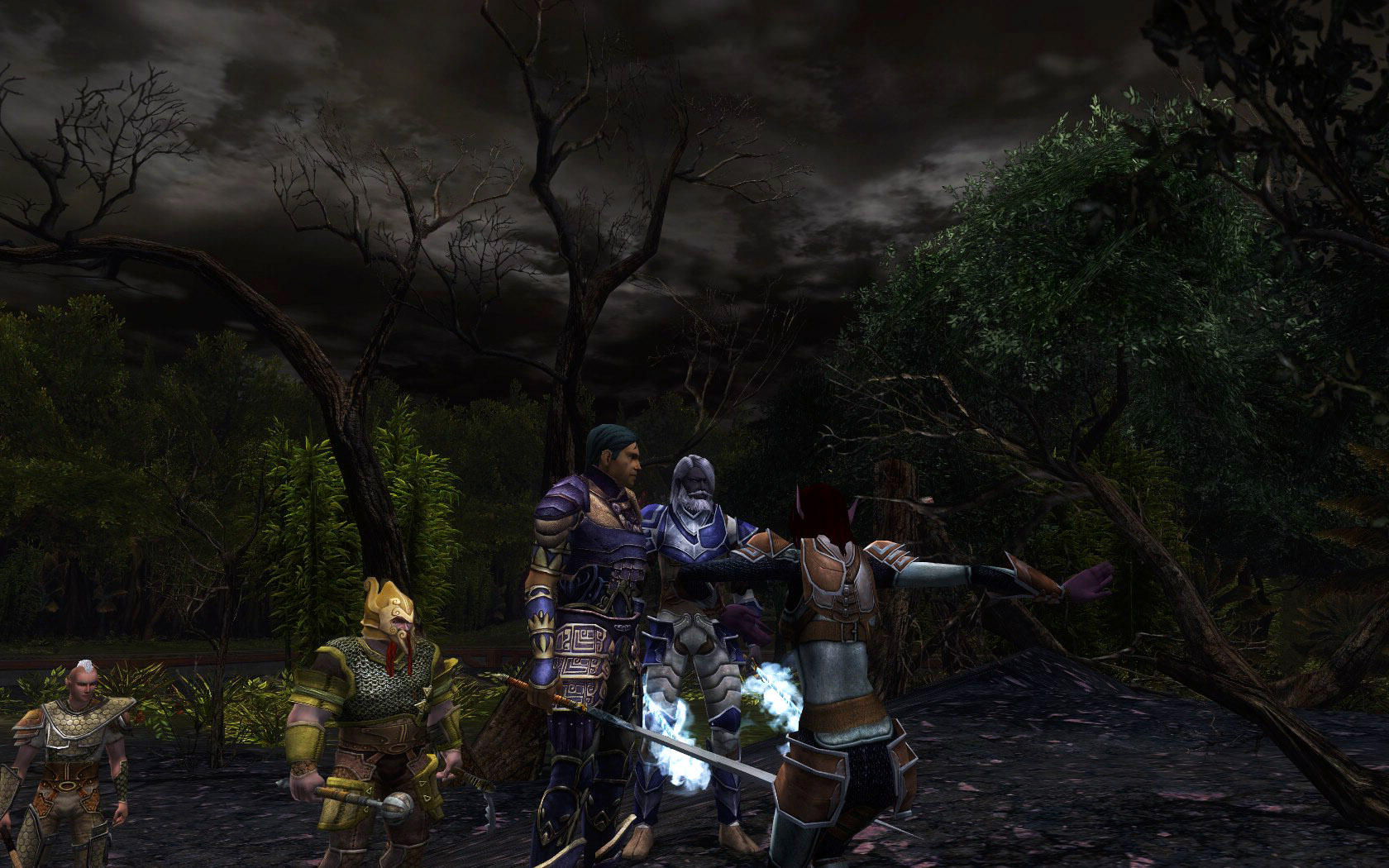
The following is another chapter from volume 1 of my autobiography entitled Sex With a Sunburnt Penis. Written on the crest of a wave of binge-drinking, it was a process of autobiography as therapy conducted between July and November of 1997. The title, Sex With a Sunburnt Penis (hereafter SWASP) is a metaphor highlighting the consequences of mounting pleasure upon pleasure. It posited that, in a country as wealthy as Australia, those born without any significant disadvantage are so well placed in life that it is really up to them to screw it up. I did so, royally, on many occasions, but regret is a wasted, pointless, indulgent emotion unless it fuels change and action. We must get back up on the bicycle so to speak, or otherwise, seek Rough Solace, a character who appears in the story as a personification of the frank good advice we can give ourselves if any wisdom dwells within. SWASP was initially intended as a one-off, but a couple of years after having written it, I envisaged a trilogy to complete the picture. Volume 2, still in the pipeline and sketched to some degree, bears the working title Loitering with Scholastic Intent. My good friend Chris recommended the title A Blow Job too Far for volume 3, though, whilst it sounds magnificent, I’m not entirely sure it will turn out to be appropriate.

The following passage, entitled Entropy, contains in its entirety my first attempt at writing a short film script. It is hopelessly inept, incongruous and contradictory, but we were very happy with it at the time and that’s good enough for me.  Too many cones indeed, and apologies for the formatting. WordPress does not seem to accommodate pre-formatted screenplays when cutting and pasting, unless I am missing something. Enjoy it, ja!

Entropy

I met Tyrone Books early in 1992 at my friend Mike’s place. As Tyrone had a certain suave, philosophical nonchalance about him and a much-coveted girlfriend, it was my plan to appear formidably impressive during our initial encounter. He found me with a bong in one hand, a glass of wine in the other and about three litres of cardboard Claret already in my stomach. When, after a good hour’s conversation about the influence of jazz and classical on certain Scandinavian metal bands, I looked down to find my No-Names bolognaise floating in a sea of wine on Mike’s polished-cork kitchen floor, I thought I had blown it. It so happened, however, that this was a defining moment of a different kind. For, as he was to confess many years later, what impressed Tyrone most of all was my insistence on continuing the conversation between apologies, cleaning, and further evacuations into the kitchen sink.

While the Barcelona Olympics were on, my old friend Gustav and I were given the opportunity to house-sit in a bungalow in Newtown. It seemed short-sighted to waste the opportunity of living in such a marvellous house by going to lectures, so instead I spent every last penny on weed, speed and acid and holed up for the games. During the second week of events I invited Books to visit one evening. We smoked hashish on hot knives, fashioned a bong out of a pen and shampoo bottle, then hosed the back yard and sat listening to it drip for a good hour.

“Gustav and I listen to the garden every night,” I explained. “The sound of the dripping is hypnotic, I highly recommend that you get right into it.”

“It’s pretty good, man,” said Books. I could tell that he was impressed.

Our conversation stretched well into the wee hours and Books finally departed as I began my shift at the Olympics. The following night he got in touch and came around for more of the same. By the end of the week we were best friends.

Books, who had just moved into Arundel Street in Glebe, soon found himself in the difficult situation of having to find new housemates. Within three weeks of moving into the house, through no fault of his own, all the other tenants moved out. He was fortunate in finding three replacements with extraordinary speed, one of whom was an enthusiastic wannabe film maker and communications student by the name of Saul Godly. Keen to get away from home and hang out with my new friend, I began to use Books’ house as an outpost at which to base myself after a long day dodging lectures. Soon Tyrone, Saul and I were as thick as thieves, and it was only natural that such a blessed triumvirate should be granted ambitious revelations.

One evening the three of us dropped acid and walked from Paddington to Glebe on an all-night epic. During that journey we declaimed, with great affectation, our dreams and visions for the future.

“I’m going to make it rich as a psychologist,” said Books, “then spend my money making movies. I’m going to be a director and an inventor, but most of all, I’m going to be a scientist and computer expert like Avon in Blake’s 7, or Davros in the Genesis of the Daleks.”

“I’m going to make films too,” said Saul. “But I don’t just want to be behind the camera, I want to be in front of it as well. Plus, I’m gonna write the damned things. I’m going to be an artiste, an auteur, an actor!”

“And I’m going to be a writer!” I shouted, beating my fist into the copy of Clive Barker’s Weaveworld, which I happened to be carrying. “I’m gunna write novels like a demon – novels, films, plays, short stories, poems – the lot. I’m going to be a writer!”

After some lines of speed at Arundel street, we spent the morning photographing each other in front of the railway viaduct at Glebe Point. It was a day to remember, and we wanted to preserve that glow of determined youth for eternity. Saul and I went further and made a pact. Within a year we were to produce a major work. He would write a film script, and I would write a book – either a novel or collection of short stories. At last I felt I had found a definite direction in which to steer myself.

Four months later, I hadn’t written a thing. I had, at least, begun to teach myself to touch type, but in a world without e-mail or the internet, and too lazy even to write my essays, let alone type them, it was difficult to motivate myself to stay in front of a keyboard. University was sliding away from me again. My absenteeism in first semester had ruled out any chance of passing in Fine Arts and Linguistics and now, having moved deep into second semester, I faced the prospect of failing the lot. Hanging thus by a thread, I could not justify such slackness unless I began to produce extra-curricular results. If I was going to be a writer, I had better start soon.

It was, therefore, without a moment’s hesitation that I accepted my first commission. As Saul was nearing the end of his first year, the deadline for his short film project was approaching. He had already signed Books up to the task but they had, as yet, failed to come up with any script ideas. So it was that Saul asked me, “the writer”, if I would be willing to help him out.

“For fucking sure, Saul,” I said. “That’d be untold!”

This was it. This was the chance. We were going to make a film!

It was a great excuse to get drunk and stoned, take some speed and drop a trip, and we did so by way of a script moot. The following morning found us drawing and painting on the walls of Tyrone’s bedroom and it was when I asked Tyrone what he was going to say to his landlord that the story finally took shape. It would be about an artist, played by Saul, painting his walls in praise of the sun and not caring for the concerns of the Proprietor, whom he considered an obstacle to art. The painter would live with a writer, (myself) and both of these characters would be plagued by the naggings of Books, the Joker.

“The story is about the tension between chaos, anarchy, vandalism,” said Books, “and order, society and structure. The proprietor is Society incarnate and his interest is to keep the walls white, for this is tradition. The proprietor wants to maintain conservative values, while the painter and writer want to express their subversive ideas in their pictures and writing. It’s about the problem of being forced to be a part of the society into which you are born.”

“Like wanting to be a hermit,” said Saul, “but needing to work to live.”

“Exactly,” said Books, “or sort of, at least. Now, the position we wish to support in the play is that the expression of individuality and the freedom of that expression is good and should not be hindered by conservatism, but that one needs to respect society and its component structures.”

“Okay,” I said, impressed by the perspicacity of Books’ reasoning. “So what is the Joker’s role?”

“Ah,” said Books, “the Joker symbolises anarchy – he is diametrically opposed to the proprietor, yet he cannot escape from the room – society – and he has no power over him. Why? Because he is not real but ethereal; not a person, but a concept – an energy, something which can be activated and used, as both the Writer and Painter do in their art. In the end the Painter uses the Joker’s energy to kill the Proprietor. The painter, you see, is the simple idealist – he is all passion, and refuses to be a sheep, helplessly passing his time in the grasslands away.”

“Nice quote.”

“I thought you’d like it. So the story ends with the death of the Proprietor and the walls painted – the Painter triumphant, but a murderer. The Joker is free, and so, in a sense is the Writer – yet the writer now wonders whether or not he will miss the Proprietor, with whom he occasionally liked to converse, being more able to walk the median strip of life. The final scene ought to take place in a field, outside of the room. For with the Proprietor dead, society is gone, and society was, after all, the room. In effect, this film is about the end of society.”

“Bravo.”

Over the next two weeks I struggled with pen and paper, having next to no knowledge of how to write a screenplay. My only experience on this front was a script written in my first year of high school as an English project called A hand for the Chopper, which was shot in exactly forty-three minutes one Thursday lunch break. My father had written film scripts and done a lot of writing for television, but rather than consulting him, I figured I could just wing it. I was sure of myself. I had talent, didn’t I? All my University friends and Newtown acquaintances thought of me as an ideas man, a creative conversationalist, someone with the gift of the gab. All I had to do was put a little of that into the project and we’d be right as rain.

Inspiration struck one Tuesday night with nothing much to do. I got stoned and went up to the Courthouse Hotel with an exercise book in which to begin my scribbling. I was soon on a roll. I poured schooners down my neck and stabbed away at the paper, hoping girls would notice me being so obviously bohemian. The few girls present ignored me completely, so I just kept writing and writing, unwilling to abandon hope. After about two hours, I put down my pen, smoked my twentieth cigarette and felt proud. I had written a masterpiece. This, I knew, would one day be remembered as the moment that Benjamin David Philip Cornford first thrust himself onto the scene as a writer.

FADE IN:

INT. TERRACE BEDROOM WITH BALCONY
Sun streams through open French doors onto a white stretch of wall. Standing, studying the wall is the PAINTER. A WRITER sits at his desk, writing with a pencil. PAINTER approaches wall and runs hands over it, scratches his chin, steps back, kneels, frames scene between joined hands.

PAINTER

I can see it all in my wall. Should my hands confess in paint the sights they wish to shape? Such bland boundaries, faded but never kissed by the light. Reduced by a sun intolerant of their lack of welcome. I must impress with colour that yellow god and look back so he knows I admire his daily ablutions.

We close to the WRITER, who leers up from his work. Music softly sounds his theme intuitive.

PAINTER

An eye. Am eye to watch the sun and not squint, but occasionally wink in friendly approval. What colours should I use?

PAINTER begins to sharpen his pencil with a knife and begins to draw on wall.

PAINTER
This is my wall, I’ll do as I will. As I must. For it is my wall.

Enter JOKER, grinning, from the doorway. WRITER watches him but says nothing as JOKER sneaks up from behind and takes the knife from the PAINTER. PAINTER backs away, disarmed, frightened, apprehensive.

JOKER
In praise of a fool you would commit this sin? For surely the sun is a fool. Your talent is a lie, your art a falsity. Dear painter, bathe yourself in guilty blood for the works you have made incite the punishment of the lawful. Does the sun care for your work? Is he not truly beautiful? Your work is a mockery of his golden pain, your guilt and your pain are as one with his, his sins are far greater. So burn in the heart you feel is true, end this childish game. Look painter, but not to the sun.

PAINTER
But, but you see (plaintive) I must paint. I must, I, I…

JOKER
So many I’s in so short a space makes for a rather egotistical young fool. The sun’s eyes bleed, he cannot see past his face. He grumbles that fools like you live and revel in his painful light.

JOKER approaches WRITER who instantly takes the knife from his hand and begins to clean his nails. The JOKER smiles at the WRITER’s wit.

JOKER
Aha!, you play well, writer, and yet do you write well? Is not the painter a fool, is not the painter going to pay for his indulgence? But you know of his kind, free with his art, licensed to vandalise and insult.

WRITER
Is his art a sin? Do you label and lay claim to his heart? What price do you place on his defence? If his belief is true, you won’t stay his hand. His work is good, it is no stain.

JOKER
And yet you write words by the thousand – his art is slow. His pictures tell a thousand words, but is this evidence of a quick mind or that of a simpleton challenged to form sentences in description of his own ridiculous plight!

WRITER
My work is long

JOKER
You work well, while he lays his foundations.

WRITER
Slash his wrist and he’ll paint till the blood runs free. I’d write his epitaph, but fill it full of praise.

JOKER
And I’d paint his headstone in praise of the sun. Cajole and provoke, but I wouldn’t take his life. See how he frustrates at his wall.

WRITER
He frustrates for he is like the sun trapped within his youthful form. His blazing light runs rivulets through his limbs, coursing through his torso, abdomen, head. Yet he cannot burn now to let it all out at once in a flash. Can one convict him of a sin when he has no choice?

JOKER
Yet in time his spirit will change. Better he realise now than when red-faced and fifty. He’ll live for twenty years and die for fifty more, die now or become now what no illusions can prevent him from being.

Cut to the PAINTER whose thoughts we hear as voice-over while he paints.

PAINTER
How will he know? How should he find my work? Soon I’ll be away and leave my work behind. Yet it will then be elsewhere. Cannot he see that it beautifies the room? Why does my very conscience nag me so? Why should I not do what is right to be done? I’ll paint, damn it. That eye will have sight and that fool’s attempt to subvert my goal – damn him, he won’t sway me.

JOKER moves back over to PAINTER and prods him with his finger.

JOKER
Ahh, I see it’s the sort of stain that spreads. And what will you do when he sees it? Shall you apologise, try to explain? The writer asks what price your defence. I’d place the price high for the work would be hard, and of course, unfulfilling, for how can you expect a pardon? Don’t you know you cannot win? Yet, I tire of this provocation.

PAINTER
Then obstruct me no more!

JOKER
Why should I indulge myself, your mind is so full of obstacles. Look at the writer, he pauses, thinks, his hand is smooth. Stop-start it is with that dirty brush – you have no style, no flow, you silly orang-utan. I see only one fully evolved individual in this room – he reads what is written and writes what is not.

PAINTER
Confound it! I cannot concentrate.

JOKER
You never concentrate, have you tried? You stare but your drive is anger – are your emotions so malformed? You’re worried and aware of the consequences of your desecration. Have some regard. Play not games with life, when your soul is unfit for competition!

PAINTER
But it bothers me not what is in the mind of the Proprietor. How painful can his punishment be? As painful as a life without freedom? Should he stand in my way I’ll sweep him aside as in a brush stroke and paint him with blood. Better than to burn slowly to death. Now leave me, I must work!

JOKER
I haven’t quite finished. Ignore me and I expect I’ll go away, but oh, you’ll listen now that slaying is on your mind. Do you think I don’t want the both of you dead? Your youthful fire extinguished, to hear the sun laugh to win in your game and to laugh at the sins on that fool’s wall?

PAINTER
Leave me!

JOKER
I shall.

JOKER steps back and stands by himself. We close in on the WRITER who sits and thinks.

WRITER
(Voice over)
I wonder how great his anger will be, how furious that landlord. Now the Painter’s veins run with anger. Is the need so great that no compromise is reached? Should not one live in cohesion with others. It is the painter’s will that the world will bend to his ways. He does not wish to rule, but to run free – push through every blockade – ignore all orders to halt or slow. It shall be his undoing. We shall soon see what the sun thinks.

The WRITER continues to write. The JOKER comes over to the WRITER’s table and picks up the knife. He crosses to the PAINTER and hands the knife to him.

JOKER
I believe you need this to sharpen your pencils, or perhaps your will. See if I care where you stick it!

PAINTER
I’ll stick you with it if you aren’t careful! Why this constant harassment? Can’t you see I want to be left alone? I’m too busy to have time for your trouble-making. Now leave me!

There is a knock at the door. Close up of PAINTER. The JOKER smiles as he opens the door to admit the PROPRIETOR.

I never made it any further. My hand was spent, my lungs were heavy, my eyes were reeling drunk. Yet, I was terrifically excited. Coming close to finishing anything was an achievement in itself. I took myself off home and passed out in a stupor. The next morning I gave the beer-stained, dog-eared script to Saul on my way to university, before lying on the grass of campus to rest my weary, hung-over mind. The shoot was to take place the following night in the colon of the University of Technology. I would need to gather my strength. Things were moving forward apace!

When I arrived at UTS the next evening, Tyrone and Saul were overrun with excitement.

“Cornford, this is classic,” said Tyrone.

“It’s a gem,” said Saul, “just what I was after.”

“It’s so incongruous,” continued Tyrone, “and there’s a lot of it we can’t even read, let alone fathom, but there are some great lines in here. We’ve decided to call it Entropy.”

Saul had enlisted the assistance of two stunning women whom I failed utterly to impress, but who did an admirable, if unsubtle job of making me look older and uglier. Since there was no time for rehearsals, the Painter and Joker had prepared a series of idiot boards, leaving frequent gaps where my handwriting proved impenetrable. I enlightened them where possible and we got stuck straight into the shoot. It was finished in about four hours, with only one or two takes for most scenes. The studio was hot and bright, the girls lounged about languidly. I could see they had no confidence in me – I was far too overexcited to appear at all cool. My make-up ran in the heat, and my powdered brow glistened in dabs and clumps.

When it was all over we felt triumphant. I returned home buzzing with a sense of achievement I’d not felt in years. At last my life seemed to have obtained some momentum. If only I could sustain it! I lay in bed, closed my eyes, and remembered the English essay I’d forgotten to write.

Saul and Tyrone took care of finishing and editing the film. The Proprietor, ably played by their other housemate, Jen-Ming, wound up with a knife in his back on the grass of Glebe Point and with him died society. A week later, Saul submitted his work and a screening of the class’s films soon followed.

On the night of the screening Tyrone and Saul sat on the steps in the tiny cinema to play guitar and bass for the soundtrack. I lay back in my chair like a lord, ready to sip away at glory, enjoying the other projects. When Entropy finally began to roll my heart was thrust into my throat. Here we were on the big screen – all ladies present please take note!

Unfortunately, despite the quality of Tyrone and Saul’s light, funky riffing, nothing could disguise the sheer incongruity of the script, nor the abundant continuity errors. The Joker’s coat was on and off like a strobe in a melange of leering close-ups, and the words that had made so much sense to me whilst drunk and stoned at the Courthouse now seemed confusing and contradictory. To begin with the audience had no idea what to make of it, but after a couple of minutes, they decided it was a comedy and laughed along with the more amusing facial expressions. Ours was one of the last films shown, and when it was over, another rolled straight on in. Entropy passed by like a ship in the night in a thick fog on the sullen expanse of a dark, moonless ocean, and with it went all hope of having anything to be proud of. Two weeks later I passed the point of no return and my second first year at university became an unmitigated failure. I was close to passing one subject, but when I turned up for my English exam, I discovered I had gotten the date wrong. I shrugged, turned away and went to get stoned again.

Nineteen ninety-two was a complete and utter flop.

Read Full Post »
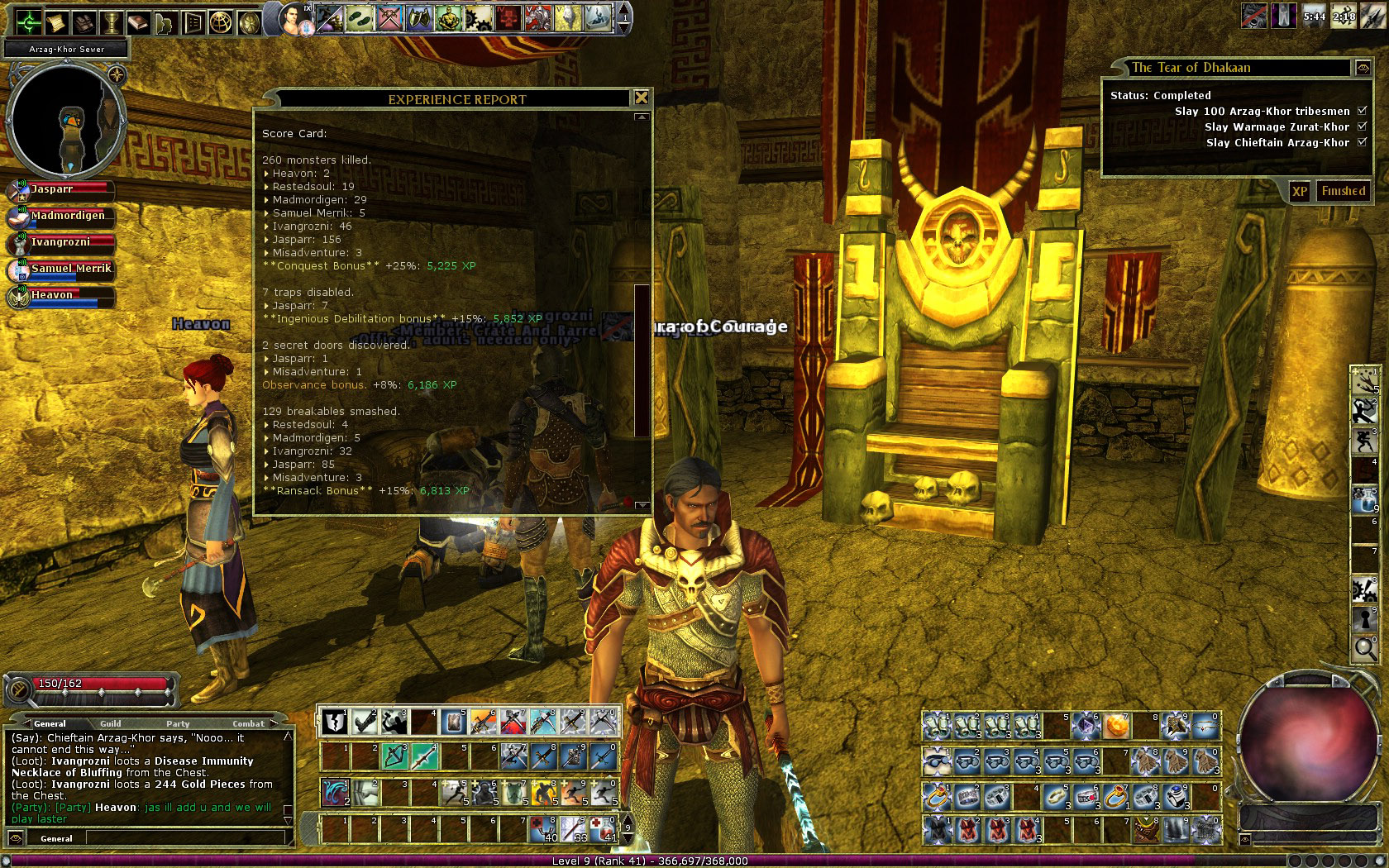
« Newer Posts - Older Posts »