Feeds:
Posts
Comments

Archive for the ‘Literature’ Category

Recently, my interest in online social networking has waned considerably. For a while now I’ve been questioning the motive behind expressing my feelings, desires and frustrations, or simply providing factual information about where I am and what I’m doing at any given point. I have, of late, been tweeting and updating Facebook much less frequently, and have completely failed to jump on the Instagram / Foursquare bandwagon. This seems slightly ironic considering the fact that after several years of wanting one, I finally acquired a smart-phone two months ago and thus have the capacity to be connected at all times.

There are, of course, many reasons for participating in social networks and people use them in a variety of different ways. Whether it is to maintain contact with friends, to make new friends, to pursue romance and sex, to promote themselves or their business, or simply because they can’t resist telling everyone everything about their life, people the world over are using social networks in ever increasing numbers and are likely to continue to do so.

Recently, sitting at a bar in Melbourne with my girlfriend, V, I realised that, despite being on holiday in another city, and despite doing a variety of different and exciting activities, eating great food, visiting galleries and museums, seeing quality exhibitions, going to a variety of cool bars and cafés – precisely the sort of thing people often tweet or update Facebook about – I had not once tweeted nor updated Facebook. For those of you out there who have never felt the urge to join Twitter or Facebook, this will all seem perfectly natural, yet for those of us who have been on social networks for some time, it’s the life-logging equivalent of a black hole.

I started talking to V about this as we sat drinking a most excellent local, cloudy cider in a new joint on Brunswick Street, and her first suggestion was that I didn’t feel the need to share everything because I had someone to share it with already – namely, her good self. This seemed to hit the nail right on the head, and it got me thinking that actually my waning interest in sharing such personal information and experiences was in large part due to being in a relationship. Was this really the sole, or, at least, principal reason? I doubted the former, but had to ask myself the questions: why, after all, did I join social networks in the first place, and what purpose did they serve in the present?

I suppose I got a taste for it from playing World of Warcraft. Despite only playing the game for a couple of months in mid 2006, the random connections with people the world over and my experience of the collective power of in-game Guilds was both eye-opening and intimidating. As a shy person, new to the game, I suffered the dreadful fear of being a noob and being seen to be such by other, more experienced players. Yet, shortly after joining, I realised that actually most people were pleasant enough and perfectly willing to help or give advice. I must have got lucky, I suppose, knowing in retrospect how many trolls inhabit the average game server these days. Either way, I came away from World of Warcraft loving the idea that I could connect with people the world over and have fun with them, even if the exchange was not necessarily meaningful. Being single at the time, living in a foreign city where I had as yet made few local friends, this was an attractive and easy way to have company.

It wasn’t long after this that I joined MySpace, to which I was introduced in late 2006 by work colleagues at the Corn Exchange theatre in Cambridge. My first inclination was to deride MySpace as a shameless vehicle for self-promotion and egotism, but reserving judgement publicly, so as not to risk having to eat my words later, I tried to be more open minded about it and soon found it rather inviting. What ultimately drew me to MySpace was, ironically, the shameless egotism of it. It seemed like a fun idea to have an online profile which somehow reflected the Me that I liked and allowed me to present myself to the world in what I considered a cool, flattering yet also slightly ironic, self-deprecating manner. I also joined because it enabled me to connect with my colleagues and have fun with them at work in a new and interesting way.

In truth, beyond these rather self-serving motives, I couldn’t see very much point to my MySpace page. After all, the people I was primarily connecting with were those I sat next to at work. I did, however, get a buzz from being able to be friends with He-Man, James Bond and Monkey among many others. Back then MySpace didn’t make it at all easy to customise one’s page, post a photograph, or anything for that matter. Indeed doing so involved copying long lines of code into the appropriate field, which required a MySpace code-generating program of some variety. I liked having a few friends on MySpace, and I enjoyed recruiting a couple of old friends in Australia in order to make contact with them easier and more fun, and yet, it didn’t actually make contact much easier. In fact, it was still easier to contact people via e-mail and most of my friends weren’t especially interested in setting up a profile. Fair enough.

Indeed, e-mail still remained the principal means of contacting my friends and family in Australia. I have written elsewhere about my diarising – having kept a diary and not missed a day since the age of 13 – and, as a writer, I always liked to try to entertain people by sending an occasional e-mail to my closer acquaintances, describing recent adventures. It served a dual purpose: putting my life into a narrative context, and, ideally, entertaining my friends and maintaining a dialogue with them.

The last of such group e-mails was sent earlier that same year, in 2006, and the following year I edited them as appropriate and posted them on this very blog. No doubt it would have been easier to start a blog sooner, and I probably should have done so years before, yet I still felt a desire to conduct the conversation in a more private manner, and also to try to keep, in my mind, the sense of unity amongst my friends – most of whom I was now very far away from. A group e-mail would often provoke a lot of responses and it felt like the nearest thing to seeing all these people at a party – something I could not otherwise do.

I can’t deny that the motivation to tell people what I was up to was also largely egotistical – something discussed in more detail below. Perhaps I needed people to recognise that I was living a good life, an adventurous life – no doubt largely on account of my innate sense of failure so far as my two chosen career paths were concerned – namely academia and creative writing. Yet, I’d always been a terribly loud person at parties who liked to entertain – was that due to some form of extroversion, or the explosive, drug and drink inspired bluster of the introvert? Either way, I had long wanted to be the entertainer in groups and tried to play that role, with, it’s fair to say, a degree of success.

I first heard of Facebook when I started dating an American geneticist who had been invited to join by many of her university colleagues in the States. Yet it wasn’t until after we had parted ways, around April of 2007, that my friend Georgina, who was also on MySpace – and World of Warcraft for that matter – told me after a brief trial that she found Facebook to be far superior to MySpace. Not only was it a great deal easier to create and update a profile, it was also far more interconnected than MySpace, with the ability to tag things and thus create hotlinks between profiles. This interconnectedness seemed, at the time, quite revolutionary, and I instantly took to Facebook like a duck to water. Once I was hooked, line and sinker, I fired off e-mails to everyone in my address book, inviting them to join. This recruitment drive was far more successful than my MySpace recruitment efforts, and, within a couple of months, the new arrivals having similarly spread the word, almost everyone I gave a shit about was on Facebook. There were, of course, a rare few who remained for a long time reluctant, and who still shun joining any social networks of any kind, and sure enough, I lost touch with them after that. Oops.

Once I had a large network of friends – and on Facebook, to begin with, I was only friends with actual friends – I found myself using the site constantly as a means of staying in touch. It was, of course, satisfying for many reasons – reconnecting with people, catching up on news, sharing something amusing and generating an entertaining discussion. It was also fortunate that the people in my age-group – mostly mid thirties – were mature enough not to participate in any trolling or bullying and so the interactions were almost universally carried out in a dignified and courteous manner. Though, of course, there was the occasional lewd and inappropriate comment to add some spice to the mix. It was also pleasing to see how many people got together back in Australia as a result of Facebook. I felt rather envious of their ability to hook up in person so easily, and in truth, it likely would not have happened without Facebook or another similarly easy to use social network coming along.

When I finally returned to Australia, I was certainly in a better position to catch up with people and knew how to get in touch with them. And this remains the very best aspect of Facebook: it is the ultimate address book. Whilst some people come and go, switching their profile off for a while, most people remain pretty firmly on Facebook. And even those who do turn off their profiles often seem to pop back on at some point and rejoin us. So, full marks for connectivity, and for ease of contact and access. These days the only e-mails I send are for professional reasons or to my parents, who haven’t quite made the leap into the ageing present, for better or worse.

So there I was in Melbourne wondering why I was no longer very interested in trying to entertain people on Facebook or Twitter, nor feeling any inclination to share my adventures and experiences. Had I finally begun to feel self-conscious about talking about myself in public? If so, why this… Or was it the nature and relevance of the information that was now being called into question?

The conversation with V. progressed through a discussion of various psychological motivations for social updates – most prominent of which being pure, unadulterated ego. There is no doubt that ego plays a very great part in our participation in social networks. We like people to think we are doing well and take full advantage of the fact that we can doctor the public image we present to people through media such as Facebook. We post images of things we like, because we want other people to think our taste is cool; we untag unflattering photographs of ourselves and post attractive ones because we want people to see us at our best. We tell everyone about what a wonderful lunch we had, what a cool restaurant we’re in, what a wonderful sunset we saw, and post a photo of it so people will think we are living an enviable life and either admire us or be jealous of us. We are proud of our likes and dislikes and wear them like badges on social pages. We assert our opinions because we think they are valid and that others ought to take note. Parents post photos of their children, even going so far as to change their profile shot to one of their child – something I personally find rather disturbing, after all, I’m not friends with the child and I’m not sure it’s appropriate – because they are proud and want everyone to tell them how cute their children are. Through all of this, I doubt very much that the desire is purely one of sharing beauty with other people in the hope of brightening up their lives, but rather it is largely about drawing attention to ourselves as the providers of beauty, wit, opinion and cool things generally.

Of course there are different levels of connection within all social networks and different means of communicating. The “wall” on Facebook is where the public discussion takes place, often very frankly about private issues, but mostly about trivial likes and dislikes or pleasant, but otherwise quotidian experiences, such as eating a good lunch or seeing a good movie. Behind the wall one can initiate a far more intimate conversation about things one genuinely wishes to keep private, and people usually reserve the message format for such purposes. No doubt most of us have had the experience of a public exchange on the Facebook wall leading to a private exchange to determine whether everything is okay after having inferred something from a comment. Equally Twitter allows one to conduct private exchanges with followers, yet the limitations of the 144 character format make it more difficult to conduct a profound discussion.

Not all our expressions on social networks are positive by any means. People very often use Facebook and Twitter to vent, whinge, or lament their circumstances; often in a good-humoured fashion, but also in an angry or unpleasant manner. I certainly have been guilty of this on occasions when the world has seriously pissed me off, or when I’ve felt especially low on account of some personal upset. Such venting will often result in sympathetic responses, but also in ominous silence.

Interestingly, research has shown that because most people post about positive, happy experiences on Facebook, people who regularly use social networking sites often have a more positive outlook on life because they believe that all the important people in their lives are happy and doing well. Equally, however, people prone to status anxiety or those who feel less successful can also experience strong feelings of inadequacy on account of the perception that everyone else is doing better than they are in life. Have you never had that feeling of “Fuck you for having a good time, I’m having a shit one, thanks for rubbing my face in it”? We don’t tend to post such things, but I strongly suspect many of us feel it more often than we are willing to admit.

Generally, however, as is the case with social relationships in all bonded groups in the animal kingdom, particularly amongst primates, the benefits of maintaining social networks far outweighs the negatives. It is why intelligent animals, including ourselves, invest so much energy and make significant sacrifices to maintain social networks. Sustaining a friendship requires a lot of effort – be it baboons grooming each other for extended periods of time, or attending a function we’d otherwise rather not go to.

Our efforts online mirror our real-world social efforts: by liking someone’s post, writing a complimentary comment, or simply “laughing” at a joke, we sustain the sense of unity, trust and like-mindedness just as we would by attending an after-works drinking session or turning up for a BBQ. In reality, most people are capable of maintaining a maximum network of about 150 friends – the so-called Dunbar’s number. This can be broken down to roughly 5 intimates, 15 best friends, 50 good friends, and 150 friends, with, of course, some considerable degree of flexibility according to social skills, gender and personality. It is very difficult for people to maintain more friendships than this, because the effort required is simply too great, and the net benefits diminish as the number grows too large to be economical and sustainable. We may have many more “acquaintances” such as local shop-keepers and colleagues or clients, and there may be an even greater number of people we “recognise”, but Dunbar’s number holds largely true as a relative maximum for most people. Research also indicates that roughly sixty percent of our social time is devoted to our five closest friends, which means the rest is very thinly spread indeed.

So, having said all of this, and having had so many positive experiences on Facebook in particular, why was I now feeling a sense of pointlessness, or even, embarrassment, at the idea of making a harmless, friendly, possibly amusing and entertaining social update? What, I wondered, was my relationship to these connective tools, to these interfaces? Had I shifted away from the spirit of sharing, entertaining and egotistical self-promotion to seeing Facebook as merely an interactive address book? How did I want to use Facebook and for what purpose? Did it matter?

In recent years, I’ve become something of a slacker at reading other people’s updates. I often don’t look at Facebook for days and then get a slightly guilty feeling that I’ve missed something important. And I have missed some seriously big somethings at various points – births, marriages and a whole bunch of special occasions. I long since switched off all the e-mail notifications and I often don’t check the Facebook notifications, so I miss a lot of event invitations in particular. Sometimes I don’t even notice that people have messaged me directly. Then, one day, with the aforementioned feeling of guilt, I’ll plunge into the Facebook log and like a whole lot of stuff, post a comment or two, before clearing off again without waiting to see if anyone replies. It never feels very sincere. It’s not that I’m not interested in what my friends are doing – I am in fact very interested, but I can’t pretend I’m interested in everything they’re doing, just as I hardly expect them to be interested in everything I’m doing. I’m just glad to see my friends happy and prosperous.

What surprises me when I do log in is just how many of my friends seem continually to inhabit Facebook. Some of them appear to be there all day everyday, liking, bantering, commenting, posting… Indeed, more often than not, Facebook resembles a crèche or parents’ club – indicative of my age cohort and demographic – which leaves me feeling conspicuously out of place for not having children. I wonder if this perception has contributed to my gradual retreat from Facebook. I certainly don’t harbour any feelings of negativity or resentment, I just feel a little out of place, and perhaps a tad unnecessary.

So why make a status update? Why tweet? Why tell people what I’m having for lunch and show a picture of it? As I’ve said, I’ve always been a diarist, an historian and a collector, and Facebook makes a great log of one’s life which is immensely satisfying as a repository of experience and communications. I’ve also long been writing creative fiction and non-fiction and taking photographs and I suppose there is an intrinsic inclination in nearly all artists to want to share their work – partly for the sake of recognition, but also certainly because it is pleasing when other people take pleasure in it – for their sake. It is nice to have touched their lives in a positive way and apart from feeling chuffed about my work, compliments always give me a feeling of having done something good and worthwhile.

I suppose it’s a combination of these two principal drives that encourages me to produce material for publication, yet I wonder if I have come to draw some sort of line between art and life. What is the difference between an arty photograph and a photograph of someone’s exotic-looking lunch? Is there a difference when posted on Facebook or anywhere else for that matter?

A part of me thinks that there is a difference, so far as what makes me feel comfortable. In recent times I have become less comfortable with providing purely personal information – where I’m at, what I’m doing, though I have no such qualms about publishing a collection of photographs with some kind of written narrative, or, indeed, posting a piece such as this. I’d like to think that the “art” or discussion is in some way educational, stimulating, provocative etc, just as this piece of writing might be in some way informative and educational. I don’t mean to suggest the photos I take or what I write is some worthy, lofty thing, or that I am in any way  superior to other people, it’s really about where I feel I ought to be putting my energies and what I consider a worthwhile form of expression. I guess I have lost the desire to be so open on a day to  day basis: where I’m drinking, what I’m having for dinner, what I’m listening to, watching or anything else for that matter, just doesn’t seem relevant to other people.

So, I’m left wondering, have I become boringly anti-social, have I drawn some unnecessary distinction between art and everyday life? I’m not sure, though I do feel less inclined to post purely social updates as I can’t shake the feeling that the only true motivation is to solicit attention, which seems somehow unworthy and makes me feel like a desperate fool shouting “look at me!”

So, sitting there at the bar in Melbourne, I was perfectly placed to check in on Foursquare, Instagram the bar, tweet about the cider and write a status update telling everybody just how bloody great a time I was having, except that, in reality, I was having far too nice a time and a good conversation to want to do any of that. My amazingly capable phone sat idly by, ready to help where necessary, but otherwise content to perform its basic functions of telling me the time and receiving calls and messages.

I suspect this stepping away from social networking is a phase. When I was single I continually inhabited the net, because I really wanted to make connections. I turned the Facebook instant messaging service back on, I put profiles on several dating websites and played the game hard, constantly instigating and answering e-mail conversations with prospective partners or bed buddies. Now, in retreat from unnecessary contact and communication – which is time-consuming and often undesirable – I feel somewhat reassured that my motive was not purely egotism, but the desire to find a cure for loneliness. Should I ever find myself single again, which I sincerely hope will not be the case, then I imagine I’d take up Facebook and Twitter again, along with other connective interfaces, with enthusiasm. For now, however, I need to find the motivation to do the bare minimum to sustain my existing friendships – which is challenging enough in itself!

ps. As a final irony, I’m now going to post this on Facebook and Twitter : )

Read Full Post »

For someone who, like so many people, is obsessed with and totally dependent on the internet, I have been strangely resistant to it at various points. The first I ever heard of the internet, though I’m not even sure it was called the internet yet, was at my friend Mike’s house in 1992. He and his housemate Laughlin used to log into “Bulletin Boards” on their 386s, much to my annoyance, as the occasional seventeen-hour download prohibited playing linked death-matches of Doom II – a favourite pastime whilst smoking bongs and eating Lebanese takeaway. The only thing that got my interest back then was the mention of the word “porn”, which at the age of nineteen still afforded rare titillation.

During the following years I came increasingly to hear talk of the “internet”, yet it remained something seemingly obscure and unnecessary. What, really, was the point of it? If I wanted to contact someone, why not just pick up the phone? What information could it provide that I couldn’t get in the university library? I still shudder to think of my reaction to seeing, c. 1997, a web address listed beneath a film title in a cinematic trailer. All I could think was – Why the hell would anyone want to go to the web-page of a film? It all seemed rather pointless.

By the end of 1997, however, my stance on the internet had softened considerably. I don’t know exactly what brought about the change, but one day, sitting with my friend Stephen in the Psychology department at the University of Sydney, I asked him if I could send an e-mail my friend Gus. I had become curious enough and self-aware enough to realise that actually my resistance was a kind of knee-jerk jealousy born of my technologically backward state – I was still writing on my dad’s massive old 128k Hitachi HiSoft word processor, which dated from 1982. It’s fair to say, considering how primitive that word processor was, that I actually lacked a computer.

My excitement at Gus’ receipt of my e-mail seems ludicrous in retrospect, but within months I had set up a hotmail account – the very same one I still have – and my interest in the internet was born. I still resisted getting it at home, but regularly began to use the net on the university computers, almost exclusively for e-mail. This use of e-mail became obsessive when my then girlfriend moved to Cambridge at the end of 1998. By early the following year, we had broken up and I started seeing someone else who, heaven forbid, actually had the internet at home. I still recall the garishly colourful pages of the many Geocities sites she used to visit – back in a time when ICQ was all the rage.

It was only in September 1998, when I myself moved to Cambridge to study, that I finally got an internet connection in my room for the first time. The whole of Cambridge was already wired up with broadband and I was fortunate in having a very fast cable connection to my house. The internet of those days still retained much of the clunkyness of its infancy, with less slick and dynamic web-pages, and it lacked many of its now dominant staples such as Facebook, Twitter, Wikipedia, yet it had at least evolved into the great communication, ticket-booking, holiday-planning, information gathering tool that it remains today. It wasn’t long before I was utterly dependent on the internet and it became impossible to imagine living without it.

When I returned to Australia in 2003 I was shocked to discover that most people were on dial-up. I struggled for a while with my parents’ connection, but when I moved to a flat in Glebe – just a few doors down the road from where I now live – I eschewed getting the net. This was partly because most plans were both slow and expensive, but really it was because I was doing a Masters in Creative Writing and writing a lot and I was afraid that it would prove a major distraction. It was the right decision, and I don’t doubt that my huge output at that time, both in writing and photography, were in part due to not having my computer time interrupted by constantly checking the web. I had access all day at work and so could get most information I needed during those hours. Still, it was frustrating not having it at home, and I often regretted it.

What frustrated me most was the inability to have any question answered immediately when writing. If, for example, I wanted to set a scene in Kinshasa, as I was doing at the time for the novel I was then writing, I couldn’t simply Google images of the city, nor articles or blogs from which to get further insights. I could do this at work, but it was annoying having to wait to have a query answered and to get information as soon as the question entered my head. Again, however, there were advantages for productivity, as I was able to write for hours without distraction.

When I moved back to England in 2006, it became immediately apparent that living without the internet in a foreign country was simply untenable. Apart from wanting to stay in touch with people, the new novel I was writing seemed continually to throw up queries that wanted quick answers. Since reconnecting shortly after settling down again in Cambridge, I have never looked back and lived without the internet. This has, of course, been the mixed blessing I imagined it might be. The access to news, information and social media is of course, wonderful, but the amount of time consumed by surfing and the scale of distraction it can cause is breathtaking. When Facebook got my attention in early 2007, I was, for a while there, gone for all money.

I have since come to the rather spurious conclusion that I can’t in fact write without the internet, because I constantly like to check facts, details, definitions and the like. I know, however, that this is not quite true, and sometimes I still switch off the router when I need to have a very intense focus and work on something without interruption. It is worth mentioning that in 1997 and 1998 I read, on average, 120 novels a year. Now I average around ten. Shameful.

So all this brings me to the subject of smart phones. From the moment they appeared on the scene, I wanted one. I was terribly jealous of those people I saw sporting them and my friends who rushed out and got them, because of their ability to have their queries answered almost instantly. This capacity to Google anything at any time, reception permitting, was too exciting to dismiss – yet I dismissed it for some time.

I’m still not entirely sure why, though it was a combination of factors. There was my concern, having been a heavy MMO addict for some time, that a smartphone would just be another obsession. I spent enough time on the internet already – did I really need to be surfing whilst on the bus or train? And those journey times were, after all, my last bastion of dedicated reading time. I feared that if I had a fast internet browser in my pocket, I’d never read a book ever again.

Another reason was cost. I inflated this in my head as a barrier to acquisition, despite the fact that it would have only cost me five more dollars a week than what I was paying already on my pay-as-you-go dumb phone. It wasn’t so much the cost that I found prohibitive, but rather the idea of committing to a two-year plan and not being sure about where to start or what to commit to. If I was going to upgrade, after all, then I should want to do it properly, and yet I found the entire world of smart-phones to be dauntingly diverse. Where should I begin?

This leads quite naturally to the next issue I had – the fear of being a noob again. Nobody likes being a noob, let’s face it, although a truly exciting new pastime does allow for once-in-a-lifetime enthusiasm that cannot be sustained or recovered. I hated the thought of having a new phone and not knowing how to use it, almost more than I hated the idea of not having one and feeling materially and technologically backward and isolated.

This peculiar blend of not especially serious objections somehow teamed up to keep from getting a smart-phone for several years after their appearance on the market. Even when they had become utterly commonplace and were far cheaper and better than in their first flush – even then I resisted and opted out. And then, about a month ago, having witnessed for so long the convenience and utility of having access at all times amongst friends, I decided I couldn’t wait a moment longer and started looking.

It was worth the wait. After a few days spent researching the phones on the market, I had narrowed things down to a choice between the HTC Sensation, the iPhone 4S and a couple of Samsung Galaxy variants. During a lunchbreak at work one afternoon I began to ask around the various shops in town to see which networks had the best deals, when I discovered that the Samsung Galaxy S3 had been released that very day. There were a slew of good deals flogging this phone, with bonus data, plenty of credit and no upfront costs for the phone itself. I ran back to work to use the internet – an irony that wasn’t lost on me – and read as many reviews as were available of this new phone. I was astonished to discover just how well received it had been and, without further ado, signed up after work for a two-year contract.

Sure enough, I love my new phone. It is a beautiful piece of machinery, with a smooth, slim design and gorgeous screen. The quad-core 1.5 gig processor is almost laughable overkill – it’s so good it’s broken, and on wifi it absolutely rips. There’s little need to wax lyrical about the convenience and pleasure of having internet access at all times, suffice to say that it has already proven extremely useful. Sure enough, as predicted, I felt like a complete noob for several days, holding the thing very delicately and clumsily getting used to its features and inputs. I must shamefully admit that I have occasionally allowed my noobish enthusiasm to show in the company of others, but feel reassured that I haven’t become completely obsessed with my phone. I feared becoming hooked on using social apps such as Foursquare, that I’d be tweeting all the time and updating Facebook like I’ve not done since 2007, yet since getting it I’ve had little enthusiasm for such things. In fact, my use of the phone has been most satisfying for being informative – I’ve primarily been using it to read the Guardian and Al Jazeera on the way to work – which has, of course, cut into my reading time. And yet, I’m reading, aren’t I? Can I really complain?

And so, finally, the internet is in my pocket. It is a great leap forward, if a significantly delayed one. I cannot now imagine ever being cut off from the internet again, even during a bus-ride. Yes, I do need to know the name of that film I can’t remember – now, not later. Yes, I do need to have Google maps to guide me whenever I get lost. Why put up with a lack of information in a world where we can outsource both our memories and information gathering at a negligible cost?

The kids I teach after school, all aged between fourteen and sixteen, have never lived without the internet. They are often so immersed in it that they seem to have little contextual historical understanding of just how recent a phenomenon it is. A part of me shudders when they say – “But what did you do without the internet?” and it feels like an even bigger question that what did people do without the gramophone, cinema, radio, or television. I’m left wondering – “Holy shit. What on earth did we do?”

So much of my youth was spent agonising over not knowing the answers to things, wishing I could watch a video again, longing to learn about the world at large, wanting to hear a song or just know the name of something. The first port of call for general information was my father and mother, then the encyclopaedia. It was frustrating, especially as there was little control over the sources of information, without access to a world-class university library and hours of time at my disposal, and even that could not help with contemporary pop cultural information.

When I was eighteen, we used to talk about how great it would be if there was a place where we could get the answers to all our questions. My then girlfriend told us there were some guys on the radio you could phone called The know-it-alls.

“You just have to ring up and ask,” she said. “They can answer any question.”

“How?”

“Dunno. They just know a lot of stuff. Maybe they use encyclopaedias.”

If they even existed, and you got through, during their obscure radio timeslot, you might just have had your query answered. Mmmm, well, thank fuck for the internet, which will not be leaving my pocket any time soon.

Read Full Post »

I put the shirt back on the rack and gave it a last look of farewell. It was a tad loose around the middle and, being very picky about the cut and fit of a shirt, it hadn’t quite made the grade. Still, it was a Diesel shirt with a nice collar and cuffs and an arrangement of blue and maroon stripes on white which I rather liked. I decided to let it go.

I looked at the other shirt I was still holding. It was a perfectly respectable, blue, white and black striped business shirt – ideal for day to day use when teaching – the sort of boring, unadventurous, yet reassuringly generic shirt that allowed me to remain both anonymous and blandly appealing.

For years I’ve been trying to blend back into the modern world, after a long Indian summer of youth in which I rejected everything mainstream and uniform.

When, now more than a decade ago, it dawned on me just how unindividual self-professed individuals were – who proved, more often than not, to be far more image conscious than the cattle they derided – I came to understand that anonymity was, in everyday life, a blessing.

I put the second shirt back on the rack. After all, it was practically identical to another one I had at home, if slightly less attractive in its colouring and thickness of stripe. It did fit me perfectly, however – so well that my girlfriend, V, who was busily prowling through Vinnies with me, had remarked at its figure-hugging qualities when I emerged from the change rooms. I had gone in there with five shirts, hoping no one would be officious about the three-items only rule. The other three shirts occupied the same end of the spectrum as the two I’d ultimately selected, then rejected, and consequently they were now all reunited on the colour-coded rack.

I lingered a moment, asking myself once more whether I wanted these two shirts. Second hand, the two were a mere thirty dollars, yet without any urgent need, the purchase seemed frivolous unless I was utterly sold on the style and cut.

Vinnies, it is worth mentioning, is a chain of charity stores who recently rebranded themselves from St Vincent De Paul. It is also one of the greatest places to shop in the known universe. There are stores everywhere in Sydney and around Australia and their range of offerings is quite formidable. Some of the larger places do furniture, household goods and kitchenware, though many only have room for clothing, books, CDs, records and the like. What makes Vinnies so attractive is the sheer amount of stuff they sell. Inevitably, anything cool and retro gets picked out pretty swiftly by hipsters, nostalgics and various other subaltern fashionistas, but there is still plenty to choose from and every so often one gets extremely lucky.

Vinnies is especially good for business shirts, trousers and suit jackets. There are quite simply so many thousands of business shirts worn and tossed aside in the world that the average Vinnies store will have upwards of three or four-hundred to choose from. Many are at the extremes of size, and many are so awfully tasteless as to garner no consideration whatsoever. Yet somewhere in that horde there is usually a very fine garment or two waiting to be snapped up. One of my favourite places to shop is the Paddington store on Oxford Street. Owing to the very wealthy and decadent nature of the locals, this outlet regularly has high quality items on its racks. I recently purchased a fine blue and white striped Van Heusen business shirt – now a teaching staple – for a mere twelve dollars. When I got it home I noticed that it had a recent dry-cleaning tag on it. Only in Paddington would someone have a shirt dry-cleaned before donating it to the local charity shop.

Another great thing about shopping at Vinnies is the complete lack of attention from staff. They are certainly helpful when approached, but otherwise they leave you alone. As there is no hope of asking “do you have this in a different size?” or “will you be getting any more of these in?” it makes for a wonderfully free and aloof shopping experience. Another great plus is that Vinnies only sells second-hand goods, which is marvellous for the environment in a world which produces far too much of everything, irrespective of demand. This knowledge, however, is tempered by the sorry fact that people actually wore some of the dreadful things on the racks in the first place.

So, having rejected both shirts, I walked back to the counter where V. was purchasing a woollen jumper.

“I decided not to get the shirts,” I said.

“Oh, why? They seemed fine.”

“Yeah, I dunno. Just not sure I really need them.”

“But they looked very good on you.”

“Did they? Oh, thanks.”

“Yes, you looked good in them. You know, handsome and respectable.”

“Oh. Yes, but – ”

I hovered a moment at the counter. Thirty dollars was hardly a big ask, and it would add flexibility to my relatively limited wardrobe. As a clothing minimalist, I usually maintain no more than about four or five outfits – combinations to which I regularly return for their comfort, style, casualness, formality or climatic-suitability. I suppose at the very least, more shirts would add a little lee-way to the wash cycle.

“Okay, fuck it. I think I’ll get them.”

Sure enough, I walked back to the rack and collected both of the shirts.

Later that day, back at home, I noticed a small stain on the arm of the Diesel shirt I had purchased. My current fad is to soak everything in Napisan for twenty-four hours to remove the inevitable yellowing around the collar and armpits. Napisan works wonders, it must be said, and my shirts have never looked cleaner. I filled up a bucket with hot water, stirred in a capful of Napisan as directed, then preceded to soak the two shirts.

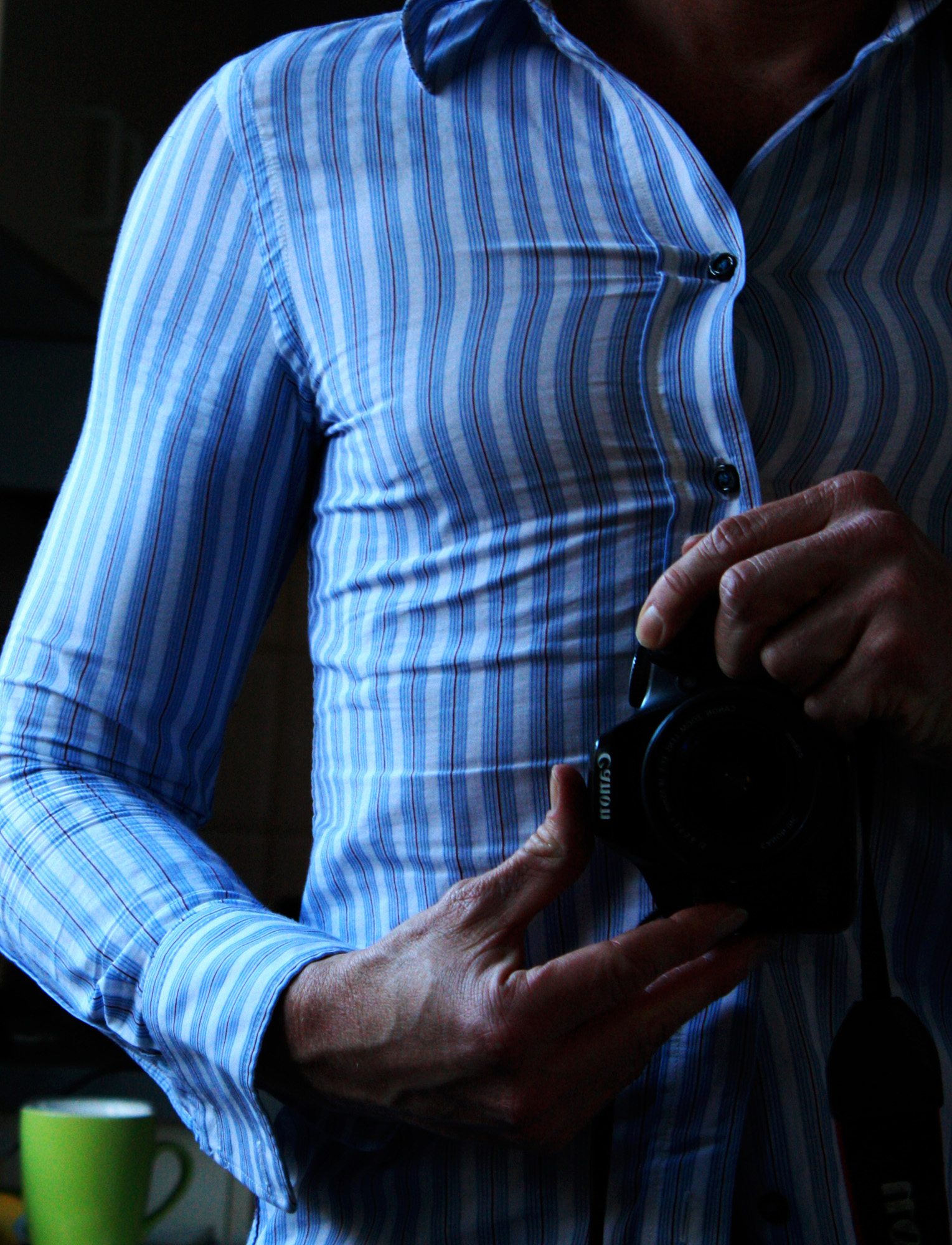
The following day, having put the shirts through the wash, then ironed them and hung them up to dry, getting ready to go to work, I took the Diesel shirt off the hanger and attempted to put it on. That something had gone horribly wrong was immediately apparent, for I could barely get my arms through the sleeves at all. What had, in the shop, been a size too large for me – a little ballooning around the middle, which I thought would be countered by wearing my favourite vest over the top – was now about three sizes too small. I managed to get my arm through one sleeve; pulled it around and forced my other arm through, but the tightness across the shoulders and chest were such that I could not do up the buttons!

I tugged and stretched the fabric as best as possible, yet it was quite firmly stuck in its new size and didn’t seem inclined to expand at all. I flexed, I pulled, I wrestled with this straight-jacket, and finally, after much effort, managed to do up the buttons. I knew already that I could not wear the shirt out, but hoped that if I wore it and flexed and moved about a whole lot, it might, given time, regain some of its former size. After all, it would ultimately be advantageous if the shirt finished up a little tighter than when I had originally tried it on.

I wore a different shirt to work that evening, and when I returned home after work, put the tight shirt back on and wore it round the house. I flexed, I stretched, I pulled, I bent, but to no avail. Not only was it uncomfortable, but it looked bloody ridiculous. And, I’m afraid to say, it still does.

The buttons strain across the chest, the sleeves hug my arms like a leotard, and whenever I move it rides high, popping open at the chest and sending the collar skywards like the headdress of the flying nun. Still, having spent so long deliberating over this purchase, having invested in it in this manner and feeling a certain fatefulness about the decision, I am determined to get the damned thing back to a wearable state. And so, for the last week, I have adopted it as my home shirt, to be worn as often as possible in the hope of loosening things up a little. It’s slow going, though I’m hoping ultimately to make some progress.

Having mentioned the saga of this shirt on Facebook, I’ve had a few tips as to what I might try. One friend, Sarah, suggested I go running in it. On Saturday evening, I did this – looking very silly indeed as I pounded around the streets of Glebe, my chest ready to burst out and my arms swinging robotically in the tight sleeves. On returning home, I took a long, cold shower, despite the winter weather, and stretched and flexed the fabric as much as possible. Having since hung it up to dry and attempted to wear it again, I found my efforts have made little difference in making this shirt wearable in public. Still, I hold out hope, and will continue to wear the shirt around the house. We’ll see who cracks first.

And so, by way of conclusion, I say to you people out there, check the washing instructions before stupidly assuming, as I did, that any shirt can be happily soaked in boiling Napisan. That is all.

Read Full Post »

This is a rather ribald and naughty short story I wrote in 2006, shortly after moving back to Cambridge. The title is a play on the famous post-coital quote from Balzac “There goes another novel”, indicative of how sexual satisfaction can sap creative energy. It contains adult themes and sexual references, so you have been warned. I’ve edited and re-edited this over the years, including just now, but its length has been prohibitive in submitting it to journals which almost universally have a 5000 word cap on short fiction. It is deliberately “overwritten” in deference to the style of the Baroque Minstrel, a nickname I acquired on account of my excitable and exclamatory conversational style. Having said that, this is merely a lurid fantasy, and not to be considered autobiographical!

A note for non-Australian readers:

Root (noun) (verb,  transitive / intransitive) – A synonym for “fuck” in almost all its uses. “Did you root her?”; “This thing is rooted.”; “I need a root.” and so on…


Here Comes Another Novel…

My thoughts had long been emerging stillborn. I couldn’t shake the tendency towards irony, which is really a despicable tone in which to write. It was nothing less than a thin disguise for a bitter indictment of the human condition. I was, admittedly, appalled by the state of affairs around me and had good reason to distrust my fellow men and women, yet the results were more the bile of perforated arrogance than the sweet renderings of the high and mighty distaste I longed to cultivate.

And then, after months in the doldrums, wondering what on earth should be the subject of my next novel, I started having all my best ideas during sex.

The recovery began one autumn Tuesday. I attended an exhibition opening in Paddington in the hope of free booze and totty. The theme was the Romanian harvest and the paintings were so surprisingly good that I was swept into a mood of delicious exposition. I clung to the few people I recognised and smoked everything they had on them; snaking glass after glass of wine and sinking against the wall with milky eyes. Outside was a long, lurid sunset, deepening to royal blue. Honestly, the last thing I expected was to strike it lucky.

I was riding a conversation about Harry Tangiers’ latest stage incarnation as a highwayman when this cracking girl called Charlotte joined in. She had long, wavy, dark brown hair, fine full eyes, pale skin and thin lips. She struck me somehow as Czech. So far as looks were concerned, there were few boxes left un-ticked, so I did what I always did on such occasions – raised my voice slightly and tried to sound more emphatically intelligent.

The conversation wended its way down a jauntily colourful path; art, books, politics, booze, the need to engineer a virus that killed only fuckwits, and slowly but surely the comings and goings saw Charlotte standing next to me. Being close to the wall and awfully drunk, I leaned back and propped myself up, hoping to draw her in with a relentless stream of words. When the rest of the talkers began to drift off, probably sick of the sound of my voice, I at last secured her exclusive attention.

“Goodness,” I said, after trying in fifteen minutes to divulge all my positives without looking like the incurable egotist I know myself to be, “everyone’s gone.”

“They are closing now,” she said, peering inside the gallery. “Looks like it’s all over.”

“No more booze then.” I moaned.

“I guess not.”

“Dear, oh dear.”

“You may not be aware of this,” she said, “but there are places called pubs and bars where they sell drinks. You have to pay, but they rarely ever run out.”

“Crikey, you must be an angel.”

It seemed we’d tacitly turned this into a date. I found the prospect both brilliant and terrifying for I could not bear the thought of letting her get away, but to go further into the night and maintain the energy required to charm and woo seemed such a challenge that I longed to be cowardly. The uncertainty of it all, the hoping against all the doubts and questions, the looming and potentially devastating revelation of her marital status… I was still hanging in there with a bawdy, roiling wit, but on the brink of uncontrollable sloppiness.

Fortunately the alcohol had not only robbed me of patience, it had also left me disinhibited. Before I could believe I was doing it and reel myself in, I took the bold step of seeking certain assurances.

“If we do go for a drink,” I said, pressing keenly against the wall to sustain my leaky stance. “What are my chances?”

Charlotte smirked and raised a hand to her mouth. She laughed with her eyes and exhaled through her nose. Her fringe fell crossways and blinked away an eye, and then she laughed out loud.

“Excuse me?” she said. “What exactly are you implying?” It was playful and uncompromised, though her tone betrayed at least a hint of shock.

“I mean,” I said, “that it’s been a long day.”

“Cryptic.”

“And if I’m going to spend my precious inner reserves of will to power another drinking session, I’d like to know now, for instance, that you don’t have a boyfriend and you’re not a lesbian and you don’t have children. Because, if we do keep drinking I’ll just get to like you more than I do already and then it’ll be a blow to me when I find out the truth.”

I struggle to make eye contact at the best of times, so I followed her mouth instead as it poised and twitched, curled and pursed, decoding my words for any measure of insult. I was pushing my luck, but you don’t get a damned thing if you don’t ask for it. Or worse, you get everything you never wanted, twenty-four seven.

“You’re very calculating,” she said. “Christ, and I thought Romance was dead.”

“Romance doesn’t have to be subtle. It’s the stuff of foundations, the root of myth, the mythology of rooting, if you will.”

I was pleased when she laughed at this, and I even laughed myself. It was a while since I had felt so lyrically lucid and I could see this Charlotte might just be the muse for whom I’d been searching.

“There’s no reason why a drunken lurch cannot be construed as romantic,” I added.

“Do you mean by way of a lunge? And what if you were to miss?”

“Or, if the target fended me off with what they call, in Rugby League speak, a ‘don’t argue’? Well, even then the humbling failure might become the keystone of a later, ennobling victory.”

She put her hands on her hips and frowned and smiled.

“So, then, are you going to make a lunge or not?”

“Are you going to fend me off?”

“Only one way to find out.”

“Hang about,” I said. But I didn’t hang about. Courage comes rarely and hence I’ve learned not to forsake it. I was on a slope, steep if short, and to lean away from the wall was a significant risk after all the wines and joints. Still, her words were the nearest thing I’d had to an invitation in a while and I longed to sink my hands into her hair.

Off I went. I launched myself with searching hands, hoping by a combination of balance and weighting to step neatly into her space. Her curls hung heavy and rich, tumbling down upon breasts so pert that they seemed to be craning upwards. I tilted towards this vision of loveliness, leaning across the chasm with the grace of a leading man; natural, gliding, firm and sure, and for about three eighths of a second I was on track. Feeling ahead with my right foot, however, committed to the step that would bring me into her ambit, I came down hard on the edge of the narrow, back-lane pavement and went shooting off sideways in a ghastly flail of word and limb.

“Fuck me dead!” I cried, striking the bitumen hard.

In she came, after me like a comet tail; long legs folding, calves tucking, heels pointing and hair spilling as her white blouse erupted with taut frontage.

“Are you alright?” she asked.

“No,” I answered. “That really fucking hurt.”

“Here, let me help you,” she said.

And thus, as I had so unwittingly predicted, did the mythology of our rooting begin.

______________________________________


Three weeks is a very long time when starting anew. It is also the best of times; fulfilment has not yet compromised the sweetness of desire and many questions remain unanswered. It took a week for our sexual rhythms to synch and after three weeks we were both champions of each other’s pleasure. Our conversations rushed with agreement, our passions found their fellows, and in each other’s space we became completely comfortable. Were I younger and more foolish I might have declared myself to be in love, but I have long since learned to wait and see. Love, lust, in love and loving – who can fathom these subtleties when they are completely and utterly cunt-struck?

And, sure enough, after three weeks, I was cunt-struck. Charlotte was marvellous – she had a high school debating prize, she wrote film reviews and book reviews, she’d studied fine arts and knew her way around an auction house – and she’d even read my first novel. I was enchanted and flattered, fulfilled and yet craving more and more. Best of all, however, my mood was lifting and the barriers were falling away – I could feel another novel coming on.

I once used to prefer to have people come to my place to be in control of the environment, the music, the atmosphere. As I got older I came to realise that it was better to pay visits in order to be in control of the coming and going. I also wanted to get out of my Glebe flat, which was beginning to feel tired, as was Glebe, and Charlotte had a wonderful, run down old art deco apartment in Kings Cross. The whole area was a thrill to walk through. I like to be titillated; hookers, lingerie, dance-clubs, tough guys and junkies; neon, trash, vomit and class. Walking past the pros and cons was a buzz.

Charlotte and I soon fell into a routine of spending time at hers. This way we both had the upper hand we liked best. Our shared vices ensured all was well; good wines, good food, marijuana, films, occasional cigarettes, coffee and of course, plenty of generous sexual intercourse.

So, one Saturday night, about three and a half weeks in, when our sexual familiarity had shifted up another gear, on the wings of two bottles of wine, having just finished a savage joint, we fell to dizzy fondling. I felt sloppy and submissive and was positively aching for a noisome wallow.

“Bedroom,” said Charlotte in caveman-like contrast to her recent discourse on Scandinavian cinema.

“Get yer kit off,” I said, standing from the couch like Superman in a mobile strip.

We made straight for the bed and feasted on what was revealed. My head was spinning in the wake of the last few tokes, yet salvation came in the form of utter commitment to pleasure, freeing my mind from all fear of nausea.

Ten minutes later I was on my knees, thrusting like a demon. Charlotte’s hair clung sticky to her back and I watched closely as the skin slid palely across her bone and muscle. Her shoulders were hypnotic; thin yet unyielding, feminine but by no means frail. The narrow isthmus from her hips to her ribs became the playground for my hungry eyes. There was grunting and sighing and no hint of holding back. I was thrilling now in all forms of sensual pleasure; muscles and joints, warm with exercise, hard as a rock, and shoulders prickling with sweat. The droplets gathered on my forehead and chest and my hands became slippery with rivulets of humidity.

Then, it happened.

I began lifting from the scene, entranced by the rhythm. The more I shovelled, the more I sweated, the more I became detached from what I was doing. My brain had been running with a sexual discourse – give it to her, thrust you ape, you barbarian, you baboon, shove and push and yes, that’s the way – the dirty talk of the lustful mind on the job in a post-porn world; only now a new voice began to emerge as I forgot somehow what I was doing and focussed instead on the motion alone in which I was caught. Soon, through its aerobic continuity, through its meditative intensity, through the driving, cardiovascular mesmerism, I lifted away altogether and began giggling inaudibly. A gate had opened and in rushed a thousand thoughts.

Fast upon the heels of a blinding flash of butterscotch came a Shakespearian figure gesticulating wildly, like a man in a blender trying to get out. Now he was happy and declaiming how so. He was chuckling and robust; a young and trim Falstaff in belching pantaloons; poignard and rapier slung from his gyrating hips. About him cowered all the trivialities; sun and moon and stars, diminished by his cheerful bombast; about his feet, the faces of a sunken audience; admiring, worshipping. As musical notes flowed physical from his lips, it soon became clear that these were the hopeful delusions of the man himself. Yet, who was he?

Before me the isthmus, the skin sliding upon bone and meat and cartilage; the silk screen for these vibrant scenes. And in my mind still far from the geography before me, this Bardic gent stood proffering his baroque exhortations and entertainments. Now he was on a street corner, unleashing his smiling rhetoric against some wrong-doers in a window opposite above a convenience store; making bold and heroic a petty disagreement. Now he was on the steps of the town hall, addressing a protest, rousing a hundred thousand cries against injustice.

Who was this jester, this troubadour, this raconteur? Who was this thespian, this demagogue, this chanteur? Who was this baroque minstrel?

I pondered these matters; thrusting, dripping, adjusting my grip; smirking, then broadly smiling. I began to giggle again, only this time there was no restraint. My amusement had been steadily growing and now ripened with hilarity. Who was this baroque minstrel? A vision of him quaffing a tankard and leering through a hundred songs of mirth destroyed my equilibrium. I erupted with laughter, spittle flying towards the wall, slumping forward, arms weakening, staggered in rhythm, divorced from sensuality by this intense distraction from what had begun as engulfing indulgence.

“What?” said Charlotte, turning in an attempt to look at me.

“Sorry, sorry,” I gasped, out of breath.

The beat was lost, but so used to the motion had I become that I did not stop altogether.

I laughed again.

“What’s so funny?” she asked.

“Nothing, honestly. I was just enjoying myself so much it seemed almost ridiculous.”

I let my weight go fully forward and kissed her perspiring shoulders. We collapsed loosely to the mattress. I still did not wish to stop and continued with a few slow pushes. Charlotte pressed against me eagerly, yet we had come down several gears.

“Go on, then, what were you laughing at?” she asked.

“I don’t even know, honestly. It was just random. This pot is quite out there, I have to say. Maybe that was it. Either way, sorry. I felt so good it made me laugh.”

“It’s just a bit disconcerting when the person rogering you starts laughing to themselves behind your back,” she said.

“Sure, sure, I can imagine,” I said, still slowly grinding away. “I know it’s a bit ludicrous. But it had nothing to do with you.”

“Well I hope no one else was involved.”

“Ha! Touché. No, no, there was no one else involved.”

“Just a few clowns by the sound of it… Good then,” she added. “Just keep your mind on the job in future, eh?”

I smiled at her playful reproach and picked up the pace again; needing to prove now that I was serious about the task at hand. And believe me I was, for sex with Charlotte was no mere thrust and bust fest, but rather a sensual hip-dance of a thoughtful and measured nature. It was energetic, but delicately nuanced; total, but not undiscriminating. We were, after all, just getting started.

That said, despite my genuine enthusiasm, after being so merrily off with the planets I had to find my way back to Charlotte through concentrated effort. I was afraid of laughing again. For all my off-hand dismissiveness, it had been deeply embarrassing. What was foremost on my mind, however, was the revelation of this new character and a new novel. Already I could see how to use him, and already I could see the title that would focus my mental keywords.

The Baroque Minstrel!

A Novel by

The Baroque Minstrel!

I needed to come quickly so I could go and make some notes.

______________________________________


The following day I was home by eleven and writing like a king. My mind felt slow and cloudy, yet a clear stream ran through to my fingers. I was banging out chapter one of The Baroque Minstrel! by The Baroque Minstrel!

It was a struggle at first to recall all my ideas and shape the burgeoning outline, but once underway I was mapping like Mercator.

It was Sunday and I had nothing to do other than my own work until Wednesday. So, when five o’clock came around and I had three thousand words and a brutaliste chapter outline, I phoned Charlotte to confirm prior plans for me to visit.

I bought the wine and while Charlotte cooked I rambled for an hour about The Baroque Minstrel. We talked over character, plot, subplot, voice, length, structure. My excitement had me on my feet the whole time, pacing the kitchen, waving my hands about in a manner not entirely unlike that of the Baroque Minstrel himself.

“If you want to make him a boastful, but lovably misunderstood genius, caught up in violent times,” said Charlotte, “Benvenuto Cellini is the first thing that comes to mind. Why not model him on that?”

“Zounds!” I cried, in the idiom of my new-found late Renaissance / early Baroque mindset. “What a brilliant idea.”

And it was a brilliant idea. I had spotted Charlotte for a potential muse the moment we first began talking, which had encouraged my initially outrageous boldness. Now I could see how it was paying off.

I took her hips in my hands and kissed her neck.

“You know you are truly wonderful, don’t you?” I said.

“Of course.”

An hour after dinner, we were in bed. We’d smoked a joint with dessert and had both been in the thick of it for some time, lacking any narrative cohesion. Yet, by the time we hit the sack, things were clearing up a tad.

As was the case the night before, we soon slid into the rhythms of pleasure and found a narrative in its vital, instinctive continuity. We flicked between foreplay and fullplay, our bodies soon wriggling with the grace of well-lubricated machines, and sure enough, as had happened the night previous, my mind set off elsewhere, beckoned by a certain antique proponent of unabashed minstrelsy.

The timing was very different. I was going down on Charlotte and working busily away. I’d learned by now that despite my every trick it took at least seven minutes to get her there, and after the first few minutes, when my tongue hit autopilot and my ears became focussed utterly on the notes of her breathing, hot blood pooling in my head, it was then that I entered the realm of the baroque.

Was this wrong, I wondered, to be off away with these thoughts? Why should I not combine work with pleasure? I had not slipped a moment in doing what I loved so much to do; playing her sighs like a bagpipe. This moment really is for her gratification, more so than mine, so why should my mind not be free to outline and to plot?

Having decided that The Baroque Minstrel was to be a retro-futuristic tragi-comedy with a touch of steam-punk, I needed to make people laugh as well as cry, and that meant conjuring funny scenes, a risky prospect considering my recent misdemeanour. Already, were they not otherwise engaged, there would have been a smile on my lips. So enamoured was I with my new creation that the very thought of the Baroque Minstrel tickled my fancy.

Just don’t laugh, I told myself, recalling those high school moments of being disciplined by a teacher and, in a fit of nervous panic, pissing myself to the worst possible effect.

And then, without any warning, I was off. I choked, I spluttered, and I came up laughing aloud. Straightaway the music died.

“Oh, Christ,” said Charlotte. “I was so fucking close!”

She sounded more exasperated than angry.

“Sorry, sorry,” I said.

“Why are you fucking laughing?”

“God knows, I just-”

“What’s with all the laughing all of a sudden?” She was up on her elbows, staring at me through a tangle.

“Hell knows. Perhaps it’s the pot. I dunno. I just started laughing.”

“You must have some idea why.”

“Not really,” I lied. “Maybe it’s just being down there, you know, there’s something intrinsically funny about it all.”

“Gee, that’s a relief. I thought it was pretty serious business myself. Next you’ll be telling me there’s something fishy going on.”

This really had me in stitches and I had to sit up fully to let the laughs out. Charlotte started chuckling too and then we both had a good old belly laugh at her prime piece of wit.

Yet, the interruption had occurred all the same, and when we finally got back to things I had to finish her off with my fingers, biting the pillow.

If only these thoughts would come to me in the daytime! I’d rarely had such clarity in conjuring scenes and characters. There sure was something fishy going on, but it was proving damned profitable for my work. The Baroque Minstrel’s revelations might be ill-timed, but they were pure gold. The major concern was of course, that if it went on much longer, it was going to throw a bloody great spanner into our love life.

______________________________________


By Tuesday I’d hit the wall with Chapter four and wondered where to go next. Nothing was coming and I needed my muse. Charlotte was busy with work and parental catch ups and I would not be able to see her until the following night. I wanted to run a few things by her and get her opinions, but it had to wait. Plus I hoped that if the circumstances were right, the Baroque Minstrel would reveal more of his secrets.

When Wednesday came around I was feeling desperate and dry. Nothing I wrote had any merit whatsoever and when I looked at the unfinished paragraph in front of me, it was lifeless and bloated; effete and unworthy. The motor was starting to stutter…

Come Wednesday evening I was over at her place in a flash. It was my turn to cook dinner and as we chopped and boiled and fried and drank in the kitchen, I let Charlotte in on my concerns about the overall structure. I didn’t want to get too far into the novel before realising I had to rework everything. Reworking was inevitable, but it would be nice to avoid a complete overhaul.

“I’m not sure what you should do,” said Charlotte. “Perhaps you should start with his childhood after all. Or, maybe with him looking back. With the final scene.”

“Mmmm, you see how I’m torn? It’s supposed to be an autobiography, but that would bug me since he’s going to die at the end. I need to know what I’m working towards.”

“I’m sure something will come to you.”

“I hope so. It’s stopped me dead in my tracks.”

Yet, as I had so slyly hoped, salvation was just around the corner. Sure enough, with uncanny timing, after dinner, going vigorously at it, the Baroque Minstrel appeared to me as we approached a much needed mutual climax.

This time, however, there was a different interruption.

“You’re not about to start laughing again, are you?” breathed Charlotte.

“No, no,” I pushed. “Not this time.”

Though my train of thought was broken, it proved a timely intervention. She had brought me back from an epic poem of the worst kind, which was just about to get uproariously funny. It was the way the Baroque Minstrel bunched up his cheeks and broadened his smile as he geared for his whimsical punchlines. I might well have laughed my guts out, but instead I drove on. My questions about the Baroque Minstrel had been answered, and I had gotten away with it.

For the rest of the week I was writing like a madman; five chapters, six chapters… Two weeks later I was pushing on into chapter nine.

It seemed I had mustered sufficient self control to stop myself laughing and was able now to enjoy the fruits of my labours. And there was a great abundance, let me tell you. The best ideas were bursting forth during our hypnotic couplings. It was a mantra, a meditation, freeing the mind from the present by making the present so heavenly it was not to be believed. Out it all came: plot, structure, dialogue, nuances, idioms, colours, tones…

Then one evening, four weeks after I’d first erupted with baroque chortling, with my head tipped back and my hands on Charlotte’s hips, working away like a piston as the Baroque Minstrel wound up a ribald song about politicians in the context of a Milesian farce, Charlotte caught my distant eye and her features grew perplexed.

She turned back to the bed-head and we pressed on regardless, yet I feared that questions were waiting the other side of climax.

Sure enough, returning from the bathroom and standing in the doorway with a cigarette, Charlotte turned serious.

“You seem very detached of late whenever we make love. Just before, when I looked at you, it seemed as if you were elsewhere.”

“Perhaps I was in Nirvana.”

I smiled with innocent mischief.

“Yes, well you didn’t seem to be in this room, that’s for sure.”

“Well then, I demand to know the name of that man you were just fucking.”

“Ha ha, very funny. No, I mean your face. You just looked… not vacant, but somewhere else.”

“God, I hate to think what sort of face I wear when I’m going hard at it.”

“You looked like you were engaged in some private joke. I thought you were going to burst out laughing again.”

“No, no. None of that.”

It was then that I made what was likely a dreadful mistake. Feeling relaxed and tired in the aftermath, I had dropped my guard and was not forecasting; not thinking six moves ahead.

“Actually, truth be told,” I said. “I was thinking about my novel.”

“Oh, were you just?”

“Yes. I often think about it during sex.”

God knows what was going through my mind, but in that moment of light-hearted naivety it struck me that sharing my secret might somehow alleviate the nagging guilt I felt at rejoicing so often in my mind’s absence from our copulation.

“How much? Like what sort of things?”

“Oh, I don’t know. Sometimes I just solve problems. I used to do it when I went running.”

She stood naked and beautifully sinuous; one arm folded across her breast, resting in the elbow of her smoking hand.

“When you went running? So hang on, remind me what we were just doing again? This isn’t Fitness First, you know.”

I laughed to bring things back to levity. I was too tired for an argument and wanted to avoid lengthy explanations at all costs.

“No, obviously, it’s different. But sometimes I guess I think about other things. Because it’s so pleasurable, I think.”

“That doesn’t make sense.’

“Doesn’t it? Crap.”

“But what sorts of things? I mean, god, are you thinking about… I don’t even know where to start.”

“No, it’s often surreal things, like images, broader ideas, funny things.”

“Why aren’t you thinking about me?”

“Of course I’m thinking about you, my lovely. You know how much I like you. But we all multitask these days. Give me a cigarette and come here for a cuddle.”

I managed to wriggle away from these questions by trivialising their import; but Charlotte was too prone to analysis to let it go altogether. We lay and smoked and I asked her about her work in more detail to keep the subject elsewhere.

The following evening, however, with her on top of me, she held down my shoulders, paused and asked me what I was thinking.

“I was thinking about you, and how attractive you are.”

“Good answer, but way too crawly to be true.”

She narrowed her eyes.

“What else were you thinking about? Mmm? Were you multitasking?”

“Umm, no, not at all.”

“Yes you were. I can just tell by the way your eyes were halfway between me and the ceiling.”

“Oh that’s just because I always stare over people’s shoulders during sex to avoid feeling self-conscious.”

She giggled at this.

“You’re so full of shit. Go on then, tell me what you were thinking or I’m going on strike.”

“Oh, god. Okay, I was, admittedly, also thinking about my novel. But it’s like that with novels. You could work on them twenty-four hours a day so you always feel like you should be writing them. Sometimes, you end up working all day, without even being near the computer.”

“Well, at least that’s closer to the truth. So tell me what you were thinking about. Exactly, I’m curious.”

Then she added hastily, “I promise I won’t be cross.”

“And then can we go back to fucking?”

“You mean, then can you go back to work? I suppose so.”

So I told her, what the hell, I told her every stupid thing that had been going through my head for the first hundred and one thrusts…

I finished up and we got back into the swing of it, but my concentration was broken on both things. I had to change position to avoid her gaze. I felt I had revealed too much.

For weeks I had been slipping away after sex to the bathroom, taking notes on the sly as I sat waiting to urinate, jotting down the ideas that had come to mind in hasty keywords on a notepad I would stash upon arrival behind the cistern.

This time, however, I gave up on any pretence of secrecy, took my notebook from the bathroom, lay down on the bed and began to take notes. I felt curiously annoyed at her inquisition. What did it matter if sometimes my mind was elsewhere? Was I not allowed to think freely? I didn’t ask her what she was thinking. Didn’t everyone’s mind wander during sex? I was annoyed because I loved her so much. That was it. It was only six weeks in, but we’d seen each other practically every day and there was no doubting the strength of feeling. This was the only thing so far that had caused me any annoyance, and it wasn’t even really her doing. Perhaps it was for that reason that I was so annoyed.

As I sat jotting down my notes, she looked at me with unsettling blankness. She was difficult to read, which made her so much more interesting. But right now I would have given everything to know what she was thinking, only, it seemed somehow rude to ask.

______________________________________


Oddly enough, thus began a brief period of bliss. Charlotte’s curiosity was engaged and there were no longer any secrets. She wanted me to share my thoughts with her – she wanted to be there, riding the wave I was on, hearing about the Sun Machine and the Purple Band, the Garfish, the Golden Pantaloons and the “Magic Poignard”, the forming of the Order of the Quills, the ghastly elephantiasis afflicting his noble sidekick…

It was a time of rare glory, which, like all golden ages, seems to last forever, but is over in a flash. I’d be giving it my all, really giving her one, and then I’d hit what I’d begun to consider the creative equivalent of “the pump” – an appropriately named phenomenon experienced by body-builders which is akin to an adrenaline and endorphin orgasm – and I’d start calling out the visions like a greyhound commentator.

“I can see the Baroque Minstrel! He’s in a hot air balloon with some minor royalty. He’s dumping sandbags, but instead of just chucking them, he’s upending them, full of lollies and cash! Now he’s holding a scroll, a tapering scroll unfurling as he embarks upon another epic!”

My eyes would roam all about, up and down her spine, focussing at length on her buttocks, drifting out the window to the red Cadillac which never moved, across the harbour where at dawn the haze of gold dust hung across the echoing quiet.

Then it just became too damned strange. I felt weird and, I can assure you, Charlotte felt even weirder. The increasing need for sensationalism was undermining the clarity of my vision and preventing me from working through the more mundane problems. My writing was becoming more colourful than I wanted. Tangents were creeping in and bloating the text. Unnecessary layers were thickening the book and for all its growing scope, it began to feel claustrophobic. It also irked me that I was dominating our encounters and the only fair response would have been to allow Charlotte equal scope for fantasy. Yet where would that leave the Baroque Minstrel? I wanted to keep the product of “the pump” all to myself.

So, after a couple of weeks I brought these baroque declamations to an abrupt halt. I pared back the story, scrapped a nascent subplot, cut out a few all too keen passages and more or less got back to basics. I hoped our fucking would somehow become less complicated as well, but in the weeks that followed, there came a new snag. Charlotte began to be suspicious of what was going through my mind. Why exactly was I now disguising my thoughts? Had they become unsavoury or in some way disloyal?

I decided then and there to play a wholly new card. I lied blatantly and told her that I had stopped thinking about the novel altogether during sex; that instead I was again relishing her pert bosom as it skipped around her ribs and glorying once more in moulding her buttocks with my greedy, grasping hands.

She wasn’t convinced by this explanation and began to press me in our extra-coital conversations with questions about the novel, just to see if she could in some way catch me out. In order to up the ante and prove I was back on track, I took a new approach and began muttering long streams of dirty thoughts. Out came all the porn monologues that had once flowed so freely through my rutting mind.

Under such circumstances I was hard pressed to retain my focus. I began to anticipate my looming expressions of detachment whenever a good idea was forming fully and to head it off with showpiece passion and theatrical grunting, culminating in an endless torrent of filth. It was cogitus interruptus of the worst kind. I was making no headway and found myself choking when I sat down to write. The ideas were forming on the crest of “the pump” but they nosedived into a sandbar of porn. I needed to find a solution.

I tried everything that came to mind. I began fantasising about other women in the hope that the synchronicity between act and fantasy would link the two more firmly so I might go back to fantasising about other things without looking as if I wasn’t where I was supposed to be. It was perverse logic, but I was desperate to make progress.

I conjured up old favourites; a girl I’d worked with twelve years ago in a deli, who one day had a tandoori handprint on her backside where she’d wiped herself on her white smock; a girl called Lauren in the first jazz mag I’d ever bought, pouting all frisky and Germanic; a woman I met at a bus-stop once who had liked the hat I was wearing. I fucked them all about town, no holes barred.

For a brief while I relished this wicked indulgence. Yet, apart from the crippling fact that I was still making no headway, I felt like a cheat. It was playing havoc with my conscience. I might look alright on the surface, but I was dirty inside. I couldn’t understand why I couldn’t just focus on Charlotte. Christ, I loved her, and god, was she ever tasty, but it had all become so complicated.

So my novel hit the wall and my agent was pissed. Charlotte was pissed because of the doubts underlying our sex-life; it had come to act misleadingly as a metaphor for our entire relationship. It might well seem as though our sexual relations were out of proportion to everything else, and they were, though they need not have been. I’m thirty seven and these days the sex usually just falls away in most relationships until it reaches an unexceptional frequency. As much as I love it, I can get by without it – without good conversation, the sex is never enough. The problem with Charlotte and I was that our sex had acquired baggage it should never have acquired; it had become a cause for suspicion and distrust. What seemed most ironic was that it was the best sex I’d had in a good many years – so good in fact that it induced hallucinations – whereas previously it had only been an issue when it was either alarmingly poor or bafflingly rare. In this case I both loved the sex and needed it for my work. I also felt an increasing need to make love to Charlotte as much as possible to prove to her that my mind was not elsewhere, all the while hoping I could get away with my mind being elsewhere. Dilemma, dilemma, dilemma. It was all the fault of the fucking Baroque Minstrel. No wonder he was laughing so much, he had the best view in the house. I looked eagerly forward to his demise.

______________________________________


“I’m sorry,” said Charlotte. “I just can’t. It might be ridiculous but that’s how it is.”

She wouldn’t look at me. She lay with her arms folded staring straight ahead.

“Well, I’m sorry to be the bearer of bad tidings, but it is fucking ridiculous.”

I got out of bed and stormed off to the kitchen. It was fucking ridiculous, even though I was acutely aware of exactly how much it was my fault.

This time it started with nothing. Or was it with everything? We were in good moods, Charlotte was tickling my cheek with her shrimp-sifting, platypus kisses and rodentine nibbles and things were about to get underway.

“So, another threesome then?” she asked.

“Hmmm?” I inquired, not entirely paying attention.

“Is the Baroque Minstrel coming as well?”

“Oh, I suspect so,” I said, with a jolt to my heart. It had become such dangerous territory.

“You know, you could bring someone else along,” I said.

“Oh, really? Male or female.”

“Well, it’s really up to you.”

“Should I be alarmed at your not being discriminating in this matter?”

“I don’t see why.”

“Actually, I’ve been meaning to talk to you for the last few days. I’ve had an idea for a novel that I wanted to run by you.”

“Oh, really? Do tell.”

“Well, maybe not now. But, you see, believe it or not, I started writing a novel last year and then put it aside. Since then I’ve felt sort of awkward about it – I guess because you’re a writer and if I was crap then it might make things difficult.”

“Maybe it’d actually be worse if it was really good. I don’t know if I could handle the competition.” I tickled her as I said this to indicate I wasn’t serious, though perhaps on a certain level I was.

“What do you mean?” she said, sounding fierce. “You’d prefer it if I was crap so you could feel superior all the time? Why does that not surprise me?”

“No, no, really I was just kidding.”

“No you weren’t. All your jokes are just thinly disguised criticisms. It’s when you’re so-called joking that I take you most seriously…”

Thus began the new ice age a few fringe scientists had so long been predicting. It was one of those terrible times in relationships when sourness colours everything rightly or wrongly. Charlotte’s criticisms were genuine and based to some degree in truth, while my defensive barbs were equally well founded. Yet, whereas we might well have joked about our differences or our areas of selfishness, few though they were, and gotten on with celebrating the many more things we had in common, indeed the many things which had caused us to declare at last that we were in love, these few negatives had blown clean out of proportion and come to dominate everything. Charlotte was overreacting, yet at the same time I kept saying things that could be construed as provocative; misconstrued, in my mind.

I went into enforced hibernation as the winter crept dryly in. We avoided all dialogue about the state of affairs and this allowed things to proceed with civility and tact at the very least. Yet, it appeared as though the damage might well be permanent and I despaired to think that a relationship, which, I hoped, had the potential for permanence, might collapse after only six months. I needed to clear my head and think more carefully about everything that had passed between us. Without wishing to ask for or genuinely believing in the benefits of a negotiated period of separation, I pleaded the encroaching end of the Baroque Minstrel and the need to knuckle down in order to buy some time.

On the subject of the Baroque Minstrel, fortunately, the rotten mongrel bastard was about to be polished off. For, despite all the mental anguish, mind games and fantasies, I had at last seen my way clear to the end of the novel.

Charlotte seemed happy to have some space as well. I hardly saw her for the last two weeks of May during which time I cancelled everything else and wrote all day. My discipline was back and I locked out the booze and the smoke to maintain my terminal charge.

And then, one Tuesday afternoon in early June, I put the Baroque Minstrel out of his misery. Down he went, fleeing from overwhelming numbers, caught by a backstab in a final drunken hoorah with neither his ego nor chivalrous bravery diminished one wit. The last sound to echo from the pages was the resonant clatter and hum of his lute as it banged to a wooden floor.

I phoned Charlotte immediately and told her that the Baroque Minstrel was done for. She sounded much more pleased to hear from me than she had when we spoke two nights previous. I was overjoyed at her cheery tone. I went straight over and she met me in the doorway in a shift. She looked as languid and sexy as ever; physically at ease and without the underlying tenseness of our last few encounters.

“I’m so happy for you,” she said, kissing me and making me so pleased that I blushed. “It’s been a lot of hard work.”

“It sure has.”

“I’ve been working on my own novel as well, you know, these last few days.”

“That’s marvellous!” I said. And so it was.

We moved inside and did not fuck around. We smoked a fat joint, went straight to bed and got right into things.

I couldn’t have been more pleased with the way things were turning out. Everything seemed just as it was at the start; both of us hungry and shameless. It had been at the back of my mind that completing my novel might bring about a change, but this was far better than I had hoped; with the Baroque Minstrel wrapped up, all the baggage was falling away. It made me realise just how insidious was his presence in Charlotte’s mind; having come to symbolise all her misplaced feelings of jealousy or inadequacy, just as he had come to embody my frustration and selfishness. I believed it was now possible for a full love renaissance to bloom; stripped of the distrust that had plagued us.

My eyes roved across the sheer delight of Charlotte. Not only did I love her, but I was free, at least for the moment, from the pressing worry about work. Our nascent romance had spawned the Baroque Minstrel and then been inextricably caught up with him. At last, cut loose, it was ecstatic in its own right.

I stepped up the pace and clutched the bed-head for extra strength and depth. Charlotte urged me on and my face stretched into a rictus of pleasure. I ploughed on; pelvis arching and sinking; my left hand clasping and my right propping her legs apart, her left leg hanging like a coat across my forearm. It was a magic fuck, hitting its strides and both of us gulping for breath.

Then, sweating and relishing the clench and strain in my tummy, my body turned liquid as I burst into “the pump”. My eyes were closed and our stomachs slid smoothly through our sweat, I was locked into the pace now, thrusting like a hydraulic engine, rocking back and forth like a feeding pigeon, and yet, as had happened so often in the past during “the pump”, my concentration was suddenly broken. For, with no apparent provocation, Charlotte began to giggle.

Read Full Post »

When I was a child, my favourite animals were tortoises. I was completely obsessed with them and went crazy over anything faintly tortoise or turtle related. All my soft toys were tortoises or turtles. Indeed, I had an entire family of stuffed toy tortoises, all of different design, gathered during my years as a toddler. There was the gigantic patchwork Papa Tort, the smaller yet still bulky bright red Mama Tort whom I won in a school raffle (organised by my mother and about which I’ve always been deeply suspicious), the less attractive and rather tatty Uncle Tort, and two younger tortoises, one named ‘Tootaloo’ – according to his label – and then, finally, Baby Tort. Together these formed the core of what my brother and I called the “Favourites” – in other words, soft toys.

My brother, on the other hand, was utterly obsessed with bears. He began with two excellent teddy bears, for which my mother used to knit jumpers, and then moved on to actual bears. Soft toy bears, that is, as we had two dogs and a cat and thus not enough room for a pet bear into the bargain. I’ll never forget his terrible sense of loss when one day our dog Poppy ate the bear my mother had brought him from Bern in Switzerland. It was made with real fur and to this day I shudder to think that perhaps it was made from bear fur, but am sure it must have been some other unfortunate animal who lost his hide. My brother’s discovery of the torn, slobbery remains sent a spear through his heart, and I hope that he has, after thirty odd years, recovered at last.

My tortoise obsession was such that I would almost certainly cry if anyone, in anyway, maligned tortoises. I remember my mother once told me what seems, in retrospect, a rather bad joke, but it went something along the lines of a Tortoise being sent to prison for “sticking his neck out.” On hearing this, and being of an age where it was difficult to divorce metaphor and wordplay from reality, I was utterly devastated and asked for days afterwards if that tortoise would be alright. Despite my mother’s reassurances that in fact she’d made the whole thing up, I never quite believed her and thought she was telling me this to stop me worrying about that poor tortoise in prison.

My tortoise collection never extended to the real thing sadly, so I had to make do with every other available manifestation of tortoises. One such was a number of small ceramic tortoises made for fish tanks. One day, I dropped one of these on the road whilst waiting at the bus stop, just as the bus was pulling into the kerb. I was saved from certain death by my mother, who restrained me as I tried to save the poor little tortoise. Unfortunately, the bus’s aim was good and after a pathetic crunching sound, all that was left was a pile of green-tinted dust.

Another of these ceramic tortoises was given by me to my father to take overseas on assignments. As a foreign correspondent who was often in warzones, or doing something ridiculously heroic like sailing around Cape Horn, we had cause to worry for his wellbeing, and naturally I thought a tortoise good luck charm would help. The great thing is that it did help, and my father managed to come back in one piece every time. So, for that matter, did the tortoise, and my father still keeps him as a travelling good luck charm.

This obsession with tortoises has stood the test of time and I retain my fondness for these curious, long-lived and fantastically ancient creatures. Yet, in my adulthood, I have come to take on a greater variety of animal totems who have, in soft-toy form, proved wonderful travel companions. These include platypuses, bilbies, rabbits and, of course, elephants.

My love of elephants also began during childhood, when I first saw these magnificent beasts at Sydney’s Taronga Zoo. For a kid who, like every other kid on the planet, was totally obsessed with dinosaurs, the elephant seemed to be the nearest approximation to the lumbering beasts that filled the pages of my many dinosaur books. Watching the shuddering flanks of the elephants as they, admittedly forlornly, drifted around the then unimpressive compound gave me my first sense of what a dinosaur must have been like. Yet elephants were no mere second-rate sop for a real sauropod – rather, they were, in themselves, magnificent and curious creatures, with possible the most exciting appendage in the animal world. I had not yet seen the star-nosed mole, which, considering the appallingly lurid nature of its snout, is likely for the best. I’ve included one here for shock value.

That first experience of elephants was sadly poignant. I couldn’t help noticing that one of the elephants was swinging its foreleg bag and forth, and when I asked my father why this was, he told me it was because the elephant was used to being chained – the foot-swinging was habitual on account of its frustration. It was enough to break a small child’s heart.

Around the age of seventeen, my mother bought me a brass elephant key-ring. It took about two years before I adopted it, but I haven’t looked back ever since. That elephant key-ring has been everywhere with me in the last twenty years and not only do I dearly love it as my very favourite accessory, but hope to continue using it for the rest of my life.

Over the last few years, I’ve been fortunate in being able to see elephants on a number of occasions. Firstly, when visiting Bali with my brother, during which trip we visited an elephant resort and I took a ride on one of the elephants. Being able to get so close to so many elephants was wonderful, though I did have many reservations about the way they were handled and kept. Not that I witnessed or suspected any mistreatment of the elephants, yet these are cultured, social and highly intelligent animals who live in sophisticated extended family groups, and the idea of them being exploited in this way, however pampered they might be, left me feeling like a bit of a hypocrite for supporting the elephant tourism industry.

I had similar reservations when I visited an “Elephant School” outside of Chiang Mai in northern Thailand. Here at least the elephants had more open, natural terrain around them, including a great river in which they were regularly allowed to wallow and wash. Yet, the elephant talent show, in which they performed tricks, played soccer, lifted logs, sat on their haunches, danced and painted, filled me with such an odd mix of pleasure, pathos and pity that I was conflicted for days afterwards. During the show a young Italian woman was overcome with emotion – seemingly the product of outrage and pity at the humiliating nature of the performance – and cried out in protest. Clutching her face in her hands and shaking her head, she hurriedly fled the scene. Her raw emotion lifted the veil of harmless fun and from thereon the spectacle was coloured with macabre thoughts of the sinister nature of archetypal circuses. Still, having said that, having come all this way, I retained sufficient excitement at being in such close proximity to so many elephants to busy myself photographing them for several hours.

It must be said that the situation of elephants the world over  is certainly a sorry one. The regular killing of elephants throughout Africa has not only reduced their numbers significantly, but also destroyed the social harmony of elephant communities. The consequences of this have been, among other things, the animal equivalent of delinquency among young males in particular, who are growing up without the support and structure of a full herd with all its subtleties and complexities. The same could be said of Asian elephants, who are even more on the back-foot than those in Africa. In India, despite much love and respect for elephants, alongside much exploitation of the creatures for work and tourism, those poor beasts remaining in the wild are often forced to compete with humans for habitat and resources, and sadly, humans invariably win these disputes.

Without wishing to say a great deal more on this subject, I believe it is time we came to respect the cultures of certain of our mammal cousins by recognising their right both to territory and to an unmolested existence therein. There has been a movement in recent years to extend an animal variant of human rights to marine mammals, to protect their right to life, liberty and the pursuit of happiness. We try, where possible, to respect the still extant primitive human cultures on Earth, though we fail dismally on this front. Surely creatures so sophisticated as to be self aware, have basic language with clear vocabulary, sing songs, talk in their sleep, have local accents and dialects, play with dolls, use tools and pass on culture to their offspring should be regarded in a similar light – as cultures that ought to be respected and protected. Not only should such rights be extended to cetaceans, but also to any other creatures who show similar levels of cultural sophistication. This would of course include all elephant and primate species. I’m not exactly suggesting they should have a seat at the United Nations, though, come to think of it, a representative for the Animal Kingdom might not be such a bad thing after all.

And so, on that note, here are a bunch of elephant photographs I’ve taken in recent years.

Read Full Post »

The photographs below were taken in November of 2007. The italicised passage at the end is the opening paragraph of an e-mail which I began, but never finished, shortly after this trip to Austria. When I stumbled upon it this morning, I decided to write the following.

The rain turned to snow at around two in the afternoon. The windows of the coach, once streaked with chilly rivulets, were now spattered with sticky flakes. The dark and bristling silhouettes of the fir trees slowly lightened as snow collected on the branches. Every so often I wiped a fresh porthole in the frosted window, pressing my cheek against the glass and imagining the flakes falling on my face.

The winding descent through forest, in thick, primordial mist, grew steeper as we neared the lake. Hallstätter See, cupped in the palm of a hand of mountains, on the road between Salzburg and Graz, appeared through the whitening trees. It might have been endless in the close, damp air; streaked by snow and stretching under the fog until it vanished in the clammy distance.

The Schiff station, where the small ferry waited, was utterly quiet.

Only one other passenger stepped off with me, and we spoke not a word to each other. The silence that comes with snow and cold was here enhanced by the solemn beauty of the lake and mountains. All I heard was the muffled scuff of my own feet as I approached the ticket window. I was drowsy and warmly wrapped, and the air, rather than bringing exhilaration, instead brought a raw contentment. The sense of loneliness was acute, but it was the very thing I was after. Solitude seems all the more welcome when the landscape is heroic.

As the boat crossed the lake, the snow intensified. It sliced through the cloying mist and carved neat diagonals across my compositions.

The lake proved not to be so large after all, and, approaching the shore opposite, I noticed that the quaint and quintessentially alpine houses had no snow on their roofs.

It was early November and the winter had not yet locked in. Perhaps this now was the beginning, and soon all would be dressed for a season in white.

From the small concrete dock, I walked along the wet streets. The wooden houses, seeping human warmth, kept the snow from accumulating. It seemed, however, that it would not be long before the whiteness swallowed everything.  Behind the buildings, the mountain rose sharply, cloaked in fir trees. Throughout this dark expanse were patches of silver, gold and bronze, the needles hued with autumn.

The tall slopes dwarfed the proud, upright buildings, lending them the air of dollhouses. As my nose slowly froze and my face tingled, I smiled broadly at the loveliness of the place. As an Australian, used to a hot, if temperate climate, true winter will always remain exotic and romantic.

It was a Saturday afternoon, just after four, and I was concerned that nothing would be open. When I strolled past a general store and saw the light was on, I didn’t hesitate to pop in a buy supplies; bread, butter, ham, fruit, milk and yoghurt. With a population of under a thousand and only a very few restaurants, I’d heard the town tended to hibernate throughout the winter and didn’t want to get caught short.

My hotel was some distance from the centre of the town, which hugged the lake at the foot of a mountain. I set off for the hotel immediately, aware that it would soon be dark. I followed the town around the lake until reaching the turn off.

The road followed a river in the valley between two peaks, and the spaces between the houses grew gradually wider. I passed several farm buildings and woodsheds on which the snow was now beginning to settle in. Indeed, once the land opened up in flat stretches either side of the river, the land became increasingly white. With the heaviness and relentlessness of the downfall, it seemed certain that the entire locale would be covered entirely by snow come morning.

After a kilometre or so I caught sight of my hotel. It was now very nearly night, and the outline of the building was barely visible. It seemed to be the last place in town, though the road continued beyond into misty shadow. The sight was very welcome indeed, for the cold had broken through my defences and my fingers were stiff and stinging.

Like everything else in Hallstatt, the place was eerily quiet. I entered the hotel to find no one at reception, and eventually had to wander into the kitchens to find the manager. She was very warm and welcoming once she realised I was there, and immediately showed me up to my room.

“We are not very busy,” she told me, “so I have given you a nicer room.”

I was appropriately thankful for this and was very pleased to check into the upstairs suite, with a separate lounge and bedroom and a small balcony. It was clean and cosy and the shower was blisteringly hot.

That evening I was too hungry to wait for dinner and ate the provisions I’d bought earlier in my room. At around seven I decided to head out into town with my tripod to try to get some good night shots of the town in the falling snow.

I made it all the way back to the centre, noticing only one open restaurant and bar. I stayed out on the street and focussed my attention on the architecture. The conditions were extremely difficult as the snow kept sticking to my lens and I struggled to position my tripod, manipulate the camera and hold the shabby umbrella I’d bought in Salzburg. Eventually, it proved too much, and, with aching fingers, fearful of the wet and damp to which my camera was being exposed, I decided to quit early and head home. The snow continued to fall. Warmed, after another shower, I watched it for a couple of hours whilst listening to the BBC; too sleepy to get out of the chair and into bed.

By morning, it was winter in Hallstatt. Throughout the night the snow had covered everything.

The steep roofs, the road, the fields, the firs; the thick white snow capping the conifers offset their metallic hues.

The river now stood out stark; a darkly shining wash through the blanket snow. The ducks waddled and swam, unperturbed.

At breakfast I learned what the manager had meant when she said the hotel was quiet – I was the only guest. Little wonder then that I had been given the luxury suite for a mere forty Euros. I had only planned to spend one night in Hallstatt, so after breakfast I took my pack with me and left.

The road into town was lined with arresting vignettes.

The woodpiles and colourful houses, the river and farm buildings, were – what the Baroque Minstrel would once have called – “ludicrously picturesque.”

I embarked upon what was to become one of my favourite shooting sprees and three hours later, found myself shivering on the docks.

I’m still not sure if anyone else survived. So far as I know I was the only one who made it out. I escaped across the lake on the train-station Schiff, ferried by two daring men who, though fully cognisant of the danger, had the sense of duty to return to see if any others might also require passage. As I sat in the warmth of the waiting room at Hallstatt station, the only would-be passenger, watching the heavy snow weigh on the bronze and black-green firs, I thought of all those poor souls stuck across the lake, soon to be interred beneath a mountain of snow. It fell no less thickly on this side of the lake, yet I would soon be on the train heading south, away from the Salzkammergut and into the relative warmth of Styria.


Some extras from Hallstat:

Read Full Post »

I began writing this a couple of weeks ago, nearly finished, then ran out of time and have been altogether too busy to finish it until now.

This evening I will begin a new job providing additional English tuition to high school students in years nine and ten. I’ve spent the last few days doing a lot of reading and thinking in preparation, and I feel as though I am now ready to enter the classroom and give a good lesson. This doesn’t mean, however, to put it colloquially, that I’m not absolutely shitting myself.

Teaching might seem a strange choice of occupation for an introvert, and I often wonder why on earth I would choose to put myself through something so utterly nerve-wracking. In most jobs there is someone on hand to assist or give advice or to take over in the initial stages if there is some uncertainty about a task or procedure. In an office I could turn to my colleague and ask a question. In a call-centre, I can put my customer on hold, or escalate the call to a manager. Behind a counter, I could say “just a minute” and get some assistance. Indeed, it’s probably fair to say that in most jobs there is someone on hand to guide one where necessary until one is fully confident of doing the job correctly. Not so, however, with teaching.

My first real experience of teaching, not including training new staff on a bar or usurping university tutorials, was back in 2006 when my old friend Chris hired me as co-lecturer for his Cambridge summer school on South African literature. Having recently returned to Cambridge after two and a half years back in Australia, I was in dire need of gainful employment – working in a pub and struggling to find a proper job. Chris was in dire need of a reduction in his workload and the solution of him hiring me dawned on us one afternoon when having a beer in Kings College.

I had not taught South African literature before, but I’d read a lot of J. M. Coetzee and had spent years at Cambridge talking with Chris about his work in sub-Saharan African and post-colonial literature. I’d also studied a lot of literature and literary theory both in my undergraduate degree and Masters in creative writing, so I felt confident I’d be able to interpret and present the material, once I’d read it and familiarised myself with it. Herein, I learned early on one of the great lessons of teaching. So long as you are one step ahead of the students, everything will be fine, for you already know more than they do about the subject. Still, I was terrifically nervous and apprehensive, largely because these students were clever kids from California, and I was afraid that they might just possibly be one step ahead of me.

Ultimately, I did just fine, but I was awfully nervous in the classroom and spent the whole time sweating and fretting, fearful of the pauses in discussion and desperately thinking about where to go next. The first time I took the class by myself, I was so on edge that one of the students asked me “Are you always this nervous?” Despite highlighting my predicament, this comment actually helped me to relax, as I could thus get it off my chest that I have a terribly nervous disposition and tend to feel rattled when expected to perform in front of strangers. Once I get comfortable with them, however, I become very gregarious and switched into a far more extroverted, performative mode. I knew this to be the case with me socially, but at the time I didn’t know it to be so when teaching. I hoped then that things would pan out in this fashion, and was thus very pleased when they finally did. By the time the course was finished, I was far more relaxed and confident in my interactions with the students.

A couple of months after returning to Sydney in 2008, I got a job teaching English as a second language with a private college in the city. The school, where I am still teaching as one of three current jobs (!) uses the Callan Method, which, for better or for worse, is a method based almost entirely on speaking, as opposed to study and technical instruction. In a nutshell, the teachers ask students questions, then prompt them through the answers; the philosophy of the method being that the more students speak and make mistakes, they will not only be better at pronouncing words correctly, but will also lose their fear of speaking and making mistakes. That’s all very well, provided they don’t merely switch off and parrot the teacher, without actually thinking about the content of their answers.

Over the last four years, I’ve seen some students really benefit from this style, and others not at all. It’s difficult to pin down whether or not the method or the students’ application is to blame, but I suspect it’s a combination of both. The Callan Method is certainly dated in its approach and techniques, and the books are in desperate need of modernisation, but the rote nature of the speaking seems to suit many of our largely Japanese and Korean students, who want as much speaking practice as possible and who often prefer a more drill-based teaching style.

So it was that, after a week of training, I was sent into the classroom, unsupervised, to teach my first lesson. It’s difficult to describe the intensity of fear and nervousness that I felt upon entering, but the expression “my bowels turned to water”, probably best sums it up. Fortunately, there were no mishaps on that front, but I lost several kilos that week through anxiety, which suppressed my appetite and, quite literally, gave me diarrhoea. The anxiety was largely due to fear of not being able to answer a question authoritatively and explain things adequately. I was also worried that I would stumble and lack the flow that the experienced teachers had, who were more familiar with the material. When I feel compromised in front of a group of people, and am put on the spot, I tend to flush bright red and sweat a lot, and even the smallest error or uncertainty can bring this on.

It took a long time for me to adjust to teaching in this new job. I was nervous for weeks, indeed, months, largely because the job continually presented new challenges. Trying to explain what an auxiliary verb is to a person with next to no English is a difficult task. Try explaining the idea of a “cause worth dying for” to someone with a very limited vocabulary, and you might see what I mean. There were, quite literally, thousands of such brain-bending moments, and even after I’d mastered the art of explaining a particular concept, grammar rule or idiom, there would always be slow students who never actually got it at all. It took months to get used to exactly what words I could deploy in explaining things, according to their level of vocabulary, and some words are not easy to explain. Take “happen” for example. It seems innocuous enough, but its best synonym is either “to occur,” or the phrasal verb “to take place”, and really, it’s not worth going there at a beginner level. Of course, the best resort is demonstration, as is the case with most words and situations, but this then requires the correct performance, an act of theatre, and a responsive audience with a good faculty for interpreting such a performance.

It took me at least six months, possibly as long as a year, before I lost all fear of entering the classroom. Only then did I feel completely and utterly confident that I could explain, via language, dance, theatre, diagram, graph or sheer fluke, everything I needed to explain. For the last few years I’ve had no qualms whatsoever about teaching any of the material, with the exception of a few real mongrel words like “abstract”, “justice”, “even”, “despite” and the like. Thank the mother of invention for electronic dictionaries.

And so, just last week, I had a successful interview and got another teaching job. This was a great score in that they pay four times more than my other school and the material is far more interesting – poetry, narrative theory etc. I must say, I’m very impressed by the difficulty of the material with which these year nine and year ten students are presented. It’s so long ago since I was in high school, that I find it almost impossible to remember the nature of the curriculum at that age, but I don’t recall it being quite so academic in its language, nor pitched so high.

My nerves don’t come from fear of not being able to handle the material, though that is a small component, but more from a fear of the technicalities of classroom procedure: the timing of the delivery of the material in our textbooks, the use of the projectors and various databases of resources, and the method of teaching itself. Much of my anxiety also derives from the fact that I will be teaching teenagers, whereas I’m used to teaching young adults, mostly in their twenties. I suspect it will take some time to adapt to their level of vocabulary and contextual understanding of the world, history, and literature. Also, I am used to students who have chosen to be there, whereas most of my students will be there because they are struggling with English and their parents have sent them. Having said that, from my class observations so far, the students seem generally to be a good bunch of kids who respond well to kindness and attention.

Ultimately, however, my biggest fear is that I will look nervous and lack confidence in both my delivery and my handling of the students. I know from four years of teaching experience that I will be absolutely fine once I’ve done this a couple of times. I doubt I will suffer for as long as I did when I started teaching The Callan Method, and it is really the first lesson that I fear the most. Indeed, on Saturday night, I became so overwhelmed with fear of the moment when I first enter the classroom that I felt short of breath and got a raging headache from the cold that gripped my body as the blood drained away. I have, for the last few days, been fluctuating between this cold fear and hot flushes. The worst case scenario is to enter the room and either faint or completely seize up and not know what to say or do. It would be a terrible way to begin a new job and my relationship with the students, whom I will have all term, would suffer.

There are, of course, many ways I can try to reassure myself. I have a lot of teaching experience now, I’m an adult, and school children generally expect authority and professionalism from teachers. They will likely be more afraid of me! It’s also true that I have not only prepared extensively for these particular lessons, but I have, in effect, been preparing for them for almost twenty years. I know, and I say this not in a boastful way, that I generally do things well when I really apply myself to the task, so I ought to be confident that I will also nail this job. Yet, the thing about fear and anxiety is that it is not rational, and no amount of reassurance will stop the heart and mind from quivering with fear of failure. Were it any other job or situation where I could ask for assistance, then I might be less fearful, yet the thing with teaching is that one does it alone and is expected to have complete command of the situation.

Either way, whilst I’m sure it will all go well, I suspect I’ll be shedding a few more kilos on the job. I hope I can summon the confidence with which I now stride around the classroom in my other teaching role, where no one would suspect that I was nervous in the slightest. I do very much enjoy teaching, yet it is, perhaps, an odd choice of profession for someone whose worst fear is to stand in front of a group of strangers and perform.

By way of a post-script, I’m pleased to report that not only did I not faint, but my first two classes went off perfectly well, and sure enough, the confidence I have from my previous teaching experience, came flooding back as soon as I’d gotten through the first, slightly awkward five minutes. After my second week, I now have no fear of teaching these classes at all and am both enjoying the job and looking forward to presenting the material in the courses. Woot!

Read Full Post »

Anzac Day

In Australia and New Zealand April 25 is Anzac Day. The term ANZAC refers to the Australian and New Zealand Armed Corps, and the day commemorates the first landings of these forces at Gallipoli, in the Dardanelles, on the Aegean coast of Turkey in 1915. It was a controversial strategy designed to give the allied British, French and Colonial forces a springboard from which to choke Turkish shipping and troop movements, secure a sea-route to Russia, and also to prepare for a push towards Istanbul.

The campaign was not a success to say the least. It began badly in March with a failed attempt to force a way through the Dardanelles by the British and French navies. The older and, in some cases, obsolete battleships tasked with clearing the straits met with unexpectedly heavy concentrations of mines and the attack was called off after a number of ships were severely damaged. Ground forces were then deemed necessary to secure the coastline and allow the minesweepers to clear passage for the larger warships.

Without wishing to go into too much detail about the campaign, it will suffice to say that ultimately the Turkish forces, led by a man who was later to become the founding father of modern Turkey, Mustafa Kemal Ataturk, proved more than capable of meeting the allied attack. Like so many battles of the First World War, the Gallipoli campaign was characterised by wave upon wave of men charging across artillery-harassed killing fields towards trenches and well dug-in machine guns. Between April 25 and January 9 of the following year, when the allied forces finally relinquished their toehold on the Turkish coast, both sides suffered heavy casualties, with an estimated 250 000 Ottoman and 140 000 allied dead or wounded. Ironically, as was later to be the case with Dunkirk, the most successful part of the campaign  was the evacuation.

For the allies, the campaign was an unmitigated disaster. It failed to achieve any of its major objectives and gave the Ottoman forces a significant moral boost at a time when they were struggling to maintain the integrity of their empire on all fronts. Yet, the Gallipoli campaign also came to mark a defining moment in the development of national consciousness in Australia and New Zealand. It was also a defining moment for modern Turkey – a last great success for the Ottoman Empire, which laid the grounds for the Turkish war of independence and the foundation of the republic of Turkey in 1923.

The brutal nature of the Gallipoli campaign instilled in the soldiers of both sides a healthy respect for their opponents. This was in no small part due to various outstanding acts of chivalry and an empathetic understanding of the difficult conditions under which all the soldiers were forced to operate. Nowhere is this respect more visible than in the strikingly powerful words of Kemal Ataturk, composed in 1934 as an epitaph for those who lost their lives.

Those heroes that shed their blood and lost their lives… you are now lying in the soil of a friendly country. Therefore rest in peace. There is no difference between the Johnnies and the Mehmets to us where they lie side by side here in this country of ours… You, the mothers, who sent their sons from far away countries, wipe away your tears; your sons are now lying in our bosom and are in peace. After having lost their lives on this land they have become our sons as well.

Australia and Turkey continue to enjoy close relations as a consequence of the Gallipoli campaign.

Every year, on April 25, the returned service men and women in Australia and New Zealand, parade to commemorate not only the Gallipoli campaign, but to show respect for the contribution of all men and women in the armed forces in both countries. The day has long been both a solemn occasion for reflection, and something of a carnival, as is the nature of any public holiday. There has always been some discomfort amongst those who mistakenly interpret Anzac Day as a glorification of war, and those who remain sceptical of overzealous national sentiment and flag-waving. Yet, irrespective of the rightness or otherwise of any of the conflicts in which Australia has taken part – far too many for my liking, particularly in the case of Vietnam and Iraq – it would be curmudgeonly not to acknowledge that the poor sods who have gone to war did so, in most cases, firmly in the belief that they were doing the right thing. There is little that is glorious to celebrate, but we can certainly recognise that almost all of these people have suffered in some way, and their suffering was, for better or for worse, done on behalf of the rest of us.

It has been some time since I have paid much attention to Anzac Day. The last time I actually attended any form of  public commemoration was in 2001 when, in one of the more out of character acts of my life, I travelled to Gallipoli on Anzac Day to camp on the beach and watch the dawn service. The idea was largely a result of homesickness, for I had been living in England for two years at the time. Once surrounded by a horde of Australians and New Zealanders, however, and after staying up all night only to hear the voice of Alexander Downer, the then foreign minister, at dawn, I wanted to get away from them all as quickly as possible. Still, it was a fascinating experience, and when I scaled the sandy cliffs at sunrise with a country-town west Australian called Scott Hardy, I felt a strange and eerie connection with the campaign and its setting.

After returning to Australia, I grew increasingly uncomfortable with expressions of national sentiment under the conservative Howard government, whose Nationalist agenda was disquieting to say the least. It was around this time that I developed a deep feeling of discomfort whenever I saw the Australian flag. Rather than being a symbol to which I felt I could relate, it seemed, for many years, as though it were being thrust in my face as the paradigmatic emblem of an Australia in which I didn’t believe.

I still remain deeply sceptical about overzealous expressions of national sentiment, yet am willing to accept that Anzac Day is an appropriate occasion on which these symbols might be deployed as a mark of respect for people who have risked their lives on behalf of others. Yet it does trouble me that in the modern world people are still willing to join the armed forces, despite a widespread understanding and awareness of the ugly, unjust nature of recent conflicts. I don’t wish to suggest that those serving in the various forces are bad people or that their decision to join was not well-intentioned, but let’s face it, if no one joined the army anywhere ever, however crazy and naive such an idea might seem, there would be little possibility of war. Ideally the entire world would put down its weapons and form peace corps of people armed only with tools to help the needy. Sadly, however, this is not going to happen in the near future, and whilst others bear arms, it seems everyone else will continue to do so.

It was thus an interesting opportunity to be given the job this year of heading out to take photos of people on Anzac Day. The photos, of people in uniform, spectators and “everyday Australians” celebrating Anzac Day, are needed for a teaser trailer for a television show pitch on which I am working. I can’t say any more about the project at this stage, except that it’s another collaboration between the dynamic duo of Dr Fantasy and Mr Plausibility. The basic remit for the shoot was wide, flat frames in colour. Dr Fantasy, behind the wheel, dropped me at a variety of locations and off I went looking for shots.

I mostly sniped people from a distance with the long lens, but was also looking for close and less candid portraits, so I often approached people and asked if I could take their photo. I especially enjoyed some of the conversations I had with veterans, all of whom were very obliging in letting me photograph them. After hitting the War Memorial in Hyde Park and various city pubs, we drove down to the very wealthy and decadent eastern suburbs, on the hunt for cashed-up Australians putting it out there. Many pubs hold Two Up competitions on Anzac Day, a form of gambling in which two pennies are tossed in the air and bets are placed on the outcome – either two heads or tails, with one of each a dud result. This usually results in some very boisterous scenes of hard-drinking and money waving. Precisely the sort of larrikin behaviour for which the Australian population likes to think its armed forces were responsible, out of a desire to be considered roguishly affable.

And on that note, enough said – here is a collection of portraits of people throughout the day, which I hope you will enjoy.

Read Full Post »

Included below is a collection of photographs from my last visit to Rome, in February 2008. They were taken on my old Canon EOS 350D. If you prefer to scroll straight to these, I won’t be in any way insulted – indeed, I fully sympathise. There is a hell of a lot to read in this life!

There was a time when Rome – the city itself and its once vast empire – were the be all and end all. My childhood fascination with ancient history stemmed as much from sword and sandal epics as it did from the history I learned from school and my parents. There is a point in every child’s life when they first learn about Pompeii and are overwhelmed by this incredibly fortuitous insight into history. In many cases, they soon let it go, just as children will grow out of being fascinated with dinosaurs. I, however, never really let it go.

My love affair with the Roman Empire as an historical subject actually began rather late. As a child and a school student, Classical Greece always seemed more attractive and interesting. Perhaps it was the more archaic lure of Agamemnon’s death mask, the prominence of the Parthenon as a recognisable monument, or the incredible story of that paradigmatic marathon runner – whatever the case, it was Greece that grabbed my attention. As a child who played a lot of fantasy role-playing from the age of nine onwards, I was also strongly drawn to Greek mythology. The story of Homer’s Odyssey opened a door to a world where men and gods and mythical beasts still co-existed, and this fantastic, largely illusory past, this time of legends and heroes, was more appealing to my fantasy genre inclinations. The Roman Empire, by comparison, was so terribly modern; it was the developed world of ancient times, and, indeed, hardly that ancient. They were also, more often than not, portrayed as the bad guys in cinema, and it was difficult to sympathise with their perceived brutality and mercilessness.

Despite my keen interest in Greek history, I wasn’t especially interested in studying classical Greek. This was partly because my high school’s head classics teacher was a predatory paedophile, but mainly because I was already doing two modern languages, French and German.

In ancient history classes I tended to switch off a little with Rome. It was too vast and complicated, unlike the neat spectrum of the Aegean and the coast of Asia Minor. The Persian Wars were such an epic tale of victory against unbelievable odds, and so admirable for being a co-operative effort amongst people willing to forget their differences in the face of an overwhelming common enemy, that little else came close to tweaking my romantic fascination. That is, until I discovered Tacitus at the age of seventeen. It was the sheer brilliance of Tacitus’s writings, particularly in his Annals of Ancient Rome that properly got my attention and gave me a newer and deeper understanding of the Roman Empire. The complexity of his observations and characters, the subtlety of his descriptions, and his at times, scathing wit, opened a view on the Roman world that was too alluring to ignore.

It is worth making a brief digression to note just how much chance was involved in me or anyone encountering Tacitus’ Annals. Tacitus, who has been called by some the greatest writer of the ancient world, unsurpassed until Dante, barely made it through at all. The first six books of his Annals survived on just a single manuscript, written, in all likelihood, around AD 850 in Germany at the Benedictine monastery of Fulda, which was probably copied from a third or fourth century edition. The manuscript was transferred at some point to the monastery of Corvey in Saxony where it remained without further reproductions until it was stolen in 1508 and sold to Pope Leo X. It was re-published in its first printed edition in 1515.

Books 11 to 16 (books 7 to 10, covering the reigns of Caligula and Claudius have been lost forever) and Tactitus’ Historiae, were also preserved on a single manuscript, likely written in the second quarter of the eleventh century at the since destroyed monastery of Monte Cassino in Italy. This manuscript (M. II, or Second Medicean) had a rather interesting life. Some time in the late fourteenth century, it wound up in the hands of no less than Boccaccio, who donated it to the monastery of S. Spirito in Florence. By 1437, it was in the monastery of San Marco in Florence, and it was shortly after this that the first new editions began to appear. Had either of these manuscripts been lost or destroyed as so many other ancient manuscripts were, then there would be no Annals and our understanding of that most pivotal Julio-Claudian period in Roman history would be unimaginably poor by comparison. That anyone can read Tacitus at all these days is really down to some incredibly good luck – one shudders to think what other Latin masters have vanished altogether.

So it was that Tacitus opened the door, and for my Higher School Certificate, in which I focussed entirely on Ancient History, Modern History, English and Visual Art, I wrote about his Annals with a loving keenness. Once I began to study in earnest at the University of Sydney, I took units each semester in both Ancient and Modern History. Realising that my sympathies had shifted from classical Greece to Rome, I took only Roman subjects each semester, focussing on Roman religion and ceremony, Roman imperialism, Roman law, the early Republic and the transition from Republic to Principate under Augustus. I learned a great deal about Roman history from the foundation of the city in the eighth-century BC, to the end of the first century AD, but little beyond that, and, ultimately, it was the question of what happened next to which my attention shifted.

In my final year of high school, I had turned once to the end of our textbook and lit upon a map of the Roman Empire at the accession of Justinian (AD 527-565). All that remained on the map was the “Eastern Roman Empire”, with a line drawn down the middle of the Mediterranean marking its western boundary, and not including Italy, Gaul, Spain, Britain or Carthage and the other north African provinces west of Cyrene. What!? The Eastern Roman Empire? Justinian? And neither Rome nor Italy included in its ambit?! How could this be?

Of course, I might have answered these questions simply by reading the textbook, but considering that, at the time, I had only advanced as far as the reign of Nero in the first-century AD, the idea of catching up to this time, five hundred years later, was just too daunting. What on earth had happened in the meantime? I had never imagined the Roman Empire to have lasted quite so long, and yet, in what form had it lasted? When I flipped the pages showing a map from AD 565, after Justinian’s reconquest, I was even more baffled. Did they really mean to suggest that, in the second quarter of the sixth century, the East Roman Empire had reconquered Italy, Carthage and southern Spain? What had happened in the west? It all seemed too extraordinary and I realised that I knew nothing whatsoever of this time. To me “Byzantine” was merely an adjective meaning unnecessarily complex and bureaucratic.

Despite two years of studying Roman history at university, I still hadn’t satisfied this old curiosity.  Thus, when I looked at the available subjects for ancient history in my third undergraduate year and saw a course called “The World Turned Upside Down”, covering the period from roughly AD 200 to 800 and spanning the entire academic year, run by Drs Peter Brennan and Lynette Olson, I leapt at the chance. It was during this incredible lecture series that my true obsession with Roman history began. Inspired initially by Peter Brown’s primer The World of Late Antiquity, I could not get enough of this later period with all its incredible complexity and diversity. Not only was the history of the transformation of the Roman Empire, economically, culturally, militarily and religiously, fascinating, but in finally coming to understand the so-called Dark Ages which followed, I was at last able to join the dots historically in the West.

In 1995 I graduated from my undergraduate degree, took a year off, and travelled across Europe for five and a half months with my then girlfriend. It was during this trip that I first got to see Roman ruins and a far greater array of artefacts than the meagre offerings available in Australia. My trip had largely been planned around visiting a lot of prominent ancient sites, though there were also many more that I discovered along the way. When I finally reached Rome after a couple of months on the road, I felt an especially great sense of having achieved something I’d always wanted to achieve. For years I’d tried to imagine what this city was like, sifting through the abundant clichés, and finally, here I was. Initially I was not greatly taken with the place. It took a few days for my eyes to adjust to its shapes and colours. There seemed too few green spaces, not enough trees and an excessively red and ochre palette, but once I grew accustomed to its spectrum, I came to love the colours of the city and its buildings. Most of all, however, I was mesmerised by the sheer number of prominent ruins and standing monuments, which seemed to rear up from the past in the city’s many holes. We stayed for twelve days and, though I didn’t know it at the time, it was the beginning of a long and curious relationship with the city.

After Rome, we headed south to Naples to see Pompeii and Herculaneum, and by the time we left Italy on a stormy ferry ride to Greece, I knew that I could not walk away from studying history. Upon returning to Australia, it was fascinating to reflect that through every country we had visited, from Britain to Turkey, we never actually left the boundaries of the former Roman Empire. For the first time in my life, I got some sense of the true scale of the Roman achievement. The ubiquity of their structures and ruins, in or under nigh every single European city or town, was mindboggling.

In 1997, I began an honours year in Australian literature, but my heart wasn’t really in it. During that year, I also took the honours preparation course for history and became keenly obsessed with the twelfth-century renaissance. I found myself tossing up the possibilities of working in the Middle Ages or the late Roman Empire, but, in the end, I chose the Roman Empire.

My now burning obsession with finding out what happened in the late period found a focal point in a thesis on a barbarian generalissimo called Ricimer, who rather badly co-ordinated Roman military policy and raised and deposed emperors in the 450s and 460s, shortly before the deposition of the last western Emperor in AD 476 – the ironically named ten year old Romulus Augustulus. During that year, I became so possessed by the story of how, over seventy-odd years, the Western Roman Empire slowly delegated itself out of existence, that I didn’t want to put it aside once I was done. That year I fell in love with someone whose ambition was to do a PhD in medieval history and to do it at the University of Cambridge and, once this idea entered my head, I began working keenly towards the same goal. The idea of doing a PhD had never previously occurred to me, yet suddenly it became the only thing I could imagine myself doing, despite never having studied Latin.

To cut an already too long story short, sure enough I got a scholarship to study a PhD at Sydney University and then, later that year, was offered a scholarship to do my PhD at St John’s College, Cambridge. In September 1999, after a year spent swatting hard on German, Latin and French, I moved to Cambridge. I had originally planned to write a thesis on “Nostalgia, Pessimism and Optimism in the Late and Post-Roman West,” but after a few meetings with my excellent supervisor, Professor Rosamond McKitterick, she quite rightly pointed out how broad, difficult and unquantifiable these concepts were, and directed my attention to a little-studied history of Rome written in the eighth century by a chap called Paul the Deacon. I was to spend the next three years translating and researching the Historia Romana and its context.

Though many will tell you writing a PhD will send you crazy, this was the happiest time of my life – so far. Once I discovered Ryan Air’s ludicrously cheap flights around Europe, I began a period of unprecedented travel, flying to the continent frequently, in some cases, every month for up to two weeks at a time. I tried to make each trip have an historical or cultural focus – visiting ruins, archaeological sites, museums and galleries, but I also partied harder than I had in years and indulged in the many pleasures of modern Europe.

When I first returned to Rome in February 2000, I did so with two good friends – both scholars of Italian history – and some ecstasy, which we popped before visiting the Vatican museums and the Sistine Chapel. I know it’s not the sort of thing I ought to recommend, but can I just say that seeing the Sistine Chapel on ecstasy whilst listening to the choral movement of Beethoven’s 9th symphony was a life-changing experience.

It was this trip that really made me fall in love with the city of Rome. Wandering the streets, fired up and talking nineteen to the dozen with two people who shared my obsessive enthusiasm about history and ideas, remains one of the greatest pleasures I have experienced. I learned a lot, not only about the city’s Roman past, but also about the medieval and Renaissance period. And it was here that I realised the true potential of my time at Cambridge. It was not merely an amazing place of learning, with its inspiring lecturers and brilliant graduate student community, but it was just forty minutes from Stanstead Airport, the home of Ryan Air in the UK. I liked to joke and call Britain “Airstrip One,” its rather utilitarian name in George Orwell’s 1984. It was that trip to Rome which kick-started my European travel-mania that was to bring so many more amazing experiences.

For the next three years, in between study and research and way too many parties, I toured many ancient sites around the Mediterranean and northern and southern Europe. I re-visited Greece and Turkey, spent a lot of time in France and Italy, and explored Eastern Europe for the first time. I visited Rome on another two occasions and gradually began to feel a familiarity with its various locales.

In the final year of my PhD, I slowed down considerably, needing to save money and to write the bulk of my doctoral thesis. Looking ahead, with very little real idea of what I wanted to do with my future, I applied for a post-doctoral fellowship at the British School at Rome and was pleasantly surprised when my application was successful, granting me a four-month stint there from January to May 2003. Once I knew I was leaving in January, I made it my goal to have the PhD written and submitted before the year was out.

With just four months to the finish line, I fell into a strange routine of working all night until 0700 AM, sleeping roughly four hours, getting up to eat breakfast in front of Bargain Hunt, then heading for the library. I would begin work slowly, finding, reading and photocopying texts, then heading home around five to go running and prepare dinner. At around eight or nine I would sit at my desk to write and always seemed to hit my full stride around midnight. I kept this up until the damned thing was finished, firing off a group e-mail to old friends entitled Printer at the Gates of Dawn, as the sun rose on the St John’s college library and my thesis spilled hotly from the laser printer. I include below not the e-mail, but perhaps the most amusing response from a Cambridge colleague:

Congratulations Ben. And it sounds like a performance worth of Enkidu, and possibly also Gilgamesh. Collect your magnum opus from the binders; take it to the Board of Graduate Studies, and then go out and get absolultely cunted. It’s what Paul the Deacon would have done – if there had been a house doubles night at the Eagle of a Saturday Evening.


It was a great relief to get it finished, and sure enough, I did go out and get absolutely cunted – so much so that I woke up drunk, four hours late for an appointment with the binders to hand in a revised text with some minor corrections, having slept through three alarms. I went out that night and begged some marijuana off some guys rolling up outside a pub, then went home and packed my life into boxes. The next morning, I flew to Rome.

When I finally did arrive at the British School at Rome, I was totally and utterly exhausted. I was shown to my room by the old porter, Reno, whose Italian was rather gruff and difficult to follow. It didn’t help that whilst I had managed to acquire a basic reading knowledge of Italian, my spoken efforts very wanting indeed. I felt a terrible sense of being lost and out of my depth, but once I entered my room for the first time and saw the bed, I lay down and went almost immediately to sleep. Over the next two days I slept almost fifteen hours a day, only emerging from my room to eat meals down in the dining hall. It was during these meals, however, that I became acquainted both with some of the school’s residents, and a group of seventeen Australian students, who happened to be staying there throughout January for a course in Renaissance and Baroque Rome.

Over the following four weeks I joined this group’s excursions and visited many amazing off-limits sites around the city. It was a wonderful way to learn about aspects of Rome I’d not been aware of previously and a privilege to have two good lecturers in Renaissance and Baroque art on hand to explain both the history, context and significance of much art and architecture in the city. I did my best where possible to pay my way with insights from earlier periods in the city’s history.

That four months in Rome was a very curious time. Once I’d recovered from the exhausting effort to finish my PhD, I had absolutely no desire whatsoever to do further research and made no effort to further the next project I had outlined – namely a translation and commentary on Jordanes’ sixth-century Historia Romana as part of a comparative study with Paul the Deacon’s later work of the same name. I found it almost impossible to get motivated on this front and far preferred the more active education of wandering the streets, visiting museums and galleries, familiarising myself with Roman life and culture and spending a hell of a lot of time thinking. I made good friends with three students from the Australian group, especially a bloke called Dominic, and we had some great times exploring the more Bohemian locales around Trastevere, meeting odd characters and puffing on the occasional joint. To wander through Rome at night a little toasty can, if done in the right spirit, be an epic experience. I often detoured past the Pantheon, or via other prominent monuments, just to see them and soak up their atmosphere.

In this way, I truly came to love Rome and developed a life-long attachment to the place. Almost every day I went running in the Villa Borghese gardens, across and down to the top of the Spanish Steps, before turning around to head back towards the plaza overlooking Piazza del Popolo. I often set out walking very early, wearing sandals in the chill morning air, taking photos with my first digital camera, which I bought en route to Venice after a return visit to Cambridge. Some days I just hung around watching people, drinking coffee and eating gelato. I regularly visited Della Palma, the gelato shop just up from the Pantheon, and tried forty-three of their different flavours – the honey and sesame being my favourite. I took every possible opportunity to walk into the Pantheon, especially when it was raining. On such occasions the open oculus in the centre of the vast, domed, second-century ceiling allows rain to fall far below on the marble floor. The acoustics in this great, circular stone and concrete chamber amplify not only the shuffling feet, but also the sound of splashing.

Most days I wandered down the Corso once the road had been closed to private vehicles after peak hour traffic. I was gratuitous in visiting some places repeatedly – the Trevi Fountain and Piazza Navona, the Roman Forum, the Campidoglio,  the Capitoline hill, the Palatine – just because I could. I’d been given a pass from the Italian cultural ministry that allowed me into any state-owned museum or gallery free of charge and I used it often.

In April another group of students arrived, this time from various universities in the UK, to take a course called “The City of Rome.” This focussed primarily on the Roman period, and being right up my alley, I again joined their excursions. Thanks to a significant number of previously arranged permessos, the group was able to visit many off-limits places – newly dug archaeological sites, locked basements at the old Roman street level, the ancient pavement of the Campus Martius with Augustus’ horologium in ankle-deep water, the inside of the Aqua Virginae – things deemed too precious, obscure or plain dangerous to be open to the public. The course was a deeply satisfying experience that taught me a great deal about life in Roman times. It only served to increase my wonder and fascination at the precocious modernity of Roman civilization.

When it came time to leave Rome, I felt a terrible sense of loss. It was not merely for having to leave the city, but was made more acute by an awareness that the long run of funded academic indulgence had come to an end. I was also suffering homesickness both for Cambridge and Australia, and confusion about where I was headed in my relationship with my girlfriend who was back in England at the time. I no longer knew where home really was, but knew that Rome would forever remain one of the places I called home. After a somewhat lacklustre four more months back in Cambridge, I returned to Australia in September, having abandoned all hope of finding a lectureship in my field.

To skip ahead somewhat, I last visited Rome in February of 2008. In 2006 I had moved back to England and this trip to Rome was actually the last hurrah of that two-year stay. When I walked up the stairs from the metro and stepped out into the street, I was immediately overcome with emotion. There before me was that characteristic Roman style and palette. There in my nostrils was that dry winter air, full of scooter exhaust and desiccated leaves. I stood on the pavement and tears filled my eyes. I had been away five years and the immediacy with which my memories came flooding back was shocking and left me unseated. I had to sit down a moment on a bench to regain my composure. As I sat there, I kept asking myself – how could I ever make this work? To be able to live in or regularly visit all the places to which I am attached? Or was I simply destined to spend the rest of my life feeling torn, with never a clear sense of belonging?

I spent five days in Rome on that trip and dedicated my time to indulging my nostalgia and taking countless photographs. It was an odd visit, coloured by the fact that I knew that within a week of returning, I would be flying back to Sydney and abandoning my mission of trying to make a new and permanent life in England. The photos I took on that occasion have since come to colour my memories of Rome, as some of the old detail falls away and the My Photos screensaver throws up these images. I’m not sure when I shall make it back to Rome, but feel almost wary of returning again as a tourist. I don’t know that I could achieve much more than wallowing in an active and exciting nostalgia, and feel more inclined to go out into the world and find new memories and experiences. Either way, I doubt I shall ever stop loving the city of Rome and its history.

Roma

Temple of Jupiter

Centurian assists Muslim tourists

Centurian silhouette

Glass baubles

Carabinieri, off Piazza del Popolo

Theatre of Marcellus

Roman Shop

Roman Forum

Bernini sculpture and advert hoarding, Piazza Navona

Vatican Museum

St Peters, traffic cop

Arch of Septimius Severus, dedicated AD 203

Roma

Capitoline seagull

Roma

Roma from Spanish Steps

The Pantheon portico at night

4th century Roman Sarcophagus

Pantheon interior

Mendicant, Spanish Steps

Ara Pacis

Vatican museum, apologies, forget the attribution, but suspect Raffaele

Arch of Constantine

Busy day, St Peters

Colosseum

Sunset view

Read Full Post »

Making a Cookbook

Over the past month I’ve been assisting my partner in putting together a cookbook. Being a trained nutritionist, the book is to be sold to her clients as another means by which to encourage them to eat healthily. All of the recipes here are vegetarian and made from fresh, quality ingredients and have very strong and distinct flavours. Indeed, one of the things that has impressed me so much with these recipes is the surprising and delightful mix of flavours they all exhibit.

These photos were compiled over three separate shoots, all of them taken in or near the kitchen in which they were prepared. I found it a rather challenging task to get the best results – questions of lighting, focus, colour, background. Not being a professional food photographer and not wishing to do a great deal more than present the food as it appears, I generally kept the backgrounds and compositions as simple as possible. Ultimately, as we entered the photographs into the cookbook template, using an online self-publishing service, we found that square-cut images fit best, further limiting the presentation to, essentially, a close-up of the bowl or plate and contents. In some cases there were issues with the colour balance of the photos due to reflected internal light, and hence the dishes might occasionally appear overdone. This lush, saturated colour seemed in some ways at odds with the natural qualities of the food, yet it does also add a certain attractive vibrancy.

The shoots were hard work but a lot of fun. In a sense I had it easy in that I only had to arrange and take the photos – (You will, however, be pleased to learn that I washed up). I took more than fifty shots of each dish, in some cases as many as a hundred, trying a variety of different lighting conditions and placing the dishes on a range of different surfaces. Funnily enough, the best results came from placing the bowls upon the shiny, reflective surface of a dishwasher that had been removed from its housing to be discarded. It was not only well positioned by the French doors, but also radiated a soft, white, uniform light that helped to clearly illuminate the compositions. I very much lamented the absence of this most excellent surface when doing the final shoot.

Originally planned as a single volume, the book was eventually divided into two slim volumes for Hot Dishes and Salads. We’re both very excited about seeing the final product, which is only a few tweaks away from the press.

Unfortunately, as much as I’d love to offer up the recipes here, so any readers could prepare these dishes if desired, that might defeat the purpose of the exercise in the first place, which is for V. to produce a sellable product. Either way, I hope the photographs steer you in the right direction with your next lunch or dinner option. Eat well and the rest will take care of itself : )

Read Full Post »

« Newer Posts - Older Posts »