Feeds:
Posts
Comments

Archive for the ‘Literature’ Category

Memory can be a fickle thing, subject to all manner of flaws in storage and recollection. There seems to be little logic governing what we remember and what we forget, though to suggest that the process is entirely random would be rather an unscientific assumption. There are clear differences in people’s capacity to remember information, with some displaying quite prodigious talents in recollection. We talk of short and long-term memory, of absentmindedness, of photographic memories, of good and bad memories – so far as ability is concerned. Yet, despite our differences in capacity, all of us remember a great deal more than we give ourselves credit for.

When I was a very young child I had an overzealous desire to know everything I’d ever done and felt an innate distress at the idea of information slipping away from me. In particular, I wanted to know how many times I had done things in my short life thus far – how often I’d caught the bus, how many times I’d had a bath, how many times I’d kissed the dogs, and how many times I’d said “Mummy, I love you,” all too audibly, in the supermarket.

This feeling really began to take hold around the age of four, when I first developed a sense of having done certain things a number of times already. I had, then, an inkling of a routine stretching into the past, and some understanding of the narrative of my life to that point. It baffled me that there were things my parents mentioned or told me about, things I had apparently said or done, that I couldn’t remember. Why couldn’t I remember everything? It seemed almost as though it had never happened.

Being the owners of an effete, pedigree dachshund and a rescued stray bitsa, Jason and Lady respectively, my father used to walk the dogs every afternoon in Centennial Park with my older brother and I. On the way home from a good, long walk, we’d stop in at the Nelson Hotel in Bondi Junction, and there my father would drink a middy or two of Reschs, whilst my brother and I made do with sarsaparilla and lemonade. Often, sitting in the afternoon beer garden, I found myself thinking – how many times have we done this? It was a routine that had been established before I had sufficient language to form coherent, narrative memories, and so my recollections were hazy and impressionistic – but the park had always been there, as had the dogs. How often had I been there? How many sarsaparillas had I drunk in my short life so far?

My brother began to collect bus tickets around the age of six. Back then the driver tore a bible-paper thin ticket from a long, flat piano keyboard-like array of stubs, and the flimsy little things were excitingly colour-coded: Purple, yellow, red and green tickets, for which my father’s order was always “One and two halves,” when he took us down to the beach. How many times had I been to the beach? I’d seen photographs of myself there as a baby, something I could not independently remember. When my brother began to collect tickets, it seemed there might be some means by which to answer these questions. If one always kept one’s ticket, then there would be a ready reference point for such information. But how on earth would I record the other things? The number of times I’d eaten food? The number of times I’d worn a certain shirt, or ridden the tricycle, patted Jason and Lady? How could I possibly store and recall all this information?

Perhaps the obsession with small details derived from the relatively limited world in which I operated as a toddler. The local geography had enough detail in it to keep me preoccupied for years, but once I had the basic features down pat, I wanted to know about things more intimately. I made an ineffectual attempt at collecting bus tickets too, but soon abandoned this in the face of that all too common feeling of the younger sibling – that everything one does is, in its execution, a pale imitation of the actions of the older sibling. It never occurred to me to write anything down, but this is not surprising considering how late I came to reading and writing, initially resistant as I was to books and letters.

Despite my frustration at not being able to recall everything, as the years passed, I realised that the bigger picture was more important than the minutiae. I didn’t really need to know how many times I’d had my haircut, for it was not these things that gave life its narrative, beyond forming the flat, regular palette on which all else was presented. Rather, I wanted to recall the events that stood out as exceptional; our family trips to the Blue Mountains, my brother’s attempt to flush me down the toilet, the time the window slammed down on my mother’s fingers. It was, after all, these things around which any narrative in life seemed to gravitate, and which formed the basis of moral and ethical lessons in the household and world at large. These events all carried both a story and a moral of sorts.

Take, for example, the infamous day on which my mother angrily threw a pair of tongs out the kitchen window and hit my brother in the face, completely by accident. The “snappers” incident was often conjured up as a great milestone in our lives; it was an early, pivotal example of an error of judgement and a lesson in caution. There was the time my brother and I left our racing car towels at the bus stop. Certain that we had lost them forever, and dismissing my father’s reassurance that we would get them back, we were both amazed when my father asked in the local shop on our return home and the towels were produced from behind the counter. This story added strong impetus to life’s narrative, both chronologically, as a way point, and morally and ethically, as an example of consideration, thoughtfulness and selflessness. Perhaps more importantly, despite its less salubrious nature, there was the famous incident that occurred at the Pizza Hut restaurant in Bondi Junction, circa. 1977.

This last event stands out because it was the first example in my life of a written diary entry, of deliberately recorded information. My brother had been given a pocket appointments diary with a week to a double spread. After dining out at the Pizza Hut that night, we returned home to giggle uncontrollably for hours about what had taken place in the toilets. My brother summed this up very nicely when he sat down at his desk on our return.

“Boy fell in trough at Pizza Hut,” were the exact words he wrote in his diary that evening. And indeed, some poor lad, stretching well beyond his capacity to reach the chain, had overbalanced and fallen face-first, then down sideways, right into the pisser, with its frothy flow and yellow mints.

“Boy fell in trough at Pizza Hut,” is a line that has been quoted many times since by my brother and me, and, for a long while, it was my favourite memory. I wonder in retrospect whether this was in part because, for the first time in my life, I’d seen the clear relation between something I’d witnessed, and the written version of the events. Either way, it was an early example of how we can record and shape our memory of things with language that is both succinct and arresting. It presented a whole new range of possibilities so far as solving the problem of remembering was concerned. I still value my brother’s early chronicling of this event to be one of the key snippets of narrative non-fiction. Its total and utter insignificance historically is irrelevant and in no way detracts from its long occupation of one of the summits of the very spike and trough graph that constitutes my childhood recollections.

However much I might have been inspired by my brother’s efforts and, however keen I was to record information, I didn’t make any real attempt at keeping a diary until 1983. For Christmas the year previous, I was given a small appointments diary by my friend Marcus – he was from South Africa and the diary, appropriately, had a cheetah on the cover. It was some time before I got around to writing anything in it, and, indeed, the only time I really used it was to begin counting down the days til my birthday; a rather pointless task, it must be said. When my birthday did actually arrive, I made a note of the presents I had received, and after that, the diary fell into a drawer somewhere and was, so far as I remember, not used afterwards. It was thus not until 1986 that I truly began to keep a diary. This too was a small appointments diary with seven days to a spread, and very little room in which to write anything. All the same, inspired as I was by the Secret Diary of Adrian Mole, I at least had a much clearer understanding of what a diary really could be – of the sort of information one might record, and in what style.

Still, to begin with, my diary was too small to contain any strong narratives. Invariably my efforts did not go beyond such brief entries as “Gus stayed over. Played Dungeons and Dragons. Had meatballs for dinner.” It was hardly a very exciting chronicle, yet it was a chronicle nonetheless, and once I’d begun to write the diary in earnest, every day, I didn’t look back. Indeed, from around April 1986 to the end of that year, I didn’t miss a single day and diligently filled in the admittedly small rectangle provided for each day. For Christmas that year, I received a new diary for  the coming year, which was significantly larger – an A5 book with a day to a page, though with Saturday and Sunday squashed together on a single page. I didn’t hesitate to make full use of the greater space that was available to me, and from January 1 1987, I diligently wrote a full entry for each day throughout that year.

It may surprise some to hear that I have never, ever missed a day since. Indeed, from April 1986 to the present, I have recorded every single day of my life in a diary, always following the same rule – that the page must be filled completely. In 1988, I continued with an A5 diary, but this time, had a full page for each day of the weekend. Using a diary of this size was standard practice until 1998. That year I began to use a full-sized, A4 diary, and have continued to do so to the present. I always fill the entire page, and I never allow a day to go unrecorded.

Now, of course, this may seem like some impossible task, given that one can hardly expect to be in a position to sit down and write a diary entry at the end of every night. Of course, there are all too many occasions when this is not possible. Consequently, I have written the entry at a later time, sometimes as much as a week later, always, however, maintaining the fiction that it was written on the day itself. When I travel I take the big, heavy thing with me wherever I go, which, considering I have, for the last twelve years, used a mere day-pack for every trip I’ve done, means that it constitutes quite a significant part of my otherwise minimalist baggage.

There have, too, been several incidents where the diary has caused problems. On four known occasions it has fallen into the hands of others, or been read illicitly, thus causing emotional crises and much embarrassment. Despite this, I have never considered not writing my diary. I suppose that if I behave honourably there should be no cause for suspicion and no need for my partner to dip into my diary. Generally, I trust that people will be honest and trustworthy, being good enough not to read my diary. Still, I have ultimately been forgiving of those who read my diary, as my behaviour certainly warranted it. Whatever the case, the show must go on.

And so the diaries continue to accumulate. Mostly I write the entry before I go to bed, but often I am too tired, lazy, or otherwise engaged, in which case I try to do it the following morning. Either way, the process takes me roughly ten minutes and is thus subject to the mood in which I approach the task. It is also subject to my ability to remember events. Even a few days later, it can be very difficult to find anything to write about a run-of-the-mill Wednesday. Sometimes this provides a great opportunity to sum up a recent emotional situation, to flesh out an idea, or to provide an update on current affairs – yet it often hardly says a great deal about the day itself.

In many ways, this is a good thing, for the biggest limitation of my diary writing is the day-to-day format. Limited to one page, it is difficult to go very far with any narrative at all and, often feeling the need to record basic information about the day, I lack sufficient space or time to discuss emotional and personal developments. I suspect that much of my diary is extremely bland, with some very engaging passages here and there, driven and inspired by emotional investment in the content. This usually happens at exciting turning points: – during the beginning or breakdown of a relationship, when travelling, when beginning a new course of study, or a new project. It can also stem from an uplifting and exciting experience – a great gig, an excellent party, or just a desire to wax lyrical about a beautiful morning at the beach. When I approach the task with enthusiasm, I always write a much more interesting entry. The writing process also helps me to take charge of narratives in life and put the present into context. I have found this a valuable aid in coming to terms with things.

I have often asked myself what is the purpose of all this record-keeping. It is, as much as anything else, a burdensome habit that I could not possibly break for fear of the scale of regret it might bring about. I’ve made it this far, with a record of every single day of the last twenty-six years of my life, and I’m not about to stop in a hurry. I used to dip into my diary a great deal more, either to satisfy nostalgic urges, or simply to find the date of a particular incident. When I wrote volume one of my autobiography Sex with a Sunburnt Penis in 1997, I relied heavily on diaries for inspiration and enhanced recollection.

On this latter score, the diary is an invaluable tool. I have always been considered to be a reliable source of historical information in the personal lives of my friends and acquaintances, due to my ability to recall dates, times and seasons of events. I can usually narrow something down sufficiently to pinpoint where to look in my diary, when finding the exact date of a particular event is the goal, provided, of course, I actually made a record of it. For me, personally, the best thing about the diary is that it allows me access to memories I might otherwise not have, even where the diary entry itself is brief and inadequate. I can open to a random date, in a random year, read the entry, and almost invariably picture the events once again. It is rare that I cannot do so, and yet, without such a jog, would I ever have remembered that otherwise unremarkable day again?

The diary also gives me an excellent ability to examine progress in my life. Perhaps my favourite use of it is to see what I was doing on the same date a year ago, or, perhaps, five years ago. It is a rare opportunity to put life more into context. The vividness with which I can recall events with the aid of the diary entry also allows me to be nostalgic in a very pinpointed manner.

One might ask, but isn’t it better to forget sometimes? Certainly it is, and one of my biggest problems is an inability to forget things, particularly where I need to move on. My memory, particularly my emotional memory, is simply too good, and I carry things around with me for a lot longer than I ought or need to. In part, I blame my diary-writing for this. After all, writing things down is said to be a strong aid to memory, even without reference to the written information. Yet, considered in the light of my early obsession with the recording of information, my subsequent years at university studying history, including a PhD on early Medieval Italian historiography, my habit of writing autobiographical memoir, short stories, novels and poetry, my presence on several online social networks such as Facebook, Twitter and Google Plus, my seemingly insatiable desire to photogaph everything and archive it, and, of course, this blog, it seems that perhaps I was cut out to be an historian after all, be it of my own life, or, for that matter, the lives of others.

Read Full Post »

This is a piece of total nonsense I wrote one afternoon, without much thought or planning. I wanted to write something, but could think of nothing on which to work, so I began to write the first thing that came into my head, just to pump out some words and hear the hammering of the keys. I took two of my best and oldest friends as characters, and off I went.

I read recently, in an interview with Mike Skinner aka. The Streets, that he suffers withdrawal symptoms if he doesn’t create something regularly. I guess this was a product of a similar sensation, the attempt to break a certain literary constipation. So, here it is, Escape from Nowhere!

Chapter 1

Inside


Simon was tunnelling, burrowing. He had his head down and his tail up, but the concrete wasn’t shifting before his nails. He clenched his teeth against the sensation; it was unsettling as chalk on the blackboard, knives on a plate.

“It’s no good, Si,” said Benny. “You need tools for that sort of thing.”

Chez sat shaking his head. Simon came out from under the bed.

“It’s a solid wall,” he said. “I thought it might, you know, be otherwise.”

“I guess this place is real after all,” said Benny.

“I told you so,” said Chez.

“You sure did,” said Simon. “Still, real or not, we’re getting out of here come hell or high water. Not unless someone opens the door.”

It had been a very long day for the three men, who had unexpectedly found themselves in prison. It wasn’t as though they had been arrested, nor had they been charged with a crime. Indeed, they hadn’t even seen their captors and had no recollection of being transported here. One minute the three old friends were living their lives independently, and next, they quite literally found themselves inside a prison.

“It must be a dream. I mean, it must be,” said Chez.

“But how then?” said Simon. “Is it my dream or yours? Because, I’m telling you, it’s real. The wall, for example.”

“What else could it be? I should just try to shut you guys out and wake up,” said Chez, who had displayed so far, the greatest equilibrium. “It can’t be real, so it must be my dream and you guys are just very, very real in it. I’ll wake up soon. I must. This can’t happen.”

“I agree,” said Benny. “But it is happening. I’ve pinched myself like ten times, it hurts. I head-butted the wall – that hurt too. It’s been too long now not to be a dream. Even when I’ve been duped by a dream in the past, it’s never been as good a job as this.”

“Well, I kinda like it,” said Simon. “Sure, we don’t know what the hell’s going on, but someone must have captured us somehow – drugs, tranqs, aliens, fuck knows, and brought us here. Because here we are and, well, magic isn’t real. It’s pretty bloody interesting that someone would think the three of us were important in some way.”

“But why? Who?”

“It’s a mystery,” said Benny. “And a proper one at that!”

Benny stood up and began to walk around the room. They had been here almost an hour now and in that time had inspected the place thoroughly. There was a heavy metal door locked so tight it didn’t shift at all when jostled and a not ungenerous window, heavily barred. There were three single beds and a wall-mounted oil heater under the window. The heater was on and the room was comfortably warm.

“If this was Dungeons and Dragons,” said Chez, “I’d check the lock for traps.”


Chapter 2

The Dream of the Novella


I had a dream last night,” said Benny. “You had written a novella, Simon, and it got published.”

“Really? That’s awesome.”

“Yeah, well it was alright for some. I was gutted. Totally jealous. I’ve been writing for years and none of my novels ever get published and you just blew in and whipped one up and next thing you’re published.”

“Must be a natural,” said Simon.

“The man can spin a great yarn,” said Chez. “We all know that.”

“I know, I know,” said Benny. “But this was an affront! Naturally I pretended I was stoked for you. It wasn’t like I was being a prick about it, but it just got me so riled up. I was actually there, in the dream, holding this thing in my hands. I could smell it, feel it, I could even read it. It was about a hundred and twenty pages, it weighed nothing, the cover green, not very flattering, but it was real alright. I flipped it over and read the back. There were four endorsements. I couldn’t make out who the reviewers were, but I read all the reviews. The one I remember said something like ‘Tracey has delivered a most entertaining pot pourri of ideas and invective. A colourful stream of curses the likes of which we’ve not seen since Burroughs.”

“Colourful curses!” laughed Simon. “I like that. What the hell was it about?”

“I haven’t the faintest idea. But I had a feel for the mood of it. It felt like Tom Waits. It felt like working class New York. It felt like all that, but with a hint of Ruskin. It was, in places, full of high-falutin language that thought it was keeping it simple. It was all tied up like a double bow, when a single bow would have sufficed. It had a sort of swashbuckling style, and then a certain raw frankness, with hookers and coffee and fried potato breakfasts. It also had these sections that looked like they wanted to be in italics but weren’t. There was one called “Definitions”, only it just had the one definition, which was for the word “Quest”. It went on to say how quests were like, were like…”

“Like what?” said Chez.

“I can’t actually remember.”

“But what it was, when I held it and read it and thought about it and could feel it, I mean the shape, the parameters, it was as though my dream were sending me the blueprint for a novella. That if I woke up, but kept my eyes closed and started writing, I could have hammered it out and then bang – instant novella.”

“That’s pretty classic, really,” said Simon. “Because actually, I wrote a novella.”

“No bullshit?” said Benny.

“None whatsoever. It was called Buckley’s Second Chance.”

“Who’s Buckley?” asked Chez.

“Buckley, you know, of Buckley’s chance fame?”

“Oh,” said Benny. “You mean, as in, you’ve got Buckley’s?”

“Exactly.”

“That’s classic,” said Chez. “So you gave him a second chance?”

“Sort of,” said Simon. “But then, why not?”

“I don’t know. Tell us.”

Benny and Chez sat forward. Simon leaned in close.

“Well, you know how people will say ‘you’ve got Buckley’s, right? But think about it – sometimes those chances must come off. It’s as slim as all hell, but someone’s gotta come good against the odds. So if they can do it, why can’t Buckley?”

“I don’t see why not.”

“Hang on,” said Chez. “Who was this Buckley guy anyway?”

“I’ll tell you this much,” said Simon, “he was a real ugly son of a bitch. He looked like one of the orang-utan-descended dudes in Planet of the Apes. He had a total bell-end head, a full penis-job, and he was on the run for all money.”

“I’ve got my notebook here,” said Simon, producing a spiral-bound pad from under his pillow. “Now, according to some bloke called George Russell, Buckley was ‘a tall, ungainly man…and altogether his looks were not in his favour; he had a shaggy head of black hair, a low forehead with overhanging eyebrows nearly concealing his small eyes, a short snub nose, a face very much marked by smallpox, and was just such a man as one would suppose fit to commit burglary or murder.”

“Huh! Talk about profiling. But he did, right? He was an escaped convict wasn’t he?”

“He had a pretty interesting pedigree,” said Simon. “The dude was an apprentice brick-layer who fought under the Duke of York against Napoleon in Holland, in like 1799. He got busted a few years later for stealing cloth in London and they sentenced him to transportation. Once he’d done a bit of time in Australia, he broke out with five other convicts. They stole a boat and rowed around towards Melbourne. The five other guys decided to head north east, but Buckley decided to punch on.”

“And, what, he died or something afterwards?”

“No no. Apparently he learned a few tricks off some local aborigine families and fended for himself – eating wild berries, fish, ants, you name it. Eventually he hooked up with the local Watourong tribe and, get this, he was mistaken for the spirit of a long dead chief and they adopted him. He lived with them for the next thirty-two years as a spirit, doing a bit of theft and rustling, that sort of thing.”

“Hang on,” said Benny. “I thought he was supposed to have died or something. That’s why ‘you’ve got Buckley’s’ means, you’ve got no chance whatsoever.”

“It’s true,” said Simon. “That’s the gist. But I mean, this guy actually returned from the wilderness. He went back to civilisation and got a full pardon!”

“So really, the expression is bullshit,” said Chez. “Or does it just mean his survival was a fluke.”

“Good point, Mr Chesterman, it’s a very slim chance, you see. But then, on top of that, there’s a lot of questions over the origin of the expression anyway. Some blokes reckon it has nothing to do with this William Buckley after all.”

“Sacrilege! So what’s his second chance all about? The return to civilisation?”

“Ah, well,” said Simon. “Listen up…”

Read Full Post »

Falconettied

This short story is based on an anecdote from an old friend. The story intrigued me when I first heard it, and I have since found it popping back into my head at the oddest of times. The natural response, as with recurring dreams, was to write it down, as I both remembered and imagined it…


Simon woke up in the dark. He couldn’t see anything at all. He was lying face down and he felt awful; dry mouth, headache, nicotine skin, half drunk and desperate to urinate. He raised his head and blinked twice. He still couldn’t see a thing, yet he could sense somebody nearby. He rolled onto his back and felt about on either side. To the left was the edge of a thin mattress, carpet, the leg of a chair. To the right he felt something warm; a back, another person.

“What?” said a voice. “Simon?”

“Yeah. Who’s that?”

“It’s me.”

“Who? Dom?”

“Yeah, it’s Dom.”

“Where are we?”

“I dunno, man. I can’t remember.”

Simon rubbed his eyes and tried to swallow.

“Do you know where the dunny is?” he asked.

“Yeah, it’s down at the end of the hall. There’s like a glass door.”

“Sweet.”

Simon was lying under a sleeping bag, burning hot. The bag was designed for more capricious climes, but this was summer in Sydney. He peeled it back and stumbled up to his feet.

“I’m going for a piss,” he said.

“Yeah?” said Dominic. “I’m going back to sleep.”

Once on his feet, Simon looked about for the door. He could still only make out the barest outlines of shapes that remained indistinct. On the far side of Dominic he detected a thin slice of pale grey light. He figured it was the window, so the door was likely behind him.

He struck out his arms and began to feel his way forward. His leg bumped against a chair. He took hold of it and steadied himself, then stepped carefully around it. His bladder was bursting and his head was pounding. He felt drunk. He reached out again and felt a smooth, plaster wall. He slid his hand along it to the left until he struck a perpendicular ridge of wood. A doorjamb. Continuing over the ridge, his fingers found the stiles, panels and mullion of a wooden door. He moved his hand down to the lock rail and swept for the handle. Aha! There it was.

“This is tough,” he whispered.

Simon opened the door and entered the corridor. It was even darker than the room. There was nothing but static and fuzz before his eyes. So close was the blackness that he felt removed from himself; as if the dark had crept inside and pushed him out. It was dizzying, confusing. He leaned against the wall and felt suddenly very ill. He took slow, deep breaths until the nausea passed. Where the hell was he? Where on earth had he been?

He began to feel his way down the corridor, bumping a hung picture at his first attempt. He moved his hands lower, leaned on the wall and reached out a foot with precarious curiosity. He was barefoot. The floor was covered in rattan matting. He could even smell it through the sweat of beer and heavy reek of smoke in his stale nostrils.

He took another step forward, then another; using the wall as a guide to keep him going straight. The blackness was rearing and enveloping. The fluid shifting across his eyes sent ripples through the inky continuum. He felt a pearl of fear forming inside him that soon dissolved into frustration and anger. How had he wound up here? What was the last thing he remembered?

Simon stopped and patted himself down for a moment. He was wearing his jeans and a tee shirt; his wallet and soft-pack of cigarettes were still in his back pockets. What shoes had he been wearing? He was sure it was a pair of thongs. Then he remembered: sitting on a swing, kicking out his feet with his thongs dangling from between his toes. So he had been in the park. Only what park, where?

He pushed on down the corridor. His eyes were not adjusting as there was no light by which to adjust. The rattan massaged his feet. It was a pleasant, dry and soft sensation, but the occasional tickle of an upright thread gave him fright. He had trodden on Lego enough times to know the true meaning of pain.

Feeling ahead, he felt sure that he was approaching something, or was something approaching him? He stopped, afraid, sure there was something there. What was it that made him know? Did his eyes see something his mind could not process? Was it some sixth sense that blind people had mastered, a combination of hearing, touch and scent? Perhaps a sense of the movement of the air around objects? Was he merely being paranoid?

He took another step, sure there was something in front of him. Then he felt it – a glass door! A glass door with a thin, fine wooden frame. He stopped and ran his hands across the cool, smooth panels, finding his way to a handle. It was a curiously thin and narrow door, an odd choice for a toilet. When he found a second handle it all made sense; it was a double door, two tall, narrow doors opening outwards.

Simon pulled on both of the small knobs, opened the doors and took a tentative step forward. Bang! Rattle! His knee struck something hard and the world shook with the clink of crockery. An object slid along a wooden surface and landed, rolling and ringing. It was a plate settling on a shelf. He had walked into a china cabinet.

“Fuck,” said Simon. “This is bullshit.”

Nothing fell to the floor. What a fright it had given him! Simon exhaled at length and took a deep breath. His heart was racing and he flushed freshly with sweat. He closed the doors and reached around the cupboard, finding his way back to the wall. He was at the end of the corridor where it seemed to take a small turn across an open doorway. Through the opening he detected pale moonlight falling across a table. He couldn’t be sure, but he thought it must be the kitchen. If it was the kitchen, then perhaps he could take a piss in the sink. He gave this idea some thought, but, standing there on the threshold, he smelled the bathroom to his right. It was the coolness of the air and a mild whiff of Harpic loo cleaner; a faint hint of Pine-o-clean. It reminded him of the retsina he’d drunk at his Greek mate’s birthday.

He felt ahead, sure now that he could see something at last. Before him were two tall, oblong panels of frosted glass, grey-lit with pale, filtered moonlight. How could this place be so dark? Were they living in a burrow? Were they hobbits? He inched forward, felt for the handle, opened the door, reached forward with his foot and felt cold tiles beneath his feet. At last he had found the bathroom. A moment later he found the light and, closing his eyelids against the expected, punishing glare, flicked it on.

Five minutes later, relieved, watered, blinded and with a throbbing head, leaving the bathroom light on to show him the way, Simon retraced his steps and went back to sleep on the floor beside Dominic.

___________________________________________

“Si, wake up, man. Wake up.”

Dominic was leaning over him, shaking him by the shoulder.

“What is it?” asked Simon. He was startled. He looked up, unwillingly alert, his mouth uncertain. “What’s wrong?”

“Nothing, man. It’s just morning. We should get out of here. I don’t even know where I am.”

Simon relaxed, flopped back to the mattress.

“Jesus. I feel like shit.”

“Yeah, I feel pretty special as well,” said Dominic. He stepped back and Simon lifted up his head again. It was heavy, woozy.

“So where the hell are we? Can’t you remember getting here?”

“Man, I can’t remember a thing,” said Dominic. Then he laughed. “Pretty classic, huh?”

“Yeah, tell me about it.”

Simon sat up, resting on his hands. He rubbed his face and knuckled his eyes.

“So what is the last thing you remember?”

“I remember being in Centennial Park,” said Dominic. “Then we went off with William, but I can’t remember where. Like a bar or something. I remember being in a taxi, but I don’t remember getting into it, or where I got into it.”

“Man, that’s more than I can remember,” said Simon. “The last thing I remember is sitting on a swing. It must have been Centennial Park.”

He laughed in recollection. “Hang on, that’s right. I remember Luke having a full-on spew. He was going for a massive chuns between his legs. That’s fully the last thing I remember.”

“It’s weird.” said Dominic. “Did we meet some other dudes or something? Some chicks? I reckon I’d remember if we met some chicks.”

“Yeah, me too. But then, you’d reckon you’d remember whose joint you were staying at.”

“Wherever we are,” said Dominic, “let’s get out of here.”

“Have you got all your stuff?”

“Yeah, I think so.”

Simon stood up and looked about him. Dominic had lifted the dark blinds and indirect sunlight flooded the room. They were in a lounge room, not a bedroom. A thin double mattress had been placed on the chunky, fluffy carpet. There was a television, lounge-setting, coffee table, magazines, a cabinet. It looked like a family home.

“Must be someone’s parents’ place, I guess.”

“Yeah, but hell knows who.”

They looked at each other, laughed, groaned, shook their heads.

“Well, let’s make a bale then,” said Simon.

“For sure.”

Simon and Dominic stepped out into the corridor. It was windowless, with a heavy wooden door at the end. Curious, they walked in the other direction, towards the china cabinet and the bathroom. They could smell breakfast cooking and hear the sound of a radio. It was Sunday morning and Australia All Over was on the ABC. They smelled bacon, eggs, toast and grilled tomato. Simon’s mouth watered and his stomach yawned. He could almost taste the orange juice.

At the end of the corridor an arched opening led into a spacious kitchen. Simon and Dominic shuffled nervously under the arch to survey the scene. There before them, sitting on a beanbag by a long, low wooden table, was an enormously fat man. Opposite him, standing by a stove, was a gigantically fat woman working a frying pan. Beyond them lay an open door and overgrown backyard. They did not recognise these people at all.

“Good morning,” said the man and woman. “Did you have a good sleep?”

“Yeah, yeah, thanks,” said Simon.

“Just fine,” said Dominic.

“You’re just in time for breakfast,” said the lady at the stove. “Can I tempt you with bacon and eggs?”

Simon and Dominic both looked to each other, each expecting his friend to make a decision. They frowned and aspirated, cheeks bunching, eyes opening, but found no answers. Then Simon spoke:
“Nah,” he said. “I think I’m alright.”

Despite his rapacious hunger, he felt an urge to get away. He was only seventeen and was not completely comfortable sitting down to eat with strange adults.

“Yeah,” said Dominic. “Me too, I guess. I better get on home.”

“There’s plenty there if you want it,” said the man on the beanbag. “Baked beans, eggs, bacon, the lot. Even some saussies if you like.”

“Nah,” said Simon, “thanks very much for the offer, but I better get on home to mum.”

“Alright then. You don’t mind if I don’t get up, do you? The front door’s just at the end of the hall.”

“Yeah, we can find it alright,” said Dominic. “Thanks for putting us up.”

“No trouble at all,” said the man.

The lady by the stove was smiling at them.

“Look after yourselves,” she said, waving with the spatula.

“Yeah, thanks,” said Simon. “Right then, see you later.”

Mr and Mrs… ? In his quick scan of the kitchen he had not seen anything to make plain whose parents these people were. No family photos on the fridge, no framed family portraits. Were they even someone’s parents? They hadn’t mentioned a son or daughter when they might have done. Simon felt too embarrassed now to ask, and despite the burning curiosity, he had already excused himself and wanted to be out in the open air. With a final nod and a wave, they turned and walked to the front door.

___________________________________________

Simon and Dominic stepped out into a long, treed street. It looked like somewhere in the eastern suburbs, though they did not recognise exactly where. They glanced about, stared at the front of the house, walked to the middle of the street and stood staring down it. Most of the houses were terraces, but there were also bungalows and unit blocks. Moreton Bay figs lined the street, their branches reaching from one pavement to the next and forming a continuous canopy. It might have been Bondi, Bronte, Woollahra, Paddington, Coogee. Neither Simon nor Dominic could quite tell which, if any.

There was hardly any traffic so they walked along the middle of the road. It was a warm summer morning; the temperature already up in the mid twenties. Simon looked at his watch. It was just after nine o’clock.

“Where are we?” mused Dominic. “Bellevue Hill?”

“Nah, I know it too well,” said Simon. “I reckon it could be Vaucluse, or Rose Bay. Actually, screw it, I wouldn’t have the faintest.”

“It’s gotta be the eastern suburbs for sure,” said Dominic.

Simon pulled a bent cigarette from his battered packet. He offered one to Dominic.

“Have a smoke, to make the bus come.”

They both lit up and kept walking in the warm, patchy sunshine. Before they had reached the next intersection, only half way through their cigarettes, a vacant taxi turned into the street. Dominic spotted it first and hailed it.

“Where you boys going?” asked the driver, pulling up.

“To Bondi Junction, I guess,” said Simon, looking at Dominic.

“Yeah,” said Dominic, “I can get home from there.”

Sitting in the back of the cab, the two young men turned their attention to piecing the evening back together. Starting with a rendezvous at the Paddington Green hotel, they recalled moving on to the RSL, to the Imperial Hotel and, finally, up to Centennial Park. Beyond that, however, they could make no further headway.

“There might have even been a couple of other stops in between,” said Simon.

“It’s a fair way to walk without a pit-stop. We’ll have to ask Luke and Willie.”

With their attention focussed on the task of reconstruction, Simon and Dominic failed to note the streets through which they were driving. When, after ten minutes, the taxi emerged onto New South Head Road, they were so relieved to be in familiar territory that they forgot to ask from where they’d come. Three minutes later they paid the driver and stepped out into Bondi Junction.

They were both exhausted and sat down on the pavement to bask in the sun.

“Why didn’t we ask the bloody driver?” said Simon, lighting up another desultory cigarette. “About where we were.”

“I dunno, mate,” said Dominic. “My brain just isn’t working.”

“Geez,” said Simon, rubbing his temples, “I’ve got such a savage hangover. What a shocker.”

“Yeah, tell me about it. We must have been completely smashed last night.”

“I was a total goner,” said Simon. “Judging by the damage report, I must have been fully falconettied. Done like an Italian vendetta.”

“Falconettied, aye?” said Dominic. “That’s one of William’s isn’t?”

“Yeah,” said Simon, “it’s a gem of a word. I reckon it sums things up pretty good.”

“I reckon,” said Dominic, reaching out for a drag of Simon’s cigarette. “There’s no two ways about it; we must have been seriously falconettied.”

In the days that followed, despite questioning everyone they could recall taking part in the events of that evening and following all leads there from, Simon and Dominic were unable to determine where they had stayed. The query burned brightest in Simon, who continued to look for answers in the months that followed. Though he eventually gave up asking, he never gave up hoping that the mystery might one day be solved in a chance encounter or remark. That was twenty-two years ago, and often, walking through the eastern suburbs of Sydney, with their broad, tree-lined streets, he still wonders at the provenance of his hosts.

Read Full Post »

Except for a very small percentage of people, nobody wants to die. At least, not before having lived a full and satisfying life, and even then, when the end nears, many choose to hang on for as long as possible. It’s a strange thing to be aware of one’s mortality. So far as we understand it, no other creature on Earth is conscious of its life span, though for many survival and reproduction are the two principal biological imperatives. For some creatures reproduction is the only imperative, and once this has been achieved, survival becomes obsolete and their time here is done.

Humans, on the other hand, as with many social mammals, have found a means by which to make themselves useful beyond reproductive age. Our consciousness and sophisticated intelligence have also made reproduction itself a lifestyle choice rather than a necessity. However we choose to live our lives, we do so according to our own ideas of fulfilment, contentment and achievement. For some, it is work and sacrifice, for others, it is the pursuit of happiness, for some it is reproduction and providing for one’s children. And, of course, some humans find life too difficult, meaningless, complex or unpleasant and so choose to take their own lives irrespective of whether or not they have passed on their genes.

I value life a very great deal and, being an atheist, consider it to be all that I have. So far as I see it I am nothing but a bag of meat and a bunch of cells and my consciousness, the bafflingly complex software of billions of rapidly firing neurons. When I die, there will be nothing left beyond material remains and anything I may have produced that is worthy of preservation. So far as I see it, the only shot I have at immortality is to produce great art, and, I suppose, offspring. For the latter reason, I have long considered becoming a sperm donor. After all, if the real, underlying purpose off life is to pass on one’s genes, then surely the best way to distribute these most widely, without the unaffordable social and financial complications of fatherhood, is to impregnate as many women as possible. Ultimately, I decided against this course, though largely because I simply didn’t care enough to do so. The decision ultimately to have children will not be based on the desire to pass on my genes, but rather for the joys of parenthood and an unwillingness to miss out on this pivotal life experience.

As someone who has always been a keen history buff and who studied history at university for many years, including going to Cambridge to do a PhD in late Roman, early medieval Italian history, and as a weekly reader of New Scientist and someone fascinated by questions about the future, I would prefer to live for at least five hundred years, in order to see what happens and how many of my predictions come true. The future promises to be endlessly fascinating and the rapid geopolitical, technological and environmental developments are worthy of study in the longue durée. Five hundred years should just about satisfy my wish to see how current short and long-term trends unfold, and to witness how humans cope with the environmental consequences of their development. Considering I cannot quite manage five hundred years, without very sudden and dramatic discoveries in arresting the ageing process or, beyond that, some form of cryogenic freezing and rebooting in a rejuvenated body several centuries from now, I’d like at least to live for as long as is physically possible, whilst retaining my mental faculties.

In short, the last thing I want to do is die young. Many might suggest that is no longer possible at the age of thirty-nine! But after all, one is only as young as, well… we know how that one goes. It was, therefore, a great relief to me when I visited my most excellent doctor this morning to be informed that my chest and lung x-rays showed nothing of concern whatsoever. For the last three months I’ve suffered muscular pain and discomfort in my chest and shoulder area, and it has, at times, been difficult to pinpoint the source of this pain. To begin with, I thought it might be my all too vigorous copulation style; secondly, I blamed my keen and regular use of barbells to buff myself up. Ultimately, I began to fear that the source of the pain was deeper than these possible structural causes, and once the idea had gotten into my head that the source of discomfort might be my heart or lungs, the paranoia grew into a dreadful fear.

It is worth pointing out that I no longer smoke cigarettes and have not smoked a single one since April 2007. I have, however, smoked a good few joints in the intervening period and, anyway, lung cancer can strike many years after quitting smoking. So there was no reason to feel complacent on this front, and once the thought had entered my head, I began to fear that I was about to pay the ultimate price for the follies of youth.

I have often experienced such paranoia about possible catastrophic health problems in the past. In late 2010, I became convinced that I had something very seriously wrong inside my head, when for three to four months I suffered from constant headaches, sore, dry eyes and dizziness. I visited five doctors and was not at all impressed with their attempts to identify or diagnose the source of the problem. It was the fifth doctor, now my current regular, who had no hesitation in sending me for a CT scan (I still can’t believe it took this long!) which determined that it was, in fact, a cyst in my sinuses. When he read the report of the scan in the office, and, nodding and frowning said “Mmmm, there’s definitely a lot going on there,” I thought I was doomed and broke into a cold sweat. For, perhaps twenty seconds, all the fear and paranoia that had built up in preceding months reached a terrible peak and I genuinely believed I was about to be told I had a brain tumour. Once he had made sense of the jargon in the radiologist’s report, however, Dr Lam was very quick to reassure me that all was well. A most glorious sense of relief washed over me. I wasn’t, after all, going to fucking die! I was going to live!

For the last month I’ve been living with a similar gnawing feeling; that really something awful was going on inside my body and my time on this Earth was about to draw to a premature close. It was quite overwhelming at times, and indeed, I would have dizzy spells and moments of desperation as the feeling congealed inside and, naively convinced, I asked myself “What else could it be? It must be my lungs.” Well, that is yet to be determined, when I take the next step, in seeing a sports medicine specialist at the University of Sydney, but the good news is that it ain’t lung cancer and is most likely, as originally suspected, a structural, muscular problem.

You may wonder why I took so long to confirm this and have x-rays done. The reason, I suppose, was that a part of me needed to believe I was just being paranoid and I tried to reassure myself that it really was nothing serious. There was also a part of me that did not wish to face the truth if there was something serious amiss; this despite the fact that were something seriously wrong, the sooner it was identified and addressed the better. It was also, in part, because I knew that my worst fears about my health were often misplaced, as on the occasion when my fears of testicular cancer resolved instead into a diagnosis of epididymitis; not a pleasant condition, but certainly not fatal! As was the case with my nuts, and, indeed, the cyst in my sinuses, there have been several other occasions when I thought for certain I was dying. Before leaving for Europe in 1996, for example, when I’d been plagued by a mysterious pain in my side for months, and again in 2005, when I suffered long dizzy spells and bouts of blurred vision for several weeks. On both occasions these turned out to be posture-related, and I’m now beginning to wonder if this latest issue is not also posture related, though I have for a long while used an ergonomic chair and sat upright and straight-backed at my desk.

I hope that soon this problem will be solved, and I can get back to lifting weights (other important pleasures have not been curtailed). For now, however, I will simply revel in having seen off the worst-case scenario and return to looking forward to a long and fruitful life, ideally, several centuries long.

By way of conclusion, I would like to present a half-completed poem. It was written in 2005 during my tenure at “Cornieworld #1”, when the dizziness I was experiencing led me to believe that something was seriously wrong with me. When, after seeing a couple of doctors and ultimately consulting a physio, I realised that I wasn’t, in fact, dying, I sat down to write “For three weeks I thought I was dying.” I never completed it satisfactorily and am unlikely to do so, so I present it now in its unpolished form.

Live long and prosper!


For three weeks I thought I was dying…


For three weeks I thought I was dying.

The misunderstood stink of sleeplessness;

greasy sweats born of fear and imagined

tumours within this corrupt, greying vehicle

still desperately far from success.


The horizon became naught but wasted grafting

with the falling short suggested in my wrenching

abdomen, aching head and blood wisps

snaking from a stool. A pallor which even

hard running could evince, a dizziness growing

and solemn, I was convinced.


Til, on a day away from vulgar work I walked

afraid for projects long assured, en route

to seek the testing proof across the arching

concrete bridge. Humidity smeared my skin while spring

bustled in my chest and the looseness,

transported from the earthworms to my joints,


watered my swoon to encourage a distant lifting

from sharp displeasure at the nape, the protest

and the query of my body yet to answer

for betrayals. Taunted by the semblance

of a lifespan, I pressed on, assured I carried

some illness come from the burrows, come


from some lodger born of me. I tottered amongst

the students as though sunstruck and recalled

a film wherein a thirsting bumpkin

staggered on a rippling road; recalled a youth

I then thought was old – outside this very building!

The coming dim this doctor must soon name


– I don’t doubt I’ve mouthed it in some searching,

prussic forecast – has ensured this clarity

and the poignance of each nostalgic yearn.

Outwardly now, a sunset hacienda, bloody again

in my fearful cheeks and lips, roaming forward,

pursed against the ague, aghast at atoms in disjunction.


The lion’s share lies still ahead, my organs

take me there! That night, unfurrowed, though as yet in limbo

I walked down to the sinking docks. High across

the water stood a straddling bridge, wired and search-lit,

streaked and roaring, with two great striving concrete towers.

And about these, trailing their dusty orbits,

five hundred seagulls fed on a million moths.

Read Full Post »

Nana

An updated, edited and polished excerpt from Volume 1 of my autobiography, Sex with a Sunburnt Penis.
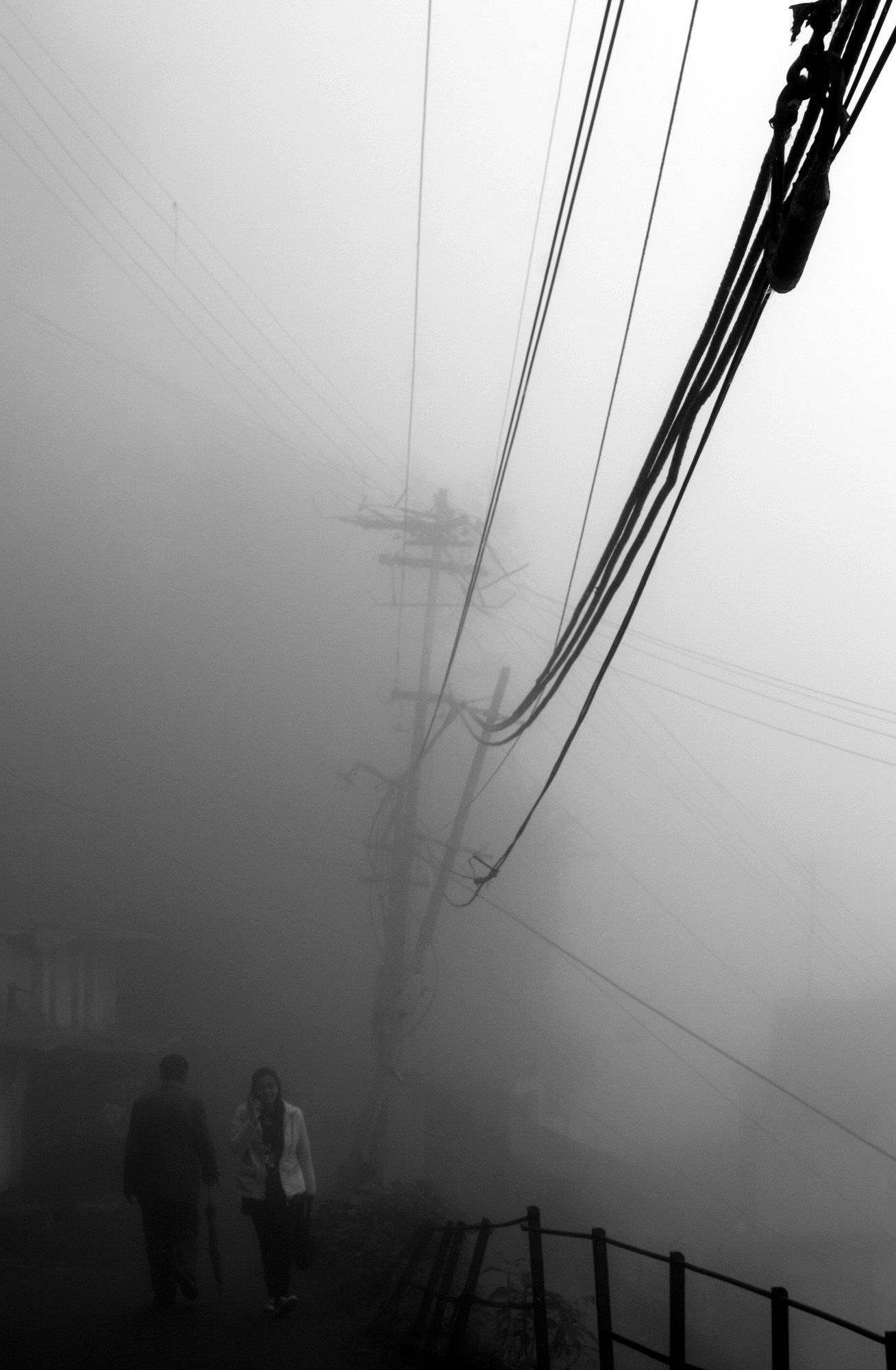
 

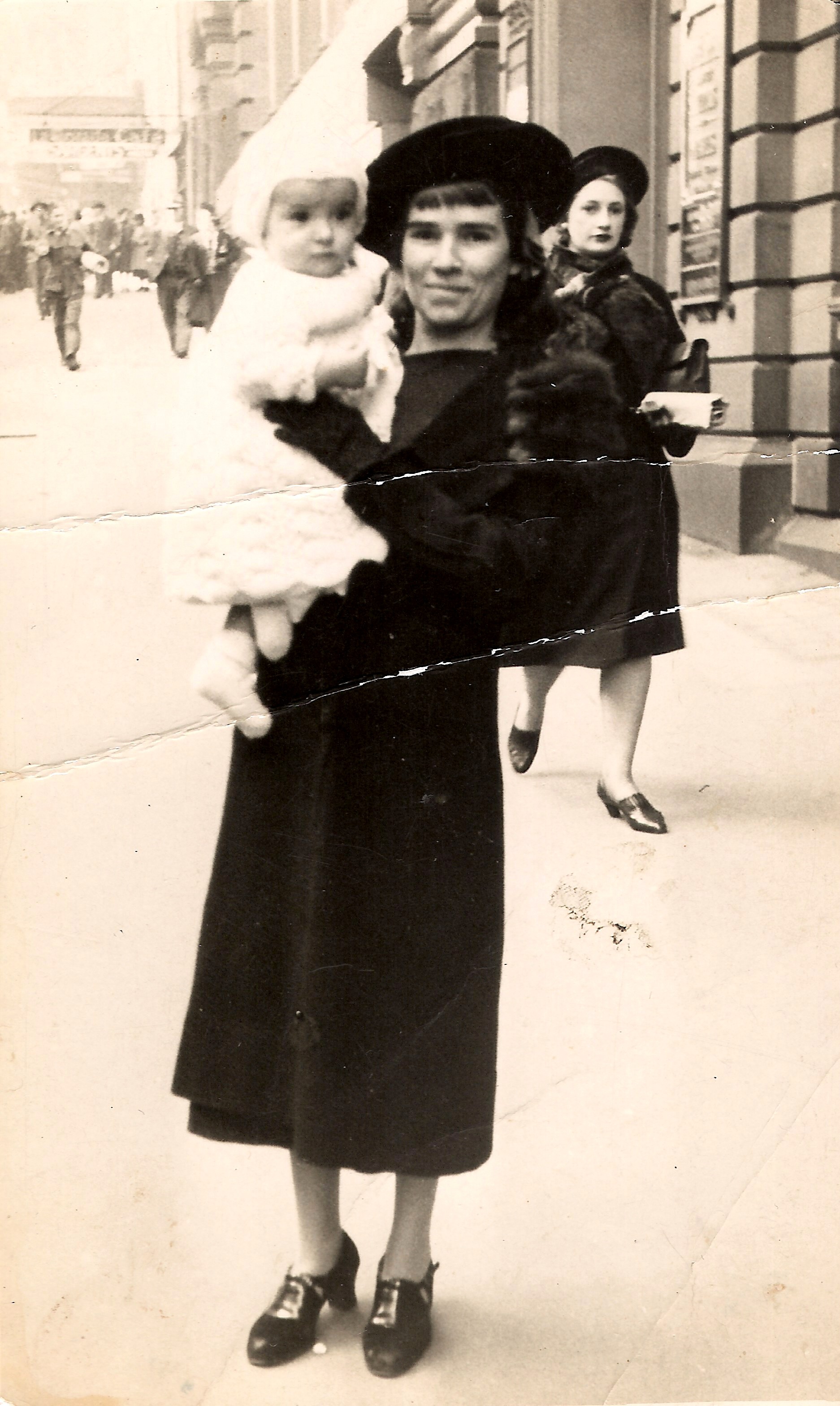
My grandmother had a very strong influence on me as a child, largely because she was so utterly different from everyone else. To begin with she was by far the oldest person I knew, and on top of that she was French. Indeed, my grandmother was so French that she almost seemed a parody; like Edith’s bed-ridden grandmother in ‘Allo ‘Allo. Nana, as we called her, however, was far from bedridden. She was a dynamic elderly lady who busied herself in the house and garden and whose wizened frame held remarkable strength.

Of course, as a very small child, without any sense of context, I simply took Nana at face value. She was always kind and loving, though she could certainly be tetchy. My brother and I stretched her patience as all children will, and whilst she wasn’t quite overprotective, we at times found her rulings a little ridiculous. Like most children, I always wanted to run down the street when I got excited, but, knowing how uncoordinated I was, like most five year-olds, Nana would order me to stop.

“Oh, Benjamin, you will fall over!”

“No I won’t!” I would protest, before promptly tripping over my sandals and grazing my knee. Too ashamed and embarrassed to cry, I was also too stubborn to admit that her judgement was sound on this front. Restraint is, after all, never appealing in the eyes of a child. She did, however, let me pick my nose; watching with her cunning, smiling eyes and saying “are you hungry?” whenever my finger went searching.

The only thing I really remember holding against her was her gravy. She could cook the hell out of a peach pie and made a knockout custard, but her gravy was something else altogether. One hot evening when she was minding my brother and me, she marched into the dining room and placed a clear glass jug on the table. We could see the contents in cross-section, and on top of the gravy was an inch-deep slick of molten, light-grey fat. As a child, I loathed fat in all forms. While Nana returned to the kitchen to collect the peas, I turned to my brother, Matthew, to share my astonishment. He too seemed to feel a wave of indignant protest welling up inside, but so afraid were we of the gravy that neither of us could articulate our anguish beyond the words; “No way, it’s just not fair. That’s not gravy. It’s not fair.”

My lip trembled as the tears formed in the corners of my eyes. I wanted to cry out that I wouldn’t eat that pooing, snot-breath, bum-hole gravy even if you gave me five bucks, a Tonka truck and told me what condom meant. But such was the power of the gravy that my spirit was utterly crushed. I don’t even remember whether or not I ate it, and think that therefore I must have done so, and the trauma was such that the memory has been repressed all my life.

If at times I was blind to the good sense behind her admonishments, I generally paid a great deal of attention to what Nana told me. She had a certain prophetic quality about her, like an Oracle, full of superstitions, sayings and adages that rang with the undeniable truth of ancient wisdom in my young ears.

Nana told me that things would always go my way – something my mother often reminded me of. If I had a stroke of luck, my mother would say: “Nana always said you’d land on your feet. She said you were the lucky one.” I believed what Nana said with such conviction that it developed into a sense of entitlement. Things were supposed to work out for me naturally, and though opportunity doesn’t generally knock, she was firmly of the impression that I wouldn’t have to make my own luck. I always kept that thought at the back of my mind and somehow it helped me to screw a lot of things up later on in life.

Being old-school colonial French – having come from Noumea in 1922 aged 17 – Nana was a good, superstitious Catholic. She had a little shrine to Jesus and a ceramic bell with the Pope’s portrait on it. She drank once a year, never wore make up, never swore, venerated Joan of Arc and Saint Anthony and always cheered when the Pope came on television.

They must have really done a good job on educating them into the spirit of Empire over in New Caledonia. Nos ancestres les Galles and all they stood for were being threatened by the Bosch when Nana was in school, and they ensured that the spirit of Nationalism was planted deep. She worshipped Napoleon and swore blind he never really abandoned his men. She hated Italian art because as far as she was concerned it couldn’t possibly be as good as French art. She didn’t drink wine, but knew deep down that that Italian rubbish wasn’t a patch on the French product. She hated the Nazis with a passion and still resented Germans as though the war had happened yesterday, and to her personally.

Nana also had very old-school Catholic attitudes to various social phenomena. One day, as I sat playing euchre with her in my old bedroom that had since become hers, she turned to me after something flashed across the television screen and said: “What is a lesbian?” The thought of explaining that to an eighty-nine year-old woman who changed the channel when people started kissing was just too much to come to grips with.

“What is zis, Lesbian? Er… two women,” she said with a terrific sneer. “They should shoot zem!”

When I was a kid, it was easy to converse with Nana, but as I got older her conversation grew a little more unsettling. She liked to put the knife into whichever of my parents had misbehaved in some petty way or another. In this respect she was venal and vindictive, though I knew her to be loving and generous at heart. It was loneliness and a life of disappointment that had done it to her. It must be difficult to avoid being jealous of youth and the opportunity it still affords. She never got over losing her husband and her son, and ultimately she resented being a tenant of her daughter. I could hardly hold those things against her, when all she’d ever wanted was to own her own home and feel the security and permanence that comes with it. It was remarkable that she showed such pluck all the way through. She did so by narrowing her desires down to small, everyday pleasures, none of which could be considered luxuries.

Nana was almost eternally optimistic about something and had quite incredible stamina, despite having shrunk to about four foot ten. Being so small she’d get drunk on half a glass of sauterne or Tia Maria with lemonade, which she insisted on drinking at Christmas, and her little face would bubble up bright red with life and hardy vigour let briefly off the hook as she pulled on a christmas cracker.

Nana collected toy frogs, which was the only piss-take on the French she would condone. Her favourite past-time was to play card games and for years she had been going to the local French Club for poker nights. She and I would, at times, play hours and hours of patience, euchre, poker and rummy, and she never seemed to tire of it. We’d natter away during hands of cards, and whenever the conversation got a bit curly, I’d try to shift it over to a safe topic like sport or France, or, more particularly, French sport, which was safe so long as one heaped undiluted praise on even the most minor of French achievements.

Nana was a real fount of knowledge on French sport and will likely remain the only ninety year-old woman I’ll ever know to sit up until three in the morning and watch an entire grand prix race because there was a Frenchman in it. She watched the entire Tour de France. She watched tennis, soccer, yachting, skiing, anything, so long as there was a Frenchman. She supported the Eastern Suburbs Roosters in the rugby league because their colours were red, white and blue, and they had the same mascot as the French team. She even called them “les tricoleurs.” Heaven forbid, but Nana even watched golf if there was a Frenchman playing. I think she sincerely thought the French ran the entire world and if there was any evidence which might bring French superiority into question, either on or off the playing field, such as getting a thrashing in the rugby by Australia, she would always have a nimble excuse.

“Oh, zose Australians are terrible. Zey won’t let ze Frenchman run with ze ball. Every time ze Frenchman gets ze ball, zey stop him! Zey are brutes!”

There was no point in explaining the legitimacy of tackling the opposition in a rugby match, just as I couldn’t explain why Guy Forget and Yannick Noah weren’t both equal number in the world tennis rankings. After a while I simply got used to complying with her wishes and telling her that I found it equally baffling, and no doubt a network of saboteurs and agents provocateurs were at work undermining French hegemony over the entire universe. Either way, it beat the shit out of explaining what a lesbian was.

Nana was also a great fan of French industry. Whenever I visited her, I was duly informed of the arrival on the market of any form of manufactured good which had been produced in France.

“Did you know zat ze French have built ze largest sailboat in ze world?”

It seemed quite incredible to be told what a wonderful thing it was that Club Med was opening up a new resort somewhere previously unspoilt. If the French did it, it was almost certainly beyond reproach. And yet, Nana wasn’t entirely uncritical of the French. When they were blowing the Christ out of Mururoa Atoll with their nuclear tests, she became very deeply upset and looked rather sheepish for weeks. She, like most reasonable people, really didn’t see the point behind the further development of the world’s most destructive weapons – and testing them in the beautiful Pacific Ocean was patently insane. It hurt her to hear all the protests against French testing, particularly because so many protesters lashed out unnecessarily at French culture and French people without sensible discrimination of who was actually responsible. One night when I sat in her room and the news came on with the leading announcement that the French had exploded a nuclear device on Mururoa, a look of terrible shame came over her face. I felt immensely sorry for her to have to feel any loss of faith in France this late in her life. I was angry with France myself, but it was mostly for disappointing an increasingly frail ninety-year old woman, whose heart was unswervingly patriotic.

From her shame, however, she could lash back with some wonderful exclamations.

“Oh, zose terrible sings zay say about ze French. Those Australians, they steal all zair ideas from ze French! Zay always copy ze French.”

Sometimes she just loved to put the boot in.

Nana used to do all her own housework, and then sit in the sun and read the newspapers cover to cover. She was an avid reader and manic word-puzzle fanatic. Nothing gave her greater joy than the latest edition of Le Courier. She’d take it out into the sun, sit at the little table beneath the boughs of the mulberry tree with some quartered, de-crusted ham sandwiches and a weak, very milky cup of tea, and read it about sixteen times. Occasionally she’d offer me articles to read, and I’d struggle through, embarrassed by how much my French had gone down the toilet. Oh look, something about a bridge. Yes, somebody built something. Oh, hang on, they shot something. No, they ate it. Maybe it wasn’t a bridge after all…One way or another, Nana would make it seem about seventy-three times more important than it actually was. I mean, honestly, what was news like that doing on page 13 of Le Courier?

The terribly sad truth, however was that Nana couldn’t live forever, though it seemed for a while there that she might just pull it off. She only visited a doctor for the first time when she reached eighty-eight years of age, and wouldn’t have had to go at all if she hadn’t tripped over the bull-terrier and hurt her arm. Sadly it was Pug’s fault that she went to hospital again a couple of years later, as he came tearing out into the back yard to bark at passing small children and ploughed straight into my unsuspecting Nana.

The resulting broken hip landed her in hospital, where she came through the operation with flying colours. Yet, sadly, as she lay there in the hospital bed recovering, she seemed to lose interest in everything. She stopped eating and became withdrawn and subdued. I have no idea what came over her in that hospital bed, but despite being well set to recover, she seemed to give up trying. Initially she had been so proud of herself; so proud of her health and vitality – up walking a day after the operation, and at the age of ninety. Perhaps she at last realised that there was nothing left for her to live for, though she’d always seemed so happy with simple pleasures. It mystified me a great deal, and of course upset us all immeasurably.

I sat holding her hand for as many hours as possible either side of work. My mother never left her side, and my father, who was also a great admirer of Nana, was there night and day as well. Slowly, but surely, she shrank away into herself. Her features slowly sank, as though the muscles that supported her robust expressions had slackened for good, then vanished. As I stared at her face for hours on end, I noticed for the first time in my life all the physical similarities between her and my mother and brother; the shape of her nose, the set of her mouth, expressions I had seen on her blood relatives. Then, late one Saturday night, with me at home, in the middle of a relationship crisis of my own making, she passed away.

Nana’s funeral was perhaps the most moving experience of my life. As we took up her coffin, draped in red, white and blue flowers, and proceeded down the aisle of the church, the organist struck up La Marseillaise. Strangely, I had not expected it – too grief stricken to have any thought for the logistics and organisation of the funeral, about which I had asked no questions. The  first few notes struck me like a thunderbolt.

“Alons enfants de la patrie! La Jour de gloroire et arrive!”

I felt a heavy mix of pride and awe; a momentous weight became a glorious burden. Fatality, which can seem so mundane and nondescript in an inglorious church, became a heavenly power; grief, which can be so black and all-encompassing in its restrictive singularity, became the channel for a unique beauty and rare soaring of emotion. For the two days before I had been so upset that I felt like lead – but when I heard La Marseillaise, I knew that in the end Nana had been victorious; she had left the battlefield on her own terms and she had ascended in a way that I didn’t even believe in; such was her greatness, she could defy even the tenets of my atheism. Nana had risen and taken her place in heaven – a reward she deserved more richly than anyone else I’ve ever known.

The saddest irony about Nana was that she was never not French at any point in her life – after seventy-odd years in Australia her accent had hardly diminished – and yet when she died we discovered that her citizenship had lapsed after fifty years. It struck me that the French government needed to be notified about Nana. Her patriotism was so undying and overwhelming that she deserved to be awarded the Legion of Honour, or at least some ribbon commemorating her devotion to France. Even when at last she lay dying, she managed with her weak voice to sing the entirety of her true national anthem, and cried out “Liberté, Egalité, Fraternité!” I don’t think there is a single person in France who was as French as my grandmother. Though of course, her Frenchness was an anomaly; an anachronism from the golden age of European imperialism, and now, sadly, she has passed from this world, taking with her rare memories of a bygone era.

Read Full Post »

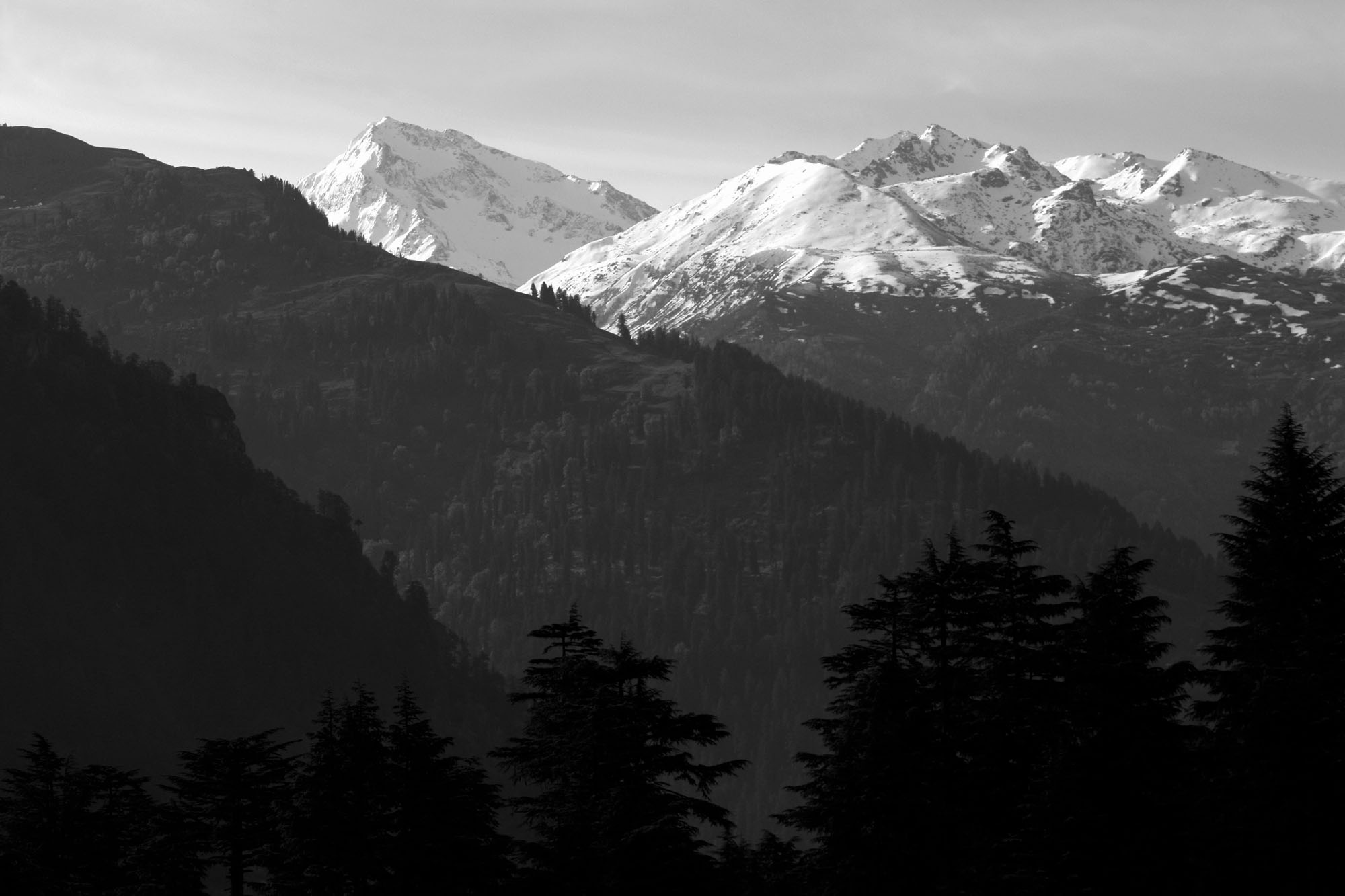
Having come to Darjeeling in part to see its views of the Himalayas, I felt frustrated when the horizon proved to be continually covered in cloud. Only in the late afternoon of my first full day did I manage to catch a glimpse of the mountains; when heavy rain cleared the mist and fog from the sky. The break in the clouds was brief, however, and by the time I reached a decent vantage point, the view had vanished.

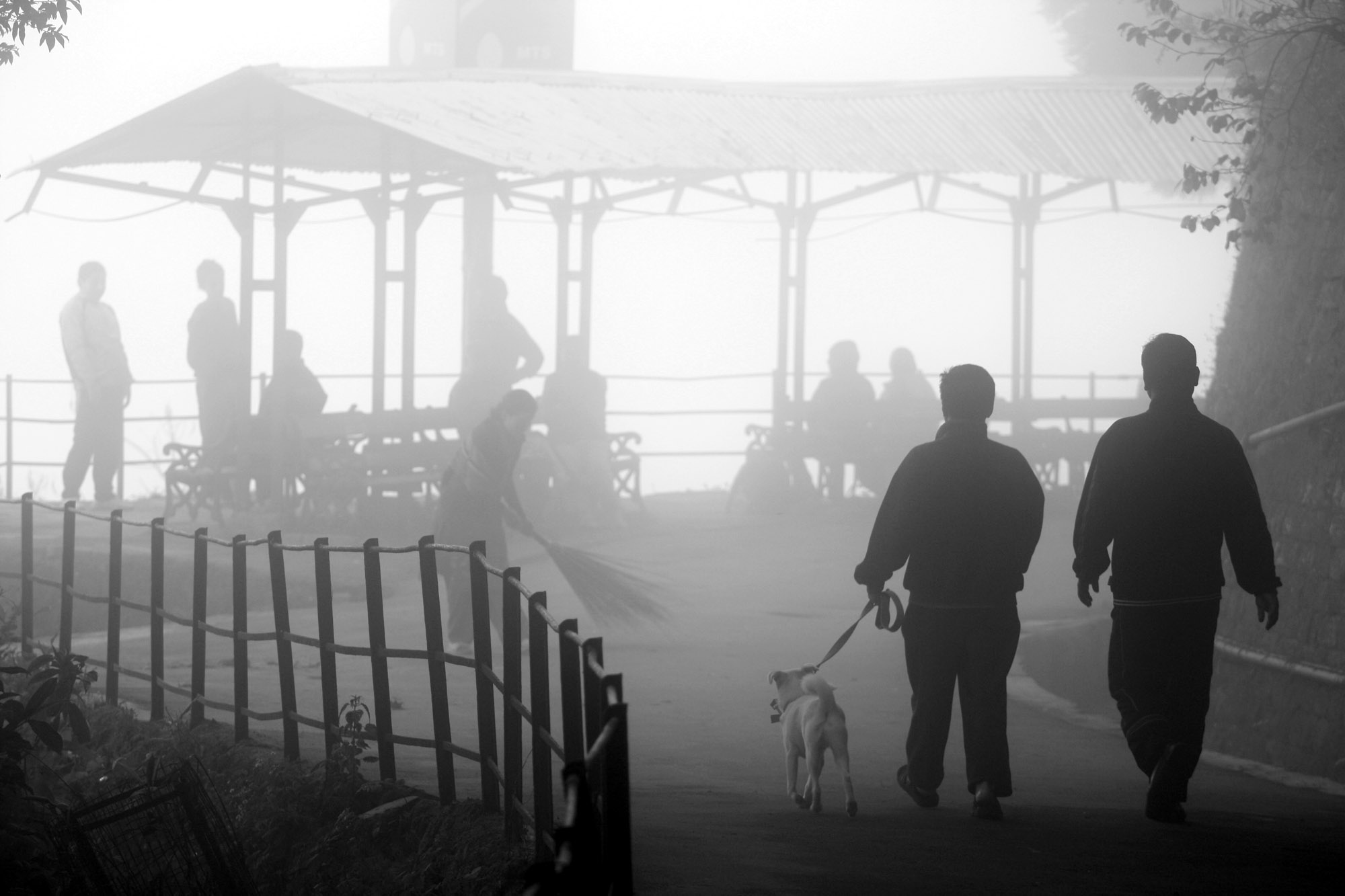
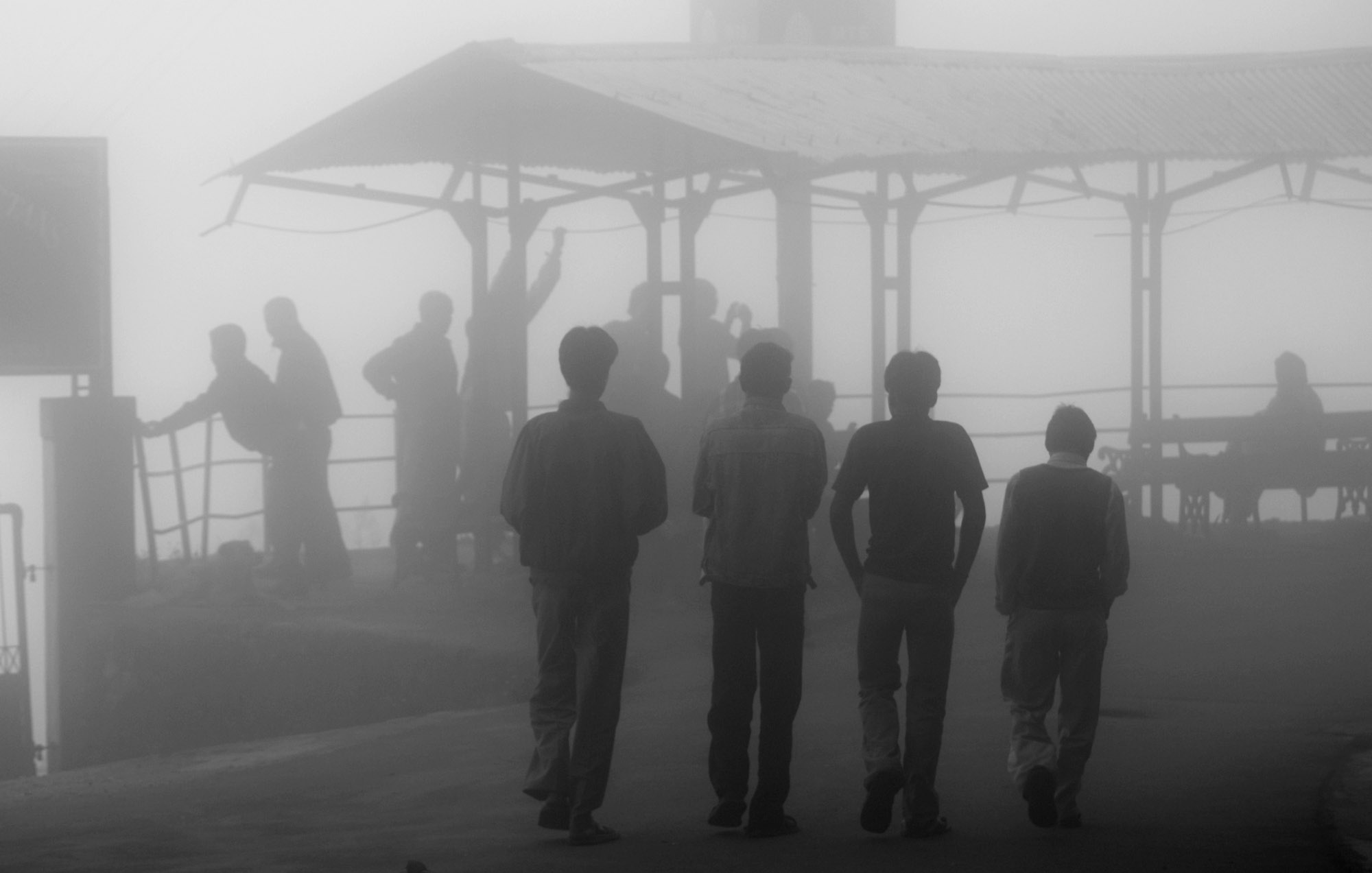
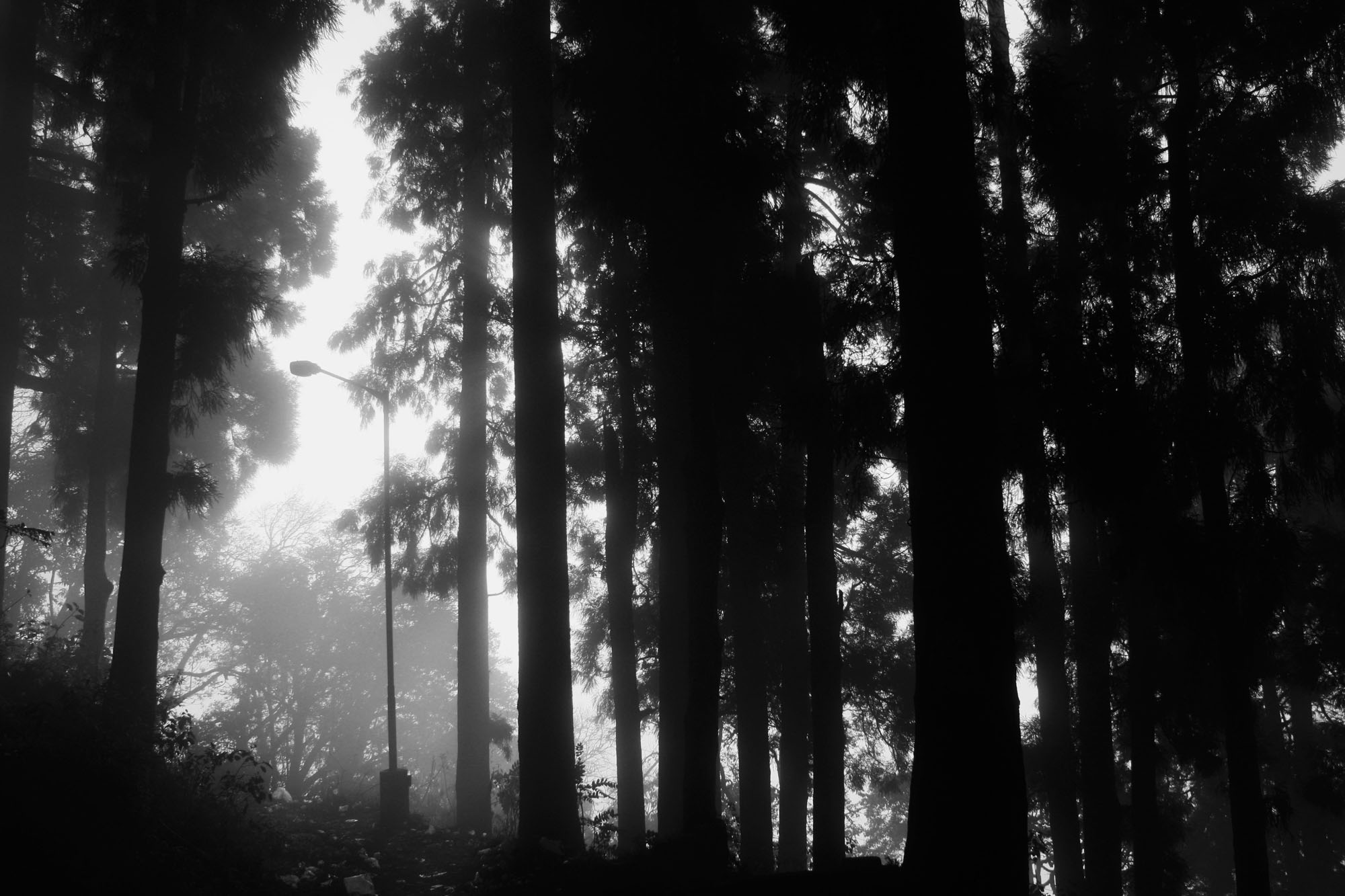
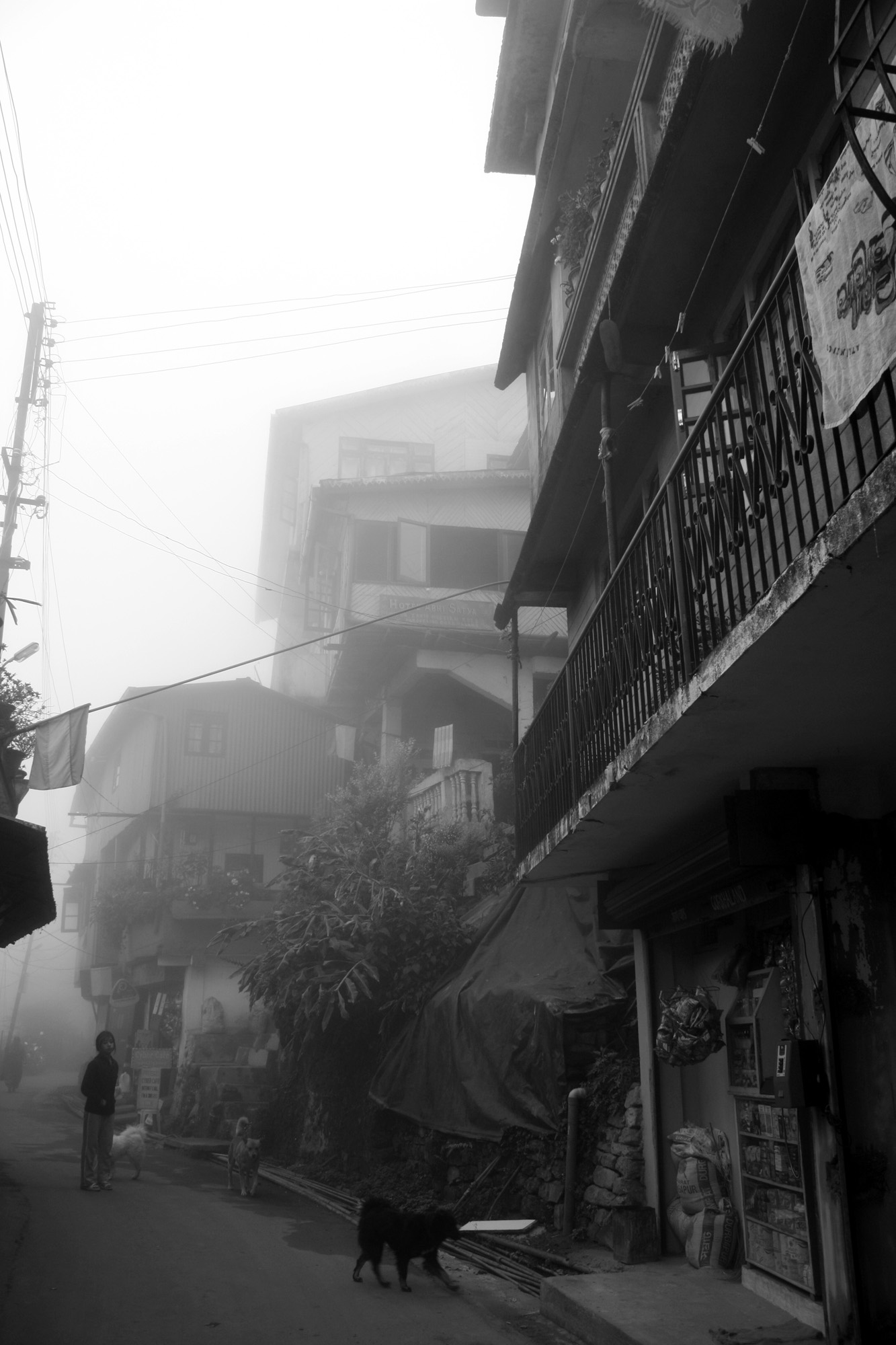
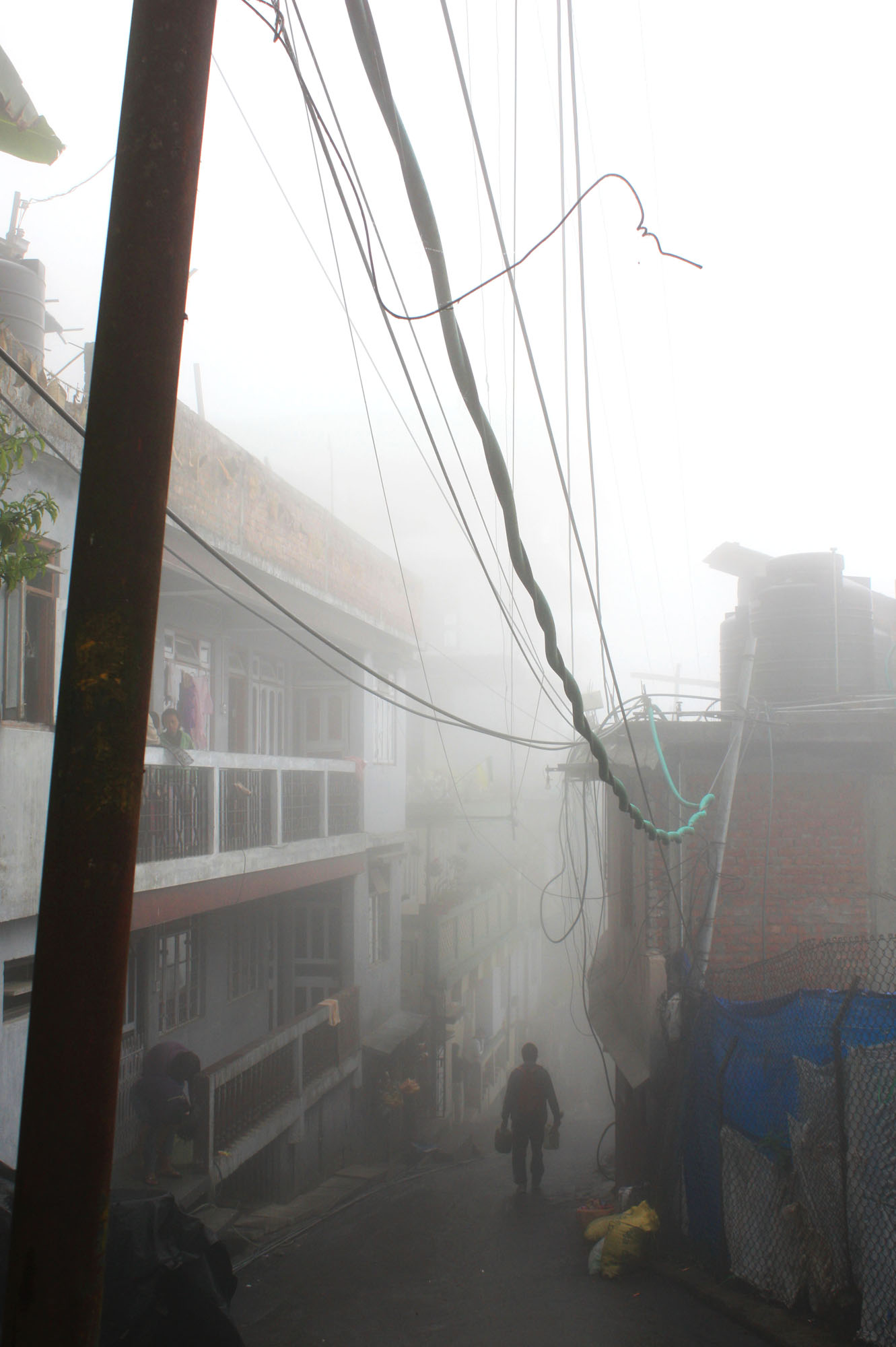
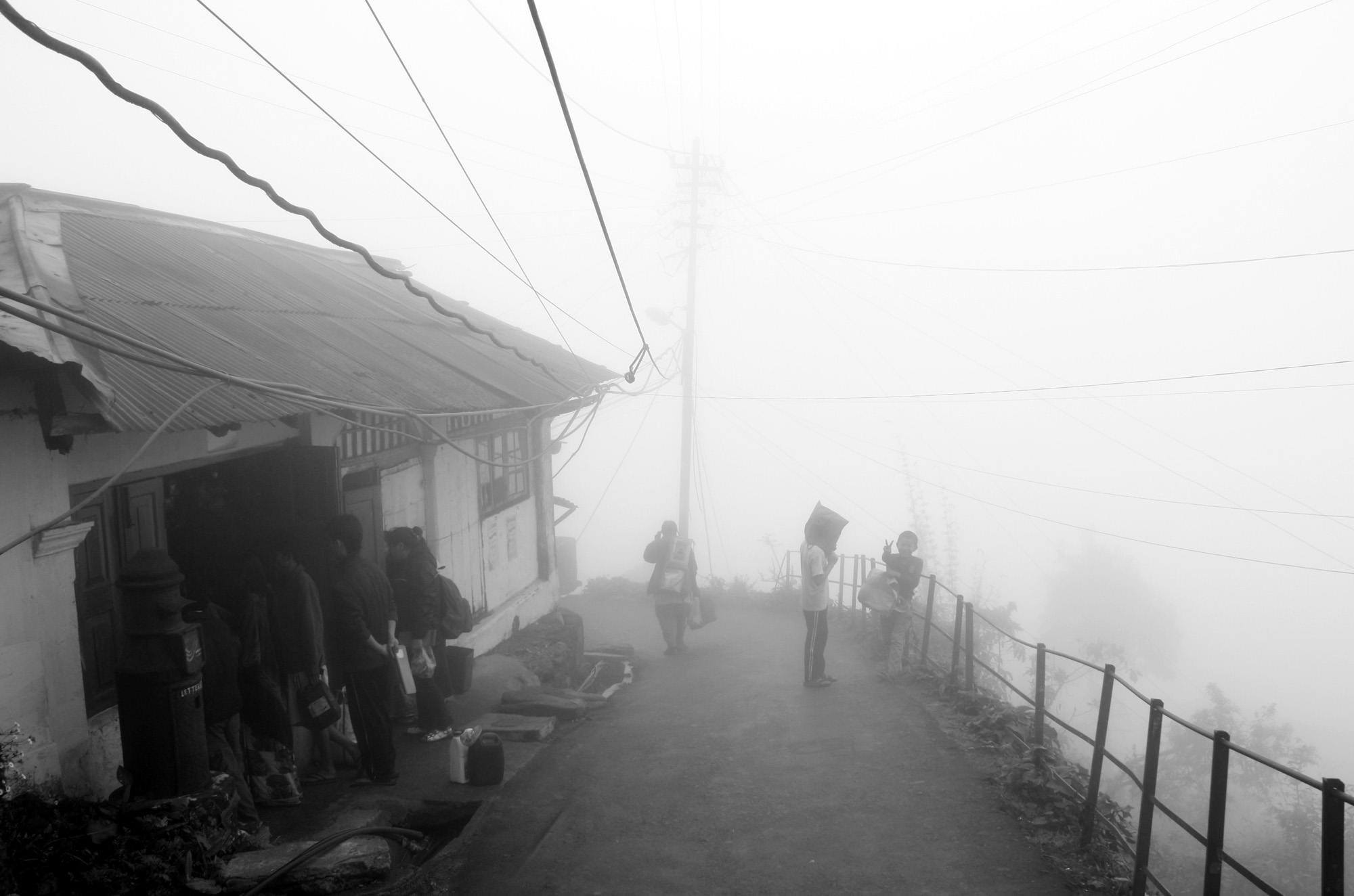
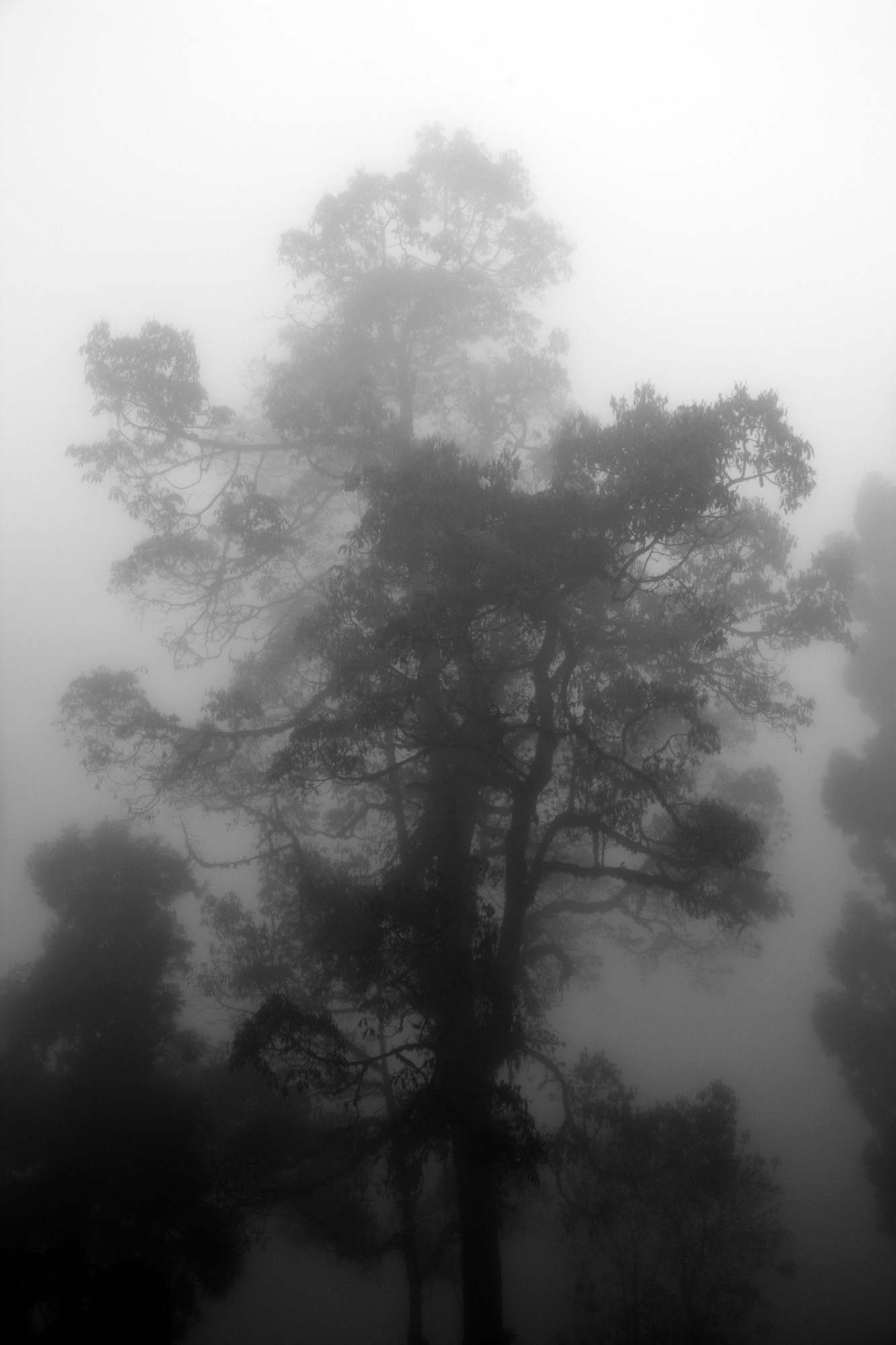
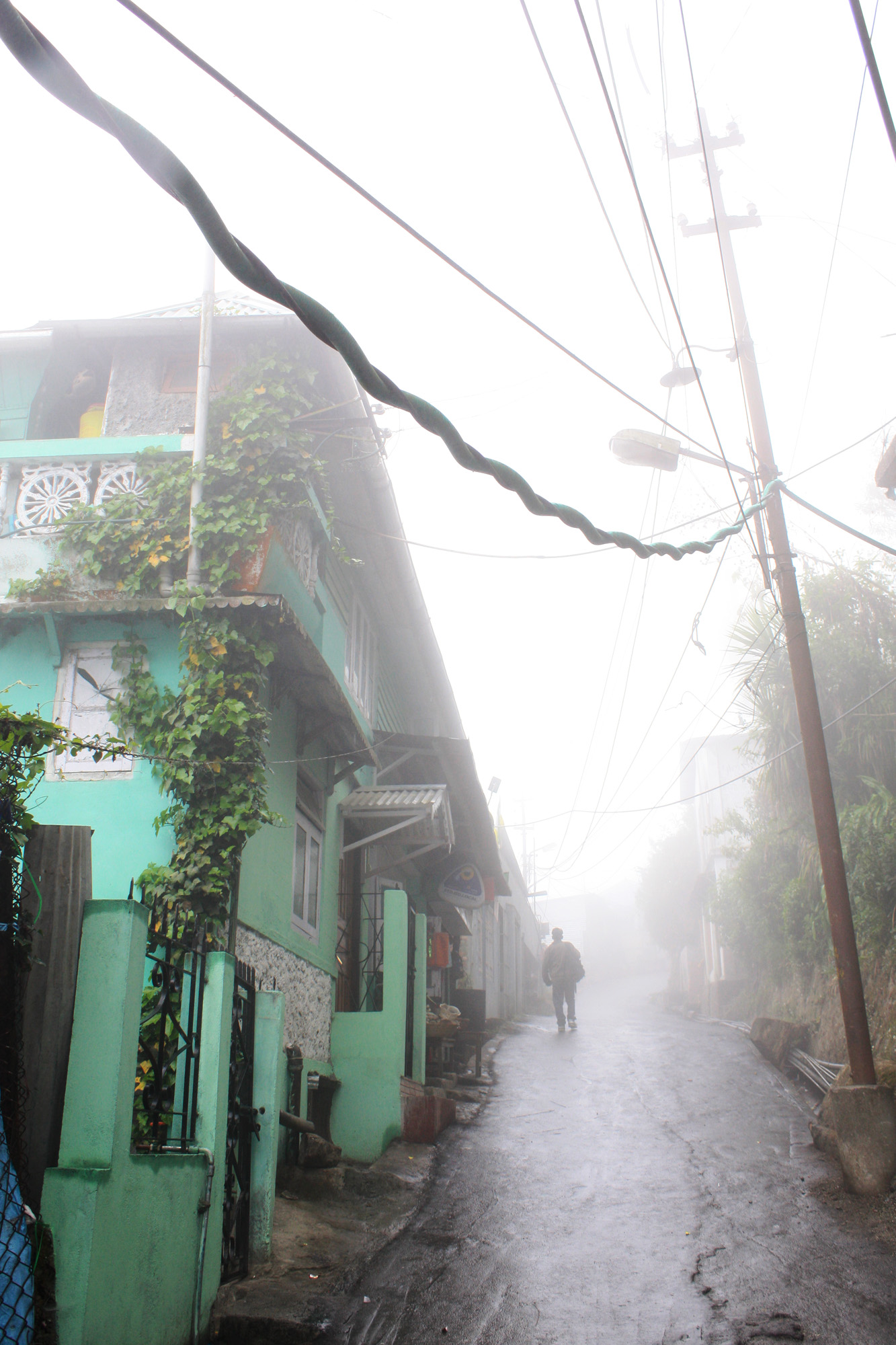
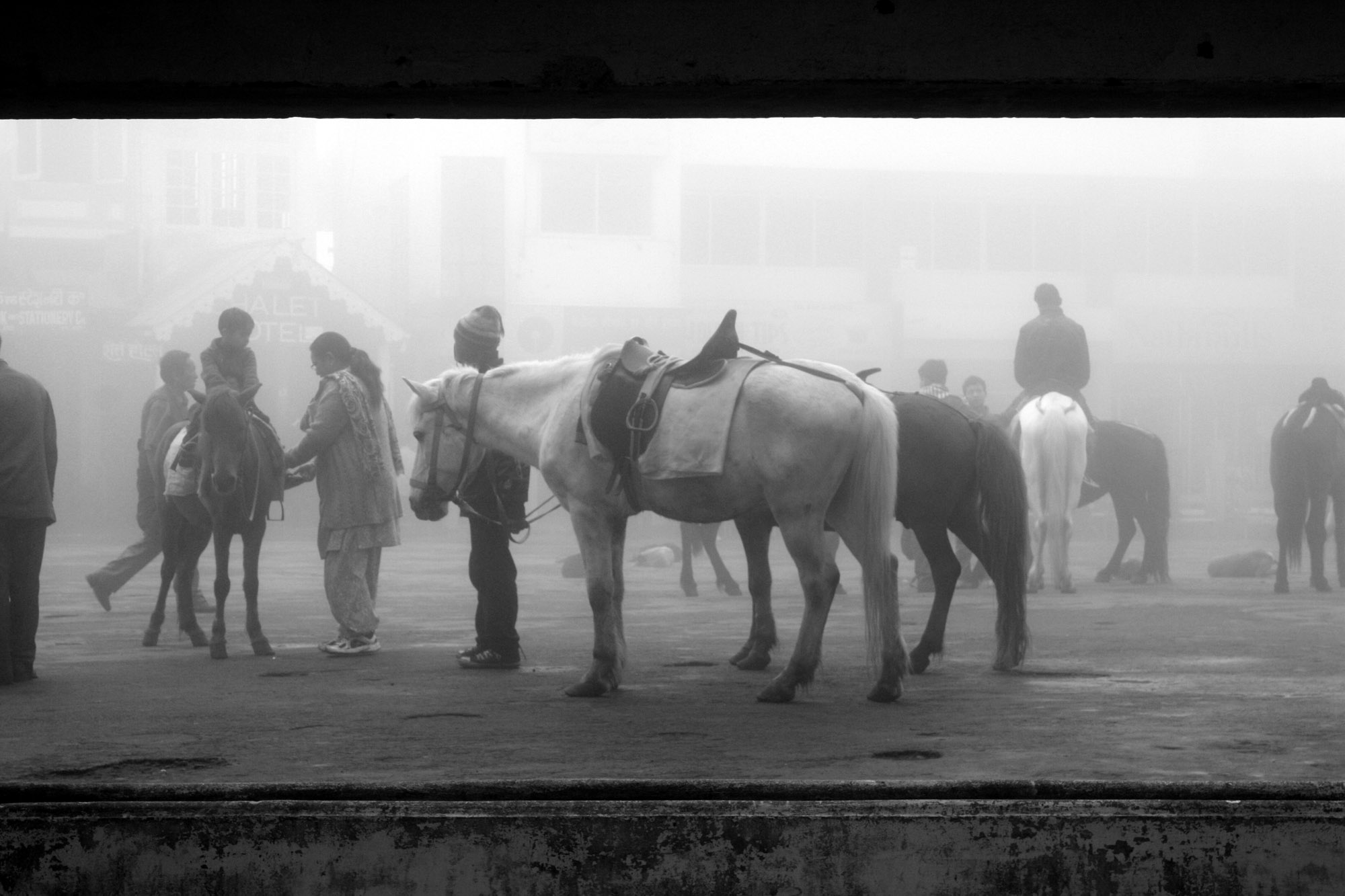
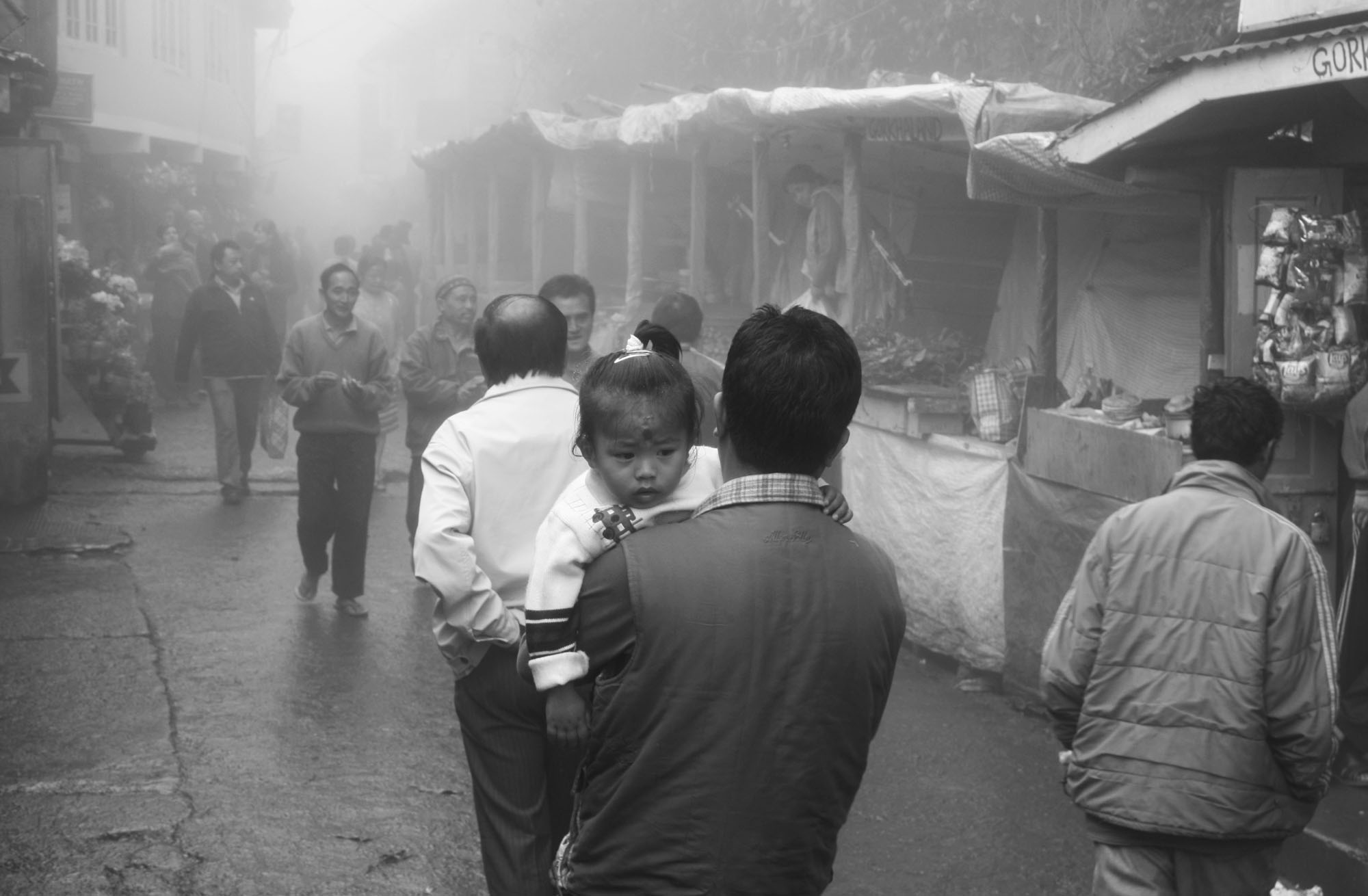
This was, by no means cause for despair. For, by way of beautiful compensation, the following two days had seen the town entirely shrouded in heavy fog. The beauty and wonder of it were ample entertainment and I could probably have continued to photograph the silhouettes and shadows without ever getting bored. Indeed, the fog proved so beautiful and entrancing that I almost forgot about the mountains altogether. Almost.

I have always had a great love of mountains and snow, possibly because of Australia’s relative lack of them. There are the Snowy Mountains in southern New South Wales, with a roughly eighty to one-hundred day ski season. Yet the highest mountain, Mt Kosciuszko, is a mere 2228 metres, and lacks the drama of other, more elevated peaks. There is, of course, the Great Dividing Range, a vast line of mountains stretching for roughly 3500 kilometres down the east coast of Australia, making it the third longest mountain range in the world. Yet, the Great Dividing Range formed some three hundred million years ago during the Carboniferous period and has suffered significant erosion since. These are very old mountains on the planet’s oldest and flattest continent.

If Australians want to see high mountains and better skiing, they traditionally duck across the Tasman to New Zealand. Still, despite the significantly more impressive peaks of New Zealand and their year-round snow-caps and glaciers, the highest mountain, Mt Cook, or Aoraki, is only 3754 metres tall. If New Zealand does not suffice, then Japan, Canada, or the European Alps are the likely choice for skiing, with The Andes, Rockies and, of course, the Himalayas, also featuring prominently on the mountaineering circuit. For most Australians, therefore, snow and high mountains are exotic – and elsewhere. For some, no doubt, they have little appeal against the perhaps more obvious attractions of paradisiacal beaches, yet for me, who was never especially fond of the hot climate, high, snow-capped mountains are the ultimate dream. They are impressive not merely for their staggering reality, yet also for their fantastical implications; being so long evoked throughout my role-playing childhood as the home of dragons, frost giants and hard, uncompromising barbarian folk. Just looking at mountains is enough for me, and I could likely do it all day without ever getting tired.

So, despite the great beauty of the fog, I was dying to see Mt. Kangchenjunga, which, at roughly 8500 metres high, is more than six kilometres higher than Mt Kosciuszko. This very thought – eight and a half kilometres, up into the sky! – was enough to give me goose bumps, and the brief glimpse I had caught of it had confirmed for me that it looked uncannily tall against the Earth. Determined to see the mountain properly, on the evening of day three, after another gorgeous day in the enveloping fog, I decided to stay in Darjeeling until I had done so. If it took a week, then so be it. But one day surely, perhaps just one morning, the horizon would be clear and the full glory of the snow-capped peaks revealed.

On my fourth morning in Darjeeling, therefore, I rose at 0500 AM and parted the curtains. It was still very dark outside, yet the sky had lightened just enough to see that it was clear. The dim stars overhead faded towards the horizon, from which the day was beginning to spread. The mist that had cloaked the town for the last few days had lifted, and whilst it was still too dark to make out the line of mountains in the distance, I felt confident that I should get lucky on this occasion. I ran to the shower, washed up and dressed, then set off with my kit into the cold morning.

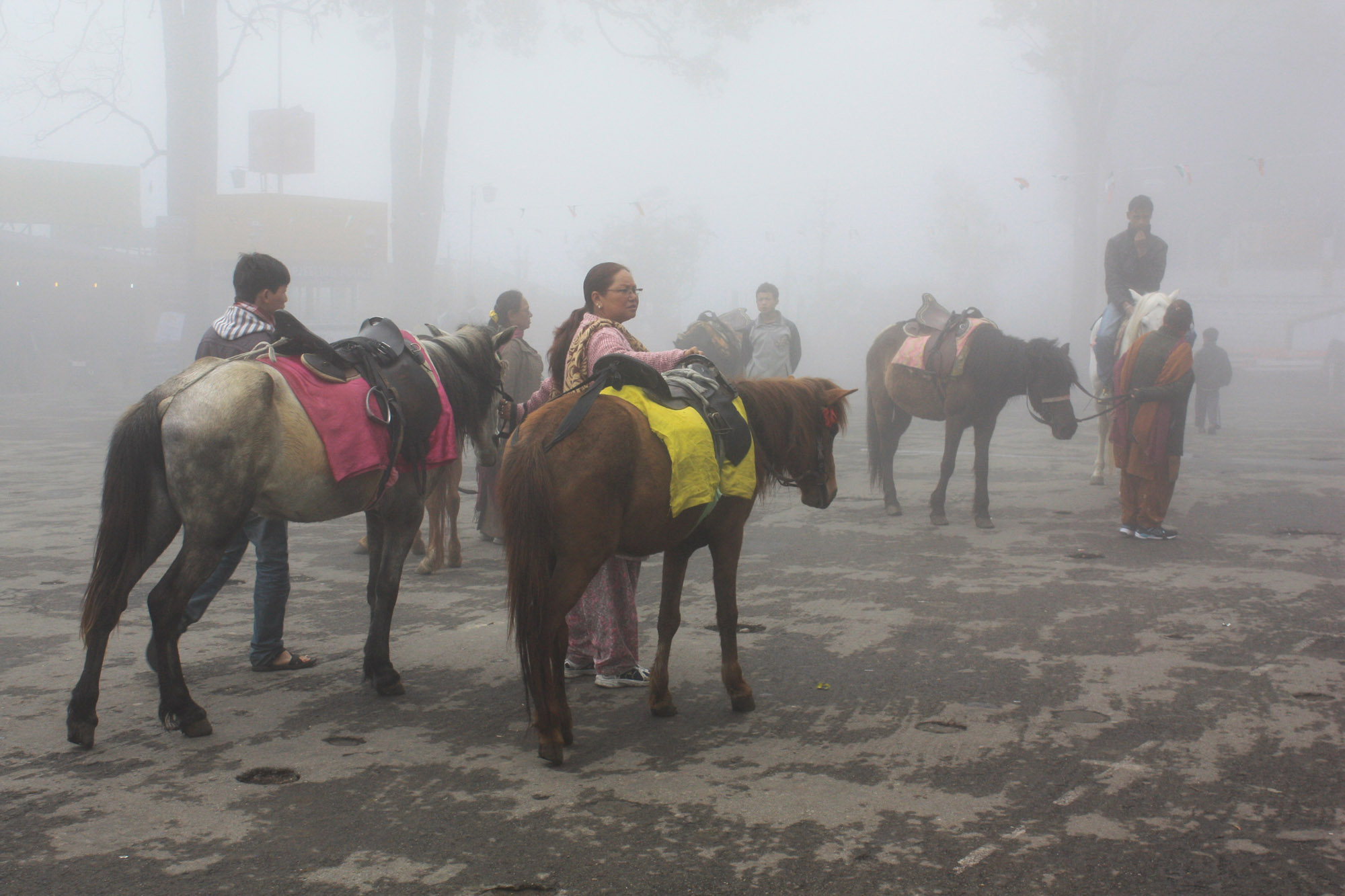
Darjeeling was quieter than ever at this time of day, but once I neared Chowrasta, the main square at the top of the town, there were signs of activity along the street. Shop doors stood open with the owners sweeping their floors; on the wooden stalls hugging the road, vendors were already laying out their wares: fruit, vegetables, poultry and the like. On the edge of Chowrasta, in their ramshackle tarpaulined shelter, the tea-wallahs I’d become so fond of the day before were setting up. I checked my watch – it was still only five-thirty. How hard these people must work, for they continued serving until almost ten at night! Opposite them, the concrete stables were, for once, full of horses. Several of the handlers dozed on the steps, and I wondered if they were stoned already.

Being, shall we say, rather naughty, I had, just two days before, purchased a bag of marijuana from these so-called Pony Boys, who provided joyrides around Chowrasta, and along the road that ringed Observatory Hill. The night before I had prepared a couple of joints in hopeful anticipation of a clear morning, or as a form of consolation should things prove otherwise, and it was with one of these tucked behind my ear that I crossed the square and set off down the road beside the hill.

I expected it to be very quiet and largely free of people, yet, walking around Observatory Hill on its eastern side, I was astonished by the number of people exercising. Many of the locals were out running already; men and women of all ages. I passed a lot of joggers and groups of people doing stretches and aerobic exercises against the metal railings. Despite having been a keen runner for many years, even when I’m in an early-rising phase, I’ve never been able to exercise this early in the morning and have long been jealous of people who woke up feeling so energetic. The people were all very friendly, both to me and to each other, and I was surprised by how many used English greetings amongst themselves: “Hello” and “Good morning.”

When I rounded the corner to the northern side of the hill and saw the horizon, I felt a sudden slump in my hopeful mood. The sun had not yet risen, though now the sky was light and clear, but the mountains were dressed in cloud and remained invisible in the distance. In their place were great stacks of cumulus of varying heights. I imagined the shape of the cloud might somehow reflect the size of the mountains underneath, yet without any real sense of scale or proportion at such a distance, I might have been horribly wrong. Either way, the mountains were not to be seen.

I did not want to give up hope just yet, for in truth I knew very little about the meteorological conditions and reasoned that perhaps the sun might rise and burn away the cloud. There was obviously less moisture in the air today, which felt much more dry and crisp. It had a mild sting in it, as cold, clean air will do, and this gave me further hope that the day would not be so humid and thus less foggy.

Unable to see the mountains, I continued walking and focussed on photographing the valley below and the locals performing their exercises. When I reached a lookout I had discovered a couple of days earlier, I stopped, deciding this would be the best vantage point should conditions prove favourable. It was a shelter of cast-iron, with a corrugated sheet-iron roof, under which sat long, old-fashioned park benches. One of these bore the inscription Darjeeling Health and Fitness Club (I think), and it was a very popular place to congregate for early morning exercise. Around the shelter and benches, before a steep, wooded descent into the valley below with its rounded slopes of tea, were roughly twenty men and women performing stretches, jumps and running on the spot. To the side of them stood a Buddhist monk with a large, round, hand-held drum, like an outsize tambourine. He was humming and banging on the drum, facing the east where the sky was ever lightening, singing in the dawn, I can only imagine.

I figured there was likely another twenty-odd minutes before the sun actually rose, so I walked to the back of the road, where Observatory Hill rose steeply, and began to climb a steep watercourse. Before long I was thirty metres up above the people below, with an excellent view to the hidden mountains on the horizon. I took the joint from behind my ear and, feeling ever the fugitive, crouched behind a shrub to smoke.

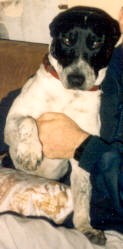
I was soon joined by a friendly dog; a healthy and clean stray who was scavenging for food in the trees on the hill. She nuzzled in and sat down beside me, deciding we were to be friends. I patted the dog just a couple of times, not wishing to encourage her too much for fear of having her sit outside the hotel for the rest of my stay. It was difficult not to show more affection to this attractive, light-brown bitsa. I hadn’t had much in the way of company for some time, and as the marijuana put me once again into very high spirits, I wanted nothing more than to play and wrestle with this lovely dog, then buy the poor thing a great feast and give it a bath.

The sun, however, was rising and I needed to focus my attention on getting the shots. I took some from where I sat; switching lenses repeatedly for a wider or longer focus, then descended back to the road. The dog followed me down, but had the decency not to hang off me. She skirted the exercisers nervously, wondering which way to turn.

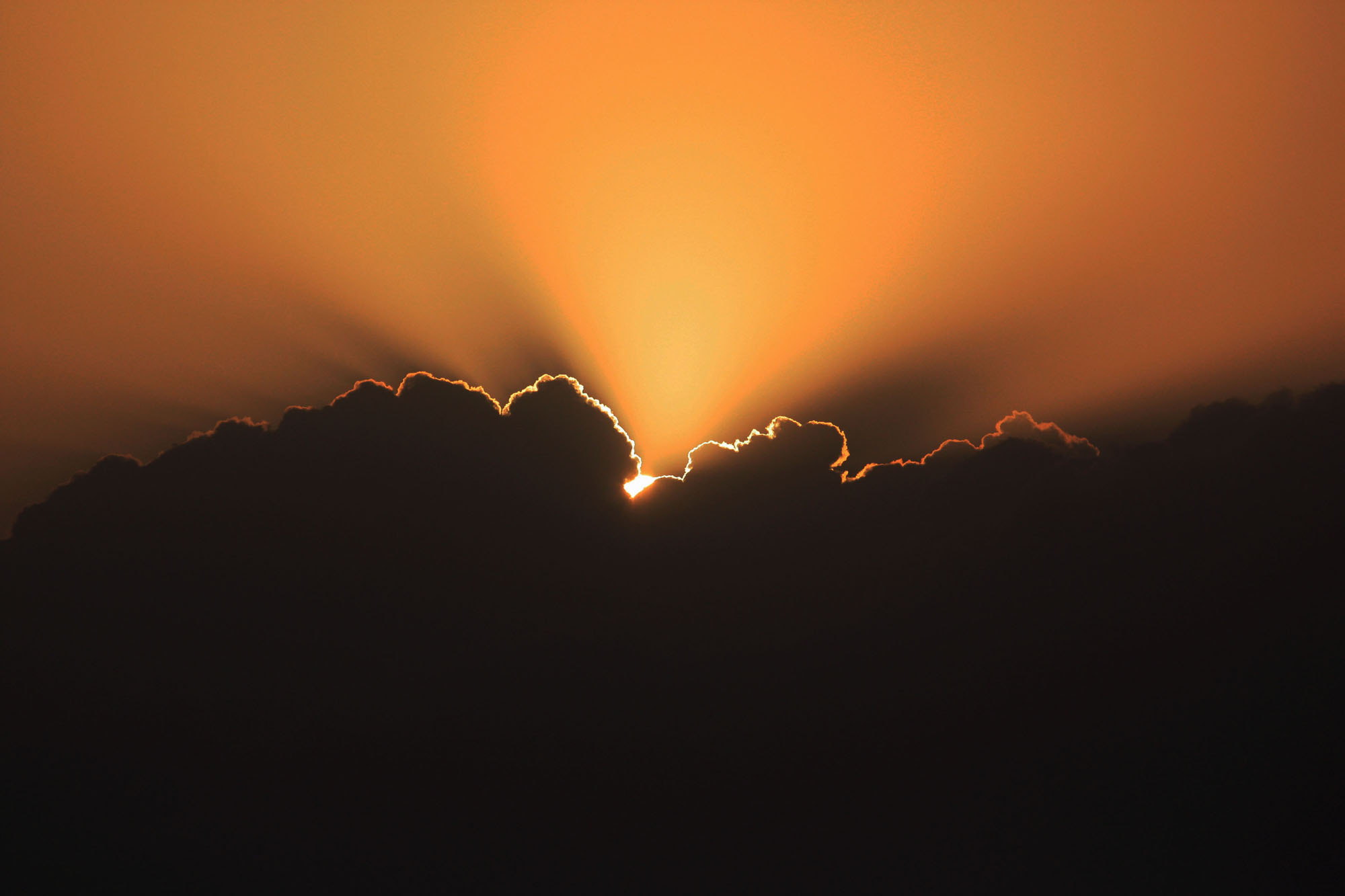
The monk’s drumming and droning was all the more intense now in my heightened state, and I felt completely in the zone for shooting, targeting people and scenery alike. Just above the layers of cloud in the distance, long, bright rays of sun were spreading in triangular fans. The cotton wool, popcorn clouds, beautiful in themselves, were rimmed with a fiery gold that burned in the back of eye. Below, on the slopes and in the valley, the tin and iron-roofed houses nestled in a light mist that blew like puffs of smoke. Where the hills spread out in lower undulations, the rich green of the orderly tea plantations was washed with drifting coils of mist.

The monk continued his slow beat and droning, and I, taking refuge behind my sunglasses, watched from a short distance, shooting video. I wanted more stability for the long-range focus and, not having brought my tripod this morning, I soon moved to one of the benches, alongside the shelter, and rested my camera on the rail in front. On either side the locals continued their exercises; huffing and breathing loudly, but otherwise, doing their routine without a word. The valley below made a pleasant subject for study, and I spied on the activity of tiny distant people and dogs, drifting through the light cloud that brushed the tree tops. I could hear the happy singing of children from a school a couple of hundred metres down the slope; a dawn chorus of upbeat, unbroken voices, both energetic and joyous. What time did school begin here? Such happy singing seemed a very positive way to start the day.

When, at around 0630, the sun climbed atop the rounded crenulations of cloud, there was a splendid murmur of excitement. The lens flared with the light that shot in clear beams from the small orange arc of sun. The sun rose rapidly and the light fanned quickly across the hills and valleys below. The tree-tops lightened, the fog shone white, and the locals doing their exercises seemed to find an extra spring in their step. It was a powerful and uplifting vision, without a hint of anticlimax and, though I longed to see the mountains, I was happy indeed with this burst of sunlight.

I sat and stood and sat again, photographing the scenes around me in the growing brightness. I continued to hope that as the sun grew higher and hotter, it might burn away the cloud below and reveal the snow-capped peaks of the mountains. Was this the beginning of a dry, warm, clear day in Darjeeling? Was I about to be treated to that mountain view at long last?

It was now that I noticed a change in the valley below. The mist that had, until recently, been sparse and thin, began rapidly to thicken. In the warming sunlight, the abundant moisture was evaporating and gathering into pockets of cloud above the vegetation. Slowly the iron rooves and tea plantations became more difficult to see as these blooms of mist spread and floated until, after about ten minutes, with the sun now well clear of the clouds on the horizon, the scene below was almost entirely shrouded.

This gathering cloud now sent up a long, thin coil of white mist. It rose in a tall column that stretched up high above the tallest trees near where I sat watching. This column of rising moisture began to widen, fattening until it grew dark and dense, like a pillar of thundercloud. At the top of the column the mist very abruptly spread sideways, like a flat mushroom cloud, colonising the sky with fog.

Once this process was underway, the speed with which it continued was astonishing. The sun, it seemed, rather than burning off the cloud, was having quite the opposite effect; vaporising all the moisture in the valley and lifting it into the air. From a meteorological perspective, it was absolutely fascinating. The spreading cloud soon covered the sky immediately above, blocking all direct sunlight. The treetops began to dim, the golden wash turned silver then grey as the hills and valley below vanished completely from view.

Soon the entire sky, as far as I could see, was covered in haze and cloud. Great waves of fog rolled up the slopes and onto the heights where I sat, brushing my skin with cool moisture. By the time the clock struck seven, the fog had smothered everything. I could see no more than twenty metres.

This marvellous meteorological event was too exciting to allow for disappointment. So much for the mountains – I was perfectly content to spend another day in thick fog and try again the following morning. I took another joint from my packet and wandered back along the road I had followed to the look-out.

Silhouettes appeared against the wan backlight, and the trees, now full of enticing shadows through the filter of fog, seemed especially fecund with their newly wetted leaves. I smoked took photos, looking back towards the “Darjeeling Fitness Club” where several locals were still doing exercises. Their shapes made excellent subjects and I kept the camera trained on them for some time.

I drifted back into Chowrasta, towards the chai place on the edge of the square which I had adopted as my own over the last couple of days. The man and two women were all there, and the place was fully operational. I ordered tea and a chilli egg bun and sat down on the bench to watch them at work. It was sad how much I loved what they did, yet could not possibly love their life. To work such long hours and to be so constantly busy was not something to which I could relate. It was hardly a new sensation, this wonder at the workers of the world who slog it out all day. Yet, sitting so close to this dynamic trio, who gave me such pleasure with their excellent tea and lovely, simple food, I felt a passionate hope that they should find enough time to be happy outside of work. At least they were their own bosses, and perhaps this was the life they chose, but it didn’t exactly look easy. I stayed there almost an hour, and drank three cups of the best tea in the world.

Over the next five days, I repeated that morning almost exactly. I rose just before five AM, showered, dressed and set off towards the same look-out. There was, at Ghoom, the highest railway station of the Darjeeling Himalayan Railway, a very famous and better situated lookout called Tiger Hill, to which many people ventured in the morning to see the mountains. This, however, was equally contingent on the sky or horizon being clear and, without such conditions, it seemed pointless for me to take one of the many early morning jeeps there.

Every morning over the next five days, I carried the same hope around Observatory Hill: that today would be different; that the sky would clear completely for a spectacular view. Sadly, however, on every single occasion, the entire horizon was covered in fog.

In the later mornings and afternoons, with never a sign of the distant cloud lifting, I wandered around town, photographing the workers, shops and the closer views.

I spent some time up on top of Observatory Hill, stoned, lost in thought, watching the colourful flags of the Buddhist monastery flap in the persistent breeze.

I spent hours sitting with the monkeys at the back of the monastery, watching their antics, squabbles, grooming and occasional surliness. Some days I wandered quite a way out of town, floating along the curving roads through the smaller, surrounding villages. I walked up into the forest and sat amongst the trees; smoking, reading, dozing, lying, thinking, thinking, thinking.

I saw a man with a prize pig, a most flamboyantly feathered chicken, women breaking rocks for a roadway.

I walked all day, looking for photographs and vignettes. I followed the railway out of town into some of its slightly grubbier quarters.
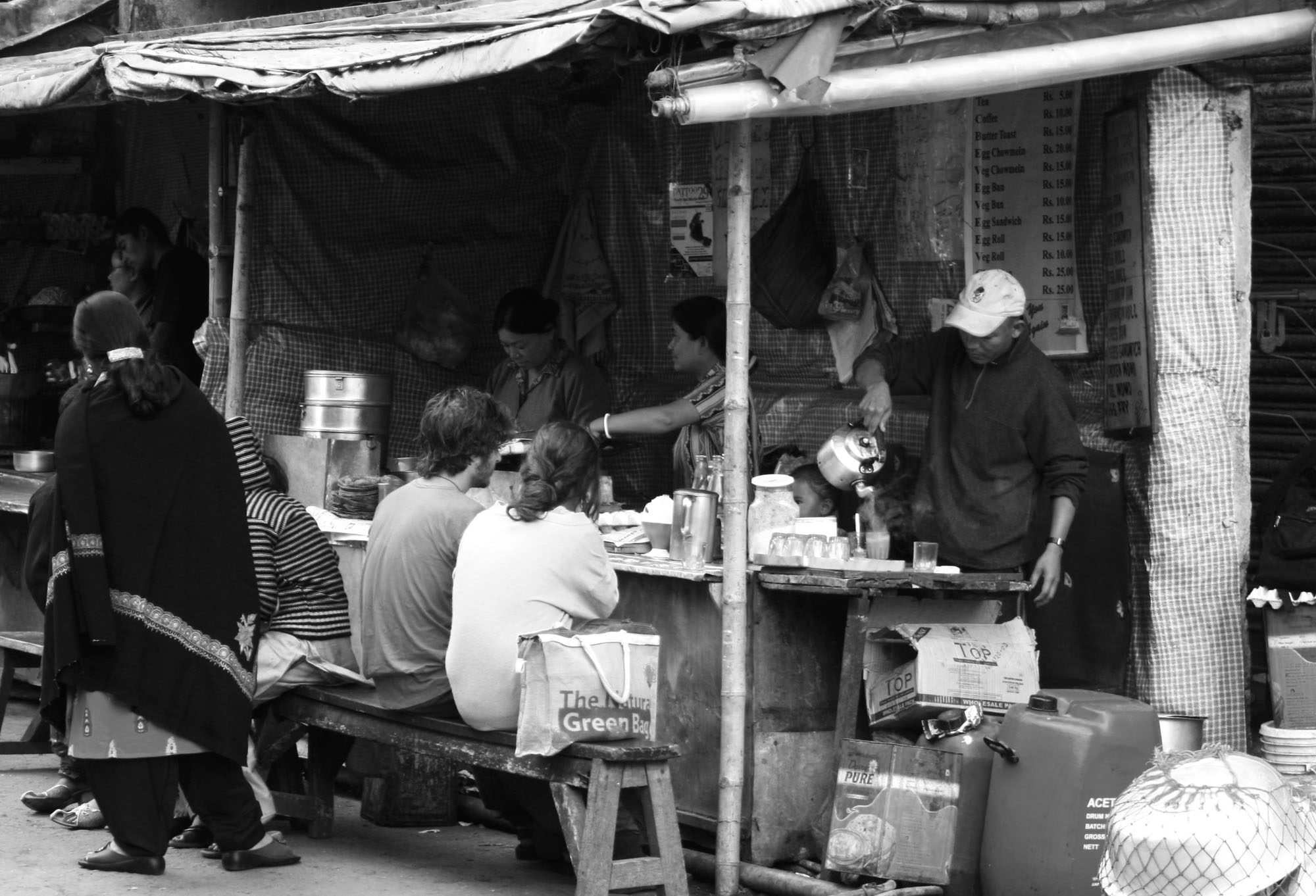
A small, quiet man showed me around another monastery. He told me its quaint, unassuming history, then a story of the school they hoped to build if only they had the money. I made my donation on cue, then left, feeling disappointed with both him and me.

Every breakfast lunch and dinner was spent at my favourite chai wallahs. I never learned their names, and we hardly ever shared a word, but we had an unspoken friendship that lived in our genuine smiles. I was certainly curious about their lives, but, knowing how much I value my own privacy, I did not want to pester them with a bunch of personal and anthropological questions. I figured that if I just kept ordering tea and food, and they kept making it so well and serving me in so friendly a manner, then we already had a strong enough relationship.

When, on my ninth morning in Darjeeling, the horizon was once again covered in cloud, I gave up all hope of seeing Kangchenjunga. Two days before, I had booked my ticket – from Siliguri to Delhi – and I wasn’t about to miss my flight. I sat and watched the mist rise from the valley once more, then walked back to Chowrasta for a final breakfast.

On the way there, I passed the very Pony Boy from whom I had bought a bag of marijuana almost a week earlier. He was standing holding the reins of his horse, grinning enough to show his blackened teeth. He recognised me and said:

“Are you going riding again today, sir?”

“No. Thankyou!”

I laughed and smiled at his conceit. How sad and happy this little encounter made me feel. When I sat down on the bench and ordered tea a few moments later, I felt a choking thickness in my throat. How could I leave Darjeeling, having become so used to the place, and with my mission still unaccomplished? Did I not feel as though I were stagnating, perhaps even on the brink of a sort of dissipation, I might well have stayed on.

I knew that there could be only one cure for this growing burden of loss: to get back on the road and find new places and people. From Delhi I was flying on to Amritsar, right across India in a day, and after that, it was anyone’s guess. That morning, sitting there for the last time, I drank four cups of tea and made a new plan. From Amritsar, I would head north up into the mountains of Himachal Pradesh and see the Himalayas around McLeod Ganj and Manali. If the road was open and I could make it all the way to Leh, then so be it.

As many attractions as India might hold, the need for mountains was in my blood, and anyway, I preferred the cooler climate of higher altitudes. My mission in Darjeeling was indeed as yet unaccomplished, but if I couldn’t see the mountains here, then I would travel until I saw them somewhere. I had at least another month up my sleeve, and nothing, whatsoever, was calling me home.

Read Full Post »

Dirk watched the foam churning round the propellers. It washed to and fro from the wharf. He watched the people milling on the docks; smoking and waving. There were no familiar faces. He toyed with a cigarette before lighting it. The ferry bobbed in its turbulence, roaring and vibrating. Then the ropes came in and they were off; away from Samothraki.
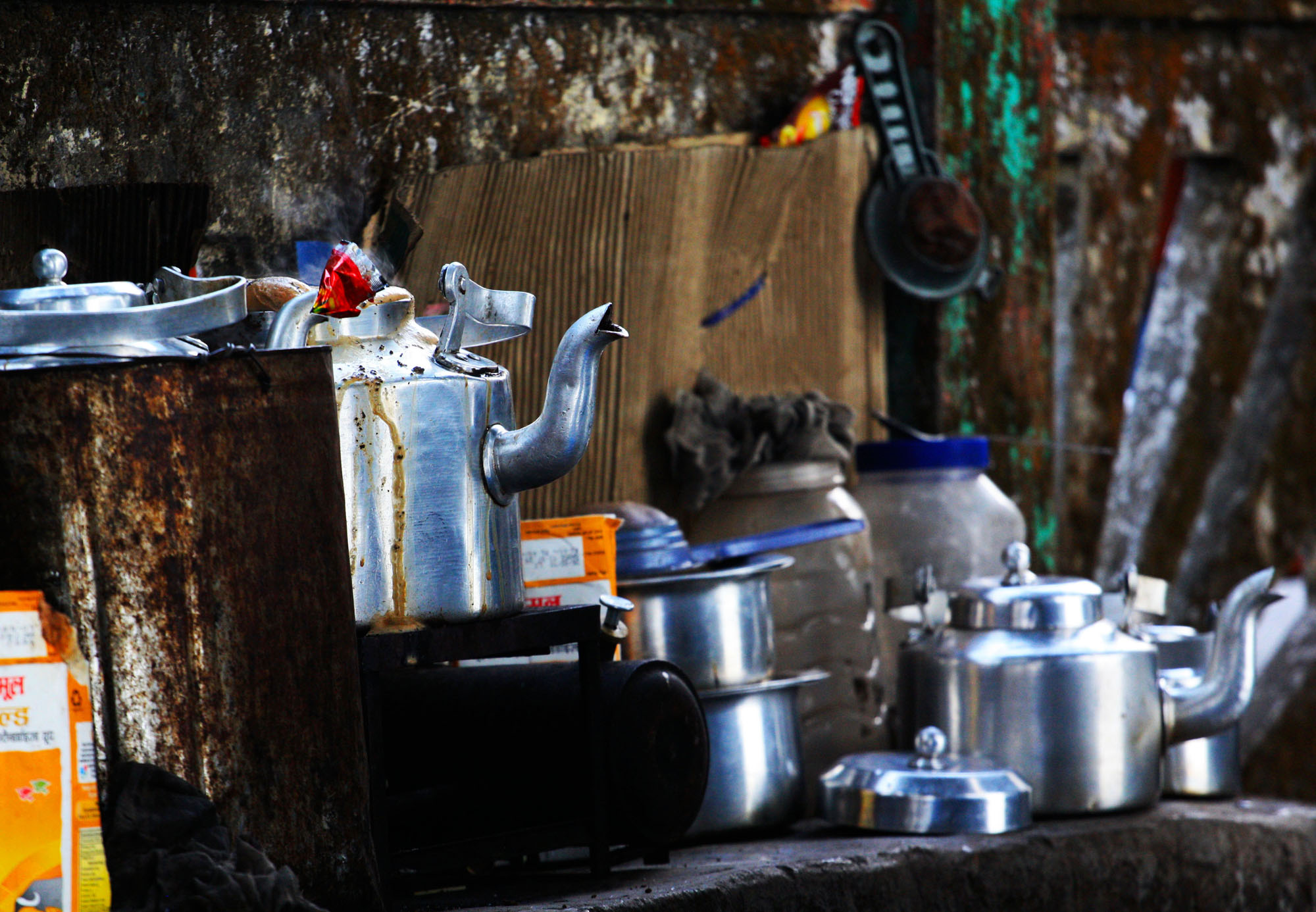
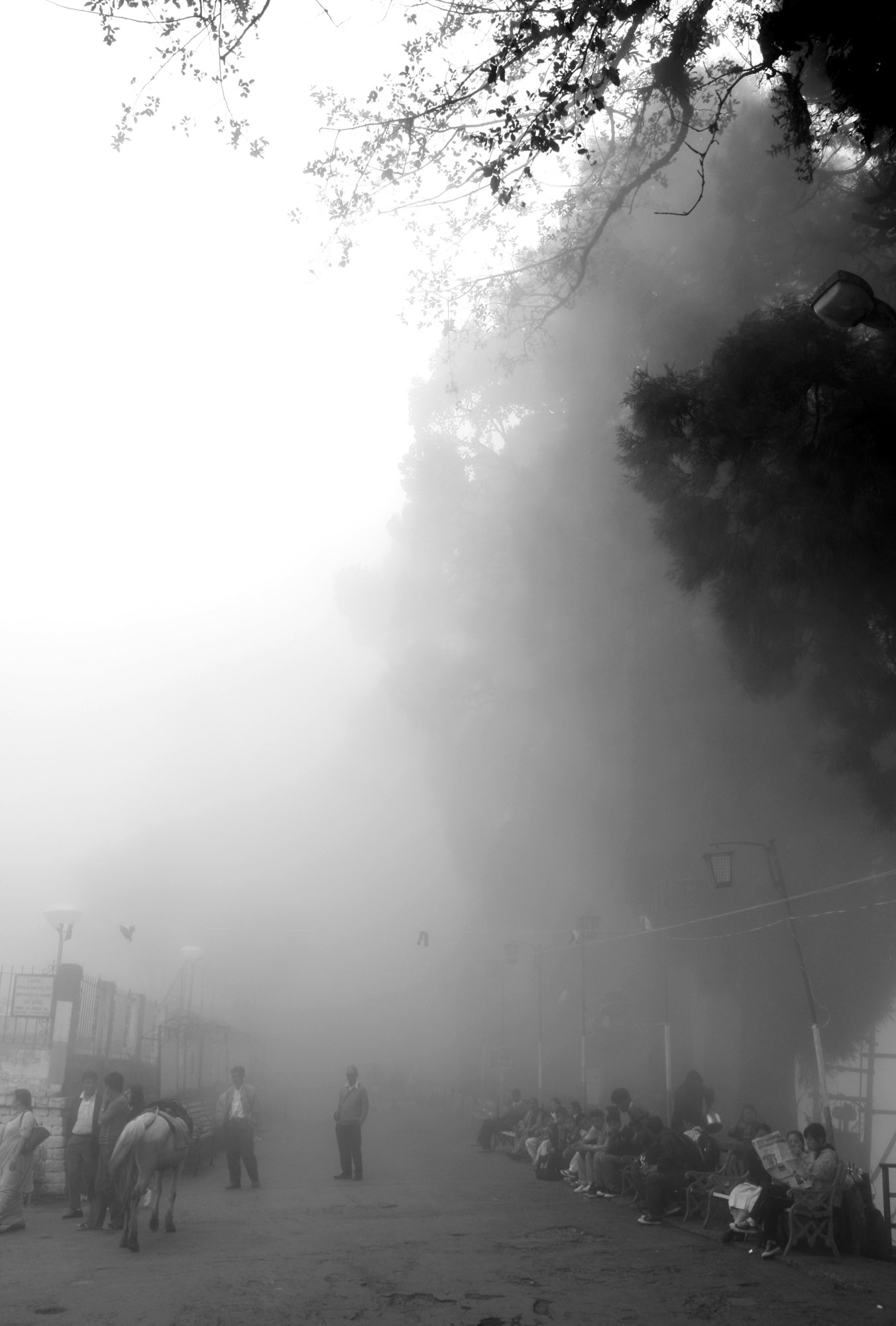
Dirk stayed on the rear of the upper deck to watch the island shrink. It soon fit within his field of vision, fading to a ghost in the late haze. He stayed and watched as it sank beneath the curve of the earth. Then it was gone altogether and he had only the dust on his sandals and dirt beneath his nails. He shivered. The breeze was beginning to go through him.

The sun set and it grew colder still. Dirk wandered outside along the decks, before heading into the cafeteria. It was full of people, standing and sitting, craning to watch a big screen. He looked around for any pretty girls. There were too many men. The film Gladiator was showing; English with Greek subtitles. The name Maximus appeared at the bottom of the screen. Μαξιμος. It looked like the parallel translations he often read in ancient works. It seemed somehow more authentic. The Roman army was gearing up for war. “On my command, unleash hell.” Dirk smiled. The accent was familiar. He too was Australian.

Dirk went for a walk. He needed to find somewhere to sleep for the night. Deck class was no misnomer. He’d been out there in a storm before, out with the banshee wails and the rain devils. The evening was clear. He had a sleeping bag. He bought a toasted cheese sandwich and a carton of milk, then went back out on the deck.

Dirk poked around until he saw a space under a lifeboat. It was out of the way; no one would disturb him. He unfurled his sleeping bag, unzipping it from end to end. He laid the sleeping bag under the boat and slipped himself onto it. There was only two feet of space beneath the boat, but it was shelter and seclusion. He got in and pulled the sleeping bag together, zipping it up halfway. He lay staring up at the base of the boat, thinking about the last five days on Samothraki. He weighed up the mix of loss and relief. It was a good basis for a sort of happiness; fulfilment and expectation, the end and the beginning, though it wasn’t exactly happiness. He soon fell asleep.

_______________________________________________


Dirk woke up at three thirty. He wasn’t sure if he’d slept, but could not account for the hours. He was still tired; warm and tired. The breeze was thin and chill and he did not want to get up. Getting up would be like being born all over again. People walked past him on the deck, talking loudly. He leaned out from under the lifeboat to see what was happening. Across the deck towards the prow were the lights of the shore, of a harbour, a mere hundred metres away.

“Lavrio,” he said. “It must be Lavrio.”

Dirk lay back down and stretched and yawned. The deep horn of the vessel sounded right through his body. He smiled and rubbed his face then ran his hands through his hair. He recalled how one cold morning before a camping trip he and his brother and his friend Gus had lain in their beds, reluctant to get out from under the covers. Then, of a sudden, his brother had hurled back the blankets and leapt out of bed, defying the cold. Dirk tightened himself, unzipping the bag. He too could call on that same spirit. It was just like diving into the surf first time in summer.

He washed up in the bathroom, working cold water into his eyes. He took off his shirt and rubbed himself down with the damp corner of his towel, getting the stickiness out of his shoulders and off his forearms; the dried sweat, the clamminess of sea salt. Dirk slicked his hair back and cleaned behind his ears. He felt proud of his efficiency. He thought of himself as a seasoned traveller.

_______________________________________________


Dirk stepped slowly down the gangway. He was in no hurry. The sun would not be up for another three hours and, the longer things took, the better. He walked along the concrete wharf and stopped in the wide car park. It was full of cars with their lights on, waiting for friends and relatives.

Dirk was glad to be walking. He watched people standing around and getting into cars. He looked closely, counting the passengers, but no one had a spare space. While he was sleeping, others had made their advances. He was uncertain. Despite the freshening up and the cool air, he still felt trapped in the timidity of tiredness. It was a while since he’d spoken and he did not trust the sound of his voice. On Samothraki he had asked some Greeks if he could puff on their joint and they had told him no. It was the first time it had ever happened to him. In every other way, Greek hospitality had been unparalleled, yet since then he had had second thoughts about asking for anything.

Still he hung around. Maybe some cute girl would take pity on him. He might get to lie on a couch for two hours, then take the metro to Piraeus. He might even get a blow-job! He might fall in love. He laughed. He waited and watched until there were only a few left. No girls approached him. No one approached him. He recognised one couple from the ferry. The young man was noticeably tall, almost six and a half feet. He looked awkward, but friendly. Dirk could not hear their voices but he was sure they must be English speakers. He could see it in their mouths. He watched them as they drifted on the edge of the docks, near the roadway. They too must have no rides.

Dirk stayed a while more. He no longer knew what he was waiting for. He guessed that there must be no buses until later in the morning, but he felt a creeping stubbornness. He was determined to be the last to leave. That way he would know he had not missed any opportunity.

_______________________________________________


At four-thirty Dirk walked over to the road. The couple he had spotted earlier were there, sitting on one of the barriers. He nodded to them and they nodded back. They avoided eye-contact. He looked down the length of the road. Some of the last few passengers from the ferry were still walking away from the docks. They were moving slowly, as though resigned. He wondered if they really knew where they were going.

The couple were sitting and talking just out of earshot. Dirk was sure they were waiting to get into Athens just like him. He watched them out of the corner of his eye, then looked back up the road at the other disappearing passengers. He knew he should go and talk to the couple. It was easier not to have to do things by yourself. Some things, that is. It took courage to ask questions in a foreign country and if he teamed up with others, they would have the courage of numbers. Then they could laugh when their words fell on deaf ears; they could joke instead of curse in the face of intransigence. He looked back along the street at the last of the passengers. Athens seemed a long way off. He shrugged and set off after them.

_______________________________________________


After checking the timetable, Dirk walked to the middle of the square. He had an hour to kill before the first bus. It was cold and he was tired. The lights were filtered by the feathery branches of the trees. The remaining passengers were resting around the periphery; sitting and lying on benches. Dirk did the circuit, keeping his distance from anyone. He felt shy. He felt reluctant. He did not want to impose.

The square spilled into a pedestrian mall. There were more benches along its length. Dirk put down his pack and took off his fleece. He put on another tee shirt then replaced his top. He stretched out with the sleeping bag for a pillow and set the alarm on his mobile phone. He placed his beach towel over himself like a blanket, then hooked his arm through the strap of his bag. There were two other guys with backpacks only fifteen feet away. Safety in numbers. He had never considered other travellers a threat. Same species.

Dirk closed his eyes for a while. The light was too bright, but he did not want to cover his face. He preferred to appear more alert. He heard footsteps in front of him and opened his eyes. The couple he had seen by the road were walking past. They moved on to the next bench and sat down. Dirk watched them. They were watching him. He smiled at them and they smiled back. No one spoke.

_______________________________________________


Dirk was awake when his alarm went off. It was five thirty. The bus was at a quarter to six. He switched off the alarm and looked across the square. There were people standing down at the bus stop but no sign of the bus. Dirk pulled his smokes out of his bag and stuck one in his mouth. He felt in the pocket of his jeans for his lighter then decided he wanted to use a match. He got the matches from his bag, took one out and, leaning up on one elbow, stabbed the match against the rough. He smelled of dog. He smelled of a campfire. He liked who he was and what he was doing. He felt cool lighting his cigarette this way. He was an adventurer. He was beat. He lay back and smoked up the early purple light.

The couple from the next bench walked past him. The young man was speaking loudly. He was speaking English with a South African accent. Dirk smiled. He’d just spent five days with a bunch of South Africans. Couldn’t he bump into someone else for once? Perhaps they were Zimbos. Dirk took a drink from his water bottle and stood up. He gathered himself quickly and picked up his pack. He felt a compulsion to hurry after them.

At the bus stop Dirk put his back against a tree. He stood with his knees locked, tilting like a buttress. He watched the twenty-odd people there a while, then closed his eyes and chewed his cheeks. He was worrying now about making it to Piraeus in time. He knew it was a long ride, but he didn’t know just how long. There was also the metro to take. He couldn’t afford to miss the ferry, if there even was one.

The bus was right on time. Dirk let the others get on first then paid his fare and walked down the aisle towards the back. The South African couple were also sitting towards the rear. He passed them on the way down and nodded. They both smiled at him and he smiled back. Dirk tore his eyes away quickly, settling them on where he was going. He had a practical excuse, but he wondered why he was such a nervous character at times. He missed having comrades on the road.

_______________________________________________


It was a dirty dawn through the unwashed bus windows; pale grey sky above pale blue smog, backlit by seeping orange. Dirk had his head against the window, enjoying the little bangs and bumps of the road. He thought of the buses in Sydney, how they rattled when they were idle. There he liked to press his head as hard against the perspex as possible, giving his teeth a good shake-up.

Dirk felt tired and oily. He wanted a hot shower and a sleep. An orange, an apple, a banana and a bottle of Coke. He watched the couple in the seat in front. They spoke quietly and he only heard one word in three. Nothing made sense. They were talking about relatives. After forty minutes, the tall man leaned across the aisle and addressed another young man sitting opposite.

“Excuse me,” he said. “Do you know where this bus stops?”

“I don’t know,” said the young man. “I only know it goes into Athens.”

“Do you know how long takes?”

“I think it is one hour and a half. I don’t know.”

Dirk watched them with a nervous apprehension. He had left it so late to make contact, despite the numerous chances.

“Syntagma,” said Dirk. “I think the bus goes to Syntagma.”

The couple turned around. The man across the aisle nodded, but turned away.

“Or Monastiraki,” said Dirk. “Both are central.”

“It goes where?”

“To Syntagma,” said Dirk. “It’s a square in the middle of Athens. Do you know Athens at all?”

“No, not at all.”

“Where are you heading? Are you staying in Athens?”

“No,” said the man, “we’re heading out into the islands. To the Cyclades.”

“So am I,” said Dirk. “I’m trying to get to Mykonos.”

“Excellent,” said the girl. “We were thinking about going to Mykonos.”

“I’m Dirk, by the way.”

“Gerard, bru, and this is Melita.”

“Cool. Do you know what boat you’re taking?” asked Dirk.

“No,” said Gerard, “we’re not even sure which island we’re going to. We were just going to head down to Piraeus and check out what’s on offer.”

“Did you know that all the ferries leave really early? At eight o’clock in the morning?”

“No, I didn’t know.”

“Some even go at seven. I’m heading straight there now. To get a boat.”

He looked at his watch.

“Put it this way – you better head straight down there unless you want to wait until tomorrow.” He sounded too dramatic. It was his exhaustion amplifying the emotion.

“Really?” said Gerard.

“Trust me,” said Dirk. “I’ve been there a good few times and almost all the ferries go by eight o’clock. I can take you,” he added. “I know the way.”

“That’d be cool,” said Melita.

“Ya, please,” said Gerard.

Dirk was wide awake now. He was full of purpose. The consequences of failure had just become greater, though the consequences of success troubled him too. He was not sure he wanted to take them to Piraeus if they wound up on the same ferry. He wanted to be alone on the ferry so he could listen to music. He wanted to stare into the Aegean and think about Homer and Thucydides; think about the Peloponnesian war.

The bus went carelessly fast. It dipped and bobbed at the corners, the standing passengers swayed and swung. They were tearing into Athens; ripping through the morning.

“You were on Samothraki as well, were you?” asked Dirk.

“Yeah,” said Gerard. “It was top notch, eh?”

“It sure was. I had a great time.”

Suddenly Dirk missed his friends so greatly that his head swam. He had not been alone for five days; five days surrounded by people and then the lonely bosom of the ferry. It was good to have companions. Until the ferry. Then he would need loneliness again, to sadden himself into an epic.

_______________________________________________


They stepped out in Syntagma. It was just after seven and the sun was still full of dew. It was damp in the shadow of the buildings; cold blue light below the spreading yellow sky.

“Have you got all your kit?” asked Dirk.

Gerard and Melita nodded. They had humped their packs on board.

Dirk clapped his hands loudly.

“Right!” he said. “Follow me.”

He led them down the paving towards the metro. He had a view of himself, rushing in his mind; a view from outside of himself. If they were slow he would want to leave them behind, so he must not let them be slow. It was his role now to be urgent; he must be entirely in character.

“There should be plenty of ferries going,” said Dirk, “but likely only one on each route. If you want a particular island, you might only get one chance.”

He didn’t have much of a contingency plan. He was thinking aloud; building up pressure to make their Piraeus decisions quick. Gerard and Melita were smiling in pursuit. He was doing them a favour; already he had saved them from uncertainty and given them direction; he might yet save them from disappointment; launching them into the sea.

Dirk stepped up the pace. He indicated the entrance to the metro and jogged towards the steps. He would get them tickets, for he knew how. He ran down the stairs to the machine; liquid with excitement. He could not work fast enough through the checklist. He pumped in the euro coins. He missed the old Drachma; Pericles, Alexander, Athena, the Olympic flame. Now they were modern heroes.

Gerard and Melita puffed down the stairs. They were fit, but tired; bemused but urgent. Dirk waved the tickets.

“Come on,” he said, “we have to change at Monastiraki.”

_______________________________________________


At Monastiraki they walked fast along the edge of the crowd. On the second train they tucked themselves into a corner. The carriage was full. All they saw were close-packed heads and up-thrust arms – tired and sleepy Greeks; sombre, but free of scowls. Dirk ticked off the stations; Thissio, Petralona, Tavros, Kalithea, Moschato, Faliro. He was burning for Piraeus, restless by the orange sliding doors.

Dirk had been to Piraeus five or six times, but had never really seen the place. He was always caught up in a hurry or a set back. Once it had stormed so hard they closed the sea. He was only thinking about the ferries now. He liked Gerard and Melita, and sometimes it was easier to travel with others, yet really it was faster alone. It just took courage. He needed one ticket and one ticket only; not three; not information on more than one ferry; not multiple timetables and options. It was all about Mykonos. Dirk rehearsed his questions. Kalimera, do you speak English? Mykonos, Mykonos, any ferries to Mykonos? And what if it was just the one ferry? They would ride with him.

They were one stop from Piraeus. Gerard and Melita were talking and had been for some time. They were talking about islands.

“Where are you going, do you think?” asked Dirk.

“I’m not sure,” said Gerard. “It depends.”

“I want to go to Samos,” said Melita. “Or over to the Dodecanese. We think the Cyclades might be too touristy.”

Dirk nodded. “They probably are,” he said. “But I want to see Delos. It’s a really important ancient site.”

In truth he didn’t care a fig if it was touristy. After camping on Samothraki, he could use some touristy places. Hot, stupid women; hot, stupid men. He wanted to sit in bars and chat up girls; he wanted creamy cocktails and brazen beers, cold, in sweating bottles. He wanted to eat fatty meat. He wanted to slump and pout and scan the scene. After five days with a bunch of hippy ravers, he longed for neon decadence; the best and the worst of civilisation; debauchery in the sluice of the temples.

The metro pulled in with a soft squeal. The sun shone straight through the dirty glass of the narrow station. It was a quarter to eight; the ferries would be warming up their engines, churning their propellers. Dirk was ready to go. His pack was on, Gerard and Melita had their packs on. If need be, Dirk would leave them behind. He had already helped these people enough.

“There are offices all around,” he said, stepping quickly off the train. “Over here.” He pointed outside to the sunlit pavement.

“I’ve got to run,” he called, “I don’t want to miss out.” But he was running already; quick walk, slow jog, and running through the station exit. Melita and Gerard followed in a skip.

Dirk ran across the road to a window in a wall of signage. Ferry boats, tickets, passage. “Passage!” he shouted, surprising himself. The man at the window was ready. At a quarter to eight, the customers always ran.

“Kalimera, kalimera, do you speak English?”

The old man at the counter nodded. “Yes,” he said deeply.

“When is the next boat to Mykonos?” asked Dirk.

“The boat goes now. At eight.”

“One ticket please, thank you. Deck class, efharisto.”

Melita and Gerard pulled up behind him, scanning the lists of departures.

Dirk handed over the money. The man moved slowly but surely. He printed and stamped the ticket.

“I’m going to Mykonos,” said Dirk. “I have to run as soon as he hands me the ticket.”

“That’s cool, bru,” said Gerard. “If you gotta go…”

“I gotta go.”

“Best say goodbye now then,” said Melita.

“Sure,” said Dirk. “Where are you going?”

“To Samos, then on to the Dodecanese.”

“Thank you,” said the man behind the counter. He handed Dirk the ticket.

“That’s it, gotta split. Goes at eight.”

“No sweat, bru. Thanks for helping us.”

Melita was already at the counter while Dirk shook Gerard’s hand. She ordered their tickets then turned back to Dirk.

“Really gotta go,” said Dirk.

“Go then,” she laughed. He thrust his hand at her and she took it firmly.

“Right then,” he said, and began to run.

“Hey,” Gerard called, “we might be on the same ferry. But don’t wait up, bru, just get on board!”

Dirk ran backwards, he nodded, waved his ticket in the air, and then he turned and fled. Different island, same ferry. It hadn’t ever occurred to him. He ran and ran along the docks. The big ferries stood many storeys tall, with a long, hammock slouch from bow to stern. The sun was bright and he was on his way, alone enough for now. He would get up onto that deck and sleep in the sun. He had a good book, good music and plenty to think on. He came to the dock where his ferry was waiting. He walked down to the edge of the wharf where the cars were being driven up its belly. There was no queue at all. Dirk looked down as he stepped aboard the boat. He watched the foam churning round the propellers. It washed to and fro from the wharf.

Read Full Post »

It is not especially easy to find cigarette papers in India. This first became apparent in Jaipur, when I wanted to roll up a little something. I had just returned from ten days travelling around Rajasthan and my contact, Sunny, had been kind enough to donate a small rock of hashish. I crossed the street that afternoon to the local general store near my hotel, which sold cigarettes, assuming they would also sell papers. Yet, when I inquired of the man behind the counter, I was told otherwise. Baffled but by no means thrown, I walked around the corner where there were two small, free-standing booths which also sold cigarettes and chewing tobacco.

“Do you sell cigarette papers?” I asked.

“No, sir,” said the vendor. “Up the road. Near the roundabout.”

“And the other guy?” I asked, pointing to the other booth.

“No, sir. Roundabout.”

He pointed up the street.

The roundabout of which he spoke was a couple of hundred metres down a long road. On the way, I passed quite a number of small businesses and stopped in at three general stores, thinking surely someone must sell cigarette papers. Again, my plans were thwarted. When I did finally reach what was a colossal roundabout, beneath an overpass, with small shops and booths circling it, I expected to be at last rewarded for my efforts. Yet, when I asked the shopkeepers, all of whom sold cigarettes, not a single one of them sold papers.

Now I was indeed thrown. Did no one in India roll their own cigarettes? It seemed like just the place for it, considering how popular rollies were amongst the budget minded, and India, sadly, is not exactly a rich country on a per capita basis. If no one sold cigarette papers, and not having spotted any shops selling chillums, I had little choice by to compromise. I bought a cheap twenty-pack of Navy Cut, resigning myself to carefully emptying and repacking the cigarettes, after having “enhanced” the tobacco.

When, roughly three weeks later, I went looking for cigarette papers in Darjeeling, the situation proved no different. Walking back through the heavy fog, armed and dangerous after a successful and picturesque score in Chowrasta, I asked in every single shop I passed, only to be told no. Oh well, I sighed, there’s always that battered packet of Navy Cut in my bag.

Upon reaching my hotel room, I lay down on the bed and took out the bag of weed I’d collected from the so-called Pony Boys, or, rather, the horse-handlers down in the square. It was a large if lightweight parcel, roughly the size of a very healthy potato, full of stick and twig and seed, and lots of dry, leafy marijuana. It certainly didn’t look impressive, but it had a fresh and natural smell which was a refreshing change from the heavy, pungent, hydroponic wipe-out buds circulating round Sydney in this day and age. Either way, there was plenty of it, and it had, after all, been recommended by a gruff Queenslander, who seemed to know his business.

It was not yet ten o’clock and, having risen early, the day seemed destined to be a very long one. Lying there, with the curtains wide to a view of faint outlines in cloying fog, I pulled some sprigs of weed from the bag and began diligently to remove the small, oval seeds. There were so many of the little buggers, that this task took me the better part of forty minutes, after which I had produced an impressive pile of mix. I hopped up and emptied three cigarettes by carefully rolling and squeezing them between my fingers. Then, having blended some tobacco with the marijuana, proceeded to re-stuff the cigarettes, ably aided by a pen. By ten forty five, I was ready. I took a warming shower, dressed and gathered my things.

Just before leaving I paused by the window, taking in the limited view. Since arriving in Darjeeling two days ago the town had been shrouded in mist and visibility did not extend much beyond the foreground. Only on the afternoon of the day previous, when it had rained heavily, had the sky cleared for long enough to catch a glimpse of the Himalayas in the distance. It was an impressive glimpse, but very brief, for the dispersal of the clouds lasted just a short while, and soon they had reformed their ranks.

On the street below a family of carpenters rested on the pavement outside their shop; at their feet a carpet of shavings. I watched them a while and photographed them, before deciding that I could likely get away with smoking a joint there and then.

I tested the wind direction with a licked finger, took a smoke from my packet, struck a light, and crouched by the window. Feeling rather deliciously naughty, enjoying this fugitive act, I inhaled as Bill Clinton never did, with zeal and gusto. The smoke went straight to my head and I wobbled a little on my heels, but, determined to do things properly, I diligently smoked my way to the filter, exhaling in carefully directed puffs, guiding the smoke away from the closed, neighbouring window.

When, two minutes later, I stepped out into the roiling fog, I was as high as a weather balloon.

“Sensational,” I muttered, and set off towards the carpenters. Feeling rather louche and chummy, I couldn’t resist a rather baroque greeting as I walked past, and waved with both hands, spewing forth hellos. The two men and a young boy responded warmly, and it was at this point that I realised just how ridiculously happy I was. The high I was experiencing was of the most rare and upbeat variety, and its effect was growing in strength with every passing minute. For the last two days the mist had fascinated me and already its beauty had won me over. Yet now, intensely stoned, feeling marvellously fit and rested, having been travelling for a month already, full of wonder and curiosity, the magic of what I was seeing exploded inside me like a bomb.

Despite six years spent living in Cambridge, which could, on occasion, become enveloped in mist rolling in from the fens, I had never seen fog anything like as thick as this. Since the blanketed morning it had increased its hold over the town, turning even the most derelict and mundane subject matter into something breathtakingly beautiful. Tears welled in my eyes and my jaw-dropped; I was thankful that in the thick mist, the few people I passed could not see my face clearly, for I could barely control my expressions. My throat was thick and my lips wobbled. I felt a burning in my heart and was flooded with a feeling of love; love for the fog, love for the cool air, love for the buildings, love for the passers-by and the curled-up dogs. The world was a pencil sketch, viewed through tracing paper. It shifted and whispered itself through the droplets, soft and muted.

I strolled onwards through the moist air; my camera at the ready and Sigur Ros in my ears. The houses, shacks and shops, huddled together along the route, loomed in and out of focus. The figures in attendance, crouched inside their stalls, seated cross-legged next to their wares, were quiet and patient. They seemed in many cases very poor, and I hoped that their lives were happy and their hearts at peace.

The mood and pace of Darjeeling was so very unlike the insistent whirlwind of the India I’d seen so far. Perhaps it was the influence of Buddhism, the cooler climate, the different ethnic blend, or their relative isolation from the weight and competition of the population at large, but whatever the case, it was a pleasure to be left alone.

I passed the stables and the tea-wallahs I’d visited that morning.

Only now did I feel slightly conspicuous, as though the so-called Pony Boys, from whom I’d bought the weed in the first place, might soon be pointing and laughing at me. Feeling far too positive to allow any paranoia to take hold, I shrugged away the sensation and wandered out into the middle of the square, where the horses stood calmly about. Despite the relative cool and the heavy fog, the square was very busy. The orange and white-striped benches along its edges were full of locals relaxing; reading newspapers, drinking tea, smoking cigarettes and in one case, playing a game of chess. People milled about in the centre and periphery; tourists, bringing children for a pony joyride or shopping in the stores along the western side of the piazza, and locals, trudging back and forth, carrying loads and pushing carts, or simply taking a stroll.

It was a pleasure to photograph these people, but having hung around the square on several occasions already, I wanted to explore further and see new sights. On the eastern side of Chowrasta was an alluring road that led down the less-developed side of the mountain. It was impossible to see where it went in the heavy mist, yet, considering how incredible everything looked and having no specific goals other than to revel in the beauty of the day and take as many photographs as possible, I set off down this narrow street.

The fog so far had been very thick indeed, yet once away from the mass of people and the tightly packed houses and shops, it grew thicker still. Without the warmth of the people and kitchens, the moisture did not disperse so readily and, a mere two hundred metres down this side road, the world closed in as never before.

I was stopped in my tracks, breathless with excitement. Above me the trees were embraced by cloud, rising up in ever-paler shades of grey.

The density of the air was such that within small spatial increments visibility dropped alarmingly until the merest ghosts of branches could be seen. I stood there, overcome, looking up into the branches, shaking my head and muttering expressions of disbelief. I took out my video camera to film the mesmerising trees, trying to comment on what I was seeing.

I soon stopped talking, for there was too much emotion in my voice and it kept cracking with pending tears. How could anything be so beautiful? How lucky was I to be right here, right now, completely off my chops?!

A family of three – an older couple and their adult son – all wrapped in bright orange or yellow shawls and blankets, stopped me to say hello.

“We are here, on holiday, from Kolkata,” the younger man told me. “It is very nice to get away from the heat!”

We shook hands and I took their photograph. When I showed it to the old man and said, “Very handsome!” he seemed extremely pleased. We all laughed and smiled and shook hands again, and in less than a minute, I was on my way, smiling at just how much warmth and friendliness the Indians had shown me since arriving in their country.

The road wound down along a natural contour, passing Buddhist shrines, tall trees and occasional houses and shops.

After a stretch, I came to a cluster of buildings – too close to town to be called a village, but otherwise so in its likeness.

The steepness of the road made its vanishing point more daunting, as though this were the last stop before the end of the world. I passed between these silent houses, again surprised at how quietly and patiently the locals sat in their doorways and shops.

An old man emerged from the fog, wearing two large square tins on his back. I followed him slowly, through the village and down to a bend in the road where a lone shop perched on the brink of oblivion.

The man took one of the tins from his back and placed it on a low concrete wall. At first I thought he was resting, but then a young boy approached from the shop to buy some of what he was carrying. I watched from a distance, but could not see what he was selling through the fog; perhaps milk or oil, or even cheese?

After taking more photographs, I continued down the hill. Slowly, but surely, the number of houses diminished and the road grew increasingly lined with trees.

Five minutes later found me standing beside a row of cute wooden houses, their weathered boards and unsquared lines only magnified their beauty. I have long fantasised about such small, cosy dwellings; for their privacy and intimacy and simple provision of basic necessity. The houses didn’t look especially warm, however, and the man of whom I asked if I could take his photograph, looked cold. I felt a somewhat hypercritical taking this shot, suspecting that thousands may have done so before me. So much for my vision of privacy and intimacy!

The road soon turned in a hairpin, with a dirt road running off the bend. With an hour and a half having passed since leaving my hotel and thinking that now might be the time for another joint, I stepped off the bitumen and walked twenty metres up the dirt road. The road was backed by a wall of dripping ferns and dew-laden grass clumps, whilst in front was the swirling nothingness. I took out the cigarette packet, extracted a joint and stuck it in my lips. Again, feeling excited and ambitious, I smoked the whole thing. As I stood exhaling into the cold air, looking over the edge of the road, I blinked in amazement as a faint outline revealed itself. I tried to focus my eyes through the fog as it shifted and rolled and saw what looked like a monastery below. Then the intensity of the fog diminished in the face of a momentary breeze, revealing what was indeed a Buddhist monastery.

I hurried back to the road and followed it down the hill. It soon turned again, back in the direction of the monastery, and I walked quickly towards it, keen to have a look. The monastery slowly materialised to present a bright face, veiled and wan with mist. It was a tall, square building, with a tower at each corner, painted with lavish designs in blue, red, green and gold. The curling patterns and images had a floral, almost organic quality, as though a colourful, symmetrical mould had grown on the structure. The flair of the portico and façade, with its rounded columns, gave the monastery a slightly garish, yet beautiful stateliness.

I kicked off my thongs and wandered inside. The wooden floor was satisfyingly worn, and the rich interior contrastingly cold. I noticed a monk in the corner and, not being sure of the protocol, decided not to take any photographs. Instead I merely stood for five minutes, hardly moving, slowly turning my head to follow the many bright images on the walls and ceiling; peering from the low light.

Once outside again, I felt inclined to press on. I’d taken off my headphones, but now decided I wanted music again and chose the Guo Brothers, performers of traditional Chinese music. The haunting and exotic mood of the music combined well with the atmosphere, and I set off away from the monastery with renewed purpose.

Just around the corner from the monastery the road steepened and spilled away into a another small cluster of houses and flats. I paused on the top of a small rise, suddenly feeling very hungry indeed. It seemed that after all this walking in the mountain air and two brilliantly uplifting joints, the good old munchies had finally kicked in. Not wanting to distance myself too much from the momos and tea of Chowrasta, I turned around and headed slowly back up the hill.

Read Full Post »

Post no Bills

Read Full Post »

When I woke up the on my second morning in Darjeeling, it seemed as though the day had been cancelled. I pulled aside the curtains to a view of next to nothing. A pea-soup fog had settled over the town and visibility was reduced to the powerlines outside my window. The eerie, wan sunlight at the back of it leant the fog a disquieting luminescence; a sheet of pale gold leaf behind the swirling, moist air.

I stared in wonder and caught occasional glimpses of the ghostly satellite dish and the iron rooftops; their outlines seemed characteristically oriental, like the tops of pagodas. Darjeeling’s quaint brand of orientalised colonialism made it the most distinct indication of the long tenure of the Raj I’d yet seen in India.

I peered out into the corridor was greeted with curious sight. Down the other end, the door to the fire stairs had been left open and the fog had seeped into the passage. It too was lit by the glary white of the hindered sun and the corridor, cold, tiled and light blue, brimmed with arcane mystery.

I walked to the end and looked out from the landing. The road below offered up the occasional silhouette; a dog, a person, a rooftop, a passing car, but little else. It was a quiet world; the sound damped down by the heavy air.

I hurriedly got my things together and set off into the fog. It was seven AM and the street was eerily silent but for the squeaky sound of a panda bear-like dog mauling a foam box. I patted this playful beast and continued down Dr Zakir Hussain Street which ran along the ridge towards Chowrasta, the main public piazza on the top of the town. There was no one about, but plenty of dogs; huddled together against house and shopfronts, curled into balls along the road, nestling on door-steps.

They all seemed friendly and not cowed; their worn faces and matted hair were less saddening when one considered their general robustness and apparent, ruddy good health. For the dogs of Darjeeling were certainly the healthiest, if not the cleanest, I’d seen as yet in India.

The street passed many a wide-open vista, where a view of the valley and mountains beyond opened out. Yet, with the rolling fog, so constant and thick and the peculiar, seemingly paradoxical heavy wetness and icy dryness of the air, all light and white like smoke, all cloying and dense like fallen clouds, it was impossible to see beyond the wire fence that hugged the street’s edge. Here and there a local emerged from a shop or house, transformed until just a few feet away into a pale outline.

Less than half a kilometre down this muffled street, it dipped steeply towards a junction and there I spied a café called Sonam’s Kitchen.

I had seen the name in the guidebook and, as is usually the case, it had all the hallmarks of a place that catered almost exclusively for tourists. I was reluctant to try it, but paused outside just long enough to catch a whiff of their excellent filter coffee. I realised how hungry I was and just how much difference a good coffee would make. A moment later, I was seated inside studying the menu.

I ordered a pot of what they called “real stuff” coffee, along with eggs and hash-browns. It was comparatively expensive for India, but with fried eggs at just fifty cents, who on earth could complain? The lady who took my order was the same as the one featured on the laminated menu – Sonam herself. She spoke great English and was effusively friendly. I felt, as the name of the place suggested, that I was in someone’s home rather than a café or restaurant. Clearly this place was favoured with good reason.

I pulled out my laptop and surfed the internet, all the while eavesdropping on the conversations around me. When travelling I tend to be rather shy about approaching people, but once drawn into a conversation, I relax more readily with company than I would in my daily life. I spent some time playing the accent game; guessing where people were from. The tables were communal and around the time my food arrived, I was joined by an American, an Israeli and a Queenslander.

All three of them were travelling independently but, having been in town for a fair while already – two weeks in the case of the Queenslander – they all recognised each other. When they greeted me and asked where I was from, I was happy to be drawn into a friendly chat. They were good people and genuinely interested in the town and region, all with their own, quasi-anthropological zeal. They also seemed curiously as they ought to; the handsome young American, well educated and scholarly, with an old world politeness only the new world can produce; the glowing Israeli, tanned and well-fed, full of questions about the spiritual nature of the locals; the gruff and rugged Australian; realist, pragmatist, egalitarian. Rather unexpectedly, within five minutes the conversation turned to girls and growing marijuana. The American had experience of it in California; the Israeli had grown his own and liked a smoke as much as the next man, but, most importantly, the Australian knew where to get it.

“All this talk is making me want to smoke,” I said.

“Not hard in this place,” said the Queenslander.

“Really? How so?”

“Just talk to the pony boys.”

“The pony boys?”

“Yeah, the pony boys. The guys down the road.”

“You mean the dudes with the horses. In Chowrasta?”

“Yep, the pony boys.”

I had passed the so-called pony boys many times the day before, strolling up and down Dr Zakir Hussain Street which, along the stretch before it met with Chowrasta, was a popular thoroughfare lined with stalls and shops. Right on the edge of the square was an old concrete stable with space for roughly ten horses. These horses, traditionally used for transportation and communication, were now primarily used in giving joyrides to children and tourists. They weren’t exactly what I would have called ponies, in the miniature sense, but they were certainly small and slightly-built horses. According to the Queenslander, the pony boys also made a little extra from the sale of marijuana.

“Just look at their eyes,” he said. “Like piss-holes in the snow.”

“Goodness! I hadn’t noticed. Are they all baked?”

“Yep. They’re off their chops. Go have a look.”

“I think I will.”

I took a big sip of coffee, thinking how delicious it would be to get smashed in these winter wonderland conditions. I had smoked a little hashish in Rajasthan and Rishikesh, but had kept things pretty clean since then.

“So,” I pressed, lowering my voice. “Have you actually bought some from them?”

“A couple of weeks ago.”

“And?”

“It was great. Very dry and seedy, very natural, wild stuff. But it’s got a great high on it and it’ll have you giggling like a little girl.”

“That is very tempting. How much did you pay?”

“Five hundred, for a bag like this.”

He shaped his hands to indicate a pretty serious nugget, about the size of a decent potato.

“It’ll take you forever to get the seeds out of it. But fuck it, you’re on holiday.”

I laughed at his laconic humour and knew my mind was already made up. Until I scored, I’d be salivating for a smoke like Pavlov’s dog.

I finished my breakfast and stayed chatting until my seat was required for someone else. When I left the café, I walked straight down the street to where the stables were, through a fog even heavier than it had been before breakfast. Only when I reached the line of stalls at the bottom of the hill, where the collective human warmth had caused the mist ever so slightly to dissipate, could I begin to see more than twenty feet. The stalls were a great spectacle in themselves. Mostly selling vegetables, these simple wooden huts, roofed with tarpaulins and plastic sheets, were attended by people who often sat cross-legged next to their wares.

The stables sat directly opposite two most excellent chai wallahs, who also cooked simple local cuisine in a steamer and wok. I sat down beside some locals on the long bench at the corner chai stand and ordered a cup of tea. I then turned my attention to studying the scene. There were just two ponies currently in the stables, the rest being out offering rides to children. Only an old man, whom I had seen there throughout the day before, was present, sitting on a step. Out in the square were the dim outlines of people and horses.

There was little hope of seeing their eyeballs, let alone their faces at this distance, in this weather, so I turned my attention to the tea, which, upon my first sip, sent me into paroxysms of pleasure. It was, without a doubt, the best cup of tea I’d had since arriving in India. It was only really at this point that my location hit home. Darjeeling – one of the tea capitals of the world!

I now studied the people behind the counter. There were three of them, two women and a man, all Nepali, likely in their mid thirties. They seemed to have their own particular role behind the stall. The man was in charge of the tea; using a large tin kettle in which he placed what looked like a home-made tea-bag the size of an apple. From this steaming hot kettle he would pour the tea into the regulation small tumblers one found right across India, mixing in sugar as desired and powdered milk. I was, initially, disappointed to see him use powdered milk, but by the time I’d finished the cup I was convinced that I’d never drunk anything so delicious in my life. I ordered another cup – at five rupees a piece, a little less than twelve cents – and watched the two women. One, whom I suspected was the wife of the tea man, was in charge of the cooking. She stood behind a large wok on a gas cooker, cooking noodles, frying eggs with chilli and heating buns by pressing them against the hot wok. The other lady, whom I guessed, again with very little evidence, might be a sister of one of the other two, was in charge of the momos. She stood marshalling a tall pile of tin and bamboo steamers, filled with what looked like delicious dumplings. I was astonished to realise that a mere fifteen rupees bought eight to ten of these soft, hot, fresh momos. Whatever was to come, I knew I’d be coming back this way for lunch.

When the tea was done, I thanked the people and stood up. Now fully fortified against the cold air, I had to work on my resolve to make an approach. I walked straight past the stables and out into the square, slowly walking towards the group of pony boys with their horses. The mist was especially thick out in the middle of the square and the Japanese cedars that lay behind the ring of orange and white park benches were lost a mere half-way up.

I hovered about for a while, feeling somewhat apprehensive. I wasn’t so much nervous as reluctant; not wanting to get involved in a misunderstanding that had the potential to turn sour. I watched the fellows for a while. They made very photogenic silhouettes in the fog and I took some photos whilst observing them. Many Indians come to Darjeeling when the weather heats up and this year was already particularly hot. In recent days Delhi had seen the temperature sore to fifty centigrade. The holidaying families were very distinct amongst the Ghorka, Nepali and Tibetan community. Several lucky children were being treated to rides.

I edged closer to the unengaged horsemen, wondering how much English they might speak. Would it be too confusing to begin with “I was told…?”

I tried to see their eyes. Who looked the most wasted? Fortunately, the first one I approached – a short, curly-haired man with a dark brown pony in tow – looked completely and utterly stoned. The whites of his eyes were the colour of lightly-flavoured chocolate milk and his pupils were hardly to be seen. I nodded to him and had his attention.

“I heard that if I wanted bhang, I should talk to the horsemen.”

The man said nothing, but examined me closely.

“I want to get some bhang, some grass… I was told to speak to the horsemen.”

He continued to look at me, clearly totally oblivious to my cryptic remarks. I knew I had to word things more simply, but was nervous and verbose.

“Marijuana,” I said.

“Marijuana?” said he. “Marijuana, three thousand.”

“Three thousand? No, no, not that much. Less.”

“Three thousand.”

“No, less.”

“Ten grams.”

“Smaller, smaller.”

“Ten grams, one thousand.”

“Ten grams, one thousand? Deal.”

Considering that twenty-five bucks usually bought one gram in Sydney, it seemed a pretty decent deal.

The pony-man gave me a big, slow, stoned smile.

“You go here.”

He pointed down the street that ran from the southern end of Chowrasta. “Down here. I talk to boss.”

With that, he was off, suddenly energised, with a distinct and unexpected spring in his step. I felt quite pleased with myself and couldn’t help smiling. I was going to get baked after all! I drifted down the side road as instructed and lifted the camera to my face, returning to my disguise as a regular tourist.

The side road was especially misty and it was clearly a good place in which to make a deal. There were some local carriers resting with their loads underneath one of the tall cedars, and I walked down past these, stopped and turned back to face the town. I reached into my bag to find my wallet and got the money ready in my hand then took a few photographs of the shapes in the mist.

The carriers picked up their loads, slowly rising, a little stiff. They walked bent forward, stepping like giants, their parcels supported by ropes around their foreheads. How strong their necks must be! When the carriers disappeared from sight, I heard the rapid clop of galloping hooves. Through the swirling mist, the shape of the mountain pony-man appeared, a mere ghost at first, but soon he burst through and materialised in front of me. He pulled up his reins and brought the horse to an abrupt and dancing halt. He had a broad smile on his face and seemed to spring in tune with his mount on the saddle. I knew instantly that he was profiting handsomely from this and figured I should be paying about five hundred, as my informer had done. Still, it was a mutual happiness, as we were both about to make each other’s day.

He guided his horse until he stood right next to me.

“Here,” he said. He reaching down, holding a plastic bag tied with a rubber band. I held up the thousand rupees and took the weed from him. It was a large bundle. Light, springy, and leafy, I suspected, but certainly copious. Finding out whether or not it was actually weed would have to wait.

“Thank you very much!”

I shoved the weed quickly into my pocket and offered the pony man a salute. He said nothing, merely smiling and nodding, then wheeled his horse and rode off into the oblivion of the fog.

I walked away quickly, firstly away from the square, feeling an urgent need to get away from the scene of the crime. A moment later, I gathered my wits and turned around, heading back towards Chowrasta. The time had come to buy some papers and get on with it. I began a determined march back to my hotel room. Why wait after all?

Read Full Post »

« Newer Posts - Older Posts »