Feeds:
Posts
Comments

Archive for the ‘Literature’ Category

Had I known what the weather would be like for the next eight days, I might have acted more promptly. I had come to Darjeeling not only to see the marvellous hill-town, but also for its famous views of the Himalayas. It never occurred to me that seeing them would prove so difficult.

The first morning I awoke in Darjeeling the horizon was shrouded in a veil of haze. The room was cold with the seeping air outside and for the first time since arriving in India, I nestled under the blankets, feeling deliciously comfortable. The last two days had been exhausting days of travel – from Rishikesh to Delhi, across to Siliguri courtesy of Kingfisher Air, then up to Darjeeling by jeep – and I was happy to take it easy. I sat on my bed and snacked on biscuits, reading about the town.

Darjeeling had only come into prominence in the second quarter of the nineteenth century. The locale first came to the attention of the British East India Company (BEIC) in 1828, when a delegation of company officials stayed in the town and realised how suitable the site would be for a military sanatorium. In 1835, the company leased the area west of the Mahananda River from the Chogyal of Sikkim, traditional rulers of the region. Over the next fifteen years, the population of Darjeeling grew one-hundredfold, thanks to the company’s policy of attracting workers to the region, mostly of Nepalese origin.

When, in 1849, the British East India Company Director Arthur Campbell was imprisoned by the Sikkim Chogyal, the BEIC sent a force to free him, resulting in the annexation of 1700 square kilometres of territory. In the following decades, the BEIC strengthened its grip on the region, gaining control of the passes through the hills, the town of Kalimpong and the area east of the Teesta river, from the Sikkim. In 1864 the town became the official summer capital of the Bengal presidency and by 1866 the district had assumed its current shape and size.

Commercial tea cultivation began in the region in the 1850s and many schools were set up by missionaries. In 1881 the Darjeeling Himalayan Railway was opened, connecting the town with the plains far below and further increasing the pace of the town’s development.

When, after independence in 1947, Darjeeling was merged with West Bengal, tensions began to increase between the largely Nepalese population of the hill towns of Darjeeling, Kurseong and Kalimpong, and the Bengali population of the plains below. The Nepalese population agitated for an autonomous state and the recognition of the Nepali language as the official language of the region. The latter request was granted in 1961. When, in 1975, Sikkim was recognised as an independent state, it again brought calls from the people of the mountains for a separate state of Gorkhaland, with occasional eruptions of violence. In 1988 an agreement between the government and the Gorkha National Liberation Front resulted in the creation of the Darjeeling Hill Council. This, however, did not quell calls for a separate state, and agitation and protest continue to this day. In 2011 the government granted further concessions, with the creation of a new and autonomous elected body called the Gorkhaland Territorial Administration, which, whilst not governing a separate state, has more powers than its predecessor.

I found myself quite fascinated by the town’s history and was keen to explore further. Not only did Darjeeling offer exciting views, amazing geography, fascinating architecture, great tea and an interesting ethnic blend, but, perhaps most importantly, the large Nepali population guaranteed one thing: momos – and I love eating good momos.

At half past nine I found the housekeeper in the corridor outside my room. As soon as she saw me, she said:

“Your room is ready.”

“Great. Can I move now?”

“Yes, yes. Come, I’ll show you. It’s here.”

The room was diagonally opposite, across the hall – a mere ten feet away. She opened the door and presented it to me. It was smaller than the previous room, but with a double bed, coffee table and chairs, wall-mounted television, a bedside dresser and a stunning, wide-angle view of the drop into the valley below and across the foothills. At four hundred rupees, a mere ten dollars Australian, it also came with a large en suite. I stood by the windows and thought of the views I might expect when the sky cleared. For now, the horizon was covered in cloud and haze, and I could barely see into the floor of the valley below. The mist rested like hands upon the hilltops, fingers stretching down the wooded slopes.

It took two minutes to shift my few belongings and, at ten o’clock I set off in search of breakfast.

I followed the road down the hill, past the little restaurant and shop in which I’d dined the night before. After a steep and winding leg the street levelled out at what appeared to be another informal jeep-stop. Here the road split into two tiers and, at this junction of climbing streets, stood a triangular building with a rounded prow: Keventer’s restaurant. I’d seen the name in the guide book and knew it to be rather famous, as a shop, in the downstairs section, but primarily for its café / restaurant upstairs. What made this Raj-era throwback popular, apart from its relative antiquity, was the amount of meat on its menu.

Since arriving in India, I hadn’t eaten any meat whatsoever – this despite ordering a mutton biriani in Rajasthan, which contained two large pieces of gristle that I promptly discarded. Here at Keventer’s they offered a variety of meat products, almost all made from chicken and pork: meatballs, sausages, bacon and the like. I sat right near the kitchen – a counter behind which men cooked methodically – in the run-down old interior. Around the walls hung pictures of the views across to the mountains, which only served to whet my appetite for the peaks I’d come to see.

I ordered pork meatballs and bacon and eggs, drawn wholly in by the old world atmosphere. The view offered a splendid fore and mid-ground of rusted, corrugated rooves and wonky wooden frames stacked down the forested hillsides.

The coffee was not great, but passable, and I soon fell to chatting with two young Indian guys; students up from Calcutta. They were friendly and charming and curious about the photos I ’d been taking. After a while they invited me to drinks that evening, and I said I’d certainly consider it, though I knew somehow that I wouldn’t go and felt an early regret at this. Having spent most days walking and taking photographs through the daylight hours, I was almost always too tired to be sociable at the end of the day. I was also enjoying staying completely off the booze on this journey.

After breakfast, I took a long walk around town; down to the bottom of the town, where I’d arrived the night before.

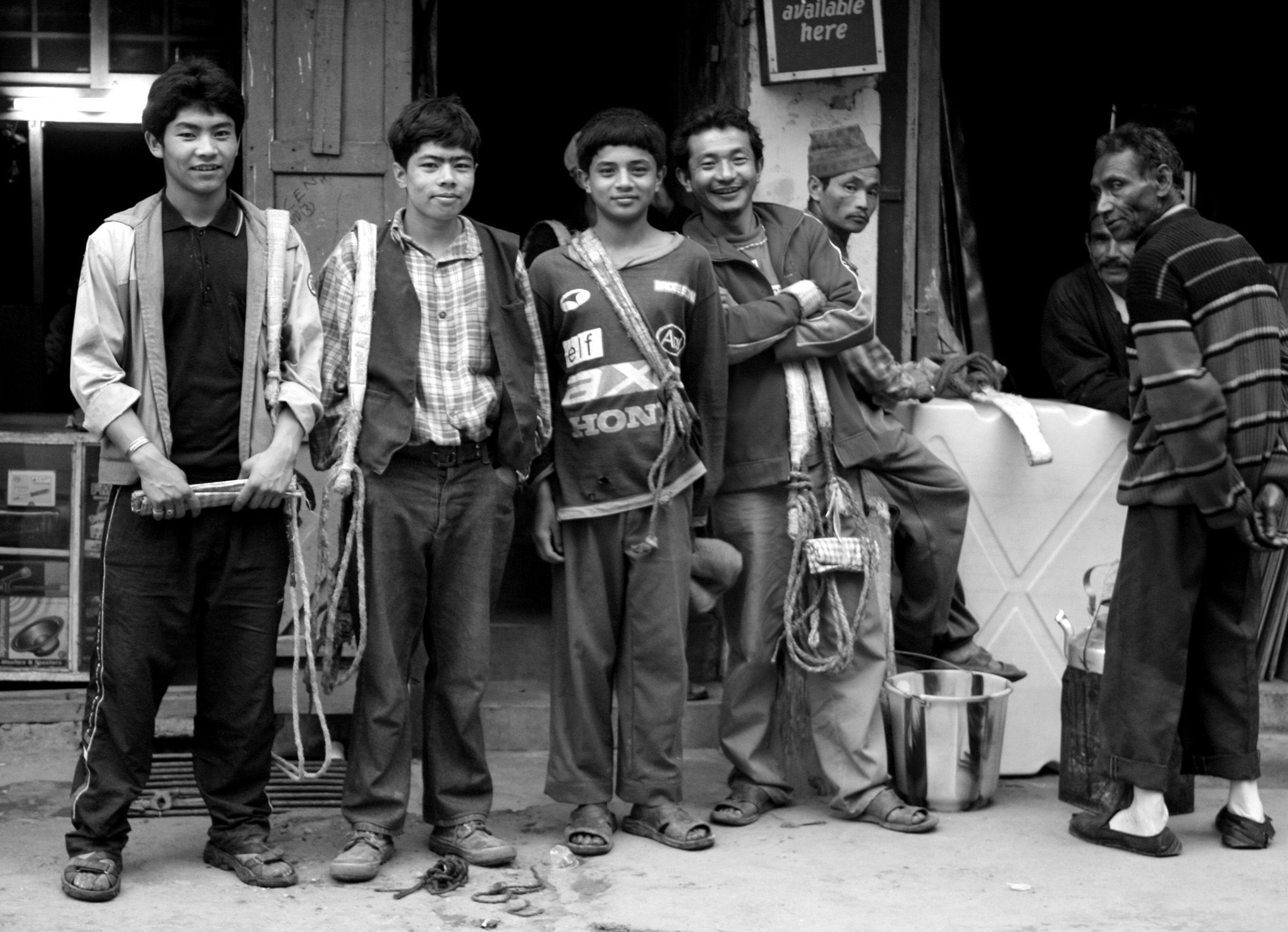
I wandered through the back streets, up and down long flights of steps; found a lane with closely packed stalls behind which men and women worked with old Singer sewing machines. I shook hands with locals, answered their friendly inquiries as to where I was from, and eventually wandered into the meat market. There, in this dirty old shed hung with carcasses, I chatted with several of the butchers and asked them about their work.

One man approached me and said:

“Come with me. I’ll show you how I make mince.”

He led me to a corner of the shed, where, on a heavy, round wooden chopping block, using only a machete, he threw down pieces of meat and hacked them into mince with swift, strong blows.

“How long have you been doing this for?” I asked; a little squeamish from the proximity of his fingers to the blade.

“For twenty years,” he replied. “I am the mince man!”

I watched him hack away at the mince for a couple of minutes; lifting the blade just a short distance and bringing it down with surprising force and accuracy. I took out my video camera to film his impressive action, and it wasn’t long before he had turned the large chunks of fatty meat into finely chopped mince.

“There,” he said. “Mince.”

“Bravo!”

I thanked him for showing me his trade and farewelled him.

I continued my wandering about town, plunging into the tight alleyways of shops and stalls. As with so many places in Asia, the businesses tended to group together according to what they sold: spices, shoes, tea, vegetables. I drifted in and out of the lanes, taking photographs here and there. Most people were friendly and generous with their smiles. Unlike other places I’d been in India, rather than trying to sell me things, they seemed merely to want to be acknowledged.

I took a walk around the circuit of Observatory Hill, then returned to Chowrasta, the main piazza at the top of the town. The horizon remained shrouded and I could see only the foothills. These, however, were beautiful in the dull light; wet and fecund, cool and, here and there, dressed with tea.

Three o’clock found me sitting in another Raj-era café, Glenary’s bakery and restaurant, situated just a little up the hill from Keventer’s. The pale mint walls, white wooden beams, wicker chairs and corrugated iron roof gave it a classically colonial appearance. I sat in the back section, like a wide, closed-in verandah, where a bay of windows faced the valley and the still-obscured mountains. I surfed the internet, ate pastries and drank two rather disappointing cups of tea. As the afternoon had progressed, the air had become increasingly damp with pending fog, until finally, at around a quarter past three, it began to rain.

Having been in India a month during the dry season and having seen no rain for some time, the idea of rain had hardly occurred to me. Perhaps some uprush of humid air from the Sundarbarns had met with the chill mountain breath and dropped its bucket, but whatever the case, once the rain began, it came down hard as hell. It poured for two hours, with little let up, striking hard on the iron roof. It was as beautiful as it was surprising, and for a long while I sat and watched figures darting through the wet below, with torrents in the gutters and cascades from the rooves. The pigeons opposite, huddled under the eaves, were positively ruffled on their multi-generational pile of droppings.

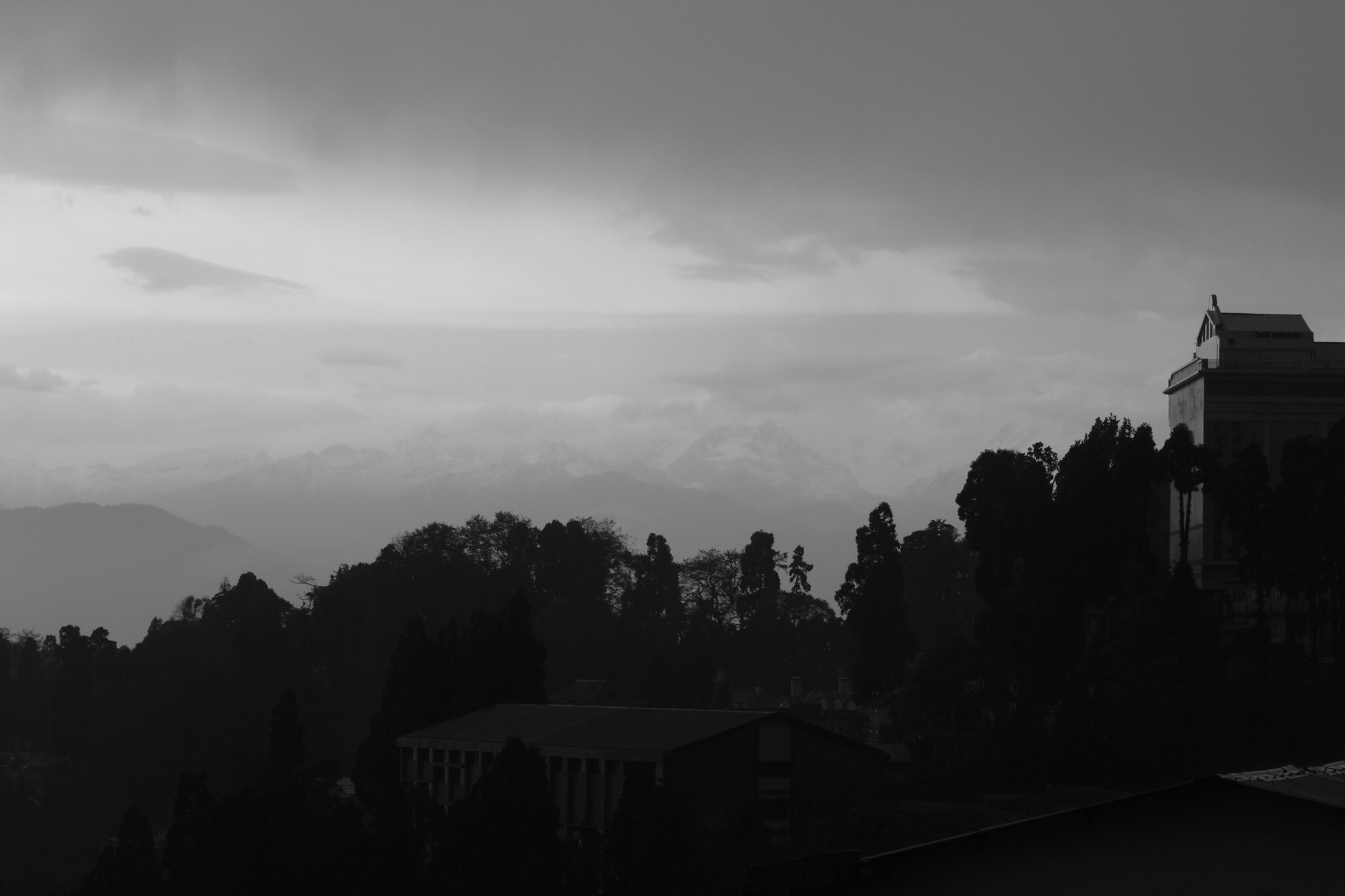
When the rain did finally stop, something extraordinary happened. I was sitting, face pressed close to the glass, watching the play of mist and light across the valley, when suddenly the clouds parted and opened a clear view to the horizon. All the haze had been washed from the sky, which was transformed to a pale blue, dotted with cotton wool clouds. I tried to shoot through the window but the curve of the hill blocked the bulk of the view. I wanted a clear line of sight, for I was dying to see Mount Kangchenjunga, the third highest peak in the world at nearly 8600 metres tall.

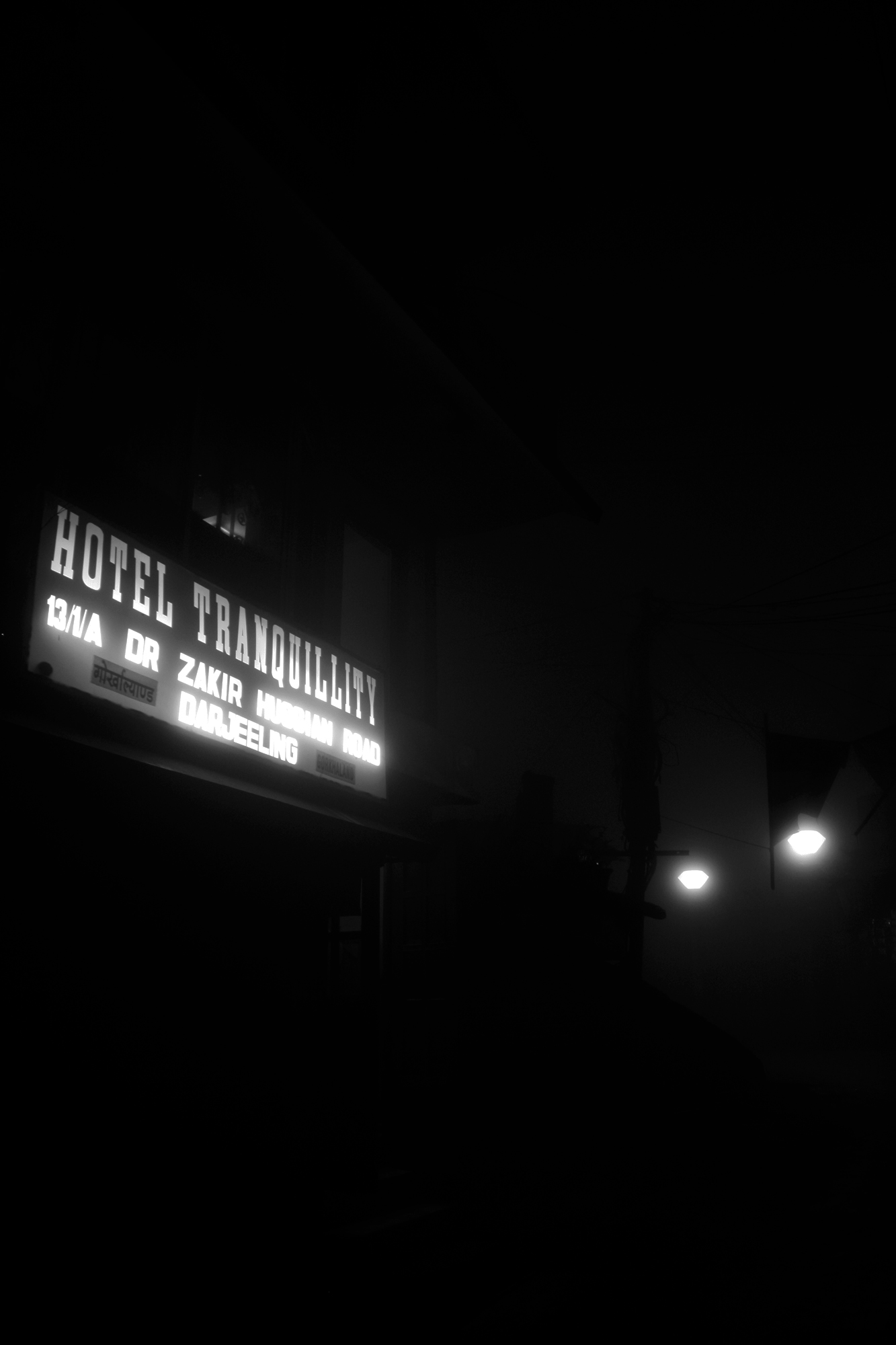
I stood up, stuffed my lap top into my bag, sorted myself out and hurried off. It was still drizzling a little, and, worried about my camera, instead of going straight to find a vantage point, I decided to head back to the Hotel Tranquillity (sic) to pick up the small but sturdy umbrella I’d packed in a moment of boy-scout foresight. I raced back to the hotel, which took a good ten minutes, grabbed my umbrella and was about to head off, when I heard voices from the roof, just up the next flight from my room. I walked up the stairs where a door opened out on a flat concrete roof, flooded with rain. Here I found Tenzing, the hotel’s owner, talking with two other guests.

“Hello!” said Tenzing. “Come to see the mountains?”

“I hope so!”

The two other guests were also Australian and we smiled and nodded at each other. Their attention, however, as mine was soon to be, was rooted in the distance. And there, sure enough, was Mount Kangchenjunga. I gasped when first I saw it, amazed by its sheer size. How high up it seemed to go into the sky. It had an unnatural quality to it, as though its extension from the Earth was somehow impossible. How could anything be so big? The towering peaks of stone and snow were nothing short of fantastical. The only problem was that much of the view was blocked by an inconveniently placed radio antenna, a hill and trees. I could see roughly half of the mountain, and that through a tilting of the head and shifting of angles.

I looked as well as I could, but the lack of a clear line of sight was simply too frustrating. I needed a new vantage point, for now clearly was the time to go shoot the mountain. I took a few snaps, made some cheery remarks, then fled down the stairs and out onto Dr Zakir Hussain Street, figuring I should make for the road that circumnavigated Observatory Hill. I scurried down the street towards Chowrasta, past all the stalls, butchers, fishmongers, bakers, fruit and vegetable sellers, chicken and egg sellers; many of them seated up on the boards of their wooden stalls.

When I reached Chowrasta, however, I could see already that I was too late. The sky in the distance was thickening again with white mist and soon everything would be hidden. I broke into a run, down along the side of this hill with its famous monastery and tall Japanese cedars. Yet, by the time I reached the far end of the road, the mountains had once again vanished behind haze and cloud. I stood cursing, deeply regretting having gone back to get my umbrella, and shook a fist at the sky. I wasn’t sure quite how long I was planning to stay in Darjeeling, but figured that some time in the next couple of days I ought to see clear skies. The rain began to come down again and I popped up my umbrella. Stuff it, I thought, there’s always tomorrow.

Read Full Post »

When I stepped down from the back of the jeep in Darjeeling, I found myself in the middle of an intersection. This was no formal station, just a central location which the streets attended from what seemed to be unplanned angles. The lights were a very dim orange, barely illuminating the shuttered and shabby shop-fronts and the greasy road.

It was half-past eight in the evening and I was pleased to be on my feet again. The prolonged journey up the mountain had been very beautiful, but being two and a half hours behind schedule, I was concerned that my room might not still be available at the Hotel Tranquillity (sic).

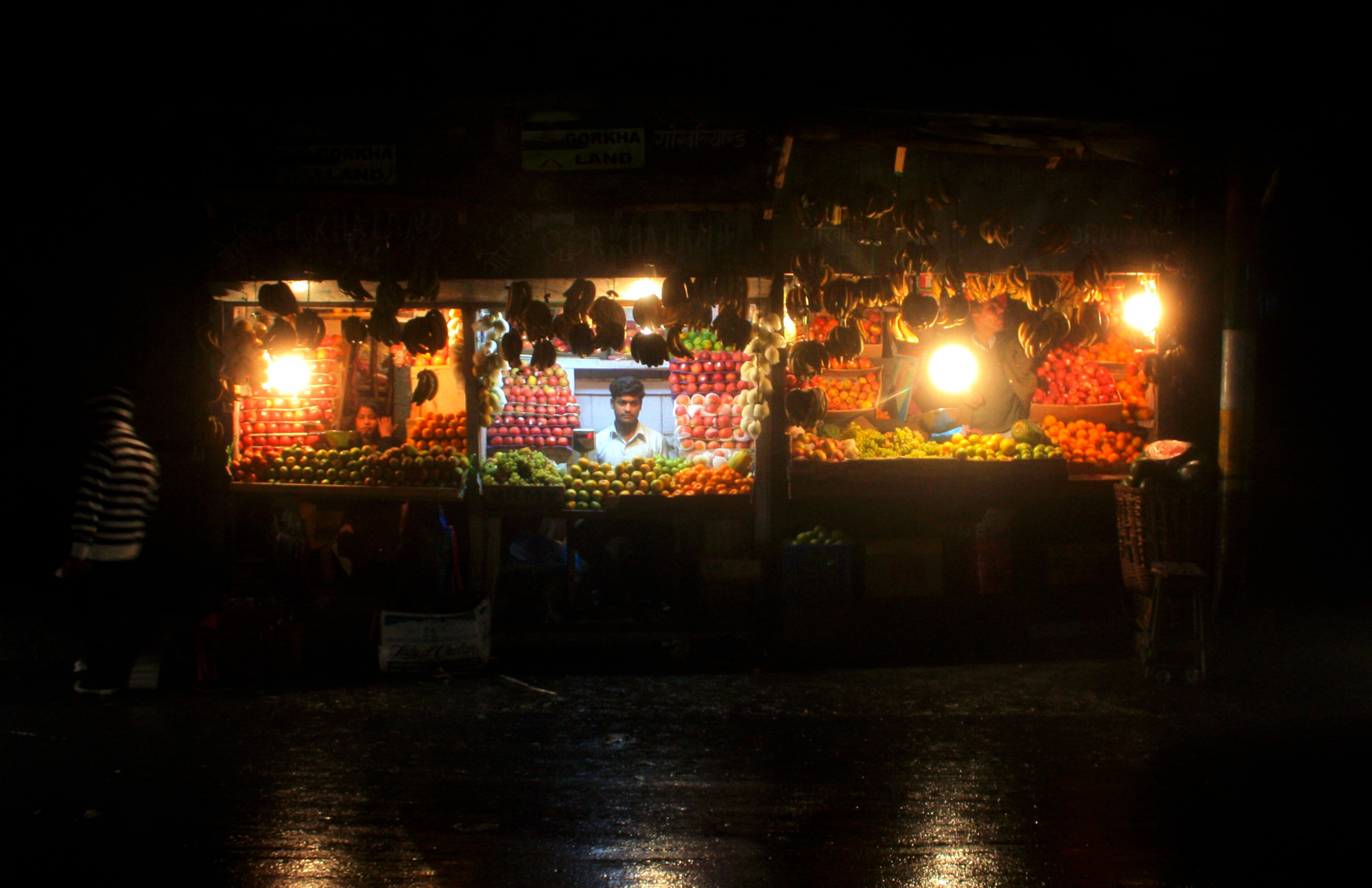
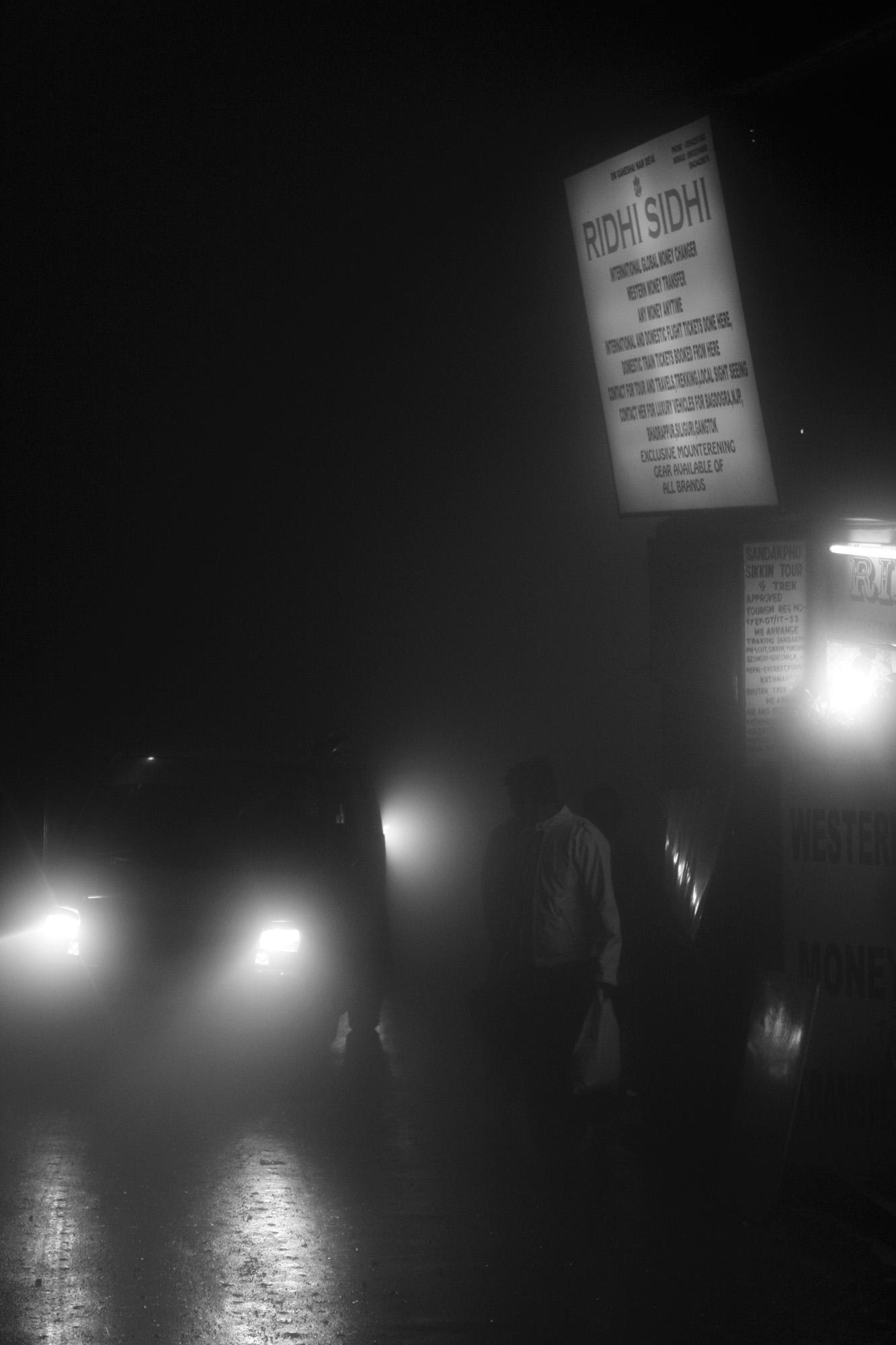
Overhead hung countless lines of multi-coloured triangular flags; the green orange and white of India barely discernible in the sapping light. I turned a slow circle to take it all in. There were a few stalls lit by kerosene lamps and tapers in bottles; on one a steaming wok in which noodles were tossed, the cook’s face visible in flashes of fire. On one side of the road two wide-fronted fruit and vegetable shops remained open; shallow holes in the wall, the wares bathed in low-wattage lamplight, each tended by a patient, smiling man. The air was damp and a thin fog lurked above the corrugated iron roofs, threatening to descend as the day’s last warmth was leeched into the night. It was comparatively chilly after the stifling humidity of lower altitudes, but the close air and absent breeze kept me from shivering. Cars and jeeps rolled slowly out of shadow, their headlights blinding in the mist.

I looked around for street signs; any indication of where I was and where I needed to go. The light was so poor, I had to take the small bicycle light from my pack to read my inadequate guidebook map. There was no signage anywhere, and rather than finding out where I was, it made more sense to ask after my destination. I approached one of the fruit sellers to enquire where Dr Zakir Hussain Street was. The man spoke just enough English to tell me it was up the hill.

“Up, up,” he said, waving vaguely down the street to my right. “Go up the stairs. Then go up more.”

He was struggling to articulate exactly where to go and I rightly guessed it was because the town sprawled up the hill and the streets wound back and forth on lines that followed the natural contours.

I thanked him and walked away down the dark street. Had I not already been in India for a month, I might have found the darkness more forbidding. There were groups of dogs curled up against the closed shops and lone men shuffling through the night. The damp and weathering had rusted, blackened and warped almost everything, and nothing seemed new or recently renovated. It had, of course, a derelict charm which I appreciated, but having no knowledge of what this part of town or its inhabitants were like and, uncertain as to whether or not I was in any danger, I remained on my guard. I walked slowly, not knowing where I was going, and after a moment, felt bold enough to take out my video camera and film my journey.

Presently I rounded a corner whereon stood a late night chemist shop; illuminated with bright, white light, which shone across the narrow street. Three men stood out the front, chatting with the man behind the counter. I approached them and asked if they could tell me where Dr Zakir Hussain Street was. They pointed to a place directly opposite, where I now noticed a long, steep flight of steps that creeping up the hill between the tall, leaning buildings.

“Go up, up,” the man said, much as the other had done.

“Do you know the Hotel Tranquillity?” I asked.

“Yes, yes. It is up the hill. Go up the stairs. Then up again. Up to the top.”

Clearly, I had to go up! I took the stairs which cut a significant shortcut through the winding, contoured streets. About half-way up, as I walked filming with my camcorder in one hand, my thongs slipped on the wet stairs and I fell on my hands, just managing to avoid damaging my camera. I cursed and dusted myself off, feeling clumsy and stupid and pleased no one had witnessed me stumble. This, however, was as nothing to what greeted me at the top. I stepped out onto the road, and, in the near total darkness, put my foot into an open sewer, filled with a sucking muck. The muck was so grotesquely thick and clinging, that I had to reach down to extract my thong. My foot was covered in slime to above the ankle. I couldn’t bear to think what bacteria lurked in that drain, particularly as I had many cuts and cracks on my battered feet. I tried to wash it off with the last water from my bottle, but this was inadequate to the task, and the only other option that presented itself was to stick my foot into the water flowing down the street’s gutter. It was, at least, decidedly cleaner than the gunk I’d collected, but the whole experience left me with a deep feeling of disgust and I longed to reach my hotel to shower and soak my foot in the Dettol I carried for emergencies.

I pressed on up the hill, soon arriving at another intersection of zig-zagging streets. Cars pushed past and edged me onto the narrow pavement. The headlights lit up the rolling fog that was seeping down the slope.

I turned on my camera again and began to narrate as I walked, feeling a mix of discomfort and relief that I would soon be in a hotel room. Where the streets levelled out, I asked directions again from a man behind the wheel of a jeep. He pointed to the steep road leading up to my right and said, as all had done before, “Go up. To the top of the hill.”

It was some time before I reached the top of the hill. The street wound back and forth and grew ever steeper, stacked on either side with wooden houses and concrete apartments. It was so dark in places, I narrowly missed falling into a vast pot-hole. When I finally did reach the summit at a quarter past nine, I felt surprisingly short of breath. Even at an elevation of just over two thousand metres, the air felt thinner in my lungs. I paused beside a large satellite dish, backlit in pale orange light, a mere silhouette in the fog. On either side of the road were closed wooden stalls; booths that sold fruit and vegetables, snacks, cold drinks and cigarettes.

I was about to ask about the Hotel Tranquillity, when I saw its sign just ahead of me. The two ells were quaintly attractive, curiously welcoming, and I rubbed my hands together with glee.

The chap in reception was very tall indeed; around six foot five. He was a Ghorka man, with high and wide cheekbones and a strong jaw. I never caught his name and for the rest of my stay in the hotel, just thought of him as Tenzing. He stood behind a closed-in counter, rather like a toll-booth. The room around it had the aspect of a cheap European ski lodge, the décor of which had not been updated in years. If somewhat unattractive, it certainly felt very homely and the smile on the man behind the counter was reassuring indeed.

“We do have a room for you,” he said. “But it is a triple room. Three beds. There is a bathroom, of course, and tomorrow morning I can put you in a double. Also with a bathroom.”

“That sounds excellent.”

“How long would you like to stay.”

“I don’t know. I’ll say three nights for now.”

The room was only six hundred rupees, fifteen dollars Australian. Despite being more than I had recently been paying, it was ridiculously cheap. Towering Tenzing showed me up the stairs to a large, carpeted room with three single beds. Noticing how cold it was in the room, I chose the bed furthest from the window and threw down my bag. Tenzing showed me around and switched on the hot water.

“Do you have a restaurant here?” I asked.

“No, I’m sorry. Have you eaten?”

“Not at all.”

“Ah,” he said, in an oddly disconcerting manner. “Then you must hurry if you want to eat. In Darjeeling, everything shuts very early. You might not find a restaurant.”

“Oh dear. Thanks for telling me.”

As soon as he mentioned this I felt ravenously hungry and dreaded the idea of snacking on crisps and biscuits for dinner as I’d done once or twice when so caught.

“The front entrance will be closed at nine thirty. If you go out, you must come in through the back. There is a small door, up the driveway. It leads through the kitchen. The door will be closed, but you can open it. Just make sure you close it behind you.”

After a much-welcomed, but brief shower, I dressed again and went in search of a restaurant. I first stopped at the stalls and bought some crisps, fruit and biscuits, water and mango juice. If I did get caught short, I’d at least have something to eat.

I walked down the steep slope in the descending fog, determined to enter the first restaurant I found that was open. One hundred metres down, where the road turned in a hairpin, I found a small shop with a restaurant attached. The space inside was cramped and triangular, with wood board panelled walls that gave it a very dated look. The tarnished glass counter was full of packets of sweets and biscuits, of crisps and chewing tobacco, old toys and mobile phones. The old furniture – linoleum-topped tables with metal rims in which lurked ancient grease, attended by wooden benches – reminded me of the old diners and cafés of Sydney which seemed no longer to exist. I sat down and picked up a sticky menu, quietly loving this place for being so enticingly run down; honest, simple and, as was so often the case in India, unbelievably cheap. It felt like the past.

The menu was a little like Darjeeling in microcosm. The Indian staples were joined by Chinese, Nepalese and Tibetan dishes; momos, spicy soups, noodles. I ordered hot and sour soup, dhal with paratha and a bottle of Coke to cleanse the palate. The man who served me kept quietly busy, and when I placed my order, he disappeared through a curtain into what appeared to be his home. I caught a glimpse of his wife in the back room, standing before a stove. The dim sound of a television snuck through into the restaurant.

I took the chance to photograph the shop, particularly interested in a very old public phone upon a stand. Many times in India I had been reminded of my holidays to the Blue Mountains as a child. For, whereas Sydney had, even in the late 70s and early 80s, kept somewhat up to date, the small towns like Katoomba, Leura and Blackheath had always been well behind the times, both in style and facilities. My brother and I had found endless satisfaction in the relative cheapness and antiquity of things, and such was the case in much of India.

The food was not long in coming, and when I tasted it, I was surprised by how good it was. I felt briefly guilty for suspecting otherwise, but had often found restaurant food to be not as good as that of the street. My father had always said that the best sauce in the world is hunger sauce, so perhaps my ravenous appetite coloured my opinion. Either way, I felt very content when I farewelled the quiet man and left to walk back up the hill.

On arriving at the Hotel Tranquillity, again finding myself out of breath, I did as instructed and walked around the back of the hotel. The door opened into a tiny kitchen, and in it I encountered a lady whom I assumed might be Tenzing’s wife. She was sitting on a stool in an upright posture, resting it seemed, and enjoying the peace of the quiet and shrouded night. I nodded in greeting, grimacing a little to convey an apology for disturbing her. She gave me a big smile in return and gracefully motioned towards another door which led to the hotel stairwell.

Later, as I lay back on the bed with my feet soaking in a bucket of hot water and disinfectant, I found myself pondering how utterly different this place was from everywhere else I’d seen in India. The cool, the damp, the faces and architecture, and here, at the foot of my bed, several extra blankets neatly stored in clear, zip-up plastic bags. That I should feel cold at all, after a month of forty degree heat, was a clear sign that this was a whole other world altogether. Being one born to suffer greatly in hot weather, though less so in the dry than in the humidity, I was excited by the chill feeling and the cold, clinging damp. It reminded me of living in Cambridge and I felt a clear-headedness I’d not felt for some time.

Most of all, however, I was excited about what the next day would bring. For then I should see what I had come here to see. The Himalayas!

Read Full Post »

I’ve been working on this piece on and off for years, not entirely sure where to go with it. Too long for a short story, too short for a novella. I could develop the characters further and intensify the drama, but I rather like it as it stands, not too deep, not too shallow… Anyways, here it is after a final buff and polish, enjoy!


Dirk slumped in the early morning. So he had come to Rafina for nothing. There was no ferry today or tomorrow and he was dog tired. The sky was lightening up mauve and the orange street lights coloured everything sickly. It didn’t look real, like blue screen in a film. But it was real – an hour out of Athens at the wrong port and no ferries.

He put his pack down and leaned his back against a wall. If he was going to make a decision, he figured he’d better rest first. He watched the seagulls and the men. They all had a role, even the ones doing nothing. Some made scraps and some cleaned them up. There were guys hauling on ropes, guys smoking cigarettes, guys drinking coffee. All the shutters were down. It looked like a big, noisy fraud. There were clanks and thumps and hisses and men raised their voices, but for all that, nothing was happening. They were just shifting stuff about.

Dirk got fed up pretty fast. He was supposed to be in Samothraki that day; miles north, off the coast of Alexandropouli, and he hadn’t even left Athens. He hadn’t even been to Athens. It was a bum steer. He hauled himself up like a big old sack, shouldered his pack and made for the bus stop. He was too tired to deal with foreignness and a language he did not speak. He pulled himself together and read the timetables calmly. He figured correctly. Money talks: when the bus showed up and he held out the cash, it was obvious enough what he wanted.

_______________________________________________

From a distance Athens looked like a dirty, smoggy pile of old white Lego. It was stinking hot at nine in the morning and Dirk’s eyes stung from the fumes. The sunlight was tungsten and sepia, and it was hot, damn hot. He was sweating as he reached the train station. There weren’t many trains in Greece, but there was a line heading north and that’s all he cared about. The train station was dismal. Birds shat through the heat wobbles on the burning lime of the tracks. He felt it all in his skin, like a car had been blowing exhaust on him for half an hour.

“No tickets here,” said the lady at the window. “No sell tickets.”

“This is the train station?” asked Dirk. “But you don’t sell tickets?”

“No sell tickets. Ticket office in town.” Dirk thought he was in town. She waved her hand several times back the way he had come. If she’d waved it only once he might have thought it was just around the corner, but it was like she was counting off the blocks.

Dirk couldn’t believe it. The heat was driving him nuts. His flight had been at four in the morning and he hadn’t slept a wink. It was a hell of a time for a flight. He got out his guidebook and tried to work things out. There was a place that sold train and bus tickets about six blocks away.

He followed the map and crossed the road. He walked up a long, wide street. There were cross-streets heading off all black and bronze in the sunlight. The air was thick and hazy. People were rushing about and the cars were noisy. All the horns sounded high pitched, like they’d been knackered. Dirk didn’t know what he was looking for. He just stumbled on, feeling more out of the loop than ever. He was so tired that every time he was checked he felt desperate, but he was too tired to panic so he just kept going.

Dirk walked six blocks and found the place. They sold tickets for everything; trains, ferries, buses; a state enterprise of some kind. He walked down the granite steps. It was dark. The lights must be real dim, he thought, or he’d been blinded outside. His eyes began to adjust. The only light came through the back windows, bounced from a dirty, pipe-veined wall behind. It was all dark wood and thick, old glass. It was dusty and the floor a scudded, maroon linoleum. It had “communism” written all over it. He walked up to one of the counters where an old man was sitting.

“Do you speak English?”

The man shook his head.

“Train?” said Dirk.

“No light,” the man said.

He made a gesture, moving his hand up and down like he was holding something, then shrugged.

“Huh?”

“No light,” said the man, making the gesture again, this time accompanied by a clicking sound.

Dirk stared dumbly, like a dog shown a card-trick.

“No light,” the man said once more, but by now Dirk had understood. He was mimicking flicking a switch. There was a power failure.

Dirk walked over to the worn, studded, leather-bound benches across the room and took off his pack. It was ten o’clock now and he was truly beat. It was only half as hot as the outside inside, but still a good deal cooler. He sat down a while, then shrugged and pulled up his feet. He stretched out in the dark corner and closed his eyes. Two minutes later he was asleep.

_______________________________________________

Dirk woke up drooling. He wiped off his mouth and looked around. The lights were still out. He looked at his watch. Midday. He stood up and walked over to the counter again. It was the same old man. Same old game.

“Train?” he said to the man.

“No lights,” the man replied.

Dirk walked away. He was fed up already and he’d just woken up. He took out his guidebook and looked through it again. Athens – Getting Around. He sure was getting around. There was another ticket office eight blocks east. He could take the subway. It was nearby.

He bought a Coke in the subway and gulped it down. He was sticky as hell with humidity and dirty air. He rode down the line and came out in a square he liked the look of. There were palm trees and neo-classical buildings; museums, galleries. Across the square he found the ticket office. The lights were on; it was air conditioned; the place was modern; the staff were young.

The Coke was dragging him up and pulling him through. He waited in the line. The girl spoke English; she was cute, black hair with a square fringe. Dirk fell in love with her in about two seconds, he was that stretched. She sold him a ticket all the way to Thessaloniki. From there, if he couldn’t get a ferry, he could take a bus to Kavala or Alexandropouli. The train didn’t leave for another hour. He would have time to get back to the train station. He walked out of the office, smiling for the first time all day; smiling, just like she loved him too.

He looked around the square, took a bunch of photos, then realised he didn’t have his guide-book. He ran back to the office, burst through the doors and shoved his way through to snatch it off the counter.

“Fuck it,” he said, when he received a few rude looks. He’d never see any of them again anyway.

_______________________________________________

From the subway Dirk walked to the station. His pack was settling in now. It was carry-on sized; a glorified day-pack. A couple of changes of clothes, a pair of flip flops, a Latin dictionary, some translations he had to make, his diary and The Golden Ass, by Apuleis. He travelled light and washed things as he went. That was the way he liked doing it.

At the station it was hotter than ever. He saw a sign saying thirty-nine degrees. Crikey. The air was acrid, unpleasant; a flatulent pall. Dirk went into the washrooms and cleaned himself up. He washed his face and slicked his hair. He wet his arms and legs and worked all the sweat and fuel and dust off. He dried himself with his beach towel and went back outside to wait. He felt good now. He bought two Cokes, three bread rolls, two apples, a block of chocolate and a packet of smokes from the station shop. He sat on a bench and smoked. The cigarette gave him head-spins, but it tasted great. He noticed people were buying tickets from the ticket office. The shock left him briefly unseated, but he soon ceased to care.

The train was only ten minutes late – one thirty-five. There weren’t many people at the station, but the carriages were near full. It was an old train and smelled of old train; soot and diesel and hot, greased metal. Dirk climbed up and walked by the compartments. They all looked full. He kept searching for an empty one. He didn’t want any conversation, just to smoke and look and put some music in his ears. He found one with just two people in – a pair of young Greek blokes. They looked hip and Dirk wondered if they were going where he was going, all the way to Samothraki. They were sitting by the door, not the window. Dirk went through and took the view. He was stoked to get the window.

_______________________________________________

Four hours later they were high up in a rocky land and everyone in Dirk’s compartment was asleep. It was full now and the guy sitting opposite had slumped like a dead man. He was covered in sweat; completely drenched with it. Dirk had never seen a bloke sweat so much in his life and it made him uncomfortable just looking at him. His clothes were dark with it, dripping.

Dirk got up with his walkman, his smokes and a Coke and went into the corridor. There were guys leaning out the windows down its length and Dirk pulled down one of the long, rectangular windows. He lit up a cigarette and leaned his elbows on the frame. It was just the right height. The wind blew in his hair and he rested his eyes across Thessaly. Dirk had been around Greece before, but never up through Thessaly or Thrace. He was excited about the terrain and thought a lot about hoplites and partisans. He also thought a lot about donkeys.

They passed over a gorge on an iron bridge. The soil was white and orange and the rocks white and orange too. The trees were spindly; hardy and evergreen. There were clumps and spills of shrubs and bushes, with the white rock and soil in between like bald patches. The land rose and fell with this forest and scrub and rock and Dirk caught glimpses of distant, cultivated plains through the gorges.

He watched the train ahead as they took the turns. Rafina was another day, another life. When he looked back on the dawn’s disappointment, it wasn’t real after all. He smoked his cigarette and a guy up the front looking back gave a wave. Dirk brought his hand up in a salute. Hey, they were all comrades here. Everyone on the same trip. The camaraderie of the road. Dirk was smiling now. He lit up another cigarette and put on his walkman. Dark Side of the Moon. He wanted something epic; something to reflect the day’s quiet desperation. There was still a long way to go. He would eat some chocolate now.

_______________________________________________

At Thessaloniki Dirk took a hotel right by the train station. He was all washed up and wanted an easy finish and an easy start. The town was boiling hot. The concrete and bitumen and stone still poured out the day’s heat. The air was thick with pollution. Unlike the acid sting of Athens, it was a roiling, eggy flatulence. Dirk took a shower and lay down in his towel for five minutes. He stared at the ceiling blinking.

Though it was dark, Dirk hauled himself up and went out to see some Roman remains. The Arch and Rotunda of Galerius were a good leg from his hotel. He was pleased not to have to carry his pack. He followed his map along the main drags and took a couple of detours to look into the harbour. It wasn’t so neat, he thought, but the air was cooler. There were palm trees. He always liked palm trees.

Dirk stopped by the clumsy, weathered reliefs on the arch and smoked cigarettes. He hated the late third-century style. It was too thickset and graceless. It wasn’t just the way the stylization robbed the figures of detail, but the compositions were poor; cluttered and syncopated. Dirk smoked and thought about rhythm. He never liked Galerius anyway. “You were a bit of a cock, Galerius,” he said. Then he went back to his hotel and went straight to sleep.

In the morning Dirk rose early. He felt travel-fit after a day of errors. He was rested and sharp. “On the ball,” was about the only thing he said all morning. He took a walk through town to look at the churches and see the Roman structures in the daylight. The rotunda was closed this early so he missed the mosaics. He found a fifth-century church that had been so rebuilt and renovated, it might as well have been late medieval. He gave up and went to a café. He ate eggs, toast, coffee and fried potatoes. He mopped up the grease with heavily buttered bread. He drank a second coffee and smoked two cigarettes. This morning was cooler, clearer. It felt like he’d pulled all the stuffing out of his lungs. He walked down to the harbour and asked about ferries. There were no ferries to Samothraki. He would have to try Kavala or Alexandropouli. He’d figured on that anyway and left town.

_______________________________________________

Dirk reached Kavala at noon. It was the prettiest place he’d stopped so far. There were a lot more older-style houses. Up on a hill, on the northern side of the harbour, was a fortress, with pre-gunpowder battlements and crenulations. The sun shone clear, without haze. The air was fresh. There were palm trees amongst the red roofs. He liked the colours. The sun on his face made him smile.

Dirk walked around all the ticket offices and asked about ferries. There were two ferries a week to Samothraki and the next one was two days away. He asked about a boat to Alexandropouli. It would be nicer than the bus, but didn’t go for three hours. He was getting impatient again. He didn’t want to get to Samothraki and find all the good stuff was gone. It might take him a day just to find his friends. Hopefully they would have the right gear.

He boarded the bus and sat by the window. There were others milling about outside, finishing cigarettes, saying farewells. Dirk noticed one bloke in particular. His hair was closely cropped and he was wearing an orange and red tie-dyed tee shirt and cargo pants, carrying a large pack. He looked a couple of years older than Dirk – about thirty. He looked like a raver. He was talking to a couple of young girls in an animated, friendly manner. Something about him made Dirk think he was a good bloke.

The bloke boarded the bus with the two girls and two other guys in tow. He was still talking and spoke in English English. They sat down just in front of Dirk and kept up the conversation. The two girls sounded French. Dirk figured they’d not all known each other that long, that they’d met on the road. He liked the look of the two French girls. One of them reminded him of a girl named Juliet he’d had a crush on years ago. The other one just looked French, in a good way. He was certain they were all going to Samothraki. He decided to wait until he was sure.

After five minutes he still wasn’t sure, but he wanted to talk to someone.

“Excuse me,” said Dirk, leaning forward. “Are you going to Samothraki? To Solar Lunar?”

“Yeah,” said the Englishman.

“Yes,” said the girl who looked like Juliet.

“Cool, me too. Do you know about the ferries? I was hoping to get a boat at Alexandropouli.”

“Hope being the operative word,” said the Englishman. “You can definitely get the ferry there, but it’ll be busy.”

“That figures. I don’t suppose you know the times?”

“I don’t. But there’s a few each day. They’ve put on extra.”

“Oh, good, good. That’s relief. I’m Dirk, by the way.”

“I’m Sean.”

“I’m Annette,” said the girl who looked like Juliet, “and this is Milene.”

Dirk smiled. He waved around and through the seat backs. Across the aisle, in front of Sean the heads of the two other guys popped up. “Hello,” they said.

“That’s Numa and Tom,” said Sean. They smiled and sat back down.

“Are you travelling solo?” asked Sean.

“Yeah. I’m meeting up with some friends on Samothraki. I just have to hope I’ll find them.”

“You ought to stick with us. We could use an Australian. I’m sure it’ll all work out.”

“Cheers,” said Dirk. “I feel like I’m finally getting there.”

_______________________________________________

They arrived in Alexandropouli around four. Dirk and Sean talked the whole way. They got off the bus and went straight across the square to a café. They ordered Nescafé frappes.

“I’ve only been in Greece two days,” said Sean “but I can tell you that this is all they drink.”

“So much for Greek coffee.”

Numa and Annette were an item. Numa was from Marseilles. He was thin and darkly tanned, with long black hair tied back. He looked like a pearl diver; pointy, like a spear gun. Annette was thin and pale and from Orleans. She too was thin, sinewy, but when she smiled she fleshed out with the softening. Dirk liked the way her hair fell. Milene was Annette’s best friend, also from Orleans. She didn’t speak much English and acted like a sidekick. Dirk’s French was poor. He knew he had some work to do, but he wanted to do it. She wasn’t wearing a bra. He could tell she was nice.

Tom was from Hamburg. He was quiet and kept his eyes down. He wasn’t so trusting, but he was learning to be. Dirk figured he fancied Milene as well. Fair enough. She might well sting them all. Sean was from Sheffield. He was an ex-army private; a mechanic; a writer. He D.J.ed in clubs in Liverpool and Manchester. He knew what he was doing and was organising the others. He and Tom had been travelling alone. They’d all met in Kavala. They finished their drinks and hit town.

At the ferry ticket office, the queue was out the door and down the street. It was a real bustle. They drank tinned beers and everyone checked each other out. They got tickets at sunset with the lights on in a hot press: two PM the next day. Dirk looked about for his friend Julian and his brother Jason, but couldn’t find them. He thought about a hotel room. He didn’t have a sleeping bag. It was a hot August. He’d been promised a tent berth on Samothraki. He figured he could pull through till then. He chose to save money and sleep rough with the others.

They bought supplies and walked to the harbour beach. It was thick sand and scrubby clumps. They laid out groundsheets and foam rolls and sleeping bags. Dirk lay down nothing. He put on two tee-shirts and a jumper. He figured he’d be fine if it stayed warm. They talked about life and work. Dirk liked them all and they seemed to like him. They got half drunk then called it quits.

At ten o’clock the sun was gone and with it went the heat. The moon was thereabouts full and lights shone bright from a shipyard further down the beach. Dirk took a walk to look at the yard. There were hungry dogs barking all around, but they always sounded far off. He came to a wide wire-mesh gate in a tall, shabby iron fence. The light was orange and yellow and leeched the colour from everything. The only colour he could see was rust; rust and dirty sand; rust and dead yellow grass. There was a great pile of iron and chain and junk. Scrap. He stared into it and listened to the junkyard dogs. He took a piss on the fence and walked back.

That night he shivered like hell on the sand. He put on another shirt and borrowed a sleeping bag cover for a cap. He lay in the light breeze, thinking how he’d done this twice before, in Turkey, in Sardinia, and both times it was stupid without a sleeping bag. Then Sean pulled him in and said, “get under here, you dill, and don’t get any ideas.” Backs together under a plastic sheet, heads on a pillow of sand, Dirk slept.

_______________________________________________

Seagulls skimmed the flecked wake of water, hunting the fish chased up in the foam. The day was bright and everyone felt happy. Sean was at his best, cheery and jibing. Dirk was smiling, but thinly spread, too much so to chase Milene. He leaned on the rails and stared at the sea, throwing in his odd two cents worth. He’d spent the morning baking and thawing in the sun. Now the sea was clearing out the drowse. He was thinking about Julian. How would he find his friend? Soon Samothraki’s tall Mount Fengari arose from the haze with its forested crest.

Kamariotissa spread with the wash of arrivals. They gushed out into the car park and broke against the shops. Dirk and the others flowed with them, down to the main promenade.

“The shopkeepers can’t believe their luck,” said Sean. “Two and a half thousand people on the whole island, and bang, seven thousand customers arrive in a couple of days.”

“They probably hate us,” said Dirk.

“Only the spoilsports.”

The buses were ready and waiting. It was a few miles to the campsite and the fare was next to nothing. The bus was jam-packed full of ravers; a mess of colour and language and accents. It took just twenty minutes. The land was olive green and ochre, with yellow and pink-red flowers. The sea was both blinding and dark. Where it did not foam or glint, it was deep bruise blue – how it should look in its belly; how it would look to the drowned. It flashed through the trees as they sped.

They got off at a dirt road that led into a forest. There were rainbow banners and police out the front. Through the gate and down the road was an open space swarming with people. There were low concrete buildings and dust in the air. The ground was rocky, clay, dirt. There was hot food and cold snacks, hot drinks and booze, massages and aromatherapy, candles, tarot, first aid, come down, pick up, meditation and left luggage.

“It’s all happening,” said Dirk.

They looked at the message board by the cafeteria and found nothing. They walked into the forest, down towards the beach.

“If I don’t find my friends today,” said Dirk, “can I crash with you guys somewhere?”

“I have a space in my tent,” said Tom. “You can stay with me.”

“Thanks a lot, man. That’d be great.” Dirk had bought a cheap sleeping bag that morning.

They walked for a mile through the forest. Tents were pitched everywhere; hammocks, lean-tos, wigwams, tarps; there were hardly any gaps between the trees. It was a new settlement, the largest on the island, more populous than the main town. They soon came to one of the two main stages. There was just a small clearing before it, and the trees formed a swaying canopy overhead. There was music playing, but things were still being set up and only one lone tripper was dancing. The party was to begin that evening.

They continued through the forest until they came to a much larger clearing, almost a hundred and fifty metres wide. Here the main stage had been set up, roughly a hundred metres from the water. Tall, triangular sails formed a clever and colourful roof above the speakers and equipment. Flags fluttered from the tops of poles, and, behind it all, rose the forested crest of Mount Fengari.

They finally found a spot between the two stages and began to set up camp. It was dark and surrounded by trees; just enough room for two tents. Sean planned on sleeping in the open. In fact, he didn’t intend to sleep at night at all. None of them really did.

_______________________________________________

It was dusk when Dirk spotted Julian. He was walking to the beach, coming up a rise from a grassy dip before the shoreline.

“Hey Julian!” he shouted.

“Dirk,” called Julian, “I thought you’d never make it!”

“Here I am.”

They walked over and embraced. Julian wore red and black board shorts, a black tee shirt. He was dark-haired and tanned. His face was slim, though his frame was built and full.

“Well done, man,” he said.

“Well done yourself,” said Dirk.

“Where you at?”

“I met a bunch of cool people on the road and pitched in with them. Not too far from here. Over that way. Where’s your lot?”

“Over that way. We’ve got a top spot, bru. You should move on over.”

“So there’s room?”

“Of course, bru. We’ve been expecting you.”

“Excellent. I might get my stuff right now. It’s not far.”

“For sure. I’ll come with you. I was on my way to get Jase, but he’ll be cool.”

“Okay, let’s do it now then.”

“It’s good to see you, bru!” said Julian. He slapped Dirk on the back.

“It’s a hell of a relief to find you. It’s been a bit of a mission so far.”

“You love missions, don’t you?”

“There’s nothing else.”

Julian laughed.

“Let’s get your stuff.”

They set off back to where Tom and Numa had pitched their tents.

“Have we got, you know, the wherewithal?” asked Dirk. “Are you equipped, with the goods?”

“No problems there, bru. We’ve got the lot. Liquid acid, ecstasy, hash, Ketamine, mushrooms.”

“Wicked. How did you pull that off?”

“Friends in low places.”

“Top notch.”

“It’s all back at the camp. Just sorted today. I’m holding off for tomorrow though. I’d like to start fresh in the morning. We’ll talk about it later.”

They found Tom alone, organising his tent. Dirk introduced Julian and explained that he was moving.

“Sorry, man, I feel like I’m abandoning you,” he said, pulling his bag from inside the tent.

“It’s no problem,” said Tom. “I’ll come with you. Show me where you’ll be.”

“Yes, make sure to tell the others.”

They set off through the forest.

_______________________________________________

“This is the laager,” said Julian.

“Cool spot.”

They were just a few hundred metres from Stage One. There were five tents, all facing into a circle; a hammock, a clothes line, a stone fire circle and some wide, woven dog blankets. There were also three men and a dog.

“This is Ian, Andrew and Pieter,” said Julian, “and this is Dirk and Tom.”

“Hi.”

“Hello.”

Everyone smiled. It was genuine.

“And that, my friends,” said Julian, “is Brutus the dog. He likes a bit of hard trance, but mostly he likes sleeping. Speaking of dogs, my brother should be along sometime soon. You know Jase, Dirk. There’s some other people staying here too, you’ll meet them soon enough. We all got here yesterday morning. Prime real estate.”

“It sure is.”

They talked for a few minutes and shared their adventures so far. It was almost dark, so Tom stayed just a short while before excusing himself.

“I’ll tell the others where you are,” he said as he left.

“Make sure you do.”

“So,” asked Dirk, once Tom had left, “is anyone here not South African?”

“Brutus,” said Julian. “And Hilda, who owns him. She’s Dutch.”

“That’s pretty close.”

“Don’t worry,” said Andrew, with a sinister lisp, “we’re non-discriminating.”

“Et tu, Brute? Non yarpie est?” asked Dirk, sitting down with Brutus. He was a big, piebald mutt with a thick skull and slow manner. Dirk took an instant liking to him and patted him a good deal. Brutus put his head in his lap and Dirk lay down on the blanket. He was feeling beat again and decided not to go anywhere or do anything for a while.

“So you’re from Cambridge too?” asked Ian.

“Yeah, same college as J. Where are you guys all from?”

“In England?” said Pieter. “We’re all from London.”

“In our own way,” added Andrew.

“Different parts,” said Ian.

“Otherwise, Capetown or Durban.”

Everyone had their shirts off and were tanned. They were all good-looking men; handsome, fit and toned. Dirk could tell just looking at them that they were capable. It was a good tribe to join and he was happy right where he was. He felt safe. The trance music pumped across the Stage One clearing and through the trees. The music would never stop. How would they ever sleep? Right now he was so tired he figured he’d drop off anyway. He closed his eyes.

“You off to sleep already, boet?” asked Julian.

“Looks like it,” said Dirk. “Just give me a bit. I’m spent.”

“Sure thing. There’s plenty of days ahead. I’ll wake you in a bit.”

“Do that.”

“You want some of this?” asked Ian.

“What’s that?”

“Hashish. The world’s best painkiller, bru.”

“Sure, thanks, man.”

Dirk sat up and leaned over. He took a few pulls on the joint and handed it back. He lay down again.

“Say, it’s damn nice here. I might just sleep out with Brutus tonight. It’s lovely.”

“Go for your life,” said Julian.

Dirk felt the hash come on like a massage. Up through the trees he could see the stars emerging. The sun had dipped below the fading, orange horizon. There was no breeze and the earth was dry and warm. There were soft needles on the sandy forest floor. He reached out a hand and ran it through them. He was on a nice flat stretch. Brutus nestled in with a meaty grunt. He’s a first-rate dog, thought Dirk. My new best buddy.

The stars grew brighter. Dirk closed his eyes and listened to the voices about him. Julian was off to find Jason. Andrew and Pieter sounded gay. Ian was smoking a cigarette. Was it just ravers, he wondered, or had some great good fortune thrust him in amongst the nicest, most welcoming, friendly and easy-going people on the planet? And dogs, he thought. Easy-going dogs. He emitted a high little giggle and fell asleep.

_______________________________________________

It was Jason who woke Dirk. “Laka, bru, it’s good to see you,” he said, pulling him from his slumber to his feet. They had met previously in the thick of some hard-core nights and had the bond of having seen in dawns together. They were both younger brothers and knew just what this meant.

“It sure is good to see you, Jason.”

Once he was up, Dirk decided he had better find Sean and co. He walked the twenty metres to the beach, washed his face and hands, walked back, changed clothes, then led Julian, Jason and Ian to find his other friends. It was Tom who sent them on to the cafeteria, by the entrance to the site.

Dirk did the introductions, then sat at the head of the table and watched everyone mingle. He smiled at the way Sean and Julian singled each other out. They were similar beings. It was animal; both of them leaders. One ex-army, the other ex-Olympics. It was not in any way macho, but diplomatic. They both held assurance and wisdom; could sense the other’s inner disciplines. Instead of boasting or posturing, they praised. Dirk admired them both. He tried to admire all the people he liked and felt he could learn from. He watched as these people enmeshed. It was he who had brought them together. Perhaps he too was a leader.

Milene sat at the other end of the table with Annette; still the sidekick. They were like Ernie and Bert in their stripes. Dirk watched them as he spoke to Ian and Numa. He felt further away than ever from Milene. Across the table, across the language. He had thought about her a lot because he knew the advantage of introductions. Proven safety; vouchsafed goodness. She had already seen that he was at least okay; a good person.

Dirk took up his camera to take a photograph of the group. He wanted to record this coming together. It meant a lot to him. He saw Milene watching him. He saw her looking into the camera when he peered through the viewfinder. He saw how she was the only one who had noticed. He saw how she smiled at him. He took the photo and roused everyone with the flash. Milene continued to smile and he smiled back. She really was sweet. It was her manner. Her eyes. That’s where you look for intelligence, for kindness. He wished to god his French was better. His moves were all conversation. Without the words, she was totally out of reach. He’d never been with a girl without a spoken understanding. He put away the camera. He knew he’d already given up. He knew that he would not dance with her, in case it came down to it. He could not be so mute and then physical in love.

_______________________________________________

The water was still. Dirk and Julian were sweaty from dancing. To their hot bodies, the sea was a lukewarm bath. They swam beyond their depth and back, scoured clean with salt. The full moon hung over Mount Fengari. It was so bright and the sea so still they could see the rocks underwater for thirty metres. The air was warm, much more so than the previous night. They sat on the round rocks dripping.

“I want to go up to the mountain tomorrow,” said Julian. “We should get up early, bru, go for a swim, take some acid and walk into the mountains.”

“Have you been up there yet?”

“Not yet. But I spoke to people who went up there today. There’s cool mountain pools up there. Streams and pools called ‘Vathres’. There’s ancient trees and goats, man. Goats.”

“Excellent. I love goats.”

“This is ancient Greece, bru. Up there it hasn’t changed. Just set your mind back.”

“I already have. I’ve been thinking a lot about the ancient world since I got off the plane.”

“Tomorrow we’re going back in time. We’ll go into the mountains and look for the past. Not in monuments, but in nature. The one thing from the ancient world that is exactly as it was. At least here, anyway. This used to be the home of the ancient gods, bru. There is a shrine to the old gods on this island.”

“I know, I know. The Shrine of the Great Gods. But it’s miles away from here.”

“It wouldn’t be the same anyway. Just a ruin. The Greek gods came from the landscape, from the mountains, from the forest. From nature. That’s no ruin, let me tell you. Tomorrow we’ll go in search of the ancient world, bru. The landscapes of Heroes and gods.”

“On acid,” said Dirk.

“On acid.”

Dirk rubbed his hands together. He was excited. He shivered.

“We’d better get some kip then,” he said.

_______________________________________________

Dirk woke at six thirty, at sunrise. The beats were pounding out as hard as ever. No one else was up; not even Brutus. He smelled curiously fresh, like a warm bread roll. Dirk smoothed the dog’s ears and gave him a kiss on the forehead. He slid from his sleeping bag. He picked up his towel and walked down to the beach. He was still in his board shorts.

He walked down into the water and lowered himself in its coolness. He lay on his back to float and look up at Mount Fengari. There was a thin mist around it so the top was a ghostly outline. He could just make out the textured layers of forest. Beneath it all, right before him, was Stage One with its kites and sails canopy. In front of that was the hoard of non-stop dancers.

Dirk looked along the beach. There were three huts constructed from branches and fronds. They had a feathery look, like crouching beasts. Scattered people sat and smoked or swam. Many still slept.

Dirk looked again up to the mountain.

“See you soon,” he said, then swam back to the shore.

He walked back into the laager to find Julian and Jason were up.

“Morning, sport,” said Julian. “I was just heading down myself.”

“It’s beautiful. Today is going to be a scorcher.”

“Come have another swim, bru,” said Jason. “Then we’ll get some breakfast.”

“And after breakfast,” said Julian, “we can begin our initiation into the mysteries.”

Julian smiled a luscious, suggestive smile, replete with the prospect of physical and intellectual decadence.

“What the hell,” said Dirk. “Another swim can’t hurt.”

_______________________________________________

They came off the burning bitumen into the shade of the sycamores. There was a trail through the dry scrub leading to a riverbed. The hot air followed them in. They were five: Jason, Julian, Ian, Andrew and Dirk.

Dirk breathed in all the crackles and clicks. The sandy soil turned to gravel as they stepped into the dip of the river. There was no water at all, yet once in the bed itself the space was cool. It came not from the shade but from the blue-grey boulders. They were soft in the mottled light; as soft as blu-tack. The riverbed was thick with roots that clasped these rounded lumps.

“Awesome,” said Jason. “These boulders, eh?”

“Yeah,” said Dirk. “The place is strewn.”

The acid was climbing in all of them. Ian, who had chased his drops with mushrooms, was coming on quicker than the others. Dirk, who had taken ecstasy as well, felt a nervous, fervid ripening. All their eyes were widening, their perspectives shortening. Time was slowing down; the world was tinged with a lush desperation. It was accruing a tantalising intensity.

Andrew was soon engrossed in his own game. It was his birthday and he wore a purple shirt. All morning they had called him Augustus, yet now he was crouching and slithering, hands spanned. As they drifted silently up the gully, he prowled and hissed amongst the rocks. It’s Gollum, though Dirk, not the emperor. Gollum looking for his precious.

Dirk came to a ten foot high rock about which the river had split. To the top of it clung a tree; a crooked, gnarled sycamore. Nursed in its thick clutching roots, heaved above the dry river, was another of the blue-grey boulders. Unlike ancient cities where the layers accumulate, here the ground had been lowered, eaten by the river. Dirk stood before it in awe. It was natural history. The tree coiled upwards like smoke, roots spreading in ringlets. He had never seen such curly trees; the gnarls were like twists of bread, the boulder a set gem. The roundness of both; river-smoothed rock, weather-rounded tree. Already he was thinking too much. He was moving forward, slowly, across the mottled light, descriptive words unfolding in his mind; the dappled light, the ochre leaves. The words had a tangibility. Of course they did, the things they described were actual. Dirk had never seen a place so dappled. “So dappled,” he sang. Sunlight lay like dropped gold coins.

They walked on up the riverbed, beneath the spotted canopy. The acid was powerful; the ecstasy and mushrooms were powerful, were growing more powerful. The men were all engrossed and hardly spoke. When they did it was exclamations, exhortations to come see what they had just seen; were seeing. This tree. This rock. “Look at this. At this!” They all looked. They were all in agreement. It was all incredible.

They soon spread out; walking at their own pace. Gollum stayed back. He was taking his time. His birthday. He stopped and went even lower to the ground. He lay down, gathered up leaves and pulled them over himself like a blanket. He found the earth so close and wonderful. It was an embrace, a burial, a return. The others soon lost sight of him.

Dirk forged on ahead. For him it was everything; the trees, the leaves, the light, the blue-grey rocks. His hearing grew more acute as his eyes rolled. He was breathing in colour, inhaling the things that he saw, hearing the colours, each had a different hum, smelling the colours, tied to times and scents. His nerves were crossing over into the bliss. The transition had passed, the come-up, the rise. His body had ridden the shock of the drugs. He was starting to soar. He was blissing out. He was peaking.

Dirk came to a large pool of water. At the other side of it the gorge rose up sharply in sheer rock walls. The cover of the trees ended. The pool could only be crossed on foot. At the other side they would have to begin climbing up the rock through the path of a stream. Dirk took off his sandals and put his feet in the water. It was silken, thrilling. He shivered as his body pulsed and rushed. He sat down to wait for the others. He wanted a cigarette, yet it was complicated. He took off his shirt and put it in the small satchel he was carrying. He wet his hands and washed his face, ran water through his hair.

Julian caught him up. “Where’s Andrew?”

“I don’t know,” said Dirk. “Last I saw he was hissing about the rocks.” He laughed nervously. The thought of it, the sight of it, was so ridiculous. Just what was Andrew playing at?

Ian was beaming, rubbing his hands together. He’s elsewhere, thought Dirk, but he knows to stick with those who have a purpose.

“Let’s go on,” said Jason. “Keep climbing. Follow the stream. There are more pools up ahead.”

He pulled off his trainers and plunged straight into the pool.

“Come on, you oaks,” he said.

Julian followed, Dirk and Ian followed. The bottom of the pool was smooth mud and rock. They came out between narrow walls of rock. A tumble of boulders led up through the gorge and without stopping, led by Jason, they began to clamber up the rocks.

They came to a tall slope of granite. Water rushed by its foot. They walked crab-like up and along it to emerge at its rounded top. On the other side the blue-grey rock sloped down in smoothed humps and ridges to a pool.

“Jesus,” said Ian. “Look at that.”

There was a small waterfall spilling into the pool. Dirk shook his head in wonder. He felt tearful. It was so beautiful. And then they heard it, the sound of a light bell clanging. Dirk looked to his right and there, just fifteen feet above the pool, on a narrow ridge running along the side of the gorge, were three goats.

“Goats!” shouted Dirk. “Look, Julian, goats!”

“Goats!” shouted Julian.

“Goats!” shouted Jason.

Dirk was near hysterical with excitement. The goats were plodding along, not minding at all being spotted. Their shaggy coats hung down between their legs in brushes, their ears bounced and flopped; their narrow faces soft as felt. One of them stopped and sniffed the air. Then it began to descend the slope, towards them. It was not afraid. It angled away, aiming for a place a mere ten feet from them. There they saw an orange lying on the rock. Someone must have dropped it. The goat went to it and sniffed. It began to jaw away at it; lips rippling in a curious, rolling motion.

“I love goats,” said Dirk. “They’re just so classic.”

Julian erupted in a great laugh. Once he was started, he was off; laughing loud and long. He laughed so hard he was clutching his belly. Ian and Jason began to laugh too, though they did not know at what.

“Classic?” said Julian. “Of course – classic! They’re the most classic thing here!”

“Oh my god,” said Dirk. “Of course!”

“This is it, bru,” said Julian. He sent an arm flying out and slapped Dirk heartily in the chest. “We’ve made it. We’re in ancient Greece!”

“Fucking brilliant!”

“We just need a goatherd or two,” said Julian. “And an eclogue. You can’t have an eclogue without goatherds.”

“What about a parable?”

“The parable of the goats?”

“It could work,” said Dirk. He was snorting and giggling, hysterical little laughs. It was all too much.

They fell silent, watching the goat again. The goat was well into the orange. It was lapping up the sweet juice, gnawing through the rind.

Jason, meanwhile, put down his shoes. He shed his satchel and moved to the water’s edge, then hopped in.

“Woooo!” he shouted. “Check it out.”

He was up to his neck in the water. It was deep and pure. He swam over to the waterfall and let it spill down on his head.

“Paradise,” he said, “it’s perfect.”

The others were very quick to follow. They soon forgot all about the goat.

“This is paradise, alright,” said Ian, once they were all in the water.

“It sure is,” said Dirk, emerging, head dripping from a plunge.

“Though I have to say, it’s a bit nippy in paradise.”

_______________________________________________

They reached the top of their climb. They could go no further without more equipment or daring. The rock they were climbing poked out like a triangle, above a deep pool, forty feet below. On either side the walls were sheer. Across the other side of the pool was another sheer wall. Walking along its edge was a stunning blonde in a yellow bikini. She was tall, lithe, busty. Dirk was astonished. They were all astonished; reduced to an awed snickering.

“Jesus Christ,” said Julian. “I can’t believe it.”

“Is she really that beautiful?” asked Dirk.

“I think she is.”

She moved about playfully, unafraid of tripping or falling. They had passed other people in the last stages of their climb; a man, meditating furiously, cross legged on a ledge; another tanned and soft where he lay, asleep. They had stopped and watched and people caught them up.

“She must be a nymph,” said Julian. “Look at how well she walks along the rocks. She’s so natural.”

“But in a yellow bikini!” said Dirk. “Gods, man, it’s killing me. I just can’t believe what I’m seeing. I don’t think I’ve ever seen anyone that beautiful in my life.”

“She looks Greek,” said Jason. “She’s just glowing. Check her out, bru. She’s really, seriously fucking good.”

“Nymphs,” said Julian. “Nymphs!”

The nymph in yellow sat on the edge of the cliff, beaming. She looked across to the men and smiled. Her eyes were shining; her face shifted blissfully about. The men looked on in admiration. It was lust, but it was also art. The rocks, the trees, the pools, the sky, nothing came close to the nymph.

Julian began to pace.

“I’ve got to get over there,” he said.

“What are you going to do?” asked Dirk.

“I just want to…”

“It’s madness,” said Dirk. “Madness!”

“Look at her!”

“I know, I know,” said Dirk. He wanted to cry.

Julian moved to the edge of the drop. He looked over, looked down at the lowest point above the pool.

“I want to touch her,” he said. He started laughing, a giggly, fragile laugh. “I want to roll around with her.”

“Oh, god man, so do I,” said Dirk. “But it’s madness!”

Ian, who had been smiling and picking dirt from beneath his nails, burst out laughing. Dirk began to laugh too, and Julian, who was already snickering, began to bellow. Big, gulping, laughs. Dirk rubbed his face with his hands. He squeezed his eyes. Was this a sort of torment – the world of myth, yet they could only look?

“I’ve got to look away,” said Dirk. “I can’t stand it any longer.”

He turned and walked back down the slope. He sat on the rock and watched the man who was meditating. He looked cranky. Other people were coming up from behind him, talking loudly. Why shouldn’t they? Who was this prick who thought he was so superior? Dirk was soon joined by the others. They could not stand it either.

They had come as far as they could. What now?

_______________________________________________

Dirk and Julian were in front as they began the descent; both of them caught up in longing. They passed a group of people; more shirtless men. A middle-aged Greek in sandals stood aside to let them through where the passage narrowed. “Yiassou,” he said.

“Yiassou,” said Dirk and Julian.

“Pleasure is art,” said the man, smiling, as he stepped down and walked on.

Julian and Dirk were agog. Had they heard right?

“Did you hear that?” asked Julian, walking on.

“Did he say what I think he did?”

“Pleasure is art. My god.”

“I know. I mean, what a thing to say.”

“What a genius thing to say. How Greek of him!”

“You’re right,” said Dirk. “Think about it. It’s incredible. It’s like some carry-over, some cultural embedding of the ancient philosophies in the people. The man must be an Epicurean!”

“We have to think this through.”

They continued talking along the stream-eked course. They climbed down rocks, swung around tree branches, swam again through pools, talking. Twenty minutes later, as they reached the first pool they had crossed, Dirk grabbed Julian by the arm.

“Hell, man, it just hit me. What if we misheard him? What if he actually said, ‘pleasure is arse’?”

Julian laughed so hard he nearly fell over. He wheezed, barely able to breathe, doubled up, heaving out bellows. His face went red and his eyes were wild and wet.

“Brilliant,” was all he could manage. “Brilliant!” Then his eyes narrowed, his mouth straightened, his face fell cold with realisation.

“Bru, bru – what if what he actually said was ‘pleasure is ars’ – ars, ars, the Latin for art.”

“My god, Julian. That would be about the most perfect Epicurean double entendre in history!”

They shook with the ideas, their hands dancing in gestures.

“What is Greek for art?” said Julian. “Christ, how could I not know?”

“I don’t know, I don’t know,” said Dirk.

“Fuck it, bru,” said Julian. “But we’re going to find out.”

But it was all around them.

_______________________________________________

The canopy thinned and the air grew drier. Before them, over a rise, was a bitumen road. They had emerged from the forest.

They started out down the road. They were in the open air, under the shadow of the mountain. The sun was low and close to setting. It was still warm.

There was a taverna just a hundred metres away. It was built above the road with a wide patio. They walked up the stairs and sat down at a table. The waiter came over.

“Should we put our shirts on?” said Dirk.

“Women wear very little at trance parties,” said Julian, “so why not the men?”

“Can I help you?”

“A bottle of wine, please sir. Red. Anything,” said Dirk.

“Red wine,” said the man then walked away.

“I hope it’s rough. I want something rustic.”

The waiter was back in a flash with the wine and four tumblers. He put the bottle on the table.

“This feels like the end,” said Dirk. “The sun is setting.”

“It’s only because we’re in the shadow,” said Jason.

Ian just kept smiling.

Dirk filled the glasses.

“We’ll drink this and split. Straightaway. Come on, drink!”

They picked up the glasses and tipped the wine straight down. Dirk poured another shot. “Drink this and let’s leave. It’s too dark here, it feels like the end of everything.”

“What’s the rush, bru?” said Julian.

“I just don’t want to sit somewhere dark. Look, across that way, you can still be in the sun there.”

“Okay.”

They drank the wine straight down and Dirk rushed over to pay.

“Let’s move,” he said. “There’s the little village down the road. We’ll get a drink there. This is dead. No nymphs.”

“No nymphs,” giggled Ian.

“No nymphs,” said Julian.

They walked for a kilometre, away from the base of the mountain and onto the plain. The low sun was lighting up the houses and shops. They reached a taverna, white and blue and covered with vines. It was a rustic Greece postcard. They went inside and smiled and smiled. The wine had warmed them. They had the taste for it now. The waiter led them to the yard. There were trellises overhead, coiled with grapevines. They sat down, shirts off. Julian took charge and ordered two bottles. “The best wine,” he said, “I’ll pay,” he reassured the table. “I’ve just got more funding.”

When the wine came it was the lady of the house that brought it. She spoke better English and recommended the lamb.

“My thoughts exactly,” said Dirk.

“I’m not vegetarian today,” said Julian. “Not in ancient Greece.”

“Lamb,” said Ian.

“Lamb,” said Jason.

“Four lambs,” said Julian.

Dirk laughed. Four lambs indeed.

“Salad,” said Julian. “Tabouli, humus, taramasalata, olives.”

“Haloumi,” said Dirk, “fried Haloumi.”

The lady smiled as she wrote it all down. The four men smiled back at her; tanned and southern, fit and smiling men.

“We don’t have any cutlery,” said Dirk, when the food arrived.

“You’re supposed to eat without it,” said Julian.

“No you’re not. They’ll think we’re barbarians.”

“We are barbarians. Dionysian barbarians.”

“They have cutlery,” said Dirk, pointing to another table where a family of four ate cautiously, eyeing them.

“They’re old fashioned,” said Julian.

They ate with their fingers. Lamb, yoghurt, potatoes, olives, dolmades, and great gulps of wine. Their appetites were furious. They laughed, they roared. The place filled up and hid them better, but not quite well enough. The sun went down and the vines lit up with fairy lights. They were hot and tipsy, full and blessed.

“How can this day ever end?” asked Dirk. “It’s my favourite so far. I mean, ever.”

“Well,” said Julian, “I have one or two suggestions. We take some more acid drops, smoke some hash, pop a couple of pills, go to the world’s best trance party on the beach, and dance in the sea.”

“That’ll do nicely.”

_______________________________________________

Dirk shook and stamped, entranced, in a scuffle of dust. He could not dance hard enough, though he sure was trying. It was a form of fury, a dance of artful dodging. His arms pumped to counterbalance the bouncing of his feet. He was ducking, switching, jinking; with his elbows out he imagined himself describing a hexagon. All about him bodies heaved and leapt. Dirk saw thighs and calves and feet that caught the light. They loomed close then trailed across his eyes.

Dirk was right at the front and had been for hours. It was partly that he wanted the volume; partly that he felt it was heroic, but mostly because it was where the few lights were shining. He had a point of reference for the swimming visuals behind his eyes; the shimmering rainbow Mandelbrot sets tossed up by the acid. The music came in snapping, neon colours. Driving it all was the constant beat; a mosquito hardened into a bounce. “Dugga da dug, dugga da dug, dugga da dug,” it had been at him all night beneath the trumpeting of elephants and roaring of tigers; animal trance.

Dirk turned to look behind him and gasped. It was getting light. Low, just above the horizon, pale peach and orange bled into wan turquoise. It went on, right up into the stars. Dawn had arrived. Awareness of time came flooding back. The short, full moon night; that manic, heaving, tribal episode was coming to a close.

Dirk was still as high as a kite. His energy had not diminished. When he saw the sky his mouth hung open. He stepped forward, walking awkwardly, like he might after a long bicycle ride. He soon gathered pace and weaved through the dancers. Animal sounds ripped into the dawn; squawks and shrieks in shades from the towered stacks.

“Dirk, Dirk!”

A shape loomed before him, an orange man in a yellow and purple hat.

“Sean!” shouted Dirk, “Sean!”

They walked into an embrace and bear-hugged each other.

“How you going, man?” asked Sean, stepping back. “Big night?”

“Yeah, man, yeah,” said Dirk. “Mate,” he added. “Truly, man, this is the best day of my life, ever. I really mean ever! Give us another hug, man, this is a day of miracles.”

They embraced again.

“This is the best day, man, the very best day!”

“That’s a big claim,” said Sean, smiling. “What the hell are you on?”

“Oh, man, everything. Bloody everything.”

“Sounds about right.”

“Where are the others?” asked Dirk. “Annette and Numa and Milene and…” he knew there was someone else, but the name had gone.

“They’re switching to day shifts,” said Sean. “They got real messed up last night.”

“Classic.”

“Dirk, over here!” Dirk turned left then right, seeing no one he recognised.

“Dirk, over here.”

This time he pinpointed the voice. It was Julian calling him, waving to him, standing on the rise just before the water.

“Julian, Julian!”

Dirk threw his arms wide and stamped ahead through the dusty grass. Sean followed in his stumbling wake.

“Where have you been?” asked Julian.

“Right up there, man, right at the front.”

“Hey, man,” said Sean, catching up.

“Sean, classic,” said Julian.

Dirk grabbed the two of them by the arms.

“Come on,” he said. “Look – sunrise.”

He walked over the small rise and onto the stones of the beach. They shifted beneath his sandals with a ceramic clink.

“Look at this,” said Dirk. “Look at this!” He spread his arms wide and presented the dawn to them. He was getting a big rise from the light and space.

“This is perfect, perfect.”

The beach ran straight for miles on either side, a diminishing line of stone; behind it the forest, pine, cypress and sycamore, rising into the mountain. In front of Dirk stretched the still and filmy sea. The water was pale lilac and mauve; closer to the shore a blue rinse filtered the stones, as weightless as spirit.

Dirk walked on to the water’s edge. He sat down on the rocks, feeling a great stiffness in the back of his legs. It was chilly, but he was sweating. He shifted until his bottom was comfortable on the stones, then he looked at his feet.

“Jesus,” said Dirk. “Sweet Jesus.”

His feet were bleeding and covered in dust. Both of his big toes had worn themselves raw; the blisters having popped long before. Several smaller toes were also blistered and bloody. He had felt no pain at all.

The stones clinked behind him.

“Wow, bru, look at your feet,” said Julian.

He and Sean sat down either side of Dirk. Dirk undid his sandals and pulled his feet free. Now that he had noticed them, they felt very tender. He stretched and placed his feet in the water. It was cool and thrilling. The heat in the raw patches diminished with a sting. He leaned forward to rub free the dirt and expose the wounds. How had they gotten like that without him noticing?

“The salt water will be good for them,” said Sean. “Give them a good soak.”

Dirk looked beyond his feet to the horizon. He had watched the sun rise on beaches before, but this had a different character. He had never seen the sea so still and softly coloured. A dog ran into the water to his left. It swam out twenty metres then turned and swam back. Dirk’s blisters rippled through the mauve. How could he have not known? God, he had wrecked himself. Really wrecked himself. It would be a hell of a comedown and no peace to be found. Buy now, pay later.

Sean produced a packet of cigarettes and offered them around. They all took one and began to smoke. Behind them the music was soaring. Then Julian spoke.

“Many don’t realise that Zeus had a father,” he said. “Before Mount Olympos he lived on this rock. This is the home of the first pantheon, of the sanctuary of the great gods. In that place the stones remember what the poets glossed over. The beginnings of time.”

Dirk rubbed his feet. How white they looked now that the skin was beginning to prune.

“There’s not a lot left from those times,” said Julian. “Just enough to be tantalising. It’s all bound up, into myth. Bound into myths, in an overgrown glade.”

Dirk nodded along with Julian’s words. He was sure he was right, that here was the ancient world, all bound up in the stones and the trees. He looked back to his feet. It was shocking. Stiffness was spreading up his legs as his muscles cooled, finally allowed to rest. How much he had asked of his body!

Dirk looked at Julian, about to say something. He stopped himself and his mouth grew slack. Instead he looked back out to sea, where the dog was once again swimming through the filmy water. Before the orange core of the sunrise drifted a cabin cruiser. It looked like a holiday poster. Dirk turned to Julian again, once more hoping to say something. He longed to think about the ancient world, but his feet were shouting about the present. Still, he wanted to press on. He brought his hand up to emphasise his point, then realised he had forgotten it. He looked back to his feet. They pulled him up short. Despite the obvious magnitude of everything they had discussed, it was all so bloody unimportant. The final truth resided in his blisters.

“I’m lost,” said Dirk. “Lost forever after this. That was the highpoint of life.”

He lay on his back like a ship-wrecked Odysseus, bracing himself for the future.

_______________________________________________

Read Full Post »
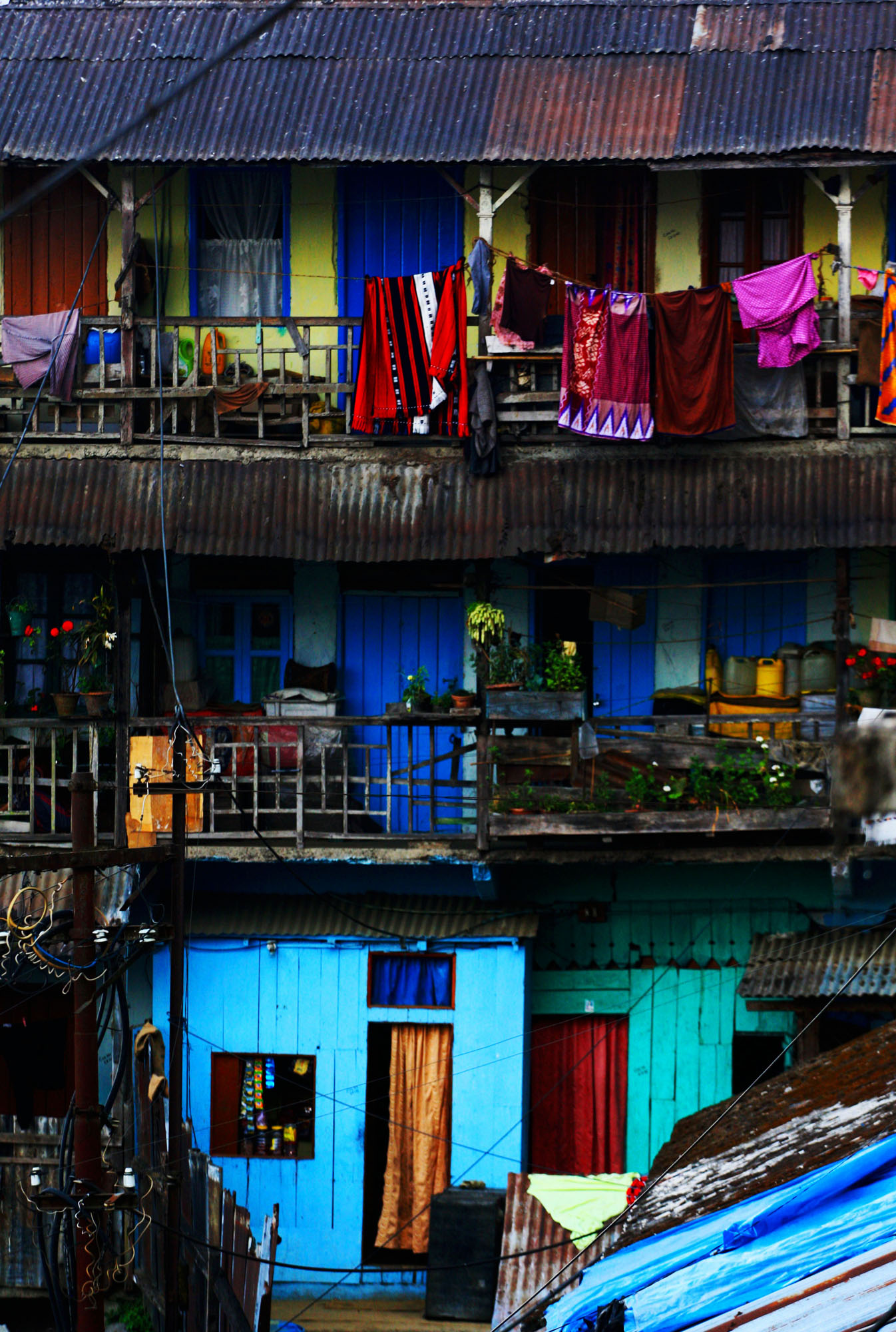
This year really was remarkable, and it was remarkable on a number of levels: politically, economically, militarily, and, indeed, personally. So many exceptional things happened that, scanning back over the events of 2011, I see myself as a blur, flailing about between massive international stories and personal crises. 2011 was the year of the Arab Spring, and I don’t think even the economic crisis in Europe or the earthquake and Tsunami in Japan could trump that. Three absolutely colossal sequences of events, all of which, in themselves, contain individual events that would be considered huge stories in and of themselves; Tunisia, Egypt, Libya, Syria, Greece, the Fukushima nuclear crisis… And this is not to mention the Occupy movement, the London riots and the ongoing decline of American industrial might.

Just as the massive earthquake in Japan shifted the planet Earth ever so slightly off its axis, so 2011 saw the planet shift geopolitically. The rise of the Arab street has transformed the Middle East forever. The change is not yet securely in place, but the mechanism of change certainly is. It is difficult to predict what sort of governments and societies might emerge from the popular uprisings in the Middle East, but now that the people have found their voice, there is a real hope that they will no longer allow themselves to be lorded over by tyrants. One can only hope they seek a new direction in liberal governance and not religious fundamentalism. In the case of Egypt, one can only hope that they actually do get their revolution in the end. For, the sad fact of the matter is that a successful revolution means the removal and replacement of the governing body with a new one installed by the revolutionaries, and this has not happened in Egypt yet. The army is still in command as it always has been and despite them allowing elections to proceed, just how much power and privilege they are willing to relinquish is anyone’s guess. A possible worst-case scenario might be a marriage between the military and a resurgently non-secular Muslim Brotherhood. Wait and see.

Of course, Syria is the story of the moment – a situation about which I feel totally incapable of making confident predictions. Will the uprising spread further through the armed forces? Will there be a bloody civil war? Will the presence of Arab League observers ensure a transition to a more peaceful political solution? Will the sanctions hurt the government and security forces sufficiently to disrupt their campaign of oppression, or merely drive the people further into deprivation, poverty and anger, causing them to rise up with greater fury? Will the Assad regime come unstuck, or will they, through deception and manipulation, mitigate change to accommodate their continued rule?

And what now of Europe? The collapse of the Greek economy and their ability to service debt has not so much spread across Europe as it has occurred concurrently with other poor models of economic management. Spain, Ireland and even possibly Italy have all borrowed and spent beyond their means and now face internal crises of spiralling debt, stagnation, stagflation, and mass unemployment. It was once thought that a great strength of the Euro was that should one country encounter difficulties, it oughtn’t be sufficient to effect an economy as large as the Eurozone. Few predicted such a widespread debt and financial crisis, and few also predicted that the response would be so tiresomely old-fashioned. Austerity measures are one way of saving money, but they significantly inhibit the ability to produce money by removing stimulus from the economy. It might be cheaper to support workers on unemployment benefits than to pay them their public sector salaries, but the newly unemployed have very limited purchasing power, this further reducing consumer spending and increasing economic contraction.

Europe it seems, has yet to hit rock bottom, and precisely how it can recover long term is anyone’s guess. No doubt it will, but how with much social compromise? The rising success of authoritarian capitalism in China might be anomalous in the long term, but it could also presage a new model wherein democracy is no longer the inevitable consequence of prosperity. In China, the economy has always been strong when the state has been strong. Democracy might prove too big a risk in so vast a region, too unwieldy and detrimental to the smooth flow of capital and the operation of business and industry. Perhaps this is a particularly Chinese situation, but will Europe, in the grip of its highly divisive social pressures, ultimately seek solace once more in right wing politics: old fascism, new fascism? With China buying up global debt and investing its vast reserves in infrastructure projects at home and abroad, is this the moment when the west fatally stumbles and loses its hegemony? It has, to a great degree, lost much of its legitimacy, and were it not for the Arab Spring, one might fear that democracy itself as a desirable goal globally has lost much of its legitimacy.

This is quite an intense period globally, with communism dead and buried, capitalism has largely reigned triumphant by default. Apart from the more alarming extremes of ideology such as totalitarianism or religious fundamentalism the only real alternative ideology in politics, and one which is by no means intrinsically at odds with neo-liberal capitalism, is environmentalism. As this is seen as a challenge to capitalism, rather than as a means by which to regulate the worst excesses of capitalism, it has been demonised as the new communism – attracting venomous attacks by right wing forces the world over as nanny-state socialism designed to destroy private enterprise and restrict social freedoms, especially in the realm of consumer choice. And, let’s face it, consumer choice is the new democracy, providing sufficient of a sense of freedom to satisfy the over-consuming needs of the largely apolitical middle classes the world over. Singapore is a perfect example of this marriage of authoritarian government and consumer freedom, which may, alarmingly, provide an ideal template for the capitalist management of future societies.

So 2011 was, in some ways a very hopeful year for democracy and the empowerment of people, in others, a testament to the failings of western democratic capitalism versus Asian authoritarian capitalism. It was also a year that saw the further delay of any legal, binding environmental treaty to replace Kyoto, an almost purely symbolic treaty in itself. With governments mostly limiting themselves to voluntary reductions in greenhouse gases, with half-baked promises of a legally binding treaty to be determined in 2015, and hopefully taking force by the end of the decade, we can pretty well write off the next ten years so far as meaningful reductions are concerned. Certainly, there will be further investment in alternative renewable energy sources and other efforts to reduce carbon through greater industrial efficiency, yet without a grand global strategy and any real oversight, governments will default on their promises whenever convenient or expedient, or continue to move the goalposts as they have done for years while increasing carbon output. In truth, they would likely do this with a treaty in place anyway, as has proven to be the case with Kyoto.

The world is only just beginning to grasp the nature of the playing field that has developed in the twenty years since the collapse of the Soviet Bloc. Asia is in the ascendant, well on its way to becoming the wealthiest region on the planet, as it was for most of human history until Europe got lucky and discovered and exploited the wealth of the Americas. Brazil has now overtaken the UK as the world’s sixth-largest economy and the United States will finally be eclipsed by China by roughly 2025, possibly even sooner. To understand global priorities looking ahead, one only has to compare actions and words – governments are really only concerned about their economic vitality and thus the success of the businesses and economic activity that drives those economies – everything else is a sideshow. The gulf between the energy, speed and money poured into attempting to solve the economic crisis and funding the military, and the money and energy applied to tackling global warming, disease, sanitation, the rising cost of food, growing social inequality etc is absolutely staggering. Money talks and bullshit walks. As Leonard Cohen sang, “I’ve seen the future, brother, it is murder.”

On a more personal level, 2011 was an incredible year in which I finally returned to full productivity and regained my engagement with and interest in the world around me. After spending almost eighteen months in a virtual world, it took me some time, from the end of 2010 until roughly June of this year, to fully shake off the hangover and wake up.

To mix up some lyrics by The Church, “I embraced a machine, went through the routine, and hid from the people who were trying to find me.” Well, again, to quote The Church, 2011 was the year I came “back from software limbo.”

An ex-girlfriend once told me many years ago, when largely unenthused about life and engrossed in Baldur’s Gate 2, that it was as though I had lost the will to live. She was right, at the time, in a way, because there have been times when I’ve found, through hard work, drudgery, or indeed, overindulgence, that my interest in things around me has diminished to a shrug and forget “whatever.” Throughout 2009 and 2010, I found myself continually struggling against losing the will to live. Not in a serious sense – I’ve never been suicidal, but in the sense of putting a lot of energy into life and doing active and exciting things. There were moments where I really came back to life, such as the two months in India I had between March and May 2010, yet on the whole I was lacklustre, single and quite frankly, not at all bothered about where I was at in life.

Such a state of being was a luxury of sorts, but when I found things that mattered again, met new people and re-engaged, I was drawn back into reality and began to pay attention to it once more. Without wishing to go further into it, falling in love and getting dumped earlier in the year was the best thing that happened to me in ages. It shook off the last vestiges of the torpor that prevailed even in the post-gaming haze. Going to emotional hell and back, where I realised how much I hated myself and thus needed either to rebuild, reprogram or reinterpret myself, was precisely what I needed. It was only when deeply depressed and despairing that I could see the truth clearly and thus prioritise accordingly. Moving house, working harder, running harder and faster, seeing a psychologist, making new friends, finding new venues, applying myself fully to writing and photography, all proved beneficial. In effect, getting dumped kick-started a thoroughly enjoyable period of personal spring-cleaning that has filled me with hope and purpose. It also put me in a great place from which to meet someone amazing, the best possible finish to a very trying and exciting year. I certainly won’t be forgetting this year in a hurry.

Read Full Post »
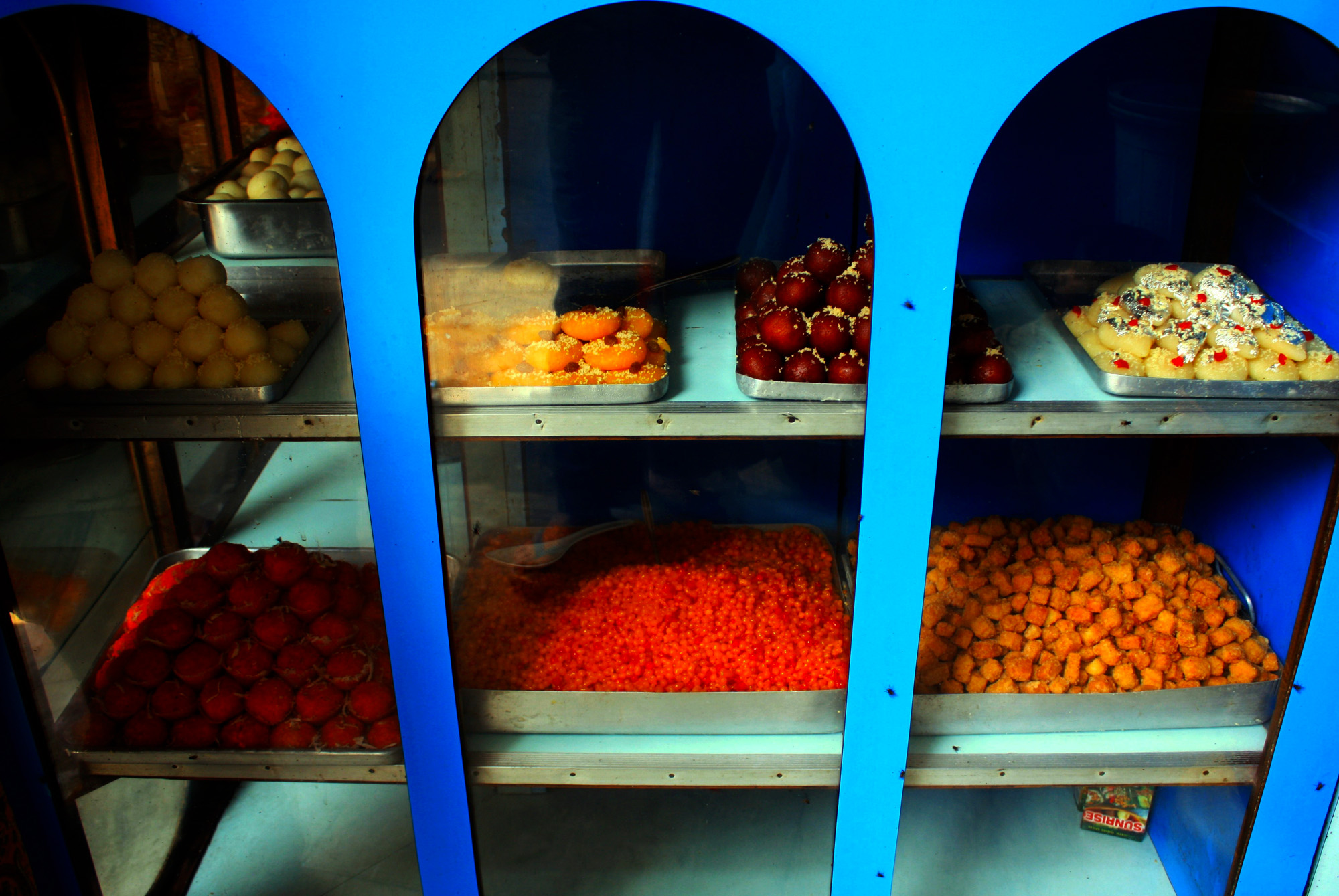
Dirk stepped out onto the broken street. The hotel was a furnace, and for once the air outside seemed cooler. Beneath his feet, the road surface had been stripped; a jumble of steel and plastic pipes ran along the narrow passage between the stacked hotels. The concrete buildings formed a canopy over the lane. The bright lights of shop-fronts, the signage and hanging bulbs, lit the place up like a bombed-out shopping mall.

Dirk turned left and stepped along the pipes onto Main Bazar, the central street of Paharganj. Here too the road was being re-surfaced, and even now, at eight in the evening, they were concreting a section of it just twenty metres away. All about was busy with human traffic; Indians mostly, but tourists as well, traipsing up and down through the open ground, pitted and full of mud.

Dirk had come to India with just a pair of thongs and he stepped carefully amidst the slush. The caps of manholes, sumps and drains protruded here and there as islands in the muck. Dirk stepped up onto a manhole and surveyed the scene. Just ten feet away was a man with a camp-stove and small wok; a pile of eggs beside him and a taper burning beside some loaves of bread.

He walked over to the man, who was dressed in a white smock with a round, peak-less white cap.

“Hello, sir! Omelette for you?”

“Yes, please,” said Dirk.

“How many eggs? One, two…?

“Two eggs, please.”

“No problem, sir. You want bread? Like sandwich?”

“Sure,” said Dirk. “Sounds great.”

“Chilli?”

“Sure.”

The man cracked two eggs into the wok, then threw in some chopped green chillies. Dirk stood waiting for the conversation that seemed inevitable, but, to his surprise, the man busied himself in the rising steam and said nothing. Thus freed, he turned back to the street and watched the scene. There was mayhem around a choke point, where rough barricades had been erected to block the traffic. In the lightning flash of welding sparks, a man was trying to squeeze his motorbike past a camel-cart, which had paused on the other side, unable to pass. The camel-driver backed the animal up, which coughed its displeasure and, after a couple of feet, stopped and stood working its jaws. Once the motorbike was through, the shadows shifted and people emerged from the pools of darkness about the shabby shopfronts, flowing through the gap. In their wake came a line of bicycles, the riders seated and stepping along the puddled road.

“Drink, sir? Lemonade, cola?”

The man had finished cooking and placed the omelette on a slice of white sandwich bread on a white, disposable plastic plate. The bread had been lightly fried. He covered it with another slice.

“Sure. I’ll take a Thumbs Up,” said Dirk. He had grown rather fond of India’s answer to Coke.

“Thirty rupees.”

Dirk took the money from his pocket and paid the man. His dinner cost less than a dollar. If he was still hungry, he’d buy another one later.

Dirk strode across to an empty doorway and stood on the step. With his back to the door, he ate and watched the procession of people along the street. The bread tasted lightly of smoke and charcoal, and the chillies were hot and flavoursome. He had arrived at his hotel only half an hour before and had not eaten since breakfast, yet the heat left him with only half an appetite.

Dirk finished his omelette and wiped his hands on his dirty shorts. Everything he wore had been repeatedly hand-washed with soap and shampoo in showers and sinks. Despite his best efforts, his tan shorts were stained with ingrained dirt and grease.

Dirk waited until the path was clear then walked past the road-block behind which men were toiling with shovels and mattocks. On the other side, the street opened out and was soon met by a cross-road. Coming towards him was a teenage boy pushing an iron-banded wooden cart, covered in what looked like biscuits. Dirk stepped one way, trying to get around him and the boy turned his cart in the same direction, accidentally blocking his path. They both laughed and Dirk stepped the other way, just as the boy swung the cart in the same direction, blocking him again. Now they both laughed aloud, and the boy said:

“Try my biscuits!”

“Maybe. What are they?”

The boy stopped and walked around to the side of his cart.

“Butter, nuts, very nice. It’s the local recipe!”

What nuts? wondered Dirk, but he wasn’t too fussed. The biscuits looked excellent; like rough-cut, round shortbreads, crumbly and greasy. His mouth watered as he thought of how buttery they looked.

“You like? Fifty rupees, one bag.”

“Okay, go on then.” The price seemed rather high for India, but it was still just over a dollar.

“You will love these biscuits very much, sir,” said the boy, who can’t have been much more than fourteen. He picked up a bunch with a wooden scoop and tipped them into a paper cone. Dirk got the money out and paid as soon as the bag was offered. The boy smiled so broadly that Dirk wondered what the regular price was. Still, at such prices, it was a win for them both.

A minute later, Dirk stood leaning against a telegraph pole, eating the biscuits. They were indeed good and he relished the buttery, nutty flavour. It tasted like macadamia, but he wasn’t sure whether macadamias were available in India. Eating the biscuits was as enjoyable as buying them had been. How often these things happened to him in India! He was less than a hundred metres from his hotel and already he’d been fed twice.

Further down, the street was lit by lights festooned with power cables, hanging at various heights. Everything seemed so slapdash and unfinished; beneath the wires and lights surged a crowd of the urgent and enterprising poor. Dirk stood and marvelled, until a young man walked directly towards him, raising his index finger to get Dirk’s attention.

“Hello sir, how are you?”

He didn’t wait for Dirk to answer.

“Can I help you? I can get you hashish, marijuana. You want to smoke charras? I can help you.”

“Maybe,” said Dirk. “What exactly have you got?”

The young man looked different to most of the locals. His features were more Asiatic, like the people Dirk had seen in the foot hills of the Himalayas. He was dressed in jeans, overly busy with buttons and embroidery, and a simple black tee-shirt. He didn’t look dirt poor, but nor did he seem exactly wealthy.

“Which do you prefer? Marijuana or hashish?”

“I’d prefer marijuana,” said Dirk. He liked the way this man was straight down to business. “If you have it.”

“I have it!” said the man, excited.

“I want only five hundred rupees.”

“Okay, okay. You get what you pay, no problem sir. You want more, pay more, want less, pay less. Which country, sir?”

“I’m from Australia. Where are you from?”

“India, of course!”

“But where in India? You’re not from Delhi, are you?”

“No, I’m from West Bengal. From the north, in the mountains. Near Darjeeling.”

“Darjeeling!” said Dirk. “My favourite place!”

“Yes? You like Darjeeling?”

The young man was clearly excited.

“Yes, I’ve just come from there. I stayed ten days.”

“That is great, sir, great.”

Dirk stuffed the bag of biscuits into the thigh pocket on his shorts and adjusted the camera on his shoulder. The young man read the signs and motioned for Dirk to follow him.

“Come with me. Here, sir, this way.”

Dirk followed the young man into a narrow back lane. He was wary of what might happen once he got there, but he also knew such deals could not be done on the busy street. He was a strong man with a large upper body, and he made sure his arms were ready, like a probing wrestler. So far he had managed to avoid any genuine hassle on his travels, and he liked to think this was in part because he looked capable of handling himself. He was certainly better built than most of the locals, though he didn’t doubt their wiry strength. He had once worked in a pub with a man much thinner than he, who could lift a full keg to chest height.

“Here, take this,” said the young man, holding out a bony hand. Dirk opened his palm and a cluster of tightly-compressed, dry buds were placed into it.

“Thank you.”

“No problem, sir. You will enjoy it! Very nice smoke, very sweet high.”

“Excellent.”

Dirk closed his hand tightly then reached into his pocket to produce the five hundred rupees. He passed the note to the young man, then took another note from his pocket and wrapped the marijuana in it. Another day in India, another deal. He began to laugh and the young man gave him a curious look, standing there amidst the trash and dinginess.

“Good joke, eh?” the young man asked.

“No. Yes. It’s just India,” said Dirk.

“You like India?”

“Man, I love India. But it’s crazy.”

He reached into his pocket again. “Here,” he said. “Take this.” He took out a one hundred rupee note and handed it to the young man. “Thanks for your help.”

“Thank you very much, sir! Thank you.”

“No worries. You’re a champion.”

They walked back out onto Main Bazar, both of them smiling. Dirk wondered as he did about everyone he met in India, how this young man’s life would turn out. Would it be ceaseless toil and poverty, would he wind up in prison, or would he get a lucky start and crack into the new middle class? It seemed unlikely somehow, but then, what did Dirk know of this man’s abilities? Perhaps he already was middle class.

“Good luck,” said the young man, as they reached the milling chaos of the busy road.

“You too,” said Dirk. “Take care.”

They shook hands, beaming at each other. Just now, things were going well for the both of them.

“See you later!”

The young man walked off into the crowd and was soon gone from sight. Dirk stepped across the mud to another manhole island in the stripped, dirt road. He surveyed the scene a while, then took his camera from his shoulder and began to line up shots. Part of him was inclined to return to the hotel and get baked, but he also knew that this street was a potential goldmine with its characters and curiosities. A long continuity of heads and shoulders bobbed beneath the dark mess of wires and dim street lights. The low light made it difficult to capture anything in a brief exposure, and Dirk struggled to hold the camera firm and steady, opening it up for a second or more each shot.

He stepped off the manhole and slowly walked further down the street. He soon reached another crossroad, on the other side of which the street was paved and busy with traffic. Dirk stepped up onto the pavement and leaned against a pole. He placed his camera against the metal and pressed hard to stabilise it. The people, auto-rickshaws, cars, carts, cows and camels that filled the long, wider street before him, offered a shifting collection of silhouettes.

Dirk became so engrossed in concentrating on his photographs that he didn’t at first notice the high, thin voice that was attempting to address him.

“Hello, sir. Hello, sir.”

Dirk heard the voice now and inwardly groaned. He had barely made it two hundred metres down the street and it had taken him forty minutes. Now another person wanted his attention. Despite the pleasure of his last three encounters, he wanted to focus on photographs. Would he ever be left alone? He was determined to see this one off as quickly as possible.

“Hello, sir, can you help me?”

Dirk lowered his camera and turned to his right. Standing before him, with a look of anxious concern on his face, was a terrifically thin young man. Dirk was so astonished by his appearance that he blinked and looked again. The young man was mere skin stretched taut over a skeleton. He was dark-skinned, yet somehow pale, almost white, his arms and legs covered with dry dust. His clothes were threadbare, but clean, and hung from him like they might from a clothes-horse.

“Can you help me, sir? Can you buy me some food?”

“Sure,” said Dirk. “Here,” he reached into his pocket to take some money out, and the young man began shaking his head.

“No, please, sir. No money, no money. Please come with me, please can you buy me the food?”

“You don’t want money?”

“No, no money, thank you. Please, it’s not far.”

Dirk had encountered this before in McLeod Ganj, when a young boy had become enraged after he handed him 100 rupees, a decent sum. At that time Dirk had been hurrying back to his hotel and needed the toilet. He was surprised and annoyed by the boy’s reaction, though he was equally mystified and by no means unsympathetic. Why didn’t they want the money? Would the shopkeepers not sell to them? Would no one sell to them? Was it a caste taboo? Could every shopkeeper be intimately aware of the caste of every urchin in the town? There must have been somewhere for them to go. He thought again. How else would caste work if people didn’t make it their business to know what caste other people were? It still seemed incomprehensible to him; the scale of it, the antiquity of it. Was caste still so prevalent in modern India, in Delhi? It struck him how hopelessly ignorant he was of all this.

Shocked by the emaciated appearance of the young man, and not wanting to disappoint him, Dirk was determined to help. He felt a very sudden and overwhelming sense of responsibility and wanted to do more than just buy him some food, yet he had no idea where to start. His thinness was alarming, like the wrecked bodies of the holocaust; huge sorrowful eyes, peering from an oversized head atop a tiny neck. He had an almost alien air, like those depictions of visitors from other worlds.

The young man began to walk and Dirk walked with him.

“It’s not far, sir, not far.”

“It’s okay,” said Dirk. “I’ll buy you some food, no worries.” He could see how anxious the young man was that he not change his mind, and Dirk wanted to reassure him. Indeed, he could feel the horror of anxiety that filled this boy’s whole life. If he could, just for a moment, save him from this draining, sapping worry, he would be doing something real, something substantial.

“Not much,” said the boy. “Just some chapati, some dahl, some lassi. Please, sir, also one lassi for my brother.”

“Of course,” said Dirk. “Of course. Just tell me what you want, you can have it.”

They stepped along the broken street, over the puddles and mounds of mud and gravel, heading in the direction of Dirk’s hotel. They walked around the barriers where the men were concreting, ducking under the hanging wires of the arc-lights. The young man walked with the lanky gait of a spider. His stick-thin legs stretched ahead like feelers, and his body seemed to pitch forward, as though his upper body had its own momentum. He glanced continually at Dirk, eyes full of guidance, like a man leading an animal or a child, making sure it did not stray.

Dirk was brimming with questions. He wanted to ask about the boy’s life, to know about his circumstances, his privations, yet he had no idea where to start. He remembered hearing a prostitute complain about how men always asked why they did what they did; showing a pathetic sympathy, which perhaps disguised a lurid curiosity. “I hate it when they ask,” she had said. “Are they trying to make me feel ashamed? Are they trying to make me feel like a victim?” Dirk wondered if they boy wanted to tell his story; he also wondered if the boy would tell the truth. He wanted to know the truth, but how could he ever be sure? Even if the boy lied to him, was there any doubting his thinness, his horrid emaciation? What could have made him so thin? Was it simply hunger, or was there something worse, something terminal? He pondered all this, half losing himself in the careful placement of his feet.

“Here,” said the boy, as they arrived at a counter selling hot foodstuffs. “This place.”

“What do you want?” asked Dirk.

The man standing behind the blackened bricks and boiling pots of the roadside kitchen smiled at Dirk, and before Dirk could say hello, the boy began to rattle off his order.

“Four chapatti, dahl, two lassi.”

Dirk, watched him smiling. “Whatever you want, just order.”

But the boy’s order remained modest.

“It’s enough, for me and my brother.”

Dirk thought of his own brother; how they loved and hated and loved each other as children. He felt a great welling of emotion in his heart at this boy’s fraternal care. On very few occasions had he or his brother ever found themselves wanting; not for anything they needed; food, shelter, love, warmth. When his older brother had stood up for him as a child, Dirk had felt a loving admiration and deep trust that only family could engender. It was sweet that this boy cared so much for his brother, but Dirk wanted them to have plenty.

“Are you sure you don’t want anything else? You can order, go ahead. It’s no problem.”

“No, it is enough. Thank you.”

“What about some money? Would some money help? You could buy something for your brother. Really, it’s nothing to me.”

“No, thank you,” said the boy. “No money.”

The man behind the pots handed over the food. The lassi were in clear plastic bags, like prize goldfish. The young man took the food and smiled at Dirk.

“Thank you again,” he said. “You are very kind.”

“Okay, sure,” said Dirk. “But won’t you take some money?”

The young man shook his head and began to walk off. He was smiling and, apparently, greatly relieved. The relief in his face choked Dirk right up.

“Thank you, and good luck,” he said, rather quietly, his voice catching. The young man turned and his pale face flashed a moment in the crowd, like one of Caravaggio’s urchins. Then he was gone.

Dirk felt as though he had dropped a coin into a well, not for luck, but in the hope of one day filling it. His heart was fit to burst with the hunger to help; an appetite for altruism that surprised him. Perhaps, however, one must be very select in this business; unable to give to everyone, it made more sense to give something significant to one person.

This young man had indeed moved him. He stood on the pavement on tiptoe and looked through the crowd, trying to catch another glimpse of him. He was tempted to try to follow the boy, as much out of curiosity as anything else. Perhaps he could do something, if there was an address, a family, he might be able to help them further; even once back in Australia. Yet, the boy had vanished into the stream of people on the dark street and his fate was entirely his own.

Dirk turned back towards his hotel, eager to photograph and remember, to smoke and, perhaps, to forget.

Read Full Post »

Rugby League Poetry

For many years now my friend Gus and I have had a deep and abiding love for Rugby League. It seems anathema to many, and to some degree, out of character, yet as the sport which most captured my fancy as a teenager, I have remained attached to it. There is something of a current of rugby league in the family. When my grandmother emigrated to Sydney from New Caledonia in 1922, she began supporting the Eastern Suburbs Roosters because their symbol was the rooster and their colours, red white and blue, also those of France. Consequently, my mother has held a membership of the Eastern Suburbs Leagues club in Bondi Junction for her entire adult life.

My father, far more of a rugby union fan, played rugby league as a schoolboy and, no doubt with some element of nostalgia, used to take my brother and I to see games every so often when we were young. The only thing I remember is hearing some chap shout “rip his bloody heady off, Kevin,” and otherwise pulling up grassblades. There is a famous family moment when the Roosters were playing in the 1980 grand final, a game which they lost. My mother sat watching the game, gripped, holding Jason, the dachshund’s ears, one in each hand. At moments of real tension and suspense, she would pull on Jason’s ears, absentmindedly, not causing Jason any harm, but all the same, grabbing his attention. It became known as the time my mother almost pulled Jason’s ears off and, since then, the idea of “almost pulling Jason’s ears off” has been something of a byword for exciting entertainment.

And then, in 1987, it happened. I fell in love with rugby league. I could not begin to tell you quite why, but it all began when I watched the Roosters flog St George 44-2 in one of the opening games of the season. I came to love all aspects of the game, but most especially the boofhead players. There was something quite magnificent about these working class gladiators who would pit themselves against each other. Rugby league could be a very violent game, full of punch ups and heavy hits, and it had a raw brutality that was utterly captivating as a teenager. The incredible skill and finesse they displayed amidst such hardness was astonishing, and, to be honest, it still is.

So, loving the characters of rugby league, especially the truly working class blokes who could tackle all day and take a hundred hits without blinking, blokes with nicknames like “cement” and “blocker”, blokes who would play with a broken arm, we began to imagine alternative lives for them, after rugby league. It began with the first e-mail I ever sent. It was a little vignette about some of the personalities of rugby league from the 80s.

“I eat it by the truckload!” said Blocker, with a piping shrug.

Is about the only line I remember… Yet it began an exchange of e-mails over the following years, in which we would say things like. “Hey, I ran into Ian Schubert the other day, you remember, he played for Wests. He’s doing a PhD on logging in the Papua New Guinean highlands.”

It wasn’t long before the first ode to a rugby league player emerged, followed by poems allegedly written by rugby league players, almost invariably about the game. Anyways, without further ado, I present those poems I have so far managed to dig up, which are disappointingly few in number. There are others, however, which I shall dig out. I have also commissioned new works from some of the games greats, and will update this page accordingly.

R.I.P Artie Beetson. Long a by-word for bigger than Ben Hur.


THE COATHANGER

Out the gallows’ arm

Bane of dwarves and giants

winter on the sidelines


– Haiku, Trevor Gillmeister, 1989


MEN OF THE PLAINS

Thunder from the mountains
lightning o’er the plains
men of steel and paddock
hard as rock.
Big men defiant
-biff and stoush and hang ‘em
out to dry.
Don’t argue, says Achilles
stiff-arm sinners in the bin.


– Royce Simmons, 1994

 
CAMPBELLTOWN

A blue in 87

Campbelltown in winter

Schuey, he was there


– Haiku, Alan Fallah, 1999


DRY JULY

What’s dry July?
I think I qualify
for it’s been a while
since I looked
through the bottom
of a glass.


– Phil “Whatsapacketa” Sigsworth, 1985


Excerpts from correspondence:

Jean Desfosses definitely approves – he has started working on his own contributions at his Institut du Rugby League at the Sorbonne. Peter Spring is there on sabbatical.


Hey, what happened to the chooks? I might come back and see about coaching them myself. I’ve been talking to Peter Spring about it a bit over here (he’s still working on waste-disposal in the Bangladeshi river deltas) and he thinks it’s pure pshychology.


“There’s no dynasty better than a rugby league dynasty” – Simon Schama, 1997
“I ran into Peter Tunks the other day and he reckons it’ll come down to whichever team adheres most strictly to the sex ban the night before. “I’ve been studying testosterone levels in league players for years with the Ponds Institute,” he said, “and let me tell you, you blow your load, you blow the game.”


…the little read title “Harriet Wisecastle at the Blues Training
Camp” by Allan Fallah.


Good to hear Peter Spring is keeping busy. I have been doing some work with Jean Desfosses on his genealogy and turned up the following information which should interest Peter and Shoey:

Jean DESFOSSÉS
(1787-1854)
Né à Nicolet et baptisé dans la paroisse Saint-Jean-Baptiste, le 27 novembre 1787, fils de Joseph Desfossés et de Madeleine Boudreau.


I hear that Sam Backo has developed an online “lewdconverter” which translates lascivious material into aussie slang. He developed it as a political protest in conjunction with Kerry Hemsley.


Read Full Post »

The first time my brother really chose to acknowledge me was about two weeks after I was born. He asked my mother, “Mummy, when are we taking Benny back to the hospital?” As soon as he realised that this was not happening, the assassination attempts began. One of his earliest was a daring scheme to pull the entire kitchen table over, whilst I was reclining on top of it in a bouncinette. His next attempt was by shoving a model plane up my nose. He then tried to flush me down the toilet as we celebrated his fifth birthday in the Blue Mountains. After a while he just resorted to assaulting me when I least suspected it, hitting me over the head, or pushing me in front of a moving dog. I soon realised that this was the natural order of things, but that didn’t mean I was going to take it lying down, and after a time I learned to emulate his methods.

One afternoon I lay in wait behind the door frame at the top of the short flight of stairs leading from the kitchen to the back yard, armed with a Sesame Street bedroom slipper. As my brother came running up the stairs, I stepped in and lashed out, heel-first, and whacked him across the mouth. I hadn’t intended to hit him in the face, but being an uncoordinated four-year old, I clocked him quite by accident. I don’t think he saw Ernie and Burt coming and it was shock as well as pain that set him screaming and bawling. I was almost as stunned as he was; firstly that I had actually hurt my brother, who, despite frequent torments, I loved and admired, and secondly with the realisation that this could be two-way traffic. Matthew was so put out by this reversal of the natural order of things that he, in return, emulated my methods and dobbed me in to my mother.

The narrative of our early relationship as brothers is distorted by the strong impression left by these few violent incidents, for on the whole, we got on well and acted as co-conspirators. There’s a photo of Matthew and I in the Blue Mountains from around this time in which we have our arms around each other. I am holding my red stuffed tortoise (Mama Tort) and we both look entirely happy. That photo was taken about ten minutes before we wandered off along the slope at the back of the house to play in the garden. It was a steep slope, landscaped with little flower beds surrounded by large stones which formed simple terraces. At the bottom of the slope was a trail that marked the start of one of the local bushwalks. The temptation to roll a few of these stones down the hill was irresistible, so we prised one of the larger rocks from its place of rest and sent it off down the slope, just as a family of four walked by underneath. My brother, of course, had the good sense immediately to hide behind a shrub, but for some reason I just stood there. I watched the rock crash into the bushes, heard the cries of alarm, and stood beside the marigolds staring with my mouth open. Then a man began shouting.

“I can see you up there. I know you’re there!”

I stood stock still, in my bright pyjamas, staring now at my feet. I had no idea what to do, and Matthew’s hissing whispers of “hide, hide,” drew an entirely gormless response.

“I can see you. Don’t think you can get away with it, you little horror!”

I remained standing still, hoping that if I stayed that way for long enough they might just go away. Fortunately, I was right. After a few more reprimands, they wandered off in a huff.

I have since wondered whether my response was indicative of embarrassment, stupidity, or rather, a show of conscience. Either way, my brother might have had good reason for thinking me stupid and treating me with a measure of contempt. No wonder he was so often trying to put me out of my misery.

My brother’s first day of school was a traumatic occasion. Standing slumped with his red, leather, lunchbox-shaped suitcase, he bawled and bawled until two great stalactites of yellow snot descended from his nose and swung ponderously into space. These two lengths of mucus, one at least two inches long and the other perhaps an inch and a half, hung for long seconds – as they hang still in my mind – before being wiped away by my mother. I was scared as well, for however ambivalent my attitude was to my brother, seeing him in such a state of distress caused my soul to cry out. Or perhaps it was the selfish thought that I’d now have no one to play with.

Two years later, knowing how quickly he grew to love school, I eagerly awaited my entry to the playground and my first day was a day of joy. Kindergarten held many treats, but best of all were the excursions to local businesses. Our first port of call was Churchill’s butchery on Queen Street. I was fascinated by the cheeriness of the staff, who had that simple appeal that so many adults have for children – as grown-ups capable of physical skills and tricks. When they let us into the cold-room, however, I felt a horrible wave of repulsion come over me; not on account of the hanging carcasses and cuts of meat, but the smell. The air was full of frozen death; a not particularly unpleasant smell, but one that was cloyingly neutral; disturbing for its deceptive mildness. I’ve never since felt comfortable walking into a butcher shop and still won’t buy or handle raw meat.

Subsequent excursions to the post-office and fire-station were far more appealing and devoid of anything upsetting, which is perhaps why I don’t recall them in the slightest. Yet, for all the wonder these excursions brought, none could match the excitement of our class, along with several others, being selected to attend the gala opening of the new Angus and Robertson’s bookstore in Pitt Street.

I remember the cake best of all. It was the first thing I noticed – a vast white oblong laid out on a table before a lectern, and all about, men in suits and several television crews. My mother had been excitedly telling me how I would be on television, but I could barely grasp the concept and forgot everything before the sight of that enormous cake. My only fear was that it would prove to be, like the awful, deceitful wedding cake I’d once eaten, fruit cake dressed up as something lovely. The detail of the proceedings was lost on me and my attention was regained only when the knife pushed through the icing. All the children gasped in expectation.

At six that evening, my mother positioned my brother and I in front of the television and switched on the news. When the story finally came on, my mother’s excitement generated a high-pitched thrill within me and I bobbed up and down before the screen, giggling.

“There it is,” said my mother, and sure enough the interior of the bookstore was once again before my eyes.

I stared dumbfounded at the screen. There was the cake again, that immense, crenulated oblong, and there was that nice man in the suit who had cut the cake, he was making his speech. There were a number of children on the screen, but I could not see myself.

“Look, Benjamin, there you are,” shouted my mother. “There you are!”

I stared hard but could see nothing. I was still bubbling, but the mood was being cooled by mystification. Where on earth was I?

Then came the moment when the man cut the cake, I let out a little gasp, remembering the joy at discovering its chocolate heart. I had been standing beside the man, hadn’t I? I was one of the lucky ones, right up the front, only how come I didn’t seem to be in the shot?

“Look, there you are, darling, look!”

Now the screen showed the man smiling across the assembly and everyone clapping. I looked and looked and looked as hard as I could. But where was I?

“There you are, Benjamin, see? Right there.”

I kept looking, but I couldn’t see myself at all, not even at the very tip of my mother’s finger. The news item ended and the scene vanished from the screen and, made distraught by my full realisation of the root of the problem, I burst into tears. My shoulders heaved with soaring whimpers and I turned away, feeling ashamed.

“What’s the matter, darling? What’s the matter?”

I sobbed and spoke through a clenched throat.

“I don’t know what I look like.”

Read Full Post »

Having been working in the city for the last three and a half years, first on Castlereagh Street and, since last October, George Street, I’ve developed something of a love-hate relationship with the place. It is, in its own way, rather ugly at times; crowded, noisy, busy and dotted with blackened gum. Along Pitt Street, the monorail sits like stitches on a sore, old wound; its pylons covered with grime and the ill-fitting papier maché of advertisements. In other places, the smog-darkened concrete, the dusty marble cladding, the spattered glass of the many tired, generic buildings, looms above the pavement. There are places where the skyline is boxy and dull, where contrasting architectural ambitions sit like class warfare writ large. There are places where aesthetics have not had a look in; where the roller-doors and security grills guard the crooked shopfronts that wear their clashing colours like bad fashion.

Yet there are also places where aesthetics have won out. Viewed from the Botanic Gardens, the skyline is certainly something to behold. Tall and impressively weightless, the more thoughtful and picturesque designs of architects like Renzo Piano give the city a distinctly timeless modernity. The clean sheen of the newly renovated Pitt Street Mall is a congenial oasis amidst the traffic-huddled streets. The open view of St Mary’s across Hyde Park is genuinely grandiose; the trees and fountains of this expanse, the pool of reflection, the long avenues under the canopy, all offer respite. The Art Gallery, the Gardens and Domain are arguably outside the CBD, yet so close as to have a very intrinsic relationship with it and give direct refuge from it.

Inside, behind the facades, beneath the pavements, countless holes in the wall offer a range of snacks and diversions. In these places in particular, the Asian-ification of Sydney moves apace. From Town Hall down to Railway Square, and even beyond, from Elizabeth Street down to Sussex Street, the dominance of Asian shops and business is very apparent. A whole range of new Korean and Japanese restaurants have opened in the last few years; along with ever more shops selling foreign groceries, Asian fashions, accessories and trinkets. The expansion of Chinatown might be commercially driven, yet it is also a cultural phenomenon that reflects the growth of one of the few true communities that inhabit the CDB. Personally, I see it as a great improvement. The new life downtown is not only far better than the empty wasteland of two decades ago, it has made the slummy end of the city centre truly exotic.

There is also a powerfully vibrant energy to the city. The old, carpeted pubs that hang on the corners from Park Street down to Central; the Windsor, the Criterion, the Coronation, the Edinburgh Castle, The Sir John Young, The Century Tavern, Stratton’s Hotel, all these places fill in the late afternoons and spill their noise and patrons onto the streets. It all seems, at times, rather cheap and tawdry; very lowest common denominator, tasteless and with little attention to detail, yet the pubs, the take-aways, the convenience stores, the internet dens, the gaming parlours, the multiplex, the discount fashion shops, the bubble tea and Ramen joints, the hairdressers and dry-cleaners, all give this end of town an exciting buzz.

The city does indeed make an interesting subject, and every day, when I get off the bus at Town Hall, it feels like being right in the middle of the mayhem. The buskers, homeless people, charity fundraisers, shoppers, students, suits, service staff, all mill about, busily doing either something or nothing. It’s oddly thrilling, if rather disappointingly unattractive. Still, such is life!

These photos, of course, don’t necessarily reflect all mentioned above. They are mostly taken downtown, but there are also some from Newtown and Glebe, and a couple from a very good Hallowe’en party. But still, I had to write something! Enjoy.

Read Full Post »

“Give me back my broken night, my mirrored room, my secret life, it’s lonely here, there’s no one left to torture.” – Leonard Cohen, The Future

On the 19th of June, 2009, I flew out from Sydney to Singapore to visit my girlfriend’s (S.) family for her mother’s birthday. It was the first leg of a five-week tour of South East Asia, taking in Cambodia, Vietnam, Thailand and beyond, should time, money and will allow. In the preceding weeks, I had been doing nothing whatsoever but playing Dungeons & Dragons Online (DDO) all night and dragging my sorry ass to work the next day. Not an overly onerous burden, considering I was working part-time as an ESL teacher, yet, when I came to board the flight, I was physically and mentally exhausted.

Being someone who has enjoyed a boom-bust cycle of personal discipline over the years, ranging between some quite emphatic extremes, I figured the trip was a good opportunity to put some distance between myself and the game that had, for the last two months in particular, swallowed up my life. I was, in truth, in the grip of a full-scale, hardcore addiction. I could think of nothing other than levelling my characters, working the auction house and teaming up with equally afflicted, yet entertaining and very companionable individuals the world over, to hack, slash and magic our way through hordes of enemies. I was sleeping roughly three to four hours a day and staying awake by drinking enough coffee to blow the head off a rhinoceros. The trip to Asia would be a chance to rest and heal, and to break away from the clawing cravings and heavy withdrawal I suffered whenever I was not logged into DDO.

That, at least, was the idea. However, as soon as I arrived in Singapore and logged into a local unsecured wireless network, I began to wonder how on earth I could stomach five weeks without even so much as the auction house. What, really, was the point of the internet after all? It was all very well reading the news, researching intended destinations, updating Facebook and sending the occasional e-mail, but it lacked the more direct interactivity of a gaming interface. Then I got curious. Travelling with just a carry-on sized day pack as I have always done, but having, as ever, found room for a laptop, in this case, my EEE PC, I began to wonder if this mini PC could handle running DDO. After all, it had roughly the same specs as my previous, considerably larger laptop on which I had initially played the game when in Cambridge two years before. There was only one way to find out, and, in one of those fateful and, I suppose I should say, regrettable moments, I went to the DDO website and set in train a download of the game, which was still being offered on a trial basis.

It took me a couple of days in various locations, on various wireless connections which I managed to snake, before the download and installation of the game was completed. In the meantime, I did my second best to be sociable and hold my end up in various family situations. I’ve always been rather crap at knowing where to put myself when surrounded by other people’s families, especially where children are involved, as I seem to lack the skill to talk to them. I hung around and made conversation, was polite and even jovial at times, yet I felt a strong inclination to retreat, whenever possible, to the privacy of whatever bed I was sleeping on at the time and surf the net. That is, of course, when not sightseeing or participating in some group activity such as dinner or lunch. I certainly did retire early a few times where I might have been social for longer, though this had as much to do with my shyness around people as it did with my internet addiction. I know that S. wasn’t exactly happy with me because I didn’t make enough of an effort socially, and she could detect my mental distraction, but I was out of sorts in more ways than one, and the colossal gaming withdrawals didn’t help. I was finding it very difficult to concentrate or shift my mind away from the narrative of the game.

When the time came to fly out from Singapore to Cambodia, I felt greatly relieved, largely because I knew that once there, the location and events would occupy both my time and mind and I would not have time to hunker down and watch the game files download. Anyone who is prone to watching downloads tick along, staring at bit-torrent data-rate graphs or hanging on every small creep of an installation bar, waiting for those satisfying forward thrusts, will know what I’m talking about. Visiting Angkor Wat was going to be a buzz and if that didn’t drag me out of my torpor and turn my mind back to its love of history, ancient societies and foreign cultures, then there was no hope for me whatsoever. After all, I did have a PhD in history.

The good news was that our flight to Siem Reap had this effect. Once on the ground and in the taxi with Panha (pronounced Pun-yah), who was to become our driver for the next five days, I was dragged back into the real world by the contrasts of Cambodia. Siem Reap was dusty and alarmingly poor, for the majority of the locals anyway. The tourists, who brought money and work opportunities, but also drove the local prices far higher than any Cambodian could afford, had the luxury of staying in nice hotels for next to nothing. There were all manner of services to cater for tourists, and not much of a local middle class to enjoy them. The tourists even had their own street, which I dubbed Tourist Street, where everything was comparatively clean, modern and freshly painted.

We stayed in a cheap but very nice hotel on a less touristy, muddy road, with a lean-to brothel opposite and men selling sun-dried chilli snails from old carts. Siem Reap seemed ostensibly to be a peaceful and functional place, but with the Global Economic Crisis kicking in, most of the locals dependent on tourist dollars were suffering, with follow-on effects for the rest of the very poor population. Panha dropped us off at the hotel and we negotiated a price with him for the next few days. Once we’d checked in and showered, we went straight back out and he drove us to Angkor Wat itself, where we had breakfast in a café, watching the temple through a haze of dust and orange sunlight.

It was the first of several very long, hot and exhausting but rewarding days, and it was always a relief to return to the hotel to eat and refresh. The hotel had advertised wireless internet, though when I tried to access it on our first evening, I found that the signal did not reach as far as our room. I moved into the reception area where it was usable, but very slow, only really suitable for checking Hotmail and Facebook. I was annoyed about this, but let it go, knowing that I was, after all, in Cambodia, where internet access was not my top priority. Still, when on day two, they offered us the chance to move to a room at the front of the hotel, near reception, we took it.

I shan’t here describe the many pleasures of the sightseeing we did with Panha over the next few days, suffice to say that we visited most of the major temples and spent hours wandering through them.

It was remarkable experience, despite the thirty-seven degree heat and hundred percent humidity. I was especially out of sorts with the weather, but inspired by the overgrown ruins and hungry to get good photographs. On the latter score, it turned out to be more hit than miss,  partly because I was so hot and bothered that it was difficult to concentrate, but also on account of problems with haze and glare, which were exacerbated by my cost-cutting purchase of a cheap UV filter. Still, we saw everything we had come to see, along with plenty of other extras courtesy of Panha’s local knowledge.

On the fourth day we decided to take a break from the temples and Panha drove us to the floating village of Chong Khneash on the edge of Lake Tonle Sap. This long collection of houseboats and barges along the river mouth left us filled with wonder and despair; both for their remarkable way of life, and their almost complete lack of facilities and services.

I took a lot of photographs, but shooting these truly dirt-poor people felt almost pornographic, and I still feel guilty about how little we tipped the two guys who took us up the river. We had paid for tickets and thought the boat operators received some of this money, but only found out later that the company selling the tickets kept all the money and the boatmen lived solely on tips.

Spending so many days immersed in ancient ruins, and, indeed, modern ones, it was inevitable that I should crave a game of Civilization at the end of the day. This not being an option (I had already tested Civilization IV on the EEE PC and whilst it ran on minimum specs, it was too frustrating to be worth the effort) and, with the internet now available in our new room, albeit, at the pace of a sun-dried chilli snail, I used the hours at the end of the day to complete the installation of Dungeons & Dragons Online. It was only on our final evening, as we prepared to leave, that I at last had the opportunity to see if it would actually run.

I fired it up and was surprised to see that it did indeed run, albeit jerkily, with the sound off, and all the graphics turned down to minimum. I would also only be able to play it solo, as the computer could not handle rendering too many toons on screen at once. The cooling fan was already whirring and whistling at the highest pitch. It was hardly ideal, and I soon thought about abandoning it altogether. Yet, rather than doing so, partly fuelled by a passion to experiment with different character builds, I created a character called Byronne of the Sword Coast in honour of my favourite campaign world, The Forgotten Realms. It was another fateful moment: I had the chance to walk away, to give up in the face of such graphical retardation, yet, rather than giving up and uninstalling the game, Byronne was to become our fourth travel companion, much to the detriment of the rest of the journey. If you’re wondering who number three was, well, it was Bilby 1.0, of course.

When we arrived in Hoi An in Vietnam the following day, I discovered, much to my displeasure, that there was no internet connection in the hotel. Again, I knew it was not exactly the end of the world, and probably to be expected, but I did feel a deep sense of disappointment. I should probably point out at this stage that I have been, on and off, rather spoiled for internet since having had broadband at Cambridge from 1999. Indeed, it was then that I first really started to use the internet on an everyday basis, having previously been a here and there hotmailer. Despite using an old Pentium 1 or some equally dire rig back then, the cable connection was extremely fast, for the whole town had been wired up. After four years of this, I just assumed this was how the internet was for everybody. Even at the British School at Rome in 2003 we had a relatively fast internet connection, despite being attached to the Vatican’s server. This naturally prompted me to download as much porn as possible, partly for my own depraved entertainment requirements, and partly to see if they would hit me with the cosiddetto Inquisition Virus, about which we often joked.

When I returned to Australia at the end of 2003 to discover the joys of dial-up, I nearly died of shock. How people could be living in such backward circumstances in what was ostensibly a modern country, if a little intellectually and technologically retarded, was beyond me. For the next couple of years I struggled, before returning to England to find the entire country wired up to broadband and many cafés and pubs offering free wireless internet. I found this to be the case across much of Europe as well, even enjoying free, fast wireless internet at the airport in Bratislava, of all places. If poor old Slovakia could get its shit together in 2006, why on Earth couldn’t Australia, or Vietnam for that matter in 2008?

Only at the best of times does patience become me. With the stifling, coffin heat knocking me for six, alongside the frustration of nagging DDO withdrawals, I found an outlet for my agitation in the hotel swimming pool. Fortunately, there was much to see and do and, despite some tensions between S. and myself, we found Hoi An to be a very beautiful place. It was when we arrived in Hanoi, after visiting Hue, that the trouble started.

Hanoi is a pretty incredible place. It was wonderfully chaotic, dirty, run-down, ramshackle, and hung with the most captivating electrical wiring. Countless wires ran from each pole, stretching across and along the streets to a plethora of fuse boxes. In some places the electrical wires hung down to street level and had to be ducked under to access the pavement.

There were cables lying unattached on the ground, cables dangling precariously from junctions, cables crawling through tree-tops like a spawning of snakes. Everything seemed shabby and neglected. The state of the buildings in the old quarter was a sorry sight, some with no rooves, some with tarpaulins across the front, most in dire need of repair and paint, yet it was all very beautiful in the eyes of someone who loves decay and ruin. It was also crazily busy with constant traffic and activity.

The first night we arrived in Hanoi marked a terrible turning point in our journey. As we stepped off the coach that evening to be surrounded by taxi drivers, whom we tried initially to ignore as we had a map and planned to walk to our hotel, S. , in dodging our would-be chauffeurs, stepped awkwardly and went down hard on her ankle. Two minutes later, we found ourselves sitting on the edge of a building coming to terms with the fact that her ankle was in fact quite badly hurt and that she would not be able to walk. I was highly annoyed, not with her, but with the circumstances, as I had been determined to avoid taking a ride and was instead, looking forward to walking to the hotel. I have never liked depending on anyone when I travel, especially not people who thrust themselves in my face. Ultimately, despite my having told the drivers to clear off because they were hanging around like seagulls, too obviously gleeful that S. could not walk, we had no choice but to take a taxi to our hotel. It was when the taxi dropped us off on the wrong street and we were left standing there with absolutely no idea where we were and S. unable to move, that my frustration overwhelmed me. I’ve had only a few such moments in my life, but the end result is a sort of Tourettes supernova, wherein I scream “Fucken cunts! Fucken cunts! Cunts!” at the top of my voice for a minute or two. I did so, and having vented, stood like a prat, wondering what in hell to do next.

The sad upshot of all this was that, despite being an expression of my frustration and anger at finding ourselves in these circumstances, after a long and unbearably humid day, it inevitably seemed to S. as though it were partly directed at her. I think she was both shocked and deeply hurt, and understandably so. When I become angry, it takes me a while to achieve equilibrium and wasn’t until we finally made it to our hotel room, via a rickshaw driver, that I got around to apologising. It was an apology which, I think, was ultimately insufficient to assuage the bad taste left by my brain flip. I was also deeply ashamed of myself, having travelled alone for so long and in so many places and having dealt with difficult situations with far greater panache. In rather childish manner, having an audience was all that was needed for me to vent. It was, no less, a tanty of the worst sort, and was in no way dignified by my failure to throw myself on the ground and writhe.

It didn’t help matters that, over the next five days, finding myself with an internet connection in the hotel room at last, I spent much of the time when we weren’t sightseeing, playing DDO. Instead of giving my attention to S. and attempting to make amends through good behaviour and general sweetness, I was instead running an extremely low-res Byronne of the Sword Coast through low-level quests in Stormreach harbour, on the easiest difficulty level, collecting collectables and putting them up for auction.

I lay there at night, long after S. had gone to sleep, beating living hell out of kobolds and making packets of virtual cash from selling Deadly Feverblanch. Admittedly, we weren’t used to spending a lot of time together, but my detachment only made things more awkward. The fact was, however, that I was in the full grip of an addiction and, as is so often the case, almost all other concerns were completely eclipsed.

The trip to Halong Bay, where we spent a rainy night on a junk, proved to be something of a tonic. Kayaking around the limestone karsts, and, indeed, through a low, flat hole in one to a secluded bay, was a lot of fun, as was bombing from the top of the boat.

Yet, when a day later, we flew out of Vietnam and arrived in Bangkok, it was time to talk again about where things were going. I tried to apologise further for my behaviour overall, only now realising just how awkward I had made our time together, but the greatest impressions are always left by deeds and not words. The fact was that I could not get the desire to play DDO out of my head and it had completely skewed my sense of priority. I had, on the whole, been irritable, restless, bored and frustrated, despite the many awesome experiences we enjoyed. I do hold the heat and humidity to account to some degree, as humidity has always been my kryptonite, but there was no excuse for not being more consistently nice to S. She knew it, and I knew it, and when she flew back to Australia after a couple of days in Bangkok, as had always been planned, I had a lot of soul-searching to do.

I was, however, also entirely free to game! That night I changed hotels in Bangkok to ensure I had an internet connection, booked a flight to Chiang Mai, went out and got some dinner, then bunkered down with my computer. It was the first time I had had internet access for a couple of days and I now found myself slapped in the face. The trial period had expired and I could not get into the game without an active account. In order to start the trial, I had been forced to create a new account with a different e-mail address, as for some reason they would not allow me to log in with my active account. Simple, I thought, I just need to pay and have the account upgraded to full status and all will be well. This should have been simple enough, but as they were, at that time, still selling the game at retail outlets, the only way to activate the account was, in effect, to buy a copy and insert the serial number.

I was filled with despair, for I had been hoping to indulge myself throughout the rest of my trip after long days of sightseeing and photography. The following day I set off into Bangkok, wondering where on earth I might find a computer game store. I’d done some research on the internet and lined up a couple of shopping malls with games shops, but once downtown and in the thick of it, I found the shops mostly sold console games and next to nothing for PCs. What were the chances, I wondered, of finding DDO here in Bangkok? I tried to remember if I’d run with any Thais in game, but could only recall Chinese, Indonesian, Malaysian and Singaporean gamers. I asked one of the chaps in a shop and he directed me to another shopping mall, two block s away, but once I got outside, I had no real way to orient and my map was inadequate to the task, so I wandered about ineffectually for some time. I was about to give up altogether and pursue other missions, when I finally spotted this huge shopping centre across a footbridge.

I hurried on in to find myself in a veritable warren of commerce. This place had dispensed entirely with the spacious, luxurious shoppig experience, and gone instead for cramming as much as humanly possible into the space. And the space was massive. The building contained level upon level of countless tiny shops, counters and hole in the wall outlets. Different levels seemed to be dedicated to different products – one was electronics, another was mobile phones, and another seemed entirely dedicated to computer games. I felt like a kid in a candy shop, and went to town flipping through thousands of games in plastic folders, no doubt illegal copies produced locally or in China. I was having no luck, however, and noticed that none of the games sold in these shops were MMOs. No doubt because there is no getting around registering online, and thus the need for a unique serial number. I pushed on with my quest through the forest of shops, and finally, after almost an hour, found what appeared to be the only honest retailer, who sold games in original boxes. It would be an understatement to say I was astonished when I spotted Dungeons & Dragons Online sitting on the shelf.

Back at the hotel, I went straight to the website and tried to insert the serial number and update the account. Yet there was another hitch. The account would not accept my credit card and gave me an error message. When I searched online to find discussions of said message in forums, I soon learned that the problem was caused by my attempting to use an Australian credit/debit card, with an account I’d registered to Australia, whilst in a foreign country. It was clear immediately that the only option was to get someone in Australia to log in for me. But who could I trust with this task, who would be available, and just how sad would I look when the purpose of the task became clear?

I turned the Facebook instant messaging service on (I loathe its intrusiveness and leave it off at all times) and got busy contacting friends. I first tried a work colleague, Chris, then another friend, until finally I manage to rouse my old buddy Demitri to take care of it for me. This had all taken several anxious hours where my frustration at being so close and yet so far was building all the while. In the end, already frustrated from not having been running for a month, I went downstairs to thrash it out in the hotel pool.

Finally, around ten PM that evening, Demitri had sorted things for me and I was free to log back in. When I ran Byronne of the Sword Coast across to the mailbox to collect the fruits of my previous labours, I felt like a junkie shooting up after a long, long wait. It was a case of goodbye Bangkok, hello Stormreach.

When I arrived in Chiang Mai two days later, I found I had booked a very appealing old hotel room with polished wooden floors and a vast, built-in wooden bed. It was a large room on the top floor which opened onto a wide balcony with a table and chairs on it. The view across town to the mountains was stunning, especially at dawn and sunset, and over the next few days I was to spend a lot of time out on the balcony taking photographs.

Already somewhat disappointed with my attitude throughout the holiday, and realising that the only way to avoid further regret was to make sure I used my time wisely, I signed up for a couple of excursions on my first two days. On the first day I visited a Hmong village, up a dodgy road through the forested hills in heavy fog, then visited a gorgeous Buddhist temple on top of a mountain. That evening I attended a banquet with traditional Thai dancers as entertainment.

On the second day I went on a longer journey to an elephant “school” where I rode one of these magnificent beasts.

At the end of each day I would lie down in bed, armed with milk and cookies, and farm the hell out of quests for collectables. I was very content here in Chiang Mai and had no intention of going anywhere in a hurry, despite the clock ticking before my flight back to Australia out of Singapore. I took things easy on day 3 and wandered around town, but when it started to rain, I had every excuse to return to the hotel and game. It was on day four in Chiang Mai that the sickness really set in. I was attempting to book a flight to head elsewhere in Thailand, when the internet crashed. I contacted reception to get them to sort it, going down there in person to encourage them as politely as possible, for the staff at the hotel were lovely, but there was no progress whatsoever. I paced about my room, cursing and shaking my fists at this horrible twist of fate. Give me internet! Come on! But there was no progress whatsoever and, whilst the signal remained strong and I was connected, there was no internet in the pipe.

My frustration grew over the next four hours, until I knew the only solution was to take matters into my own hands. They had reset the internet on at reception, so I figured the problem must lie with the local wireless router on my level. I had already had a cursory look about the place for it, but hadn’t seen it anywhere. After wandering about with my EEE PC, however, testing signal strength to get some idea of the router’s location, I finally found it in a cleaning cupboard. I restarted the little bastard and, hey presto! the internet was back on.

Having gotten so used to the internet over the last few days, I was flooded with relief when I regained access. And, just as a desperately thirsty man drinks insatiably when he finds water, I booked the ticket then plunged straight into an orgy of gaming. With my flight back to Hong Kong via Bangkok not leaving for another two days, I thought about the many options before me in Chiang Mai, but ultimately, spent most of the time gaming. Be it on the bed with milk and cookies, or out on that wonderfully spacious balcony, I was a happy man. I swam in the hotel pool in the morning, ate a hearty breakfast, then went back to bed to game. I made sure I took a trip around town each day, venturing to some very interesting places like the local, non-touristy markets and taking a lot of photographs of workers.

Yet, after two or three hours, in need of another shower, I would buy a carton of milk and two packets of cookies then head back to the hotel room. I always planned only to stay a while before going out again, but this didn’t exactly transpire. What baffles me is how, in retrospect, it all seems rather foolish, whilst I recall at the time being extremely happy. I loved that hotel room, I loved Chiang Mai, and I loved every bit of what I was doing there.

When I finally returned to Sydney after five and a half weeks away, having spent the final week in Hong Kong and Singapore, it wasn’t long before I had the chance to log in at last on my desktop and give Byronne of the Sword Coast a proper run for his money. How big he looked, how magnificently detailed, and how wonderfully rich he was after all my efforts! I now had two paid accounts on Dungeons & Dragons Online and, it soon turned out, one less girlfriend. I was in a state of emotional flux, both caring and not caring in equal measure, and I did what any hardcore gamer would do in such circumstances. I went out, spent some of my last few dollars on a big fat bag of weed and settled in for a total lock-down for the next few days. Editing the photographs could wait, for there was much ado in the city of Stormreach.

Inevitably, those days would stretch into weeks and the weeks into months. Far from putting any distance between myself and my obsession, I had managed instead to become even more deeply immersed in the game. With no one other than myself for company and not especially interested in anything other than reading the New Scientist and going to the cinema, there was little that could distract me from gaming. I was now free to give the bulk of my time to DDO. Bring it on!

ps. This was first posted in April 2011, then taken down some months later. I wasn’t comfortable with the content and thought it reflected poorly on my character, but in retrospect, I’d prefer to have it out there as it stands, as it belongs with the other pieces in the series.

Read Full Post »

Jehovah’s Witness

First Published in Westerly, volume 52, 2007.

This story was based on an anecdote from my friend Simon about his former employer, a fruiterer of some note.


I was crying when I opened the door. Even with the glimpse I got through the peephole I could never have guessed what a sweetie she was. I couldn’t help myself, I was crying like a baby, and she was looking all doe-eyed and gracious, holding a bunch of magazines and wearing a skirt. I knew the moment I saw her she’d come to talk about God, knew it even when I heard the knock. But what did I care? The mere sight of her knees was enough to wind me right up. It doesn’t take a lot at my age.

“I’m sorry, sir,” she said – sir! such respect – “I’ve come at a bad time.”

“No, no,” I assured her, before she could back away, “the timing couldn’t be better.” I sniffled and smeared the tears across my cheeks. “I’m sorry, it’s just that everything’s been a bit much lately. I’m right down in the dumps. Perhaps you can help me, yes, yes, come in.”

“I don’t want to upset you.”

“Oh, please, please,” I said – how could such a lovely creature upset anyone? –  “I’m already upset, it’s just… Everything.”

I was hunching and breathing in sniffles, huffing up a good old sorrow. I was misery personified, the very mask of Greek tragedy.

“I was hoping to talk to you about Jesus,” she said, finding refuge in her mission.

“I know, I know,” I said, pathetically. “I know.”

“But if it’s not a good…”

“Go on,” I said, weeping like a willow, “sit down, make yourself at home.”

I walked through into the lounge room, waving her on. She trailed behind with that peering-round-the-corner look people sport when they aren’t too sure of things.

“Are you sure this is a good time? I could come back another day.”

“Oh no,” I said, “this is perfect timing. I could use a good talk right now. Especially about Jesus. Something to cheer me up.” I pulled out my handkerchief and blew my nose loudly, trying to avoid too much burbling. I was crying out tears as quick as I could wipe them away.

“Please, please,” I said, “I’ll put the kettle on.”

We were in the lounge with the kitchen adjoining. My round, old, wrinkled belly was tight with the drama. I bowed and scraped and showed her to the couch. She stood looking at it for a moment, clutching her colourful brochures, then sat down, knees tight together with her back as straight as a rod. There won’t be any flies on her!

“Tea?” I asked.

“Err, yes please. Thank you.”

I shuffled into the kitchen, still having a good old blubber. It really was a first rate bawl fest I had going on; top notch stuff. Safe in the kitchen I cracked a hidden smile and washed my face under the tap. I dried myself vigorously with a tea towel. For a little treat like this I didn’t want to look too bleary. I’d already unfurled the black flag of pity.

I stuck my head around the corner. “Milk, sugar?” My eyes were dry now, with just a faint sheen and a sting of red veins.

“Umm, white, one sugar,” she said. “Look, are you sure…”

“Of course, of course. I want to hear all about Jesus. This is a godsend, I’m sure of it.”

She stayed put and the kettle clicked home. Having just had a cuppa, there wasn’t much of a wait. I’d prefer to be pouring half a bottle of scotch down her throat, but it just wasn’t going to happen. I made the tea in a flash, wanting to hurry through before she did too much thinking. If everyone turns them away, then don’t they wonder about the people who let them in? I shuddered to think what she thought of me; if I was anything like the others.

I poured the tea and brought the steaming cups on through, eyes kept low and mouth in an arch; hung with the fishhooks of gloom. I sat down next to her, close but not too close. There was still plenty of time while the tea was hot.

“Well, here we are,” I said, throwing in a gratuitous extra sniffle.

“Okay, thank you.”

She really was a darling; lovely long dark hair, tall and slightly awkward, small, pert breasts – what a lucky old bloke that Jehovah was! There were quite a few things I wouldn’t have minded witnessing, let me tell you.

“Everything alright?” I asked.

“Yes. Are you alright?”

I took my time, just to keep her thrown. I could see she’d normally be damn confident, smiling and charming, telling it how it was, turning the pages of the magazine, letting me in on the good news, until someone broke all the rhythms. It might have been she who came knocking, but it was me who was calling the shots.

Are you alright?” she asked again, all sincerity. It was a long while since such a beauty took so genuine an interest.

“Yes, and no.” I said. “I’ve been up and down like the lid on a boiling kettle. Maybe you can help!” I said, too excitedly, banking on her putting my exaggerated sincerity down to being hysterically sad.

“But you were crying so much,” she said. “Have you had some bad news?”

“Always bad news,” I said. “Always.” I shifted a little closer. “Thank Christ for small mercies!”

She straightened up even further, stomach flat as a tack, small but haughty breasts, nice firm tittie handfuls.

“We have this free magazine,” she said. “It’s called The Watchtower. It’s about living a better life.”

“A better life!” I said. “That’s exactly what I’ve been looking for.”

I shifted across another inch as she held the magazine tight in her taut little lap. On the cover was a lovely, peaceful scene; a huge, lush garden, with people of all different races and colours, neatly dressed just like her, lolling about on the grass with a whole zoo full of animals; tigers, deer, squirrels, hippos, dogs, monkeys. There were fruit trees in bloom and flowers sprouting all about. It was a vision of paradise, and the sun was belting on down; I don’t suppose it ever gets nippy in paradise.

“My name’s Jennifer,” she said, ready to get on with things. “I’m from the Jehovah’s Witnesses. We believe the Bible is the word of God and we look to live according to His words.”

“As it is written.” I said with theatrical awe.

“Yes, that’s right.” She shuffled the magazine in her hand. “Exactly as it is written. Not as other people have said it is written, but as it is actually written.”

“I see,” I said, shifting towards her another inch.

“The important thing is to ask whether or not things stand up to the test of scripture.”

She was back on track and down to business. I liked that immensely, right back on target she was.

“Things like?”

“Well, anything really. Especially about how to live according to God’s will, in harmony with the laws of the Hebrew and Greek testaments.”

“Like the ten commandments?”

“Yes, that’s one example.”

I leaned over for a closer look at The Watchtower. I took a sip of my tea and wiped my eyes again, pinching them into my nose.

The Watchtower tells you most of what you need to know about what we do.”

“I’ll bet it does,” I said, remembering to throw in a sniffle. “And so what do you have to do to be a Jehovah’s Witness?” I inched closer still.

She reached forward carefully and picked up her cup of tea. She was looking straight ahead. Not looking at me. She took a sip and put the cup down again.

“We talk about the meaning of the scripture and how it governs our lives. How we believe we ought to live by it.”

“Well that all sounds pretty useful to me.”

There was a time when I didn’t have to put on a big old act just to get a young lady on the lounge. Back in the good old days they were queuing up for yours truly, and even once past my prime my form held good. This was one of the longest shots of my long career, but you never can be sure with these godly types. They’re either ripe and ready for a bit of exploitation, or they’re tight as a rusted wingnut. Truth is, it’s just plain tough when you’re over sixty. You have to hope they really love their daddies.

“I find it very useful in helping me to live a good life,” she said.

I rested my arm across the back of the couch, just behind her shoulders. I could almost feel the bone beneath her young flesh.

“I wish I knew how to live,” I  replied.

“Perhaps,” she began, but she got no further, for I was tired off all the dithering. Bursting into a new and more outrageous wail of sorrow, I plunged my head down straight into her lap and wrapped my arm around her shoulder. At last I could feel the scents I smelled; the fabric softener, the conditioner, the hint of an iron’s metallic steam. She gasped and writhed, stiffened and shifted. I could feel her bones and softness jumping about beneath my weeping face. I pressed myself right into her crotch. I couldn’t get my nose through the fabric, but being there was enough, right in the crucible of the world.

“Get off me!” she cried. “Get off!”

She tried to leap up, but the sheer weight of me made it impossible. The Watchtower slid off the couch and spilled across the floor. I reached up and managed to get my hands on her breasts. It was more than I could hope for; they were there right enough, and none of those wooden bras you sometimes run into; I could feel the nipples in the palms of my hands like stigmata.

“Get off me!” she cried, forcing herself upright with all her strength. “Get off!”

Ah yes, this was a champion score! Even better than the time I faked a heart attack in the fruit shop and fell down right under the skirts of two young twins. I saw everything that time, let me tell you, absolutely everything you can hope for without paying. Then there was the time I fainted on that towering beauty at the opera house. I just don’t get near women like that most days, but there in the foyer, falling in a falsified fit, as my hands ran along her perfect thighs it was like gliding down a curtain of sex; sliding down from heaven on a silken fire pole.

“Get off me!” cried my little Jehovah’s Witness, lunging into the air. “Help me, someone help!” I could see she was going to cause trouble if I didn’t let her fly, so I took in one last great whiff, treated myself to a final squeeze of her titties, then slackened my grip and rolled off.

I fell into the gap between the table and the couch, arms and legs flailing in the air like a beetle. I’d come a right cropper and she was on the move, making straight for the door. I had no intention of pursuing her, except maybe to give her magazines back. I’d had my fun and gotten as good as I was ever going to get.

I started to laugh aloud, great big belly laughs that rocked me back and forth as she skidded through the hallway and clattered down the steps.

I laughed and laughed until I could stand it no more. Then a wind sprang up and the door slammed shut. I looked to the crumpled Watchtower beside me with a rending surge of pity. My heart heaved a sigh, my throat locked up and this time I really started crying.

Read Full Post »

« Newer Posts - Older Posts »