Feeds:
Posts
Comments

Archive for the ‘Literature’ Category

Rainbow Zebra

I never expected to see a rainbow zebra when I rounded the corner into Castlereagh Street. Yet, there it was, splendid and radiant, standing before two more conventional black and white zebras. For a brief moment I was minded of the term “acid flashback”, but in truth, I recall no rainbow zebras during prior encounters with LSD, so figured these were new kids in town. What surprised me most of all, however, was that they should be painted on the wall of Stratton’s Hotel; a rather old school pub – not without rustic charm – married to a youth hostel. Indeed, as the local pub of JET English College, before we moved to George Street, it had obtained some small regard and was affectionately known as “Strap-ons”.

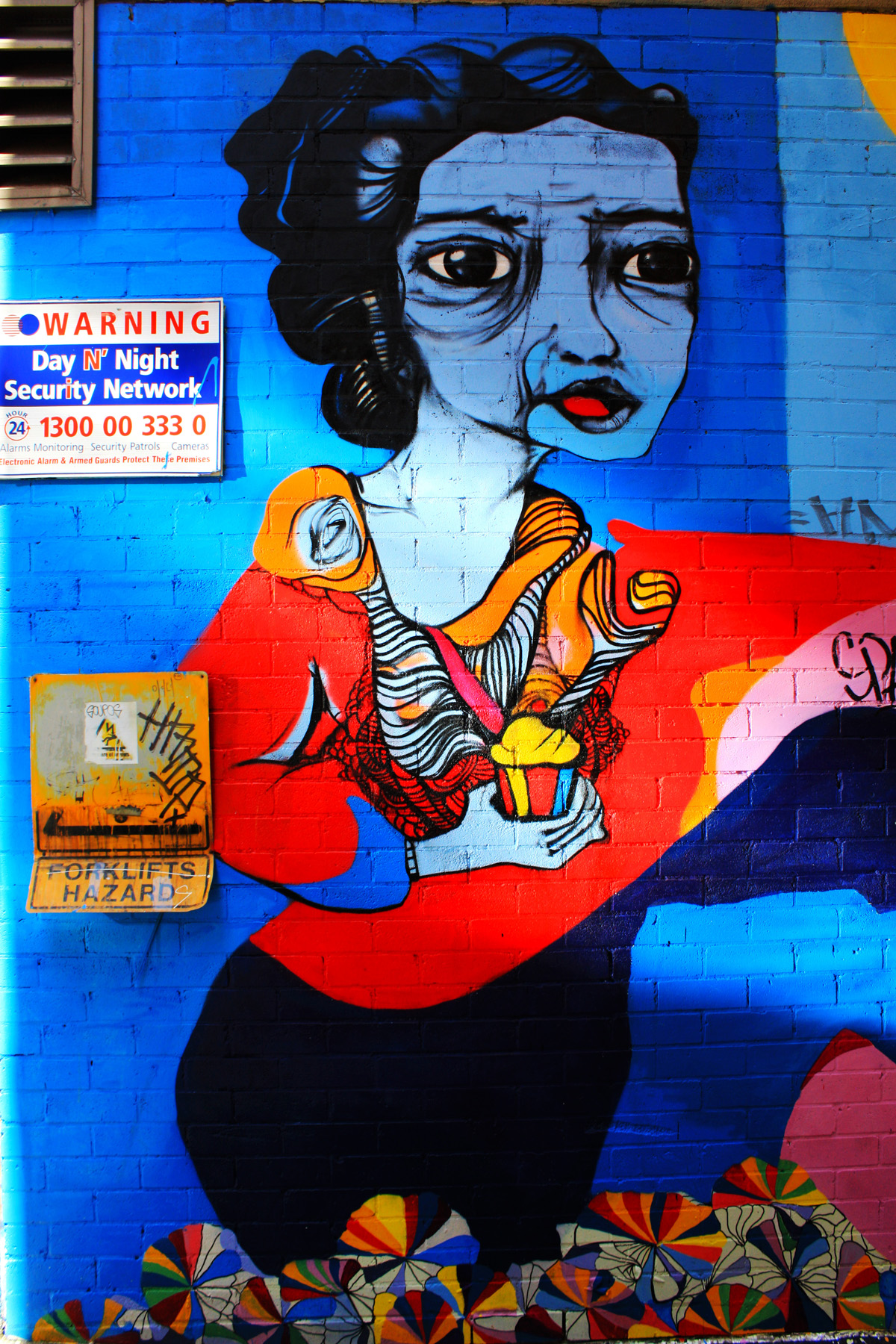
Still, it was, in effect, the jug-swilling haunt of city office workers – not the rummest of crowds, nor entirely uncongenial, given sufficient rope – and not a place I pictured festooned with imagery that was, at least somewhat, psychedelic. So, the good news is that Strap-ons has tripped out and Sydney is now home to a small population of zebras, who are, I think, seriously cool (featured below). What is perhaps even cooler is the portrait of the woman on the wall opposite, across the little laneway. The style of the artist, particularly with regard to the features, suggests to me that it is the same painter who did the walls in the back garden of Sappho Books in Glebe.

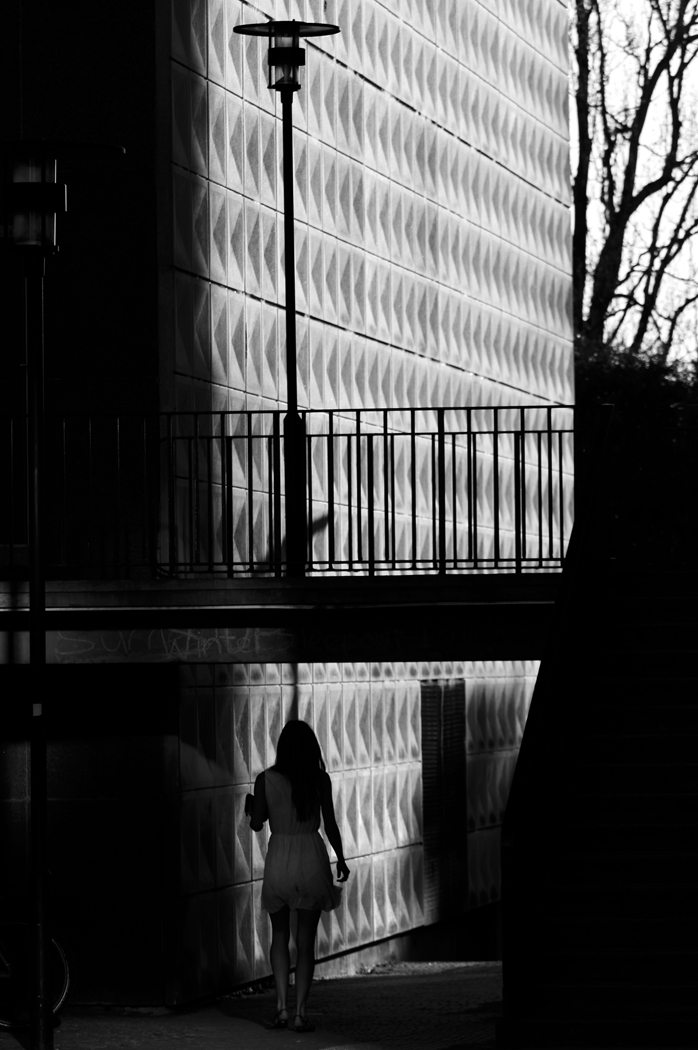
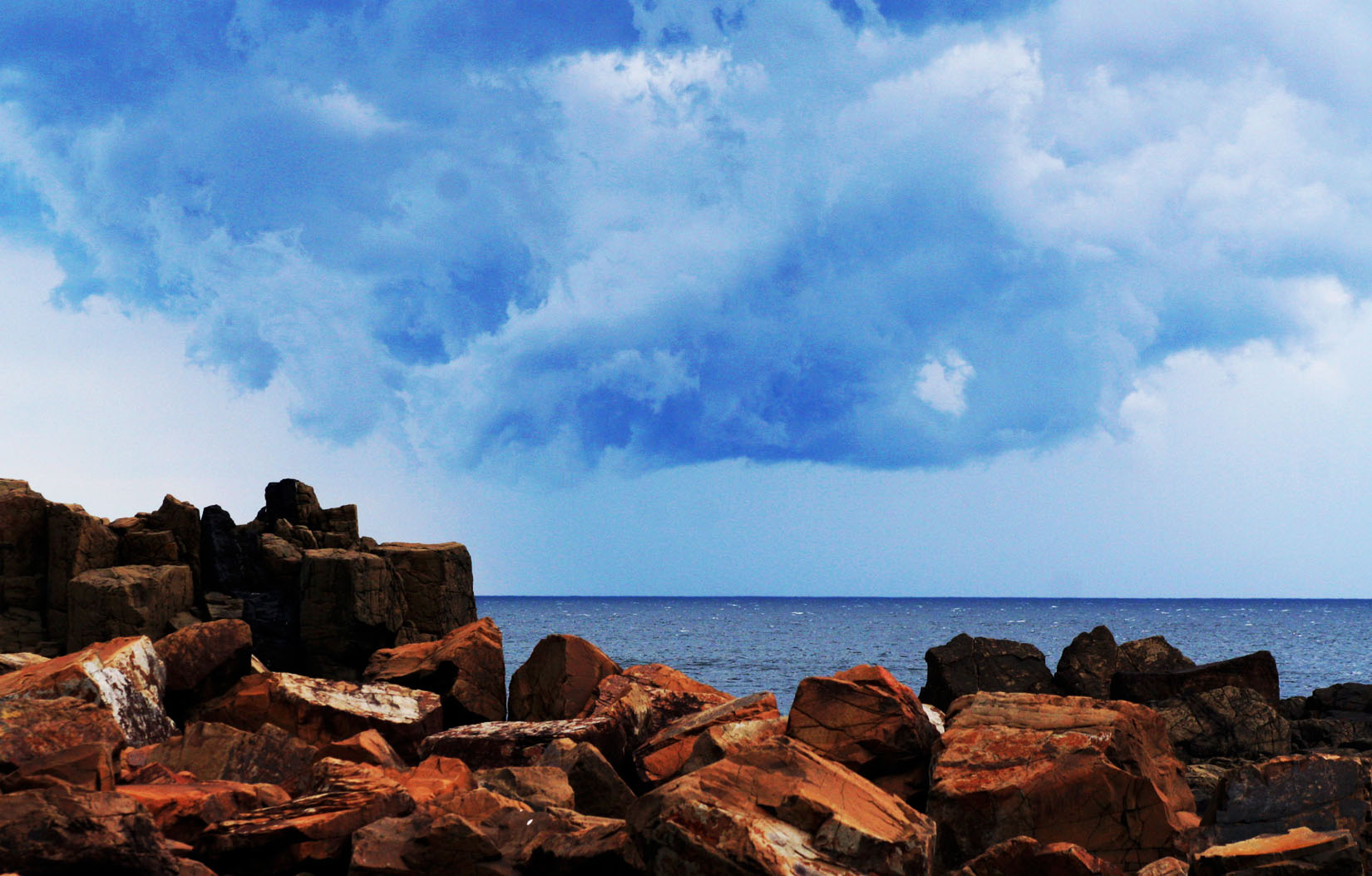
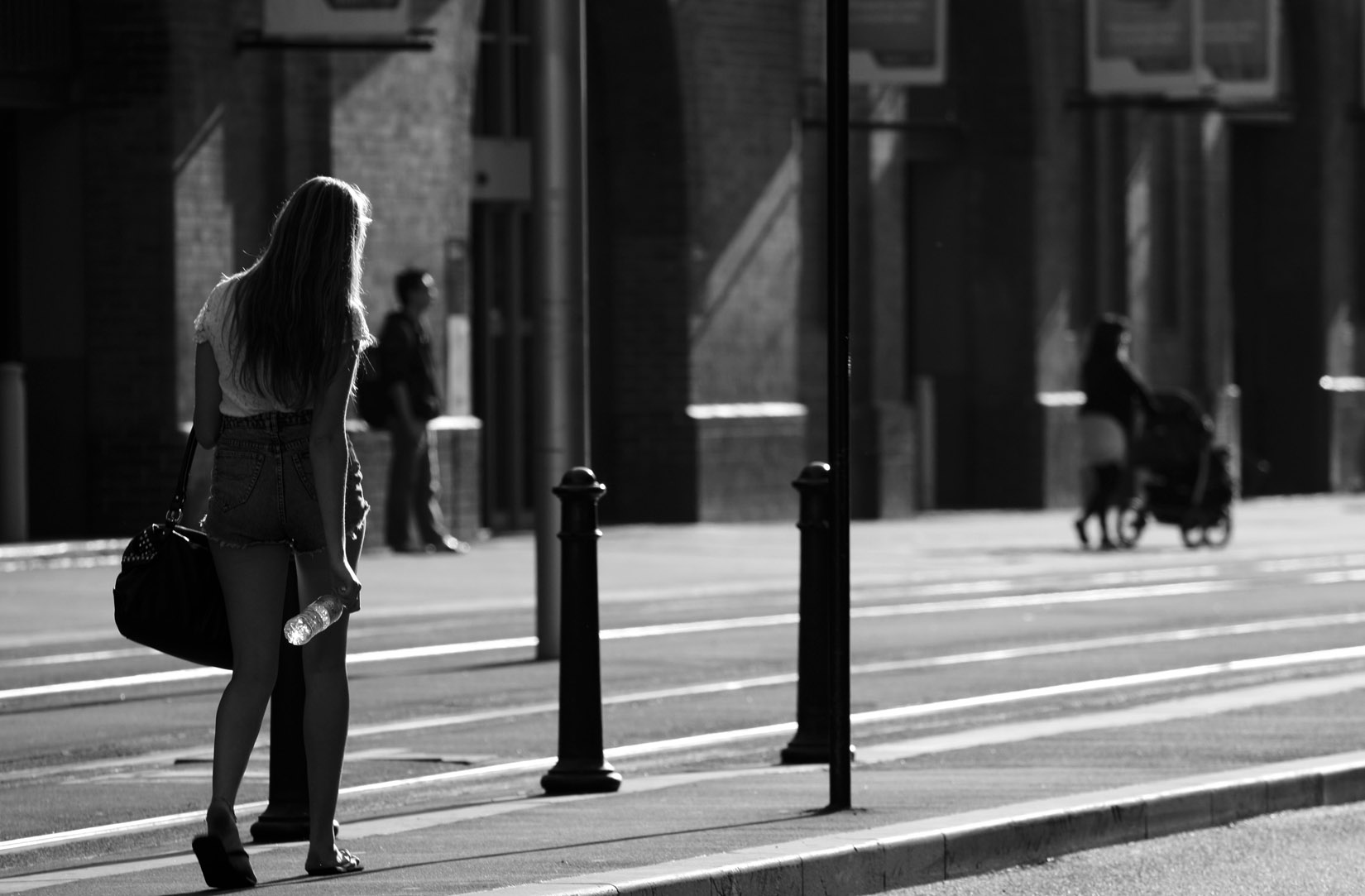
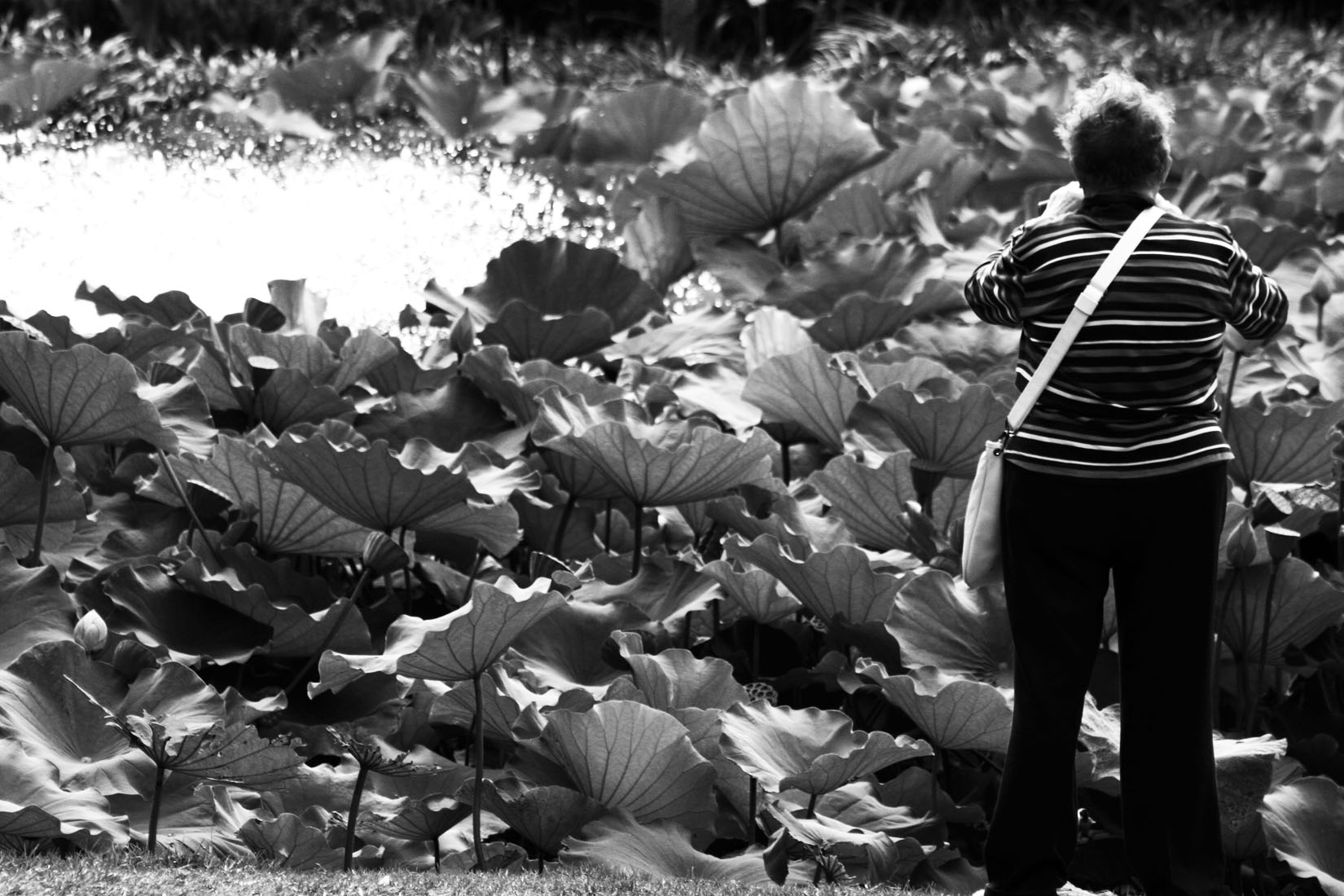
Anyways, here is another collection of photographs from the last ten days or so. I didn’t set out with any particular purpose in mind, though most of these shots were taken whilst actively seeking shots. I’m just never quite sure where I’m going to look next and tend to wander about. In accordance with this habit of drifting, I’m including a couple of snippets from poems I was sorting through a short while ago. They are meandering and prone to non-sequiturs, but there you have it.

So, reading through Olympos again – named after a city in southern Turkey, not Greece – I had very visceral memory of the scuff and feel of ancient floors and realised how desperately I miss walking around archaeological sites. As a means by which to study architecture, ponder the eternal verities, take good photographs, have a picnic, get a tan, feel awed and privileged, there are few better activities. The poem commences with a rather forced evocation of Roman interiors and the city itself. The Italicised section of the poem below is actually the translation (not mine) of a funereal inscription from the archaeological site at Olympos. The site is quite impressively overgrown with forest and spreads through the trees, a short walk from a wide, glorious beach. I recommend a visit! As to the poems, they’re just here to be thought provoking : )


Olympos

Pompeian rooms, dusty, buckled

reliquaries, shuffle and scuff

with emptiness. The Augusta’s

triclinium, frescoed with tired

fruit garlands…

In Trajan’s market sparse is the jink

and shout of a once gnashing trade.

While, against the sky, the Colosseum,

rings with the horns of traffic.


The ship sailed into the harbour last

and anchored to leave no more.

No longer was there any hope

from the daylight or the wind.

After the light carried by the dawn

had left, Captain Eudemos

there buried the ship; with a life

as short as a day like a broken wave.

http://bit.ly/MonsterLove


Dresden

Dresden wears its patches like a man

showing a piece of skull

he was lucky to live through losing.

Read Full Post »

Ideas Man

I‘ve always been deeply envious of people whose job it is to think for a living. It’s certainly an appealing remit, though of course, something that might manifest in various ways in different fields and industries, particularly where new branding and marketing concepts are required.

I was never quite satisfied, however, with the idea of working in a particular industry, such as advertising. Instead I imagined myself as something of a general ideas guru; someone whom anyone could consult about absolutely anything; be it a slogan for a new product, the name of a character or device, a sound-bite for a movie, the caption for a picture, the name of a novel or film, or, indeed, the name of a band. I saw myself sitting in a futuristic office, swinging from a suspended, white-cushioned clear-perspex globe, dressed entirely in white, drinking cold milk and throwing out immeasurably valuable suggestions to enthralled, fawning attendees.

“Guru,” they would say, a little breathless with awe, “can you help us? We need a really catchy title for our new album, but we can’t come up with anything.”

I would sip my milk, take a long pull on my hookah then, rolling my eyes like the priestesses of the Delphic Oracle, offer up my immeasurably valuable and ultimately best-selling suggestions.

Whilst none of the above ever eventuated, partly through general apathy and directionlessness, I have spent much of my life coming up with ideas that have gone nowhere. Those that have gone somewhere have mostly found their way into novels and short stories, which is a pity as they often seemed best deployed elsewhere. I would like to think I have come up with some good story ideas and created a few cracking titles along the way, but the one area in which I’ve always wanted success and recognition has been in the invention of musical groups. Over the years I’ve spent far too much idle time imagining band and album names, styles and concepts. Perhaps I should have gone into advertising, but, typically, I haven’t ever really worked out how to go into anything in this life, apart from consecutive university degrees, focussing on obscure intellectual pursuits like early medieval Italian history.

The love of band-names and branding began with the first and only band I was ever in: Easter Road Toll. I wish I could lay claim to the name, but that honour goes to my friend and founding member, Owen, who had also suggested the name Glass Asylum. The latter was, at the time, too obscure, intelligent and thus less appealing to the thrash-loving teenager that I was, who was primarily interested in the shock value of punk. The band’s origins lay in our rejection of Australia’s Bicentennial celebrations, which we all agreed were inappropriate since it effectively constituted the invasion and theft of the continent from indigenous Australians. We wanted to tap the spirit of nationhood, suck out the poison and spit it in the sewer.

Conceptually, Easter Road Toll was supposed to be a combination of political grandstanding and blatant badmouthing, but being fifteen years of age and hopelessly naïve about politics, plus having a strong inclination to say “fuck” at every given opportunity, the songs turned out to be considerably less intelligent than they might have been. With lines such as “Ronald McDonald is a Nazi war criminal and therefore he deserves to be introduced to a ham-slicer”, it was quite clear that any intellectual pretensions were hopelessly misplaced. Some of the “tunes” such as Fingers don’t grow back (not even when you glue them back on), Zombies are Philosophers, Fuck I hate Car Alarms, Blow up your Relief Teacher, Lick the Lice off my Sweaty Butt-Hairs, Gun-toting Customs Officer, Spon-Com, Lemmings know what they’re doing and the ever popular Schwarzenegger, captured the curious spirit of adolescence with such power that I remained a sympathetic teenager for some time after their composition.

At the first ever jam we were armed only with an acoustic guitar, an electric guitar and Gorilla amp, a cheap Casio keyboard and a pair of drumsticks. We made an unbelievable racket, screaming about this, that and McDonalds, spitting at each other and freely indulging in the use of the word “Fuck.” There was very little method to the madness with the exception of my friend Max’s chunky riff on I Got Spewed on.

After three months there were just three of us left, Mike, Demitri and myself, but our dedication was unwavering. We had a lot of ambition which steadily increased as my good friend Demitri, the lead guitarist, fashioned my hastily scribbled lyrics into vaguely coherent structures. We tried a number of different ring-ins to make up for the sad reality that only Demitri was a competent musician, but organisation was a problem and as us core members had a furious passion for our art, we couldn’t risk depending on the availability of others. Demitri’s parents had been good enough to concrete their backyard and put a garage in, and it was from here that Easter Road Toll offered up its vomit to the residents of Redfern. Mike, our drummer without a drum-kit, would belt away on his carefully selected chairs, Demitri would unleash chords of unparalleled power, and I’d scream myself ugly hoarse. So professional were we that during a recording of Whipper Snipper Massacre, Demitri, who’d taken over the “kit” so his brother could give us some traditional Greek guitar and thus enhance the song with a more multicultural feel, broke one of Mike’s drumsticks and everything went to the dogs. The words “Aaaah! You broke my drumstick, you fuckwit,” and the ensuing scuffle, captured in unholy mono on a portable cassette player, are perhaps the greatest testimony to the achievement that was Easter Road Toll.

Our starting point had been cum-driven incongruity, and though it took a rather lengthy ejaculation that got Mike a drum-kit, me a decent guitar and amp, nearly wound us up in a recording studio, almost got us a gig, and saw the later addition of a Dostoevskian verse to Zombies are Philosophers to celebrate the seventh anniversary of its composition, the foundations were always going to give way. Phallic music is intrinsically immature, and as I tried harder and harder to take myself seriously, it became a considerable embarrassment.

One of the many problems faced by Easter Road Toll was how quickly we outgrew the music. When I turned seventeen and began to grow my hair long and wear paisley shirts, I lost the desire to shock and longed instead to charm and beguile. This was soon reflected in changing musical tastes and the themes and subjects of my artistic output in school. Inspired by David Bowie and Pink Floyd, I wanted not only to reinvent myself, but also to invent new bands, songs and concepts that suited the more introspective me.

This soon extended to my final-year major work in high school art class. I did a group of five drawings of the different members of a fictional band called Hydraulic Banana. The drawings were based on photographs of myself and friends playing instruments at various jams, heavily stylised to look both rock and roll and, at least somewhat futuristic. Hydraulic Banana were, in effect, inspired by Disaster Area, the fictional “plutonium” rock band from the Gagrakacka mind-zones, as featured in Douglas Adams’ Hitch-hikers’ Guide to the Galaxy. Indeed, my principal inspiration for the sound of Hydraulic Banana came from the very brief snippet of music in the BBC television series of Hitch-hikers’ Guide, which is just audible in the background when Disaster Area’s Guide-book entry is voiced. I never actually wrote a song, nor came up with an album title for Hydraulic Banana, which seems odd in retrospect as I spent so long imaging how they might look and sound.

It was around the same time, during that wondrous final year of high-school, with all its house-parties and acid trips, that my friends Simon and Viveka invented the band Onions 11 &  12. The name was based on the relatively unscientific theory that any given bag of onions contained roughly ten onions, and the subsequent, and perfectly natural concern for the fate of onions eleven and twelve. Of course, one might simply say that they wound up as onions 1 & 2 in the next bag of onions, but this was not a time for simple deductive logic. Onions 11 & 12 were essentially an industrial band, heavily influenced by the sounds of Einstürzende Neubauten, with a dash of Nurse with Wound thrown in. Rocket Morton, anyone?

Immediately after high school, my friend John and I came up with a fresh band and album concept: Stool Pigeon was a return to the thrash / punk shock music that had so enthralled me at the age of sixteen. John and I spent quite some time not only designing the album cover, but also writing the full list of song titles; none of which were ever actually written. The album, Squeeze out the Meat, was to feature on its cover a black leather-gloved hand squeezing raw meat from a sausage into a bowl of breakfast cereal, capturing the moment that the meat struck the milk, sending skywards a neat dollop. The opening track of the album was called “Push in my stool,” a rather cheap innuendo which is, sadly, the only song title I recall.

A couple of years later, whilst watching Star Wars, I came up with another band name and concept. “Look, Sir, Droids,” a line spoken by a storm-trooper when looking for R2D2 and C3P0 on the planet of Tatooine, had the added advantage of being abbreviated to L.S.D. Look, Sir, Droids was to be an unashamedly psychedelic outfit, blending elements of Cream, Captain Beefheart, Mahavishnu Orchestra, and early Pink Floyd, with the then contemporary beats of The Stone Roses and Happy Mondays. Again, my total inability to write music or play an instrument, beyond a few cock-rock guitar pieces, made it rather difficult to take things further. I had always wanted to be the lead-singer of a band, and believe, given the chance, that I might ultimately have written some half-way decent lyrics, yet my appalling singing voice shut the door on this possibility as well.

The last additions to the list of band concepts came to me only recently. We’ve all heard of the animal kingdom; the many and varied beasts who walk the Earth, but who ever mentions its natural corollary – The Vegetable Kingdom? Indeed, the only time I have ever seen this name used was in an inter-title in F. W. Murnau’s 1922 film, Nosferatu, in which a professor refers to the Venus Fly Trap as the vampire of the vegetable kingdom. Watching this film on the big screen recently during a German Modernist retrospective at the Art Gallery of New South Wales, I was struck by the quite magnificent possibilities of this title. I imagine The Vegetable Kingdom to have plenty of scope as a band; positioned precariously somewhere between folk, trip-hop and minimal electronic: the haunting sounds of Beach-House meet the more upbeat tunes of the Baths album Cerulean.

Another band name that only recently occurred to me derives from a line in the Pink Floyd song In the Flesh – “That Space-Cadet Glow.” That Space Cadet Glow would invariably be a prog-rock band; somewhere between The Church and early Radiohead, with a dash of glam to add a touch of harmonious melodrama, of melodious hysteria. The lyrics would be both poetic and poignant, ideally mixing the best elements of the successful concept album with stand-alone songs that lulled, moved and rocked their audience.

There have been a number of other titles and concepts along the way, many of which have been forgotten or lie buried in the depths of my diaries and notebooks. I can only really vouch for them by saying that I find them appealing, without any expectations of these sentiments being shared by others. One of the earliest titles to which I became attached was the incongruous Moscow Gherkin on the Rocks, a collaborative effort between myself, my brother and his friend Kieran, coined late one giggling teenage night in the kitchen of our old house. I have since appropriated the name as the title of an unwritten, fictional novel, but still dream of applying it elsewhere.

I still hope one day to find myself swinging from that Perspex globe, but until then, will have to make do with more pipe dreams and another blog entry…

ps. Should anyone wish to run with the abovementioned concepts and titles, be my guest, so long as appropriate accreditation is given : )

Read Full Post »

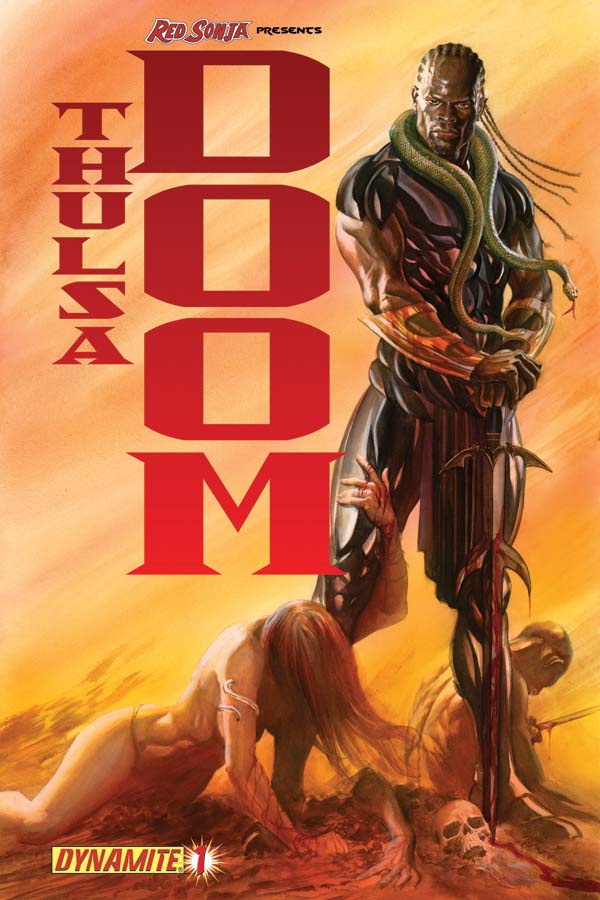
Thulsa Doom

Of all the villains who populated the books, comics, films and role-playing games of my youth, one figure stands head and shoulders above them all: Thulsa Doom.

Thulsa Doom was, what my mother would call, the evil baddie in the 1982 film Conan the Barbarian, which starred Arnold Schwarzenegger as Conan. I first saw the film at the cinema at the age of ten with my brother and my best friend Gus. Before going, I was terrified of being made to feel unwell by reports of gore and bloodshed, for I was pretty squeamish at that age and couldn’t bear the sight of blood. Gus, who had already seen the film, warned me of a scene with a soup made of human body parts. Funnily enough, I misheard him and thought he had said a “suit”. The soup, ultimately, was mild by comparison, and when I came to see the movie, perhaps on account of the gore being rather stagey and over the top, I enjoyed it thoroughly.

And there, before me, for the first time, was Thulsa Doom!

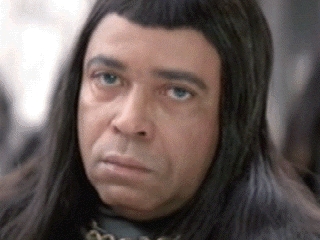
Thulsa Doom was, and still remains, an absolutely splendid villain. A god of sorts, with the ability to change himself into a giant snake, Thulsa Doom was more than a thousand years old. The leader, chief priest and guru of an ancient cult of snake-worshippers, he was a fearsome warrior, a demagogue, a philosopher, and a downright murderous son of a serpent. Played by James Earl Jones, with long black hair and a frighteningly square helmet fringe, decked out in chunky, adorned black leather armour, armed not only with two murderous, serpentine swords, but also with the voice of Darth Vader, he was certainly something to behold. Thulsa Doom had a mesmerising stare, an enchanting voice, and a wonderful way with words.

He first appears on the screen in the opening scenes of the film, in the frozen wastes of the Cimmerian north. Having, with his warband, raided and wiped out Conan’s village, Thulsa Doom approaches Conan’s poor mother, who stands defending her young son. Flanked by his two stalwarts, Thorgrim and Rexor – Norse metal-heads never looked so good – Thulsa Doom removes his horned helmet, revealing a noggin that seems curiously moulded to the shape of said headwear. The scene is a masterful combination of sad music, pathos and lingering stares. Thulsa Doom, without a word, hypnotises Conan’s fiercely defensive mother with his big, beautiful eyes, so that she lowers her sword and relaxes, in a sort of trance. Slowly turning, as though to walk away, he suddenly swings back in her direction, removing her head with the very sword we had seen Conan’s father forging through the opening titles, now taken as loot from his mauled corpse. Conan, looking up and into the face of Thulsa Doom as his decapitated mother falls beside him, is not about to forget either the visage or standard of his mother’s murderer in a hurry. Thus begins this epic tale of survival and revenge.

Despite its being something of a fantasy genre gore-fest, Conan the Barbarian is a surprisingly good film. It has its flaws, technically and dramatically, but written by Oliver Stone and directed by John Milius, it was a serious attempt to render the epic nature of the original Conan stories by Robert E. Howard. Beautifully shot and with a very moving soundtrack composed by Basil Poledouris, it feels at times more like a sword and sandal epic of the 50s and 60s than a fantasy genre film. The great sets and locations and the use of thousands of extras in vast crowd scenes, give its settings a very real and tactile quality, whilst the limited dialogue is terse and laconic, but nonetheless emotionally engaging. I was absolutely blown away by the movie when I first saw it, largely because I had, just a year before, started playing Dungeons & Dragons and reading a lot of fantasy literature. It was very much my cup of tea – an enthralling evocation of a fantastic world that felt authentically historical. Shortly after seeing the film for the first time, my brother and I began collecting the original Conan stories, which we were to read and re-read avidly through our teen years.

I went to see the movie twice at the cinema, and as soon as it was released on television, recorded it on the VCR and watched it repeatedly. I became so obsessed with the film that I kept a tally of how many times I had watched it in my diary – an early indicator of a life of mildly autistic behaviour! I learned the entire script off by heart, and could quote it from start to finish without prompting; aided, no doubt, by the relatively limited dialogue in the film. And, all the while, there was Thulsa Doom, looming large as my very favourite on-screen villain, even more so than Darth Vader himself.

The character of Thulsa Doom first appeared in Robert E. Howard’s Kull the Conqueror short story Delcardes’ Cat. Kull was a sort of precursor to Conan the Barbarian, a hero of the world prior to the destruction of Atlantis.

Thulsa Doom is described by Howard in The Cat and the Skull as being a large and muscular man (As he and Kull are said to be “alike in general height and shape.”), but with a face “like a bare white skull, in whose eye sockets flamed livid fire.” He is seemingly invulnerable, boasting after being run through by one of Kull’s comrades that he feels “only a slight coldness” when being injured and will only “pass to some other sphere when [his] time comes.” (Wikipedia)

Thulsa Doom later re-surfaced in comic-strip versions of Kull the Conqueror as his principal nemesis, wherein he is portrayed as a powerful necromancer through various editions.

In Oliver Stone’s film version of Conan The Barbarian, Thulsa Doom’s strength seems to lie in his antiquity, demagoguery and hypnotic presence as much as his magical powers.

http://bit.ly/TheStare

Thulsa Doom can not only transform himself into a snake, but can turn snakes into arrows, which he fires from his serpentine bow. His snake cult engages in the sacrifice of young nubile women to giant snakes reared, in some cases it seems, as pets by Thulsa Doom and his principal henchmen.

After a torrid youth spent strapped to the “wheel of pain” – http://bit.ly/WheelOfPain – followed by years in a brutal fighting pit, having excelled as a gladiator, Conan is trained in more delicate martial arts and given an education before being set free one windy night. It is not long before Conan, accompanied by his own henchies, in the form of Subotai and Valeria, has his first run in with Thulsa Doom’s snake cult and begins to plot his revenge.

Without wishing to describe the film in detail or at length, it will suffice to look briefly at  Conan’s ensuing encounters with Thulsa Doom, which are certainly memorable.

When Conan rather clumsily infiltrates Thulsa Doom’s cult and is captured, we are privy to one of Thulsa’s more eloquent outbursts. Having finished interrogating his battered and bleeding prisoner, Thulsa Doom proceeds to tell Conan of the power of flesh over steel. He summons one of his many female followers to leap from the cliff above to her death then, indicating her recumbent corpse, he says:

“That is strength, boy! That is power! The strength and power of flesh. What is steel compared to the hand that wields it?”

http://bit.ly/SteelVsFlesh

Having, in typically megalomaniac fashion, suggested that he himself was the source of all this power, Thulsa Doom admonishes Conan to “Contemplate this on the Tree of Woe,” before instructing his henchmen to “Crucify him.” An order that is duly and gruesomely fulfilled.

After having been rescued from the Tree of Woe, Conan and his companions make a murderous raid on Thulsa Doom’s compound, slaying many of his followers and guards. Thulsa Doom escapes by transforming himself into a snake, but, reverts to human form in sufficient time to shoot a snake arrow into Valeria, Conan’s lover, as they flee the scene, sated with the gore of their enemies and having liberated the princess they were seeking to liberate.

It is here that we are treated to one of Thulsa Doom’s more memorable lines; one I often find myself quoting when seriously pissed off.

“Infidel defilers. They shall all drown in lakes of blood. Now they will know why they afraid of the dark. Now they will learn why they fear the night.”

Conan, after a long night watching Valeria’s funeral pyre, now with even more reason to detest Thulsa Doom and wish him dead, prepares for the final battle amidst the mounds and gravestones of the ancient dead.

Yet the final confrontation does not take place in the ensuing, climactic battle, in which Conan slays both Thorgrim and Rexor, the latter wielding Conan’s fathers sword, taken at the start of the film. The sword is broken in a mighty overhead cleave by Conan, and, with Rexor dead, Conan retrieves it and holds it aloft.  That evening, he makes his way once again to Thulsa Doom’s impressive temple, at the so-called Mountain of Power. It is here, as Conan sneaks his way past the guards, aided by the charms and access of the errant princess, that we are treated to Thulsa Doom’s finest moment.

Standing before a vast crowd of thousands of extras in white robes holding candles, bellowing from atop the podium of his epic temple at the head of a grand processional staircase, Thulsa Doom makes the following speech:

“The purging is at last at hand. The day of doom is here! All that is evil, all their lies – your parents, your leaders, those who would call themselves your judges! Those who have lied and corrupted the earth! They shall all be cleansed. You, my children, are the water that will wash away all that has gone before. In your hand, you hold my light, the gleam in the eye of Set. This flame will burn away the darkness, burn you away, to paradise!”

http://bit.ly/ConanTheEnd

I am still deeply stirred when I hear this speech, and believe it has profoundly affected my rhetorical style over the years.

A short while later, Conan approaches from the shadows and comes face to face with Thulsa Doom. Thulsa Doom turns his benevolent smile and loving gaze upon Conan and tries to woo him with his honeyed words.

“My child. You have come to me, my son. For who now is your father if it is not me? Who gave you the will to live? I am the wellspring, from which you flow. When I am gone, you will have never been. What will your world be, without me, my son? My son.”

After being briefly seduced by those beautiful, snake-charming eyes, Conan looks down to his father’s sword and snaps out of hypnosis. With a look of sudden alertness, he promptly hacks Thulsa Doom’s head from his shoulders with his father’s broken sword.

It is a rather gruesome end for a villain, to see his head tossed like a hairy medicine ball down the steps of the temple, to flip and flop with an ugly wet sound, but the simple fact is, he sure had it coming. And as for Conan’s fate, well, that is another story…

Read Full Post »

Shooting Sydney

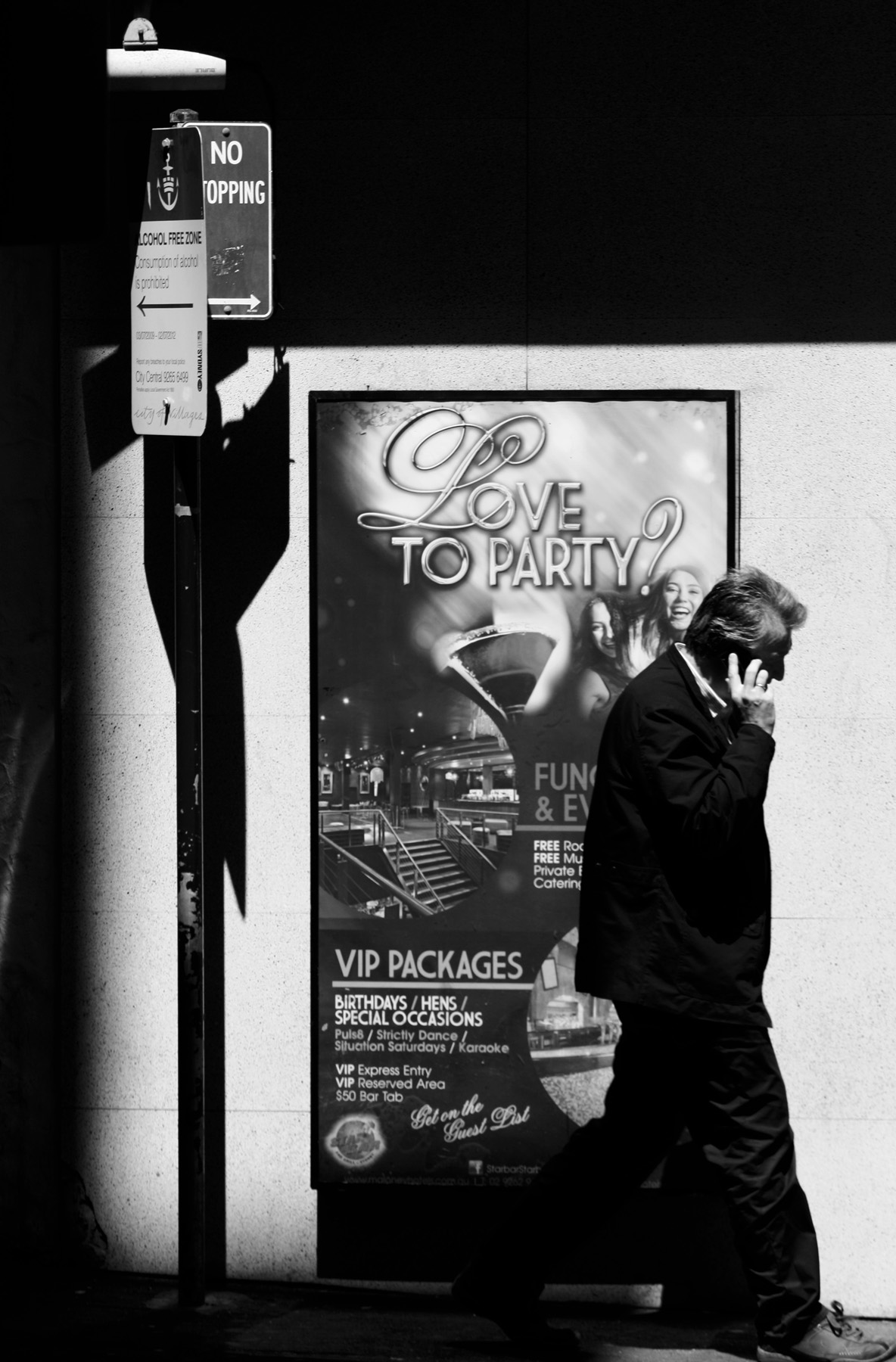
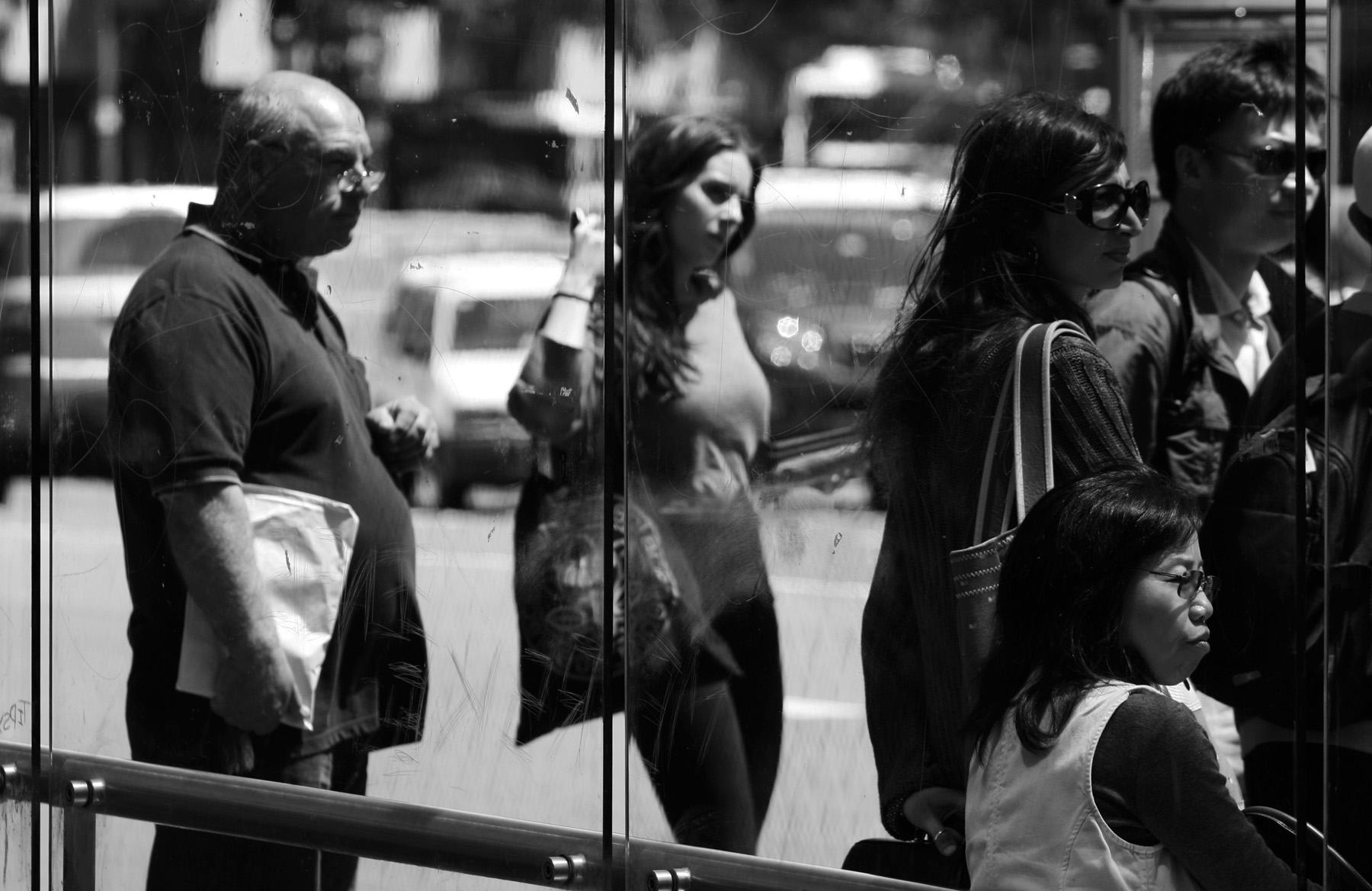
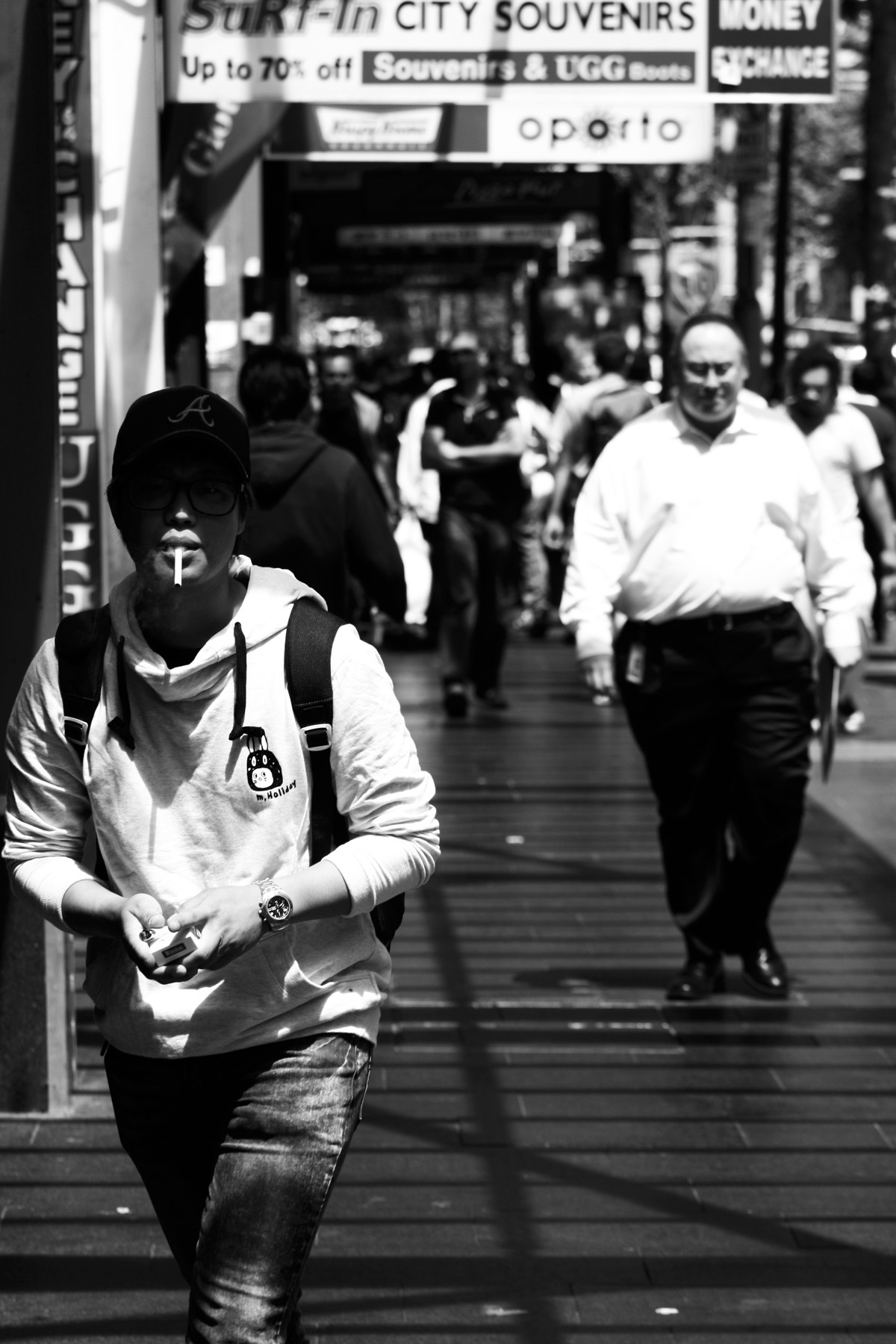
In more ways than one, I’ve been trying very hard to get back into Sydney. Not only as a place to live, work and enjoy myself, but also as a photographic subject.

Sydney is certainly a lot more fun these days. Despite the inability to purchase decent ecstasy anywhere in Australia, the countless new bars that have opened in the last few years since the licensing laws were changed has made the place a hell of a lot more livable.

The city also looks a lot better thanks to a great deal of inner-city gentrification and the completion of prestige developments and re-developments. This process really began back in the late nineties with the first efforts to beautify the city centre in preparation for the 2000 Olympics; widening and repaving pavements, replacing lighting, redirecting traffic flow, planting hundreds more trees and generally cleaning up a lot of ugly crap. The property boom of the mid to late 90s not only saw the filling in of the many unsightly holes left by projects which stalled in the 89/90 recession, but also attracted architects such as Renzo Piano and Norman Foster to the city. Anyone who remembers the ugliness of the CBD before this process began will no doubt be thankful for the transformation – perhaps with the exception of Darling Harbour, an overdeveloped nightmare. At the start of the 90s, almost no one actually lived in the city centre, and the chances of finding a supermarket or convenience store were next to none. Now it is a vibrant place that is alive with people in the small hours – for better or for worse. Irrespective of one’s opinion of the nature of the activities, the type of culture that has emerged, or the calibre of the people dwelling in the city, it is far better in its living incarnation, than the dead and, let’s face it, dangerous place it used to be.

Of course, the unfortunate upshot of all this investment and development was skyrocketing rents. This phenomenon, however, is by no means a necessary consequence of the improvement and renovation of public spaces, but rather it is driven by the selfish habit of Australians to speculate on property and buy for the sake of investment rather than to secure a home in which to live.

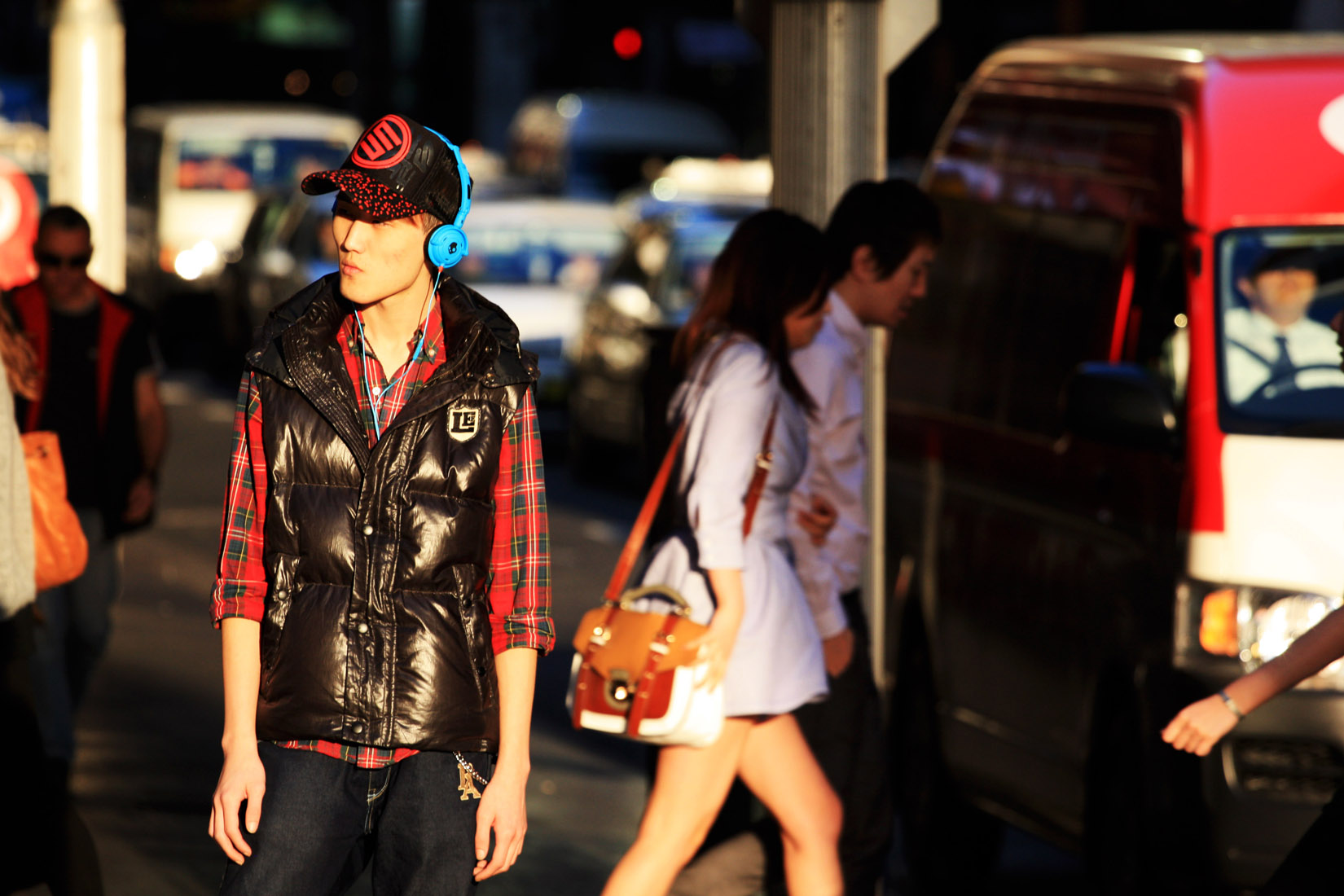
But I digress, for I came here to talk about taking photographs. Recently, I’ve been trying to get back into shooting this city, which, for a few years left me quite cold. The problem often lay in knowing where to start and why. What is most interesting about the place? The people, the geography, the architecture? I generally find people to be the most interesting subjects in any place, but in a modern, cosmopolitan western city, are they in any way different to those of other such cities? Sydney certainly has many diverse subcultures and scenes; inner city hipsters, inner westies, surfies, bogans, cashed-up bogans, office-workers, city professionals, winers and diners, foreign students, clubbers, surfies, grommits, beach-bums, goths, westies, rev-heads, fixies, transvestites, swing dancers, wanna-be latinos, hip-hoppers, theatre-goers, glamour-pusses, café-crawlers, jocks, hoons, thugs, prats, geeks, gits, princesses and parasites, and everywhere, the disconnected, disjointed, unemployed and homeless. It’s difficult to know where to start, and occasionally they’re all thrown together in the endlessly fascinating, chaotic and democratic mess of places like George Street or the Pitt Street Mall, where most will venture at some point, whether they like it or not.

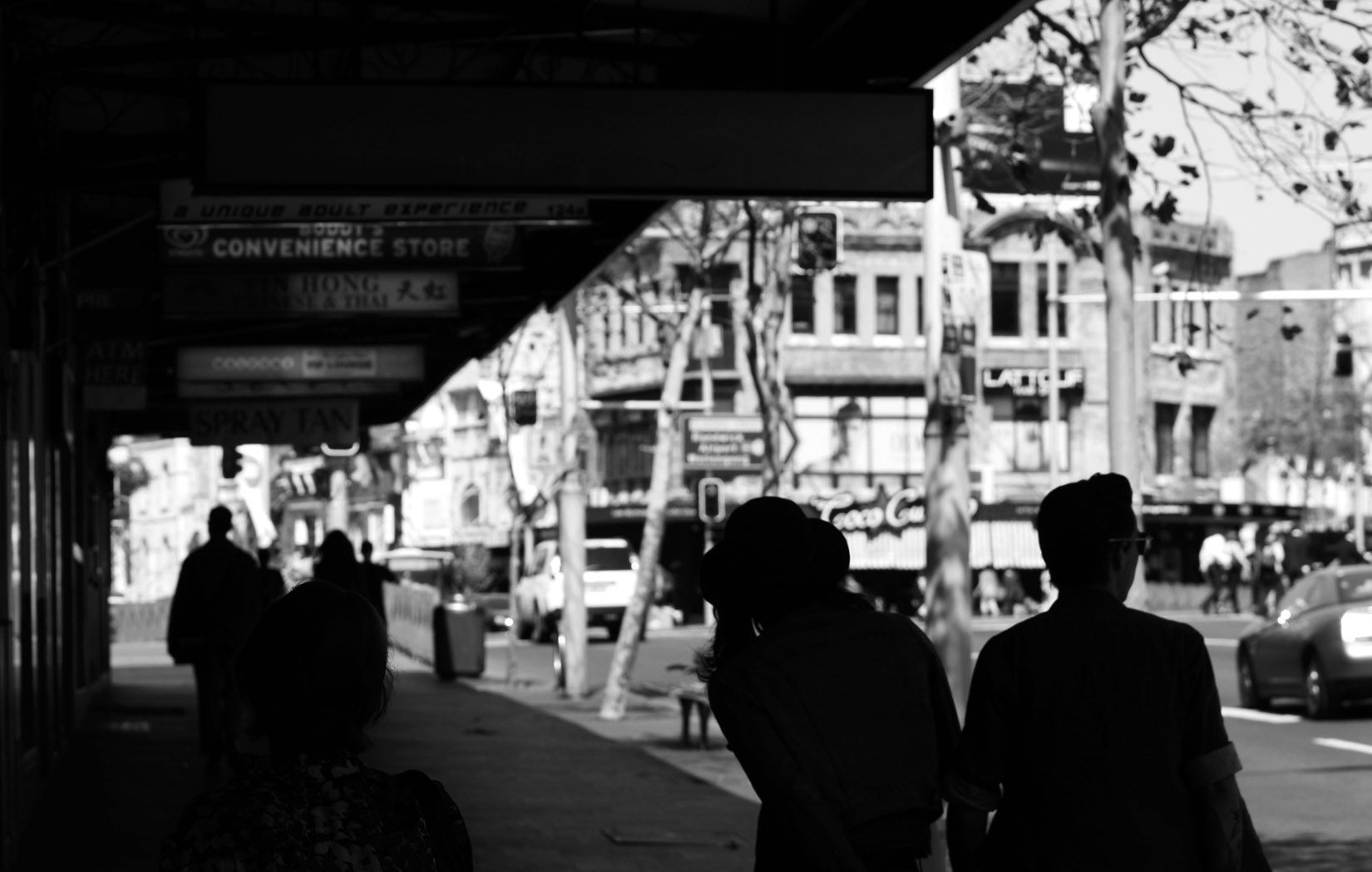
George Street, despite its relative ugliness, is not a bad place to start because of its mix of characters. The area around Town Hall in particular is, without wishing to be too disparaging, a magnet for freaks. Along much of the length of George Street, however, it is not an easy place to shoot. The subjects are many and diverse, but outside of midday, when the sun is overhead, or in the late afternoon, when, for example, the towers of World Square reflect the setting sun onto the pavements, this north / south canyon is in shadow. I’ve spent many hours hanging around on the pavement in George Street and in Chinatown, but with mixed results. Frankly, I’m a little tired of the place. There are, of course, more obvious and picturesque subjects; the prestige buildings, the harbour, the beaches, but they either have a magazine neatness and sterility, or a clichéd obviousness about them that ultimately leaves me unsatisfied. It’s nice enough to catch a good sunset around the Opera House, but without a unique and curious foreground subject, it all feels a tad pointless and touristic.

Often the best strategy is to head out with no expectations and shoot whatever seems interesting. I’ve been trying to do this recently, but again it’s difficult to know where to start, nor in which direction to walk once having started. There are the various “villages” of Sydney; Balmain, Leichhardt, Surry Hills, Erskineville and Glebe to name a few, yet unless some spectacular combination of light, weather, subject and drama occurs, seemingly by random, they can come up rather boringly flat. Without access to a car, it is difficult to go further afield at the drop of a hat. It would be nice to spend some time in places like Lakemba, Strathfield, Ashfield, Cabramatta, Blacktown or Liverpool, which have their own particular ethnic concentrations, but I haven’t quite managed it yet. Perhaps I’ve simply been unlucky in the last few years in Sydney, for surely any old place will do, provided one is fortunate in witnessing some utterly random and unpredictable ballet of chance elements. Who knows quite where a fight will occur, a car crash, or a wedding spill onto the street? I’ve learned many times that the planned and deliberately targeted subjects can give the most disappointing results. The key element is, more often than not, having time and mobility at your disposal and stumbling upon an event or play of light.

So what exactly am I banging on about? Basically, that Sydney, a city which ought to provide a diverse range of subjects, is proving disappointingly difficult to shoot at the moment. I’m not sure if it’s me, my choice of locations, my failure to make the most of good subjects, or the fact that the subjects are not that interesting to me. Having been spoiled in places like India, Vietnam and Cambodia in the last few years, where the people and backdrops were so fascinating in themselves as to bring a photograph alive, I sometimes wonder if the people of Sydney are just too intrinsically dull to be worth shooting.  Inside my head is a frustrated photographer shouting “Come on, do something! Dance for me!” only, much of the time they seem just to be walking on down the street minding their own business and looking any old bunch of westerners. I wish they’d do something ever so slightly theatrical or curious more often.

One thing I which continually frustrates me is cars. Oh man, cars! Grrr. My intense dislike of the things is always significantly enhanced whenever out on a shoot. Not only are most cars ugly, misshapen lumps, with so little thought put into their aesthetics, sacrificed no doubt in favour of aerodynamics, but they are quite simply everywhere. It’s almost impossible to find a street without the hideous things parked all along its length. They block views and make it nigh impossible to shoot from a low angle across a pavement. They are continually trying to steal the show by driving past, sitting in the field of vision, sticking their ugly noses, bald pates and shiny foreheads into shots. How much finer streets would look without them!

In some places the strata laws dictate that people cannot hang their washing out on balconies, nor drape clothes over railings, in order to maintain a boringly sterile appearance. Clothes, however, add colour and individuality; they flutter, create shadow and movement, they can have both a simple homely, domestic quality, or a diaphanous beauty. Cars, however, are almost universally hideous. In my ideal world they should all be hidden away in garages, or not kept at all. Antique vehicles, in which form seemed more important than function, might just get a look in, but the average modern car has all the attractiveness of a fridge with wheels. Put simply, I detest cars. They pollute, they kill, they’re awfully noisy, and they are responsible for ruining thousands and thousands of photographs the world over.

But again, I digress… And so, of late, I’ve been wandering about trying to catch some interesting shots, with varying degrees of success. I’ve had some success with workers before, especially in some of the more graphic and gruesome industries – meat-markets, fish-markets, industrial workers, construction sites – and perhaps this is where I need to direct my energies. I’ve thought about heading into more clubs and bars, yet these people are well enough documented in publications like TheThousands and the social pages of the Sunday rags, and I don’t think we need more photographs of hipsters and clubbers. Having said that, why am I kidding myself that anyone needs more photographs of anything?

Anyways, I have already ranted far too much on this subject. Here are some more recent shots, along with a few not so recent ones, from the last three years.

Have a nice day!

Read Full Post »

Sunset Burlesque

It’s been a while since I took my camera out with me regularly, just as it’s been a while since I wrote a lot of poetry. Between 2003 and 2007, there was a period when I never left home without my camera. I had carted a little film number around for years, but things really picked up with the purchase of my first digital at Stansted airport for a trip to Venice in February 2003, en route to Rome, where I was living at the time. It was a sexy and very portable 3.2 megapixel Minolta with a 3x zoom and a wholly inadequate chip, c. 100 meg – I really can’t remember, though I do still have the thing in a drawer somewhere, its circuit board fried in Gatorade. It was a wonderful camera and the sheer delight with which I pointed it at things cannot be overstated.

In 2004, back in Australia, I really thought I’d hit the big time when I upgraded to a 4 megapixel 10x zoom Olympus, purchased en route to New Zealand. I loved that camera, and dreamed of seeing it displayed in a glass case in the Museum of Me, which I intended to build in the megalomaniac bachelor future to which I’ve since abandoned looking forward. Irrespective of the future existence of said museum, my father’s forgetful abandonment of the camera in a bottleshop in Prague in 2008 has rather put paid to these plans. Still, it took some magnificent photographs of which I remain very proud and which now constitute the High Romantic Era of the inter-Cambridge years, also known as the first incarnation of Cornieworld: 2005-06.

Judge for yourself:

http://on.fb.me/Sydney2003-2006

This was a splendid period of endlessly seeking photographs. I often took a bus into town or hung around before and after work, looking for shots. At night I would take my tripod with me, armed with a couple of hefty bifters, and prowl the streets of Glebe in search of gold. I was especially fond of dusk, and made many a mission at this magic hour to shoot the royal blue skies that emerged in extended exposures. I tried to capture the sentiment of those times, when I was also writing an absolutely stupid amount of poetry, in an ineffectual poem, which has long since languished on the scrap heap. I include it here for its attempted evocation of the restless, and overtly melodramatic yearning that gripped me.

Late afternoon

This late afternoon’s neither open nor closed,

though most of the day is gone and I’m yet to feel

proud. I stared through the morning as through a picture

window, running an hour late for nothing

and already that sickness, that sinking.

Luncheon came with just a few short lines.

The sun on the palm flower (soft as the flesh

of a sapling stripped by a child’s

tepid inquisition) was hypnotic; milky

smooth as an albino root.

Speckled doves rattled the leaves;

dry, resounding clicks with every branch-hop.

Foliage fell, winking down the sunned backs

of traffic-hardened terraces

through mottled streaks of blaze. Come four o’clock

I’m typing into warming gold and expectation spoils

these clutched-at scraps. Calling, the low sun urges

its partisans, drives me to grab my camera for this brief

hour – hasty magic, when so far north of south.

Go shoot tired vistas, hoping copper light will tweak

their tune. I need to be three places at once: the light-

rail viaduct, the sunken ferry, the bridge

like a leggy woman pissing – that mongrel pylon

never lets me win. In the park trying to work

out how my heroes made it. One low

cloud wiggled like a swung dash across

the rending sunset; an overexposed, sylphid burlesque.

My hands already clammy with that pallor

born of going home, restless to head out again

and squeal in the interrogation of the moon.

___________________________________

In early 2006, in preparation for my return to England, I upgraded again and bought myself Canon 350D. Before leaving I carried it with me everywhere I went, including taking it to work every day, with two hefty lenses. I didn’t mind the weight of it so much, though it was bulky and awkward. I suppose I felt not a little windswept and heroic, and, armed for the first time with a 300mm lens, became quite obsessed with “sniping” people at a distance.

I’d like to think I got some grand results, and once overseas, put it to good use on many trips. Yet it was here that I also slowed in my quest. I lost the habit of taking it with me every day. I got tired of the weight and bulk of it and, increasingly, left it at home. There were certainly many bifter-fuelled missions wherein I rode my bicycle for hours on end seeking shots, and when I travelled overseas I shot like a man possessed. With less regular practice it took me a little longer to warm up, yet, when I went on holiday, I was pretty quickly inspired by the exciting subject matter and took some of my very favourite photographs in this period.

http://on.fb.me/RecentWork1

http://on.fb.me/PhotosBCornford

When I returned to Australia in 2008, I upgraded again to the Canon 450D and bought myself an L-series 200ml lens. It is this camera that I am currently using, though I would dearly love to upgrade again and spend ten grand on lenses. That megalomaniac bachelor future seems more distant than ever, though the bachelor part is, shall we say, in full swing.

And so! Having recently moved back to Glebe, to a studio from the back window of which I can see the old flat in which I wrote the above poem and where I dwelt during the High Romantic Era of the inter-Cambridge years, I have once again been inspired to write bucketloads of poetry and cart my camera about with me. It’s a wonderful feeling, as though I have returned to complete some long-unfinished business, and, so far, I’m pleased both with my output and dedication. It’s two in the morning, and really I ought to be in bed, but ABC Classical FM is having a bit of a Bach special, and after a long day of writing, conditions are ripe for hammering the keys still further.

Yet, I have digressed too far, for the purpose of this piece was merely to introduce a few photographs of a rather unique sky I spotted on Saturday afternoon. It seems almost unreasonable to be excited about these photos, considering the subject matter was presented to me complete, and by chance, and I certainly had no hand in it other than being in the right place at the right time. I had gone to Chinatown – pork buns are my weakness (sung to the tune of a certain Kate Ceberano song) – but the clouds, which later proved to be so enthralling, were a hindrance. I was hoping for conditions such as those which prevailed when I took some photos in Chinatown a while ago. Namely, these, for example:

But such was not to be. And so, I took the bus home, all bunned up as it were, and when I hopped off just past the footbridge, found myself quite mesmerised by the following:

Fingers crossed, there shall be plenty more to come. And on that note, I shall bid you good night!

Read Full Post »

Ashes and Diamonds

This is the half-finished (now rounded off and polished) first chapter of a science fiction novel I began sketching some years ago, entitled “Hotel Paradiso.” It was inspired by a number of long and involved conversations with friends and colleagues at Cambridge about how much awareness of the past the human species might retain were it to survive for millions, even billions of years. I doubt, for example, that in the year 5,793,657,349 they will be focussing on Germany between the wars in history faculties around the galaxy…

The heavy black ship drifted through the barren dark. Across the vast silence of limitless death its engines burned a lost roar. Ranged along its bulky hull, tiny windows shone like torches pointed across an immense cavern. Their power was rapidly swallowed by the emptiness; their minuscule warmth, much less even than that of the engines, made no impact on the one Kelvin expanse of eternity.

The ship knew where it was going, for its occupants – a bipedal, carbon-based form not entirely unlike ourselves – had instructed it to move into orbit around an ancient planet. The planet had long since ceased to receive any warmth from its dead sun, which, were it shining still, would have illumined a red soil, here and there fused by great heat into fields of glass.

Deep inside the hull, in the ship’s museum, warm orange light illuminated an extensive archive. Beneath a frescoed ceiling, painted with scenes of ancient forests, of suns and stars, of a world out-of-doors, of ruddy, bipedal beings playing, swimming, surfing, or sitting cast in thought, were rows of computer banks, storage shelves, display cases, brackets, niches and cabinets, stretched through the ship for almost two kilometres. This was the heart of the University of the Empyrean, one of thousands in the sprawling, skulking civilisation of Homo Superior.

Even now, as the ship moved into orbit around the heavy, sullen orb, negotiating with the gravity of the crushed white dwarf, a lecture was taking place. It was given in a language of which we cannot hope to have an understanding, so many were the years through which it had evolved, so many were the contexts, so many were the worlds, indeed, galaxies that it had traversed, that the vocabulary, grammar and tones bore little relation to the dialects to which it traced its origins, billions of years before, on a planet lost in mythology. The basic sense of it is given here.

“Naturally,” said the lecturer, “any study of a period as ancient as this one is heavily dominated by conflicting methodologies. It is why, as ancient historians, we emphasise the development, above all, of the faculty of interpretation. Our evidence is so limited, so much has been lost which could have illuminated our understanding of the very early origins of homo superior, and indeed, our evolution from the Homo Sapiens and Homo Sapientissimus…”

The amplified voice was crisply resonant in the gallery of students and fellows. They sat attentively, looking not so much for revelations as confirmations of their common purpose.

“With only several hundred Earth texts surviving, and mostly in later translations from the publishing houses of Mars and Europa, you know as well as I do what a paucity of evidence we have for constructing the chronology of human social evolution on Mars. With five hundred million years of habitation, commencing with the first mission in the year thirteen billion, seven hundred and three million, four hundred and eight thousand and fifty-three, little was preserved from the earliest period of settlement.”

“However,” and here the lecturer, Professor Julian Rollmops, tapped his elongated middle finger against the air as though knocking on the door of an important point, “you will all be familiar with the ancient Homo Sapiens novel Moscow Gherkin on the Rocks, with its wealth of anecdotal evidence about the Hotel Paradiso, founded two hundred years after the initial Martian settlement. It paints a picture of a time that witnessed the first true flourishing of the economic potential of the Martian colony, which had, for so long previous, languished under the cost of overheads, the logistics of communication and transportation, the absence of sophisticated culture and cuisine and the consequent inability to attract colonists to the slow-growing, insular, claustrophobic frontier mining society. Though we cannot be certain that the incidental information is entirely accurate, we do have proof that the Hotel Paradiso did exist, for, owing to the popularity of the novel as much as the hotel itself, it was preserved as a cultural icon, a vast artefact, celebrated as the gateway to the golden age of Martian settlement.”

Professor Rollmops cleared his throat and adjusted his adrenaline level. He was excited and nervous, but over all, proud to be delivering what amounted to a pep talk preliminary to the exploration phase of a long-dreamed of project. It was well-trodden ground and his audience were all too familiar with the details. Once they were on the surface, however, or under it, for that matter, every so-called fact enumerated here would be open to conjecture.

“We know this,” continued Professor Rollmops, “because the hotel is inventoried in the famous document, Grand Marineris 793. If the accepted dating is correct, this originates in the twenty-seventh century of Earth years. The monograph, a pivotal examination of ‘gender blending’ amongst the wealthier colonists, displays a sophisticated use of academic reference, a most impressive awareness of several Earth dialects, and, judging by the scale of the bibliography, it gives tantalising hints about the culture of detailed research which existed. But I digress. What is significant for our purposes is that it pinpoints the exact location of the hotel and indicates that having been decommissioned, it was encased by surrounding developments and came to form a sort of subterranean museum, the structural integrity of which, according to Olympus 137, was still intact some two thousand years later. Whether we can hope to find anything after five billion years is anyone’s guess! But, ladies and gentlemen, fellow scholars, that is precisely why we are here.”

The room hummed with muffled murmurs of interest and one man began to clap, before thinking better of it.

“Sol was a main sequence star in the G2 spectral class. At the end of its lifecycle, in the shedding of its outer layers – still barely visible in the fading remnants of the planetary nebula – and subsequent loss of gravity, both Earth and Mars were pushed into more distant orbits and their atmospheres slowly but surely stripped. Exactly what, if anything, survived on or beneath the surface, is anyone’s guess. The loss of so many ships in the flight to the moons of Saturn and subsequent Titanic War has left us with only a piecemeal understanding of the final Martian evacuation. Fortunately, however, it is only twenty-three thousand years since the last ship is estimated to have departed from the dying system and I personally am hopeful that we shall find some astonishingly well-preserved archaeology. Our scans and models of gravitational dynamics indicate next to no asteroid bombardment, despite the planet’s acquisition of two new moons. Or, rather, two replacement moons, after the expulsion of Phobos and Deimos.”

Professor Rollmops leaned forward, placing both his elbows on the synthetic wood lectern, as though about to deliver an aside. Instinctively, the audience leaned forward, joining him in this greater intimacy.

“Indeed, I am very hopeful that, what is, for the moment, an almost non-existent chronology outside the framework of a vague mythology, will soon be transformed into a sophisticated understanding of the history and culture of this latest phase of outer Sol system settlements.”

There were murmurs among the audience, and shuffles not of restlessness, but warm approval. As the keynote speaker, at this, the last lecture series before the archaeological exploration got underway, Professor Rollmops was tasked with reminding all of their mission and raising spirits appropriately. He was not so much here to inform and instruct, but to motivate; to celebrate.

“We have, of course,” Professor Rollmops continued, “the well-known reference from Phobos 652, regarding the final evacuations from the planet Earth, and the then very great mythological significance which it entailed. The parallels drawn between the long-remembered destruction of a place called Troy, and exile from an abundant garden, are a tantalising glimpse of, we can only assume, even more ancient Earth myths whose significance, again, we can only assume, had acquired a purely academic currency for the fleeing Homo Sapientissimus.”

Across the audience heads nodded sagaciously and Professor Rollmops was pleased to see them so poised for his coup de grace.

“Well, ladies and gentlemen,” he said. “How proud and, perhaps, surprised, our long dead ancestors would be to know that now we have returned from exile after so many troubled millennia!”

This comment brought spontaneous applause from several audience members, and once it was underway, the rest joined in. “Bravo!” they cried. “Hoorah!”

A few stood in their seats, and soon the entire crowd was on its feet, caught up in a wave of nostalgia and destiny to which only an intelligent species that has somehow survived and replicated itself successfully, never quite losing touch with its origins, over a time-span of five billion years, is privy.

Professor Rollmops, himself overwhelmed with the historical significance of the moment, found himself choking back tears.

“Yes, my esteemed colleagues,” he croaked. “We have come home at last!”

Read Full Post »

Rain

This is a chapter from a novel I wrote between 1998 and 2004 entitled Et in Antipodes, Ego. It was intended to be something of a romantic epic, but lacked sufficient gism to make it readable. Too long and slow, the romantic elements were based, at times quite painstakingly, on personal experiences from the period prior to its conception. The story centred around Edward Cockfoster and his uncovering of a literary controversy whilst writing a PhD on the fictional Australian author, Bryce Chapman. His unexpected, serendipitous success with his research contrasted with the failure of his relationship with the Cambridge-bound Pandora.

Whilst containing some, if I may say so myself, quite beautiful moments, there was too much pedantic and pedestrian detail which could only be described as self-indulgent. With the first draft running to 140,000 words, it was terribly overwritten, yet at the time I was too precious to take the axe to it in the way that was necessary. In retrospect, it was good “marathon training”, but not something I intend to go back to, having moved so far away from its characters, themes and sentiment. This is the fourth-last chapter, wherein Edward finally sees a light at the end of the tunnel.


Rain

Edward met Felicity at her house at eight and they walked around the corner to the local church. He had worn his only suit for the occasion, a dark blue pinstripe over a pale mustard shirt. Felicity wore a ballooning white skirt, a pale blue blouse and dark blue cardigan; her long black hair hung flat to the top of her bottom.

It promised to be a difficult sitting when they saw the uncushioned benches. Felicity curtseyed to the alter and slipped by, the hem of her skirt brushing Edward’s shin; the cotton half catching then springing away from his trousers. He slid along the bench after her.

“This is nice,” said Edward, shrugging.

The service began soon afterwards and Edward stared ahead, thinking only of the girl beside him. Neither he nor she was Catholic, but as students of Latin, this had seemed a curious excursion. It was not long before Edward was overcome with drowsiness, induced by the soft fragrance of Felicity. The slow rhythms of the Latin washed over him, spoken by an Italian-accented speaker with a cadence and elision usually neglected by unimaginative readers. The words hummed in the solid wooden pews; a language come back from the dead.

Amidst the press of Italian families, Edward and Felicity moved hardly a muscle. Forced close together, the fabric covering their upper arms touched lightly. The contact filled Edward with such a sensual languor that he was afraid of moving and breaking the spell. Out of the corner of his eye, he could see that Felicity was transfixed, though he did not know by what.

When at last it was over they stood up quickly to leave. It was just after eleven and they emerged into a mist of light rain.

“Well…,” Edward trailed. “That was kind of interesting.”

“I was pretty disappointed actually. It wasn’t as medieval as I’d expected.”

“Vatican Two is to blame.”

They began to move off under the dripping trees in the direction of Norton Street.

“What’s the point of Catholicism without the incense, mystery and chanting?” said Edward. “They’ve lost their schtick.”

“I know. And, hello, guitars and cow bells? Whatever…”

“Say no more.”

They hurried through the rain to Bar Italia, a busy, informal café; worn tables, ice-cream counter, movie posters and a bohemian crowd. The clash  of plates and clink of spoons reverberated on the wet-footprinted tiles.

They ordered a fettucini melanzone and salata caprese to share. They drank tea and coffee and laughed about the service. When they had finished eating Felicity suggested going on a walk around the neighbourhood.

“It’s raining,” said Edward.

“But I want to get wet,” said Felicity.

She led him through the streets in her ballooning white skirt; small in stature and perfectly proportioned. All she lacked, thought Edward, was a wand trailing stardust. They came to a wide grassed pavement behind which lay railway tracks upon an embankment. Along the line of the fence an array of towering trees and flowering shrubs hung their branches to form bowers. In their romantic communal enthusiasm, the local residents had set up wooden benches, constructed from old wood, and painted with a fading assortment of blossoms.

They stood talking under an arched trellis until Edward decided to brave the wet bench. He wiped off the top slick and sat on the damp wood.

“You can sit in my lap, if you like,” he joked, putting his elbows up on the back of the bench.

“Alright,” she answered. “I should have known better than to wear white.”

“I’m sure the church-goers liked it. They love to fantasise about virgins.”

“Well don’t you get any ideas.”

She sat on his lap and he adjusted her weight until they were comfortable. Although he tried his hardest not to place his hands on her with obvious intent, the merest touch communicated more than he had intended to learn: the neat roundness of a thigh, the inward curve from hip to waist; hands where they might be in a more ardent encounter.

Felicity sat in Edward’s lap until his bottom went numb. They talked and talked and when she enthused about her favourite poets, Edward’s suffering increased tenfold. She too was a fan of the romantics, and after a time he could bear it no longer.

“I am dying to kiss you,” he said.

“What?” she said, genuinely surprised. “Oh no, you can’t say that, it isn’t fair.”

She twisted in his lap and looked at him.

“Why? I’m sorry,” he said. “But it’s the plain, simple truth.”

Edward leaned back to give her more room, relaxing his hold on her.

“But… This is such bad timing. I’ve just started seeing someone.”

“Oh? Really? I know. I mean, I didn’t know, but I should have known. That you must be, that is.”

He bit his lip.

“Someone like you would be, I guess. I wasn’t sure.”

She sat stiffly.

“You shouldn’t have said it.”

“That I wanted to kiss you?”

“Yes.” She turned her eyes away and moved further towards his knee. “It’s been a month now. It’s just turned the corner towards something more.”

Felicity stood up and so did Edward, she walked away a few feet and turned to look at him, smiling.

“I still want to kiss you,” Edward said. “Maybe it’s not too late.”

She looked at him pityingly, moving about on the spot.

“This is so unfair. It’s so confusing.”

She giggled nervously. She walked in a circle, looking up and then around, laughing when their eyes crossed.

“You know, I had a dream about you the other night,” she said. “You came to me in a Latin lecture and handed me an envelope. Inside there was a card with a heart in it, a simple heart cut out of paper and coloured in with red pencil. I hoped you were going to turn up after class, and then you didn’t, and I realised how much I wanted you to be around. That was Wednesday.”

“Well here I am!”

She laughed again and let her voice trail off in a frustrated whine, walking away again and turning to come back.

“It’s just such bad timing all this. No one should have to make this sort of decision.”

“So there is still a decision to be made then?”

“Oh, please, Edward, no, no. Don’t keep on about it.”

“I’m really sorry. Honestly, I should never have said anything. I wouldn’t have said a thing if I knew there was someone else. Something you said gave me hope. I thought you were just out of a relationship.”

“I was. I am. But then I met this other guy. He’s in third year. Undergrad.”

Never demean the opposition, thought Edward, just keep hoping.

“Studying?”

“Science.”

They were both standing, facing each other, twisting on their feet and half smiling.

“I’m sorry,” he said. “I didn’t know. I always pick the wrong time.”

“It’s hard to get the timing right. Things just happen when they do.”

“Are you in love?” he asked.

Felicity began to nod, then slowly stopped. Gradually her head began to shake.

“Not yet. But there’s nothing wrong. Everything is nice with us. Maybe I will be.”

“I’m sorry,” he said again. “It just seemed so right here. Normally I don’t have the courage.”

She looked up slowly from the wet ground with mischievous eyes.

“It is right, and I want you to kiss me, but…”

“Perhaps I should try anyway?” Edward’s heart was pounding beneath his breastbone. All about him water was dripping. He could hear and smell and taste the world so well.

“I guess you could try,” she said, faintly.

Edward advanced rapidly, afraid of a change of heart. He put his arm around her waist and drew her in, and she placed her hands, a little cautiously, upon his shoulders. He closed his eyes and she closed hers, and their mouths came together in an awkward, mistimed kiss. Their teeth clashed. He kissed her again and she responded, but their mouths seemed not quite to fit, and they broke away, both feeling disjointed.

“Mmm,” said Edward. “Your face is even more beautiful up close.”

She skipped away from him.

“I thought our first kiss would be better than that,” she said. “I imagined you kissing me the way Ewan McGregor kisses.”

“How so?” asked Edward, a little shocked at the critique.

“I’ll have to show you,” she said, and she came for him, taking his face in both her hands and tipping her own face to one side. He tipped his head the other way and their lips met and this time they got the kiss right, full mouth sucking full mouth, their lips softer, more pliant. Edward warmed from his brief shock and Felicity seemed more enthusiastic now.

Once the kissing had begun it acquired its own momentum, moving forwards to familiarity and then to a sort of immediate necessity. Edward picked her up in his arms and held her there, kissing her further. Her small body was almost weightless and so he held her for minutes until he felt sure something larger must come of this.

An hour later she led him into her back yard and snuck him through the window into her bedroom.


 ********

Edward reached Parramatta Road at a trot, his coat flapping. With his breast thrust out, sloughing the wind, he might have warbled like a proud robin. The rain came on in clinging beads; undecided drizzle that reminded him he wore his only suit. It had been put through the motions this night and dawn, blessed and baptised then hung from a bed-post.

He swept under the tired awnings and faded signs, slowing to pace down the pavement. In the light spread evenly by the bright grey sky, he saw and loved this dirty, great road. Bereft of cars and with its bitumen black and clean, the run-down shop-fronts and two-bit businesses pooled forgotten glories.

He smelled her in the humidity of his warming body; her scent rising from his shirt as he thrust his arm out for a taxi.

“Good morning,” he said, settling in; relishing the soft neatness of the door’s closure. The driver smiled at him, happy simply to drive. Edward rested his hands on his knees and sighed. In the taxi, all he could smell was her. He could not stop smiling, despite his exhaustion. A vision of her naked form hung behind his eyes. Had it really happened? Had they really lain together, right through to the wet sunrise? Tired in the chest, his limbs just a little numb, he flowed home unhindered through lights that stayed green.

How he longed for a hot cup of tea. How lovely then to shower and towel, and simply to be so alive at dawn.

Read Full Post »

“Depression presents itself as a realism regarding the rottenness of the world in general and the rottenness of your life in particular.” – Johnathan Franzen, How to be Alone.

When you’re sad, you see things as they are. It’s a blessing and a curse, because whilst there’s nothing as refreshing as the truth, when it’s ugly it only compounds the problem of feeling sad in the first place. Sadness not only takes the sheen off things, but it also takes the screen off things. It denies us the levity required to accept things that we have tolerated rather than enjoyed. When its cause is sudden, and its magnitude is great, it pulls away the carpet that hid how cold the floor was.

This effect has many repercussions, some of which, if coupled with sufficient will, are positive. In the short term, however, it magnifies the sorrow. If we are unhappy with our job, then the work becomes intolerable. If we are unhappy with our home, then the place seems unbearable. If we are unhappy with our life in general, then even the most everyday situations can become awfully difficult, especially when preoccupied with the source of our depression. These peripheral circumstances, which cease, in the thick of things, to seem peripheral, can, however, be addressed, even though it might not be possible to address the original source of lament. Depression provides us with an excellent opportunity to become pro-active and to make important and necessary changes that we have delayed for too long. The only problem is, of course, finding the strength, positivity and determination to take these necessary steps when feeling so deflated.

This ability to see the truth in things also applies to human relationships. In situations where a dispute or disagreement has jeopardised a relationship, where we have neglected someone or paid insufficient attention to their concerns, we can more easily see the significance of this. Without the security of things being ostensibly well, when depressed, our egos deflate and petty points of order upon which we might have stood become so glaringly trivial as to seem repulsive. The sources of displeasure, of frustration that were present previously, seem as nothing to the possibility of losing the relationship altogether. The onset of a deeper sadness can cause us to see just how foolish we have been in handling aspects of a relationship, and how much more easily certain situations might otherwise be or might otherwise have been negotiated. It must be seen as a chance to remember, so fiercely, the example, as to prevent its repetition in future.

Sadness can, of course, be as selfish as it is selfless, especially in situations where two people are involved. Sadness can cause us to fall into ourselves, from which point of view it is difficult to perceive things through the eyes of others. We can too easily monopolise grief and see our own troubles as paramount over those of our friends or partners. We can hurt those around us with the inherent egotism of sorrow, just as easily as we can sympathise with them. And sadness can be a great source for sympathy. Just as we see the truth of our own lives, so we can see the truth of others. We can find a great deal of empathy in sadness, for we detect it so much more readily in others. Even if they cannot see their truth, when we are depressed, and utterly disillusioned, in the most literal sense, we can see through others. The fraudulence of things becomes most readily apparent.

One of the principal troubles of a heavy depression is that it becomes nigh impossible to enjoy oneself. In the case of the loss of a partner, when grief for their absence is the source of depression, it is hard to enjoy anything because the only perceivable source of happiness is their presence. Everything acts as a reminder of the person’s absence; the inability to share the experience with them makes it cold; the heightened desire for them to be there makes their absence more urgent and hurtful. Every guilty pleasure becomes a crass mockery of the fulfilment we crave from their company.

Time, and its passing, presents a dreadful dilemma. When a crisis is fresh and the rawness is absolute, the spirit is completely abject. Time passes awfully slowly and each day can seem interminable, yet we long for time to pass so we might be on the other side of things. Day one, day two, day three after a tragedy, without sleep, unable to eat, feeling sick in both head and stomach, wanting nothing but to curl up and cry out in agony, unable to do anything to alleviate the cause of the sadness, full of self-loathing, loneliness, and finding everything in one’s life abhorrent, in such a state, time is not your friend. It must pass for the healing to take place, it must pass so that distance can accrue between the cause of suffering and the present one inhabits, yet it crawls more slowly than ever at such times.

It also takes a long time to resolve problems and make changes. It can take months, for example, to find a new job, to find a new house. It can take months to bring about changes in oneself, of habit, attitude and outlook. And whilst we wish time would simply pass, that we might find ourselves six months into the future, sufficiently buffered from the source of hurt, time also acquires an urgency, a preciousness that it lacked when we neglected it. Where once it seemed alright, even delightful, simply to do nothing, when in the thick of an urgent depression, where one feels a very great need to change things, to change oneself, all time becomes of the utmost importance.

Recently, battered by a devastating break-up, once through the first two weeks of hellish torment, I wanted more time each day to write job applications, I wanted more time to read, to write, to watch quality cinema, to listen to classical music, to read poetry, write poetry, take photographs, meet new people, meet with friends. Time became something that must be spent well, always, with purpose, with energy, because doing things to improve the depressed mood and unhappy situation was the only way forward, the only apparent possible way to lay the foundations of a future happiness.

Not only did it seem to me that time must be well spent, but I found it especially difficult to enjoy anything lacking in depth. Deeply depressed and distraught, I was unable to stomach what I would call “popcorn” entertainments. Television radiated an unbearable artifice; all sport seemed not merely futile, but appallingly populist and anti-intellectual; popular music that had once cheered or stirred me, now seemed glib and insignificant; computer games that had so appealingly rendered a genre, now seemed so awfully genre. Almost everything acquired an aspect of irrelevance. I could no longer stomach the theoretical physics articles in the New Scientist, which I read every week, so baselessly speculative are some of them. Where is Occam’s Razor in theoretical physics, I ask you?

Feeling no artifice in the self, it was nigh impossible to stomach artifice in anything else. It is a strong recommendation of psychologists that one should seek fun entertainments when depressed. This strategy is no doubt successful in many instances, for lifting the mood is paramount when depressed and comedy, or any other light-hearted distraction, is one of the best means of going about this. “Popcorn” works to shore up the spirit against heavy moods. Yet, when I tried to take pleasure in amusing trivialities, I found they were not powerful enough to distract me from my thoughts. Indeed, they seemed unpleasantly frivolous. It was far better either to exercise, read a good book, or immerse myself in a symphony.

For every action there is an equal and opposite reaction. So it was that as I dropped the popcorn in the aisle, the quality entertainments grew once again in stature: great literature, great art, live performance, art-house cinema, classical music, opera and intellectual radio programs. Not that I had neglected these things entirely by any means, but, when plunged into a gloomy mood, they acquired an almost intense relevance as carriers of truth in art and emotion. Such thought, philosophy and talent have gone into “the canon”, that it offers the comfort of sitting at the feet of wisdom. I needed to hear intelligent voices; to be moved again by powerful art and ideas, to remember how much there is beyond the self.

It was thus in the great work of others that I found satisfaction; beauty, honesty and integrity, such important fundamentals when trying to lay the foundations for self-rehabilitation. Great art can teach us not only how to improve ourselves, but also how to forgive ourselves. It broadens our perspective and sympathies by teaching us about others, directly and indirectly. The meditative quality of a lengthy piano concerto; the range of moods in a symphony; the intense engagement with the emotional circumstances of a character in a film or novel; the overwhelming satisfaction of beholding a beautiful painting; all these works speak directly to emotion and require no artifice. They move us before we have time to think, but then we think, for we are moved, and it is, more often than not, a philosophical, reflective train of thought.

There are, of course, other more scientific avenues for rehabilitation; medicinal and therapeutic. In my own case, reluctant to go down the medicinal route, I took the advice of trusted friends and began to see a psychologist. I had always doubted the usefulness of such consultations, as I seemed to spend most of my life ruminating on myself and identifying my issues. Yet, it occurred to me that whilst I knew what was wrong with me, I wasn’t entirely sure what the best solutions were. Perhaps a psychologist could lend some assistance on this front.

Speaking with a psychologist is certainly an interesting experience. On one level, it’s nice to seem so important as to be worthy of discussion : ) On another level, being assessed by someone trained to rationalise and contextualise emotion and character is pleasantly reassuring. However well we think we might know ourselves, it is hard to see the wood for the trees much of the time, and to hear an intelligent and informed assessment of the big picture is an opportunity to replace the image of the self in one’s own head. It is a little like working with an editor to improve a narrative.

To know that we are, as Neitzsche said, Human, all too human is something of an unwelcome relief. To learn that anything learned can be unlearned, that one can in fact, with discipline, change habits of thought and behaviour, however long established, is, however, genuinely reassuring. People who have always driven on the left-hand side of the road, can, within days, drive comfortably on the right. People whose response to frustration is to become angry, can learn to prevent the anger developing. People who have a fear of talking to strangers, can, through practise, approach people without the irrational fear that their approach is an unwelcome intrusion.

Yet, all this requires a lot of energy and effort and many will, through the weight of their depression, lack that energy. Perhaps, in their instance, some form of medication would be beneficial. Perhaps, also, in such cases, they would do well to seek levity in light-hearted entertainments. I can only speak of my own experience, where quality art and psychotherapy have been immensely beneficial – as indeed, has writing. The process of creation provides an outlet, a means of channelling emotion, though regaining the concentration required to practise any art is a hurdle in itself. Each person must tailor their response to themselves and to the source of their unhappiness; yet perhaps the best starting point is to see depression as an opportunity. Clearly, things must change, and the sooner we seek to make those changes, the sooner we might find some form of emotional equilibrium once more.

Again, I reiterate, I can only speak from my own experience, and enough has been said on that front already.

adieu.

*True Seeing (Divination) Reversible

Sphere: Divination

Range: Touch
Components: V, S, M
Duration: 1 rd./level
Casting Time: 8
Area of Effect: 1 creature
Saving Throw: None

When the priest employs this spell, he confers upon the recipient the ability to see all things as they actually are. The spell penetrates normal and magical darkness. Secret doors become plain. The exact location of displaced things is obvious. Invisible things become quite visible. Illusions and apparitions are seen through. Polymorphed, changed, or enchanted things are apparent. Even the aura projected by creatures becomes visible, so that alignment can be discerned. Further, the recipient can focus his vision to see into the Ethereal plane or the bordering areas of adjacent planes. The range of vision conferred is 120 feet. True seeing, however, does not penetrate solid objects; it in no way confers X-ray vision or its equivalent. In addition, the spell effects cannot be further enhanced with known magic. The spell requires an ointment for the eyes that is made from very rare mushroom powder, saffron, and fat and costs no less than 300 gp per use. The reverse, false seeing, causes the person to see things as they are not: rich is poor, rough is smooth, beautiful is ugly. The ointment for the reverse spell is concocted of oil, poppy dust, and pink orchid essence. For both spells, the ointment must be aged for 1d6 months.

From the Dungeons & Dragons – Players’ Handbook.

ps. “If you end up with a boring, miserable life because you listened to your mom, your dad, your teacher, your priest, or some guy on television telling you how to do your shit, then you deserve it.”

– Frank Zappa

Read Full Post »

This short story was first published in Wet Ink #22, March 2011.

This is a mix of fact and fiction, involving elements from four visits to Venice. Conspicuous by its absence, however, is perhaps my favourite Venetian anecdote, wherein, forgetting my key on the way to the shower, I was locked outside my hotel room at 0600 AM in nothing but a towel, for two hours. Three wonderfully adventurous octogenarian Kiwi ladies made me cups of tea and kept me company the whole time, which made up for not being able to photograph the sunrise, sorta. As to cigarettes, I took my last drag in New York, in April 2007 and don’t miss them at all.

Last Smoke in Venice

I had to give up. Again. I swore I’d never smoke another cigarette after the age of thirty on pain of cancer and, being superstitious, I believed it. For many shining months I didn’t have so much as a single drag. It was tough when waiting for trains. It was tough when drinking, tough after eating, tough with my afternoon coffee, tough when emerging from a film. In the end it was just too tough. After eight months, like a dog returning to his own sick, I found myself back sucking grime.

The truth is that I was already suffering from cancer: cancer of the discipline; cancer of the willpower. If I couldn’t control something as simple and straightforward as an addiction to a deadly poison, then what hope did I have of achieving anything worthy? I needed to find the strength, or perhaps the romance, for a ceremonial act of excision; the cigarettes had to go once and for all.

Travel was a serious problem. Every time I gave up smoking it would be a holiday that brought me back. It’s nigh impossible to resist cigarettes on the road. My resolve had failed in Tokyo, in the Balkans, in Italy, Spain and Greece. Wherever the smokes were plentiful and cheap, and whenever I was in a festive, campaigning spirit, out came the wallet and in came the poison.

Then it hit me. Perhaps I could turn the problem on its head. Perhaps I could make a journey just for the sake of quitting; pick somewhere special – new and exotic, or even an old favourite – go there, smoke myself silly until, in a chosen moment of unmatchable glory, I polished my final gasper.

I was excited by this idea. It was also a good excuse for another holiday, and I immediately began to think about where to go.

Four weeks later I flew into Bergamo, having decided on a forced march across northern Italy as a prelude to the glories of the Venetian lagoon. In five days I travelled through Como, Milan, Brescia, Verona, Mantua, Bologna, Rimini, and Ravenna, smoking all the way. On the night before I set off north for the floating city, I went out skulking. In the grey exhaust side streets, before a rainy fortress, I met some hooded men and bought some hash.

The following day was lost behind curtain rain. I took my time. At Ferrara I changed trains in a fish-tank world, fearing the worst for my visit to Venice. I was banking on sunshine for high-contrast, black and white photography, and of course, for plenty of outdoor smoking. Thankfully, as the train rattled across the causeway, the sun returned; shining low through departing clouds. The winds flicked raindrops like mounted archers peppering a column. It was late afternoon. The lagoon was bruise and silver blue.

At the station I ordered a coffee and smoked a cigarette on the steps outside the cafeteria. It was nothing special, but I enjoyed every drag. The first of my last cigarettes in Venice! I had booked a hotel in advance; a little two-star number only three minutes from the Piazza di San Marco. November was clearly a good time of year to visit; if only the fog and the rain might hold off. I set off into Venice down its old, paved ways.

I found my hotel without trouble. The heating worked, the bed was comfortable, the outlook simple but pleasant. The tiled floor was cool on my hot, tired feet and the shower ran with rare force. Having stopped at the supermarket, I opened the shutters and placed my supplies on the deep window sill; ham, cheese, bread, milk, pastries, and a two-litre bottle of cheap barbera.

Warmed, fed and spruced, I set off into light rain to commence my picturesque arrivederci to the smokes. I chose melancholy music to match the chilling beauty of the weather. I wandered without aim over bridges, stopped under awnings, leaned against dry walls, puffed my way down narrow alleys. After two hours the long day got the better of me and I returned to the hotel for another hot shower and some bed rest. I treated myself to one last cigarette; leaning over the street with a glass of milk. There were plenty of smokes left, so I didn’t count them. This may have been the final packet, but it wasn’t ration time yet. Below, the wet stones scuffed and echoed. I exhaled into the backlit droplets.

The following day dawned with a piercing blue sky. The air was mild and bracing and standing at the window I felt fresh. Ahead lay many indulgent hours of smoking and photography. I showered, made my lunch, ate my breakfast, and kicked off with a nice hit of hash. At seven thirty, I set out to walk the streets in awe.

I spent the morning circumnavigating the Arsenal; from here the Venetians had once ruled the eastern Mediterranean. It was no mean feat and yet, despite the size of the space, and not normally being one to judge a book by its cover, it had about it the quaintness of pre-industrial industry. The small, clean, pocked bricks of the wall belied the great scale of the business they once secreted.

I took the ferry to the Island of Burano. Despite the beauty of its rainbow streets, it left me empty and distant. My eyes were ever looking back to Venice; the floating city seemed so rare and precious that I could not stand long to be separated from it. Anxious, I rushed back to the ferry and returned post-haste.

By one in the afternoon I was half drunk. The bottle of barbera in my pack steadily lightened as I swigged my lost way through alleys and down canals. At two I followed the signs to the Rialto and waited to take up pole position. Once installed at the bridge’s summit, the sun swung into place and shone down the blinding Grand Canal. The water turned to a black steep of silver stars; oblivion overrun with ripple sparks. I shot in black and white, straight into the face of the sun, seeking out silhouettes, cigarettes hopping on my lips. It might be impossible to take an original photograph of Venice, yet if one can get the cliché just right, then perhaps there is art in that.

So, things were going nicely! If this really was to be my last packet of cigarettes, what better place could there be, what better than this? And there were other good signs to consider. For all the pleasure of the loving drags I took, I rued the pungent reek of my fingers and the oily prickliness in my cheeks. I allowed myself to enjoy the cigarettes, yet did not forget the many, immediate and obvious disadvantages; the stench, the dizziness, the heaviness in the lungs. How I longed for a scrub with soap and water.

I grew increasingly drunk on the Rialto Bridge and did not budge for two hours. By four in the afternoon I was exploding for the loo and finally abandoned my post. Back at my hotel room, relieved by a rumbling torrent, I lay on my bed to download my photographs and woke up, lap-top across my thighs, at eight in the evening. The day had gone, the sun had set; the clear sky had retreated behind fog and rain clouds.

Sunburned and beat; hungover and nicotined out, I set off into the clinging night for a final, tripod-mounted shoot. My impeccable sense of directionlessness got me lost in all the right places. I felt fraught with a wonderful longing that pained me to know what to long for. I stumbled across floodlit decay; scaffolding shoring up damp bricks; dead ends in the emerald murkiness. I looked for spots to sit, spots to smoke then leave behind for other spots, feeling at times both whole and halved.

I was woken at six by a booming siren. In my pillow-muffled ears it sang like the old factory hooters that once sounded so sonorously across Sydney. The low moan tugged me back to harbour sunrise; rinsed blues and yellows in a hazy glare. With the dawn colour of ocean behind my eyes, I recalled where I was. My lids fluttered, blinking away the chimneys and rusting cranes. I stirred, happy in my heat, and sent a foot to the temperate air.

A moment later I knew the siren’s meaning. It came with unexpected clarity. Some time ago, when reading up on Venice, a particular detail had stuck; that the sirens warned of floodtides. Their sounding called the city council into action and prepared the people for a day of sloshing. All across the sinking city, Venetians would be pulling on gumboots. I sprang out of bed feeling lucky. It was too good to be true. The surf was up.

From my window I could see nothing of the flooding, but my faith was strong. I showered and dressed quickly, emptying my pack of all that I would not need. I should have to return before eleven to check out, but there was plenty of morning before then. I sat by the window and rolled two joints, tucking them into my cigarette packet. There were only five smokes left. I made myself a packed lunch; over-buttered rosetta rolls, ham and chunks of hard, dry cheese; apples and chocolate. I ate half a packet of cupcakes, drank a pint of milk and went downstairs for a surprisingly bad coffee.

It was seven thirty when I left the hotel. Outside the door, to the left, the street came to a dead-end at a narrow canal. Here the water had spilled over the lip, but it was dry along the base of the wall. I stopped, eyes locked to the ubiquitous arched bridge opposite, and smoked up one of the joints.

Being morning, the first thing that hit me was the tobacco. I felt so light-headed that I leaned against the wall to avoid dizziness. Good old tobacco, wondrous nicotine, with its strange ability to relax and make uneasy simultaneously. The hashish came on strong as I turned back towards the main vein.

I soon found what I was looking for – the canal overlapping its banks. Along the promenade, heading west and south, the water had risen above ankle height. Men unloaded from barges onto these swilling pavements. The manmade banks with their pretence of ordering the ocean had lost authority to the swollen sea.

I stopped, aghast, in love, in awe, propped and fired off shots. The cigarettes were hot in my pocket; the sea air risen, sharp and salty. I pulled out a smoke and stuck it in my lips. I knew I was putting it on, narrowing my eyes, sucking in my cheeks, trying to look tough and cool, but that’s how I started smoking and that’s how I was determined to finish. It was an irresponsible stance, foolish and vain, but how I loved it here on this fired-up, overflowing morning, the thin sun yellow through a fug of fading mist. I set off for the fish markets; first stop on a long day’s march.

Along the lengths of the main thoroughfares, wooden platforms, like clattering old school desks, had been erected. Upon these people walked, one abreast, turning their shoulders sideways as they edged past each other. Alongside, vendors stood in calf-high water, wearing thigh-high, olive green gumboots. People leaned from the safety of the platforms and bought whatever they required. I stuck some Italian opera in my ears, highlights, arias, then walked up and climbed aboard the platforms. It was slow going and soon lost its novelty, so the first chance I had I hopped off onto an island of dry land outside a café. On a whim I went in and ordered a scotch, to put some fire in my belly. It went marvellously well with a cigarette. I stood outside watching people shuffle down the boards; I was high on the atmosphere, high on the romance, high on the nicotine. It was all going so well!

I made my way along the higher, drier streets, photographing everything I could: men slicing fillets from large and bloody fish; market stallholders and deliverymen unloading goods into handcarts; widows sloshing from their homes; bored gondoliers lamenting the clouds; waiters waiting. I wandered through these vignettes; hoping my camera could capture the narrative. Venice was such a tumult of stimuli that it had ruined my concentration. The emotional tugs in the arias; soaring beauty and epic despair, robbed me of the desire to force things. I abandoned all plans to visit galleries and museums. Despite the rich interiors, this was not a time or place to be indoors. I strolled on through the wet and marvellous gloom that grew across the morning, content to witness this decay and fading grandeur. Venice is a living ruin, the heart of glorious sadness. It was appropriate that under a leaden sky, chest heavy with the weight of awe, I was smoking my final cigarettes.

I stopped and had another whisky. It warmed me and loosened my shoulders. Cold was seeping in from the ever-present damp. The clamminess and slow oil of skin passed to memory with the macchiato chaser. I had another smoke, then washed up in the bathroom. I had only two cigarettes remaining and the thought was making me anxious. Doubts were beginning to creep in. What would really happen when the final one was smoked? How long before the joy of being clean was overcome by gnawing need? I wanted to be free of anxiety on this front, yet I felt the impending nostalgia of finality.

Time had flown and I had to get back to my hotel to pack my bags. I made a beeline and walked apace. I took a gratuitous extra shower, freshened up, packed and left right on the stroke of eleven. Once outside I took stock of how to spend the afternoon before the train and plane and coach ride home. All along I had been avoiding the obvious; I aimed myself towards the Piazza di San Marco to see how the floods had taken hold.

The Basilica sat on the shore of a tidal lake, rain-stained and murky gold. The walking platforms had been erected around the piazza, one line of which led directly into the church. The smooth-worn and deceptively soft marble shone with wetness and reflections. Under the cloisters the scrape of steps echoed; the air was sewn by the whispered gasps of voices and a ceaseless lap and plop. I stopped just before the entrance; the hot damp of a present congregation exchanging its breath with the outside cold. My interest was unfocussed; bemusement and preoccupation with the presence of water. I wanted only to sit undisturbed on a wet marble step and listen to the drops and ripples.

I turned straight around and headed back out, walking on the platforms to the side of the piazza. The three steps to the arcade were sufficient to keep it above the height of the water. I had missed the tide at its peak and cursed.

Walking to the opposite end of the square, I sat on the steps and opened up my cigarette packet. The moment was dawning and the ludicrous significance I’d attached to it filled me with the melancholy of pointlessness. Was my life so devoid of purpose or meaning that I had to resort to conceits such as this? On the other hand, should I not be pleased that I was able to take such a curiously indulgent holiday? One cigarette, one joint, that was it.

The time beyond smoking seemed like darkness. It was a significant step towards death; like losing my hair or being forced to give up dairy products. Yet, it was a good while since I’d smoked without guilt; the casual unconcern of youth had long since left me. I knew I would live more comfortably if I accepted the inevitable.

I fired up the joint. There weren’t too many people about and I figured they would be none the wiser. The smoke curled roughly into my lungs; harsh, dry tobacco; sweet, oily hash. I had taken the music out of my ears to be alert and watched the people around me. Only one person seemed to have an inkling of what I was up to; a lithe and pretty girl with long dreadlocks, in hipster jeans and a colourful, striped top. She was facing perpendicular and our lazy stares must have met somewhere out on the shallow water.

As the hash came on, I closed my eyes and breathed. I wanted some music that kicked me with its pith and began spinning the dial on my iPod. I loved all these songs but was growing tired of them. Then my eyes lit on something so apposite I could have wept. Fate was guiding me, lending this moment a whole new grandeur; Led Zeppelin, When the Levee Breaks.

The loud, echoing snare timed me into six minutes of heart leaps. I rocked back and forth with the slow grind of the intro, till Page’s spanking riff had me breathing in tears. The basilica rippled at the end of the square, mirrored in the flood.

The song built and built, up and up so my hair stood on end. Yes, this was the moment – the moment to finish with smoking. The levee was broken, the pigeons shat hard from the columns and pilasters; the heavy sky was threadbare with blocked silver light. My heart was full; rich with excitement and the anxiety of uncertain yearning. I held the moment as tightly as I could; sweating in it, rocking with it.

My eyes locked to the centre of the piazza, I noticed a break in the water where the tide was receding and the land revealed its uneven shape. Had the weight of the buildings pushed down the edges of the piazza, leaving a hump along the centre?

The song was drawing to a close, petering into repetition. I turned down the volume and smiled through its coda. Perhaps now was the time. The longer I waited, the more anxious I would become about commencing the final smoke. I picked up the packet and withdrew the cigarette.

It was in my fingers, ready to be applied to my lips, when I heard a scuffle to my left. As I turned my head, a bright, cheery face leaned into view, introduced by a waving hand. It was the girl with the dreadlocks.

“Hi,” she said.

I smiled; startled, embarrassed, and pulled out my earphones.

“Hello,” she said, “sorry to disturb you.”

“No problem.” I hadn’t had a conversation in English for four or five days and was surprised at the sound of my voice.

“I don’t suppose you have a spare cigarette?” she asked.

“Well, actually,” I began, but then my heart sank. How could I explain?

“It’s my last cigarette,” I said, “really my last one.”

Knowing just how old and tired this excuse was, I added, “It really is genuinely my last cigarette.” I showed her the empty inside of the packet.

“Oh, that’s cool,” she said, but she did not leave immediately.

I was not sure what she was waiting for. Did she want to share it with me? Did I really want her to go away?

“I guess you can have it if you like,” I said a moment later. “I’m supposed to be giving up.”

“Oh, no,” she smiled, “I couldn’t take your last cigarette.”

“No, go on,” I said. “Seriously. You can have it, I suppose. I don’t see why not. Or we could share it, if you like? I guess a little company’s a fair price.”

“For sure,” she said, beaming. She sat down beside me, closer than I could have hoped.

“I’ll start it, if you don’t mind,” I said.

“Go right ahead.”

She was English, probably from London, though I couldn’t be sure.

I put the cigarette to my lips and stoked it up. My final cigarette! The very last one! And here I was, completely distracted from my mission to savour it. I’d been dragged kicking and screaming from detached, heroic edginess into thoughts of lewd acts following an imagined pissed-up luncheon. Never could I have predicted such a dilemma. This would be a cigarette to remember – that much was certain, but how, how, how could I explain?

I passed the cigarette to her and she took her first toke. I watched her technique; it was practised and sure. She drew the smoke smoothly, without grimacing. She took three tokes then passed it back to me.

I was pleased to find the filter dry. I took my drag, thinking of things to say. There was so much from which to choose that I said nothing at all.

“Any plans for the afternoon?” she asked.

“Not especially,” I said. “How about you?”

“Nothing really. Just more sightseeing I guess.”

“Cool, me too.”

I passed her the cigarette.

“Are you here by yourself?” she asked.

“Yes. And you?”

“I am now,” she said, “my sister went home yesterday.”

“Cool,” I said, not really knowing exactly what was cool.

“Well, in that case,” she said, taking a drag and passing the cigarette back to me, “we’d better get some more cigarettes.”

I laughed and smiled at her. I liked the sound of “we.”

“Yes, I suppose we should,” I said.

The floor was falling away beneath me. Was I really about to get lucky? This had happened once before in Turkey; a grand opportunity arising just prior to my departure. I gave a woman my jumper – she was worried about being cold – and she smelled it saying it had the scent of a real man. I left and caught my flight on that occasion, yet here, already I was calculating the cost of skipping tonight’s. I had often joked about heading back to England overland. I felt an awkward, bowel-shaking mix of despair at the impending failure of a sacred mission and the longing to succumb to a rare romantic possibility. It would need some thought, it would need some good fortune, it would definitely require more cigarettes.

“Yeah, fuck it,” I said, exhaling out the side of my mouth, “let’s go get some more fags.”

Read Full Post »

This short story is derived from an incident in Apuleis’ 2nd-century novel, The Golden Ass.


Part I

I thought I knew donkeys. I thought I knew a thing or two about asses. By all means they’re known to be temperamental, as stubborn as they are dependable, and some even say the gods take their form to keep an eye on the natures of men. This ass, however, was a very odd beast indeed.

I didn’t have him for long. He was in my company just a few short weeks. Yet, in that time I watched him closely, and there were things I noticed and dreams I had that spoke of his curious nature.

It was some time ago now, when I was stationed in Thessaly, near the town of Hypata, just outside of Larissa. One day I received orders to transport my commander’s gear from the fort to his new station, in the nearby town of Lamia. I set off to look for a suitable beast. I was not in a good mood, it must be said. My mate Strabo, who takes his wine without water, had filled me full of his impious libations the night previous. My head clanged like an anvil, my stomach was sour as old milk, and I did not feel the master of my temper.

On the way back into town I came upon a man riding an unloaded ass. What followed, it pains me to recount, was nothing short of shameful.

“Where are you going with that ass?” I asked.

The man, a dirty poltroon in such wretched, dishevelled clothing he could barely be said to be clad, glanced at me quickly then turned back to the road, saying nothing. I watched him a moment, dumbfounded, then called to him again, approaching closer.

“Where are you going with that ass?”

Again he ignored me, staring ahead like a dumb mute. I found this every insulting; coming, as it was, from such a peasant.

“You, beggar,” I shouted, marching up behind him. “Where are you going with that unloaded ass?”

Still the man said nothing. I wasn’t about to stand for anything of the sort, and so, without a moment’s hesitation, I took my vine-staff and clobbered him one over the back of the head. The blow knocked him clean from the donkey’s back, and he hit the ground like a basket of bricks. At last I had his attention.

“Sir, sir,” he gasped, all humbleness now, scrabbling at my feet. “Please, sir,” he whined, “I speak no Latin. Only Greek.”

“Alright, alright,” I said in Greek, embarrassed by this new-found sycophancy. “Quit your whining. I asked you where you are going with this unloaded ass?”

“Why, sir,” he replied. “He’s not unloaded. He’s carrying me.”

“Not any more he isn’t. Where are you taking him?”

“I’m taking him into town.”

“Well,” said I, “we need his services. The commandant’s gear is being transported from the fort.”

The man looked at me like a dumb beast. I don’t have much patience for fools, so I took hold of the ass’s bridal.

“He’s wanted to join with the rest of the baggage animals.”

I began leading the ass away.

“But sir,” cried the man, his face a mask of sorrow. “I paid fifty sesterces for him! He’s all I have.”

“It’s no use telling me your stories.”

“Please,” he begged, “sir,” he whined, “friend,” he pleaded, as though I was his brother. “Be more civil. I wish only the best for you and your men, for the success of the legion and the commander, for a swift promotion for yourself. I call upon the gods to give you these blessings, but please don’t take my ass.”

He grabbed at my feet, bowing and scraping on his knees. The blood ran freely from his head. I could see that I’d hit him too hard.

“And anyway,” he said, “it’s a useless beast and terribly vicious. It’s on its last legs! It has a horrible disease! There’s only just enough life in it to carry a few vegetables from my garden without collapsing. It’s not fit to bear your master’s equipment.”

The blow must have made him forgetful. Had I not just seen him riding on the beast’s back? It looked a fine enough creature to me. I kicked the man away and stepped up the pace. I was sick of the sound of his voice. He was like all the rest; a liar, a dodger, a sycophant. I was in half a mind to give him another whack and put him out of his misery. He came after me again, abasing himself, grabbing at me. It was the height of insolence.

“Please, please, sir,” he said.

He clutched at my feet and nearly tripped me over. Completely fed up, I turned and raised my cudgel to silence him. Next thing I knew, he grabbed me like a wrestler. Crouching right down, the scoundrel took me round the calves and heaved me up and over with uncanny strength. In the blink of an eye I was down on my back with the wind knocked out of me. Straightaway he was onto me. He hit me and bit me, then took up a stone and beat me round the head and shoulders. It was all I could do to protect myself from a fatal strike. His strength was phenomenal; I was powerless against his onslaught.

“Get off me,” I cried, reaching for my sword, “I’ll finish you once and for all!”

Seeing me go for my sword, the knave went for it himself, took hold of it, and hurled it away into the bushes. Now he resumed his attack with even greater savagery, raining down heavier blows. There were no witnesses, no one to intervene – if it went on a moment longer I’d be done for. I was nearly expiring already, battered and bruised and bleeding all over. It was the least I could do to protect my head. Then, after a terrific punch to the brow, I went limp. I lay like a corpse, playing dead, fearful that he would find my sword, or take a larger stone and finish me off.

Instead, however, my assailant stood back, surveying the scene with horror. Believing that he had done me in and fearful now of a capital charge, he panicked and bolted. Taking up my sword, he made off after the ass, who was already hotfooting it out of there. He caught him up, hopped aboard his sturdy back, and off they went towards the town. In a welter of shame, relief and exhaustion, I blacked out.

When I came around the day was well on its way towards evening. The air was thin and cool and full of the requisite dust. I could smell a trace of cooking fires from the fields and my stomach turned in hunger. I felt desperately thirsty.

I hauled myself up, a sorry sight indeed. If anyone had passed where I lay, then none had stopped to help. They’re all the same round these parts, a bunch of selfish good-for-nothings. Still, it was a relief not to have to explain myself, for I was ashamed and disgusted. To lose my sword was sacrilege. The thought of having to explain the beating I had received was bad enough, but to have lost my sword as well! Almighty Jove, I was in for it alright.

I stumbled towards town, head hanging low. The birds were settling into the trees and making a hell of a racket. I cursed them and all their twilight chirpiness; cursed all the insects that tickled my wounds. Soon, however, I began to curse myself. The more I thought about it, the more I knew that I only had myself to blame. I had been too rough with him. He was just another simpleton like all the rest. That ass must have meant a lot to him and I should never have struck him like that. Still, were it not for his rudeness we might both have been spared all this misery. After all, the army had every right to that ass. We take what we need, and that’s the way it is. I cursed the hides of both man and beast who had shown such stubborn arrogance.

As I neared the entrance of the town a group of farmers emerged, returning, I suppose, from the markets. They saw the state I was in and took pity upon me, asking how I had come to be this way.

“Please,” I said, “this is a criminal matter; a serious offence.”

I was ashamed to think how the town would view me should the story get round. I wanted to be rid of their sympathy as soon as possible. Thank the gods I was moving on to Lamia.

“But, sir,” said one, “you can hardly stand. You need help.”

“There,” I said, pointing to the town gates, “the soldiers will help me. It is a matter for the army, now leave me.”

I stumbled on, feeling the chides of their kindness. The smoke of the hearth fires was rising from the roofs, the softened bustle of the day’s end drifted from the dusty streets.

It was a relief to see Caecus and Appius on duty. I knew Caecus well and waved to him as I approached. The moment they saw how I looked, they came running.

“What happened to you, Marcus?”

“I was attacked on the road.”

“Are you alright?”

“I can’t speak of it here. Help me to the barracks, I’ll explain everything.”

“Here, take my cloak.”

Appius remained on duty while Caecus led me away. With the aid of his cloak, I passed unnoticed through the darkening streets. We went by the back ways and soon arrived at the barrack block. The moment I entered, my friend Strabo, already resting from his duty, leapt to his feet.

“Gods,” he said, “what happened?”

“Let me drink first.”

I made straight for the fountain. Strabo brought me a cup and I drank until I thought I would burst.

Soon the off-duty men had gathered around, anxious to hear my tale. Despite my disgrace it was such a relief to be alive and amongst comrades, that I felt a great urge to get the story off my chest. I called for wine to ease the pain and food to give me strength. With Strabo’s aid, I removed my clothes and took up a sponge to clean myself. With a cup of wine in hand and the sweetness of fresh dates on my tongue, I shared my story by the flickering lamps.

“Don’t worry,” said Phaestus, a man of local birth. “We’ll find this beggar and his ass and get your sword back.”

It was treachery, they declared, what this beggar had done. What right, after all, did he have to question my authority?

“It will be best if you stay in your quarters for a couple of days,” said Strabo. “If the commandant gets word of this, he’ll have you skinned. We’ll put the word out that you’ve taken ill with the fever.”

“But I’m supposed to transfer his gear to Lamia tomorrow.”

“A day won’t hurt. Tell him you were delayed on the road. Show him your scars – how well you defended his possessions! Now, describe again the appearance of this man who took your sword, and we’ll make sure to find him.”

“First thing in the morning,” said Phaestus, nodding. “We won’t rest until we get your sword back.”

The following morning, good to their word, the men went in search of my assailant. I stayed put in my cot, anxious for news and thankful of the rest. My ribs were bruised black and blue; my arms and thighs had taken a battering, my head pulsed like an open vein, but nothing was broken. If Fortuna wasn’t exactly smiling on me, she was at least wearing a smirk.

Just after midday I heard the sound of footsteps running into the barrack block. A moment later, a young soldier, Manius, burst into the room and shouted.

“Marcus, sir, we’ve found him! Come with me.”

Despite my stiff, sore body, I was on my feet in a flash.

“He’s holed up in some friend’s house and won’t come out. The friend denies he’s in there, but we know he’s lying. The neighbours ratted him out.”

“What about the ass? Finding the beast would make it plain.”

“There’s no sign of him – but listen; Strabo cooked up a story. He’s told the magistrates that the man we’re after has the commander’s silver cup. He said it was lost on the road and this man found it and won’t give it up. They’re on their way now, to try to coax him out.”

I dressed as quickly as I could; Manius assisted me with the buckles. The weight and pinch of the breastplate came as a stern caveat. I grabbed my cloak and we were off into the streets, marching as best as I could manage. It wasn’t long before we arrived at the house. It was a two-storey number with a shop downstairs selling grain and legumes. There was a big crowd already gathered round the front; all the nosy locals had come for a peep. Right in the middle of it all stood a man I assumed to be the owner of the shop, facing up to the authorities.

“It’ll only be trouble for you, Philo, if you don’t deliver him up.”

It was Spurius Posthumus speaking; a magistrate I knew and liked. He was short, but handsome; a straight talker who lived for the law courts.

“How many times do I have to tell you,” said the shop-owner. “Shall I swear on the Emperor’s genius? You’ve got the wrong house.”

“Come on, Philo,” said Posthumus, “enough of that. We know you’re an honest man and that you have a duty of hospitality. This theft could result in a capital charge. Your duty to the law brings no dishonour in breaking a bond of friendship.”

“Shall I say it a thousand times?” said Philo. “I don’t have anything to do with it.”

I moved up next to Strabo and tapped him on the shoulder. He turned and saw me and clasped my hand.

“Shsshh,” he said, “say nothing. It’s all in hand. The law’s on our side and it’s just a matter of time.”

“How did you find him?”

“It’s a small enough town. Apparently he’s a gardener for a private estate. He often sells legumes at the market. This man is one of his purchasers.”

Another of the magistrates now stepped forward. A local man whose name I never recall.

“If we have to stand here much longer,” he said, “things will only get worse for you, Philo. If you want to save your skin from a charge of aiding and abetting, then you’d better give this man up quickly.”

The shop owner seemed not at all frightened. Indeed, he maintained an air of calm shock that such accusations should be levelled at him. I’ve seen plenty of bad liars in my time, but this wasn’t one of them. He stood with his arms folded, his legs apart and his chin thrust out. His curly beard was tapered in the eastern fashion, and his eyes shone above this like those painted on temple statues.

“Come on, Philo,” said Strabo. “We know he’s in there. Your neighbour, good friend that he is, told us as much. He saw you let him in last night and we have it from others that this gardener is an old friend of yours.”

The crowd was having a great time watching the scene. Relishing the sunshine, unseasonably warm for this late in the year, they pointed and chattered and some called out, “give him up!”

“You leave us no choice but to search the premises,” said Posthumus.

“Search all you like,” said Philo. “You’ll only see what an honest man I am.”

The constables, who had accompanied the magistrates, went inside while the rest of us waited. Deciding it was best to remain inconspicuous, I kept my head down and watched the faces of the crowd.

Soon the constables emerged shaking their heads.

“We found nothing and no one. There’s not a soul in there, and certainly no ass.”

“What did I tell you?” said Philo.

“This is ridiculous!” shouted Strabo. “All you shop-keepers have your little hidey-holes from the taxman. If it’s not in the floor, then it’s up in the roof!”

The crowd had grown and were jostling to get a better view. I was shoved slowly forward, inside the ring around the shop. The other soldiers began to shake their fists and back up Strabo’s accusations; repeatedly invoking the name of Caesar. The magistrates, however, were preparing to leave.

Strabo turned back to Philo. “In the name of Caesar, bring him out!”

Philo stood firm, shaking his head. We might have stood there all day, bickering like a bunch of jealous wives, were it not for what happened next.

“Look, up there!” shouted one of the soldiers.

We all followed the line of his finger up to the roof. Just below the tiles was a small opening at the side of the building; placed to shed light into a loft. There, poking from the window, mostly in shadow but plain enough for all to see, was the snout of an ass.

“The ass! The ass!”

The crowd rushed forward, the magistrates gasped, the soldiers bellowed, and Philo slumped like an empty sack. The game was up. The constables rushed back into the shop and this time Strabo went with them, pointing with his sword to all the likely hiding places. They soon found the entrance to the loft round the back of the building. Gods only know how they’d had missed it in the first place, being big enough to winch up an ass. A ladder was soon brought and up went the men.

I waited outside; worried should my sword come to light and with it the truth of the matter. The crowd were laughing and calling for Philo to give up his gardener friend. Philo said nothing. He sat on the pavement with his head sunk against his chest. I felt sorry for him, liar that he was. After all, weren’t my own friends lying even now on my behalf? I had not forgotten that my own foolishness had brought this sorry business into being.

Strabo soon emerged from the shop.

“Where is he, Philo? Save us the trouble, would you?”

Philo shook his head. In his shame he had clammed right up.

A shout came from inside.

“Look here!”

The crowd surged towards the doorway. Inside the shop, a rug had been lifted, revealing a trapdoor. One of the constables opened the trapdoor to reveal a space filled by a large, wooden chest. He whipped off the lid and there inside, cramped and gasping for breath, lay a terrified man – the very one who had caused me so much pain!

“I’m innocent,” he shouted. “This has all been a mistake!”

“Innocent, huh?” said one of the constables. “So innocent you had to hide yourself under the floor!”

This set the crowd howling with laughter. The constables dragged the man out onto the streets, where everyone craned for a look. This business had caused such a stir in the district that peddlers had gathered at the fringes. It was a veritable market day, though I can’t confess I was feeling very jovial at this point. If that gardener was to start making accusations, things might turn awkward. The magistrates, however, weren’t interested in any public hearings. Without hesitation they ordered my assailant to be taken off to the prison. As they dragged him past, I turned my face from his sight, afraid should he meet my eyes.

Posthumus approached and stood over Philo.

“Don’t think I’ll be forgetting about this,” he said. “It’s lucky for you that this crime has such an air of public entertainment, else I might feel a lot less inclined to be lenient. You can thank the spectacle of that silly ass for your reprieve.”

With this he turned his back and set off. The other magistrates and constables followed. Everyone seemed to have forgotten about the supposed silver cup.

“Bring out the ass,” called a man in the crowd.

“Bring out the accomplice!” shouted another.

All manner of jokes were being bandied about now, playing on the theme of the peeping ass.

As though he knew he was being talked about, which in hindsight, I don’t any longer doubt, the ass let out a loud bray from up in the loft. The crowd cheered and applauded.

In the meantime, Manius and two other soldiers were working to bring him down. With a rope and pulley fixed to the roof of the loft, they strapped him in and slid him down the ladder, bringing him in through the shop.

Now that the gardener and the magistrates were gone, I went inside. Strabo was there still, searching in the hide-away. He had helped himself to some wine.

“You can relax,” he said quietly. “I have your sword.”

He lifted his cloak and showed me where he had placed it, wrapped in a cloth and stuck into his belt.

“Try this, it’s good,” he said, offering me a cup.

I took a sip and it was indeed good. Nutty and syrupy, yet it only served to make me realise how thirsty I was. Philo now walked back inside. He looked both dejected and concerned, and I guessed he was worrying about the fate of his friend.

“I suppose you think you can just help yourselves, do you?” he said.

“You should be lucky we don’t take the lot,” I replied.

Philo looked at me, penetratingly, and I lowered my eyes. He must have known the truth of it and had likely guessed my role in things; scratched and bruised as I was. Seeing this in his face, my feelings turned once more to shame.

Outside in the street, the crowd was beginning to thin. They had all seen the donkey and the spectacle was over. The hawkers began to drift off.

Strabo joined me, smiling with his squinty eyes.

“Not bad for a day’s work,” he said, taking out my sword and handing it to me. “I don’t know why these criminals bother. The world is full of snitches.”

Now Manius approached me, leading the ass.

“There you go, sir,” he said, handing me the rope. “A prize for all your trouble.”

The ass looked up at me. His eyes were wide and sullen. If anything, he looked resigned, almost bored.

“Thank you,” I said, to Manius. “He’ll make a fine recruit.”

And that, you see, was how I came into possession of the ass.


Part II

I wish I was a better man, but I’ve always been a bully. It’s why I wound up in the army, after my father spent his whole life working to get out of it. Were it not for my disreputable lethargy and uncontrollable temper, I should have risen up the ranks already and found my own way out. They say the army teaches you discipline, but we all know that garrison life is a licence for bad behaviour. And here, in the land of Dionysis, bad behaviour is practically a virtue.

So, by such means, the ass became mine. As to his previous owner, I cannot claim to know his fate, though I can claim to have had a further hand in it. Is it boastful of me to account for the wrongs I tried to right? Looking over this, I see that already I’ve tried to excuse myself. It’s also true that my account has drifted from its purpose, so I’ll keep it brief.

The following morning, stiff and sore, but a good deal better rested, I went into town to make an appeal to the magistrates on behalf of the gardener, my assailant. Without telling the whole truth, I told sufficient of it to make plain that this man’s crime was merely to have overreacted to extreme provocation; that his guilt was of a much lesser nature than first supposed. I requested that he be treated with leniency, indeed, that he should be released immediately, without any fear of his offending again in future. He is not of criminal mind or intent, I pointed out. He is a poor man who was treated with injustice. Sadly, it must be said, the magistrates were only too familiar with the corruption and brutality amongst soldiers; they accepted my story without fuss, having already had their suspicions about the events of the day before.

“Too often the law comes down on those who kick against the pricks,” said Spurius Posthumus. “You bully a man until he fights back, then put him away for assault. That’s justice for you.”

It was Thucydides, a Greek sure enough, who said that justice is the plea of the weak when they can’t enforce their own interests. It is indeed true, yet only the hard of heart would hold it as doctrine. I did not, however, offer financial compensation. I am not so soft as to throw money away, and besides, it would be tantamount to admitting my complicity.

I returned to the barracks and inspected my ass. It seemed a fair prize for the morning’s philanthropy. He was firm of leg and sound of body – his back young and strong, not yet bowed by seasons of bearing. He was a handsome beast with cunning eyes, broad flanks and a fair round gut. He protested as all asses will when subjected to a bath, though when I brushed him down and cleaned behind his ears, I do swear he showed a certain embarrassed pleasure. Owing to a small patch of red above his nose, I decided to name him Rufus.

Keen to avoid further trouble, I made preparations to leave as soon as possible. I took Rufus to the fort and there spoke with the quartermaster. It was fortunate that the commandant had already left, or else I might have had to meet with him in person. Along with the commandant’s equipment, I was given a letter of introduction and told to report to one of the town councillors in Lamia.

I loaded up the ass, and, just after midday, led him out on the road, arrayed in full military panoply. For amusement, I placed the helmet atop his head and strode with as much of a swagger as my bruised body could manage. For a travelling Roman soldier, it’s important to keep up appearances. I had made use of some ladies’ ointments to disguise my cuts and bruises, and hoped the polish on my shield and sword should be sufficient to deter any would-be assailants. The main roads are fairly safe round these parts. I suppose people such as myself have seen to that.

The journey was pleasant, despite the dust and heat. The road was regular and I strolled at an easy pace. As we walked into the flat country, I passed the time, musing to my ass. There seemed to be something conversational in his occasional grunts, and after a time I fancied he was listening.

“I would like to get married,” I told him. “But not to the local girls. It’s all very well to fall in love, but marriages must be politic. If I play my cards right I can hurry along up the ranks.”

“Eee-or,” said Rufus.

“And what of you, Rufus? Have you had much luck with the ladies? You certainly seem well enough endowed.”

He let out a strange, and very sanguine moan, and I pitied him; for the hairy flanks he must have to mount.

“Still, I suppose you fancy them in your asinine way.”

We entered the town towards evening. I had never been to Lamia, and as I drew closer it struck me as an attractive place. It was built on a slight rise above the plains, with numerous trees standing tall over the rooftops. The town had no walls, but soldiers were posted on the main road. I greeted them and explained my business. They gave me directions and I set off into the quiet streets. I had little trouble finding the councillor’s house, and soon enough Rufus and I stood before a fine building with a half-columned entrance and painted frontons decorating the roof.

I was greeted by a soldier on the doorstep.

“Here at last, I see.”

“Yes,” I replied. “I was attacked on the road yesterday and my injuries caused the delay.”

The soldier grunted and reached out for the bridle.

“I’m to take these things to the barracks. You, for some reason, are to remain here this night.”

“I’d rather come with you, if that’s alright.”

“I’m afraid not. You are to remain here. You should consider yourself lucky.”

“But I wish to keep this beast. I paid fifty sesterces for him.”

“You can keep the beast, but I need him for now.”

“Will you return him to me?”

“If I can, I shall do so tomorrow.”

Rufus grunted and hung his head. I wondered if perhaps he was growing fond of me.

The soldier placed me in the hands of a household servant then set off, in accordance with his orders, to report to the commandant. The servant led me round the back of the house and in through a small stable. I was shown to a vacant slave’s cubicle by the kitchens, where I was supposed to sleep. Despite the lowly conditions and the councillor’s apparent lack of interest in his guest, I was relieved not to have to report to the barracks, if somewhat baffled as to why this was so. I was given meat and wine and a basket of fruit, and after a wash-down in the yard, I turned in for an early night.

The following morning, the soldier who had greeted me on arrival returned with Rufus. He informed me that I was to reside here until the commandant was ready to see me.

“Why am I not to see him?”

“You must have done something right,” he said. “We’re all busy up there, putting the new place in order. There’s a thousand men digging ditches and putting up walls. No one ever tells me a thing, but it looks like they’re moving the garrison for good.”

I already knew this to be the case, but merely shrugged and nodded. The soldier’s words had troubled me. In the army, you get used to uncertainty, but no one likes it. Being singled out for special treatment could be as much a curse as a blessing, and I wasn’t entirely sure I wanted either.

It was another two days before I was ordered to report to the commandant. I amused myself by walking around the town and the local countryside, resting my sore body and talking to Rufus. I took him with me through the streets and amongst the farms, riding him whenever I grew weary.

I passed much time inspecting the whores around the theatre. They were for the most part a pretty desolate bunch, with hollow eyes and sunken dugs; but some of the younger ones caught my eye. What surprised me was how they seemed to catch the eye of Rufus as well. He often brayed and grunted in the presence of finery, and I soon learned to follow his gaze to the more delicious of these creatures.

“You certainly have good taste, my friend. She’s a real delight indeed.”

“Ee-orr,” said Rufus.

In particular I noticed that he had a penchant for fine patrician ladies, few though they were round these parts. He would raise his nose to a waft of perfume and take from it such pleasure as I’d never before seen in an ass. On several occasions I caught him wandering off down the street on the trail of a beautiful woman. I’ve heard that desire can come in equal measure for different beasts, but that it should be so consistent with my own was unheard of in my experience.

Rufus displayed many other curious habits. He showed little interest in the oats and hay I offered him, yet would stop by all the stalls and nod his head towards the meats and stews. I’ve never known an ass to eat flesh, yet he seemed very fond of it and would stand salivating by the open kitchens.

I also had trouble keeping him from wandering into gardens. He seemed strangely fond of flowers and would rush to devour them first chance he got. Odder still was how quickly he lost interest after his first few mouthfuls, walking away seemingly disconsolate.

One night I was sent a strange dream. Rufus and I were in the markets sampling the quality of various goods. We stopped by a weaver’s stall to inspect the tunics and cloaks, and I showed various of them to Rufus who gave his opinion on this or that, showing, once again, quite discerning taste. It was only after a while that I realised not only was Rufus speaking to me, but he was standing on his hind legs in the manner of a man!

When finally I received orders to report to the commandant, the fears I had been suppressing returned to me. Though I had tried to avoid him through indolence and fear of extra duty, he was not a bad man and had been friendly to me in the past. Still, I was afraid that he knew something of my encounter with the gardener. Perhaps I was to be given slave’s detail or flogged in front of the men.

I was marched through a busy construction site where many familiar soldiers toiled in the cool, dry conditions. The commandant’s quarters were in a new building, three-storeys tall, with a view right across the town and out to the plains. The bricks were still bare and unfaced, while the entrance lacked steps and had in their place a wooden ramp.

I steadied myself for what was to come and strode in past the guards.

“Marcus,” said the commandant. “You’re looking well.”

There was a hint of sarcasm in his voice, but I was determined to play it straight.

“Thank you, sir.”

“I have a job for you, Marcus.”

“Thank you, sir.”

“Yes, you should thank me. You’re a lucky man, indeed, if at times a complete buffoon.”

He glared at me sharply and I felt his eyes like pinpricks. He was very tall, almost half a foot higher than me, and his lean frame gave him the aspect of a skeleton.

“First things first. Don’t think I don’t know about this business with your sword. Don’t even begin to wonder how I know, just rest assured that nothing escapes my notice. That’s why I’m at the top of this steaming pile. You’re a smart man, but you’re also a damn fool. I should have you flogged for being such a clumsy ass, but I know you’re worth more than most of these other imbeciles.”

He moved to the window, wide and uncovered, gazing over the plains. It all seemed a little theatrical to me.

“Maybe it’s this place, with all its witchcraft and trickery,” he mused. “A man has to be careful to keep himself from going bad.”

He turned and faced me directly.

“I’m sending you to Rome. I want you to take a dispatch to the Emperor, but most of all I want you to disappear for a while. We can’t have word getting around and you being a laughing stock.”

His eyes narrowed.

“Wipe that goddamned smile off your face!”

What a shock his words gave me. I hadn’t even noticed, but I must have started smirking. For a moment I believed he would retract his decision and have me flayed alive. Was I really being sent to Rome? This was a great privilege, not a punishment.

“Thank you, sir.”

“Don’t think you’re off the hook, soldier,” he said. “This is more than you deserve and I expect you to take note of that fact and pull yourself together. Take this chance to straighten yourself out and come back a man. Unfortunately, you’re the best-educated man in my pay and it’s probably time you were promoted. You know you’re a cut above the others, so prove it.”

“Thank you, sir. I will carry out my duty with all care.”

“Yes, you had better do so.”

He picked up three scrolls on his desk and offered them towards me.

“Don’t forget, I could just as easily put a shovel in your hands. Make whatever preparations you need to make, draw your allowance from the quartermaster, then leave as soon as possible. I want you gone by this evening.”

I concluded my business with the army and walked back into town. The coins were reassuringly heavy in my purse. For the sake of speed I would be using post-horses for the journey, and had little choice but to sell Rufus. I took him with me to the marketplace, and there, standing in the centre of the square, announced my desire for a quick sale. I was not concerned about the price, yet when a couple of ruffians approached me, I refused the sale out of feelings for the ass. I had grown very attached to him, more so than with any other beast before, and I wanted to be sure he went to good owners.

I was soon approached by a pair of finely-clad brothers. They were the well-to-do slaves of a rich master, Thiasus of Corinth, who had recently risen to the quinquennial magistracy: a pastry cook and a chef, who seemed rather fond of themselves.

“We only want him to carry food from the markets to the kitchen. If you really are worried about his welfare, then you needn’t be,” said the more portly of the two.

This seemed a happy enough situation for Rufus, and I certainly didn’t quibble when they offered me eleven denarii – a handy sum for an ass that cost me nought but cuts and bruises.

“Feed him well,” I told them. “But be careful. He’s very fond of the ladies.”

I took their money, gave Rufus one last scratch behind the ear, then turned my back on him and walked away. Before I had reached the other side of the square, I was struck by a terrible sense of loss. I stopped and turned for one last look, feeling as sorry as a child. The sight of him being led from the market brought a lump to my throat. What in the heavens was wrong with me? How little tenderness there had been in my life of late! Still, I had much to be thankful for. I was off to Rome.


Part III

There is little point in me recounting my journey from Greece to Italy and back. Suffice to say that it was made all the more remarkable by unseasonal storms and various diversions. I was a happy traveller and a very lucky one at that, and the many towns and cities through which I passed filled me with wonder at the greatness of Roman enterprise. I had hoped to meet the Emperor in person, but as I grew closer to Rome my nerves wore ever thinner at the prospect. In the end, I was spared an audience, and passed my commander’s dispatches to his trusted staff.

Three months later, I returned to Lamia to report the success of my mission. The commander was very pleased with me and told me I might expect my advancement to begin sooner rather than later. He was right to place his trust in me, for the journey had given me much time to reflect on my conduct and maturity.

After just two days back, whilst in the marketplace purchasing a new tunic, I recognised one of the two slaves to whom I had sold Rufus the ass. The fatter of the two.

“Hail,” I cried, approaching him. “You work for Thiasis of Corinth, yes?”

“Yes,” he replied. “Is something wrong?”

“Not at all. You have likely forgotten, but I sold you an ass some three months ago. Here, in this very market.”

“Indeed! Of course!” He seemed to become unduly excited about this and took me by the upper arm.

“That ass you sold us turned out to be quite a surprise,” he said. “Quite a surprise I can assure you!”

“How so? Is he still alive?”

“Oh yes, he’s still alive. And more alive than ever, it would seem!”

“What do you mean?”

“Listen up. A month ago we caught him eating all the best left-overs in the kitchens. At first I thought it was Agapios, my brother – the finest cuts had been disappearing for some time and no ass should have a taste for cured meats, sweets and other savouries. But, when I pointed the finger at him, he pointed it straight back at me. So the two of us sat up one night, spying on the kitchen, and sure enough, it was that ass of yours!”

“Ha!” I laughed. “He always seemed to have finer tastes.”

“Did he ever! But who could have guessed what would happen next? When my master heard of this he was so amused and intrigued that he invited the ass to dine at his table! When presented at the dinner table, he sat down on the couch as any man might, as though he were born to it, and showed himself to have perfect table manners. Not only could that ass nod and blink and bray in answer to questions, but he would, in his way, with his looks and his gestures, call for more wine! In the time you were gone, he became the talk of the town – so much so that all the local dignitaries came to witness this great spectacle. My brother and I have worked overtime ever since, for every night the noblest guests, happy to pay for the privilege, came to dine with my master and his ass.”

“Extraordinary! How can it be? Is he some sort of god?”

“Who knows? Many think that he is, my master included. Did not Zeus take the form of a bull? Did not Apollo once change the ears of Midas into those of an ass? Perhaps he has been punished by the gods, for some awful crime.”

“Or cursed by some black magic!”

“All the local philosophers and priests have their take on it. Some say he is just a clever beast, for you know as well as I that some are much smarter than others. Others say, as you have, that he was a man, transformed by witchcraft. Those who believe him to be a god can’t decide if he is a new god or an old one, come amongst us. No one risks offending him.”

“Where is he now? Can I see him?”

“He is on his way to Corinth. My master has returned to host his great games. He himself is riding the ass, and I believe he intends to make a great show of him in his home town. My brother has gone while I must stay here to keep house.”

Despite the sincerity with which his tale was told, I found this all very hard to believe. Yet, in the days that followed, I heard more and more gossip about the wondrous nature of this ass. The bawdier women spoke brazenly of their longing for his seed; the men of the town wished to be blessed with a member as thick as his. Increasingly, I felt a great sense of privilege; that if he were a god, then perhaps I had earned his favour by treating him with kindness. Yet, also I felt a grave sense of loss once again, as I had at our parting. To have traded away such a wonder for a few denarii seemed an inconsolable error of judgement!

I had little choice but to get on with my job and received, in due course, my promotion. As a Duplicarius I was now exempt from common duties and found my income doubled. I was thankful for this and made as good an account of myself as possible. Having witnessed the splendour and dignity of Rome’s cleaner districts, I was filled with ambition to rise higher still. Yet, all the while I could think of little other than my old friend Rufus.

In the weeks following my return, talk of the ass died down, as such things will without fresh incident. Then, after a month some news finally arrived. A travelling merchant, recently arrived from Corinth, stood himself on a stool in the market and called for the crowd’s attention.

“Wondrous news I have! People listen up!”

The crowd closed in and craned their necks. There was never anything so exciting as fresh news from afar.

“Citizens, hear me! You recall of course the recent tales of the divine ass in the household of Master Thiasis? Well, you’ll never believe what I’m about to say, but it’s all perfectly true!”

Like any good teller of tales, the man was drawing out his introduction until he had the full attention of the crowd.

“Citizens! Hear that upon his arrival in Corinth, preceded by his reputation, the divine ass was greeted with much enthusiasm. Not only did the local nobles all come to inspect and dine with him, but it is said that even women of patrician rank were paying a fortune to spend the night with him!”

This set the crowd roaring with laughter. He certainly had their attention, and indeed, mine.

“Believing him to be divine, and hoping they might become the vessel of a divine child, they risked not only their reputations, but their bodies as well! Soon master Thiasis, benevolent magistrate that he is, put on his glorious games; a great spectacle with largess for all and sundry. As a culmination of his week-long celebration, the master placed the divine ass on centre stage. There he was – ladies, cover your ears! – to make merry with a local prostitute. A real beauty, mind you, so that the people might see how gods are made! Yet, the divine ass, seeing this as beneath his holy dignity, baulked at the prospect and turned to flee the arena! He ran with such fury that no one could capture him, and soon he had lost himself in the streets.”

“What next friend? Did they find him?”

“They did not find him, but it seems that he found himself!” cried the merchant. “Several days later, reports came from the nearby town of Cenchrae that, during a procession of the goddess Isis, an ass had joined the worshippers. Amongst the priests he strode, walking in supplication before the idol. What happened next is beyond the old tales of legend. For, there, amidst the faithful, it is said, the divine ass consumed a bouquet of roses, and was transformed into a man!”

I felt tight beads of sweat break out upon my brow. I noticed that my knees had gone weak and my palms moist. The crowd hurled questions at the merchant, who assured and reassured that all he said was true. I had several questions of my own, but found myself unable to speak and in great need of sitting down.

Was it indeed possible, that Rufus had been a man?

“What was this man’s name?” called one of the crowd. “Tell us his name!”

“His name was Lucius, though I know not of which family. He was not a native of these parts, but travelled here on business.”

I listened further to the queries and answers. The merchant was adamant that events had transpired just as he said, and though such happenings were not common in this everyday world, I knew in my heart that he spoke the truth.

I found myself drifting away, my thoughts turning on recollections of Rufus. Had I indeed been kind enough to him? Had I treated him well? Was it possible that he was a divine agent, or indeed a god himself? Not a superstitious man, and hardly one for spending my coppers at the temple, I felt a great need to make a sacrifice. If I had, in anyway, offended this creature, then custom and common sense demanded all precaution.

If the goddess Isis was the patron of this wondrous ass, perhaps even his mother, then it was from her that I must beg protection and forgiveness. She was not a goddess to whom I’d ever given much thought, but like a great extended family, they all tugged at the folds of each other’s robes. I turned my soldier’s feet towards the sacral district where a small, new temple to Isis had been erected just five years ago. There, through the rising, aromatic smoke, in an expensive show of piety, I hoped to insure my soul against calamitous fate.

Read Full Post »
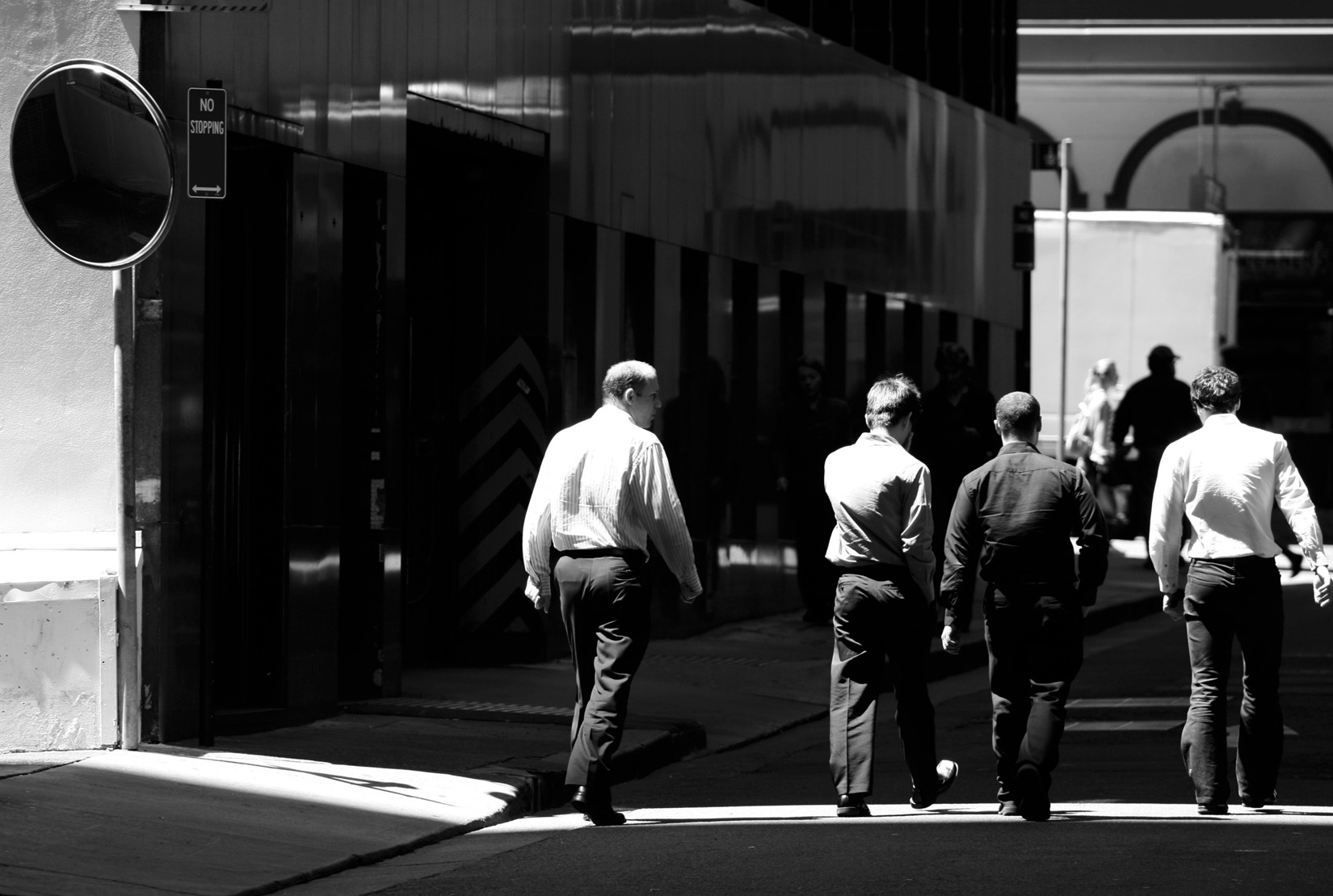
« Newer Posts - Older Posts »