Feeds:
Posts
Comments

Archive for the ‘Literature’ Category

The following is the 2nd chapter of the first novel I wrote entitled Fools’ Gumboot and later, No Job Too Strange. I began writing it at the age of 21 when living in Calder Rd Darlington. The first draft took me from 1994 to 1996 and came out at a total of 260,000 words. It was monstrously incompetent and came to constitute a perfect lesson in exactly how not to write a novel. “Is he really on as much dope as you say he’s on?” Well, yes I was. The original premise in part rested on the, er, inspired idea of a “drug lord” as a sort of superhero in another plane of existence, where, powered by their respective substances, like elemental forces, they did their deeds for good or evil.  It soon morphed into a story about a private detective called Roland Columbus who found a means by which to travel to an alternative universe where the characters who populated our literature were made whole in one gigantic, ungodly mess. This other plane of existence lay across an expanse called “The Blue”, which was, of course, the very same “blue” that things come out of – unexpectedly. At its conception, the novel was titled Fools’ Gumboot. I shan’t elaborate.

The story was hopelessly bloated, badly written and hugely self-indulgent. So tangentially wayward was the plot that even I had trouble following it at times. Still, in its ultimately clumsy way, it held to an internal logic and made some degree of sense. The second half was far superior to the first, because it was written in a more consistent flurry of writing which took place between December 1995 and August 1996. I had quit smoking cones and was living in a sunlit, one-room flat, high up above Bronte beach with an incredible view of the coast from my balcony. Swimming every day in summer and, motivated by working seven days a week to save money for an overseas trip to make the most of my spare time, for the first time in my life I began to write in a determined and organised manner.

I finished the draft just before I left for Europe on August 19, 1996, and left it until I returned. It was thus in 1998 and 1999 that the second draft was completed, whilst I was living in a one-bedroom flat in Glebe and back at university doing honours in Australian Literature and Medieval History. The second draft was practically a second novel – I dismissed the bulk of the first draft and kept only selected elements as a story within another story. This reorganisation relocated the story to a fictional town in Queensland called Clayton, where the author of Fools’ Gumboot, Dirk, is taking a holiday and has his manuscript stolen. In his subsequent encounter with the police, and via the medium of the stoner thieves who end up reading his manuscript, the more promising and coherent elements of Fools’ Gumboot were revealed. The goings on in the town of Clayton became, in fact, the true narrative framework for the story. The novel also received a new title: No Job too Strange, and it was at this stage of the process, in 1998, that the below chapter was written. It’s not exactly all that great, especially in its rather tired colloquialisms, so I present it here more in the spirit of putting it on the record.


The Too-hard Basket

“Jeez it’s hot today, Trev,” said Bill.

“Sure is,” said Trev.

And it really was hot that Tuesday. Now, at midday, the sun reached its cruel zenith. Bill adjusted his corpulent body in the sagging brown swivel chair.  His red face glistened with perspiration, gathered in the gullies of his exhausted frowns. It ran down his temples and dripped from his nose and brows; dropping away into hot space.

“Sure is, Bill,” said Trev. “It’s a real hot day. Lucky we haven’t gotta go out, ‘cos I don’t know if I’d be up to even walkin’ down to the corner.”

“Too right.”

Trev plucked up the courage to reach for a cigarette. His arm hung across the air and flopped onto the fake-wood veneer desk where it inched towards the smokes. He took one out and lit it with genuine effort from a disposable lighter. He sank back into his reclining brown leather chair. The smoke curled off into the unpleasant air, writhing in the agony of the heat.

“I’m bushed already mate, I’m really bushed.” The deep whine of his voice trailed off. He grunted, clearing his throat. “But we got a job to do Bill, we’ve got this case to think about.”

Bill shrugged with sincerity. “Sure do mate. I’ve bin thinkin’ about it all morning and I haven’t got anywhere. Let’s go over the facts again.”

“Alright mate.”

They both paused a while. They were not men accustomed to pouncing.

“Now, let’s see,” said Bill. “It happened in Doug’s cafe, two days ago. A guy walks in who Doug claims was a short, swarthy lookin’ bloke, with dark hair. He could see a bit poppin’ out the bottom of his balawhatsicallit. This swarthy bloke was wearing a blue denim jacket and black jeans, and he had a ring on his right hand with Adolph Hitler on it and the bloke had somethin’ tattooed on his knuckles. There were some letters, though he didn’t see what they were.”

“Not the epistles to the apostles I don’t reckon,” threw in Trev.

“Aye? What’s that, Trev?”

“Nothin’, mate,” said Trev.

“I’ll take ya word for it. Anyhow, this bloke pulls out a gun and says, ‘look ‘ere pal, turn it over, the loot I mean,’ and a’ course Doug’s no slouch when anybody orders anything. You know how quick he can whip up a mixed grill. I mean, sure, this time he doesn’t exactly want to pull out all stops, but he gets on with the show and the guy chucks him like an airport bag.”

“Did Doug see the airline or anything like that?”

“Nah.” Bill paused to catch his breath and his eyes widened in obese appreciation. “But that’s real thinkin’ that is, see if he’s like a registered jetsetter. He only said it was ‘like’ an airport bag, so’s it might a’ been something else altogether, only like an airport bag.”

“Ah, heck.”

“Yeah, we mighta been onto somethin’ with real evidence like that.” Bill reached down and undid one of the buttons on his dark brown shirt. The moist hairs on his chest popped out in a grizzled plume. Trev sucked back on his dismal, hot cigarette.

“Anyway, mate. Two’s a crowd, the bloke says, and next thing you know e’s off with the lot, and poor old Doug’s wondering what’s ‘appened to his morning’s takings.”

“Far out, Brussel sprout.”

Trev shifted his bulk and ran his spare hand through his tropical hair.

“So what can we do with that?” he asked.

Bill stared long and hard at the ceiling. The orange and yellow lampshade dangled flypaper over his head. A large blowfly that had become attached seemed to give up the fight and stare back down at Bill. The brilliant green of the eyes held the lure of sighing bottles, of longaway refreshment, hunted into misery by the savage, unforgiving heat. Trev’s gaze wandered into the axis of his companion’s hypnosis.

Bill soon broke the spell.

“It’s a tough one Trev, a real tough one.”

“Phew, you can say that again. Where on earth do you start with a thing like this?”

“You write it all down mate, you write it all down. Then you sit and think about it, and you talk to people.”

“Well, yeah, that’s what a case is all about. But this time around. I mean, this case, Bill. What can we do?”

“Let’s think. We spoke to Doug, right. Hang on.”

He reached forward with immense effort. His body heaved and droplets plunged from his fringe. On top of the desk was a two-tiered wire tray, an in-tray and, well, another one altogether. Reaching into the top tray, he levered his fingers under the single manila folder that lay there, removing it to his lap with a deep exhalation.

“Here we are.” He opened it up and pulled out a sheet of paper. “Here’s what Doug said. Blah, blah, blah, bloke comes into the shop. Yep, blah blah, give us ya money, yep, and then he goes on, two’s a crowd, and whooshka ‘e was off.”

“What else we got in there, Bill?”

“Well, that’s all we got, mate. Shivers, I been thinkin’ about it for days, but I just don’t see how we can get the bloke. E’s probably left town by now, for sure. Gone up the coast, you know.”

“Yeah, I reckon you’re right. If I remember rightly, Doug said he asked a few people, but nobody saw anyone with a balaclavala or Mr Hitler, or any black jeans or anything. It was lunch time and there was just nothin’ happening. If he’d walked in and there was plenty of people we might have had something to go on, but what can we do?”

Bill took a deep, serious breath. He raised an eyebrow in resignation and puffed his cheeks like a bullfrog. His brow knitted and his eyes roved from his right hand to his left. He looked closely at Trev, sunk deep in the hot trance of his chair.

“I guess this one’s for the too hard basket, mate,” Bill said, and plopped the file into the full tray beneath the in-tray, on the top of the brown desk.

Read Full Post »

I scabbed a smoke off a Japanese traveller at Charles de Gaulle airport. Lise was standing on the other side of the glass, but I had to wait for my luggage. She looked ecstatic and a little slimmer and seeing her, I felt rested after the flight from Sydney. We motioned and blew kisses through the glass and I sucked my cigarette with the force of an old habit regained after three weeks of parties. Back in Europe, en route to England, I felt like a conquering hero.

After many kisses the first thing I did was have Lise take my photo. Selecting a point in the bright concrete ring that provides, with such airy modernity, access to the gates, I wanted to look like Bono on the cover of All that you can’t leave behind. In the fever of travel and a tad self-conscious, I lingered just long enough for one take; the backdrop, uncannily, in near perfect alignment. The photo done, we moved to the transport and waited in glee for the bus.

I was on the final leg of an extraordinary four months of travel. In August I’d flown to Berlin, then hitched a ride many miles south into France to meet Lise in Strasbourg. From there we’d ventured around Alsace and into Switzerland, crossing into Germany via Freiberg and spending my birthday in Baden Baden. I finally returned to Cambridge via several drunken nights with old friends in Paris. In November I attended a medieval history conference in The Netherlands, then, the morning after returning, flew to Vienna and took a train to meet Lise and her parents in Budapest for a Nato conference. At the end of the month I flew to Northern Italy to see an exhibition of Lombard artefacts in Brescia and travelled on through Verona to Venice. In December, Lise and I flew to New York and then on to Toronto to spend Christmas with her family, returning to a Cambridge covered in snow. We made straight for London and spent a crazy new years high on piles of coke and champagne at Circus Bar in Soho and later at a party at Rolf Harris’ old house. A couple of days after that, I flew out to Australia for three weeks, whilst Lise moved into a friend’s apartment in Paris where she planned to conduct further research. Life had been unbelievably kind to me; to the both of us, in fact.

Lise’s Parisian flat was on Rue des Quatre Vents in the 6th arrondissement. It was a beautiful apartment, not far from the Odeon and within easy walking distance of Notre Dame or the Luxembourg Gardens. It was small, but very tasteful, with polished floorboards and simple, comfortable furniture. It had an aspect of the old and new. It was very quiet, being set back from the road, down a passage protected by old, dark green, wooden doors.

I was exhausted, but far too tired to go straight to sleep. And anyway, it had been a while since we’d seen each other, so the loft bed, up the ladder, was initially put to more energetic use. We hit the streets of Paris and wandered about. I smoked cigarettes and felt strung out, drank coffee and dreamed of being drunk. Paris can make anyone feel cool, unless you’re prone to status anxiety and feel oppressed by how effortlessly cool everyone else is. I was so full of confidence, fun and bravado at the time that I felt especially cool, even more so than the Parisians. Perhaps I genuinely was at that time; it was a rare window in life in which to feel magnificent.

That night we went out for an assiette grec, which was decidedly Turkish. We returned to drink a bottle of wine, and after that I was spent. There was no chance for me to stay awake any longer, and anyway, I’d already made it into the evening; a first step on resetting the circadian clock from the southern hemisphere. We climbed up the loft ladder and, mid conversation, I fell into a deep sleep.

At four o’clock in the morning, I was suddenly very wide, bruisingly awake. I felt a momentary disorientation and initially wondered where I was. Sydney, Cambridge? Ah, Paris. Beside me Lise slept and I had no wish to wake her, so I tried to remain still as possible. I lay in the loft staring at the close ceiling. I smiled, feeling the residual warmth of my close friends who had gone the distance in those last, frantic days. We had squeezed every drop for a final hoorah and, now, feeling fully rested, my emotions were at liberty to indulge in nostalgia.

Perhaps it was the inevitable comedown from the ecstasy I’d taken two nights before, or perhaps it was just the terminal distance, but, very suddenly I felt enormously sad and before I quite knew what was happening I began to cry. A yawning chasm had opened in my heart.

Only now did it dawn on me just how far away I was from Australia. For a year and a quarter I’d been living in England and at times my heart had burned. I had missed my friends and family and I had missed the climate, but most of all I had missed the history I had with people. I was fortunate to have established very deep friendships at Cambridge with people I knew would be my friends for life, yet in Sydney my relationships had an antiquity that lent itself so naturally to nostalgia, and I have always been cripplingly nostalgic.

Lying there in the loft, I realised how long it would be before I was back in Sydney again. A year, perhaps even two years, I couldn’t be sure. Oddly enough, it wasn’t that I didn’t want to be here. I loved Europe, was obsessed with it. The experience of going to Cambridge was the highpoint of my life. The year 2000 was the happiest of my life, and I knew it then and there. And this happiest year had occurred up here, in the northern hemisphere, in England, in Europe. I wanted to be here in Europe and had even begun to wonder if I shouldn’t stay here forever; albeit in the UK. The only problem was, I wanted to be in Australia as well.

I plunged wholly into sadness and reflection. The glint of the ocean, the broad camaraderie, the hugs and the handshakes, the dinners and drinks; cigarettes borrowed while shouting my tales. I confess that life had been working to tickle my ego. I was the centre of attention, I had all the yarns to spin, I had gone away and become somehow exotic. Sydney had been even more fun than I remembered because I was there this time as a tourist, and everyone came out of the woodwork. I revelled in my time and, high on pills, drunk on wine, smoked up to the clouds, I rolled through it all with a robust good humour. And then, I had to leave.

I also remembered the kisses to which I had almost succumbed. An old friend, with the unfortunate name of Beryl, a person I’d kissed before, loomed back into my life from a long obscurity. I watched those lips swell luscious before me, and in the throes of some rare, first-rate ecstasy, we sat close the luxurious staff lounges in an office behind the Martin Place clock-tower, full of desire. It was all born of a longing for everything. I had become so accustomed to things going my way that I could resist nothing, not even things my timidity might once have forsaken. With other friends gathered round, high as kites, we drank all the office beer and shot pool. At 0600 AM, I phoned the city council and spent ten minutes politely complaining to the nice man on the other end that the clock was two minutes slow, and could they please fix it.

In Tokyo, sleeping between flights in an airport hotel, I wrote a letter to Beryl on the hotel paper. At last I found a use for the Emperor’s yen that my old friend Marcus had given me five years before, and which had ridden my hip for so long. The note I posted was slightly dark with the oddness of flying; the introspection, the philosophy and the urgency of travel. I told her how strange it was that I was thinking of where I was leaving and not where I was going. That I should be looking forwards, not backwards, that I felt half in love, but wasn’t sure what the other half was up to. There was no question that I was in love with Lise, so what had I fallen for in Sydney? It was, in truth, the whole package; the city and its lights, the living postcard, the friends and stories, the emotional history, the scents, the water, all gleaming in the midst of a northern winter. Beryl had, rather unexpectedly, come to symbolise it all. She was the muse of Sydney just now, and so my heart went out to her as I felt the desperate loss in leaving.

I soon erupted in weeping. Another year at least would have to pass before I saw those faces again. A whole other year of waiting and missing things. I had already missed two weddings and the birth of my best friend’s daughter. It was as though people had waited for me to leave before taking these important steps. I lay there still, under that close ceiling, and the tears kept coming.

Soon, Lise was awake.

“What is it, Snail, what’s the matter?”

“I don’t know, it just hit me. I feel so far away.”

There was little she could do, though I wanted her there. She held me and I held her. There was nothing else for it but to seek comfort. Truly, I was very happy to be here, which made my sadness seem so oddly out of place; yet it was the consequence of coming out of such a deep immersion. My synapses hadn’t reconnected with Europe. Home had shifted back south in my head and I was severely disoriented.

I sat up as best as I could. I was wide awake and I felt awfully restless. What should I do? It was January in Paris and still dark. The dawn would not come until near eight o’clock. I needed to sit alone for a while; to compose myself with some sobering cold. Not even the central heating could keep the chill from the tiles. I hugged Lise and kissed her.

“I’m OK,” I said. “I’m just sad to leave my family and friends. I’m glad you’re here.”

I climbed down the ladder to go to the lounge. Little did I know that what I was about to do would have such far-reaching consequences.

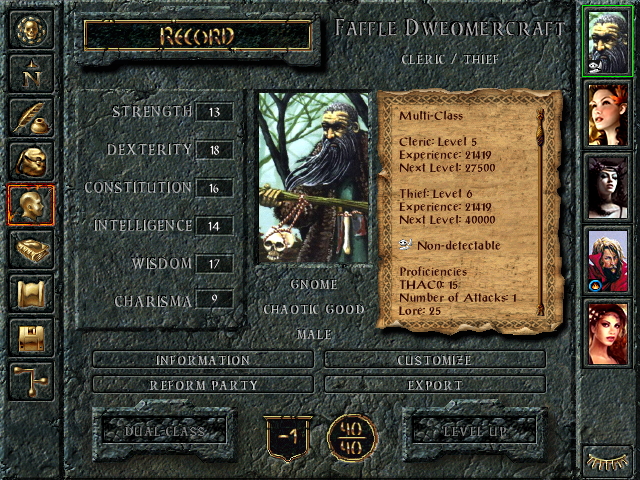
There, sitting on the table, was Lise’s new laptop. I had gone with her to buy it in Toronto and it was, for the year 2001, a state of the art machine. Whilst in Sydney, my brother had flown down to visit, and during his stay he brought with him a computer game he wished to give me. It was called Baldur’s Gate; an epic-length role-playing game based on the 2nd Edition Dungeons & Dragons rules. My brother and I had grown up doing little else but gaming. Strategic board games, role-playing games, tabletop miniatures, naval warfare simulations, you name it. Between us we owned something like 31 different role-playing rules systems and I had even written my own role-playing system, consisting of more than 100 pages of rules, at the age of eleven. My brother owned around 30 Avalon Hill military strategy games; complex and involved board games and now much coveted in the first edition. Yet pride amongst all of these games was taken by Dungeons & Dragons. We had once locked ourselves in my room out of protest for being made to stop playing and go down to dinner. My father thought there was something dangerous in our obsession, whereas he should rather have marvelled at the exponential expansion of our vocabularies in learning these sophisticated rules systems.

Despite not playing the game for many years, I had never lost my love for D & D. The last sessions had been conducted between 1994 and ’95, when I was still an undergraduate and living in Darlington in Sydney. My old friend Cody created an excellent campaign; political intrigues in a small regional capital, replete with wear-rats in the sewers. I was a feisty 17 year-old female ranger by the name of Trissa Slondar, ably assisted by my friends Ventris and Faldor, aka, Mike and Malakai, and a very peculiar NPC wizard who chose to join us here and there. It was always fun. Has there even been a better reason to roll dice?

I reached into my bag and pulled out the discs of Baldur’s Gate. Computer games were still relatively primitive at the turn of the century, yet they had come a very long way from the text-based, 2D graphics and simple engines I had begun with. Baldur’s Gate was a multiple award-winning piece of work, both for its narrative qualities, its neat and functional engine and interface, and its incredibly epic scope. Not only did it boast up to 200 hours of playing time, but it was, within the bounds of commonsense, very replayable on account of the wide variety of characters on offer as potential henchmen.

My brother had raved to me about the game in Sydney, and I had been impressed immediately.

“Bro, it’s totally Dungeons and Dragons rules. It even simulates dice-rolls. It’s a TSR product. It’s the real deal.”

The strength of my nostalgia for the game cannot be taken for granted. It had been the great comfort of my childhood. I had stared every day into those lengthy rule books, reading descriptions of magic spells, ancient items, the lore and legends of different races and professions. The illustrations, the fantastic settings, the at times disturbingly adult nature of the content had awed me. Being thrust daily into dangerous situations, striving either for loot in an ancient temple or some desperate rescue; pitted against an incredible array of foes in deserts, jungles, snowy mountains, in quaint and corrupt medieval fantasy towns, was a rare privilege. To play through a quest could take several days and each had its own narrative, its own settings, its own heroes and villains. Solving all manner of problems, making moral, tactical and strategic choices, conducting interrogations, investigations; the variety and versatility of the role-play seemed boundless. Of course, it was often just good hack and slash dungeon-crawling, but this too had its merits as old-fashioned fun.

“Hey, Lise,” I said, walking back into the bedroom, before she had a chance to fall back to sleep. “Can I install this game on your computer? I’ll delete it later. I just need something to do.”

“Of course, Snail. Go for it.”

“Thanks a million.”

I ran up the ladder and kissed her sleepy face. Already I felt considerably better. Wasn’t I really happier in Europe anyway? Hadn’t the last year been the best of my life? For someone obsessed with history, there was simply nothing for me in Australia. It was an empty land, full of fat, rich, vapid people growing more conservative by the minute. Did I really want to be there when I could be here in Europe – in Paris, for god’s sake! There was more culture in Paris alone than in the whole of Australia. What had I been thinking? I smiled, trying to shut out my sense of loss by rationalising my good fortune in being where I was. It was working.

I slipped in the first of the six discs and began the installation of the game. I rubbed my hands together in the light of the lamp. I closed the door and put on the kettle, making a cup of tea. I could see nothing outside the frosted window, except a few muted stars. The cars were sparse enough that each had an individual tone. I checked the time. It was only 0430. The world was going to leave me alone for a good while yet. It was exactly how I wanted it.

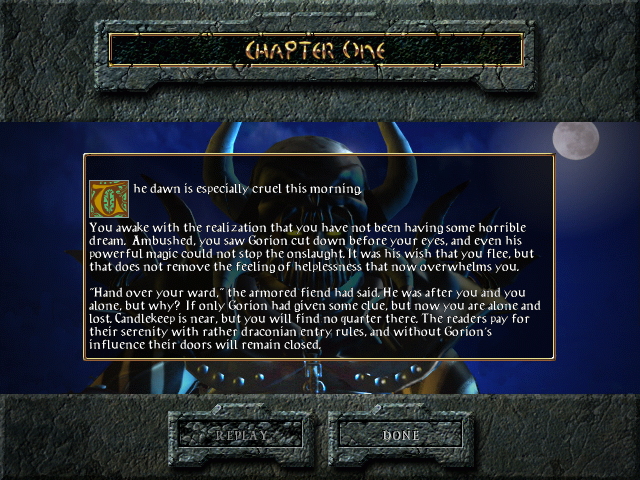
I put in my headphones and started the game. The title music was slow but insistent, bombastic and dramatic. I watched the opening animation of a man in armour being thrown from the top of a tall tower by some great brute with an evil voice. This brute must, ultimately, be my nemesis. The body struck the ground and the blood flowed between the cobbles, finding its way to the title, written on the medieval pavement. BALDURS GATE. I was excited to say the least, but far more so when I entered the character creation screen. Just as my brother had so enthusiastically assured me, in every way the game seemed true to the rules of Dungeons & Dragons. My troubles were behind me now as I basked in the rich colours of the interface.

When, some three hours later, Lise finally arose and joined me in the lounge room, I was in another state of being altogether. I had rediscovered a happy place to which I thought I could never return. Baldur’s Gate was simply marvellous, it was enthralling, it was like cocaine. It was the computer game for which I had been crying out for many years, it was that good it was better than sex. I didn’t want to stop playing. I couldn’t bring myself to stop playing. I had to request special indulgence from Lise to let me go through until lunchtime. Everything about it tickled my nerdy fancy and my deep nostalgia for the game. The character classes, the potions, the magical items, the simulated dice-rolls, the sense of adventure, the mission, the quest. Sure, it could hardly replicate the freedom of movement within the pen and paper game, especially when it came to dialogue, but everything else was absolutely spot on. When, from a scroll I’d found, I cast my first Stinking Cloud spell for perhaps 12 years, I nearly wept afresh.

Such was my enthusiasm, that I managed to enlist some from Lise. She found the game cute at first, with its entertaining voices, its artwork and themes. In the days ahead, however, when I continued to wake up at four in the morning, and could not be easily pried away from the computer, my obsession with it became a burden to her.

And this obsession did not diminish upon my return to Cambridge. I continued to play the game, completing it, then restarting it and running it through again, and just when I had finally walked away from it, Baldur’s Gate 2 was released with its far greater complexity, detailed character work, lengthy dialogues and more engaging and coherent story. If Baldur’s Gate was cocaine, then the much lauded and still highly regarded Baldur’s Gate 2, was heroin.

There came a time, further down the track, when things between Lise and I became more strained. We were used to spending a lot of time apart, and when she moved back to Cambridge, we didn’t adapt so well to being together all the time. One day she turned to me, teary-eyed, after I had frustrated her once more with my apathy, and said. “It’s all gone wrong.” It was a dark joke we had often made to each other, that there would come a time when it would “all go wrong.” Then, as if to clarify, with, I’m afraid to say, deadly accuracy, she said, “It all went wrong with Baldur’s Gate.”

Though I don’t regret the beauty of those mornings in Paris, the truth is, it did all go wrong with Baldur’s Gate. And later, with others who were yet to come, it went wrong with many other games as well.

ps. Have you ever seen anything so universally well-reviewed in  your life?

http://www.metacritic.com/game/pc/baldurs-gate-ii-shadows-of-amn/critic-reviews

Read Full Post »

Life is Cheap

This is a very short story, more of an anecdote, which I wrote back in 2005. The events took place in 1997.


Life is Cheap


“Life is cheap over there, son.”

It was my father who spoke, on the eve of his departure for Sarajevo. He had been drinking scotch and was pacing up and down his bedroom, throwing things into a suitcase.

“I’m a bit nervous this time. It’s a long time since I’ve been to a place like this. When I went to Beirut and Afghanistan, I couldn’t wait to get in.”

He stood still and shook his head.

“Mate, there’s people over there who’ll rub you out for nothing.”

His nerves were palpable, but then my father had always been overrun with excess energy. How often had my mother told him to stop tapping his knees up and down under the table?

“You’ve been to worse places,” I offered. “You’ll be alright.”

“Yeah, your dad’s an old pro. I know how to look after myself.”

He took a shirt off the hanger and lay it flat on the bed.

“But you know, mate. In some places, there’s nothing you can do. Life is cheap.”

He was on his way to spend a month in the former Yugoslavia to conduct research for a novel he was writing on a fictional war criminal. I too felt nervous because I knew him well enough to know that he would try to get himself into every dodgy situation available in order to get closer to the real story, wherever it happened to lie.

It was, therefore, with not inconsiderable relief that my mother, brother and I greeted his safe return to Sydney. I was living in Glebe at the time and met my father for dinner at our favourite Thai restaurant in Surry Hills, two nights after his return.

He told me of the frustrations he had encountered in trying to get into Serbia, a move eventually blocked by impenetrable bureaucracy. He told me of being flown from one place to the next by the Luftwaffe, of riding on tractors with peasants and of the heavy, rich, Balkan cuisine he had consumed with such guilty passion, washed down with harsh grappa.

“It’s corrupt as buggery,” he said. “The black market is vast and you can get pretty well anything – guns, grenades, drugs – whatever you want.”

“Didn’t some guy try to sell you a tank once in Beirut?”

“Yeah, an old T-34.”

“Any tanks for sale?”

“No, mate,” he laughed. “But everyone kept telling me to change my deutschmark on the black market, so I did, and fuck me, I got burned.”

“How did that happen?”

“It was in Sarajevo – just a kid on the street, in one of the main squares. This kid must have used the most incredible sleight of hand, because I had my eyes on him like a hawk.”

He took a gulp of his wine, the held his hand in my face.

“He held up a roll, like this, right in front of my face, and counted off the notes before my eyes. I saw every note, mate, and they were all good. Somehow, by some miracle of magician’s dexterity, when I handed him the hundred marks and he handed the roll over, he managed to substitute it for a different roll.”

“What was in it?”

“There was one good note on the top, and the rest was paper.”

“What a pisser.”

“By the time I found out, the kid was long gone. I can’t tell you how angry I was. The little rat, I thought – nobody double crosses Phil Cornford. I went straight back to my hotel room and got a good heavy, woolen sock. Then I walked back to the square, and on the way I got half a brick and put it in the sock. I was determined to break both of his fucking legs if I found him again.”

“Bullshit.” I said, though it was as much a question as an expression of disbelief.

“No mate, I was livid. It didn’t matter that it was only a hundred marks – it was the principle. I hung around that square all afternoon, and I went back again the next day to try to find him. I swear to god I was determined to break both his legs if I found him.”

“But you didn’t find him.”

“No, I didn’t. And then I calmed down a bit and I had to leave Sarajevo. I was amazed at myself, and I still don’t know why it made me so angry. It might have been the tension I felt the whole time I was there. I guess I felt scared – maybe I’m getting less reckless as I get older, I value my life more and I don’t want to die. Twenty years ago, I wouldn’t have even noticed if I was afraid.”

The words ‘less reckless’ hung across the table, and I wondered whether he’d noticed the contradiction.

“Mate,” he said, “there’s blokes over there who’ll do you over for nothing.”

Yeah, I thought, picturing him hanging around in the middle of Sarajevo with half a brick in a sock, waiting to break some kid’s legs. Life sure is cheap over there.

Read Full Post »

The following is another chapter from volume 1 of my autobiography entitled Sex With a Sunburnt Penis. Written on the crest of a wave of binge-drinking, it was a process of autobiography as therapy conducted between July and November of 1997. The title, Sex With a Sunburnt Penis (hereafter SWASP) is a metaphor highlighting the consequences of mounting pleasure upon pleasure. It posited that, in a country as wealthy as Australia, those born without any significant disadvantage are so well placed in life that it is really up to them to screw it up. I did so, royally, on many occasions, but regret is a wasted, pointless, indulgent emotion unless it fuels change and action. We must get back up on the bicycle so to speak, or otherwise, seek Rough Solace, a character who appears in the story as a personification of the frank good advice we can give ourselves if any wisdom dwells within. SWASP was initially intended as a one-off, but a couple of years after having written it, I envisaged a trilogy to complete the picture. Volume 2, still in the pipeline and sketched to some degree, bears the working title Loitering with Scholastic Intent. My good friend Chris recommended the title A Blow Job too Far for volume 3, though, whilst it sounds magnificent, I’m not entirely sure it will turn out to be appropriate.

The following passage, entitled Entropy, contains in its entirety my first attempt at writing a short film script. It is hopelessly inept, incongruous and contradictory, but we were very happy with it at the time and that’s good enough for me.  Too many cones indeed, and apologies for the formatting. WordPress does not seem to accommodate pre-formatted screenplays when cutting and pasting, unless I am missing something. Enjoy it, ja!

Entropy

I met Tyrone Books early in 1992 at my friend Mike’s place. As Tyrone had a certain suave, philosophical nonchalance about him and a much-coveted girlfriend, it was my plan to appear formidably impressive during our initial encounter. He found me with a bong in one hand, a glass of wine in the other and about three litres of cardboard Claret already in my stomach. When, after a good hour’s conversation about the influence of jazz and classical on certain Scandinavian metal bands, I looked down to find my No-Names bolognaise floating in a sea of wine on Mike’s polished-cork kitchen floor, I thought I had blown it. It so happened, however, that this was a defining moment of a different kind. For, as he was to confess many years later, what impressed Tyrone most of all was my insistence on continuing the conversation between apologies, cleaning, and further evacuations into the kitchen sink.

While the Barcelona Olympics were on, my old friend Gustav and I were given the opportunity to house-sit in a bungalow in Newtown. It seemed short-sighted to waste the opportunity of living in such a marvellous house by going to lectures, so instead I spent every last penny on weed, speed and acid and holed up for the games. During the second week of events I invited Books to visit one evening. We smoked hashish on hot knives, fashioned a bong out of a pen and shampoo bottle, then hosed the back yard and sat listening to it drip for a good hour.

“Gustav and I listen to the garden every night,” I explained. “The sound of the dripping is hypnotic, I highly recommend that you get right into it.”

“It’s pretty good, man,” said Books. I could tell that he was impressed.

Our conversation stretched well into the wee hours and Books finally departed as I began my shift at the Olympics. The following night he got in touch and came around for more of the same. By the end of the week we were best friends.

Books, who had just moved into Arundel Street in Glebe, soon found himself in the difficult situation of having to find new housemates. Within three weeks of moving into the house, through no fault of his own, all the other tenants moved out. He was fortunate in finding three replacements with extraordinary speed, one of whom was an enthusiastic wannabe film maker and communications student by the name of Saul Godly. Keen to get away from home and hang out with my new friend, I began to use Books’ house as an outpost at which to base myself after a long day dodging lectures. Soon Tyrone, Saul and I were as thick as thieves, and it was only natural that such a blessed triumvirate should be granted ambitious revelations.

One evening the three of us dropped acid and walked from Paddington to Glebe on an all-night epic. During that journey we declaimed, with great affectation, our dreams and visions for the future.

“I’m going to make it rich as a psychologist,” said Books, “then spend my money making movies. I’m going to be a director and an inventor, but most of all, I’m going to be a scientist and computer expert like Avon in Blake’s 7, or Davros in the Genesis of the Daleks.”

“I’m going to make films too,” said Saul. “But I don’t just want to be behind the camera, I want to be in front of it as well. Plus, I’m gonna write the damned things. I’m going to be an artiste, an auteur, an actor!”

“And I’m going to be a writer!” I shouted, beating my fist into the copy of Clive Barker’s Weaveworld, which I happened to be carrying. “I’m gunna write novels like a demon – novels, films, plays, short stories, poems – the lot. I’m going to be a writer!”

After some lines of speed at Arundel street, we spent the morning photographing each other in front of the railway viaduct at Glebe Point. It was a day to remember, and we wanted to preserve that glow of determined youth for eternity. Saul and I went further and made a pact. Within a year we were to produce a major work. He would write a film script, and I would write a book – either a novel or collection of short stories. At last I felt I had found a definite direction in which to steer myself.

Four months later, I hadn’t written a thing. I had, at least, begun to teach myself to touch type, but in a world without e-mail or the internet, and too lazy even to write my essays, let alone type them, it was difficult to motivate myself to stay in front of a keyboard. University was sliding away from me again. My absenteeism in first semester had ruled out any chance of passing in Fine Arts and Linguistics and now, having moved deep into second semester, I faced the prospect of failing the lot. Hanging thus by a thread, I could not justify such slackness unless I began to produce extra-curricular results. If I was going to be a writer, I had better start soon.

It was, therefore, without a moment’s hesitation that I accepted my first commission. As Saul was nearing the end of his first year, the deadline for his short film project was approaching. He had already signed Books up to the task but they had, as yet, failed to come up with any script ideas. So it was that Saul asked me, “the writer”, if I would be willing to help him out.

“For fucking sure, Saul,” I said. “That’d be untold!”

This was it. This was the chance. We were going to make a film!

It was a great excuse to get drunk and stoned, take some speed and drop a trip, and we did so by way of a script moot. The following morning found us drawing and painting on the walls of Tyrone’s bedroom and it was when I asked Tyrone what he was going to say to his landlord that the story finally took shape. It would be about an artist, played by Saul, painting his walls in praise of the sun and not caring for the concerns of the Proprietor, whom he considered an obstacle to art. The painter would live with a writer, (myself) and both of these characters would be plagued by the naggings of Books, the Joker.

“The story is about the tension between chaos, anarchy, vandalism,” said Books, “and order, society and structure. The proprietor is Society incarnate and his interest is to keep the walls white, for this is tradition. The proprietor wants to maintain conservative values, while the painter and writer want to express their subversive ideas in their pictures and writing. It’s about the problem of being forced to be a part of the society into which you are born.”

“Like wanting to be a hermit,” said Saul, “but needing to work to live.”

“Exactly,” said Books, “or sort of, at least. Now, the position we wish to support in the play is that the expression of individuality and the freedom of that expression is good and should not be hindered by conservatism, but that one needs to respect society and its component structures.”

“Okay,” I said, impressed by the perspicacity of Books’ reasoning. “So what is the Joker’s role?”

“Ah,” said Books, “the Joker symbolises anarchy – he is diametrically opposed to the proprietor, yet he cannot escape from the room – society – and he has no power over him. Why? Because he is not real but ethereal; not a person, but a concept – an energy, something which can be activated and used, as both the Writer and Painter do in their art. In the end the Painter uses the Joker’s energy to kill the Proprietor. The painter, you see, is the simple idealist – he is all passion, and refuses to be a sheep, helplessly passing his time in the grasslands away.”

“Nice quote.”

“I thought you’d like it. So the story ends with the death of the Proprietor and the walls painted – the Painter triumphant, but a murderer. The Joker is free, and so, in a sense is the Writer – yet the writer now wonders whether or not he will miss the Proprietor, with whom he occasionally liked to converse, being more able to walk the median strip of life. The final scene ought to take place in a field, outside of the room. For with the Proprietor dead, society is gone, and society was, after all, the room. In effect, this film is about the end of society.”

“Bravo.”

Over the next two weeks I struggled with pen and paper, having next to no knowledge of how to write a screenplay. My only experience on this front was a script written in my first year of high school as an English project called A hand for the Chopper, which was shot in exactly forty-three minutes one Thursday lunch break. My father had written film scripts and done a lot of writing for television, but rather than consulting him, I figured I could just wing it. I was sure of myself. I had talent, didn’t I? All my University friends and Newtown acquaintances thought of me as an ideas man, a creative conversationalist, someone with the gift of the gab. All I had to do was put a little of that into the project and we’d be right as rain.

Inspiration struck one Tuesday night with nothing much to do. I got stoned and went up to the Courthouse Hotel with an exercise book in which to begin my scribbling. I was soon on a roll. I poured schooners down my neck and stabbed away at the paper, hoping girls would notice me being so obviously bohemian. The few girls present ignored me completely, so I just kept writing and writing, unwilling to abandon hope. After about two hours, I put down my pen, smoked my twentieth cigarette and felt proud. I had written a masterpiece. This, I knew, would one day be remembered as the moment that Benjamin David Philip Cornford first thrust himself onto the scene as a writer.

FADE IN:

INT. TERRACE BEDROOM WITH BALCONY
Sun streams through open French doors onto a white stretch of wall. Standing, studying the wall is the PAINTER. A WRITER sits at his desk, writing with a pencil. PAINTER approaches wall and runs hands over it, scratches his chin, steps back, kneels, frames scene between joined hands.

PAINTER

I can see it all in my wall. Should my hands confess in paint the sights they wish to shape? Such bland boundaries, faded but never kissed by the light. Reduced by a sun intolerant of their lack of welcome. I must impress with colour that yellow god and look back so he knows I admire his daily ablutions.

We close to the WRITER, who leers up from his work. Music softly sounds his theme intuitive.

PAINTER

An eye. Am eye to watch the sun and not squint, but occasionally wink in friendly approval. What colours should I use?

PAINTER begins to sharpen his pencil with a knife and begins to draw on wall.

PAINTER
This is my wall, I’ll do as I will. As I must. For it is my wall.

Enter JOKER, grinning, from the doorway. WRITER watches him but says nothing as JOKER sneaks up from behind and takes the knife from the PAINTER. PAINTER backs away, disarmed, frightened, apprehensive.

JOKER
In praise of a fool you would commit this sin? For surely the sun is a fool. Your talent is a lie, your art a falsity. Dear painter, bathe yourself in guilty blood for the works you have made incite the punishment of the lawful. Does the sun care for your work? Is he not truly beautiful? Your work is a mockery of his golden pain, your guilt and your pain are as one with his, his sins are far greater. So burn in the heart you feel is true, end this childish game. Look painter, but not to the sun.

PAINTER
But, but you see (plaintive) I must paint. I must, I, I…

JOKER
So many I’s in so short a space makes for a rather egotistical young fool. The sun’s eyes bleed, he cannot see past his face. He grumbles that fools like you live and revel in his painful light.

JOKER approaches WRITER who instantly takes the knife from his hand and begins to clean his nails. The JOKER smiles at the WRITER’s wit.

JOKER
Aha!, you play well, writer, and yet do you write well? Is not the painter a fool, is not the painter going to pay for his indulgence? But you know of his kind, free with his art, licensed to vandalise and insult.

WRITER
Is his art a sin? Do you label and lay claim to his heart? What price do you place on his defence? If his belief is true, you won’t stay his hand. His work is good, it is no stain.

JOKER
And yet you write words by the thousand – his art is slow. His pictures tell a thousand words, but is this evidence of a quick mind or that of a simpleton challenged to form sentences in description of his own ridiculous plight!

WRITER
My work is long

JOKER
You work well, while he lays his foundations.

WRITER
Slash his wrist and he’ll paint till the blood runs free. I’d write his epitaph, but fill it full of praise.

JOKER
And I’d paint his headstone in praise of the sun. Cajole and provoke, but I wouldn’t take his life. See how he frustrates at his wall.

WRITER
He frustrates for he is like the sun trapped within his youthful form. His blazing light runs rivulets through his limbs, coursing through his torso, abdomen, head. Yet he cannot burn now to let it all out at once in a flash. Can one convict him of a sin when he has no choice?

JOKER
Yet in time his spirit will change. Better he realise now than when red-faced and fifty. He’ll live for twenty years and die for fifty more, die now or become now what no illusions can prevent him from being.

Cut to the PAINTER whose thoughts we hear as voice-over while he paints.

PAINTER
How will he know? How should he find my work? Soon I’ll be away and leave my work behind. Yet it will then be elsewhere. Cannot he see that it beautifies the room? Why does my very conscience nag me so? Why should I not do what is right to be done? I’ll paint, damn it. That eye will have sight and that fool’s attempt to subvert my goal – damn him, he won’t sway me.

JOKER moves back over to PAINTER and prods him with his finger.

JOKER
Ahh, I see it’s the sort of stain that spreads. And what will you do when he sees it? Shall you apologise, try to explain? The writer asks what price your defence. I’d place the price high for the work would be hard, and of course, unfulfilling, for how can you expect a pardon? Don’t you know you cannot win? Yet, I tire of this provocation.

PAINTER
Then obstruct me no more!

JOKER
Why should I indulge myself, your mind is so full of obstacles. Look at the writer, he pauses, thinks, his hand is smooth. Stop-start it is with that dirty brush – you have no style, no flow, you silly orang-utan. I see only one fully evolved individual in this room – he reads what is written and writes what is not.

PAINTER
Confound it! I cannot concentrate.

JOKER
You never concentrate, have you tried? You stare but your drive is anger – are your emotions so malformed? You’re worried and aware of the consequences of your desecration. Have some regard. Play not games with life, when your soul is unfit for competition!

PAINTER
But it bothers me not what is in the mind of the Proprietor. How painful can his punishment be? As painful as a life without freedom? Should he stand in my way I’ll sweep him aside as in a brush stroke and paint him with blood. Better than to burn slowly to death. Now leave me, I must work!

JOKER
I haven’t quite finished. Ignore me and I expect I’ll go away, but oh, you’ll listen now that slaying is on your mind. Do you think I don’t want the both of you dead? Your youthful fire extinguished, to hear the sun laugh to win in your game and to laugh at the sins on that fool’s wall?

PAINTER
Leave me!

JOKER
I shall.

JOKER steps back and stands by himself. We close in on the WRITER who sits and thinks.

WRITER
(Voice over)
I wonder how great his anger will be, how furious that landlord. Now the Painter’s veins run with anger. Is the need so great that no compromise is reached? Should not one live in cohesion with others. It is the painter’s will that the world will bend to his ways. He does not wish to rule, but to run free – push through every blockade – ignore all orders to halt or slow. It shall be his undoing. We shall soon see what the sun thinks.

The WRITER continues to write. The JOKER comes over to the WRITER’s table and picks up the knife. He crosses to the PAINTER and hands the knife to him.

JOKER
I believe you need this to sharpen your pencils, or perhaps your will. See if I care where you stick it!

PAINTER
I’ll stick you with it if you aren’t careful! Why this constant harassment? Can’t you see I want to be left alone? I’m too busy to have time for your trouble-making. Now leave me!

There is a knock at the door. Close up of PAINTER. The JOKER smiles as he opens the door to admit the PROPRIETOR.

I never made it any further. My hand was spent, my lungs were heavy, my eyes were reeling drunk. Yet, I was terrifically excited. Coming close to finishing anything was an achievement in itself. I took myself off home and passed out in a stupor. The next morning I gave the beer-stained, dog-eared script to Saul on my way to university, before lying on the grass of campus to rest my weary, hung-over mind. The shoot was to take place the following night in the colon of the University of Technology. I would need to gather my strength. Things were moving forward apace!

When I arrived at UTS the next evening, Tyrone and Saul were overrun with excitement.

“Cornford, this is classic,” said Tyrone.

“It’s a gem,” said Saul, “just what I was after.”

“It’s so incongruous,” continued Tyrone, “and there’s a lot of it we can’t even read, let alone fathom, but there are some great lines in here. We’ve decided to call it Entropy.”

Saul had enlisted the assistance of two stunning women whom I failed utterly to impress, but who did an admirable, if unsubtle job of making me look older and uglier. Since there was no time for rehearsals, the Painter and Joker had prepared a series of idiot boards, leaving frequent gaps where my handwriting proved impenetrable. I enlightened them where possible and we got stuck straight into the shoot. It was finished in about four hours, with only one or two takes for most scenes. The studio was hot and bright, the girls lounged about languidly. I could see they had no confidence in me – I was far too overexcited to appear at all cool. My make-up ran in the heat, and my powdered brow glistened in dabs and clumps.

When it was all over we felt triumphant. I returned home buzzing with a sense of achievement I’d not felt in years. At last my life seemed to have obtained some momentum. If only I could sustain it! I lay in bed, closed my eyes, and remembered the English essay I’d forgotten to write.

Saul and Tyrone took care of finishing and editing the film. The Proprietor, ably played by their other housemate, Jen-Ming, wound up with a knife in his back on the grass of Glebe Point and with him died society. A week later, Saul submitted his work and a screening of the class’s films soon followed.

On the night of the screening Tyrone and Saul sat on the steps in the tiny cinema to play guitar and bass for the soundtrack. I lay back in my chair like a lord, ready to sip away at glory, enjoying the other projects. When Entropy finally began to roll my heart was thrust into my throat. Here we were on the big screen – all ladies present please take note!

Unfortunately, despite the quality of Tyrone and Saul’s light, funky riffing, nothing could disguise the sheer incongruity of the script, nor the abundant continuity errors. The Joker’s coat was on and off like a strobe in a melange of leering close-ups, and the words that had made so much sense to me whilst drunk and stoned at the Courthouse now seemed confusing and contradictory. To begin with the audience had no idea what to make of it, but after a couple of minutes, they decided it was a comedy and laughed along with the more amusing facial expressions. Ours was one of the last films shown, and when it was over, another rolled straight on in. Entropy passed by like a ship in the night in a thick fog on the sullen expanse of a dark, moonless ocean, and with it went all hope of having anything to be proud of. Two weeks later I passed the point of no return and my second first year at university became an unmitigated failure. I was close to passing one subject, but when I turned up for my English exam, I discovered I had gotten the date wrong. I shrugged, turned away and went to get stoned again.

Nineteen ninety-two was a complete and utter flop.

Read Full Post »

This short story was a third and final chapter in the life of Oliver, a semi-autobiographical character whose misfortunes I greatly enjoyed charting in a variety of circumstances. Indecisive, snobbish and self-important, Oliver also has the more positive qualities of being intelligent and romantic, if in an all-too autistic fashion. The story needs to be fleshed out more and is more of a sketch than anything else. It is also dependent, to some degree, on being united with its predecessors. I have, however, other plans for the fate of this character, thus making this installment redundant.


The Benefits of a Broad Education

Oliver’s thoughts were on Wordsworth as he sat in the box office, for he had just finished reading Lyrical Ballads. The poems had left him with a feeling both beautiful and sad, and he was pleased in the late afternoon that business was quiet. It was a perfect prelude to the busy evening to come, when customers would arrive in droves to collect their tickets for the night’s performance.

At around seven two young couples, whom Oliver guessed to be just out of school, approached the counter. While taking an order from one of the girls, he could not help overhearing the loud and slightly inebriated conversation of the other three.

“So what’s Greg doing at university?” asked the other girl.

“He’s doing history,” said one of the young men.

“Like, why?” said the girl, with such astonishment that Oliver felt a stab in the breast.

“Hell knows,” said the young man. “He’s always been into that sort of stuff.”

“Yeah, but like why?” said the girl. “What’s the point of doing history? What’s he supposed to do with that?”

“I don’t know,” replied the young man. “It’s like Arts full stop, what’s that going to get you? It’s a total waste of time.”

Oliver kept his cool. He was sorely tempted to speak in defence of the arts, yet was tired now and did not feel sufficiently articulate. In fact he was sorely tempted to bash them all over the head and drag them off somewhere to be quietly gassed. So often in his life he had come across people with the same attitude and he had wanted to murder every single one of them. They were clearly beyond redemption as human beings, if indeed, they were human to begin with. His ire was rising and his neck was reddening, but he caught himself just in time. No, no, he cautioned internally, heart pumping fast, he was being unfair. They were ignorant and naïve, they had been brainwashed by materialism and acquisitiveness. It was re-education that they required, not extermination.

Following on from this caveat to himself, and in spite of the burning hostility in his breast, Oliver’s thoughts took on a more charitable aspect. He longed to tell them of the benefits, both to the individual and society, of a broad and specific education in the arts. Yet, as such words hovered, not so much on the tip of his tongue as at the back of his throat, it struck him that were he to mention having a PhD in history from the University of Cambridge, and add to that the observation that he found the study of history both fulfilling and worthwhile, they would have immediately pointed out to him that he was working in the box office of a theatre. Perhaps they had a point after all.

When the young customers had departed and the strange mix of rage and shame had settled down in him, Oliver was left soul searching. What was he doing with his life? What was his story? He wasn’t by any means useless; indeed, he regarded himself as rather versatile, having majored in Literature as well. But still, what was his story? What was he doing? If there was one thing the study of literature had taught him, it was that from start to finish a story must demonstrate a process of transformation in the main character; bringing them to a new understanding of themselves or their circumstances. There had to be a trajectory of sorts – the character arc – for surely that is the nature of a story; to start one place and finish somewhere else.

Yet what, Oliver asked himself, was his own character arc? He had been through many emotional ups and downs and seen significant changes to his circumstances, yet had he changed at all or was he more than ever himself? If the latter, could that be considered change? He had resigned himself to a fate of diminishing returns, yet was that progress or change of emphasis? He had to grab at things faster and faster, his relationships grew shorter and shorter and he had less time for making amends when things were not working. Yet was that change or acceleration?

Oliver had always been a man of phases and, in reflection, it seemed to him that for the last few years he had merely switched between old and understood phases with varying degrees of intensity; work, play, obsession, mission, lust and asexuality. His life was not an arc, but a dial. It was a turntable. Nothing really changed him, but the disc kept spinning. It wasn’t a lack of experience, but rather a consequence of having experience. Indeed, Oliver felt so saturated by experience that he did not see how anything could change him without being extremely traumatic.

What was to be done? What might shake him from his torpor?

Oliver sat at his desk, furiously tapping his leg up and down. He felt a great, energetic, vigorous disappointment. Soon, however, the stream of customers had him on his feet again; twirling, stretching, fetching their tickets from the bench upon which they were arranged. He smiled and exuded good cheer, yet behind the helpful eyes his displeasure was paramount.

How angry that girl’s comments had made him! If she and her friends lacked the foresight to see just what one might do with a mind geared for lateral thinking, for query and inquisition, then it was time someone got up and showed them.

***************

In Al Gore’s film An Inconvenient Truth he makes the point that ten to fifteen years from now there will be no more snows of Kilimanjaro. How is it possible that things could have come to such a pass? Will nature one day be merely a subject for nostalgia?

William Wordsworth had just an inkling of what we were doing. He knew the way things were going when he walked through the smog and stink of industrial London. He’d seen the hellish fires across France as well, seen the towers of smoke and plume. It was clear to him that industry had entered a phase of expansion and intensification that was liable to be ongoing and, if left unchecked, potentially devastating.

In itself, industry on a large scale was nothing new. The Romans had built factories too; huge industrial workshops for beating out thousands upon thousands of swords and shields; great mints for smelting metals and clinking out coins; foundries, tanners, whole hillsides of waterwheels for the mass production of flour. Yet, the scale of Roman industry was hampered by the comparatively primitive nature of their mining and exploration. Most don’t realise that the curious pocks hacked into the masonry of ancient buildings were caused by thieves seeking scrap; the lead-coated braces of iron that secured the stone blocks. Bronze is an alloy of copper and tin, and tin, though plentiful in China, was extremely rare in the west. By the sixth century, the classical world had run significantly short of metal.

In the eighteenth and nineteenth centuries, however, new sources of raw materials sprang up like mushrooms after imperial rain and Wordsworth found himself choking. He saw what monstrous tumours were growing in the hearts of the towns and called upon his contemporaries to return to the earth. He saw just how greatly the conditions and consequences of industry were degrading the human condition and he exhorted people to fill their lives with natural beauty.

His poems, therefore, as much as they were a genuinely heartfelt celebration of the wonders of nature, were a reaction against the industrial revolution. For many years his contemporaries laughed him off as childish and unrealistic; coy and “namby pamby”. His poetry was roundly dismissed as so much dreamy claptrap, just as, until very recently, the greens were so often dismissed as a bunch of unrealistic lunatics.

Yet, whilst Wordsworth rebelled against the destruction of the human soul and the turning of people into termites; while he recoiled from the blight of the towns and the smog and the slurry, unlike the green movement he could never have imagined that whole natural vistas could actually turn to deserts; that once snow-capped mountains, whose thaws fed vital rivers, might be snow-capped no more and the rivers vanish. Nature was surely too great, too powerful, to be affected this way. Could mankind truly create a wasteland? For Wordsworth the more obvious and immediate concern was the wasteland of the soul. We might have divorced ourselves from nature, but surely we could not destroy it altogether.

“Oh, Nature,” thought Oliver, channelling Wordsworth as he sat out the end of his shift staring at the cover of Lyrical Ballads with its watercolour of the Lakes District, “how often have our spirits turned from thee!”

_____________________________________________________________


It was to prove a fateful evening for Oliver. As they were about to close the doors of the box office, a tall, tanned, middle-aged man walked in, wishing to purchase tickets for a concert the following week. While Oliver took care of the transaction, the customer stood examining the large, colour photograph of the interior of the venue, displayed beside the counter.

“So, for a standing show,” asked the man, “all the seating comes out downstairs, is that correct?”

“Spot on,” said Oliver, looking up from his monitor.

“And the only seating for this show is on the balcony?”

“That’s right.”

“So, how does it work? Do you mean that every time you have a standing show, someone has to take all of those seats out and put them back in the next day?”

“Pretty much. They often go from standing to seating and back again on consecutive nights. It can go on like that for weeks, until we get a longer running show.”

“My god,” said the man, “that’s gotta be a hell of a job, to have to do that every day.”

“Yeah,” said Oliver. “Strange, but I never really thought of it like that.”

He leaned back in his chair.

“It’s a hell of a job,” the man said again.

“It does seem like a hell of a job,” said Oliver, “but then, the world is full of awful jobs, isn’t it? I mean, some people cut the heads off fish for a living, others shovel manure, some have to patrol war zones; in the scale of things, it’s not so bad.”

“I suppose not. Though that all depends on how much you get paid for it.”

“Not a lot, I imagine,” said Oliver. “And anyway, that’s not necessarily any consolation. I think it was Aristotle who said that all paid jobs absorb and degrade the mind.”

“Well, you wouldn’t catch me doing it.”

“No,” said Oliver, “I guess not.”

____________________________________________________________


Cycling through the streets of Cambridge on the way home that evening, Oliver pondered the spiritual penury of his circumstances. He was a nobody who was doing nothing to save a dying world; a nobody whose education ought to cut him out for greater things; a person whose wisdom should find a more practical application. He saw himself as a wasted resource, an untapped vein, and if it wasn’t his wisdom or education they needed, then hell, surely someone, somewhere, working for a good cause must need a spare pair of hands?

Oliver was a man who had played a lot of role-playing games in his thirty-two years on the planet and, almost invariably, he played a bard or minstrel character. The ultimate jack of all trades and master of none, bards were the show-ponies of the adventuring world; all lyrics and no action, they added more colour than punch. It was no great leap of the imagination for Oliver to see the parallel between himself and his avatars, and though this occasionally made him feel effete and useless, he did at times remind himself of the true greatness of bards: not only did they significantly boost morale, they were famed for their knowledge of lore and could try their hand at anything.

Perhaps, he wondered, it was really his context that was at fault. For the last two years he had been unable to find any work in his field, and outside of it, nothing that was morally, ethically, or intellectually stimulating. This had, admittedly, a good deal to do with his over-qualification, his lack of practical experience, and a certain unwillingness to compromise by committing himself to anything distastefully serious. Yet he found himself increasingly blaming not merely the particular city in which he dwelt, but the entire country.

Perhaps, he reasoned, in some troubled land, the absence of properly qualified people might allow for their substitution with intelligent, lateral thinkers. Must he now go in search of such a land? Must he join a team of adventurers who were off on some vital quest to save a people, a nation, or indeed, the entire planet? The planet was dying, people were dying. He had heard and ignored the call of the trumpet all his life and now the trumpet was blowing louder than ever! Yes, thought Oliver, pushing his way through the cool, thin evening, balancing the ideas and emotions that had assailed him that day, it was time to take up the reins of adventure.

He stopped a moment to chide himself. Was it right to make vital decisions such as this whilst examining his life through the prism of fantasy role-playing? Wasn’t he the first person to criticise misguided, foolhardy, romantic adventurism? Had he not just recently argued that the real reason Tony Blair went to war in Iraq was because his favourite novel is Ivanhoe?

“The imperial romance,” said Oliver aloud, “the fairytale of the damsel in distress. Huh! But these people run the world. Well, the hell with them,” he muttered, wheeling his bike across the footbridge over the lock, “if it’s good enough for them, it’s good enough for me. Why can’t I have a crack at rescuing the world as well?”

His voice went unheard; lost in the winds that swept the empty dark of Jesus Green.

___________________________________________________________


When the ice-shelf gave way, Oliver knew instantly that it was all over. Curiosity had caught him out, trying to take a photograph he should never have attempted. Still, how was he to know when his luck would run out?

Tumbling head-first into the crevasse, he emitted a piercing cry. This time, his voice did not go unheard, though his colleagues from the Scott Polar Research Institute were in no position to help him. They had told him not to go, told him that it was risky, and still he went, though he was not a reckless person; not normally anyway. Perhaps, given time, he might have become one. The mission would have to end now, and soon his colleagues would all leave Greenland. Had he survived the fall, he might have wondered at how, in the end, he had come only to hamper the efforts of the true. So much for volunteering to make a difference! So much for the dabblers of this world! How often fate can be cruel to them; how often it turns out that they are, after all, just in the way of everyone else.

Read Full Post »

Hashish

This is a chapter from Volume I of my autobiography entitled Sex with a Sunburnt Penis. The chapter was in fact removed from the second draft as part of a lengthy culling process and re-organisation of the material. Sex with a Suburnt Penis (hereafter, SWASP) was written between July and November of 1997 after a particularly bad break-up of a relationship that had lasted four and a half years. It goes without saying that I brought it all upon myself through repeated misdemeanours, but still was genuinely devastated when the shit hit the fan. It set me off on a particularly introspective  period of binge-drinking and autobiographical writing, inspired by Henry Miller, Lawrence Durrell and Ernest Hemingway to name a few. My habit of diary-keeping – still have not missed a day since 1986 – made this process considerably easier as I had a wealth of material to mine, alongside my then more vivid recollections of the events.  Whilst not in evidence here, I still consider some of the the stronger passages of SWASP to be my most visceral and honest writing to date.


Hashish

One afternoon when I was sixteen years old, whilst helping my dad to paint the lounge-room, he asked me a question out of the blue.

“Mate, do you smoke marijuana?”

“Ummm, no,” I replied.

“Look,” he said, “I used to smoke it a bit myself, and I’m not against it. But I still think you’re a bit young to be getting into it.”

I nodded and said, without making eye contact, “Well, I haven’t tried it.”

“Well, look, mate,” said my dad, squaring up, “if you ever take anything, for whatever reason, and you get into any trouble, I want you to know that you can always call your dad. Just get straight on the phone and I’ll come and get you, wherever you are. Don’t be afraid of being in trouble – the first priority is to make sure you’re alright.”

He was looking at me so intently that I felt embarrassed. I was glad to have the roller in my hand.

“You’re my son,” he said, “and I don’t want you to do anything stupid, obviously. But we all make mistakes. Don’t be afraid of calling your dad if you need any help.”

“Umm, I won’t. Thanks.”

He turned back to the wall and smiled to himself.

“I tell you what,” he said, “smoking dope used to make me as hungry as buggery.”

The truth, of course, was that I had started smoking dope the year previous, though I never seemed to get properly stoned. I rather wondered what all the fuss was about, for none of my friends seemed to get stoned either. My closest friend, Jason, tried his best to prove otherwise one truant afternoon by hiding in the cupboard and pretending to be linen, but it didn’t exactly wash. I felt sure he was faking it, and so did everyone else, yet our doubts were mixed with the envious fear that he was actually stoned. It seemed churlish to challenge him so I just pretended I was stoned as well. We all did.

Such pretending certainly had its precedents, for, earlier that year, Jason and I had spent many hours practising with tea-leaves. One terribly immature evening we donned some paisley head-scarves, ordered a pizza and rolled up a savage, nine-skin, Earl Grey and Russian Caravan Tea joint. After a heavy dose of bergamot we upped the ante with a few lines of sherbet, put on The Tracks of my Tears and re-enacted the scene from Platoon in which Charlie Sheen smokes through a gun-barrel, albeit with Irish Breakfast and a plastic tube. It was a farcical charade of retro cool, but at fifteen we longed for a taste of counter culture so badly that even mere pretence had the tang of rebellion.

Well versed as I was on the subject of tea, when it came to marijuana I was entirely ignorant of the varieties and in all likelihood we were only smoking leaf. No wonder we never got stoned, but then, getting hold of any stuff, let alone good stuff, was a serious obstacle. In my third year of high school Jason and I had tried to buy our first “foil” from a classmate called Duke. A few days later in maths he handed our twenty dollars back. No luck. It was to become a familiar story and our hopes were regularly dashed in this fashion.

By the time we were sixteen, marijuana began to show up at parties. I puffed away on the rare and holy joints of empty leaf, but so little effect did it have beyond inducing an overexcited and ultimately frustrated musing on its workings, that I entrusted my evenings to the siege engines of tequila. Not having been properly stoned made it difficult to know what to recognise when it finally happened. Yet, when I did find out, the contrast was immediately apparent and set a benchmark I was unlikely ever to forget.

Like so many pivotal moments in life, fortune smiled from the unmapped realm of the random. One Friday night, a mere week after my father’s enquiry, I walked into the Paddington Green hotel to see if anyone was about. This pub was notorious for turning a blind eye to underage drinkers and was a favourite haunt of the more game amongst my high school peers. “Game” was a tag to which I keenly aspired.

In the front room I spotted two friends, James and Rowena, who were playing the card machines. They seemed happy to see me, so I bought a beer and pulled up a stool.

“I’m having shit luck,” said James. “Why don’t you have a crack?”

“Okey dokes, though I haven’t the faintest…”

They showed me what to do and I doubled up a few hands; a fifty-fifty choice between red or black cards. I can only assume that it was a brilliant spate of beginner’s luck, but within five minutes I had won them forty dollars. It was no piddling amount for a teenager back then.

“Fucking excellent,” said James. “What a champion. We should go and get smashed!”

Both he and Rowena were keen as mustard to get hammered and it was plain they knew how to make it happen. I was scared of their capability; James and Rowena were united in rebellion against school and convention and were known to indulge in harder things than booze and pot. Despite being curious and adventurous, I retained much childhood timidity.

“Maybe we could get some speed as well,” said James, confirming all of my worst fears.

“Oh, no,” I protested nervously, “I don’t want to get involved with anything like that.”

“Nah, well, don’t worry, man,” said James, “we wouldn’t want to do make you do anything you don’t want to do.”

I was pleased with how quickly they ruled it out. I felt completely reassured and my spirits rose again. They were going to look after me! I was excited by the prospect of heading into a world with a harder edge; nothing too dramatic, and hardly a patch on what was to come only a year later, yet it had all the gravity of anticipated significance.

Before long we were on the ever-reliable 380 bus to Bondi. The long bus swung and dipped its winding way to the Royal Hotel, where James said a quick score was certain. “We’ll get some hash, man. Have you ever smoked hash?”

“Nah,” I said, swallowing my resurrected uncertainty.

“It’s just like dope, man. It’s the same stuff. But different. Better.”

Rowena smiled. She was beautiful, Italian, wearing a little too much foundation.

“I love hash,” she said.

It sure seemed sexy now.

The pub terrified me. I’d never seen a place with so many rough blokes in it and there was none bigger and rougher than the bloke whom James approached and disappeared with into the toilets. I waited outside on the street with my nerves crippling my conversation. I liked Rowena, but she was so grown up for a girl her age that I felt like a child beside her. I stood dumb, expecting something awful to happen; that somehow we would all be the victims of violence. The real world could be frightening, exposing the thinness of my bravado. It was vast and I felt small. It struck me that out on the edge there was less room to run.

When James emerged a couple of minutes later I couldn’t wait to get moving. “It’s sweet, man,” he said, “I got a hell-good deal.”

The humid air was full of spring blossom and the sea. We hurried off into the night, all of us with an extra spring in our step.

“Have a look, man,” said James, offering me a stick of hash. I had no preconception of what hashish might look like and was surprised to find a slightly sticky, malleable brown lump in my hand. It was like the chocolate Spacefood bars I’d eaten in primary school and similarly moulded into a rectangle. I gave it a light squeeze and took a sniff. It was nutty, pungent and dusky. I smiled and handed it back to James.

Away from the main strip I was able to relax. Since being harassed by Nazi punks only a year before, I was wary of everyone and felt more at ease away from the main strip. In the side streets I could hide in the shadows, but Bondi Road swarmed with fired up, drunk young men and it was anyone’s guess as to who or what they might not like.

Before long we arrived at James’ house. It was a modern, red-brick semi which mirrored the one adjacent; set back from the road down a fragrant path.

“My mum’s home downstairs,” he said, “so we have to be real quiet.”

We tip-toed along a hall and into the front room; James held his finger to his lips. This was much more familiar territory; a game I knew only too well. I was adept at being stealthy and had a whisper so low it might be mistaken for the brush of silk.

We settled against bookshelves, sitting cross-legged. “I’ll be back,” said James, and snuck off into the hall. Rowena and I remained silent, smiling and raising eyebrows. I wondered what she saw in James. He might be cool and know a thing or two, but he was jug-eared and acned. It must have been his street cred, his dedication to the dark side that gave him the upper hand.

He returned just two minutes later with a bowl, a bong and a packet of biscuits.

“Are you mixing?” James asked, handing the bowl to Rowena to confirm this demarcation.

She took the hash from him and squeezed it into a ball. In the bowl was an unfolded, blackened paperclip. Using the paperclip as a prong, she stuck the round ball of hash on the spike, then placed it beside her. Without a word she removed a cigarette from the packet and began toasting it with the lighter; running flame up and down its length. The paper browned and blackened in spots and soon, satisfied, she put down the lighter and rubbed the cigarette between her fingers. The now drier and more brittle tobacco spilled out into the bowl. Next she took the paperclip in her fingers and held the lighter under the ball of hash. She turned this over and over in the flames, flicking it in and out and being careful not to set it alight. Sweet and heady smoke arose to mix with the toasted tobacco smell, and then, in a quick move, she pinched the hash from the end between thumb and forefinger, plunged it into the tobacco and began to work the mix with her fingers. In no time she had transformed the contents of the bowl into a dark, finely ground powder. I’d never seen anything like it and had watched the whole process in silent awe. Marijuana was marijuana, but this looked more like drugs. Perhaps it was really Rowena who had all the cred, and it was James who was along for the ride.

I still did not say a word; partly in honour of the request to remain silent, and partly out of a desire not to reveal my ignorance by asking naïve questions. James just sat smiling, saying nothing either. Rowena now packed this powder into the cone of the bong and handed it to me with a lighter.

“You go first,” she said, with a polite smile.

“Are you sure?” I whispered?

“Yeah, go on.”

I put the bong to my lips, put my thumb across the air hole and fired up the cone. The smoke tasted as rich as it smelled; it was a brown and heavy flavour, dusty and woody, and within seconds of tasting it I felt my head reeling. I leaned back against the bookshelf and didn’t move or say a word. I knew it was regarded as unmanly not to “punch” a cone, to finish it in one hit, but I took it slowly through several breaths. By the time I placed the bong on the floor and nodded silent thanks, I was well on my way to a new sensation.

James and Rowena smiled and turned their focus back to the business of packing and smoking their own cones. I sat silently, feeling myself accelerate and slow simultaneously. I guessed that this must be it, that I must be becoming stoned! Time slowed down further and my heart began pounding in my chest; the few words uttered by James and Rowena reverberated in my ears. The quiet, almost inaudible sounds of the room became echoes in what seemed a vast soundscape. I shuddered with the sounds; I shuddered in myself; I heard a sliding, throbbing noise and listened to the blood coursing through my veins. I pressed myself close against the bookshelf and watched the other two going through the motions of smoking. I had absolutely nothing to say. I was afraid of hearing my voice.

I felt both fearful and elated; and rose and dipped rapidly between the two. James and Rowena were smiling. “Excellent,” said James. “Excellent hash,” and I found myself laughing, having never heard anything so funny before in my life. It was the release I needed, but it was not enough. A moment later I felt the shelves against my spine and began to reason my way through this.

“Okay,” I thought, “this must be it. So, I’m stoned at last – tick – but what the hell do I do now? What happens next?” It was almost unbearable being forced to sit here so quietly, and then I realised that James was talking. He was talking to Rowena! Weren’t we supposed to be quiet? I couldn’t really understand what they were saying, for by the time he’d reached the end of a sentence, I’d forgotten how it started. I blinked and then closed my eyes, but things began to spin, so I opened them again and looked straight ahead. The packet of biscuits was being offered to me.

“Have one,” said James, “they’re fucking excellent.”

The biscuits were crisp and cheesy and I took two. I stuck one in my mouth and broke it in my teeth. It was dry and so was my mouth, yet in no time I chewed it into a salty, cheddary paste. They were superb biscuits! I felt the world had once again grounded itself. This was the key – sustenance! How could mankind live without food? I felt myself growing hysterically excited, tears welled in the corners of my eyes, my throat caught and thickened , but I said nothing. I was afraid of what might happen if I started to speak. What would come out? My words or someone else’s?

I ate the second biscuit. It was an historic moment. Here, still, after thousands of years, we were making things from wheat, as once they had in the fertile crescent. Where would we be without crops? Without agriculture? Where we would be without all these slow accumulations?

I was nodding to myself, nodding and chewing my way through that second biscuit. Damn the biscuit was good. I reached out and took another one. So this was what they called ‘the munchies.’ Now I could say I’d officially had the munchies, and yes, I was officially stoned!

James got up to leave the room again. Suddenly there were only two of us – how odd it all seemed. This room felt desultory. I hated overhead lights, yet, propped like some quarto volume leaned against the shelves – a book full of words and pictures – I felt small and inconspicuous. Safe enough to begin speaking.

I opened my mouth and nothing came out. I hadn’t prepared anything at all. Where should I start?

“I’m really stoned,” said Rowena.

“Yes, yes, me too!” I said, thrilled to have a contribution. So, it wasn’t just me, of course! We were both stoned. And what about James? He must be stoned as well. How was he faring out there, sneaking like a cat, like a hunching goblin, picking adventurers’ pockets, hiding the gems in his little chest…

I spoke on; unfocussed, confused inanities to Rowena. James returned and smiled at us. No toilet had flushed, no tap had run – where had he gone? I dived back into the crackers like a man possessed. I needed something to do; I needed to return to the Fertile Crescent. I ate three, four, five more biscuits; but still could not think of a way to start a conversation. I saw Rowena reaching for the bowl, saw her filling the cone. Was she mad? Was it time for another? How much time had gone by? Oh my god, what day was it? Where the hell was I? She was leaning forward with her almond eyes, her cunning smile, her lures and wiles all just for James. I took the proffered bong – it had come from a beautiful woman. Could I say no and still be a man? I smoked it, more quickly this time. By gosh my mouth was dry.

Time stretched out, accordion-like, and I tumbled backwards into the widening distance. It was slow in there, heart-pumpingly slow. I took a deep breath and fell further back into a new and juddering slowness, only this time I kept falling. I could feel the bookshelves against my back, but no longer did they anchor me to the world. I was turning over and over, in an ever-faster spin. I pushed myself more firmly against the shelves to discomfort myself back to reality. It didn’t change anything; I tumbled ever on into a ghastly image of an Icelandic maelstrom conjured from some children’s book.

Oh god, I thought, and suddenly felt very sick indeed.

“James,” I said, breathing carefully, trying to right myself, “I don’t feel so good. I think I need some fresh air.”

“Okay man,” he said.

“Are you alright?” asked Rowena.

“I dunno,” I said. The saliva rushing into my cheeks was sobering; enough to give me speech, but not enough to stop the spinning.

I stood up, climbing hand over hand behind my back, shelf by shelf. James steadied my elbow and guided me through the door. I was listing and reeling, but I stayed my course and we made it to the entrance.

“Are you alright, man?” asked James.

“I’ll just be a bit,” I said and left him standing in the doorway.

I stumbled into the night and made straight for the nature strip, feeling sure I was going to puke. I lay on the grass and welcomed the cool of the springy blades, stretching my neck to place my cheeks on the cold concrete gutter. I had learned from several overzealous tequila nights that cold floors were my salvation. Ideally I’d be lying on bathroom tiles, but at least the air was fresh out here.

I held off the first wave of nausea and tried to haul myself in. I wanted to close my eyes and go to sleep, but could only avoid the spins by keeping them open and focussed on the streetlights. What was wrong, I wondered? Was it the cheese biscuits? The earlier beers? Or could hash do this all by itself? What would my father think of all this?

I slowly managed to get myself together. I felt confused and disoriented, but my stomach had stopped its lurching. I couldn’t stay out here forever and decided, after some time that I was well enough to go in.

I stood up, turned around and found myself in serious trouble. The two houses in front of me were identical, and like a butterfly print, their doors faced the same central path. I remembered that the door had been on my left when I came outside, and therefore, I reasoned, it must be the door on the left. I walked towards it and tried the handle, but it was locked. I was afraid that I had been locked out accidentally and reached for the buzzer. It was only then that I realised my mistake. I stepped back, walked over to the door on the right, found it unlocked, and went back inside the house.

I made it through to the room where James and Rowena were sitting, gave a little wave and welcomed their smiles, but the moment I caught a whiff of the hash my stomach vaulted. My head reeled and saliva rushed again to flood my gums. I wobbled, flushed with panic and turned straight back around to head for the pavement once more.

I took up my previous position. The grass was waxy and sharp and pressed through my loose black shirt. The concrete smelled of stale sun. I could scent the cool rubber of a car tyre and the metallic grease of the brakes. I desperately wanted some water, but had not had the good sense to ask for it. I was still an amateur at looking after myself, still working out all the cures. I stared at the lights, hiding in the shadows. At first I had been too anxious to be ashamed, but now I was beginning to feel conspicuous.

I pulled myself together, stood up and brushed myself down. I was dizzy and confused, but my stomach felt sound. I made for the doorway but once again faced a dilemma. Which door was it? The left or the right? I struggled to remember. All I knew was that I had gotten it wrong last time. I recalled my previous mistake and tried to work through it – I had started confident but came to the wrong conclusion. Only where had I started from last time? What was the basis of my previously flawed logic? I could not remember, but the door on the left looked attractive. It looked familiar. Had I not perhaps gone through it before?

I tried the handle on the screen door. It was locked again! I couldn’t think at all. What had happened last time? Had I rung the buzzer? Had I knocked on the window? I couldn’t remember a thing. Was this what it was like to be stoned? I pressed the buzzer. What the hell, I needed water; I needed to get inside. I waited only a few seconds before being struck by the terrifying realisation that this was the wrong door. Of course! The other door had been open all along. I ran across the path, tried the other door and was through into the hall in a flash.

I needed water, but wasn’t going to try finding the bathroom by myself, so I walked through to where James and Rowena were sitting. It looked and smelled as though they’d just had another cone; the air was thick with smoke, coiling around the glaring, ugly light. The reek was dreadful, overpowering, and before I could say a thing I felt myself reeling again. “Oh, god,” I said, “get me some water!” Then I turned straight back, ran this time through the front door, lunged towards the gutter and vomited into the concrete.

“Oh, god, oh god,” I moaned, as the full scale of my cheese-cracker consumption became gaudily apparent.

I rose with the heaving retches, otherwise lying flat as a lizard. I don’t imagine anyone likes to vomit, yet I had lived with a phobia of it since suffering a terrible bout of gastro-enteritis at the age of eleven. I was old enough to know I would shrug it off, however, and did not feel overly concerned, but rather, humiliated, ashamed, longing for home. My father’s words now came back to me clearly. His offer of assistance would be more than welcome now, yet my troubles did not seem to be on the scale his words had suggested. Still I imagined him helping me up, grabbing me under the armpits and lifting me to my feet. “We’ll get you home, don’t worry, son. You’ll be alright.”

My home grew great and necessary in my heart. What was wrong within me to make me seek these alternatives, these frontiers? Could I not be happy at home, clean and fed, loved and looked after? Of course it came with a swathe of attendant woes, but the core things, beyond all the bickering, brought a simple, profound happiness. I wished these truths could be always predominant. What a pleasure it would be to go home now and feel them in my body and soul; to feel the safety, comfort and love.

One evening when I was twelve years old, walking home with my father along Oxford Street, we passed by a scene that shocked me to the core. On the bus-stop bench sat two young men with a girl lying across their lap. The girl was, to all intents and purposes, unconscious and had vomit trickling from her mouth, right into the lap of one of the blokes, who seemed so out of it as not to care.

“Jesus,” said my father, “who bloody-well sold them the booze?”

I felt at the time a mix of fear and shame, but worst of all, it made me feel very, very ill owing to my morbid, indeed, at the time, pathological phobia of vomiting. I could not comprehend how people could put themselves into such situations. And yet, look at me now! Perhaps it wasn’t always so obvious where the limits lay.

I retched and retched until I could retch no more, praying that no one would walk past, wanting neither their scorn, their charity or their pity. I was especially fearful that some young child might walk past with their father or mother and that I would become the fearful blueprint of how not to behave. I cursed my fate. So, being stoned could make you sick as well? I suppose I wasn’t to know.

After fifteen minutes I stood up and steadied myself. I was disappointed that neither James nor Rowena had come to check on me; yet perhaps things were more discrete without a pavement congregation. I faced my foe one last time: the two identical doors. Surely I could not make the same mistake a third time, and yet I did, trying the handle repeatedly on their tight screen door. I stood a while shaking my head. How could I be so useless? How I longed to be home, showered and changed, warm in my bed with a good book and the dogs snoring at my feet. How I looked forward to the happy normality of Sunday, killing time with my brother.

I soon realised my mistake and crossed to the right side of the path. I turned the handle and walked on in, back with the low, roiling scents of oily hash. I marched straight through to see James and Rowena and told them I was leaving.

“Can you call me a taxi?” I asked, and they were more than obliging. Perhaps they had just forgotten about me out there; perhaps they had simply not cared. I couldn’t be sure, but I was pleased to be leaving.

“Can I use the bathroom, man?”

“Sure thing.”

Rowena showed me through with a curious, sorrowful smile. I wondered if their hearts were hardening in this life they led, or were they harder to begin with.

I washed my face and hands, rinsed out my mouth, drank a small amount of water. When I emerged from the bathroom, James and Rowena were waiting to see me off.

“Taxi’s coming,” said James, “it won’t be long now.”

We all walked outside.

Later that night as I sat up in bed, freshly showered, book on my lap, nursing a hot cup of tea, I made a silent promise that my father need never come fetch me. Despite his willingness, was it really necessary for him to know of my shame?

So it was, that on the hard nights to come, on the speed and acid, coke and ecstasy nights of the reeling future, I didn’t muck around, but instead went straight to hospital.

Read Full Post »
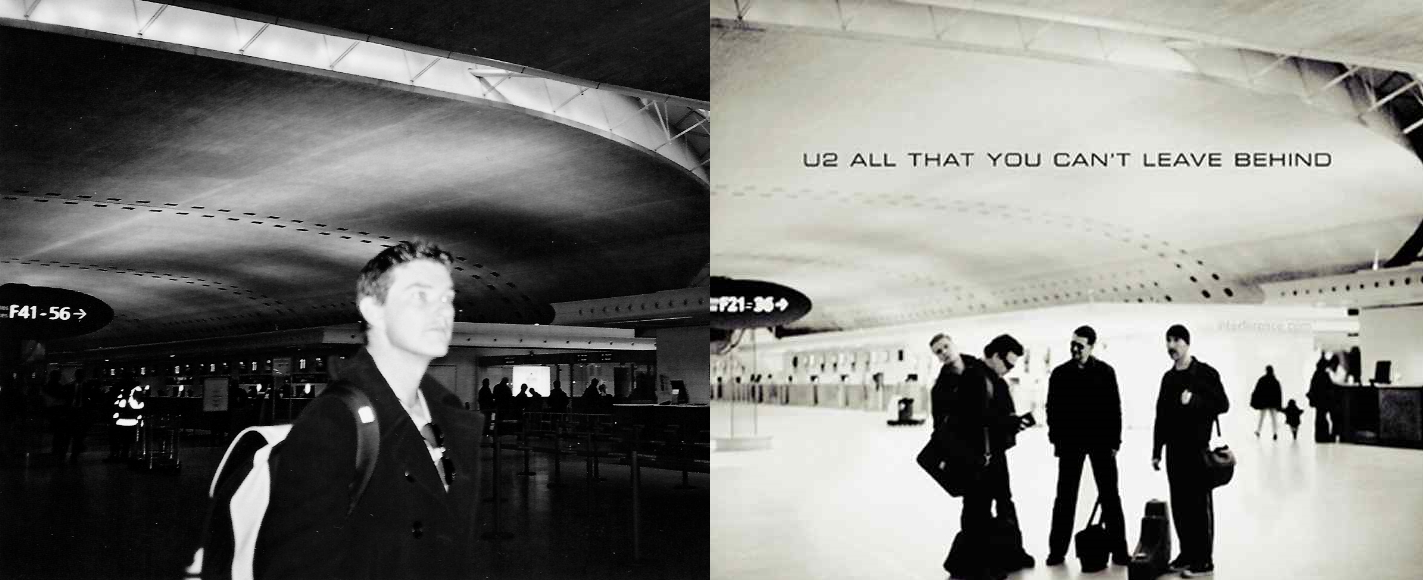
This is a chapter from a novel I wrote between 1998 and 2004 entitled Et in Antipodes, Ego. It was intended to be something of a romantic epic, but lacked sufficient gism to make it readable. Too long and slow, the romantic elements were based, at times quite painstakingly, on personal experiences I had in the period prior to its conception. The story centred around Edward Cockfoster and his uncovering of a literary controversy whilst writing a PhD on the fictional Australian author, Bryce Chapman. His unexpected, serendipitous success with his research contrasted with the failure of his relationship with the Cambridge-bound Pandora.

Whilst containing some, if I may say so myself, quite beautiful moments, there was too much pedantic and pedestrian detail which could only be described as self-indulgent. With the first draft running to 140,000 words, it was terribly overwritten, yet at the time I was too precious to take the axe to it in the way that was necessary. In retrospect, it was good “marathon training”, but not something I intend to go back, having moved so far away from its characters, themes and sentiment. This passage comes from, well, somewhere in the middle.


The Reliability of Change

“So come on then, what’s the big surprise?”

Edward was standing in a bath full of hot water and bubbles. The soft pop and tickle on his shins was a welcome distraction from the mild scalding his feet had just received. They were at Pandora’s parents’ house, having taken the opportunity of their absence to indulge in a little luxury.

“I told you I would show you once we were in the bath,” said Pandora.

“Alright, alright.”

“Well, how is the water?”

“It’s a bit of a shock at first, but after that…”

He began to lower himself into the bath. Pandora removed her towel and poked a pointed foot in at the other end. “Ooh, it does feel hot,” she said. Edward emitted a high-pitched whine as his testicles touched the hot water. They tingled fiercely; a delicious sensation.

“Where is it hidden?” he asked, rubbing his delicacy.

Pandora stepped fully into the bath and stood over him, smirking. Her high, pointed breasts sporting long, erect nipples.

“On the chair. Under the towel.”

She placed her hands on her hips. “Do I look like an Amazon?” she asked; sounding English, like her mother.

“You need a tan,” he said, “and one less breast.”

“Oh goodness, I forgot about that.”

Your shoulders are a tad too round as well, was Edward’s unvoiced thought.

“So come on, how about this surprise?” he said. “We are both now in the bath after all.”

“I’m not fully in yet.”

Edward tutted. “Well… I’m going to have to lift up the towel.”

Pandora smiled.

“No, wait. Close your eyes.”

“Now we’re talking.”

Edward slid down in the bath so that his mouth was level with the foam. He closed his eyes to a world of red warmth. He heard Pandora lifting the towel, imagined her leaning and reaching. Then he felt a soft tap on the head; something light and thin.

“Come on.”

He reached out awkwardly and grabbed what she was holding.

“Da da!” said Pandora, as Edward opened his eyes. In his hands was a set of plastic farm animals, still in the cardboard-backed, clear plastic package.

“Fantastic!” said Edward. “You found the duck and geese set!”

Edward stared lovingly at the packet; steamed and wet from his hands.

“Can I open it?”

“Of course.”

He pulled free the plastic cover and released the animals: two ducks and a goose.

“These are quality ducks,” said Edward, admiring them.

Pandora nodded, then leaned over and reached for her dressing gown.

“And look,” she said, “I brought Otto and Merrylegs as well.” From the dressing gown pocket she produced a plastic sheep and border collie.

“Brilliant.” Edward lined the new animals up along the edge of the bath. Pandora placed Otto and Merrylegs next to them, then sat down in the water.

“So, what shall we call these fine ducks?” asked Edward.

“They must have names that match their aristocratic looks.”

They examined them closely for a moment.

“I think this one looks quite cheeky,” said Edward. “He might be a bit of a womaniser.”

“I think they’re both womanisers,” said Pandora. “This one’s awfully sure of himself.”

Pandora nestled further into the foam, pushing her legs past Edward’s hips. She studied the ducks a moment longer.

“Casanova,” she said. “Let’s call one of them Casanova.”

“Cool,” laughed Edward. “I was thinking of the name Rudolf.”

“Wonderful, duckest. Rudolf and Casanova it is.”

“Does it matter which one is which?”

“I don’t think so. They can be like Rosencrantz and Guildenstern.”

They lay back and played with the animals; walking them over foam hills and down to popping dales. When the bubbles vanished, they swam the small ducks through the cooling water, then ran more hot and paddled it around.

After their bath, Edward and Pandora cooked pasta for dinner, then settled down to eat in front of The Bridges of Madison County. Sitting behind an oil heater, legs covered by a picnic blanket, they marvelled at Meryl Streep’s accent. When the film was finished they sat on stools in the kitchen and ate ice-cream.

“It’s a very sad movie,” said Pandora. “Beautiful and sad.”

“Beautifully sad,” said Edward, his teeth aflame with cold.

“There was a lot of truth in that movie,” said Pandora. “That line about change being the only thing you can depend on in life, and not to be afraid of it. It really is true.”

“I suppose. For better or for worse, change happens.”

“And if it is for worse, then next time it might be for the best.”

Edward switched on the electric jug and stood with his eyes lowered. He did not look up when Pandora touched his shoulder.

“Duck,” she said, “are you alright?”

“Of course. I was just thinking about the movie.”

“It really was very good.”

She took two teacups from the cupboard.

“You look sad,” she said.

“I feel a bit sad,” said Edward. He looked at Rudolf and Casanova, sitting on the kitchen bench. “I don’t want things to change. I want things to stay the same.”

“Poor, sad duck.” She took his upper arm and turned him to face her. “Your little squirrel still loves you.”

Edward stuck out his lower lip.

“But you won’t always be my little squirrel, will you?”

“What do you mean?”

He rubbed his nose.

“I mean, if you do go to Cambridge. Everything will change and you’ll leave me for someone else.”

“Edward, that’s a horrible thing to say. What makes you think I’ll leave you?”

“I don’t know. You said that when you got overseas you’d have to think about everything again. Re-evaluate how you relate to everything.”

“Well, firstly there’s no when about it. And anyway, what sort of person do you think I am? How do you think that reflects on me?”

“I don’t mean it like that.”

“Don’t you think I’m telling you the truth when I tell you I love you?”

“That’s not what I mean. It’s just that you’ll be far away and you’ll meet other men and you’ll forget about me. Change. It’s inevitable – the one thing you can depend upon.”

“Edward, that’s a horrid thing to say, when you make it mean that.”

Pandora’s eyes went moist and her lip faltered.

“You’ll just as soon find another girlfriend,” she said, her voice quivering. “If anyone’s shown evidence of poor character in the past, it’s you, Edward.”

“No I won’t,” he said. “I don’t ever want another girlfriend.” He reached out toward her and she pushed his hand away.

“I’m sorry, Panda. I didn’t want to make you upset. It’s just I was thinking about what you said the other week – that you would have to think about everything again. I’ve been despairing about it ever since.”

“Why do you have to bring that up now?”

“Why did you have to say that in the first place?”

“What you said was cruel.”

“So was what you said. You know how afraid I am of you going.”

She pushed back her hair and folded her arms.

“But you’re always pressuring me to reassure you. I have to be realistic. And anyway, I didn’t necessarily mean I’d have to think twice about you.”

“Well, what did you mean?”

“I don’t know, Edward, I don’t know. I don’t think you should have said what you did. You’re the one who’s going to find someone else if anyone is.”

“Well if I’m of such poor character, why don’t you leave me now? If that’s what you think, how do I know you won’t try to get in first?”

Pandora began to sob, shaking her head. The electric jug clicked and Edward inclined his head toward it, Pandora’s eyes followed his and they both stared at the steam pouring from the lip of the jug. Pandora tried to hold her position but had to unfold her arms to wipe her tears and rub her eyes.

“Why do you have to ruin everything, Edward? I don’t need all this extra pressure. It’s hard enough as it is, waiting and not knowing.”

Edward set his jaw. He felt as if he was falling and was uncertain how hard the ground might be.

“Well I’m in the same boat. Except whereas you stand to win, I only stand to lose.”

“Well that isn’t my fault! So stop taking it out on me.”

She stared at him with her red eyes wide and cheeks blotched with anger and Edward could not meet her gaze. He looked again at the jug and felt ashamed.

“But can’t you stop making me feel so insecure?” It was a measured half-whisper, keeping his eyes low.

“You started this. I’m not the one who should be making concessions.”

Edward moved towards the jug and poured the hot water into the two cups.

“Do you still want tea?” he asked. She stared at him and said nothing, so he turned around and tried to meet her gaze, but again he felt ashamed and cast his eyes to the floor.

“I’m sorry, Panda. I didn’t want to have a fight.”

“Well what did you expect?” she snapped. “You can’t just say things like that and expect me not to react. You should have said nothing at all.”

He nodded solemnly, easing himself into penance.

“I’m sorry. I don’t want to argue any more.”

“I never wanted to argue in the first place. You have to stop torturing me about this – and yourself. Even if I’m going I don’t start until October, and that’s six months away. How do you know whether or not things will change?”

Edward shrugged weakly and picked up the jug. He poured both cups in silence, then jiggled the tea bags. It was true, he didn’t know if she was going and worrying about it would change nothing. Then again, he thought, staring into the worn and holed yellow stove-mit hanging from a hook in front of him, for better or for worse, change was the one thing upon which he could depend and, from a starting point of rare happiness, things could only get worse.

**********

Edward slipped his arms through the dressing gown and pulled it across his chest. He was nearly out the bedroom door when Pandora mumbled: “Do you have to be such a big, noisy monster, Duck?”

“Sorry,” he breathed. “I have to go to the toilet.”

She said nothing more and he closed the door behind him. After going to the bathroom, he was taken with the idea of a cheese sandwich and walked on through to the kitchen.

Edward’s thoughts had kept him awake for some time and eventually he had found the effort to lie still too taxing to endure. He was heavily prone to insomnia. At home he would lie awake for hours, sweating tight little beads. After a time he would throw the sheets off and listen to his heartbeat, all the while trying to concentrate on breathing steadily and doing anything other than listening to his heartbeat. At night everything seemed so impossible, but when the morning came and everything was possible again, he would be too tired to address whatever had kept him awake. The inefficiency of it was maddening.

He took bread and butter from the fridge and began to search for cheese. A moment later he spotted a hunk of neatly-wrapped cheddar.

What had compelled him to ruin the evening with Pandora? He should have known what would come of raising the question of her departure again. Again, the inefficiency of it all was maddening. All he had hoped for was a night of lovemaking and a long, easy sleep. He and Pandora rarely spent the night together anymore, not that they had ever done so very often. The habit had formed at Pandora’s instigation, for she did not like to have her rest disturbed and tended to sleep an hour or so later than Edward, who hopped up shortly after dawn.

He took a plate from the cupboard and began to slice the cheese.

Their first ever night together had been an awkward squeeze in Edward’s bed and neither of them slept a wink. At five that morning a flatbed truck had huffed and clanked into the back lane and Vietnamese voices unloaded huge sacks of flour for the bakery next door. Fatigue was the talking point of the coming day and the following night they slept apart.

Edward buttered the bread and began arranging the cheese on his sandwich. In those first few late November days, now more than a year ago, all Edward had longed for was a holiday from work and good sense; for the chance to plunge into love. Having yearned for Pandora to the point of distraction for so many months beforehand and having found his feelings requited, he had rather hoped that the intensity of his passion would also be requited. Yet soon the exhaustion of the chase became matched by the exhaustion of the beginning and their love-life began in syncopation; halting progress and mounting failure. Such was Edward’s concern to get things right that he was unable for many weeks to rise to the occasion. Deeply disappointed by this and considerably embarrassed, despite his attempts to dismiss the paradigmatic anxieties of masculinity, the more he failed, the harder he was inclined to try. Every time he went home alone was a missed opportunity to prove his prowess or, at least, his basic competence, until, exhausted by desire and unable to convince Pandora that they should spend the night together more often, he was forced to admit that sex was a lesser priority and to agree that sleeping soundly made more sense than lying awake in discomfort. So it was that Edward went back to masturbating, and with the steam let out, everything began to go more smoothly.

He finished the preparation of his sandwich, cut it down the middle and, poured a glass of milk.

For all his agonising over their sex life, Edward was over the moon to be with Pandora in those first months. When she moved from her old room to a new and furnished flat in the same suburb, acquiring a double bed in the process, Edward was allowed to stay at weekends. By this time, however, he had become so used to parting at the end of the night, even after lovemaking, that he rarely did stay over. When he did, he rose early and left first thing to avoid being reprimanded for reading too loudly. The new discipline they came to encourage in each other had entrenched itself, and the anxieties of the beginning had passed sufficiently to smother the desperation for her to be there always. Needless to say, he preferred it when she was.

How long it now seemed since they had established these rhythms. How certain he was that change must come. Why this must happen, even when a flawless happiness had been so painstakingly established, was anyone’s guess.

Edward chose to eat in the lounge-room. Before him the dark windows swayed with liquidambar. Starlight flowed across the floor like the glimpse of a river through trees and ran to the low shelves alongside the hearth. Edward traced the paintbrush curves to a set of bold letters, stark against a dark spine on the shelves: The Atlas of the Viking World. He squinted at the title a while, then took this quarto volume and placed it in his lap.

Below the title he could just make out a photo of a grass-roofed bungalow, built of stone and sunk in soft dips of hill. From the grey chimney rose a long rope of smoke, barely visible against the grass and overcast sky. Inside he imagined a warm fire and a long table, a double cot and a smoky smell at dawn in the high places. It was coziness and isolation; a nest for lovers who needed nothing more than each other; where even through acres of grey, the sunlight fell, if muted. There everything was narrowed to simplicity; and there, across oceans of time and distance and under a roof of grass, Edward might know that they were together for good.

He chewed into his sandwich with a thick throat, wondering what on earth there was to eat in those empty hills.

Read Full Post »

This is the first chapter of a novel I wrote in 2005 called Advance Australia, Farewell. A first-person narrative from the point of view of Harrison Borgnine, a 17-year old boy who is deeply traumatised by the death of his family in a terrorist incident in Sydney Harbour, it was set in a distopian Australia in the year 2030. The novel was inspired by my total and utter hatred of the conservative government of John Howard and all they stood for. It posited a callous future of collapsed social services, restricted individual freedom, draconian employment laws, selfishness, obesity, military adventurism, publicly muscular “Christianity”, overzealous nationalism, both legal and rhetorical, flag-worship, unaffordable medical services, environmental degradation and, ultimately, Australia’s ostracism by Europe and other right-thinking governments through the vehicle of trade and sports sanctions. The novel was not intended to be an accurate prediction of the future, but rather the worst-case scenario of a dangerous political ideology and bad policy. Most of all it was intended to be a tongue-in-cheek rollicking yarn, based very loosely on the 1608 picaresque Spanish novella The Swindler by Francisco de Queveda. It begins when Harrison flees from his school to join a group called the Sydney School of Mendicants, who specialise in fraudulent means of extracting charity. Ultimately, having rescued his friend Alfonse from one of Australia’s fortified schools for politically suspect children, completely fed up with Australia, he escapes on a boat as a refugee to New Zealand.


Advance Australia, Farewell

It’s the joy of forgetting, such a joy to forget

But we killed all our first born, we slashed and we burned

And we sold off the paddocks, and we raped and we gouged

On the wings of a six-pack will we ever learn?

– Midnight Oil, Who Can Stand in the Way


So here I was jigging school, having a cigarette with my zits stinging and my tie hanging out of my top pocket. It wasn’t even midday and there was plenty of time to kill. I was still cruising on the juicy rush of my legendary escape and was happy to sit it out for a bit. I didn’t have to be anywhere until about one-thirty, and when one-thirty came around, you betcha, I had somewhere to be alright.

Lorna Fishburn. Need I say more?

Now, obviously today was a special day, and apart from a certain forecast rendez-vous, it was also the day on which I’d decided to make a run for it. It was time to do what my champion brother used to call the hell U-bolt, and break out of school once and for all.

During recess, before the playground patrol started mopping up stragglers, I’d hidden myself under the demountables and disabled my tracking tag. It was piss easy to do, and everyone knew the trick. My bag was chock-a-block with all the stuff you need to survive – like clothes and a toothbrush – but I’d still found room for a few of my favourite Conan books. You can’t beat Conan when you need to gee up for the odd mission impossible and, sure enough, as I lay there with all the rubbish and spiders, I pulled out an old fave and got stuck into some quality reading.

Ten minutes later, I was itching to go. The playground looked clear and with Conan on my side, I was fully psyched. I put away my book, pushed my bag out and rolled from under the building like some army hero. I was up near the tennis courts and had a pretty good view across the yard, and couldn’t see a rat’s flap. I got my bag on, got into a champion crouch, hung on just a moment, then made my break.

Would you believe it, but just as I hit the palm tree, I heard this dude shouting at me, and next thing Blinky Bill’s on my heels. He’s the school caretaker, and though he’s a mere kumquat of a man, he came at me like a falling coconut. I fully stepped on the gas and went like crazy, and Blinky kept on coming. I was amazed to see him run like that because we all know he’s smashed beyond the realms of a goat by lunch-time. Admittedly, it was only recess, but he would’ve had a few already to be sure. I ran like the wind in your hair on a beachfront cliff, and looking over my shoulder, Blinky was doing the same. I was touched to see him put in such an effort on my behalf, especially when I knew I was leaving him for dead. His stumpy legs meant he ran like a right lump, and it wasn’t exactly a coat of varnish job in the end. I was out that gate like a gold medallist.

Now that’s all very well, me getting away, but more importantly I don’t reckon he saw my face and the camera on that gate is stuffed. They may well be into some hi-tech paranoid bullshit, but that school doesn’t exactly have electric fences and savage pit-bulls like some of the private ones. My dad reckoned back in his days it was much easier to jig school. These days you need a change of clothes and an all-round plan and a bit of a taste for skulking about in sewers, and that plan had better be a good one or else you’ll have a hell of a lot to answer for and wind up in the state barracks.

Fear not though, comrades, for let me assure you that on this stinking hot day of quality escapology I had a totally first-rate plan that was flawless in every regard. The fact of the matter was that no pisspanhandling spermivore was going to stop Harrison Borgnine from reaching the goal of his expedition. For, lo and be bold, I had a date with Lorna Fishburn.

You might have guessed already that she’d be a bit of a hottie – a truly Ghengis-looking girl with top quality legs and a brain-bending bosom to boot. The honest truth is she had loads of things going for her and not just the looks or the intravenous talk she could pull off, but she was gifted with all kinds of friends in low places. Make no mistake, Lorna knew a thing or two about skulking about in sewers.

But hang on there, son. Hold your horses, old boy, as my dad used to say. Shut up, Harrison, you little spew-bag, you don’t wanna spill the seed too early. Enough about Lorna for the moment – it’s no good wearing her out before she’s even on the scene. When she turns up she’s bound to do herself justice with her world-series looks and lurid qualities. It’d be a tragedy to soil the expectation.

So there I was sitting in the park and slowly roasting. I’m always getting sunburnt, like my mum used to tell me to be careful and put cream on and not sit around without a hat and sure enough I’d come home looking like Abraham Spastoonce, that guy who locked himself in a glass cage in the Himalayas and lost a testicle or something. Not like I lost a testicle, though. I mean, as if, but I was prone to looking like a lobster.

I tossed a few rocks at the carp in the water, but they weren’t doing squat. I half expected one of them to have a heart-attack because one time when I jigged with my best mate Alfonse, we got busted throwing rocks at the ducks by a couple of rangers. Not like Aragorn and his bunch, but those bullshit park cops who are just trumped-up gardeners. These guys came over and said, “I hope that’s bread you’re throwing. You better like show us the loaf, or you’ll be in hot water.” Actually, they weren’t too aggro about it, but they did get shirty and wanna see I.D. and naturally we were packing about getting busted. So I pulled out a bullshit bus-pass I’d nicked off a bloke who baled out of school called Donnie Candles, and when they wrote down Donnie I could have pissed myself laughing, except right then and there I was so scared I nearly shat myself. Alfonse didn’t have any fake I.D., only the stolen Cab-charge which said he was Jenny Fu. Then they said we were going to be deep in shit, and that tomorrow there’d probably be about eight dead ducks floating on the lake, with them being so prone to heart attacks if you give them a scare. I reckon they were full of shit though because when we got to school the next day, there was no hoop-la at all. So take note – those lazy bastards didn’t do their jobs properly. I should have taken their names and reported them for bloody negligence, even if they did me a favour. No wonder I wanted to smash the state.

The duck incident happened a while back, well before I got my stupid medal and even before Alfonse got done for terrorism. And what the hell, I was just a kid who liked throwing rocks at ducks and Alfonse was just a kid who liked having a few words here and there, and kids get up to plenty worse shit these days, like you wouldn’t believe. My dad reckoned, back in his day, it was just hooking up car batteries to troughs, letting off stink-bombs and the odd friendly stabbing. Now kids go around gassing people and shit; gassing and shooting and pipe bombs and blowing up trains and gang-raping whole gangs – serious stuff. But it’s hardly surprising what with about eight million wars and religious freaks everywhere and that tanker they blew up in the harbour. No wonder some kids wanna run away and smash the state. I reckon it’s fair enough, and at the end of the day, I guess I’m one of those kids. Well, sorta, kinda. See, smashing the state seemed like it was way too big a job, so I went for a compromise. I decided to dodge it instead, and that’s kind of what this story’s all about.

Either way, I was just a kid and you can’t do too much about that. I never asked for anything and this all just came along – everything and nothing – and maybe I’m better for it, after such a run of bad luck. And just as I didn’t know what was coming back then, I’ll likewise lay it all out so you don’t know what’s coming. A big old pile of carpet no one’s ever seen before, rolling out after a quality boot with some screwed up pattern by a crazy weaver going nowhere and always different – never a dull moment; not in this day and age.

So go on, comrades, lend me your ears!

But you can keep the blackheads and the wax.

**********

So there I was down at the park with a bunch of mutant fish and I started to get a bit worried. Hell knows why I was sitting around in the open. It’s always the way – along comes some cop who’s been having a wank in the bushes and next thing it’s hand-jobs all round or off to the barracks.

It was high time to make for the public dunsters and get out of my “prison garb”. I’d even brought some clean pairs of dungers with me, in case Lorna took pity. After all, you never know your luck. That’s the sort of thing Conan might have said if he wasn’t so hard-core and spent a bit more time philosophising. In this old film of Conan, Conan’s dad told him to learn the riddle of steel and only trust his sword – not men, not women, not beasts. My dad gave me good advice too, and he reckoned you make your own luck. So, sure enough, I brought a clean pair of dungers with me.

I stepped out after a couple of minutes in my funky pants, trainers and a black tee-shirt – nothing conspicuous, then set off towards the comforts of Redfern. The sparkling glories of the mall were in my sights. My dad reckoned Redfern was a slum about twelve thousand years ago, though I can’t see it myself. You still get a few mutants down the shopping village. Bums love seats – it’s the simple truth. I kind of like bums myself. Both kinds, like especially the ones on women. This bloke was saying the other day, arse is the new tits, arse is the new tits in some crazy mantra, which is like when they say the hundred’s the new fifty with inflation on the up. But really I do like bums, and I quite like boobs as well, now that you mention it.

You can see I was thinking about Lorna. Not like I’ve ever seen her breasts, only the outline, pressing through her tops – it’s sick the way they do that, I swear to cod. The more I’d think about her though, the more nervous I’d get. Alfonse only ever saw her once but he reckoned she was hot as and described her as “sultry.” I reckon! Supple as a panther, like the birds in Conan, supple and lithe and all things nice, and either a total sack-monster, or she’d be shit hot with a scimitar and a complete legend at climbing walls with daggers – that’s the birds in Conan, not Lorna. But Lorna did have a body like those Brythunian women Conan’s always finding in Zamoran brothels and seedy Zingaran taverns. Or at least, so I reckoned, not ever having been to Hyborea and seen such ladies in the flesh.

I ducked down a few back streets to steer clear of the cameras and it wasn’t long before I was a mere block from the untold pleasures of what my brother used to call the Pigslops Bonanza. I never understood why, just like he used to call Angus and Robertson, Hangin’ for Robinson and Barbecues Galore, Bumroots Gaylord. He used to call people Turk-farts – not like it meant anything, but then he was always creative with language. Didn’t matter if what he said made sense, or whether it was logical or anything, but my brother had a word for everything under the sun. Brown Spiderman was one of his.

I made straight for the hot bread shop where they sold the cheese and bacon rolls and stood in front of the cutesy Chinese chick who I secretly hoped was a chronic sperm bandit. I was running a bit of a risk because some turd-burglar of a security guard was struggling to hold up a vast gut right next to the shop. I could see he was checking out the Chinese chick too, filthy old fatso. He had a head like a cup of hot fat and when he saw me approach his face screwed right up like he smelled a runny one from a prison plops bucket. I stuck out my chest and cleared my throat and thought I’d better talk all neat and trim.

“Hello,” I said, “could I please have two of your finest cheese and bacon rolls, and a half-dozen sugar and cinnamon donuts.”

I was all politeness and there was no stopping me now, so I turned to the keg and flashed him a smile, all the while thinking, Cuuuuuuuunnnnnnnntttttttttt…  He really was a hideous fucksplint and I was afraid for a second he might want a piece of me too.

The Chinese chick handed over the paper bags and hit me up for nineteen bucks. I pulled out my wallet and smiled like a total gonad.

“No sweat,” I said, “inasmuch as I have the wherewithal herein,” which was a favourite line of my brother’s when he was trying to sound like a ponce. I don’t think she had the faintest ballsplinter of what I was saying, but man she was tasty, and who could deny a feisty one smelling of bacon rolls and donuts with flour fingerprints on her cheeks? If I wasn’t meeting Lorna, I might have asked her out. Yeah, right, just like I did all the other times too…

I squeezed off and took up pole position on one of the benches. I was getting more and more nervous by the minute and didn’t have half the hunger I thought I did. I knew I’d be packing the moment Lorna showed up. I had to distract myself and get off the nerve rack and the easiest way was to visualise a bit of quality hack and slash. Sometimes I could really paint a picture, and this time around I had no trouble getting started. I opened my bag and had a squiz at the cover of Conan of Aquilonia and whooshka! – my mind was off.

In runs Conan and he’s heading straight for the Cup of Fat. The Cup’s seen nothing and before he can even get his hands out of his pockets and off his nob, there goes the arm in a flash of broadsword and a torrent of grease. Then Conan, bristling with steely thews, shears through the other one for good measure and the Cup’s going down like that Black Forest cake my dad cooked once using margarine instead of butter. Next thing Conan goes nuts when he realises he’s surrounded by a bunch of useless, retarded parasites loaded with booty and he’s swinging like a propeller, scything through skin and bone and cartilage and brains and ears and noses and guts and there’s no shortage of carnage whatsoever.

I was clamping my eyes hard conjuring this massacre and made it get so big I saw myself jumping over the counter and hiding with the Chinese chick under a couple of old flour sacks until the butchering’s done and Conan’s made his way back to the war galley he filched from some Hyrkanian pansy, leaving a trail of twitching gore.

My head was nodding up and down with the pace of my unfolding vision, and next thing I stopped dead in my tracks. I realised my legs were shaking and my fists were clenched tight and my mouth was all gummed up with bacon roll. I wasn’t panting but I sure was swallowing heartbeats. I’d gotten myself real geed up in a welter of violence and my head was starting to spin. The old panic set in and I got this feeling as if everyone really might die as I’d imagined, or like maybe I’d be the one to do it, or worse that I might die too. I had to pull myself in and stop the fear, because I knew where it would lead and then I’d get the sweats.

I chewed my dry mouth of bacon roll and took a deep breath. Like how crazy is that – that you can think some shit up for the hell of it and totally horrify yourself in the process? I clamped down on those thoughts right away. Man, I used to really love violence, but then all that shit happened and the government gave me that bloody medal like they wanted to insult me. And how fucking dumb was that – getting a bravery medal for not being somewhere when the shit hit the fan? If they’d told me what they were really doing to my mate Alfonse I might not have spat on that guy when he handed it over like he was real sorry and it wasn’t their fault in the first place anyway.

They kept an eye on me after that. But my brother would have done even better. My brother would have told them they were about as much use as a dead bear in a dust-storm. He would have asked them about Alfonse and made them tell him what they were doing to him, even if they didn’t know shit. Christ I missed my brother. But like the psyche-man said, be brave, be brave, and a huge, steaming pile of other positive ballslap that’s no consolation for a whole harbour full of people. At least I had my Conan books, and even if they were a bit violent and got me so fired right up that sometimes I got scared, I could still think about Conan taking a mighty sword to whoever the hell it was that killed my family and all the people who drove them to it. Conan was the only brother I had now.

And then I was all choked up. My bacon roll was gumming my mouth something savage and I couldn’t swallow because of the lump in my throat. I managed to get some of it down, but there were sniffles as well and I was shaking like a leaf, feeling weak and down in the dumps and scared shitless about meeting Lorna and her friends in low places and what was going to come of it all once we started skulking about in sewers.

And would you believe it, but I started crying. Right there in the shopping village with Lorna about to show. Huge, pathetic, milksop tears running down my cheeks and I could hardly breathe with all the thick gooey mess of roll in my mouth. I needed a drink real bad and couldn’t work out why the hell I hadn’t bought one at the bread shop, but I just clean forgot. I tried to stop crying, but I was fully packing now and my father and mother and brother were all there in my head and not even Lorna Fishburn was going to stop me thinking about them. And the tears just kept on coming and my cheeks were puffed right out and I tried hiding behind my hand, but nothing could stop me looking like an unblown nose.

And that’s how she found me, crying like a sissy; having a first-rate bawl with bacon chunks in my cheeks. It pretty well goes without saying that it wasn’t the way I had planned it.

Read Full Post »
“Do you want some books? Some English books?”

It was Sunil speaking, my auto-rickshaw driver for the last two days in Jaipur.

Jaipur - The Boss

“I have two books. You can take them with you.”

“What books?”

“Two English books. A girl gave them to me to read. She said they are very good books. She gave them to me to read them when I learn to read properly.”

“Oh, nice. What books are they?”

“I’ll get them.” He stood up in his chair and I rose halfway myself.

“No, it’s cool, man,” I said. “Don’t worry. It’s too much trouble.”

“No, it’s no trouble. I live across the road. I’ll get them.”

“Really, only if it’s no trouble.”

He laughed and smiled again. “It’s just across the road.”

“Okay, sure. If you want to, thanks.”

Sunil left in a flash and I eased back into my chair. I was sitting on the open rooftop of the hotel; drinking black tea and picking away at a paratha. For the last twenty-four hours I’d had stomach problems aplenty and had only just gotten through the day’s activities: a visit to the Jantar Mantar and Amber Fort; a test of endurance in forty degree heat.

Amber Fort, Jaipur
At the far end of the rooftop, before a painted arch, a two-man troupe were putting on a puppet show; stories of the Ramayana. At times the volume was too much, the cymbals too clanging. I was too fragile for much patience, but also a tad too weak to feel any annoyance. I was still acclimatising to India, to Rajasthan, and I guess getting sick was part of the trip.
Sunil and I had just cut a deal. His uncle, Shyam, was to drive me around Rajasthan for the next ten days, starting the following morning. The price was fair and it seemed a far more convenient arrangement than taking my chances with the local buses and trains. It would also ensure I could see the more remote forts and temples, provided I was well enough.
I began to wonder about the books Sunil was bringing. What would they be? Rudyard Kipling, for heaven’s sake? I wasn’t terribly optimistic, though I wasn’t too pessimistic either. The worst case scenario would be a couple of airport potboilers, or some junk about spiritual enlightenment, though I most expected him to hand me some inoffensive, lightweight fiction.

Jaipur Hotel
Sunil returned after five minutes, wielding two books. One was a hardback, the other, a floppy paperback.

“Here they are!” he said.

He was slightly out of breath. A short, moustachioed, rotund and cheerful man in his mid-thirties, Sunil always had an air of abundant enthusiasm.
He placed the books on the table and as soon as I saw the titles, I was pleased and surprised.
Summertime by J.M. Coetzee and The God of Small Things by Arundhati Roy.
I had read neither of them, but had wanted to do so, and now I was free to take them with me around Rajasthan.

“Oh, cool,” I said. “Excellent.” I picked up Summertime.

Summertime - Coetzee

“This guy, Coetzee, is a very famous author. Have you heard of him?”

“No.”

“He won the Booker prize, twice. It’s like the biggest prize in writing and only two or three people have won it twice. I’ve read about six of his books. Hell, I even taught his stuff once!”

“But that’s great,” said Sunil. “See, I knew these books would be good. The girl was very nice, very clever.”

“And have you heard of Arundhati Roy?”

He shook his head.

“She’s Indian, though I don’t know where from. This book also won the Booker prize. It’s supposed to be very, very good.”

“Very good then! And now, you can read them and tell me what you think. One day, I will read them too.”

We turned back to planning my route through Rajasthan over a large map of the region. I was very excited, though uneasy with stomach cramps. As we sat there over the next half hour, I kept glancing at the books and wondering whether or not these would really be the best place to start reading English literature. Coetzee might be just the thing, with his terse, laconic use of language and simple sentences, but I had no idea what to expect from Arundhati Roy. Still, as an Indian writing about India, the book could well be a lot more interesting and accessible for Sunil. There was only one way to find out: Read them.
The following morning I set off for Pushkar with Sunil’s uncle, Shyam. I had decided, on account of recurrent stomach problems, to hole up there for a couple of days in the hope of getting over my illness. The drive was easy, if disappointingly desolate, until the final stretch that is, when we turned off the main road. The land became more fertile, with many trees and patches of green growth; it was a yellow land, the colour of wheat heads, baking in the sun at the end of the long, hot dry, yet nourished by wells and tanks from the last monsoon.

Shyam!
We arrived at just after one in the afternoon, and made straight for the hotel. It took some time to rouse reception, but once on hand, it wasn’t long before I had the keys. I had booked a somewhat luxurious room – white marble, high ceiling, fan, air-con, a king-sized bed – all subtly decorated with painted flowers and curlicues. The small balcony overlooked the swimming pool and surrounding countryside; framed by tall hills of scrub and martian rock, the low-land was bright with crops of flowers grown for Puja. It was stupidly cheap at twenty dollars a night.

Pushkar street
After a swim and a meal of dry garlic naan and black tea, I set off into town to explore. My fragile stomach rebelled at the powerful scents of dung and refuse, and, feeling physically exhausted, I was not in the mood for solicitations. I lasted only two hours before heading back to the hotel; tired, with a headache, wanting to have eaten, but having no appetite whatsoever. It was simply too hot, at thirty-six degrees and there was nothing for it but to read. I picked up The God of Small Things and lay down by the bright window. I was soon completely hooked.

God of small things
The following day, my guts had not improved and I again only managed a short visit to town. It was disappointing, but I made the most of the time and took some good photographs. I was quite content to stay in the hotel anyway, with my imperial view across the fields of flowers to the hills, the swimming pool and abundant natural light. I spent a couple of hours watching women in traditional clothes harvesting flowers in the fields, before returning to my room to read.
Late that afternoon, as the sun fell quickly behind the turrets, painting the sky a brief pink and purple, I finished the book. I felt immediately bereft, having gained and lost so much so quickly.

Pushkar

Pushkar
I was exhausted and weak. I’d eaten some bananas and half a pineapple that day, along with more dry bread and black tea, but it was nowhere near enough food and I had to force myself to eat it. I decided I needed antibiotics, but had left it rather late to get something.
Tired, yet restless, I forced myself to start reading Summertime, if only not to feel so hollow. It took me a while to get started, but slowly and surely, it drew me in and gave me sufficient solace to get through the evening.
The following morning, Shyam and I left early to head down through Chittorgarh, en route for Udaipur, where I finally got hold of some antibiotics. I left Summertime in the car by accident, but was not in any great hurry to finish it.

Ranakpur

Jodphur

Jaisalmer

Shekhawati Shyam

There was now the Indian Premier League Cricket to watch, and, with my recovery starting the moment I took the first pill, I wanted to spend the time seeing things and taking photographs.

It was thus more than a week later, at the end of the Rajasthani tour, driving from Jaisalmer to Bikaner, that I finished reading the book. It had had its moments, though I was left feeling a tad nonplussed. The organisation of the book seemed too arbitrary, too random, though the writing throughout was quality.

When Sunil and I finally sat down together again in Jaipur, eleven days after our last encounter, I brought the two books with me. Sunil produced a small bottle of rum and poured us both a glass.

Team Jaipur!

“Do you know what rum means?” he asked.

“No, I don’t. Does it mean something?”

“Yes,” said Sunil. “The letters. R.U.M – Regular Use Medicine.”

We laughed together and I took a slug of Sunil’s medicine. Soon the waiter came by and I ordered a vegetarian thali and a bottle of beer.

“Look, about these books. I’m not sure that either of them is a good place to start reading.”

“Why not?”

“Basically, I think you’ll find Summertime rather boring and too academic. It has some very simple and easily understood parts to it, but it also discusses literature, theory – university stuff. It’s not really going to be that easy, I think, if you don’t know half the words. And, you know, that’s kind of the problem with The God of Small Things. I loved this book, it’s a great read – yet the language is very idiosyncratic. I mean, she uses a lot of words in strange ways, in different ways, and here and there she adds new words. It also moves back and forth in time, and has some complicated scenes where it was at first difficult to work out who was who. I had to read the first chapter twice to work out who the people were. I think it’s going to be a hard place to start reading English novels!”

I was concerned that he might think I thought him stupid, whereas I knew from our conversations that he had a very agile mind. But I also knew how limited his writing and reading skills were, because he had asked me to compose and type text messages for him to his English-speaking French girlfriend, so uncomfortable was he with spelling and grammar. What he needed was a great novel with simple language and limited nuance, though not devoid of it.

“But you liked the books? They are good?”

“Yes, I liked the books a lot. This one in particular,” I pointed to The God of Small Things. “But maybe you’d be better off starting with something else. Something with easier language in it.”

I began to wonder if he wouldn’t just prefer to read a crime thriller or action story of some kind. In truth, I hardly knew the guy, and apart from his professed interest in women of all shapes and sizes, I didn’t have a handle on his tastes. Then, I had an idea.

“Hang on. I think I have a suggestion. I’ll write it down for you.” I felt in the front pocket of my bag. “Oh crap.”

“What?”

“I don’t have a pen.”

He turned and called out in Hindi. The waiter came over with a pen.

“Write on the napkin,” said the waiter.

“No, no,” said Sunil. “I want to keep it. A napkin is not good paper.”

“Hang on,” I said, taking the pen. I pulled a folded sheet with an old hotel booking from my bag, pressed the folds and tore off a quarter. The waiter moved away.

“The book is called The Old Man and the Sea, by Ernest Hemingway. It’s a great classic and you’ll be able to find it in India, no problem.”

The Old Man and the Sea - Ernest Hemingway

Not long afterwards we parted ways for the last time and I returned to my hotel room. I smoked a little hashish, watched the cricket and went to bed. Before sleeping, I thought more about my recommendation. The choice seemed sound enough, and I felt rather too smugly pleased with myself for having suggested it. I suppose, having read a lot of novels and studied literature at university for years, along with teaching English, I ought to be able to make a good recommendation for a first English novel, or at least reserve the right not to feel like a total fraud in doing so. Still, what troubled me was that I had only read The Old Man and the Sea once, more than twenty years ago, when still in high school. Did I really know what I was talking about?

Four days later, sitting in the German bakery overlooking the wire suspension bridge, Lakshman Jhula, in Rishikesh, I noticed that there was a bookstore next door. I had walked straight past it and missed it altogether, yet they had a side window that opened into the café; a window, I had, strangely mistaken for either a mirror or a poster. Precisely what it was supposed to be reflecting or advertising, I can’t say.
I finished my meal of fruit salad, banana pancake with honey and two bowel-shifting filter coffees, and walked inside. By coincidence, the first shelf I looked at contained a collection of Hemingway novels and short stories. Sure enough, there it was: The Old Man and the Sea. I pulled it out and flipped it over: one hundred and ten rupees, or two dollars fifty. I could hardly just leave it, especially as, with a mere hundred pages, it would be no burden to cart around with me.
That day I took it back to my room at the Jaipur Inn; an expensive place at almost thirty dollars a night, but all I had been able to find at this time of year. It wasn’t quite full season yet, but the Kumbh Mela, a once-every-four-year Hindu festival of epic proportions, indeed, the largest gathering of people on Earth, was on down in Haridwar, a mere ten miles from Rishikesh. I was lucky to have a room at all, for the town was jam-packed full of pilgrims, sadhus, nomads, middle and upper class Indians, and tourists who had come either to find or lose themselves.

Rishikesh

Rishikesh

Rishikesh

Rishikesh

I needed a break from the throng, and, after negotiating the ever-crowded Lakshman Jhula, I showered, lay down on my bed and began to read the book.

Oh dear, was my first thought, as the characters began to speak. I have never been entirely comfortable with Hemingway’s dialogue; at times it has a crisp and simple reality to it; his characters speak in no-nonsense, no-frills, laconic utterances; brutally factual, often quietly defensive, formidably stoic. At other times, the tone is lighter; a slight playfulness creeps in, if somewhat reluctant, hard-boiled, guarded. Yet all too often, Hemingway’s characters speak with an odd and awkward formality. One understands that, particularly in his Spanish-speaking characters, he is attempting to replicate the more formal qualities of the grammar and niceties of the language. Yet it feels inauthentic, staid and archaic. In an attempt to create something naturalistic, there is too much evident process. His characters sound more like people reading lines, uncomfortably; like people bent on finishing their sentences with peculiar completeness.
This was my response to The Old Man and the Sea. I pushed on through the first twenty pages, wondering how on earth I could have recommended this novel. It wasn’t that it was bad, in fact, I was very much enjoying the setting, the observational detail, the tone and mood. But it struck me as a very odd book to choose as one’s first novel to read in English. It was full of jargon peculiar to fishing; hooks, lines, hawsers, thwarts. Would my Rajasthani friend bother reaching for his dictionary to understand the anatomy of a boat, of the fisherman’s trade? I very much doubted it. Would the story interest him; this slow-starting yarn of physical and psychological endurance? This melancholy tale of struggle, victory, loss and quiet respect? I very much doubted it.

I finished the book in an hour and a half, then got up to go back outside. I was very much inside the story, and it was very much inside me. I relished the intensity of mood it had brought on; it truly was a great story, and very well told, but I couldn’t help feeling I had given my friend a bum steer.
After a couple of minutes, my embarrassment passed. I began to laugh to myself. Hadn’t Sunil, after all, given me a bum steer as well? Hadn’t he told me that the Kumbh Mela would in no way effect Rishikesh, for all the pilgrims and tourists stayed in Haridwar? Hadn’t he told me I’d have no trouble getting up to Gangotri, only to find on arrival in Rishikesh that the road was closed until opened by the army on May 15? Hadn’t he sent me to the wrong bus-station in Delhi? I smiled at the thought of him settling in with The Old Man and the Sea. Perhaps he would find a way in, just as I had made my way here and found a hotel room despite tribulations. Yet, somehow, I didn’t think English novels were for him.

Read Full Post »
New Delhi train station was a daunting sight. The air was a combination of acrid and flatulent scents. Human and animal excrement, raw exhaust from a variety of fuels; smog, wood-smoke, burning manure, charcoal fires, kerosene, refuse and sewage. The people did not seem threatening, but their poverty assailed me in a way I had not expected. I had seen very poor people in Cambodia and Vietnam, yet here they seemed far poorer and dirtier. Indeed, some men, some children, seemed as lank and undernourished as the hungry, mangy animals; the eczema dogs, the cataract cats. It was heart-breaking. In their midst I didn’t feel so much like a target as a brazen show of opulence, if only for being clean and well-fed; like the occupants of the billboards, who smiled down with success.

It was five in the morning and the floor of the station concourse was full of sleeping people. Either they slept here regularly or were awaiting early trains. Where was this fabled new middle class, I wondered? Perhaps they would arrive later in taxis.

Having been the unsuccessful target of several confidence tricks already, I was wary, but confident now that I would not be fooled; or, at least, not fooled in a way that was not to my advantage. I stepped through the people, who oddly enough paid no attention to me, until I was closer to the ticket window. A man spotted me and called.

“Ticket, ticket!”

“Yes sir.”

“Here, you must come here, fill in form.”

“What form?”

“Here, form for ticket.”

I followed him, expecting another scam of some sort. He took me to the far ticket window and picked up a form from the counter, handing it to me.

“Here fill in, then must come to office. Office is closed, so you go to emergency office. Come.”

He started to walk off. So perfunctory! I followed him. I had read that there was an office for foreigners upstairs that opened at eight. So far, he seemed to be telling the truth. I looked at the form, it was shabbily printed from and antiquated stencil, but it could well be legitimate. What would I know? I followed him back out of the station; through the jostling, belching auto-rickshaws, across the potholes and puddles, down a street full of rubbish. Again I saw an office with an official sounding name, this time up a steep and narrow staircase across a temporary bridge over an open sewer. The man motioned me to follow him up the stairs. I went up, head ducked against the low roof. Inside was a tired little office and a tired little man. His forehead was covered in sweat and his eyes were red. He looked half asleep and entirely exhausted. I thought he might be sick, and a moment later, he coughed as he tried to speak, then gave up.

The man who had brought me here spoke in Hindi. I heard the word Agra and figured he now knew my purpose. Immediately after speaking, my escort left.

“The six-fifteen,” I reiterated. “Please, thank you.”

The tired man turned on his computer and I began to despair. If this was the official, emergency tourist office, why was his computer off in the first place? I felt sure once again that I had been brought to another poser who would sooner have me in the back of his brother’s taxi than on the train to Agra.

His computer took forever to boot, and tired and nervous, I laughed. If his computer was as shit as this, then it likely was the official office! At least now I was near the train station and soon it would be light. If he couldn’t help me, someone nearby surely could. After a time, he had the website up on his screen. He looked. I looked. It was entirely different to the one I had seen earlier in the other conman’s office.

“No,” he said. “No tickets. But, you can go on the eleven-thirty train. No problems.”

It was a set-back, but I was pleased. I suddenly felt a strong inclination to trust him. He looked tired and bored enough not to be trying to sell me something. He had an air of exhausted honesty about him.

“That’s good,” I said. “But it is much later. Does the ticket office open at eight?”

“Yes, at eight o’clock.”

“Good. Then, I will go there at eight.”

I wanted to get away, though I wasn’t sure where. It never occurred to me to ask him about buses, and I walked out of the office with the idea in mind that I would go and find out about these. Where, exactly, I did not know, but I had seen many buses in the car park and figured the train station might also serve as a bus station.

I crossed the sewer, crossed the road, and walked to the ticket terrace at the front of the station. Now I was approached by another man. He was tall and lean, with hollow cheeks and a short, sparse beard. He had a laid-back wisdom in his eyes, and something about his expression suggested he was genuine.

“Where are you going?” he asked, as everyone had before.

“To Agra. But the train is full.”

“Do you have a piece of paper? A pen?”

“Yes.”

I pulled some paper from my pocket and handed it to him.

“Agra, yes?”

“Yes.”

He turned to the wall, and, leaning on it, proceeded to write some numbers down.

“This is the train you want. Number 2165. This is the time, 0615.”

“Yes, yes,” I said. “But I have no ticket. The train is full.”

“You need a ticket? Then come with me.”

I wondered why he seemed so genuinely concerned. Perhaps he hoped for a tip of some kind. Either way, he seemed to want to help me and I was grateful. The first three people I’d met had tried to con me. The next three had tried to help. The balance sheet was evening up and already I felt more hopeful about the next couple of months. It was, after all, only reasonable to expect rip-off artists in a big, poor city like Delhi. It was hardly any different in Naples.

He led me the same way that the first man had led me; through the crowd of people and rickshaws, through the mud and dogs and cows. I began to smile with bemusement as he showed me to the very same office to which the other man had showed me.

“Oh, yes, I have been here before.”

“Come,” he said, and led me up the stairs.

There, once again, was the tired, sick man behind his desk. He smiled at me, a little surprised to see me again. Or was it because he had been expecting me? I fumbled in my pocket for a small note, but I only had 500s. I wanted to tip the man who had brought me here. I apologised, but he waved it away. At last, a truly honest man!

The lean man spoke in Hindi, and again I heard the word Agra.

“I know, the train is full,” I said, over their conversation. “Is there a bus?”

“Yes, there is a bus at six thirty,” said the man behind the desk.

“Perfect, I’ll take the bus.”

The lean man left, and I stood before the desk.

“Why not sit down?”

“OK, I will sit down.”

I took off my bag and sat on the cushioned bench before his desk. His eyes were more alert and his face less pasty. He wiped his brow with a cloth.

“There is the normal bus, or the tourist bus. The normal bus takes six and a half hours, and the tourist bus four and a half. They are three hundred or seven hundred and fifty.”

“Definitely the tourist bus.”

“No problem.”

He tapped into his keyboard, then picked up his mobile phone.

“Just for one? You?”

“Yes.”

I looked at the time. It was five forty five. I was going to get to Agra after all, this very day. My plans were not to be thwarted.

When he had finished on the phone he smiled at me again.

“Relax. The bus will come here.”

“And it’s direct to Agra?”

“Yes direct. Tea?”

“Sorry?”

“Do you want some tea?”

“Umm, yes. Sure.”

He stood up and walked to the top of the stairs, calling out.

“They will bring,” he said, on returning to his desk.

I paid him the money and he printed the ticket, and a couple of minutes later, a man arrived with two cups of hot, sweet, milky tea. It seemed the largest hurdle was behind me; the size of which I had not foreseen.

I decided to introduce myself properly. His name was Sharad Kumar, a name I shan’t forget in a hurry for being so curiously hospitable. We talked about my further plans, the proposed trip around Rajasthan after Agra. Again he suggested taking a private taxi to tour around the region. His offer was not dissimilar to the first one I received, only it was a hundred dollars cheaper, and I promised that I would consider it. I took his card.

The tall lean man, my second helper, returned to the office. This time he brought two Asian girls with him. I quickly moved across to the other bench so they could sit in front of his desk. They too wanted to go to Agra.

Mr Kumar introduced himself, but before he could address their needs, his phone rang, so it was I who explained about the trains and buses. Julie was Chinese Canadian, whilst Naoko was from Japan. It wasn’t long before they were booked on the same bus as myself. Just in time for its arrival.

We sat waiting in the office and I chatted to the two girls. I was exhausted, but had passed my lowest point and felt stronger knowing I would have comrades on this journey. Julie had been travelling in India for a month already and would be a very useful ally. Naoko had just flown in that morning, and it was equally comforting to have another noob with which to share my general culture shock and astonishment.

When we stepped out into the street, dawn had already come. The sun hung under an overpass at the end of the street like a polished gong, its outline visibly distinct with the smog to cushion the glare. What it illuminated was even more chaotic than what had been visible in the dark, if less threatening with the addition of colour. Caravaggio’s  chiaroscuro often seemed stripped of menace, though we know that behind it lay swordplay and vendettas.

I was surprised to see a camel pulling a cart, cows grazing the rubbish heaps, men so lean and small beneath heavy burdens. The road was a mere remnant of itself, kept flat by the constant steamroller of traffic. I stopped to take a photograph and the girls got ahead of me, so I followed their backpacks up the street. We walked under the footbridge, past roadside stalls, beggars and rickshaws. Around the corner was a stretch of ruined buildings; like war damage. Walls had collapsed, roofs caved in, and the piles of bricks spilled down into the street. It seemed these tall, jagged, irregular buildings were still inhabited.

Everything was fascinating to me. I thought, having been to Cambodia and Vietnam, that I was prepared for anything India could offer; yet this seemed to go far beyond it somehow. It must be the scale, I thought; the sheer number of people, the great burden, the pressure on everything. How else could a city, not currently at war, be so derelict? Then again, I reminded myself, this was the train station, and major train stations the world over are often in pretty run-down locales. Was not Piazza Garibaldi in Naples something of a mess? Was not Kings Cross in London surrounded by bleak concrete grime? Yet nowhere, surely, that I could recall, was as battered and wasted as this.

We walked past the rubble, skipped over the potholes. People called on either side.

“Hey, Hello, sir!” but we were on a mission and nothing was going to slow me down. I nodded, smiled, waved.

A hundred metres down the street we reached the bus. It was a battered old thing with patched Perspex windows and the back bumper tied to the chassis. So long as it drove, I wasn’t too fussed. We stepped through the doors and were sent to the back, to a long, deep bench seat. It was dirty and sticky, but it looked very comfortable. I thought I was fortunate in getting a window seat in the corner, and opened it wide to look out at the rubble across the street.

At last! I was on a bus for Agra. Again, I reflected on my victory over the liars and cheats. My mission was still on track. I’d expected to be on a 0630 train, but a 0630 bus would do fine. The sunrise shone orange through the back window. I smiled into it and forced a positive frame of mind. Delhi was always going to be the worst, I told myself. Everything else will be easier, more cool, more shanti. I’ve never liked big cities; especially not polluted, heaving, overpopulated ones. India had given me a shock, but so had Rome when first I stepped out there; so had Bratislava; so had Sarajevo, so had Hanoi.

The bus began to drive, and I smiled across to the two girls who had come aboard with me.

“This is comfortable enough,” said Julie.

“Yes, I suppose so.”

After a few hundred metres the bus stopped in heavy traffic, and more people were brought on board. Three people, who looked European, were led to the very back bench on which we were sitting. It was, at a stretch, designed to seat five. They were crammed in between us. I pressed myself into the corner, my bag lifted up onto my lap. Now things were very far from being comfortable. Inwardly I groaned. Oh god, just get me there! Now the five hours struck me as being a very long time. I wondered if we would in fact arrive in five hours. Would there be delays?

I introduced myself to the chap next to me. He was a young, short, blonde guy with an angular face and pointed jaw.

“I am Alex,” he said. “Russian.”

“Aha!”

The bus, however, was going nowhere. We sat and grew increasingly uncomfortable on that back bench for the next half hour. I passed the time watching Indians at work through the window. One young man had been sleeping on top of his truck. He woke up and leaned over to chat to his friends or colleagues below. An old man walked by, carrying a staff and a small metal pail. Stretched above and hanging low, a jumble of wires. Behind it all, dirty shops with faded posters, roller doors, hand-painted advertisements, flaked and darkened with soot. All about, horns sounded, scooters, rickshaws, cars and buses wove in a slow mess.

Then, at last, we started to move through the traffic. I was already in great discomfort. Having had no sleep or food and being already physically and mentally exhausted made it difficult to marshal good spirits. I tried as best as I could, but my legs were stiff and cramped and the bag on my knees was very heavy.

On we drove, down the dirty road. Never in my life had I seen such poverty; people as black as soot, with matted hair, lying in dirt by the road, begging from hell knows who; children, naked in piles of refuse; men, lean and greased, dressed only in loin-cloths, working with rusty car parts. We drove past shanties, slums, past plastic-sheet and cardboard dwellings, cripples crawling to vehicles at the traffic lights.

Where was the fabled middle class? Where was all the new money? The whole length of the road, through the first four hours of driving, seemed lined only with the poor, rubbing shoulders with the desperately poor. How anyone made any money from the few things they had to offer, with so many seeming thousands offering exactly the same, was beyond me. And perhaps that was exactly it. No one wanted what they sold, and so they made no money, but there was nothing else for them at all. And those with the stalls were the lucky ones. Still, this was a major road leading out of town, not a fashionable new suburb, and it was likely offering a particular view; the lower caste, working class side of town. Perhaps soon my eyes would adjust and I would see things differently. The people did not all look unhappy, and many were impeccably groomed, if clearly not wealthy. And of course! The middle class were tucked away in the other cars on the road.

I realised what I should have realised earlier. That the poverty in India was far worse than I had ever imagined; that despite having heard often, and seen on television, stories of the poor and desperate, I had never in my life imagined it to be on such a grand scale. How could so many people be so utterly destitute? How could this road, which ran for mile after mile, be lined with such terrible despair? As yet I had not understood. I had been in shock, I had my own concerns. I was searching for an escape, for an exit, for a long ride away from the things that upset me, towards something more beautiful, more clean. But I realised now that my own concerns were terribly petty. There was nothing I had to face that came close to the abject nature of some of these people’s lives, nor would there ever be. I was Australian and even the worst-off and most neglected people in my country could seek help and redress; it was there for them in some form; and certainly more so than it seemed to be here. I could always escape, indeed, I was always escaping. But these people would never escape. They were trapped in poverty for ever; for some, it was on the cruellest, most persistent, most hellishly relentless scale.

I straightened up in my chair. I was awfully uncomfortable, exhausted. The young Russian’s head was banging against my shoulder. He’d fallen asleep again. So long as he did not drool, then I had no problem. I adjusted my nuts. I stretched my back and shoulders, then pushed up and re-seated myself. It did not matter that I was hot, sweaty, sticky, sore, stiff, hungry and needing the toilet. It did not matter that I must spend the next four hours stuck in this same cramped position, the underside of the footrest cutting into my leg, bottom aching. The truth was that in a few hours I’d be in a shower, in a hotel, with a clean bed to lie on and plenty of money to spend on food. I was rich. Richer than a hundred of these people put together. I was the raja, and so I should bloody well stop thinking about myself as though I were in some way unfortunate to be cramped in the back of this shabby bus. The truth was that I had it all, and the poor bloody Indians outside my window didn’t have a goddamned thing. How awful it was that I would soon try to put them from my mind and enjoy myself.

Read Full Post »

« Newer Posts - Older Posts »