Feeds:
Posts
Comments

Archive for the ‘Nothing in Particular’ Category

Ideas Man

I‘ve always been deeply envious of people whose job it is to think for a living. It’s certainly an appealing remit, though of course, something that might manifest in various ways in different fields and industries, particularly where new branding and marketing concepts are required.

I was never quite satisfied, however, with the idea of working in a particular industry, such as advertising. Instead I imagined myself as something of a general ideas guru; someone whom anyone could consult about absolutely anything; be it a slogan for a new product, the name of a character or device, a sound-bite for a movie, the caption for a picture, the name of a novel or film, or, indeed, the name of a band. I saw myself sitting in a futuristic office, swinging from a suspended, white-cushioned clear-perspex globe, dressed entirely in white, drinking cold milk and throwing out immeasurably valuable suggestions to enthralled, fawning attendees.

“Guru,” they would say, a little breathless with awe, “can you help us? We need a really catchy title for our new album, but we can’t come up with anything.”

I would sip my milk, take a long pull on my hookah then, rolling my eyes like the priestesses of the Delphic Oracle, offer up my immeasurably valuable and ultimately best-selling suggestions.

Whilst none of the above ever eventuated, partly through general apathy and directionlessness, I have spent much of my life coming up with ideas that have gone nowhere. Those that have gone somewhere have mostly found their way into novels and short stories, which is a pity as they often seemed best deployed elsewhere. I would like to think I have come up with some good story ideas and created a few cracking titles along the way, but the one area in which I’ve always wanted success and recognition has been in the invention of musical groups. Over the years I’ve spent far too much idle time imagining band and album names, styles and concepts. Perhaps I should have gone into advertising, but, typically, I haven’t ever really worked out how to go into anything in this life, apart from consecutive university degrees, focussing on obscure intellectual pursuits like early medieval Italian history.

The love of band-names and branding began with the first and only band I was ever in: Easter Road Toll. I wish I could lay claim to the name, but that honour goes to my friend and founding member, Owen, who had also suggested the name Glass Asylum. The latter was, at the time, too obscure, intelligent and thus less appealing to the thrash-loving teenager that I was, who was primarily interested in the shock value of punk. The band’s origins lay in our rejection of Australia’s Bicentennial celebrations, which we all agreed were inappropriate since it effectively constituted the invasion and theft of the continent from indigenous Australians. We wanted to tap the spirit of nationhood, suck out the poison and spit it in the sewer.

Conceptually, Easter Road Toll was supposed to be a combination of political grandstanding and blatant badmouthing, but being fifteen years of age and hopelessly naïve about politics, plus having a strong inclination to say “fuck” at every given opportunity, the songs turned out to be considerably less intelligent than they might have been. With lines such as “Ronald McDonald is a Nazi war criminal and therefore he deserves to be introduced to a ham-slicer”, it was quite clear that any intellectual pretensions were hopelessly misplaced. Some of the “tunes” such as Fingers don’t grow back (not even when you glue them back on), Zombies are Philosophers, Fuck I hate Car Alarms, Blow up your Relief Teacher, Lick the Lice off my Sweaty Butt-Hairs, Gun-toting Customs Officer, Spon-Com, Lemmings know what they’re doing and the ever popular Schwarzenegger, captured the curious spirit of adolescence with such power that I remained a sympathetic teenager for some time after their composition.

At the first ever jam we were armed only with an acoustic guitar, an electric guitar and Gorilla amp, a cheap Casio keyboard and a pair of drumsticks. We made an unbelievable racket, screaming about this, that and McDonalds, spitting at each other and freely indulging in the use of the word “Fuck.” There was very little method to the madness with the exception of my friend Max’s chunky riff on I Got Spewed on.

After three months there were just three of us left, Mike, Demitri and myself, but our dedication was unwavering. We had a lot of ambition which steadily increased as my good friend Demitri, the lead guitarist, fashioned my hastily scribbled lyrics into vaguely coherent structures. We tried a number of different ring-ins to make up for the sad reality that only Demitri was a competent musician, but organisation was a problem and as us core members had a furious passion for our art, we couldn’t risk depending on the availability of others. Demitri’s parents had been good enough to concrete their backyard and put a garage in, and it was from here that Easter Road Toll offered up its vomit to the residents of Redfern. Mike, our drummer without a drum-kit, would belt away on his carefully selected chairs, Demitri would unleash chords of unparalleled power, and I’d scream myself ugly hoarse. So professional were we that during a recording of Whipper Snipper Massacre, Demitri, who’d taken over the “kit” so his brother could give us some traditional Greek guitar and thus enhance the song with a more multicultural feel, broke one of Mike’s drumsticks and everything went to the dogs. The words “Aaaah! You broke my drumstick, you fuckwit,” and the ensuing scuffle, captured in unholy mono on a portable cassette player, are perhaps the greatest testimony to the achievement that was Easter Road Toll.

Our starting point had been cum-driven incongruity, and though it took a rather lengthy ejaculation that got Mike a drum-kit, me a decent guitar and amp, nearly wound us up in a recording studio, almost got us a gig, and saw the later addition of a Dostoevskian verse to Zombies are Philosophers to celebrate the seventh anniversary of its composition, the foundations were always going to give way. Phallic music is intrinsically immature, and as I tried harder and harder to take myself seriously, it became a considerable embarrassment.

One of the many problems faced by Easter Road Toll was how quickly we outgrew the music. When I turned seventeen and began to grow my hair long and wear paisley shirts, I lost the desire to shock and longed instead to charm and beguile. This was soon reflected in changing musical tastes and the themes and subjects of my artistic output in school. Inspired by David Bowie and Pink Floyd, I wanted not only to reinvent myself, but also to invent new bands, songs and concepts that suited the more introspective me.

This soon extended to my final-year major work in high school art class. I did a group of five drawings of the different members of a fictional band called Hydraulic Banana. The drawings were based on photographs of myself and friends playing instruments at various jams, heavily stylised to look both rock and roll and, at least somewhat futuristic. Hydraulic Banana were, in effect, inspired by Disaster Area, the fictional “plutonium” rock band from the Gagrakacka mind-zones, as featured in Douglas Adams’ Hitch-hikers’ Guide to the Galaxy. Indeed, my principal inspiration for the sound of Hydraulic Banana came from the very brief snippet of music in the BBC television series of Hitch-hikers’ Guide, which is just audible in the background when Disaster Area’s Guide-book entry is voiced. I never actually wrote a song, nor came up with an album title for Hydraulic Banana, which seems odd in retrospect as I spent so long imaging how they might look and sound.

It was around the same time, during that wondrous final year of high-school, with all its house-parties and acid trips, that my friends Simon and Viveka invented the band Onions 11 &  12. The name was based on the relatively unscientific theory that any given bag of onions contained roughly ten onions, and the subsequent, and perfectly natural concern for the fate of onions eleven and twelve. Of course, one might simply say that they wound up as onions 1 & 2 in the next bag of onions, but this was not a time for simple deductive logic. Onions 11 & 12 were essentially an industrial band, heavily influenced by the sounds of Einstürzende Neubauten, with a dash of Nurse with Wound thrown in. Rocket Morton, anyone?

Immediately after high school, my friend John and I came up with a fresh band and album concept: Stool Pigeon was a return to the thrash / punk shock music that had so enthralled me at the age of sixteen. John and I spent quite some time not only designing the album cover, but also writing the full list of song titles; none of which were ever actually written. The album, Squeeze out the Meat, was to feature on its cover a black leather-gloved hand squeezing raw meat from a sausage into a bowl of breakfast cereal, capturing the moment that the meat struck the milk, sending skywards a neat dollop. The opening track of the album was called “Push in my stool,” a rather cheap innuendo which is, sadly, the only song title I recall.

A couple of years later, whilst watching Star Wars, I came up with another band name and concept. “Look, Sir, Droids,” a line spoken by a storm-trooper when looking for R2D2 and C3P0 on the planet of Tatooine, had the added advantage of being abbreviated to L.S.D. Look, Sir, Droids was to be an unashamedly psychedelic outfit, blending elements of Cream, Captain Beefheart, Mahavishnu Orchestra, and early Pink Floyd, with the then contemporary beats of The Stone Roses and Happy Mondays. Again, my total inability to write music or play an instrument, beyond a few cock-rock guitar pieces, made it rather difficult to take things further. I had always wanted to be the lead-singer of a band, and believe, given the chance, that I might ultimately have written some half-way decent lyrics, yet my appalling singing voice shut the door on this possibility as well.

The last additions to the list of band concepts came to me only recently. We’ve all heard of the animal kingdom; the many and varied beasts who walk the Earth, but who ever mentions its natural corollary – The Vegetable Kingdom? Indeed, the only time I have ever seen this name used was in an inter-title in F. W. Murnau’s 1922 film, Nosferatu, in which a professor refers to the Venus Fly Trap as the vampire of the vegetable kingdom. Watching this film on the big screen recently during a German Modernist retrospective at the Art Gallery of New South Wales, I was struck by the quite magnificent possibilities of this title. I imagine The Vegetable Kingdom to have plenty of scope as a band; positioned precariously somewhere between folk, trip-hop and minimal electronic: the haunting sounds of Beach-House meet the more upbeat tunes of the Baths album Cerulean.

Another band name that only recently occurred to me derives from a line in the Pink Floyd song In the Flesh – “That Space-Cadet Glow.” That Space Cadet Glow would invariably be a prog-rock band; somewhere between The Church and early Radiohead, with a dash of glam to add a touch of harmonious melodrama, of melodious hysteria. The lyrics would be both poetic and poignant, ideally mixing the best elements of the successful concept album with stand-alone songs that lulled, moved and rocked their audience.

There have been a number of other titles and concepts along the way, many of which have been forgotten or lie buried in the depths of my diaries and notebooks. I can only really vouch for them by saying that I find them appealing, without any expectations of these sentiments being shared by others. One of the earliest titles to which I became attached was the incongruous Moscow Gherkin on the Rocks, a collaborative effort between myself, my brother and his friend Kieran, coined late one giggling teenage night in the kitchen of our old house. I have since appropriated the name as the title of an unwritten, fictional novel, but still dream of applying it elsewhere.

I still hope one day to find myself swinging from that Perspex globe, but until then, will have to make do with more pipe dreams and another blog entry…

ps. Should anyone wish to run with the abovementioned concepts and titles, be my guest, so long as appropriate accreditation is given : )

Read Full Post »

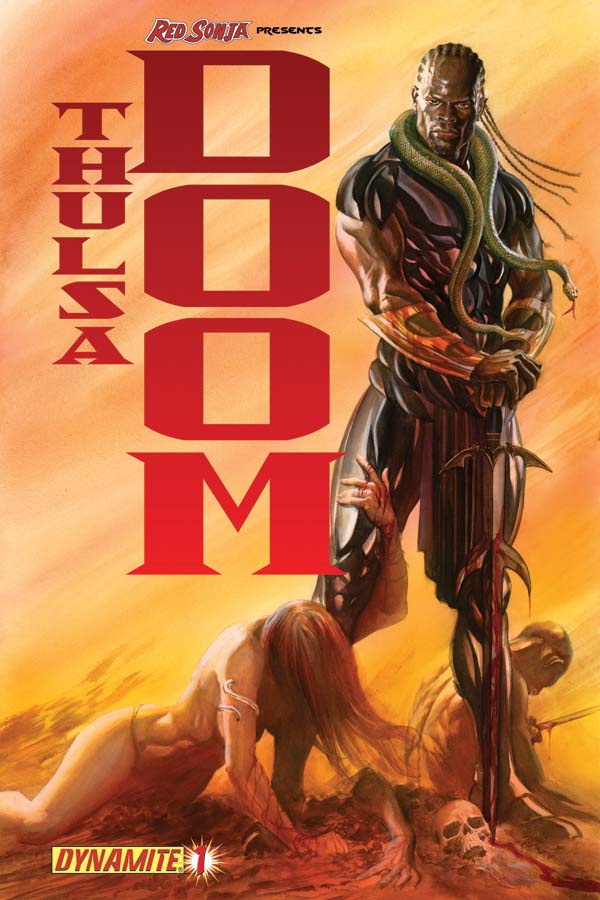
Thulsa Doom

Of all the villains who populated the books, comics, films and role-playing games of my youth, one figure stands head and shoulders above them all: Thulsa Doom.

Thulsa Doom was, what my mother would call, the evil baddie in the 1982 film Conan the Barbarian, which starred Arnold Schwarzenegger as Conan. I first saw the film at the cinema at the age of ten with my brother and my best friend Gus. Before going, I was terrified of being made to feel unwell by reports of gore and bloodshed, for I was pretty squeamish at that age and couldn’t bear the sight of blood. Gus, who had already seen the film, warned me of a scene with a soup made of human body parts. Funnily enough, I misheard him and thought he had said a “suit”. The soup, ultimately, was mild by comparison, and when I came to see the movie, perhaps on account of the gore being rather stagey and over the top, I enjoyed it thoroughly.

And there, before me, for the first time, was Thulsa Doom!

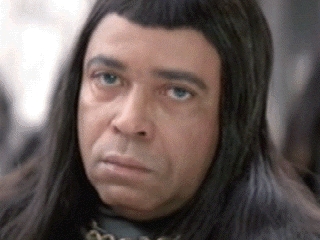
Thulsa Doom was, and still remains, an absolutely splendid villain. A god of sorts, with the ability to change himself into a giant snake, Thulsa Doom was more than a thousand years old. The leader, chief priest and guru of an ancient cult of snake-worshippers, he was a fearsome warrior, a demagogue, a philosopher, and a downright murderous son of a serpent. Played by James Earl Jones, with long black hair and a frighteningly square helmet fringe, decked out in chunky, adorned black leather armour, armed not only with two murderous, serpentine swords, but also with the voice of Darth Vader, he was certainly something to behold. Thulsa Doom had a mesmerising stare, an enchanting voice, and a wonderful way with words.

He first appears on the screen in the opening scenes of the film, in the frozen wastes of the Cimmerian north. Having, with his warband, raided and wiped out Conan’s village, Thulsa Doom approaches Conan’s poor mother, who stands defending her young son. Flanked by his two stalwarts, Thorgrim and Rexor – Norse metal-heads never looked so good – Thulsa Doom removes his horned helmet, revealing a noggin that seems curiously moulded to the shape of said headwear. The scene is a masterful combination of sad music, pathos and lingering stares. Thulsa Doom, without a word, hypnotises Conan’s fiercely defensive mother with his big, beautiful eyes, so that she lowers her sword and relaxes, in a sort of trance. Slowly turning, as though to walk away, he suddenly swings back in her direction, removing her head with the very sword we had seen Conan’s father forging through the opening titles, now taken as loot from his mauled corpse. Conan, looking up and into the face of Thulsa Doom as his decapitated mother falls beside him, is not about to forget either the visage or standard of his mother’s murderer in a hurry. Thus begins this epic tale of survival and revenge.

Despite its being something of a fantasy genre gore-fest, Conan the Barbarian is a surprisingly good film. It has its flaws, technically and dramatically, but written by Oliver Stone and directed by John Milius, it was a serious attempt to render the epic nature of the original Conan stories by Robert E. Howard. Beautifully shot and with a very moving soundtrack composed by Basil Poledouris, it feels at times more like a sword and sandal epic of the 50s and 60s than a fantasy genre film. The great sets and locations and the use of thousands of extras in vast crowd scenes, give its settings a very real and tactile quality, whilst the limited dialogue is terse and laconic, but nonetheless emotionally engaging. I was absolutely blown away by the movie when I first saw it, largely because I had, just a year before, started playing Dungeons & Dragons and reading a lot of fantasy literature. It was very much my cup of tea – an enthralling evocation of a fantastic world that felt authentically historical. Shortly after seeing the film for the first time, my brother and I began collecting the original Conan stories, which we were to read and re-read avidly through our teen years.

I went to see the movie twice at the cinema, and as soon as it was released on television, recorded it on the VCR and watched it repeatedly. I became so obsessed with the film that I kept a tally of how many times I had watched it in my diary – an early indicator of a life of mildly autistic behaviour! I learned the entire script off by heart, and could quote it from start to finish without prompting; aided, no doubt, by the relatively limited dialogue in the film. And, all the while, there was Thulsa Doom, looming large as my very favourite on-screen villain, even more so than Darth Vader himself.

The character of Thulsa Doom first appeared in Robert E. Howard’s Kull the Conqueror short story Delcardes’ Cat. Kull was a sort of precursor to Conan the Barbarian, a hero of the world prior to the destruction of Atlantis.

Thulsa Doom is described by Howard in The Cat and the Skull as being a large and muscular man (As he and Kull are said to be “alike in general height and shape.”), but with a face “like a bare white skull, in whose eye sockets flamed livid fire.” He is seemingly invulnerable, boasting after being run through by one of Kull’s comrades that he feels “only a slight coldness” when being injured and will only “pass to some other sphere when [his] time comes.” (Wikipedia)

Thulsa Doom later re-surfaced in comic-strip versions of Kull the Conqueror as his principal nemesis, wherein he is portrayed as a powerful necromancer through various editions.

In Oliver Stone’s film version of Conan The Barbarian, Thulsa Doom’s strength seems to lie in his antiquity, demagoguery and hypnotic presence as much as his magical powers.

http://bit.ly/TheStare

Thulsa Doom can not only transform himself into a snake, but can turn snakes into arrows, which he fires from his serpentine bow. His snake cult engages in the sacrifice of young nubile women to giant snakes reared, in some cases it seems, as pets by Thulsa Doom and his principal henchmen.

After a torrid youth spent strapped to the “wheel of pain” – http://bit.ly/WheelOfPain – followed by years in a brutal fighting pit, having excelled as a gladiator, Conan is trained in more delicate martial arts and given an education before being set free one windy night. It is not long before Conan, accompanied by his own henchies, in the form of Subotai and Valeria, has his first run in with Thulsa Doom’s snake cult and begins to plot his revenge.

Without wishing to describe the film in detail or at length, it will suffice to look briefly at  Conan’s ensuing encounters with Thulsa Doom, which are certainly memorable.

When Conan rather clumsily infiltrates Thulsa Doom’s cult and is captured, we are privy to one of Thulsa’s more eloquent outbursts. Having finished interrogating his battered and bleeding prisoner, Thulsa Doom proceeds to tell Conan of the power of flesh over steel. He summons one of his many female followers to leap from the cliff above to her death then, indicating her recumbent corpse, he says:

“That is strength, boy! That is power! The strength and power of flesh. What is steel compared to the hand that wields it?”

http://bit.ly/SteelVsFlesh

Having, in typically megalomaniac fashion, suggested that he himself was the source of all this power, Thulsa Doom admonishes Conan to “Contemplate this on the Tree of Woe,” before instructing his henchmen to “Crucify him.” An order that is duly and gruesomely fulfilled.

After having been rescued from the Tree of Woe, Conan and his companions make a murderous raid on Thulsa Doom’s compound, slaying many of his followers and guards. Thulsa Doom escapes by transforming himself into a snake, but, reverts to human form in sufficient time to shoot a snake arrow into Valeria, Conan’s lover, as they flee the scene, sated with the gore of their enemies and having liberated the princess they were seeking to liberate.

It is here that we are treated to one of Thulsa Doom’s more memorable lines; one I often find myself quoting when seriously pissed off.

“Infidel defilers. They shall all drown in lakes of blood. Now they will know why they afraid of the dark. Now they will learn why they fear the night.”

Conan, after a long night watching Valeria’s funeral pyre, now with even more reason to detest Thulsa Doom and wish him dead, prepares for the final battle amidst the mounds and gravestones of the ancient dead.

Yet the final confrontation does not take place in the ensuing, climactic battle, in which Conan slays both Thorgrim and Rexor, the latter wielding Conan’s fathers sword, taken at the start of the film. The sword is broken in a mighty overhead cleave by Conan, and, with Rexor dead, Conan retrieves it and holds it aloft.  That evening, he makes his way once again to Thulsa Doom’s impressive temple, at the so-called Mountain of Power. It is here, as Conan sneaks his way past the guards, aided by the charms and access of the errant princess, that we are treated to Thulsa Doom’s finest moment.

Standing before a vast crowd of thousands of extras in white robes holding candles, bellowing from atop the podium of his epic temple at the head of a grand processional staircase, Thulsa Doom makes the following speech:

“The purging is at last at hand. The day of doom is here! All that is evil, all their lies – your parents, your leaders, those who would call themselves your judges! Those who have lied and corrupted the earth! They shall all be cleansed. You, my children, are the water that will wash away all that has gone before. In your hand, you hold my light, the gleam in the eye of Set. This flame will burn away the darkness, burn you away, to paradise!”

http://bit.ly/ConanTheEnd

I am still deeply stirred when I hear this speech, and believe it has profoundly affected my rhetorical style over the years.

A short while later, Conan approaches from the shadows and comes face to face with Thulsa Doom. Thulsa Doom turns his benevolent smile and loving gaze upon Conan and tries to woo him with his honeyed words.

“My child. You have come to me, my son. For who now is your father if it is not me? Who gave you the will to live? I am the wellspring, from which you flow. When I am gone, you will have never been. What will your world be, without me, my son? My son.”

After being briefly seduced by those beautiful, snake-charming eyes, Conan looks down to his father’s sword and snaps out of hypnosis. With a look of sudden alertness, he promptly hacks Thulsa Doom’s head from his shoulders with his father’s broken sword.

It is a rather gruesome end for a villain, to see his head tossed like a hairy medicine ball down the steps of the temple, to flip and flop with an ugly wet sound, but the simple fact is, he sure had it coming. And as for Conan’s fate, well, that is another story…

Read Full Post »

This is a short assignment written in 2004 as part of my Masters in Creative Writing, for the compulsory unit in Culture and Writing. The aim was to take an anthropological approach to a personal experience in which one had been made to feel marginalised either deliberately or inadvertantly by a dominant narrative.

This brief essay is essentially an examination of the effects of assumed complicity in a form of mass identity and the difficulty in asserting an alternative voice in such a context. By assumed complicity, I refer to a situation where it is assumed by others that I share their identity and as a consequence am understood to share the same values and ideas. I wish to illustrate what I consider to be a tribal phenomenon with three examples. The first of these is an example of my assumed complicity in a shared masculine identity; the second my assumed complicity in a combined masculine and national identity, and the final example, by way of contrast, is a brief examination of the silencing of the masculine narrative and liberation from its identity constraints. I wish in all instances to highlight the difficulty or awkwardness in voicing an alternative attitude when confronted with a narrative that is strongly asserted by a group in a way that assumes my complicity and agreement with its basic tenets.

1. Assumed complicity in Rejection of the “Feminine.”


One such occasion was when I had reluctantly agreed to attend a double bill of the extended versions of the first two Lord of the Rings movies. I say reluctantly because I knew it would be an arduously lengthy experience at just over eight hours, but had decided to come on the grounds that I rarely had the opportunity to see two of my oldest friends whose idea it was that we should go. There were six of us in total, including three people I had not met before who were friends of my friend Mike. Having already purchased our tickets, we were queuing to enter the cinema itself when, pointing to a poster advertising the then upcoming release of Love Actually, Richard Curtis’ new film, one of these guys proceeded to remark: “By the people who brought you Four Weddings and a Funeral, Notting Hill and Bridget Jones’ Diary, as if anyone’s going to want to see that.”

My hackles rose instantly and I made no comment whatsoever. I had seen all three of these films and enjoyed them immensely, and as the other men chuckled around me in agreement, I turned away and pretended to be distracted by something else altogether. I was greatly angered that in making this comment, this chap expected my automatic complicity. I was also highly annoyed that my two old friends, who I had previously thought to be less prone to stereotypically negative masculine knee-jerk responses to romantic themes, were more than happy to share in this group derision.

I was about to speak and voice my dissent publicly when I realised that I honestly did not wish to engage in conversation with these other three guys I did not know, whom, in all likelihood, I would never see again. Not usually one to allow my opinion to go unheard, at the first opportunity I voiced my enthusiasm for these films separately to my friend Mike, and made clear my intention of seeing Love Actually, yet publicly I felt silenced by this aggressive masculine derision, however casually and playfully it was initially voiced.

As a consequence of my annoyance at having this narrative imposed upon me, the rest of the crowd seemed to take on a more menacing form. Here suddenly were devotees of the action movie genre, not people with a romantic imagining of Tolkien’s books as they might possibly have been only a few moments ago. As a consequence, I ended up leaving after the first film, feeling out of place in this group and no longer wishing to participate in this popular event.

2. Assumed Complicity in a Muscular National Identity

It was the opening night of the Rugby World Cup and Australia was playing Argentina. I had originally made plans to see a film that evening, but soon after arranging this I received a phone call from a friend urging me to go and watch the match at the Nelson Hotel in Bondi Junction. I pointed out that I already had plans and was going to a movie, and was then subjected to playful derision over my priorities. “Mate, you’ve gotta be joking, it’s the first night of the world cup and Australia’s playing. You can see a film any time.” This conversation continued for some time, and in the end I reluctantly agreed to go to the pub. I was not averse to watching rugby, but rather my reluctance stemmed from the desire to avoid large groups of drunk blokes shouting at a television and engaging in mind-numbing forms of chanting. Having worked in a pub for three years in England, I had been shocked by the zeal of sports fans and what I considered to be the rude and barbarous behaviour they exhibited. It had filled me with a strong distaste for English sports fans, and yet, in a sense, it was not as confronting as seeing my own countrymen behave in the same way, for in the latter instance, they were likely to assume my complicity in their behaviour.

Upon entering the pub, I was instantly plunged into an environment in which the hegemonic narrative was nationalism, and the sub-plot, jovially aggressive masculinity. I was not in any way afraid of the environment, I simply had a distaste for its lack of sophistication – a consequence of my own pretension. Here was a tribal environment, mostly white males wearing Australian colours and already boisterous. I was not out of place, and it was in fact partly for this reason that I felt disappointed, for I did not want to be included in the tribe. I considered myself to be a disinterested observer of a contest, and may the best team win.

It was hardly surprising therefore when, once the game was under way, all decisions by the referee that went against Australia were greeted with mass, loud shouts of protest, however reasonable the decision. I felt as though my reason had been silenced by this tribal identity in which I was expected to be complicit, because, with the exception of two Argentineans, no one wanted to hear me state that the decision was in fact fair and reasonable. By the time the game was over, I had had more than enough of this type of asserted mass identity and was quite determined that it would be a very long time before I again attended an event in which national fervour was paraded at the expense of reason and in which I was expected, by my presence, to share values and interests with people I felt I had nothing in common with at all and did not wish to associate with.

My internal reaction within this setting was a consequence of my own prejudice and I was aware that my distaste for this type of behaviour was unfair. It was a common enough, often entirely harmless celebration of unity, and as much an act as anything else. It was an opportunity to perform as a part of a common narrative with a recognisable structure, yet it was a narrative in which the protagonists were stereotypes and caricatures; the product of self-imposed reduction. It was unreasonable to turn up and expect otherwise, but the singularity of purpose and degree to which people took the matter seriously astonished me. In the end I had little choice but to participate passively, for the simple fact that no one really wanted to talk about anything else.

3. The Silencing of the Masculine Narrative: A Liberation.

The final example is particularly close to home, but one that struck me as worth some discussion; namely, the phenomenon of my being the only male in my particular class for this course.

I had not realised the scale of the gender imbalance until I sat down and the lady sitting next to me stated, “gee, you’re a bit outnumbered here.” At this I took a good look around the room and realised that I was in fact the only male present. Four more students entered after this point and they were also all female. When later I came to think about the class composition in more detail, I realised that my reaction to this situation was complex and occurred on many different levels, almost all of which were positive.

At a most basic level, it was titillating to be the only man in a room full of women, and the absence of other males ensured precisely the sort of monopoly I was genetically programmed to desire! Yet I was also marginalised in a way that gave me a heightened awareness of my gender. Whilst everyone proved open and welcoming, there was still a sense initially of being an outsider and I was concerned that I might feel isolated should the debate concern gender issues and I were to find myself at odds with general opinion. This was not something I expected, and fortunately did not prove to be the case. Instead, in assessing my position in the class it became clear that I was, in fact, made more comfortable by the absence of other males.

There were a number of reasons for this, the most prominent of which was the absence of another individual that I might be expected to bond with at the level of gender. Not having any natural ally in this sense made it more much more difficult to adopt a masculine attitude. There was no one whose natural agreement I might seek, or who equally might seek mine.

Viewed from another angle, however, as the only man present there was a certain pressure to appear representative, either broadly, or typically. This was another form of imposition whereby it might be assumed that I was a party to the extant masculine narrative. Yet, the significant difference was that I had more freedom to undermine and circumvent that identity, for here there was not so much a direct assumption of complicity, but rather a sort of challenge to prove a lack of complicity. Without the cacophony of an imposed masculine identity and its attendant necessary exchanges, I felt more at ease to project a masculinity with which I was comfortable.

Read Full Post »

The following is a rather pointless essay I wrote in 2004 for an exercise on cultural artefacts during my Masters in Creative Writing. It may prove diverting if the paint is drying too slowly.

Loved and Loathed

The Straw Boater Hat


Introduction

The Boater hat is an item of clothing that has been both loved and hated. Throughout the hundred and fifty odd years that this style of hat has been in existence, it has been viewed at various times as a charming item of leisure wear for men and women, as an effete symbol of privilege as a compulsory article of school attire, and as jaunty accoutrement for barbershop quartets, vaudevillian performers and appreciators of haute couture. Now generally relegated to the status of a nostalgia item only sported on occasions such as the Henley Royal Regatta, the boater’s has been a curious journey which has seen the social significance of this artefact change dramatically.[1]

In a recent work entitled The Man in the Bowler Hat, Fred Robinson noted that the Bowler hat is “rich with its various and (seemingly) contradictory meanings; its iconographic vocabulary is complex.”[2] I would argue that this statement is equally true of the boater hat, although its dissemination and multivalency are not as great as that of the bowler. With that in mind, what I would like to establish in this essay is a brief and wholly inadequate ethnography of the boater hat and the various significations of this particular cultural artefact. My examination will focus on the history of the boater hat with particular reference to its role as a component of school uniform, followed by an examination of the boater as a part of the uniform of Cambridge punt chauffeurs, as an example of its survival as an item of contemporary attire.

The following is a recent internet advertisement for the Boater hat as a prestige item of stylish gents and men of status and influence.[3]

Straw Boaters are back. This is the famous Straw Boater hat worn by politicians and stylish men alike after the beginning of the last century. Sometimes called Straw Sailor Hat, or Skimmer, this high quality hard Straw Boater hat is blocked into the classic boater shape in Italy. Watch for this hat on your favourite Barbershop Quartet. Don’t be fooled by our low price; this is the genuine article and the best available. This Italian Boater comes with a satin lining on the inside top and a leather sweatband.

The History of the Boater

The hat has long acted as a particularly potent symbol and signifier of social status. As is the case with any item of clothing, it is also subject to the dictates of fashion and as early as 1822 Lloyd in the Strand was offering forty-eight different styles of hat to their customers.[4] Apparently originating in the Bedfordshire town of Luton, the boater was distinguished by its particular manufacture; namely, plaited straw coiled into a mass which was then moulded into the ‘boater’ form.[5] The boater hat typically sports a not insubstantial flat brim topped with a flattened pill-box crown, surrounded by a ribbon band. Surprisingly tough for a light, cool hat, the boater is believed to derive from the flat-topped caps of French sailors and was first adopted as children’s wear in the middle of the nineteenth century.[6] The boater gradually established itself during the second half of the nineteenth century as an item of leisure wear for both men and women and was mostly worn during informal occasions. Indeed the introduction of the boater, along with the homburg and fedora hats, marked a general adoption of informal hat styles. The manner in which the boater was worn was of particular importance for both men and women, with fashion generally dictating a rakish angle and debate being centred around exactly how far forward and how far to the side the hat should be worn.[7]

The popularity of the boater reached its height during the period 1880-1930, though it was already in decline by the end of the First World War, after which it was eclipsed by the panama and the trilby.[8] During this time the boater managed to find its way into the wardrobes of many different social classes both in Britain and abroad. When British schools began adopting it as part of their uniforms in the 1880s, the boater took on a new association which perhaps gave it its most distinct character and significance. Initially schools adopted the boater for wear during the summer term, decorating it with a ribbon in the school colours, yet for some it became a year-round feature of school attire and in many cases the boater was preferred to the much more formal top hat and was considered more than just a cut above the ubiquitous school cap.[9]

The Boater as School Uniform

As was noted above, the boater was widely adopted as a compulsory part of school uniform as early as the late nineteenth century and was on the whole greeted positively as a consequence of its not being so formal. The popularity of this hat soon led to an inevitable reduction in its exclusivity and many schools dropped the boater from their uniforms when it was adopted for orphanages.”[10] Many schools, nonetheless, retained the boater as a compulsory part of their uniform and with its diminished popularity as an adult style after the 1930s, the boater was most commonly to be found on the heads of English public school children, both male and female.

Curiously enough, it was not until after the Second World War that the boater established itself as one of the most potent symbols of public school privilege and came to be regarded as an article denoting superiority. This phenomenon is marked by the abandonment at Eton College of the silk top hat in favour of the straw boater shortly after the war.

A particularly interesting aspect of the school boater was its sheer impracticality. Rather than the high-crowned boaters common as an item of costume for adult men, the school boater for both boys and girls tended to be particularly flat, with a very low crown, which, coupled with the fact that they were rarely made to measure, meant that they sat with some difficulty upon the head. As a consequence, it was often necessary to secure the hat with cords or elastic to ensure it remained on the head.[11]

Boys from Harrow School.[12]

Colin Symes and Daphne Meadmore have argued that “…the school uniform is something of an anomaly, conferring on its wearers a state of deference and dependence that denotes them to be the subjects of administration rather than its architects.”[13] They further note that “…the wearing of uniform generally denotes inferior rank and status, with the right to wear ‘normal’ dress one of the privileges being conferred on the figures in authority.”[14] One is inclined to wonder if the intrinsic impracticality of the straw boater came to be favoured by English public schools as a contradictory symbol denoting extra-mural privilege, and intra-mural subjectivity.

Boaters as worn by students of Kent College in Canterbury, c. 1952.[15]

The impractical design of the boater, had, however, one important advantage. The low, flat, stiff form of the boater also made it ideal for being tossed in the manner of a Frisbee. According to Alexander Davidson, it was commonplace for boys to amuse themselves by skimming their boaters under passing buses with the object of having it pass through to the other side.[16] Naturally, there must have been many incidents where this aim was not achieved, and in many instances, an unsuccessful throw might well have resulted in shouts of delight from the boater’s owner, for amongst school boys forced to wear them, the boater was commonly despised. Rather than acting as an artefact commanding respect, throughout the post-war period in particular, the boater became an object of derision in a world which had become less forgiving of effete signifiers of privilege and it was often despised equally by those forced to wear it and those who saw it worn. So hated was the boater by some students that they ritually burned it when their schooling had finished.[17]

The aggression and derision brought upon dayboys who were forced by school rules to wear their boaters at all times outside of school grounds only increased this resentment. Kent College in Canterbury insisted on the wearing of boaters well into the 1970s. The 1985 Centenary Book carried this reminiscence from a dayboy who enrolled at the school in 1967:

Stiff as a board, uncompromising, blatantly assertive (and impossible to hide -it would not even fit in a briefcase) it was a symbol of the worst aspects of the public school ethos… One evening I was walking home with my boater perched awkwardly atop my head like an inverted nest when a boy from the local secondary modern school grabbed it and sent it spinning across a field. To the wearer the hat was an embarrassment – to the beholder, an object of ridicule.[18]

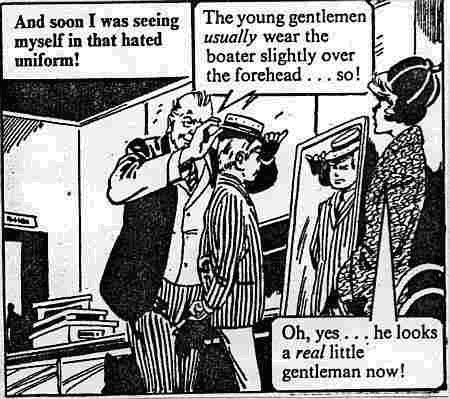
The following panel from a comic strip of 1970 is a fine illustration of the negative social consequences of being marked by such an obvious signifier of privilege.[19]

As a consequence of its unpopularity and increasing levels of harassment, most schools abandoned the straw boater as a compulsory part of uniform during the 1970s, although some schools, such as Harrow still enforce wearing of the boater.[20]

Life is a Cabaret, Old Chum

Roland Barthes argued in “The Diseases of Costume,” that “in all the great periods of theatre, costume had a semantic value; it was not only there to be seen, it was also there to be read, it communicated ideas, information, or sentiments.”[21] This is certainly true of the boater hat as it was of the bowler. The ubiquitousness of the bowler hat, and its many and varied uses by the upper, middle and working classes primarily throughout the period 1850-1950, enshrined it as a symbol of modernity. Indeed its ubiquity made it one of the preferred props of entertainers of both the stage and screen, usually for comic purposes, because it can be used so successfully to represent such a multiplicity of different caricatures.[22] Barthes points to the relationship between the item of costume and “what Brecht calls its social gestus, the external, material expression of the social conflicts to which it bears witness.”[23] When used as costume by performers, the boater and the bowler are capable of lending the wearer automatic recognition as one of the agents of a multiplicity of social situations and conflicts.

In the 1920s and 30s, the boater became synonymous with the French chansonier and actor Maurice Chevalier. Maurice Chevalier leaves us with perhaps the most enduring image of a boater, or canotier as it is known in the French, tipped forward almost to the point of blindness above his jutting lower lip.[24] The hat generally had always been a significant prop amongst entertainers. Indeed the earliest vaudeville acts took the form of chapeaugraphy, an act using only a crownless, adjustable hat rim which was manipulated to assist in impersonations of the innumerable hat varieties and the type of person signified by the wearing of a particular type of hat.

Changing his expression to suit each new shape, the chapeaugraphist was able to portray dozens of different characters – male and female, haughty and abject – in quick succession.[25]

The success of chapeaugraphy lay in the fact that until the second World War hat-wearing and hat culture was a part of every day life.[26] The significance of the hat as an essential item of everyday wear cannot be underestimated.

Having been so long established as a staple prop of stage, vaudeville, and barbershop, it is hardly surprising that upon first trying on a boater hat, I immediately started to impersonate a tap-dancer then burst into song, and had I at the time been armed with a full-length umbrella, I should certainly have swung this by the handle and perpetrated further acts of mock-vaudevillian silliness. This seems to be something of a universal phenomenon, at least amongst my own circle of friends, who I do not wish to suggest are representative of the wider public, for whenever I have a guest, should they happen to pick up the boater out of curiosity to place it upon their heads, they almost invariably tilt it forward across the forehead, break into a brief little step or two, and occasionally go so far as to drop to one knee and throw their arms wide in expectation of applause.

Having long been abandoned by most schools as a part of school uniform and with the retreat of vaudeville stage act to nostalgic obscurity, the boater primarily survives in its original informal role as an item of leisure wear. Whilst something of a sartorial anachronism there is, nonetheless, a degree of mobility in the way it is perceived as the negative associations of compulsory boaters recede, leaving it free to exist purely as an article of fashion.

The Cambridge Punt-Chauffeur’s Boater

On the river Cam in Cambridge the boater is still worn by the punt chauffeurs who provide tourists with river tours throughout the year.[27] Both of the major punting companies, Tyrrells and Scudamores, include the boater as a compulsory item of uniform. The uniform is subject to seasonal variations and occasional innovation, but generally consists of a pair of light tan trousers or long shorts, a white collared shirt and a waistcoat, and of course, the boater. Whilst the punt chauffeurs are strongly encouraged to wear the boater at all times, the uniform regulations are not heavily enforced and it is not uncommon to see punt chauffeurs without boaters. Nonetheless, the majority of punt chauffeurs do wear the boater, creating an affable image of leisured decency, lending formality without the stifling austerity of school attire.

Whilst chauffeurs essentially perform a service role and are expected to show respect for and deference to customers, their position is also a prestigious one for they are generally understood to be University of Cambridge students and the University’s reputation is usually sufficient to ensure an immediate expectation of good character. More often than not, however, Cambridge punt chauffeurs are in fact “townies” or travellers on a working holiday. The reinforcement of a sense of tradition which the boater provides, combined with the context in which the chauffeurs are employed, helps to maintain a deception which many punters actively encourage by falsely claiming to be a member of a particular college. The costume also helps to discourage the tourists from feeling that they are in some way being tricked should the accent of their punt chauffeur not match the well-honed aristocratic tones they were expecting.

Apart from reinforcing what is perceived to be an English tradition, the boater lends an element of the entertainer to the chauffeur, who acts throughout the trip as a tour guide, providing detailed information on the history of the university and the colleges along the river. Thus, within the context of the river Cam, the punt chauffeur enjoys a combination of the prestige of the university and the vaudevillian performer, both of which are exploited according to both the mood of the chauffeur and their captive audience. Many chauffeurs take the opportunity to spice their tour with banter and regale the passengers with saucy anecdotes about student life.

Indeed, before his dismissal, one punt chauffeur with whom I was acquainted, Bradley, was notorious for inventing the entire tour whenever chauffeuring groups with very little or no English. Armed with and no doubt emboldened by his vaudevillian prop, Bradley on one occasion declared that Kings’ College Chapel was in fact an illusion constructed through mirrors which had been erected by the Germans during their occupation of England in 1943. Bradley was also notorious for re-naming the bridges after his close friends.

On the whole, amongst the Cambridge chauffeurs the boater is treated more with amusement or pride than derision, and during a long summer day spent touting and punting, it affords valuable protection against the sun. It also affords basic amusement on slow days as it can be tossed about, swung upon the forefinger, or flipped, donned and doffed in emulation of those entertainers who have given hats such as the boater their distinctive meaning and style.

Yours Truly.


Bibliography


Appadurai, Arjun, The Social Life of Things: Commodities in Cultural Perspective, Cambridge, 1986.

Barthes, Roland, “The Diseases of Costume,” in Critical Essays (1964), trans. Richard Howard, Northwestern University Press, 1972.

Alexander Davidson, Blazers, Badges and Boaters: a Pictorial History of School Uniform, London, 1990.

Ginsburg, Madeleine, The Hat : Trends and Traditions, London, 1990.

Glassie, Henry, “Artefacts: Folk, Popular, Imaginary and Real,” in Marshall Fishwick and Ray B. Browne (eds.) Icons of Popular Culture, Ohio, 1970.

Harrison, Michael, The History of the Hat, London, 1960.

Hopkins, Suzie, The Century of Hats : Headturning style of the Twentieth Century, Sydney, 1999.

McDowell, Colin, Hats : Status, Style, and Glamour , New York : Thames and Hudson, 1997.

Probert, Christina, (ed.) Hats in Vogue Since 1910, London, 1981.

Robinson, Fred Miller, The Man in the Bowler Hat : his History and Iconography, Chapel Hill, 1993.

Shields, Jody, Hats : a Stylish history and Collector’s Guide, portraits by John Dugdale, additional photographs by Paul Lachenauer, New York, 1991.

Symes, Colin & Meadmore, Daphne, “Force of Habit: the School Uniform as a Body of Knowledge,” in Erica McWilliam & G. Taylor (eds.), Pedagogy, Technology and the Body, New York, 1996.


[1] Suzie Hopkins, The Century of Hats: Headturning style of the Twentieth Century, Sydney, 1999, p. 48.

[2] Fred Miller Robinson, The Man in the Bowler Hat : his History and Iconography, Chapel Hill, 1993, p. 3.

[4] Colin McDowell, Hats: Style, Status, and Glamour, New York, 1997, p. 98.

[5] Michael Harrison, The History of the Hat, London, 1960, pp. 162-3

[6] Harrison, The History of the Hat, pp. 162-3.

[7] McDowell, Hats, p. 83.

[8] McDowell, Hats, p. 221.

[9] Alexander Davidson, Blazers, Badges and Boaters: a Pictorial History of School Uniform, London, 1990, p. 32.

[10] Harrison, The History of the Hat, pp. 162-3; Christina Probert, (ed.) Hats in Vogue Since 1910, London, 1981, pp. 55-56.

[11] Davidson, Blazers, Badges and Boaters, p. 32.

[12] Davidson, Blazers, Badges and Boaters, p. 31.

[13] Colin Symes, & Daphne Meadmore, “Force of Habit: the School Uniform as a Body of Knowledge,” in Erica McWilliam & G. Taylor (eds.), Pedagogy, Technology and the Body, New York, 1996, pp. 171-191; p. 176.

[14] Symes, & Meadmore, “Force of Habit,” p. 178.

[15] Davidson, Blazers, Badges and Boaters, p. 30.

[16] Davidson, Blazers, Badges and Boaters, p. 29.

[17] Davidson, Blazers, Badges and Boaters, p. 28.

[18] Davidson, Blazers, Badges and Boaters, p. 35.

[20] Hopkins, The Century of Hats, p. 48.

[21] Roland Barthes, “The Diseases of Costume,” in Critical Essays (1964), trans. Richard Howard, Northwestern University Press, 1972, p. 41.

[22] Robinson, Man in the Bowler Hat, pp. 1-12.

[23] Barthes, “The Diseases of Costume,” p. 41.

[24] McDowell, Hats, p. 83.

[25] McDowell, Hats, p. 73.

[26] McDowell, Hats, p. 73.

[27] Hopkins, The Century of Hats, p. 48.

Read Full Post »

Bilby 2.0

I have always had a fondness for soft toys. As a child I had many soft toys and slept with no less than twenty on my bed every night. Mostly I was into tortoises and from the age of four used to carry a very large quilted tortoise around with me everywhere I went. It was at least two and a half feet long and a foot and a half wide, and thus spent much of its time misshapen as I squashed it under my arm. Papa Tort, as he was known, was later joined by the very thoroughly stuffed, bright red Mama Tort, who begat Tootaloo and Uncle Tort and so on… My soft toys were collectively known as The Favourites and, not only were they a great comfort to me as a child, they were also good conversationalists.

The Favourites still reside at the family home, known to us as the Workers’ Socialist Democratic Republic Paradise of # Furber Rd. Sadly, however, they have suffered the rather ignominious fate of being stuffed into garbage bags and buried deep in the cupboard.

My fondness for soft toys remained undiminished into adulthood. All too often I have rescued soft toys from the street and taken them in. One hot night in Alexandria, in the summer of 1992, my friend Simon and I were wandering the streets on some rather intense, highly hallucinatory acid, when we stumbled upon a large hippopotamus abandoned on top of an old oil heater. The poor Hippo had a badly wounded leg and was in dire need of medical attention, so we took him home and got our housemate Zola to bandage him up. We dressed him up in a waistcoat and tie and Hippo soon became our mascot. He lived a royal life in that house and later moved with me to Erskineville and Glebe.

Around the same time as I found Hippo, I also found Bünchen, a small white rabbit discarded from an Easter display at David Jones. I was working in the food-hall at the time and found poor Bünchen lying, dirty and neglected beside one of the bins in the back docks. Little did she know what a glorious future awaited her!

When I left to do my PhD at Cambridge in 1999, Bünchen accompanied me, along with a more recent soft toy acquisition – the indomitable Platypus, known broadly as Platty. Bünchen and Platty made a terrific team and found their way into my now legendary travel bag on many occasions. The two of them travelled to New York, Paris, Strasbourg, Budapest, Istanbul, Amsterdam, Barcelona, Venice, Verona and Rome just to name a few places. I was especially fond of them and often used them as photographic subjects. It was my then girlfriend Liz, a scholar of German history, who gave Bünchen her name – a sort of comedy German diminutive for “Bunny.”

When I lived in Rome in 2003, Platty and Bünchen became quite famous amongst the other inhabitants of the British School. They had their photos taken in a number of archaeological sites and other such desirable locations. They returned to Australia with me in 2003 and then returned with me to England in 2006. Again, during the following two years, they travelled with me to many different places.

One day in 2008, I was coming down the stairs of Kogarah railway station in Sydney when I spotted a soft toy lying on the stairs. The poor fellow had obviously been dropped by some child on the way, but as there were no children about, I figured he might well have lain there for some time. I was uncertain as to what he was, looking rather like a large-eared, pointy-nosed mouse, but I picked him up all the same and took him into my care. I soon discovered from his label not only that he was a bilby, but he was a McDonalds happy meal toy.

Ah, Bilby! I was instantly very fond of him and placed him inside my manbag. He seemed so at home in there that I took him with me everywhere, everyday. When I travelled to Singapore, Cambodia, Vietnam, Thailand, Macao and Hong Kong in 2009, it was Bilby who accompanied me. Despite the humidity, he thoroughly enjoyed himself and returned safely, a wiser and better travelled Bilby.

When I left for India for two months in March 2010, it was only natural that Bilby accompany me. He found his way once more into the legendary travel bag which has done no less than 50-odd foreign trips since 2000. It was an incredible and at times harrowing trip, but I made a particular point of keeping Bilby safe the whole time. Indeed, I didn’t lose a single thing and was careful with all my possessions, but Bilby earned special “Bilby checks” to make sure I hadn’t forgotten him or that he hadn’t somehow fallen from my bag. He was as important to me as my passport.

When I returned from India, Bilby returned to my manbag. Whilst, like me, he suffered from terrible wanderlust and incurable restlessness, he was good enough to be patient, to a point. Then, sadly, tragedy struck. Early in January of 2011, I was reaching into my manbag to get something and realised I couldn’t feel Bilby in there. I had a closer look, upended the bag and emptied its contents, but there was no Bilby to be seen. I immediately feared the worst and looked everywhere for him. He was nowhere to be found at home, at work, and, well, I could hardly search every bus, train, street and stormwater drain in Sydney for my poor little friend. I soon came to the conclusion that he had most likely fallen out, or, indeed, run away, at some point during New Year’s Eve, when, high as a kite, and cycling around town, I regularly reached into my bag to pull things out.

I was devastated, and when it dawned on me that there was no hope left of him turning up somewhere, I turned my thoughts to replacing him. My first port of call was McDonalds, to see if they had a direct merchandising section on their website, where past Happy Meal toys could be purchased. They did not – at least, not beyond the current and previous offer. I turned to Ebay, finding to my surprise a vast array of Happy Meal toys for sale – almost twelve hundred hits – but not a single Bilby.

It was at this point that my despair reached a new peak, so I returned to McDonalds and wrote the following e-mail to them.

Dear McDonalds,

My query is regarding a happy meal toy, more specifically, the Endangered Species series you had on offer about two years ago. I have recently been devastated by the loss of my Bilby. He and I travelled through the whole of South East Asia and India over the last two years and I was especially fond of him as a good luck charm and photographic subject when nothing else would do. I would dearly like to replace him, despite him not being the original, intrepid and well-travelled Bilby who was so loyal to me through so many difficult situations. Is there anyway I can get hold of a replacement Bilby? I cannot find a direct merchandising website for McDonalds and nor can I find a Bilby amongst the many thousands of McDonalds happy toys being sold on E-Bay. If you could help me in any way, I’d be very grateful.

Yours,

Dr Benjamin Cornford.

I sent the e-mail with more hope than expectation and when, after a couple of weeks, I hadn’t heard back from them, I was ready to give up and was close to getting over the loss of Bilby. Imagine my surprise when one morning, three weeks after sending the e-mail, just as I was leaving for work, I received a phone call from a girl at McDonalds. “We’ve spoken to our distributors and they’ve managed to find you a bilby,” she said. I was overjoyed and thanked her profusely.

“Just put some money in the Ronald McDonald House charity box next time you’re in McDonalds,” she said, which I did, next time I passed.

Two days later, a brand-new, cherry-ripe Bilby arrived in the post. It was a wonderful moment and I held him close; a powerful symbol of sentiment, loss and recovery. I don’t have much money and there are few possessions I hold dear, but the Favourites have always been special to me. I love them as much as pets.

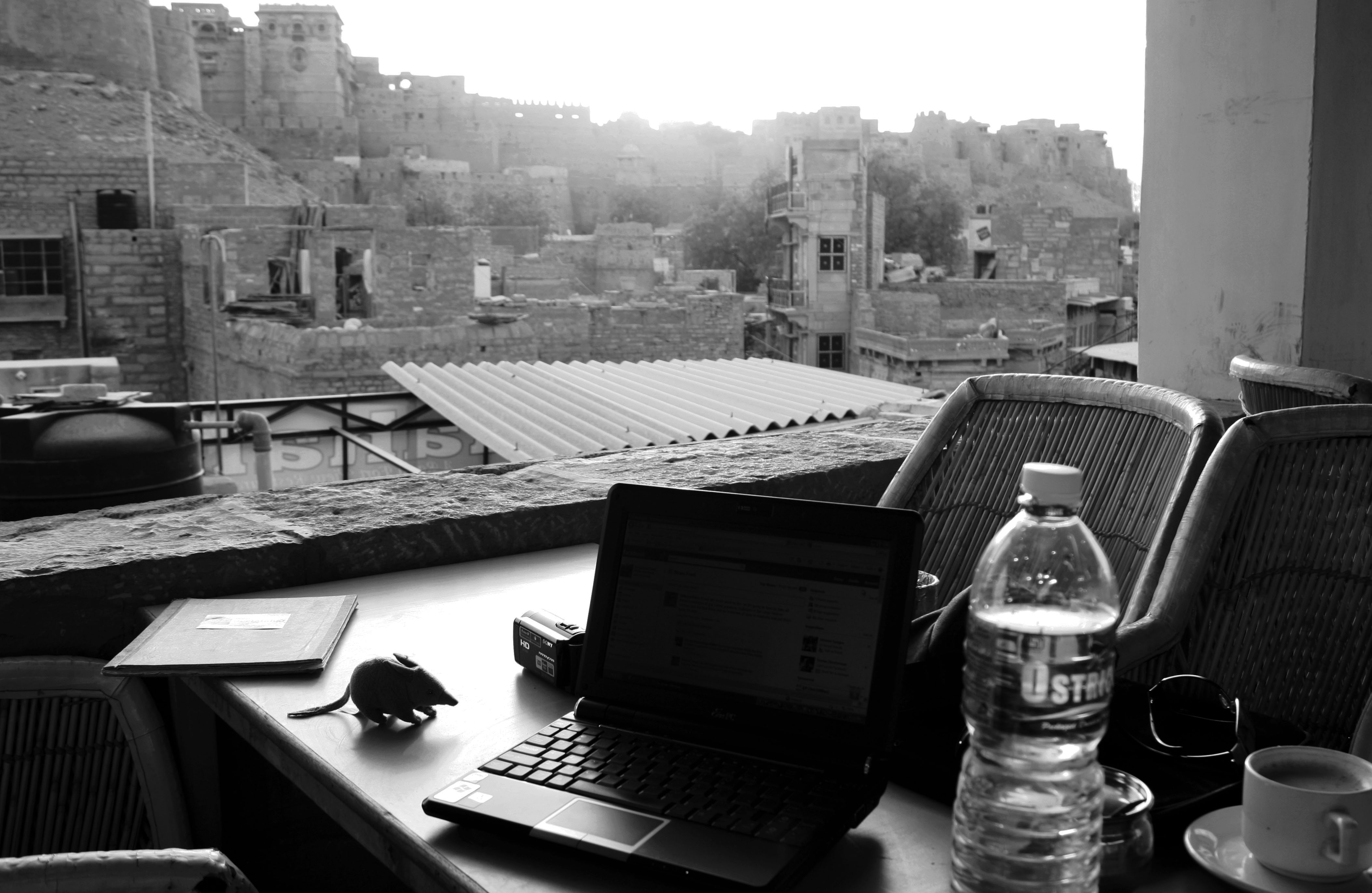
As I write, Bilby 2.0 sits beside me on my desk. After his arrival, I carried him in my bag for three weeks to make him look a little more travelled, and despite the fact that he is not the original and the best, he looks identical and that’s good enough for me. I never thought I’d say this, but, Thankyou McDonalds. Their customer service dedication deserves high praise, though I’m sure they just thought I was some troubled person with an autistic spectrum disorder.

Long live Bilby! And all the many Favourites, for that matter.

Read Full Post »

« Newer Posts