Feeds:
Posts
Comments

Archive for the ‘Favourite Shots’ Category

Three young men, Shekhawati, Rajasthan, India, April 1, 2010

Three young men, Shekhawati, Rajasthan, India, April 1, 2010

This shot was one of many wonderful gifts given to me by Indian people during my first trip to India in 2010. Being generally pretty shy when it comes to strangers, I tend to photograph people furtively, from a distance, rather than shoving my camera in their face. This means that most of the time I get candid shots of people whose attention is elsewhere and not focussed on the camera. For the most part this is great, and I generally prefer candid shots of people doing whatever it is they are doing, yet sometimes the lack of eye-contact deprives the photo of the arresting intimacy that direct portraits can offer. Fortunately, in India, many people ask to have their photo taken, which makes it possible to get some lovely portraits, without any feelings of guilt or, at worst, exploitation.

These three young boys approached me in the  Rajasthani town of Shekhawati, famous for its gorgeously decorated old Havelis – a type of private mansion common in parts of India and Pakistan. They were curious as to where I was from and, as with so many Indians, wanted to know what I thought of India. After a brief exchange, they all requested that I take their photo and quickly arranged themselves in front of the camera. I remember how excited I was at the time, because they were such great subjects with their immaculate, wonderfully styled clothes and their friendly, expressive faces. I wanted nothing more than to take their photo, and yet would likely have been too shy to ask myself.

While all three make engaging subjects, I especially like the fact that the young man to the right of the frame chose to look away at the crucial moment, thus adding an unexpected dynamism to this triple portrait. His cocked leg and crossed arms give him an air of confident nonchalance, which matches his carefree smile. I only wish I had time to ask who their tailor was, in which case I’d have had enough shirts and trousers made to last me a life time. What clothes!
Read Full Post »

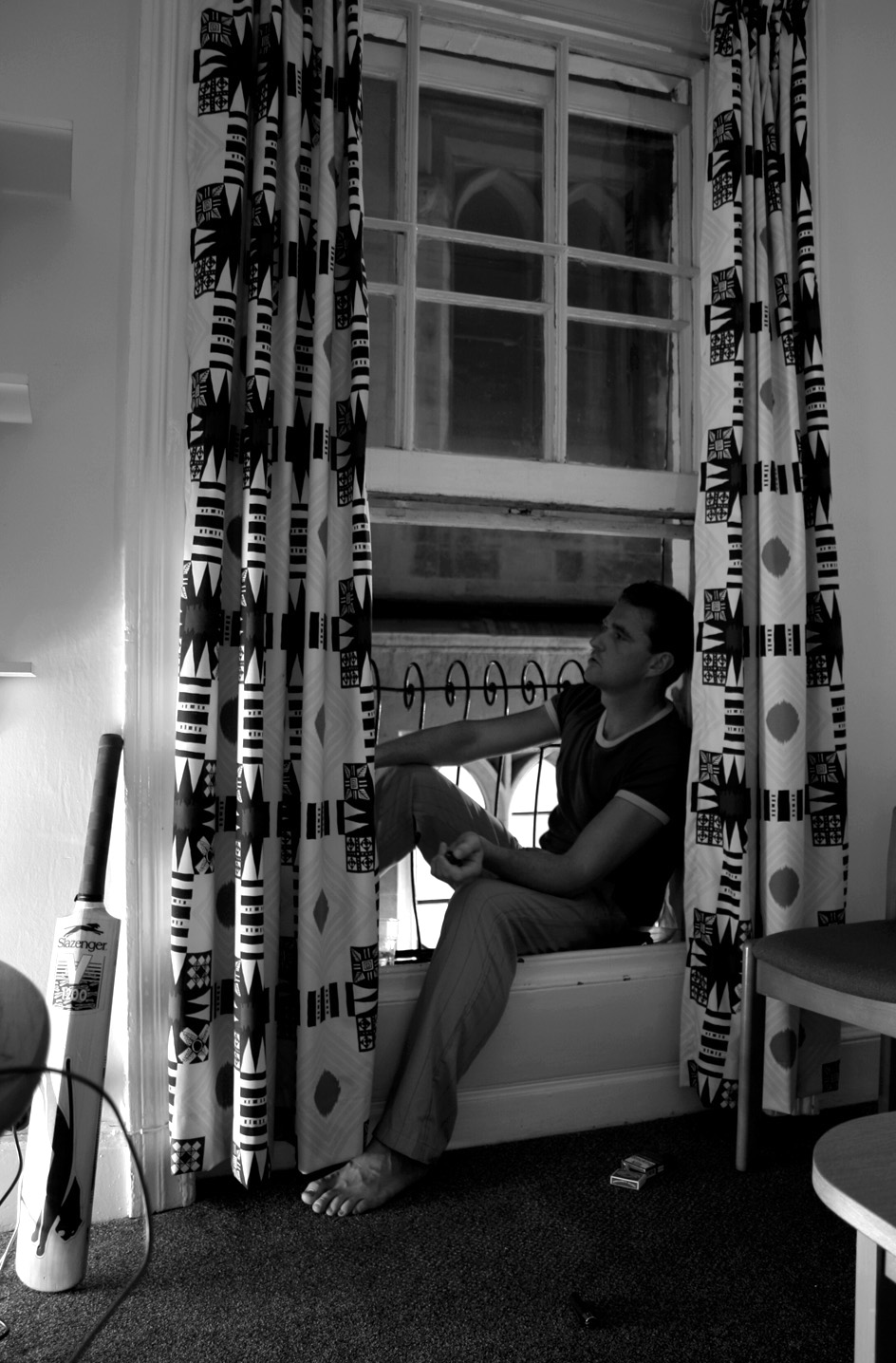
Self-Portrait, All Saints Passage, Cambridge, July 25, 2006

Self-Portrait, All Saints Passage, Cambridge, July 25, 2006

Though it may at first appear otherwise, this is not an elsie but a selfie. If you look closer you’ll see I’m holding the remote control in my left hand, whilst trying to act as candidly as possible. This is perhaps made easier by the addition of the cigarette, one of the occasional smoky treats enjoyed in what was to be my final phase of smoking. I’m sitting in the second-floor window of a house in the very narrow All Saints Passage in Cambridge, England, no doubt wondering what on earth to do with myself.

This photo has always been a personal favourite – it’s the only shot I have of myself in this house, where I lived for just over a month in the long and beautiful English summer of 2006. Having arrived back in Cambridge six weeks earlier, after a two and a half year absence, I relied on the charity of close friends and my old college, rather unexpectedly finding myself co-lecturing a summer school on South African literature, before finally settling into another house for a longer haul. My friend C and I had a lot of fun during this time, and, indeed, in this house, and we still occasionally refer with great affection to “The All-Saints Passage Years”. Though it may seem to be a deliberately placed prop, symbolic of the college context, the cricket bat is entirely accidental.

This low window, with its protective grate, was a splendid place to sit and smoke and watch people walk down the passage. It was a warm summer and I was still running on the energy of having made big decisions – clinging tenuously to a new life in England; or, rather, a nostalgic attempt to recapture the old. As will most such grand projects, it all ended rather disappointingly a couple of years later, but I still recall with great pleasure the intensity of the time and its romance. Ambition should be made of sterner stuff!

Read Full Post »

6928 Vita in St Peters

St Peter’s, Vatican, October 3, 2013

By way of a very loose narrative thread, Number 47 finds us still in Rome, albeit, Vatican City. On the subject of narrative, I recently found myself teaching the “Kuleshov Effect”, more broadly known as montage, wherein narrative is constructed by the viewers themselves as suggested by the sequence of shots. I have never set out to construct any story through the sequence of my Favourite Shots, yet it used to be a favourite pastime of mine to watch random slideshows of photos from throughout my life and find threads in them. Often a story would present itself in a run of places, characters and moods that reordered history into new possibilities.

This shot was taken inside St Peter’s early on a weekday morning. It was the most enjoyable visit to St Peters I’ve ever had – the building had not impressed me in the past, largely because of its rather dull grey and gold interior. Obviously St Peter’s is opulent and elaborately decadent, yet it is also vast and cavernous and the abiding atmosphere has a greyness about it that seems to mute the place and make the frills seem out of proportion. On this visit, however, sun was streaming through a floating interior haze and the towering ceiling had an epic refinement, the beauty of something natural. At ground level it felt intimidating in places, yet looking up, it’s grandeur became apparent.

This shot was taken as we slowly drifted to the exit, feeling more content than expected. Perhaps it was the pleasant surprise of the place, or its soaring elevation, but V carries herself with a light floatiness, like the dust-motes in the warm air.

Read Full Post »

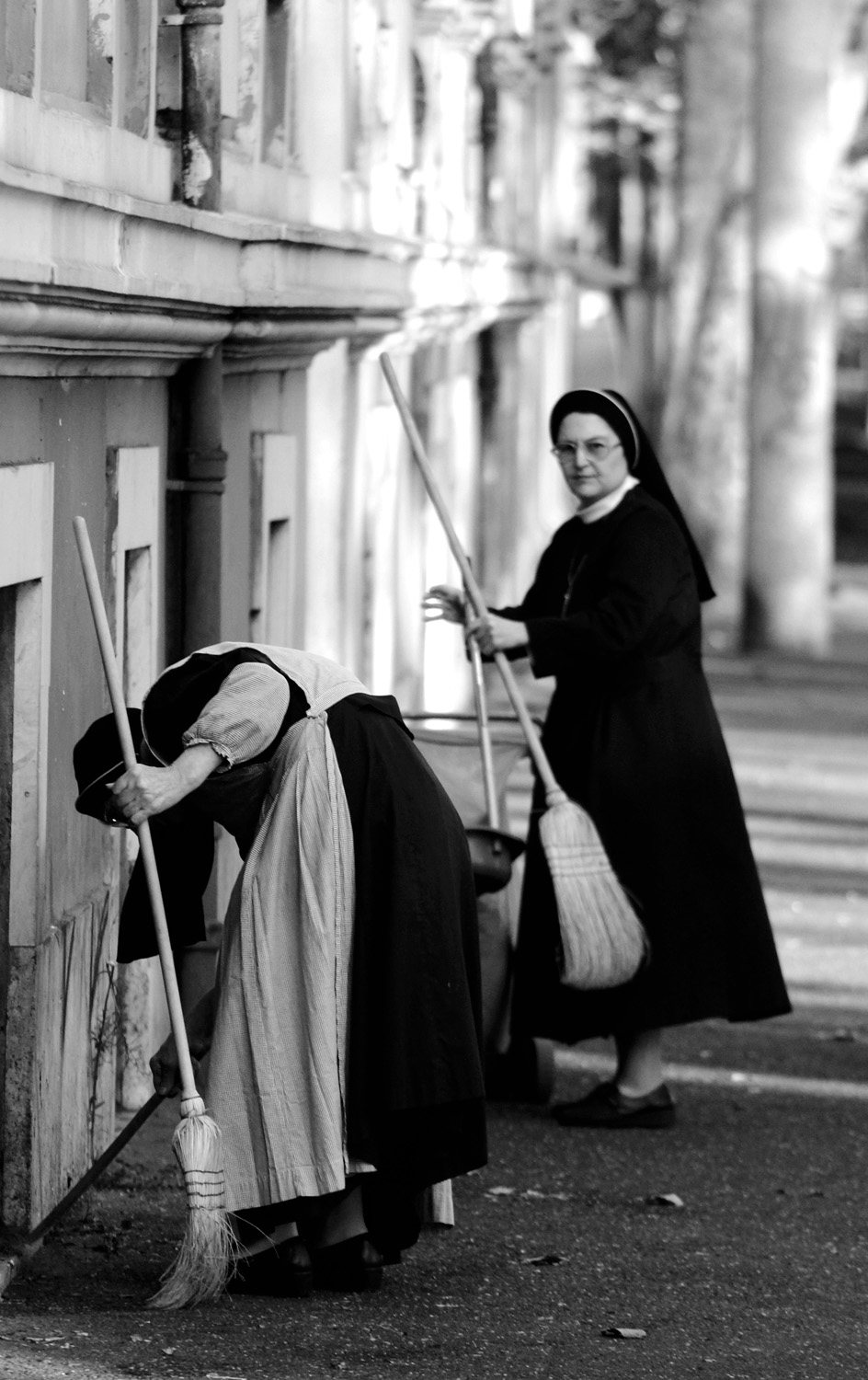
Sweeping Nuns, Rome, October 3, 2013

Sweeping Nuns, Rome, October 3, 2013


Sticking with the theme of nuns, this seemed an appropriate complement and contrast with the last-posted Favourite Shot, wherein nuns could be seen enjoying themselves and wielding pizza. In this image, taken along the Lungotevere Gianicolense in Rome on the way to the Vatican around 0740 AM in the morning, rather than kicking back, these nuns are al lavoro. I’m not entirely sure in what capacity they are working; perhaps there was a religious institution of some sort in the immediate vicinity, or are they an order who contributes to the cleaning of the streets more broadly? Perhaps someone can tell me. At the time, we were marching very rapidly in order to get in line for the Vatican Museums, famed for their length and the duration of the wait, and so I didn’t pause any longer than to take this shot.

Cleric-watching, including taking an interest in clerical artefacts and ritual, can be one of the more mild diversions when in Rome. As might be expected, there are various shops which specialise in items for the clergy ranging from the luxuriously opulent to the most austere. The sight of things such as beautifully crafted ceremonial items for giving mass on the fly, stylishly arrayed in velvet-lined, chic suitcases, is a curious reminder of the degree to which religion is a kind of craft. The stores specialising in underwear considered appropriate for nuns and priests can be très drôle for the unsuspecting tourist.

Incidentally, it’s my birthday today, and, as is traditional these days in our society, I thought I should draw attention to that fact. It’s also my first birthday as a father. I’m not entirely sure whether this makes much of a difference, but it is true that having a child draws a clear dividing line in life of the before and after. Perhaps, therefore, an image of people doing chores is an appropriate choice for this birthday.

Read Full Post »

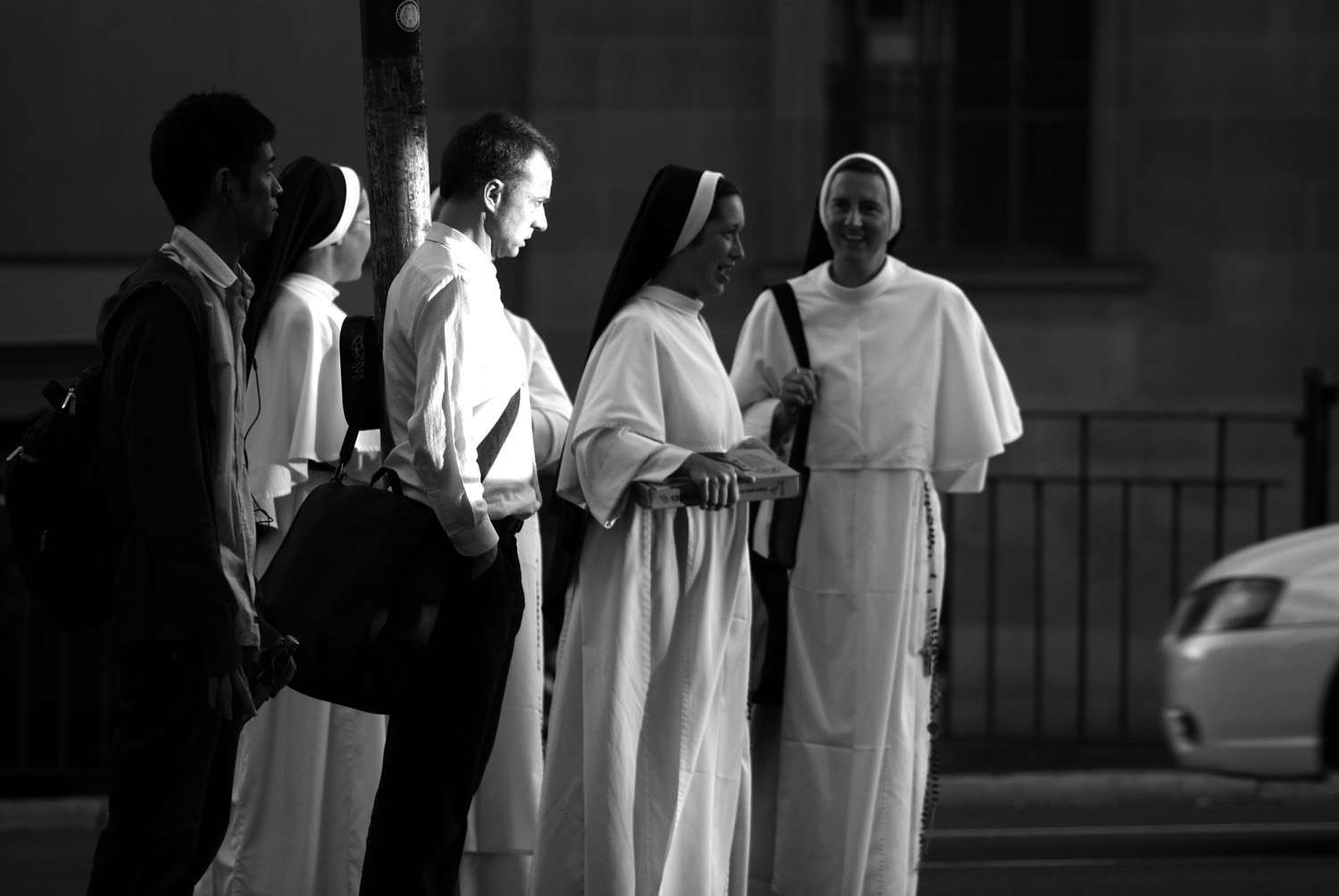
6049 Sunlit man with nuns (with pizza)

Nuns with Pizza, Broadway, Sydney, November 2, 2011

Nuns with pizza, enjoying themselves, say no more. This was one of those fortunate moments when one is thankful for all the time (and energy) spent carrying a heavy camera around. I’ve probably said something along these lines before, and would hardly be the first person to say it, but one of the things that makes photography so enjoyable is when everyday life offers up a scene with artistic potential that is entirely random and neither planned nor expected. I’ve often doubted my ability to create compositions, in a studio, for example, and tend to be more reactive than proactive when it comes to taking shots. This can be as frustrating as it is pleasing, for often there is nothing worth shooting in real life, or a scene which might be worth shooting is too poorly lit or interrupted by something – usually a car. Have I mentioned how much I hate cars? The bane of urban photography.

Yet, even worse than failing to capture a scene that was fleetingly there for the taking, is not having a camera with which to shoot it. Sure, one likely always has a mobile phone as back up, but no matter how much phone manufacturers bang on about their cameras, the lenses simply aren’t good enough and suffer tragically when attempting to zoom. Surely I’m not the only person who finds the photos presently advertised as “Shot on iPhone 6”, a little underwhelming. They’re nice landscapes for the most part, which pretty much any camera could capture adequately. Just as one might struggle to take a bad photo of say, Anne Hathaway. Having said that, I don’t mean it pretentiously, or to deny that people do take amazing photos with phones. It’s simply that given the choice between a phone and an SLR, surely no one in their right mind would choose the phone.

This photo was just another case of being in the right place at the right time, with a camera. I’ve always found it mildly ironic that the man is the one lit by the afternoon sun, and not the nuns, who seem to be, somewhat contrary to their supposedly sober nature, having a very good time. This was shot on Broadway, Sydney, on a late spring afternoon.

Read Full Post »

Natatio, Baths of Caracalla, Rome, October 10, 2013

Natatio, Baths of Caracalla, Rome, October 10, 2013

Wrætlic is þes wealstan, wyrde gebræcon;
burgstede burston, brosnað enta geweorc.

“Wondrous is this wall-stead, wasted by fate.

Battlements broken, giant’s work shattered”

– The Ruin, Old English Poem, c. 8th-10th century

It is hardly surprising that across Europe in the early middle ages, many people living in the post-Roman world thought that the earth had once been inhabited by giants. With the collapse of the Western Empire, many of the major metropolises across western Europe suffered vast declines in population – by the late 5th century Rome’s population had shrunk from over a million to less than 400,000, and by the middle of the 6th century, after Justinian’s reconquest of Italy, it plummeted to a mere twenty thousand. A combination of disruption of the countryside, the breakdown of trade networks and supply lines, and the effects of ongoing war, famine and repeated cycles of plague, the 6th century was an age of disappearing cities and towns.

Indeed, in this period, many cities and towns vanished altogether, only to show up later in the archaeological record. The crumbling remains were either entirely abandoned or quarried for materials. In some major cities, the shrinking population abandoned the city centre to live on the fringes, where access to agricultural land was easier. Major edifices were repurposed, making use of the cavernous spaces between pillars, for example, which could be bricked in with a ready-made roof. Amphitheatres were fortified and piled up with houses built upon the rows of seats. In Rome, such was the scale of the city that it broke up into a series of small villages, with shepherds grazing flocks through the abandoned, overgrown streets. It was the world’s first true apocalypse, the first collapse of a “modern” civilization.

This photograph shows the immense brick walls of the Baths of Caracalla. Constructed between AD 211 and 217, they remained in use until the aqueducts were cut in Rome during the devastating Gothic War fought between the Eastern Empire and the Ostrogoths from 535-554. The baths complex covered an area of 25 hectares, with the main building no less than 228 metres long and 116 metres wide, reaching to a height of 38.5 metres. It could accommodate up to 1600 bathers and contained libraries, gymnasiums, restaurants and shops. It required thousands of slaves to maintain and had its own aqueduct built to supply the water. As it lay on the outskirts of the ancient city, it was left almost entirely abandoned for centuries after its water supply was cut. The immense and impressive statuary which adorned the vast complex, such as the Farnese Hercules, was not recovered until the 16th century, almost a thousand years after it fell into ruin.

This photograph shows a view looking from the frigidarium (cold bath) into the natatio (swimming pool), which was roughly of Olympic length, with dimensions of 54 x 24 metres. The epic scale of the wall dwarfs the human subjects and goes someway towards highlighting just how massive this structure was, and, indeed, still is. An hour-long visit to the bath is a great way to spend a sunny afternoon in Rome.

Read Full Post »

“Emergency Window” – Mysore, India, January 2, 2013

There is an engaging sadness in the expression of the main subject; a pre-emptive longing for a friend yet to depart. The lady on the train seems more cheery, as though she is reassuring her friend. It is, after all, saddest for those left behind, who have to go on as before with the acute absence of the departed. Yet while departures can presage adventure and possibility, sufficient to distract from the missing, or a welcome homecoming to familiar comforts, they can also be a sorry return to quotidian drudgery. Either way, it is so often the case that when someone close expresses an unconstrained sorrow, the other is driven to optimism and persuasive reinforcement, which often masks the true sadness that lies beneath.

This train window farewell took place in Mysore, a lovely, tidy and well-run city with by far the most attractive old market I’ve ever come across. Originally I gave it the title of “Emergency Window” as the full composition includes a notice above the opening which seemed neatly to compliment the solace emanating from the passenger. The title stands though this symmetry has been removed. On the subject of symmetry, perhaps it is just their identical facing, yet the two women in focus, looking left of frame, not the moving passer-by, appear similar enough to be related. I’ve always assumed it was mother and daughter, though this is just as likely mere inference.

Read Full Post »

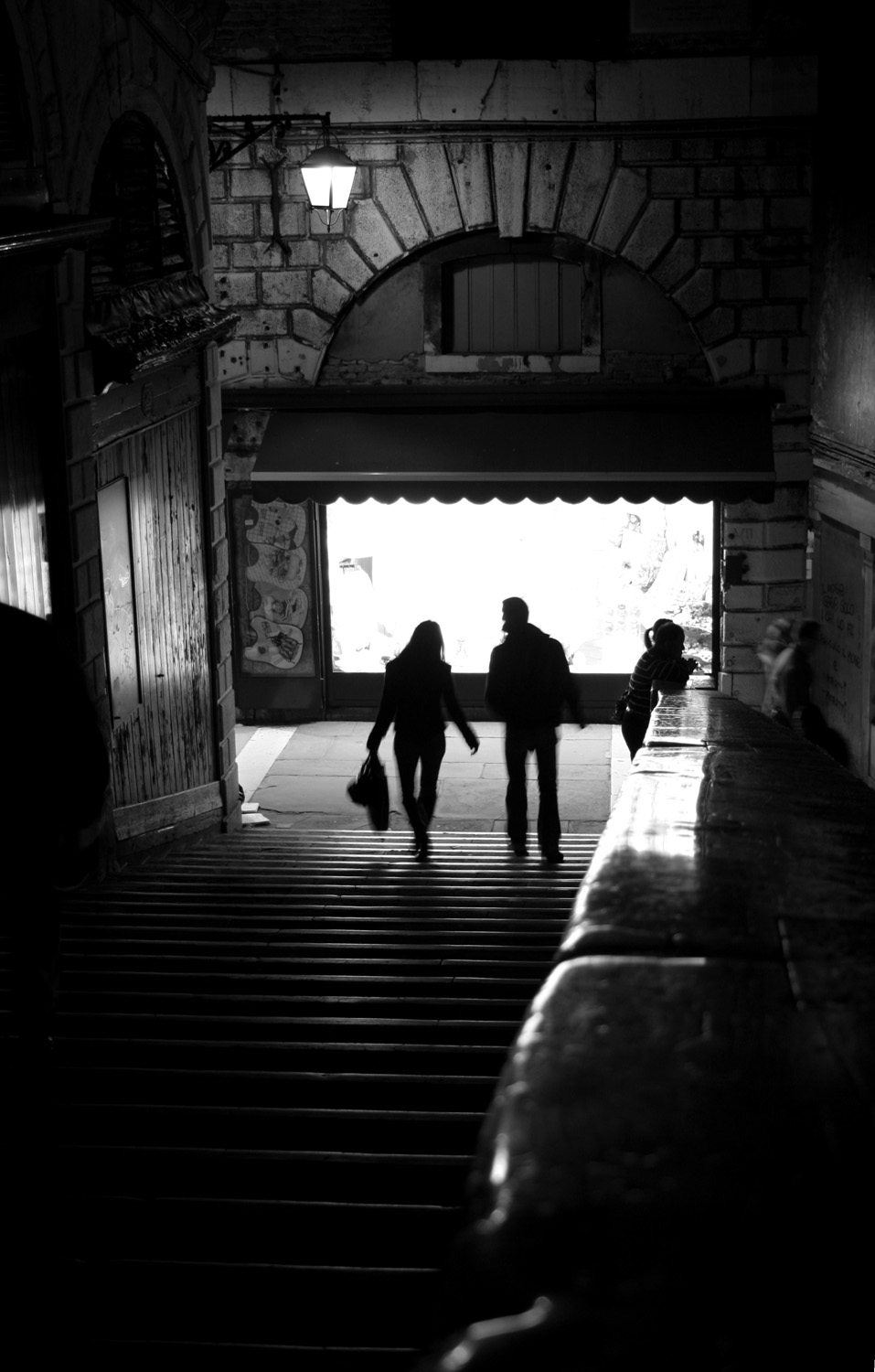
1615 Venice

Venice, Rialto Bridge, March 9, 2007


During the day the Rialto Bridge in Venice is a very busy place. Whatever the season or weather, the bridge is not merely a tourist magnet, but one of the key central crossing points along the Grand Canal and is thus rarely free of people. This is the case for much of the centre of Venice – being as beautiful as it is, the streets are often packed with both locals and foreigners. Things certainly quieten down in the off-season, but the thinning of the crowds starts from the outside in and the Grand Canal retains its floating population.

At night, however, particularly in the colder months, the streets can become surprisingly empty and a welcome quiet descends upon La Serenissima. The freedom to stroll leisurely and alone through the streets, hearing the soft scuff of one’s feet on the flagstones is a rare and beautiful thing. It gives Venice back its subtlety and romance, hidden behind the hubbub of the busy days. It is then that the city’s antiquity and its strange melancholy become most apparent; the precarious decay, the suggestive gloom, the orange of lamps and jade of the luminescent canals seem as genuinely characteristic as the glittering palazzi reflected in the sunlit waters.

This photograph reminds me of the quiet and empty nights I experienced in Venice on my four visits there in various years. Be it March, April, October or November, there were always nights on which the crowds completely dispersed and the streets were free to wander through, unhurried or interrupted by others. This photo is of the stairs leading down the eastern side of the Rialto Bridge of a couple whose dynamic silhouettes captured my attention. I’ve always liked this shot on account of its movement; the setting remains so still, the bridge’s marble polished by millions of visitors, but the couple are wonderfully expressive without meaning to be so. They seem so sexy and alive while around them the city eases into sullen silence.

Read Full Post »

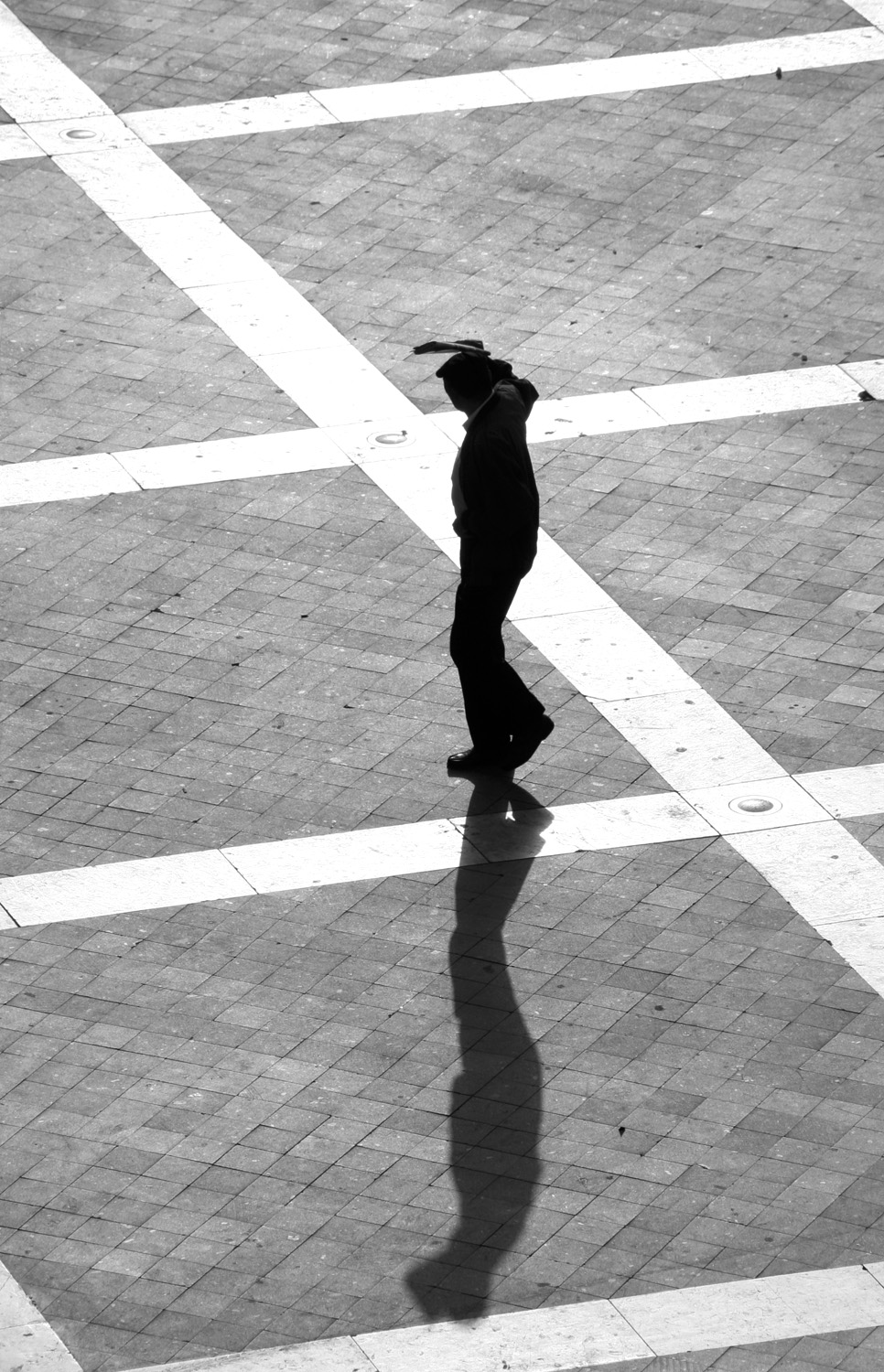
5146 Lisbon

Praca Figuera, Lisbon, Portugal, September 6, 2007

The sunlight was blinding in the square below, the air already on its way to another hot day. For the last hour a blind man had been calling aloud the title of the journal he was selling at the metro entrance – a publication from what sounded like the Borda d’aqua. Every ten seconds or so the title would roll off his tongue, finishing up with a rhythmic flourish of “Borda d’aqua.” It seemed a sorry task, attracting little interest, yet he went about it with dignity and determination, sustaining his pitch through the morning’s indifference.

Later research found only the following link, the Borda D’Agua almanaque of 2008, which certainly fits the context as it was September 2007 at the time. It seems the almanac was designed as a guide for the coming year. Though I haven’t quite conducted the most comprehensive search, the lack of more recent hits suggests this almanac might have since ceased publication.

The bright glare of the square made a delightful backdrop against which to shoot. The man here with the newspaper is not the aforementioned blind man, but merely a passer-by troubled by the intense sunlight. I spent a lot of time with my head and shoulders poking from the small hotel room window above Praca Figuera, the square below. This was, however, not merely because of the great light and people-watching opportunities, but on account of the intense orange-scented smell of the cleaning product with which someone had cleaned the room the day before. So intense was it that I had had trouble sleeping and the scent stayed in my clothes for weeks afterwards. Clearly, I should have switched rooms, but this one did have the view after all, and on that sunny morning, it was worth it.

Read Full Post »

Halki, Naxos, Greece, September 22, 2013

Halki, Naxos, Greece, September 22, 2013

This table sits in the intimate central square of Halki, a village on the Greek island of Naxos. Like so many villages in Greece, Halki is blindingly beautiful – brightly coloured doors and white walls concentrate the sun’s glare, filling the streets with an almost tangible lightness. It is the simple low-maintenance beauty of something done exactly right. Outside the village the land is dry and yellowed; outcrops of ochre and umber lending a pervasive orange glow to the thirsty green. Pockets of well-watered garden with swollen aubergines exude a moist fertility; the silver-backs of the pale green olive leaves reflect a million points of light, overexposing the scenery. Naxos is a dry and rugged island – its centre like another planet – yet it thrives on good fortune and nurture.

On a sunny September afternoon, in the mild heat amplified by the absent breeze, the shade of this tree-covered square was most welcome. There was nothing to it but to sit and eat and drink, so we ordered the perennial Greek salad and an onion tart, mineral water and coffee. Simple things done immensely well, it was a brief yet memorable stay.

I like this photo for its pleasing colours, indicative of the ease with which Greece achieves harmony. Perhaps it is a quality of the light – the clearest and brightest I’ve seen outside Australia – or perhaps it is that white and blue make such a neutral base from which to work, that even contrasting colours fit effortlessly into the picture. The soft focus of the background perhaps does not reflect the sharpness of the light, yet I’d like to think it captures the dreaminess of the old towns on the islands, which always seem far too incredible to be true.

Read Full Post »

« Newer Posts - Older Posts »