Feeds:
Posts
Comments

Archive for the ‘Favourite Shots’ Category

Heavy rain, Bangkok afternoon, July 7, 2009

Heavy rain, Bangkok afternoon, July 7, 2009

The sky has often been described as leaden, yet there is something more leaden about the way rain falls in the tropics – it seems to live out the lie that heavier things fall faster. When the pressure drops in the mid afternoon and the rain switches on, it is as though the atmosphere has liquefied and entered a state of collapse. Tropical downpours have a lush gratuitousness about them, a gentle ferocity, like being patted on the head by a giant uncle. For the most part, the rain is benevolent – a source of life and refreshment, fresh air and clean water, a time of abundance – yet all too often the weather is dreadfully heavy-handed.

This shot was taken in Bangkok, from a hotel window, during the regulation afternoon downpour. After the restless preamble of electric air, smothering oppression and a tell-tale cool gust, down it came, nozzle opened full, spilling most of its guts in the first five minutes. I’ve written elsewhere what a fan of rain I am – a fan of all weather, really – and watching these tropical downpours was a special treat.

The wall of drops adds a sketchiness to the shapes huddled behind it, as though the city were rendered in charcoal. This picture reminds me of such a sketch, but with a palpable sense of dampness – the ubiquitous moist fecundity of the tropics.

Read Full Post »

Venice of Mykonos, Greece, September 25, 2013

Venice of Mykonos, Greece, September 25, 2013

I love taking other people’s photographs. By that I mean photographing people who are posing for someone other than myself. What seems so appealing about such shots is the way people present themselves as they want to be seen, or as best befits the moment, but with all their self-consciousness directed elsewhere, towards another lens. The posed moment thus becomes candid – like a still from a movie set.  There is also a certain electricity in the fact that this is an exciting moment for them –  a proof of concept; this was my dream, now here I am! Perhaps it’s a little nefarious, like a form of theft, but I counter that thought by reminding myself that I should only show them in a flattering or positive light – I’m certainly not interested in humiliating anyone.

This shot was taken just before the so-called Venice of Mykonos. V and I spent a wonderful three or so hours before sunset, drinking take-away beers and people-watching. As the afternoon wore on, countless tourists posed before this backdrop and had their photo taken. What was most noticeable was how seriously many of them took the whole process. Indeed, much of the time it was more photo-shoot than holiday snap, with people vogueing before the camera for numerous takes. In one case we were approached by a young south American couple (not the couple in the photo) who asked us to take their photo. They were perfectly nice when speaking to us, yet just prior to their approach we had watched them being shirty with each other as she posed while he took photographs. After the young man had taken a number of photos and had them checked, he was berated for not getting them right and it was at that point that they decided to seek outside help for a couple shot. I guess the need to drive everyone on Facebook wild with lust and jealousy was just too great to pass up, and nothing less than the most flattering shot would do.

One thing that really stood out during this whole trip was a seismic shift in how un-ironic people have become about their own vanity. No doubt this is an inevitable consequence of the spread of social media, but the fact is that what once might have been considered vain and pretentious is now par for the course. All through Greece and then later in Rome we witnessed this process – the long photo shoot with some of the most laughably un-ironic beauty poses. It was, I have to admit, mostly women being photographed, and the sincerity with which they approached the whole thing was unsettling. The constant checking and re-checking of the photos and then posing for more suggested a kind of desperation – a need for validation and status by showing off how attractive and fortunate they were to be, for example, posing in front of the Trevi Fountain. Perhaps there’s nothing to it – that it’s merely a shift in habit rather than in sense of self-importance – but if it is the latter, then heaven help us!

Read Full Post »

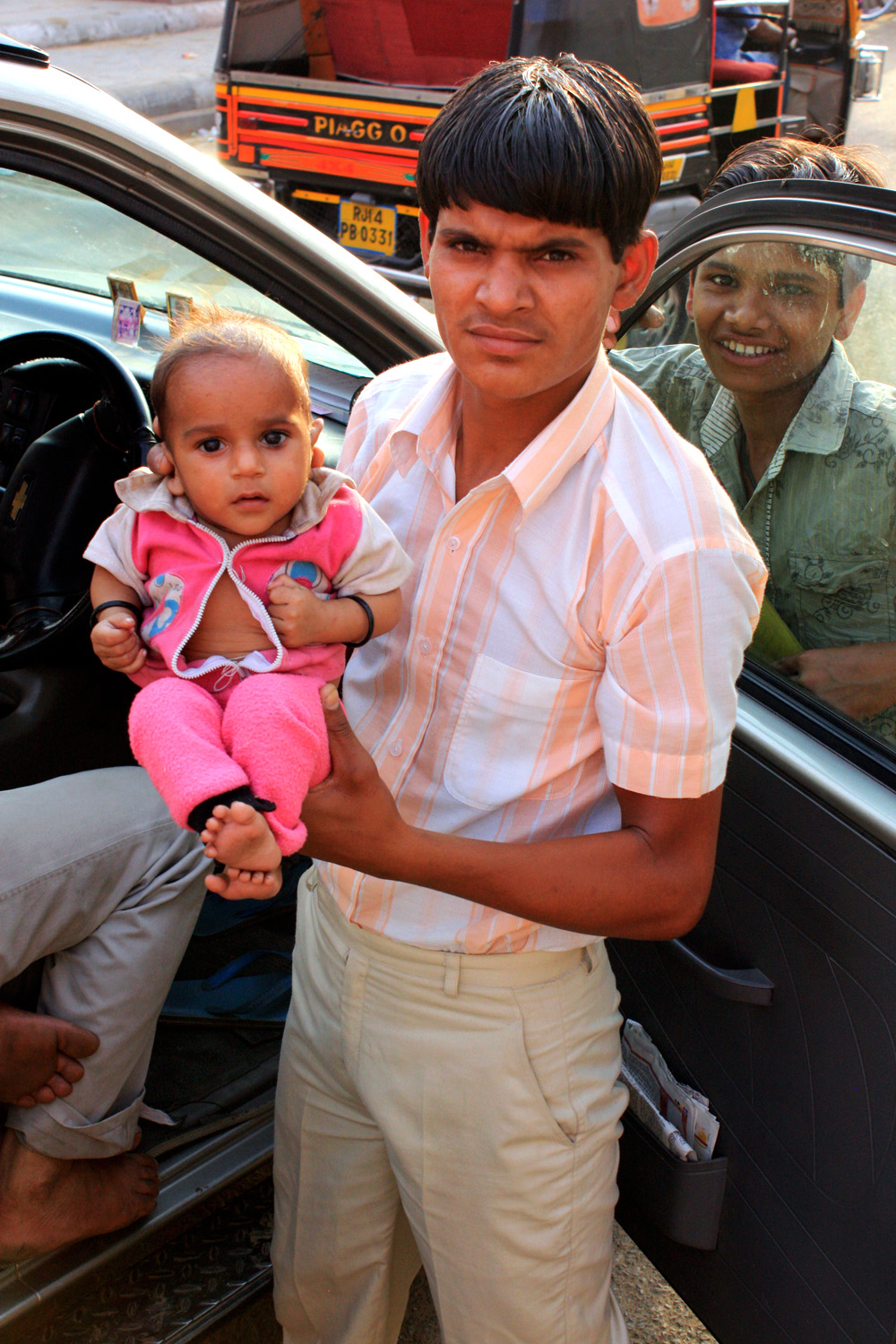
Young Man with Baby, Jaipur, March 21, 2010

Young Man with Baby, Jaipur, March 21, 2010

This shot was a gift. The young man in the photo, taken just outside the entrance to the Galwar Bagh Monkey Temple in Jaipur, where I was also fortunate enough to shoot a lovely goat, was eager to have his photo taken. After initially taking a rather off-the-cuff portrait standing before the gate, he seemed keen to do a couple more; running over to the family car, opening the door and taking the baby from the man seated behind the wheel. Without saying another word, he adopted this pose and presented the baby to me. I don’t know exactly whose baby it was – the driver’s I suspect – though I got the impression this was not his own son. How lucky I was that his younger brother should duck in behind and add himself to the frame. It was one of those rare and beautiful moments when something unexpected offers me a chance to go straight for gold. The moment I pressed the button, I knew I had just been handed a classic portrait – the likes of which I’ve dreamed of having the balls to ask for more often.

Technically I’d say that the main subject is a little underlit, but the calm togetherness of his face, the alert, quizzical expression of the baby, and the yearning excitement of the younger brother through the window all add up to a touching family portrait. Great clothes, great haircuts, great poise. I only wish I could find the young man holding the baby and send him a copy. As it was, I was there with two other travellers and a local rickshaw driver we’d recruited as a guide and had to hurry off. All I could do was show them the pictures in the camera, which they seemed to really appreciate.

I have often wondered why it is that people want their photo taken. Is it simply a chance to see themselves in a shot, or a means of connecting with others? Perhaps a combination of the two. Sometimes I go further and imagine that they like the idea of being somehow immortalised somewhere. Maybe that’s just the historian in me, expecting that others also long for a place in history, however brief. If that’s the case then it’s my privilege to add this memory to the sea of vignettes, episodes and anecdotes past and present. All this took place in less than a minute and, moments later, we were climbing the hill to the monkey temple. Yet here he is, a young man proud of his family, asking me to remember him.

Read Full Post »

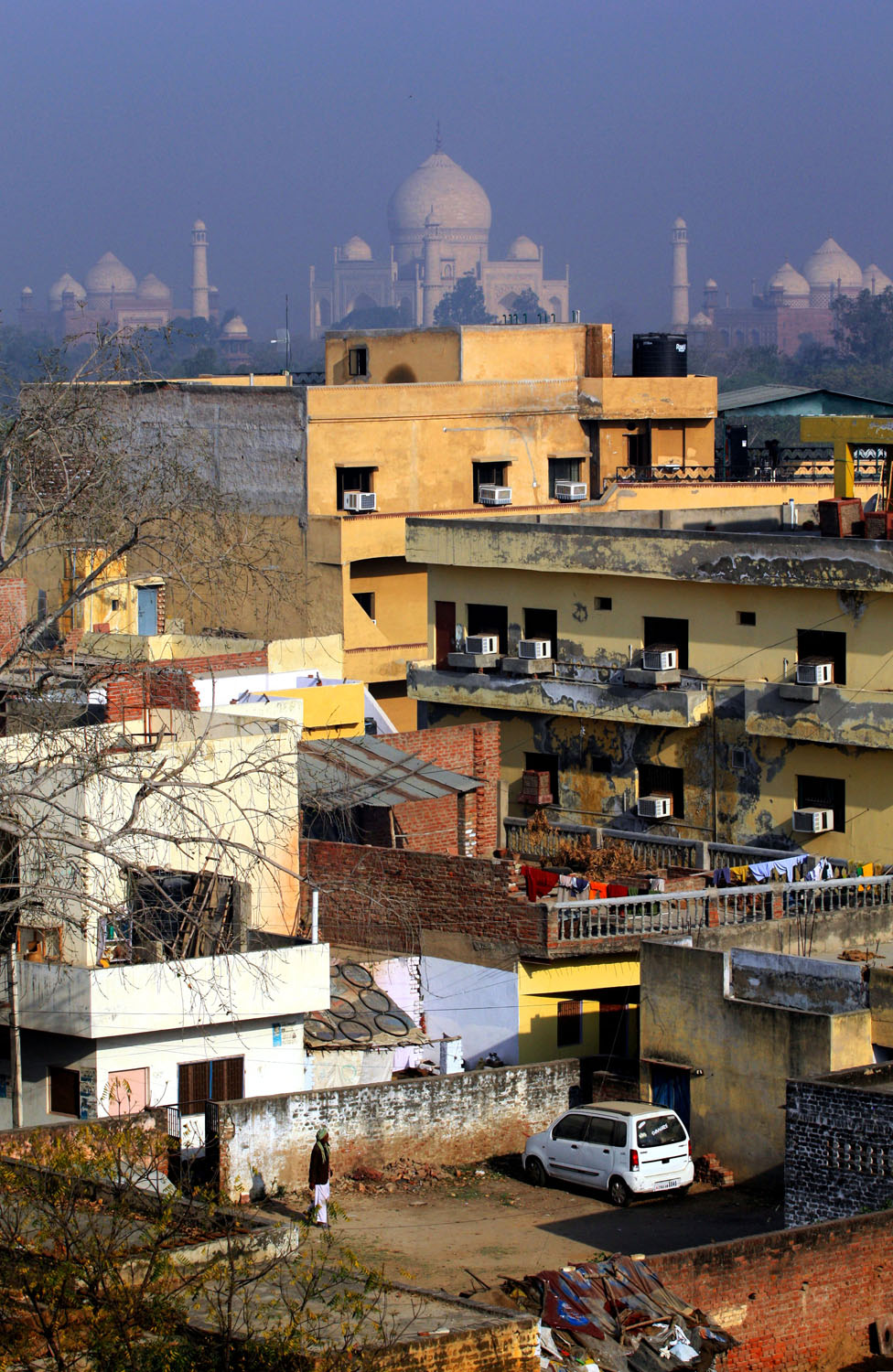
Taj Mahal from Agra, March 20, 2010

Taj Mahal from Agra, March 20, 2010

Most views of the Taj Mahal are from inside the complex – looking down the long rectangular, reflective pool towards the magnificent 17th century mausoleum to Mumtaz, wife of Mughal Emperor, Shah Jahan. This is the most obvious, symmetrical and, perhaps, from a certain perspective, the most pleasing way to view the Taj Mahal. Yet, as a colossal monument which far outdoes in size and scale anything in its immediate vicinity, it is visible from a considerable distance and can be seen towering above the comparatively low-rise city of Agra, beside which it sits.

The first shot presented here shows the Taj Mahal from the town of Agra – more specifically, from the roof of my hotel. I only came to appreciate this shot on closer study – the cascading diagonals of the buildings and walls in the mid and foreground create zig-zagging vectors which lead the eye down from the top to the bottom – or, perhaps the other way if you’re so inclined. The Taj Mahal itself, sitting atop these utilitarian concrete boxes, is like the crown of the image – even if something of a distant phantom through the heavy smog. It has strong connotations of the stratification of Indian society – at the bottom, the poor, the quotidian, exemplified by the shabby buildings and single, solitary figure – and at the top – unimaginable decadence and wealth, like a hazy dream of heaven.

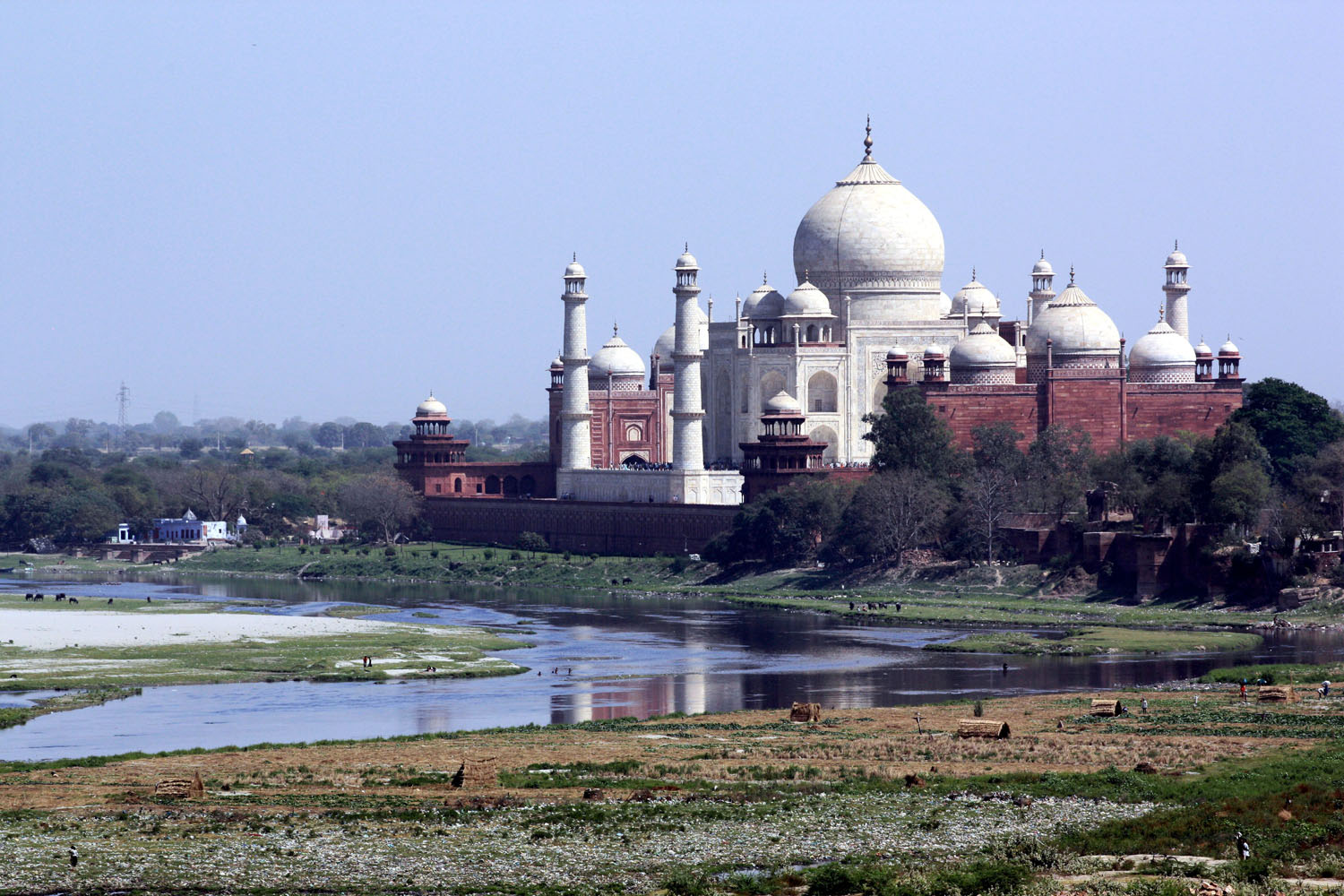
Taj Mahal on the River Yamuna, March 20, 2010

Taj Mahal on the River Yamuna, March 20, 2010

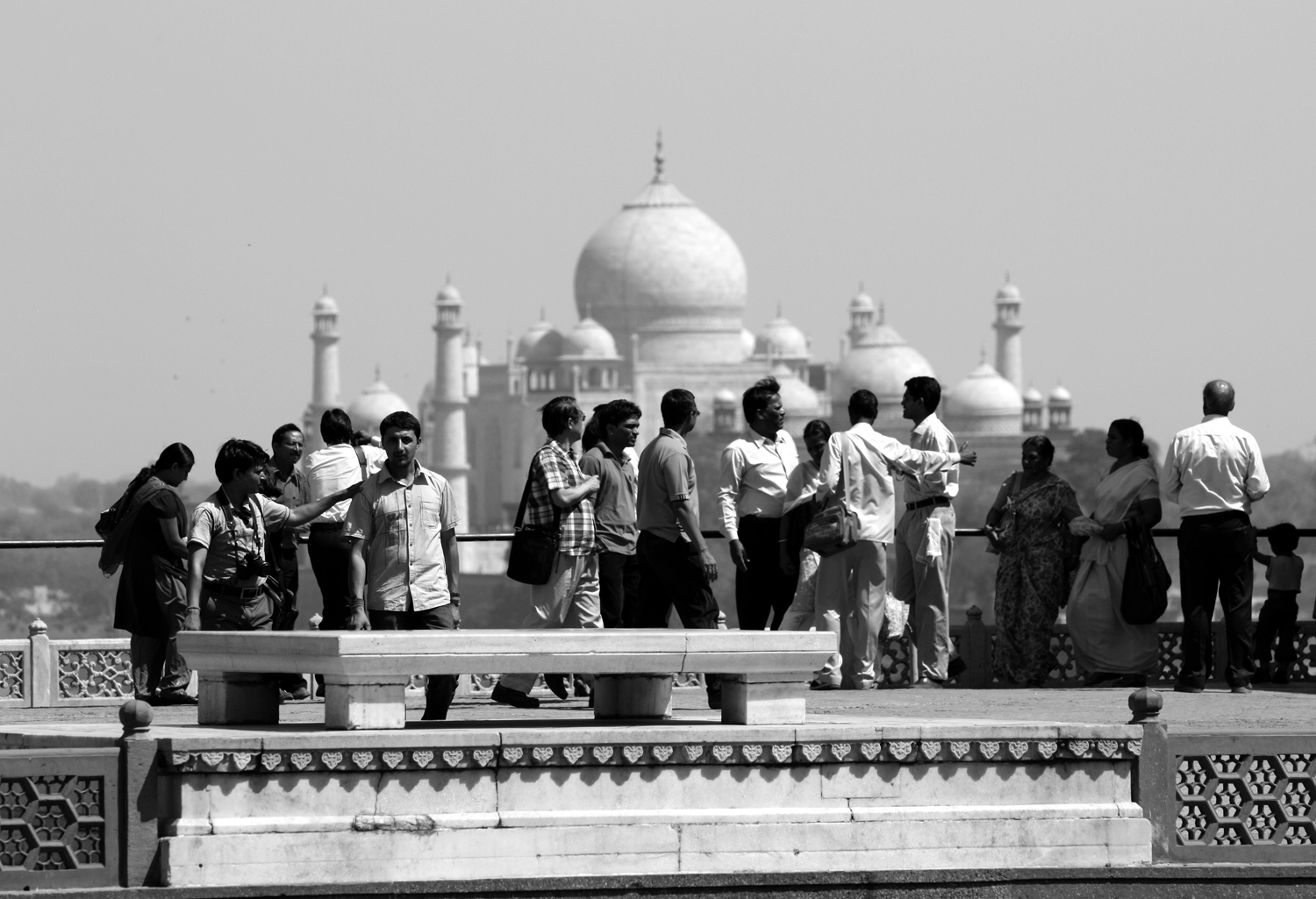
What is not often shown is that the Taj Mahal actually sits on a river – the Yamuna – which lies immediately behind the mausoleum itself. The presence of the river and the wide, open space it creates with its flat, shallow banks, allows beautiful views of the Taj Mahal, especially from the nearby Agra Fort. I’ve included two other views, both taken from Agra Fort, to show this different side to the Taj Mahal. As a backdrop, it creates a very powerful effect, and, when simply viewed as a riverside monument – it loses the protection of its orderly gardens and is forced into juxtaposition with natural asymmetry. Fortunately, however, the building is so organic in its soft curving, bosom-like domes and its thrusting phalluses, as to find a harmonious balance with nature. In a nutshell, whichever way you look at the Taj Mahal, it works.

Taj Mahal from Agra Fort, March 20, 2010

Taj Mahal from Agra Fort, March 20, 2010

Read Full Post »

5689 Cambridge

Parker’s Piece, Cambridge, July 9, 2006

This photo seems ostensibly to be a celebration, yet what draws me to it is a mild sense of loneliness and isolation. The solitary figure, with arms folded, watches the firework with studious interest, a certain patience and mild curiosity, as though supervising the phenomenon to ensure nothing out of the ordinary happens. The absence of other onlookers, the wan sky and soft palette all add to the loneliness of the photo, yet the onlooker does not seem lonely. Indeed, there is a sense that, friends or otherwise, they were, in an unhurried manner, quietly determined to go down to Parker’s Piece and set off a firework or two.

Clearly, this is a handheld shot and it was fortunate that the brightness of the firework arrested the exposure before too much of the background was lost to unfocussed blur. I’m never especially confident about out of focus shots – is it an accidental masterpiece, or just a poor photograph? Sometimes it can be difficult to be sure. In this case, however, perhaps in the way that a poem operates more indirectly, it has strong mood and atmosphere, precisely on account of its nature. Even then, it was another case of a friend’s comment on facebook when I posted this in 2007, which convinced me that what has since become a personal favourite, was a good one.

G’s comment also adds a nice little anecdote, on which note I conclude:

This… also reminds me in a pleasing way of those Bonfire Night paintings everyone did at school (everyone in England anyway, even at convent schools). The ones where you got your mind blown by being given a piece of BLACK paper, on which you had to make your mark with lighter coloured chalks or paint. A topsy turvy world! And if you wanted a silhouetted figure like this, you had to just be really careful to leave a space.

Read Full Post »

8285 Jaipur! Expecting someone else

Relaxed Goat, Galwar Bagh Monkey Temple, Japiur, March 21, 2010

Expressing a fondness for goats these days is a bit like telling people you breathe oxygen. It seems that everyone has discovered the beauty and wonder of goats. Be it through their gorgeous goggle eyes or eminently strokeable ears, goats have entered the affections of most who inhabit the internet. Perhaps this is inevitable. That more than ten thousand years co-evolution, since the dawn of animal husbandry when we first began to shepherd goats, has inclined us to like them.

Without any desire to boast, I can say that in truth I have long been a goat fancier. For me, it’s always been about the ears – the way they hang like the frame of a bob. There’s little doubt that one of life’s great pleasures is to stroke the silky ears of a beast – I strongly recommend dachshunds. Of course, it goes without saying that the eyes and smile of a goat are marvellous to behold, yet without the ears, I doubt the overall effect would be quite so sweet.

This particular beauty was just chilling on a concrete bench, with a sleepy, almost nonchalant insouciance. I would never have dreamed of disturbing such expressive, almost sultry repose and left it alone to enjoy the afternoon sunshine. I can’t help but mention how goats’ teats look like Kibbeh – tell me it isn’t so!

This shot was taken on the outskirts of Jaipur, by the gate at the foot of the hill atop which sits the monkey temple, Galwar Bagh. As is typical of India, there was a splendid selection of animals about the place: piglets, dogs, monkeys, cows and goats – a veritable open air petting zoo. I was very pleased to get this shot, with its great contextual colour continuity, which highlights the shiny blackness of the goat.

Read Full Post »

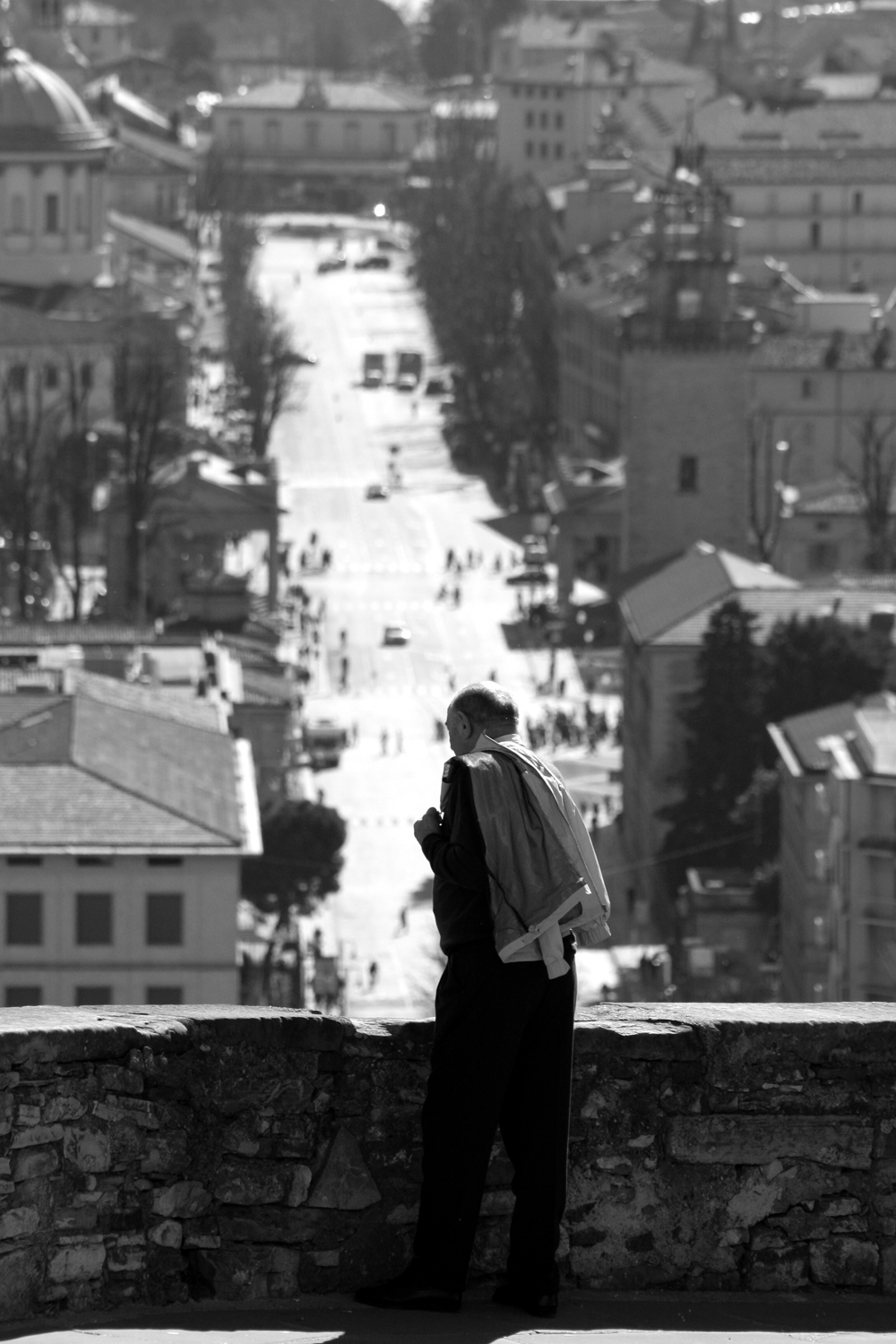
"My life is a counter-point, a kind of fugue and a falling away - and everything winds up being lost to me, and everything falls into oblivion, or into the hands of the other man" - Jorge Luis Borges. Bergamo, March 3, 2007

“My life is a counter-point, a kind of fugue and a falling away – and everything winds up being lost to me, and everything falls into oblivion, or into the hands of the other man” – Jorge Luis Borges. Bergamo, March 3, 2007

Bergamo was but a brief stop on the way to Como and beyond – a convenient destination in northern Italy courtesy of Ryan Air’s seemingly endless expansion. Situated at the base of the foothills of the Italian Alps, to the north of the flat plains of the Veneto – the hips of Italy’s leg, if you will – Bergamo was welcomingly dry and bright after some variable early spring weather in England. I recall very little about Bergamo, outside the photographs I took, and don’t remember how I arrived at this point, aside from taking a bus into town from the airport. I can only assume I was drawn to this vantage point from the views it promised to offer. Tired as always on day one of a trip from having had next to no sleep the night before, I felt almost high and elated from the bright light and elevation.

It was around 1030 in the morning and, being a Saturday, the town had a pleasingly slow pace to it. There were plenty of people about, but no one was in a hurry. The air was cool enough for most to be wrapped in coats, yet the sun had a clear, if entirely dry warmth to it – a welcome break from damp. This acropolis of sorts was a favoured place for people taking their constitutionals. A couple of old gents played chess, women waited as their lap dogs sniffed at things and some cool kids smoked cigarettes with the carefree air of not having anything else to do. Initially I had been impatient to get on my way to Como, yet the welcome sunshine and sense of space held me in thrall for a few hours.

This remains my favourite photo from that brief visit. Whilst I liked it from the start, as with so many photos, it wasn’t until, on Facebook, my friend Chris appended it with the quote contained in the caption that I really came to appreciate it. Sometimes, even when confident about a piece of work, it takes a second opinion to convince myself that I do truly like it. The quote from Borges may not actually suit the narrative of this old gent’s life, but it certainly goes well with the image, and for that I have Chris to thank. Cheers, buddy.

Read Full Post »

Macaques, Monkey Forest, Ubud, March 13, 2009

Macaques, Monkey Forest, Ubud, March 13, 2009

The Sacred Monkey Forest of Padangtegal village, on the edge of Ubud in Bali, is a natural highlight for tourists – attracting roughly 10,000 visitors a month. A 2011 monkey census put the monkey population at exactly 605 crab-eating macaques (Macaca fascicularis), a figure which has no doubt shifted since. It is a lush, dark and deep green place which, with its shrines, stone-carved animals, Hindu gods and hanging roots and vines, would not be out of place in an Indianna Jones movie.

Whilst the macaques are called “crab-eating,” you will likely only see them eating bananas, durian, cucumbers and watermelon. Perhaps some species of fresh-water crab inhabits the primeval stream which runs through a short, steep gulch beneath a fantastical stone bridge, though I saw no evidence of this. The monkeys are, as monkeys will be, cheeky and impudent and will quite happily snatch anything faintly resembling food from visitors. If they were any larger, this would be more intimidating, yet it is certainly enough to give a person a fright, should one of them run up your leg. On my first visit there my brother made the mistake of buying some bananas to feed them and promptly found himself with three monkeys running up his legs onto his head and shoulders, hanging from his arms and snatching at the bananas. His only option was to drop the bunch, which vanished quicker than chips in the beaks of seagulls.

At quiet times the monkeys can be mysteriously absent, then suddenly appear in a bunch, usually chasing each other or seeking food. Many sit around in small family groups, unafraid of people, though seemingly more concerned about the mischievous intentions of their own kind. The group of monkeys in this shot were placidly sitting, maintaining a sort of crèche with several youngsters. The light was very low under the forest canopy and the exposure time less than instant, hence the blurring effect on the adults. I was very fortunate that the young monkey remained so still, creating the pleasing effect of sharpness and clarity in the midst of the textured blur of the adults’ fur. It is a cute face presented by the little one, if a little ghastly – like a strange homunculus. I do, however, like his curious little mohawk.

Read Full Post »

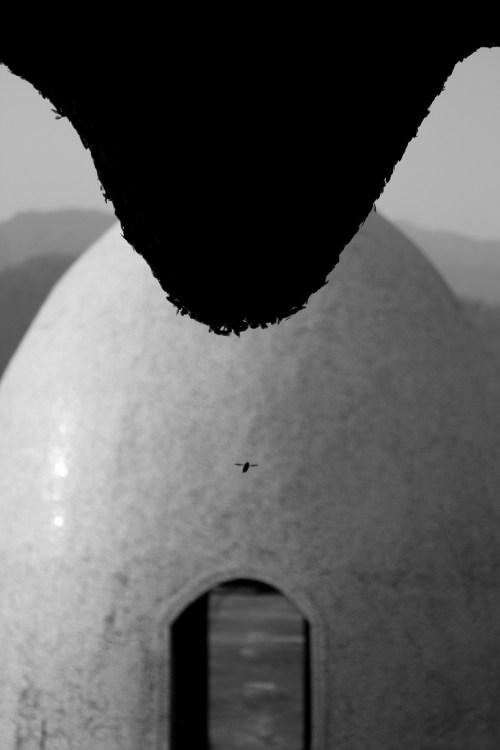
Two Beehives, Rishikesh, April 5, 2010

Two Beehives, Rishikesh, April 5, 2010

This shot was taken from the top floor of the now abandoned Maharishi Mahesh Yogi’s ashram in Rishikesh, India. The man-made beehive structure is a chamber for transcendental meditation, designed to focus your thoughts and prayers more effectively (ahem). The other beehive is bee-made, and very nicely placed to form a curious juxtaposition and uncannily fortunate symmetry. The hovering bee, waiting, it seems, to dock with the mothership, was a neatly-timed addition to a set-up that seemed too good to be true.

The ashram was abandoned in 1997 due to an expansion of the national forest on which it bordered. The place was simply locked up and left to nature, with no real attempt to demolish or dismantle the structures. I visited the place in 2010 with a cool Canadienne I met at the end of an unexpectedly epic eleven-hour journey from Delhi – Kumb Mela was on at the time in Haridwar, a mere ten kilometres from Rishikesh, and the roads were choked with millions of pilgrims. Rishikesh itself was flooded to the gills with saffron-robed holy folk and it was a constant pleasure to walk among them, curious sight that they were.

There weren’t any guards or attendants at the entrance to the ashram, but there was a gate-keeper of sorts; a lame young bloke with a pair of crutches. He “let us in” for a couple of hundred rupees and once inside we were free to roam about. It wasn’t long before we were met by a long, white-bearded former ashram guest named, I think, Mohan (?), who offered himself as a guide in such a friendly manner that we accepted his offer immediately. Mohan had spent his life working as a high-level public servant in the transport sector and now, in retirement, he had taken to wandering around India like a holy man. Clearly, having spent years at the ashram in the 80s, he was pursuing a long-standing inclination.

Mohan led us along the leaf-strewn paths, through the curious overgrown structures. Most of the buildings were sturdily stone and concrete built, and where they were damaged it was largely through having been looted for fittings. He took us to the four beehive huts where the Beatles had stayed, numbered 7 through 10, if I remember correctly, with John Lennon having been in number 9. Alyne and I had a few great fan-boy moments, exploring and taking photos, quietly contemplating along with excitedly chatting about the rock n roll history of the place.

In one of the buildings we explored, Beatles fans had painted murals in the abandoned rooms, depicting Beatles themes and lyrics. These had a lovingly amateur quality to them, somehow appropriate considering the stylised charm of the Beatles’ own cartoons. Eventually, we came to the largest structure on the site – a three-storey concrete mass with more beehive domes on the roof. It was in this building that I came across this actual bee hive, looking out across the low foothills towards the gorge cut by the Ganges. Its context in the derelict human structure offers a sense of caveat and foreboding – as though a prelude to the fall of civilization. It also reminds me of an important thing to bear in mind when contemplating human civilization – that, of course, the human beehive is natural too. It’s just a more elaborate nest.

Read Full Post »

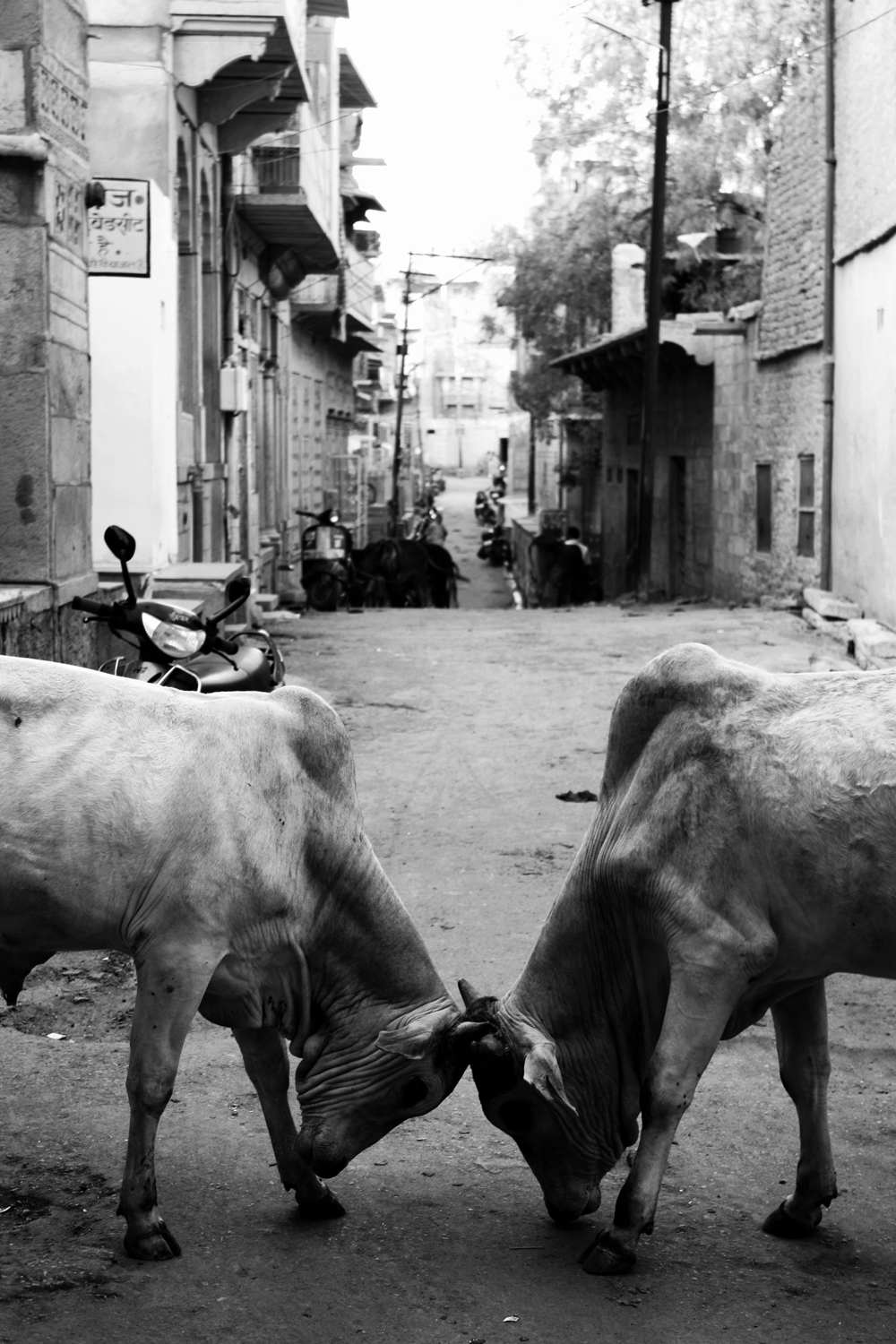
Young Bulls, Jaisalmer, Rajasthan, March 30, 2010

Young Bulls, Jaisalmer, Rajasthan, March 30, 2010

You walk past a lot of animals in India; cows, goats, monkeys, dogs, camels, horses, elephants… There’s something very evocatively medieval about the blurred lines between town centre and rural hinterland; a boundary that only seems to exist in the very heart of the major metropolises – and even then such animals can still be found. The intrusion of the rural into the urban (or is it the other way around?) brings with it all the scents of the countryside – that rich fug of beast and manure – which seems anomalous to the scale of the towns and reminds me of when the Easter Show used to come to the old Royal Showgrounds in Sydney’s eastern suburbs. Then, every morning, for roughly two weeks, I woke up to the smell of cows, sheep and pigs in, of all places, Paddington.

The presence of large animals on the street can be intimidating at times. Mostly they are placid and docile, yet occasionally a narrow passage will be blocked by a cranky bull. Whilst he might exhibit only the most minor irritation – a flicking tail, a restless stamp, a displeasured snort, stung perhaps by a sand-fly – it would be unwise to get into close proximity. Sometimes the condition of the animals can be quite distressing, though generally it was the stray dogs which seemed the most malnourished. Indeed, I was surprised at how robust most of the cows and bulls looked – a little thin at times, but rarely emaciated.

These two bulls were mucking about in the streets of the Jaisalmer, Rajasthan, having a playful wrestle. There was little animus in their proceedings, just a languid and lazy butting practice. It was good of them to provide me with such a symmetrical subject, and indeed they remained like this for some time, pushing slowly to and fro. It seemed the bovine equivalent of a fist-bump; a soft, yet muscular display of power; a subtle reminder that such friendliness could not always prevail – not when the time came to compete for cows.

Read Full Post »

« Newer Posts - Older Posts »