Feeds:
Posts
Comments

Archive for the ‘Favourite Shots’ Category

Dung Hien Hair Salon, Hanoi, July 6, 2009

Dung Hien Hair Salon, Hanoi, July 6, 2009

I’ve always liked the way advertising can work both to complement and to contrast with other elements of a composition. Advertising almost invariably portrays a perfect and airbrushed world which, in the developed world, comes closer to mirroring the context than it does in the developing world, where it all too often symbolises an unattainable dream. This is especially noticeable in India – a country in which, if you were to try to understand the society based entirely on its advertising, you would believe that everyone was comfortably middle and upper class. Of course, the simple answer is that advertising is targeted almost exclusively at the middle and upper classes – no one else can afford the products. The television ads and billboards offer an ironic and at times, ghastly contrast to the conditions prevalent on the streets.

In this photo, taken somewhere in downtown Hanoi, the hair ad is perhaps less of an anomaly compared to the status quo – after all, a nice haircut is more affordable than, say, a new kitchen, car or air conditioning unit – yet it still stands out as an ideal in the midst of a less glamorous reality. Here the contrast is not so much one of decadence and privilege versus poverty, but rather that of indulgence and comfort against pragmatism, for there is something wonderfully impractical about what the image presents to the quotidian street. What use such well-brushed hair and long luscious lashes when doing laundry and carrying kettles? It seems appropriate therefore that, whilst in this shot the L’oreal woman is prominent, in the wider context she seems almost marginalised – pushed into a corner behind scooters. Is it for this reason that her eyes are closed? Or is it that she can’t quite bear the relative banality of a backstreet in Hanoi?

The L’Oreal woman presents an image almost of piety and consolation, less offensive than more brash and “sexy” representations of the decadent lifestyle. I love the dreamy effect of the closed eyes and long lashes – an exaggeration I don’t usually find attractive, yet which seems inviting and comforting in this instance. By contrast, the facial expressions of the other women in the scene are far more engaged with real world concerns, though the lady holding the kettle has her eyes turned towards the sky, perhaps entertaining thoughts of escape – or is it just concern about the weather? Ironically, the lady whose tee-shirt reads “don’t feel small” looks pretty fed up with life, lending the message on her shirt the quality of an exhortation to herself.

Read Full Post »

Smoker, Tokyo, May 21st, 2006

Smoker, Tokyo, May 21st, 2006

Smoker, Tokyo, May 21st, 2006

Smoker, Tokyo, May 21st, 2006

Call me a fascist, but I love how marginalised smoking has become around the world. In just a few short years, most of the developed world has banned smoking from the workplace, pubs, bars, restaurants, cafés, and even from directly outside buildings so the smoke doesn’t flow in through the doors. It’s a win for everyone, even smokers, though they sometimes refuse to acknowledge it. What makes all this most incredible is that it is a very rare victory for common sense over capital – big tobacco can go and suck on that.

Australia has been a world leader on this front, something that is both astonishing and entirely unsurprising in this country – astonishing because as a nation we all too readily get down on our knees and drink the jizz of big business, and unsurprising because we love overdoing safety regulations. Our laws on smoking are the toughest in the world so far as sales and advertising are concerned. Cigarette packets can no longer be displayed behind the counter; they are now all packaged in plain, dull packaging without any brand identification other than a uniform text stating the manufacturer and variety, with bold health warnings larger than the brand name and a disgusting image of the effects of smoking on health taking up the bulk of the packet. All advertising has long since been banned and the taxes on cigarettes are now so wonderfully high that a regular packet will cost you over $20 Australian and a packet of rolling tobacco over thirty. It’s a much healthier world we live in when a nine-year old kid asks “what is a cigarette?”

We could, however, go further still. In some cities in Japan it is illegal to smoke whilst walking down the street, and smokers must use designated smoking areas as depicted in these two images. How often have you gotten stuck walking behind a smoker on the pavement and been forced to inhale their pollution? How many fines and public awareness campaigns will it take to stop smokers littering city streets with their cigarette butts? It would be far easier simply to ban smoking from all outdoor areas, bar certain designated smoking stations, which could even be enclosed to ensure passers-by are protected from the smoke. The idea has been discussed in Sydney and a trial ban in downtown Melbourne was implemented last October with all the usual whinging from businesses that it will affect their custom. What they too often fail to consider, however, just as was the case with smoking in bars, is that less than 20% of the population smoke these days, so bear in mind how many customers are put off by the presence of smokers. I certainly am, and won’t sit at an outdoor area in a café if smokers are present.

Anyways, enough ranting – as to these photographs, it was tough to decide between the two so I’ve gone for both. I’ve always liked these shots for the chap’s posture, the seemingly arrogant cool he projects and the very contextual circumstances of the shot. If I was advertising smoking, which I might inadvertently be doing, and that makes me a massive hypocrite, then I think I’d like this guy in my ad to say screw the lot of you, smoking is cool and it makes you look like a real man. Incidentally, if you look closely at the wider shot, there’s a splendid little warning and graphic reminding people of street etiquette. It states: “When I bumped into someone, I apologized. When my smoke hit your face, I said nothing,” telling people in a curiously shaming and cryptic manner that they ought to consider the impact of their smoking as similar to accidental physical contact. Hear hear.

Read Full Post »

Toy Train, Ooty, January 1st, 2013

Toy Train, Ooty, January 1st, 2013

The late afternoon drive into the Nilgiri Hills offered high crags and hairpin turns, steep ravines and sunbeam spotlights through the foliage. On either side of the winding road was heavy forest, wild and unfettered for the most part, but here and there plundered for the serried and terraced tea plantations. Our driver was the most cautious in India and a welcome slowness prevailed during our sure but steady ascent. We passed through Coonoor, two thirds of the way up the mountain, a colourful, boxy town, spread across the top of the ridge like a heap of lego. From here it was another forty minutes to Ooty, which we hoped to reach before sunset. It was, after all, New Year’s Eve, and it can be hard to find champagne in India.

Sadly the hotel we had booked from the Lonely Planet was not up to scratch. On the outskirts of town, bare and cold, monastic, dark and viewless, it wasn’t so much dirty as incapable of looking convincingly clean. The lack of sheets or blankets in the rustic room, the dim lighting, the desultory and grim aesthetic, the absence of a kitchen or hot water, had us apologising to the old manager, out the door, down the hill and in an auto-rickshaw within about five minutes. “Take us to the Savoy!” said V, in the last of the golden afternoon sunshine, and from there on in we took the evening more seriously.

The Savoy, part of the Raj chain of hotels, offered a stupendously better alternative. With six acres of landscaped gardens, the hotel itself consisted of colonial style cottages built between the 1830s and 1860s, centred around a large porticoed administration building, housing the reception area, bars and dining hall. Our cottage was long and cosy, with a wide-windowed sunroom at the front, colonial furnishings, a huge bed and a functional fireplace. Being at an elevation of 2200 metres, the temperature had dropped rapidly as the sun descended and after checking in, we called reception to have a fire prepared for later.

We set off back into town to search for a bottle-shop. It can be tough finding alcohol in India, and different states and towns have different policies as to its sale. We expected to have a long and potentially fruitless quest as we walked a few hundred metres down the road to the nearest group of shops. Imagine our astonishment when, descending into possibly the darkest, grottiest and least inviting underground bar I’ve ever visited, we saw, through an open door behind the counter, a room with shelves full of beer and spirits. We left well-stocked, and this good fortune was soon followed by another, when we ventured into the inauspiciously named “Kabab Corner” to order takeaway. On this recommendation, the Lonely Planet was absolutely correct, and I will never forget the unsurpassed excellence that was Kabab Corner. The tandoori chicken shish was extraordinary – not only in the flavour and texture of the char-grilled chunks, but in the quality of the meat – usually a risky variable. Yet the real highlight of the meal was the spicy paneer. It remains the best paneer I’ve ever had – great spice, wonderful sauce, and huge, sloppy chunks of the cheese to satisfy both the huge appetite and the delicate palate.

It is worth digressing, in this story which is, in itself, a digression, to mention an exchange that took place when we returned the following evening. Raving to the owner of Kabab Corner about how good his food was, he asked where I was from. When I told him Australia, he replied “You don’t have fresh food in Australia? Only canned food?” It was an extraordinary and evocative expression of the distance between the two places and, more so, his relative isolation. That he could be so ignorant of Australia was refreshing – allowing me, through his eyes, to re-imagine the world I thought I knew.

The rest of the evening was not exactly uneventful, though it could hardly be said to have been a big night. We returned home to our cosy room, lit the fire, turned on the television, ate heartily, began drinking, and then, around 2130, V fell asleep and I dozed off in front of a crappy action movie. We regained some spirit around eleven and I made a concerted effort to get drunk, but never made it past half-way. At midnight, we stood in the chilly grounds watching the distant fireworks, then were forced to evacuate our room when the chimney backed up and flooded the cottage with smoke. As the air cleared we chatted politely with a lovely, older Indian couple, wishing them all the best, then retired for the evening. A success of sorts, made great by virtue of the comforts that our location afforded.

As to this photograph, it was taken the following day at the Ooty station for the Nilgiri Mountain Railway. The so-called Toy Train, a seemingly common feature of British Raj era hill-stations, was so popular that we couldn’t board on this occasion, but the station afforded great photo opportunities. We spent about half an hour hanging around here, watching people and enjoying the excited vibe amongst them. I was lucky with this shot to get such a well-lit subject, with an engaging expression of either sullen curiosity or mild concern – I can’t determine which. The shapes created by the train’s windows and door neutralise the background into pattern and thus accentuate the central figure.

Read Full Post »

Ha'Penny Bridge, Dublin, November 27, 2007

Ha’Penny Bridge, Dublin, November 27, 2007

Without knowing a great deal about the place outside of Joyce, I just assumed I would like Dublin. The image that existed in my mind had it looking rather more like Edinburgh – an impressive Celtic capital with imposing and distinct buildings, a place whose monuments exuded the cultural strength of Ireland, a place whose buildings brimmed with character and identity – that much stereotyped Irish blend of larrikin and literary intellectual. Yet, upon visiting Dublin, I found myself entirely nonplussed to the point of grave disappointment and in the end, I didn’t like the place very much at all. Perhaps it was my state of mind, and such can be the nature of travel, yet it all felt mismatched somehow, as though no real thought had gone into building the place. Trinity College and the Book of Kells were truly amazing, but the city itself had a rather desultory air and in my wanderings I never found a place that made me want to stop and sit and soak up the atmosphere and beauty.

Fortunately, however, I was travelling with my tripod on this occasion (not my mother’s three-legged cat) and spent a lot of time shooting at night. This was November 2007, just after the financial crisis had struck, and whilst I’m not sure it was directly related, there seemed to be a lot of people sleeping rough on the streets of Dublin. Again, my ill-informed preconceptions about Ireland, a cloudy awareness of its history of struggle and poverty, led me to believe that this might be par for the course as much as it might be due to the Celtic Tiger’s golden run coming to an abrupt halt. Still, it gave me something to think about, and focussed my photographic attention on the situation of the homeless people.

This shot was taken on the appropriately named Ha’Penny Bridge, over the river Liffey. Being early evening, there were a lot of people on their way home from work in suits, making it an ideal time to capture the contrast between rich and poor. As is so often the case with photos involving passers-by, it was a matter of patience to get a worthwhile shot – of standing with the remote in hand and shooting whenever the balance of people in the composition seemed right. And, as is so often the case when shooting unwitting subjects, it was just another case of blind luck that the figures climbing the stairs should frame the central subject so neatly and give me a good result. Needless to say, there were quite a considerable number of mis-hits either side of this one, a reminder that it’s often worth sitting on a scene and shooting a hundred plus shots, until the elements line up just right and go for gold.

Read Full Post »

Varanasi, along the ghats, May 7, 2010

Varanasi, along the ghats, May 7, 2010

Varanasi, also known as Banares, is considered to be the holiest city in India. Indeed, it is the holiest of the seven sacred cities in Hinduism and Jainism, and hence it is often associated with exotic and colourful rituals and traditions. All along the riverside ghats – stepped stone embankments – tourists and pilgrims join a swirl of commercial and religious activity, giving the place a constant sense of movement. If you’re not being sold flowers, boat trips on the Ganges or head massages, then someone will no doubt try to save your soul. Watching the laundry men and women hand-washing and beating clothes with wooden clubs makes for great spectacle. Yet, despite expectations of anthropological oddities and curiosities, Varanasi seemed to outdo itself in creating some of the oddest scenes imaginable.

I was exhausted when I finally arrived in Varanasi, at the end of a two-month trip around the north of India, and could feel the holiday’s end hanging over me. To some degree I had lost touch with reality, smoking too much, feeling dissipated, unmotivated, tired and a little bothered – a state of mind I’ve written about in a short story. As an atheist, I don’t have much time for expressions of religious sentiment and was far from charmed by Varanasi, having rather lost my patience with India at that stage of the journey. Consequently, I only ventured out in short bursts, shuffling through the heat haze and trying assiduously to ignore the constant offerings of goods and services. Yet, in those relatively brief forays I was continuously impressed by the array of colours, costumes and, indeed, behaviour that I witnessed, of which I’d like to think this shot offers at least a taste.

There is a lot going on in this scene, and I consider myself lucky to have been in the right place at the right time. There is much that I love about this shot – the forward stare of the lady to the right of frame, seemingly untroubled by the bag on her head; the bright and sharp uniforms of the marching band members, whose body language has a sort of poised cheekiness about it. This contrasts with the wonderfully grumpy face of the other woman with a bag on her head, which rather comically looks like a giant, sagging ice-pack. Most of all, however, I love the way in which the band-leader, dressed in black and holding a trumpet, seems to be staring into the distance in a state of satisfied, yet humble thanks or lofty contemplation. The patchwork colours of the background testify to the intensity of the visual experience at Varanasi, where chromatically speaking, anything goes.

Read Full Post »

North west Bali and Java from Munduk, March 15, 2009

North west Bali and Java from Munduk, March 15, 2009

My father always told me, much to my annoyance, that a photo without a human subject was at best boring, at worst worthless. This point of view used to frustrate me considerably because I love photographs of architecture and landscapes. As a journalist, my father has a long-ingrained inclination to see that the story is always in the people, rather than things or places alone, and thus, understandably, in his eyes, a photo without people has no narrative. The question I would posit is whether it is really necessary for a photograph to have a narrative to be appreciated. I don’t believe so, though, as any glance through the photos so far selected in this series will show, I have ultimately come to prefer photographs with human subjects, precisely because they have a more narrative element. There is, however, plenty of room for enjoying the purely decorative.

This shot was taken from Munduk in Bali in 2009 and is a view across the north west of Bali to what I believe is Gunung Merapi on the island of Java. Munduk is at the relatively low elevation of 900 metres, in the foothills of Mt Kintamani, but due to the tapered land along the northern coast, it commands a view right across to the volcanoes of eastern Java. This is taken with my 200 mm lens, which cuts out much of the land before the coast, giving Munduk the deceptive feeling of being much closer to the sea.

I took this photo in the early evening, while my brother and I sat on the porch of a bungalow in Puri Lumbung Cottages drinking coffee. We sat there for hours, ultimately around the flame of a small kerosene lamp with a roundel portrait of Barbie affixed to disperse the light. There are almost 300 shots of this view taken with various exposures, shifts of focus, different cloud cover, varied light – but this one stood out to me somehow as the most striking. There is something fantastical about the volcano’s separation from the rest of the shot behind a ball gown of cloud. The mountain’s monumentality contrasts with the intricacy of the coast and its more delicate, finicky appendages. The exotic otherworldliness of the scene is enhanced by the wash of purple light, which, rather than aligning this with thoughts of lost worlds and south seas, inclines me to think of science fiction impressions of other planets. That this scene is indeed on planet Earth is a very pleasing thought on which to finish.

Read Full Post »

5527 Dresden

Dresden, July 5, 2006

This photo was taken in downtown Dresden, in the newer part of the city on the train station side of the river. It was a warm and sunny day in Saxony and the scene around the public fountains was either ecstatic play as with these chaps, or chilled sunbaking on the benches flanking the long, rectangular water features. I was on my way back to England after five days spent in Prague, having done what I so often did – booked a Ryan Air ticket into one place and out another – in this case, flying out of Altenburg. This was just a pit-stop in Dresden to have a quick look around, before getting on a train to Leipzig. Indeed, it was this very day on which I coined one of my favourite travelling caveats – “Remember Leipzig.”

Why remember Leipzig? Because I arrived there at 1800 that evening, with the expectation that finding a hotel, as with anywhere in Europe, would be a doddle. It was not. I walked around town for four and a half hours, although not all of this time was dedicated to finding a hotel, it was also a quest to find an ATM I could use. It wasn’t so much that the hotels were too pricey or didn’t have rooms, but rather, there only seemed to be about three in town, and this problem was exacerbated by the fact that Germany was, at that very time, hosting the World Cup.

I did finally find a hotel at around 2030, after walking a considerable distance from the centre, but they didn’t take credit cards, completely messed up the exchange rate when I offered pounds, and wouldn’t let me check in until I paid cash. Therefore, I had to spend the next two hours trying to find an ATM, which involved walking all the way back into town twice – since every ATM in the area seemed only to work with German bankcards. Not much of a soccer enthusiast, I had however, been looking forward to having a few drinks that evening and watching the Portugal v. France semi final, but this was not to be. By the time I got some money and into my hotel room, it was already 2230 and the game was nearly finished. That, however, didn’t stop me from drinking all night with some 60s acid-casualty Californian whose name was officially One Zero Six Nine, whom I met at a bar whilst catching the last few moments of the football.

Remember Leipzig! Don’t ever arrive anywhere without either plenty of cash in your pocket, a reservation, a guidebook or a reliable recommendation. You’d think you can just wing it in Europe, but not always. As to this photograph, I loved the mischievous look of fun on the young bloke’s face as he stands poised to kick or throw the ball. I’ve never been sure whether or not he saw me taking the shot, and whether or not it’s the camera he’s looking at here. I think, however, that he is just looking at his mate with a sense of cheeky anticipation. On a rather random tangent, he’s always reminded me of a happy version of Cameron from Ferris Bueller’s Day Off.

Read Full Post »

Hoi An, Vietnam, June 29, 2009

Hoi An, Vietnam, June 29, 2009

There are many clichés in photography and they are particularly common in travel photography. This is somewhat inevitable considering how countries and cultures are stereotyped in iconic images which are designed to quickly inform the responder of the cultural context and subject matter. Travel guides and brochures make the most of these established clichés, many of which are exotic, paradisiacal or evocatively rustic, to entice people into visiting the places they present. Whilst familiarity can breed contempt and I generally prefer less obvious compositions, I can certainly appreciate a good cliché for having captured the scene so well.

Aspiring to achieve a successful cliché is actually a useful motivator for developing photographers. Whilst people should rightly be encouraged to try to do something “original”, whatever that means, being able to shoot a good cliché – just like those in the travel brochures, for example – is an excellent way to build confidence. Imitation is a form of flattery, certainly, but it is definitely flattering to be able to produce a shot that is roughly the equal of those you seek to emulate.

It is for this reason that I have always felt pleased with this shot. It is a cliché, yes, but it is also a sort of iconic image, immediately recognisable as a symbol of east Asia, and, more particularly, Vietnam. It was taken in 2009 in Hoi An, Vietnam, on what was probably the hottest evening of my life. It was a had been a very hot day – around 38 degrees and highly humid – and the temperature did not seem to drop as evening came on. In the centre of this gorgeous, heavily French colonial influenced town, the still air was so stuffy that even at ten o’clock that night, four hours after sunset, I became so hot I felt sure I would faint. I had to sit down on the pavement for almost twenty minutes to try to avoid the effects of heat exhaustion, which mugged me in a way I’ve never experienced. Fortunately, the temperature dropped somewhat after midnight and things became more bearable.

This did not, however, spoil my appreciation of Hoi An. The historic centre is a low-rise showcase of quaint architecture and fairy-lit streets, lovely to wander around aimlessly. It is also famous as a city of tailors, and if you want something made – a dress, a pair of trousers, a waist-coat – they can usually have it ready for you the following morning at embarrassingly low costs. The quality varies of course and the only real way to be sure is to get a reliable recommendation, or to examine closely the clothes they have on display in their shops.

Read Full Post »

Different Pace of Life - Pitt Street Mall, Sydney, October 9, 2011

Different Pace of Life – Pitt Street Mall, Sydney, October 9, 2011

It’s been a while since I hung around Pitt Street Mall in Sydney looking for shots – largely because I have already spent a lot of time doing so and feel a bit tired with the subject. This shot, however, should serve to remind me that the real importance of Pitt Street Mall is not the aesthetic but the crowd it draws. As the de facto shopping heart of Sydney’s CBD, and the only really significant public square in the centre between Hyde Park and DarlingHarbour, it is always crowded with a wide variety of people and entertainments. Perhaps too mainstream for my tastes, so far as its offerings are concerned, I still enjoy the Mall’s rich opportunities for people watching.

What I like about this shot, apart from the obvious juxtaposition of the two main subjects, is the various ways in which they are juxtaposed. The slumped figure of the homeless man faces in entirely the opposite direction, while the slack position of the legs forms a far less dynamic triangle than those sharply presented as forward arrows in the legs of the striding workers. The pointed heels of the central female subject, coupled with the mild blurring of her figure, only adds to the pace of her stride – an absolute opposite of the man’s inertia. That she is young, shapely and neatly attired, whilst the homeless man is elderly and haggard, reminds us of the objectively mythical but all too real connection between beauty and success.

The dog has always offered some hope for me in this image – that he is watchful and alert, equipped with the energy the homeless man lacks, still loyal and fiercely so. It would be tough without a dog and I just hope this bloke got a roof over his head eventually.

Whilst I did like this photo after taking it and posted it under the title Different Pace of Life, it wasn’t until my friend Kylie told me how much she liked it that I felt completely confident about it. It is a little overexposed and the light seems harsh and unsubtle, but ultimately I suppose that’s an appropriate texture for what might be termed social realism.

Read Full Post »

Ajanta Caves, India, January 14, 2013

Ajanta Caves, India, January 14, 2013

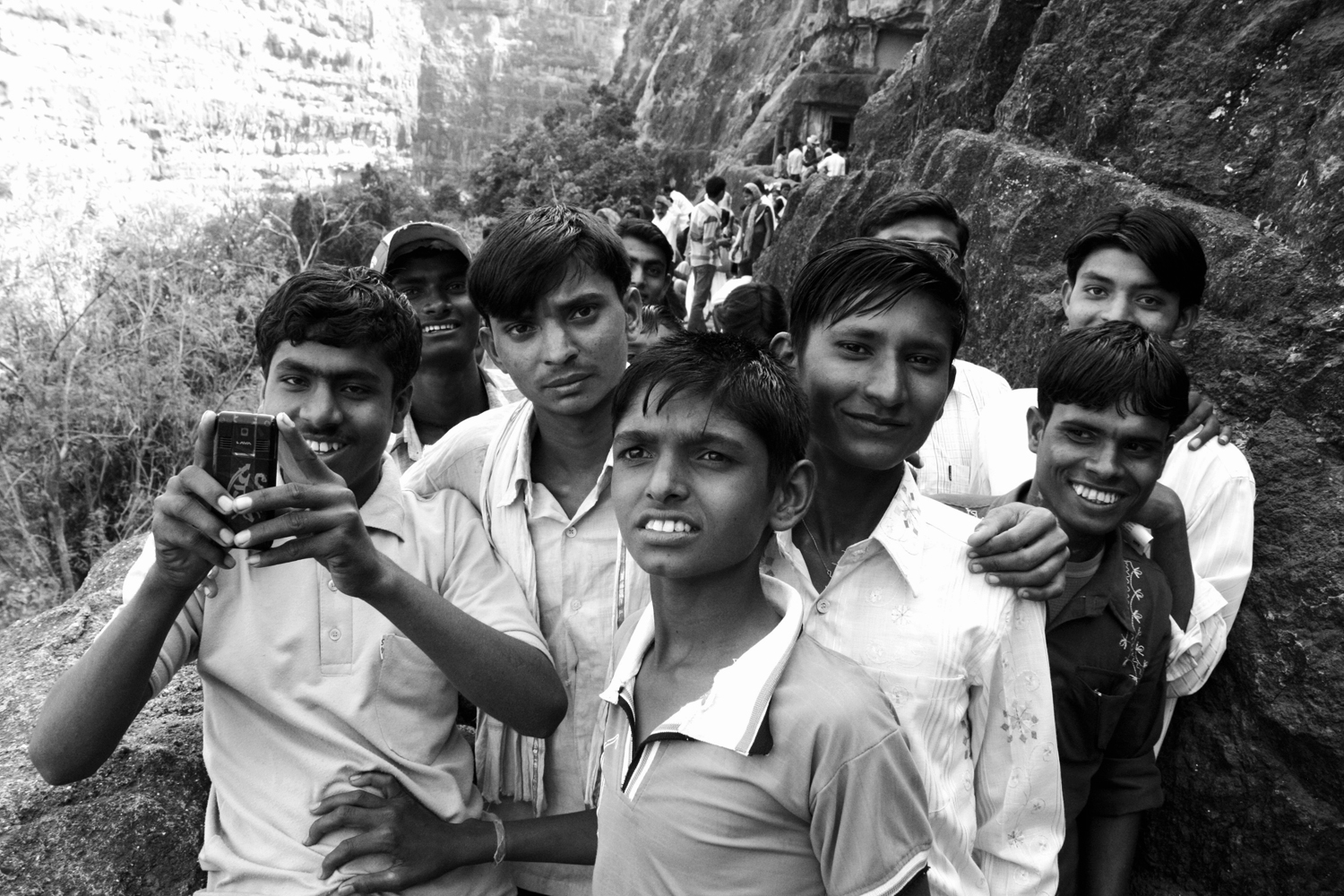
These young blokes, like so many in India, were itching to have their photo taken and to take a photo of me. It can get a bit much at time, just how often one is asked for “just one photo, sir!”, but of course, it’s done in the nicest spirit and in the hope of making a connection, however briefly. I do wonder what the purpose is – like collecting westerners! – but then I think, hang on, am I not collecting Indians, so to speak? What I do love is that I mostly enjoy taking portrait photos, especially candid ones, but always feel somewhat guilty about pointing my camera at strangers. These guys made it so easy.

This shot is taken at the Ajanta Caves, a series of 31 rock-cut Buddhist cave temples and monuments in Maharashtra, India. The caves were carved out of a rock-face between the 2nd century BC and, roughly, the 5th to 7th centuries AD in two distinct phases. The location in itself is a sight to behold; a horseshoe-shaped valley, the handiwork of the Waghora River, curved around a high, central rocky outcrop, that rises sheer from the valley like an acropolis. The caves are accessed by walking along an at-times narrow path carved mid-way up the cliff face, which can be very crowded and difficult to move along.

The caves contain, according to the Archaeological Survey of India, “the finest surviving examples of India art, particularly painting.” They are not exaggerating. Whole temples, complete with all the architectural features of free-standing structures, have been shaped inside the dark and comfortingly cool interiors. The paintings, in the form of frescoes and murals, are difficult to see in the dim, protective light, but well worth the effort of squinting. They are mostly elaborate depictions of the Jataka tales, a large body of stories that tell of the previous lives of the Buddha. Smaller, and ultimately more intimate than the larger caves at Ellora, the Ajanta caves might be difficult to get to, but they are a true archaeological, artistic, logistical and geographical wonder and not to be missed on a visit to India.

Read Full Post »

« Newer Posts - Older Posts »