Feeds:
Posts
Comments

Archive for the ‘Photography’ Category

Natatio, Baths of Caracalla, Rome, October 10, 2013

Natatio, Baths of Caracalla, Rome, October 10, 2013

Wrætlic is þes wealstan, wyrde gebræcon;
burgstede burston, brosnað enta geweorc.

“Wondrous is this wall-stead, wasted by fate.

Battlements broken, giant’s work shattered”

– The Ruin, Old English Poem, c. 8th-10th century

It is hardly surprising that across Europe in the early middle ages, many people living in the post-Roman world thought that the earth had once been inhabited by giants. With the collapse of the Western Empire, many of the major metropolises across western Europe suffered vast declines in population – by the late 5th century Rome’s population had shrunk from over a million to less than 400,000, and by the middle of the 6th century, after Justinian’s reconquest of Italy, it plummeted to a mere twenty thousand. A combination of disruption of the countryside, the breakdown of trade networks and supply lines, and the effects of ongoing war, famine and repeated cycles of plague, the 6th century was an age of disappearing cities and towns.

Indeed, in this period, many cities and towns vanished altogether, only to show up later in the archaeological record. The crumbling remains were either entirely abandoned or quarried for materials. In some major cities, the shrinking population abandoned the city centre to live on the fringes, where access to agricultural land was easier. Major edifices were repurposed, making use of the cavernous spaces between pillars, for example, which could be bricked in with a ready-made roof. Amphitheatres were fortified and piled up with houses built upon the rows of seats. In Rome, such was the scale of the city that it broke up into a series of small villages, with shepherds grazing flocks through the abandoned, overgrown streets. It was the world’s first true apocalypse, the first collapse of a “modern” civilization.

This photograph shows the immense brick walls of the Baths of Caracalla. Constructed between AD 211 and 217, they remained in use until the aqueducts were cut in Rome during the devastating Gothic War fought between the Eastern Empire and the Ostrogoths from 535-554. The baths complex covered an area of 25 hectares, with the main building no less than 228 metres long and 116 metres wide, reaching to a height of 38.5 metres. It could accommodate up to 1600 bathers and contained libraries, gymnasiums, restaurants and shops. It required thousands of slaves to maintain and had its own aqueduct built to supply the water. As it lay on the outskirts of the ancient city, it was left almost entirely abandoned for centuries after its water supply was cut. The immense and impressive statuary which adorned the vast complex, such as the Farnese Hercules, was not recovered until the 16th century, almost a thousand years after it fell into ruin.

This photograph shows a view looking from the frigidarium (cold bath) into the natatio (swimming pool), which was roughly of Olympic length, with dimensions of 54 x 24 metres. The epic scale of the wall dwarfs the human subjects and goes someway towards highlighting just how massive this structure was, and, indeed, still is. An hour-long visit to the bath is a great way to spend a sunny afternoon in Rome.

Read Full Post »

“Emergency Window” – Mysore, India, January 2, 2013

There is an engaging sadness in the expression of the main subject; a pre-emptive longing for a friend yet to depart. The lady on the train seems more cheery, as though she is reassuring her friend. It is, after all, saddest for those left behind, who have to go on as before with the acute absence of the departed. Yet while departures can presage adventure and possibility, sufficient to distract from the missing, or a welcome homecoming to familiar comforts, they can also be a sorry return to quotidian drudgery. Either way, it is so often the case that when someone close expresses an unconstrained sorrow, the other is driven to optimism and persuasive reinforcement, which often masks the true sadness that lies beneath.

This train window farewell took place in Mysore, a lovely, tidy and well-run city with by far the most attractive old market I’ve ever come across. Originally I gave it the title of “Emergency Window” as the full composition includes a notice above the opening which seemed neatly to compliment the solace emanating from the passenger. The title stands though this symmetry has been removed. On the subject of symmetry, perhaps it is just their identical facing, yet the two women in focus, looking left of frame, not the moving passer-by, appear similar enough to be related. I’ve always assumed it was mother and daughter, though this is just as likely mere inference.

Read Full Post »

1615 Venice

Venice, Rialto Bridge, March 9, 2007


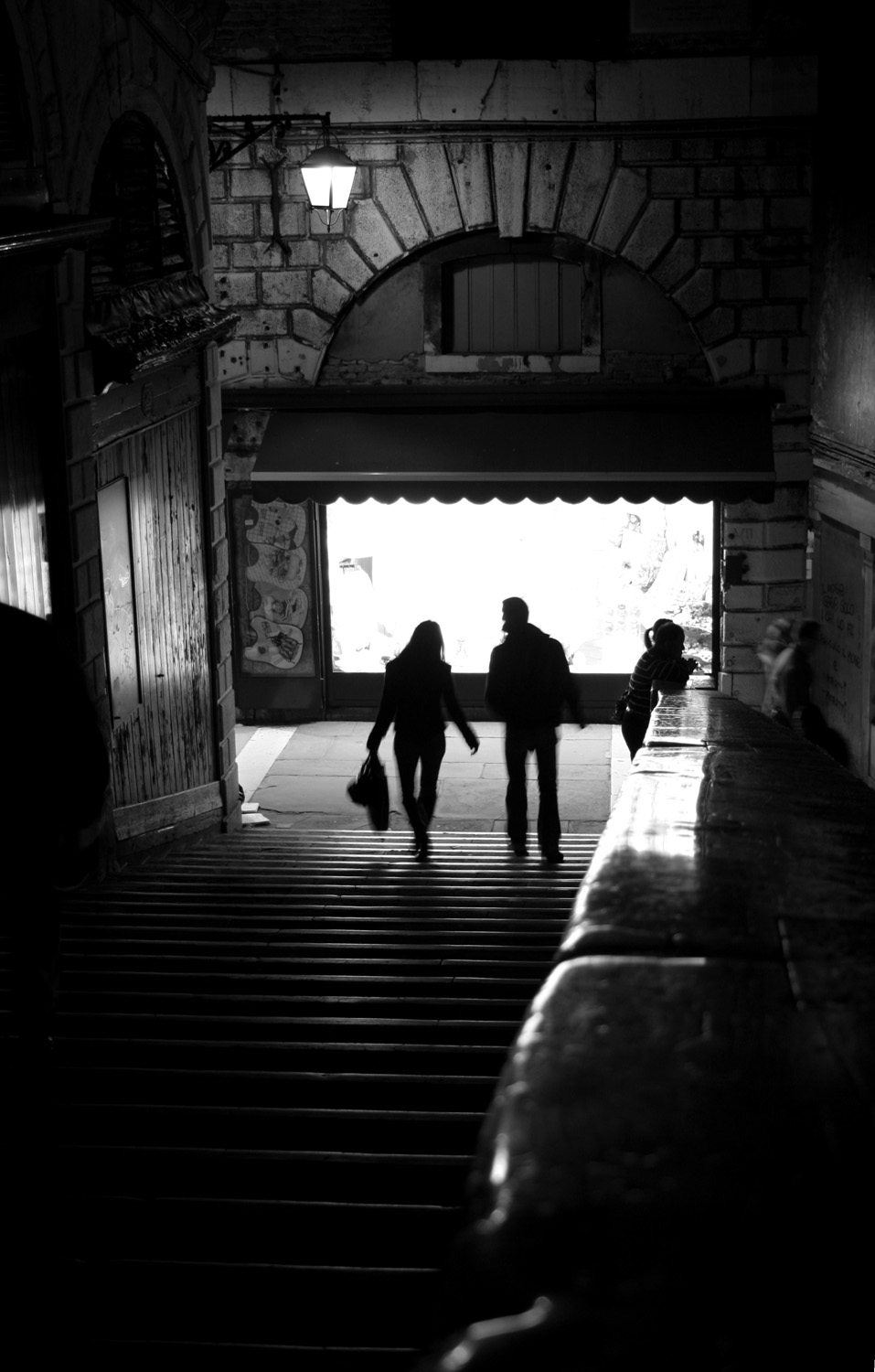
During the day the Rialto Bridge in Venice is a very busy place. Whatever the season or weather, the bridge is not merely a tourist magnet, but one of the key central crossing points along the Grand Canal and is thus rarely free of people. This is the case for much of the centre of Venice – being as beautiful as it is, the streets are often packed with both locals and foreigners. Things certainly quieten down in the off-season, but the thinning of the crowds starts from the outside in and the Grand Canal retains its floating population.

At night, however, particularly in the colder months, the streets can become surprisingly empty and a welcome quiet descends upon La Serenissima. The freedom to stroll leisurely and alone through the streets, hearing the soft scuff of one’s feet on the flagstones is a rare and beautiful thing. It gives Venice back its subtlety and romance, hidden behind the hubbub of the busy days. It is then that the city’s antiquity and its strange melancholy become most apparent; the precarious decay, the suggestive gloom, the orange of lamps and jade of the luminescent canals seem as genuinely characteristic as the glittering palazzi reflected in the sunlit waters.

This photograph reminds me of the quiet and empty nights I experienced in Venice on my four visits there in various years. Be it March, April, October or November, there were always nights on which the crowds completely dispersed and the streets were free to wander through, unhurried or interrupted by others. This photo is of the stairs leading down the eastern side of the Rialto Bridge of a couple whose dynamic silhouettes captured my attention. I’ve always liked this shot on account of its movement; the setting remains so still, the bridge’s marble polished by millions of visitors, but the couple are wonderfully expressive without meaning to be so. They seem so sexy and alive while around them the city eases into sullen silence.

Read Full Post »

5146 Lisbon

Praca Figuera, Lisbon, Portugal, September 6, 2007

The sunlight was blinding in the square below, the air already on its way to another hot day. For the last hour a blind man had been calling aloud the title of the journal he was selling at the metro entrance – a publication from what sounded like the Borda d’aqua. Every ten seconds or so the title would roll off his tongue, finishing up with a rhythmic flourish of “Borda d’aqua.” It seemed a sorry task, attracting little interest, yet he went about it with dignity and determination, sustaining his pitch through the morning’s indifference.

Later research found only the following link, the Borda D’Agua almanaque of 2008, which certainly fits the context as it was September 2007 at the time. It seems the almanac was designed as a guide for the coming year. Though I haven’t quite conducted the most comprehensive search, the lack of more recent hits suggests this almanac might have since ceased publication.

The bright glare of the square made a delightful backdrop against which to shoot. The man here with the newspaper is not the aforementioned blind man, but merely a passer-by troubled by the intense sunlight. I spent a lot of time with my head and shoulders poking from the small hotel room window above Praca Figuera, the square below. This was, however, not merely because of the great light and people-watching opportunities, but on account of the intense orange-scented smell of the cleaning product with which someone had cleaned the room the day before. So intense was it that I had had trouble sleeping and the scent stayed in my clothes for weeks afterwards. Clearly, I should have switched rooms, but this one did have the view after all, and on that sunny morning, it was worth it.

Read Full Post »

Halki, Naxos, Greece, September 22, 2013

Halki, Naxos, Greece, September 22, 2013

This table sits in the intimate central square of Halki, a village on the Greek island of Naxos. Like so many villages in Greece, Halki is blindingly beautiful – brightly coloured doors and white walls concentrate the sun’s glare, filling the streets with an almost tangible lightness. It is the simple low-maintenance beauty of something done exactly right. Outside the village the land is dry and yellowed; outcrops of ochre and umber lending a pervasive orange glow to the thirsty green. Pockets of well-watered garden with swollen aubergines exude a moist fertility; the silver-backs of the pale green olive leaves reflect a million points of light, overexposing the scenery. Naxos is a dry and rugged island – its centre like another planet – yet it thrives on good fortune and nurture.

On a sunny September afternoon, in the mild heat amplified by the absent breeze, the shade of this tree-covered square was most welcome. There was nothing to it but to sit and eat and drink, so we ordered the perennial Greek salad and an onion tart, mineral water and coffee. Simple things done immensely well, it was a brief yet memorable stay.

I like this photo for its pleasing colours, indicative of the ease with which Greece achieves harmony. Perhaps it is a quality of the light – the clearest and brightest I’ve seen outside Australia – or perhaps it is that white and blue make such a neutral base from which to work, that even contrasting colours fit effortlessly into the picture. The soft focus of the background perhaps does not reflect the sharpness of the light, yet I’d like to think it captures the dreaminess of the old towns on the islands, which always seem far too incredible to be true.

Read Full Post »

4665 Indian beach scene

Palolem Beach, Goa, India, January 9, 2013

Despite having roughly 7500km of coastline, I never much associated India with the beach. Perhaps this is simply a consequence of the sheer richness of India’s landscape, cultural and architectural heritage, which, with the exception of the much vaunted Kerala backwaters, dominates the images of India seen in tourist advertisements. When it comes to considering what is distinctly representative of India, it is sights such as the Taj Mahal, the forts of Rajasthan, the ghats of Varanasi, the desert, jungle and mountains that get more of a look in. Even after my first trip to India, during which I stayed entirely inland across the north and in the foothills of the Himalayas, I didn’t give much consideration to the coast and beaches of India at all.

It was, therefore, a real eye-opener to begin my second visit on the west coast of the south, at Varkala, which I’ve written about elsewhere. Apart from the prevalence of various ritual practises – offerings made to the sea and small shrines or idols present in some places on the sand – Indians seem to enjoy the beach in much the same way as most people – only, they tend to do so in considerably more clothing. This was not universally the case, however, and the men more often than not cover little more than their privates. It’s worth mentioning that across India I was often surprised by the apparent acceptance of nudity. In various places I saw women bathing in their undergarments alongside men, not so much at the beach, but certainly in the Ganges. Without any sophisticated knowledge of the context, I had rather assumed attitudes might be more conservative, and it is still possible that these were exceptions, or perhaps what is acceptable is very much differentiated by social status.

This photo was taken on Palolem beach in Goa. We had never really intended to go to Goa, fearing it would be an over-touristed disappointment, yet we came across enough strong assertions of the beauty of the place and the fascinating legacy of Portuguese colonialism to decide it was worth a look. I like this photo not merely because of the dynamic and graceful posture of the cricketer, but also for what it represents – a culture so recognisably similar to that of my own country, where we too play cricket on the beach. It serves as a healthy reminder that we should focus more on what we have in common with other people, rather than our differences.

Read Full Post »

First Autumn

My favourite season has arrived in Sydney – Autumn. It begins in the balmy, residual humidity of sticky February and finishes in the dry cool of a winter prequel. Without haze the horizon flattens and sharpens into focus; the sky lifts towards the stratosphere and the shade regains a measure of chill. The sun, for the most part, shines and yet, as longer days shorten, the air acquires the nostalgic foreboding of the onset of loss.

This is my son’s first autumn. At four and a half months old he can’t yet feel those weighty emotions we associate with the shift – it is but a question of warm or cool, blanket or no blanket, hats and socks and jumpsuits. He may be excused for being unsure as to the time of year considering we still go to the beach several days a week. With the ocean at 22C, it’s hard to resist.

9167 Surfers

9582 Window wet

9201 Watcher 2

9503 Mural, off Cleveland street

9516 Bubbles 4

9379 Colgate ocean

9176 Great childhood

9343 Stormy swell 2

9635 Succulents

9442 White ceiling

9545 Broadway

9449 Mynor 2

9595 Boy at Bronte Pool 2

9141 Mother and child

8447 Stormy weather

9701 Bronte beach morning

9046 Boy at Bronte

9639 Succulents

9760 Hood

Read Full Post »

5641 Amritsar

Golden Temple, Amritsar, Punjab, April 22, 2010


The Golden Temple of Amritsar in Punjab is truly a wonder, and not simply because of the beautiful and elaborate solid gold upper storeys of the Harmandir Sahid, the structure at the centre of the complex seen here in the background. It is a huge site – a square of gleaming white marble colonnades surrounding a central man-made lake, or tank – and is without a doubt one of the cleanest, most stunning places in the world. The perfection of the architecture and the standard to which it is maintained is immediately apparent. Upon entering through one of the four temple gates (symbolic of the openness of the Sikhs to all who wish to visit, irrespective of religion), the blinding white marble is just as striking as the shining gold.

This was without a doubt one of the highlights of my first visit to India. I flew in first thing in the morning, after an overnight stay in Delhi en route from Darjeeling. I had not had anywhere near enough sleep and felt a little overwrought, which actually heightened my experience, intensifying the emotional response to the magnificence of this site. There was so much to be appreciated here – the chanting and music which played throughout (on without a doubt the best P.A in India), creating a peacefully exotic atmosphere; the spear-wielding, turbaned temple guards; the gorgeous, colourful clothes of the Indian visitors, so luminous against the white backdrop; the dreamy reflections in the water of the lake, and the almost cloying niceness of every single person I met.

Apart from the impressive appearance of the place, I was astonished to learn that the temple feeds up to 40,000 people each day, for free, through the efforts of volunteers. This involves using around 12,000kg of flour a day, and the number of people fed can rise as high 100,000 on religious holidays and weekends. This seemed to coincide with how nice everyone was. I had several locals approach me, all wanting to make friends and talk to me. This is not uncommon in India, but the locals around the temple in Amritsar seemed somehow to be the sweetest people I’d ever met and I actually was left feeling terribly guilty when I finally made excuses and walked away from them.
Originally I intended to stay in the town, but ended up just visiting the temple for four hours before taking a bus north to McLeod Ganj. It was a short, but sweet visit and the temple has left indelible images in both my mind and camera.

This photo is taken from just outside one of the gates, looking back into the temple. I chose this one for its various vignettes – the man inquiring of the temple guard, the cleaner, the woman taking the photograph and the man in the striped shirt who may or not be accompanying the man in the white turban. It reminds me fondly of the different people who visit the temple for different purposes and of the people who look after and maintain the place.

Read Full Post »

2525 Hampi

Hampi, India, January 5, 2013

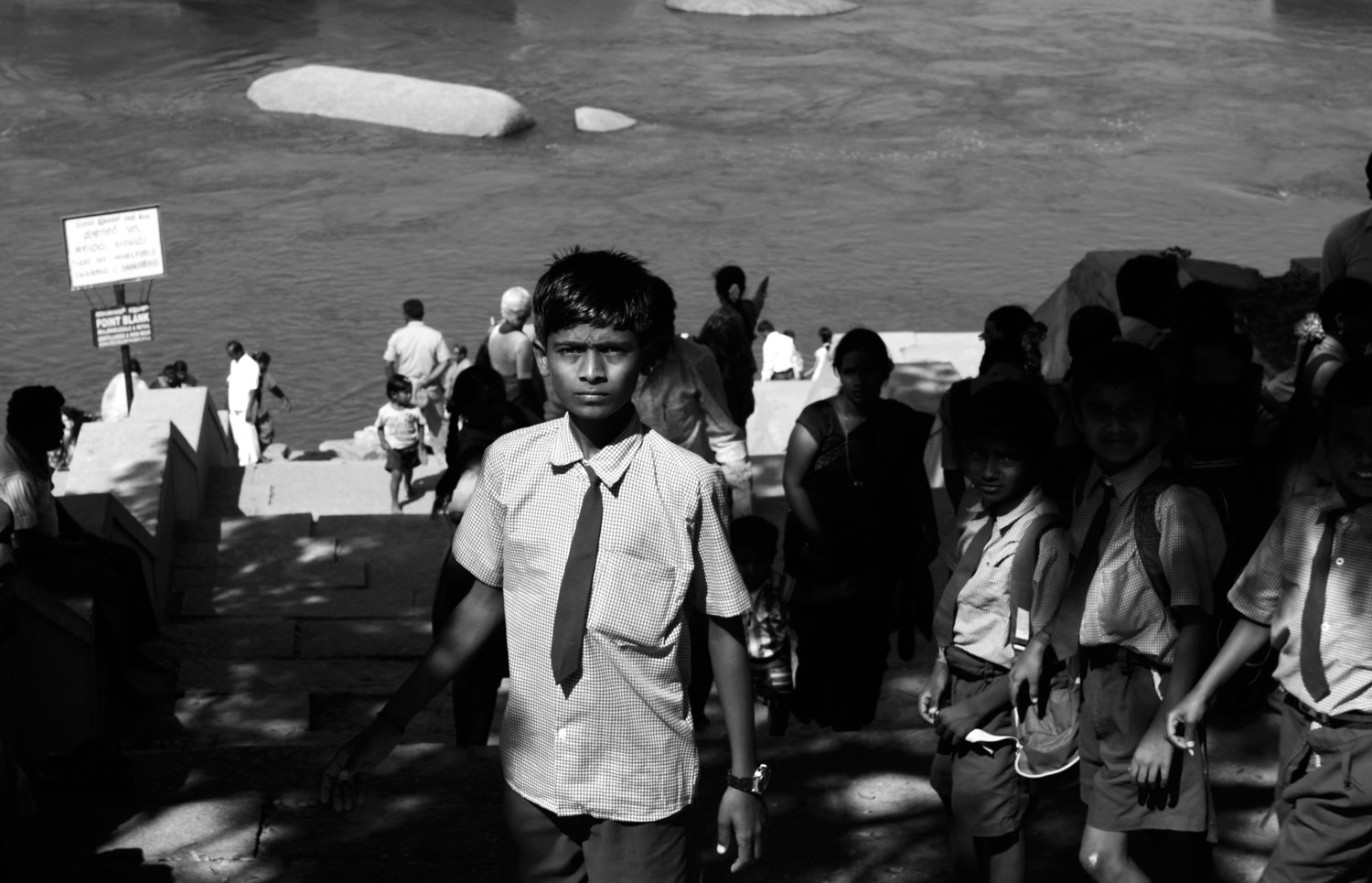
This shot was taken by the river that flows through Hampi in northern Karnataka in India. There is no bridge across the river at this point and the stairs here lead down to the bank along which the tiny ferry – a small, uncovered boat with outboard motor – collects and unloads passengers. The stairs pictured here were also a popular place for resting in the shade.

These school-children may have been locals, or else they may have come to Hampi on an excursion to see the extensive archaeological ruins, which I have written about elsewhere. As is so often the case in India, they wanted their photo taken and called out to me to do so. Unlike so many other children who asked for their photo to be taken, the young chap in the middle didn’t smile, but rather offered a far more serious and quizzical expression.

Aside from the strong contrast of the sunlit boy against the dark shadows on the stairs, it is his expression and body language that I most like about this photo. Every time I look at his face, I detect an intelligent and discerning personality – he strikes me as a real thinker. There is almost a hint of disapprobation in his look – the frown, which forms a neat triangle at the top of his nose, seems to indicate some frustration or impatient curiosity – or perhaps he is just squinting into the sun. Though their faces can barely be seen in the shadow, the other children are also an interesting mix of expressions, with only the one in the middle smiling unreservedly. Something gave me the impression that the main subject was older than the others, or in some way more mature, and that his friends looked up to him. Of course, one can never be certain in these brief, stolen moments.

Read Full Post »

The Eternal Beach

8666 Swimmers

7990 Surfer shapes 2

8516 Transient Alps  2

8800 Whitewash

8243 Aquatic

8679 In full flight B & W

7916 Shiny 2

8248 Bronte B & W

8281 Bronte

8817 Bronte surf

8576 Surry Hills, Sydney

8627 Rainy St John's college

8282 Into the Pacific

7981 Surfer's leap B&W

8495 A long way to Chile

8175 iPhone 2

7877 Pastel haze

8876 Donovan's Leap

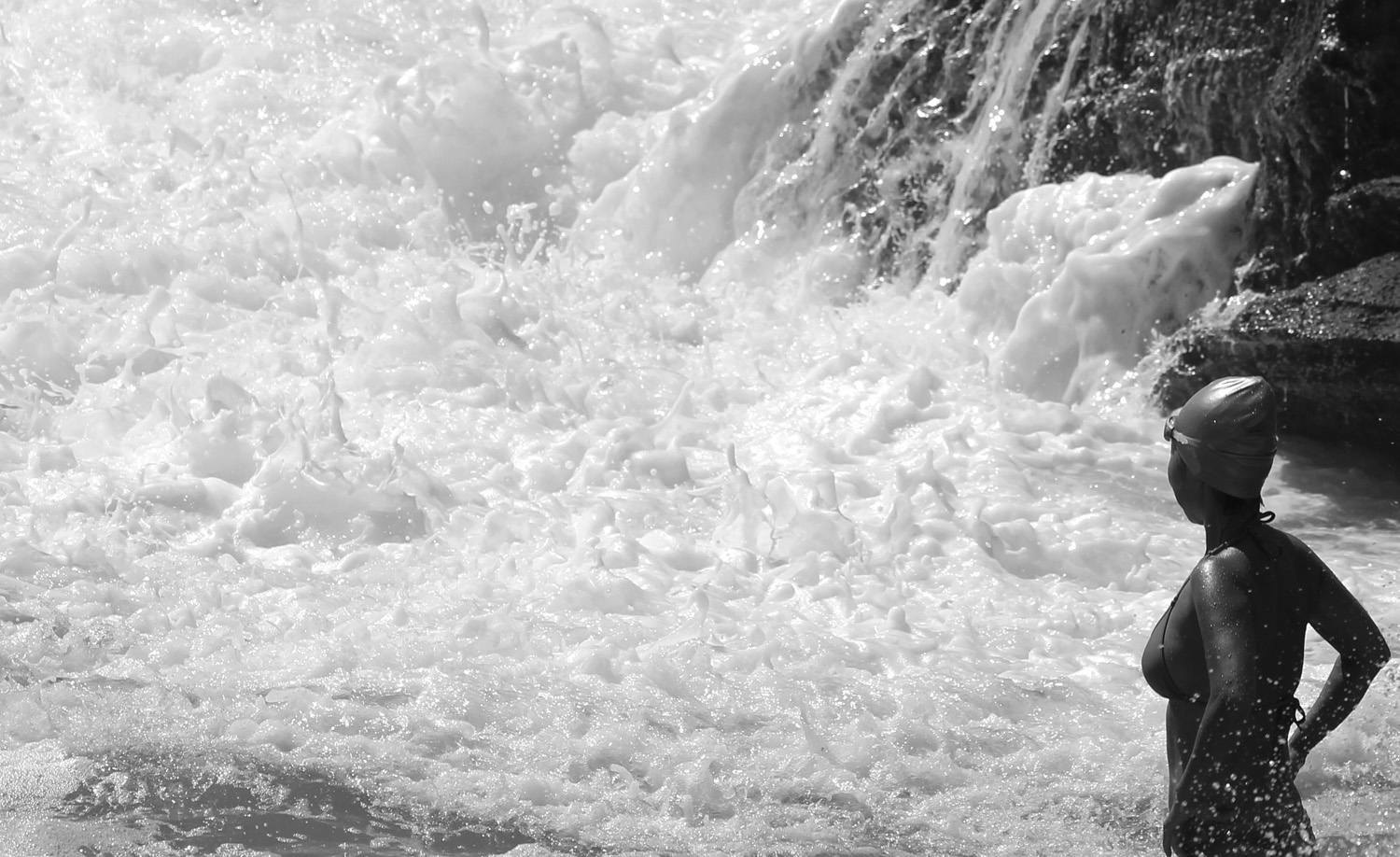
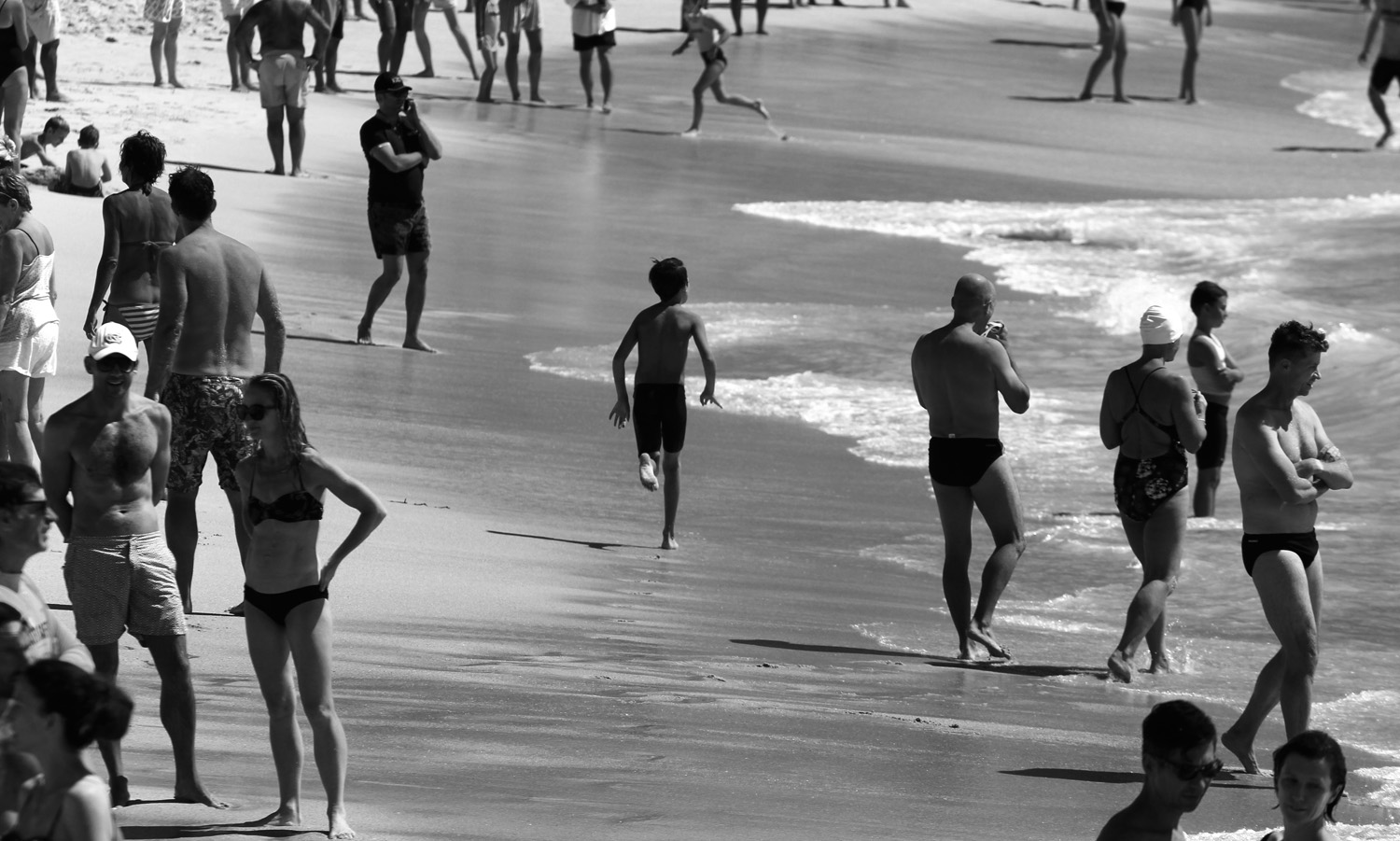
I doubt I’ll ever get bored of the beach – it is simply far too beautiful and pleasurable. It is the key to life in Sydney for almost three quarters of the year, considering we usually swim from November through to the end of June. Sydney has many attractions, of course, and I never forget how fortunate I am to live in a society with such a high standard of living and sophisticated lifestyle. Yet, what makes the beach so wonderful is not merely the refreshing sense of well-being it offers, but the grandeur of the expanse, the light and space and the humbling, epic nature of the ocean’s power.

Years ago I came to these sea-cliffs at night and sat atop them under a full moon, pondering the incomprehensible vastness of geological history. Even the ancient sandstone cliffs tell a relatively recent story, compared to the oceans of time that preceded the laying of those sediments. I never fail to look at those cliffs against the backdrop of the Pacific and consider how deep and long is the history of the earth, and indeed, the universe. Thus the beach not only offers pleasure, space, light and beauty, but it also prompts philosophical considerations – our insignificance before both nature and time, our fleeting time in the light of our otherwise unremarkable sun.

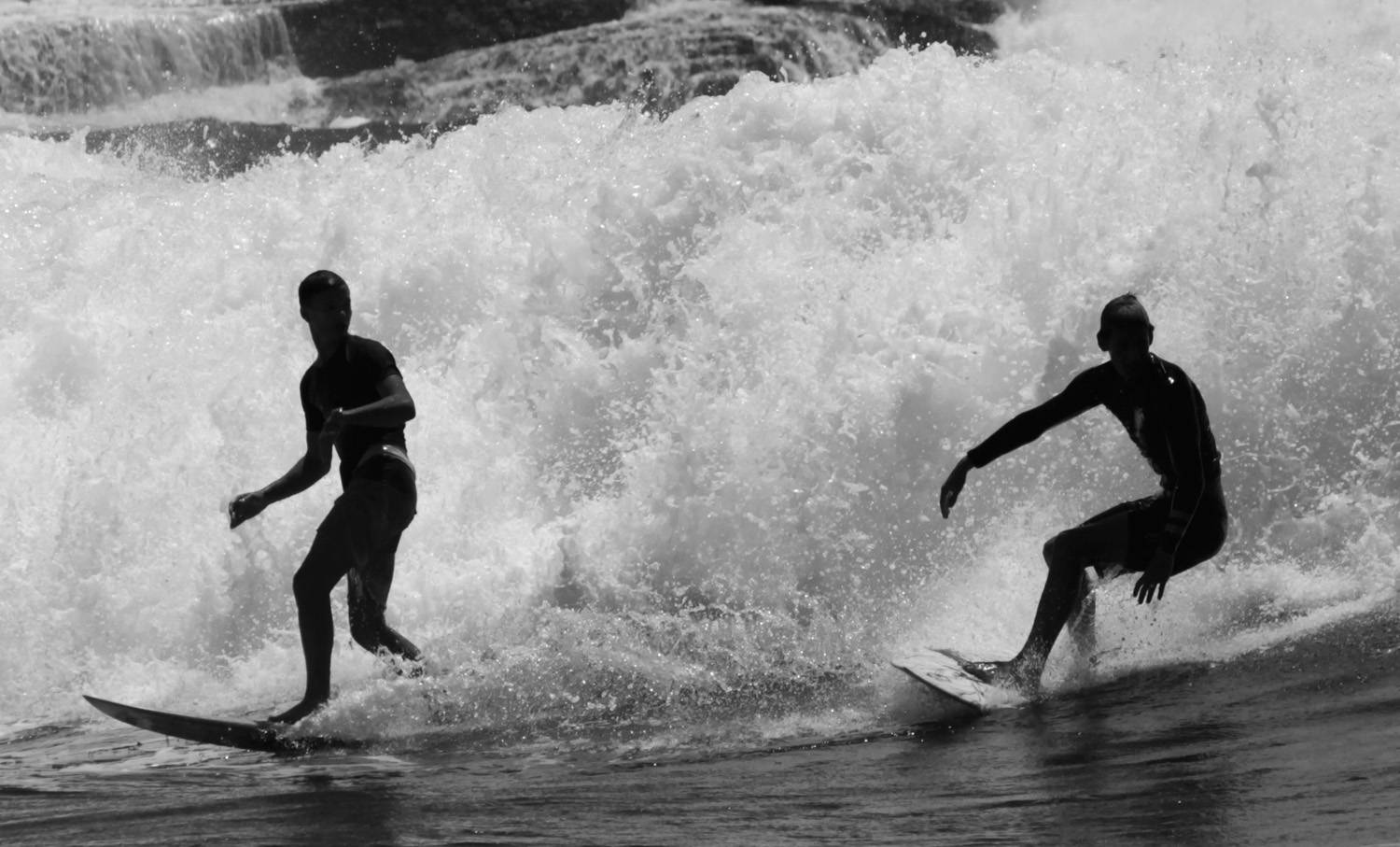
Whilst the beach may never bore me, I do wonder how long I can continue to shoot it. It seems as though I take photos of nothing else at the moment, and yet, in truth, I hardly go anywhere else outside of work and various regular commutes. Still, considering how frustrated I feel when I forget to take my camera with me to the beach, it seems that inside I still have a burning desire to mine the sea and sand for gold. The new mission is to try to photograph surfers more, to capture the languid shapes they create as they balance themselves on their boards. One day, I’ll get around to learning how to surf myself…

Read Full Post »

« Newer Posts - Older Posts »