Feeds:
Posts
Comments

Archive for the ‘Photography’ Category

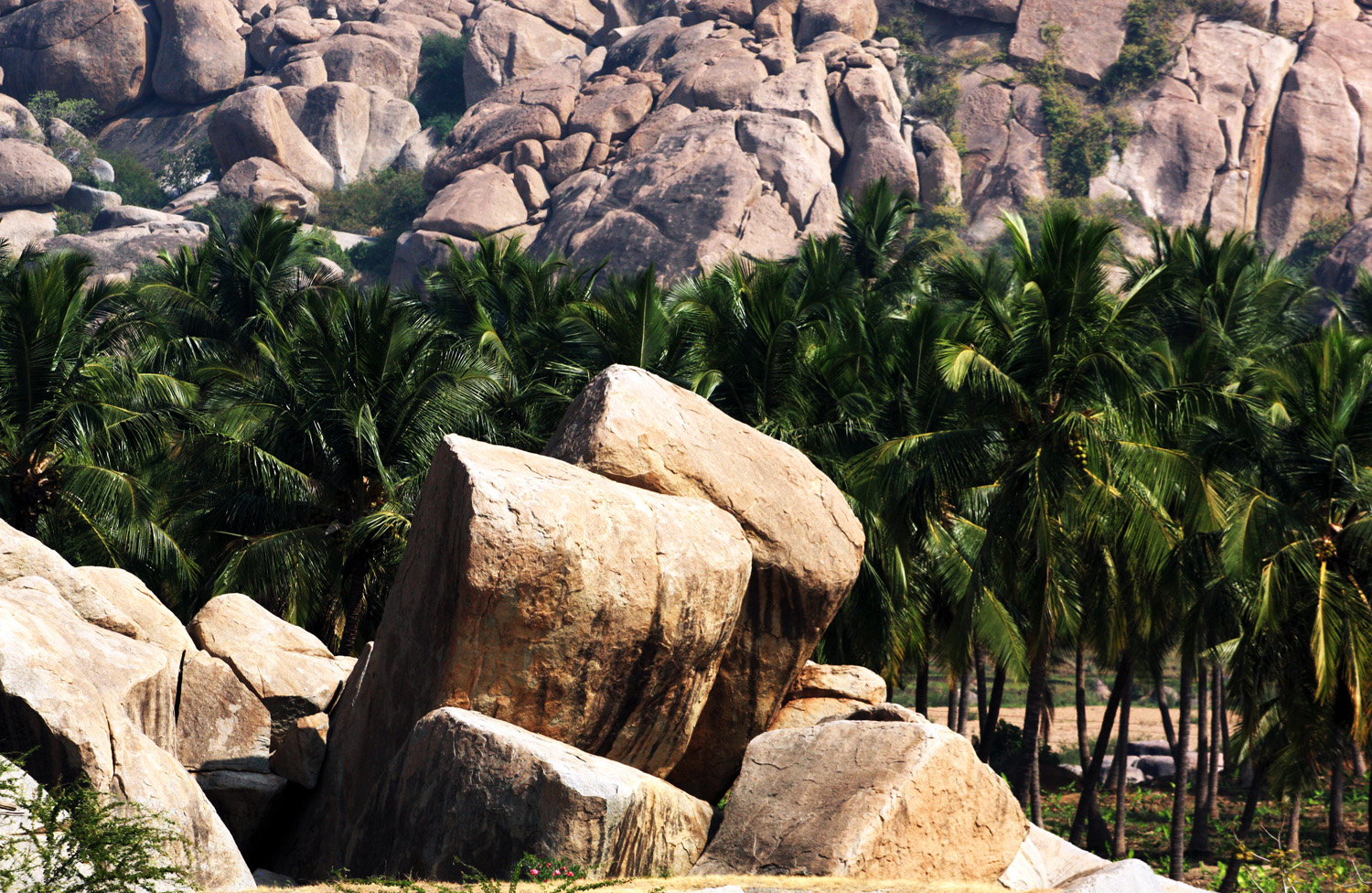
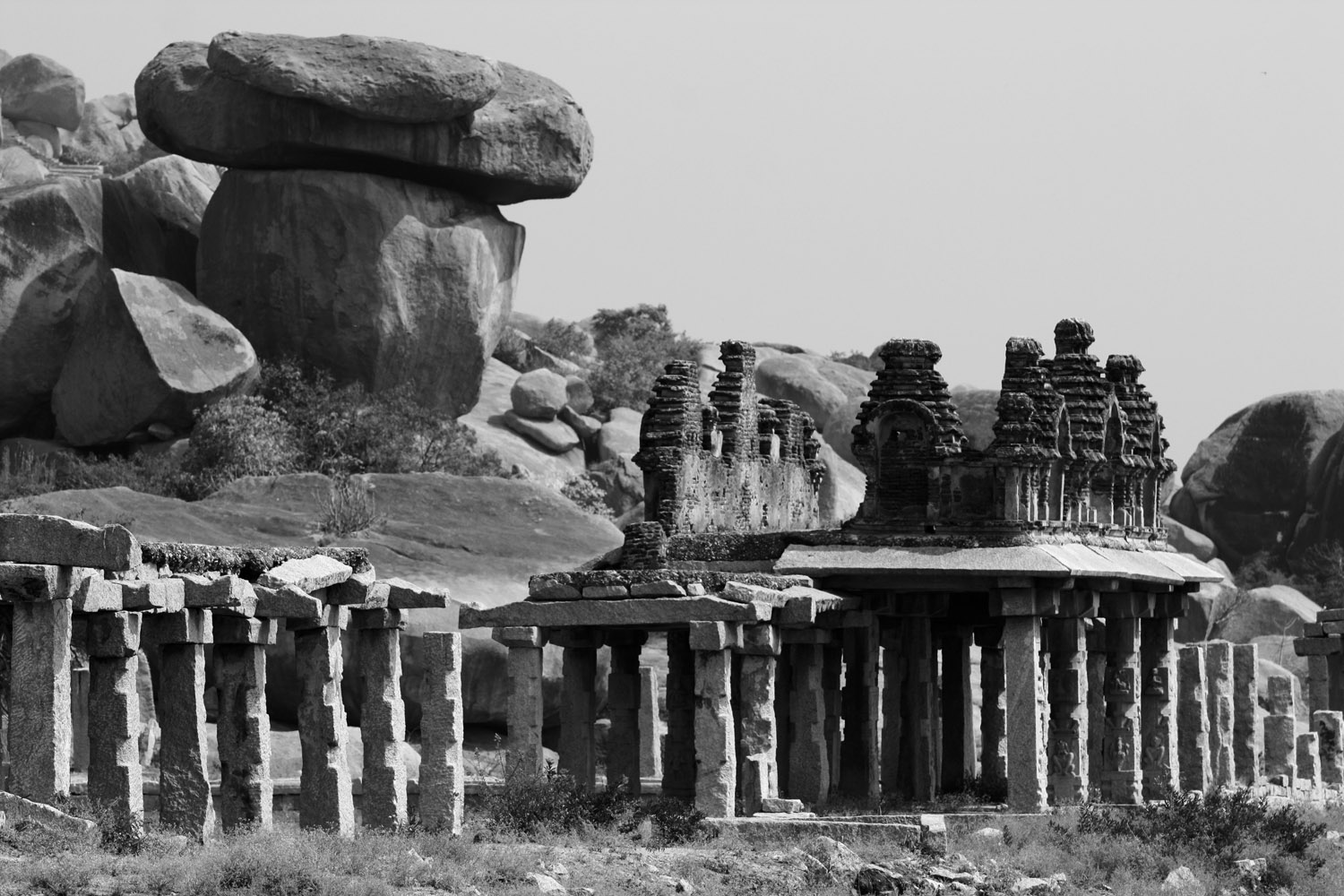
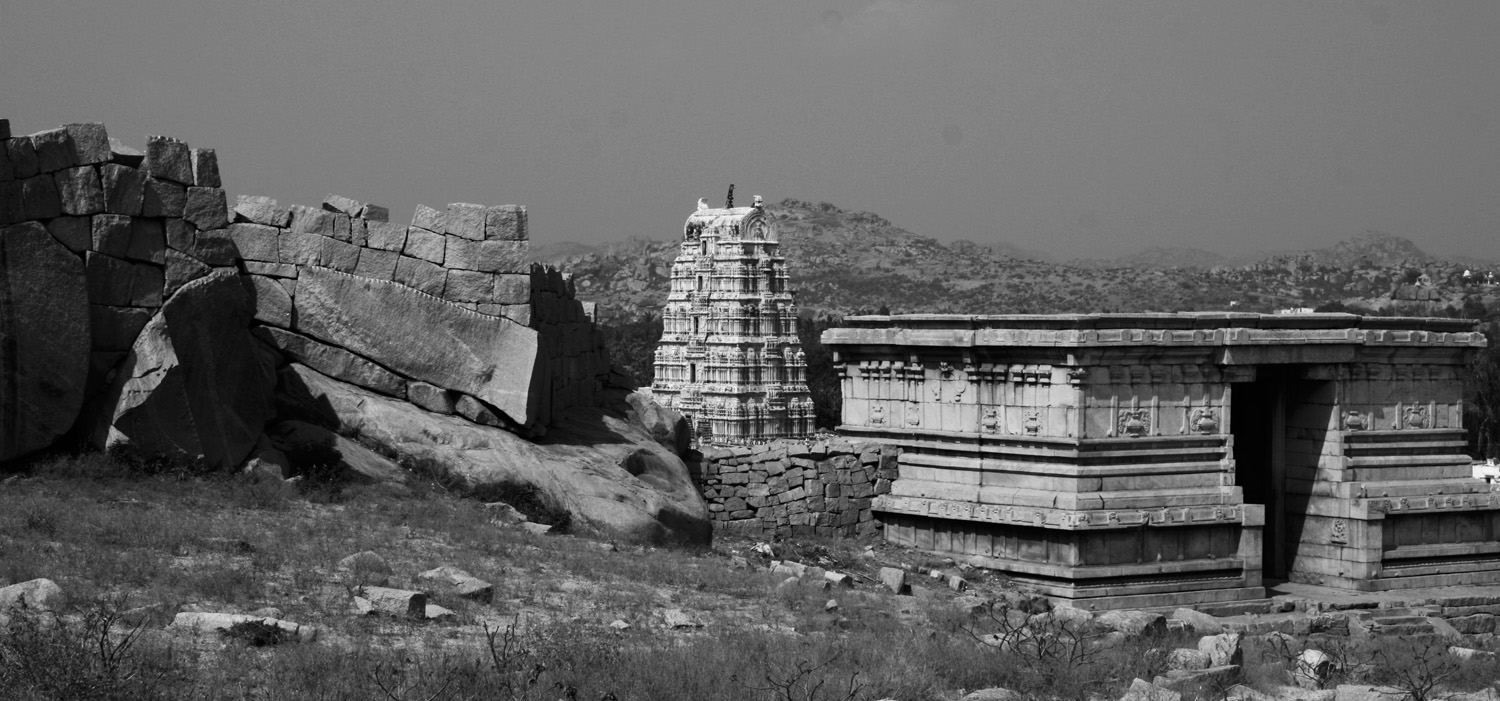
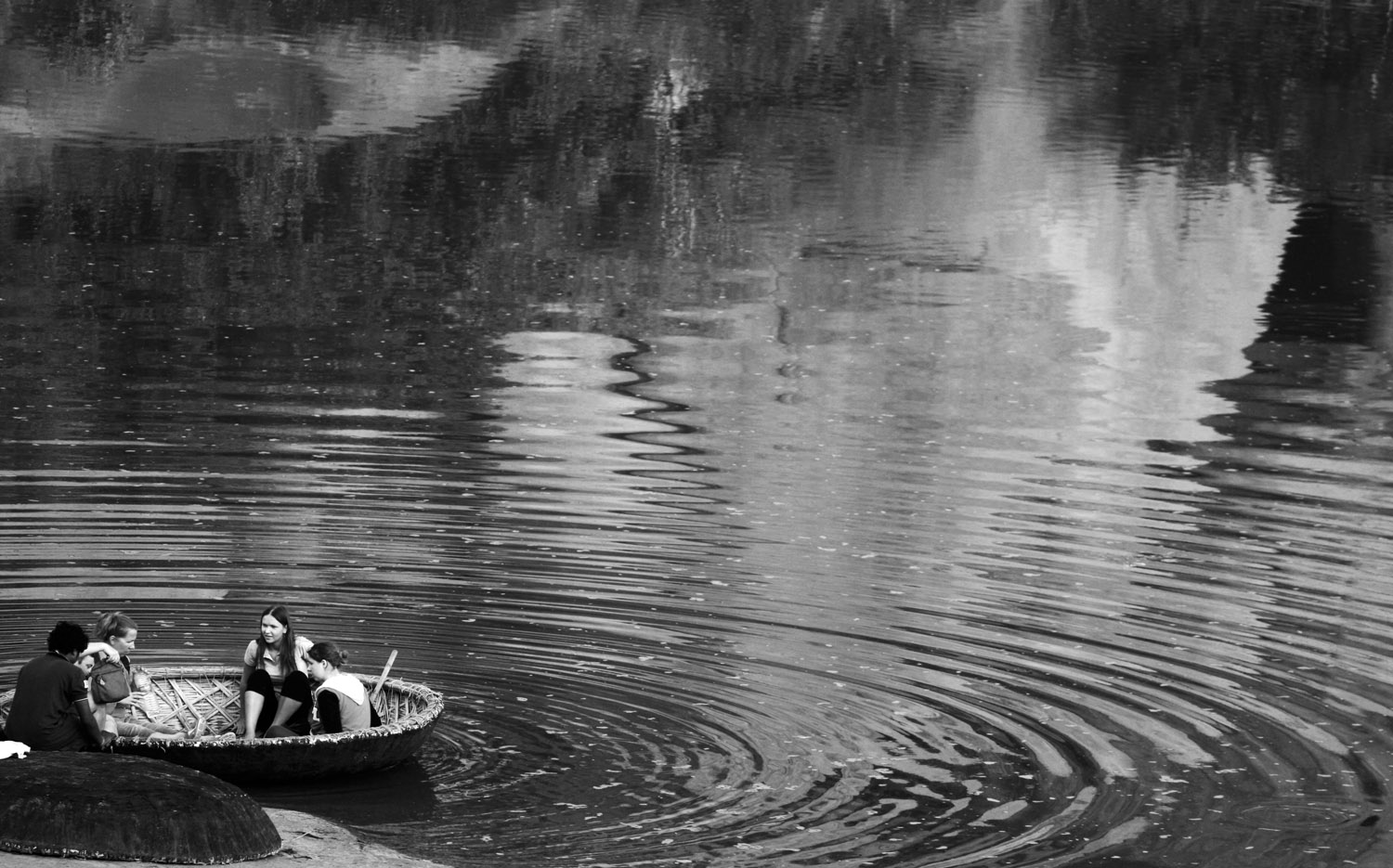
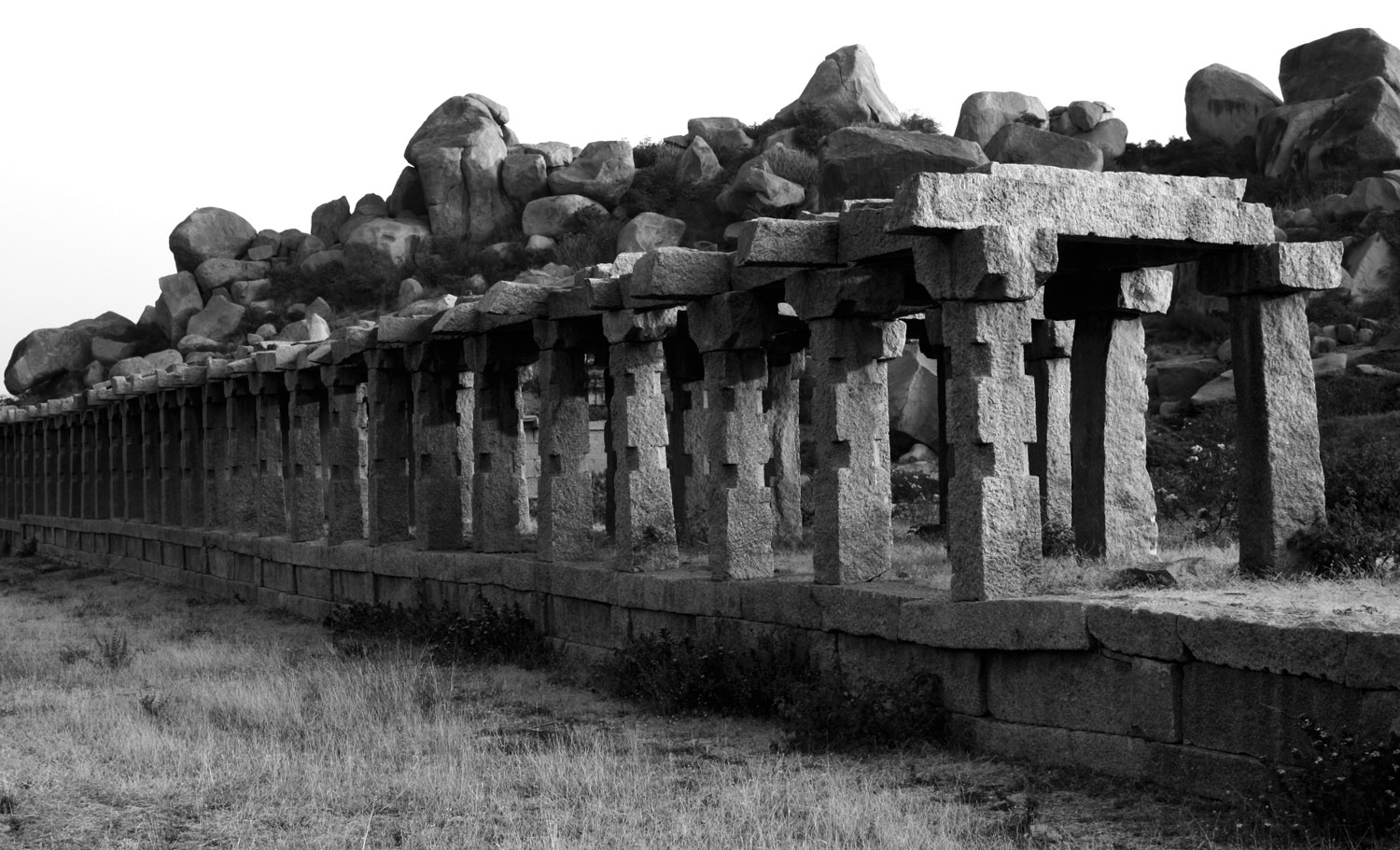
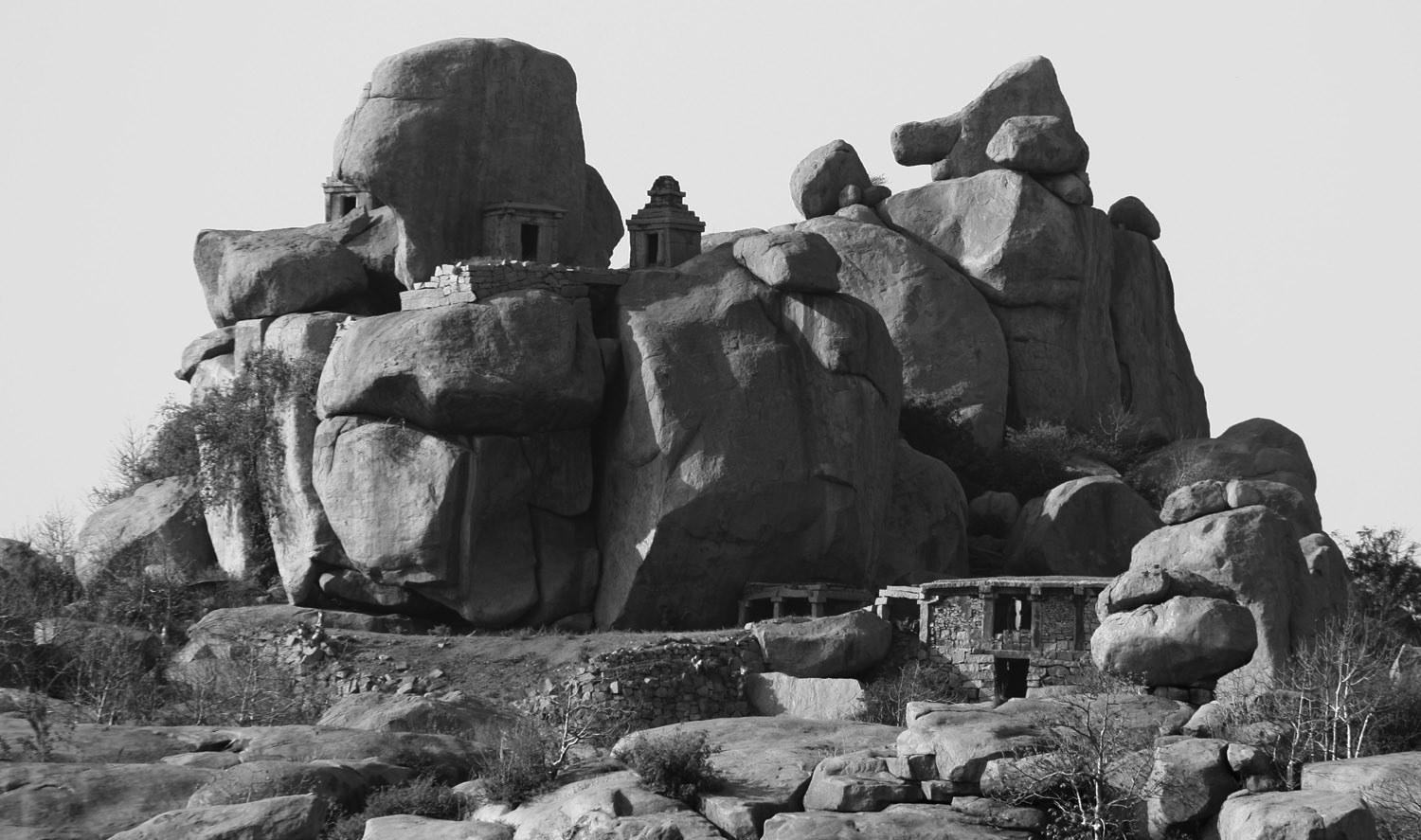
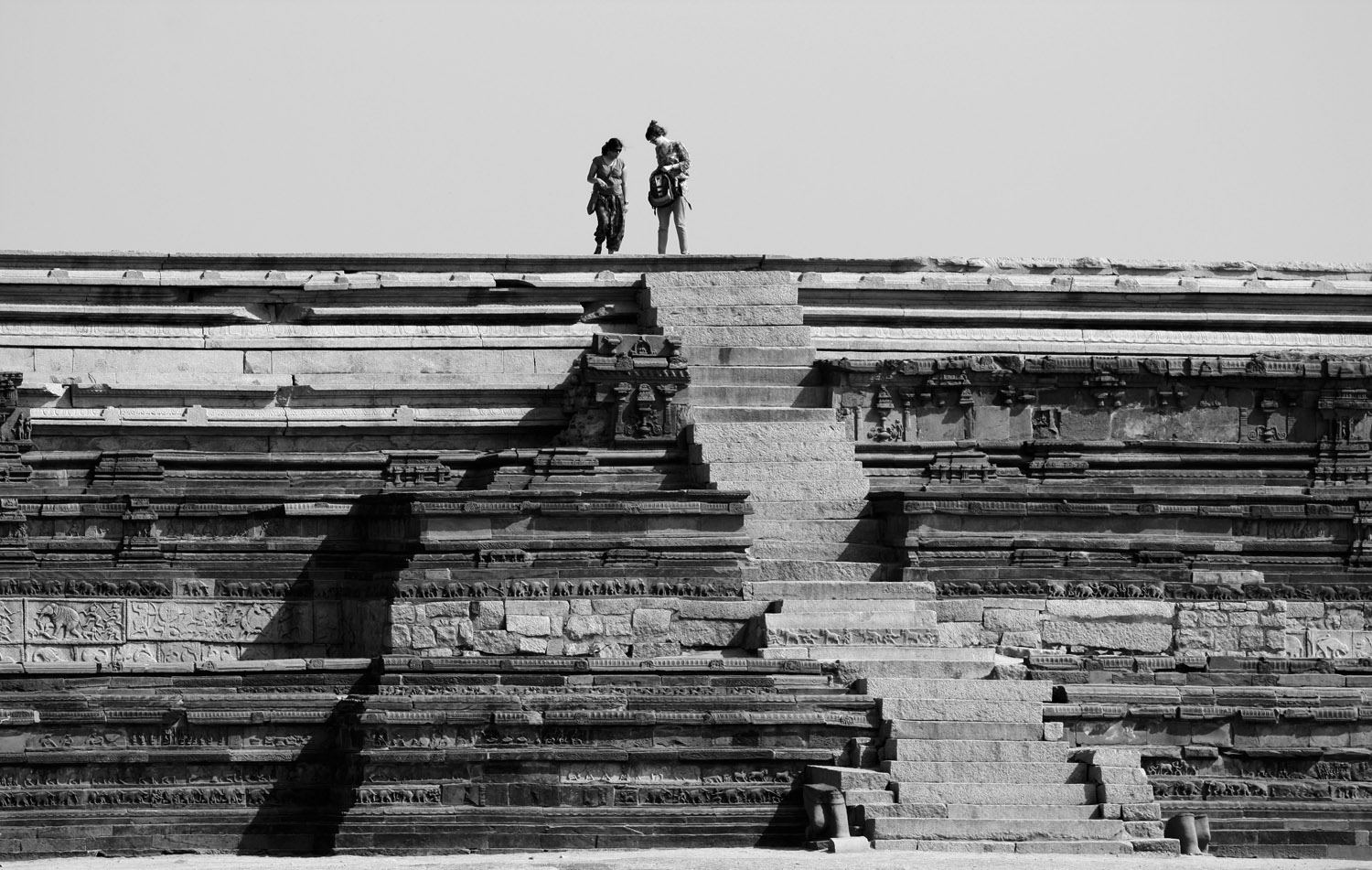
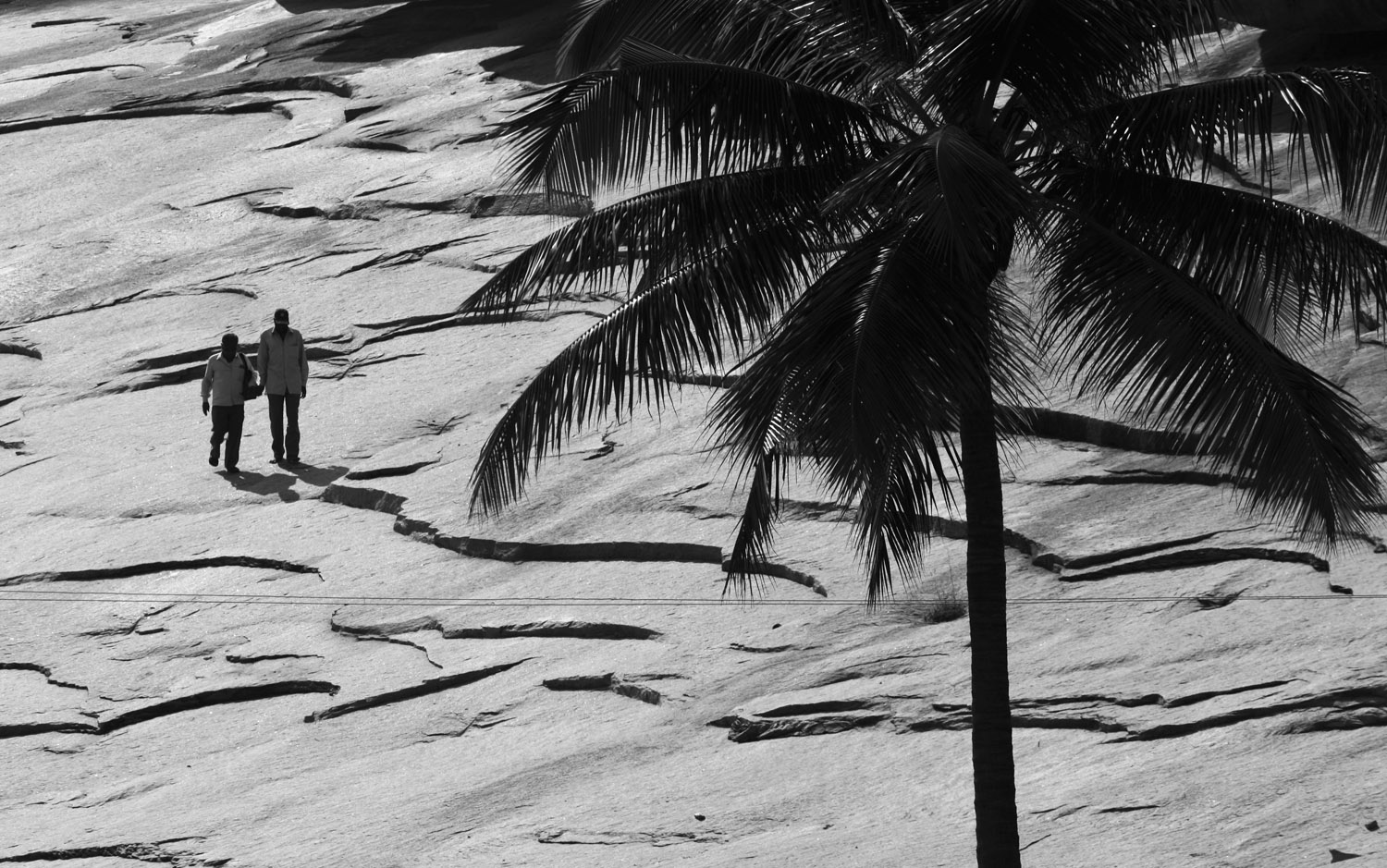
Hampi is a striking place – an odd landscape of giant, tawny granite boulders, strewn across dry river plains and low hills. The weathered, rounded rocks protrude from the rusty, orange soil like scattered marbles, giving the place an otherworldly feel. Hampi is not only a geological wonder, it is also an archaeological one. Having once been the capital of the Vijayanagaran Empire – at its height between the 14th and 16th centuries – the site is full of monumental stone ruins – covering a whopping 26 square kilometres.

Hampi Bazaar

2583 Hampi

2851 Hampi stones and palms

3030 Epic landscape

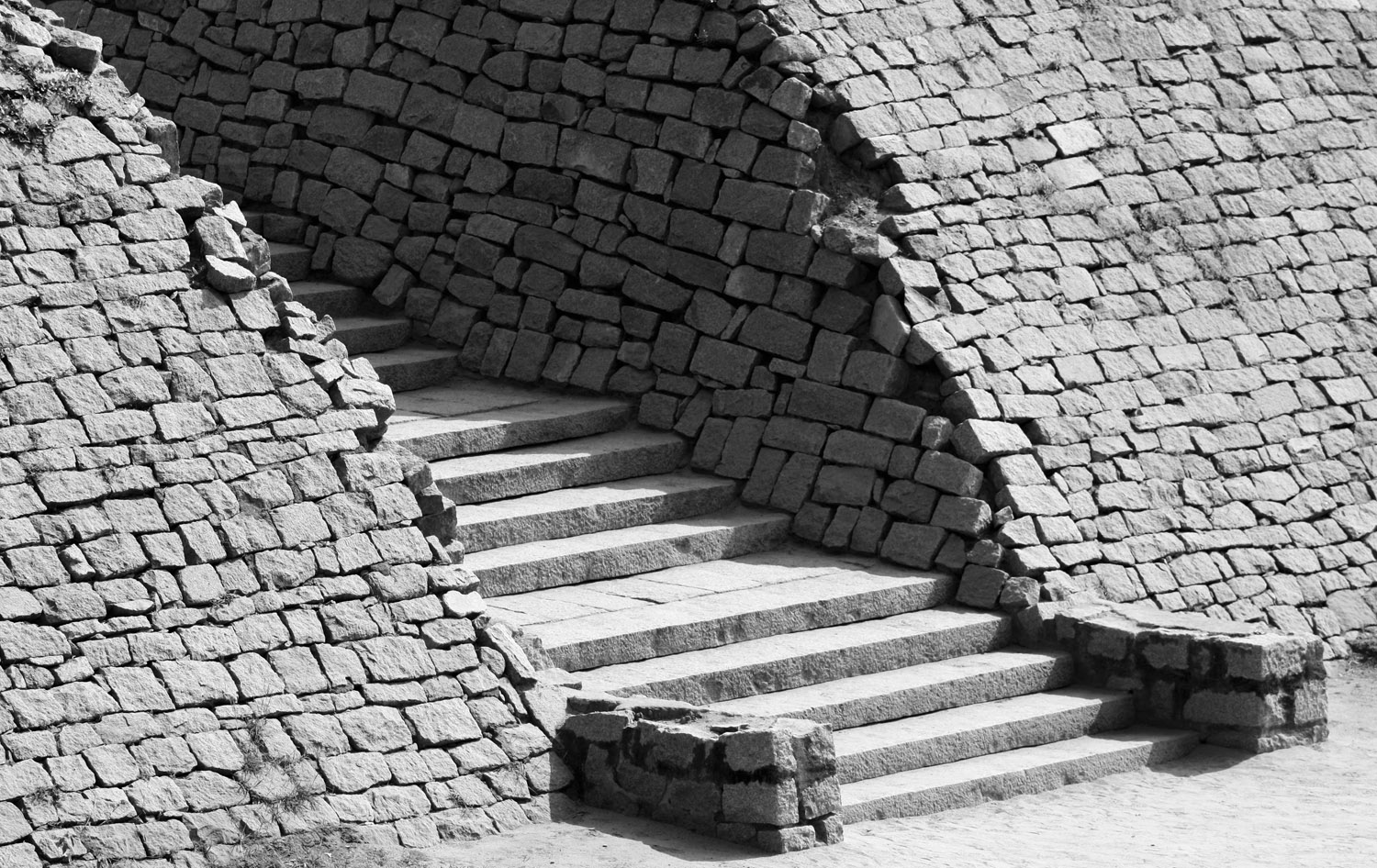
The city of Vijayanagara was founded on the Tungabhadra River in 1336 by two brothers – Harihara and Bukka, and quickly rose to become a major centre of trade and Hinduism. Its wealth came primarily from cotton and spices – a market monopolised by the local rulers to great effect. With such ample stone reserves to be quarried, Vijayanagara experienced an extended construction boom which peaked in the early 16th century under the rule of Krishna Deva Raya (1509-1529). It is from this time that many of the major structures are derived; vast temple complexes and colonnades, bath-houses, cisterns, aqueducts, palaces and elephant stables.
3352 Temple platform Hampi

3217 Hampi 2

3064 Hampi Temple

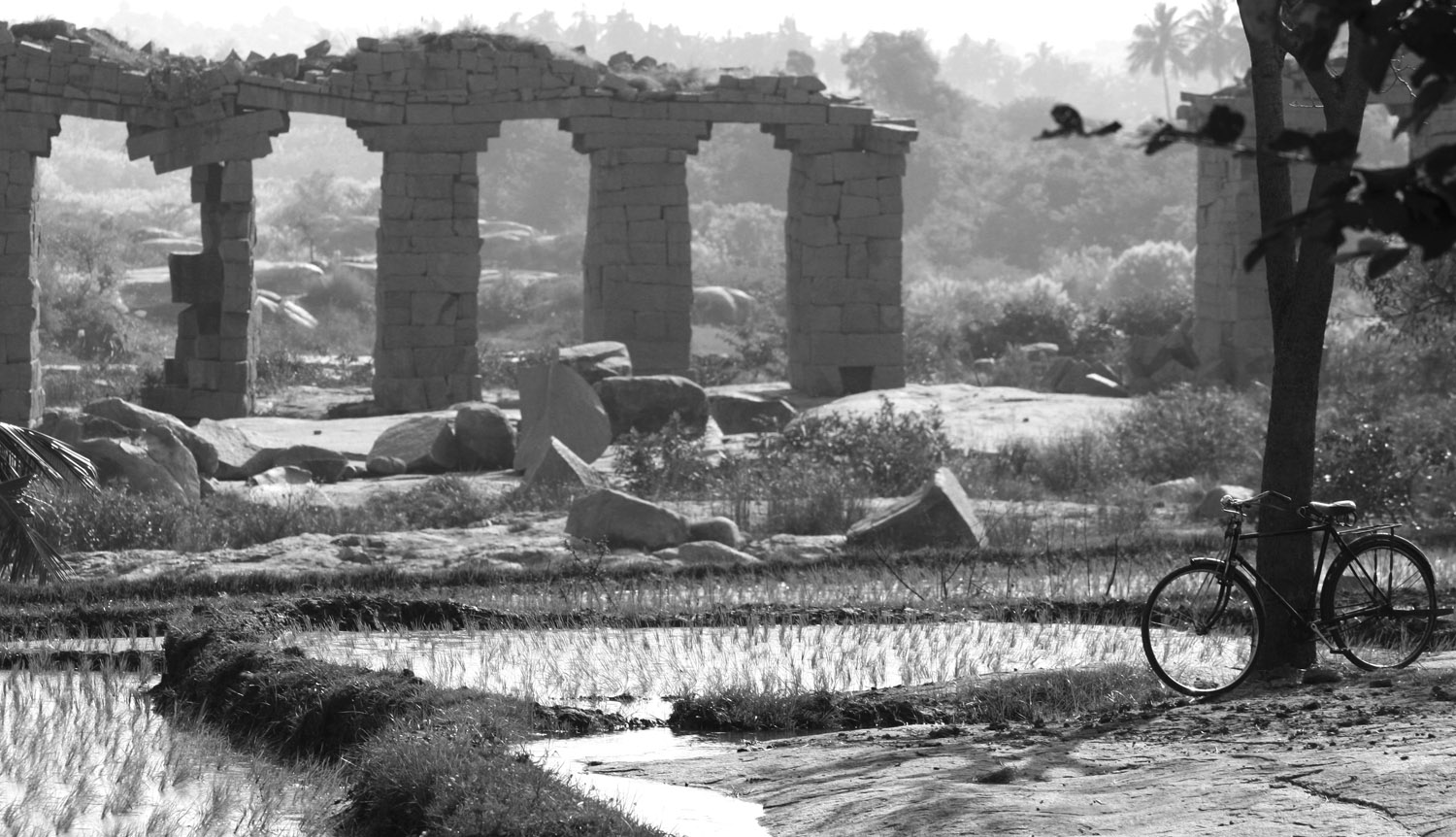
4393 Bicycle and ruins

3695 Elephant stables, Hampi

2720 Hampi

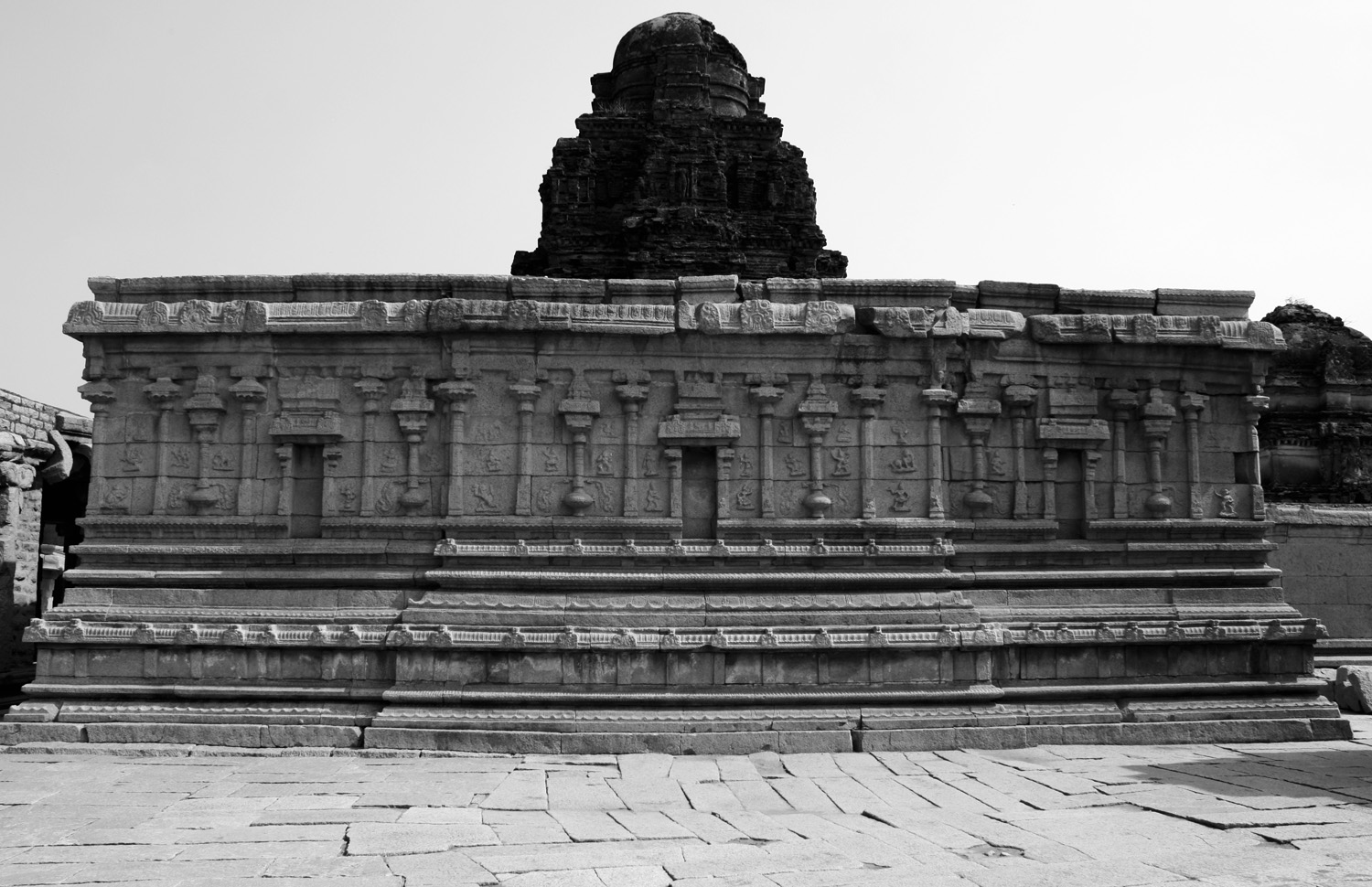
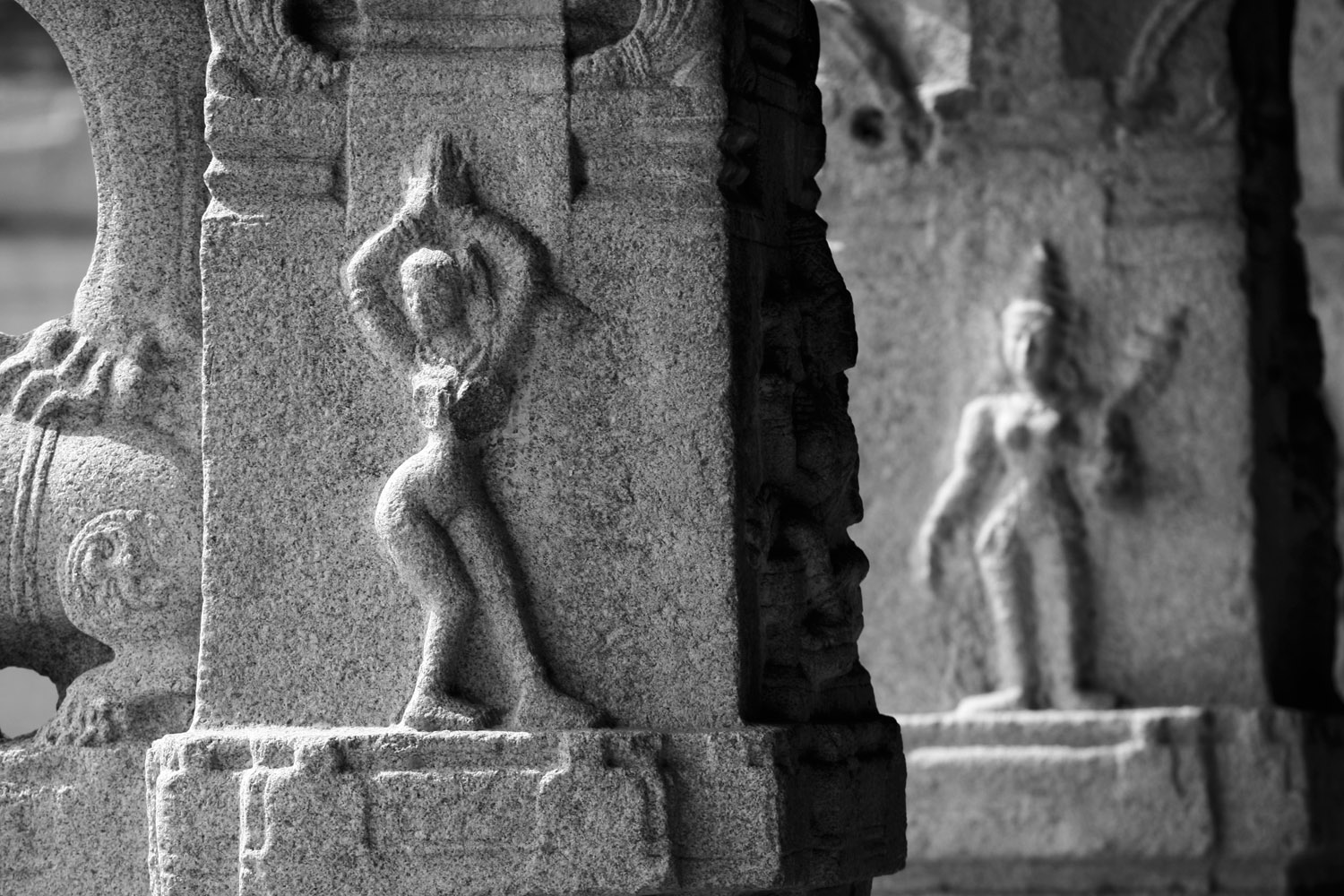
Much of the architecture bears similarities to Hindu structures elsewhere, particularly with regard to the temples, yet Vijayanagara also reflects a local bent for ingeniously blending its buildings into the rocky landscape. It is a busy style, sporting countless high relief carvings and patterned motifs which give the buildings an organic quality.
3112 world of Conan

3291 Horse with horse motif, Hampi

2956 Hampi

2859 Temple, Hampi Bazaar

At its height, Vijayanagara, which means, city of victory, had a population somewhere upwards of 500,000 people, making it the second largest city of its day – surpassed only by Beijing – and a rival to ancient Rome. Vijayanagara fell not long after reaching its peak – sacked by a coalition of Muslim rulers from the north – the Deccan Sultans, who defeated the Vijayanagarans at the battle of Talikota in 1565. After the 16th century, the city fell into decline and ultimately, ruin.

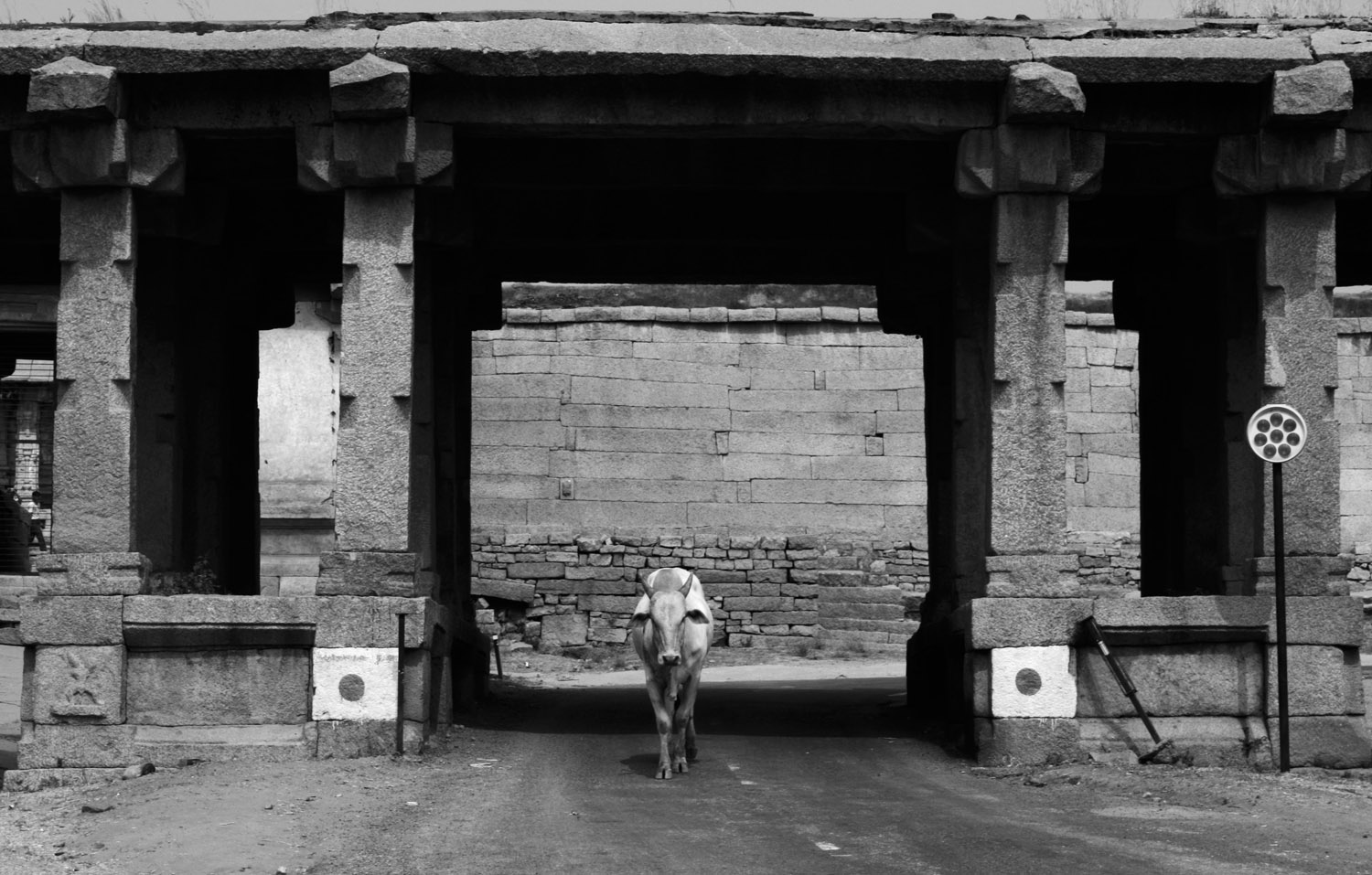
Vijayanagara, and modern day Hampi, are both major sites of ongoing archaeological activity and popular tourist destinations. The town itself – Hampi Bazaar – is tiny, a mere village of neatly swept dirt streets populated as much by animals as people. The town was, until very recently, a good deal larger. Concern about overdevelopment and the locals’ tendency to re-use the ruined buildings as dwellings or for commercial purposes led the local authorities to demolish a number of structures built in the last 50 odd years, and to evict people from re-purposed medieval buildings. Despite this, Hampi Bazaar still sits right amongst the ruins of Vijayanagara and the transition from one into the other is seamless.
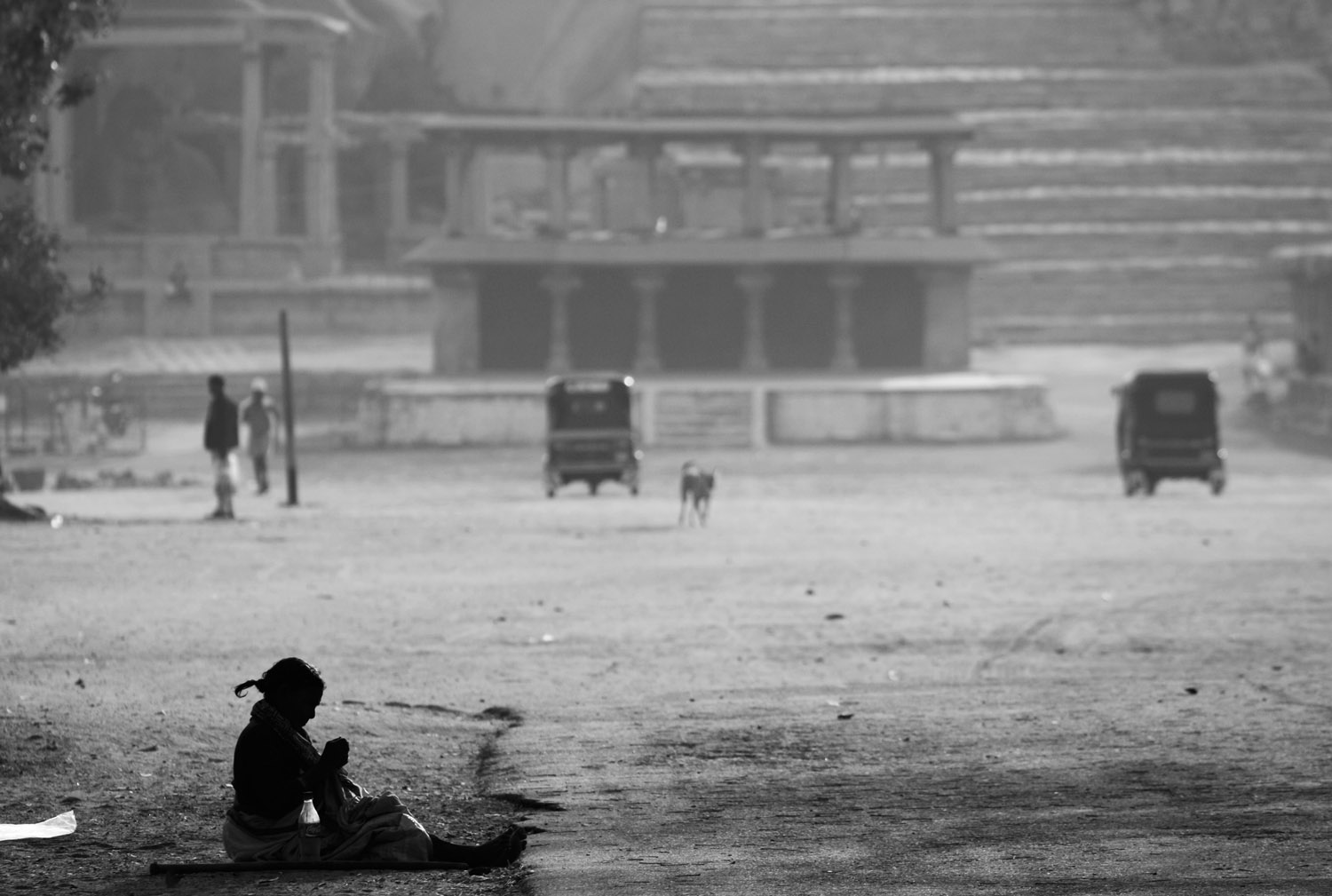
2978 Medieval gate, Hampiu

3969 Hampi morning

2822 Ruined street, Hampi bazaar

2793 Clothes line

Hampi Bazaar, whilst by no means an inhospitable place, is likely not for those who are used to luxury – most of the hotels are very basic and some lack hot water and private bathrooms. Many hotel rooms are also quite musty and mouldy – a consequence of the humid conditions and walls apparently lacking damp protection from the earthy foundations. Yet it is a lovely place to stay – the colourful houses are intimately close together, and the local people can be seen getting on with their lives in the midst of the tourist hordes who inevitably fill this place.

2818 Dances with goats

3823 Hampi Bazaar

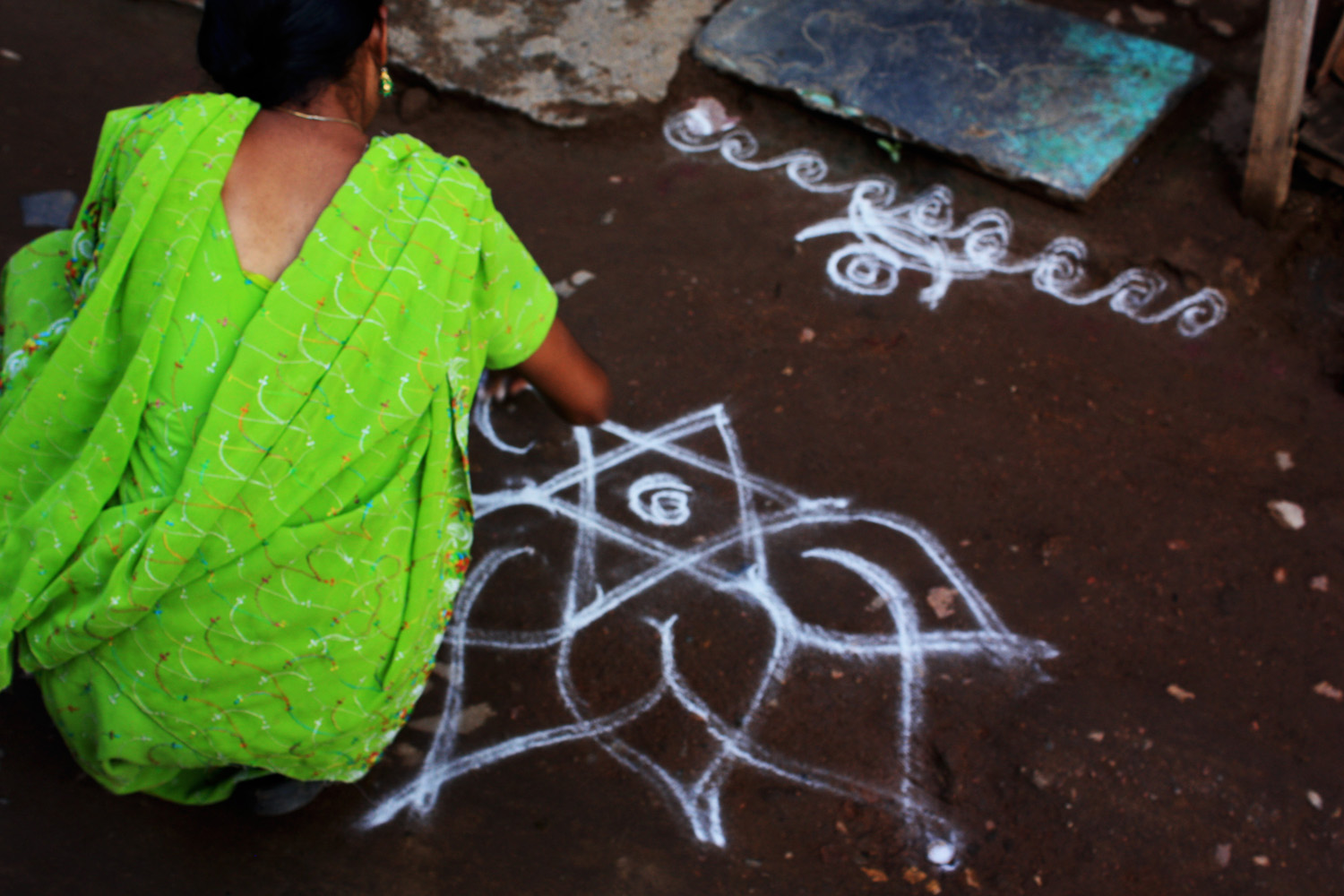
2799 Simple street Mandalas

3963 Hampi

It is especially popular with younger, more alternative travellers – some of whom come to Hampi and get stuck for days or weeks. It has a very chilled aspect to it and the many roof-top restaurants, despite the disappointingly average quality of the food across the board, are excellent places from which to view both the village and the surrounding landscape. The proximity of the torrential river makes the setting all the more idyllic and exotic.
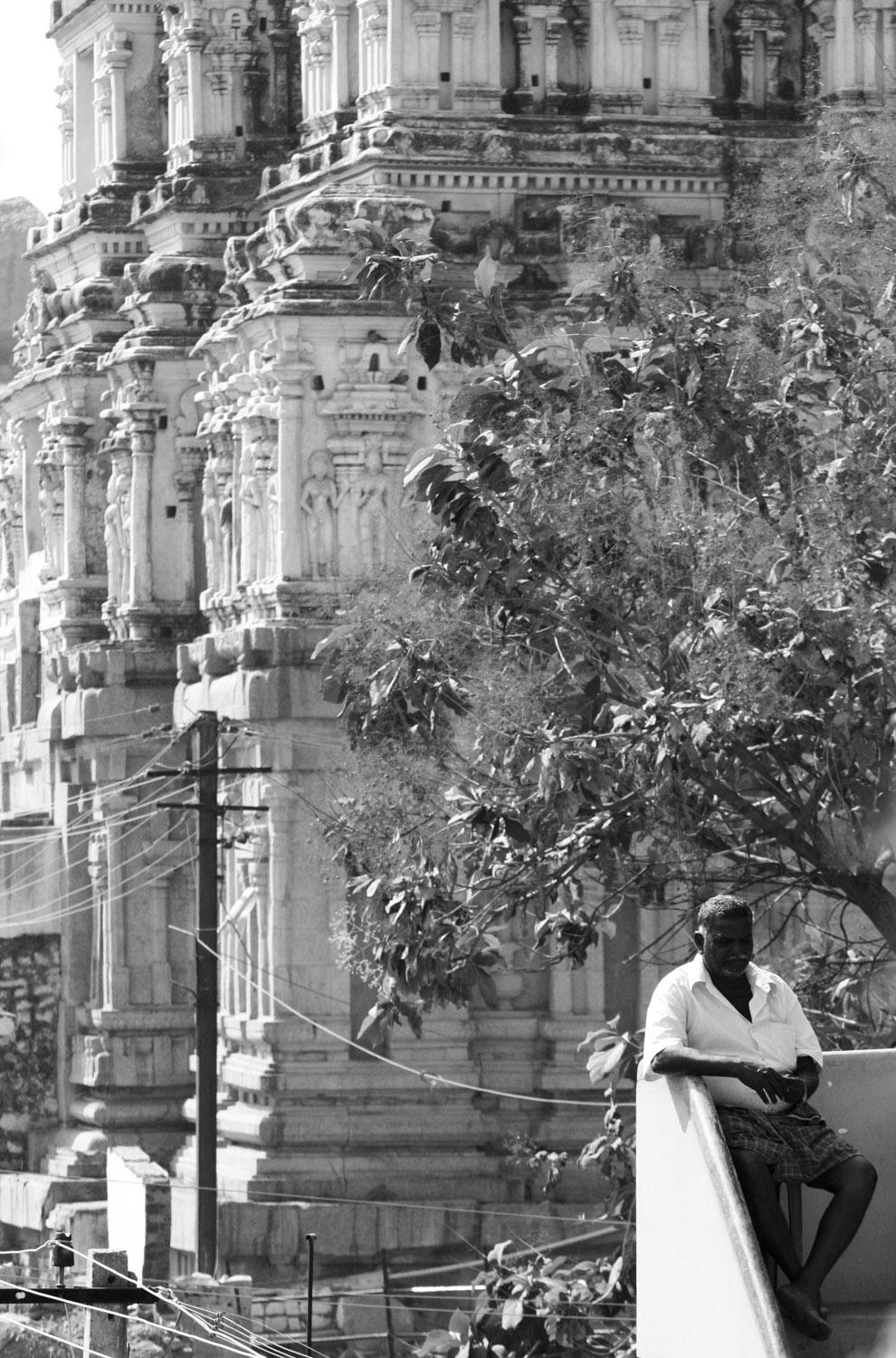
2394  Temple, Hampi

4011 Tourist

3954 Hampi ruins

2599 Hampi

3867 Tourists, Hampi

As noted above, Hampi Bazaar has its fair share of ruins and intact medieval structures. The monumental Virupaksha temple, flanked by an epic cistern, seems almost embarrassingly oversized for the modest village. Yet this but a taste of the wide array of impressive structures and temple enclosures dotted around the huge site. The number of temples is astonishing and their intactness gives some parts of the site the sense of a ghost-town, hastily abandoned. It is possible to walk for hours, for days and still only touch on what is on offer here.

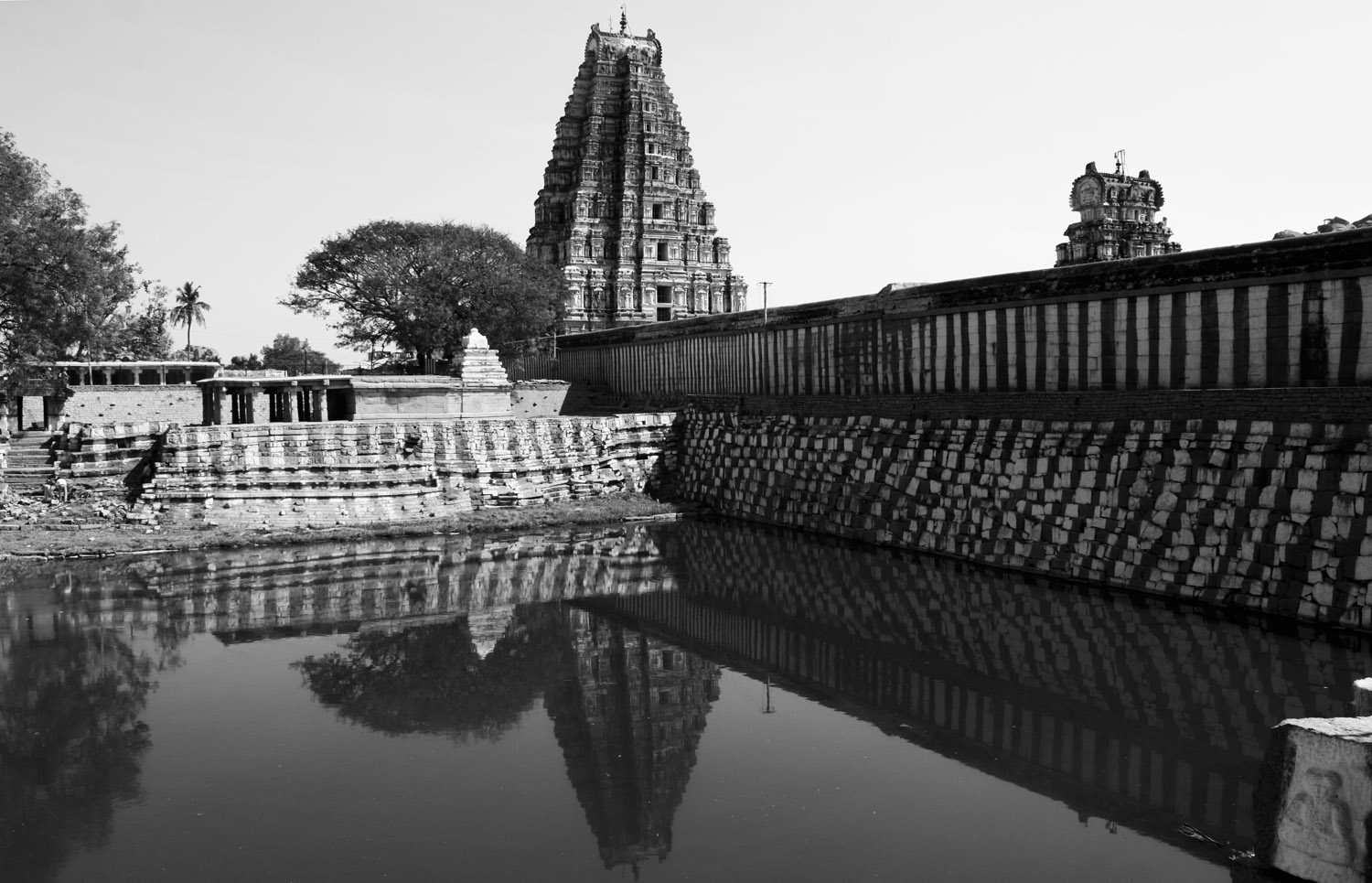
2836 Virupaksha temple 2

2513 Temple and tank, Hampi

2895 Hampi Temples

Following the river to the northeast leads one through a glorious landscape, past a fantastical collection of ruined complexes to the immense Vitthala Temple with its famous stone chariot – the wheels of which still turn. Though it is less than five kilometres, one could spend at least an entire walking there and idling back, exploring the temples and enjoying the natural setting.

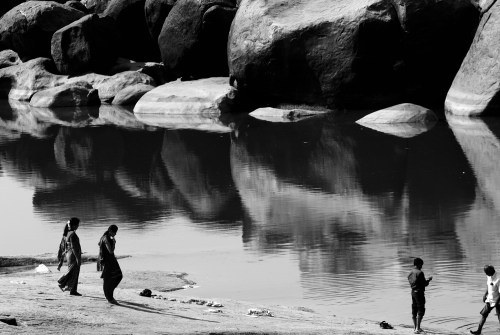
2761 Hampi, Age of Conan

2579 Hampi

2602 Hampi 2

2651 Hampi

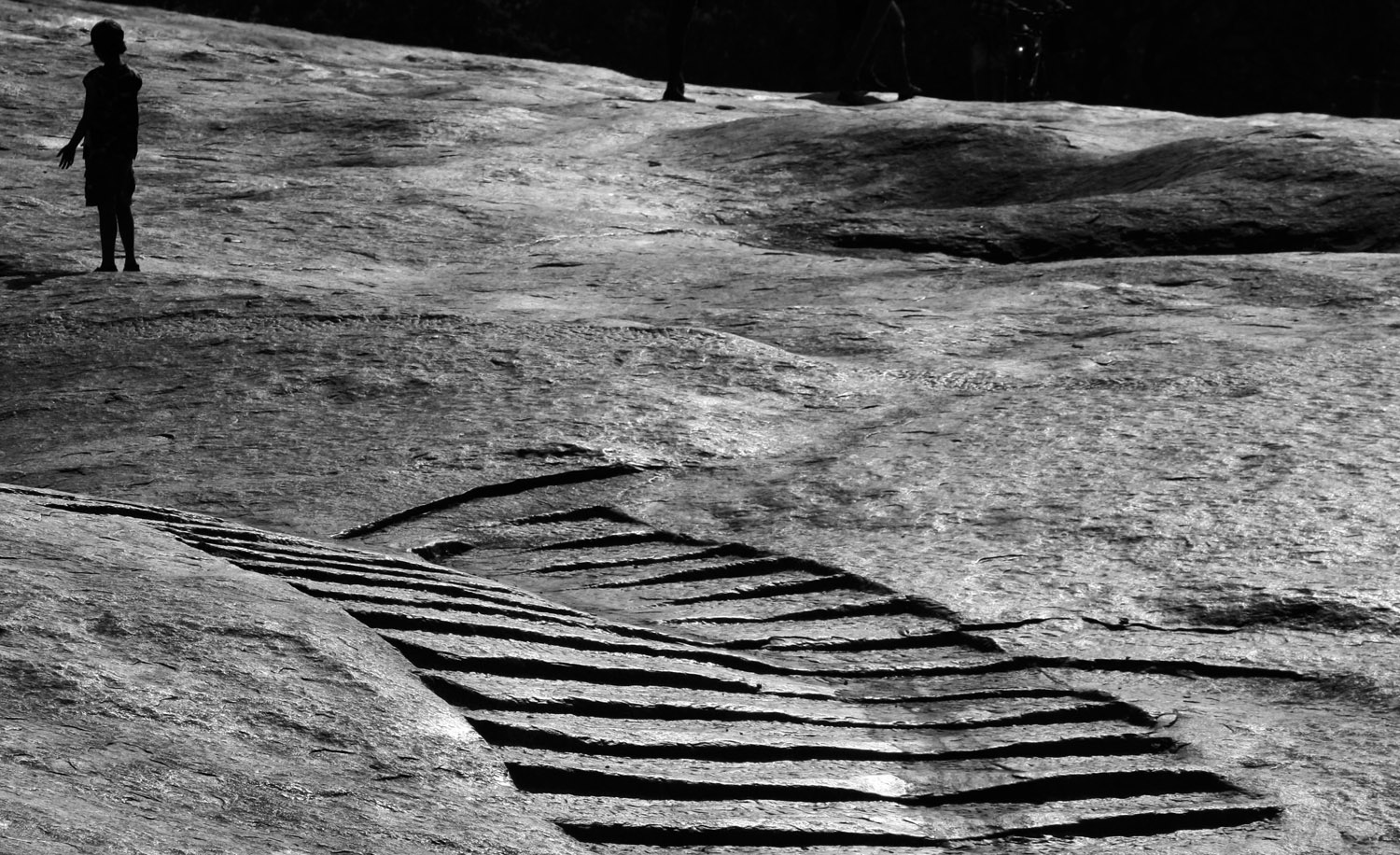
2586 Hampi, rock cut steps 2

2580 Hampi

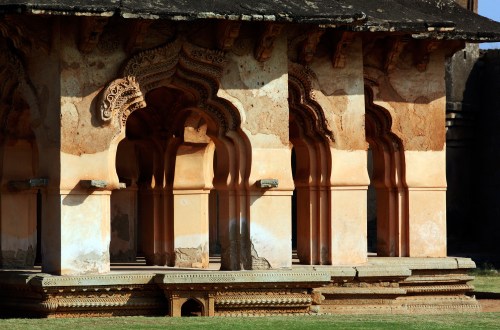
The Royal Enclosure, to the south of Hampi Bazaar, marks the old centre of the medieval city. It is here that some of the most impressive monuments are to be found – such as the Lotus Mahal – said to be the queen’s pleasure palace, and the elephant stables. At least a day is required to satisfactorily explore this wide area, depending on your patience, curiosity and temperament. Either way, be prepared for a lot of walking, or else hire a motorbike or auto-rickshaw with driver as the massive scale of the site means many of these monuments are widely spaced.

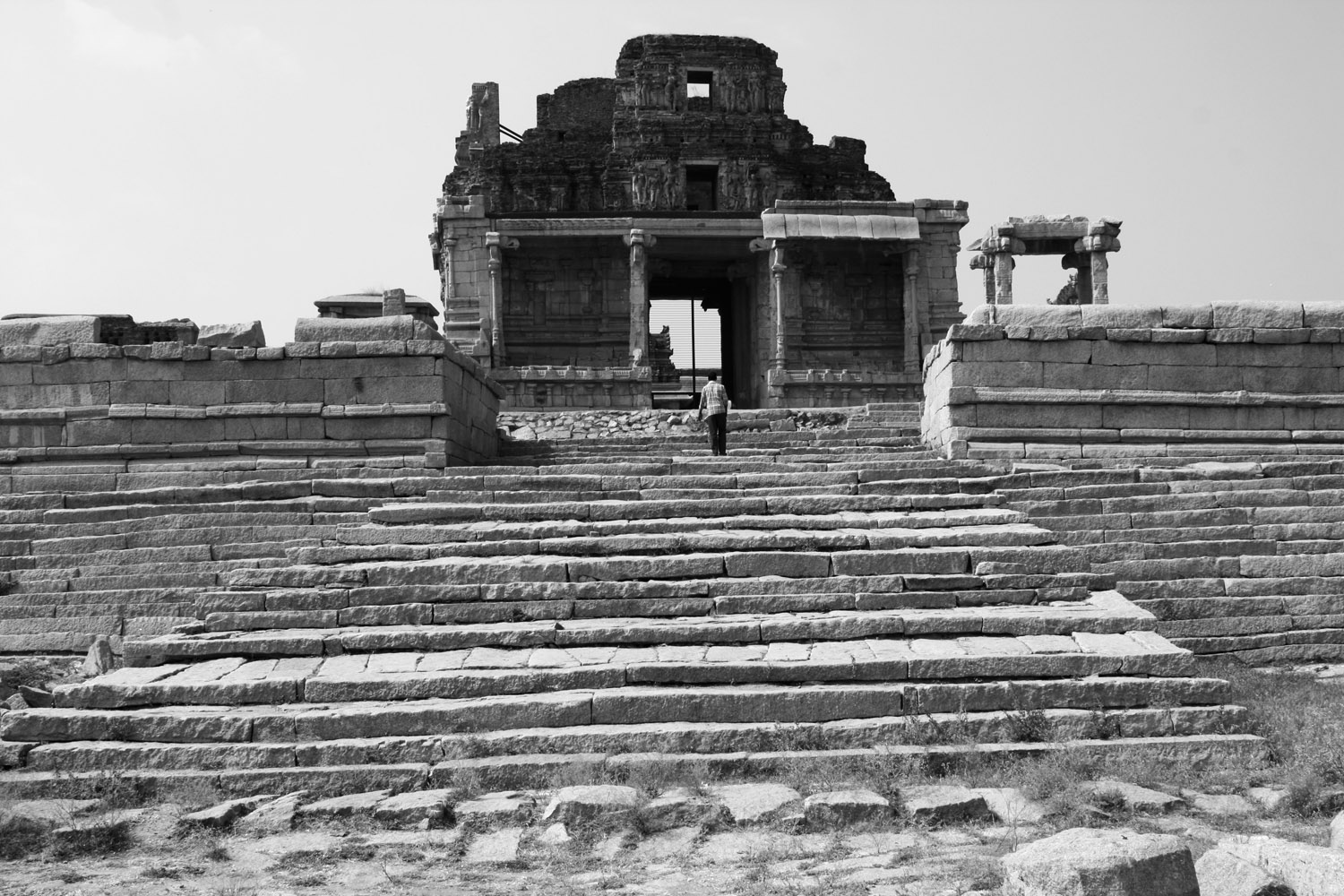
3579 Vijayanagara

3044 Hampi temple

3720 Elephant stables, Hampi

3088 Hampi Temple

3083 Rocks and ruins

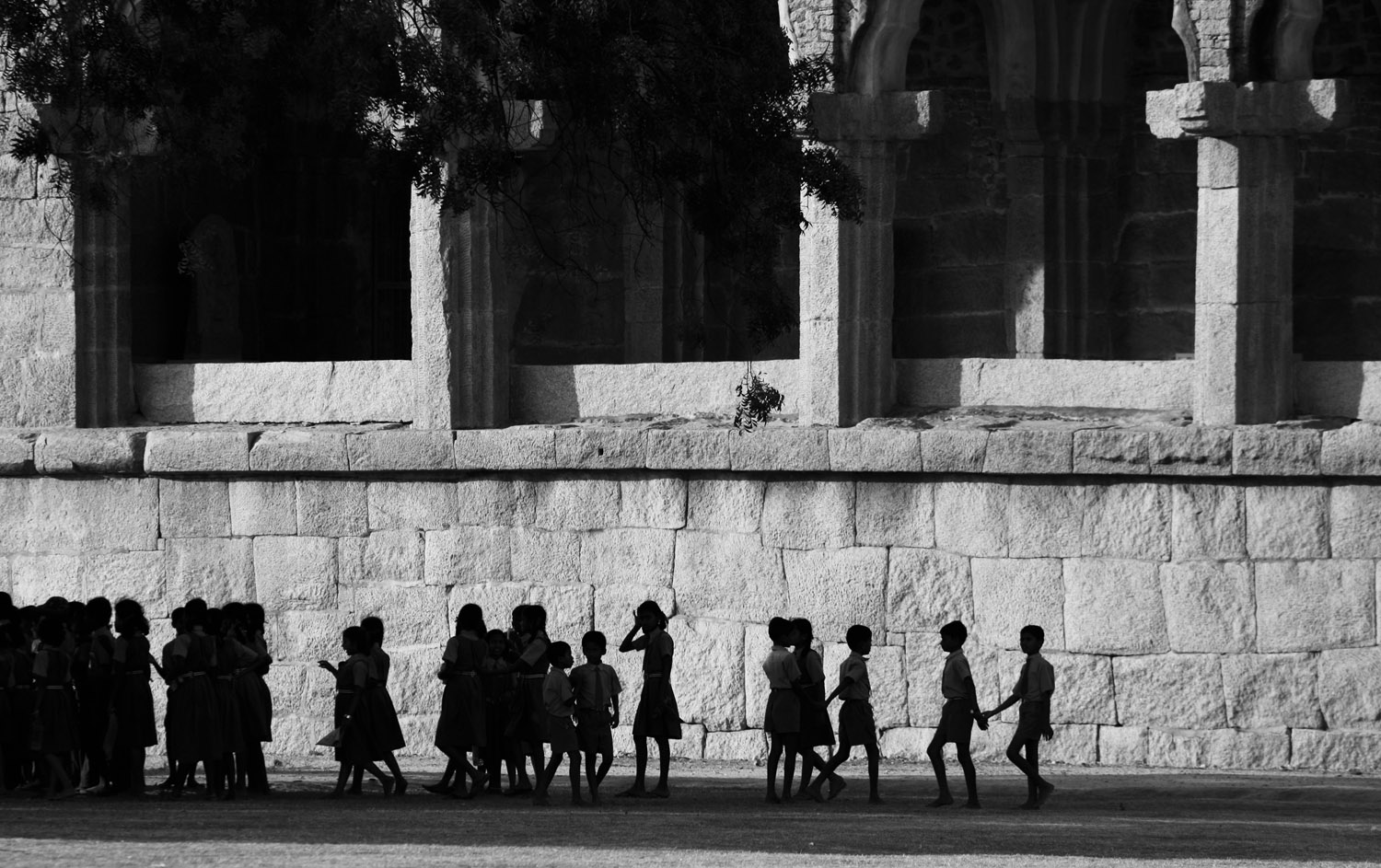
3794 School group, Hampi

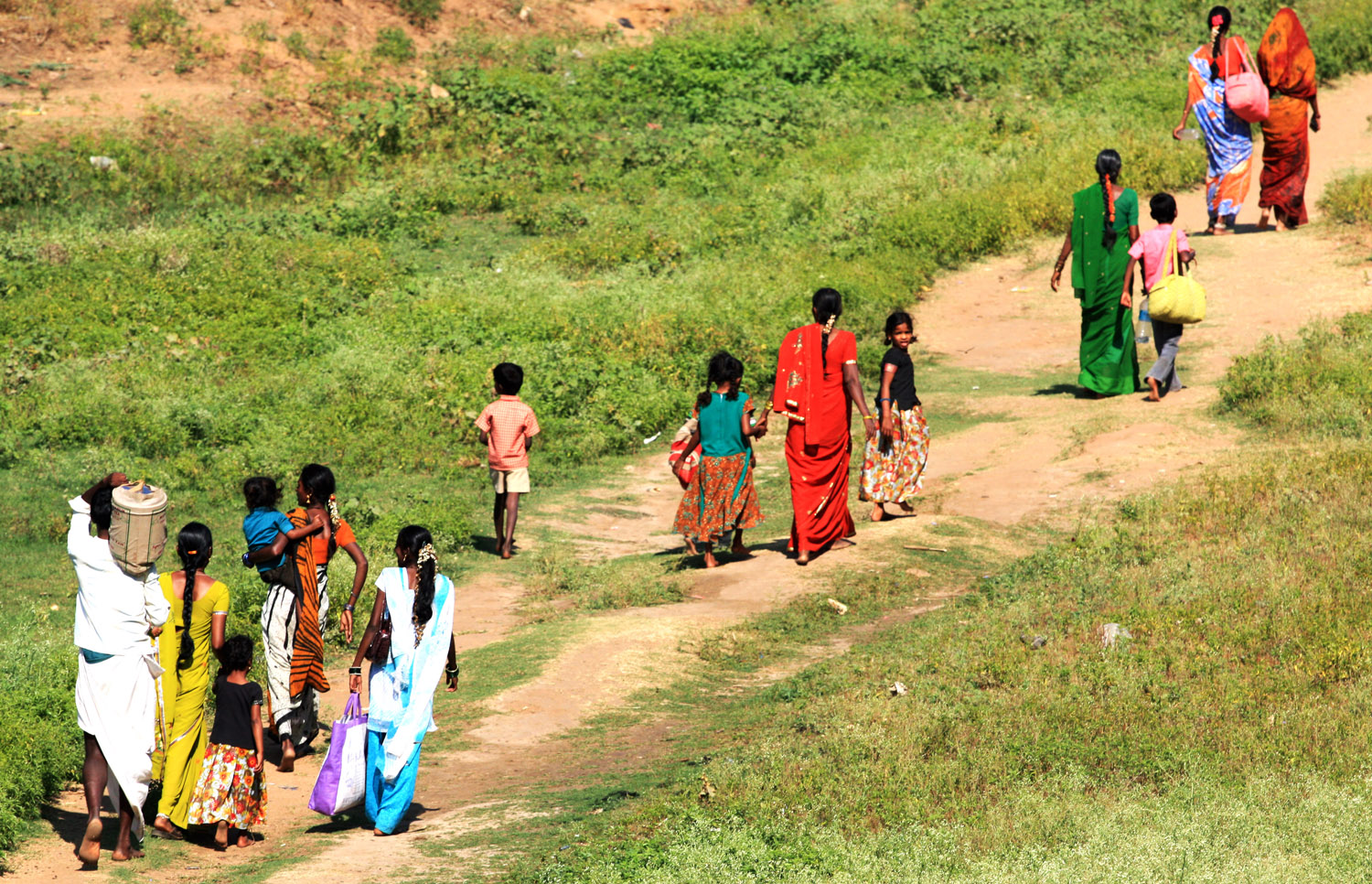
Whilst the landscape seems, for the most part, dry, rusty and scrubby, it is full of bright green palms and banana plantations. The rich, dark soil of the flood-plains also yields brilliant, emerald green rice-fields which illuminate the dry, toweringly smooth rocks with radiant verdure.
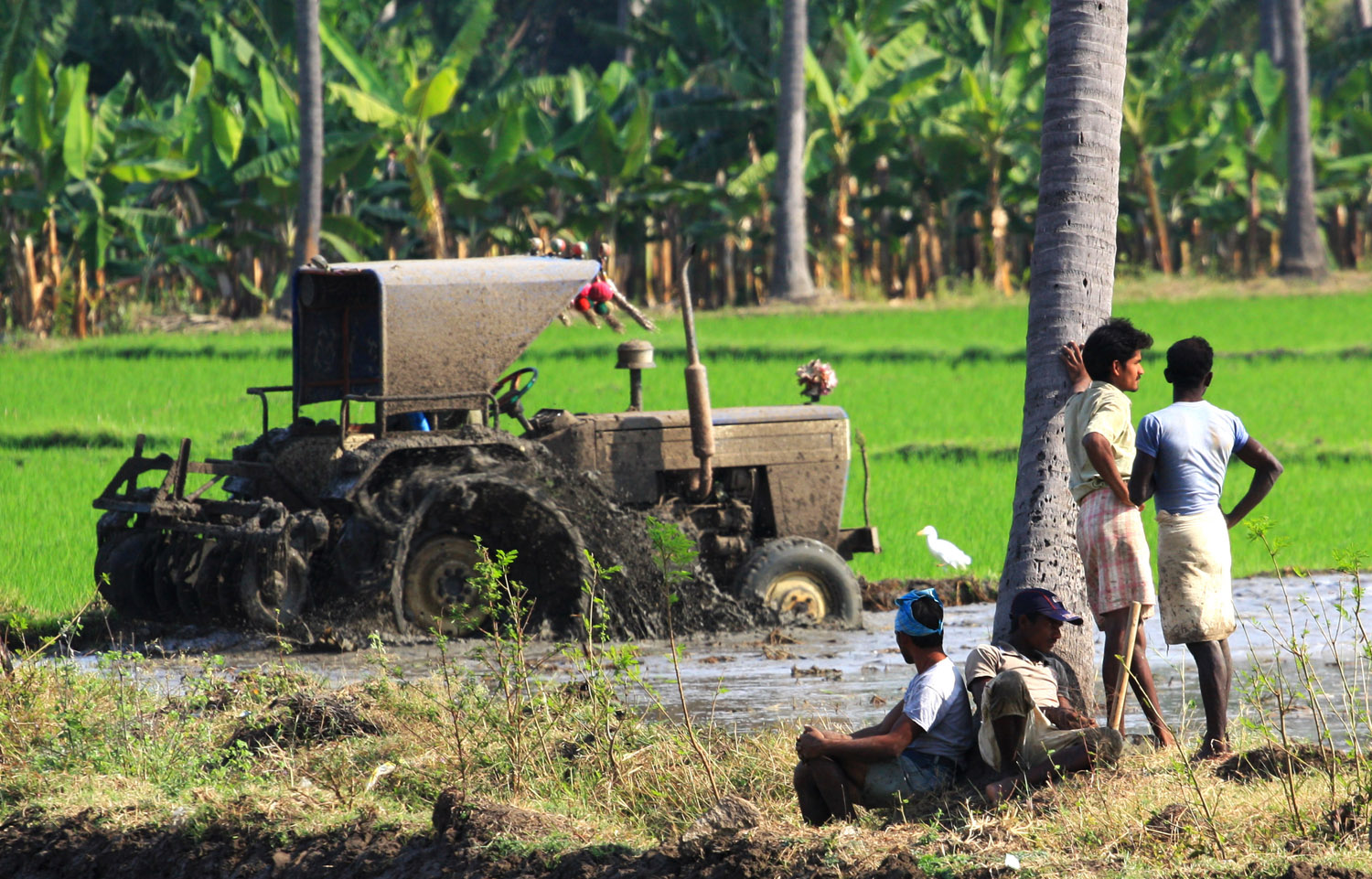
4349 Near Anegundi

3321 Sitting under the tree

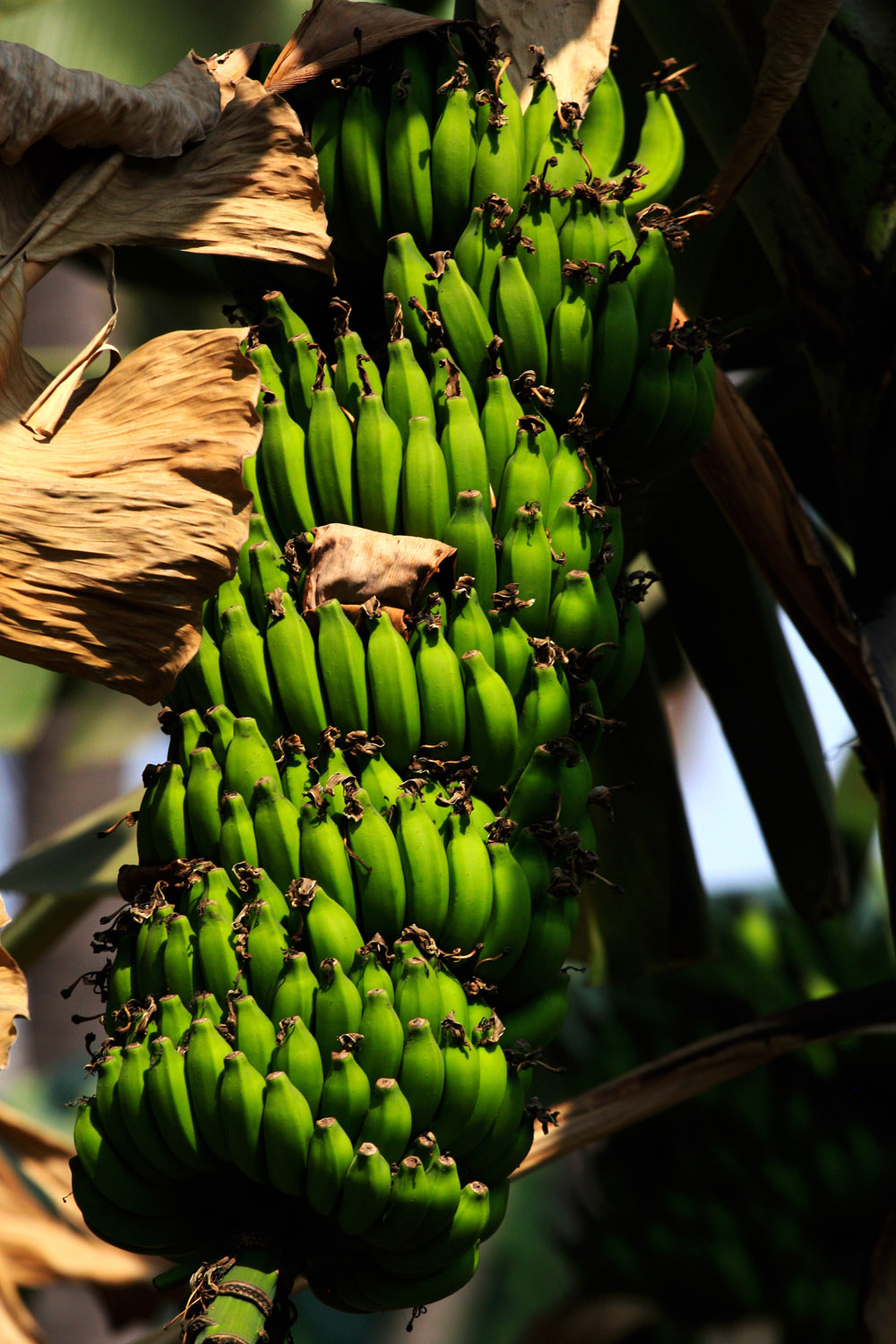
3135 sensuous bananas

4257 Anegundi

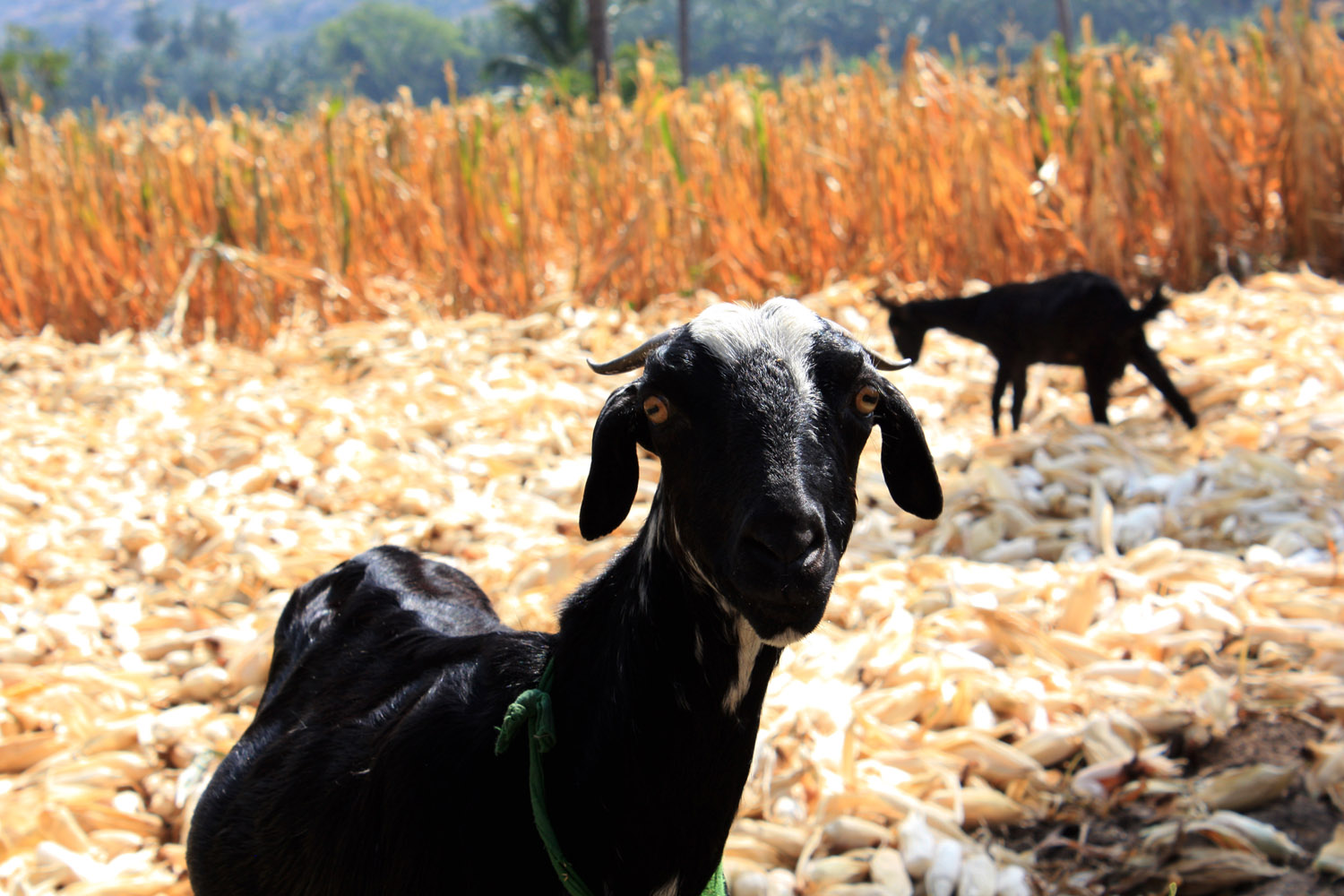
4218 Goats eating cornhusks

It is a curious mix of the lush and the semi-arid, and can also contain some nasty surprises should one venture off the beaten track. Hard, sharp white thorns, up to an inch and a half long and strong enough to penetrate a rubber sole, often lie in the undergrowth. I learned about these the painful way, when I put my full weight on one in a pair of thongs and nastily punctured my foot which then spasmed awkwardly for the next two minutes. The thorn went so deep into my foot that it nearly came through the other side and for days afterwards walking was a very tender exercise.

3141 Thorns

Another place worth visiting is the small, historic village of Anegundi. It lies a few kilometres to the north east of Hampi Bazaar and, without taking an enormous detour, can only be accessed by ferry.

4113 Ferry crossing

Construction of a bridge crossing at Anegundi began in 1999, but was halted the following year over concerns about the impact on the site, both physically and visually. Shortly after reconstruction was resumed in 2009, the bridge collapsed, killing eight construction workers. It now lies like a crooked slippery dip, angled into the river – an interesting modern ruin.

4056 Collapsed bridge 2

The local people remain with no choice but to take the tiny ferry or another, private boat, across. A few motorbikes can fit aboard the ferry, but cars are forced to drive some forty-odd kilometres to access the nearest bridge.
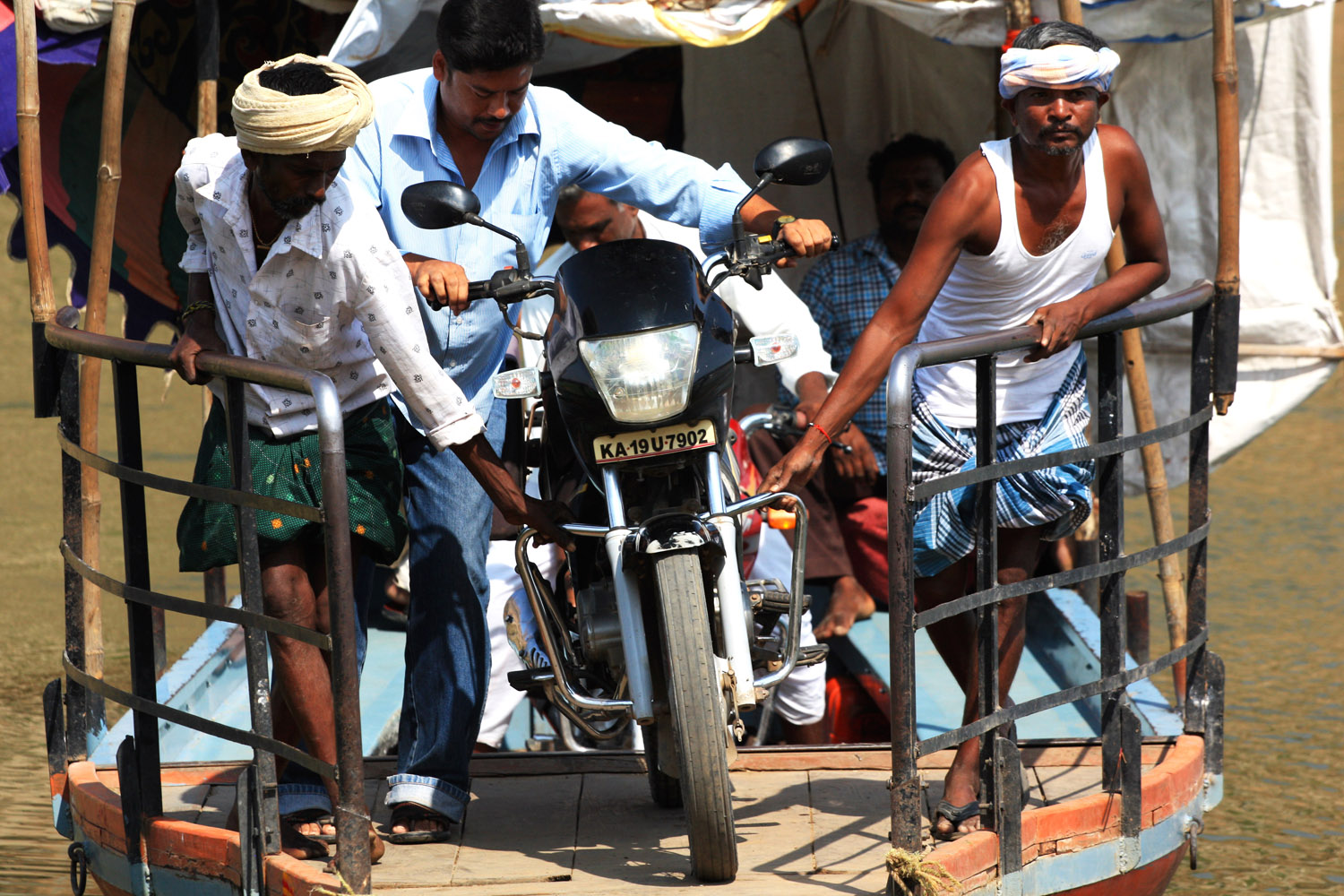
4091 Off the ferry

A local guy from Anegundi with whom we spoke on the ferry was very vocal, if philosophical about the bridge. It was corruption, he said – poor construction due to cutting corners. “This is an India problem,” he said. So it seems.
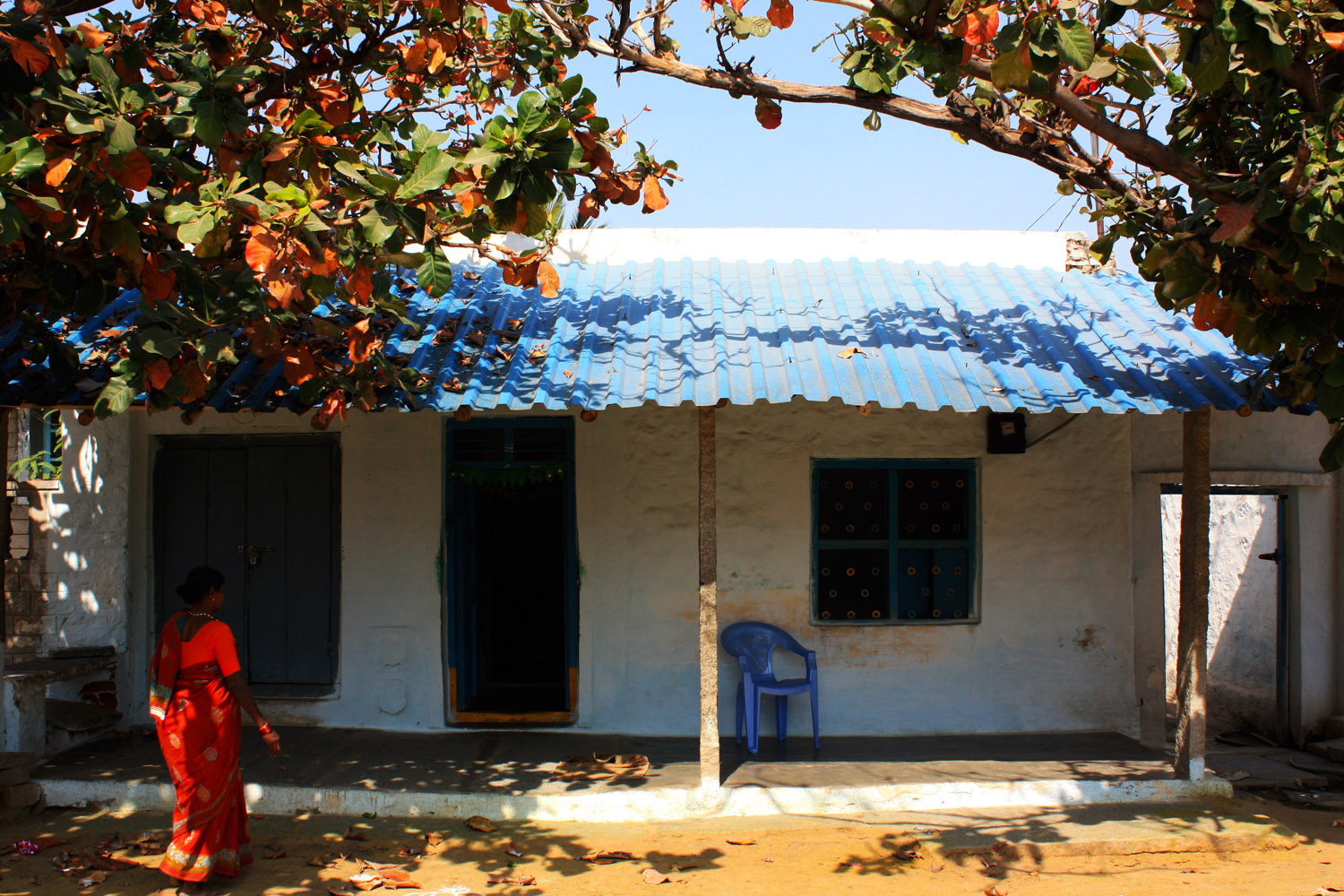
4166 Anegundi

4135 Anegundi

4175 Anegundi

4202 Anegundi

4408 Happy locals

With such an unreal and captivating landscape, Hampi demands being seen at both sunrise and sunset. There are many vantage points which will yield a mind-blowing view, and the elevated places immediately outside Hampi Bazaar are some of the best. At these times of day the landscape’s colours are smoothed with an orange wash from the low-hanging sun. One morning, V and I set out before dawn to climb the rocky hill at the eastern end of the town. The wan light of morning was powerfully evocative of sunrise on another planet.

3903 Sunrise on Mars

3897 Sunrise, Hampi

When we descended from the boulder atop which we had been sitting, we came across another temple site we had not found yet, nestled between hills and palm trees. The heaviness in my heart and guts was the heaviness of awe – weighty feelings of eternity and mortality, fuelled by aesthetic beauty and the visceral freshness of the early morning grandiose. For four days Hampi had me under its spell – it is not something I’m ever likely to forget.
4270 Near Anegundi 2

4426 juicer

3956 Coracle crossing

4234 Hampi rocks

3938 Hampi 2

3643 Hampi

3746 Shrines on the rocks

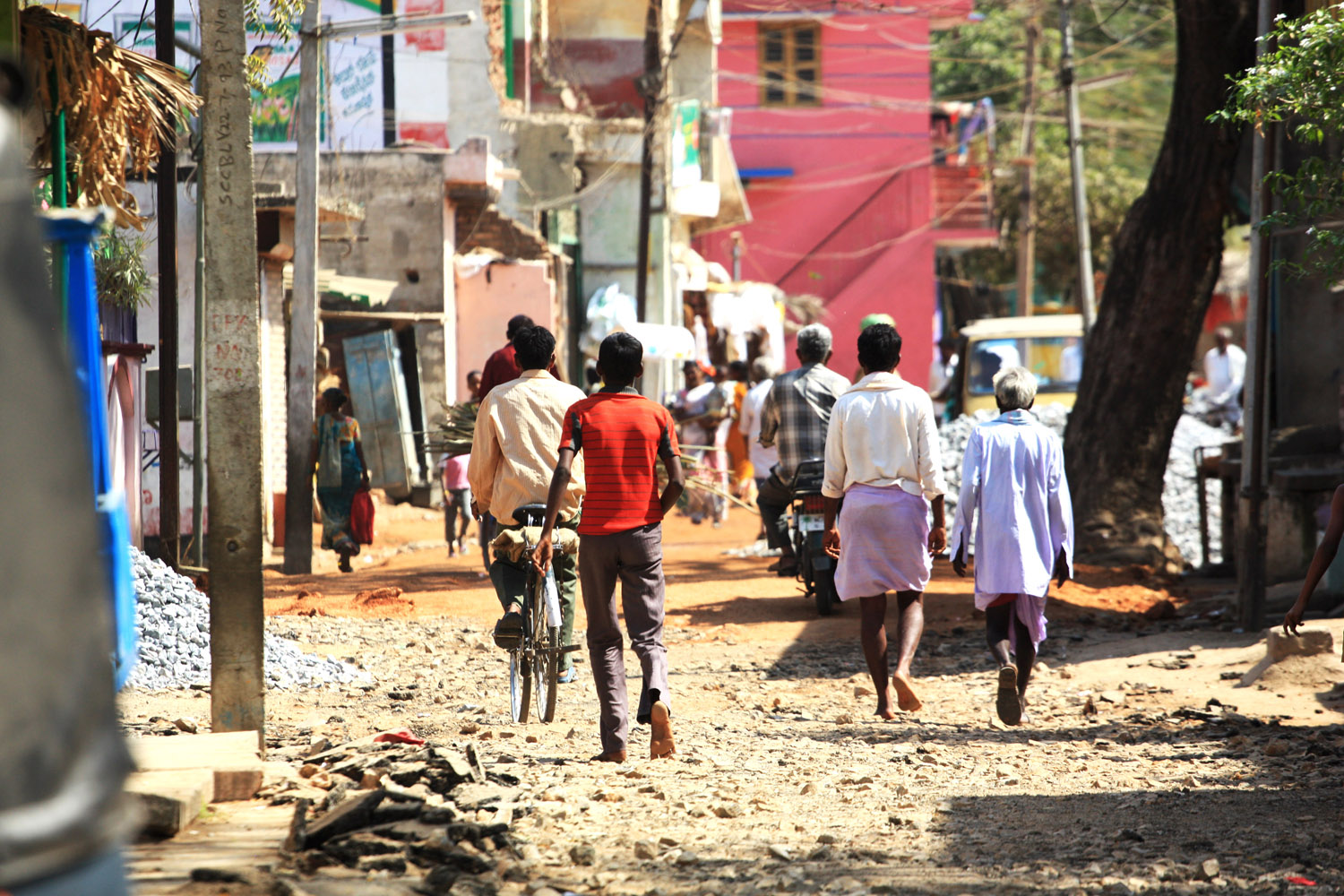
2426 Street scene, near Hampi

3634 Islamic quarter, Hampi

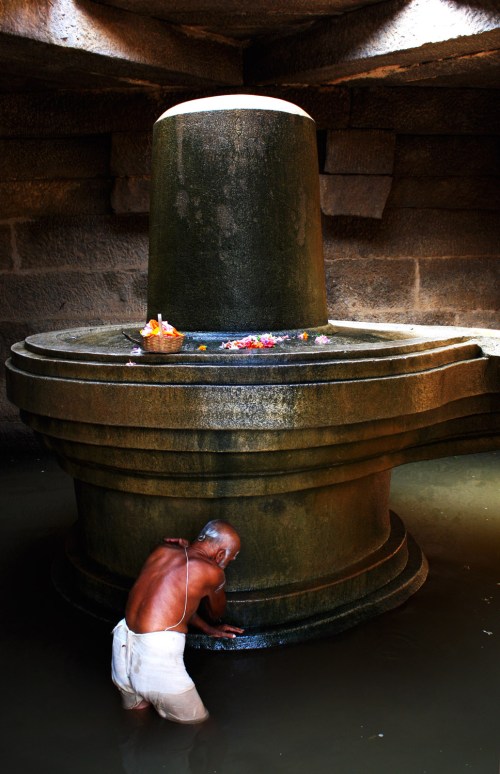
2965 Tending the lingam

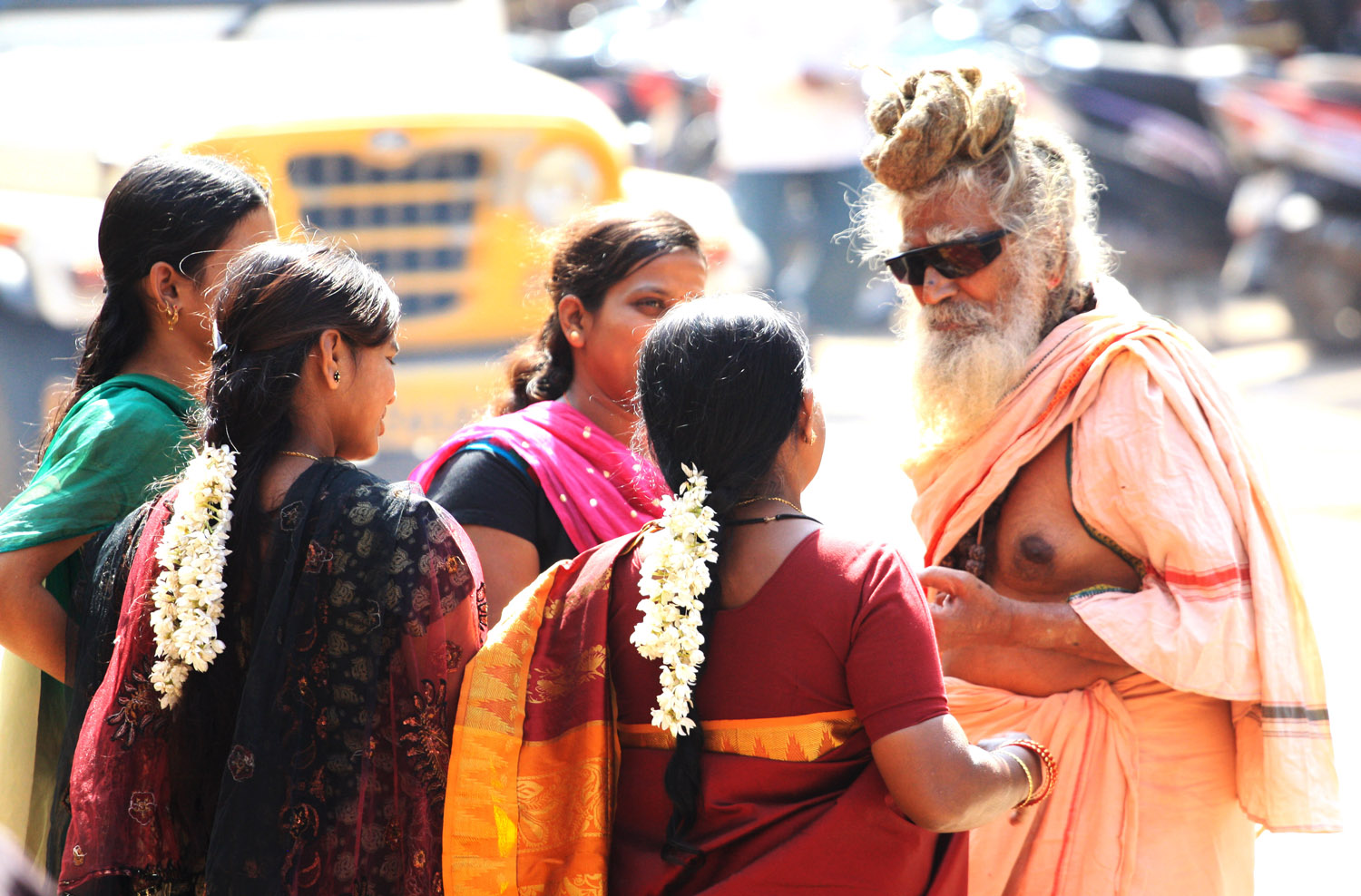
2461 Hey ladies

Read Full Post »

Macaques, Monkey Forest, Ubud, March 13, 2009

Macaques, Monkey Forest, Ubud, March 13, 2009

The Sacred Monkey Forest of Padangtegal village, on the edge of Ubud in Bali, is a natural highlight for tourists – attracting roughly 10,000 visitors a month. A 2011 monkey census put the monkey population at exactly 605 crab-eating macaques (Macaca fascicularis), a figure which has no doubt shifted since. It is a lush, dark and deep green place which, with its shrines, stone-carved animals, Hindu gods and hanging roots and vines, would not be out of place in an Indianna Jones movie.

Whilst the macaques are called “crab-eating,” you will likely only see them eating bananas, durian, cucumbers and watermelon. Perhaps some species of fresh-water crab inhabits the primeval stream which runs through a short, steep gulch beneath a fantastical stone bridge, though I saw no evidence of this. The monkeys are, as monkeys will be, cheeky and impudent and will quite happily snatch anything faintly resembling food from visitors. If they were any larger, this would be more intimidating, yet it is certainly enough to give a person a fright, should one of them run up your leg. On my first visit there my brother made the mistake of buying some bananas to feed them and promptly found himself with three monkeys running up his legs onto his head and shoulders, hanging from his arms and snatching at the bananas. His only option was to drop the bunch, which vanished quicker than chips in the beaks of seagulls.

At quiet times the monkeys can be mysteriously absent, then suddenly appear in a bunch, usually chasing each other or seeking food. Many sit around in small family groups, unafraid of people, though seemingly more concerned about the mischievous intentions of their own kind. The group of monkeys in this shot were placidly sitting, maintaining a sort of crèche with several youngsters. The light was very low under the forest canopy and the exposure time less than instant, hence the blurring effect on the adults. I was very fortunate that the young monkey remained so still, creating the pleasing effect of sharpness and clarity in the midst of the textured blur of the adults’ fur. It is a cute face presented by the little one, if a little ghastly – like a strange homunculus. I do, however, like his curious little mohawk.

Read Full Post »

Two Beehives, Rishikesh, April 5, 2010

Two Beehives, Rishikesh, April 5, 2010

This shot was taken from the top floor of the now abandoned Maharishi Mahesh Yogi’s ashram in Rishikesh, India. The man-made beehive structure is a chamber for transcendental meditation, designed to focus your thoughts and prayers more effectively (ahem). The other beehive is bee-made, and very nicely placed to form a curious juxtaposition and uncannily fortunate symmetry. The hovering bee, waiting, it seems, to dock with the mothership, was a neatly-timed addition to a set-up that seemed too good to be true.

The ashram was abandoned in 1997 due to an expansion of the national forest on which it bordered. The place was simply locked up and left to nature, with no real attempt to demolish or dismantle the structures. I visited the place in 2010 with a cool Canadienne I met at the end of an unexpectedly epic eleven-hour journey from Delhi – Kumb Mela was on at the time in Haridwar, a mere ten kilometres from Rishikesh, and the roads were choked with millions of pilgrims. Rishikesh itself was flooded to the gills with saffron-robed holy folk and it was a constant pleasure to walk among them, curious sight that they were.

There weren’t any guards or attendants at the entrance to the ashram, but there was a gate-keeper of sorts; a lame young bloke with a pair of crutches. He “let us in” for a couple of hundred rupees and once inside we were free to roam about. It wasn’t long before we were met by a long, white-bearded former ashram guest named, I think, Mohan (?), who offered himself as a guide in such a friendly manner that we accepted his offer immediately. Mohan had spent his life working as a high-level public servant in the transport sector and now, in retirement, he had taken to wandering around India like a holy man. Clearly, having spent years at the ashram in the 80s, he was pursuing a long-standing inclination.

Mohan led us along the leaf-strewn paths, through the curious overgrown structures. Most of the buildings were sturdily stone and concrete built, and where they were damaged it was largely through having been looted for fittings. He took us to the four beehive huts where the Beatles had stayed, numbered 7 through 10, if I remember correctly, with John Lennon having been in number 9. Alyne and I had a few great fan-boy moments, exploring and taking photos, quietly contemplating along with excitedly chatting about the rock n roll history of the place.

In one of the buildings we explored, Beatles fans had painted murals in the abandoned rooms, depicting Beatles themes and lyrics. These had a lovingly amateur quality to them, somehow appropriate considering the stylised charm of the Beatles’ own cartoons. Eventually, we came to the largest structure on the site – a three-storey concrete mass with more beehive domes on the roof. It was in this building that I came across this actual bee hive, looking out across the low foothills towards the gorge cut by the Ganges. Its context in the derelict human structure offers a sense of caveat and foreboding – as though a prelude to the fall of civilization. It also reminds me of an important thing to bear in mind when contemplating human civilization – that, of course, the human beehive is natural too. It’s just a more elaborate nest.

Read Full Post »

Young Bulls, Jaisalmer, Rajasthan, March 30, 2010

Young Bulls, Jaisalmer, Rajasthan, March 30, 2010

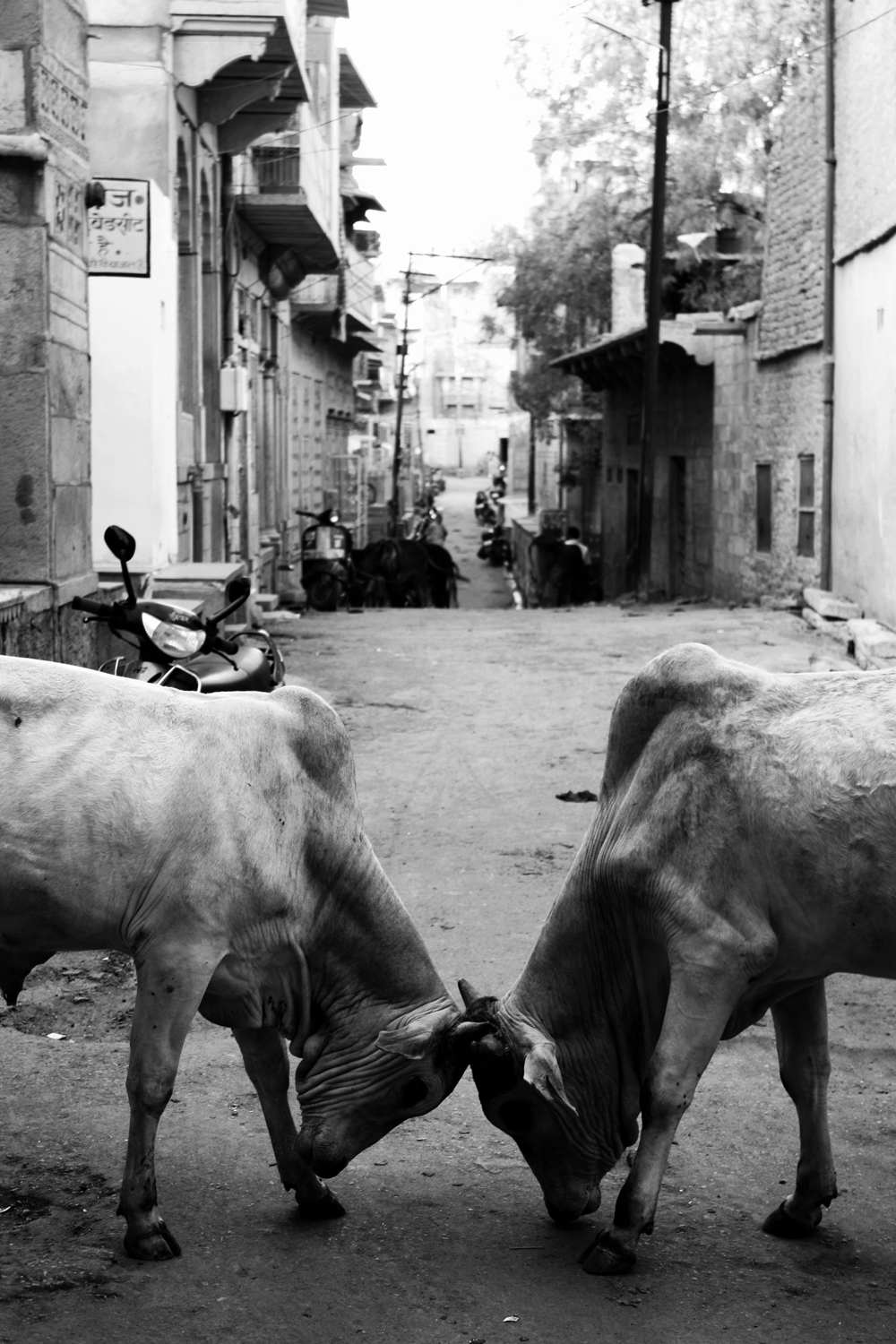
You walk past a lot of animals in India; cows, goats, monkeys, dogs, camels, horses, elephants… There’s something very evocatively medieval about the blurred lines between town centre and rural hinterland; a boundary that only seems to exist in the very heart of the major metropolises – and even then such animals can still be found. The intrusion of the rural into the urban (or is it the other way around?) brings with it all the scents of the countryside – that rich fug of beast and manure – which seems anomalous to the scale of the towns and reminds me of when the Easter Show used to come to the old Royal Showgrounds in Sydney’s eastern suburbs. Then, every morning, for roughly two weeks, I woke up to the smell of cows, sheep and pigs in, of all places, Paddington.

The presence of large animals on the street can be intimidating at times. Mostly they are placid and docile, yet occasionally a narrow passage will be blocked by a cranky bull. Whilst he might exhibit only the most minor irritation – a flicking tail, a restless stamp, a displeasured snort, stung perhaps by a sand-fly – it would be unwise to get into close proximity. Sometimes the condition of the animals can be quite distressing, though generally it was the stray dogs which seemed the most malnourished. Indeed, I was surprised at how robust most of the cows and bulls looked – a little thin at times, but rarely emaciated.

These two bulls were mucking about in the streets of the Jaisalmer, Rajasthan, having a playful wrestle. There was little animus in their proceedings, just a languid and lazy butting practice. It was good of them to provide me with such a symmetrical subject, and indeed they remained like this for some time, pushing slowly to and fro. It seemed the bovine equivalent of a fist-bump; a soft, yet muscular display of power; a subtle reminder that such friendliness could not always prevail – not when the time came to compete for cows.

Read Full Post »

Dung Hien Hair Salon, Hanoi, July 6, 2009

Dung Hien Hair Salon, Hanoi, July 6, 2009

I’ve always liked the way advertising can work both to complement and to contrast with other elements of a composition. Advertising almost invariably portrays a perfect and airbrushed world which, in the developed world, comes closer to mirroring the context than it does in the developing world, where it all too often symbolises an unattainable dream. This is especially noticeable in India – a country in which, if you were to try to understand the society based entirely on its advertising, you would believe that everyone was comfortably middle and upper class. Of course, the simple answer is that advertising is targeted almost exclusively at the middle and upper classes – no one else can afford the products. The television ads and billboards offer an ironic and at times, ghastly contrast to the conditions prevalent on the streets.

In this photo, taken somewhere in downtown Hanoi, the hair ad is perhaps less of an anomaly compared to the status quo – after all, a nice haircut is more affordable than, say, a new kitchen, car or air conditioning unit – yet it still stands out as an ideal in the midst of a less glamorous reality. Here the contrast is not so much one of decadence and privilege versus poverty, but rather that of indulgence and comfort against pragmatism, for there is something wonderfully impractical about what the image presents to the quotidian street. What use such well-brushed hair and long luscious lashes when doing laundry and carrying kettles? It seems appropriate therefore that, whilst in this shot the L’oreal woman is prominent, in the wider context she seems almost marginalised – pushed into a corner behind scooters. Is it for this reason that her eyes are closed? Or is it that she can’t quite bear the relative banality of a backstreet in Hanoi?

The L’Oreal woman presents an image almost of piety and consolation, less offensive than more brash and “sexy” representations of the decadent lifestyle. I love the dreamy effect of the closed eyes and long lashes – an exaggeration I don’t usually find attractive, yet which seems inviting and comforting in this instance. By contrast, the facial expressions of the other women in the scene are far more engaged with real world concerns, though the lady holding the kettle has her eyes turned towards the sky, perhaps entertaining thoughts of escape – or is it just concern about the weather? Ironically, the lady whose tee-shirt reads “don’t feel small” looks pretty fed up with life, lending the message on her shirt the quality of an exhortation to herself.

Read Full Post »

Smoker, Tokyo, May 21st, 2006

Smoker, Tokyo, May 21st, 2006

Smoker, Tokyo, May 21st, 2006

Smoker, Tokyo, May 21st, 2006

Call me a fascist, but I love how marginalised smoking has become around the world. In just a few short years, most of the developed world has banned smoking from the workplace, pubs, bars, restaurants, cafés, and even from directly outside buildings so the smoke doesn’t flow in through the doors. It’s a win for everyone, even smokers, though they sometimes refuse to acknowledge it. What makes all this most incredible is that it is a very rare victory for common sense over capital – big tobacco can go and suck on that.

Australia has been a world leader on this front, something that is both astonishing and entirely unsurprising in this country – astonishing because as a nation we all too readily get down on our knees and drink the jizz of big business, and unsurprising because we love overdoing safety regulations. Our laws on smoking are the toughest in the world so far as sales and advertising are concerned. Cigarette packets can no longer be displayed behind the counter; they are now all packaged in plain, dull packaging without any brand identification other than a uniform text stating the manufacturer and variety, with bold health warnings larger than the brand name and a disgusting image of the effects of smoking on health taking up the bulk of the packet. All advertising has long since been banned and the taxes on cigarettes are now so wonderfully high that a regular packet will cost you over $20 Australian and a packet of rolling tobacco over thirty. It’s a much healthier world we live in when a nine-year old kid asks “what is a cigarette?”

We could, however, go further still. In some cities in Japan it is illegal to smoke whilst walking down the street, and smokers must use designated smoking areas as depicted in these two images. How often have you gotten stuck walking behind a smoker on the pavement and been forced to inhale their pollution? How many fines and public awareness campaigns will it take to stop smokers littering city streets with their cigarette butts? It would be far easier simply to ban smoking from all outdoor areas, bar certain designated smoking stations, which could even be enclosed to ensure passers-by are protected from the smoke. The idea has been discussed in Sydney and a trial ban in downtown Melbourne was implemented last October with all the usual whinging from businesses that it will affect their custom. What they too often fail to consider, however, just as was the case with smoking in bars, is that less than 20% of the population smoke these days, so bear in mind how many customers are put off by the presence of smokers. I certainly am, and won’t sit at an outdoor area in a café if smokers are present.

Anyways, enough ranting – as to these photographs, it was tough to decide between the two so I’ve gone for both. I’ve always liked these shots for the chap’s posture, the seemingly arrogant cool he projects and the very contextual circumstances of the shot. If I was advertising smoking, which I might inadvertently be doing, and that makes me a massive hypocrite, then I think I’d like this guy in my ad to say screw the lot of you, smoking is cool and it makes you look like a real man. Incidentally, if you look closely at the wider shot, there’s a splendid little warning and graphic reminding people of street etiquette. It states: “When I bumped into someone, I apologized. When my smoke hit your face, I said nothing,” telling people in a curiously shaming and cryptic manner that they ought to consider the impact of their smoking as similar to accidental physical contact. Hear hear.

Read Full Post »

Toy Train, Ooty, January 1st, 2013

Toy Train, Ooty, January 1st, 2013

The late afternoon drive into the Nilgiri Hills offered high crags and hairpin turns, steep ravines and sunbeam spotlights through the foliage. On either side of the winding road was heavy forest, wild and unfettered for the most part, but here and there plundered for the serried and terraced tea plantations. Our driver was the most cautious in India and a welcome slowness prevailed during our sure but steady ascent. We passed through Coonoor, two thirds of the way up the mountain, a colourful, boxy town, spread across the top of the ridge like a heap of lego. From here it was another forty minutes to Ooty, which we hoped to reach before sunset. It was, after all, New Year’s Eve, and it can be hard to find champagne in India.

Sadly the hotel we had booked from the Lonely Planet was not up to scratch. On the outskirts of town, bare and cold, monastic, dark and viewless, it wasn’t so much dirty as incapable of looking convincingly clean. The lack of sheets or blankets in the rustic room, the dim lighting, the desultory and grim aesthetic, the absence of a kitchen or hot water, had us apologising to the old manager, out the door, down the hill and in an auto-rickshaw within about five minutes. “Take us to the Savoy!” said V, in the last of the golden afternoon sunshine, and from there on in we took the evening more seriously.

The Savoy, part of the Raj chain of hotels, offered a stupendously better alternative. With six acres of landscaped gardens, the hotel itself consisted of colonial style cottages built between the 1830s and 1860s, centred around a large porticoed administration building, housing the reception area, bars and dining hall. Our cottage was long and cosy, with a wide-windowed sunroom at the front, colonial furnishings, a huge bed and a functional fireplace. Being at an elevation of 2200 metres, the temperature had dropped rapidly as the sun descended and after checking in, we called reception to have a fire prepared for later.

We set off back into town to search for a bottle-shop. It can be tough finding alcohol in India, and different states and towns have different policies as to its sale. We expected to have a long and potentially fruitless quest as we walked a few hundred metres down the road to the nearest group of shops. Imagine our astonishment when, descending into possibly the darkest, grottiest and least inviting underground bar I’ve ever visited, we saw, through an open door behind the counter, a room with shelves full of beer and spirits. We left well-stocked, and this good fortune was soon followed by another, when we ventured into the inauspiciously named “Kabab Corner” to order takeaway. On this recommendation, the Lonely Planet was absolutely correct, and I will never forget the unsurpassed excellence that was Kabab Corner. The tandoori chicken shish was extraordinary – not only in the flavour and texture of the char-grilled chunks, but in the quality of the meat – usually a risky variable. Yet the real highlight of the meal was the spicy paneer. It remains the best paneer I’ve ever had – great spice, wonderful sauce, and huge, sloppy chunks of the cheese to satisfy both the huge appetite and the delicate palate.

It is worth digressing, in this story which is, in itself, a digression, to mention an exchange that took place when we returned the following evening. Raving to the owner of Kabab Corner about how good his food was, he asked where I was from. When I told him Australia, he replied “You don’t have fresh food in Australia? Only canned food?” It was an extraordinary and evocative expression of the distance between the two places and, more so, his relative isolation. That he could be so ignorant of Australia was refreshing – allowing me, through his eyes, to re-imagine the world I thought I knew.

The rest of the evening was not exactly uneventful, though it could hardly be said to have been a big night. We returned home to our cosy room, lit the fire, turned on the television, ate heartily, began drinking, and then, around 2130, V fell asleep and I dozed off in front of a crappy action movie. We regained some spirit around eleven and I made a concerted effort to get drunk, but never made it past half-way. At midnight, we stood in the chilly grounds watching the distant fireworks, then were forced to evacuate our room when the chimney backed up and flooded the cottage with smoke. As the air cleared we chatted politely with a lovely, older Indian couple, wishing them all the best, then retired for the evening. A success of sorts, made great by virtue of the comforts that our location afforded.

As to this photograph, it was taken the following day at the Ooty station for the Nilgiri Mountain Railway. The so-called Toy Train, a seemingly common feature of British Raj era hill-stations, was so popular that we couldn’t board on this occasion, but the station afforded great photo opportunities. We spent about half an hour hanging around here, watching people and enjoying the excited vibe amongst them. I was lucky with this shot to get such a well-lit subject, with an engaging expression of either sullen curiosity or mild concern – I can’t determine which. The shapes created by the train’s windows and door neutralise the background into pattern and thus accentuate the central figure.

Read Full Post »

Ha'Penny Bridge, Dublin, November 27, 2007

Ha’Penny Bridge, Dublin, November 27, 2007

Without knowing a great deal about the place outside of Joyce, I just assumed I would like Dublin. The image that existed in my mind had it looking rather more like Edinburgh – an impressive Celtic capital with imposing and distinct buildings, a place whose monuments exuded the cultural strength of Ireland, a place whose buildings brimmed with character and identity – that much stereotyped Irish blend of larrikin and literary intellectual. Yet, upon visiting Dublin, I found myself entirely nonplussed to the point of grave disappointment and in the end, I didn’t like the place very much at all. Perhaps it was my state of mind, and such can be the nature of travel, yet it all felt mismatched somehow, as though no real thought had gone into building the place. Trinity College and the Book of Kells were truly amazing, but the city itself had a rather desultory air and in my wanderings I never found a place that made me want to stop and sit and soak up the atmosphere and beauty.

Fortunately, however, I was travelling with my tripod on this occasion (not my mother’s three-legged cat) and spent a lot of time shooting at night. This was November 2007, just after the financial crisis had struck, and whilst I’m not sure it was directly related, there seemed to be a lot of people sleeping rough on the streets of Dublin. Again, my ill-informed preconceptions about Ireland, a cloudy awareness of its history of struggle and poverty, led me to believe that this might be par for the course as much as it might be due to the Celtic Tiger’s golden run coming to an abrupt halt. Still, it gave me something to think about, and focussed my photographic attention on the situation of the homeless people.

This shot was taken on the appropriately named Ha’Penny Bridge, over the river Liffey. Being early evening, there were a lot of people on their way home from work in suits, making it an ideal time to capture the contrast between rich and poor. As is so often the case with photos involving passers-by, it was a matter of patience to get a worthwhile shot – of standing with the remote in hand and shooting whenever the balance of people in the composition seemed right. And, as is so often the case when shooting unwitting subjects, it was just another case of blind luck that the figures climbing the stairs should frame the central subject so neatly and give me a good result. Needless to say, there were quite a considerable number of mis-hits either side of this one, a reminder that it’s often worth sitting on a scene and shooting a hundred plus shots, until the elements line up just right and go for gold.

Read Full Post »

Varanasi, along the ghats, May 7, 2010

Varanasi, along the ghats, May 7, 2010

Varanasi, also known as Banares, is considered to be the holiest city in India. Indeed, it is the holiest of the seven sacred cities in Hinduism and Jainism, and hence it is often associated with exotic and colourful rituals and traditions. All along the riverside ghats – stepped stone embankments – tourists and pilgrims join a swirl of commercial and religious activity, giving the place a constant sense of movement. If you’re not being sold flowers, boat trips on the Ganges or head massages, then someone will no doubt try to save your soul. Watching the laundry men and women hand-washing and beating clothes with wooden clubs makes for great spectacle. Yet, despite expectations of anthropological oddities and curiosities, Varanasi seemed to outdo itself in creating some of the oddest scenes imaginable.

I was exhausted when I finally arrived in Varanasi, at the end of a two-month trip around the north of India, and could feel the holiday’s end hanging over me. To some degree I had lost touch with reality, smoking too much, feeling dissipated, unmotivated, tired and a little bothered – a state of mind I’ve written about in a short story. As an atheist, I don’t have much time for expressions of religious sentiment and was far from charmed by Varanasi, having rather lost my patience with India at that stage of the journey. Consequently, I only ventured out in short bursts, shuffling through the heat haze and trying assiduously to ignore the constant offerings of goods and services. Yet, in those relatively brief forays I was continuously impressed by the array of colours, costumes and, indeed, behaviour that I witnessed, of which I’d like to think this shot offers at least a taste.

There is a lot going on in this scene, and I consider myself lucky to have been in the right place at the right time. There is much that I love about this shot – the forward stare of the lady to the right of frame, seemingly untroubled by the bag on her head; the bright and sharp uniforms of the marching band members, whose body language has a sort of poised cheekiness about it. This contrasts with the wonderfully grumpy face of the other woman with a bag on her head, which rather comically looks like a giant, sagging ice-pack. Most of all, however, I love the way in which the band-leader, dressed in black and holding a trumpet, seems to be staring into the distance in a state of satisfied, yet humble thanks or lofty contemplation. The patchwork colours of the background testify to the intensity of the visual experience at Varanasi, where chromatically speaking, anything goes.

Read Full Post »

North west Bali and Java from Munduk, March 15, 2009

North west Bali and Java from Munduk, March 15, 2009

My father always told me, much to my annoyance, that a photo without a human subject was at best boring, at worst worthless. This point of view used to frustrate me considerably because I love photographs of architecture and landscapes. As a journalist, my father has a long-ingrained inclination to see that the story is always in the people, rather than things or places alone, and thus, understandably, in his eyes, a photo without people has no narrative. The question I would posit is whether it is really necessary for a photograph to have a narrative to be appreciated. I don’t believe so, though, as any glance through the photos so far selected in this series will show, I have ultimately come to prefer photographs with human subjects, precisely because they have a more narrative element. There is, however, plenty of room for enjoying the purely decorative.

This shot was taken from Munduk in Bali in 2009 and is a view across the north west of Bali to what I believe is Gunung Merapi on the island of Java. Munduk is at the relatively low elevation of 900 metres, in the foothills of Mt Kintamani, but due to the tapered land along the northern coast, it commands a view right across to the volcanoes of eastern Java. This is taken with my 200 mm lens, which cuts out much of the land before the coast, giving Munduk the deceptive feeling of being much closer to the sea.

I took this photo in the early evening, while my brother and I sat on the porch of a bungalow in Puri Lumbung Cottages drinking coffee. We sat there for hours, ultimately around the flame of a small kerosene lamp with a roundel portrait of Barbie affixed to disperse the light. There are almost 300 shots of this view taken with various exposures, shifts of focus, different cloud cover, varied light – but this one stood out to me somehow as the most striking. There is something fantastical about the volcano’s separation from the rest of the shot behind a ball gown of cloud. The mountain’s monumentality contrasts with the intricacy of the coast and its more delicate, finicky appendages. The exotic otherworldliness of the scene is enhanced by the wash of purple light, which, rather than aligning this with thoughts of lost worlds and south seas, inclines me to think of science fiction impressions of other planets. That this scene is indeed on planet Earth is a very pleasing thought on which to finish.

Read Full Post »

« Newer Posts - Older Posts »