Feeds:
Posts
Comments

Archive for the ‘The Odyssey of Life’ Category

Downfall

This is an account of my father’s dreadful head injury which happened on May 10, 2005. I finally got around to writing up the notes…

At quarter to five on a Monday afternoon I received a call from my mother telling me my father had fallen off a ladder and suffered a head injury. She was unsure exactly how severe it was, but he was “in a pretty bad way.” I ran out of my flat and took a taxi across town through peak-hour traffic, thinking how ironic it was that only moments before I’d been dozing at my desk, conjuring excuses not to go to university that evening.

When I arrived at Emergency at St Vincent’s Hospital, Darlinghurst, I had no reason to suspect it would become so familiar to me. I found my mother in a small waiting room beside reception, drinking a cup of tea and looking composed but bewildered.

“Oh, Benjamin,” said my mother. “Thank god you’re here.”

Before I’d had a chance to say boo to her, a social worker introduced herself as Julie and asked if I too would like a cup of tea. I said I would, then turned to my mother.

“What happened?”

“Your father was fixing the awning and he fell off the ladder. The lady who lives upstairs over the road saw him and called the ambulance.”

“But how bad is it?”

“Oh, he looks awful.”

“But how had is it?”

“I don’t know. They haven’t told me yet.”

Very little news had come through and, this, coupled with the shock, made it difficult to feel properly panicked or upset. I still felt a lingering air of inconvenience. How bad was it, for goodness’ sake?

Over the ensuing two hours our fears increased significantly as we learned more about the damage to my father’s head. On the surface there was a fracture at the back of the skull after a direct impact from a fall of between two and four metres, plus his two remaining front teeth had been knocked out. His neck and back were also uninjured, badly bruised and grazed, yet our biggest concern was about the state of his brain.

At last we had a visit from a young English doctor who told us how things stood.

“It’s a very serious injury,” he said. “To be perfectly honest, we can’t give you any guarantees at this stage. The next forty-eight hours are crucial. With an impact like that the brain can swell up so much it can cause a haemorrhage or stroke by pressing too hard against the casing as it expands. We just have to hope the swelling isn’t so bad. It’s a wait and see situation. There’s not a lot we can do.”

My mother clasped my hands and gasped back her tears. She was too thankful with the doctor, embarrassed by her own emotion. The doctor was handsome and kind and she wanted him to know he was a good man.

Shortly afterwards we were joined by my older, half-brother Dirk.

“What’s he done this time?” asked Dirk. “He just wants to be the centre of attention!”

I felt reassured once Dirk was there; with the news growing darker, numbers would help to shore us up against despair. Julie brought more tea and sandwiches and offered more comforting words. I soon began to feel sorry for her, coming face to face daily with others’ tragedies.

At seven-thirty we received word that we could see my father and we kicked immediately into gear. Julie led us via the spacious lifts to the Intensive Care Unit on level five. We emerged into a wide, hundred-foot long, linoleum-paved corridor. A garish series of canvasses stretched along its length. It was my first taste of a place that would become indelibly familiar to me over the next week.

We were led straight to the I. C. U. waiting room where we were introduced to the neurologist, Surita. She had conducted the first C.T. scan.

“There is a lot of bruising and swelling of the brain,” she said. “And until the swelling stops there is a very real risk of haemorrhage.”

It was the same news; she could tell us nothing different. Having already plumbed the depths of the worst-case scenarios, there was little left to be shocked about. The English doctor we had met before, whose name was Kevin, rejoined us. He was in a chirpy, sympathetic mood and he cheered my mother up no end. Ironically, that afternoon my parents had arranged to meet and see the film Downfall. Kevin jokingly suggested that since my mother was now without a date, he ought to take her himself.

It was another half hour before we were admitted to the Intensive Care Unit. We walked through in silent anticipation and reverence. There was activity all around, but I was compelled to focus only on my father. There he was, laid out, bloated and bloodied.  At first I struggled for equanimity against the sight of his breathing tube and the small pool of vibrating blood caught in its corrugated U-bend. In the thin line draining fluid from his lungs via his nose, pockets of bile shunted down towards a bag remaining mercifully hidden. I was saved by the whiff of hospital fluids, a tusk of alcohol riding the bestial emissions of bodies in crisis. I feared that I too, like my brother Matthew, might be prone to blood injury phobia; a mix of anxiety and disgust leading to a sudden loss of blood pressure which had caused him recently to faint and suffer a severe concussion upon a visit to see his girlfriend in hospital. I gripped the railing of my father’s bed and smiled with false courage.

My father was battered, damaged, hanging in the teeth of death. Yet he was also a tough old bastard and if anyone could keep themselves alive through sheer bloody-mindedness it was him. He was in an induced coma, to stop him struggling against the bonds. Apparently he had wrestled with the paramedics, ordered them from the house in a stream of filthy insults. It was incalculably fortunate that our neighbour had seen him. In the aftermath of his fall he had lain like a felled giant, flat on the bricks gushing blood. Yet still he had regained his consciousness, crawled to the kitchen, dragged himself to his feet and carried himself off to bed. He would have died there had he remained undiscovered; drowning in his own fluids as his gums poured blood into his lungs. I surmised that, in landing, his arm had swung back and through his teeth; what appeared by comparison a minor, cosmetic injury, might have been the final straw in this calamity. We stood and watched him a while, taking turns holding his hands and whispering words of encouragement, inaudible to him, but reassuring for us. We would need to maintain high morale for there was little chance this would be over in a hurry.

That night, I went home to my parents’ house with my mother and from there I immediately phoned my oldest friend Gus. He had done his PhD in traumatic brain injuries and would be able to tell me everything I needed to know.

“If it’s as bad as you say,” said Gus, “then he’s going to be out of action for a long time.”

“How long?”

“Months. Maybe three or four months to recover. It all hinges, of course, on how bad the damage is and how long the post-traumatic amnesia lasts. Post-traumatic amnesia effects the ability to form new memories. He’ll be able to remember the past, but it’ll be almost impossible to form new memories in the present. For a while anyway.”

“How long?”

“That’s the thing; it’s hard to be sure. The length of the PTA usually determines the extent of permanent brain damage. If it lasts a few days, he’ll probably be OK. If it lasts a week, then there will likely be more damage. If it lasts two weeks, three weeks, a month or so, then it often indicates quite severe cognitive impairment. It’s not a fixed scale, there are a lot of variables, but it’s a general rule that the length of PTA coincides with the level of damage.”

I talked to Gus for over an hour, quizzing him on every possibility. The staff at the hospital had told us none of this, focussing instead only on his immediate situation. It was a relief to know, but also difficult to stomach the idea that he wasn’t going to walk out of hospital in a week with some bruises and a headache. From what Gus had told me, he was likely to be there for two weeks at least, before undergoing extensive rehabilitation in a dedicated rehabilitation centre, to assist in restoring his cognitive ability. This was going to be a long campaign. I hung up the phone and broke the news to my mother.

It had become abundantly clear that we had on our hands a family crisis of the first magnitude. The following morning, on the way to hospital, I phoned work and took the rest of the week off, condemning myself to impending penury. Going back and forth to the hospital every day was hardly my first choice for a holiday. The idea of sitting and fretting on the purple chairs in the fluorescent mint waiting room of I.C.U for an indeterminate number of future days was not so much scraping the barrel as eating the bottom out of it so far as vacations went.

I must have looked anxious on that second morning, for the bearded, weather-beaten man sitting opposite, waiting for news of his brother, looked up from the Daily Telegraph and said:

“Don’t worry, mate. This place is like Valhalla. Everyone here’s a bloody hero.”

I chuckled and thanked him, feeling one of those fluctuating mood spikes so common to crises. From what I had experienced so far, I found little reason to doubt his words. The staff weren’t exactly wearing horned helmets, sporting battle-axes and quaffing foaming tankards, but even in the few brief encounters so far, it was clear that they were all heroes dedicated to the point of obsession. Irrespective of their medical expertise, having always been particularly squeamish, I was impressed merely by their willingness to deal with the array of revolting discharges with which they were regularly confronted. As I stood beside my father that morning, the man in the bed opposite continually groaned and vomited, shouting in despair for the assistance that was never absent. Elsewhere a man was swearing aloud after having soiled his bed. Across the room I could not avoid catching glimpses of the stricken; mostly elderly people, propped in often necessarily undignified positions, plugged into a tangle of tubes.

That morning I met Som, an amiable Thai nurse with a comforting smile. He had been assigned to my father and, over the next few days, he became our first port of call.

“Your father very strong,” he said, smiling. “Already he try to get up when he wake up one time. They want to keep him under sedation for at least two more days.”

Som struck me as a man who found it easy to be gentle. One minute he was hushed, addressing us with a touch of his soft hands, then his eyes would gleam with conspiratorial humour, as coy as a teenage girl. I was impressed by how personable all the doctors and nurses were, recalling public concerns about medical staff who lacked communication skills and empathy. Anna, Nicola, Jenny, Brian, Eric, all of whom had found the time to be pleasant and show genuine sympathy, even early in the morning or towards the end of twelve-hour shifts. They were comfortingly frank and honestly optimistic.

Outside in the waiting room, an altogether different culture was taking shape. This space soon became a meeting place for my father’s journalist colleagues and friends. I witnessed tears and laughter, black humour abounded, and within a few days the burden of co-ordinating everyone was transformed into an obsession. I began to feel almost at home when in this space, with its unforgiving lighting and repellently “neutral” scheme. It warmed considerably once colonised by passionate well-wishers. I felt a peculiar satisfaction in being the go-to man for news to some of Sydney’s best journos; presiding over the space and ready, at the drop of a hat, to deliver the much-rehearsed verbal press release.

By the third day, my father had survived the immediate risk of haemorrhage, but he was by no means safe. The doctors were still reluctant to be confident and chose to keep him in a comatose state so that his body might recover without the stress of consciousness and physical restlessness. After these first three seemingly eternal days, the hospital visits had already become routine. Going to and from St Vincent’s up to three times daily slowed down the passing of time by breaking the day into many different units; the heightened emotions added a raw edge that cast this environment more distinctly in black and white. Considering that I was, in effect, on holiday, I brought my camera and took photos of the people and the scenery.

The fine mildness of the dry May air was spiced with a pinch of desiccated leaf, and the occasional curlicue of chilled exhaust. The pale, cream hospital, bathed in crisp light and stark against the cloudless blue, radiated confident functionality. On the curving wall of the car-park entrance ambitious creepers pressed themselves arrestingly flat against the paint. By the sliding doors, invalids stood smoking by the drips they had dragged with them on wheeled stands. I found their relentless determination to get straight back into being themselves encouraging and amused myself with the thought that my father, being no idler in the assertive personality stakes, would be ordering everybody about again in no time. Despite his being such a difficult person, we only wanted him to be himself again as soon as possible.

Through the glass doors was an oddly welcoming world: purple carpet flecked with slashes of primary, a black wall embedded with backlit glass vessels, a collage of shots exhibiting local colour, monochrome photographs of a rodeo and a polished wood-veneer reception desk that everyone seemed to ignore. There was bustle about the café, tired faces of relatives, more ambling patients, a charity stand and industrial vacuum cleaner, and striding through everything with unaffected nonchalance, the doctors and nurses who had seen it all so many times before.

Having awoken to the possible consequences of the accident and the responsibility it entailed, these small details became comforting when appreciated in their own right. Optimism was a necessity and I began to view the journey as a quest for small positives alongside an indeterminately long road. My mother equally sought refuge in small mercies, and came to focus her attention on visits to the hospital café. “You must try one of these flans,” she enthused to me one afternoon. “They’re to die for.” As is so often the case with her, it was not long before she was on friendly terms with all the staff and receiving freebies.

Inside the I.C.U., Som remained our principal contact. He was always cheery and mild.

“Your father is very strong man,” said Som one afternoon, tittering. “All the time he try to break free. Even, unconscious, always, his body want to get up. Like Frankenstein.” He held his arms out and walked forward slowly, then began to giggle, his shoulders shaking amidst piping sibilations. His warmth was catching and we laughed along with him.

“We have to keep him tie up. Until he go off the drip.”

Like so much that is said in hospitals, it was both comforting and disquieting. We were concerned that my father might think he had gone mad should he wake up and find himself restrained. He had often joked that if he went “silly in the head” I was to finish him off with the two-pound hammer. Part of me genuinely feared that he might well have suffered irreparable brain damage and would never function normally again. I tried to focus instead on wondering whether or not he was dreaming.

On the fourth day, the breathing tube was removed and my father was allowed to emerge from sedation. Som was overjoyed when he saw my mother and I approaching the bed.

“Come see, he talking now,” said Som, beckoning us.

My father looked awful, swollen and bloated and sick. His face was bruised and veined by broken vessels. When first he spoke his voice was nasal and windy, transformed by the loss of his front teeth. It rasped like grinding gears, punctuated by coughs and gurgles.

“G’day, son. When did you arrive?” His eyes were bleary, yet his eyebrows attempted surprised inquisitiveness.

“I’ve got to get back to the hotel,” he said. “I’ve got to make some phone calls.”

“What hotel?”

He ignored my question.

“Where are you staying, mate? Which hotel?”

“He must think he’s still in Bali,” said my mother.

“You’re in Sydney,” we both said to him.

He looked at me like a dog shown a card trick.

“Sydney, we’re in Sydney,” I repeated.

He shrugged.

“When did you arrive? Are you going back tomorrow?”

His eyes glassed over and he sank back into his pillow.

As Gus had informed me, Post-Traumatic Amnesia, an almost inevitable consequence of any serious brain injury, impairs the ability to form new or continuous memories. It does not normally affect memories formed before the injury, although recollections of events immediately preceding the accident might vanish, sometimes for good. In my father’s case, he appeared to have lost at least five days. He had returned from Indonesia on the morning of the Friday previous, where he had been breaking stories on the 2005 tsunami and the Bali 9 heroin smugglers. He did not realise he had left.

A few minutes later he opened his eyes again and peered through a milky film.

“Ah, g’day, son,” he said. “You’re here as well? Everyone must’ve come over.”

There was a stab of shock at his forgetfulness. It was to be some time before we became used to it.

“This is Sydney,” I repeated. “Sydney.”

“What? I can’t hear you. Which hotel are you at?”

They tested his hearing that afternoon and got no response from one ear and virtually none from the other. We later learned that his left inner ear had been fractured irreparably in the fall and his right ear, which had previously been his bad ear, only had about twenty percent hearing. My mother and I went immediately and bought two foolscap notepads and a Texta.

Thus began our hapless attempts to communicate with him that were to improve only marginally over the coming months. My father would ask a question, almost invariably something to do with our whereabouts, and by the time we had written the answer, he had forgotten not only the question, but the fact that we were there altogether.

“Ah, g’day, son, good to see you,” he would say, as I sat scrawling an answer.

No matter how often we wrote to tell him that he was in Sydney and not Denpasar, it never registered for more than a minute or two. It was like talking to a deaf goldfish. His lapses in memory could be at times shockingly demoralising and at others, cause for amusement.

After six days my father was moved from I.C.U. to the Neurological ward, where, in his bed on level seven, he could see the city skyline. This helped to convince him that he was no longer in Bali, but only for brief periods. Even though he could see Centrepoint Tower, it still had to be pointed out to him and the import of its being there made clear. In the new ward, we found a wholly different culture with a host of different faces. Everyone moved at a slower pace compared to the decisive energy so prevalent in I.C.U. During his first week there, my father was in and out of a host of rooms, which didn’t help to anchor him in the present.

“Good to see you, son! Where are you staying? Did you fly in today?”

Now that he was more animated, it became increasingly exhausting spending time with him. The shifts at work I had felt so relieved to discard would have been preferable to the draining routine that replaced them. Since my father seemed to think he was in Bali, I began to daydream about being there. Sitting in the ward room with the blinds drawn on account of his headaches, I conjured pristine beaches attended by fawning palms. The tropics had always held a false lure for me, as someone more at home with museum collections or the dusty foundations of an ancient structure. Just at this moment, however, I would have given anything to be sunning myself on the beach, amongst the splashes, boasts and giggles of the Balinese meat-market.

After two weeks the post-traumatic amnesia did not appear to be lessening. It would have been a lot easier to deal with were it not for his deafness. My father began to ask more complicated questions. He was gradually becoming paranoid; unable to work out quite where he was or why he was there, his journalist’s nose for conspiracy led him to question everything. The problem remained that, by the time we’d written the answer, the question had slipped from his mind. I could see the fear in his eyes. It was an awful look of confusion, of a longing for trust founded on a dreadful mistrust. He was not eating and had, in just two weeks, shed almost ten kilograms. He looked taller, more angular, more fragile.

Throughout my life my father had always been an alpha male of the first order; a moustachioed masculine figure; a sailor, a sportsman, a marathon runner, gun journalist, a fighter. He was famously brave and famously good at what he did, undaunted by getting himself smuggled into Afghanistan in 1981 to join the Mujah Hideen who were then fighting against the Russians; spending months in Lebanon during the war with Israel and bringing home the bullets plucked from a wall that had nearly killed him several times; crewing boats that sailed around Cape Horn and the Cape of Good Hope. Occasionally he was wracked by nightmares of helicopter gunships, of religious fanatics who had tried to kill him for something as innocent as bathing naked in a stream. He was highly strung and unpredictable; at times irrational and angry, he took things out on his family, who were not especially forgiving. His real weakness was alcohol, yet it only made him more macho, and as a child, I’d hidden away from him; more afraid of him than reverent. I grew up spending the bulk of my time with my mother, whilst my father was on assignments, or in the pub. I was far more inclined to her habits – quiet pursuits like reading and writing – and found his machismo and jingoism disappointingly vulgar; until, that is, I began to affect it at the age of 16.

Now, weakened, restrained and bewildered, his eyes had the awful sadness of a caged, emasculated lion. He had become dependent on others, a situation that was initially unbearable for him. As I sat there, day after day, observing him and attempting to communicate with the notepad and gestures, I felt a great upwelling of annoyance at the stubbornness that had led to all this. That he had fallen off the ladder whilst fixing the awning in the backyard was the final consequence of his twenty-year effort to redecorate the house in Centennial Park.

From 1985 onwards, the family home had been a semi-construction site. My father had taken on almost all the tasks himself with the reluctant aid of his sons. For years, instead of being able to spend time with friends or play games with my brother, I had been handed a shovel or a paintbrush or a bucket on a Saturday or Sunday morning and made to work. I dreaded going under the house, where, cramped and wearing bicycle helmets, we shovelled out mud and dug channels and rubble drains in an attempt to stop the rising damp. Sure, he paid us generously, but at the age of thirteen I had no interest whatever in anything physical. Even later, once I’d started playing rugby, I resented this never-ending family obligation to work on the house. I hated it, and I hated the incompetence with which so much of the work was done. Three or four years after something was finished, the cracks began to appear. The mistakes were often very costly and, ultimately, it would have been far cheaper to have the whole house overhauled in a few months before we moved in. Had my father not insisted on torturing us all with his personal project for years – and my mother certainly had plenty to say about it, largely unheeded – then our family life might have proven far more harmonious. Had my father not tortured himself with his own project for twenty years, he might have instead spent his spare time finishing his third novel, then writing a fourth and a fifth and so on. Instead, he stalled, devoting himself to physical labour that only seemed to make him more annoyed, and indeed, more annoying. In the end, it led to his loss of a finger, when he dropped a great block of sandstone on it, and finally, this horrific accident.

I sat in the hospital and watched him for hours, laid up and afraid, stripped of his tyrants’ crown, yet still no less demanding. After two weeks he was moved to the Brain Injury Unit of the Ryde Rehabilitation Centre where he was to spend the next three months. Even after six weeks, he still suffered from post-traumatic amnesia, but it had gradually begun to lessen. It became possible to have conversations with him, albeit through the medium of the notepad and pen. These conversations mostly consisted of mundane small-talk, yet he also wanted to be informed of developments in stories he had been chasing in Indonesia. As time passed, he became increasingly paranoid, afraid that he was trapped in some sort of conspiracy. Story elements, jostling about in his imagination, began to creep into his utterances.

“Listen, son,” said my dad, grabbing me by the forearm one day. “I’m telling you right here and now, don’t get involved in buying those plane tickets from the Russians. They know all about it in New York. It’s too dangerous. I don’t care how bloody cheap it is, don’t buy those tickets from the Russians!”

On several occasions he would point to the notepads on which we wrote and demand that we keep them safe.

“Don’t let anyone see your notes! Keep them with you at all times. When you go, mate, you should take them with you. A journalist always protects his sources,” he said, banging a fist. “It’s not safe leaving them here; there’s people coming and going all the time. I don’t know who the fuck half of them are!”

After two months, they let me take him out to Camperdown to meet with a specialist doctor who performed Cochlear implant operations. We were relieved to find, when tested, that the nerves attached to his shattered inner ear were still intact, allowing him to have a bionic implant. A week later, the operation took place and, with the aid of a hearing aid on his other ear, we were at last able to hold a conversation with him in real time. I cannot even begin to express the relief that this caused, despite the fact that his comprehension was awfully patchy as he got used to the sounds through the devices.

“Mate, you sound like bloody Donald Duck. What’s the story? Stop quacking.”

On visits I would find him shuffling about the rehabilitation unit, wobbly and weakened, yet too curious and bored to stay in bed all day. Despite the bouts of paranoia, he was friendly with most of the staff; he seemed to have acquired more patience than I’d ever thought him capable of.

After three and a half months they finally released him. My mother felt a contrasting mix of relief that she no longer had to venture out to Ryde on a daily basis, and annoyance that my father was coming home where she would have little respite from him. Remarkably, despite the length and severity of his post-traumatic amnesia, despite the savagery of the injury he had suffered, my father’s brain had undergone an extraordinary rehabilitation. No doubt in part due to his strength of personality and fierce determination, his brain had re-routed much of its processing via less damaged regions. It seemed the principal impairment was with the bigger picture; he found it less easy to comprehend larger narratives, such as the complexities of a plot, yet he was by no means unable to do so.

On the whole, he was still very much himself. Indeed, in many ways, he seemed a taller, ganglier, more softly spoken version of the same man; a little more fixed in his inflexibilities, more prone to perseveration, but at the same time, slightly more apologetic. Having been brought so low, having for months relied entirely upon nursing staff and his family, and having finally understood how much effort people had put into his recovery and how dedicated his friends and family had been in following and assisting in his progress, almost none of which he would ever recall because the memories had never formed, he seemed quietly thankful.

My mother and I were also quietly thankful, though often we glanced at each other with the exhausted look of the long suffering. The power vacuum had brought about a coup, and the family dynamic would never be the same again. The totalitarian dictatorship of the Workers’ Socialist Democratic Republic Paradise, as my father called the house, had become, at last, through crisis, a genuine democracy.
Read Full Post »

Paddington, 1983

Pug, the bull-terrier, cattle-dog cross, was straining at the leash, half-strangling himself in the process. I had often asked why we didn’t get him a harness, instead of the leather collar he wore, so that he wouldn’t choke himself all the time, but my father argued that it would only maximise his strength and give him more pulling power. It didn’t seem entirely logical to me, being far more concerned with the dog’s comfort. What I really wanted to know was why Pug insisted on pulling at the lead perpetually; he certainly did not seem concerned about his own comfort. Perhaps he liked the pain.

Poppy, on the other hand, border collie, mother of eight, was on a choke chain, and she too was no stranger to self-strangulation. On several occasions she had lunged forward so suddenly as to snap her chain and break free, almost invariably incensed by a motorbike or lawnmower. Indeed, anything with a two-stroke motor was sufficient to get her riled. For me, aged eleven, holding Poppy and pug was a tough assignment, not unlike having a Wookie try to pull both your arms out of their sockets.

We approached the house on Moore Park Road. My father had come to pick me up from school and as ever, brought the dogs. My older brother, who had recently started high school at Sydney Boys High, insisted on walking home by himself now that he was relatively grown up and, since my father couldn’t pick us both up, only I received the privilege of the canine escort.

As we reached the front fence, I looked up and saw a youngish, fair-haired man with a blow-wave and mullet, skip lithely down the steps of our house with a hessian bag over his shoulder. I had no idea what to make of this, expecting he had made a delivery of some kind, and stood dumbly watching him. My father, preoccupied with hooking the dog leads onto the fence so he could fish the keys out of his pocket, had failed to notice him altogether.

Then, my father looked up and saw the man walk straight out the gate. Instantly suspicious, he looked to the front door and noticed it was ajar. My father exploded into action.

“Stop!” he shouted, as the man broke into a sprint. My father threw the dog leads from his hands, shouting, “Benny, take the dogs!” and ran like hell after the man. Pug and Poppy yelped and barked at this sudden activity, and I had a right job getting control of them. I grabbed their collars and held them as tightly as I could manage, just catching a glimpse of the burglar disappearing around the corner, past the Olympic Hotel and into Regent Street, with my father in hot pursuit. My father had recently taken up running marathons and he was as fit as a fiddle. He was also a hard man who had been in several warzones. I figured that if my father caught him, the burglar was, to put it mildly, fucked.

I struggled to get the dogs inside the gate and through the front door, but once inside the house they seemed to forget all the excitement and run off in search of food. There, in the hallway, sat one of our suitcases. I tested the weight to find it very heavy, and rightly guessed that the recently acquired and, then, very valuable, video recorder was inside. Clearly we had arrived just in time. I tried to spring the sliding button locks on the case, yet they wouldn’t open. For some reason, getting the suitcase open struck me as a matter of the greatest urgency.

I ran upstairs to my bedroom to fetch the Swiss army knife my mother had brought back from Switzerland the year before. Taking out the awl, I plunged it into one of the locks on the suitcase, trying to prise it open. I worked it as best as I could, yet the mechanism still would not shift. I applied more strength, working the awl under the sliding button of the lock in an attempt to gain extra leverage. I tried as hard as I could until, suddenly, the awl snapped. I was terribly upset by this, and somewhat disillusioned with my prized tool. I gave up, called Pug to join me, and went to my room to sulk.

Fifteen minutes later my father returned home.

“Benny,” he shouted? “Are you alright?”

“Yes. What happened?”

“I chased the bastard all the way to the town hall, but he was fast as lightning. Then I got worried about you, so I gave up. I thought there might have been another bloke.”

“No,” I said. The idea had never occurred to me.

I pointed to the suitcase. “He was trying to steal the video. I can’t open the suitcase.”

“Son of a bitch,” said my father. “Anyway, everyone’s all right, that’s what’s important. Is Matthew home?”

“Nope.”

“Well, that’s good, I suppose, that he didn’t come home sooner.”

I hung around and helped my father set up the video again, something he did not, in fact, know how to do himself. The whole incident had seemed very exciting, and when my brother returned home half an hour later, it became briefly exciting again. I took great pleasure in recounting the incident, after which we soon forgot about it altogether and went upstairs to play Dungeons & Dragons.

It was not until my mother arrived home from work, however, that the burglary assumed new and greater proportions. The upstairs bedroom had been, to a degree, ransacked in the search for jewellery and valuables, and the thought of it upset her enormously. It was not, initially, the loss of any valuables that made her so distressed, as the invasion of privacy. The idea of some total stranger going through her things left her shuddering with a deep sense of violation. Then, when she discovered that an old jewelled watch of her grandmother’s had been stolen, she became quite distraught.

“Oh, Benjamin,” she lamented. “I’ve been meaning to have that watch fixed for years and now I never shall.” She burst into tears, and, being only eleven and a mere pinch or punch away from tears at the best of times, I joined her in weeping for this loss.

My mother spent the rest of the evening going through her drawers to see what else might have been taken. I hung around and mapped the highs and lows as she discovered things she thought might have been taken, and realised what was missing. My father, though not unsympathetic, was more inclined to manifest a “what the hell, nobody died” mindset, and he was principally annoyed that he hadn’t caught the burglar and sorted him out. “Fucking junkies,” he muttered over dinner.

In the days that followed, I found myself wondering what I should do in future should I again encounter a burglar. I spent a whole week of afternoons in the backyard, diligently practicing archery with my home-made, high-tension bamboo longbow. After nailing countless cardboard boxes on which I had drawn the faces of Orcs, I felt my aim was sufficient to take out anyone who came through the front door from the top of the stairs. This knowledge was enough to arm me mentally, and, over time, I began to long for the opportunity…

____________________________________________________________

Glebe, 1998

Edward heard the doorbell ring and paused a moment in his typing. He wasn’t expecting anyone and didn’t particularly want to be interrupted, so he shrugged and sipped his tea. It was probably his landlady who ran the video store a couple of doors down the road. She often dropped by to make a spurious announcement of some kind or another. Perhaps he was due for another rent increase.

Edward tapped a few keys noncommittally. It was two weeks since he had seen his supervisor, and having knuckled down and made some good progress after their last conversation, he found himself coming up against another barrier; he had only a vague idea of what it was he was trying to say. Nothing felt right. “Always stick with your gut instinct,” his father had told him. “If it doesn’t feel right, it probably isn’t.” Great advice, but while it was a good start knowing what was not right, knowing what was right was another thing altogether.

The doorbell rang again, and Edward shrugged again. It definitely wasn’t Pandora, for he knew all too well the way she knocked or rang his bell and Rickets the cat knew her footsteps. Rickets remained impassive at his feet. Edward looked back to the screen. Fifteen minutes ago he had given up on his thesis and turned his attention to his novel, Mr Tracey, Grocer. He had since written nothing but nonsense.

 “A double Jack Daniels thanks, mate,” he demanded politely of the bartender.

“Ice?”

“Yep.” Mr Tracey grabbed the drink, took a strong sniff of it and, clenching a fist, he sipped it.

“Nah, there’s no reason to be angry,” he mumbled, smiling wryly and taking another sniff of his drink. “What’s it to be cross? What boots it to maunder?”

“What’s up, mate?” asked the bartender.

“No point worrying about things, mine honest tapster.” said Mr Tracey. “All’s well in love and war.”

The doorbell rang again. Edward’s attention was hanging by a thread. He could feel his mind drifting into the opiated visions of his daydreams, suckling from the fecund nipples that had nurtured his first novel, Moscow Gherkin on the Rocks. The doorbell rang twice more and he ignored it with new fervour. He had sworn he would write until midday at least and nothing was to get in the way. He paged up and down rapidly, watching the words leap into streaks, spotting vocabulary like fleeting fauna. Then he heard a banging sound that seemed to be coming from the kitchen. He paused and listened, feeling sure that someone had entered the house. The sounds were muffled and indistinct, for, being the first cold day in autumn, he had closed all his internal doors to keep warm.

The banging continued and Edward grew certain that it was coming from the kitchen. Then he remembered: the landlady’s brother, Ali, was coming over to fix the tap sometime this week. It had an annoying leak and he wanted it seen to. Edward really wasn’t in the mood to talk to Ali. The last time they met Ali had enthused interminably about what a visionary Muhammad was for predicting the invention of the aeroplane in the Koran. It was alright when the Jehovah’s Witnesses came knocking, at least he could challenge them on their historical knowledge of the rise of Christianity and the textual validity of the New Testament. With his landlady’s brother, a modicum of diplomacy was required to ensure that he didn’t end up out on his ear for being an evangelising atheist.

The banging continued; a dull, soft, reverberating thud. He’s probably hammering away at the sink, thought Edward, with the Koran stretched out beside him, open to the plumbing section; a vision of the Arab armies at the battle of the Yarmuk coursing through his mind…

Then there came a loud smash – quite clearly that of breaking glass. Alert at once, Edward kicked the cat off his foot and stood quickly. It was close to ten in the morning and he had not bothered dressing yet, being attired only in a knee-length flannel night-shirt his mother had bought him. He opened his bedroom door and walked through to the kitchen. Seeing no one there, he walked on into the front room, where he was greeted by a most unexpected sight, almost amusing for its absurdity. A man, possibly in his forties, was trying to squeeze himself through the tiny rectangular window above the door. In doing so, he had pushed it inward as far as it could go so that it pressed against the decorative flange on the top of the stately, built-in cupboard. The pressure on the frame had bent the window and caused the glass to break, which now lay in shards on the carpet. So intent was this man on gaining access, that he neither saw nor heard Edward approach.

“What the hell do you think you’re doing?” asked Edward.

“Er, what?” said the man, startled. He stared at Edward fixedly a moment, and paused, his shoulders still half through the gap.

“I said what the hell do you think you’re doing?”

“Er,” said the man, trying to climb down, “I thought this was my friend Mick’s place.”

Edward advanced right to the door, and opened it as far as the chain-lock allowed, the man scrambling onto the landing.

“What?” he demanded through the gap.

“Yeah, I thought this was my friend Mick’s place.”

“That’s bullshit!” Edward was quite definitely incensed now. This was, after all, a terrific imposition on his time. He took the chain off the door and opened it more fully.

“Nah,” continued the grey-haired man, who seemed surprisingly well-dressed for a burglar, “I honestly thought this was my friend’s place.”

“Rubbish!” Edward shouted again. “That’s a lie. You’re a fucking burglar, that’s what. Go on, fuck off!”

And the man turned and ran as fast as he could.

Edward stood shaking with fear and anger as he looked at the broken glass beside his bare feet.

“What a bullshit artist,” he said, closing the door.

He walked back into the kitchen and put the kettle on, more out of habit than anything else. A moment later he remembered he had a cup of tea beside his computer, so he went and sat down to continue writing, shaking his head in disgust. It wasn’t long before he knew he would never regain his concentration that morning. He dressed, put on some shoes, and went to see his landlady at the store next door.

____________________________________________________________

Cambridge, UK,  2001

Dirk was woken by a loud bang. It was followed by the clink of dragging metal. He turned his head to the French doors and was surprised to see one of them wide open, its latch scraping on the gravel path outside. Seconds later, he was very surprised indeed and sat bolt upright in his bed. There was simply no way the door could be open.

What time was it? He looked to the stereo; 0634. Too early for bedders, cleaners or porters to come around; it could only be a practical joke or something more sinister. Dirk threw off the covers and stood quickly. It was a cool morning at the end of April, and the night before he had returned from Turkey with a head-cold. His ears were blocked and he shook his head to try to clear it.

He moved to the door to inspect it; somehow it had come off the latch and swung wide open in the wind. Only a person, or a monkey, could have done such a thing, surely. The snout of a dog? A wild pig? A curious cat? A squirrel? There were often deer in his front garden, though they were so timid as to never approach the house. Dirk made straight for his desk to look for his wallet. It should have been there, yet it was not. He cast his eyes about the room; it was not on top of the television, not beside his bed, not on the floor, not on the chair. He looked for his shoulder bag and it too seemed to be missing.

“Christ,” he whispered, realising he had been burgled. Someone must have snuck into his room while he was asleep. The thought was so awful that he shuddered in fear of his life. He might have been murdered! His blood ran cold with an intense feeling of violation, before flushing hot with the adrenalin of a dawning crisis. Then he heard a footstep outside on the gravel. Then another. Someone was standing very nearby, just around the corner out of view.

Without thinking further on the matter, wearing just a small pair of shorts, Dirk walked straight out the open French door and stepped barefoot onto the gravel. He marched with purpose, unblinking, determined. He was not afraid and asked of himself no questions. He was going to retrieve his wallet – it was as simple as that.

Dirk rounded the corner of the house and there, standing under the bike shelter, going though the contents of his shoulder bag, was a pale, blonde-haired man in a dark green army jacket. Dirk could not see his face clearly, as he was staring downward, intently looking through Dirk’s shoulder bag. Dirk walked steadily towards the man, who was so preoccupied that he neither saw nor heard Dirk’s inexorable approach. Dirk picked up the pace, closing the distance in a matter of seconds. He had only sufficient time to think “fuck you, arsehole” before punching the man as hard as possible in the guts.

The rogue had the wind knocked out of him and doubled over with a strangled cry of pain. Dirk didn’t hesitate to take him in a headlock with his left arm. With the bandit thus accosted, struggling and kicking, Dirk used his right arm to deliver repeated punches to his stomach, hoping to stop the felon from recovering his composure altogether. The man stank of neat vodka and cigarettes; he was of similar size to Dirk, though clearly lacked the tone and strength to throw him off. The two stood there a moment in an awkward embrace; the burglar struggling to free himself, to protect his stomach from the incoming buffets, and Dirk working hard to subdue him.

Only now did Dirk have time to think. Engaged thus in a struggle, with no one about at such an early hour, he had no choice but to win. It was an ancient and grim contest and losing was not something he could allow. The gravel cut into Dirk’s bare feet and the pain gave him a new lease of strength. He heaved with all his might and hurled the burglar into the wall. He was still putting up a strong resistance, and Dirk knew he had to get him down and pin him. He swung the man out from the wall, and swung him back in, slamming his body hard up against the plaster. The burglar shuddered with the impact and some things spilled from his pockets; a long screw-driver, Dirk’s passport. Dirk slammed him into the wall again. There was no talk, no swearing, no shouting, no cries of pain. Dirk only had one thought in mind, “I must monster him and never let him gain the advantage.” But then what? Hold him until security arrives? Shout for help and hope the police come quickly? He tried to wrestle  him to the ground, yet the burglar kept his feet.

Then, without quite knowing why, Dirk released him. He let go his hold, stepped back, and put his fists up. The burglar stumbled forward, sped away from the wall, and began to run on the gravel. Dirk stood watching, wondering why he had let him go and what he should do next. The burglar kept running until he was twenty metres away, then he turned and looked at Dirk over his shoulder. That look was, without a doubt, the greatest look of terror Dirk had ever seen. The man’s pale face, framed by lank blonde hair, was twisted in shock and fear. Dirk stood watching; the burglar reached into his army jacket and pulled out a large bottle of vodka, which he then hurled into the bushes before fleeing towards a purple bicycle leaning against the hedge.

Dirk picked up his passport, he picked up the screwdriver, then ran around the corner to where the bag had been dropped. He expected that he would find his wallet here, but within seconds of picking up the bag realised that it must still be with the burglar.

He ran inside and tossed the things on the bed.  He picked up his keys, ran back outside and, still wearing only a pair of shorts, unlocked his bicycle and ran with it out onto the driveway. The house, one of many fine properties owned by St John’s College, Cambridge, was surrounded by other college houses with spacious, attractive grounds. He wasn’t sure which direction the burglar had gone in, and there were many in which he could go; through the gardens, cutting through hedges, down the drive, out the back fence into the tennis courts of St Edmunds College. The purple bicycle was gone, so Dirk felt certain he must have ridden out onto the street.

Dirk hopped on his bike and rode out onto Madingley Road. Like a goalie in a penalty shoot out, he had to make a call. Left or right, yet there were still other possibilities. Dirk chose right and pedalled furiously down the pavement. The cool autumn air was freezing on his fingers and his cut and bleeding feet stung on the rough pedals. He swung around the corner and rode down the street, hoping to catch a glimpse of his quarry. Yet, the burglar was nowhere to be seen.

Dirk made several circuits of the neighbourhood over the next half hour. He hoped he might find something discarded, something tossed aside and abandoned. After all, what could the chap do with his Australian bankcards? He rode in all directions, even out into the wheat fields of the farms that ringed the town. Soon, however, the cold got the better of him, dressed as he was in just a pair of shorts, and it being a cold April morning in East Anglia. He took a last look across the rising heads of wheat, then rode home to contact the college and the police. On the way home, he began to wonder if he shouldn’t have just demanded the return of his wallet from that beggardly scoundrel…

Read Full Post »

August 21, 2011

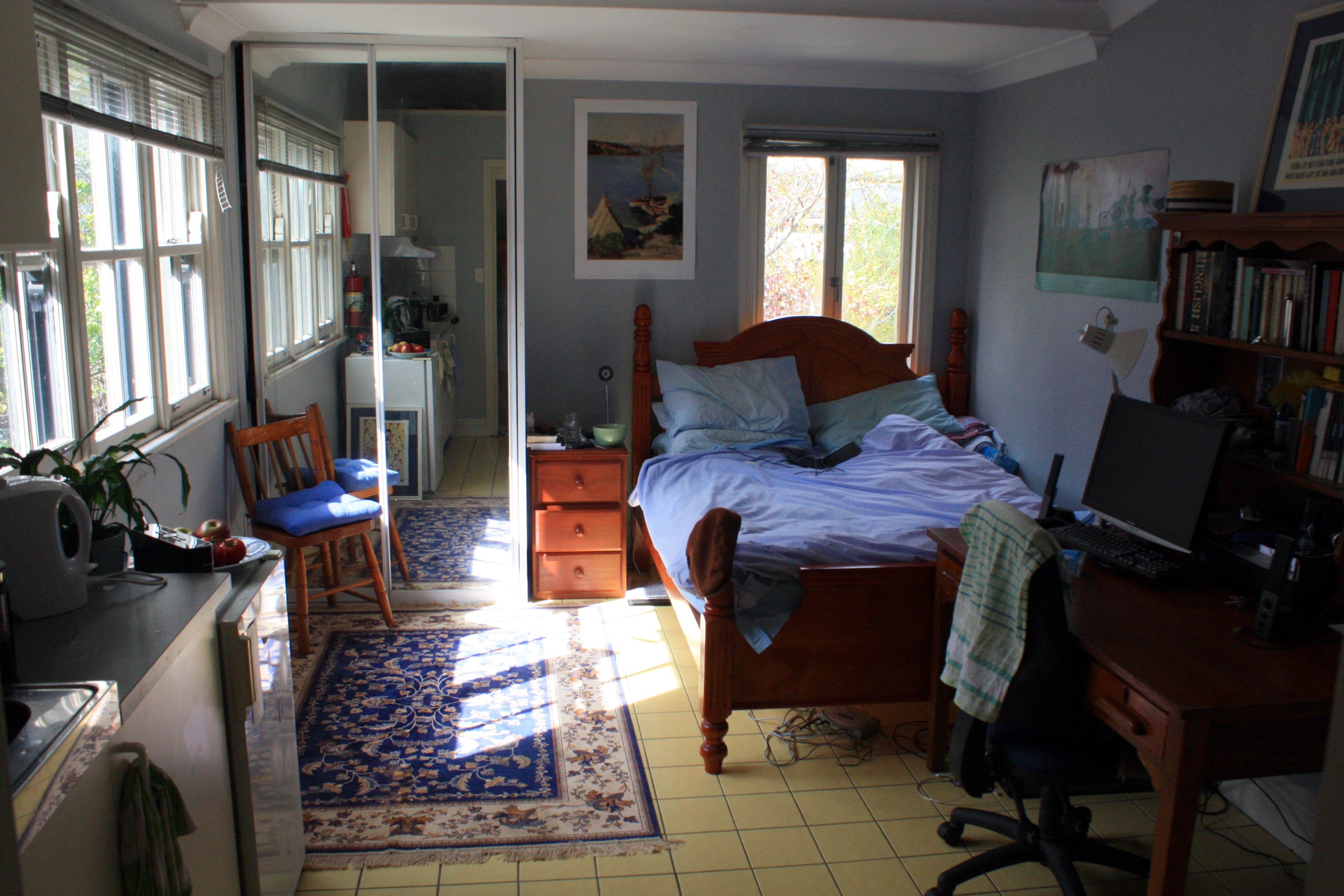
It’s a grey day, but I’m bathed in abundant natural light. The morning sun, having shifted across the Dijon mustard tiles and the royal blue Persian rug, now hides behind the clouds yesterday was supposed to bring. Outside my wide, elevated, east and south-facing windows, is a peaceful expanse of back yards and flourishing trees; their branches gearing up for spring. Being at the back of the building, the traffic sounds reach me like a distant, muffled wind. It’s peaceful enough that the birdsong is paramount, and my little old fridge keeps largely to itself.

I moved here just yesterday, to this sweet little studio in Glebe, and already I’m in love with the place. After a month of searching, considering many options, of sharing or flying solo, I inspected this place last Saturday morning and instantly saw the potential. I had actually come to inspect this unit the week before, yet in a moment of folly wrote the address down as Glebe Point Road and found myself wandering into someone’s house. Having missed the inspection time, I was ready to give it up for dead. When no one subsequently applied, I was further inclined to pass pre-emptive judgement that the place was, in fact, undesirable. Yet my at times insatiable curiosity got the better of me, and thank goodness it did.

The previous situation, a large, friendly share-house on Queen’s Park, had been good in every regard with the exception of its outlook. The room, whilst nice in itself, faced onto a brick wall which made it oppressively gloomy during the day. The neighbours’ front door was also a short distance from my window, and their constant comings and goings, their children’s tendency to practice recorder badly and bounce basketballs outside on the path, and their recent acquisition of a small, yappy dog were driving me bonkers. When I returned from visiting my brother in Brisbane, where I had slept on a wide, comfortable, solid wood queen-sized bed in a room gold with morning sunlight and myriad magpies singing like squeaky swings outside the window, I knew instantly that I could wait no longer. I had to get out, and so I did, fleeing briefly to the ancestral home so I might find a new place at leisure, without the pressure of having to fix a departure date. The Workers’ Socialist Democratic Republic Paradise (hereafter, WSDRP) as our family home is known, proved again to be both wonderfully welcoming and convenient in a time of transition.

Today is my birthday and it is very pleasing to wake up in such a lovely place. Even the onset of heavy weather only fills me with a greater sense of romance. There is nothing quite so well suited to making a place feel homely, than to sit reading by a rain-lashed window. The move here was very smooth, and my regular helper and good friend Paul again deserves my great thanks for his efforts in driving me and my belongings. I ought also to thank the Holden Commodore, which impressed me with its capacity – especially when I slotted my half-sized fridge across the back seat; a fridge, incidentally, which my much-missed French Nana gave to me in 1993 when she moved into my old room at the WSDRP. It still works like a charm, despite having been left on in the laundry for the last six years to form a vast, solid-core iceblock around the small freezer compartment. Paul helped me to load and unload the car, whilst I did all the carrying work. My zeal, pace, energy and efficiency, earned me the nicknames Conan the Removalist and The Removalator. There is definitely something to be said for keeping fit and developing one’s upper body strength!

Moving into a place has always been one of my very favourite activities, whilst, conversely, moving out is one of the least enjoyable. This move had in fact begun on Wednesday, the day I signed the lease. After finishing teaching at one, I went straight to Surry Hills to purchase a bed and a desk, the core furniture I lacked, having lived since returning from England in furnished houses. I was in something of a hurry to do so as I was signing the lease in Concord at three o’clock, and I wanted the furniture delivered later that afternoon. It made sense to have the furniture delivered directly to the new address, and thus obviate the need for a removal truck, which I would not otherwise require.

The range of furniture available in the store proved disappointingly small. The business had relocated from Bronte, and, having been to their previous store, which covered three storeys, I had expected a wide range of beds and desks. Yet instead I found a single storey, quite sparsely stocked. It was in this that I was unexpectedly and unknowingly fortunate. The choices lay at either end of the  scale and, remembering one of my favourite Chinese proverbs, “The bitter taste of poor quality lingers long after the sweetness of a good bargain,” I knew I would regret the cheaper, aesthetically poor choice. After all, what had been lacking in my last place was aesthetics.

So it was that, after wandering around the shop floor, stepping repeatedly past the big, grey-beard drowsy dog, I knew I had no choice but to buy the solid and stylish wooden queen bed I had been eyeing for the last five minutes.  Not far from it was a wonderfully weathered old wooden desk of epic size, yet slender legged and not too brutish. The one seemed the natural corollary to the other, so I mentioned my interest and cut a deal with the chap, who gave me a very nice discount. On top of this, he promised he would deliver at six thirty, and since I was to be his sole helper in unloading the goods, he would not charge for the delivery. It was, after all, a sweet bargain, but for quality.

I took a train to Burwood and walked out to Concord to sign the lease. It rained all the way – which one of my Korean students tells me is a good sign when moving house. As someone who loves the rain, I felt quite content as I returned via a long and congested bus-ride down Parramatta Road to Glebe. The brake-lights hung through the humid window in a world as sullen and grey as lamb fat. I felt an oddly peaceful eagerness, knowing I had time to kill before the delivery.

Here’s a poem I once wrote about Parramatta Road in 2005, which I throw in here by way of diversion.


Parramatta Road

These tired shops will never bring

slow-walking couples, blithe and entwined,

such is the hustle, the bash and the hiss;

heaves of freight, rubber and metal,

rolling petroleum, fog of exhaust.

And,

every morning,

as the bitumen warms,

as this smeared, groaning gully

fills freshly with urgent trumpets,

this stretched fan-belt girdle,

this gasoline funnel, this road

is like Christ risen

on a noose.

_________________________

Having arrived at the apartment and determined which keys were which, I found it ever so slightly smaller than I remembered. I realised now that the bed was not going to fit where I had originally intended it to go, and felt a momentary uncertainty about my decision both to purchase such a large bed and to rent this flat in the first place. I became concerned about sleeping in the same space as a fridge. Were they not prone to groaning and rumbling throughout the night? Was I not someone who could not bear the almost inaudible hum of a device on standby; someone with a phobia of ticking clocks – who on earth wishes to hear their life disappearing like that? Would sleeping with a fridge be impossible? Would it unnerve me, disturb me, send me bats? I pushed this fear aside. The space was very nice, with great light; it was clean, peaceful and harmonious, and I trusted my ability to make it very nice indeed. Sleeping with a fridge, bah! If it bugged me, I could always turn it off at night and no doubt all would keep til the morrow.

With two hours to kill, I set off for Vinnies on Glebe Point Road and proceeded to buy up all the floral granny plates I could find. I also bought some cups, saucers, mugs, glasses, a milk jug, silver sugar bowl and a large painted tray with a lacquered fruit fresco as its base. Using this tray, I carried my collection of crockery and utensils back through the rain to the apartment. After washing and stacking it on the sink, I sat down to read The Butcher’s Wife by Li Ang; a gripping, yet very visceral novel which I would recommend, though not without reservations.

At six thirty the chap was outside with the furniture. Together we brought the various parts of the bed in without any difficulty. The desk however, being all of one piece, proved more of an obstacle. Unable to fit through the door, the only option was to haul it up through the back window. What followed was equal parts comic and heroic. With me at the top hauling on the ropes, and the chap from the store standing below on a piece of backyard furniture and trying to hold the desk steady over his head, we managed to get it through the back window after much straining. Sadly, in my wrestle to drag the desk through, I cracked the glass of one of the window panes.

Come Saturday, I finally had the chance to put everything in order and decorate my new home. It took only two hours to order the furniture, put books on shelves, hang clothes, fill drawers, make the bed, lay the rug, stock the kitchen cupboards and bathroom cabinet, and set up my computer. The next few hours were then spent decorating; arranging photographic prints, hanging poster reproductions of artworks, deciding which tea-towels to display…

And so here I am on Sunday morning, feeling almost indecently pleased with myself. The birds are singing, the light is glorious, the outlook soothing, the drizzle calming, the bed exceedingly comfortable. In such a short space of time I have already recovered a long-lost sense of equilibrium. The absence of pressure or interruption, the freedom from other agendas, the serenity of complete overlordship over one’s domain, have flooded me with relief. For years previously I had lived alone in apartments and houses, and it had always given me a far stronger sense of self. The last time I lived alone was in Glebe, just eight doors down the road from my current address. Indeed, if I look out the back window, I can see the balcony of my old flat. That was famously given the nickname “Cornieworld”, and it was a most excellent place in which I wrote a great deal, including my second-last novel. Funnily enough, the above poem was also written whilst living there. I was extremely happy in Cornieworld, though I stayed only a year as my growing disappointment with John Howard’s Australia inclined me to move back to Cambridge.

Since 2006 I have shared houses with others, and whilst this has been largely a pleasurable experience, I have not in all that time felt entirely at home. Even in the most relaxed and friendly of households, there is a need to keep up appearances. Even with the most open-minded and casual people, there is an awareness that one is observed in one’s own home. Occasional inconveniences and disturbances occur that are beyond one’s control; the bathroom is busy, the stove-top full, the oven in use, the kitchen is full of people when one is really not in the mood for conversation, and does not wish to be seen looking so tired and frumpy. All these things take their toll, and despite the good company of housemates, it is not possible to choose at which times one has this company.

Already, just one day into my new house, on the first day of the 39th year of my life, I feel transformed. There is no one above me and no one below me, for despite being on the second floor, below is the laundry and a store-room. I can step as heavily as I please, play music loudly, speak without fear of being overheard, and nor do I seem to hear anyone else. My new, old furniture looks magnificent; the pot plants, the rug, the photographs, the book spines, the tea-towels, cups and saucers, the wooden chair, the bedside table, the trio of soft toys, Bilby, Platty and Bünchen sitting beside me, all fill me with a sense of wholeness.

When I said I was moving back to Glebe, my old friend Simon, knowing how much I love the area, said “Ah, you’re going home!” And, for the first time in years, I really do feel as though I am at home. And that little old friend of mine, that ever durable, long-lasting fridge, makes barely a sound at all.

Happy days indeed! Cornieworld 2 is born!

Read Full Post »

I have recently been through an awful personal moral and ethical crisis over something I ought to have sorted out a good deal earlier in my life. Having been challenged on my use of the word “retarded” as a synonym for “stupid” and having initially defended the use of the word, I have, after much anguished consideration, made  a pledge not to use this word ever again.

The noun “retard,” and the adjective “retarded” are certainly common enough in local parlance. Indeed, they are widespread in the language of people in most English-speaking countries, and are especially common in the UK, Australia and the United States. I first came to use these words in high school, along with other unpleasantries such as “spaz”, and at the time thought little of it. It’s fair to say that, as a teenager in a boys’ high school, it was difficult to avoid hearing these words, and there was little discouragement from peers regarding their use.

In retrospect it seems like a habit one ought to have grown out of, especially considering there was no intended animosity towards people with intellectual or physical disabilities. My parents would have whacked me if I’d ever expressed prejudice against such people and my father was particularly tough about the matter as his sister had spent her life in care, having had a severe Autism Spectrum Disorder. My father had been left in charge of her by the untimely death of his parents when he was in his early teens and he was fiercely dedicated to ensuring that she was well looked after.

I used to enjoy visiting Diana in the home where she resided, despite her almost complete inability to communicate verbally. I was quite young at the time and all I remember of her was her love of bananas and how much they excited her whenever they were produced. My father had explained to me that, in effect, her brain had not developed beyond the age of three, though it was, of course, just a layman’s explanation for a young child. It was certainly a confusing and uncomfortable experience for me at that age, but most children are capable of a most unconditional black and white morality, and my attitude towards her, and to people who were equally disadvantaged, was entirely sympathetic.

It thus surprises me when I consider, in retrospect, the disconnect between this emotional response and the use of words such as “spaz” and “retard” in high school and beyond. Our teachers certainly did not condone it, although some were prone to call us half-wits, morons and idiots when riled. I guess I must have understood the link between the words and the people about whom they had originally been used, but their use was so commonplace, I simply came to regard them as another type of insult or derogatory adjective.

When recently challenged on my use of the words “retard” and “retarded”, my response was not exactly co-operative. I argued, as I have in the past, that I bore no malice whatsoever to physically or intellectually disabled people and that in fact the use of the words was perfectly legitimate as they had, in my mind, become detached from their original use. The origin of the word dates back to the term “mental retardation”, which was used in a very general sense to describe people with an Intelligence Quota below 70. It was not initially intended to be a pejorative, but certainly came to be used as such shortly after its deployment to describe a certain type of intellectual disability. Indeed, in some states in the US it is still used in an official capacity, despite widespread opposition to this.

Though I am not here to defend myself, it is worth pointing out that several other very common words, which many people find pejorative, but not particularly offensive to disabled people, had precisely the same origins.

In 19th and early 20th century medicine and psychology, an “idiot” was a person with a very severe mental retardation. In the early 1900s, Dr. Henry H. Goddard proposed a classification system for mental retardation based on the Binet-Simon concept of mental age. Individuals with the lowest mental age level (less than three years) were identified as idiots; imbeciles had a mental age of three to 7 years, and morons had a mental age of seven to ten years.

These words have lost their medical definition to a very great degree, and have thus been neutralised into mere general insults. The same, no doubt, will ultimately happen with the word “retarded”. Yet, having been told by my significant other that she found the words “retard” and “retarded” offensive, and knowing that they have had a more recent association with intellectual disability, I ought to have given it more consideration.  Despite this, in my at times annoyingly obstructive manner, I continued to defend the use of these words as a commonplace, unrelated to disability, partly because I had used them for so long and did not feel them to be necessarily discriminatory or offensive, but also because I have often argued that no word really should be taboo.

Political correctness has long been a hot topic on the left of politics, as well as the right, where opposition to it has been strong. I have always been a strong advocate of non-sexist language, at least since I developed more intellectually and personally in my mid to late twenties, when I first really became aware of the issue through gender studies and Labor party initiatives. I felt quite strongly that non-sexist and non gender specific language, should be used both officially and at a personal level. Indeed, I  once had an awful argument with an ex-girlfriend’s father about the matter. In the aftermath of that heated argument, I came away wondering about whether or not one really could restrict the language people used, whether or not this would constitute an appropriate form of legislation, or a too intrusive level of oversight. My attitude became more ambivalent, at a personal level, but not at the official level. I was certainly not about to ditch my opposition to the use of sexist language, yet, to a degree, I began to believe that language ought to be contextual. As a friend once said, “Life is not PC.” As a writer, one ought to be free to use language as one wishes, appropriate to character and context. Of course, if one were to use a word like “retard” in the presence of someone with an intellectual disability, however unwittingly, it would no doubt cause immense offence.

As was rightly pointed out to me recently, however, the use of the word is not appropriate in any context. What I failed to realise, and what I now deeply regret not seeing at the time, is that using a word like “retarded” is not merely wrong contextually, but it is just plain wrong. There are simply too many people in society to whom it might cause offence; too many people who may have been subjected to the word as a form of discrimination against their disability. I was grudgingly willing to concede that I would not use the term in the presence of the lovely person who had upbraided me about it, but I still felt I had a right to use it as I saw fit in other situations.

What now astonishes me, having seen how my ignorance has caused potentially irreparable harm to a beautiful relationship, is that I actually felt the freedom to use these words was worth defending. Some freedoms, certainly, are worth fighting for, and in some countries, where words of opposition and revolution are repressed, there is every reason to fight for semantic freedom. Yet why on earth would anyone choose to defend the use of a word like “retard”? What is the objective?

What I failed to see, probably in part because I’ve heard the word so often in every workplace I’ve ever been in, is that using such a word has the potential to do immense harm to one’s reputation and character. I was blind to this, like a total and utter fool, and in due course, the consequences have been, to say the least, devastating on a personal level. It is not only someone I care very deeply about that I have upset, but I have upset myself over this matter and it has precipitated a personal crisis of great magnitude about what sort of person I actually am.

I have long considered myself to be someone with good ethics, who took the time to find out what was happening to people in the world and try, where possible to inform others. I was never very active politically, but in social circles, particularly during my later years at university, I had a reputation as a firebrand who railed against oppression, discrimination and injustice. I have never been afraid to take people on and have, on one occasion, been thrown out of a party for causing a disturbance when someone started complaining about asylum seekers and proved to be intransigent on the matter. And yet, all the while, there I was using a word like “retard”, giving next to no thought to just how much offence this could potentially cause.

We all make mistakes, and there are things about which we can be very wrong indeed. At times I know I can be arrogant, I can be inflexible, I can be stubborn to the point of stupidity, but I can admit that I was wrong. Sometimes this comes too late, and the damage cannot be undone, but I am willing to put it on the record that I was very very wrong indeed on this matter. There is no context in which it is OK to use a word like “retard” or “retarded”. There is no situation where it is appropriate, unless, of course, one is writing the words of a character in a literary composition of some sort – and even then, it should be discouraged unless one wishes to make that character out to be an intellectually careless or unpleasant person. I, however, have three degrees and should know a hell of a lot better.

I should also like to extend this embargo to the word “gay”. It too is very commonly used, and by no means necessarily in a manner designed to be offensive to gay people. Indeed, I have worked with gay people who have continually said “Oh, that’s so gay.” In retrospect, however, whilst it might be appropriate for gay people to use a word like “gay” in such a sense, just as many African Americans feel comfortable using the word “nigger” with people of their colour, it is not at all appropriate for me to use it. Not only does it send all the wrong signals, suggesting a prejudice I do not hold, but it could, if used before gay people, cause immense offence.

I shall not be using these words in future, and I would encourage others not to do so either. It is careless, potentially offensive, and might cause harm to one’s reputation to do so. I would strongly advise against it and regret any harm that I may have caused in the past through my own carelessness on this front. Sometimes in life, we have to admit that we are wrong. Just because one has shown an ethical correctness in many areas, does not mean one cannot still be ignorant and wrong about others. It is best to listen and learn from those whose arguments show a superior degree of consideration on moral or ethical questions, especially when their argument is not based on a religious principle, but rather sound reason. I cannot dispute that these words are capable of causing offence. Indeed, I did know it already, but failed to correct myself out of the misguided belief that my use of it was inoffensive in its intention. Well, I certainly offended someone, and now I’m paying the price. I hope that I never again allow recalcitrance to get in the way of learning to be a better person.

Read Full Post »

The Odyssey

The Odyssean Lifestyle

I recently came across an article in the Sydney Morning Herald, entitled “Odyssean lifestyle makes a comeback”. I liked the title and was immediately curious, partly because, being a Sydney newspaper, my first thought was that its author was in fact the very David Brooks who had been one of my profs at The University of Sydney. It was not so – the article, which had first appeared in the New York Times, was written by an altogether different David Brooks.

Brooks writes:

There used to be four common life phases: childhood, adolescence, adulthood and old age. Now, there are at least six: childhood, adolescence, odyssey, adulthood, active retirement and old age. Of the additions, the least understood is odyssey, the decade of wandering that frequently occurs between adolescence and adulthood.”

The odyssean lifestyle is aided by new workplace flexibility, social media, easier and broader access to tertiary education, vastly changed perceptions of roles and status according to sex, gender, race and cultural background, ease and affordability of travel, more flexible social mores, online dating, the list goes on. The world has never been so full of choice and possibility, or, for that matter, such a variety of role-models. Personal development now includes a far richer range of experiences and opportunities, and the naturally curious human species is exploiting this to the full where possible.

Brooks is likely correct in suggesting the odyssean stage of ones life typically spans a single decade, yet there is, arguably, no limit to how long this may run. I myself have been on an odyssey since I left high school twenty years ago and, let’s face it, I still don’t know exactly what I’m doing with myself. It’s fair to say, however, that despite having three degrees, including a PhD in history from the University of Cambridge and a Masters in Creative Writing from the University of Technology, Sydney, I haven’t exactly been successful.

It has also become increasingly difficult as I age to justify my lack of assets and financial security. Most would consider the odyssean phase to be one in which one tried ones hand at various things, ultimately with the aim of finding a suitable situation, career, partner and place to settle down at the end of the odyssey. Rather than merely accepting the old paradigm of finding a career either immediately after high school or university, many now prefer to try a variety of options until their tastes mature sufficiently to make a more satisfying choice of lifestyle. My problem, however, is that the paths I have chosen have so far proven to be dead-ends or have not been satisfying. I also suffer from a rather short attention span, or, conversely, an almost pathologically intense period of focus which, after some years, leaves me totally and utterly sick of whatever it was I was doing. Just like Zorba the Greek, who, as a child, loved cherries so much that he ate them until he was sick, I too tend to overdo things until they no longer give me pleasure. The law of diminishing returns is one of the few laws to which I subscribe without hesitation.

I have already experienced this sudden, plummeting loss of interest in the study of history and writing novels, though I’m still hitting the keys, as is here evident. Perhaps it is merely lack of success in these fields that has left a bitter taste in my mouth, but also a quite incurable restlessness finds me dreaming of further career possibilities at the age of 38 – architecture, photography, archaeology, biology, environmental management and planning… the list goes on.

The job for which I yearn most of all, however, is that of a holiday package tester. Yes, people do do this for a living – going on a package tour and rating the quality of the holiday experience. Many people I know do not like flying, become frustrated upon entering an airport, and are unhappy to have a schedule that is regularly disrupted by travel and jetlag. I, however, love these things dearly and feel most comfortable when constantly confronted by new stimuli – be it a crappy hotel room or second-rate buffet breakfast. Anything novel is, well, novel, for better or for worse, which is, I suppose, part of the reason for my clinging to the odyssean phase of my life for as long as possible.

One interesting upshot of the Odyssey is a loss of any coherent understanding of how or where I am supposed to be at any given stage of my life. There are clear signs all about; many of my friends are breeding, married and have successful careers, yet this process has had almost no impact on me whatsoever, other than to confirm my worst suspicions that it looks more complicated than desirable. Having always disregarded social convention, initially for the sake of rebellion and later through a philosophical rejection of materialism, careerism and acquisitiveness, I still believed that eventually I would, to some degree, fall into line.

This future point in my life, possibly involving marriage, the production of children and permanent, professional employment, combined with an attempt to latch onto the lower rungs of the property ladder, was always, from the age of around twenty-eight onwards, five years away. Nothing has changed, it is still five years away, and I believe I have at last begun to understand just why this is so. It is not so much a question of the necessary elements being in place, but rather one of the absence of any desire to set this process in motion. I quite simply don’t want to own anything or anyone, nor have to make life-decisions that depend on someone else’s say-so.

The unsettled, curiosity-driven, admittedly aimless, wandering lifestyle has become so integral for me as to be the only lifestyle I am capable of imagining. I have been through several mental exercises, imagining myself in the role of father and husband, or father and partner, or as permanently co-habiting childless, home-owner, or even, simply, home owner, but it all seems so farfetched. I have begun to wonder, does the old adage that you can’t teach an old dog new tricks, come into play so far as lifestyle is concerned? Is it possible that I have become so detached from and spent so long avoiding exposure to these more settled lifestyles, that I am not actually capable of living such a life? Am I too set in my ways to adapt to it without suffering from crippling wanderlust and eternal, dispiriting restlessness?

The unwillingness to commit is often derided as a flaw; yet, I feel this attitude is out of touch with modern reality. Certainly there can be advantages to commitment, but without a sufficient level of in-built flexibility, anyone already well-used to freedom of movement is inevitably going to feel significantly restricted. Ultimately it comes down to a question of what is more important and what compromises we are willing to make, yet an unwillingness to compromise and a failure to rate permanence as highly as impermanence, should by no means be derided.

Perhaps it was my father’s work as a foreign and war correspondent that made me so attached to the idea of travel. Of course I was never actually doing any of the travelling, but remained transfixed by his tales of adventure. This no doubt helped to fuel my early and ongoing obsession with fantasy role-playing games. I had an intrinsic idolisation of characters who went off adventuring by themselves or with others. I spent my childhood pretending to be an “adventurer” and of all the literature I encountered, it was more often than not quest narratives that held the greatest attraction.

These particular influences and preferences are personal rather than broadly social or generational. Yet, finding myself in a global society marked by  the rise of flexibility and mobility in all things from work, education, relationships and gender and with rapidly rising narcissistic individualism, I have been perfectly primed to embark upon and sustain an Odyssean lifestyle. Quicker than I could decide what my own chosen norms were, the norms have changed.

There has only been a slight shift in self perception. A growing awareness that I am ageing – greying hair, lower back pain, longer warm up times when running – yet I still consider myself to be young. In fact, I rarely consider myself to be an adult, but a young man. My latest theory is that so long as I have hair, I am young. And, yes, I still have plenty of hair still on my head!

The original article link is below:

http://bit.ly/ibhXeB

Read Full Post »

« Newer Posts