Feeds:
Posts
Comments

Archive for the ‘India’ Category

When I woke up the on my second morning in Darjeeling, it seemed as though the day had been cancelled. I pulled aside the curtains to a view of next to nothing. A pea-soup fog had settled over the town and visibility was reduced to the powerlines outside my window. The eerie, wan sunlight at the back of it leant the fog a disquieting luminescence; a sheet of pale gold leaf behind the swirling, moist air.

I stared in wonder and caught occasional glimpses of the ghostly satellite dish and the iron rooftops; their outlines seemed characteristically oriental, like the tops of pagodas. Darjeeling’s quaint brand of orientalised colonialism made it the most distinct indication of the long tenure of the Raj I’d yet seen in India.

I peered out into the corridor was greeted with curious sight. Down the other end, the door to the fire stairs had been left open and the fog had seeped into the passage. It too was lit by the glary white of the hindered sun and the corridor, cold, tiled and light blue, brimmed with arcane mystery.

I walked to the end and looked out from the landing. The road below offered up the occasional silhouette; a dog, a person, a rooftop, a passing car, but little else. It was a quiet world; the sound damped down by the heavy air.

I hurriedly got my things together and set off into the fog. It was seven AM and the street was eerily silent but for the squeaky sound of a panda bear-like dog mauling a foam box. I patted this playful beast and continued down Dr Zakir Hussain Street which ran along the ridge towards Chowrasta, the main public piazza on the top of the town. There was no one about, but plenty of dogs; huddled together against house and shopfronts, curled into balls along the road, nestling on door-steps.
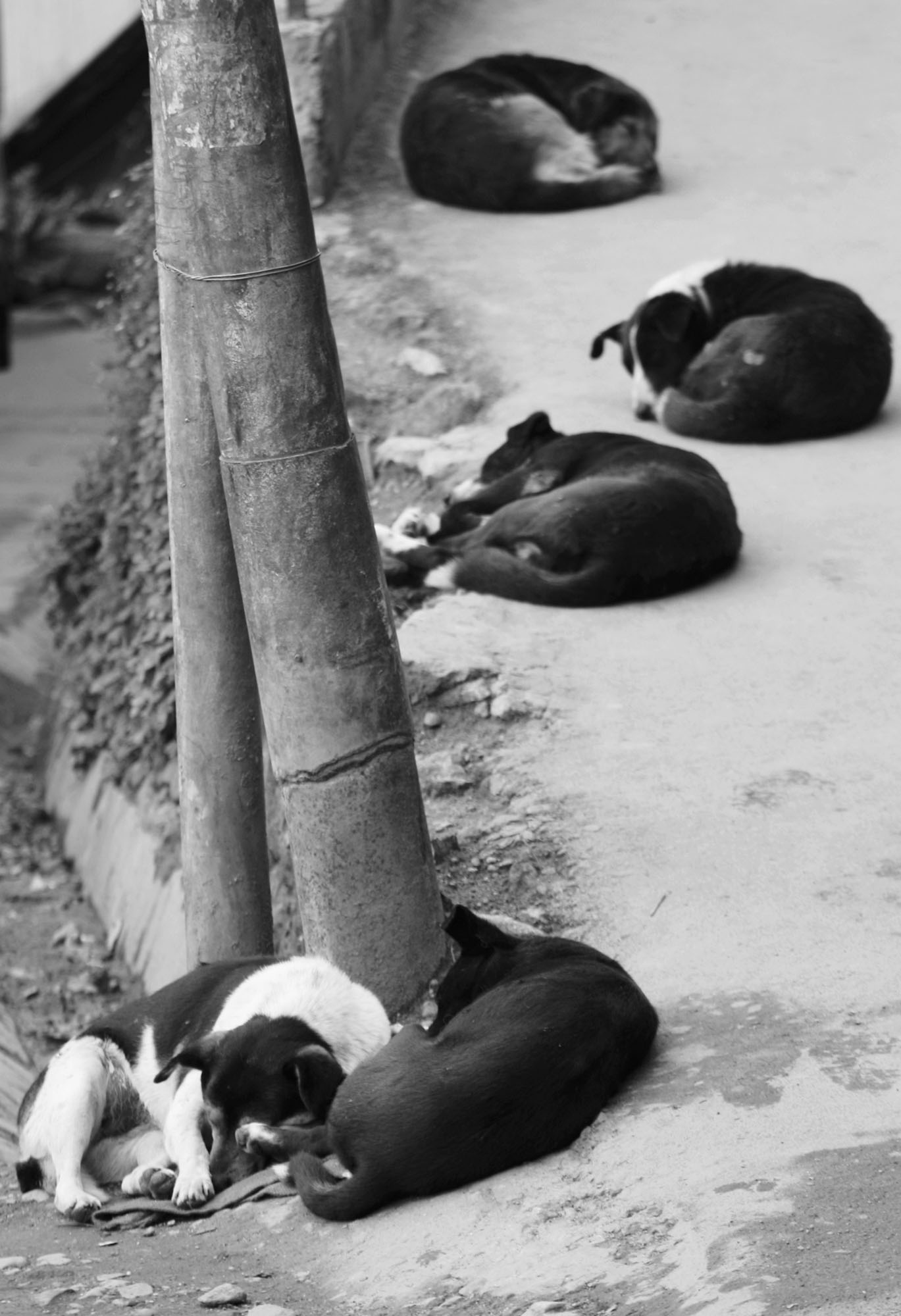
They all seemed friendly and not cowed; their worn faces and matted hair were less saddening when one considered their general robustness and apparent, ruddy good health. For the dogs of Darjeeling were certainly the healthiest, if not the cleanest, I’d seen as yet in India.

The street passed many a wide-open vista, where a view of the valley and mountains beyond opened out. Yet, with the rolling fog, so constant and thick and the peculiar, seemingly paradoxical heavy wetness and icy dryness of the air, all light and white like smoke, all cloying and dense like fallen clouds, it was impossible to see beyond the wire fence that hugged the street’s edge. Here and there a local emerged from a shop or house, transformed until just a few feet away into a pale outline.

Less than half a kilometre down this muffled street, it dipped steeply towards a junction and there I spied a café called Sonam’s Kitchen.

I had seen the name in the guidebook and, as is usually the case, it had all the hallmarks of a place that catered almost exclusively for tourists. I was reluctant to try it, but paused outside just long enough to catch a whiff of their excellent filter coffee. I realised how hungry I was and just how much difference a good coffee would make. A moment later, I was seated inside studying the menu.
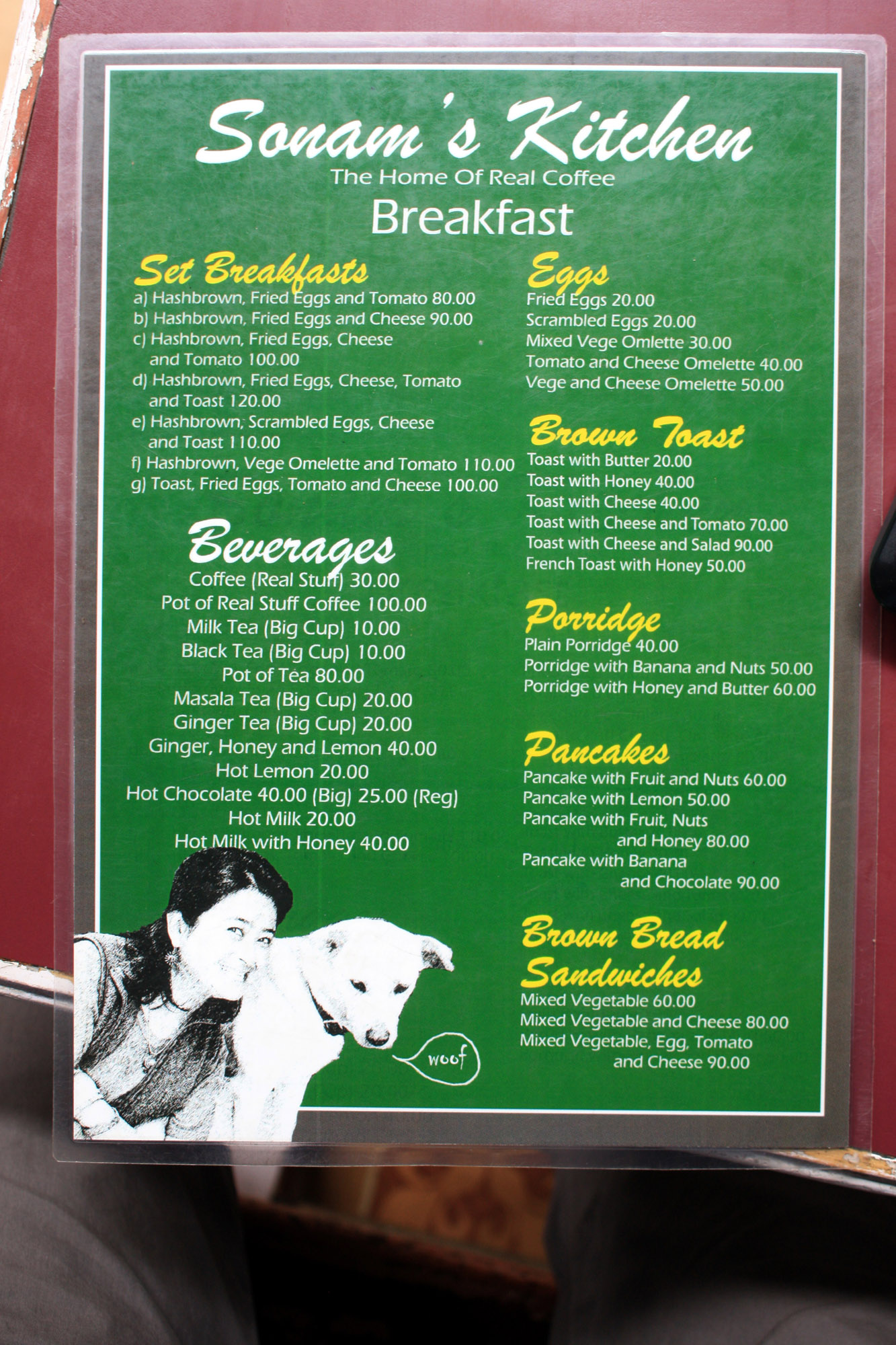
I ordered a pot of what they called “real stuff” coffee, along with eggs and hash-browns. It was comparatively expensive for India, but with fried eggs at just fifty cents, who on earth could complain? The lady who took my order was the same as the one featured on the laminated menu – Sonam herself. She spoke great English and was effusively friendly. I felt, as the name of the place suggested, that I was in someone’s home rather than a café or restaurant. Clearly this place was favoured with good reason.

I pulled out my laptop and surfed the internet, all the while eavesdropping on the conversations around me. When travelling I tend to be rather shy about approaching people, but once drawn into a conversation, I relax more readily with company than I would in my daily life. I spent some time playing the accent game; guessing where people were from. The tables were communal and around the time my food arrived, I was joined by an American, an Israeli and a Queenslander.

All three of them were travelling independently but, having been in town for a fair while already – two weeks in the case of the Queenslander – they all recognised each other. When they greeted me and asked where I was from, I was happy to be drawn into a friendly chat. They were good people and genuinely interested in the town and region, all with their own, quasi-anthropological zeal. They also seemed curiously as they ought to; the handsome young American, well educated and scholarly, with an old world politeness only the new world can produce; the glowing Israeli, tanned and well-fed, full of questions about the spiritual nature of the locals; the gruff and rugged Australian; realist, pragmatist, egalitarian. Rather unexpectedly, within five minutes the conversation turned to girls and growing marijuana. The American had experience of it in California; the Israeli had grown his own and liked a smoke as much as the next man, but, most importantly, the Australian knew where to get it.

“All this talk is making me want to smoke,” I said.

“Not hard in this place,” said the Queenslander.

“Really? How so?”

“Just talk to the pony boys.”

“The pony boys?”

“Yeah, the pony boys. The guys down the road.”

“You mean the dudes with the horses. In Chowrasta?”

“Yep, the pony boys.”
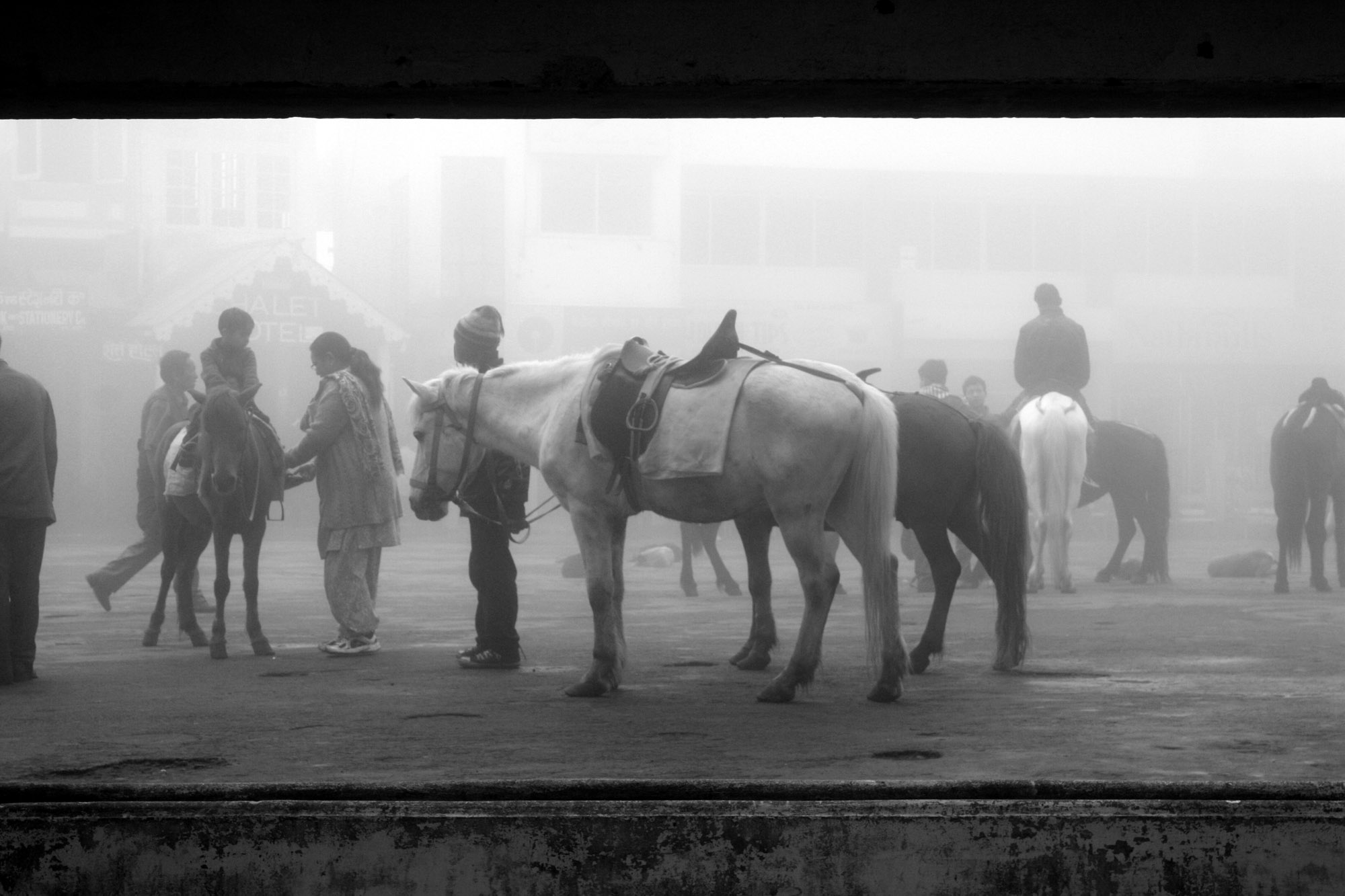
I had passed the so-called pony boys many times the day before, strolling up and down Dr Zakir Hussain Street which, along the stretch before it met with Chowrasta, was a popular thoroughfare lined with stalls and shops. Right on the edge of the square was an old concrete stable with space for roughly ten horses. These horses, traditionally used for transportation and communication, were now primarily used in giving joyrides to children and tourists. They weren’t exactly what I would have called ponies, in the miniature sense, but they were certainly small and slightly-built horses. According to the Queenslander, the pony boys also made a little extra from the sale of marijuana.

“Just look at their eyes,” he said. “Like piss-holes in the snow.”

“Goodness! I hadn’t noticed. Are they all baked?”

“Yep. They’re off their chops. Go have a look.”

“I think I will.”

I took a big sip of coffee, thinking how delicious it would be to get smashed in these winter wonderland conditions. I had smoked a little hashish in Rajasthan and Rishikesh, but had kept things pretty clean since then.

“So,” I pressed, lowering my voice. “Have you actually bought some from them?”

“A couple of weeks ago.”

“And?”

“It was great. Very dry and seedy, very natural, wild stuff. But it’s got a great high on it and it’ll have you giggling like a little girl.”

“That is very tempting. How much did you pay?”

“Five hundred, for a bag like this.”

He shaped his hands to indicate a pretty serious nugget, about the size of a decent potato.

“It’ll take you forever to get the seeds out of it. But fuck it, you’re on holiday.”

I laughed at his laconic humour and knew my mind was already made up. Until I scored, I’d be salivating for a smoke like Pavlov’s dog.

I finished my breakfast and stayed chatting until my seat was required for someone else. When I left the café, I walked straight down the street to where the stables were, through a fog even heavier than it had been before breakfast. Only when I reached the line of stalls at the bottom of the hill, where the collective human warmth had caused the mist ever so slightly to dissipate, could I begin to see more than twenty feet. The stalls were a great spectacle in themselves. Mostly selling vegetables, these simple wooden huts, roofed with tarpaulins and plastic sheets, were attended by people who often sat cross-legged next to their wares.
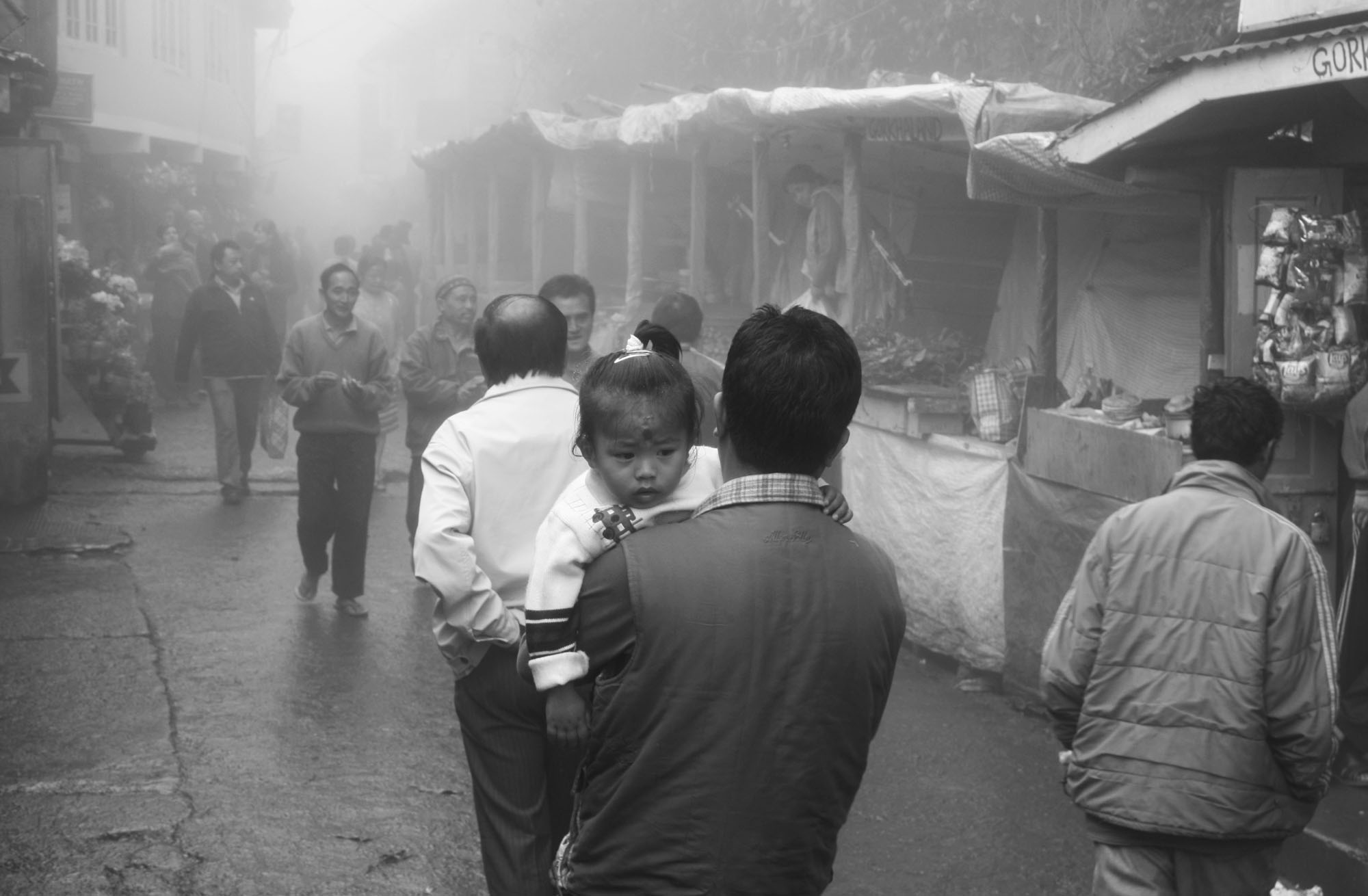
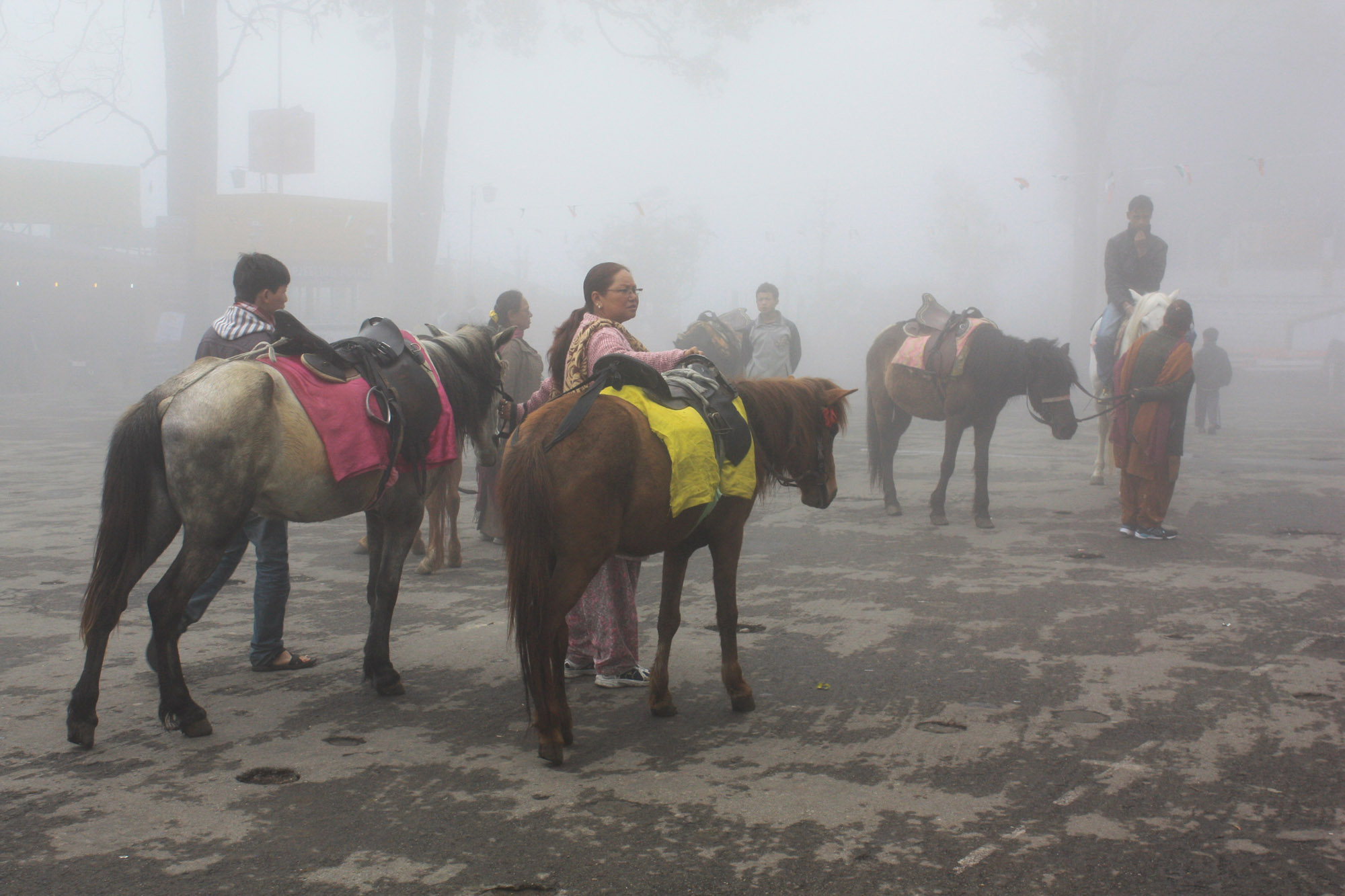
The stables sat directly opposite two most excellent chai wallahs, who also cooked simple local cuisine in a steamer and wok. I sat down beside some locals on the long bench at the corner chai stand and ordered a cup of tea. I then turned my attention to studying the scene. There were just two ponies currently in the stables, the rest being out offering rides to children. Only an old man, whom I had seen there throughout the day before, was present, sitting on a step. Out in the square were the dim outlines of people and horses.
There was little hope of seeing their eyeballs, let alone their faces at this distance, in this weather, so I turned my attention to the tea, which, upon my first sip, sent me into paroxysms of pleasure. It was, without a doubt, the best cup of tea I’d had since arriving in India. It was only really at this point that my location hit home. Darjeeling – one of the tea capitals of the world!
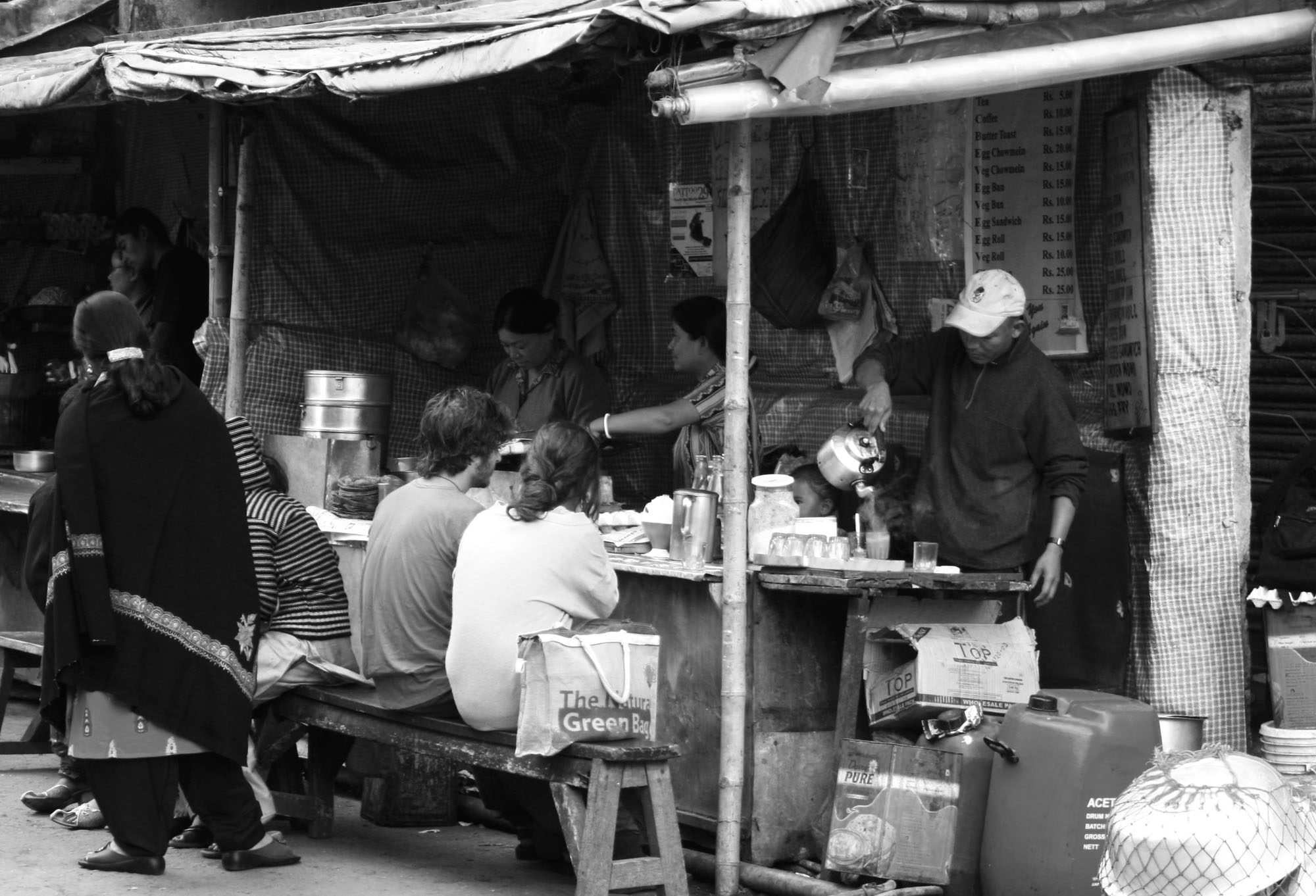
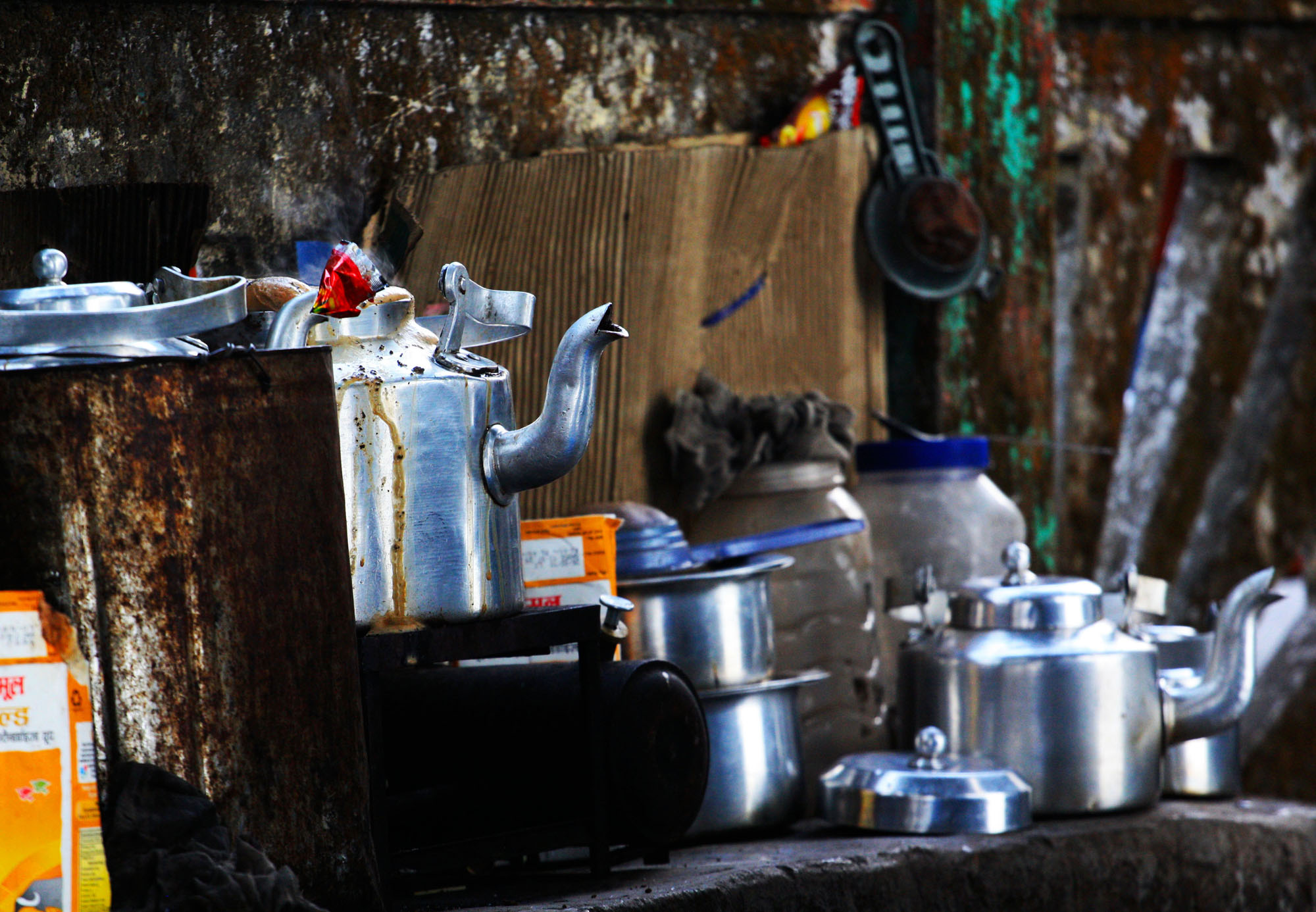
I now studied the people behind the counter. There were three of them, two women and a man, all Nepali, likely in their mid thirties. They seemed to have their own particular role behind the stall. The man was in charge of the tea; using a large tin kettle in which he placed what looked like a home-made tea-bag the size of an apple. From this steaming hot kettle he would pour the tea into the regulation small tumblers one found right across India, mixing in sugar as desired and powdered milk. I was, initially, disappointed to see him use powdered milk, but by the time I’d finished the cup I was convinced that I’d never drunk anything so delicious in my life. I ordered another cup – at five rupees a piece, a little less than twelve cents – and watched the two women. One, whom I suspected was the wife of the tea man, was in charge of the cooking. She stood behind a large wok on a gas cooker, cooking noodles, frying eggs with chilli and heating buns by pressing them against the hot wok. The other lady, whom I guessed, again with very little evidence, might be a sister of one of the other two, was in charge of the momos. She stood marshalling a tall pile of tin and bamboo steamers, filled with what looked like delicious dumplings. I was astonished to realise that a mere fifteen rupees bought eight to ten of these soft, hot, fresh momos. Whatever was to come, I knew I’d be coming back this way for lunch.
When the tea was done, I thanked the people and stood up. Now fully fortified against the cold air, I had to work on my resolve to make an approach. I walked straight past the stables and out into the square, slowly walking towards the group of pony boys with their horses. The mist was especially thick out in the middle of the square and the Japanese cedars that lay behind the ring of orange and white park benches were lost a mere half-way up.
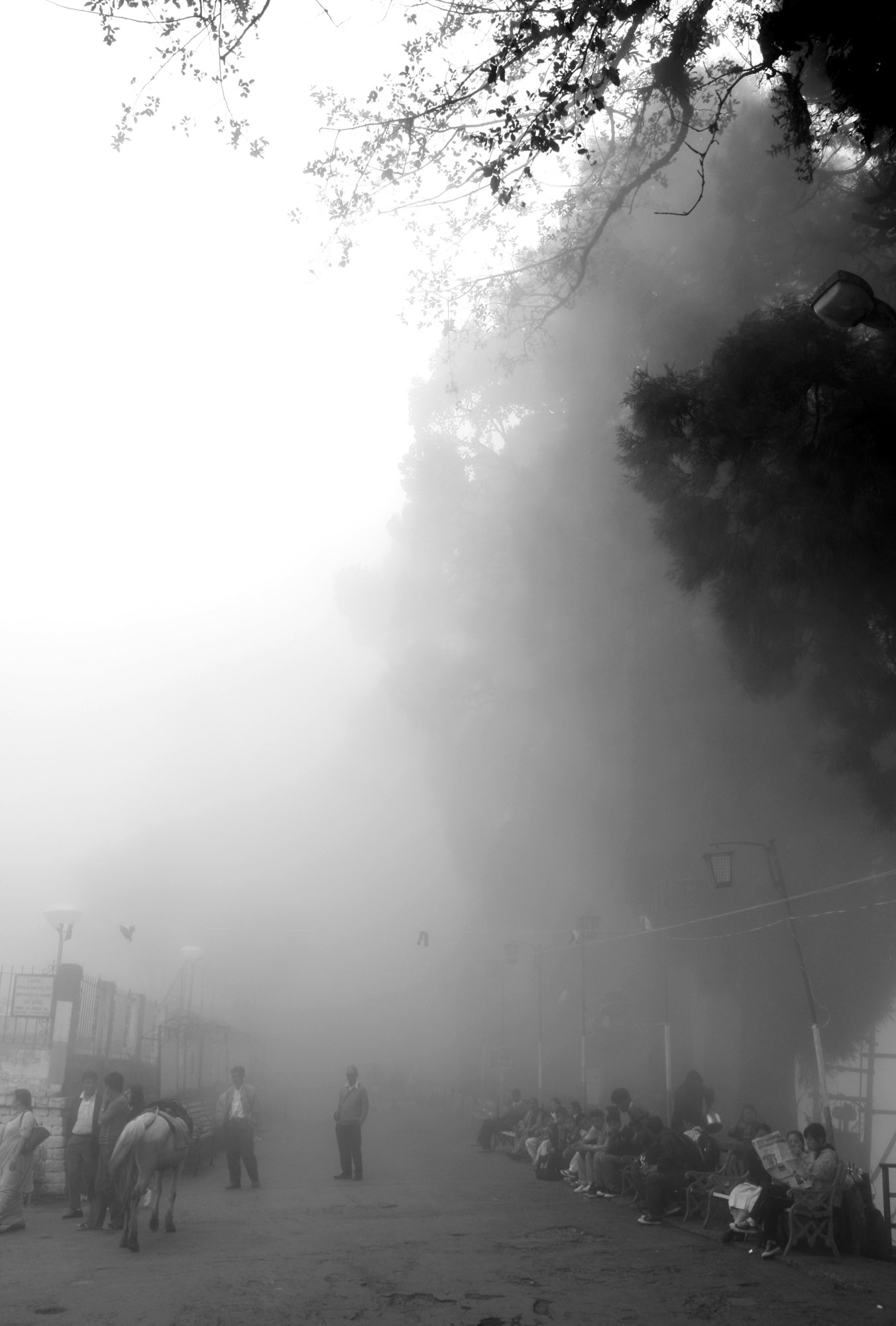
I hovered about for a while, feeling somewhat apprehensive. I wasn’t so much nervous as reluctant; not wanting to get involved in a misunderstanding that had the potential to turn sour. I watched the fellows for a while. They made very photogenic silhouettes in the fog and I took some photos whilst observing them. Many Indians come to Darjeeling when the weather heats up and this year was already particularly hot. In recent days Delhi had seen the temperature sore to fifty centigrade. The holidaying families were very distinct amongst the Ghorka, Nepali and Tibetan community. Several lucky children were being treated to rides.

I edged closer to the unengaged horsemen, wondering how much English they might speak. Would it be too confusing to begin with “I was told…?”

I tried to see their eyes. Who looked the most wasted? Fortunately, the first one I approached – a short, curly-haired man with a dark brown pony in tow – looked completely and utterly stoned. The whites of his eyes were the colour of lightly-flavoured chocolate milk and his pupils were hardly to be seen. I nodded to him and had his attention.

“I heard that if I wanted bhang, I should talk to the horsemen.”

The man said nothing, but examined me closely.

“I want to get some bhang, some grass… I was told to speak to the horsemen.”

He continued to look at me, clearly totally oblivious to my cryptic remarks. I knew I had to word things more simply, but was nervous and verbose.

“Marijuana,” I said.

“Marijuana?” said he. “Marijuana, three thousand.”

“Three thousand? No, no, not that much. Less.”

“Three thousand.”

“No, less.”

“Ten grams.”

“Smaller, smaller.”

“Ten grams, one thousand.”

“Ten grams, one thousand? Deal.”

Considering that twenty-five bucks usually bought one gram in Sydney, it seemed a pretty decent deal.

The pony-man gave me a big, slow, stoned smile.

“You go here.”

He pointed down the street that ran from the southern end of Chowrasta. “Down here. I talk to boss.”

With that, he was off, suddenly energised, with a distinct and unexpected spring in his step. I felt quite pleased with myself and couldn’t help smiling. I was going to get baked after all! I drifted down the side road as instructed and lifted the camera to my face, returning to my disguise as a regular tourist.

The side road was especially misty and it was clearly a good place in which to make a deal. There were some local carriers resting with their loads underneath one of the tall cedars, and I walked down past these, stopped and turned back to face the town. I reached into my bag to find my wallet and got the money ready in my hand then took a few photographs of the shapes in the mist.

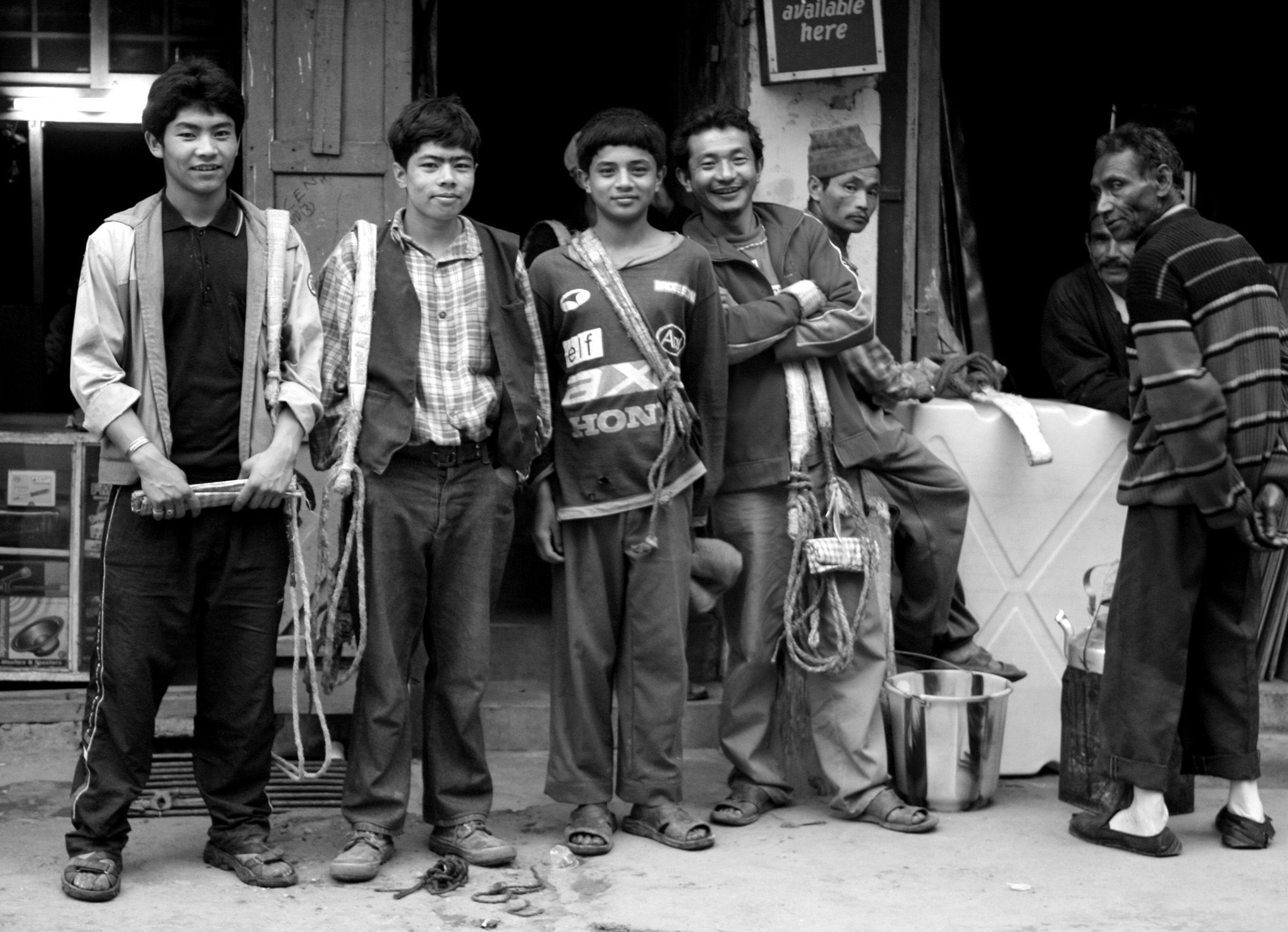
The carriers picked up their loads, slowly rising, a little stiff. They walked bent forward, stepping like giants, their parcels supported by ropes around their foreheads. How strong their necks must be! When the carriers disappeared from sight, I heard the rapid clop of galloping hooves. Through the swirling mist, the shape of the mountain pony-man appeared, a mere ghost at first, but soon he burst through and materialised in front of me. He pulled up his reins and brought the horse to an abrupt and dancing halt. He had a broad smile on his face and seemed to spring in tune with his mount on the saddle. I knew instantly that he was profiting handsomely from this and figured I should be paying about five hundred, as my informer had done. Still, it was a mutual happiness, as we were both about to make each other’s day.

He guided his horse until he stood right next to me.

“Here,” he said. He reaching down, holding a plastic bag tied with a rubber band. I held up the thousand rupees and took the weed from him. It was a large bundle. Light, springy, and leafy, I suspected, but certainly copious. Finding out whether or not it was actually weed would have to wait.

“Thank you very much!”

I shoved the weed quickly into my pocket and offered the pony man a salute. He said nothing, merely smiling and nodding, then wheeled his horse and rode off into the oblivion of the fog.

I walked away quickly, firstly away from the square, feeling an urgent need to get away from the scene of the crime. A moment later, I gathered my wits and turned around, heading back towards Chowrasta. The time had come to buy some papers and get on with it. I began a determined march back to my hotel room. Why wait after all?

Read Full Post »

Had I known what the weather would be like for the next eight days, I might have acted more promptly. I had come to Darjeeling not only to see the marvellous hill-town, but also for its famous views of the Himalayas. It never occurred to me that seeing them would prove so difficult.

The first morning I awoke in Darjeeling the horizon was shrouded in a veil of haze. The room was cold with the seeping air outside and for the first time since arriving in India, I nestled under the blankets, feeling deliciously comfortable. The last two days had been exhausting days of travel – from Rishikesh to Delhi, across to Siliguri courtesy of Kingfisher Air, then up to Darjeeling by jeep – and I was happy to take it easy. I sat on my bed and snacked on biscuits, reading about the town.

Darjeeling had only come into prominence in the second quarter of the nineteenth century. The locale first came to the attention of the British East India Company (BEIC) in 1828, when a delegation of company officials stayed in the town and realised how suitable the site would be for a military sanatorium. In 1835, the company leased the area west of the Mahananda River from the Chogyal of Sikkim, traditional rulers of the region. Over the next fifteen years, the population of Darjeeling grew one-hundredfold, thanks to the company’s policy of attracting workers to the region, mostly of Nepalese origin.

When, in 1849, the British East India Company Director Arthur Campbell was imprisoned by the Sikkim Chogyal, the BEIC sent a force to free him, resulting in the annexation of 1700 square kilometres of territory. In the following decades, the BEIC strengthened its grip on the region, gaining control of the passes through the hills, the town of Kalimpong and the area east of the Teesta river, from the Sikkim. In 1864 the town became the official summer capital of the Bengal presidency and by 1866 the district had assumed its current shape and size.

Commercial tea cultivation began in the region in the 1850s and many schools were set up by missionaries. In 1881 the Darjeeling Himalayan Railway was opened, connecting the town with the plains far below and further increasing the pace of the town’s development.

When, after independence in 1947, Darjeeling was merged with West Bengal, tensions began to increase between the largely Nepalese population of the hill towns of Darjeeling, Kurseong and Kalimpong, and the Bengali population of the plains below. The Nepalese population agitated for an autonomous state and the recognition of the Nepali language as the official language of the region. The latter request was granted in 1961. When, in 1975, Sikkim was recognised as an independent state, it again brought calls from the people of the mountains for a separate state of Gorkhaland, with occasional eruptions of violence. In 1988 an agreement between the government and the Gorkha National Liberation Front resulted in the creation of the Darjeeling Hill Council. This, however, did not quell calls for a separate state, and agitation and protest continue to this day. In 2011 the government granted further concessions, with the creation of a new and autonomous elected body called the Gorkhaland Territorial Administration, which, whilst not governing a separate state, has more powers than its predecessor.

I found myself quite fascinated by the town’s history and was keen to explore further. Not only did Darjeeling offer exciting views, amazing geography, fascinating architecture, great tea and an interesting ethnic blend, but, perhaps most importantly, the large Nepali population guaranteed one thing: momos – and I love eating good momos.

At half past nine I found the housekeeper in the corridor outside my room. As soon as she saw me, she said:

“Your room is ready.”

“Great. Can I move now?”

“Yes, yes. Come, I’ll show you. It’s here.”

The room was diagonally opposite, across the hall – a mere ten feet away. She opened the door and presented it to me. It was smaller than the previous room, but with a double bed, coffee table and chairs, wall-mounted television, a bedside dresser and a stunning, wide-angle view of the drop into the valley below and across the foothills. At four hundred rupees, a mere ten dollars Australian, it also came with a large en suite. I stood by the windows and thought of the views I might expect when the sky cleared. For now, the horizon was covered in cloud and haze, and I could barely see into the floor of the valley below. The mist rested like hands upon the hilltops, fingers stretching down the wooded slopes.

It took two minutes to shift my few belongings and, at ten o’clock I set off in search of breakfast.

I followed the road down the hill, past the little restaurant and shop in which I’d dined the night before. After a steep and winding leg the street levelled out at what appeared to be another informal jeep-stop. Here the road split into two tiers and, at this junction of climbing streets, stood a triangular building with a rounded prow: Keventer’s restaurant. I’d seen the name in the guide book and knew it to be rather famous, as a shop, in the downstairs section, but primarily for its café / restaurant upstairs. What made this Raj-era throwback popular, apart from its relative antiquity, was the amount of meat on its menu.

Since arriving in India, I hadn’t eaten any meat whatsoever – this despite ordering a mutton biriani in Rajasthan, which contained two large pieces of gristle that I promptly discarded. Here at Keventer’s they offered a variety of meat products, almost all made from chicken and pork: meatballs, sausages, bacon and the like. I sat right near the kitchen – a counter behind which men cooked methodically – in the run-down old interior. Around the walls hung pictures of the views across to the mountains, which only served to whet my appetite for the peaks I’d come to see.

I ordered pork meatballs and bacon and eggs, drawn wholly in by the old world atmosphere. The view offered a splendid fore and mid-ground of rusted, corrugated rooves and wonky wooden frames stacked down the forested hillsides.

The coffee was not great, but passable, and I soon fell to chatting with two young Indian guys; students up from Calcutta. They were friendly and charming and curious about the photos I ’d been taking. After a while they invited me to drinks that evening, and I said I’d certainly consider it, though I knew somehow that I wouldn’t go and felt an early regret at this. Having spent most days walking and taking photographs through the daylight hours, I was almost always too tired to be sociable at the end of the day. I was also enjoying staying completely off the booze on this journey.

After breakfast, I took a long walk around town; down to the bottom of the town, where I’d arrived the night before.

I wandered through the back streets, up and down long flights of steps; found a lane with closely packed stalls behind which men and women worked with old Singer sewing machines. I shook hands with locals, answered their friendly inquiries as to where I was from, and eventually wandered into the meat market. There, in this dirty old shed hung with carcasses, I chatted with several of the butchers and asked them about their work.

One man approached me and said:

“Come with me. I’ll show you how I make mince.”

He led me to a corner of the shed, where, on a heavy, round wooden chopping block, using only a machete, he threw down pieces of meat and hacked them into mince with swift, strong blows.

“How long have you been doing this for?” I asked; a little squeamish from the proximity of his fingers to the blade.

“For twenty years,” he replied. “I am the mince man!”

I watched him hack away at the mince for a couple of minutes; lifting the blade just a short distance and bringing it down with surprising force and accuracy. I took out my video camera to film his impressive action, and it wasn’t long before he had turned the large chunks of fatty meat into finely chopped mince.

“There,” he said. “Mince.”

“Bravo!”

I thanked him for showing me his trade and farewelled him.

I continued my wandering about town, plunging into the tight alleyways of shops and stalls. As with so many places in Asia, the businesses tended to group together according to what they sold: spices, shoes, tea, vegetables. I drifted in and out of the lanes, taking photographs here and there. Most people were friendly and generous with their smiles. Unlike other places I’d been in India, rather than trying to sell me things, they seemed merely to want to be acknowledged.

I took a walk around the circuit of Observatory Hill, then returned to Chowrasta, the main piazza at the top of the town. The horizon remained shrouded and I could see only the foothills. These, however, were beautiful in the dull light; wet and fecund, cool and, here and there, dressed with tea.

Three o’clock found me sitting in another Raj-era café, Glenary’s bakery and restaurant, situated just a little up the hill from Keventer’s. The pale mint walls, white wooden beams, wicker chairs and corrugated iron roof gave it a classically colonial appearance. I sat in the back section, like a wide, closed-in verandah, where a bay of windows faced the valley and the still-obscured mountains. I surfed the internet, ate pastries and drank two rather disappointing cups of tea. As the afternoon had progressed, the air had become increasingly damp with pending fog, until finally, at around a quarter past three, it began to rain.

Having been in India a month during the dry season and having seen no rain for some time, the idea of rain had hardly occurred to me. Perhaps some uprush of humid air from the Sundarbarns had met with the chill mountain breath and dropped its bucket, but whatever the case, once the rain began, it came down hard as hell. It poured for two hours, with little let up, striking hard on the iron roof. It was as beautiful as it was surprising, and for a long while I sat and watched figures darting through the wet below, with torrents in the gutters and cascades from the rooves. The pigeons opposite, huddled under the eaves, were positively ruffled on their multi-generational pile of droppings.

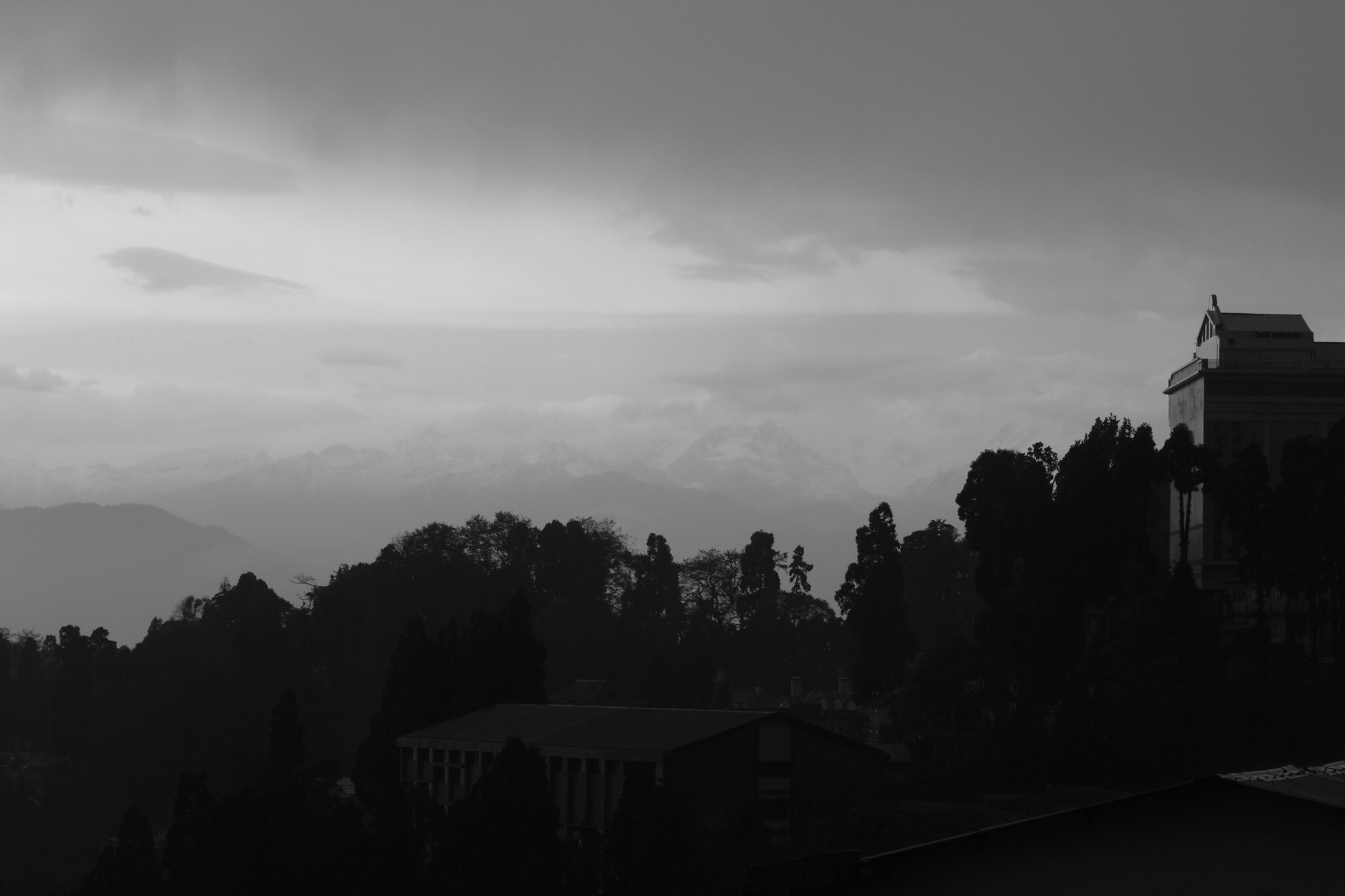
When the rain did finally stop, something extraordinary happened. I was sitting, face pressed close to the glass, watching the play of mist and light across the valley, when suddenly the clouds parted and opened a clear view to the horizon. All the haze had been washed from the sky, which was transformed to a pale blue, dotted with cotton wool clouds. I tried to shoot through the window but the curve of the hill blocked the bulk of the view. I wanted a clear line of sight, for I was dying to see Mount Kangchenjunga, the third highest peak in the world at nearly 8600 metres tall.

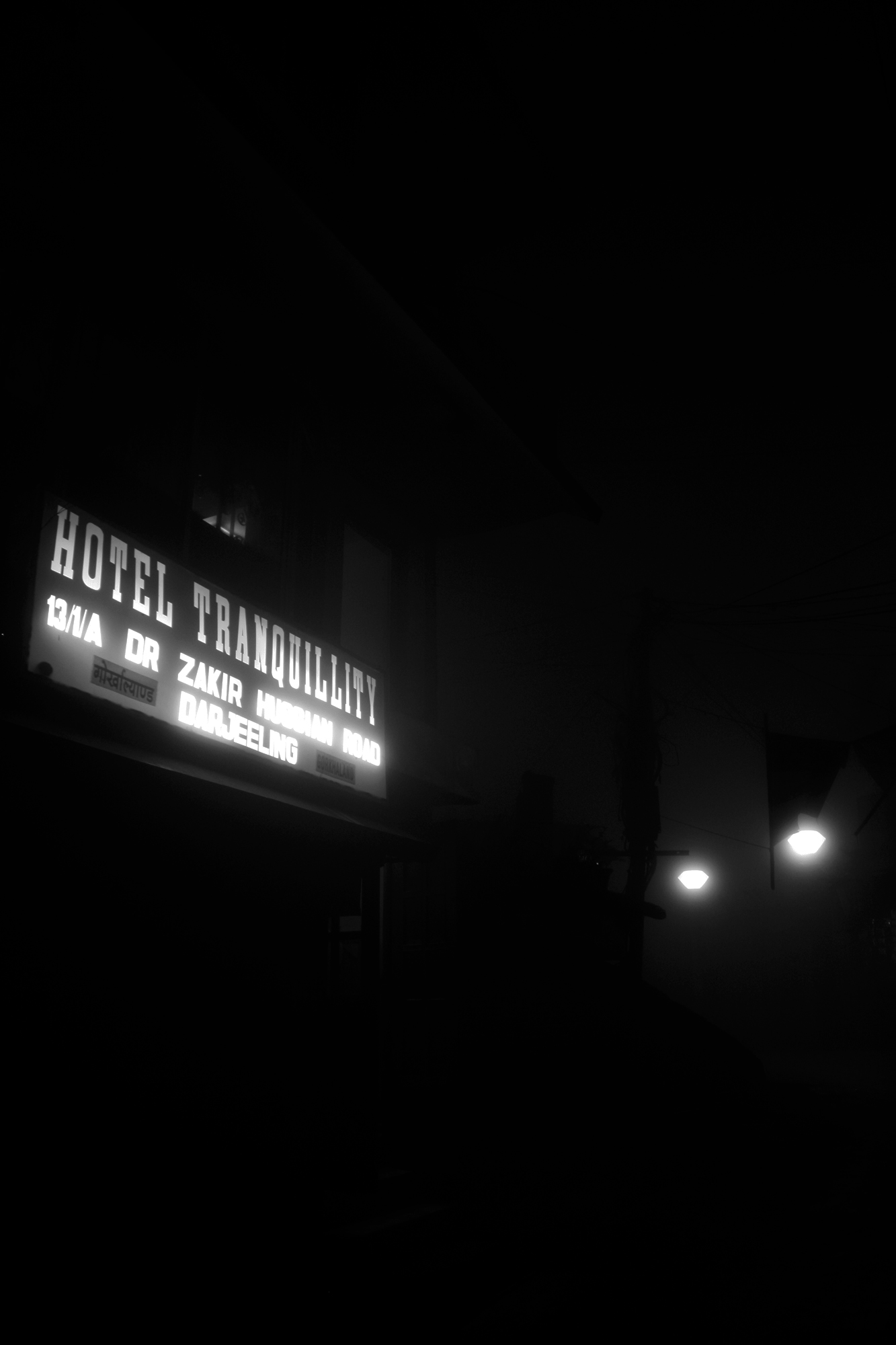
I stood up, stuffed my lap top into my bag, sorted myself out and hurried off. It was still drizzling a little, and, worried about my camera, instead of going straight to find a vantage point, I decided to head back to the Hotel Tranquillity (sic) to pick up the small but sturdy umbrella I’d packed in a moment of boy-scout foresight. I raced back to the hotel, which took a good ten minutes, grabbed my umbrella and was about to head off, when I heard voices from the roof, just up the next flight from my room. I walked up the stairs where a door opened out on a flat concrete roof, flooded with rain. Here I found Tenzing, the hotel’s owner, talking with two other guests.

“Hello!” said Tenzing. “Come to see the mountains?”

“I hope so!”

The two other guests were also Australian and we smiled and nodded at each other. Their attention, however, as mine was soon to be, was rooted in the distance. And there, sure enough, was Mount Kangchenjunga. I gasped when first I saw it, amazed by its sheer size. How high up it seemed to go into the sky. It had an unnatural quality to it, as though its extension from the Earth was somehow impossible. How could anything be so big? The towering peaks of stone and snow were nothing short of fantastical. The only problem was that much of the view was blocked by an inconveniently placed radio antenna, a hill and trees. I could see roughly half of the mountain, and that through a tilting of the head and shifting of angles.

I looked as well as I could, but the lack of a clear line of sight was simply too frustrating. I needed a new vantage point, for now clearly was the time to go shoot the mountain. I took a few snaps, made some cheery remarks, then fled down the stairs and out onto Dr Zakir Hussain Street, figuring I should make for the road that circumnavigated Observatory Hill. I scurried down the street towards Chowrasta, past all the stalls, butchers, fishmongers, bakers, fruit and vegetable sellers, chicken and egg sellers; many of them seated up on the boards of their wooden stalls.

When I reached Chowrasta, however, I could see already that I was too late. The sky in the distance was thickening again with white mist and soon everything would be hidden. I broke into a run, down along the side of this hill with its famous monastery and tall Japanese cedars. Yet, by the time I reached the far end of the road, the mountains had once again vanished behind haze and cloud. I stood cursing, deeply regretting having gone back to get my umbrella, and shook a fist at the sky. I wasn’t sure quite how long I was planning to stay in Darjeeling, but figured that some time in the next couple of days I ought to see clear skies. The rain began to come down again and I popped up my umbrella. Stuff it, I thought, there’s always tomorrow.

Read Full Post »

When I stepped down from the back of the jeep in Darjeeling, I found myself in the middle of an intersection. This was no formal station, just a central location which the streets attended from what seemed to be unplanned angles. The lights were a very dim orange, barely illuminating the shuttered and shabby shop-fronts and the greasy road.

It was half-past eight in the evening and I was pleased to be on my feet again. The prolonged journey up the mountain had been very beautiful, but being two and a half hours behind schedule, I was concerned that my room might not still be available at the Hotel Tranquillity (sic).

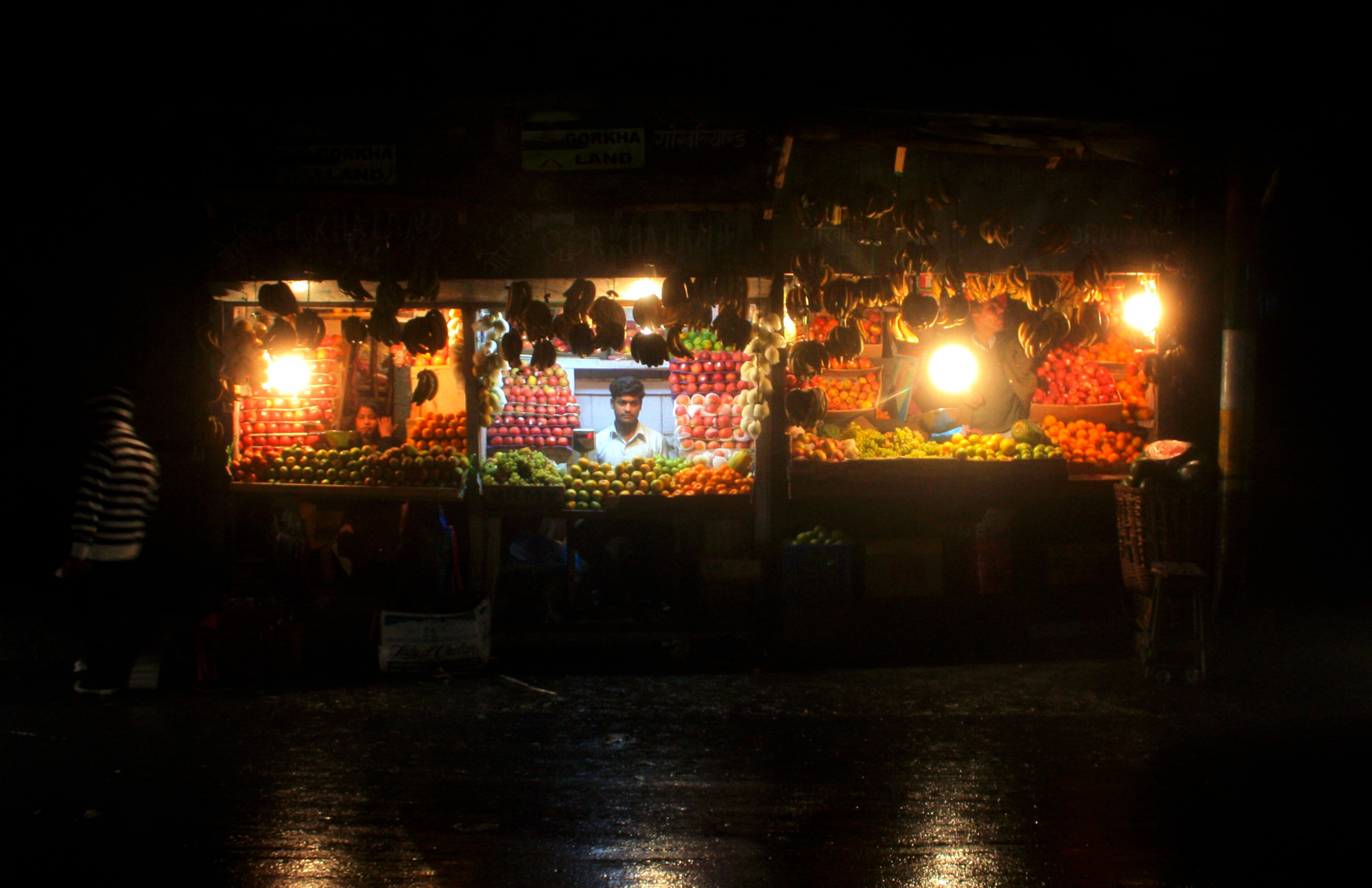
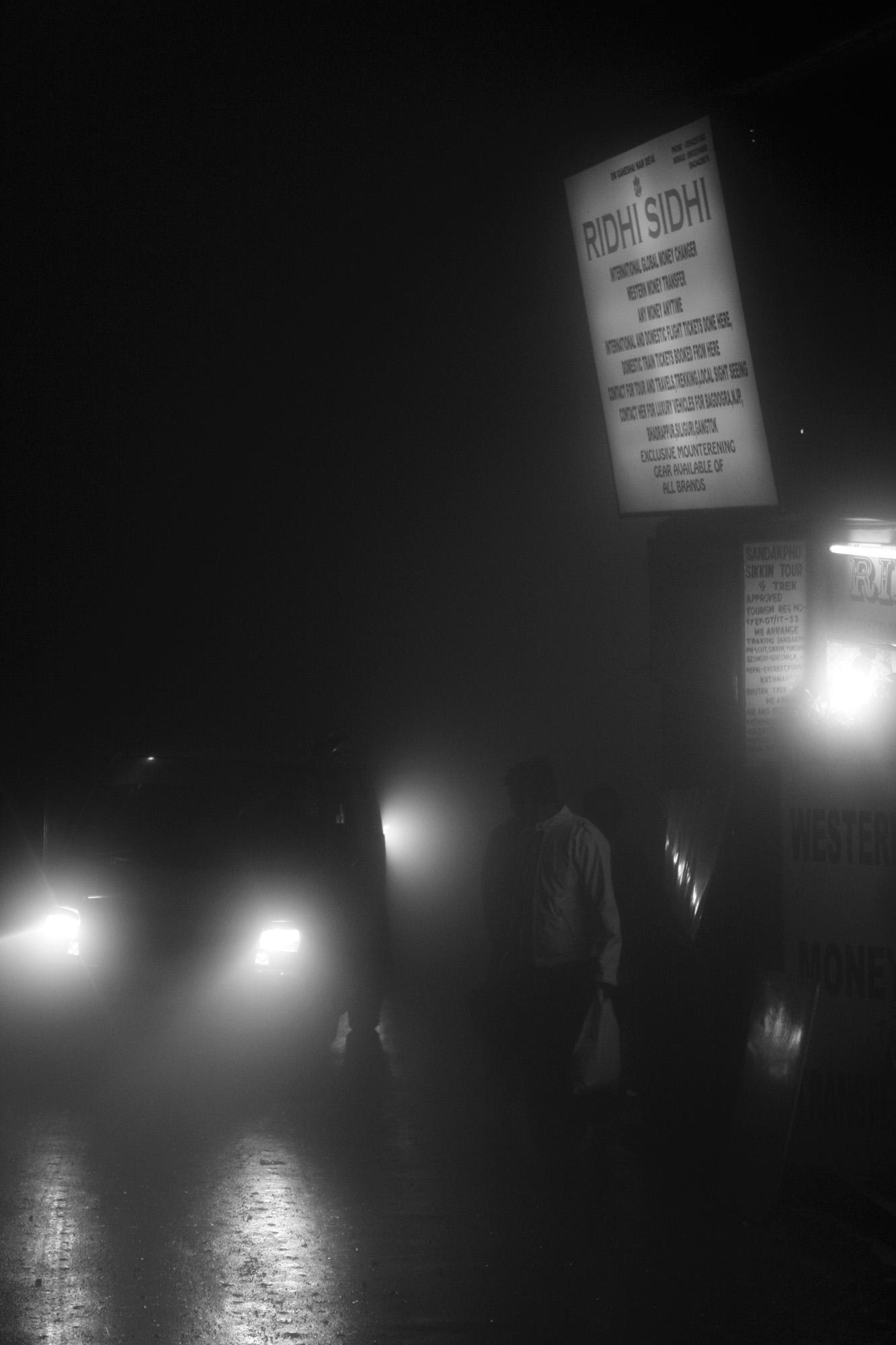
Overhead hung countless lines of multi-coloured triangular flags; the green orange and white of India barely discernible in the sapping light. I turned a slow circle to take it all in. There were a few stalls lit by kerosene lamps and tapers in bottles; on one a steaming wok in which noodles were tossed, the cook’s face visible in flashes of fire. On one side of the road two wide-fronted fruit and vegetable shops remained open; shallow holes in the wall, the wares bathed in low-wattage lamplight, each tended by a patient, smiling man. The air was damp and a thin fog lurked above the corrugated iron roofs, threatening to descend as the day’s last warmth was leeched into the night. It was comparatively chilly after the stifling humidity of lower altitudes, but the close air and absent breeze kept me from shivering. Cars and jeeps rolled slowly out of shadow, their headlights blinding in the mist.

I looked around for street signs; any indication of where I was and where I needed to go. The light was so poor, I had to take the small bicycle light from my pack to read my inadequate guidebook map. There was no signage anywhere, and rather than finding out where I was, it made more sense to ask after my destination. I approached one of the fruit sellers to enquire where Dr Zakir Hussain Street was. The man spoke just enough English to tell me it was up the hill.

“Up, up,” he said, waving vaguely down the street to my right. “Go up the stairs. Then go up more.”

He was struggling to articulate exactly where to go and I rightly guessed it was because the town sprawled up the hill and the streets wound back and forth on lines that followed the natural contours.

I thanked him and walked away down the dark street. Had I not already been in India for a month, I might have found the darkness more forbidding. There were groups of dogs curled up against the closed shops and lone men shuffling through the night. The damp and weathering had rusted, blackened and warped almost everything, and nothing seemed new or recently renovated. It had, of course, a derelict charm which I appreciated, but having no knowledge of what this part of town or its inhabitants were like and, uncertain as to whether or not I was in any danger, I remained on my guard. I walked slowly, not knowing where I was going, and after a moment, felt bold enough to take out my video camera and film my journey.

Presently I rounded a corner whereon stood a late night chemist shop; illuminated with bright, white light, which shone across the narrow street. Three men stood out the front, chatting with the man behind the counter. I approached them and asked if they could tell me where Dr Zakir Hussain Street was. They pointed to a place directly opposite, where I now noticed a long, steep flight of steps that creeping up the hill between the tall, leaning buildings.

“Go up, up,” the man said, much as the other had done.

“Do you know the Hotel Tranquillity?” I asked.

“Yes, yes. It is up the hill. Go up the stairs. Then up again. Up to the top.”

Clearly, I had to go up! I took the stairs which cut a significant shortcut through the winding, contoured streets. About half-way up, as I walked filming with my camcorder in one hand, my thongs slipped on the wet stairs and I fell on my hands, just managing to avoid damaging my camera. I cursed and dusted myself off, feeling clumsy and stupid and pleased no one had witnessed me stumble. This, however, was as nothing to what greeted me at the top. I stepped out onto the road, and, in the near total darkness, put my foot into an open sewer, filled with a sucking muck. The muck was so grotesquely thick and clinging, that I had to reach down to extract my thong. My foot was covered in slime to above the ankle. I couldn’t bear to think what bacteria lurked in that drain, particularly as I had many cuts and cracks on my battered feet. I tried to wash it off with the last water from my bottle, but this was inadequate to the task, and the only other option that presented itself was to stick my foot into the water flowing down the street’s gutter. It was, at least, decidedly cleaner than the gunk I’d collected, but the whole experience left me with a deep feeling of disgust and I longed to reach my hotel to shower and soak my foot in the Dettol I carried for emergencies.

I pressed on up the hill, soon arriving at another intersection of zig-zagging streets. Cars pushed past and edged me onto the narrow pavement. The headlights lit up the rolling fog that was seeping down the slope.

I turned on my camera again and began to narrate as I walked, feeling a mix of discomfort and relief that I would soon be in a hotel room. Where the streets levelled out, I asked directions again from a man behind the wheel of a jeep. He pointed to the steep road leading up to my right and said, as all had done before, “Go up. To the top of the hill.”

It was some time before I reached the top of the hill. The street wound back and forth and grew ever steeper, stacked on either side with wooden houses and concrete apartments. It was so dark in places, I narrowly missed falling into a vast pot-hole. When I finally did reach the summit at a quarter past nine, I felt surprisingly short of breath. Even at an elevation of just over two thousand metres, the air felt thinner in my lungs. I paused beside a large satellite dish, backlit in pale orange light, a mere silhouette in the fog. On either side of the road were closed wooden stalls; booths that sold fruit and vegetables, snacks, cold drinks and cigarettes.

I was about to ask about the Hotel Tranquillity, when I saw its sign just ahead of me. The two ells were quaintly attractive, curiously welcoming, and I rubbed my hands together with glee.

The chap in reception was very tall indeed; around six foot five. He was a Ghorka man, with high and wide cheekbones and a strong jaw. I never caught his name and for the rest of my stay in the hotel, just thought of him as Tenzing. He stood behind a closed-in counter, rather like a toll-booth. The room around it had the aspect of a cheap European ski lodge, the décor of which had not been updated in years. If somewhat unattractive, it certainly felt very homely and the smile on the man behind the counter was reassuring indeed.

“We do have a room for you,” he said. “But it is a triple room. Three beds. There is a bathroom, of course, and tomorrow morning I can put you in a double. Also with a bathroom.”

“That sounds excellent.”

“How long would you like to stay.”

“I don’t know. I’ll say three nights for now.”

The room was only six hundred rupees, fifteen dollars Australian. Despite being more than I had recently been paying, it was ridiculously cheap. Towering Tenzing showed me up the stairs to a large, carpeted room with three single beds. Noticing how cold it was in the room, I chose the bed furthest from the window and threw down my bag. Tenzing showed me around and switched on the hot water.

“Do you have a restaurant here?” I asked.

“No, I’m sorry. Have you eaten?”

“Not at all.”

“Ah,” he said, in an oddly disconcerting manner. “Then you must hurry if you want to eat. In Darjeeling, everything shuts very early. You might not find a restaurant.”

“Oh dear. Thanks for telling me.”

As soon as he mentioned this I felt ravenously hungry and dreaded the idea of snacking on crisps and biscuits for dinner as I’d done once or twice when so caught.

“The front entrance will be closed at nine thirty. If you go out, you must come in through the back. There is a small door, up the driveway. It leads through the kitchen. The door will be closed, but you can open it. Just make sure you close it behind you.”

After a much-welcomed, but brief shower, I dressed again and went in search of a restaurant. I first stopped at the stalls and bought some crisps, fruit and biscuits, water and mango juice. If I did get caught short, I’d at least have something to eat.

I walked down the steep slope in the descending fog, determined to enter the first restaurant I found that was open. One hundred metres down, where the road turned in a hairpin, I found a small shop with a restaurant attached. The space inside was cramped and triangular, with wood board panelled walls that gave it a very dated look. The tarnished glass counter was full of packets of sweets and biscuits, of crisps and chewing tobacco, old toys and mobile phones. The old furniture – linoleum-topped tables with metal rims in which lurked ancient grease, attended by wooden benches – reminded me of the old diners and cafés of Sydney which seemed no longer to exist. I sat down and picked up a sticky menu, quietly loving this place for being so enticingly run down; honest, simple and, as was so often the case in India, unbelievably cheap. It felt like the past.

The menu was a little like Darjeeling in microcosm. The Indian staples were joined by Chinese, Nepalese and Tibetan dishes; momos, spicy soups, noodles. I ordered hot and sour soup, dhal with paratha and a bottle of Coke to cleanse the palate. The man who served me kept quietly busy, and when I placed my order, he disappeared through a curtain into what appeared to be his home. I caught a glimpse of his wife in the back room, standing before a stove. The dim sound of a television snuck through into the restaurant.

I took the chance to photograph the shop, particularly interested in a very old public phone upon a stand. Many times in India I had been reminded of my holidays to the Blue Mountains as a child. For, whereas Sydney had, even in the late 70s and early 80s, kept somewhat up to date, the small towns like Katoomba, Leura and Blackheath had always been well behind the times, both in style and facilities. My brother and I had found endless satisfaction in the relative cheapness and antiquity of things, and such was the case in much of India.

The food was not long in coming, and when I tasted it, I was surprised by how good it was. I felt briefly guilty for suspecting otherwise, but had often found restaurant food to be not as good as that of the street. My father had always said that the best sauce in the world is hunger sauce, so perhaps my ravenous appetite coloured my opinion. Either way, I felt very content when I farewelled the quiet man and left to walk back up the hill.

On arriving at the Hotel Tranquillity, again finding myself out of breath, I did as instructed and walked around the back of the hotel. The door opened into a tiny kitchen, and in it I encountered a lady whom I assumed might be Tenzing’s wife. She was sitting on a stool in an upright posture, resting it seemed, and enjoying the peace of the quiet and shrouded night. I nodded in greeting, grimacing a little to convey an apology for disturbing her. She gave me a big smile in return and gracefully motioned towards another door which led to the hotel stairwell.

Later, as I lay back on the bed with my feet soaking in a bucket of hot water and disinfectant, I found myself pondering how utterly different this place was from everywhere else I’d seen in India. The cool, the damp, the faces and architecture, and here, at the foot of my bed, several extra blankets neatly stored in clear, zip-up plastic bags. That I should feel cold at all, after a month of forty degree heat, was a clear sign that this was a whole other world altogether. Being one born to suffer greatly in hot weather, though less so in the dry than in the humidity, I was excited by the chill feeling and the cold, clinging damp. It reminded me of living in Cambridge and I felt a clear-headedness I’d not felt for some time.

Most of all, however, I was excited about what the next day would bring. For then I should see what I had come here to see. The Himalayas!

Read Full Post »

Dirk stepped out onto the broken street. The hotel was a furnace, and for once the air outside seemed cooler. Beneath his feet, the road surface had been stripped; a jumble of steel and plastic pipes ran along the narrow passage between the stacked hotels. The concrete buildings formed a canopy over the lane. The bright lights of shop-fronts, the signage and hanging bulbs, lit the place up like a bombed-out shopping mall.

Dirk turned left and stepped along the pipes onto Main Bazar, the central street of Paharganj. Here too the road was being re-surfaced, and even now, at eight in the evening, they were concreting a section of it just twenty metres away. All about was busy with human traffic; Indians mostly, but tourists as well, traipsing up and down through the open ground, pitted and full of mud.

Dirk had come to India with just a pair of thongs and he stepped carefully amidst the slush. The caps of manholes, sumps and drains protruded here and there as islands in the muck. Dirk stepped up onto a manhole and surveyed the scene. Just ten feet away was a man with a camp-stove and small wok; a pile of eggs beside him and a taper burning beside some loaves of bread.

He walked over to the man, who was dressed in a white smock with a round, peak-less white cap.

“Hello, sir! Omelette for you?”

“Yes, please,” said Dirk.

“How many eggs? One, two…?

“Two eggs, please.”

“No problem, sir. You want bread? Like sandwich?”

“Sure,” said Dirk. “Sounds great.”

“Chilli?”

“Sure.”

The man cracked two eggs into the wok, then threw in some chopped green chillies. Dirk stood waiting for the conversation that seemed inevitable, but, to his surprise, the man busied himself in the rising steam and said nothing. Thus freed, he turned back to the street and watched the scene. There was mayhem around a choke point, where rough barricades had been erected to block the traffic. In the lightning flash of welding sparks, a man was trying to squeeze his motorbike past a camel-cart, which had paused on the other side, unable to pass. The camel-driver backed the animal up, which coughed its displeasure and, after a couple of feet, stopped and stood working its jaws. Once the motorbike was through, the shadows shifted and people emerged from the pools of darkness about the shabby shopfronts, flowing through the gap. In their wake came a line of bicycles, the riders seated and stepping along the puddled road.

“Drink, sir? Lemonade, cola?”

The man had finished cooking and placed the omelette on a slice of white sandwich bread on a white, disposable plastic plate. The bread had been lightly fried. He covered it with another slice.

“Sure. I’ll take a Thumbs Up,” said Dirk. He had grown rather fond of India’s answer to Coke.

“Thirty rupees.”

Dirk took the money from his pocket and paid the man. His dinner cost less than a dollar. If he was still hungry, he’d buy another one later.

Dirk strode across to an empty doorway and stood on the step. With his back to the door, he ate and watched the procession of people along the street. The bread tasted lightly of smoke and charcoal, and the chillies were hot and flavoursome. He had arrived at his hotel only half an hour before and had not eaten since breakfast, yet the heat left him with only half an appetite.

Dirk finished his omelette and wiped his hands on his dirty shorts. Everything he wore had been repeatedly hand-washed with soap and shampoo in showers and sinks. Despite his best efforts, his tan shorts were stained with ingrained dirt and grease.

Dirk waited until the path was clear then walked past the road-block behind which men were toiling with shovels and mattocks. On the other side, the street opened out and was soon met by a cross-road. Coming towards him was a teenage boy pushing an iron-banded wooden cart, covered in what looked like biscuits. Dirk stepped one way, trying to get around him and the boy turned his cart in the same direction, accidentally blocking his path. They both laughed and Dirk stepped the other way, just as the boy swung the cart in the same direction, blocking him again. Now they both laughed aloud, and the boy said:

“Try my biscuits!”

“Maybe. What are they?”

The boy stopped and walked around to the side of his cart.

“Butter, nuts, very nice. It’s the local recipe!”

What nuts? wondered Dirk, but he wasn’t too fussed. The biscuits looked excellent; like rough-cut, round shortbreads, crumbly and greasy. His mouth watered as he thought of how buttery they looked.

“You like? Fifty rupees, one bag.”

“Okay, go on then.” The price seemed rather high for India, but it was still just over a dollar.

“You will love these biscuits very much, sir,” said the boy, who can’t have been much more than fourteen. He picked up a bunch with a wooden scoop and tipped them into a paper cone. Dirk got the money out and paid as soon as the bag was offered. The boy smiled so broadly that Dirk wondered what the regular price was. Still, at such prices, it was a win for them both.

A minute later, Dirk stood leaning against a telegraph pole, eating the biscuits. They were indeed good and he relished the buttery, nutty flavour. It tasted like macadamia, but he wasn’t sure whether macadamias were available in India. Eating the biscuits was as enjoyable as buying them had been. How often these things happened to him in India! He was less than a hundred metres from his hotel and already he’d been fed twice.

Further down, the street was lit by lights festooned with power cables, hanging at various heights. Everything seemed so slapdash and unfinished; beneath the wires and lights surged a crowd of the urgent and enterprising poor. Dirk stood and marvelled, until a young man walked directly towards him, raising his index finger to get Dirk’s attention.

“Hello sir, how are you?”

He didn’t wait for Dirk to answer.

“Can I help you? I can get you hashish, marijuana. You want to smoke charras? I can help you.”

“Maybe,” said Dirk. “What exactly have you got?”

The young man looked different to most of the locals. His features were more Asiatic, like the people Dirk had seen in the foot hills of the Himalayas. He was dressed in jeans, overly busy with buttons and embroidery, and a simple black tee-shirt. He didn’t look dirt poor, but nor did he seem exactly wealthy.

“Which do you prefer? Marijuana or hashish?”

“I’d prefer marijuana,” said Dirk. He liked the way this man was straight down to business. “If you have it.”

“I have it!” said the man, excited.

“I want only five hundred rupees.”

“Okay, okay. You get what you pay, no problem sir. You want more, pay more, want less, pay less. Which country, sir?”

“I’m from Australia. Where are you from?”

“India, of course!”

“But where in India? You’re not from Delhi, are you?”

“No, I’m from West Bengal. From the north, in the mountains. Near Darjeeling.”

“Darjeeling!” said Dirk. “My favourite place!”

“Yes? You like Darjeeling?”

The young man was clearly excited.

“Yes, I’ve just come from there. I stayed ten days.”

“That is great, sir, great.”

Dirk stuffed the bag of biscuits into the thigh pocket on his shorts and adjusted the camera on his shoulder. The young man read the signs and motioned for Dirk to follow him.

“Come with me. Here, sir, this way.”

Dirk followed the young man into a narrow back lane. He was wary of what might happen once he got there, but he also knew such deals could not be done on the busy street. He was a strong man with a large upper body, and he made sure his arms were ready, like a probing wrestler. So far he had managed to avoid any genuine hassle on his travels, and he liked to think this was in part because he looked capable of handling himself. He was certainly better built than most of the locals, though he didn’t doubt their wiry strength. He had once worked in a pub with a man much thinner than he, who could lift a full keg to chest height.

“Here, take this,” said the young man, holding out a bony hand. Dirk opened his palm and a cluster of tightly-compressed, dry buds were placed into it.

“Thank you.”

“No problem, sir. You will enjoy it! Very nice smoke, very sweet high.”

“Excellent.”

Dirk closed his hand tightly then reached into his pocket to produce the five hundred rupees. He passed the note to the young man, then took another note from his pocket and wrapped the marijuana in it. Another day in India, another deal. He began to laugh and the young man gave him a curious look, standing there amidst the trash and dinginess.

“Good joke, eh?” the young man asked.

“No. Yes. It’s just India,” said Dirk.

“You like India?”

“Man, I love India. But it’s crazy.”

He reached into his pocket again. “Here,” he said. “Take this.” He took out a one hundred rupee note and handed it to the young man. “Thanks for your help.”

“Thank you very much, sir! Thank you.”

“No worries. You’re a champion.”

They walked back out onto Main Bazar, both of them smiling. Dirk wondered as he did about everyone he met in India, how this young man’s life would turn out. Would it be ceaseless toil and poverty, would he wind up in prison, or would he get a lucky start and crack into the new middle class? It seemed unlikely somehow, but then, what did Dirk know of this man’s abilities? Perhaps he already was middle class.

“Good luck,” said the young man, as they reached the milling chaos of the busy road.

“You too,” said Dirk. “Take care.”

They shook hands, beaming at each other. Just now, things were going well for the both of them.

“See you later!”

The young man walked off into the crowd and was soon gone from sight. Dirk stepped across the mud to another manhole island in the stripped, dirt road. He surveyed the scene a while, then took his camera from his shoulder and began to line up shots. Part of him was inclined to return to the hotel and get baked, but he also knew that this street was a potential goldmine with its characters and curiosities. A long continuity of heads and shoulders bobbed beneath the dark mess of wires and dim street lights. The low light made it difficult to capture anything in a brief exposure, and Dirk struggled to hold the camera firm and steady, opening it up for a second or more each shot.

He stepped off the manhole and slowly walked further down the street. He soon reached another crossroad, on the other side of which the street was paved and busy with traffic. Dirk stepped up onto the pavement and leaned against a pole. He placed his camera against the metal and pressed hard to stabilise it. The people, auto-rickshaws, cars, carts, cows and camels that filled the long, wider street before him, offered a shifting collection of silhouettes.

Dirk became so engrossed in concentrating on his photographs that he didn’t at first notice the high, thin voice that was attempting to address him.

“Hello, sir. Hello, sir.”

Dirk heard the voice now and inwardly groaned. He had barely made it two hundred metres down the street and it had taken him forty minutes. Now another person wanted his attention. Despite the pleasure of his last three encounters, he wanted to focus on photographs. Would he ever be left alone? He was determined to see this one off as quickly as possible.

“Hello, sir, can you help me?”

Dirk lowered his camera and turned to his right. Standing before him, with a look of anxious concern on his face, was a terrifically thin young man. Dirk was so astonished by his appearance that he blinked and looked again. The young man was mere skin stretched taut over a skeleton. He was dark-skinned, yet somehow pale, almost white, his arms and legs covered with dry dust. His clothes were threadbare, but clean, and hung from him like they might from a clothes-horse.

“Can you help me, sir? Can you buy me some food?”

“Sure,” said Dirk. “Here,” he reached into his pocket to take some money out, and the young man began shaking his head.

“No, please, sir. No money, no money. Please come with me, please can you buy me the food?”

“You don’t want money?”

“No, no money, thank you. Please, it’s not far.”

Dirk had encountered this before in McLeod Ganj, when a young boy had become enraged after he handed him 100 rupees, a decent sum. At that time Dirk had been hurrying back to his hotel and needed the toilet. He was surprised and annoyed by the boy’s reaction, though he was equally mystified and by no means unsympathetic. Why didn’t they want the money? Would the shopkeepers not sell to them? Would no one sell to them? Was it a caste taboo? Could every shopkeeper be intimately aware of the caste of every urchin in the town? There must have been somewhere for them to go. He thought again. How else would caste work if people didn’t make it their business to know what caste other people were? It still seemed incomprehensible to him; the scale of it, the antiquity of it. Was caste still so prevalent in modern India, in Delhi? It struck him how hopelessly ignorant he was of all this.

Shocked by the emaciated appearance of the young man, and not wanting to disappoint him, Dirk was determined to help. He felt a very sudden and overwhelming sense of responsibility and wanted to do more than just buy him some food, yet he had no idea where to start. His thinness was alarming, like the wrecked bodies of the holocaust; huge sorrowful eyes, peering from an oversized head atop a tiny neck. He had an almost alien air, like those depictions of visitors from other worlds.

The young man began to walk and Dirk walked with him.

“It’s not far, sir, not far.”

“It’s okay,” said Dirk. “I’ll buy you some food, no worries.” He could see how anxious the young man was that he not change his mind, and Dirk wanted to reassure him. Indeed, he could feel the horror of anxiety that filled this boy’s whole life. If he could, just for a moment, save him from this draining, sapping worry, he would be doing something real, something substantial.

“Not much,” said the boy. “Just some chapati, some dahl, some lassi. Please, sir, also one lassi for my brother.”

“Of course,” said Dirk. “Of course. Just tell me what you want, you can have it.”

They stepped along the broken street, over the puddles and mounds of mud and gravel, heading in the direction of Dirk’s hotel. They walked around the barriers where the men were concreting, ducking under the hanging wires of the arc-lights. The young man walked with the lanky gait of a spider. His stick-thin legs stretched ahead like feelers, and his body seemed to pitch forward, as though his upper body had its own momentum. He glanced continually at Dirk, eyes full of guidance, like a man leading an animal or a child, making sure it did not stray.

Dirk was brimming with questions. He wanted to ask about the boy’s life, to know about his circumstances, his privations, yet he had no idea where to start. He remembered hearing a prostitute complain about how men always asked why they did what they did; showing a pathetic sympathy, which perhaps disguised a lurid curiosity. “I hate it when they ask,” she had said. “Are they trying to make me feel ashamed? Are they trying to make me feel like a victim?” Dirk wondered if they boy wanted to tell his story; he also wondered if the boy would tell the truth. He wanted to know the truth, but how could he ever be sure? Even if the boy lied to him, was there any doubting his thinness, his horrid emaciation? What could have made him so thin? Was it simply hunger, or was there something worse, something terminal? He pondered all this, half losing himself in the careful placement of his feet.

“Here,” said the boy, as they arrived at a counter selling hot foodstuffs. “This place.”

“What do you want?” asked Dirk.

The man standing behind the blackened bricks and boiling pots of the roadside kitchen smiled at Dirk, and before Dirk could say hello, the boy began to rattle off his order.

“Four chapatti, dahl, two lassi.”

Dirk, watched him smiling. “Whatever you want, just order.”

But the boy’s order remained modest.

“It’s enough, for me and my brother.”

Dirk thought of his own brother; how they loved and hated and loved each other as children. He felt a great welling of emotion in his heart at this boy’s fraternal care. On very few occasions had he or his brother ever found themselves wanting; not for anything they needed; food, shelter, love, warmth. When his older brother had stood up for him as a child, Dirk had felt a loving admiration and deep trust that only family could engender. It was sweet that this boy cared so much for his brother, but Dirk wanted them to have plenty.

“Are you sure you don’t want anything else? You can order, go ahead. It’s no problem.”

“No, it is enough. Thank you.”

“What about some money? Would some money help? You could buy something for your brother. Really, it’s nothing to me.”

“No, thank you,” said the boy. “No money.”

The man behind the pots handed over the food. The lassi were in clear plastic bags, like prize goldfish. The young man took the food and smiled at Dirk.

“Thank you again,” he said. “You are very kind.”

“Okay, sure,” said Dirk. “But won’t you take some money?”

The young man shook his head and began to walk off. He was smiling and, apparently, greatly relieved. The relief in his face choked Dirk right up.

“Thank you, and good luck,” he said, rather quietly, his voice catching. The young man turned and his pale face flashed a moment in the crowd, like one of Caravaggio’s urchins. Then he was gone.

Dirk felt as though he had dropped a coin into a well, not for luck, but in the hope of one day filling it. His heart was fit to burst with the hunger to help; an appetite for altruism that surprised him. Perhaps, however, one must be very select in this business; unable to give to everyone, it made more sense to give something significant to one person.

This young man had indeed moved him. He stood on the pavement on tiptoe and looked through the crowd, trying to catch another glimpse of him. He was tempted to try to follow the boy, as much out of curiosity as anything else. Perhaps he could do something, if there was an address, a family, he might be able to help them further; even once back in Australia. Yet, the boy had vanished into the stream of people on the dark street and his fate was entirely his own.

Dirk turned back towards his hotel, eager to photograph and remember, to smoke and, perhaps, to forget.

Read Full Post »

It was late afternoon when I climbed into the back of the jeep in Siliguri, having paid a mere 92 rupees ($2.25 Australian) for my seat. After settling in and stretching my legs on the surprisingly comfortable bench, I was soon forced to shuffle over to make room for someone else. It seemed that, in fact, 92 rupees bought only half a seat. This was going to be a fun ride.

I had flown into Bagdogra airport that afternoon, one of the few destinations in West Bengal for  budget airlines. The flight was stunning. Heading east from Delhi, the plane’s path tracked the line of the Himalayas, bathed as they were in bright sunshine; below, the yellow dust and fecund green of the great Gangetic plain lay dry, flat and ancient.

From Bagdogra, I had taken an autorickshaw into Siliguri – the nearest major town, situated roughly twenty minutes away. The drive took me past tea plantations and the roadside workshops of countless cottage industries; carpenters, woodcutters, masons, banana sellers. It was a lush and moist landscape; a welcome sight after the dusty dryness of Rajasthan and the baking heat of Delhi.

It took roughly half an hour for the jeep to fill and we set off immediately afterwards; around four in the afternoon. There were thirteen people inside: four across the front seat, four in the middle, including a pedigree Pekinese called Nora, and four huddled into the back with me. They were an interesting mix of Bengalis, Gorkhas and assorted other ethnicities. Already, just waiting around in Siliguri, I had noticed quite a number of people with very Asiatic features; some passably Chinese and others who struck me as ethnically Nepalese or Tibetan. A young Gorkha couple sat opposite me, the lady wearing a gorgeous bright blue sari, and something told me they were newlyweds. They had an air of amorous conspiracy that made one want to wish them well. I sat quietly in the back, smiling and nodding to everyone, then got on with listening to my iPod and shooting video through the open window.

After half an hour driving through a forest flashing with sunset, we reached the foothills of the Himalayan mountains. The road narrowed and began to wind, and very rapidly, the landscape changed in character. The dry, bright green and yellow-leaved forest had been cleared from the slopes and terraces to make room for tea and wheat. The rich soil was dotted with quaint, modest dwellings amidst fields made tropical by the occasional spray of banana leaves. Behind it all, the sharp rise of the mountains halted in a nightcap of fog.

Soon our driver brought us to a roadside bungalow, crowded about with other jeeps. He pulled in and hopped out, muttered something, then set off with his henchman into the bungalow. I climbed out from the back of the jeep, walked over and peered inside. It was a diner of sorts and, despite having stood around in Siliguri for half an hour before our departure, it seemed our driver was about to have his dinner. I shrugged and smiled at the ways of the world, then followed the lady with the dog as she wandered off down the road.

The slope rose sharply to the left of our heading; huddled with squat, dark and damp tea-bushes. Even here, at less than six hundred metres elevation, mist had begun to creep down in the cooling mountain shadow. A few workers were still in the fields, though they seemed, at this time of day, to be merely passing through. I took some photos, watched the men waiting by the jeeps, then sat down on the roadside to stare into the valley below.

I was soon roused by the sounds of an argument. It seemed our driver had finally returned to the vehicle after forty minutes and something was up. I assumed it was the length of the delay causing trouble, as none of the passengers had wanted to eat and were all waiting to leave. I wandered back over and stood to the side, watching. Despite not understanding what was being said, with the argument being conducted mostly in Hindi, Gorkha and Bengali, I soon determined that the dog cage of the Pekinese had fallen from the roof of the vehicle at some point on our journey and now seemed irretrievably lost.

The driver and his henchman were very defensive at first, almost dismissive. Yet, when the argument was joined by several other passengers, who cornered the driver and his sidekick to press their demands for justice, the response changed dramatically. One chap in particular, a very tall man with Han Chinese features, took up the lady’s cause and argued a strong case against the driver. I could only determine this from his gestures, from his tone and air of authority, yet whatever he was saying, he was saying it very well. It was his championing of her cause that really got the driver scared. Being lectured in his native Gorkha tongue seemed to turn the tables on him, and, when he realised that he might be held financially accountable, he seemed to panic. He ran across to all the other jeep drivers, asking if any had seen a dog-box. He got on the phone, frantically calling people in Siliguri to see if the dog box had been left behind there. I gleaned from occasional English usages that the box was valued at around 2500 rupees, almost 75 dollars; a princely sum for any working-class Indian. Needless to say, the dog box was not to be found.

With all the passengers now deeply restless, we finally piled back into the jeep and set off again. The tall man had been sitting next to the driver in the front seat, and so he was for the rest of the journey. The multi-ethic, multi-linguistic debate had not stopped at all, but continued for another hour in the vehicle. I was impressed by the quiet dignity of the woman whose cage had been lost. She never raised her voice, and spoke with a polite and stern measure. The driver went very quiet; clearly downtrodden and pondering his liability. I began to feel sorry for him as it was a debt he could never afford to pay, and I doubted his bosses were likely to take responsibility. I still wonder whether or not he was ever held to the debt, or indeed, if the box was found.

Meanwhile, I returned to my iPod and stared through the jeep’s back window. Now almost five thirty, the equatorial sun was in rapid descent and, as the elevation rose sharply, we entered the mist and cloud. The mountain road was potholed and open to a steep slope; crisscrossing it at various points ran the tracks of the so-called toy train; a narrow-gauge steam-engine which began operating in 1881. It was now merely a tourist attraction and slowly chugged its way from Siliguri to Darjeeling. The journey could take up to ten hours, and I’d read that it moved so slowly it was possible to hop off and shop, then catch up and hop back on.

The darkness settled in rapidly, as did the mist. By six o’clock, we were driving through a cold, white fog, backlit with the last reflected light of the sky. Through the back of the jeep, the road swung and wended, and soon the headlights of other jeeps began to sweep across the bends in the road. As the night took hold, we reached the half-way mark; entering the town of Kurseong. It was little more than a single strip of houses and shops, backed against the rising slope of the mountain. The wooden doors and stock bins of the shop-fronts sat tight on the railway tracks; barbers, grocers, cobblers, knitwear vendors, chai wallahs, and the ubiquitous general stores of India. Everything was just a little shabby like the road; damp and plundered daily by the weather.

The main, and seemingly only street, was clogged with traffic and we slowed to a crawl. I watched bearers carrying huge loads alongside us; straps hoisted up around their foreheads to take the strain on the heads. I watched a young man being shaved in a faded pale-blue barbershop; his face padded softly with a large sponge. A young Gorkha man did his hair in the window, checking and re-checking his fringe. The moustached hot-food seller behind a glass case full of samosas eyed the jeeps suspiciously, wondering why we stared yet did not stop to eat. It was clear that we had entered a different ethnic zone. This was the beginning of Gorkha-land, something broadly proclaimed in neat, functional graffiti on various walls.

We soon edged past the toy train’s shed; the only place where the town appeared to spread out across the small, flat ridge along the slope. As we left the town, the shops and houses rapidly thinned until there were no permanent dwellings on the roadside. In their place sprang up a line of small wooden stalls; mostly covered in fruit and vegetables; lit only by oil lamps and candles. It had an ancient quality about it; such oil lamps and tapers have been lighting market stalls for thousands of years. The heavily shadowed faces that peered in chiaroscuro were mostly local Gorkha people, yet occasionally the darker-toned, heavier features of the Bengalis were apparent.

With Kurseong behind us, the road became once more a potholed, narrow curve around the mountain. I went into an even quieter mood, skipping the more upbeat tunes on my iPod and settling instead for more meditative music. Beethoven, Mendelssohn, Bach, Chinese traditional musicians, Pink Floyd. I felt a great welling of emotion within me as I stared through the scratched glass of the back window, watching the swinging headlights from those following. I was missing a girl I had farewelled in Rishikesh; I was missing the lost possibilities of a girl; I was missing something so utterly different to where I now was, that I felt only the loss but not the desire for what was lost. For in truth, nothing had prepared me for the beauty of this ride. That it could be so uncomfortable, so cramped, so cold, so dark and so much longer than expected, and yet, so compellingly beautiful, was a fortunate paradox.

When my iPod randomly offered up “This is Hardcore” by Pulp, this new, sad mood reached its zenith. The brooding, almost menacing creep of the keyboard – melancholy tinged with anxiety – the sexy noir of the lyrics, the sadness of a loss from which there is no return – all these elements were apparent. As the lengthy song reached its quiet break before concluding, I was overcome with emotion.

“This is the eye of the storm.

It’s what men in stained raincoats pay for.

But in here, it is pure, yeah.

Oh this is the end of the line.

I’ve seen the story line

played out so many times before…”

Indeed, I whispered to myself. “This is hardcore. There is no way back for you.”

And the jeep drove on through the thick fog; spotlighted in the sway of those jeeps that followed. The train tracks that had for so long, resolutely stuck to the side of the road, now seemed regularly to cross it, from one side to the other. Then, just as the tracks settled once again against the inner slope, we caught up with the train. Its steam engine chugged and puffed, and as we passed, the driver let out a great whistle; an ancient train in a more ancient land, singing like a lost soul in the heavy fog. Unexpected, and, in the dark, unseen by the others, I began quietly to shed tears.

Read Full Post »

Dirk thanked the man for the soup. He picked up the spoon, stirred the soup, then took a sip. It was hot, it was sour. It tasted like a real hot and sour soup.

Loud voices came from across to Dirk’s right. There was a table of five young locals, slightly obscured in a back corner of the restaurant. All Dirk could see was the backs of two men. They sounded drunk, but seemed to be having a good time. Fair enough, he thought. The people around here worked very hard. He was glad they got a chance to unwind.

Dirk stirred the soup and let go the spoon. It was very hot, so he turned his attention to his chai. He’d been spoiled for chai in Darjeeling, and this one was OK, but nothing special. There was too much milk and it tasted disappointingly bland. The chai in Darjeeling, along with the street food, had been the best he’d found in India. He picked up the soup spoon again. The dumplings hadn’t arrived yet. All in good time.

Outside the rapid sunset was in its final phase. The touristy streets of McLeod Ganj were already a good deal colder. The day had been quite remarkable; a blazing morning then an afternoon sun-shower, followed by a double rainbow from the valley to the snowcaps. Once the rainbows had gone, Dirk had stayed to watch the play of light and dark clouds, stretched across the rocky peaks. The altitude of the view, the contrast of the green grassed hills before the grey, snow-dusted strata of the peaks had erased his inner disquiet. Before such natural drama he could not but feel reassuringly small. He had come here to work on his patience; to get back his concentration. Not one for meditation or yoga, he was teaching himself to sit and watch.

Dirk sat and watched the drunk Tibetans. In India, people always stared at him and often approached him, but he was inclined to watch much more cautiously; sidelong glances, subtle flicks. Apart from wanting to avoid attracting attention, he was wary of offending anyone.

Two more customers entered the restaurant; a pair of Tibetan monks. They wore the deep maroon robes so prevalent in this home away from home for the Dalai Lama. Dirk felt reassured about his choice of restaurant. The new arrivals stayed in the front entrance area, near the counter, with two small wooden tables. The wooden chairs honked on the tiles as they sat down. Dirk watched them surreptitiously. He was fascinated by the local people; Tibetans, Nepalese and Ghorkas, Indians of the Himachal region, darker skinned migrants from the great Gangetic plain, all here, in the cool, clean mountains. How vast and diverse India was!

The voices of the drunken group grew louder. One of the men was clearly angry about something and banged his fist on the table, rattling the plates. They were more drunk than Dirk had originally suspected. Something was up with someone, and their mood had an urgent air.

Dirk turned away, took a sip of his soup and heard a great shout, accompanied by a crash. One of the young men was on his feet, swinging wildly, and suddenly all the others were engaged. The angry man’s chair flew back on the floor as he lunged across the table at his companions. A glass hit the deck and smashed across the tiles. The table jostled as the men all surged to defend themselves.

The angry young man – the most handsome of the bunch – tall, black-haired and with fine features now distorted by rage, threw a wild punch across the table that was dodged by his would-be victim. Another man grabbed the lunging arm and held it firm, helped a moment later by the target. The angry man was shouting loudly now; a drunken voice full of wild, impassioned rage. He was livid and convulsed with violence. The two other men got hold of his other arm, and, resisting, he thrashed about in their midst, held awkwardly across the table.

The salt cellar now hit the floor and smashed, and a moment later, another glass. The restaurant owners rushed around the corner, having been slow to react at the first crash. They saw as clearly as Dirk did how dangerous the situation was, and did not venture in, but stood watching. Dirk stood up in his chair and moved closer to the wall. He pulled the chair across in front of him and placed his back against the cold plaster. He picked up his soup and continued to sip it, watching the struggle unfold.

All the men were shouting, insisting that the man stop fighting. For a moment it seemed he might do so, and slackened slightly in their grip. Then, after a few seconds’ pause, he erupted again, thrashing his body to break free. It was a clumsy situation, with two men on one side of the table holding his right arm, and two men opposite holding his left. The angry man bent his body forward and rammed his head into the table in protest. Sweeping it from side to side, he managed not only to cut himself, but to send the remaining condiments to the floor.

Slicked now as it was with soy sauce, his feet slid on the tiles and he went down kicking, held up by the other four men. The restaurant owners were saying nothing. They must have seen how little could be done. It was simply a matter of getting the man outside without further harm to the restaurant. Yet, he was strong as an ox, and even with four men holding him, the slippery floor, the table and chairs all about made him difficult to control. They tried now to drag him towards the door, moving thus in Dirk’s direction. Dirk put his soup down and placed his hands firmly on the chair in front of him. If trouble should come his way, he wanted to be ready to defend himself. He tried to keep his face as impassive as possible; looking neither shocked nor curious. The last thing he wanted was to provoke this fellow in anyway.

Again the man tried to thrash his way out of the grasp of the four men. His eyes were red with anger and alcohol, his mouth contorted and chin hung with spittle, blood lined the crease of his frowns. He went down again, sliding to his knees, and this time took one of his minders with him. Another chair went down, and the table next to where they had been seated took a hit, sending another glass soy-sauce container to the floor. It too smashed, adding to the shards and the slipperiness. The man who had fallen cut himself on the glass and shouted angrily. He picked himself up and looked at his hand, then slammed his shoulder into the source of his woes.

The wild-man took the hit in the ribs and seemed to lose his wind momentarily. The other men holding him were talking all the while; angry and soothing, panicked and surprised. Clearly nothing they said was working, for his anger did not diminish.

They now had a good hold of him again, and were keeping him on his feet. They shifted him forward, legs kicking out at the tables. Soon they were onto dry floor, away from the tangle of chairs and tables. The angry man looked ahead at Dirk, whom he was now approaching. He stared straight into his eyes, his rage seemingly magnified, and shouted:

“Foreign devil!”

Dirk stood flat and square against the wall and let no emotion cross his face. He did not want eye-contact with the man, but he needed to know exactly what he was doing and was compelled to watch him closely. Finally his captors got him past Dirk’s table and into the entrance area. The Tibetan monks had vanished; having slipped out whilst Dirk’s eyes were elsewhere. The owners of the restaurant, three local men, stood calmly shaking their heads. They seemed more disappointed than anything else; clearly they were wise to human nature.

The group of drunken men now spilled out onto the street. The shouts continued for a moment longer, accompanied by scuffles, then vanished into the quickly cooling night. Perhaps the air would work to heal their tempers. Dirk wondered about the offence and scale of regret.

He looked at the owners and shrugged. He felt sorry for them and had a strange desire to apologise, but merely smiled in sympathy, shaking his head. The demon drink, he thought. The demon drink. He had witnessed such rages before, and had some years ago given up on alcohol as the source of too many woes. Having worked for several years as a barman, he had seen too much folly and bravado to have any time for alcoholics.

The owners moved in to begin the clean up. They worked slowly, almost timidly, still shaken by the incident. No one returned to offer recompense, nor assist with the mess. Dirk stepped forward to offer his help, but one of the men waved him back to his chair.

“Your soup is cold,” was all he said. “This is our problem.”

Dirk hovered a moment, then bent to pick up a chair and straighten a table. The man smiled at him and shook his head, before another man appeared with his dumplings.

“Eat,” said the man. “Eat.”

Cold air blew in from the doorway as the Tibetan monks returned. Dirk felt the wind go right through him, to the sadness he had been trying to fill with majesty. In the night, with the view now invisible, he must instead fill the hole with food.

He sat down and began once more to eat.

Read Full Post »

Travelling Light

Finally got around to editing and posting this. It was written in the last weeks of my travels, in Varanasi, around the 7th of May 2010. I had sunk into a deep melancholy and disciplinary dissolution in woebegone anticipation of my epic journey’s drawing to a close and sought solace in reflection and hashish.


Travelling Light

For seven weeks now I’ve been on the road in India, and the only luggage I have with me is a shoulder bag. A large, deep and wide shoulder bag, little more than a voluminous day pack. I would hasten to dismiss your fears for me having made terrible sacrifices, and be quick to add that on only a very few occasions have I found myself wanting. Very few.

One great advantage of having very few things is that there is less to be lost, and less to worry about. I can unpack my bag every time I enter a new hotel room and fit everything on a chair or small table. It is far easier to find things and keep track of them. I haven’t managed to lose anything yet and I certainly hope not to do so in my final weeks. Packing is also very quick. I have done it so many times I’m like an assassin stripping a gun blindfolded. I can be ready in a very short time, unencumbered because everything is on my back in an unobtrusive, ten kilogram bundle, though I usually choose to carry my camera.

Travelling light is an interesting experience, philosophically; a situation that demands contemplation of one’s relationship with one’s possessions. How much do you actually need on a day-to-day basis? How many clothes do you really need? How many pairs of shoes? How many gadgets? These are fundamental questions we often fail to ask ourselves. Why do we really buy things? What are we trying to fulfill? Is it purely acquisitiveness? If so, is that a desire we ought really to satisfy?
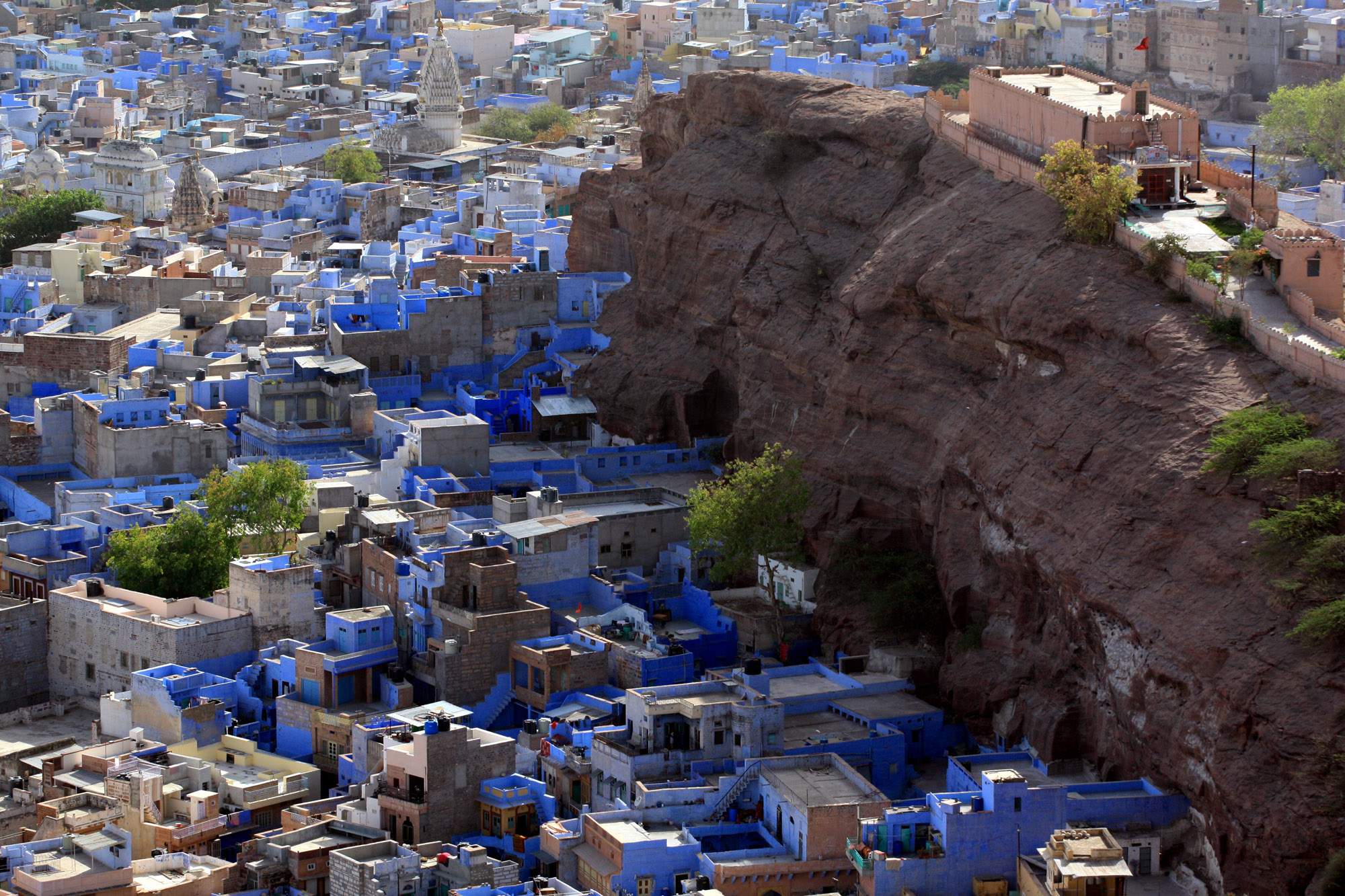
The love of possessing things also faces practical obstacles whilst on the road. If one has no space in which to carry anything, can one really afford to buy something, on account of the inconvenience? If you travel with the idea firmly in mind that you will buy nothing whatsoever, then you will feel less troubled about refusing offers and missing opportunities to buy souvenirs. I tell everyone that I will buy nothing and I mean it, so I am not troubled by desire. I must appear sincere because they rarely press the case very far at all. I don’t really feel I’m missing out at all, and anyway, is not a collection of photographs sufficient?

Not only is the absence of things beneficial to understanding that they are not necessary, but also the presence of certain possessions establishes very special relationships with them. The things that you shepherd with you everyday; the things you must look out for every time you pack your bag; the things you must remember having and must occasionally check upon; the things you have with you always, for security; the things you use all day; the things that are of most importance – the passport; the whereabouts of which you must always be aware of. These are rare relationships with things, capable of breeding great sentimentality and care.

If one combines the respect for and appreciation of one’s useful belongings with awareness of the minimalism with which one is able to live happily and comfortably, then we would have a much more environmentally friendly planet, inhabited by people with a natural distaste for greed and excess.

When you consider how many clothes you have in your closet and how many of them are actually worn, then consider the energy, water, labour and resulting pollution that went into their manufacture and distribution, it doesn’t take a lot of imagination to see that if everyone in the world bought half as many clothes, it would make a very significant impact on the environmental consequences of our overconsumption. I have very few clothes compared to most people I know, yet even still that extends to something like ten pairs of trousers and jeans combined, thirty-odd tee-shirts, twenty-odd collared shirts, perhaps ten pairs of shoes. Do I really, honestly, need that much? Most weeks I wear about three or four combinations at best, totalling around 12 staple items. Sure, keep something for a special occasion, but is the rest really necessary?

No one wants to live in a world, as predicted by so many awful old science fiction movies, where everyone wears the same type of robe. Yet we can still retain some individualism, look cool and own half as many clothes. The problem is that there is no sensible understanding of quotas or limits. How would one determine where to draw the line? I guess a simple rule of don’t buy it unless you actually need it might be a good starting point.

I have come to take great pride in all my possessions and look out for them at all times. The trusty notebook PC, the ever-reliable camcorder, the digital SLR, the clothes, the diary, the toothbrush, the guidebook, the heavy, A4 day-to-a-page diary. Some of these things I have come to know so intimately they have nicknames. My five tee-shirts have already been dubbed “The heroes” for enduring so many long, sweaty wears and being misshapen by my backpack. Two pairs of my already fatigued boxer shorts lost their elasticity, so I finally had the chance to make use of my miniature sewing kit. I folded the elasticated waist into a pleat and triple-stitched it to ensure it was sturdy. They have thus found a second life and I have obviated the need for replacing something on the road. A needless expense, and also, a needless early disposal of something still perfectly useful.

I know that travelling light is not everyone’s cup of tea. It’s certainly easier in hotter climates. I have one pair of shoes – a cheap pair of durable, Chinese flip-flops. I have one pair of long, light cotton pants and a short-sleeved collared shirt in case I have to look at least slightly less ragged. I can’t really hit the high end of town, but then, I didn’t come here for that and couldn’t afford it anyway. Whilst in the mountains, in Darjeeling, McLeod Ganj and Manali, I did at times feel cold and long for a warmer top – still, I was able to avoid discomfort by wearing three tee-shirts. Layers are the next best thing, but of course this wouldn’t suffice in wintry conditions.

Still, in any climate, I highly recommend travelling with as little as possible. I took the very same bag on many trips around Europe in winter, with an equally small number of possessions. Only once when a freak cold spell caught me in Belgium, did I suffer for lack of a sturdier coat. Even then, however, buying a new coat did not require changing the size or portability of my luggage. If everything can be fit into a carry-on sized bag, especially one you can carry on your back, then there are significant advantages. It never needs to be checked for flights and thus is never lost – you can march straight out of the airport and be on your way. It never needs to go in the belly of the bus, thus alleviating anxiety over its being stolen by another passenger when the bus unloads somewhere along the route. You can move unencumbered. You can walk all day with your baggage with relatively little discomfort. You can take your baggage to the bathroom if you are travelling alone and never need to leave it anywhere – on a train; in a restaurant; in a bar – it will always be with you, and, wherever you are, you will always be ready to get back on the road, where you belong.

Read Full Post »

“Do you want some books? Some English books?”

It was Sunil speaking, my auto-rickshaw driver for the last two days in Jaipur.

Jaipur - The Boss

“I have two books. You can take them with you.”

“What books?”

“Two English books. A girl gave them to me to read. She said they are very good books. She gave them to me to read them when I learn to read properly.”

“Oh, nice. What books are they?”

“I’ll get them.” He stood up in his chair and I rose halfway myself.

“No, it’s cool, man,” I said. “Don’t worry. It’s too much trouble.”

“No, it’s no trouble. I live across the road. I’ll get them.”

“Really, only if it’s no trouble.”

He laughed and smiled again. “It’s just across the road.”

“Okay, sure. If you want to, thanks.”

Sunil left in a flash and I eased back into my chair. I was sitting on the open rooftop of the hotel; drinking black tea and picking away at a paratha. For the last twenty-four hours I’d had stomach problems aplenty and had only just gotten through the day’s activities: a visit to the Jantar Mantar and Amber Fort; a test of endurance in forty degree heat.

Amber Fort, Jaipur
At the far end of the rooftop, before a painted arch, a two-man troupe were putting on a puppet show; stories of the Ramayana. At times the volume was too much, the cymbals too clanging. I was too fragile for much patience, but also a tad too weak to feel any annoyance. I was still acclimatising to India, to Rajasthan, and I guess getting sick was part of the trip.
Sunil and I had just cut a deal. His uncle, Shyam, was to drive me around Rajasthan for the next ten days, starting the following morning. The price was fair and it seemed a far more convenient arrangement than taking my chances with the local buses and trains. It would also ensure I could see the more remote forts and temples, provided I was well enough.
I began to wonder about the books Sunil was bringing. What would they be? Rudyard Kipling, for heaven’s sake? I wasn’t terribly optimistic, though I wasn’t too pessimistic either. The worst case scenario would be a couple of airport potboilers, or some junk about spiritual enlightenment, though I most expected him to hand me some inoffensive, lightweight fiction.

Jaipur Hotel
Sunil returned after five minutes, wielding two books. One was a hardback, the other, a floppy paperback.

“Here they are!” he said.

He was slightly out of breath. A short, moustachioed, rotund and cheerful man in his mid-thirties, Sunil always had an air of abundant enthusiasm.
He placed the books on the table and as soon as I saw the titles, I was pleased and surprised.
Summertime by J.M. Coetzee and The God of Small Things by Arundhati Roy.
I had read neither of them, but had wanted to do so, and now I was free to take them with me around Rajasthan.

“Oh, cool,” I said. “Excellent.” I picked up Summertime.

Summertime - Coetzee

“This guy, Coetzee, is a very famous author. Have you heard of him?”

“No.”

“He won the Booker prize, twice. It’s like the biggest prize in writing and only two or three people have won it twice. I’ve read about six of his books. Hell, I even taught his stuff once!”

“But that’s great,” said Sunil. “See, I knew these books would be good. The girl was very nice, very clever.”

“And have you heard of Arundhati Roy?”

He shook his head.

“She’s Indian, though I don’t know where from. This book also won the Booker prize. It’s supposed to be very, very good.”

“Very good then! And now, you can read them and tell me what you think. One day, I will read them too.”

We turned back to planning my route through Rajasthan over a large map of the region. I was very excited, though uneasy with stomach cramps. As we sat there over the next half hour, I kept glancing at the books and wondering whether or not these would really be the best place to start reading English literature. Coetzee might be just the thing, with his terse, laconic use of language and simple sentences, but I had no idea what to expect from Arundhati Roy. Still, as an Indian writing about India, the book could well be a lot more interesting and accessible for Sunil. There was only one way to find out: Read them.
The following morning I set off for Pushkar with Sunil’s uncle, Shyam. I had decided, on account of recurrent stomach problems, to hole up there for a couple of days in the hope of getting over my illness. The drive was easy, if disappointingly desolate, until the final stretch that is, when we turned off the main road. The land became more fertile, with many trees and patches of green growth; it was a yellow land, the colour of wheat heads, baking in the sun at the end of the long, hot dry, yet nourished by wells and tanks from the last monsoon.

Shyam!
We arrived at just after one in the afternoon, and made straight for the hotel. It took some time to rouse reception, but once on hand, it wasn’t long before I had the keys. I had booked a somewhat luxurious room – white marble, high ceiling, fan, air-con, a king-sized bed – all subtly decorated with painted flowers and curlicues. The small balcony overlooked the swimming pool and surrounding countryside; framed by tall hills of scrub and martian rock, the low-land was bright with crops of flowers grown for Puja. It was stupidly cheap at twenty dollars a night.

Pushkar street
After a swim and a meal of dry garlic naan and black tea, I set off into town to explore. My fragile stomach rebelled at the powerful scents of dung and refuse, and, feeling physically exhausted, I was not in the mood for solicitations. I lasted only two hours before heading back to the hotel; tired, with a headache, wanting to have eaten, but having no appetite whatsoever. It was simply too hot, at thirty-six degrees and there was nothing for it but to read. I picked up The God of Small Things and lay down by the bright window. I was soon completely hooked.

God of small things
The following day, my guts had not improved and I again only managed a short visit to town. It was disappointing, but I made the most of the time and took some good photographs. I was quite content to stay in the hotel anyway, with my imperial view across the fields of flowers to the hills, the swimming pool and abundant natural light. I spent a couple of hours watching women in traditional clothes harvesting flowers in the fields, before returning to my room to read.
Late that afternoon, as the sun fell quickly behind the turrets, painting the sky a brief pink and purple, I finished the book. I felt immediately bereft, having gained and lost so much so quickly.

Pushkar

Pushkar
I was exhausted and weak. I’d eaten some bananas and half a pineapple that day, along with more dry bread and black tea, but it was nowhere near enough food and I had to force myself to eat it. I decided I needed antibiotics, but had left it rather late to get something.
Tired, yet restless, I forced myself to start reading Summertime, if only not to feel so hollow. It took me a while to get started, but slowly and surely, it drew me in and gave me sufficient solace to get through the evening.
The following morning, Shyam and I left early to head down through Chittorgarh, en route for Udaipur, where I finally got hold of some antibiotics. I left Summertime in the car by accident, but was not in any great hurry to finish it.

Ranakpur

Jodphur

Jaisalmer

Shekhawati Shyam

There was now the Indian Premier League Cricket to watch, and, with my recovery starting the moment I took the first pill, I wanted to spend the time seeing things and taking photographs.

It was thus more than a week later, at the end of the Rajasthani tour, driving from Jaisalmer to Bikaner, that I finished reading the book. It had had its moments, though I was left feeling a tad nonplussed. The organisation of the book seemed too arbitrary, too random, though the writing throughout was quality.

When Sunil and I finally sat down together again in Jaipur, eleven days after our last encounter, I brought the two books with me. Sunil produced a small bottle of rum and poured us both a glass.

Team Jaipur!

“Do you know what rum means?” he asked.

“No, I don’t. Does it mean something?”

“Yes,” said Sunil. “The letters. R.U.M – Regular Use Medicine.”

We laughed together and I took a slug of Sunil’s medicine. Soon the waiter came by and I ordered a vegetarian thali and a bottle of beer.

“Look, about these books. I’m not sure that either of them is a good place to start reading.”

“Why not?”

“Basically, I think you’ll find Summertime rather boring and too academic. It has some very simple and easily understood parts to it, but it also discusses literature, theory – university stuff. It’s not really going to be that easy, I think, if you don’t know half the words. And, you know, that’s kind of the problem with The God of Small Things. I loved this book, it’s a great read – yet the language is very idiosyncratic. I mean, she uses a lot of words in strange ways, in different ways, and here and there she adds new words. It also moves back and forth in time, and has some complicated scenes where it was at first difficult to work out who was who. I had to read the first chapter twice to work out who the people were. I think it’s going to be a hard place to start reading English novels!”

I was concerned that he might think I thought him stupid, whereas I knew from our conversations that he had a very agile mind. But I also knew how limited his writing and reading skills were, because he had asked me to compose and type text messages for him to his English-speaking French girlfriend, so uncomfortable was he with spelling and grammar. What he needed was a great novel with simple language and limited nuance, though not devoid of it.

“But you liked the books? They are good?”

“Yes, I liked the books a lot. This one in particular,” I pointed to The God of Small Things. “But maybe you’d be better off starting with something else. Something with easier language in it.”

I began to wonder if he wouldn’t just prefer to read a crime thriller or action story of some kind. In truth, I hardly knew the guy, and apart from his professed interest in women of all shapes and sizes, I didn’t have a handle on his tastes. Then, I had an idea.

“Hang on. I think I have a suggestion. I’ll write it down for you.” I felt in the front pocket of my bag. “Oh crap.”

“What?”

“I don’t have a pen.”

He turned and called out in Hindi. The waiter came over with a pen.

“Write on the napkin,” said the waiter.

“No, no,” said Sunil. “I want to keep it. A napkin is not good paper.”

“Hang on,” I said, taking the pen. I pulled a folded sheet with an old hotel booking from my bag, pressed the folds and tore off a quarter. The waiter moved away.

“The book is called The Old Man and the Sea, by Ernest Hemingway. It’s a great classic and you’ll be able to find it in India, no problem.”

The Old Man and the Sea - Ernest Hemingway

Not long afterwards we parted ways for the last time and I returned to my hotel room. I smoked a little hashish, watched the cricket and went to bed. Before sleeping, I thought more about my recommendation. The choice seemed sound enough, and I felt rather too smugly pleased with myself for having suggested it. I suppose, having read a lot of novels and studied literature at university for years, along with teaching English, I ought to be able to make a good recommendation for a first English novel, or at least reserve the right not to feel like a total fraud in doing so. Still, what troubled me was that I had only read The Old Man and the Sea once, more than twenty years ago, when still in high school. Did I really know what I was talking about?

Four days later, sitting in the German bakery overlooking the wire suspension bridge, Lakshman Jhula, in Rishikesh, I noticed that there was a bookstore next door. I had walked straight past it and missed it altogether, yet they had a side window that opened into the café; a window, I had, strangely mistaken for either a mirror or a poster. Precisely what it was supposed to be reflecting or advertising, I can’t say.
I finished my meal of fruit salad, banana pancake with honey and two bowel-shifting filter coffees, and walked inside. By coincidence, the first shelf I looked at contained a collection of Hemingway novels and short stories. Sure enough, there it was: The Old Man and the Sea. I pulled it out and flipped it over: one hundred and ten rupees, or two dollars fifty. I could hardly just leave it, especially as, with a mere hundred pages, it would be no burden to cart around with me.
That day I took it back to my room at the Jaipur Inn; an expensive place at almost thirty dollars a night, but all I had been able to find at this time of year. It wasn’t quite full season yet, but the Kumbh Mela, a once-every-four-year Hindu festival of epic proportions, indeed, the largest gathering of people on Earth, was on down in Haridwar, a mere ten miles from Rishikesh. I was lucky to have a room at all, for the town was jam-packed full of pilgrims, sadhus, nomads, middle and upper class Indians, and tourists who had come either to find or lose themselves.

Rishikesh

Rishikesh

Rishikesh

Rishikesh

I needed a break from the throng, and, after negotiating the ever-crowded Lakshman Jhula, I showered, lay down on my bed and began to read the book.

Oh dear, was my first thought, as the characters began to speak. I have never been entirely comfortable with Hemingway’s dialogue; at times it has a crisp and simple reality to it; his characters speak in no-nonsense, no-frills, laconic utterances; brutally factual, often quietly defensive, formidably stoic. At other times, the tone is lighter; a slight playfulness creeps in, if somewhat reluctant, hard-boiled, guarded. Yet all too often, Hemingway’s characters speak with an odd and awkward formality. One understands that, particularly in his Spanish-speaking characters, he is attempting to replicate the more formal qualities of the grammar and niceties of the language. Yet it feels inauthentic, staid and archaic. In an attempt to create something naturalistic, there is too much evident process. His characters sound more like people reading lines, uncomfortably; like people bent on finishing their sentences with peculiar completeness.
This was my response to The Old Man and the Sea. I pushed on through the first twenty pages, wondering how on earth I could have recommended this novel. It wasn’t that it was bad, in fact, I was very much enjoying the setting, the observational detail, the tone and mood. But it struck me as a very odd book to choose as one’s first novel to read in English. It was full of jargon peculiar to fishing; hooks, lines, hawsers, thwarts. Would my Rajasthani friend bother reaching for his dictionary to understand the anatomy of a boat, of the fisherman’s trade? I very much doubted it. Would the story interest him; this slow-starting yarn of physical and psychological endurance? This melancholy tale of struggle, victory, loss and quiet respect? I very much doubted it.

I finished the book in an hour and a half, then got up to go back outside. I was very much inside the story, and it was very much inside me. I relished the intensity of mood it had brought on; it truly was a great story, and very well told, but I couldn’t help feeling I had given my friend a bum steer.
After a couple of minutes, my embarrassment passed. I began to laugh to myself. Hadn’t Sunil, after all, given me a bum steer as well? Hadn’t he told me that the Kumbh Mela would in no way effect Rishikesh, for all the pilgrims and tourists stayed in Haridwar? Hadn’t he told me I’d have no trouble getting up to Gangotri, only to find on arrival in Rishikesh that the road was closed until opened by the army on May 15? Hadn’t he sent me to the wrong bus-station in Delhi? I smiled at the thought of him settling in with The Old Man and the Sea. Perhaps he would find a way in, just as I had made my way here and found a hotel room despite tribulations. Yet, somehow, I didn’t think English novels were for him.
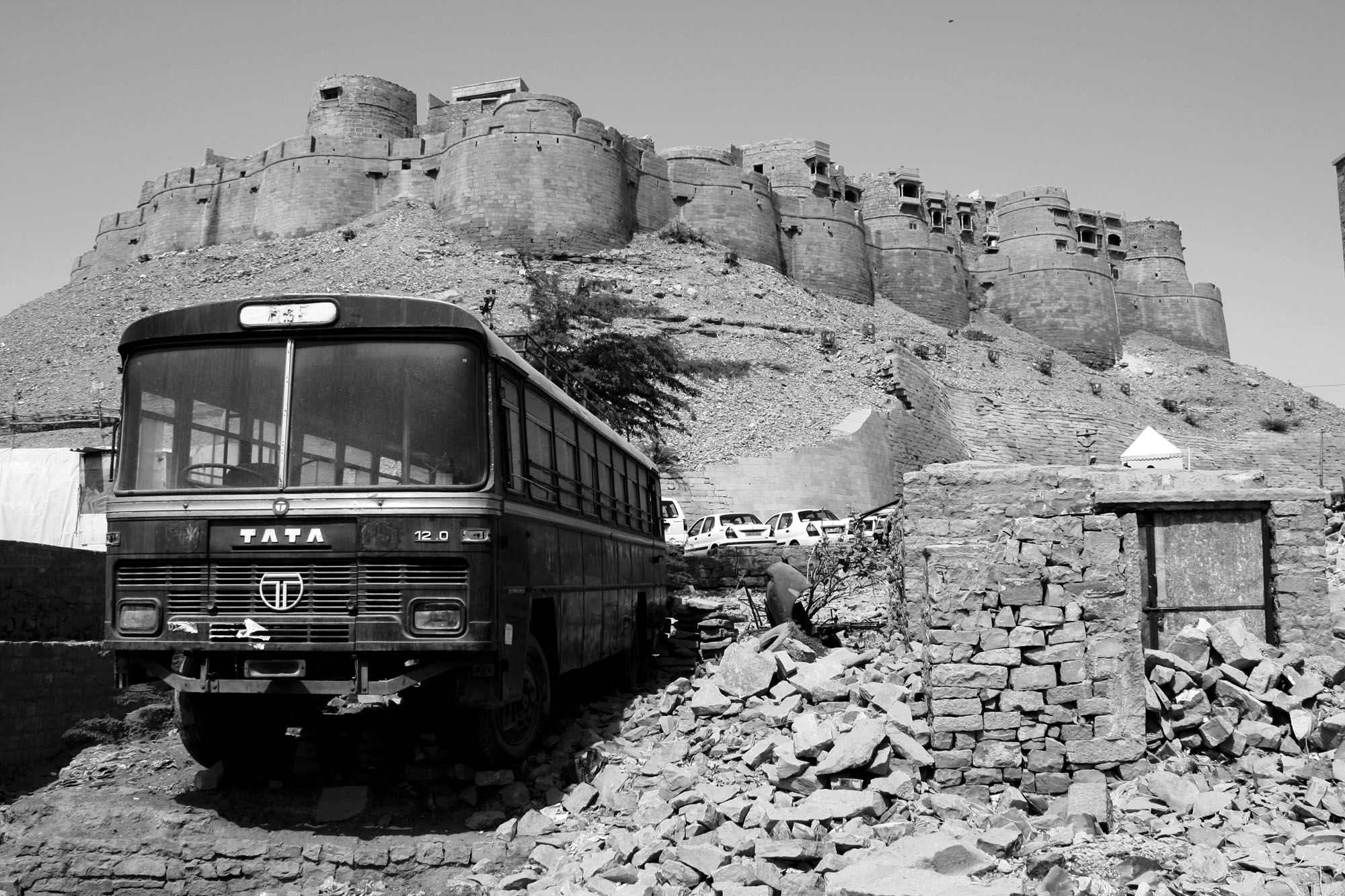
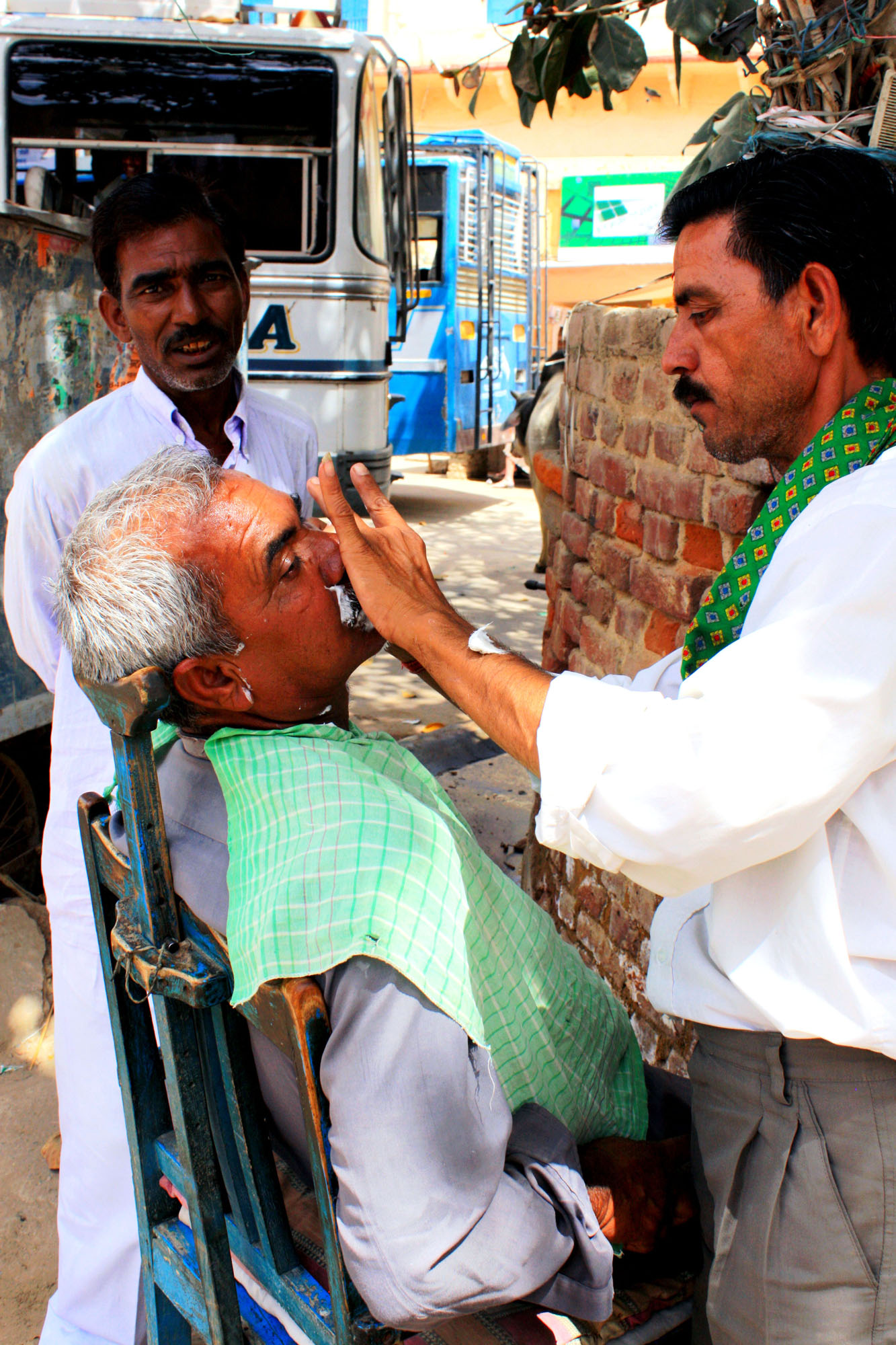
Read Full Post »

New Delhi train station was a daunting sight. The air was a combination of acrid and flatulent scents. Human and animal excrement, raw exhaust from a variety of fuels; smog, wood-smoke, burning manure, charcoal fires, kerosene, refuse and sewage. The people did not seem threatening, but their poverty assailed me in a way I had not expected. I had seen very poor people in Cambodia and Vietnam, yet here they seemed far poorer and dirtier. Indeed, some men, some children, seemed as lank and undernourished as the hungry, mangy animals; the eczema dogs, the cataract cats. It was heart-breaking. In their midst I didn’t feel so much like a target as a brazen show of opulence, if only for being clean and well-fed; like the occupants of the billboards, who smiled down with success.

It was five in the morning and the floor of the station concourse was full of sleeping people. Either they slept here regularly or were awaiting early trains. Where was this fabled new middle class, I wondered? Perhaps they would arrive later in taxis.

Having been the unsuccessful target of several confidence tricks already, I was wary, but confident now that I would not be fooled; or, at least, not fooled in a way that was not to my advantage. I stepped through the people, who oddly enough paid no attention to me, until I was closer to the ticket window. A man spotted me and called.

“Ticket, ticket!”

“Yes sir.”

“Here, you must come here, fill in form.”

“What form?”

“Here, form for ticket.”

I followed him, expecting another scam of some sort. He took me to the far ticket window and picked up a form from the counter, handing it to me.

“Here fill in, then must come to office. Office is closed, so you go to emergency office. Come.”

He started to walk off. So perfunctory! I followed him. I had read that there was an office for foreigners upstairs that opened at eight. So far, he seemed to be telling the truth. I looked at the form, it was shabbily printed from and antiquated stencil, but it could well be legitimate. What would I know? I followed him back out of the station; through the jostling, belching auto-rickshaws, across the potholes and puddles, down a street full of rubbish. Again I saw an office with an official sounding name, this time up a steep and narrow staircase across a temporary bridge over an open sewer. The man motioned me to follow him up the stairs. I went up, head ducked against the low roof. Inside was a tired little office and a tired little man. His forehead was covered in sweat and his eyes were red. He looked half asleep and entirely exhausted. I thought he might be sick, and a moment later, he coughed as he tried to speak, then gave up.

The man who had brought me here spoke in Hindi. I heard the word Agra and figured he now knew my purpose. Immediately after speaking, my escort left.

“The six-fifteen,” I reiterated. “Please, thank you.”

The tired man turned on his computer and I began to despair. If this was the official, emergency tourist office, why was his computer off in the first place? I felt sure once again that I had been brought to another poser who would sooner have me in the back of his brother’s taxi than on the train to Agra.

His computer took forever to boot, and tired and nervous, I laughed. If his computer was as shit as this, then it likely was the official office! At least now I was near the train station and soon it would be light. If he couldn’t help me, someone nearby surely could. After a time, he had the website up on his screen. He looked. I looked. It was entirely different to the one I had seen earlier in the other conman’s office.

“No,” he said. “No tickets. But, you can go on the eleven-thirty train. No problems.”

It was a set-back, but I was pleased. I suddenly felt a strong inclination to trust him. He looked tired and bored enough not to be trying to sell me something. He had an air of exhausted honesty about him.

“That’s good,” I said. “But it is much later. Does the ticket office open at eight?”

“Yes, at eight o’clock.”

“Good. Then, I will go there at eight.”

I wanted to get away, though I wasn’t sure where. It never occurred to me to ask him about buses, and I walked out of the office with the idea in mind that I would go and find out about these. Where, exactly, I did not know, but I had seen many buses in the car park and figured the train station might also serve as a bus station.

I crossed the sewer, crossed the road, and walked to the ticket terrace at the front of the station. Now I was approached by another man. He was tall and lean, with hollow cheeks and a short, sparse beard. He had a laid-back wisdom in his eyes, and something about his expression suggested he was genuine.

“Where are you going?” he asked, as everyone had before.

“To Agra. But the train is full.”

“Do you have a piece of paper? A pen?”

“Yes.”

I pulled some paper from my pocket and handed it to him.

“Agra, yes?”

“Yes.”

He turned to the wall, and, leaning on it, proceeded to write some numbers down.

“This is the train you want. Number 2165. This is the time, 0615.”

“Yes, yes,” I said. “But I have no ticket. The train is full.”

“You need a ticket? Then come with me.”

I wondered why he seemed so genuinely concerned. Perhaps he hoped for a tip of some kind. Either way, he seemed to want to help me and I was grateful. The first three people I’d met had tried to con me. The next three had tried to help. The balance sheet was evening up and already I felt more hopeful about the next couple of months. It was, after all, only reasonable to expect rip-off artists in a big, poor city like Delhi. It was hardly any different in Naples.

He led me the same way that the first man had led me; through the crowd of people and rickshaws, through the mud and dogs and cows. I began to smile with bemusement as he showed me to the very same office to which the other man had showed me.

“Oh, yes, I have been here before.”

“Come,” he said, and led me up the stairs.

There, once again, was the tired, sick man behind his desk. He smiled at me, a little surprised to see me again. Or was it because he had been expecting me? I fumbled in my pocket for a small note, but I only had 500s. I wanted to tip the man who had brought me here. I apologised, but he waved it away. At last, a truly honest man!

The lean man spoke in Hindi, and again I heard the word Agra.

“I know, the train is full,” I said, over their conversation. “Is there a bus?”

“Yes, there is a bus at six thirty,” said the man behind the desk.

“Perfect, I’ll take the bus.”

The lean man left, and I stood before the desk.

“Why not sit down?”

“OK, I will sit down.”

I took off my bag and sat on the cushioned bench before his desk. His eyes were more alert and his face less pasty. He wiped his brow with a cloth.

“There is the normal bus, or the tourist bus. The normal bus takes six and a half hours, and the tourist bus four and a half. They are three hundred or seven hundred and fifty.”

“Definitely the tourist bus.”

“No problem.”

He tapped into his keyboard, then picked up his mobile phone.

“Just for one? You?”

“Yes.”

I looked at the time. It was five forty five. I was going to get to Agra after all, this very day. My plans were not to be thwarted.

When he had finished on the phone he smiled at me again.

“Relax. The bus will come here.”

“And it’s direct to Agra?”

“Yes direct. Tea?”

“Sorry?”

“Do you want some tea?”

“Umm, yes. Sure.”

He stood up and walked to the top of the stairs, calling out.

“They will bring,” he said, on returning to his desk.

I paid him the money and he printed the ticket, and a couple of minutes later, a man arrived with two cups of hot, sweet, milky tea. It seemed the largest hurdle was behind me; the size of which I had not foreseen.

I decided to introduce myself properly. His name was Sharad Kumar, a name I shan’t forget in a hurry for being so curiously hospitable. We talked about my further plans, the proposed trip around Rajasthan after Agra. Again he suggested taking a private taxi to tour around the region. His offer was not dissimilar to the first one I received, only it was a hundred dollars cheaper, and I promised that I would consider it. I took his card.

The tall lean man, my second helper, returned to the office. This time he brought two Asian girls with him. I quickly moved across to the other bench so they could sit in front of his desk. They too wanted to go to Agra.

Mr Kumar introduced himself, but before he could address their needs, his phone rang, so it was I who explained about the trains and buses. Julie was Chinese Canadian, whilst Naoko was from Japan. It wasn’t long before they were booked on the same bus as myself. Just in time for its arrival.

We sat waiting in the office and I chatted to the two girls. I was exhausted, but had passed my lowest point and felt stronger knowing I would have comrades on this journey. Julie had been travelling in India for a month already and would be a very useful ally. Naoko had just flown in that morning, and it was equally comforting to have another noob with which to share my general culture shock and astonishment.

When we stepped out into the street, dawn had already come. The sun hung under an overpass at the end of the street like a polished gong, its outline visibly distinct with the smog to cushion the glare. What it illuminated was even more chaotic than what had been visible in the dark, if less threatening with the addition of colour. Caravaggio’s  chiaroscuro often seemed stripped of menace, though we know that behind it lay swordplay and vendettas.

I was surprised to see a camel pulling a cart, cows grazing the rubbish heaps, men so lean and small beneath heavy burdens. The road was a mere remnant of itself, kept flat by the constant steamroller of traffic. I stopped to take a photograph and the girls got ahead of me, so I followed their backpacks up the street. We walked under the footbridge, past roadside stalls, beggars and rickshaws. Around the corner was a stretch of ruined buildings; like war damage. Walls had collapsed, roofs caved in, and the piles of bricks spilled down into the street. It seemed these tall, jagged, irregular buildings were still inhabited.

Everything was fascinating to me. I thought, having been to Cambodia and Vietnam, that I was prepared for anything India could offer; yet this seemed to go far beyond it somehow. It must be the scale, I thought; the sheer number of people, the great burden, the pressure on everything. How else could a city, not currently at war, be so derelict? Then again, I reminded myself, this was the train station, and major train stations the world over are often in pretty run-down locales. Was not Piazza Garibaldi in Naples something of a mess? Was not Kings Cross in London surrounded by bleak concrete grime? Yet nowhere, surely, that I could recall, was as battered and wasted as this.

We walked past the rubble, skipped over the potholes. People called on either side.

“Hey, Hello, sir!” but we were on a mission and nothing was going to slow me down. I nodded, smiled, waved.

A hundred metres down the street we reached the bus. It was a battered old thing with patched Perspex windows and the back bumper tied to the chassis. So long as it drove, I wasn’t too fussed. We stepped through the doors and were sent to the back, to a long, deep bench seat. It was dirty and sticky, but it looked very comfortable. I thought I was fortunate in getting a window seat in the corner, and opened it wide to look out at the rubble across the street.

At last! I was on a bus for Agra. Again, I reflected on my victory over the liars and cheats. My mission was still on track. I’d expected to be on a 0630 train, but a 0630 bus would do fine. The sunrise shone orange through the back window. I smiled into it and forced a positive frame of mind. Delhi was always going to be the worst, I told myself. Everything else will be easier, more cool, more shanti. I’ve never liked big cities; especially not polluted, heaving, overpopulated ones. India had given me a shock, but so had Rome when first I stepped out there; so had Bratislava; so had Sarajevo, so had Hanoi.

The bus began to drive, and I smiled across to the two girls who had come aboard with me.

“This is comfortable enough,” said Julie.

“Yes, I suppose so.”

After a few hundred metres the bus stopped in heavy traffic, and more people were brought on board. Three people, who looked European, were led to the very back bench on which we were sitting. It was, at a stretch, designed to seat five. They were crammed in between us. I pressed myself into the corner, my bag lifted up onto my lap. Now things were very far from being comfortable. Inwardly I groaned. Oh god, just get me there! Now the five hours struck me as being a very long time. I wondered if we would in fact arrive in five hours. Would there be delays?

I introduced myself to the chap next to me. He was a young, short, blonde guy with an angular face and pointed jaw.

“I am Alex,” he said. “Russian.”

“Aha!”

The bus, however, was going nowhere. We sat and grew increasingly uncomfortable on that back bench for the next half hour. I passed the time watching Indians at work through the window. One young man had been sleeping on top of his truck. He woke up and leaned over to chat to his friends or colleagues below. An old man walked by, carrying a staff and a small metal pail. Stretched above and hanging low, a jumble of wires. Behind it all, dirty shops with faded posters, roller doors, hand-painted advertisements, flaked and darkened with soot. All about, horns sounded, scooters, rickshaws, cars and buses wove in a slow mess.

Then, at last, we started to move through the traffic. I was already in great discomfort. Having had no sleep or food and being already physically and mentally exhausted made it difficult to marshal good spirits. I tried as best as I could, but my legs were stiff and cramped and the bag on my knees was very heavy.

On we drove, down the dirty road. Never in my life had I seen such poverty; people as black as soot, with matted hair, lying in dirt by the road, begging from hell knows who; children, naked in piles of refuse; men, lean and greased, dressed only in loin-cloths, working with rusty car parts. We drove past shanties, slums, past plastic-sheet and cardboard dwellings, cripples crawling to vehicles at the traffic lights.

Where was the fabled middle class? Where was all the new money? The whole length of the road, through the first four hours of driving, seemed lined only with the poor, rubbing shoulders with the desperately poor. How anyone made any money from the few things they had to offer, with so many seeming thousands offering exactly the same, was beyond me. And perhaps that was exactly it. No one wanted what they sold, and so they made no money, but there was nothing else for them at all. And those with the stalls were the lucky ones. Still, this was a major road leading out of town, not a fashionable new suburb, and it was likely offering a particular view; the lower caste, working class side of town. Perhaps soon my eyes would adjust and I would see things differently. The people did not all look unhappy, and many were impeccably groomed, if clearly not wealthy. And of course! The middle class were tucked away in the other cars on the road.

I realised what I should have realised earlier. That the poverty in India was far worse than I had ever imagined; that despite having heard often, and seen on television, stories of the poor and desperate, I had never in my life imagined it to be on such a grand scale. How could so many people be so utterly destitute? How could this road, which ran for mile after mile, be lined with such terrible despair? As yet I had not understood. I had been in shock, I had my own concerns. I was searching for an escape, for an exit, for a long ride away from the things that upset me, towards something more beautiful, more clean. But I realised now that my own concerns were terribly petty. There was nothing I had to face that came close to the abject nature of some of these people’s lives, nor would there ever be. I was Australian and even the worst-off and most neglected people in my country could seek help and redress; it was there for them in some form; and certainly more so than it seemed to be here. I could always escape, indeed, I was always escaping. But these people would never escape. They were trapped in poverty for ever; for some, it was on the cruellest, most persistent, most hellishly relentless scale.

I straightened up in my chair. I was awfully uncomfortable, exhausted. The young Russian’s head was banging against my shoulder. He’d fallen asleep again. So long as he did not drool, then I had no problem. I adjusted my nuts. I stretched my back and shoulders, then pushed up and re-seated myself. It did not matter that I was hot, sweaty, sticky, sore, stiff, hungry and needing the toilet. It did not matter that I must spend the next four hours stuck in this same cramped position, the underside of the footrest cutting into my leg, bottom aching. The truth was that in a few hours I’d be in a shower, in a hotel, with a clean bed to lie on and plenty of money to spend on food. I was rich. Richer than a hundred of these people put together. I was the raja, and so I should bloody well stop thinking about myself as though I were in some way unfortunate to be cramped in the back of this shabby bus. The truth was that I had it all, and the poor bloody Indians outside my window didn’t have a goddamned thing. How awful it was that I would soon try to put them from my mind and enjoy myself.

Read Full Post »

Pre-dawn Delhi

Delhi, 19th March, 2010.


Having come from Abu Dhabi, with its highly polished, if dusty infrastructure, I expected stark contrast once I stepped out into New Delhi. I did not, however, expect it to be so apparent as soon as I stepped inside the airport. It was not merely shabby, old and run down, but it was also very small and poorly designed. There were insufficient toilets, which were overrun and not especially clean, and two ATM machines, of which only one was functional, and both of which were hopelessly antiquated. There was no tourist information desk and only one café. I have seen regional airports in small cities in Italy which were far superior.

India is a vast and very poor country and one must take this into account in one’s expectations. Yet, having heard of the extraordinarily rapid economic growth rate of the last ten years, the widespread and rapid swelling of the middle class, and the increased investment in infrastructure, I had expected a modern airport and not a 1970s bus-shed. That this is the only major international airport in the city which is to host the 2010 Commonwealth Games is not encouraging.

I went to the pre-paid taxi desk and ordered a taxi for New Delhi train-station. I had booked a hotel in Agra and planned to take the 0615 express train there that morning and get straight out of Delhi. It was, undoubtedly, stupid and naïve of me not to have booked a ticket in advance, yet I have never in my life booked a train ticket in advance and never been inconvenienced by not doing so.

I stepped outside. There was a great crowd of people milling about. Old men with long, full white beards, children sleeping on the floor, families sitting on bags. It was, in essence, not unlike any other airport scene, except that it was much darker, dirtier and unwelcoming. Around the car-park before me, the air was a thick and hazy orange; smog.

A man approached me immediately. “Prepaid taxi, sir?”

“Yes.” I waved  my ticket.

“This way, sir. This way.”

He asked me where I was from and I told him New Zealand. After a spate of recent attacks on Indian students in Melbourne and the ensuing anger about it in India, I decided not to disclose my true nationality unless absolutely necessary.

We talked about cricket as he led me to a taxi; I enjoyed making fun of my supposed national team. Here I met the driver, a short, bearded young man who seemed pleasant enough. Fortunately he did not ask me where I was from until I was inside the taxi and out of earshot of the other man. I decided to tell him I was Australian, as, not having slept after a long day of walking in the sun with my pack on, sitting around an airport for five hours, with a three hour flight for dessert, I was too tired to sustain a complicated lie. Again we talked about cricket. This time, the IPL. I’m a Rajasthan Royals man, whilst he supports the Mumbai team. He asked me where I was going. Did I have a train ticket? No, I told him, I did not.

I had read about many of the more common scams in India. They are, to a degree universal in poorer countries. The gem scam, where tourists are tricked into paying to carry worthless “gems” back home to be sold to an agent for a large fee, when of course, the agent does not exist, is a true classic. Most taxi drivers receive some sort of commission for bringing people to hotels or shops, so they will do everything possible to get you to a place that will pay them said commission. This is often backed up by some very brazen lies. The hotel the tourist wants to go to has burned down; there are riots; the road is blocked and there is no other route; a recent earthquake caused major damage; the hotel was closed for health reasons; it is a bad hotel, where customers have been drugged and robbed etc. They will do anything to divert you from your purpose.

The same applies for travel arrangements. If you do not have a ticket, they will ensure that you obtain the ticket or other means of transport through their preferred agent. This agent will usually pose as an official of the national tourist board or some such organization, even going so far as to have fake official-looking signs complete with appropriate acronym made and placed on the wall behind their desk. That said, they are often able to provide the service one desires, albeit it at an increased cost. It was to one such place that I was about to be taken.

The driver made a phone call, conducted in Hindi, then we continued our conversation. The road was heaving with trucks, which are only allowed to use the roads at night. They swung across our bow and stern with great noise and bustle, and we swept through them like a small fish amongst whales. All around, horns sounded and engines groaned.

I had no means of determining where I was and hence had little choice but to trust the driver. Soon we stopped in a dark street with a few lit shop entrances, and he said “come with me.”

Warily, I stepped out into the warm night. I had fallen quiet for a while and was not thinking as clearly as I ought. He had not told me where we were going, but I suspected he was going to get a friend to arrange my ticket. I rather liked the idea and figured that paying a slightly inflated price would be worth avoiding the hustle of the train station.

The driver led me into what purported to be an office of the INTB, the so-called Indian National Tourist Board. I was immediately on my guard, and determined not to be won over to something about which I was doubtful. The word “official” appeared too many times on the signage to be trustworthy. It was clearly buttressing a lie.

The gentleman behind the desk greeted me. He spoke well-educated English and seemed genuinely affable. He was clearly a northerner, and looked more Pakistani than Indian. I wanted to trust him, but could not bring myself to do so.

“You want to go to Agra?” he asked, and I told him yes, I did.

He searched online for train tickets, then, shaking his head, turned the screen towards me. What he showed me was, allegedly, the ticket availability from the official website of the India railways. The trains for Agra were booked out for the next seven days, both at 0615 and 1130. That much I could see. I looked at the web address, but was not wearing my glasses and, sadly, could not read the URL. I felt little inclined to trust him. Partly because I had been warned of just how elaborate some ruses could be, but mostly because he now attempted to steer me towards his preferred suggestion: that I hire a taxi for twelve days to travel around Rajasthan, which is where I intended to go next. It would cost around 700 hundred US, all expenses included, and be far more comfortable and flexible.

I was tempted by the offer; it struck me as quite an affordable and sensible option. Yet, I did not trust the man. I was sure he had lied to me about the trains and didn’t want him to be rewarded for being a con-man. If I could arrange such a deal with him, I could likely arrange it with someone else; someone else who had not tried to trick me into accepting it. I stood my ground through all his friendly explanations and cajoling, through his lengthy sermon on the difficulty of travelling through Rajasthan by train and bus, saying that I appreciated the suggestion, but was too tired to make a decision. My plan was simply to get to Agra, and if a train could not be had, then I would find a bus or somesuch to get me there.

I now grew tired of sitting there and wanted to be away. I changed the tone of my voice.

“Look, I want the taxi driver to take me to the train station and I will see what can be done from there.”

He tried once again to convince me that this would result in nothing, the taxi driver now chiming in to reiterate this. Again, I refused to believe them.

“I paid for a taxi to the train station and that is where I wish to be taken.”

And so, my driver now with a rather hangdog expression, reluctantly led me back to his taxi. This was not, however, the end of the scam. First he tried further to convince me to accept the deal. Then, as we drove to the station entrance, he assured me that I would not be able to get inside without a ticket, and that the ticket office was closed.

“There was a recent bomb-blast and no one is allowed near the station without a ticket.”

This sounded like precisely the sort of horse-shit I had been warned to be wary of, and told him I wanted to go anyway. He drove me to a closed gate with a big neon sign above it. It was clearly genuine, and was in fact an official body involved in train-tickets, and it was indeed closed and locked.

“See,” he said, “you can’t go inside.”

“Where is the front entrance to the train station?” I said.

“That is it, it is locked.” I did not believe him. It was clearly not the front entrance to a train station. For one, the street was deserted, and I knew from long experience of train stations the world over that there were always people around and outside them through the whole night.

“Take me to the entrance of the train station,” I insisted.

“That is it, sir. It is locked.”

Though I did not believe him, I did not know exactly how I could prove him wrong. Tiredness was catching up with me. I started to feel despair.

“So, what are you going to do?” he asked.

“Look,” I said. “I am going to Agra, and I am going to get there by my own means. If you won’t take me to the train station, then I shall go by bus. If I have to fly, I will fly. If I have to go by taxi, I will take a taxi.”

“I can drive you there, sir. I can drive you.”

He pulled away from the closed gate and began to drive, I knew not where. I did not know how to counter him. It was all very well not to trust or believe him, yet what did I know about Delhi?

We entered an open public square, and I saw a wide, marble neo-classical façade.

“What is this?” I asked. “Where are we?”

I feared I was sounding desperate, and his response held a tone of disrespect, as though I were some madman in his vehicle.

“It is the centre of Delhi, sir. Where do you want to go?”

“I want to get to Agra. How much for you to drive me?”

I had reached a new low. The tiredness was like a drug, though I did not feel sleepy. I felt edgy, anxious, fatigued, strung out.

He picked up his phone and made a call, presumably to his boss.

After some negotiation, he turned to me.

“To go to Agra will cost 5690 rupees.”

I thought for a moment, it was roughly 42 to the dollar. Should I just say yes to solve this problem and be on my way? I did not want to pay so much, but it would make life so much easier.

“No,” I said. “It is too much.”

“But, sir, it is a fair price.”

“It might be a fair price, but it is too much for me. I don’t wish to pay so much.”

“But you can afford it, sir, surely?”

“No, truth is, I can’t. I am travelling for a month or two, I will have many expenses.”

I wondered why on earth I was explaining this to him at all. He was, after all, the taxi driver I had paid to take to the train station, and he still hadn’t taken me to the damned train station! I grew angry now, flooded with a new and bitter resolve.

“Look, I don’t care. I’m not paying that much money to go to Agra. You won’t take me to the train station, so you can take me to the bus station. I don’t care, no more arguments. Take me to a bus station and I will find a bus for Agra. I know there are many.”

He groaned and protested, but he started driving.

“To the bus station!” I said. I just wanted out of his damned, infernal taxi.

“But nothing is open, sir, it is too early. You are tired. Don’t you want a hotel?”

Christ, did I ever want a hotel. But not here, not in Delhi, and not from him.

“No, no, no. How many times do I have to tell you. My plan is to go to Agra, I don’t care about anything else, I am going to Agra, and you will take me to the bus station now.”

At this, his shoulders slumped. He could see at last that I was not going to do as he wanted. I was considerably larger and more physical than he, and without back up, he had not other recourse to extract money from me. The game was up, and, thus defeated, he drove me a couple of blocks from where we were, en route, I hoped, for the bus station.

Suddenly, all about were people, lights, offices, shops, life. It was filthy – open sewers, tuk-tuks, rickshaws, cows, rubble, dung, horses, naked children, smoke from fires and hundreds and hundreds of poor, dirty people. I knew at last that I was where I needed to be.

“This is the bus station,” he said.

I opened the door as soon as the car stopped, and stepped out of the taxi.

He too stepped out.

“Here,” he said. “But you must not trust anyone. That man before, he was an honest man. You should have listened to him. Here people will lie to you. You are tired, you are not thinking.”

“I am thinking,” I said. “I am thinking many things. I am thinking I should trust no one. I am thinking I should not accept a deal from someone at five in the morning who tells me I have no other choice.”

“But you must be careful,” he said. “Many people will tell lies.”

“I know,” I laughed.

“Use your eyes,” he said. “Be careful. Use your eyes.”

Then, he seemed deeply sad of a sudden. He had not only lost a chance of commission, but had lost the chance of earning over one hundred dollars. So much for his hour and a half-long detour. He put his head down and moved back to his car, beaten. I wondered if he felt ashamed, that I was soon to discover what a liar he was.

“Goodbye then,” he said.

“Hey,” I called. “Here, I will give you something.”

I pulled out some small change and handed it to him. He might be a liar and a cheat, but either way, he was clearly quite poor and I felt sorry for him. I also felt I had won quite a complicated battle, and was inclined to generous in my moment of glory.

“Thankyou,” he said, without much conviction. I turned my back on him and walked away.

I walked alongside the sewer, past pissing men and pooing children. Faces loomed out of the dim orange smog light. To my left, on the other side of the road, stretched a row of shabby offices and shops. So nothing was open, huh! I walked between two cows, tiptoed across puddles, and came to a huge set of swinging iron gates. I felt scared, but hopeful. Perhaps I would meet an honest man here. I looked across the crowded space to the illuminated building at the back of the square. Imagine my surprise when I realised that before me was the once-grand façade of the New Delhi train station.

Read Full Post »

« Newer Posts