Feeds:
Posts
Comments
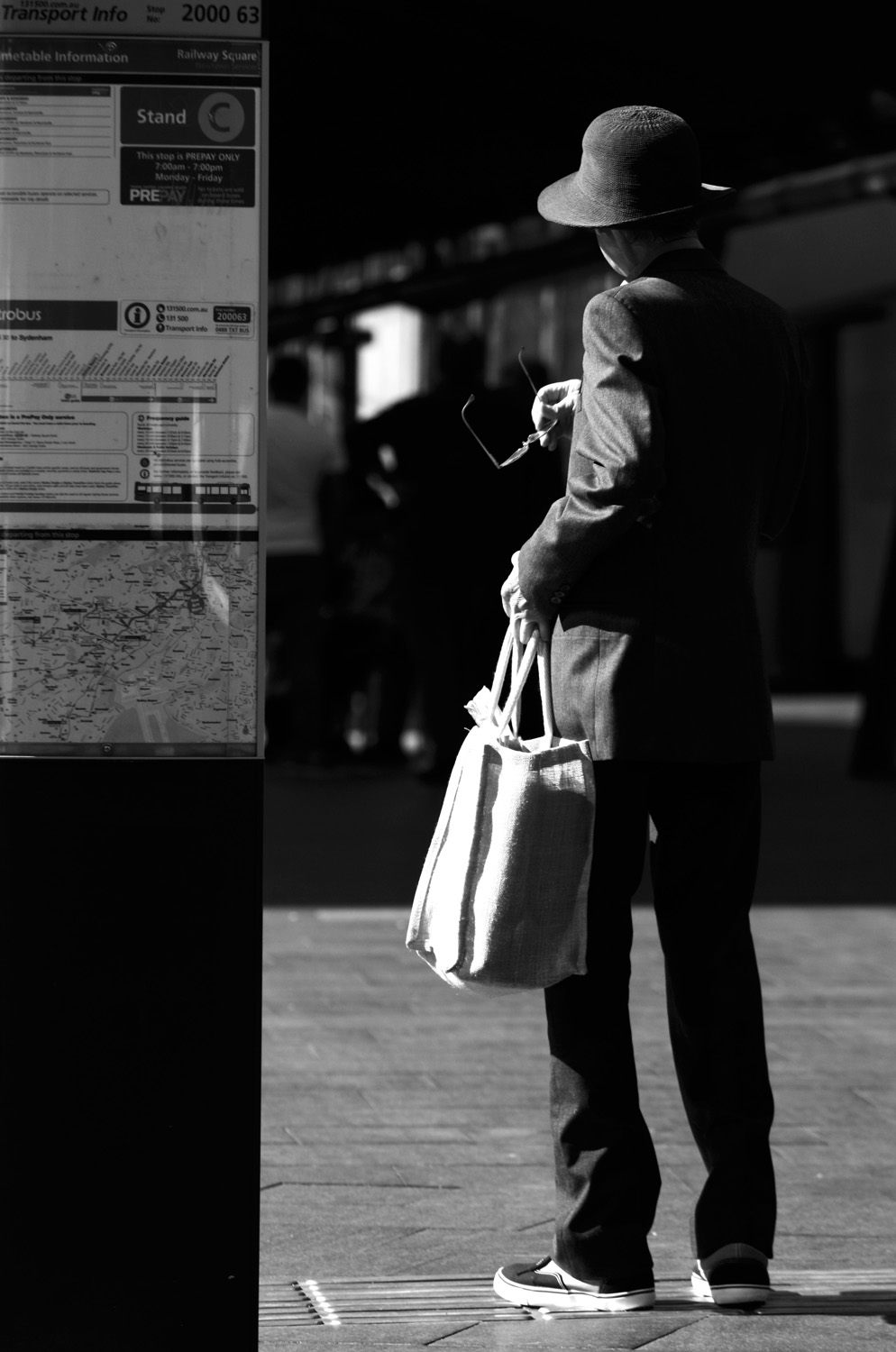
Antwerp Central Station, Feb 4, 2007

Antwerp Central Station, Feb 4, 2007

For a while there I considered this photo to be the best I’d ever taken. Upon seeing this shot, some hours after taking it, I fell immediately in love with it and remember going so far as to e-mail myself the file in case of some unforeseen disaster, like being mugged and robbed, or flipping out on mushrooms.

This photo was taken on the 4th of February, 2007 at the central train station in Antwerp, Belgium on a freezing cold day. I had just arrived from The Netherlands, where I’d spent a couple of very strange days doing what was only natural in Holland – eating shrooms, smoking weed and visiting art galleries to stare in wonder at Dutch Masters like Frans Hals and Johannes Vermeer.

The Lonely Planet made Antwerp sound fairly interesting, but I never made it very far into town. Indeed, inadequately clothed (I was on my way to Paris via Brussels to meet my then GF and, whilst carrying ample layers, had not, out of either blind hope or uncharacteristic ill-preparedness, brought a coat), I made it about two hundred metres down the road before feeling the pinch and turning back. I know only too well that very few cities look appealing around their central train station (are there any that do?) but on a cold, grey day, Antwerp seemed so large and inhospitable that I longed for the quaint intimacy I knew Bruges could offer. I still had, as my father used to say, “the wherewithal” to get seriously high, and figured this experience would be considerably more pleasurable when safely ensconced in a medieval town.

I took the next train to Bruges, where, sure enough, I flipped out on mushrooms, but not at the expense of my camera, or indeed, this photograph. I still treasure it, though the tiny, half-degree tilt in the uprights on the right side of the frame never ceases to bug me. Such is life.

5354 Hong Kong butcher 2

Hong Kong Butcher, July 2009

I stumbled upon this meat market whilst walking around Wan Chai, across the water on Hong Kong island. At least, I think that’s where it was in HK – part of the pleasure of wandering aimlessly looking for subject is not really knowing where you are. The area was full of interesting shops and market stalls on the street – or so I recall. I’ve always loved shooting in markets – especially when they’re down and dirty. The smells, the colours, the noise, the array of curiosities – and, of course, the people. Shooting wise, markets can be difficult subjects because there is often so much going on and so much stuff about that without a clear subject, the impact can be lost in the minutiae of the scene. The lighting in indoor markets can also be hard to work with – especially when they are dark and the subjects lack clear illumination.

In this case I got lucky on all counts, with a clean shot of a clearly illuminated subject and nice lighting all round. But it’s rarely for technical reasons that I like a photo, and in this case, it’s really all about the eye-contact, the appearance of the man in his apron, and the hanging lights. Great colours and a fortunate, if slightly asymmetrical arrangement of the elements. I remember feeling very much caught out after taking this (I have several of this fellow, actually, though this is my favourite) and being slightly worried that he might shake a cleaver at me and tell me to clear off. Instead I wheeled off pretty quickly and had that great and rare feeling of knowing I was going to like the photos I’d just taken.

All in all, this was a great visit to Hong Kong (July 2009) at the end of a six-week trip through Singapore, Vietnam, Cambodia and Thailand. I’d been feeling very low for a few days for various reasons, but clear skies over HK and awesome subject matter all round cheered me up no end. It was very satisfying that, after having taken thousands of photos throughout the trip to this point, my favourite ones should come right at the end.

Most of the content on my blog consists of lengthy pieces of writing or collections of photographs, or some combination of the two. I understand all too well that most people don’t want to read pieces of such length, but the simple fact is that I want to write pieces of such length and, let’s face it, what is the point of a blog if it isn’t to write in as self-indulgent a manner as possible? Free of any editorial constraints, we can go to town and ignore the rules that dictate word length and format, along with accurate referencing. Perhaps it’s because I spent so long working on novels and longer format short stories, that I believe a blog post must be substantial in some way – at the very least, a thousand words, and at the very least, a decent collection of photos – maybe 15 minimum. Then I watch with a strange, almost powerless sensation of envy as other bloggers simply go and whack up one or two photographs with barely a line written and have praise heaped upon them. This feeling is especially ironic since it’s not really the praise that I’m interested in, though I don’t deny it’s nice, but rather, the feeling of having posted something worthy of praise. On this latter score, I am a victim of my own grandiose expectations of myself; mea culpa and all that.

For a long while now I’ve been toying with the idea of posting single photographs more regularly – personal favourites, with a paragraph or two of context and commenary to accompany them. I wanted not necessarily to focus on what I consider my best photos, but photos that I really like, for whatever reason – which may mean they are not technically great, but have an interesting story, meaning or emotional impact. I used to use the term “secret favourites” for songs which I loved that might not be the most obvious choice for a favourite song from an album with more obvious choices. Like, for example, David Bowie’s The Secret Life of Arabia, being my favourite song on his Heroes album. In this case, the photos I intend to examine are all “secret favourites”, though some, I’d like to think, will be so spankingly good as to require no qualification. Trumpets!

So, to Favourite Photo # 1 – which, whilst being numbered 1st, is not, by any means, my favourite favourite. It is worth pointing this out early on in the piece, that the numerical order in no way reflects preference. I shall try to mix things up as much as possible.

Tokyo, May 2006

Tokyo, May 2006

This photo was taken either in Shinjuku or Shibuya in Tokyo (I forget) in May 2006, whilst shopping for electronics. The guy in the foreground was sitting on a railing with a few mates, watching the beautiful girls standing outside the shops in uniforms handing out fliers. I watched them for a few minutes and they were clearly interested in the girls, but too shy to approach them or do anything about it. I guess they hoped they might be noticed. After taking a few photos of them, indeed, about three seconds after taking this shot, they caught me shooting them and were good enough sports to give me a lovely wave and big smiles all round. It was a sweet moment – they all seemed like nice young guys and I’ve always looked very fondly at this young bloke, hoping for his sake that he got laid in the end.

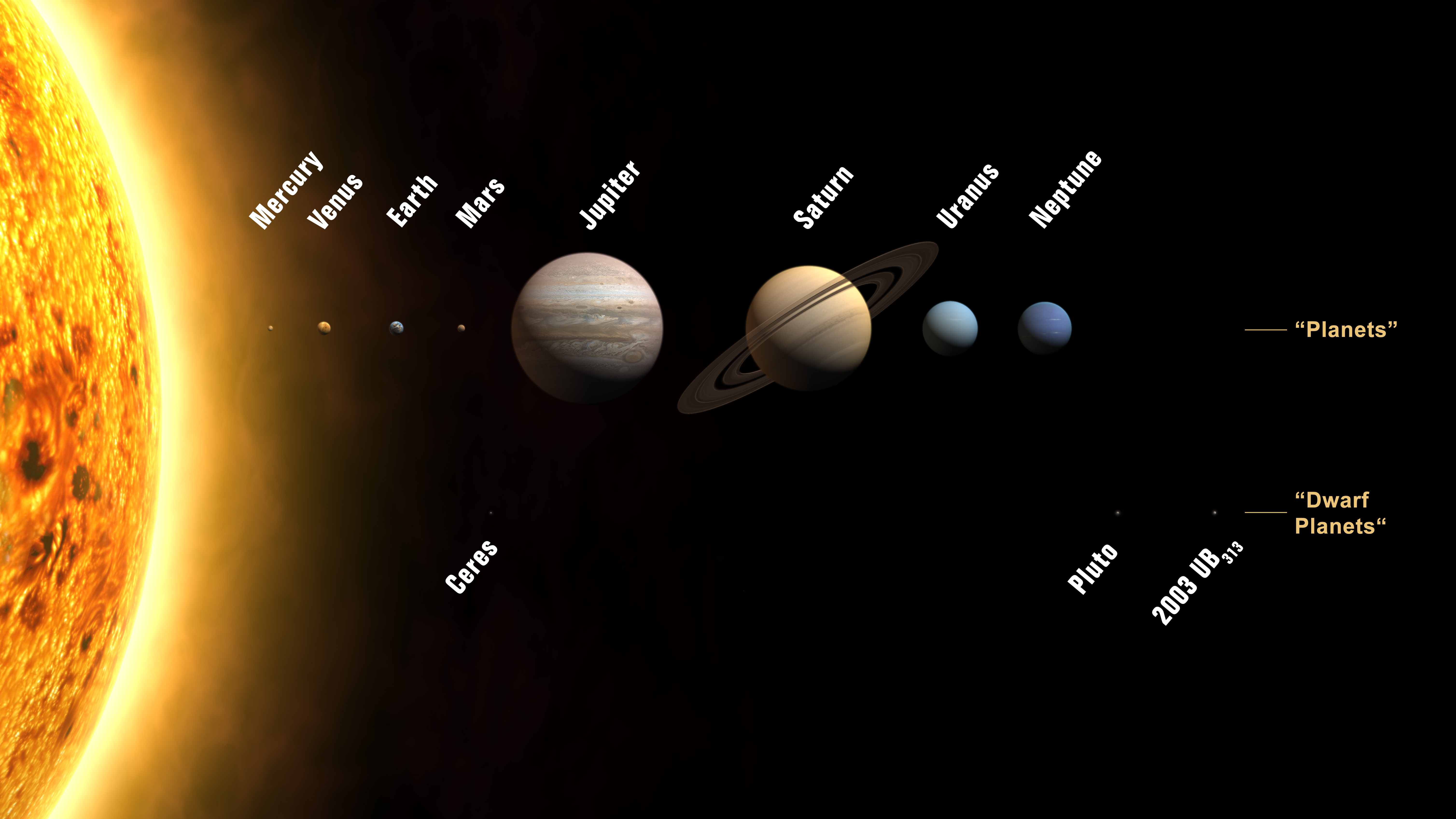
Dwarf Planets

The demotion of Pluto as a planet back in August 2006 caused a great stir and left many people feeling disappointed.
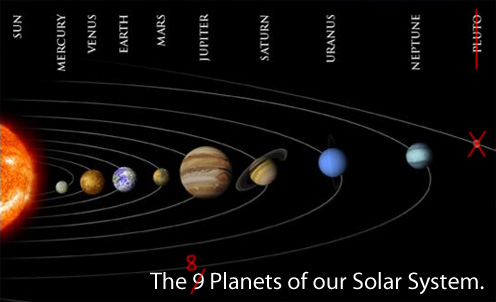
Minus Pluto -

Since its discovery in 1930, several generations have been taught that there are 9 planets in the Solar System, no more, no less. Considering how sophisticated our knowledge of space and our own planetary system has become, it must have seemed as though this were a fixed figure, unlikely to change. After all, could there really be other planets out there that we had somehow missed?
10th Planet Dr Who

Science fiction has made much of the idea of “the 10th planet,” yet with no other planets apparently introduced to the ledger since 1930, was it likely that any further planets were going to be discovered? And, perhaps more pertinently, what could possibly cause a planet to lose its status as a planet? What actually is a planet?

The answers to all this should excite anyone who has an interest in astronomy and offer more than mere solace to people mourning the demotion of Pluto. For, in recent years, many more planets have been discovered in our solar system – or, rather, many more “dwarf planets” have been discovered, and it was the discovery of another distant planet that is, in effect, larger and heavier than Pluto, that led to Pluto’s demise. Of course, Pluto isn’t going anywhere, not in a hurry, anyway, considering it takes 247.68 years to orbit the sun, but it now bears the status of “dwarf planet”, precisely because, if we were to accept it as a planet, we would have no choice but to welcome many more planets to the roster.
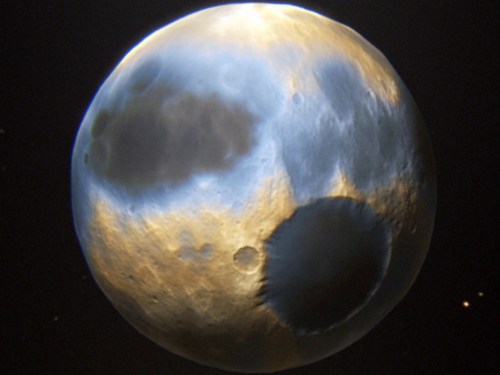
Pluto

This in itself might not be such a bad thing, considering how little known most of the newly discovered planetoids / dwarf planets are, but the lengthy debates about what constitutes a planet did set out some sensible ground rules for planetary status, even if these rules remain hotly disputed.

Here’s how the International Astronomical Union defines a planet in our Solar System:

It is a celestial body which:

  1. is in orbit around the Sun,

  2. has sufficient mass to assume hydrostatic equilibrium (a nearly round shape), and

  3. has “cleared the neighbourhood” around its orbit.

The first rule is clear enough – and, of course, we are talking about our own star, the Sun, or rather, Sol. The second rule is mostly obvious – in simple terms, a planet should be round. A fuller definition of hydrostatic equilibrium is as follows:

the object is symmetrically rounded into a spheroid or ellipsoid shape, where any irregular surface features are due to a relatively thin solid crust.

In other words, the product of things like tectonic forces, rather than simply being wildly out of shape. Earth is round (well, slightly ovoid) Mars is round and even Pluto is round.  If it doesn’t look like a deformed potato – such as Mars’ moon Phobos – then it has passed the second hurdle of planet-hood.

phobos, the potato

Otherwise, we would simply designate it an asteroid or minor planet (explained below).

Not listed above, but best mentioned now because it marks the other boundary of planetary size and mass, is a further necessary rule of planethood – that it not be massive enough to cause thermonuclear fusion.

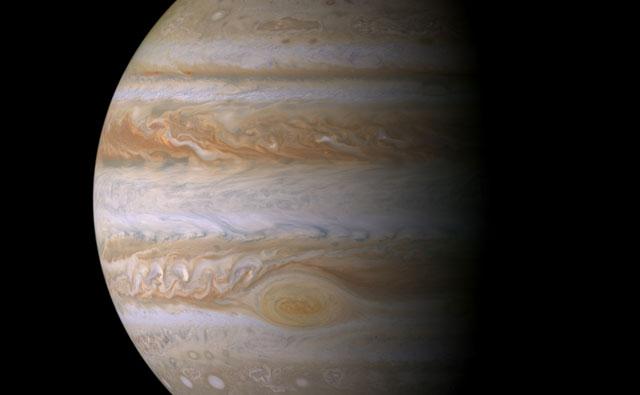
This simply means that a planet not be massive enough to ignite and form another star. Jupiter, for example, is a star that might have been – a failed star. With rather a lot of extra gas and mass, it may just have got there, but it didn’t. It’s a gas giant, not a star, precisely because it was “not massive enough to cause thermonuclear fusion. ”
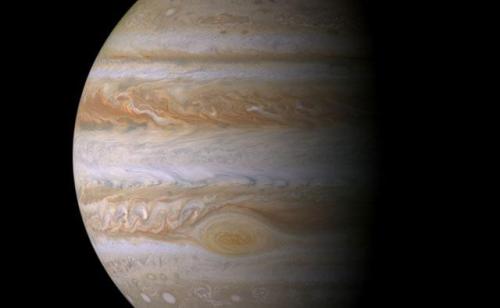
Jupiter

Fair enough. Yet it is the third definition – having “cleared the neighbourhood around its orbit” that has proven the most contentious and, ultimately, made all the difference. The idea works like this:

In the end stages of planet formation, a planet will have “cleared the neighbourhood” of its own orbital zone, meaning it has become gravitationally dominant, and there are no other bodies of comparable size other than its own satellites or those otherwise under its gravitational influence.

In other words, if a planet is a planet, it must be the only object, apart from its moons, to follow the same orbital path – a lone car on an otherwise empty highway. Mercury does this, Venus does this, Earth does this, but Pluto does not do this.

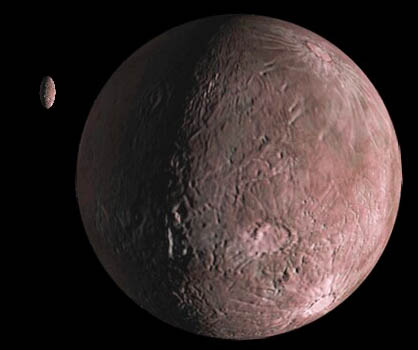
Surface of Pluto, impression, with Charon

If we think of the asteroid belt, the very name “belt” says it all. It is a space in which many objects share the same orbital path and no one object dominates with its gravity. Indeed, if one object did do this, then what would have to happen is that the objects in the same orbital path would have to be drawn together, colliding to form a new planet, or fall into orbit and become moons of the new planetary body which formed from the rest of the material.

The rules differentiating planets from dwarf planets are thus based on the following:

A large body which meets the other criteria for a planet but has not cleared its neighbourhood is classified as a dwarf planet. This includes Pluto, which shares its orbital neighbourhood with Kuiper belt objects such as the plutinos.

planets, including KB

The Kuiper belt, incidentally, is a region of the Solar System beyond the planets which begins at the extremities of Neptune’s orbit. Neptune orbits at roughly 30 AU (1 Astronomical Unit = the distance of the Earth from the Sun) whilst the Kuiper belt extends as far as 50 AU from the sun. It is not unlike the asteroid belt, but it is much larger – 20 times as wide and roughly 20 to 200 times as massive. It consists of remnants from the Solar System’s formation – in other words, pieces of rock and ice of varying size which did not come together to form planets, or which did come together to form dwarf planets or minor planets – planets which then failed to achieve sufficient size and mass to clear their orbital path.

Kuiper belt and Pluto

No doubt you’re also wondering what a plutino is. In effect, they are objects which are caught in a 2:3 mean motion resonance with Neptune. In other words, for every two orbits that a plutino makes, Neptune makes three. They share the same orbital resonance as Pluto and follow a similar path. Indeed, it was the discovery of the plutinos as much as anything else that led to Pluto’s demise. Pluto has not cleared these from its orbital path.
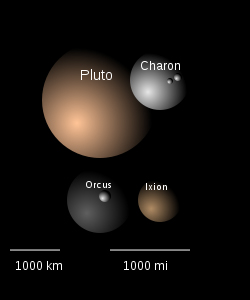
The Plutinos - Size, Albedo

So where does all this leave us? The truly exciting answer is that we are left with a surprisingly large number of dwarf planets in our Solar System. Those which orbit beyond Neptune, in the outer Solar System, are included under the rubric of trans-Neptunian Objects (TNOs). To our knowledge, there are no less than 620,000 TNOs, but before we get too excited about this figure, it must be said that this number is not for dwarf planets, but rather another categorisation: Minor Planets. Minor planets include dwarf planets, asteroids, trojans, centaurs, Kuiper belt objects, and other trans-Neptunian objects. Ignoring the other categories, let’s focus instead on how many dwarf planets have so far been identified in total, not just in trans-Neptunian orbits, though this is where most of them reside.

Neptune, does it get more beautiful

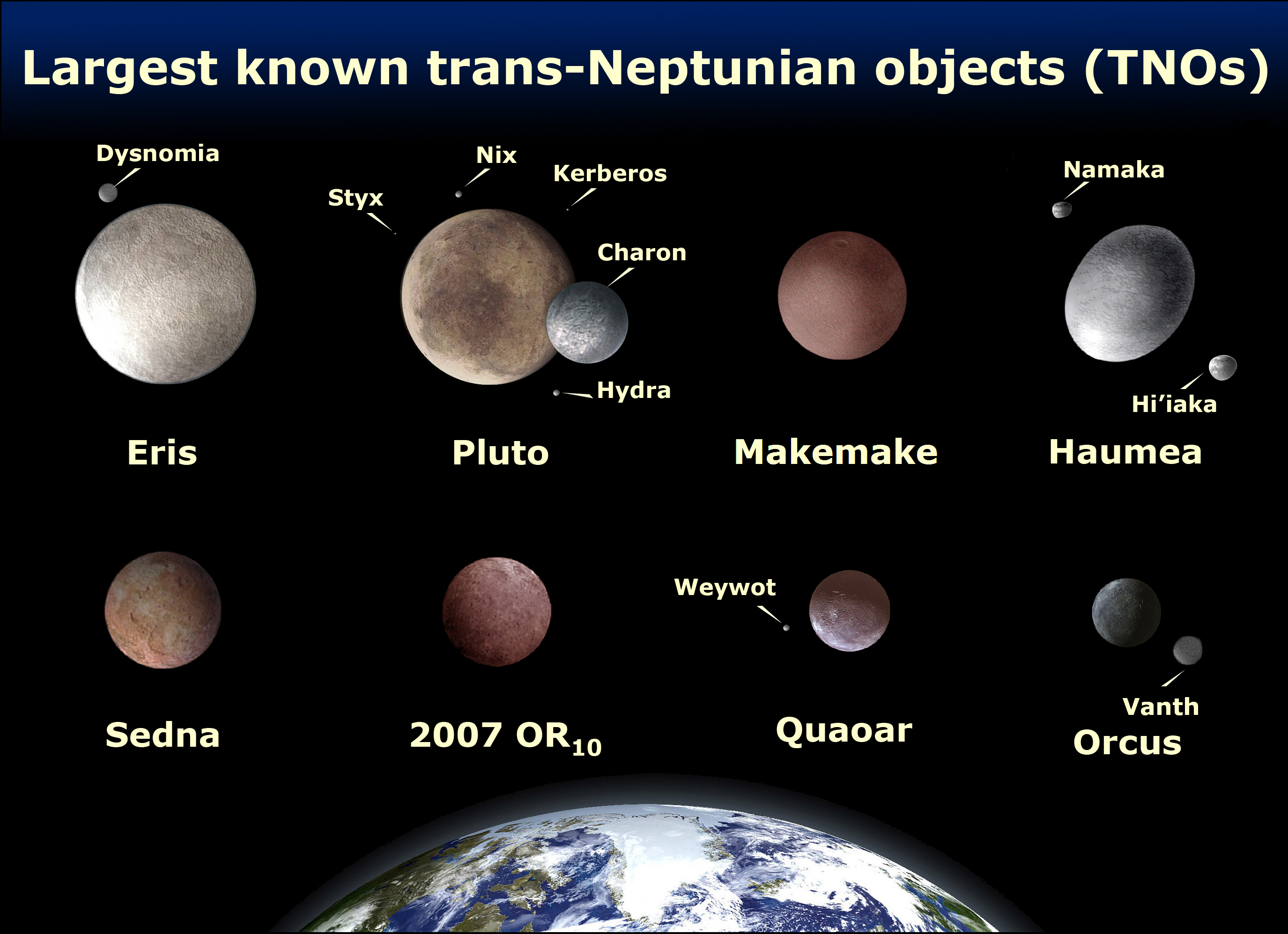
At this stage the IAU has definitively named five dwarf planets: Ceres, Pluto, Eris, Haumea, and Makemake. A further six, which in all likelihood are dwarf planets, have been discovered and await official recognition: Orcus, Sedna, Quaoar, Salaci and the less charmingly named 2002 MS4 and 2007 OR10.  Another twenty-two objects have been identified which need further observation to determine whether or not they achieve dwarf planet status.
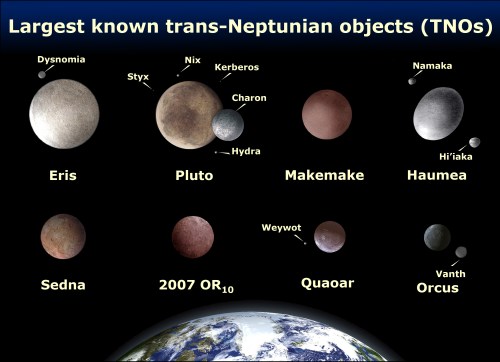
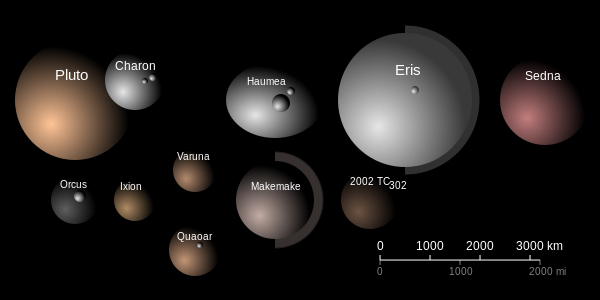
Largest known TNOs

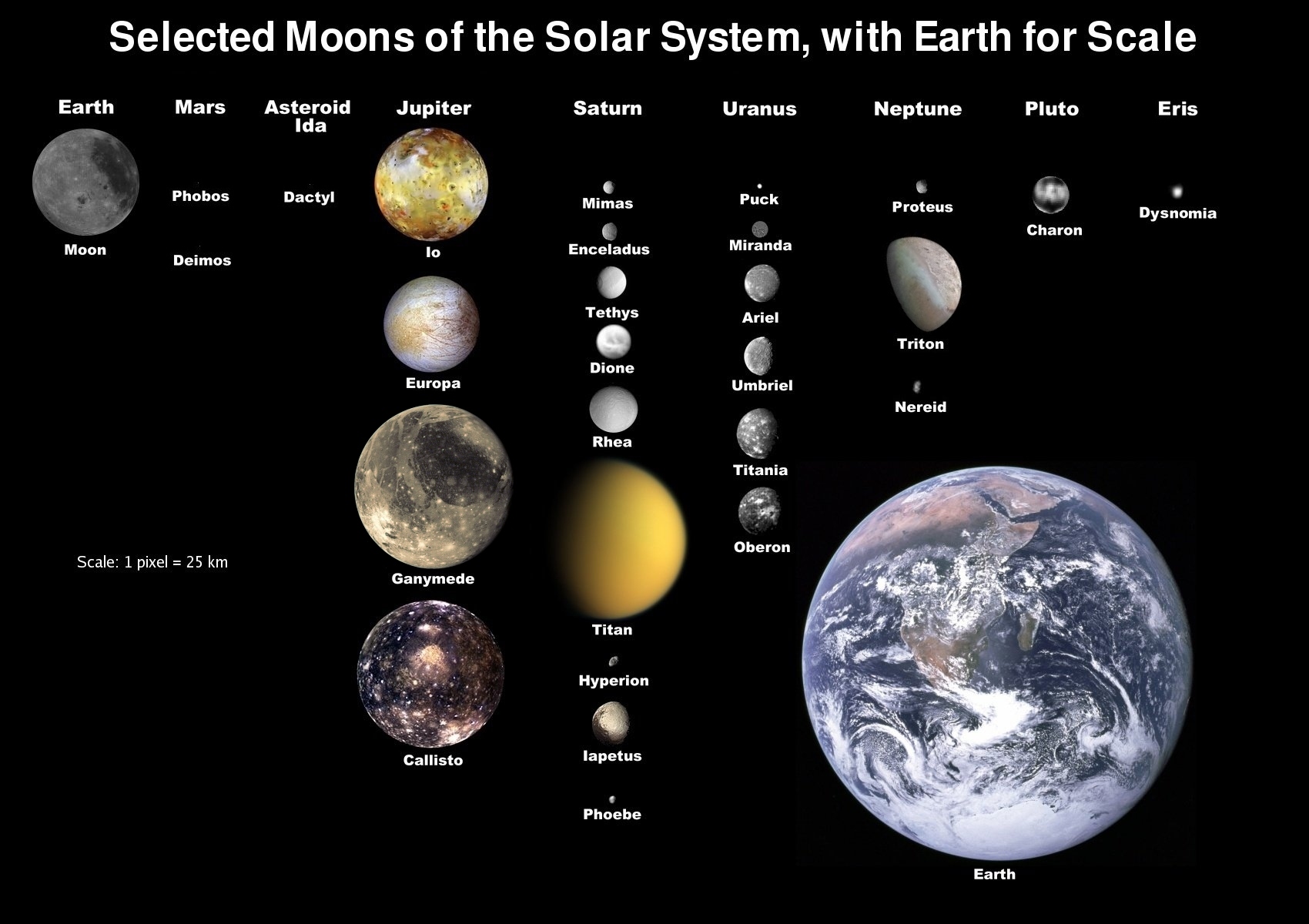
So, rather than a mere 8 or 9 planets in our Solar System, we may potentially include as many as 30 dwarf planets roaming around out there. I am deliberately ignoring the 19 moons in our Solar System, including our own, which are large or massive enough to achieve dwarf planet status (7, in fact, are more massive than Pluto: the Earth’s Moon, Io, Europa, Ganymede, Callisto, Titan & Triton) yet which clearly fall short on account of their orbiting other planets and not orbiting the sun.

Moons of the solar system

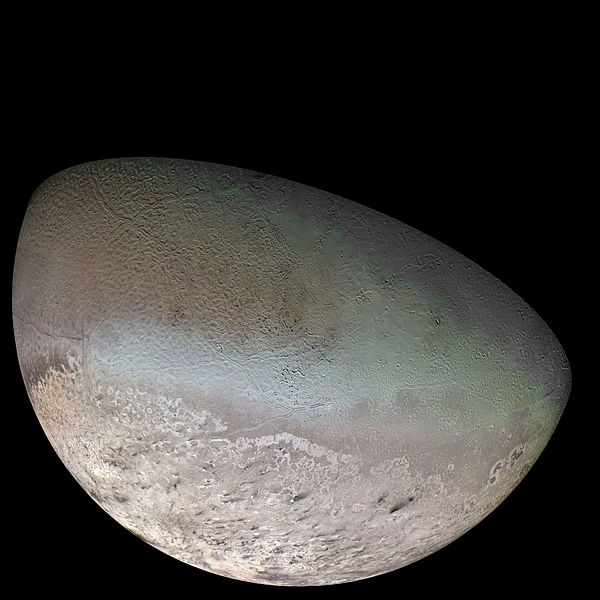
Incidentally, Triton, Neptune’s largest moon, is the only large moon in the solar system with a retrograde orbit – in other words, it orbits in the opposite direction to the planet’s rotation – and is almost certainly a Kuiper belt dwarf planet that was captured by Neptune’s gravity.
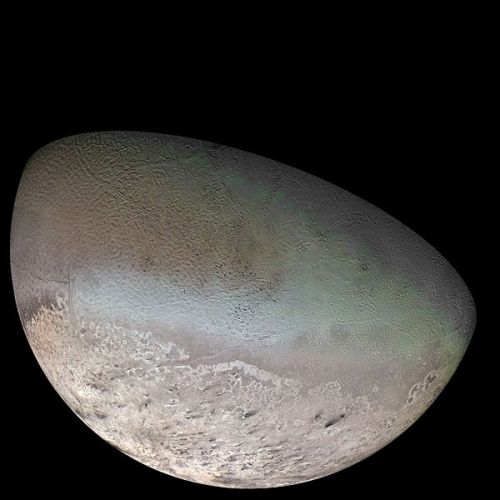
Triton moon mosaic Voyager 2

It is also worth noting that, as impressive as the number of dwarf planets discovered so far may be, the IAU estimates that there might be as many as 200 dwarf planets in the Kuiper belt alone, and, wait for it, anything up to 10,000 in the region beyond.

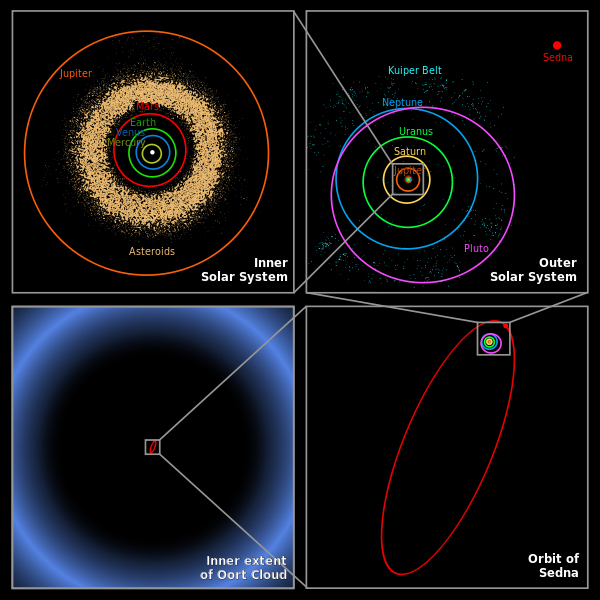
So what is beyond the Kuiper Belt? Well, remember how big space is, and here I am inclined to quote Douglas Adams: “Space is big, really big. You just won’t believe how vastly, hugely, mindbogglingly big it is. I mean, you may think it’s a long way down the road to the chemist’s, but that’s just peanuts to space…” Well, the solar system itself is also really big. The sun, an otherwise unremarkable star amongst billions, exerts an influence across a region that likely extends as far as 50,000 AU – roughly one light-year from the sun itself, though some are even willing to speculate that its influence extends loosely as far as 200,000 AU. The Kuiper belt is but a tiny narrow region by comparison to the Oort Cloud which surrounds and embraces the entire Solar System, as the image below makes clear. We shall talk about Sedna later.

Oort cloud size comparisons

Exactly what lies in the Oort cloud is anyone’s guess, though we needn’t assume it is anything alarmingly different from what we find in the Kuiper belt or asteroid belt for that matter. It is just another vast sea of rock and ice, and the likely point of origin for most comets which enter our inner Solar System.

Oort cloud diagram

Yet, I don’t wish to digress too far into the lesser known outer regions of the Solar System, which it is not feasible to explore adequately in the immediate future. Instead, let’s turn our attention to some of the exciting new (and not so new) dwarf planets that have been identified.

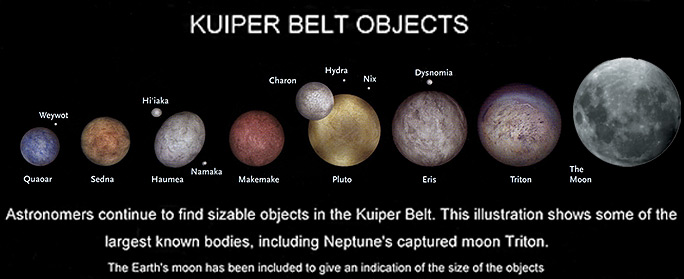
Five dwarf planets

KB objects, nice one

Trans-Neptunians, size, albedo

ERIS

We must begin with Eris, which is, in effect, the key player in the drama surrounding Pluto’s demotion. It was with the discovery of Eris in January 2005 that astronomers decided they needed new rules for determining exactly what constitutes a planet. Eris is actually larger and heavier than Pluto. At roughly 2336 km in diameter and just over a quarter the mass of the Earth, it is by no means an insignificant little rock. On account of its size, Eris briefly earned the title of the 10th planet, yet it was precisely because astronomers expected to find further objects of similar mass and size that they decided new rules needed to be established before the number of official planets got out of hand.
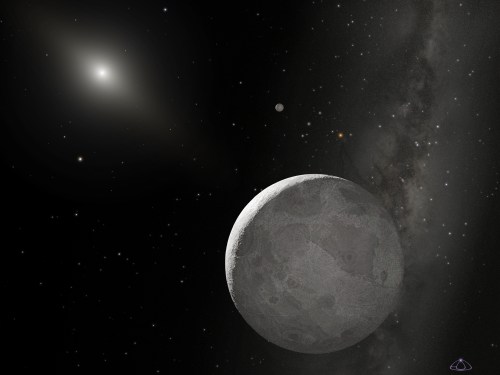
Eris, artist impression

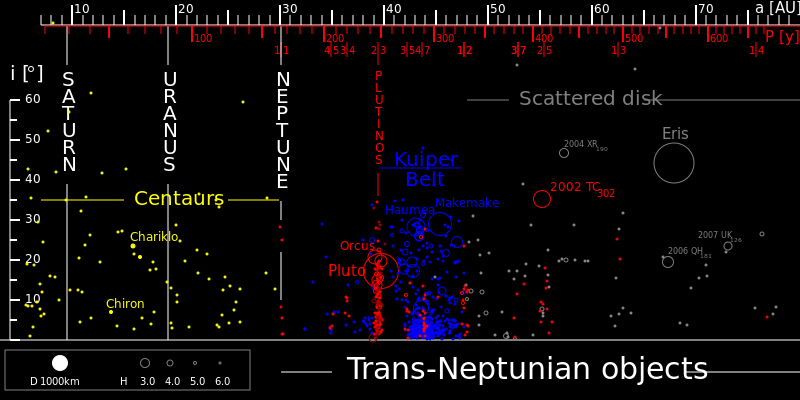
Eris actually resides in a region called the scattered disc. This region covers much the same space as the Kuiper belt, yet scattered disc objects are characterised by their less stable orbits.
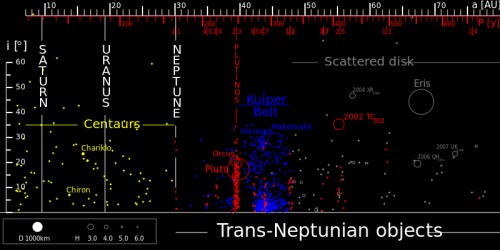
The Transneptunians

The distinction is not, however, clear cut and many astronomers include the scattered disc as part of the further reaches of the Kuiper belt. The orbit of Eris is typical of scattered disc objects in that it is highly elliptical.

Orbit of Eris

During an orbital period of 557 years, its distance from the sun varies between a maximum (aphelion) of 97.5 AU, to as low as 37.9 AU (perihelion). In 2011, Eris was close to its aphelion at 96.6 AU, and will not return to its perihelion until around AD 2256. This eccentric orbit naturally affects the planet’s temperature significantly, though its distance from the sun is so great at the best of times that its range of temperature is estimated at somewhere between 30 and 56 Kelvin – ie. -243 to -217 degrees. Not very hospitable. Infrared light from Eris indicates the presence of methane ice on the surface, suggesting it is similar in some ways to Pluto. Eris appears to be grey in colour, though, like Pluto, it is far too distant to determine any surface features at this range, with our current technology. The artists’ impressions, detailed as they may appear, are merely approximations based on information gleaned from our knowledge of its mass, density, albedo (reflectivity) and the colour of light it emits. 
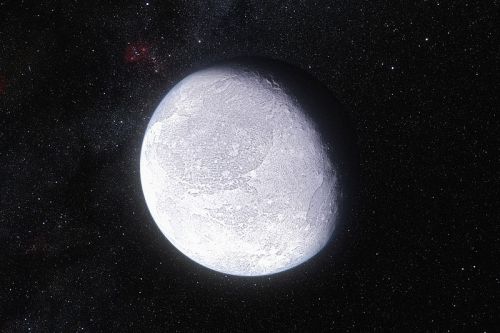
Eris artist impression

It is unlikely that we shall get a close look at it in the near future, so holding your breath is not recommended. But we most certainly will, sometime in the next few centuries, if we don’ t destroy ourselves. Eris also has one known moon, called Dysomia, the name of the goddess Eris’ daughter, and also the ancient Greek word for “lawlessness.”

CERES

Our next stop on the New Solar System tour is Ceres – a dwarf planet whose presence has been known since 1801. Despite its not being a new discovery, Ceres has only recently been re-categorised as a dwarf planet and is unique in being the only dwarf planet in the inner Solar System. Being the largest body in the asteroid belt, it was the first object to be identified in that region and was originally designated planetary status, along with the asteroids 2 Pallas, 3 Juno and 4 Vesta – a status it retained for roughly 50 years.

Dear Pluto, sincerely, Ceres

The classification of Ceres is still somewhat unclear, with Nasa and various astronomy manuals continuing to refer to it as an asteroid, but then, the term asteroid has never been defined adequately and in many cases “minor planet” is used as a sort of umbrella rubric. So much for semantics. To all intents and purposes, however, Ceres is a dwarf planet. It certainly has a neat, round shape because its mass is sufficient to round it – rule 2 of dwarf planet status as outlined above.
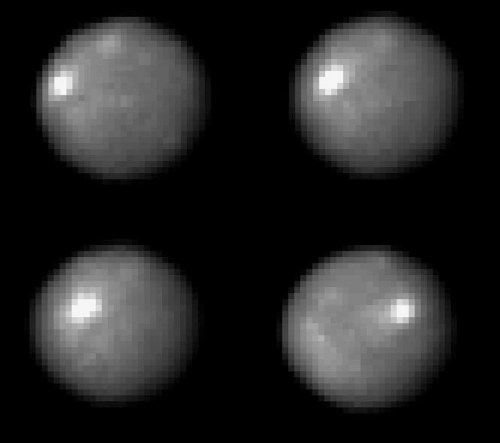
Ceres Rotation

Ceres may be the largest object in the asteroid belt – around 950km in diameter – and consists of roughly one third of the belt’s total mass, yet it is still rather small, consisting of roughly 4% of the Moon’s mass. That sounds pretty puny, but then, this equates to a surface area of 2,850,000 sq km – roughly the size of India or Argentina, which is actually pretty large.

Ceres Earth Moon Comparison

Ceres is especially exciting to us on account of its proximity, composition and its relative warmth. Orbiting between Mars and Jupiter, its maximum surface temperature has been measured at around -38 degrees Celsius, a little warmer than parts of Canada in winter : ) The surface of the planet is likely a mixture of water ice and carbonates and clay minerals and the planet may have a tenuous atmosphere, along with water frost on its surface.

Ceres Cutaway

Because of its low mass and escape velocity, Ceres has been proposed as a possible destination for manned missions. Unlike Mars, where it would be extremely difficult to take off again, Ceres offers a much easier option for a crewed ship. Ceres has even been proposed as a possible destination for human colonisation – and also as a possible way-station for further exploration of the inner and outer solar system.
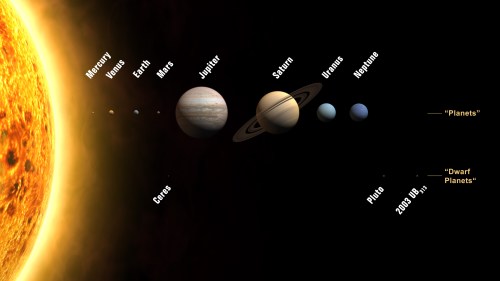
Ceres amongst the big planets

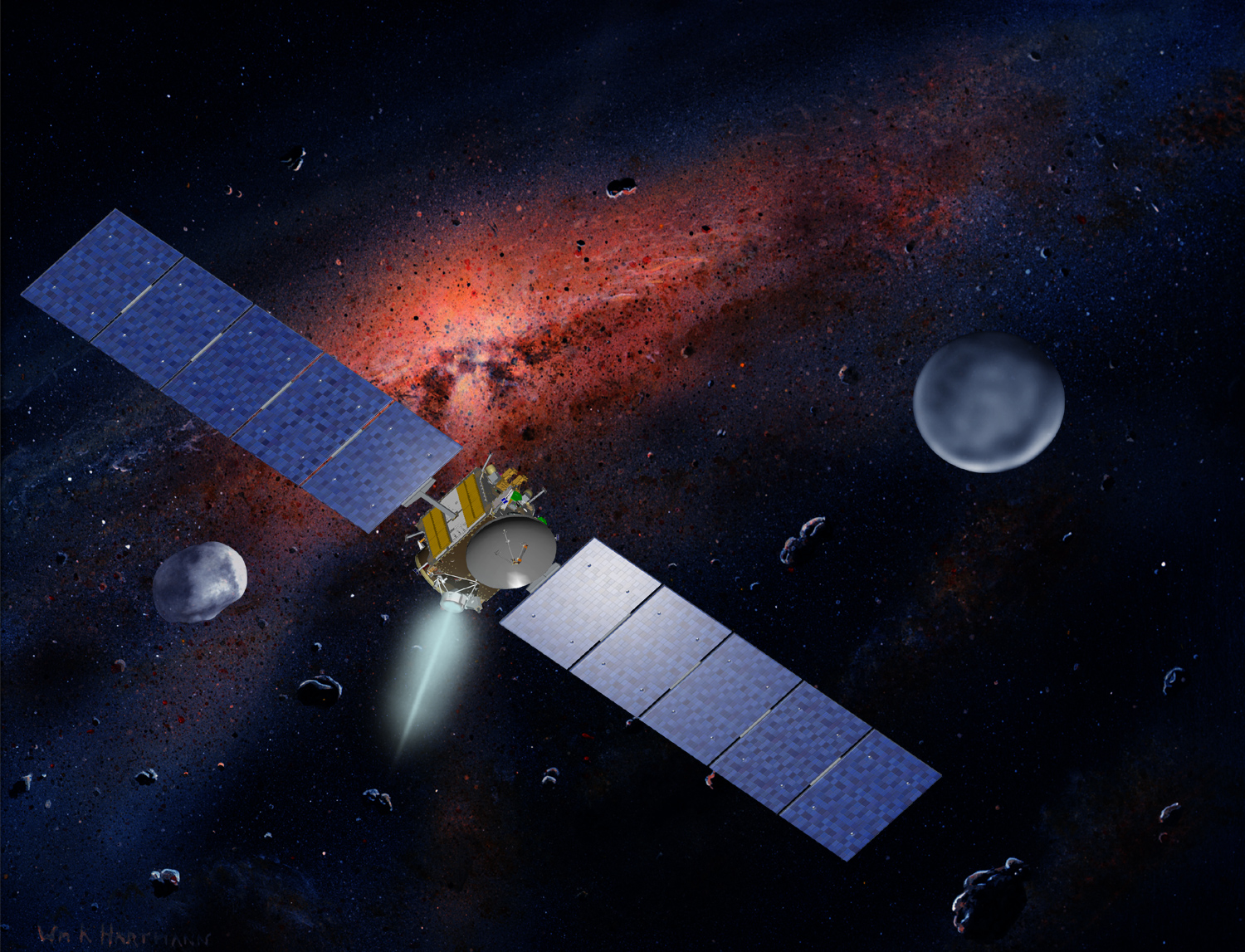
At this stage our knowledge of Ceres is fairly limited, but fortunately this is all about to change in March or April 2015 when NASA’s Dawn spacecraft arrives at Ceres. Dawn will initially orbit Ceres at an altitude of roughly 5,900 km and gradually reduce its orbit over a five month period to around 1300km. After another five months it will further reduce its orbit to a distance of only 700km. Equipped with cameras, spectrometers, gamma-ray and neutron detectors, Dawn is set to radically transform our understanding not only of Ceres itself, but of dwarf planets in general.
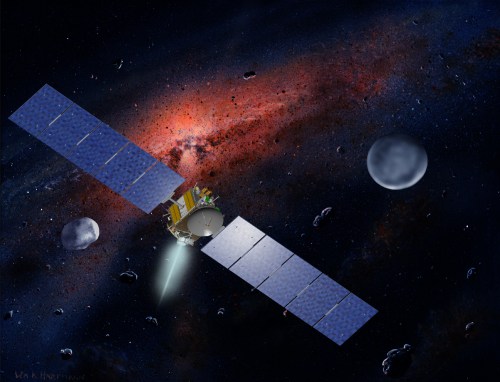
Dawn, NASA

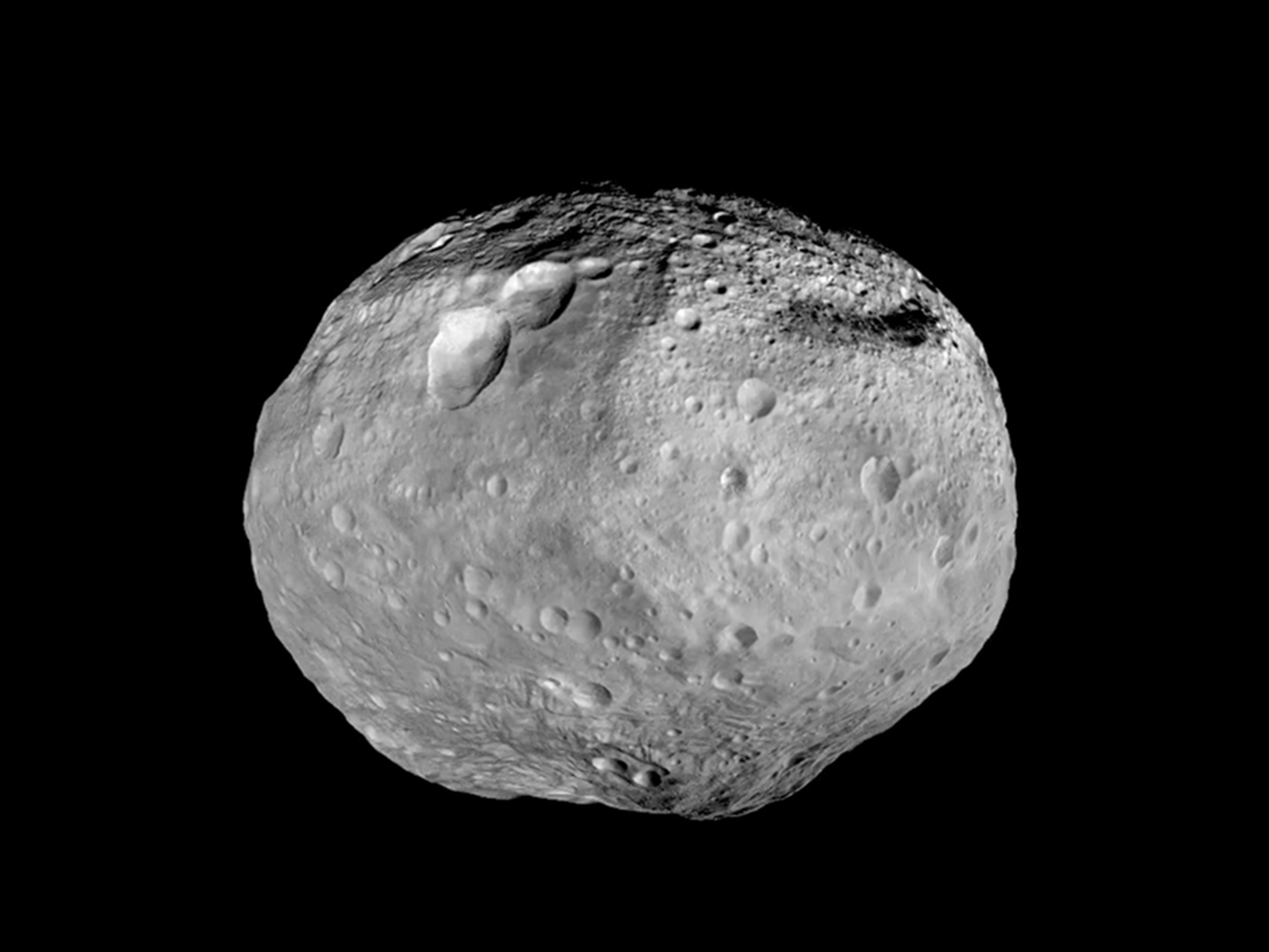
Launched in September 2007, Dawn has already spent more than a year in orbit around the asteroid 4-Vesta, which was, along with Ceres, initially recognised as a planet in the 19th century.

Vesta full mosaic

It is one of the largest asteroids in the solar system with a mean diameter of 525 kilometres and comprises roughly 9% of the mass of the asteroid belt. At 800,000 square kilometres, its surface area is roughly the size of Pakistan. Sadly for Vesta, however, it didn’t quite make the dwarf planet grade and remains an asteroid, terminologically.

Vesta comparison

MAKEMAKE

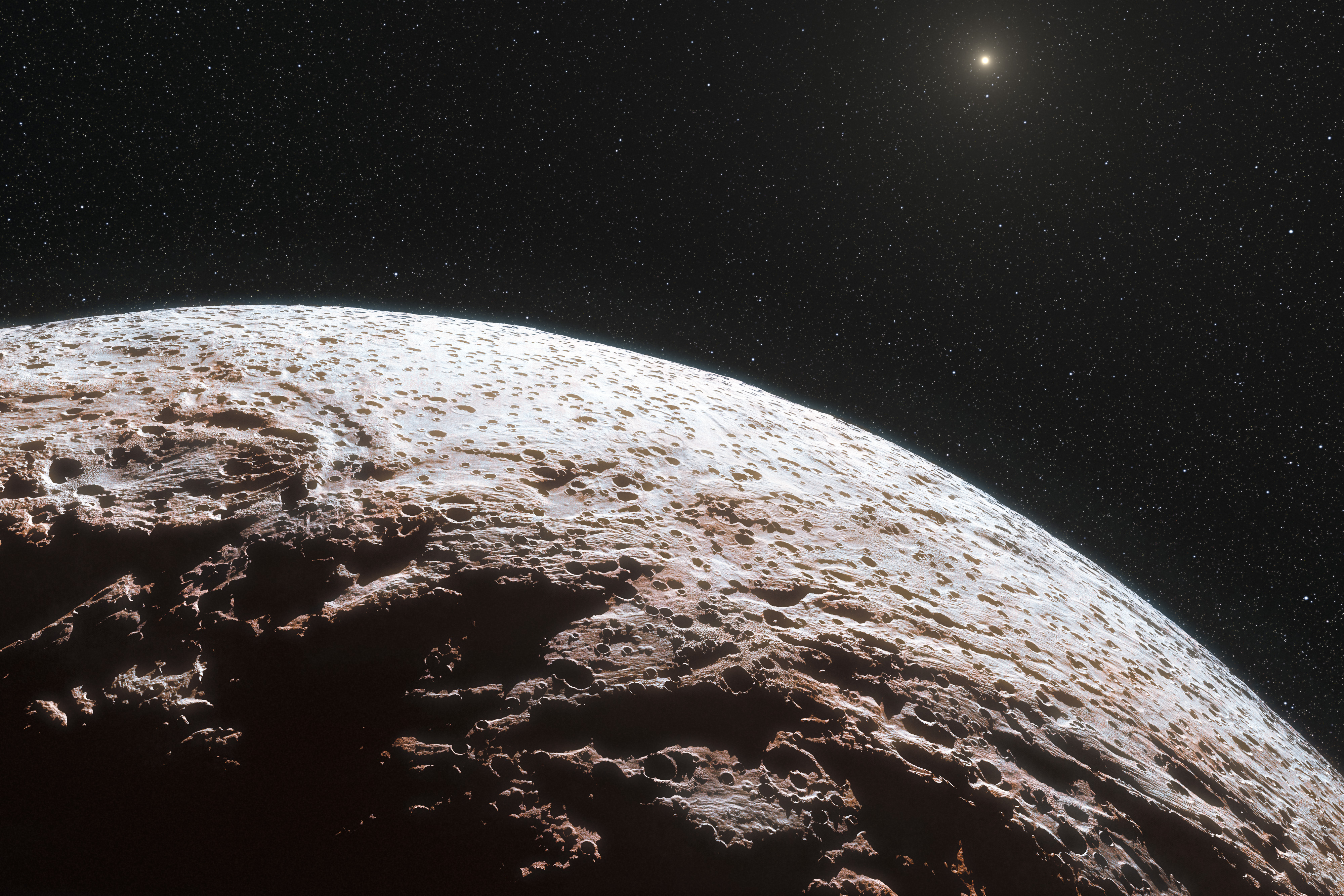
Next on our list is Makemake, a dwarf planet named after the eponymous creator of humanity and god of fertility in the mythos of the Rapanui, the native people of Easter Island. It is roughly two thirds the size of Pluto and has no known moons, making it very difficult to correctly estimate its mass. Makemake is considered another Kuiper belt object with an eccentric 310-year orbital period which varies in distance from roughly 38.5 AU to a maximum of 52.3 AU.
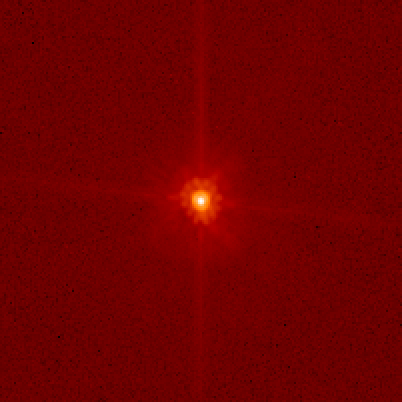
Makemake from Hubble

Makemake was another recent discovery – March 31, 2005 – and was officially recognised as a dwarf planet by the IAU in July 2008. Makemake is too distant to obtain detailed information or images and our best observations come from April 2011 when it passed in front of an 18th magnitude star. Makemake appears to lack a substantial atmosphere and its surface is likely covered with methane, ethane and possibly nitrogen ices. On account of its surface gases, Makemake might have a transient atmosphere much like Pluto when it nears its perihelion – ie, is closest to the sun. Like Pluto, Makemake also appears red in the visible light spectrum on account of the presence of tholins on its surface – molecules formed by irradiation of organic compounds such as ethane and methane, which have a reddish brown appearance.
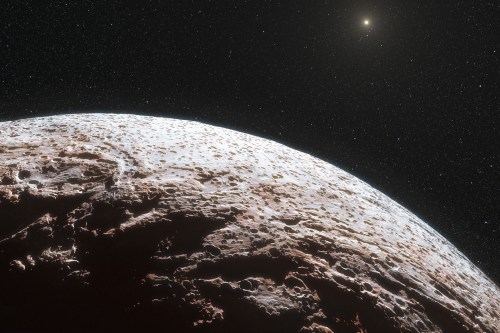
Makemake - artist impression

The colour and albedo of the surface varies in places, giving the planet a somewhat patchy, spotty appearance.

HAUMEA

Named after the Hawaiian goddess of childbirth, Haumea was discovered in 2004 and recognised as a dwarf planet on September 17, 2008. It has two moons by the name of Hi’iaka and Namaka. Haumea is distinguished not only by its shape, but by its unusually rapid rotation, high density and high albedo – caused by a surface of crystalline water ice.

Haumea, artist's impression

The surface colour and composition is considered peculiar – for its location the solar system, it should not have crystalline ice, but what is known as amorphous ice. This has led astronomers to assume that some relatively recent resurfacing has occurred, though no adequate mechanism has yet been proposed for this. A large dark red area on Haumea’s otherwise bright white surface was identified in September 2009, possibly the result of an impact. This suggests an area rich in minerals and organic (carbon-rich) compounds, or possibly a higher proportion of crystalline ice. Consequently, Haumea may have a mottled surface similar to that of Pluto, if not as diversified.

Haumea strikes me as an odd designation on account of its ellipsoid shape, as illustrated here.
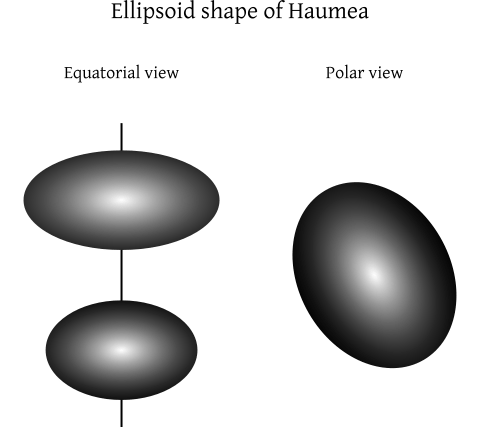
Haumea, shape

Haumea’s shape has not been directly observed, yet it is inferred from its light curve, which suggests that its major axis is double the length of its minor. This may seem to challenge the definition of what constitutes a dwarf planet, yet it is considered to be in hydrostatic equilibrium – which, just to remind you, means : the object is symmetrically rounded into a spheroid or ellipsoid shape, where any irregular surface features are due to a relatively thin solid crust. Confusing, I know, but such is the nature of planetary classification. The shape and spin of the planet are thought to be the result of a giant collision.

2003_EL61_Haumea,_with_moons

Haumea’s orbit is not dissimilar to that of Makemake, following a similarly elliptical path ranging from 34.7 AU to 51.5 AU. Like so many of the dwarf planets, it is a frozen and forbidding place, though at least the presence of water ice offers some refreshment.

PLUTO

And last, but not least, let’s take a look at good old Pluto, a dwarf planet almost as mysterious as the others. Pluto is the second most massive dwarf planet after Eris and the tenth most massive body orbiting the sun. Composed primarily of rock and ice, it too has an eccentric and highly inclined orbit which, like many of the other TNOs, takes it from roughly 30 to 49 AU during its 248 year orbit. Pluto is exceptional among the other outer Solar System dwarf planets in that its orbit periodically brings it closer to the sun than Neptune. As of this year, 2014, Pluto sits at a distance of roughly 32.6 AU.
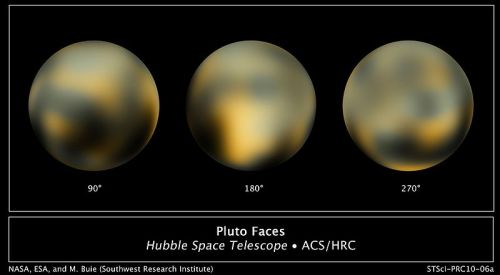
Pluto surface images from Hubble

We have already discussed Pluto’s demise as a planet, yet the questions surrounding its status began as early as 1977 with the discovery of a minor planet designated 2060 Chiron, an early candidate for the much coveted title of 10th planet. Chiron was the first of numerous icy objects to be found in the region of Pluto, suggesting that Pluto might merely be one of a cluster of minor planets in the outer Solar System. The ultimate result of course, after the discovery of Eris, was Pluto’s demotion, yet still many astronomers argue that it should remain a planet and the other dwarf planets be added to the planet count.

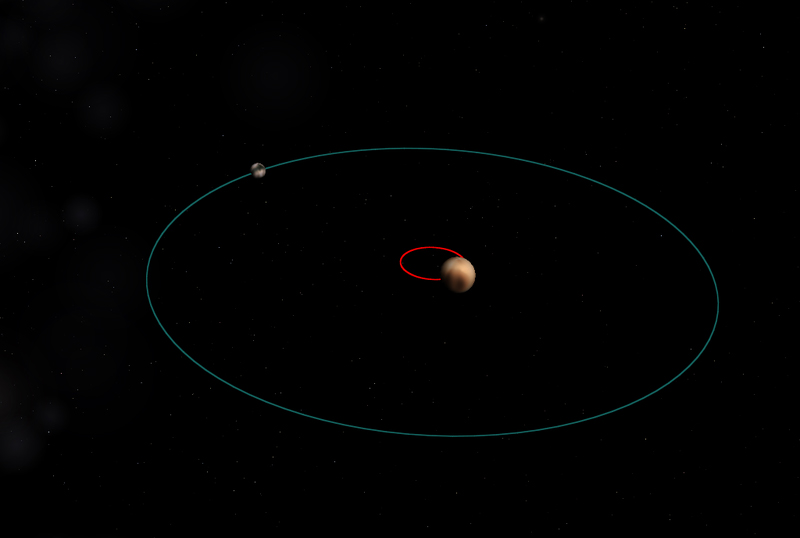
Pluto, however, has a further major peculiarity – it has five moons by the names of Charon, Nix, Hydra, Kerberos and Styx – and rather than these neatly orbiting around Pluto, it exists in a kind of binary dance with its largest moon.

587px-Pluto_moon_P5_discovery_with_moons'_orbits

The barycenter of their orbits does not lie at Pluto’s centre, but between Pluto and Charon, rather like two dancers holding hands and swinging each other round, though Pluto remains very much at the centre of the dance.
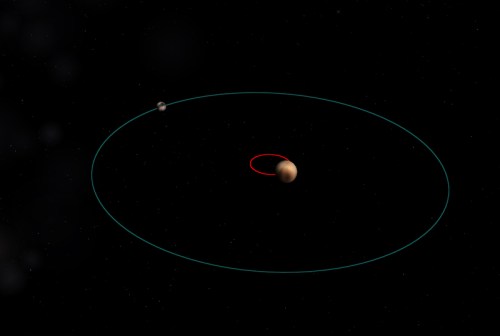
Pluto Charon dance

The IAU has yet to distinguish between such binary dwarf planet systems and others, and for the moment, there is simply no distinction.

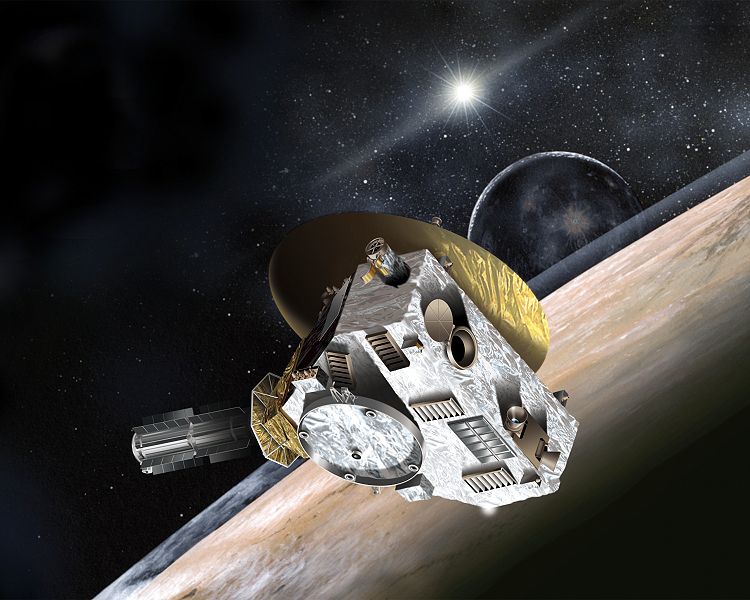
Our observations of Pluto have been very limited and only very unclear images exist of its surface. This, however, is about to change dramatically when, in 2015 (a great year for planetary exploration, woot!) NASA’s New Horizon probe will finally arrive at Pluto and perform a flyby. New Horizons will attempt to take detailed measurements and images of Pluto and its moons. When it has passed Pluto, New Horizons will attempt to explore the Kuiper belt, and astronomers have spent the last few years trying to find suitable targets within its flight path. Stay tuned.

750px-New_horizons_Pluto

What we do know about Pluto is that it has one of the most contrastive appearances of any body in the Solar System, with distinct polar regions and areas of charcoal black, dark orange and bright white. It has a thin atmosphere of nitrogen, methane, and carbon monoxide gases, which are derived from the sublimation of the ices on its surface. Like some of the dwarf planets already discussed, Pluto’s elliptical orbit has an effect on its atmosphere and surface pressure. Indeed, as it moves further away from the sun, its atmosphere is likely to freeze and collapse.

Like so many of the dwarf planets, which are extremely difficult to study directly, the size and mass of Pluto is based on best estimates. It is tiny compared even to the Earth, with a diameter of roughly 2306 km – around two thirds that of the Moon. It’s surface area is 16,647,940 km2 only 3.3% the size of Earth, and yet, when you consider that is roughly the size of Russia, it doesn’t seem all that small after all. Its mass, however, is significantly smaller proportionally at an estimated 0.24 % that of the Earth and, volume wise, around 18 Plutos could be squeezed inside the Earth. As mentioned above, Pluto is actually less massive than seven of the moons throughout the Solar System.

QUAOAR, ORCUS & SEDNA

So there we have it, a rough and ready tour of the new Solar System. There are other as yet unclassified dwarf planets that could be discussed here: little pale-red Quaoar – about half the size of Pluto with one pill-shaped moon with the enticing name of Weywot;

Quaoar and Weywot

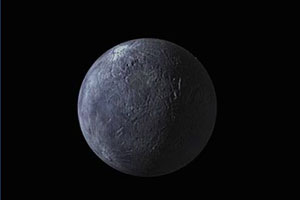
tiny Orcus, another Plutinoid about half the size of Pluto, with a similar orbital time and range, also sporting a single moon called Vanth
obscure-orcus

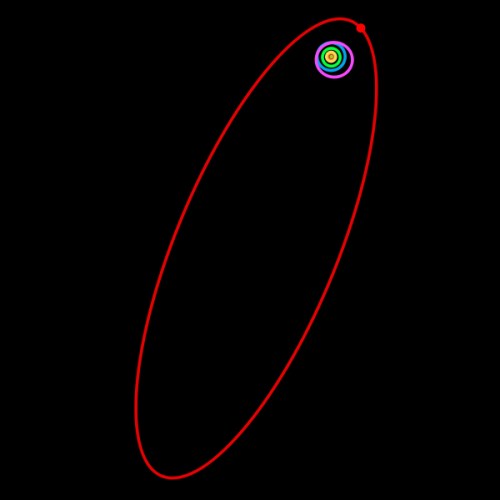
– and finally, perhaps the oddest of them all – bright red Sedna, whose extraordinary orbit ranges from c. 76 AU to 937 AU and takes roughly 11,400 years to make a single circuit.

Sedna impression

sedna orbit

It is the largest of these last three, though still just over two-thirds the size of Pluto.

Despite their almost certain classification as dwarf planets in the future, no doubt along with many others, until such a time I shall refrain from taking the liberty. As to their future exploration, I certainly hope I shall live to see more light shed on them. Considering the time and cost of preparing missions, the distance of the outer planets and the lengthy travel times, it might be decades if not centuries before these planets are better revealed or even visited. Fingers crossed it will happen sooner rather than later, if only to satisfy my  vain curiosity.
Rainy Season

Four years ago I’d never been to Bali, and now I’ve been there three times. It has become something of a habit – either as a destination in itself or a stepping stone into Asia and beyond. At only six hours from Sydney, the flight is just short enough to feel smooth and easy. So short in fact, that I ran out of time to enjoy the various entertainments I brought along to pass the time. That’s a good thing, I suppose.

This was the rainiest holiday I’ve ever had. We knew it was the wet season and had both brought collapsible umbrellas, but this was the rainiest rainy season I’ve ever encountered. Rather than the regulation afternoon downpour, which did characterise the first few days, towards the second half of the week it rained pretty hard most of the time. Fortunately, I love rain, and only once did it prove to be a real nuisance – when we found ourselves without a hotel in Candikuning. The rest of the time, it was wonderfully atmospheric; drumming on roofs, bonnets and brollies, slicking the abundant lush foliage, and pleasantly cooling the air with fresh scents.

I don’t intend to go through this holiday in step by step detail, but rather cover the basics and toss in a few anecdotes. We flew into Denpasar as per usual and were picked up by a driver to take us up into the hills around Munduk, where we spent the first two nights.

8618

8706 Munduk

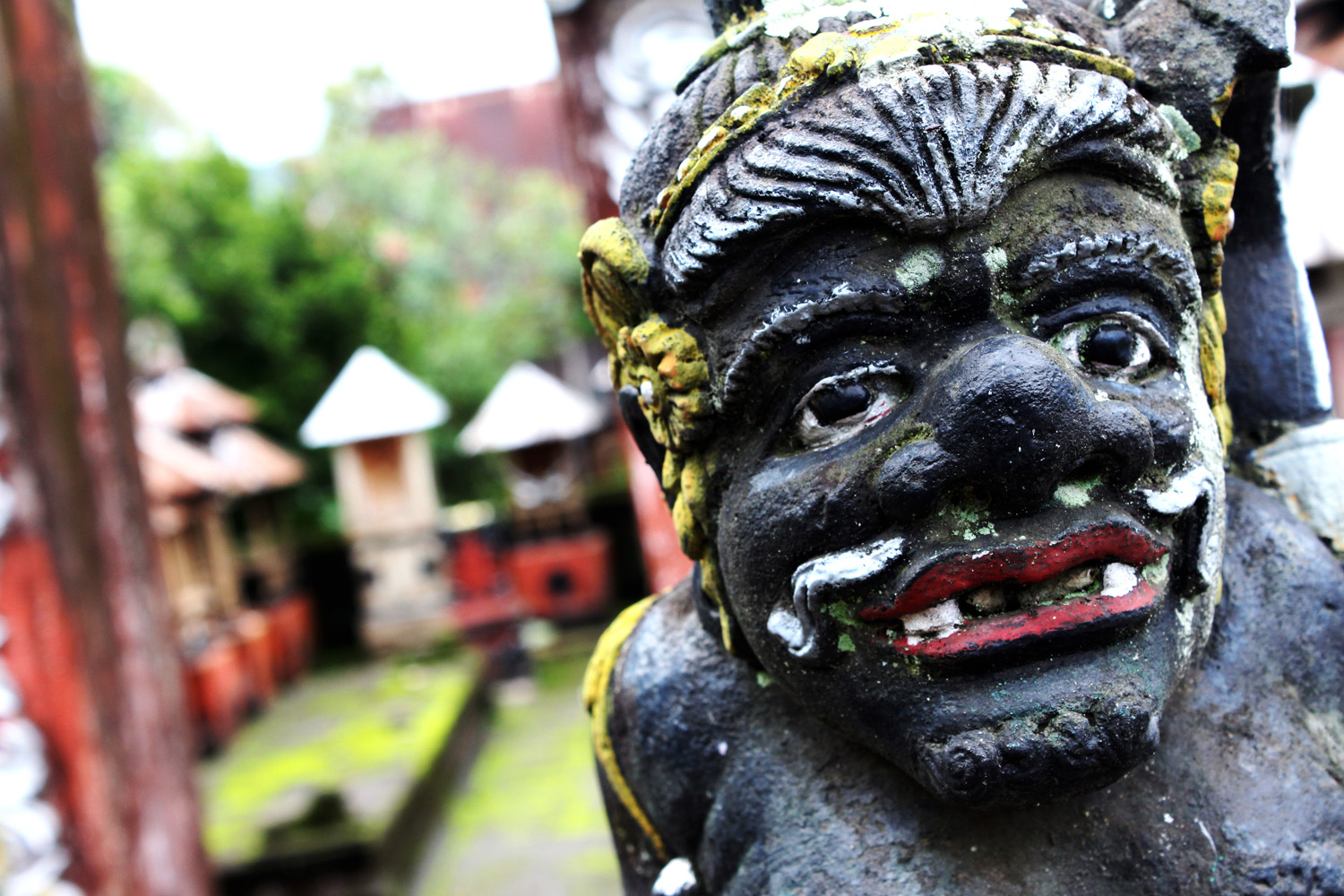
8708 Temple, Munduk

On the second night in Munduk, we stayed in the very same place my brother and I had stayed in four and a half years ago, which was surprisingly nostalgic (actually, not surprising considering I’m the most hopelessly nostalgic person I know).

8842 Waterfall, Munduk

8825 No women no cry

8901 Munduk ricefields

8928 Munduk 2

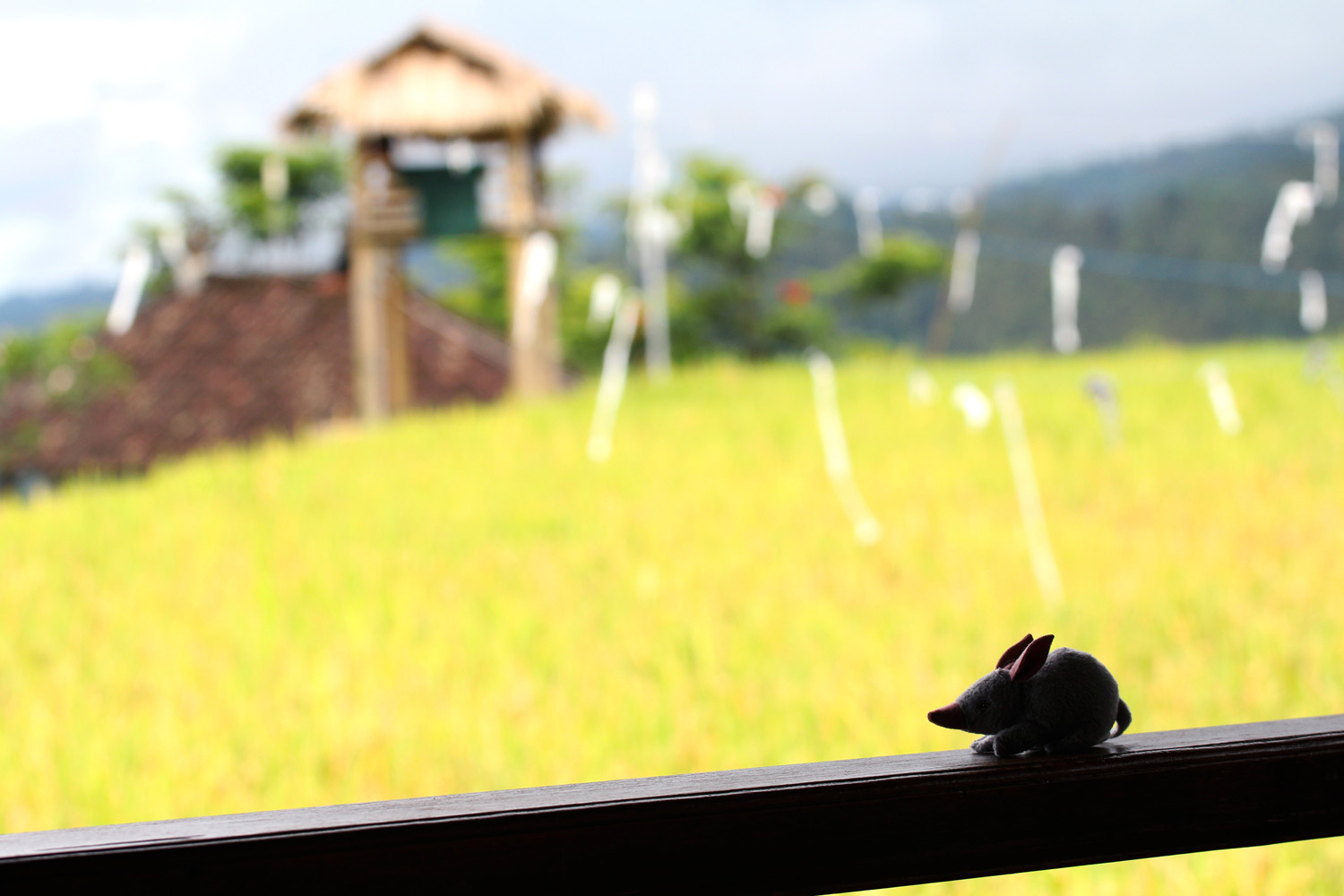
8930 Bilby, Munduk

From there we took a drive north west to Pemuteran, a coastal strip along black, volcanic beaches, where we assiduously avoided requests to partake in “activities.” Pemuteran offered up an interesting palette, with emerald green escarpments interrupted by patches of black volcanic cliff; black sand soft as soil on a beach strewn with orange and peach-coloured flowers not unlike hibiscus.

8939 Driving to Permuteran 2

8975 Road to pemuteran

8961 Road to Pemuteran

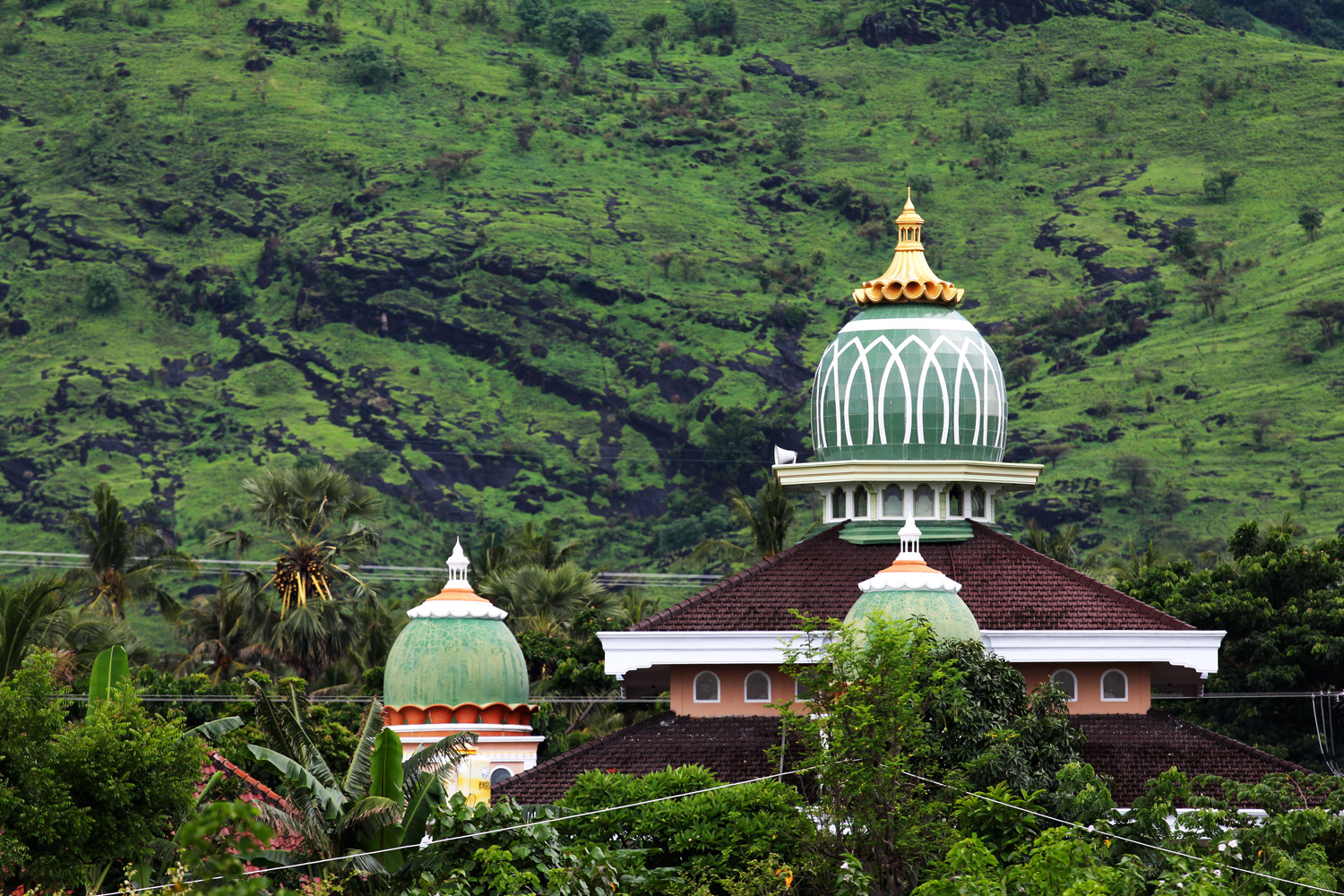
A green onion-domed mosque, young, immaculate cows amidst the blue and green outriggers beached along the bay, conical Javanese volcanoes on the horizon, all from the safe oasis of another beautiful, luxurious, indecently cheap resort, redolent with that curious blend of homeliness, perfection and transient soullessness.

9074 Pemuteran

9047 Permuteran

9049 Blue

9051 Boat, Pemuteran

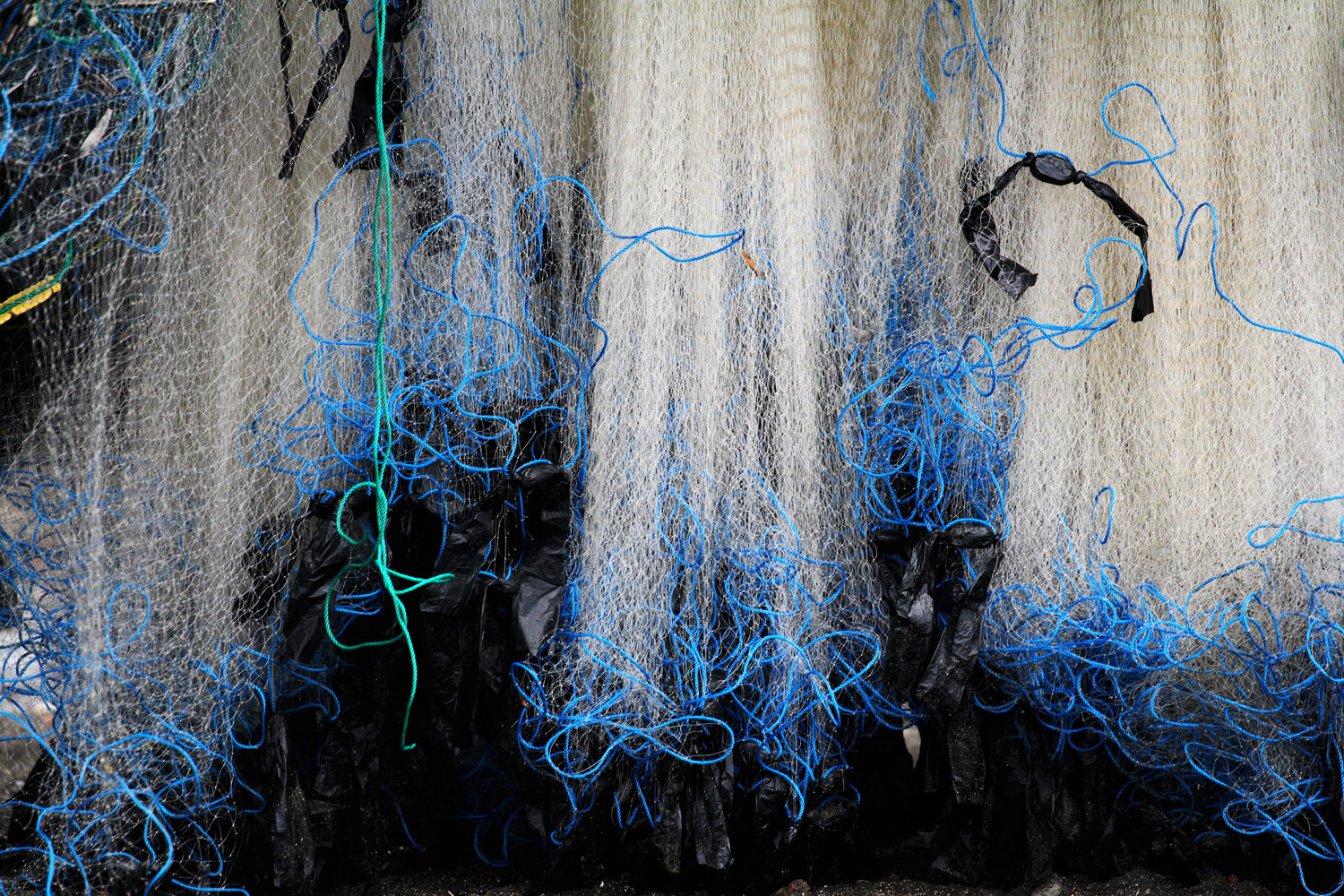
9091 Hanging nets

9087 Nets, Pemuteran

9100 Pemuteran, surf and turf

9127 collecting

8992 Adi Assri, Pemuteran

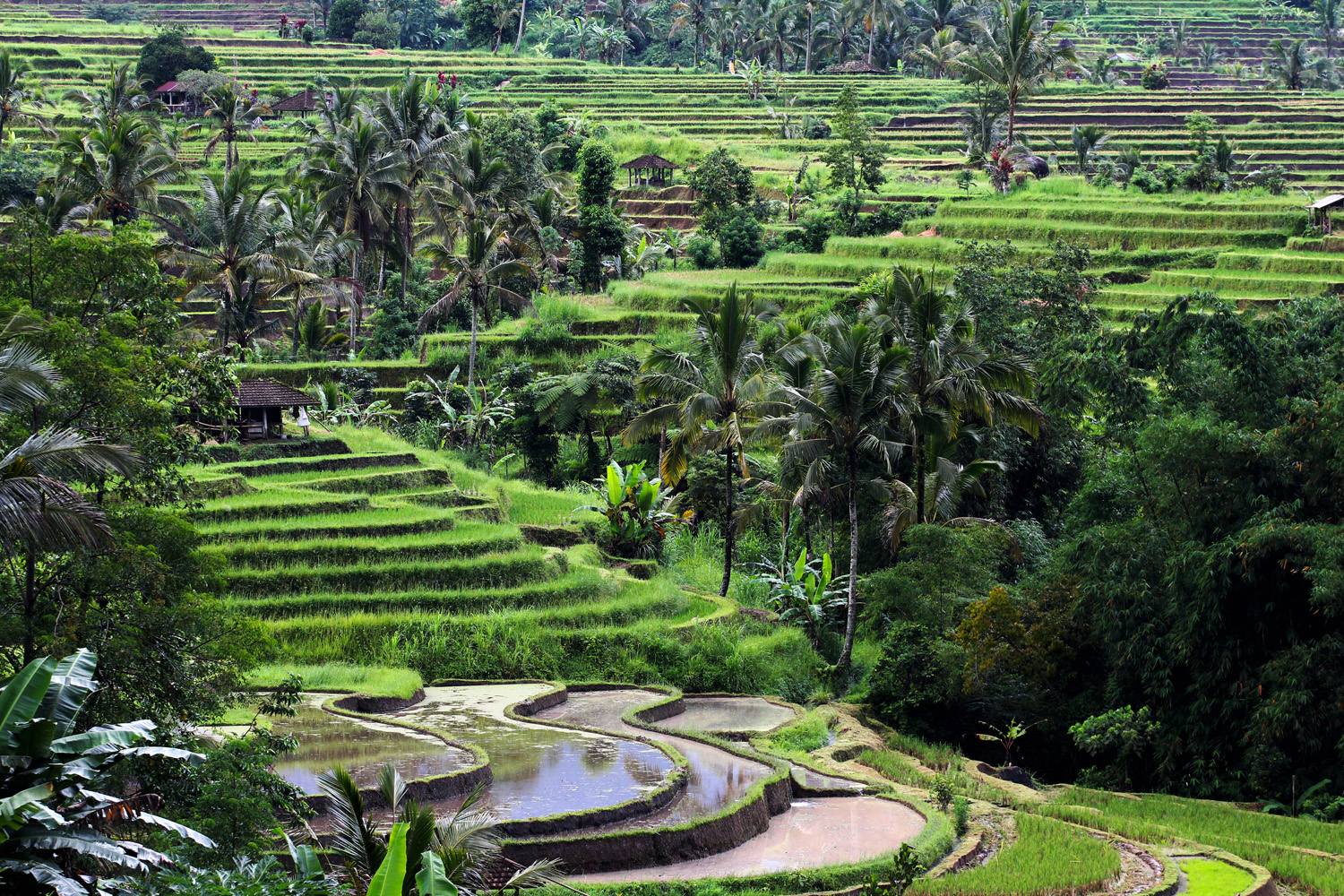
From Pemuteran, we drove to the Jatiluwih ricefields – a heritage protected area of rice terraces which have been in constant production for hundreds of years. The rain eased off to a mere sprinkle for the hour or so we spent walking around this beautiful place. It was especially attractive under the stormy skies, with filtered sunlight adding luminescence to the red rice crops.

9257 Bobble-head dog

9359 Jatiluwih ricefields

9324 Jatiluwih ricefields

9375 Jatiluwih

9314 Jatiluwih

From hereon the rain set in with real fury. We drove on through the downpour to Candikuning, where, at the height of the storm, we found out the hard way that the hotels we had in mind were all full. We bid our driver farewell, not wishing to inconvenience him further, and plunged into the rain and rivulet streets to see two awful musty hotels, whose abject cheapness was never going to be a good enough sell. This business, sloshing through a magnificently derelict road, shin-deep in water, brought us into contact with a most insufferable tout who at first seemed just irritatingly cheerful and assertive. He showed us to a dirty, musty room and so assumed we were going to take it upon showing it to us, that he was quite thrown when we indicated otherwise. We told him very politely, somewhat bemused, that we didn’t need his help, but he followed us all the same, hurling out offers. At first it was almost funny, but soon became rather tiresome. People in Bali, with the exception of some heavily touristed areas, are not usually so persistent, so it seemed out of place in this dead town. He also wearing a Soeharto tee-shirt, which didn’t exactly enamour me towards him. For some reason, I suspected he was from Java.

We got away and wandered into the market, where we downed umbrellas and sat in the local warung. We thought we were in the clear until our pursuer appeared again and sat at our table uninvited! Here he persisted in hurling constant, annoying questions about where we were from, what we were doing, which services we needed and the like, which we chose increasingly to ignore. Indeed, he only left when the owners, who clearly couldn’t stand him either – no doubt he had a reputation for acting like a big shot – asked him if he intended to order something, and when we began, quite simply to ignore him completely and pretend not to hear his words. A message for all touts out there – if you have no empathy with potential customers and don’t know when you’ve pissed people off to the point that they can’t stand you and are forced to pretend you’re not actually there, you should not be in the business of customer relations. The food in the warung, incidentally, was bloody amazing.

9390 Road to Candikuning

9423 Candikuning

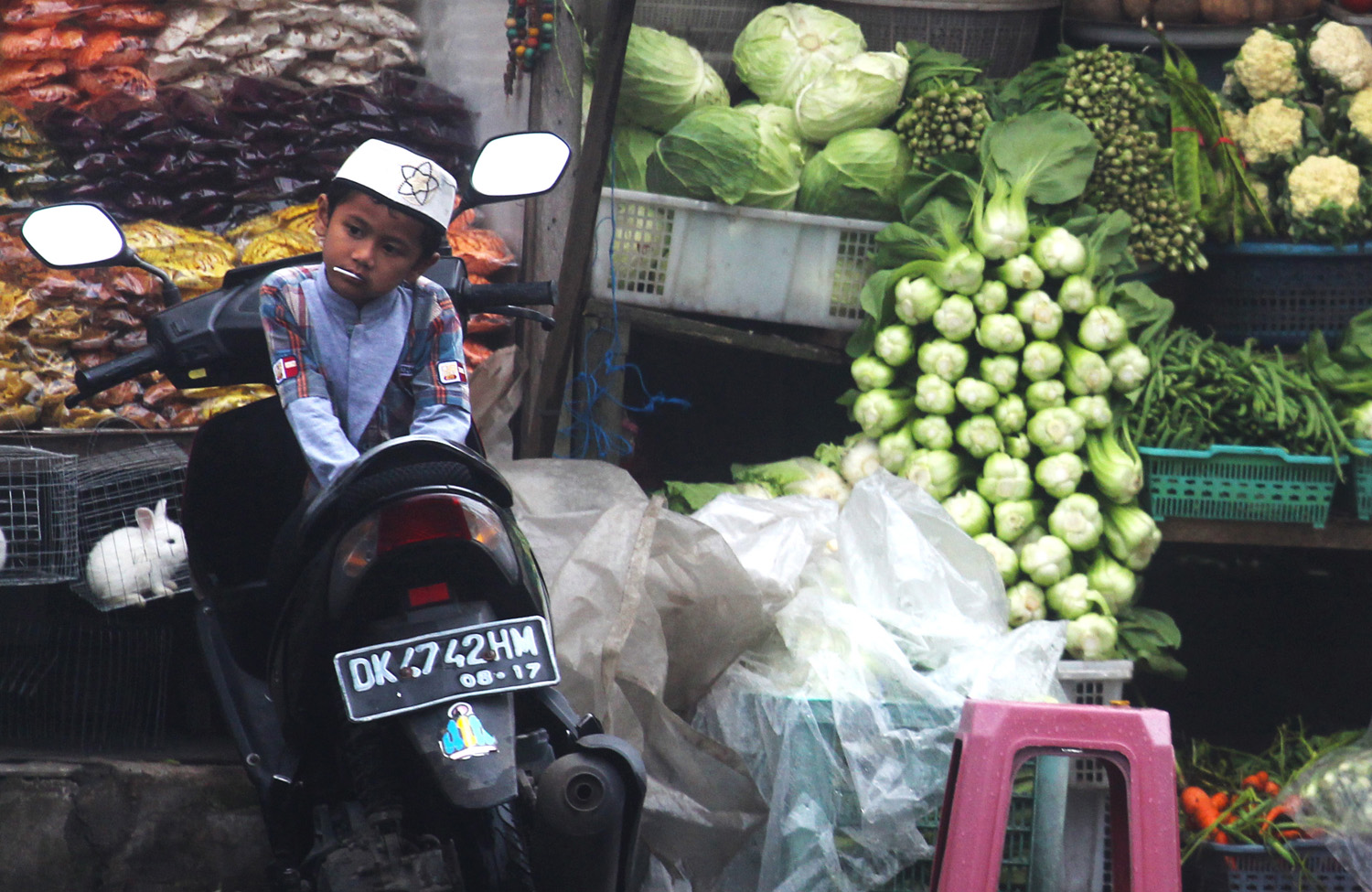
9460 Boy and rabbit 2

We organised a driver with some far more congenial and amusing locals, who had a much better idea of how touting can be done in an amusing and entertaining way. They were trying to sell me watches, but were good humoured enough to make fun of how “genuine” their watches were, and laughingly told me they would last a hundred years. He even used the term “100% pure plastic”, which warmed my heart.

9465 Servo toilet sign

We had said at the start of the trip that we would try to avoid going to Ubud and see other parts of the island instead, but stuck in Candikuning without a hotel and unsure where to go next, we figured Ubud, which we do rather like, would be a pretty nice lay-up in the rainy weather. So, two hours south with a couple of local stoners in the front, brought us to the Honeymoon Guesthouse. Like almost all hotels in Ubud, and indeed, Bali, this place was astonishingly beautiful. We chose the most expensive room, which was a mere sixty dollars, and was, like so many rooms in Bali, actually a suite with a huge terrace balcony and epic bathroom. The local architectural style, so old-world Asia, all stone and carved wood, bamboo blinds, four-poster mosquito net king sized bed, polished flagstone floors, high, pointed roof of wood and thatch, no ceiling, surrounded by lush gardens, dripping with rain. I went onto the balcony and spent the next five minutes in reverie, for this was my long yearned-for favourite melancholy mood made real.

9480 Honeymoon Guesthouse

Ever since I was a child, all I’ve wanted is to be inside, looking out upon rain falling on plants, ideally in a jade green, evocative and beautiful place, with nothing to do at all, free to indulge a mood of nostalgia or fantastical escapism. Fed fatly on the fantasy genre, be it through role-playing games or literature, I longed for these worlds, which, somehow, I always imagined to be rainy. There’s something so compelling about rain – how it quietens sound with its pleasant rush and drum, how it smells so fresh and refreshing, how, in the often dull light it causes everything to wetly glisten. On that balcony, with its high outlook into trees and flowering shrubs, and views of the other hotel buildings – imposing, yet homely stone, elaborate wooden features, hanging screens – I felt such intense repose that I wanted to curl up on the divan and never say another word for the rest of my life. Someone had bottled the heart-wrenching sadness of Crouching Tiger’s lush and dreamy aesthetic.

Then, however, there were the frogs. The block adjacent to our room was vacant and overgrown – banana trees entirely covered with creeper, just a few propeller-blade leaves poked from the clambering carpet – and it was full of loudly belching frogs.

9566 Banana trees

9573 Ubud

The man who showed us to our room initially laughed them off. “Ha, the frogs,” he said. “Because of the rain.” We rather figured they would stop croaking at some point – surely they couldn’t go all night? Yet when we returned from dinner later (a smashing meal at Casa Luna, the Honeymoon’s celebrity-chef restaurant a few hundred metres walk away), the frogs were going harder than ever.

9521 Honeymoon

9528 Ubud

9519 Honeymoon

Now, it might seem ridiculous that frogs could be so loud as to drive you from your room, but there were so many of them and they must have had some real mother air-sacks in their throats, because the sound they produced, even with the doors and windows shut, was like having a group of men in the room, cupping their hands and clapping as loudly and resonantly as possible. Or, for that matter, a gang of drunken young men burping into megaphones. In ten minutes, I had a headache and couldn’t hear myself think. Sleep in that room was out of the question, so we had to toddle off down to reception and, after looking at three other rooms, move house, so to speak. I felt very sad to leave our perfect room, yet we moved into the very one I’d been looking across the balcony to, and it, though not as absolutely perfect as the first, was still, let’s face it, borderline perfect.

From no plans to visit Ubud, we spent three nights there. Partly because we didn’t feel like doing another journey after a bunch of longish drives over the last few days, but ultimately because I got sick. For the first time, I was struck with Bali belly, as it’s called, and spent a couple of days feeling weak and on the toilet. This wasn’t so bad in the end, because I didn’t really want to leave my amazing hotel room which also had a huge terrace “balcony” with divans on which to lie. I went to the local book store, bought a copy of The Life of Pi, hurried home before I pooed my pants, and spent the rest of the day lying on the divan reading. I’ve written elsewhere of how, when I had a similar stomach problem in India, I spent two days reading in a gorgeous room in Pushkar, and this was an equally lovely experience.

9719 Reading spot

9591 Ubud

9605 Ubud

9594 Ubud

9653 Creative tattoos 2

9598 Rice

9621 Ubud streets

9689 Ubud

When we finally left Ubud, the rain had set in permanently. We took a car all the way down to the Bukit Peninsula, where we had to wait three hours for our room to be ready, despite their assurances that arriving early was no problem, got jacked off, told them to forget it, walked down treacherous stairs to Bingin beach, sat a while under shelter from the rain watching the cranky surf, then went and found another hotel, checked in, found the bed to be too musty, checked out, grabbed a car and told the driver to take us to Balangan beach, totally on spec. Through bucketing, piss-down rain, past the basket-wrapped corpse of a lorry driver from Flores, who had tragically fallen foul of the treacherous weather, our driver took us to a bloody splendid place – another “perfect” resort, La Joya, with gorgeous “bungalows”. The inverted commas are appropriate here, because traditionally bungalows don’t have epic sliding walls of rounded glass, nor a “lovers corner” of plumped cushions tucked behind curtains, just to the side of the requisite four-poster…

9776 Bingin

This again offered a sweet, melancholic reading retreat. It rained almost the whole time, and when we went to the beach, it was wonderfully apocalyptic. Indeed, I’ve never seen a beach so covered in drift-wood and detritus, fronted by stilted shacks beneath whose raised floors, the relentless, stormy ocean had eaten away most of the sand, and dangerously exposed the foundations. Driftwood, erosion, shambling shacks. It was like the aftermath off a tsunami, only the buildings were still standing. The churning water was full of soil washing down in the river that cut between the shacks. It roiled in the surf; brown water and soiled waves beneath the alienating sky; an uncomfortable colour, a sickly pallor, the decay of the end of days.

9957 Balangan beach

9868 shack stairs

9917 Beach kid

9896 Balangan beach

We took our fourth massage the following morning – the most hardcore of them all, which left me somewhat sore, and that was rather that. Paid an extra half-day at the hotel, chilled and swam and read all day, then took an early evening car to the airport for a late flight to arrive home Christmas morning.

All in all, a good break – a last minute, unambitious holiday where, for the first time ever, I had absolutely no goals, no targets, nothing. Indeed, the motivation was simply that it seemed crazy to have time off work and not go overseas. Equally unambitious were my photographic efforts. Point and shoot, stab and click, but not much attention to detail. Well, the results show this – some nice atmospherics, but nothing striking, and really, I’m okay with that.

Sort of.

Next time, the sniper is back in charge.

Greece in Chaos?

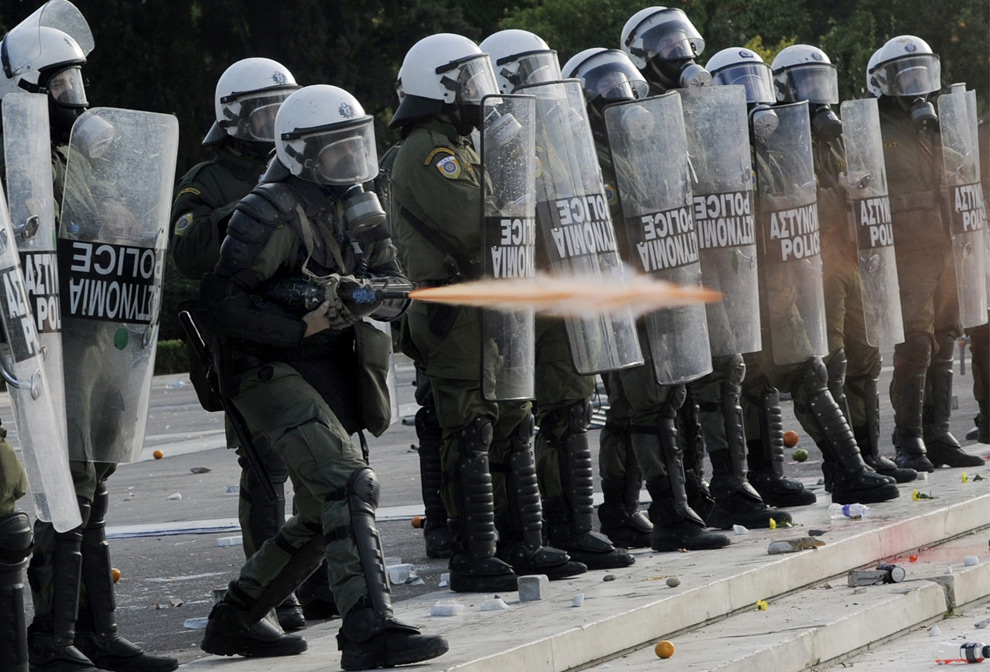
One constantly hears the word “Chaos” associated with Greece. Anyone reading or watching the news is presented with a pretty clear narrative of economic chaos, civil disorder, strikes, protests, the rise of ultra rightwing political parties, mass unemployment, increasing socio-economic division and ugly violence.

Greece riot 5

Consider the following report, which typifies the language and tone in which Greece is spoken about:

Evidence of a state tottering on the edge of complete dysfunction is apparent everywhere in Athens,” says a report by The Economic Times (ET). “Traffic signals work sporadically; a sign giving the shortened hours of one of the world’s great museums, the National Archaeological Museum, is haphazardly taped to the door; police officers in riot gear patrol the perimeters of the universities, where a growing population of anarchists, disaffected young people and drug addicts congregate in communal hopelessness.

Yet our image of the state of affairs in Greece is significantly distorted by these messages, which fail to report that most of the time life goes on in Greece, with much of the country retaining its functionality and most citizens obeying the law. Let me be perfectly clear from the start here, I am neither questioning nor denying the scale of Greece’s economic and social problems, which are quite extraordinary, rather I’m calling into question the image that is being painted of Greece by the media, which may ultimately make matters worse for a country so heavily dependent on tourism. During a recent visit to Greece, albeit for a mere ten days, I was continually surprised by how little “chaos” was evident. I don’t pretend to have sufficient knowledge or experience of what is happening across the country, but only wish to explore this whole question in the light of my limited experiences.

To begin with, I spent most of the time I was there on the islands, travelling from Rhodos, to Santorini, then onto Mykonos via Paros and Naxos. In none of these places was there any evidence of economic downturn. The islands, in fact, were booming with tourists.

1476 Rhodos

In the last two weeks of September, Rhodos was drowning in Russians, to the point that at times the streets were packed to a degree for which Venice is famous. Our hotel owner in Fira, on Santorini, told us that this year was the busiest he had ever seen, with the season seemingly extending its high point into early October.

Fira, Santorini, B & W

There was no evidence of disorder, poverty, homelessness, nor shut-down businesses on either Paros or Naxos, and Mykonos was as busy as ever, if not more so than usual. The people I spoke with gave no sense of any crisis taking place. Indeed, the only crisis they seemed to be facing was meeting demand.

It goes without saying that, economically, the islands are very different to the mainland and, in many cases, attract more tourism. They are far less reliant on industrial production and are largely comprised of small businesses, rather than large-scale corporations. The islands are also diverse enough that each faces its own particular set of circumstances, and there are likely worse sets of circumstances in some of the less heavily-touristed places. Crete, though also a popular tourist destination, has been home to political protest and unrest.

We must also consider that the ability of the islands to weather this kind of severe economic downtown is largely built into their seasonal business model. If you run a business that shuts down during the off-season, you likely have measures in place to survive through extended periods without income from that business. Of course, one high season with few customers could make it impossible to survive through to the next high season, yet most businesses do appear to have survived through this period, and some have thrived. And, so far as I could tell, the ferries still run on time.

2773 Naxos

2713 Ferry to Naxos

Again, this might simply be a consequence of the fact that tourist numbers have not significantly diminished on the islands, in some cases, quite the opposite. Anyone who is considering visiting the Greek islands as a tourist should have no concerns beyond finding cheap accommodation. The islands are as calm, fun and beautiful as ever.

3011 Venice of Mykonos

3163 Delos

3057 Mykonos

Athens, on the other hand, was a different affair. It was clearly evident that a large number of businesses had shut down across the city centre, which was now more covered in graffiti than ever. Slogans of protest very prominent among the tags and murals, but mostly the graffiti seemed to be just the kicking out of frustrated, unemployed youths. There were a lot more street buskers and musical troupes plying the restaurant scene than I recall, but no sense of systemic collapse or dysfunction. Sure, on the evening we arrived in Athens, via the port of Piraeus, two of the metro stations were shut down – including Syntagma – on account of a protest taking place outside parliament. This, however, was merely a large-scale, non-violent protest which caused a brief disruption to the service. Otherwise the metro ran perfectly smoothly. The mood of the people seemed more positive than I expected, though perhaps this is simply because, in the centre of Athens, there was, as on the islands, no shortage of tourists.

3914 Acropolis from the Areopagus

Of course, this is a first impression and inevitably an oversimplification. The problems of reduced pay, loss of savings and earnings, stress, struggling businesses and, indeed, homelessness, might not be immediately apparent to the outsider who doesn’t have to rely on Greek public services nor pay the bills with a significantly reduced pay-packet. I am not for a second suggesting these things aren’t happening – indeed, they are happening on a dramatic scale. But they are happening in a way that, despite the narrative generated by the media with its constant negative reporting on Greece, has not sent the country into outright lawlessness, nor made it an unworkably dangerous place to visit. Before going to Athens, I read the following:

Long prided as one of Europe’s safest capitals, this ancient metropolis is cowering in the shadow of harrowing crimes and lawless rampages.

Written in the wake of the brutal stabbing murder of the anti-fascist musician Pavlos Fyssas by a member of the neo-Nazi Golden Dawn political party earlier this year, such a statement would be enough to put anyone off going to Athens. The aftermath of this incident did indeed cause a fresh outbreak of violent clashes in several cities; Patras, Thessaloniki, Xanthi, Larissa and in Chania on Crete. In Athens, two days after the murder of Fyssas, mobs of ultranationalist youths ran through the centre of Athens attacking illegal immigrants.

GREECE-UNREST-PROTEST-POLICE-EXTREMISM

Many of the huge demonstrations that have taken place across the country have resulted in violent clashes. When the Greek parliament voted for austerity measures allowing them to access a 130 billion euro bailout, the parliament building was ring-fenced by roughly 4,000 police officers. In the riots that followed, the city’s best-known cinema was burned to the ground, along with nine other national-heritage sites. That protests should turn violent and destructive is always a concern, yet, as with the London riots, this phenomenon is sporadic and linked with political decisions. It is by no means an everyday occurrence.

Greece Shooting Anniversary

Violent crime has indeed increased significantly in Athens since the debt crisis struck, and there are legitimate fears that it might get worse before it gets better. Armed robberies were at historic lows in the capital in 2007, but the figure had more than doubled in 2009, the onset of the financial crisis, according to police data. Thefts and break-ins jumped from 26,872 recorded cases in 2007 to 47,607 two years later; homicides likewise nearly doubled in the period. Cuts to government budgets have left the police unable to pay for equipment maintenance and replacement, resulting in, for example, only a third of cars and motorcycles being available for patrols. Still, as alarming as a doubling of the crime rate is in any society, it does not constitute the complete breakdown of law and order.

Greece riot 6

The rise of ultra-rightwing parties has, quite naturally, alarmed both Greeks and international observers. Golden Dawn, whose senior members have expressed admiration for Adolf Hitler whilst denying that they are in fact a Neo-Nazi group, won nearly 7% of the vote in the general election last year.

Golden dawn

More recent polling indicates support as high as 12%. Members of the party and their supporters, often dressed in black shirts and combat pants, have been responsible for a large number of attacks – beatings and stabbings – across Greece, many directed at darker-skinned migrants. Again, however, we must put this into context. Those figures likely represent a proportion of the population who would normally hold more strong, rightwing views – but circumstances have encouraged them to voice sentiments they might otherwise keep to themselves in more moderate times. Let’s not forget that in the presidential elections in France, in 2002, 17.79% of the people voted for the ultra-rightwing National Front president Jean-Marie Le Pen, whose views on the holocaust, Islam, race and AIDS have been highly controversial. In 2007, he received 10.4% of the vote; still a strong level of support, but diminished in better economic circumstances. The popularity of extreme political positions has long been tied to the economy and Greece is no different in this regard.

The seeds for all this were sewn long ago. The origins of the European debt crisis go back as far as 2002, in the immediate wake of monetary union. Low interest rates and a booming housing market in Spain and Ireland led to exorbitant, unaffordable borrowing, which brought significant instability to the banking system. Greece, from the start, lied to the European Union about its level of debt in order to conform to the strict rules of the monetary union. A misdiagnosis of Greece’s problem only exacerbated the situation. Initially, Greece was thought to be suffering from a liquidity problem which could be solved with large loans. Greece was advised to balance its budget, increase taxation and reduce spending, yet the real problem lay in a lack of economic growth, in part a consequence of policies which, in effect, discouraged private enterprise. Indeed, at the start of the crisis, Greece ranked 100th on the World Bank’s ease of doing business list – behind Yemen. By 2012 this position had advanced to 89th, and in 2013, to 72nd, a significant improvement.

The strategy of implementing vast cuts in one of the most comprehensive austerity programs in economic history, ultimately backfired by further reducing economic growth and causing unacceptable levels of public suffering and systemic dysfunction through reduction in services. According to an IMF study, the increase in the share of the population living at “risk of poverty or social exclusion” was not significant during the first 2 years of the crisis: the figure was at 27.6% in 2009 and 27.7% in 2010 (and only slightly worse than the EU27-average at 23.4%). In 2011, however, the estimated figure rose sharply above 33%.

One of the principal goals of the austerity measures was the restructuring of Greek debt – to reduce the country’s debt-to-GDP ratio to roughly 160% of GDP from a forecast high of 198%.

Greek debt

This figure, as its name suggests, measures the ratio between a country’s national debt and its annual gross domestic product. A low debt-to-GDP ratio indicates an economy that produces and sells goods and services sufficient to pay back debts without incurring further debt. Governments aim for low debt-to-GDP ratios, and whilst some countries maintain ratios higher than this – Japan current sits at roughly 204% – in Greece, the figure was unsustainable. In other words, they were unable to service their debt and thus avoid its continued escalation. The strategy employed by Greece is based on the principle that lower interest payments in subsequent years, combined with fiscal consolidation of the public budget and significant financial funding from a privatisation program, should ultimately bring the debt-to-GDP ratio down 120.5% of GDP by 2020.

3711 Graffito, Athens

It doesn’t help that since the crisis began, Greece’s GDP has continued to decline. Since 2008, real GDP has fallen by more than 17%, and some forecast this figure to bottom out at 25% before it turns around. Greek GDP suffered its worst decline in 2011 when it clocked negative growth of −6.9%. In that same year, Greece’s industrial output declined 28.4% and 111,000 Greek companies went bankrupt (27% higher than in 2010).

Of course, the numbers say nothing of the pain and suffering involved in this process. Unemployment has grown from 7.5% in September 2008 to a then record high of 23.1% in May 2012, while the youth unemployment rate during the same time rose from 22.0% to 54.9%. This roughly mirrors the decline in employment in America during the Great Depression of the 1930s. In mid 2013, youth unemployment reached almost 65%. An estimated 800,000 people, in a population of just 11 million, were without unemployment benefits or health cover.

4109 Meat market, Athens

On top of this, Greece now has an estimated 1,000,000 workers who regularly go unpaid, and yet who remain employed and continue going to work for fear of losing any chance of being paid altogether. With the banks unable or unwilling to lend money to businesses, one of the few means they have of freeing up capital is to hold onto money earmarked for wages and salaries.

The social effects of these austerity measures have been savage to say the least. Some Greek citizens have resorted to seeking help from NGOs to replace cancelled government welfare services, others have put their children up for adoption. The suicide rate, once the lowest in Europe, has risen by 40%. Dimitris Christoulas, a 77-year-old pensioner, shot himself outside the Greek parliament in April because the austerity measures had “annihilated all chances for my survival.” Patients with chronic conditions receiving treatment at state hospitals in Athens have been told to bring their own prescription drugs. An estimated 20,000 Greeks were made homeless during 2011, whilst almost 20% of shops in Athens were shut down. In 2012, statistics indicated that 1 in 11 Athenians – roughly 400,000 people, were visiting soup kitchens daily.

There has, of late, been some faintly hopeful news for the state of the economy. On Monday, Moody’s announced that it was upgrading Greece’s credit rating from C to Caa3, a two step jump up from the bottom of the ladder. Moody’s further estimated that Greece will in effect have balanced its budget by the end of 2013 and move into surplus in 2014. Prime Minister Antonis Samaras announced they were expecting economic growth of 0.6% during 2014. “The sacrifices of the Greek people are paying off,” said the deputy finance minister, Christos Staikouras. Yet all would agree that the scale of that sacrifice has been far too great.

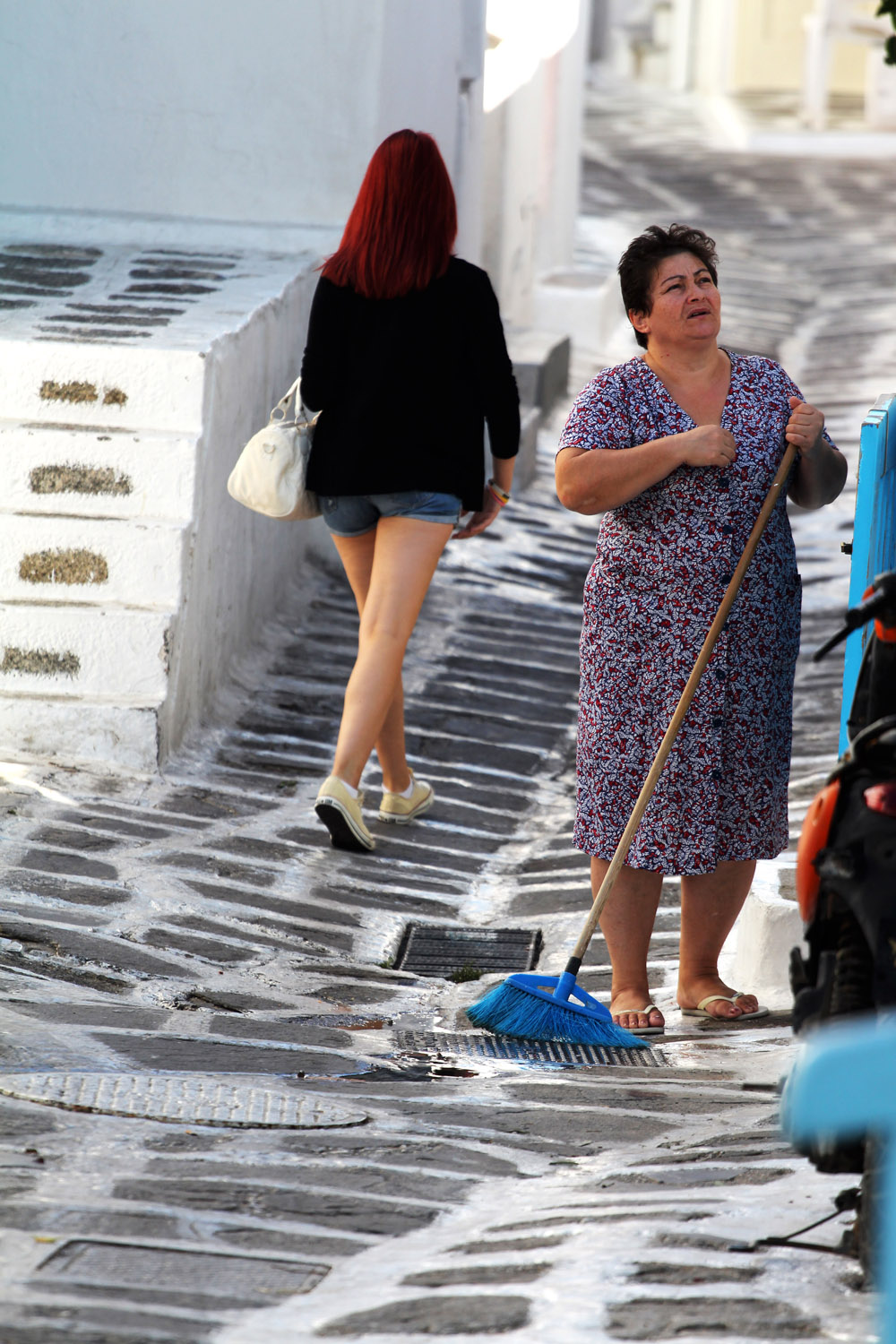
3618 Lady with broom

One of the biggest problems Greece faces is the old bugbear of tax evasion and corruption. Each year government revenues have been considerably lower than expected, with tax evasion estimated to cost Greece almost $20 billion a year. It’s easy enough to conclude from this that all Greeks must bear responsibility for the crisis – but ultimately the responsibility must rest with the government who are in a position to allow or put a stop to tax avoidance through legal action and legislation. All governments know that their citizens will try to avoid paying tax, the question is how effectively they prevent them from getting away with it.

There is much more that could be said here – the whole debate around the pros and cons of a Grexit – Greek exit from the Euro; the fundamentals of the Greek economy – which boasts the largest shipping industry in the world (yes, that is correct), and further exploration of the political and social conditions across the country.

4122 Stay or go

Yet, the point I am making here is that despite these seemingly insurmountable and crippling problems, Greece retains a great degree of social cohesion and order. It has not, in fact, collapsed into chaos and lawlessness as some reports seem to suggest. Indeed, I would argue that Greeks have shown a quiet restraint and, comparative to the scale of the economic crisis they are facing, an appropriate level of righteous indignation. Who wouldn’t be up in arms if corruption and poor economic management, as well as lax oversight of taxation had practically bankrupted not merely the present, but also the future? That the Greeks have not yet had a revolution and overthrown their government is a testament to the high levels of education, community responsibility and general good-naturedness amongst Greek people. How long this can go on for, how much Greeks can learn to live with any further entrenchment of these conditions in the long term, is yet to be seen. But, it is irresponsible to give the impression of the country being in a state of chaos, especially when they so desperately need our tourist dollars more than ever.

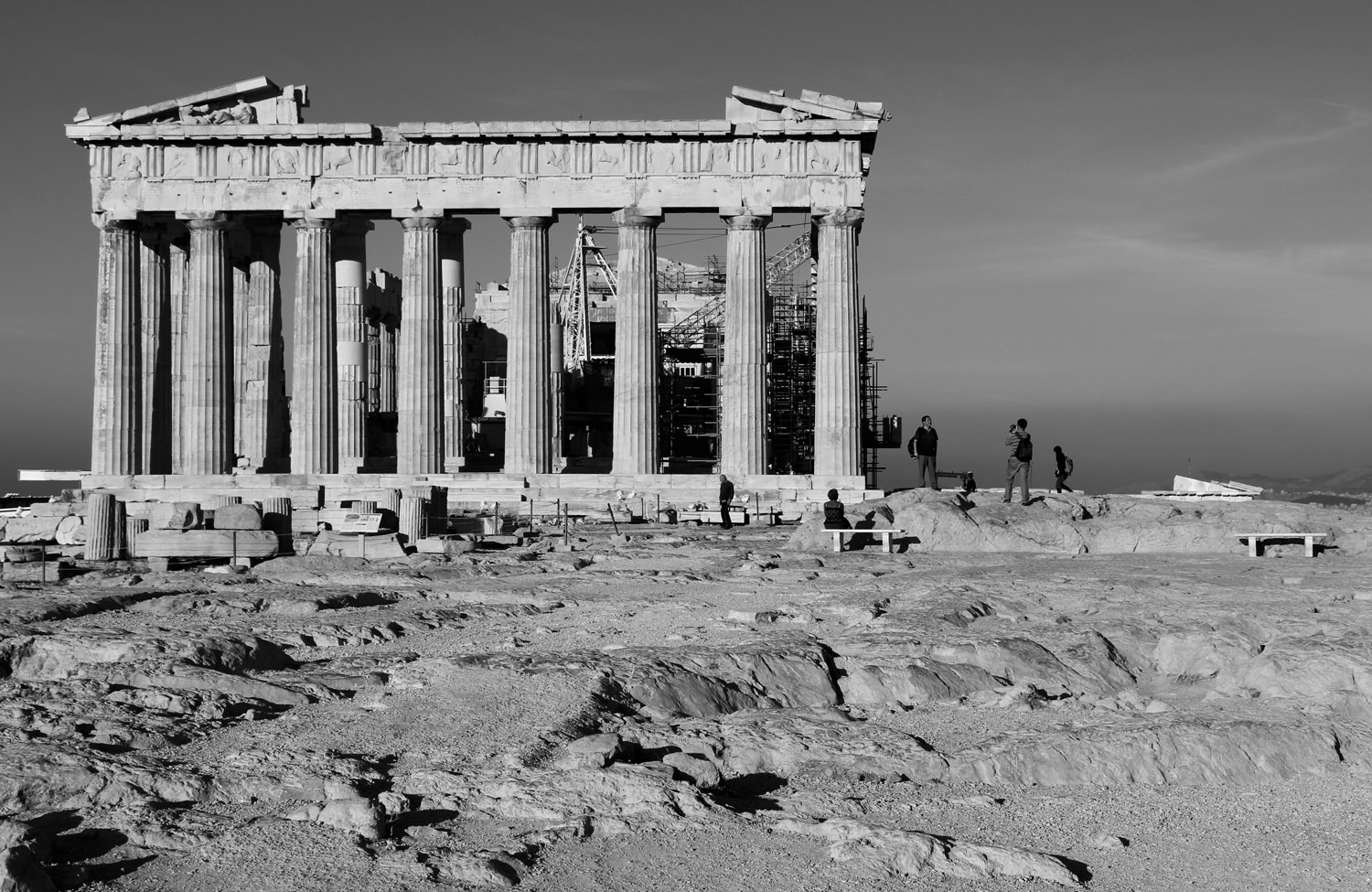
Parthenon

All this is very tragic indeed. In the long and remarkable narrative that is the history of Greece, the turn of the twenty-first century likely marked the country’s economic highpoint since the Byzantine era. That they should fall so hard after just a few minutes of economic sunshine is indeed unfortunate – a fate no one could wish upon them. How long it will take to turn this around and what it will ultimately cost is uncertain, but we certainly can help by going there. The fact that tourist numbers seem as strong as ever, may make this whole discussion redundant. Yet Greece has a hell of a long climb to get out of the hole into which it has fallen and needs all the help it can get. So, go to Greece I say, and not only will you have a wonderful time, but you’ll be helping the cradle of democracy and western philosophical inquiry get back on its feet. If you think about it, the debt we owe Greece is far greater than the debt they owe to their financiers. After all, it’s only fucken money.

2692 Ferry to Naxos


Disclaimer: All of the photos of the riots were sourced from various news sources on the net, whilst the graph hails from wikipedia – the rest of the images are my own.

Buying Rome Total War II never quite seemed inevitable. I had followed its development with interest, but in truth, my brother was far more pumped about it than I was. When I told him I was off to Greece on the 12th of September this year, he replied; “Bro, the only important date in September is the third – the release of Rome Total War 2.”

Considering how much I’d enjoyed the first instalment of this game, released almost ten years ago in 2004, it was likely only a matter of time before I got hold of its long-awaited successor. There was, however, one significant hurdle to get over – the need to upgrade. For, Rome Total War II promised not only to be an amazing feat of game engineering, mechanical, tactical, strategic and graphical magic, but also to demand a nigh impossible amount from processors. I thought I might get away with my 3.33 gig E8600 dual core processor, having recently upgraded my graphics card to a GTX670. Yet when my brother and I first fired up the game a few days after its release, it was very soon apparent that a whole new rig was required to run this baby.

Sure, the graphics are difficult enough to render – after all, the “Extreme” settings really are quite extreme – but rather the problem lies with the sheer number of simultaneous calculations that the processor is expected to make. Upgrading your video card is unlikely to help, unless you already sport a top-shelf processor. So, sure enough, when I returned from overseas in October, I splurged and built a new computer from scratch, hopefully future-proofing myself for at least another couple of years by using top-shelf kit.

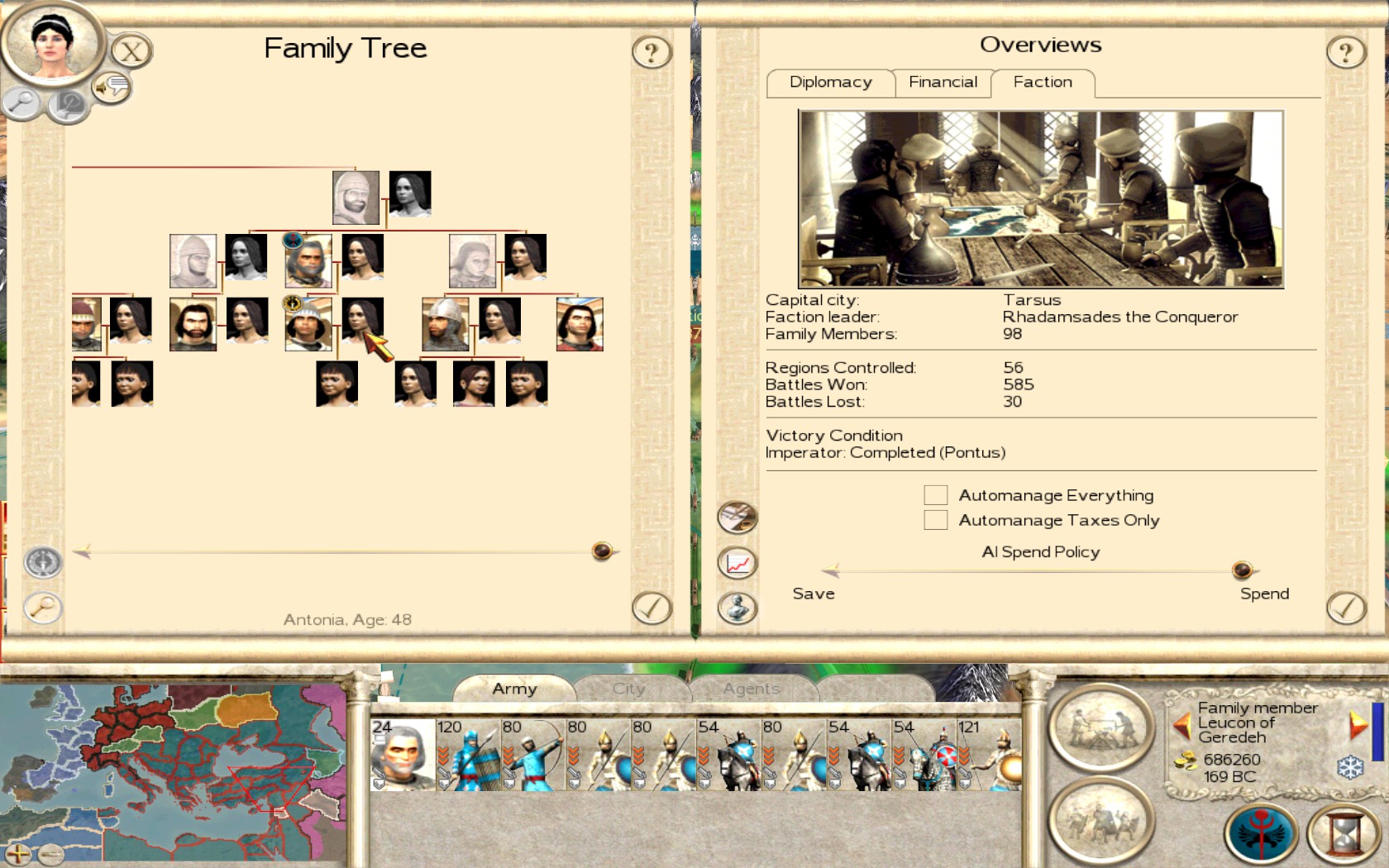
The good news is, it was worth the effort. When running at the highest settings, Rome Total War 2 looks stunning. The campaign map is captivatingly exotic across the many different regions of Europe, north Africa and the Middle East. The clouds and birds of prey which fly across the lush grasslands, snowy peaks, river deltas, dry deserts and rippling seas, give life to this world in a box.

2013-11-03_00013

2013-11-09_00011

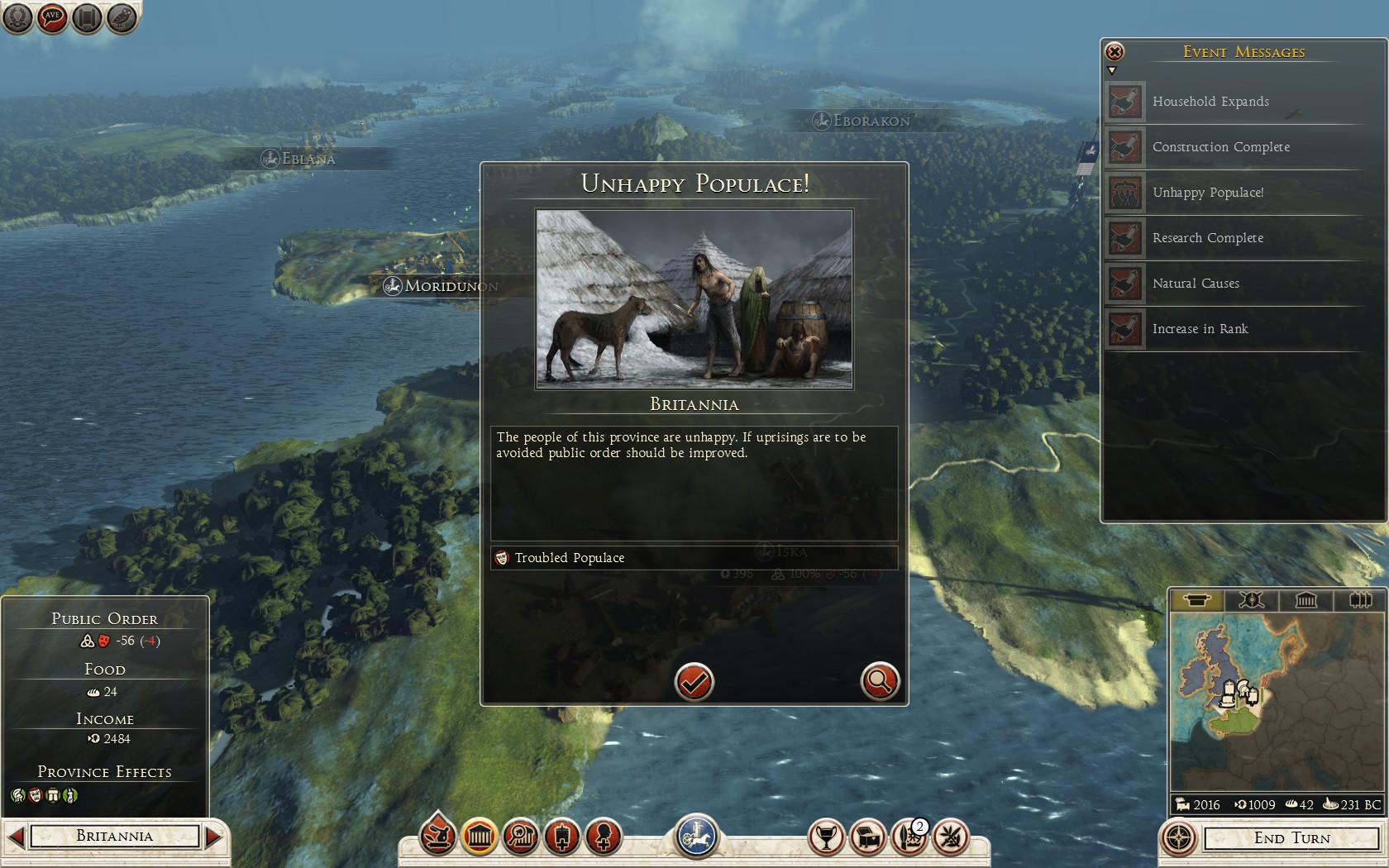
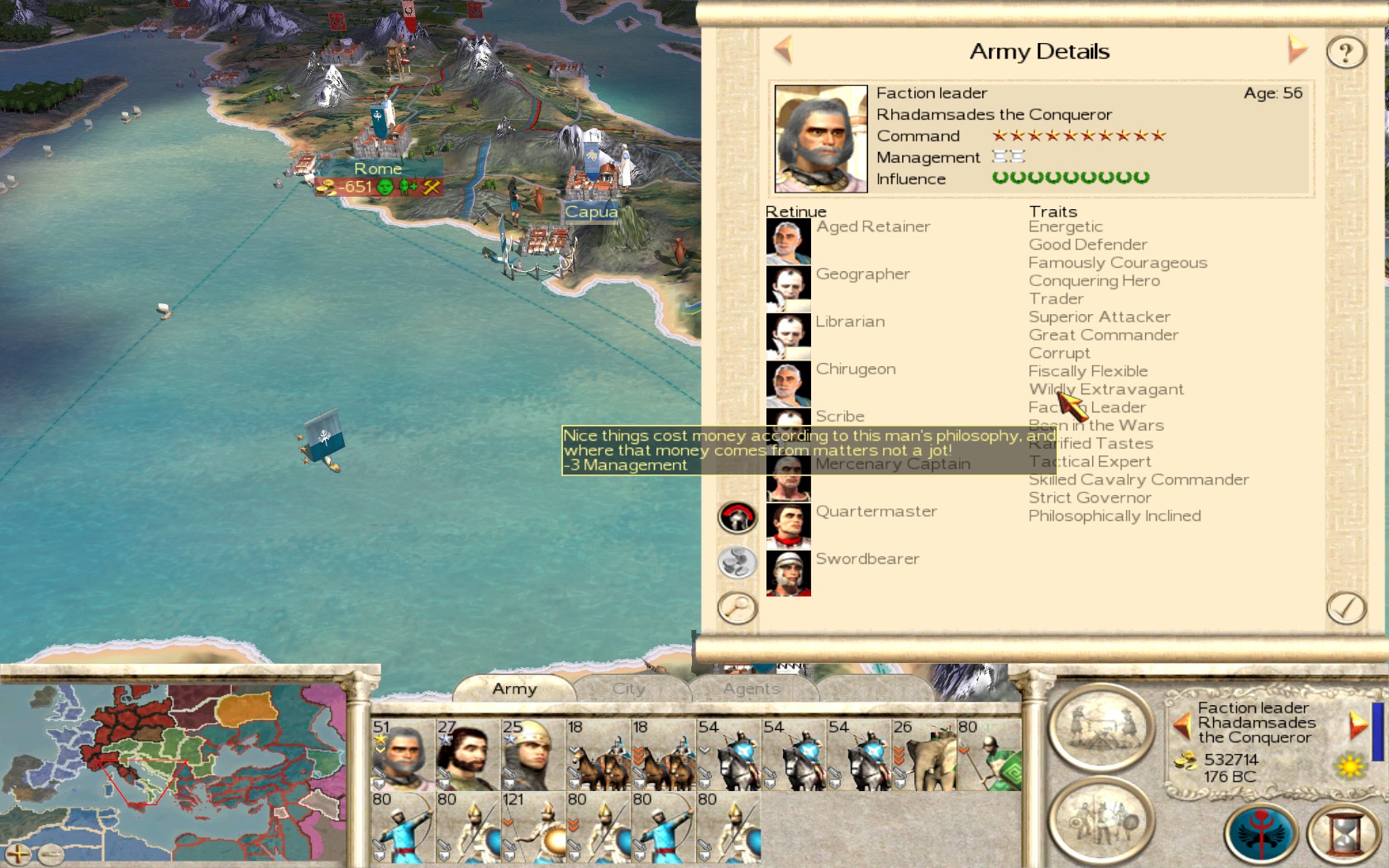
The various other maps – diplomatic, strategic, economic, etc, are all tastefully rendered in a mix of the charmingly decorative and simply pragmatic.

2013-11-29_00025

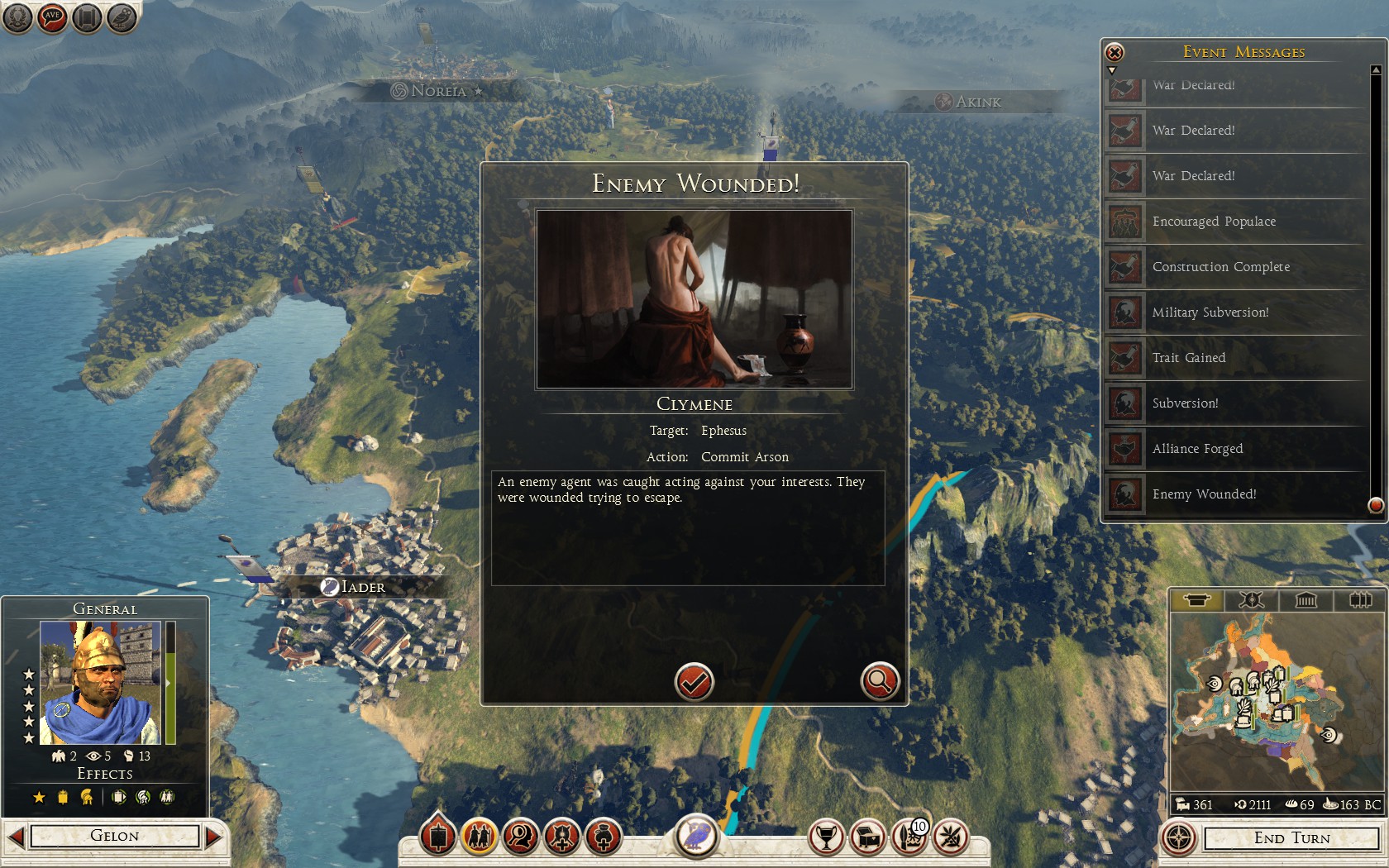
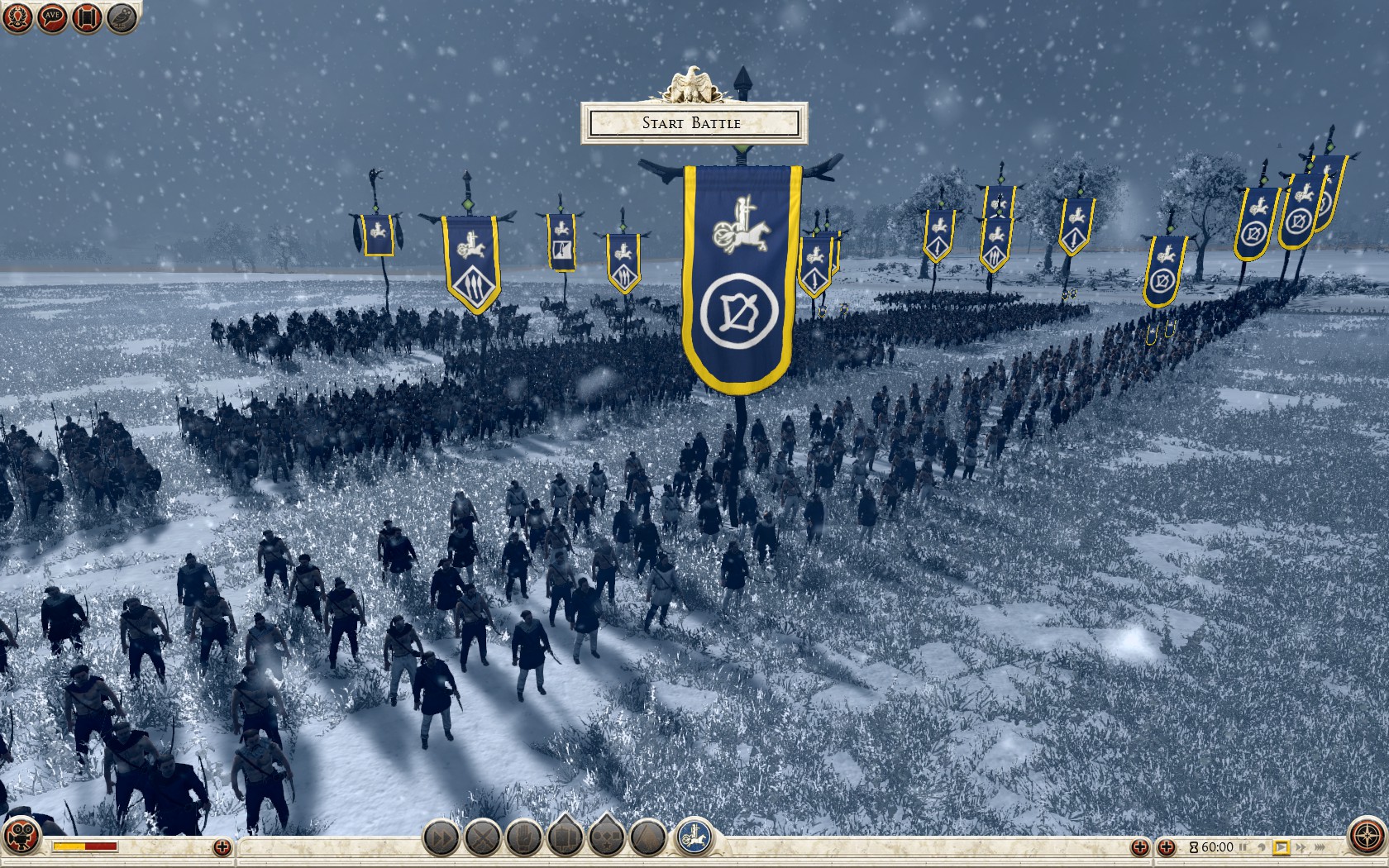
The unit icons borrow from Athenian black-figure ware, and the small pop-up illustrations that accompany news and events are evocatively reminiscent of the best card-game art out there.

2013-11-17_00003

2013-11-18_00005

2013-10-31_00005

The factional icons are wonderfully done – colourful and curious, their rapid cycling at the top of the screen between turns can be quite mesmerising.

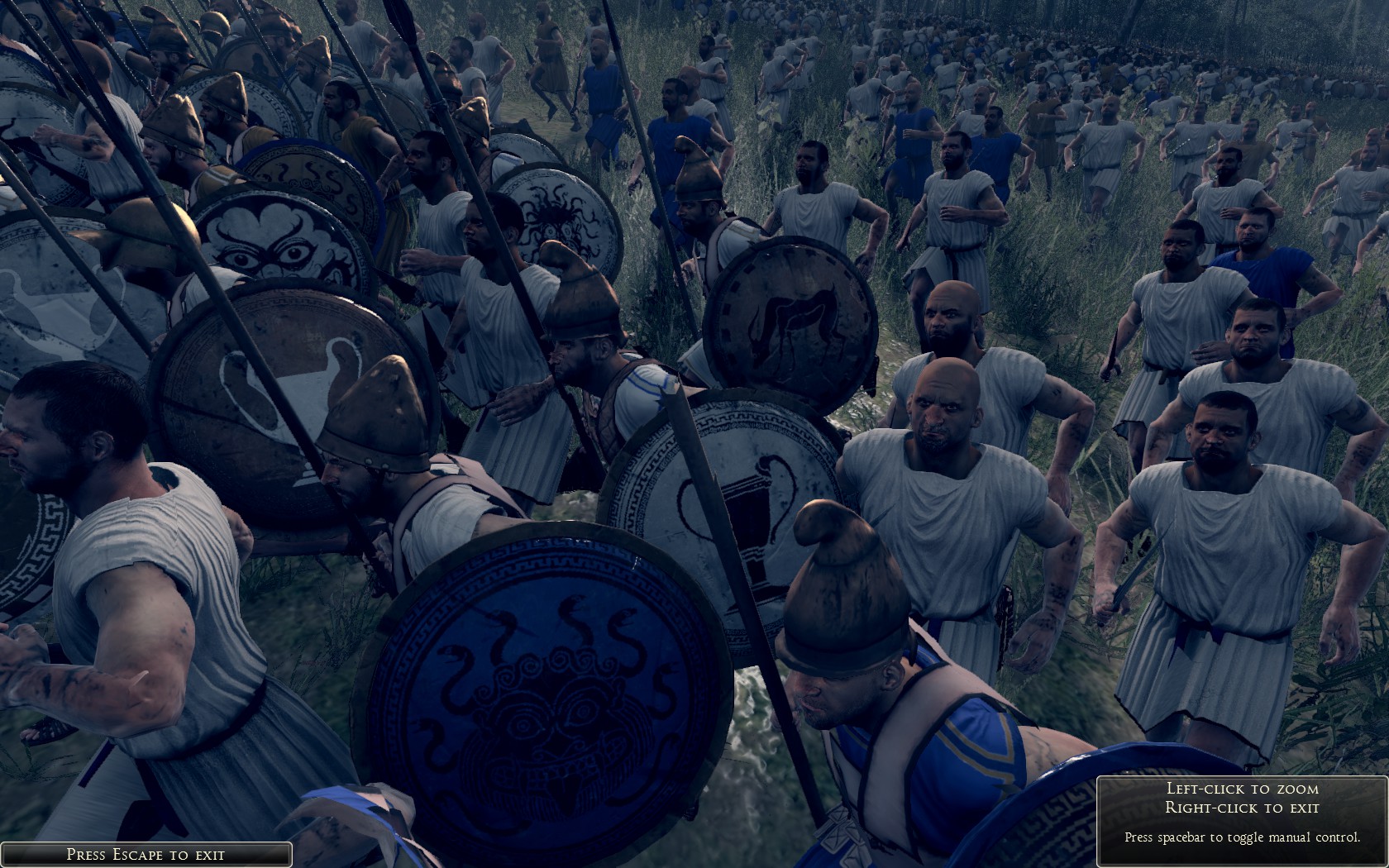
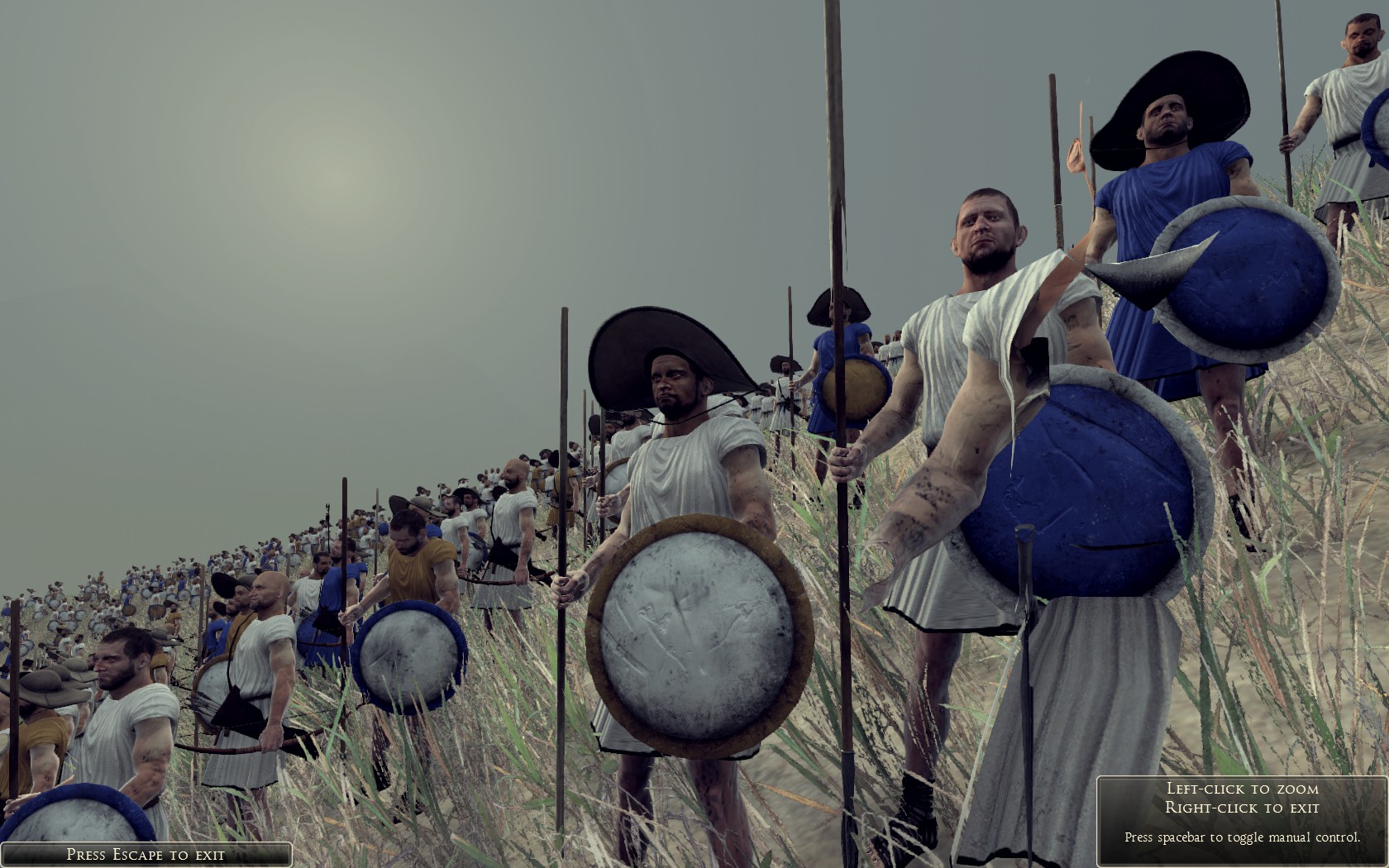
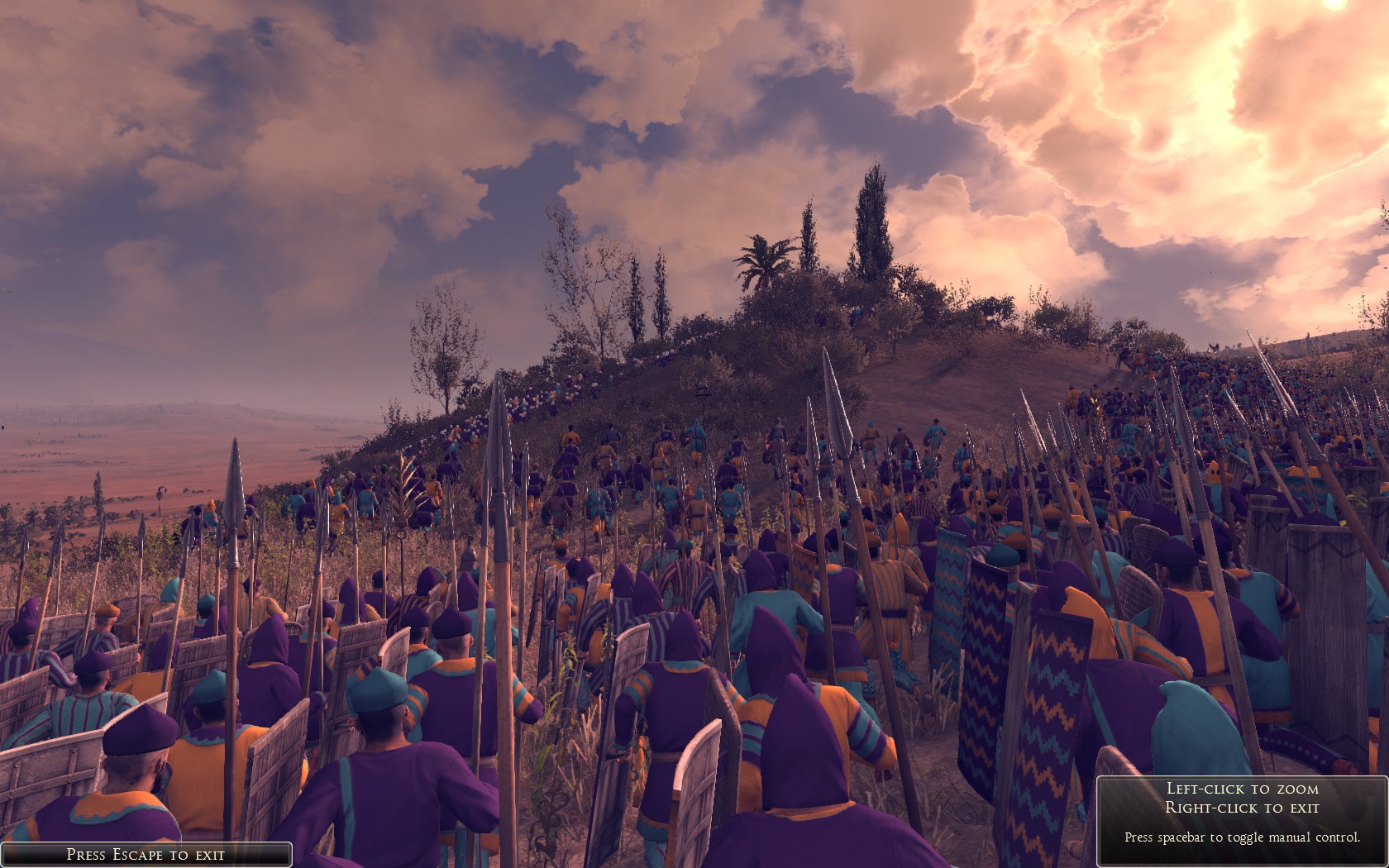
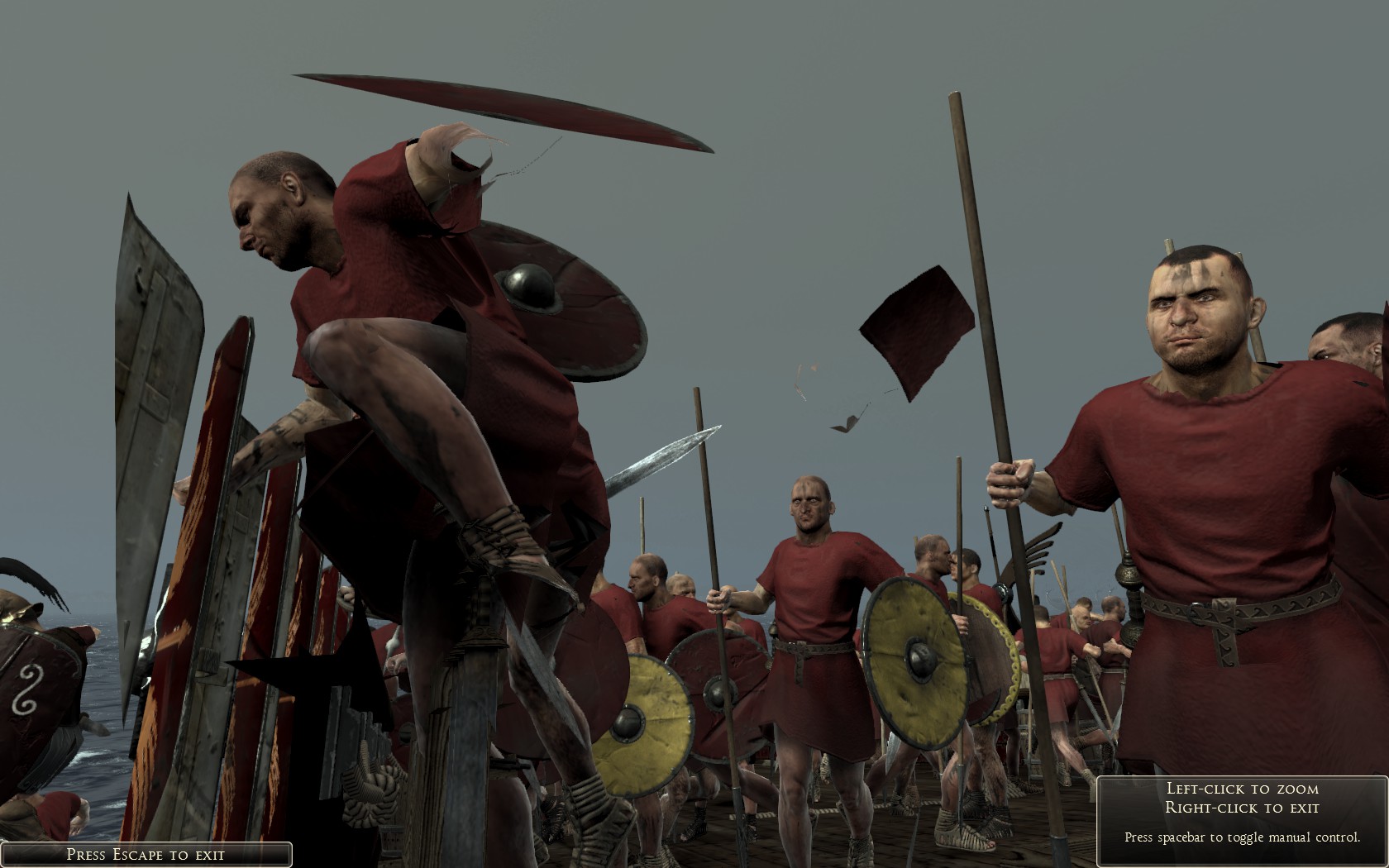
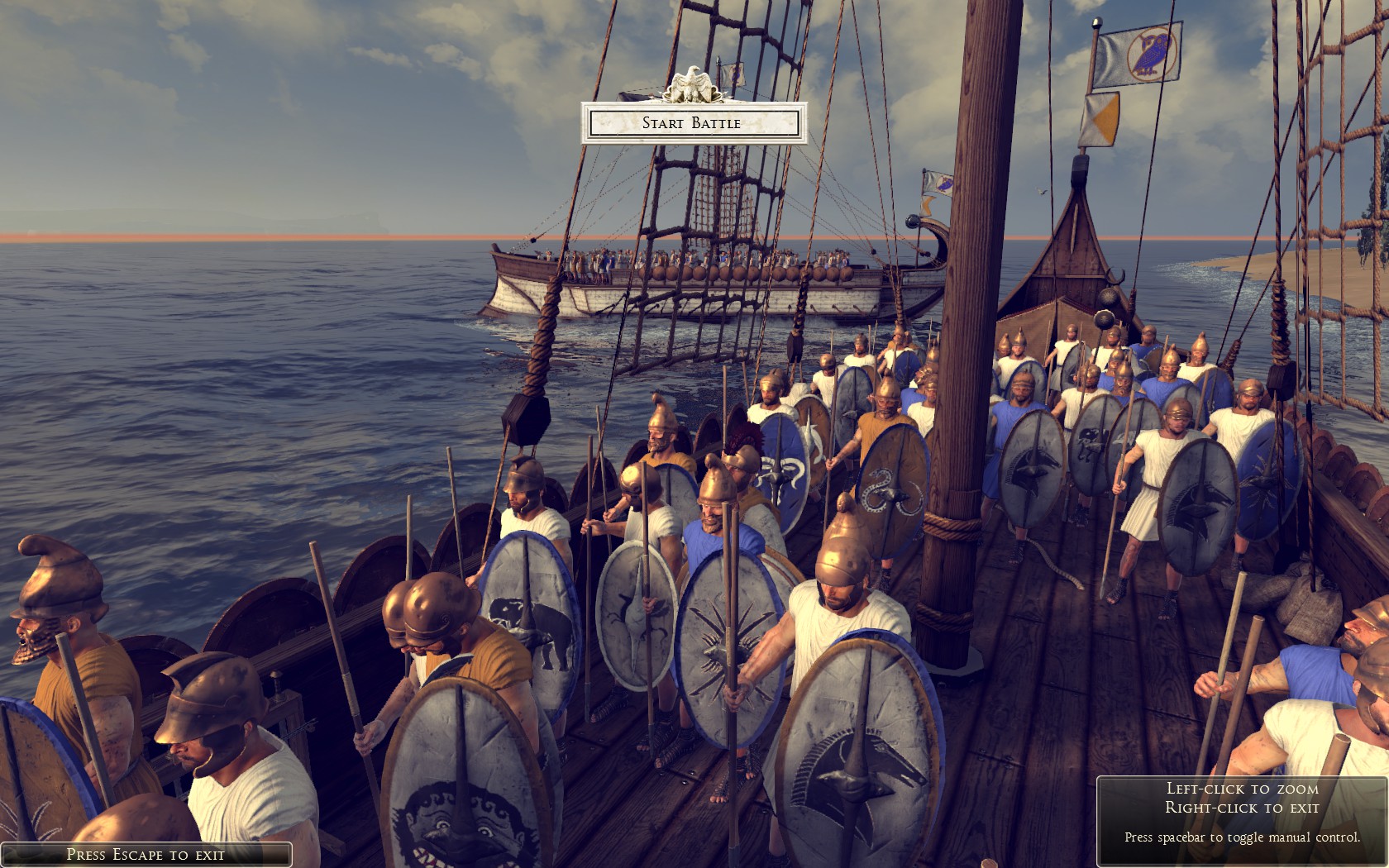
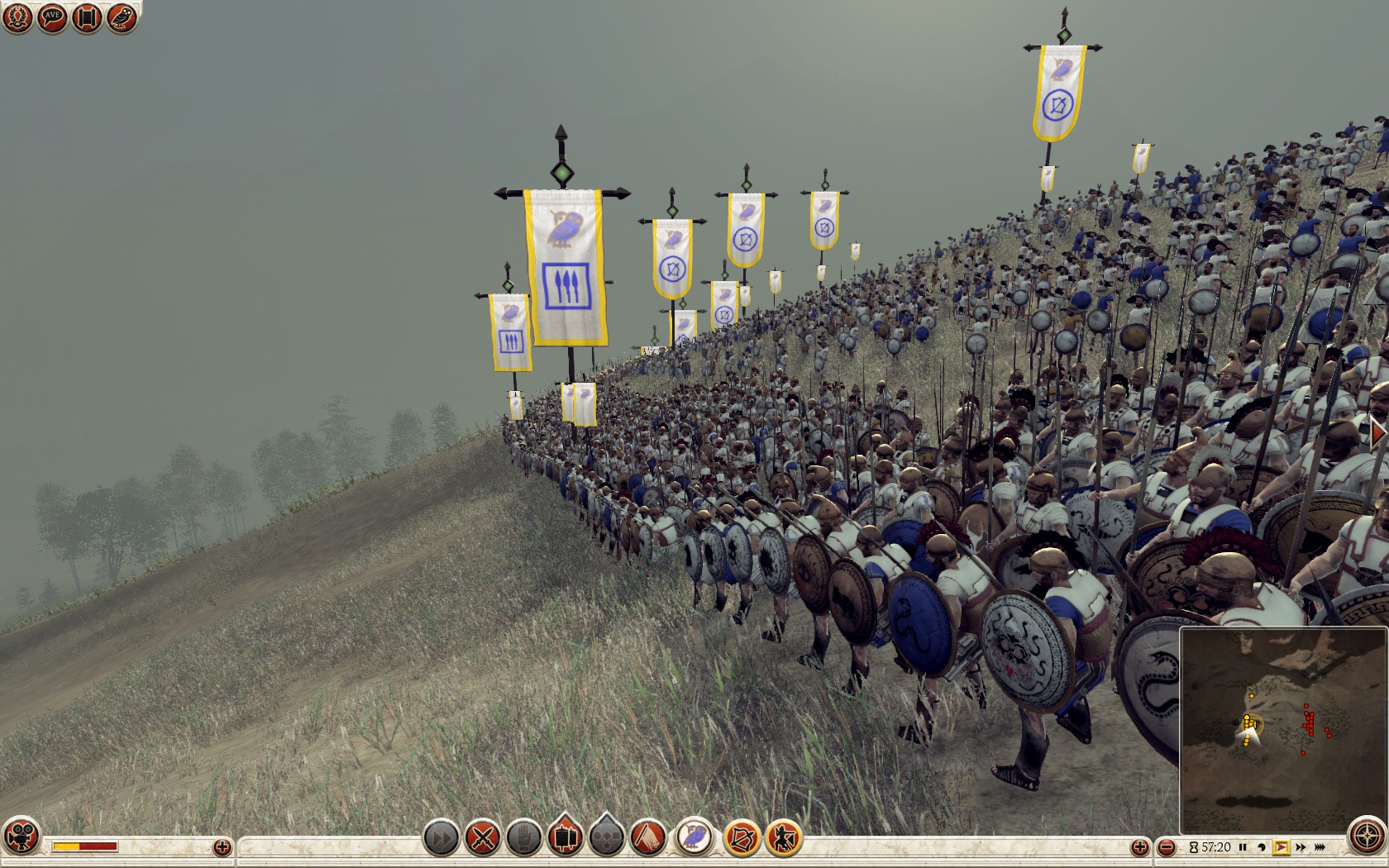
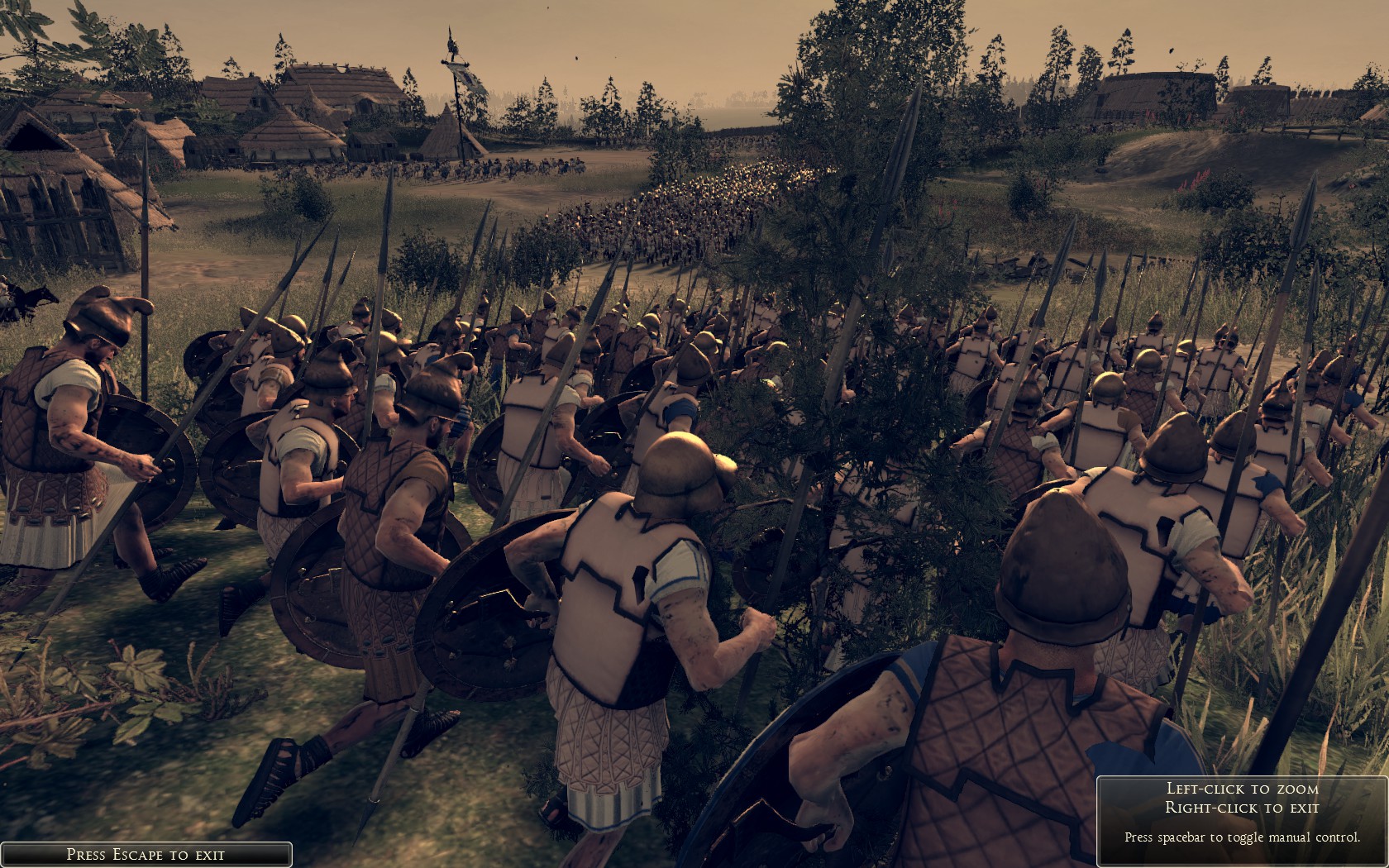
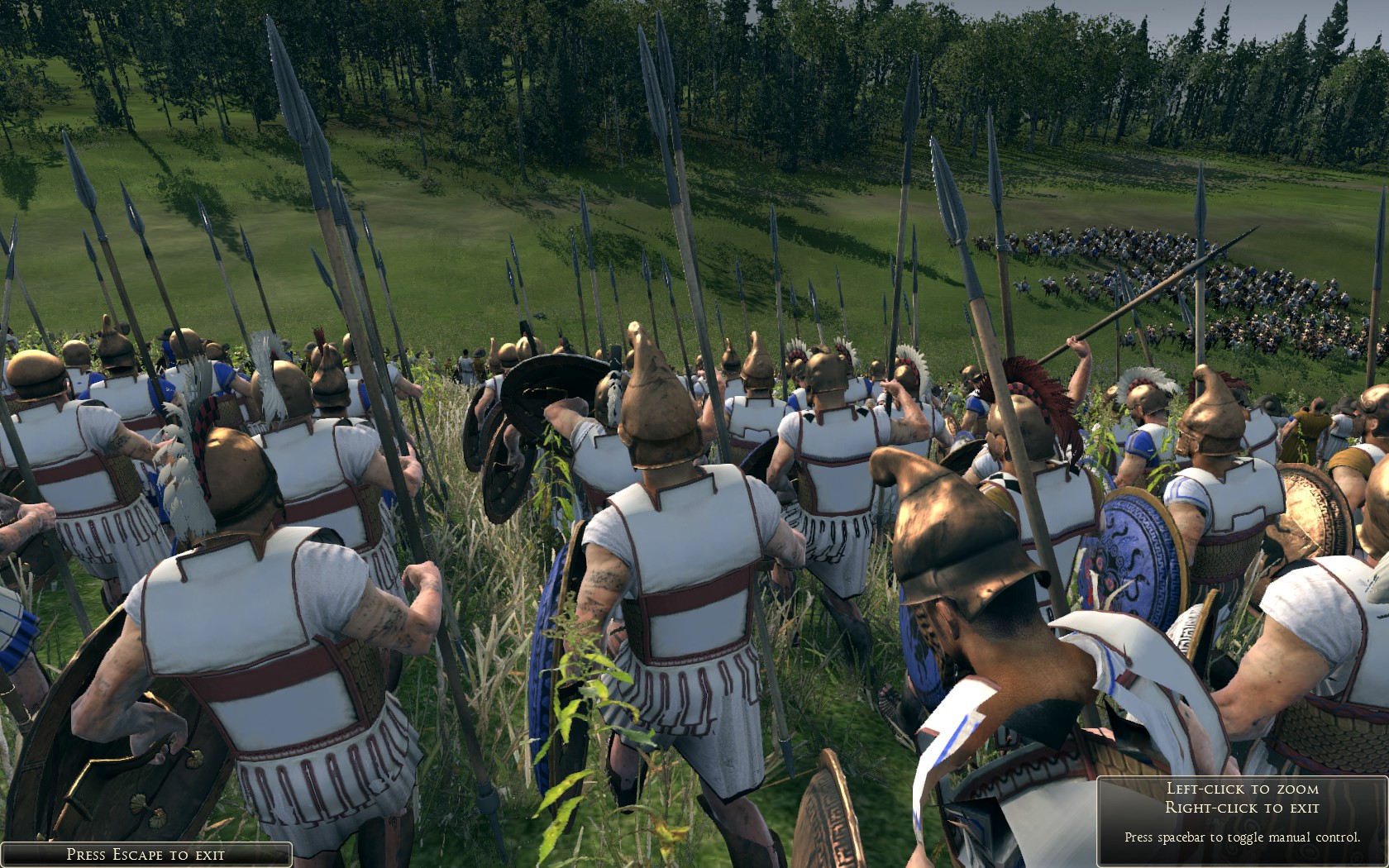
Yet it is at the ground level that the game’s appearance truly excels. The quality of the individual figures in each unit is not merely due to the high grade textures and meshes, along with, at times, perfectly fluid and natural movement, it is in their genuine individuality. Each soldier is, in fact, an individual – generated from a wide set of randomised features – face-shape, hair, facial hair etc. In some cases, for example, Greek phalanxes, the soldiers carry a wide variety of shield designs – sporting decorative emblems randomised from a large pool.

2013-11-03_00011

2013-11-19_00010

2013-10-20_00010

2013-10-16_00007

2013-10-09_00002

The landscapes are also magnificent; with highly detailed vegetation and attractive and immersive weather effects and lighting. The old option of of waiting for the weather to change when attacking is still present, yet when attacked, the aggressor gets to choose the timing of the battle. Despite its negative effects on the range of missiles, fatigue and cavalry movement speed, fighting in rain is quite glorious to behold, yet the most beautiful conditions I’ve yet witnessed is immediately after a storm. The game captures that peculiar, electrically-charged storm light perfectly.

2013-10-23_00022

2013-11-04_00005

2013-11-17_00004

2013-10-31_00002

2013-11-18_00012

2013-11-07_00009

2013-11-13_00003

2013-11-07_00020

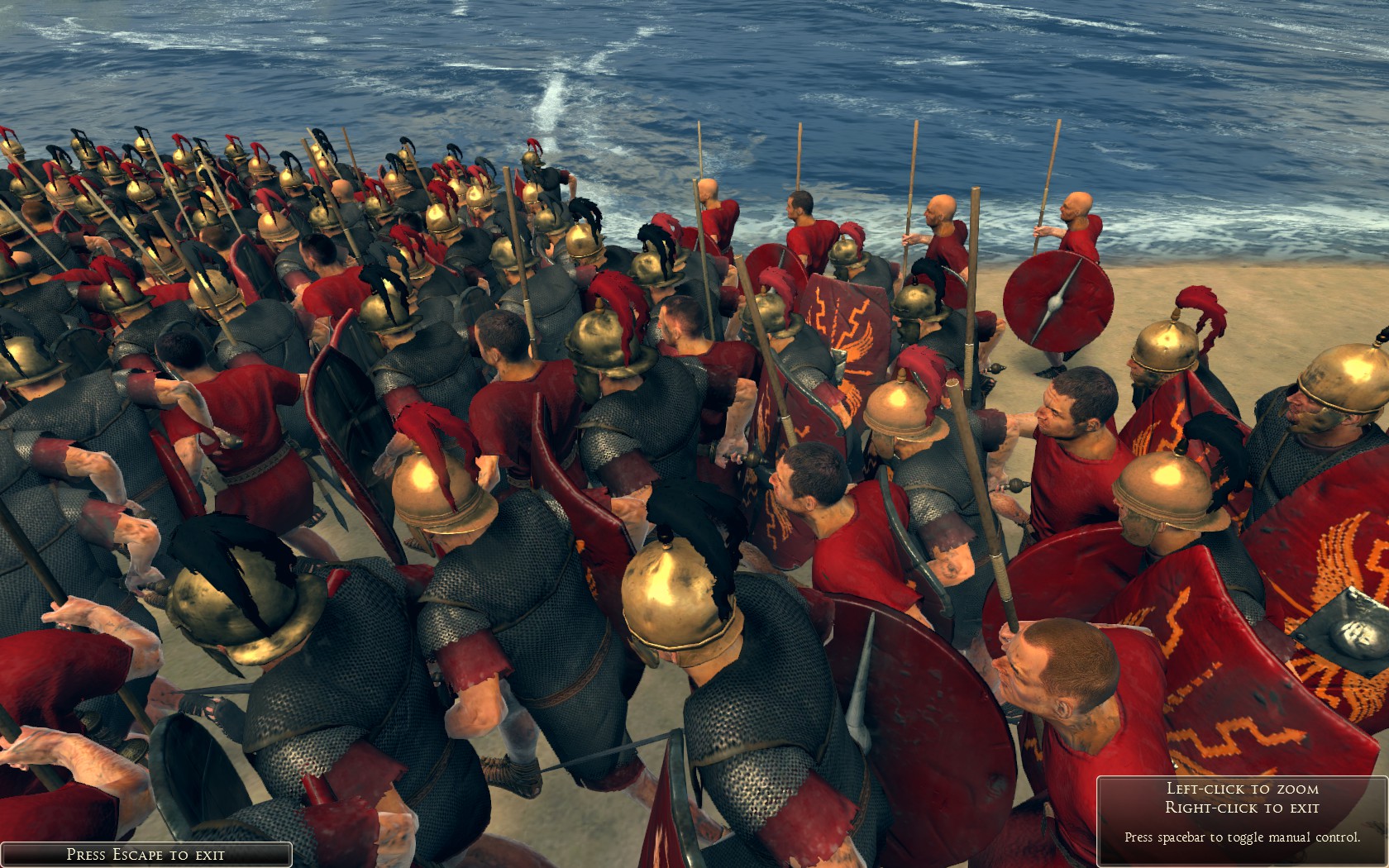
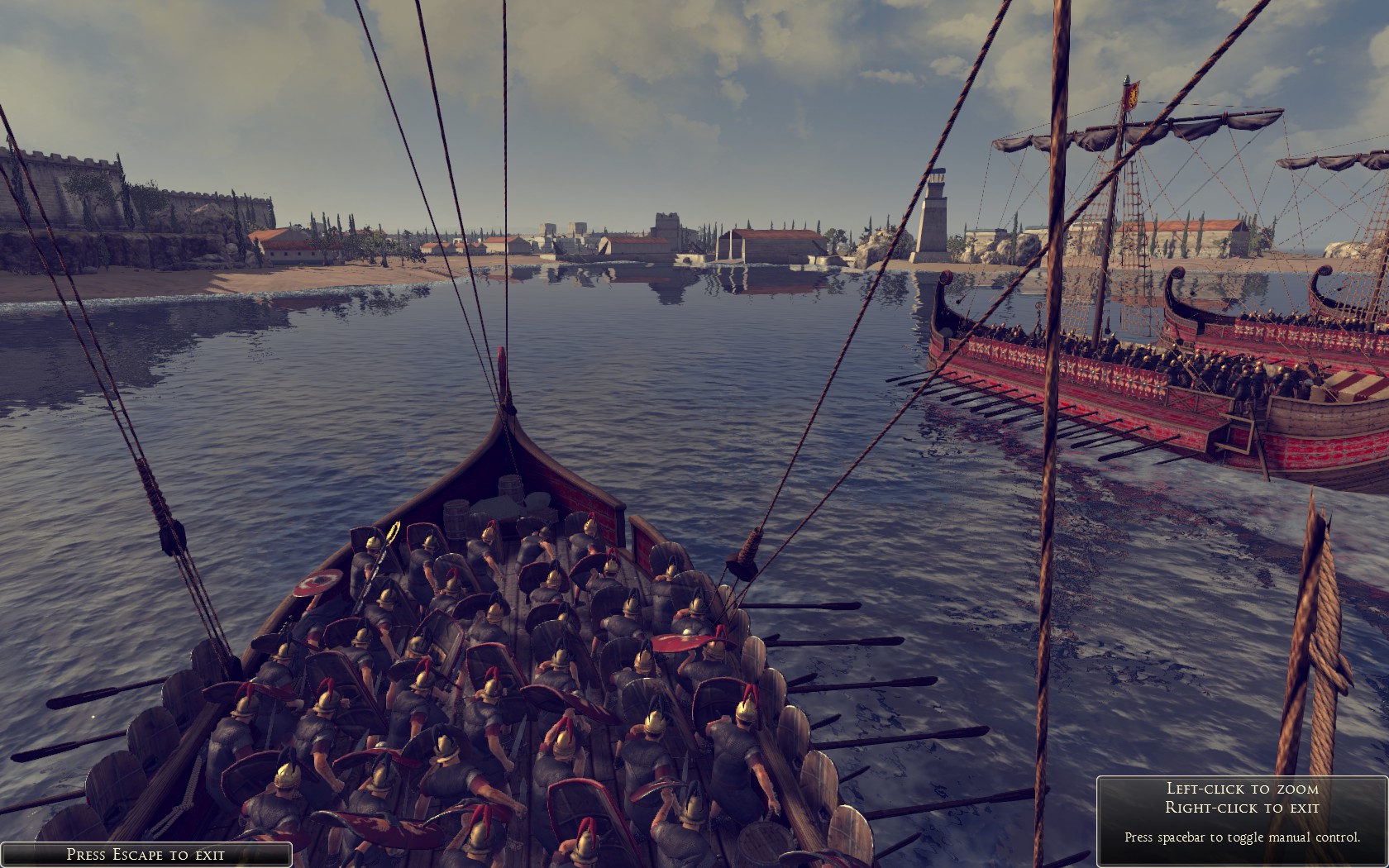
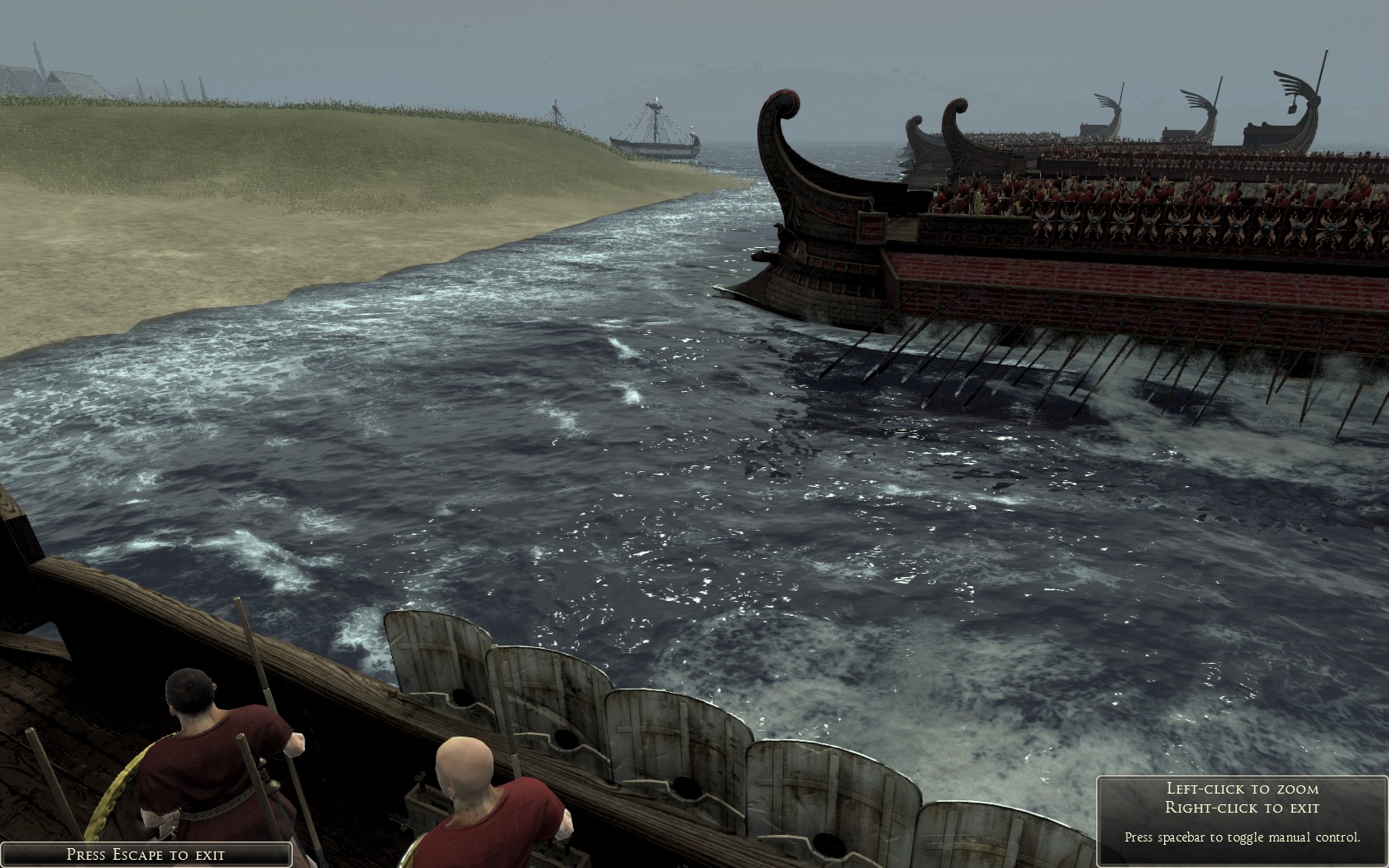
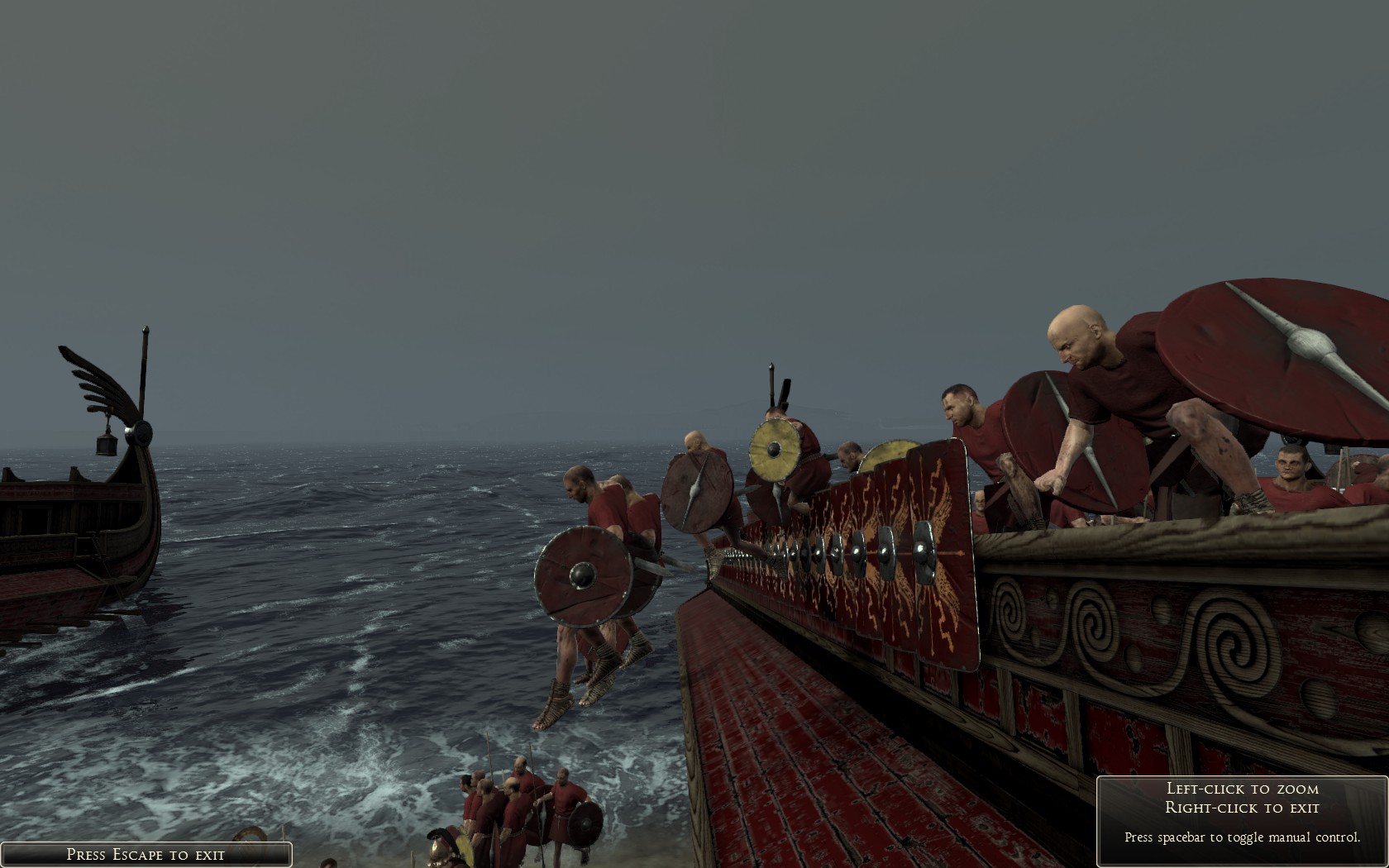
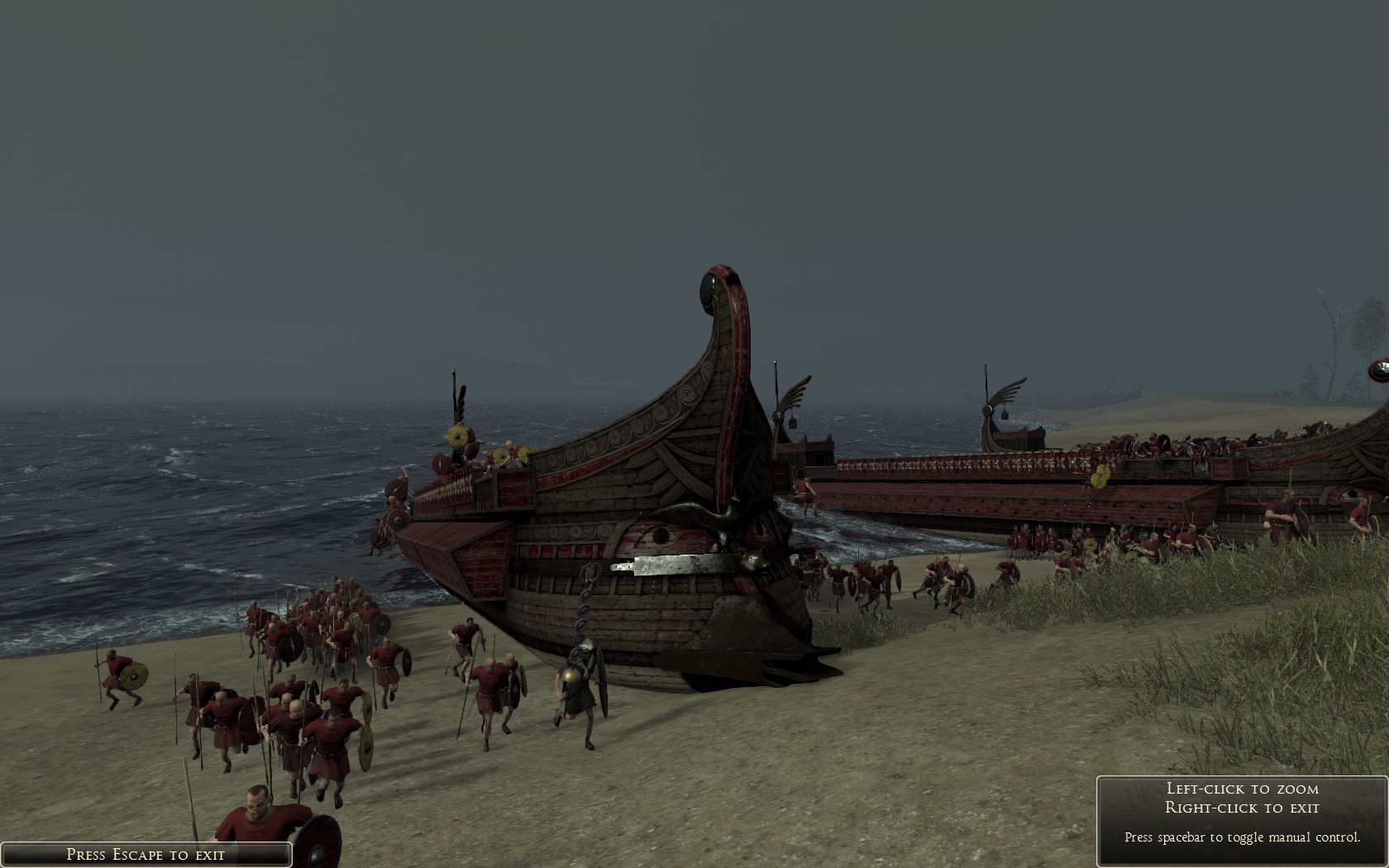
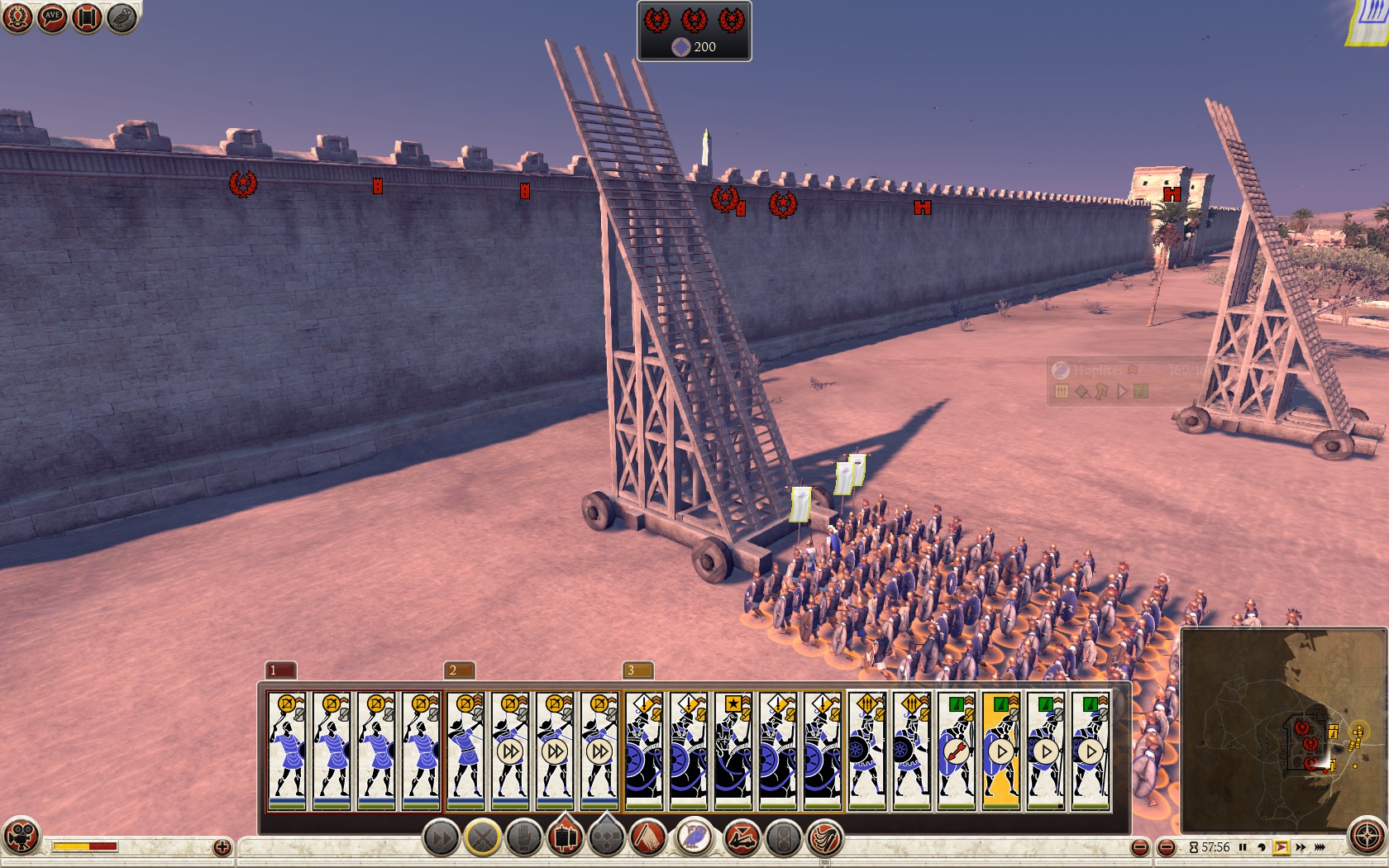
The water looks great in the campaign map, yet it enters a whole new realm of beauty in the battle-maps. This, combined with the attention to detail given to the ships, makes naval manoeuvres beautiful to behold.  Rome Total War II also allows for battles combining naval and land units, and any coastal town is vulnerable to attack from the sea. When attacking a town solely with a fleet, it is necessary to beach the ships and have the units disembark. Clicking on the unit camera icon allows one to ride with the ships towards the shore, something well worth doing at least once or twice for the sake of immersion. From hereon, the units are used in exactly the same way as land-units, yet cannot return to their ships during the battle. Naval units are typically half the size of land units, though special assault ships can be recruited which contain full-sized units. When defending a town with a fleet, or using a naval garrison, the units begin on the ships and can then either be used as ships – to attack any enemy ships – or the ships can be beached and the unit used as a land unit to defend the town.

2013-11-20_00007

2013-11-21_00005

2013-11-21_00006

2013-11-21_00007

2013-11-21_00008

It is not only dedicated naval units that can make assaults in this fashion. Any army can turn itself into a fleet – effectively boarding transports – simply by moving onto the water. These ships will, however, be dangerously exposed unless protected by another fleet or used in an area where no enemy fleets are present. When attacking a coastal city in such a manner, the ships simply need to be beached in order to get the troops ashore. All in all, the co-ordination of land and sea forces in this manner is one of the greatest aspects of the game. It not only adds immensely to gameplay variety, but also to immersiveness.

2013-10-27_00014

2013-10-31_00037

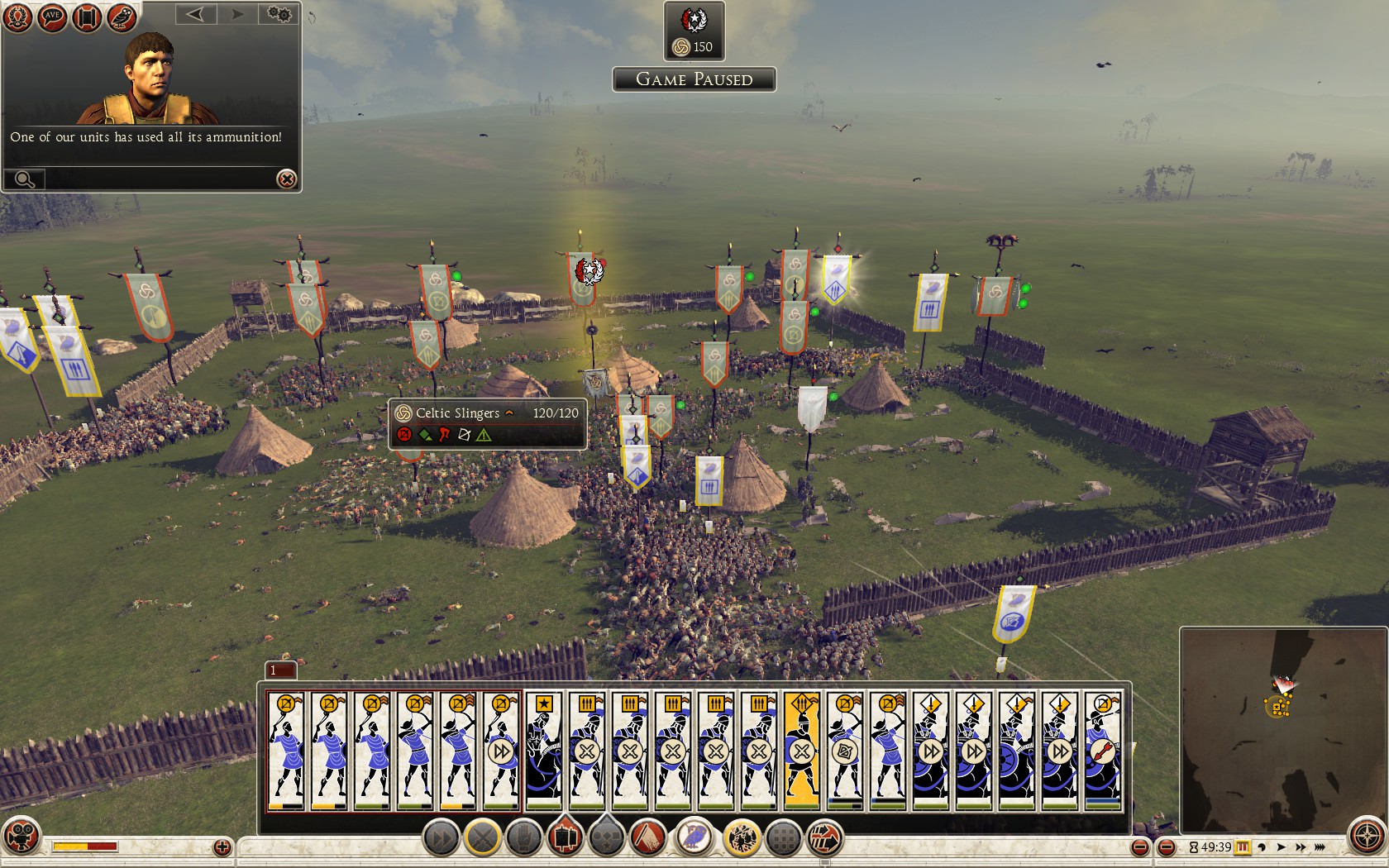
Immersiveness is one of the game’s great attractions. It operates on two levels – the intense desire to keep playing the strategic game – known all too well to Civilization addicts as “just one more move syndrome” – and the ability to get right in amongst it with the troops. The different perspectives one can explore by selecting different units around the battlefield, the views and angles this offers, makes the game experience extremely cinematic. There’s nothing I love more than, at the end of a battle, taking the time to line up my remaining troops for a victory celebration, then ride past in first person mode, watching them cheer. If you let yourself go with this game, it can be very rewarding.

2013-10-16_00011

2013-10-29_00006

2013-10-26_00008

2013-10-22_00054

2013-11-03_00010

2013-10-22_00014

2013-11-24_00015

Having come to this game pretty much directly from Rome Total War I, with a detour via Medieval II, this was my first experience of the new Total War system for maintaining armies, significantly different from the first iteration. Rather than raising troops in cities and moving them about at will, units can now only be raised by generals. They can, however, be raised anywhere inside friendly territory, provided some kind of military building exists in that province to allow units to be recruited. This makes raising units a lot more convenient in some regards, though it can be a problem if an army is needed and no general is in the vicinity. Another great new innovation is the system of troop replenishment. Rather than having to move units into cities capable of producing a particular unit variety to restock the unit, once built, units of any kind will simply replenish their numbers when inside friendly territory, including the territory of military allies, client states and satrapies. This takes a lot of irritating fiddliness out of managing armies.

2013-10-29_00003

One major change is that number of armies and fleets that can be raised is now limited. This begins at 3 and increases incrementally as your faction’s Imperium increases. A recent patch changed the rate at which new armies become available, but the restrictions do make it more difficult to manage large empires. In my current campaign, in which for the first time I’m actually playing the Romans, I control a total of 42 regions, yet am only allowed to field 8 armies. This can make managing a large empire rather complex, especially when there are several frontiers that require defence or attack.

2013-11-25_00001

This limitation on the number of armies is compensated for by the garrison system. Each region now automatically provides a garrison determined by the size and type of town or city, and the other buildings present in that region. Smaller towns with fewer buildings provide smaller garrisons, often consisting of pretty low rent troops – mobs, javelin-men, etc, whilst the larger cities, especially the provincial capitals, can often have quite considerable garrisons, strengthened by better quality units. In the case of coastal towns, naval garrisons are also provided.

2013-11-24_00025

The garrisons are rarely sufficient to defend against a large invasion force, though this is made much easier in provincial capitals, all of which have city walls. The absence of walls in smaller towns has been roundly criticised and certainly makes defending those towns much more difficult, yet at times these garrisons can prove adequate if used well against a smaller foe. The regional garrison will also enter the field as reinforcements when an army is attacked in that region, and in such instances they can provide much needed assistance, sometimes with as many as 14 extra units – I’ve not yet seen larger.

2013-11-24_00030

As mentioned above, the campaign map itself is absolutely huge and beautiful to behold. It stretches from Bactria (Afghanistan) to Lusitania (Portugal) and from Caledonia (Scotland) to Garamantia (in the Sahara). It is divided into 173 regions, grouped into 57 provinces, each of which contains up to four regions, though some have as little as two. The regions can be conquered and controlled separately, but controlling an entire province confers the advantage of being able to pass edicts – providing bonuses such as increased happiness, growth, military recruitment, economic output etc.

2013-11-15_00008

The number of buildings that can be constructed is limited in most cases to four, with regional capitals having as many as six building slots available to them. These slots are not immediately available to a town, but more become available as growth in the province accumulates, providing an added incentive to sustain a good rate of growth. The benefits gained from each building are effective throughout the province and public order is determined on a province-wide basis, not on the basis of individual towns.

2013-11-16_00005

The amount of food available is also calculated on a province-wide basis, though the total food surplus accrues across one’s entire empire. This allows some provinces to maintain negative food production figures, with the overall surplus picking up the shortfall. If, however, total food surplus falls below zero, then those provinces which have negative food production will suffer first – both through civil disorder and military attrition. In other words, soldiers in armies and garrisons will begin deserting – a penalty also incurred by lack of funds.

As in all Total War games, successfully managing the economy is absolutely essential. My experience thus far has been that, alongside initial military and tactical challenges, the most important first step is to ensure that one’s regions are producing sufficient money and food to sustain development and expansion, as well as maintain existing forces and infrastructure.

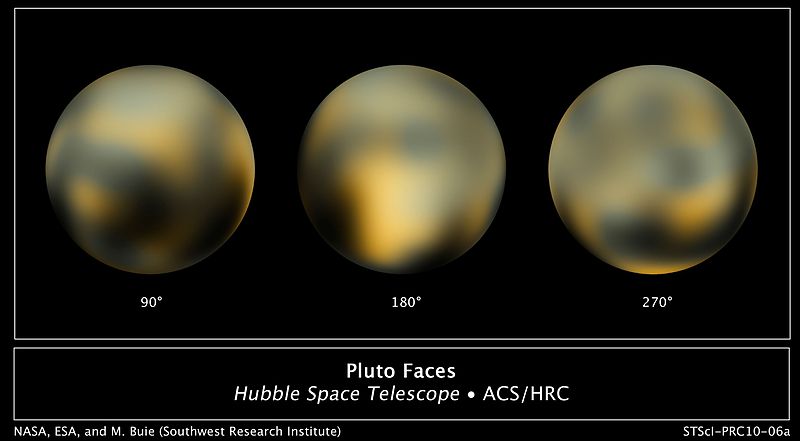
Rome Total War II offers a mesmerising number of factions to encounter during play. In total, there are 117 different factions, each with their own unit roster and agenda. The initial game release offered eight playable factions, since which time six others have been made available for players.
2013-11-10_00001

The factions are divided into different cultural groups – Hellenistic, Roman, Barbarian and Eastern. These are then further subdivided into, for example, Germanic, Gallic and Britannic. The cultural status of a faction in part determines its relation to other factions. Though this is not necessarily a barrier to co-operation across cultural divides, it does often result in these groups acting as a bloc, when they aren’t busy fighting among themselves.

Many of the as-yet non-playable factions have been unlocked by modders, yet in such a form these lack the development and variety of the officially playable factions. The Romans offer an altogether different level of sophistication on account of their Auxiliary unit system. In a nutshell, the construction of an auxiliary barracks in a region can open up certain unique unit types specific only to that region: Auxiliary Persian archers, Balaeric slingers, Numidian skirmishers etc. This makes playing the Romans a great deal more fun as it allows the player to experience using a far wider variety of units – many of which are, in effect, the units available to the original faction whose land the Romans have occupied.

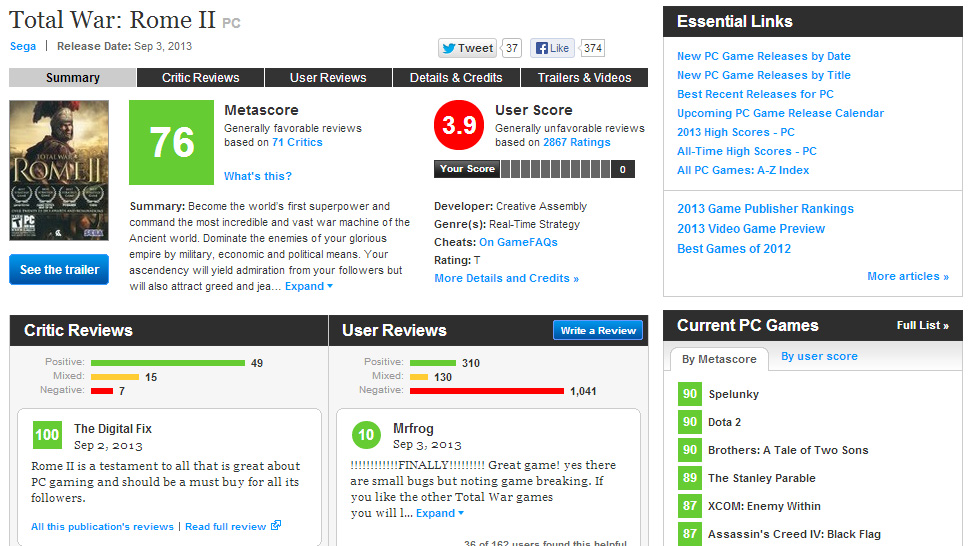
Unfortunately, however, the game is not without problems. The release of Rome Total War II immediately kicked-up a shit-storm of debate and protest about its relative merits and flaws. A quick look at the results on metacritic reveals as much about the mentality of gamers as it reflects the nature of the game. The reviewers’ metascore current sits at 76 out of 100, whilst the users’ metascore currently sits on 3.9 out of 10.

metacritic

Gamers tend to take pretty extreme positions and punish any perceived deviation from perfection. Here’s a sample of some of the comments, accompanied by scores:

On the day of release, and the week or so after this game was released. It was utterly broken. And while that is not acceptable. I am rating the game for how it stands right now as I type this. The game is now a title truly worthy of the Total War name. – 9

Horrible. Gameplay is extremely dumbed down, lack of family tree in campaign is obvious mistake and the greatest disapointment is the lack of online modes. Also, removing walls from cities is a horrible idea – 5

Just terrible. To purchase a full price game, pre-ordered I may add, and it’s clearly a beta test that other’s will benefit from our testing by buying it at half price 6 months away. The AI is bad. The FPS issues and graphics incompatibility issues (With a high end pc and gpu) are just ridiculous. The worst game release of the decade. Still not fixed! – 1

Really, I ask? Worst game release of the decade? That’s very harsh and not a reasonable reflection of its quality. As a teacher who regularly marks some pretty crappy homework, I can assure you that this game does not deserve 1 out of 10, or zero for that matter. Like an essay with some excellent paragraphs and evidence of strong analysis and interpretation, marred by a flawed overall structure, this deserves roughly 8 / 10 and would definitely score higher were it not for obvious issues with the campaign AI and the political faction system.

As to the official reviews, the reception has generally been favourable, but with reservations. PC Gamer gave the game 85%, praising the cinematic scale of the battles and attention to detail, calling them “stunning” and “the most marvellous moments of the fifty plus hours I’ve played so far”.

2013-10-16_00022

They were, however, critical of the apparent glitches on its initial release, including issues with the AI. Edge similarly praised the visuals and battles whilst criticising the bugs present on its release; “even as it topples, it’s glorious to look at, and to live through.” Daniel Starkey of GameSpot praised the variety of units and what it called “spectacular sound design and great attention to visual detail”. So far as the campaign was concerned, Game Revolution called the campaign map “a treat to look at” whilst praising the game’s  new features and depth, yet they were critical of the wait times between player and AI turns. Steve Butts of IGN complained that: “a single turn can take as much as 10 minutes… those little inconveniences add up. Don’t get me wrong; Rome II is a game worth savouring, but it also asks you to tolerate difficulties that don’t need to exist.”

2013-10-21_00005

There are other, perhaps more troubling issues with the game, most notably, the political system, which seems to bear little relationship to the rest of the game, besides offering an interface for keeping track of generals, admirals and statesmen and managing their retinues. Whilst one might pay close attention to the development and “levelling-up” of generals and dignitaries, there seems to be very little reason to focus on the degree of influence one’s faction currently maintains as it bears no impact on gameplay for the vast majority of the game. The only time it becomes relevant is when a civil war happens – something which seems to happen both spontaneously and rather randomly.

Indeed, there seems to be no way to avoid a civil war at some point during the campaign. Where the civil war happens in your empire is dictated by your level of influence on the faction list, yet gamers have noted that there is no mechanism by which to prevent it happening altogether. What essentially seems to happen is that one city will become an enemy faction and spawn a number of fleets and armies – all of 12 strength it seems – equivalent to the number controlled by the player. These will immediately fan out across the map and try to conquer as many cities as possible. The only real option is to crush them as quickly as possible – something made easier by the AIs apparent lack of common sense. When the civil war happened in one game, the AI immediately disbanded most of the units in most of its armies – perhaps some overcautious attempt to avoid bankruptcy in subsequent turns – rather than, for example, using them to attack the vulnerable nearby regions. It was a disappointing performance from what looked like being the most formidable challenge yet.

2013-11-09_00004

After a civil war has been crushed, the political system remains broken – in effect, it plays no further role. The game designers have made excuses about this – being forced to finish the game for an inflexible release date. Yet, the upshot of all this is that without some way in which to tie the player’s factional influence more closely to game-play, the whole political system seems irrelevant.

One of the biggest complaints about the game is that it has no family tree. I would like to add my voice to this complaint, as I did indeed love the family tree of Rome Total War I. The developers hastily pointed out to those complainants that all the other recent Total War products, like Shogun II and Napoleon, lacked a family tree. But many people appear to have transitioned straight from Rome Total War I, as I have done, and hence feel the absence more greatly.

What was wonderful about the family tree was how attached one could get to certain generals. In my longest and greatest campaign ever, I had a long line of succession, through six generations, of faction leaders coming from one branch of the family. This included what I always thought of as the “miracle child.” About three generations along, the only male heir in the line of succession not only developed the trait “impotent”, which greatly reduced his chances of having children, but married a woman ten years older than him and already in her late 30s. It wasnt until she was 48 years old that they finally had their first child – a son. The joy that it brought me at the time is embarrassing to admit, yet such it was. He went on to sire further generations.

2012-03-23_00049

2012-03-15_00010

The current system for managing one’s own faction lacks the same pleasure of continuity, though there is a new type of continuity to be found in the battle history of each army. As all armies must now be lead by generals and each army has its own name, the record sheet displays the history of that army’s campaigns – its commanders, their years of service and win / loss record. Beneath this it lists every battle that army fought and the outcome.

2013-11-24_00021

2013-11-17_00002

There are also significant problems with the AI, something most apparent on the campaign map. The decisions made by non-player factions are often bafflingly stupid and seemingly lack any sense of self-preservation. Often their armies and fleets flit about the board like chickens with their heads cut off, dashing this way and that on seemingly pointless ventures, and all the while, leaving their cities undefended or in a state of dire civil disorder. At times the AI nails it and mounts a challenging assault. At other times, one faction will clear out its orbital path, so to speak, knocking over a host of local rivals and building up an impressive empire, yet after the initial phase of expansion, they almost invariably fall into ruin through poor economic and military decisions, and then collapse altogether before another aggressor.

2013-11-22_00004

In every game I’ve played so far – when not playing as the Romans, both Rome and Carthage have capitulated early. Carthage have it tough as their empire is spread across north Africa, Southern Spain, Sicily and Sardinia, yet whereas this is perfectly manageable for a player, the AI gets it wrong every time. In the case of the Romans, having now played them and experienced how good their infantry is, I suspect the reason they always fail is that their cities do not produce a great deal of revenue early on, which makes funding expansion and maintaining territories more challenging than in some other factions.

2013-10-22_00058

Unfortunately, once past the initial phase of the game, whilst things might get hot on one frontier for a while, most enemies are relatively easily dealt with on account of their inability to maintain both forward attack and home defence.

Many have also complained about the battle AI, yet I find that in this regard the game is pretty sound. Troops are used far more wisely than in the past – missile units defended against cavalry with spearmen; when fighting more than one army, they often wait until they have joined before advancing – sensible decisions which make the battles more challenging and interesting. There are still some shockers, such as when a whole army sits in a town being peppered by missiles and doesn’t take any action in response, but much of the time, the AI uses its units relatively well.

2013-11-04_00002

Another area which the AI does get right is its use of agents. A faction may recruit a certain number of agents depending on their imperium – spies, dignitaries and champions. These can be used in various ways – to increase happiness and taxation, to carry out acts of sabotage or assassination, to cause military disruption, or to manipulate other agents. In this latter case it is possible to control more agents than one’s imperium would allow by way of recruitment. Getting enemy agents to defect is a useful and important way not only to increase your own capacity, but to decrease theirs.

2013-11-17_00012

2013-11-29_00023

 The diplomacy element of the game is certainly improved, yet many also have issues with this, largely on account of the way in which attitudes are calculated. Basically, attitudes are affected by cultural affiliation and past and present actions. Thus a war against one faction will cause a reduction in the level of friendliness of that enemy faction’s friends or allies, whilst simultaneously increasing your popularity with other enemies of your enemy. This is very incremental and increases or decreases with each action against or in favour of that faction. Personally, I don’t have a problem with the diplomacy screen and welcome the fact that, as in Civilization, once you have encountered another faction, they can be contacted at any time via the interface. My biggest gripe is that there is no option to request one faction to make peace with another – or am I missing something?

2013-11-27_00005

Despite all these ups and downs, many of which will, hopefully, be ironed out eventually in what seems already an endless succession of patches, this is an absolutely cracking game. Ignore those extreme reports of a game that is totally broken and focus on the fact that what they have essentially done is put the entire ancient Mediterranean world and its surrounds in a box. The complexity of the achievement is staggering, even if at times the complexity of the game-play seems underdone. Don’t expect it to be without some frustrations, but take the time to enjoy its attractions and become immersed. It’s easy after a while to become blasé about the battles and ignore them in favour of auto-resolve, yet my advice is to duck in there every so often and enjoy what really is the most fun part of the game. Rome Total War II is an epic game which creates its own epic narrative – a compelling story which emerges from this huge simulation.

2013-10-16_00025

2013-10-26_00005

2013-11-07_00004

2013-10-27_00007

2013-10-31_00057

2013-11-05_00003

2013-11-05_00020

2013-11-18_00017

2013-11-21_00003

2013-11-28_00011

Ice Age Masters

A recent exhibition at the British Museum entitled Ice Age Art: Arrival of the Modern Mind, brought together an extraordinary collection of early human artworks, dating back as far as 40,000 years. The broad thesis of the exhibition was indicated by its subtitle: an attempt to locate and contextualise the point at which our sophisticated artistic ability, and hence “the modern mind”, first emerged. Having migrated from Africa into Europe some 40,000 years ago, and finding themselves caught in the grip of an ice age, Homo Sapiens began producing complex and subtle artworks – the product of modern minds, not unlike ours. The exhibition explored questions such as what caused this to happen, and what was the purpose of this form of expression.

Reindeer

The Arrival of the Modern Mind exhibition at British Museum

One thing that is immediately striking about ice-age art is the contrast between depictions of people and animals. Whilst the animals are depicted with incredible attention to detail and a faithfulness that is manifested either through expressive dynamism or accurate realism, humans are depicted in a highly abstracted way. Consider the bulging, drooping, hugely overweight female figures, whose bodies seem to be a grotesque exaggeration of the female form.

Venuses

Many have long assumed that the attention to detail with the animal figures is linked to hunting rituals – that depicting the animals in this manner somehow gave the artist power over these creatures. The images potentially represent a mix of love, respect and awe for creatures who could both feed and kill one in this wild world. The figures of the females, on the other hand, have traditionally been seen as fertility symbols – exaggerations of the female form to emphasise child-bearing attributes.

Bison, exhibition

Yet these are big assumptions about the mindset and purpose of artists in a time so utterly remote – long predating cities, towns, agriculture and writing – that we must be very cautious before showing any confidence in our conclusions. After all, we don’t know if the artists were men or women, nor how the art was used or viewed. Were the female figures considered erotic or motherly, both or otherwise? There is one rare exception to this rule – a female head carved from mammoth ivory which has rather grandiosely been called the first true portrait of a woman for its somewhat quirky appearance, which gives it more individuality than the otherwise generic, simplified features or featureless heads on female statuettes.

Ice Age portrait

In an attempt to draw links between and to juxtapose these ancient cultures with the modern, the exhibition placed works by modern artists alongside the ancient – a sculpture by Henry Moore, a drawing by Mondrian, among others. Many reviewers were critical of this attempt to show how the ancient resonated in the modern, dismissing it as a distraction which only served to confuse by not giving the viewer sufficient room in which to forget their own culture and mindset and try to imagine one that was, in all likelihood, utterly different to that which produced these modern works.

Irrespective of this somewhat misguided pairing of old and new, the sheer peculiarity, quality and antiquity of the ice-age objects speaks for itself. The Lion Man, a carved ivory statuette which depicts a human figure with a lion’s head, found in fragments in a German cave and reconstructed, is dated at roughly 40,000 years old.

The Arrival of the Modern Mind exhibition at British Museum

As one author put it, it reeks of “dreams, terror, magical rites and myths.” The “Venus of Lespugue”, a 23,000 year-old female figurine with grotesquely pronounced thighs, buttocks and breasts, was also featured here.

That it long fascinated Picasso might lend some sense to the presence of the modern works here, yet really, it says nothing about the ancient world which produced it. Again, we are left with mere speculation as to its purpose and production, and our best guesses, logical as they may seem, must remain circumspect.

Art Historian, Professor David Lewis Williams, a major contributor to this field, has long argued that Palaeolithic Homo Sapiens “could only engage in image-making upon developing “fully modern consciousness.” He argues that cave art was a by-product of religious belief, which played a role in establishing and sustaining social hierarchies. He views the production of cave art as some kind of Shamanic ritual, perhaps even undertaken in an altered state. As much as we might find certain parallels with more recent, or even extant rock and cave art cultures, there is no way to confirm any of these conclusions. Whilst no doubt these artworks had a significance beyond the decorative and practical, surely in part their function was educational and commemorative – a visual aid in story-telling, a record and celebration of successful ventures. Australian Aborigines certainly use rock art in this way – as an aid in story-telling and passing on cultural information – yet this is also closely intertwined with religious ritual and mythological and spiritual beliefs.

Whatever the reasons for the production of this art, and whatever its function, it is certainly worthy of our admiration. To consider that people with minds as flexible and creative as ours, with equal artistic talent and capability, lived and produced art so long ago, is enough to move one to tears. The quality of the paintings from the caves of Lascoux or the Chauvet cave in southern France is breathtaking. It is not merely the understanding of movement, proportion, dynamism and grace shown in these renderings that is so striking, but also the deep sense of pathos which they convey. The eyes of these animals are hauntingly expressive, imparting a strong sense of individual feeling in some instances. Perhaps this is just my awed nostalgia combined with a tendency to anthropomorphise, yet in the absence of sophisticated human portraits, it is through the eyes of these animals, along with their meaty flanks, that we see the fleshy reality of their once having lived.

lascaux 4

Lascaux 3

Two bison

Anyone who is interested in this subject and has not seen Werner Herzog’s film The Cave of Forgotten Dreams, should do so immediately. I saw this in 3D at the cinema on its release and, whilst it has an occasionally frustrating, meandering style, it creates a powerful sense of awe around the art it showcases. I was deeply affected by this film and couldn’t stop Googling the images for weeks to come, out of awed admiration and a desire to look at great art, but also just to think, as I looked at it, that this was art produced by people, very similar in capacity to ourselves, who lived almost thirty thousand years ago in a world barely touched by the human presence. These artworks, and these spaces, have a quaintness for being both so beautiful and so discrete. They represent a time before humans had dominated their environment, when they both hid from its dangers and bravely took it on, spears in hand, made bold by the secret of fire and the tight social bonds of a rich and emerging culture. Take a look at the images and just ponder their antiquity, consider what was waiting them outside, in all its beauty, danger and uncertainty. It is staggering.

horsepanel2

Chauvet horses

Chauvet cave rhino

All this attention on European rock art, much as it deserves it, neglects potentially more ancient and significant contributions in Africa and Australia. The ancestors of the Australian Aborigines migrated out of Africa roughly 70,000 years ago and arrived in Australia via Asia some 50,000 years ago. Whether or not they were producing rock art prior to this is uncertain, yet considering how close in time the oldest dated works are to their date of arrival, it would be sensible to assume that this means of expression evolved beforehand and was brought to Australia with them, rather than arising spontaneously after their arrival. As Homo Sapiens with direct links to the same groups that migrated into Europe, this suggests we might locate the origins of art prior to the migration into Europe, though we cannot dismiss the possibility of such artistic expression developing independently on these separate continents.

The antiquity of Australian Aboriginal rock art is remarkable. Some rock art is so old that it depicts long extinct megafauna which was still extant in Australia when the Aborigines arrived.

genyornis painting

genyornis

Excavations at the the Narwal Gabarnmang rock shelter in Arnhem Land in the Northern Territory of Australia have indicated that this is the oldest known rock art site in the world. The earliest definite date for the paintings there is 28,000 years old, though there is evidence of human occupation and use of the site which indicates humans were present as much as 45000 years ago, some five-thousand years older than the oldest known rock art at the El Castillo cave in Spain. The site has been described as the Sistine Chapel of rock art, not only on account of the huge number of paintings, stencils and drawings, but also because it is, to some degree, a man-made structure.

Narwal 1

Narwal 2

The pillars which support the flat rock canopy were shaped and carved by human hands to widen and open the space in which they worked. Even more remarkable is that the local Jawoyn community have a continuous, possibly unbroken link to this site. Their tribal elders, who were taken there and inducted into the culture and stories attached to the place, are now passing on this knowledge to their descendents.

narwal 3

This is, arguably, the longest example of cultural continuity anywhere on the planet, by a quite considerable margin. Many of the rock art sites in Australia are still in use and still maintained by the traditional custodians of the land, who, at times, refresh the images with new paint. Aboriginal culture, despite its social, religious and mythological sophistication, never advanced technologically beyond the Palaeolithic and remained as such until the arrival of Europeans. On account of this, despite having undergone evolution and adaptation over thousands of years of changing climate – ice-ages, great droughts, rising sea-levels, the lost of coastline, land-bridges and inland seas – Aboriginal cultural traditions remain an embodiment of beliefs and practices which go deep into prehistory. So deep in fact, that through their art and mythology, we can almost trace a line leading all the way back to Africa and those first Homo Sapiens who ventured out into the wider world.
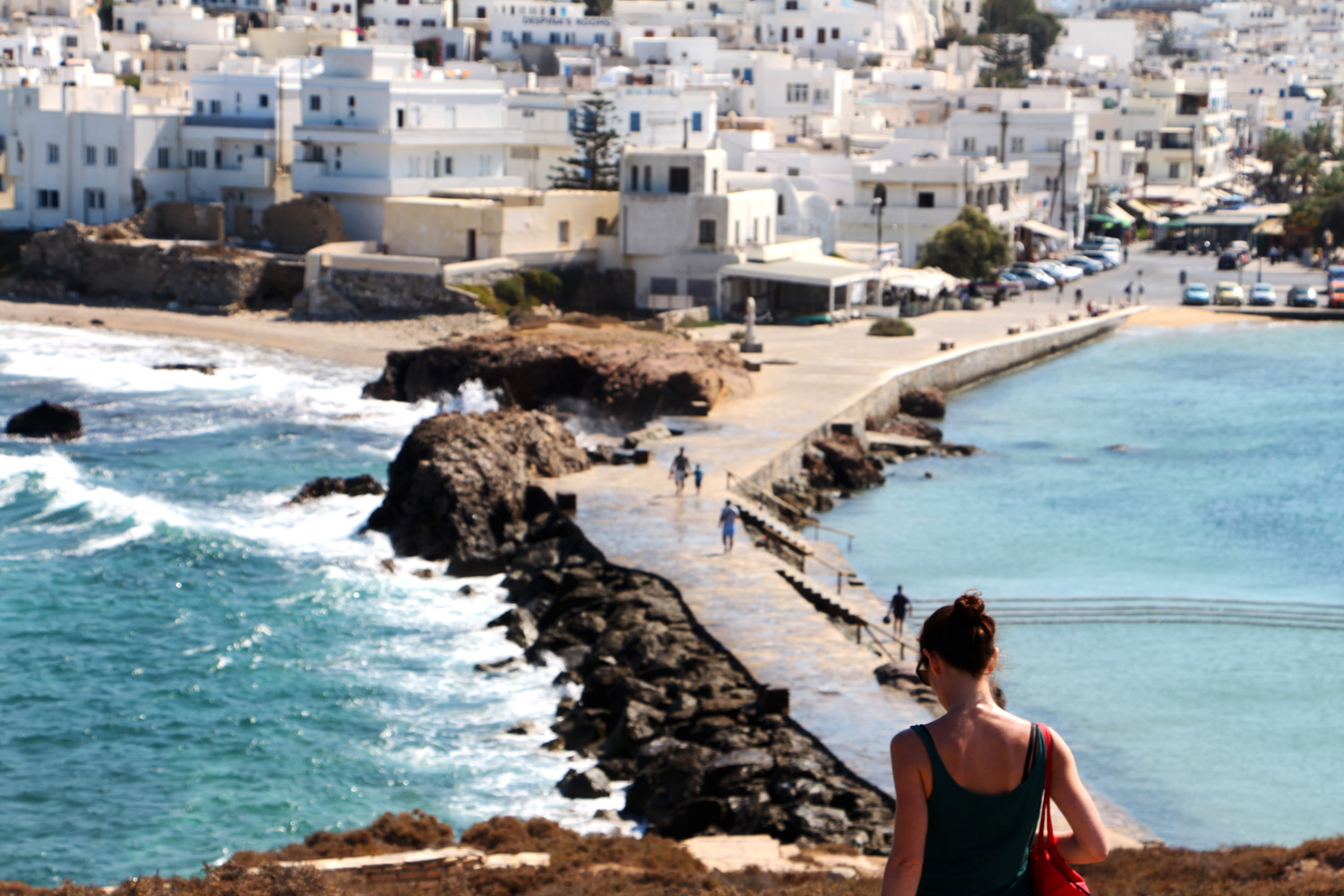
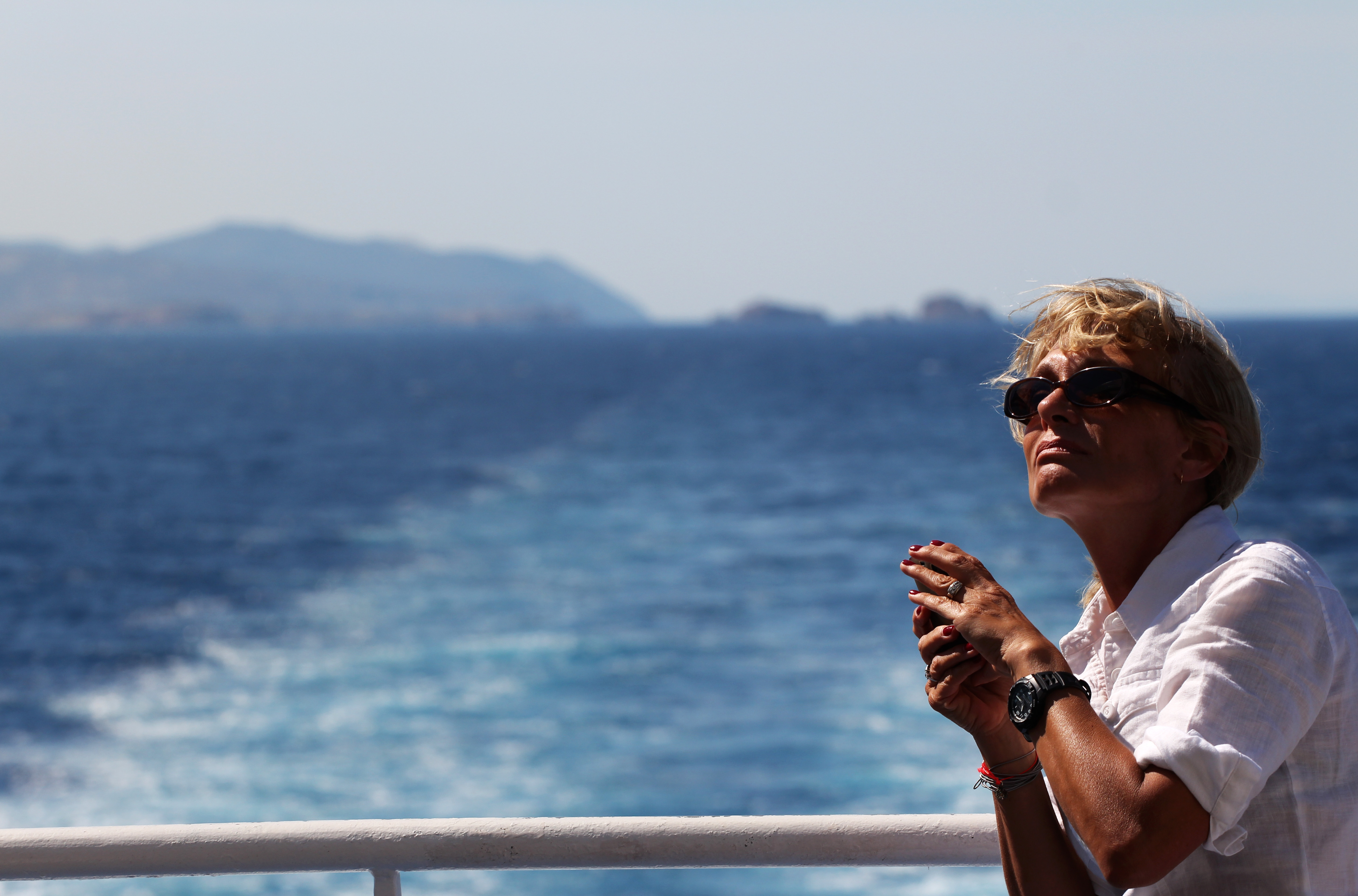
Sprang, Sprung

The following are some recent efforts, and the odd one not so recent. Warm winter, hot spring, though I do love the variability. A lot of sunshine of late, and as ever, the beach beckons…

8004 ANZ Building 2

8146 Flags

8327 Sculpture by the sea

8197 Tamarama

7705 Newtown peeps

1335 Lips

9332 Railway Square

8188 Tamarama 2

1982 City angles

8297 Sculpture by the sea

2001 Newtown Hotel

1861 Glebe Point

4123 Pitt street mall selfie

1510 Luna Park, Sydney Harbour

9224 Sunset from the wharf

9779 Big surf off coogee

Gobekli Tepe is the site of what appears to be the oldest temple in the world. So far. Its antiquity is staggering, enough to leave you gasping for breath. That it is older than the Pyramids of Egypt  (earliest date, Pyramid of Djoser, c. 2630 BCE–2611 BCE ) is perhaps not surprising, nor is it all that surprising that it is older than Stonehenge (c. 2400-2200 BC). Yet, that it is as much as 7000 years older than Stonehenge, and of a more sophisticated construction, is enough to cause paroxysms of disbelief. Gobekli Tepe is so old –  at least 11,600 years (c. 9500BC)  –  that it predates agriculture and farming.

Gobekli Tepe 9

Gobekli Tepe, which literally translates as “Potbelly Hill”, sits atop a mountain ridge in south-eastern Anatolia. The site, which was first identified as Neolithic by Professor Dr. Klaus Schmidt in 1994 (initially it had been dismissed as a Byzantine graveyard), consists of a series of dry-stone rings, roughly 20-22, ranging from 10 to 30 metres in diameter, with T-shaped limestone pillars both inset into the walls at regular intervals, or free-standing in the centre of the circles. The stone circles also typically have a walled passageway leading from them, giving them a saucepan-like shape. The pillars, the tallest of which are 6 metres high, have been carefully shaped and decorated with images of animals and insects: snakes, foxes, boars, scorpions and gazelles.

Gobekli Tepe 7

Gobekli Tepe 5

Gobekli Tepe 4

The stone circles cover an extensive area – roughly 300 square metres, much of which is yet to be excavated, but which has been shown, through ground piercing radar and magnetic resonance imaging to contain further structures. Whilst the earliest radio-carbon date is c. 9500 BC, other areas of the site could be considerably older – as much as three to four thousand years older. A great deal of stone and flint tools and animal remains have been found at the site – but no signs of permanent habitation. As yet no burials have been discovered, nor any evidence of wealth or social status differentiation – such as high status ornaments. The archaeological evidence points to this site not as a permanent settlement, but as a place used by hunter-gatherer communities, which most likely served a ritual, communal function, possible as a sort of pilgrimage site for local tribal groups.

Gobekli Tepe 12

What makes this site so fascinating is that it significantly challenges established ideas about the origins of civilization and urban society. Traditionally it had been believed that the domestication and corralling of animals, along with the development of agriculture and farming, led people to settle more permanently in areas and thus to the development of towns.

Gobekli Tepe 3

Not only does Gobekli Tepe predate the earliest archaeological evidence we have for organised farming, but it does so by almost 1500 years, and possible considerably more. This suggests that it was, in effect, ritual practice of some kind – (the role and function of these buildings is still open to speculation, however much they might resemble temples) which initially brought people together in more permanent communities. Some scholars have  even suggested that agriculture itself might be an off-shoot of this kind of centralised religious activity. The consumption of wild grain at sites such as Gobekli Tepe may have induced a proliferation of edible grasses around the site, thus sparking an attempt to harvest this resource in a more planned fashion.

Gobekli Tepe 8

The site also challenges ideas about the capacity for people to organise and carry out work on this scale during this period. Traditionally, town or village-based urban civilization has been seen as a prerequisite for this scale of building activity, on account of the need to organise and feed a considerable work-force. In hunter gatherer societies, without grain storage or food surpluses, it was assumed that it was not possible to dedicate the time and labour to something so superfluous to survival. The freeing of people from the need to hunt and gather was understood to be a product of organised town or village life, in which roles were able to diversify and agricultural surpluses could support other activities. The construction of the largest structure at Gobekli Tepe, which is estimated to have required a bare minimum of fifty dedicated labourers, has significantly challenged this established model.

Gobekli Tepe 6

One curious aspect of the site is its historical progression and transformation.  Over time the stone rings were buried, with new rings erected over and beside the old, each of which was successively smaller than what came before. This gradual reduction in size might represent either a decline in the capacity to build such structures, or a declining interest in maintaining structures of such magnitude at this particular site, the importance of which might have waned.

Gobekli Tepe 13

This latter point makes more sense when we consider the local context. Lying roughly 30 kilometres north of Gobekli Tepe, and now submerged beneath the dammed waters of the Euphrates River, is the site of Nevalı Çori, a Neolithic village, the earliest radio carbon date for which – somewhat speculatory – is the middle of the 10th millennium BC. More definite dates place Layer II – its second construction phase – in the second half of the 9th millennium BC – more than a thousand years after the earliest known construction phases on Gobekli Tepe, but still within the period known by the acronym PPNB – Pre-Pottery Neolithic B.

Nevali Cori 2

The excavated architectural remains at Nevalı Çori consisted of long rectangular houses containing two to three parallel flights of rooms. Attached to these were a similarly rectangular structure subdivided by wall projections, likely residential space. As fascinating as these early pre-agricultural, pre-pottery settlements are in themselves, what is most striking for our understanding of Gobekli Tepe is the presence of what appears to be a temple / cult complex cut into the hillside. This consisted of a square space with monolithic pillars similar to those at Göbekli Tepe built into its dry stone walls, and two free-standing pillars, each three metres tall, in the centre. The pillars were carved with images very similar to those at Gobekli Tepe and appear to be a part of the same cultural milieu. Some archaeologists have speculated that the construction of local temple sites in emerging villages reduced the importance of the site of Gobekli Tepe, with religious practice becoming more focussed on local village structures.

Nevali Cori 1

Nevali Cori 3

Further excavations will ultimately shed more light on this important period in human development. Gobekli Tepe may yet reveal itself as a settlement, not just a meeting place for ritual. Even its function as a ritual centre is uncertain owing to the difficulty in understanding the beliefs and motivations of people so remote. Were the stone circles at Gobekli Tepe meeting places, schools, markets, dining halls or even an arena of sorts? Professor Schmidt, who has been excavating the site continuously since its discovery, considers Göbekli Tepe a central location for a cult of the dead. He believes the carved animals were there to protect the dead. Despite the absence of tombs or graves, Schmidt thinks that they remain to be discovered in niches located behind the sacred circles’ walls. Either way, whatever their function, they mark the first known attempts at monumental architecture, placing the revolution of “civilization” much closer to the end of the last ice-age then previously thought.

Gobekli Tepe 10

Gobekli Tepe and Nevalı Çori are by no means the only contemporaneous sites in the region. Others include the so-called tower of Jericho – a tall, conical structure with an internal staircase, roughly 11,000 years old; Tell’Abr, a village characterised by central, communal storage buildings, also roughly 11,000 years old,; Jerf el-Ahmar, an 11,200 year old village with large communal buildings and Wadi Faynan, another village with communal buildings dating to roughly 11600 years ago. The emergence of these settlements in the wake of the last ice-age, c. 13000 years ago, is reminiscent of the Cambrian explosion of bio-diversity in the wake of the last Snowball Earth period. It appears that as the environment changed, ever-adaptable humans began to fill available niches and make use of more abundant resources. Perhaps the transition to villages and sites like Gobekli Tepe marks an attempt to recreate the centralised activity of cave-dwelling, though this rather keenly assumes these people were in fact transitioning from cave-dwelling, rather than altering an already open, nomadic lifestyle.

Gobekli Tepe 1

Recent studies in which ancient strains of grain and grass were grown in different levels of carbon dioxide – representing those of the last ice-age, and those of today – produced astonishing results. In the case of wheat and barley, the heads fattened up to and beyond double the size of those in grown in ice-age conditions. Was it as much the availability of this newly rich food source, along with the abundance of animals that drew people to this region in the first place? Was it the sheer abundance of food that allowed them to remain largely in the one area, rather than needing to forage more widely? Whilst we cannot identify evidence of organised farming and agriculture, it is almost certainly the case that people were harvesting wild grains prior to this development. Were Neolithic people storing wild grain in their communal buildings? As mentioned above, perhaps agriculture, and indeed, animal husbandry, came about as an offshoot of other, centralised activity. Whether that activity was religious or otherwise is uncertain, but the nature of sites like Gobekli Tepe certainly suggest a ritual purpose.

Gobekli Tepe 14

Professor Schmidt estimates another fifty years of work are required to unearth most of Gobekli Tepe’s secrets. This ongoing work may push the date back further, and may yet reveal further monumental structures buried beneath the hill. Other sites may yet be discovered, offering further insights into this fascinating period of human history. Whatever the case, it seems civilisation is a lot older than we originally thought, and may be older still – a more direct consequence of the end of the last ice-age than previously believed.

original night shot

Disclaimer: These images are not my own, but come from various sources freely available on the web