Feeds:
Posts
Comments

For two years now I’ve been sitting on a half-finished continuation of my Confessions of an MMO Addict articles, which detailed (and yes, admittedly in quite arcane detail) my experience of playing the Massively Multiplayer Online Role-Playing Game (MMO) Dungeons and Dragons Online (DDO). The further in time I got from the experience itself, the less relevant and interesting it seemed to me. When last I left off in this series, I’d just returned from six weeks travelling around South East Asia. What lay ahead of me was an even more intense indulgence of my already dangerous gaming habit.

What follows is mostly from two years ago, with continuations. It is worth pointing out that I wrote this whole series with the idea in mind that I was creating both a personal account and a historical record. It might seem fanciful to imagine that my blog or its content will still be readable in, say, two hundred years time, or of interest to historians for that matter, but should it be the case, then it might prove insightful to anyone interested in the detail of game mechanics, online social habits and the psychological impact of online gaming. As someone with a PhD in history, I greatly appreciate the efforts of those who have made detailed records of their present in the past. It is for this reason that I included so much detail in these accounts. In several hundred years time this period will be seen as the time of earliest origins in an entertainment media – computer gaming – that is already well set to dominate the future as a means of narrative storytelling. If I can make some contribution that might furnish future history PhDs with primary source material, then I’ve to some degree justified my education : )


Confessions of an MMO Addict, Part VI

“God I’ve been asleep so long, I’ve been away

Back from software limbo the natives call today

I let their promises bind me

I let seductive logic blind me

I embraced a machine, I went through the routine,

And I hid from the people who were trying to find me.”

– The Church, Tantalised


I had hoped that my holiday to South East Asia would help me kick the Dungeons & Dragons Online habit, but I returned to Sydney a desperate junkie. My travelling EEE PC, bless him, had struggled to render the game at all and I had been forced to play solo, with the sound off and graphics turned down to minimum. All I could manage was to farm low-level dungeons on the easiest level for collectables, to buy and sell from the brokers and thus make money on the auction house. It had, in reality, been the very worst sort of grinding, but it kept me going on those heavy hotel-room nights on the road. I couldn’t wait to get back to my desktop, log in, team up with some random bunch of heroes and play the game on full specs in magnificent wide-screen. My New Years resolution had been 1680 x 1050 and I was aching to go from the grind to the grandeur.

Sadly, my return to Sydney also marked the end of my relationship with S. I hadn’t exactly been the best companion much of the time and I was, quite rightly, let go, so to speak. I was a terribly sad way to end things, though it was at least amicable. I was left feeling pretty awful all round – not entirely enamoured with myself. What, however, was most alarming, was that I didn’t really mind all that much. I was used to being mildly unhappy and at something of a low ebb. Nor did my response have much to do with S herself, but it was all about my being so utterly consumed by the game. Without a partner in real life and working part time, I was almost entirely free to game at will.

When I hadn’t been playing the game during my trip, I’d spent my spare time using the DDO Character Planner to experiment with multi-class character builds so I might build these characters upon my return. Now that I was back, however, I realised that my first priority must be to take Hallifax Bender, my long-standing stalwart bard hero and favourite alter-ego, to level 16, the then level cap.
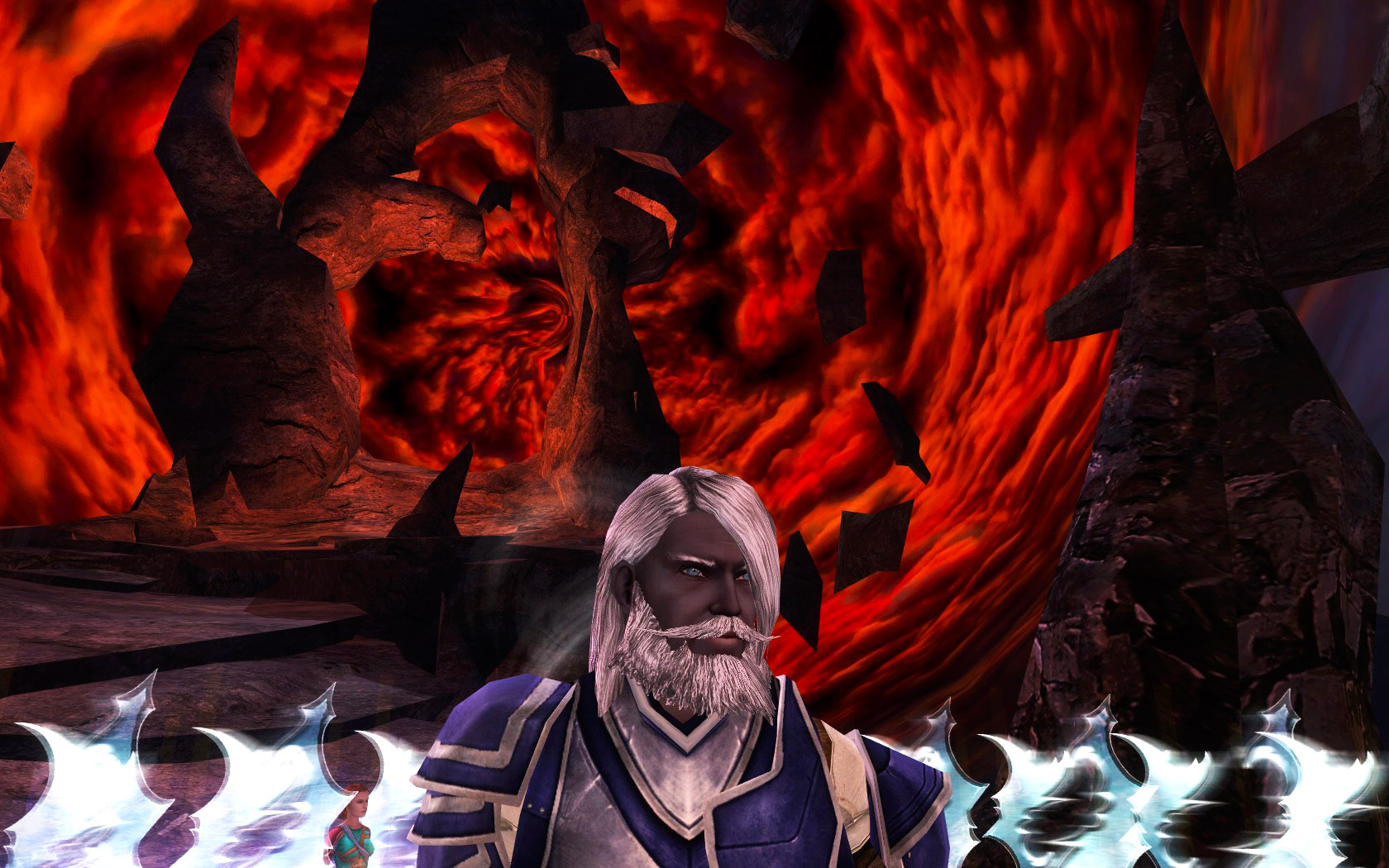
This target was really part and parcel of a grander scheme, which was to achieve 1750 favour with the various representatives of the different Houses of the city of Stormreach. The city contained four different wards, largely populated by the different, major player races. There were the Elves of House Phiarlan, the Halflings of House Jorasco, the Dwarves of House Kundarak and the Humans of House Deneith. These different districts tended to specialise in different classes, and earning favour with them allowed access to certain privileges in the form of new vendor options, buffs and useful reward items.
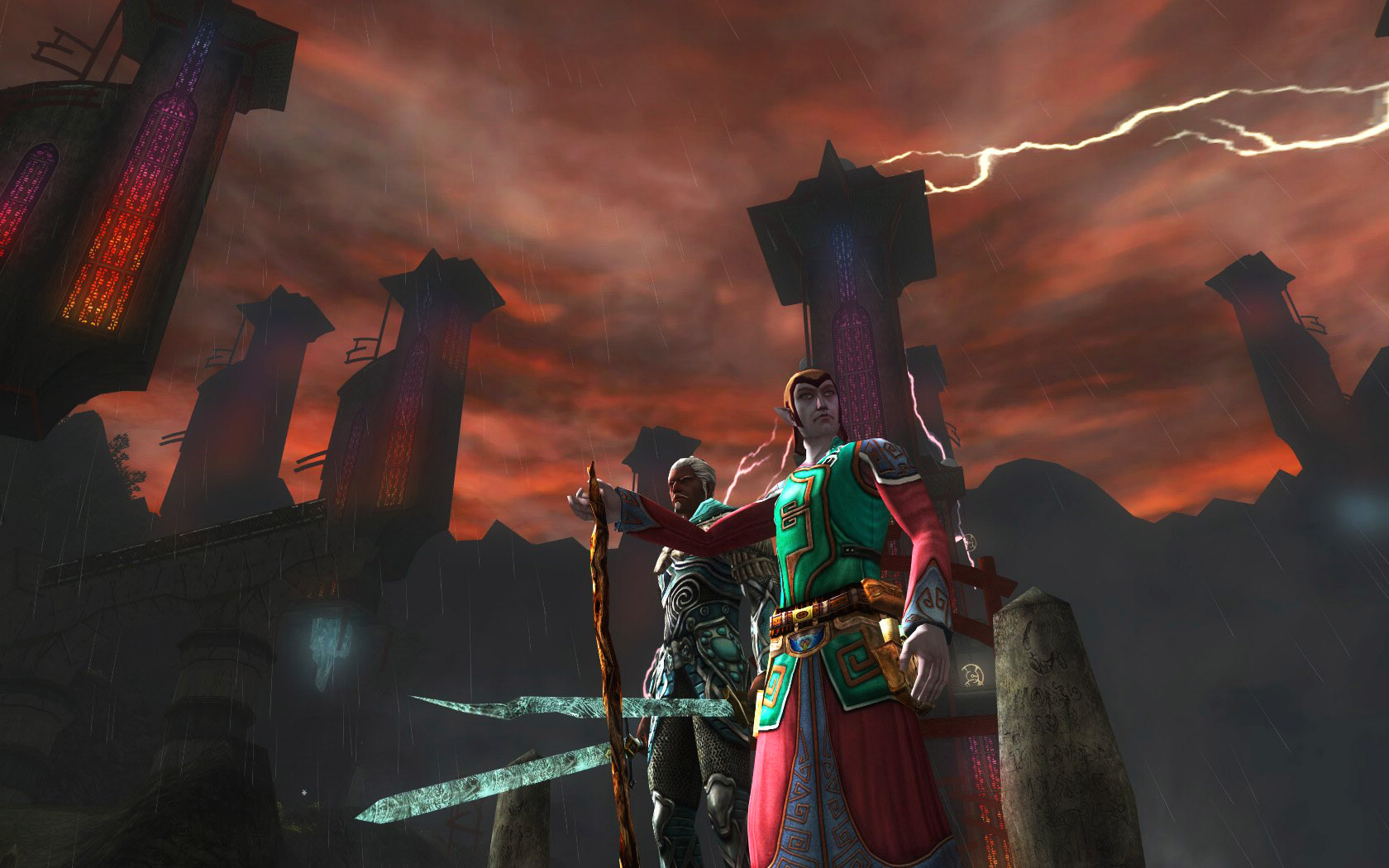
The city of Stormreach was run by a group of people known as the Coinlords, and currying favour with the Coinlords was of particular importance as this granted extra inventory space. There were also the mysterious Twelve, the Free-Agents, the Church of the Silver Flame and the Agents of Argonnessen. If one achieved 400 favour on a single character, it unlocked the Drow race, whilst earning 1750 favour allowed one to build a character with 32 build points, as opposed to 28. This was by no means insignificant, and for those who have absolutely no idea what I’m talking about, I shall elaborate.
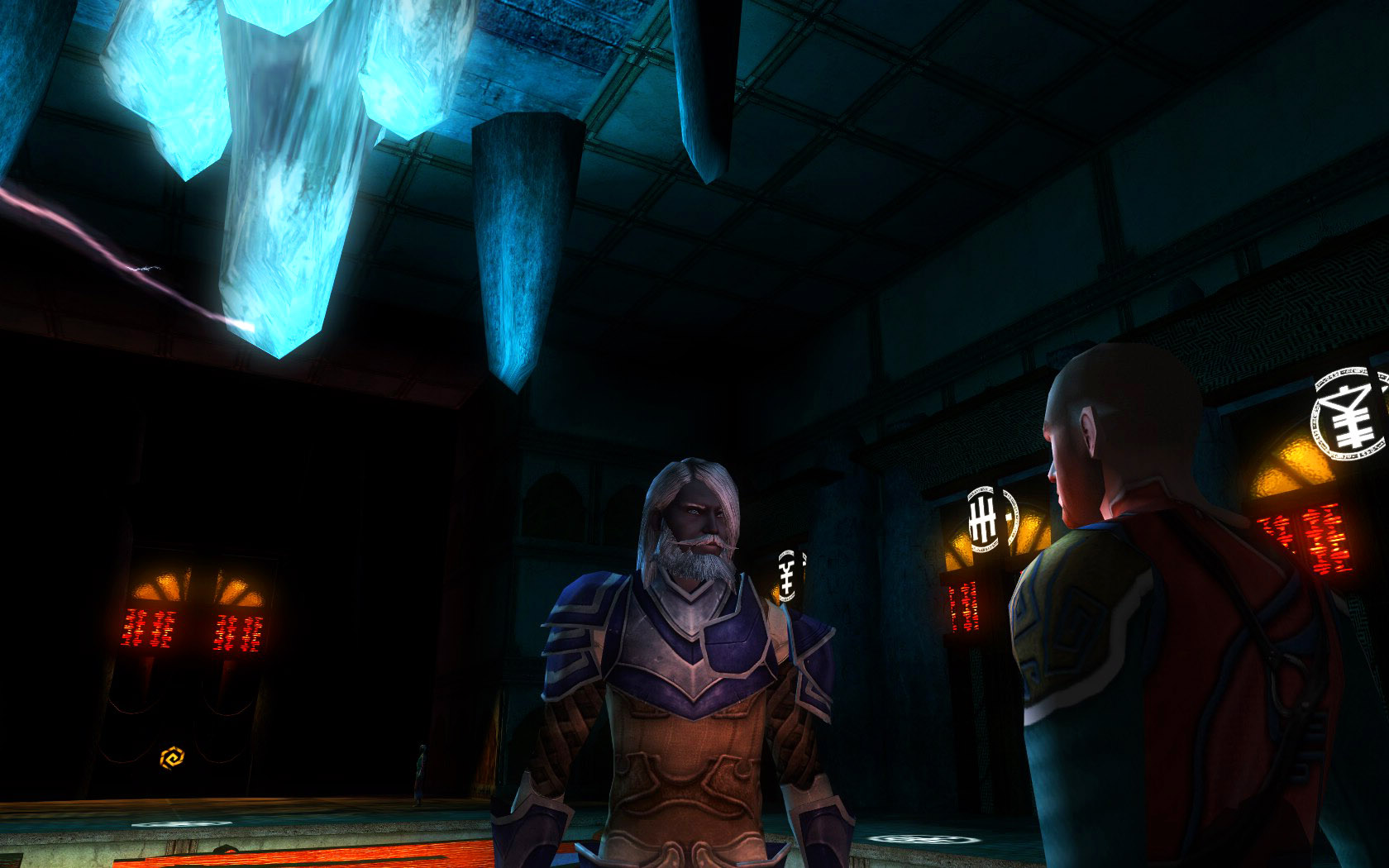
The six principal attributes of a Dungeons & Dragons character are Strength, Intelligence, Wisdom, Dexterity, Constitution and Charisma, and, in the original rules, these scores were generated by rolling 3D6, or 3 six-sided dice. This produced scores ranging between 3 and 18, with the higher score being the better. As it was such a significant disadvantage to have a 3 or, indeed, anything below 8 in an ability score, most players rolled 4D6 and ignored the lowest scoring die to generate their attribute scores. There were always other fudges allowed, such as rolling the numbers first, then allocating them to each particular attribute, or, for example, subtracting a point from one attribute score to be added to another. In the pen and paper days, as was so often the case, it all hinged on the famous “DM’s discretion.” In other words, if the Dungeon Master said it was OK, it flew.

The character creation system in DDO took the dice out of character generation altogether. It followed a similar pattern to that used in Neverwinter Nights and was designed to ensure game balance, so that players would neither roll a completely crap character, nor spam the generation process until they rolled an uncannily high set of numbers, as one could do in Baldur’s Gate for example.

The system worked as follows. Each character would begin with a base score of 8 in each ability, and be granted 28 points to allocate to the aforementioned attributes. The cost of allocation was one for one, until the score reached 14, at which point any subsequent increase would cost two points. After 16, however, any subsequent increase cost 3 points. Thus, for a human character, it would cost 6 points for a starting Strength of 14, but 8 points for 15, 10 points for 16, and 13 points for 17. One could choose either to focus on particular attributes or go for a broader spread. With non-human races, who had racial bonuses or penalties to particular attributes, say, for example, Elves, who have a racial bonus of +2 Dexterity and -2 Constitution, the starting score would be lower or higher accordingly, as would be the bar at which increasing the attribute began to cost more. Thus, the starting Dexterity for an elf was 10, and raising it to 16 would cost 6 points, whilst the starting attribute for Constitution was 6, and raising it to 12 would cost 6 points, whereas an increase to 14 would cost 10 points, with any further increases costing 3 build points per attribute point.
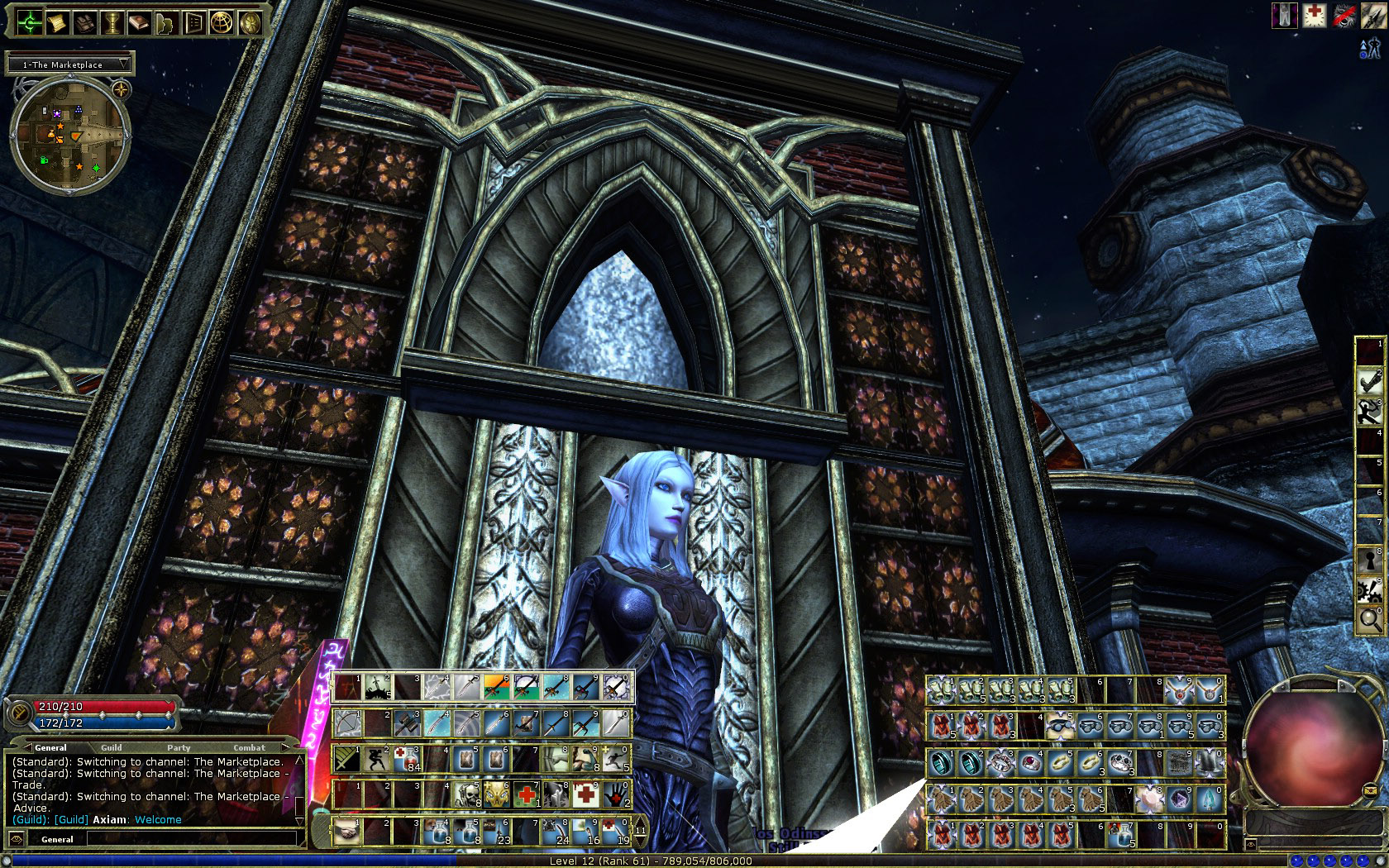
It therefore made a not insignificant difference to have 32 build points with which to commence a character, allowing the player either to increase a class’s most important attribute, such as wisdom for clerics, or to avoid penalising another less important attribute. It also gave one the option of increased specialisation or flexibility, the latter being particularly important with multi-class builds.

I have documented elsewhere my obsession with creating characters, and DDO was the most dynamic means yet for testing the efficacy of certain builds. It was not only the functionality of the characters that interested me, but the personality I’d give them through their name, style, appearance and, where I could be bothered providing it, their biography.

Before I could really go to town and start creating a whole slew of new characters, I needed to advance Hallifax to level 16 and hit that much coveted favour target. The process took me no less than a month and a half of solid play, every weeknight, every weekend, with occasional breaks when exhaustion became so overwhelming that I simply couldn’t concentrate any longer. Even then, I often pressed on, both impressed by and ashamed of my incredible ability to endure.

Yardley The Scissors Bruce in the Vale

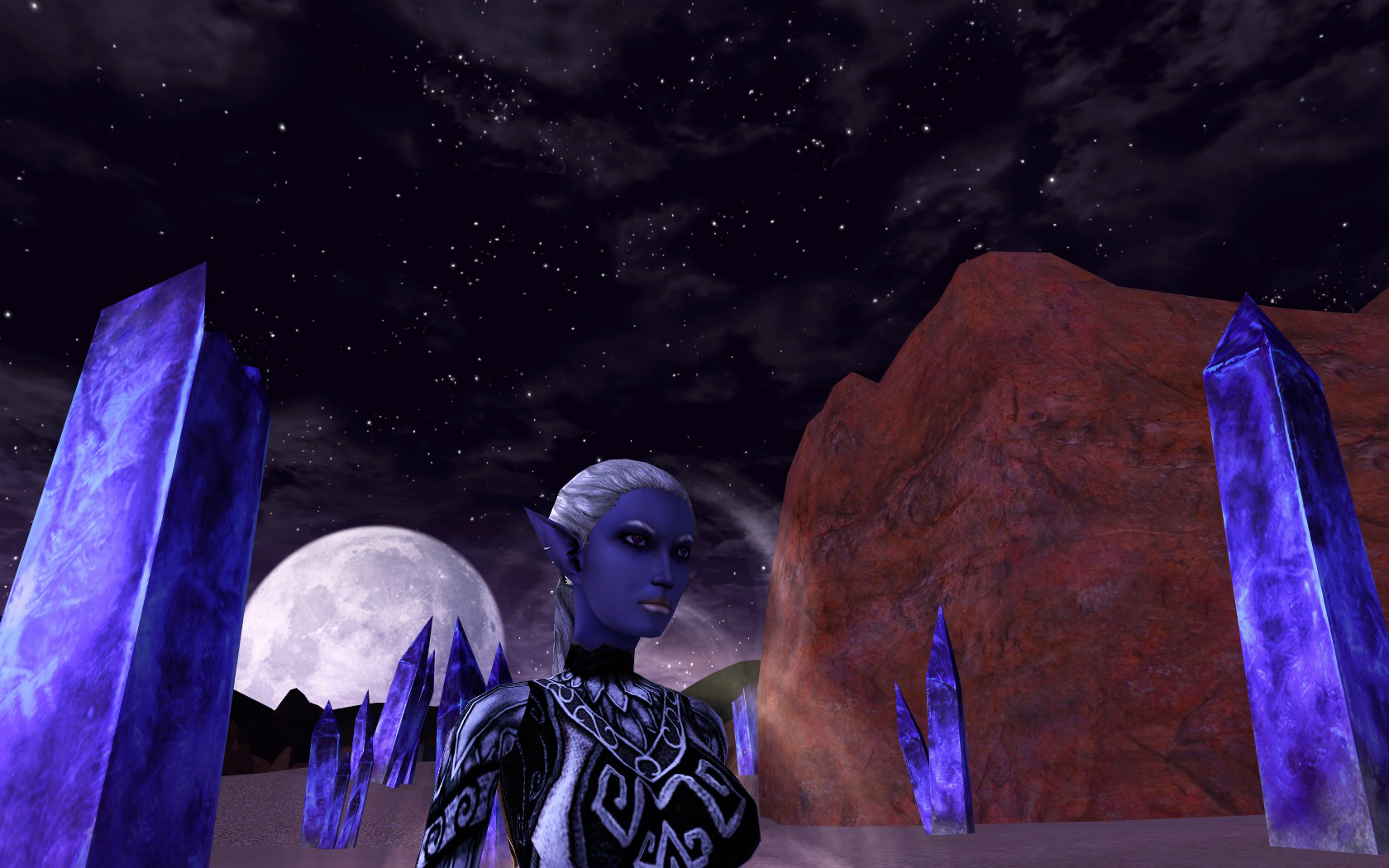
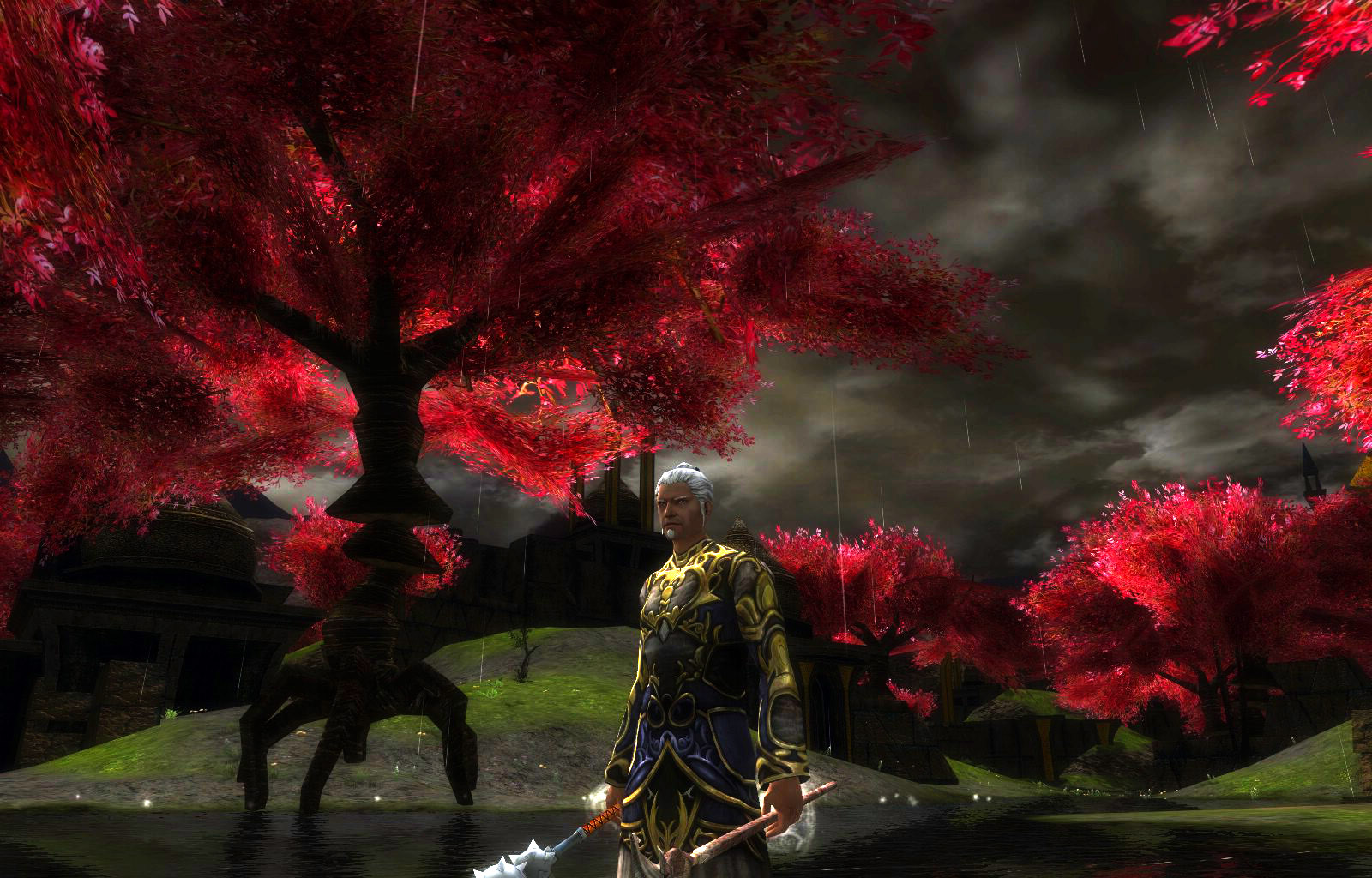
As I ran Hallifax up through levels 12, 13, 14 and onwards, I was continually coming across new quests and explorer areas I’d never seen before: The Vale of Twilight, The Orchard of the Macabre, Ataraxia’s Haven, The Menechtarun Desert, The Ruins of Gianthold and The Reaver’s Refuge. The novelty of running these areas for the first time kept my enthusiasm for the game at a very high level, despite the hit and miss nature of the groups in which I found myself. One of the greatest attractions of computer games is the ability to surprise and to fascinate through exotic locations, interesting challenges, impressive artwork and terrifying opponents. DDO had a lot to offer on these fronts and sharing the experience with random people, especially when they too shared my enthusiasm for the task at hand, made it all the more pleasurable.

Dimension door in the desert

The higher level quests were, on the whole, more colourful and complicated than some of the low-end dungeon crawls, though there were certainly a few outright slogs. In so many ways DDO failed to live up to the true promise of Dungeons & Dragons. It was too fast-paced, magic items were as common as muck, most players were focussed on end-game builds, rather than the journey, which invested them with an impatient zeal to farm as much XP as possible. Almost no one tried to role-play in character, and those who did were generally ostracised for not acceding to the meta-game narrative. By metagame narrative, I mean talking about the game as a game, not as an immersive role-play experience; discussing the mechanics, the structure, the rules and parameters rather than the story or narrative.

The 3.5 edition Dungeon Master’s Guide states:

“Any time the players base their characters actions on logic that depends on the fact that they are playing a game, they’re using metagame thinking. This behaviour should always be discouraged, because it detracts from real role-playing and spoils the suspension of disbelief.”

It was, indeed, immersion breaking, to have some nerdy kid ramble on about his weapons, or whatever inane thoughts were on his mind. All too often it was this metagame narrative that drove the conversation; babble about character builds, favour-farming plans, crafting, magical items, the effectiveness of spells, special attacks, strategies, boasts about lucky loot hauls etc. Much of this could have been contained or disguised within a more theatrical role-play, yet almost no on in the game was interested in doing so. Add to this the fact that so many players were non-native English speakers, lacked microphones or were unable either to hear or interpret chat, and you had a situation where communication in the group was largely limited to the task at hand, discussed in the plainest possible meta-game language.
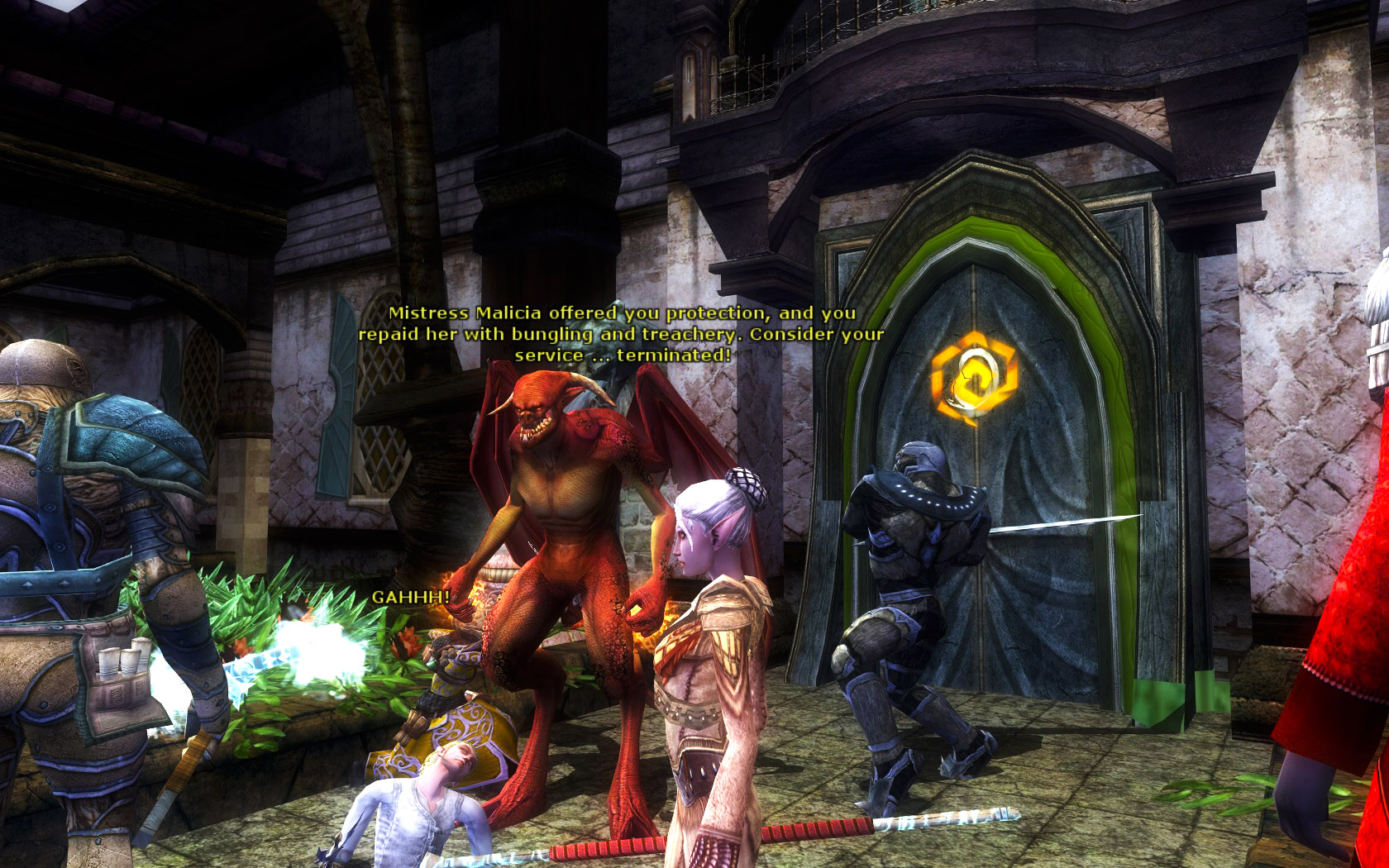
Once players knew the game well enough, metagame thinking became the only sort of thinking. This was, of course, very sensible as knowing the mechanics of the world and the tendencies of the game designers made it possible to make better predictions about what lay ahead. Also, for players who had run quests several, possible hundreds of times, there was, quite simply no mystery remaining, only the satisfaction of a swift, efficient, error-free completion. The game did not foster an environment in which role-play was at all practical or desirable for people joining pick-up groups, though it could be, if one were able to play regularly with the same, like-minded people. For the vast bulk of players, this was simply not possible.

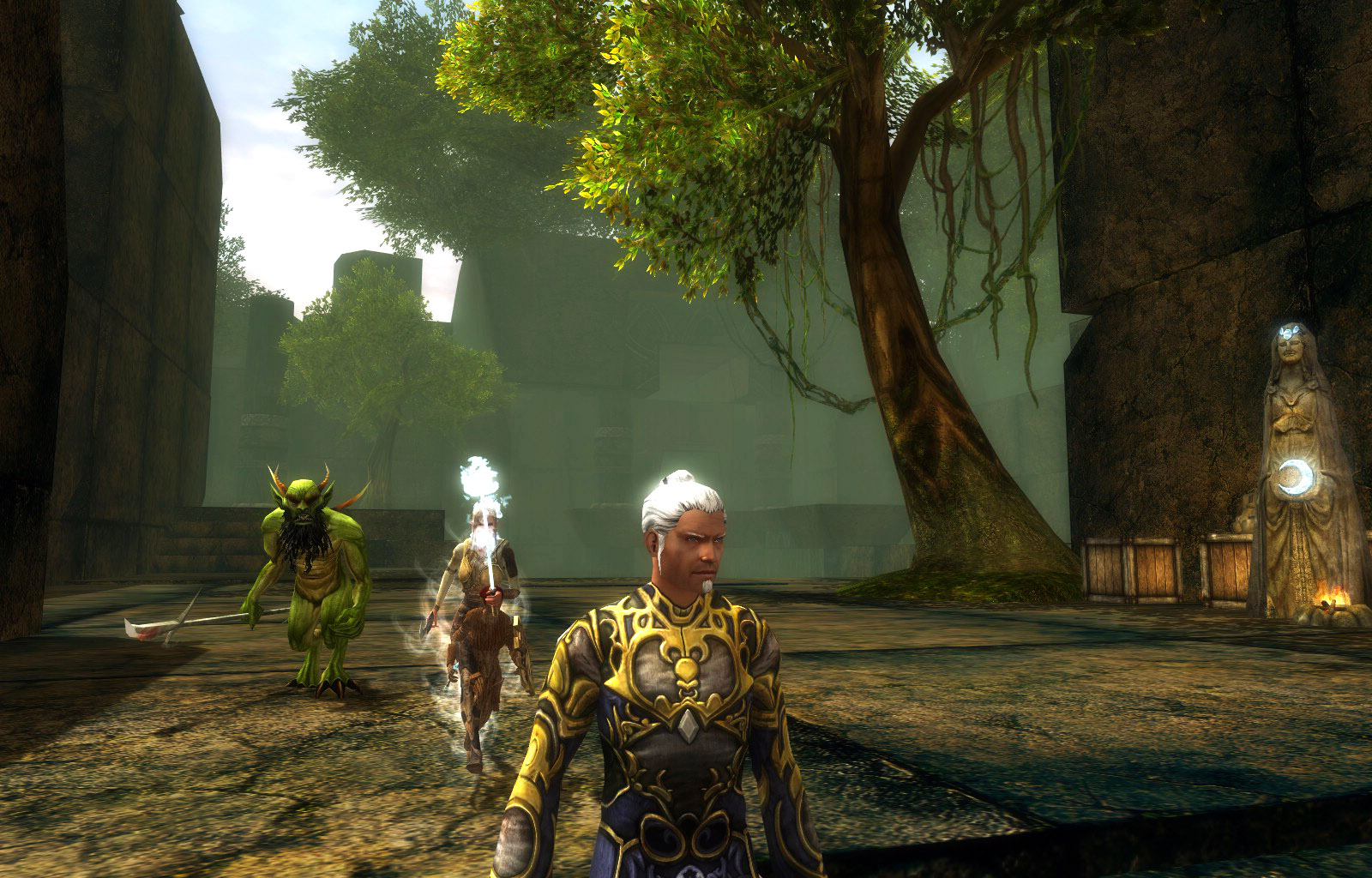
Jyzze with an extravagant companion

Whilst in many ways DDO seemed very different from Dungeons & Dragons, it was oddly true to it in other ways. Many of the quests involved treks through long, complicated dungeons, replete with traps, riddles, tricks, monsters and loot, locked doors, secret passages and illusions. The impossibly long corridors under the city of Stormreach and in the ruins and settlements surrounding it resembled those of E. Gary Gygax & co.’s earliest dungeons. They were classic dungeon crawls, which, if mapped onto pen and paper, would not be entirely out of place in a pile of First Edition modules. The principal problem, however, was the pace at which they were run. If the quest Walk the Butcher’s Path were played as a pen and paper game, it might take an entire day of careful dungeon-crawling between mob fights to complete. Yet, in DDO, an efficient party could smash through it in nine minutes, possibly less, with everyone running the entire way, as is most often the case.
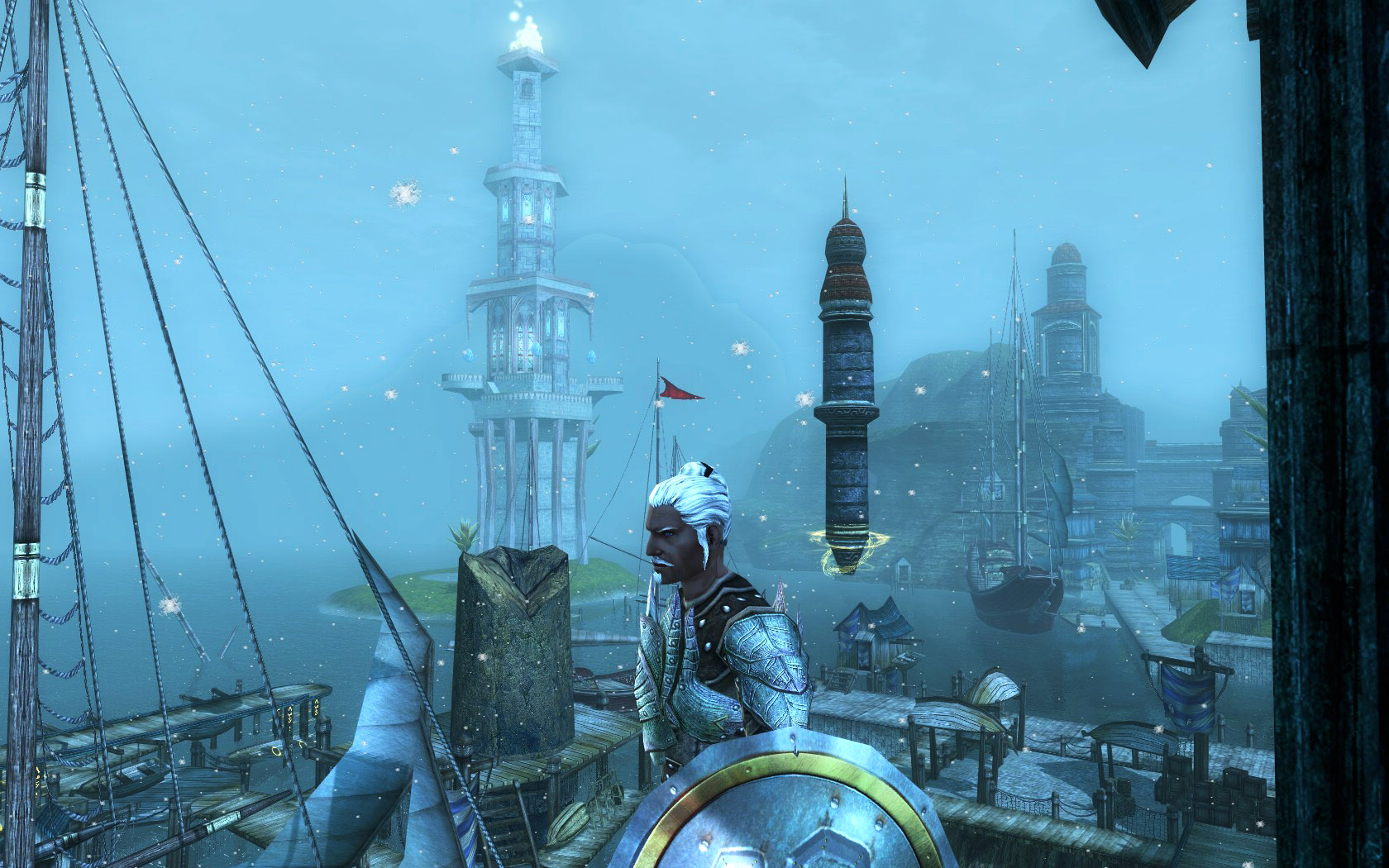
Winter in Stormreach harbour

This high-octane, fast-paced dungeon crawling was very much de rigueur on all servers and almost every group contained a player, if not several, with sufficient experience to spoil the surprises by giving advance warning of what was to come. It was a very useful preventative, but stripped the game of immersion and, at times, suspense.

Despite these short-comings, the game was still thoroughly enjoyable, especially when running quests for the first time. Some of the lower-level quests could seem quite bland, but things certainly became more diverse and colourful as time went on. The exciting newness of the locations and challenges, the landscapes and environments – be they interior or exterior – was sufficiently immersive in itself. As Hallifax Bender first began to make his way through higher level quests, I was also very fortunate in finding good groups who did not spoil the excitement, but rather encouraged it. I mentioned in earlier instalments one stalwart companion, a bard by the name of Holz, with whom Hallifax regularly ran. Though I had started playing the game some time before Holz, we both hit mid to high levels at roughly the same time, and thus experienced many quests for the first time together.

By the time Hallifax finally hit level 16, the in-game level cap had already been lifted to 20. I found some good people and made the final push for 1750 favour out in the craggy, burning wastes of Gianthold, with its depressing, relentless brown and purple landscape. Despite my great love of the character of Hallifax and my pride in his many achievements over what had now been more than a year of gaming, I knew that the instant I hit 1750 favour I would be abandoning him. So it was that, that same afternoon, I created two new characters; Barronio Morrowind and Snowfell Vanish of Mirabar.

Barronio Morrowind

Shortly prior to this, as Hallifax was clambering towards level 16, the Favoured Soul class had been introduced to the game. Favoured Souls were Divine casters, using essentially the same spells as Clerics, yet with a spell progression and spell point allocation similar to Sorcerers. Barronio was an attempt to create a versatile, combat-capable support character and, with my usual zeal for experimenting with multi-class combinations, I made him a Human Monk / Rogue / Favoured Soul. I’ve mentioned earlier that I don’t always get it right with multi-class character builds, but that depends on how you look at it. When it comes to the end-game, at level 20, they are unlikely to hold up as well as specialist characters, largely because in a twelve-member raid group, all the bases are already covered and such diversity of talents is not required by one single player. Indeed, in the end game they tend to be too compromised in all their fields to be as effective as the specialists. That doesn’t make them useless, yet it makes them seem somewhat second tier to the pros.

At lower levels, however, and, I would argue, all the way through to around level 15, their effectiveness was unquestioned. Barronio Morrowind, on account of his mixed talents, was not only a formidable combatant with great durability and incredible saving throws who regularly topped the kill count, yet he was also a maxed rogue splash who, with spells and a backpack full of wands, could act as a back-up healer and buffer. I should also give myself some credit for equipping and playing him with expertise and precision. His rise was meteoric and he was always appreciated as a standout character.

Snowfell Vannish, meanwhile, was another indulgence of my multi-class zealotry. An Elf Monk / Wizard / Rogue, I too saw him as a combat-capable support character. The plan was originally to take him to level 2 in Monk for the abilities, saving throws and armour-class bonuses, level 5 as a wizard to access haste and displacement on top of other protective spells, then put the rest in rogue. After several months of play, he finished up Monk 2 / Wiz 5 / Rogue 7, at which point I decided to retire him for a good long while.
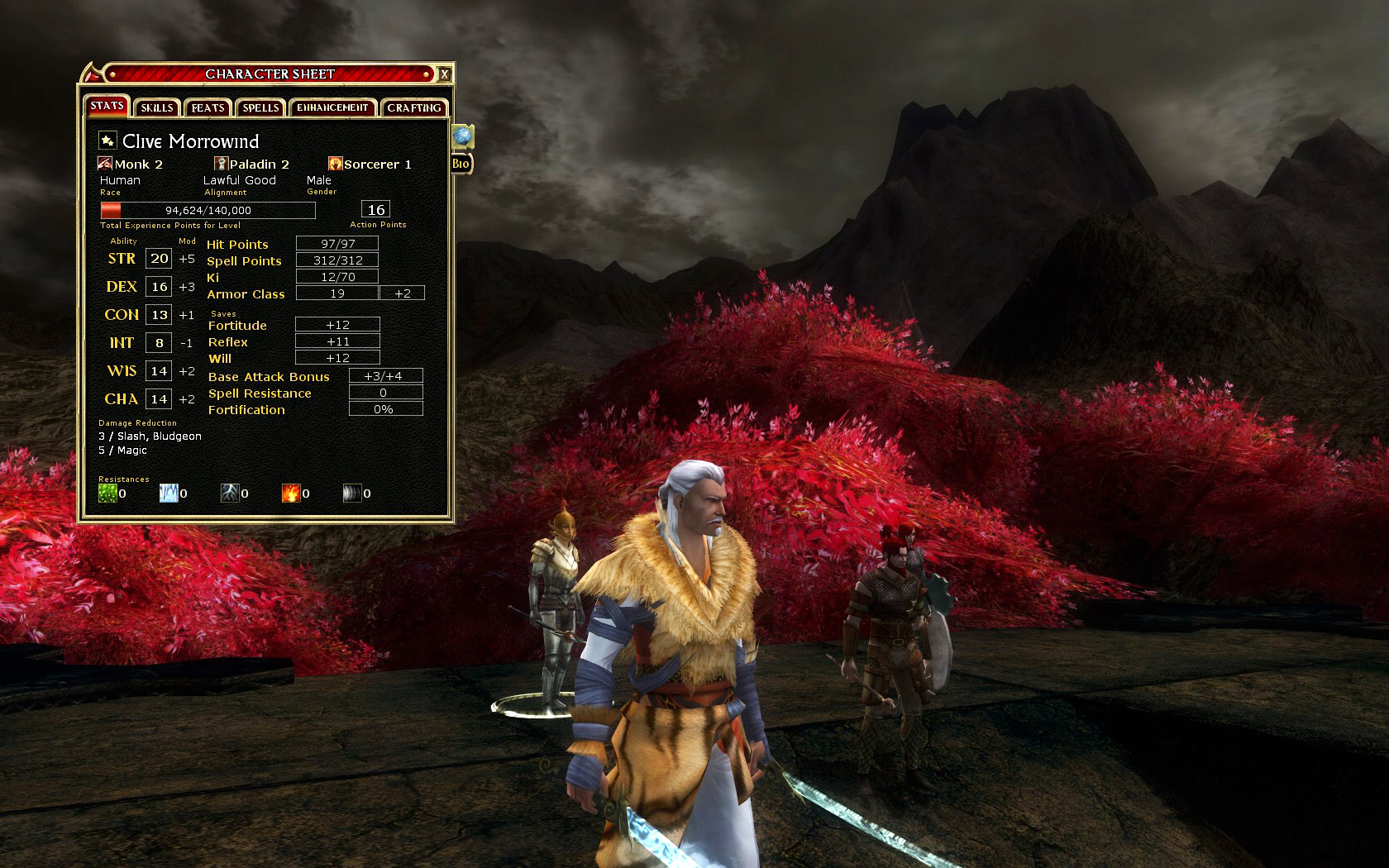
Clive Morrowind, another multi-classing experiment

Snowfell’s effectiveness was also incredible, if I may say so myself. He regularly smashed the kill count using unarmed attacks, was practically unhittable, could boost the whole party with haste in moments of need and was a top notch trap-monkey and sneak artist. Playing him was also very satisfying in that, strangely, a lot of people didn’t see the point of the build, nor could they determine what his role was, but he never failed to impress. Indeed, he was the only character I ever had who made it past level 10 without dying a single time. Ultimately, I decided that, for the sake of durability, he should in future only level as a Monk, but even then, I suspected that his effectiveness beyond level 14 was doubtful.
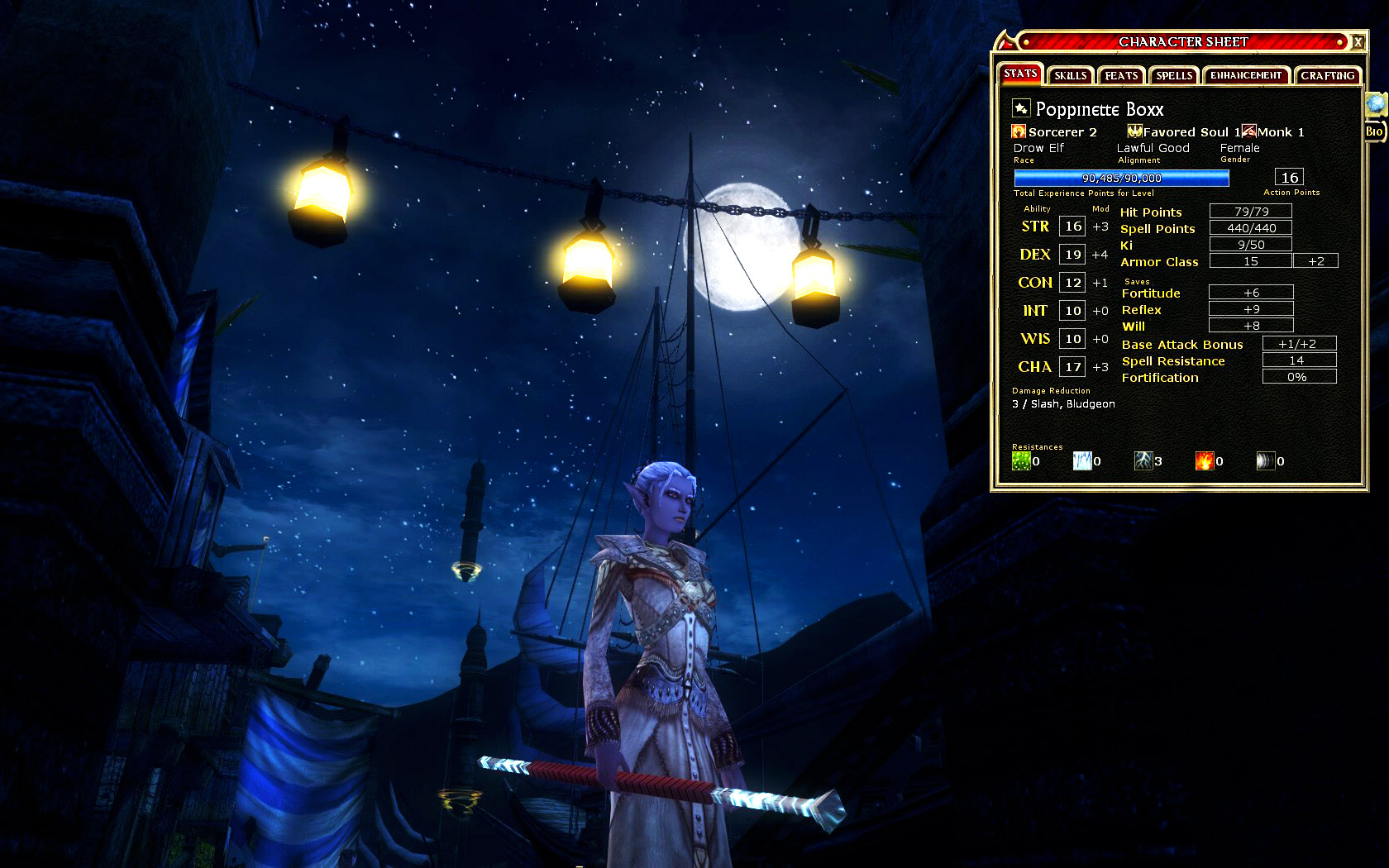
The creation of these two characters was just the beginning of a massive expansion of the playing roster. I went to town coming up with further multi-class builds, most of them following more traditional combinations that were tried and true. There was my ludicrously named Elf Ranger / Rogue / Monk Applefrost Loveblossom; the equally keenly named Drow Rogue / Ranger / Bard Honeydrop Sundew, the specialist Elven wizard whose name I borrowed, Faffle Dweomercraft and several others, some of whom were ditched shortly afterwards as failed experiments.

Many characters came and went and the quality of my game-play rose continually with experience. I gradually became far more familiar with the higher-level areas which improved my capacity there at the cost of my sense of wonder and excitement. I met many excellent people and played with my fair share of irritating dead-shits as well. As time wore on I stopped caring about the outside world altogether. I lost interest in my friends, family and other activities. I was impatient whenever other responsibilities arose and often accepted invitations to things, to which I would invariably fail to turn up.

Once in the game, however, I was unstoppable. The insatiable desire to start new characters never went away, however, and so I rarely ever took my characters through to level 16 or beyond. I’d usually make it into the teens, or at the very least to level 8, then switch out onto another toon and run them up. I often sat there, staring at the screen, scrolling up and down my list of characters wondering – who do I want to play? Once the game had switched to free to play mode and the option was there simply to pay for additional privileges, such as extra character slots, I bought up a good few and soon had 15 different characters on the one server: Lucessa Rainsinger, Rhodon Froste, Lusetta Sorrowdusk, Yardley “The Scisssors” Bruce, Jyzze Badajon, and Swimm Lantern to name a few.
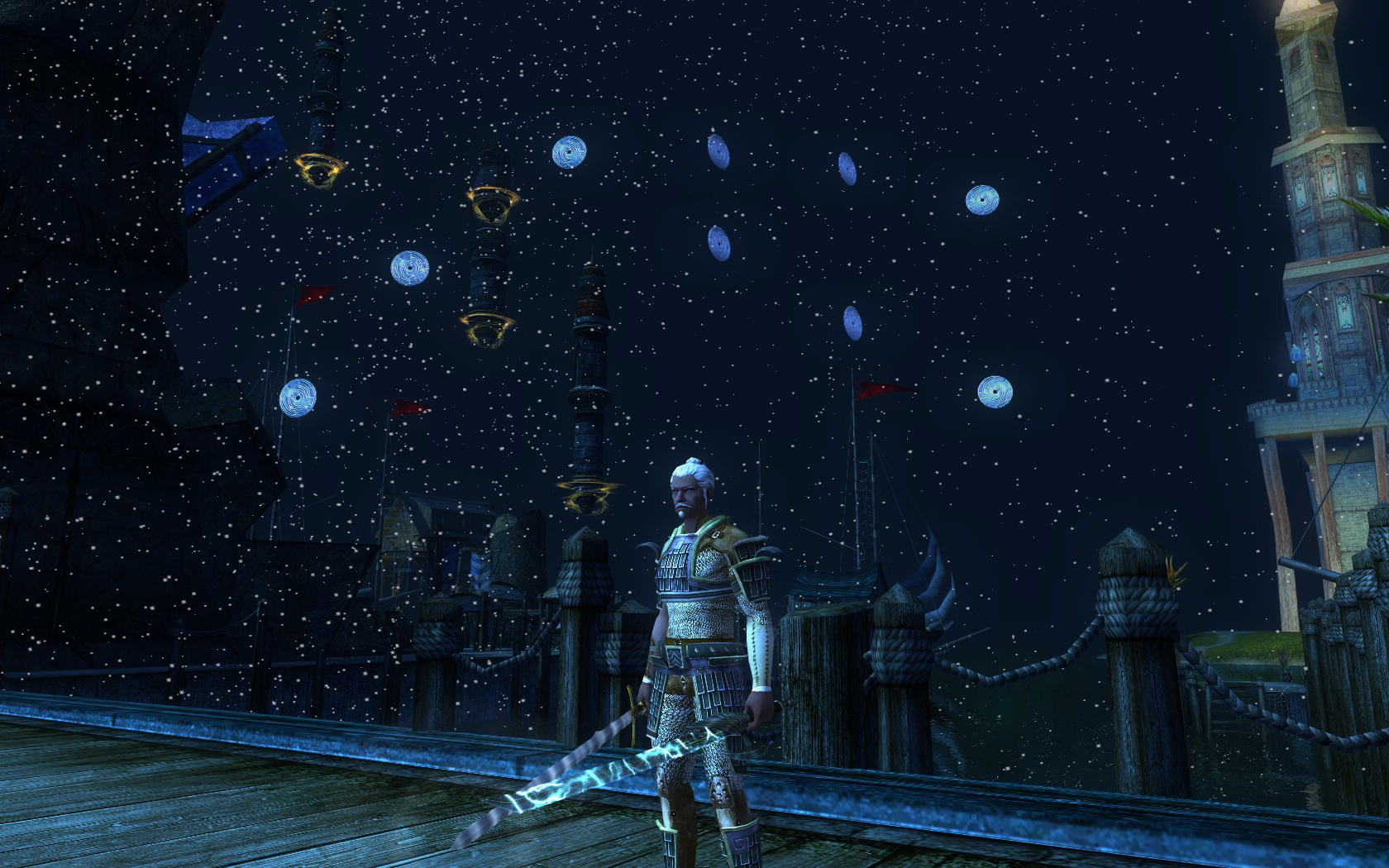
When new servers were opened and announced, I logged straight in and created a whole host of characters, in effect reserving names that were otherwise impossible to have as they had been taken from the start. Names such as Summer, for example, which can only be used once on any given server. On the Sarlona server, where much of my gaming took place, I’d had to run with Summerr – in the time-honoured tradition of variant spelling to get around the unique name issue. It was a fair compromise, I suppose. Most of these characters I never returned to and, I must admit, I feel a bit guilty in retrospect for denying those names to others. In some ways it was like having multiple personalities, and I would always, to some degree, try to be in character, at least in my own mind.
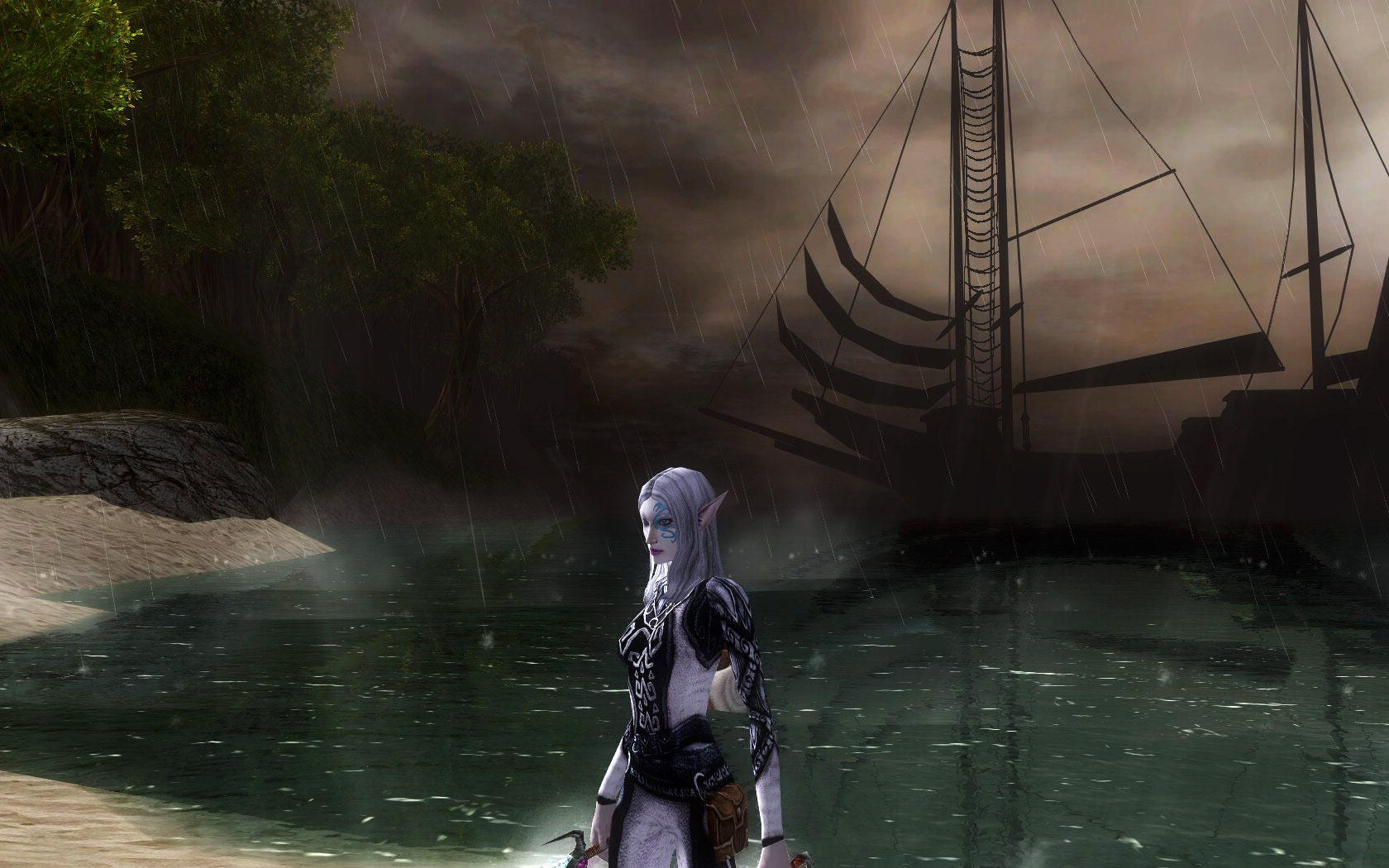
Bethanie, fresh off the boat at Sorrowdusk Isle

Time flew on by and, seven months after returning from South East Asia, I was more immersed in the game than ever. My first real attempt to break with DDO came in March 2010 when I travelled to India for two months. I had no intention of playing the whole time I was there and felt a wonderful sense of liberation once I was away. That trip to India, which I have written about elsewhere, was one of the key experiences of my life. I took over twelve-thousand photographs, wrote a lot, met great people and visited amazing places. I thought I had pretty much shaken off the DDO experience once and for all.

Upon returning, however, after a few nights of dedicated photo-editing, the desire got to m and I logged back in to DDO. As was typical of my habits, I instantly created a new character – Jasparr Krait of Luskan – who was a dual heavy pick wielding kensai fighter with rogue and ranger splash. I enjoyed being back so much, and was so enamoured of my character with his Tom Selleck Moustache, that I became lost in the game again for the next two months.

Jasparr in the Orchard of the Macabre

My second serious attempt to exit the game came in July, when I was asked to mind a friend’s parents’ house in Paddington. Despite the gnawing desire to stay with the game, I decided not to take my desktop with me and try instead to free myself of the addiction. I succeeded quite admirably and, were it not for a sinus infection that lasted a month, I would have used the time even more wisely to reconnect with friends etc. Soon after this, I briefly moved back to my own parents’ house before another move. I thought I might have shaken off the bug and logged in only intermittently. Yet, shortly after moving and settling into my new house, the bug got me again and I was back in Stormreach, hacking and slashing and zapping my way to glory.

The lovely Honeydrop in the Vale

There’s an advertising campaign about quitting cigarettes at the moment, which states that every time you quit, you get better at it. In the first instalment in this series, I’ve described that final moment when I deleted the game and never went back. It was a tough decision, but it was made a lot easier by having walked away so many times before. It ultimately came when I realised I was not getting the same joy from grouping any longer, as my patience had worn thin over the years. There were also too many elements of the game that required a lot of grinding. To be effective at the highest level required running the same old raids on scores of occasions in the hope of looting the desirable crafting materials, of which there was no guarantee. It was just too frustrating and nowhere near as much fun as the low and mid-level ambitions of levelling and developing the character build. When I realised I’d had enough of the low and mid-level game, and believe me, I did it to the absolute death, there was simply nothing for me any longer.

Minotaur fortress

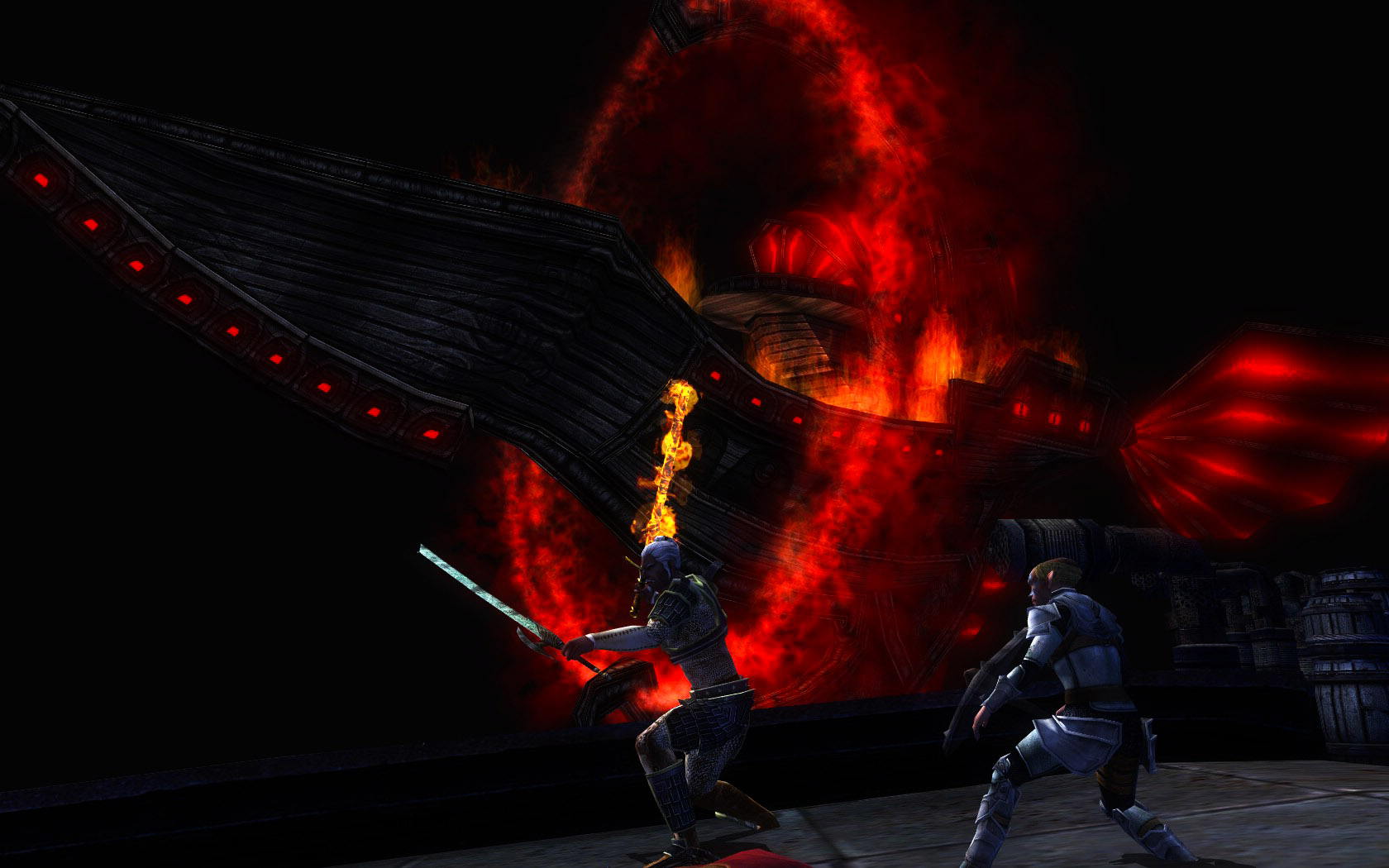
One of the more curious bosses

Like any MMO, the game’s growth continued from its inception. As it progressed, I found that generally the updates improved elements of the game. The new quests, character classes and races, new look armours and outfits, the new prestige class options for clerics and sorcerers were all welcomed. There were, however, a couple of major changes that, in my mind, changed things considerably for the worst.

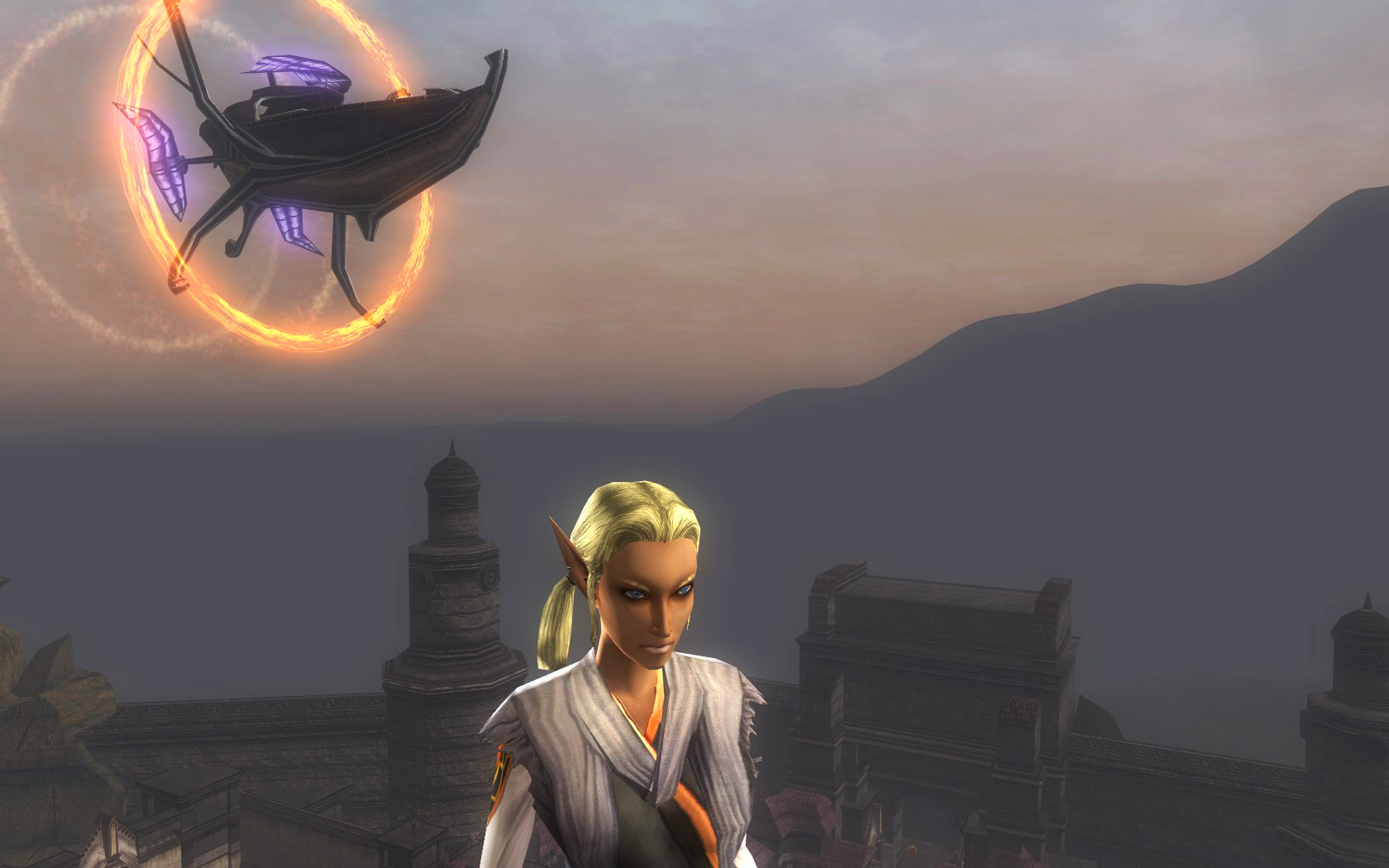
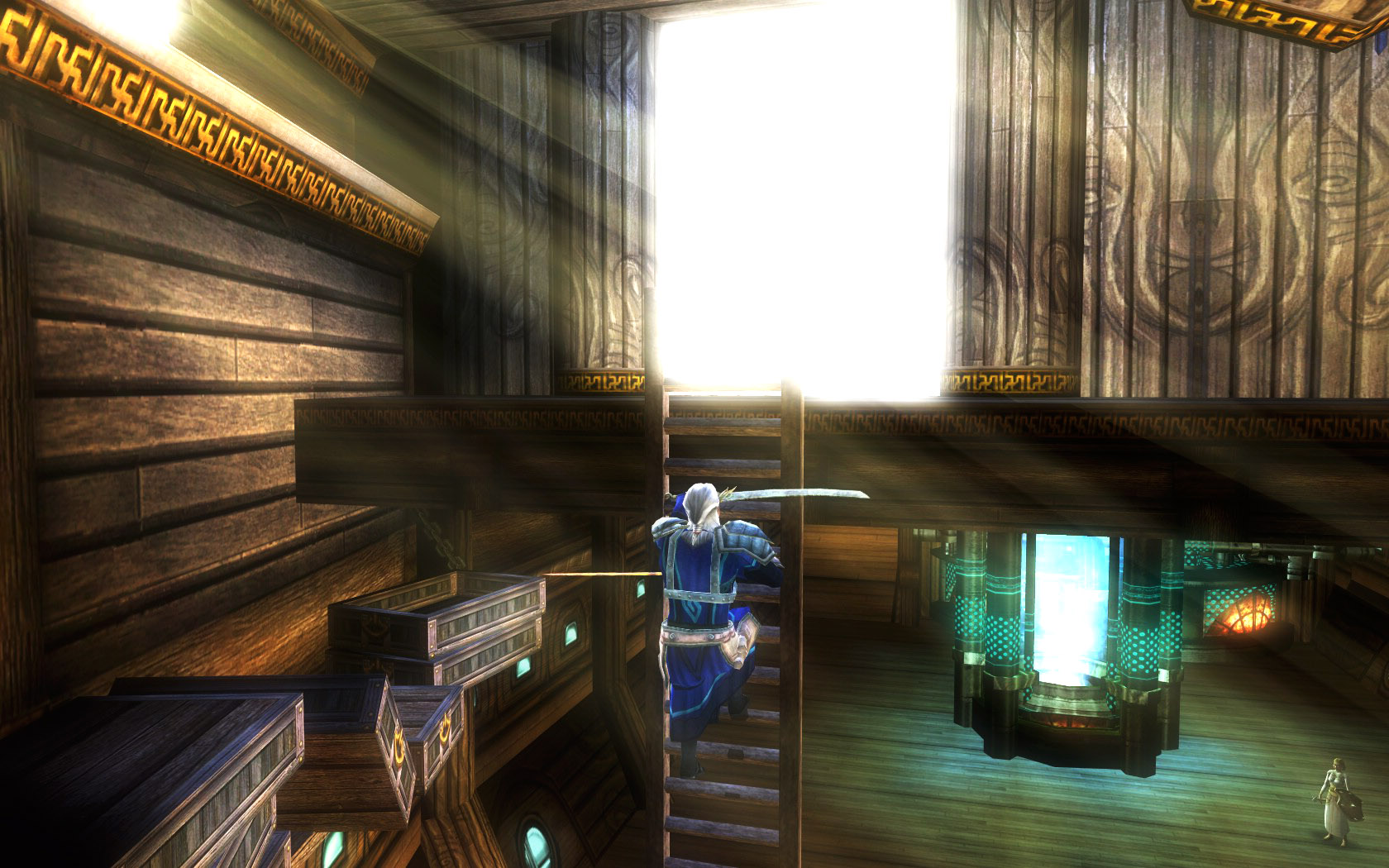
The first was the introduction of Guild Airships. This in itself was a fantastic thing – they made it easier to get around, provided an exciting place to visit and gave being a member of a guild some real oomph. Where they were flawed, however, was that the best airships offered characters the chance to buff themselves to quite a ludicrous degree, giving them so many simultaneous bonuses that people began to joke about it as God Mode. This also created a huge disparity in many quests between those with ship buffs and those with none. It also created an often long and frustrating wait to begin a quest because players would insist on getting ship buffs first. In the end, I got fed up with it all.
Airship interior

I did, however, create my own guild: The Frozen Spine. This might sound like an awful medical condition, but was actually an homage to Icewind Dale and the Spine of the World Mountains. It was fun to have my own guild and to buy an airship – the cheapest and least attractive to begin with as it was level-restricted. Yet, in the end, it just felt like something else to manage in game, when I was already busy enough with the auction house and so on.

The other upgrade that I especially didn’t like was the new crafting system. Indeed, this was the final straw. I would have welcomed this in theory, and did so initially, yet the consequences of it were, in my opinion, dire. Within weeks the auction house became flooded with countless replicas of the same item, and instead of selling their excess loot to the brokers in the market place, most players simply broke it down into magical essences etc. The items that were sold to the brokers were then bought en masse and deconstructed by wealthier players, so that the brokers never had anything left to sell. In effect, this killed one of my favourite in-game hobbies.: shopping for second-hand goods and finding overlooked treasures to sell at auction. In many ways, for me, DDO was like a grand, fantasy-themed episode of Bargain Hunt.

Dual-wielding +2 Tennis racquet holders of Greater Potency

When that pleasure was gone, I felt such a sense of loss that I didn’t really want to hang around any longer. I didn’t like the sort of rinse and repeat grinding and farming that it encouraged and the process itself was rather tedious to carry out. I’m sure I might have given it more of a go, but at that late stage, when I was already looking for an exit, it just seemed like a disappointing nuisance.
A fine day for getting your armour rusty

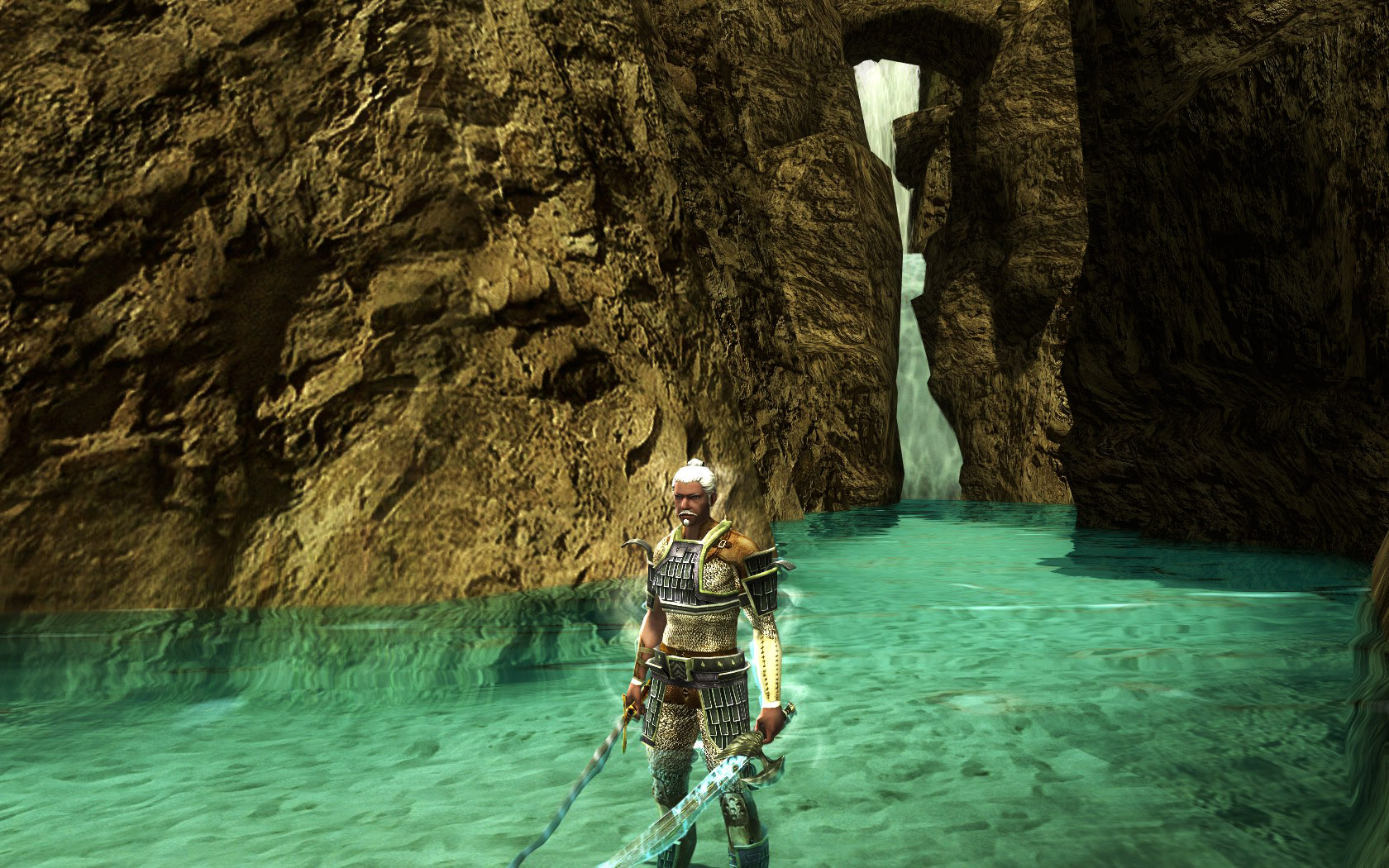
At least I had a good last hoorah. In my last phase of play, between February and April 2010, I spent a lot of time running as Jyzze Badajon, a sorcerer specialised in electrical spells. It was awesomely good fun and I was impressed with how much I nailed not only the build, but also the performance. Despite my lack of experience in the highest level quests, all of which I’d done at least once, I was pretty hard to beat in the rest of the game. Jyzze was a wonder, so good in fact that he often spoiled the fun by killing everything before anyone else could swing a weapon.

New quests, new locations

Jyzze with trees

Jyzze

Jyzze in Gwylans

There was something wonderfully visceral about using maximised Shocking Grasp and Ball Lightning and despite spamming these spells, I never seemed to get bored of them. Still, even this had its limits, and ultimately, it was the same old arenas, same old dungeons, same old mystical, magical settings. Perhaps it’s not at all odd to think how bland and run of the mill they could be after a couple of years.
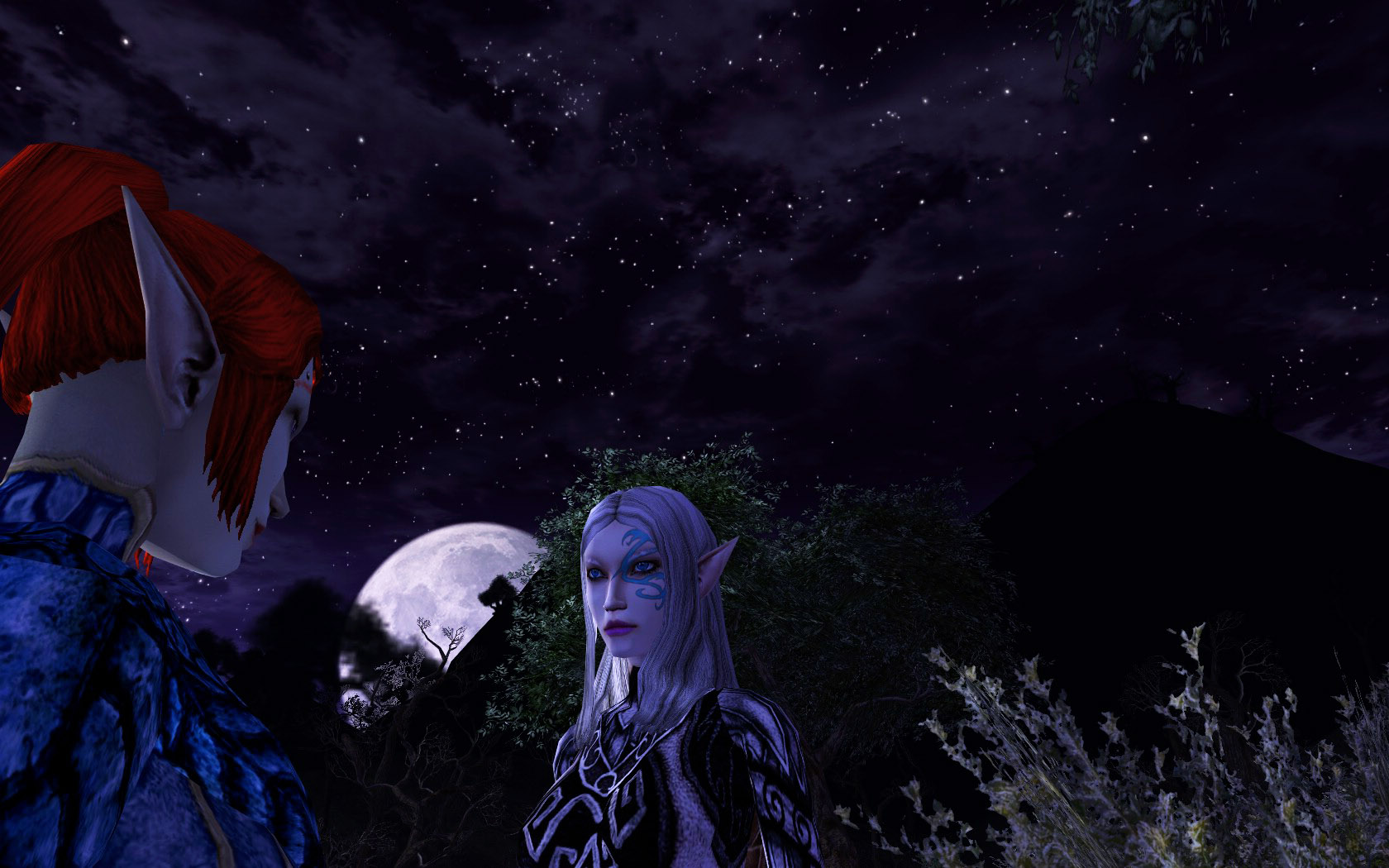
 

As the game slowly became less appealing, so the outside world grew in stature for me. Then, over the course of a couple of months in 2011, I slowly emerged, blinking, into the real world. It was the Arab Spring that dragged me back to reality. I became so engrossed in the revolutions in Tunisia, Egypt and the subsequent civil war in Libya that I went from running DDO to live-streaming Al Jazeera full time. I also took up writing about the revolutions and spent a lot of time researching Middle Eastern affairs further. Suddenly the world was very exciting again, with the onset of what seemed like a major historical shift in that region. It was a long-overdue re-engagement with reality.

I got my life back on track with other new projects, a new partner and, leaving the dreadful embrace of the machine, embraced instead a more active life. I fell in love again and, when in June of that year, it all ended in tears, the revolution was completed. That break-up proved the best misfortune I’d suffered in years and, after some deep despair and depression, another move and frequent visits to a psychologist, I came out fighting and haven’t looked back. It all made me realise what a low gear I’d been rolling through life in, and just how much underlying depression there was after having spent so much energy in preceding years writing unsuccessful novels.

Since then, despite the occasionally overwhelming desire to re-install the game and log on just one more time, I’ve been, as my old friend Justin would say, “keeping it clean.” Ironically the strongest desire to play again hits me when I’m most bored with computer games. It’s because, deep down, I love gaming and likely always will, but what is missing most of the time is the human element. Online gaming might be anti-social with respect to the real world, but it’s a highly social activity within the context of the game. The game itself has moved on with new character classes, higher level advancement, new adventures and the like. In many ways I’d love to have a look at it, but the idea of going back and not quite knowing the deal helps keep the game at a further remove.

I can’t say definitively that I will never again lose myself in an MMO, and with the Elder Scrolls Online coming out some time this year, there are dangerous waters ahead. Yet, I learned so much from this experience and know how to manage my urges much better. There is too much to do in life that is too important, and I just cannot afford the time any longer for such devotion to a game. It seems a lot easier these days simply to say no.
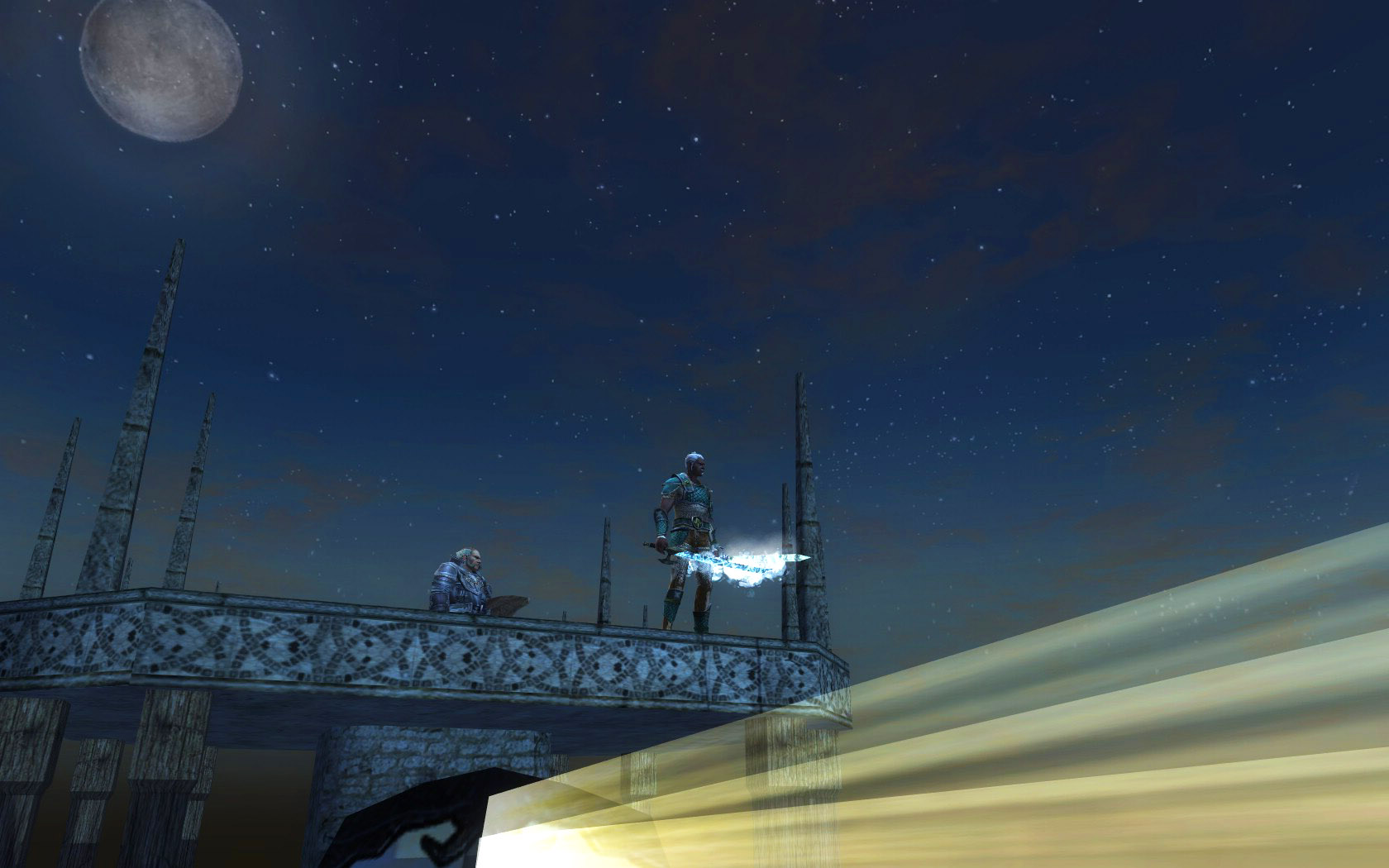
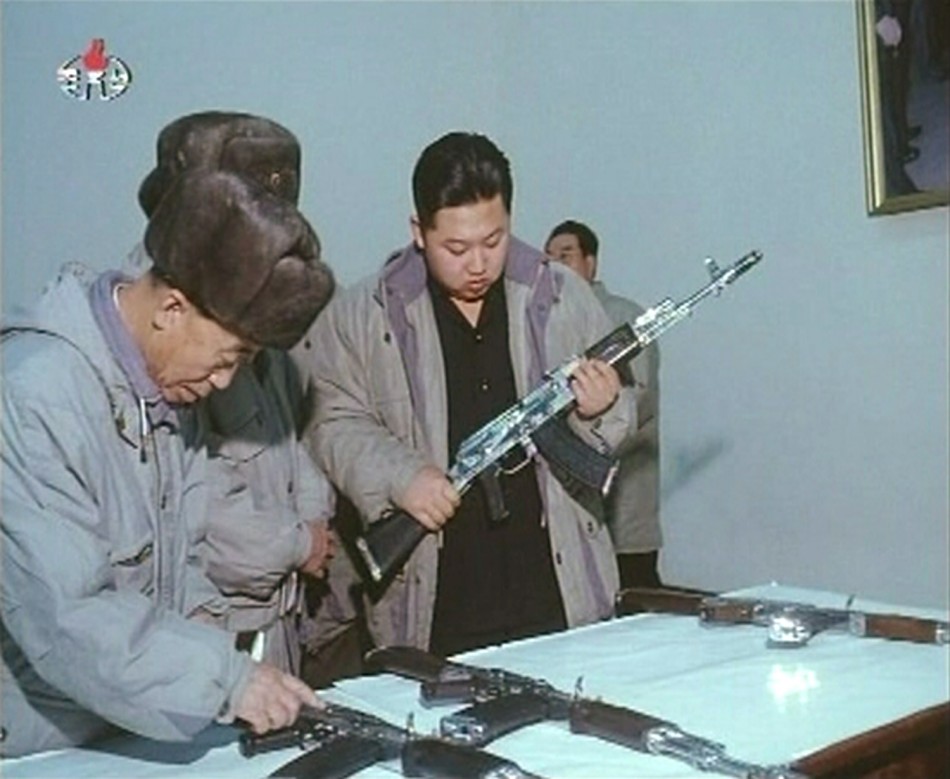
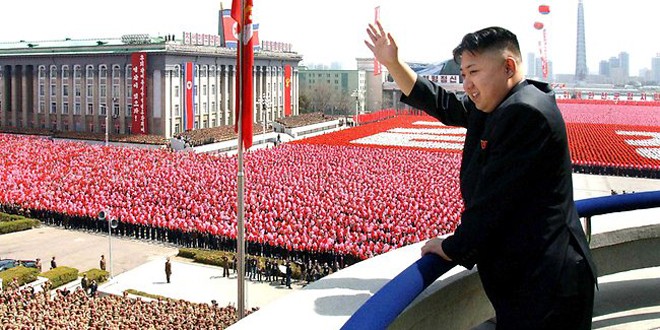
People keep asking me what Kim Jong-Un is up to at the moment. What is he hoping to achieve? Does he actually want to start a war? Is he really intending to launch nukes? I’m flattered that my friends and acquaintances think I might have an answer for them, but I don’t exactly have a hotline to Pyongyang and am thus privileged to the same information as everyone else outside of the intelligence services. Having said that, I do have an answer of sorts, which is hardly all that original – it’s all just a lot of posturing.

Inspecting weapons

The recent escalation of rhetoric has certainly been dramatic. The bellicose reminder of the state of war between North and South Korea, tough talking about ballistic and nuclear capability, overzealous reactions to even the smallest slight from the south and, more recently, the statement that foreign embassy officials could no longer consider themselves safe in North Korea – all amounts to an alarming increase of tension, but likely little else. As an official at South Korea’s defence ministry quipped – “barking dogs don’t bite.”

Boat trip

Pyongyang’s recent attacks on the south – the torpedoing of the Cheonan, which left 46 dead, or the shelling of Yeonpyeong Island, both in 2010have been by stealth, or come without warning. That doesn’t mean his threats have no substance, but it does suggests that talking and walking are by no means linked, so to speak.

The joys of authorising strikes

Some years ago a wit described the India / Pakistan nuclear arms race as “Viagra Diplomacy,” a term which applies itself well to the current situation with North Korea. There is something ludicrously phallic about rocket launches, a situation not helped by North Korea’s tendency to suffix its rocket names with the word “Dong.” Take the Taepodong for example, a name which lends itself spectacularly to punning, or the even sillier and counter-intuitive Nodong, which was effectively an adapted Soviet SS1 or “Scud” and, dare I say it, a bit of a flop. Joking aside, there’s no doubt that North Korea has made progress with its ballistic capability and just may have the capacity to mount a nuclear warhead, but the threat to rain down missiles on the United States seems farfetched considering their as yet limited range of roughly 6000 kilometres.

Missile test

Having said that, North Korea certainly has the capacity to target its immediate neighbours; the southern capital Seoul, at just 25 kilometres south of the border, is within artillery range. There is no doubt that North Korea could inflict terrible carnage if they wished to attack the south. Nuclear, chemical and biological weapons aside, the scale of their conventional forces is staggering. A quick glance at the Wikipedia list of countries by number of military and paramilitary personnel puts North Korea on top, with an active military of roughly 1.1 million, bolstered by an incredible 8 million reservists. The Korean war of 1950-53 cost the lives of two million people, and whilst any modern war would prove a very different beast, there is little doubt that it could also cost millions of lives.

Yet what, one must ask, would be the point? Surely, despite the capacity to inflict untold damage on the south, the North would ultimately be defeated. North Korea would have no allies – China would wash their hands of them and Pyongyang would find itself facing off against a broad alliance led by the United States and supported by the U.N. The north might achieve initial successes, but would surely lose the war, and, apart from the disastrous human, social, environmental and economic consequences of a conflict, losing the war would potentially mark the end of the regime, the end of military domination, and the end of North Korea as a state: the end of Kim Jong-Un. One suspects that nothing other than unconditional surrender would be demanded, especially considering how long the situation has festered and how great the desire to avoid any furtherance of this geopolitical cancer. What might follow is anyone’s guess: re-unification, a long and awkward occupation of the smoking ruins… It would all depend on the nature of the war, which, after an initial bout of shock and awe by both sides, could even be over in a couple of days with an internal coup.

Which brings us back to this important question of what the hell Kim Jong-Un is up to? If war is unlikely, what is the point of all this belligerent rhetoric and rocket-rattling? Surely the most likely explanation is that he wishes to shore up support at home.

Hello!

Song Launch

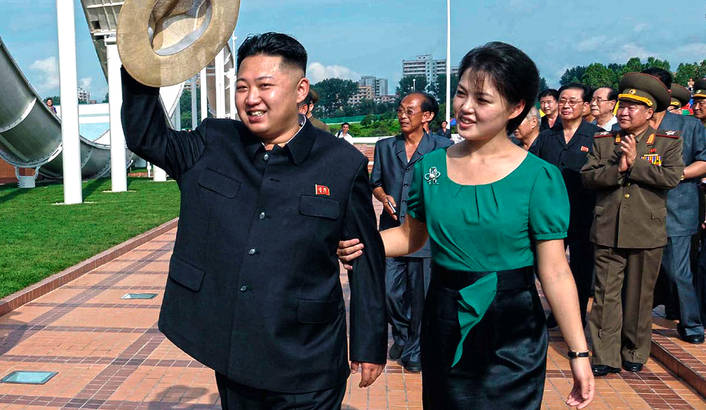
Kim with wife

Just as George Bush, John Howard and Tony Blair all rhetorically escalated the level of external threat to their respective countries after 9/11 in order to shore up domestic support for their imperial ambitions by creating a clear and present external danger, so it would seem King Jong-Un, perhaps struggling to define himself internally and to assert the legitimacy of his rule, wishes to create an almost hysterical climate of fear. If anything this whole business seems to highlight his insecurity rather than his capability or intent. Ironically the very survival of the regime depends on avoiding conflict, but the state largely defines itself through struggle and conflict.

Lovable

The real fear is that with tensions so high war might begin by accident rather than design. Miscalculation, misinterpretation… it seems unlikely, but it is by no means impossible. The levels of readiness are such that hell could be unleashed at very short notice – perhaps before clarity prevails. Should a war begin, even by accident, it will be extremely difficult to stop.

There is also the genuine possibility that Kim Jong-Un is something of a nutcase. He is certainly less predictable than his familial predecessors and less well understood, but he must know as surely as anyone else that war would be the end of his regime with all its privileges.

Kim Jong Un

It’s very easy to parody and caricature Kim Jong-Un as a greedy little brat of a despot, and I have to confess I’ve been guilty of such parody myself, yet whilst it might be childish fun to joke about him, it’s somewhat counterproductive. The belief that he is genuinely mad, propagated by the parodies and caricatures, only fuels the paranoia about his intentions.

Lunch not launch

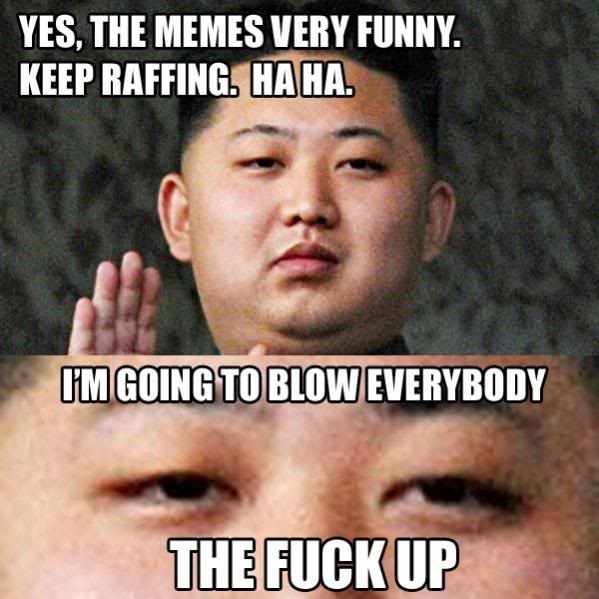
Keep raffing

Yet, as always with humour, there is a great deal of truth in much of it. He likely is a spoilt brat with delusions of grandeur instilled through constant inflation of his talents and charms, drunk on power. He really does come across as the tubby, nerdy gamer kid with a chip on his shoulder. His recent actions remind me of people on Facebook, including myself, who, when lonely or feeling starved of attention, start posting in a more exclamatory and regular manner. His international threats are like bad-tempered tweets – mouthing off at a world he can neither influence nor change because of his own relative impotence, despite having a vast army at his back.

We must not forget how recent his accession to the throne was. Despite great popular efforts to create a new cult of personality around him, there must be pressure to put his own personal stamp on the regime and cement his rule. Perhaps there is internal pressure from within the military himself. Perhaps he fears the ambitions of those who surround him. Perhaps there is fear of popular unrest. Whatever the case, all this rhetoric seems to be more inwardly focussed, despite its outward broadcast.

The real question now is what happens next, and, to be honest, I haven’t got the faintest idea. I suspect things will die down, flare up, die down, flare up, die down, flare up… for the next decade, possibly even longer. Then again, Kim Jong-Un might be dead next week, assassinated by an ambitious general, or dead by deep vein thrombosis for that matter. Whether North Korea will ever come in from the cold is anyone’s guess, but as unsustainable as the current situation appears to be, we should remember just how long it has been sustained – sixty years this very year. It is hardly possible for this feudal Stalinist regime to become more isolated internationally, and anyway, it is isolation and insularity that allows the regime to survive. Rarely have two nations existed in such contrasting states of connectivity as North and South Korea, the latter the most wired state in the world, the former disconnected from everything, including, it seems reality.

Perhaps somehow the internet will work its magic; perhaps starvation will start a revolution; perhaps there really will be coup, or an unexpected Myanmar-style change of heart. In all honesty I think there won’t be a war and nothing will change. Ten years from today, Kim Jong-Un will still be there, fatter than ever, rubbing his wealth in the face of his own people and waving his latest Dongs at the world.

Lunch - it's alright for some!

In April 2010 I spent a glorious nine days in Darjeeling. Originally my intention had been to stay there for just three days; to see some views of the Himalayas, explore the regional heritage, get a taste of the local Ghorka and Nepalese culture and enjoy a break from the sweltering heat of India. Yet, upon my arrival, after a cold and romantic ride up the mountain in the back of a packed jeep, I straightaway fell in love with the place.

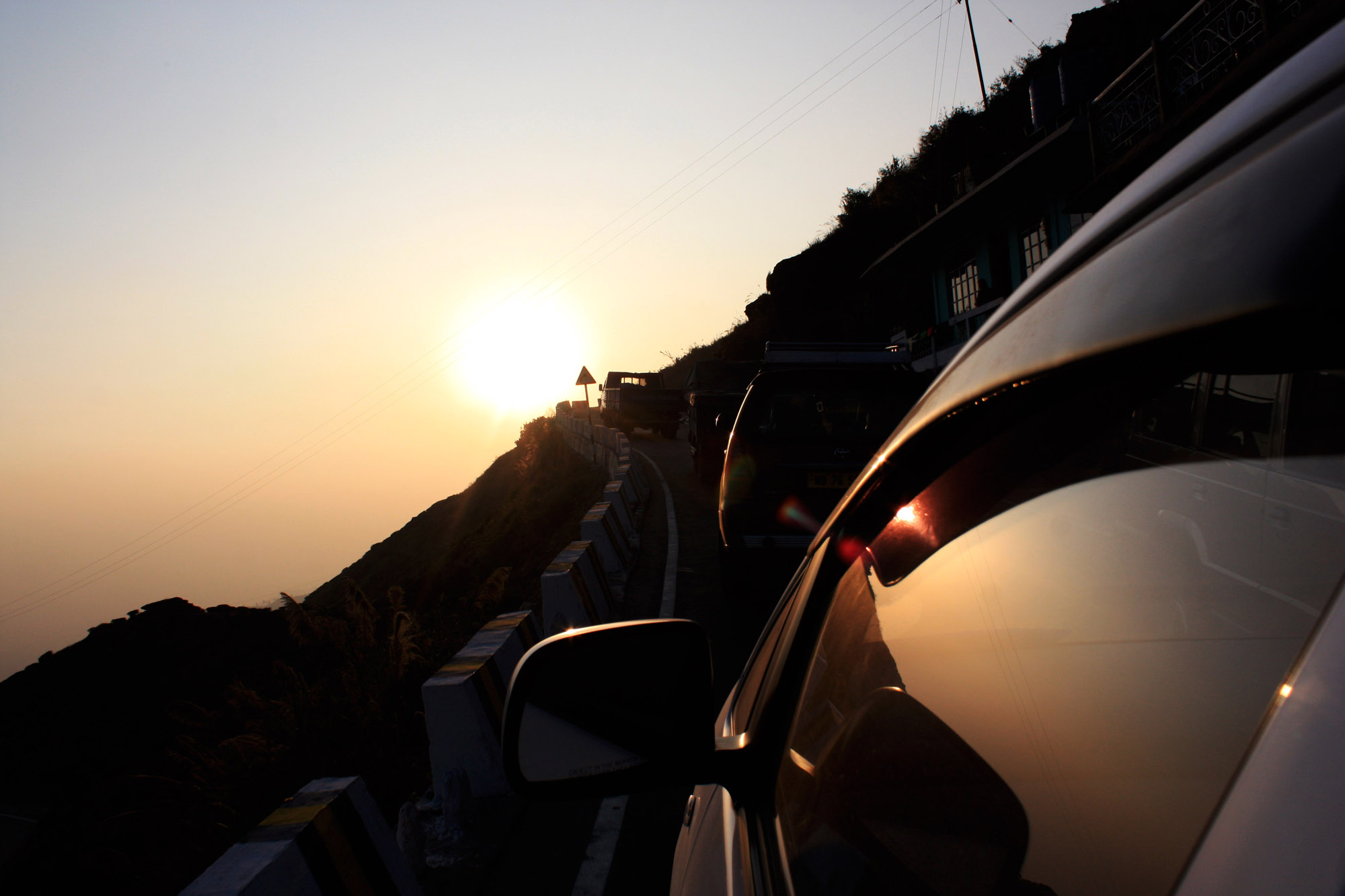
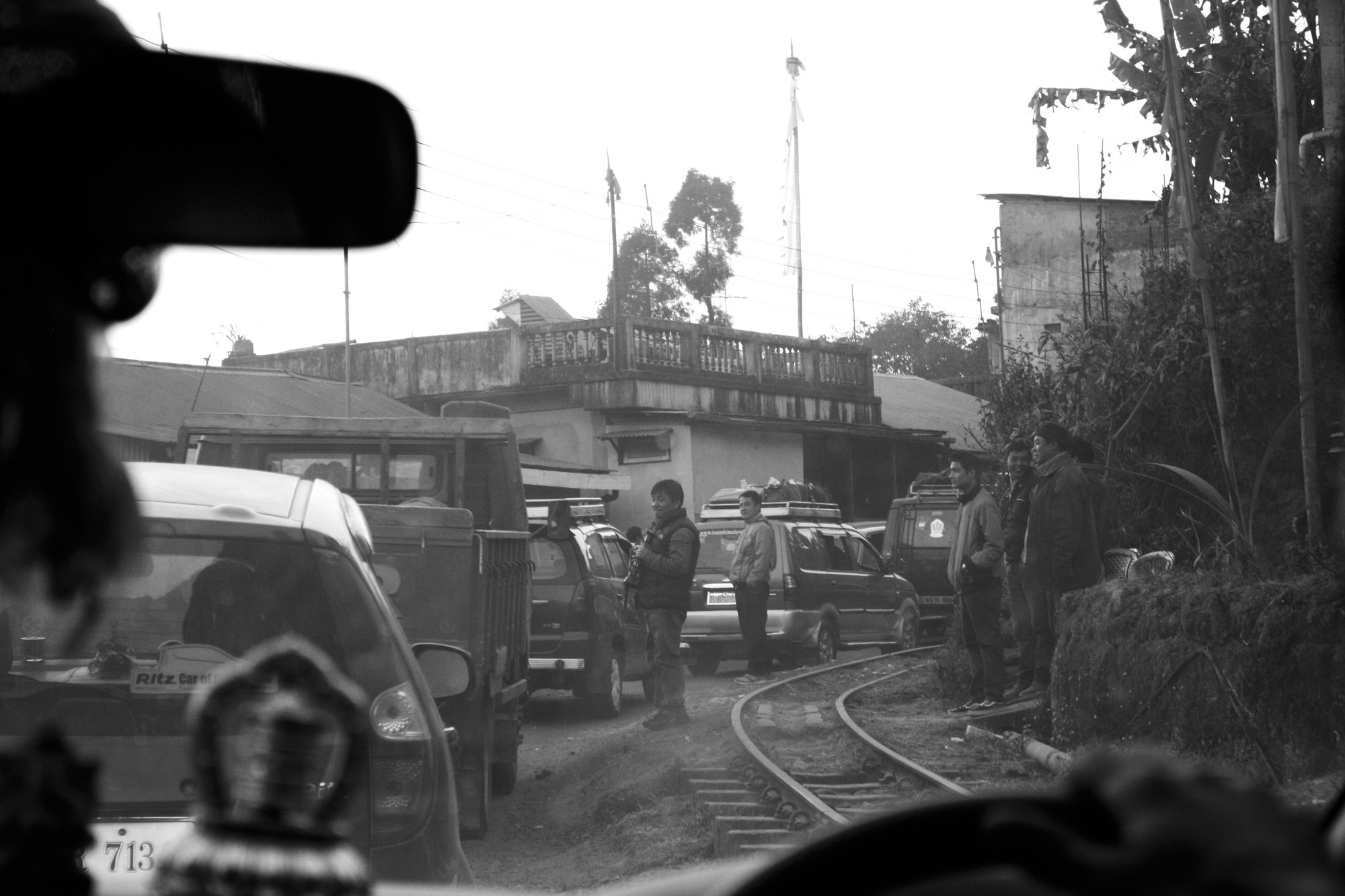
Jeep to the Darj, April 2010

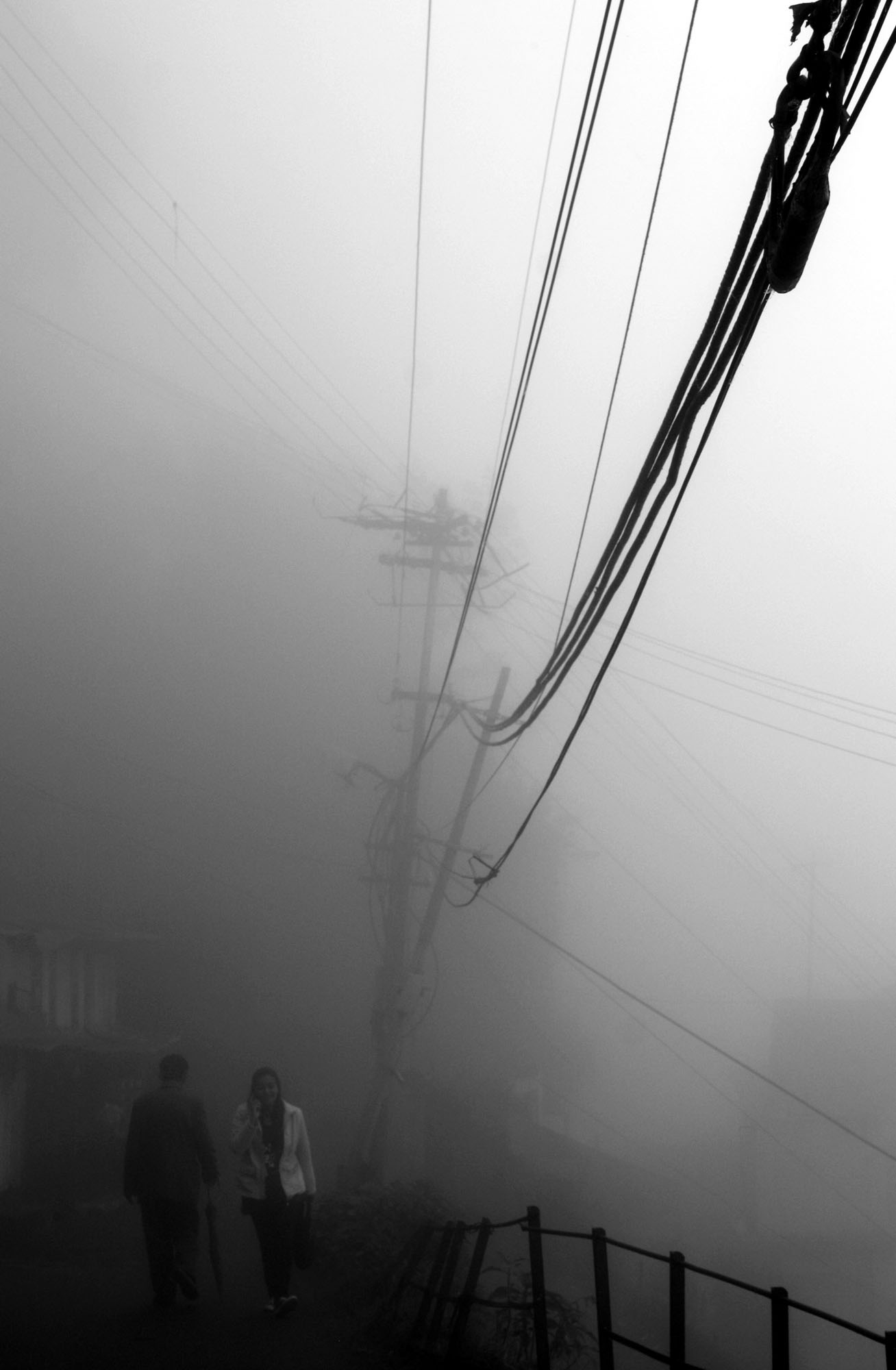
Having spent a month in the heat, the cold air was so exhilarating it felt like waking up with a new level of alertness and sensation. The torpor of humidity vanished in the chilly fog. That first night as I wandered through a town shrouded in near darkness, it was as though I had arrived not merely in a different state of India, but in a different country. The marriage of local and colonial architectural styles, the Asiatic faces, the different landscape and climate, the quiet calmness – all were very different to the India I had seen thus far.

That first night still seems like a dream in retrospect. The journey in getting there – a perilous ascent into cloud – the sense of remoteness, the light mist, the lost wandering to find my hotel, the huddled dogs on the streets, the darkness, all combined to give the place a sense of enchantment. As a childhood fantasy genre tragic, it left me feeling as though I had entered a magical and mythical land.

Heavy fog, Darjeeling, April 2010

The following morning only confirmed my excitement. The vantage point that Darjeeling affords – perched high on a ridge so that it looks down into valleys on either side – allows not merely for great views, but also adds to its feeling of remoteness and safe seclusion. It is like a world unto itself, tenuously connected to elsewhere by a winding, pot-holed mountain road.

Yet, while the views of the surrounding hills and valleys were amazing, on that first day the cloud on the horizon prevented me from seeing the mountains. I imagined that at some point the cloud would lift and I’d be treated to the spectacular backdrop, pictures of which had lured me there in the first place. It was not until the late afternoon, after a surprisingly intense downpour, that the clouds briefly parted and I caught my first glimpse of Mount Kangchenjunga, the third highest peak in the world.

The mountains were barely visible in the late afternoon light. Clouds above prevented any direct sunlight from striking the peaks, so they seemed as phantoms, faint outlines in low-contrast. I had taken shelter under the drumming tin roof of Glenary’s bakery and had a relatively clear view from their back window, but I wanted to get a better vantage point and not have to shoot through glass. Concerned about the rain, I set off at pace back to the hotel to collect my umbrella, planning to make directly for Observatory Hill. At the Hotel Tranquillity, I briefly joined some other guests and the owner on the roof for a view of the mountains. The sky was clearer now and the mountains better lit by the sun, yet there were trees, buildings and a large satellite dish in the way. I saw just enough, however, to know that the mountain was the largest thing I’d ever seen attached to the earth. I set off optimistically ready to photograph the living hell out of the mountains. Yet, sadly, by the time I reached Observatory Hill, the cloud had returned. That brief, slightly obscured view from the rooftop was to be the last I ever got of Mount Kangchenjunga.

A single glimpse, April 2010

It was largely for this reason that stayed as long as I did. Not only because I was so entranced with the town itself and its immediate surrounds, but because I became obsessed with the idea of seeing the mountains and photographing them. Over the next nine days I got up early every morning and made my way towards Observatory Hill and the various look-out points along the road that circumnavigates it. Every day, despite clear weather overhead, the horizon was covered in cloud.

There was much to compensate me, however, in the form of pea-soup fogs, great walks, excellent food and tea, friendly people and some smashingly good local weed, but I hung on as long as I could, desperate to see the mountains. It was not to be, and when I finally left Darjeeling, I vowed that of all the places I’d visited in India, it was the one to which I must return.

Heavy Fog, Darjeeling, April 210

There are many places in the world I’d like to see for a second time and doubt I ever shall. With so many countries still to visit for the first time – take China and South America for example – there’s less incentive to prioritise a return journey. Some places have been particularly favoured – Rome, Venice, Paris, London, New York, for various reasons – but on the whole, only a few places ever get a second look. India, fortunately, is big enough and diverse enough to warrant several expeditions and when V and I decided to go there again last December, I immediately began considering making a return visit to Darjeeling.

To cut a long story short, whereas my first trip had been around the north of India, this time I decided to focus on the south. We thus flew into Thiruvananthapuram and worked our way slowly north over a course of four and a half weeks. We had a lot of “targets” – things we really wanted to see – the Keralan Backwaters, Fort Kochi, Hampi, the Ellora and Ajanta Caves etc, but our itinerary was very organic and we made it up as we went along.

Chinese fishing net man, Fort Kochi

Darjeeling, therefore, was never guaranteed and we almost dropped the idea of going there altogether. Yet, with tickets booked to fly out of Kolkata, it made sense to take in Darjeeling since we ultimately had to head east anyway.

I was keen to go to Darjeeling, but was worried about how cold it might be in January. I also felt somewhat circumspect about returning, as I was afraid that I might have a different response this time around. V had never been to Darjeeling and though she wanted to see it and I wanted her to see it, I felt a bit guilty about pushing for it and decided to leave it up to her. It wasn’t until very late in the day – four days before we flew, on our one night in Mumbai – that we booked the flights.

The journey to Darjeeling turned into something of an epic in itself. It really began in Aurangabad, when we boarded a ludicrously overcrowded and chaotic eight hour train ride into Mumbai. We arrived at the airport at 2300, dirty and exhausted, planning to sit it out until our 0600 flight. After a “shower” in the bathroom – the one great thing about squat toilets is the hand-hose! – and a change of clothes, I felt refreshed and ready to face the wait. Everything would have been fine if V had not then become ill from the left-over vegetable biriani we had brought with us from dinner the night before. The next few hours were torture for her, though she did manage to take intermittent naps. Knowing how impossible it is for me to sleep in such situations, I hunkered down with Civilization IV on my laptop, fighting a lengthy war with the Aztecs and Spanish…Khmers 9

When we finally boarded the plane V was still not at all well and had a miserable time. At Delhi – which was refreshingly wet and cool – we had a two hour wait before our connecting flight on to Siliguri.

Pulp Fiction, Delhi Domestic

The second leg of the journey was certainly easier for V, but it was a longer flight, via Guwahati in Assam, and she was still very fragile when we finally touched down around 1530. From this point on, however, everything went completely right for us. A lovely young taxi driver, who was returning to Darjeeling anyway, offered to take us up the mountain for a mere thousand rupees. At less than twenty dollars, this was a small sum for such a long private taxi ride. He also proved to be very patient and helpful – taking us to a chemist to get drugs for V and then to a local market where I bought an el-cheapo so-called “Armani” coat and a pair of extremely unfashionable long trousers. Until this point I’d been travelling with just tee-shirts, a pair of board shorts and thongs and knew that it could get down below zero in Darjeeling in January. The fisherman’s-hat-shaped hood fell off the jacket when I tried it on – an ineffectual zipper being the culprit – but this proved advantageous as it offered more freedom of movement and looked even more fetchingly ridiculous.

Not what Giorgio had in mind...

That ride up the mountain proved a highlight of our trip. I was pleased to see not only that V was feeling a lot better, but that she was equally excited about the journey. Both of us are lovers of mountains and the combination that the region around Darjeeling offers – the quaint, colourful houses stacked along the winding road, the tall cedars, the yawning vistas – was especially beautiful as the sun came down.

Darjeeling ascent, Jan 2013

We didn’t run into any fog on this occasion and instead were treated to a powerful and evocative sunset as we swung past the other jeeps on the road. By the time we reached the half-way point of Kurseong, both of us had completely forgotten about the travails of our journey and lack of sleep.

Darjeeling ascent, Jan 2013

Passing through Ghoom, roughly ten kilometres from Darjeeling, we caught up to the toy train. We had been following its narrow tracks since Kurseong, winding back and forth across the road. The little steam train with its cute, shoebox carriages huffed and hooted like an outsized child’s plaything, chugging determinedly up the hill at a snail’s pace.

Darjeeling ascent, Jan 2013

Such was the traffic on the road and such was its narrowness that we were forced to stop repeatedly, thus we not only drove alongside the train for a while, but we overtook each other several times. It was great to get so close to the train and to see it in action again. Tired and emotional, full of intense sensations, my eyes flooded with tears as I silently cheered on this wonderful relic.

Our driver made excellent time and the journey to Darjeeling took only three hours, by which time the sun had gone down. When we farewelled him, we couldn’t resist giving him a big tip for being such a nice bloke and a safe driver. Our early evening arrival at the Dekeling Hotel was equally well-fated. After a steep stair climb, we entered reception to receive a touchingly warm greeting from the young gent at the counter. Indeed, it was the most friendly reception experience we’d had thus far – and not to suggest that the others were unfriendly. He stood in the cold vestibule, rugged up in woollens, his wise eyes showing a hint of tension as he held himself tight for warmth. After the usual passport-photocopying, form-filling rigmarole, he led us upstairs into a cute and cosy space with wrap-around windows, comfortable couches and a wood-panelled ski-chalet décor. In the centre of the room a curly-haired old dog reclined in front of a pot-bellied stove with a long exhaust pipe stretching out the window. Here an elderly lady, perhaps the hotel matriarch, invited us  to join her for a nice hot cup of tea once we had settled in.

Our room was just off this warm lounge area and proved very warm and comfortable. After long, hot showers and a lovely cup of Darjeeling tea in the lounge, we ventured out briefly to find something to eat. It was cold indeed outside, but wonderfully crisp and fresh. Darjeeling shuts down very early and already much of the town was closed. V didn’t have much of an appetite, but we found a place that sold hot and sour soup and sat down to dinner.

We had one last, welcome surprise that evening as we were preparing for bed. There was a knock at the door and I opened it to see the polite young man from downstairs holding two hot water bottles. Having so long dreamed about returning to Darjeeling, and having held so fondly to the memories of the place – all this warm hospitality made it feel like a homecoming.

After an early night, we both awoke at dawn. Through the curtains I could see a clear blue sky, still tinged with pale sunrise pink. I dared to hope that we should be lucky on our first morning and see the mountains on the horizon, but was wary after so many near misses last time. Indeed, all too often the sky overhead had been clear, but the mountains engulfed in cloud.

Early morning mountains

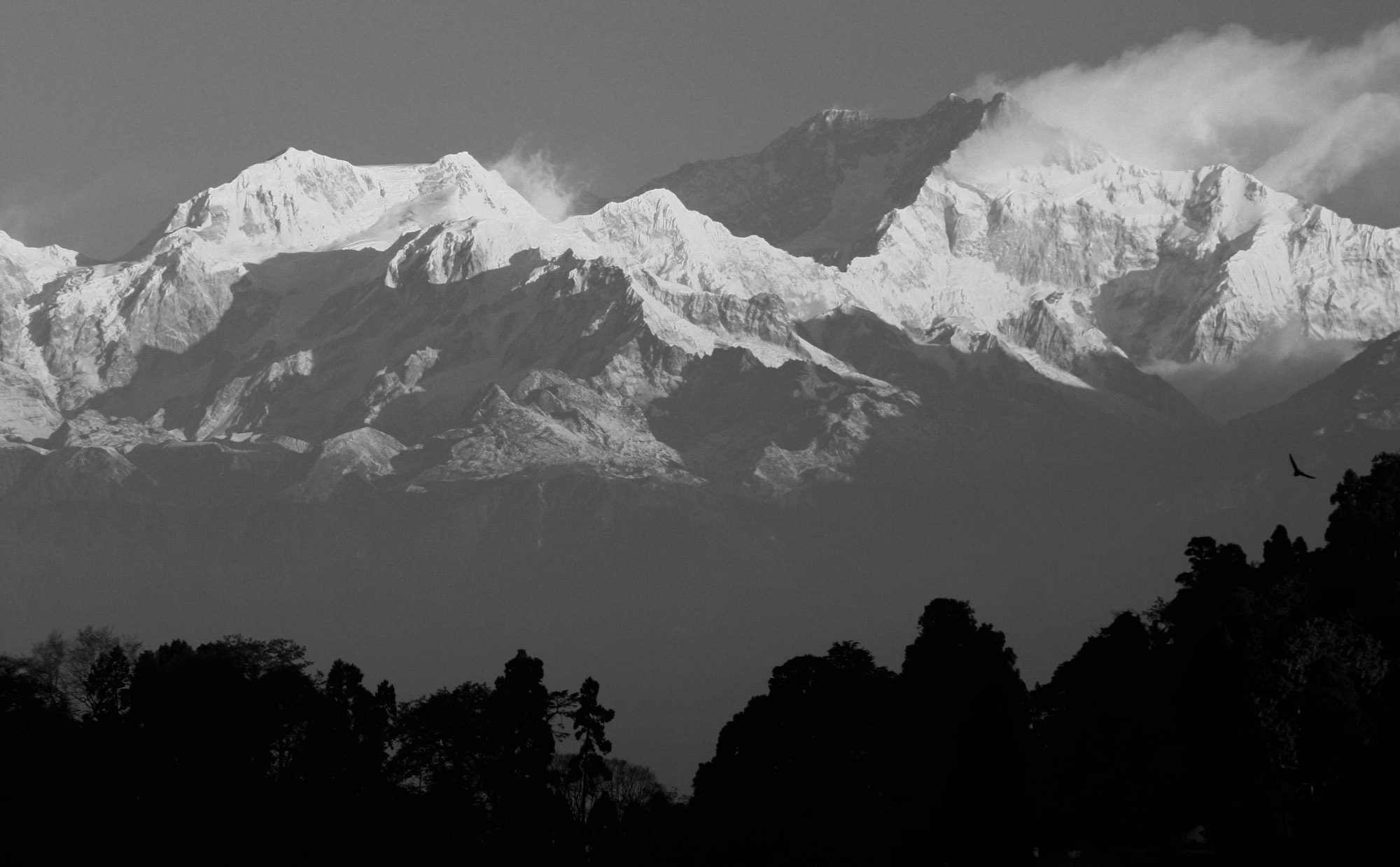
Despite being a mostly rational atheist who doesn’t believe in fate, I am riddled with petty superstitions. I had told myself that if I made this journey again, I would see what I had come to see. Irrespective of that, the law of averages dictated that surely I must get lucky at some point. Nervous with anticipation, I threw off the covers and made straight for the long wall of windows, pulling back the heavy curtains. I lifted the latch and opened one of the windows wide, sticking my head out into the cold air. My heart leapt. There in the distance, tall and seemingly immortal, toweringly omnipotent, was the staggering vastness of the Himalayas. Finally, after so much trying, I had a clear view of Mount Kangchenjunga.

Darjeeling

Katchenjunga from Darjeeling

Katchenjunga from Darjeeling

Katchenjunga from Darjeeling

Darjeeling mountain view

Something strange is going on and I’m not entirely sure how to get to the bottom of it. I’m suspicious, curious and oddly trepidacious, which is unfortunate because, under the circumstances, I should be feeling thankful and flattered.

That may sounds deliciously mysterious, or perhaps rather dully melodramatic, but I shall explain. Basically, in recent weeks the number of followers of my blog has increased dramatically – from somewhere in the 300s – which took a couple of years and two Freshly Pressed posts to accumulate – to well over five hundred, with a serious head of steam up towards 600. Over the last four days I have received regular e-mails from WordPress informing me that new subscribers have signed up to my blog, yet not a single one of them has liked any of my posts nor made any comments. Indeed, I’m convinced that none of them has even looked at any of my posts, judging by the activity data on the Dashboard, because there has been no corresponding increase in the number of views. In fact, quite the contrary – the last few days have marked a steady decline in viewing numbers – no doubt in the absence of any recent posts.

Puzzled

After my post Back to the Front was Freshly Pressed in February, I received a significant spike in views, likes and subscribers as might be expected, and for which I am still very thankful. Inevitably, as my post moved off the top and steadily further down the page, thus receiving less exposure, that flood of views dwindled to a trickle and, ultimately, down to a daily average that hovers somewhere between 40 and 100. Once a few weeks had passed the number of people liking or subscribing – outside of my posting anything new – also dwindled to the very occasional – maybe one a day at best. This is precisely what I would expect without the exposure offered by the Freshly Pressed page because it fits the pattern I’ve identified over the last few years.

At the end of that burst of activity and attention, I had roughly three hundred plus subscribers. This was a very pleasing number and, it seemed, a group made up of people who had actually read my work or looked at my photographs, judging by the distribution of likes and comments. Then, about three weeks ago, I noticed that the number of subscribers had risen to c. 450 odd. This came as a real surprise because I had hardly received any e-mail notifications of new subscribers in that period, or notice of any activity for that matter. I began to wonder – is this because WordPress no longer informs me when people without a Gravatar sign up? Had I received a torrent of subscribers getting notification via e-mail, but without any presence on WordPress? Previously I had been notified when people without a Gravatar signed up, so, perhaps something had changed. Either way, however, the numbers seemed outrageously inflated for such a short period of time. Where were these subscribers coming from? What was going on?

Then, four days ago, my inbox was suddenly full of WordPress notifications again. My first thought was, oh joy, perhaps I’ve been Freshly Pressed, for outside of a fresh post which receives an uncanny amount of attention, there are never so many notifications. This, however, was not the case, and, as stated above, none of the new subscribers liked or commented on anything I’d posted. It occurred to me that I should Google Tragicocomedia and see if my blog was somewhere being promoted or highlighted, yet apart from a bunch of references to various of my posts, the only other site that seemed to be associated was one called Bloglovin’ of which I’d not previously heard, but which seemed to provide links to roughly eight million blogs on exactly the same subjects – fashion and vanity. This was depressing enough, but also entirely unenlightening, because when I searched through all the categories I couldn’t find my blog anywhere prominent that might explain the attention it had recently received. It also seemed so far removed from the subject matter of the top blog list – which are, quite literally, almost all about fashion – that I can’t imagine anyone visiting that site would take an interest in Tragicocomedia.

F F F F F Fashion, and not much else. Bloglovin.

I was left feeling very deeply suspicious. Was this an example of the sort of bullshit that goes on at Twitter, wherein people buy whole swathes of followers in some desperate attempt to promote their personal brand of self-obsession or some utterly undesirable product? I’d certainly not instigated any such activity. Was this some slightly back-handed flattery, in that my blog had received enough hits to warrant people wanting to follow it for the sake of jumping on the bandwagon, in the hope of drawing attention to themselves? The idea seems both utterly preposterous and also deeply annoying as I had liked to think that WordPress existed outside of that insincere and pointless follow me if I follow you universe. Surely people would only follow blogs because they actually want to read them, right?

Maybe I’m being horribly naïve and old-fashioned about all this. Either way, I certainly have no desire to alienate or upset new subscribers who genuinely are interested in my writing and photography. But if you’re only here to get a leg-up of some kind, then I’d recommend you go back to Twitter, because I’m not in this for the numbers and frankly am not going to follow you back just because you followed me. I’m only interested in following blogs I’ll actually read, which I really ought to do a whole lot more of! Indeed, I just paused a moment in writing this to work out why on earth I never receive notifications of posts from blogs I’ve chosen to follow. Strangely, the default setting is to send no notifications whatsoever. Having now made reparations for this, it seems my inbox is going to be a lot fuller after all and the time I allocate to reading is going to need a serious extension.

Anyways, to finish up, I’m still baffled about all this and would be happy to receive clarification, should anyone know the cause. Either way, what I would like to say is a great big thanks to all my subscribers, especially those who have been following me for some time now. I shall try in future to be more inter-active, as it were, and to pay proper attention to what is going on in your worlds as well. All the best!

Some years ago I had the ambition of publishing a book called Ruin Diary. The idea was to put together a mix of short stories, poetry and photographs which would, in some way, reflect the theme of “ruin”. Ruin, of course, can be interpreted in a number of ways, but essentially it is the destruction of something, the remains thereof, or the process by which something comes to ruin. This is rather close to a dictionary definition wherein Ruin is described as:

The physical destruction or disintegration of something or the state of disintegrating or being destroyed.

I wanted to combine the physical and the metaphysical – the evocation of actual ruins, alongside the ruin of love, dreams and hopes etc. This might seem like a rather glum preoccupation, and I suppose in some ways it is, yet it is a natural offshoot of having an almost cripplingly nostalgic personality. It also comes from an overactive interest in history, which I indulged throughout my undergraduate degree, my honours year and, later, a PhD in late Roman / Early Medieval Italian history. I’ve spent almost half my life thinking about the fall of Rome and what it signifies – the first failure of a sort of proto-modernity. It’s a sad period, the onset of the so-called Dark Ages, but an absolutely fascinating one. The hangover of Roman civilization, the undercurrents of continuity, and, in the peoples of western Europe, the lingering, shadowing, saddening awareness that greatness was behind them, not in front of them. It’s a period full of nostalgics and studying it only seemed to fuel the emotions which often left me paralyzed in contemplation of the past.

In Ruin Diary I wanted to get this emotion across – in all of my preferred forms of expression: through photographs of actual ruins, modern or ancient, or poems and stories which touched on these places and the atmosphere and moods they generate; through stories and poems about the failure of love and relationships, the sense of loss itself, the effects of loss and failure. It was a naïve and overly ambitious idea, without an agent or publisher or real awareness of the market, but irrespective of that, it was a great spur to develop ideas based around this theme. Indeed, in the end, I accumulated more than enough material, some of which, particularly short stories and poems, have already been published on this blog.

Anyways, without further ado, the following poems are some of those I had in the Ruin Diary basket. I’ve never quite regarded them as complete and have continued working on them until recently. Some have been rejected by publishers several times, and possibly with good reason, others have never been let out of the stable. I find my style a little overblown in retrospect and have resolved not to work on these any longer, yet I still have a strong liking for the core elements of these poems, which, here and there, get it right. It is also the case that the publication of these poems is a nostalgic tribute to the spirit that first inspired them and to my slightly younger self.

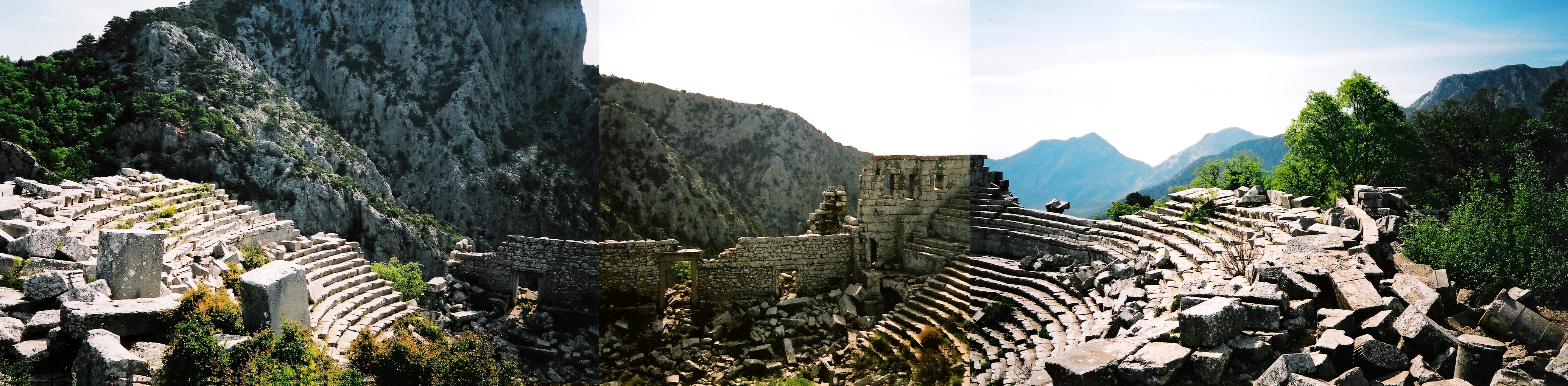
I’ve also attached a badly stitched together panorama of one of my favourite ruin sites – Termessos, in southern Turkey. The shots were taken on a crappy film compact and later scanned. The quality is pretty appalling, but I think you’ll want to go there all the same after checking it out : )

Termessos, Southern Turkey

Termessos, Southern Turkey


l’amour, le vin et le tabac

 (After a visit to the Mucha museum in Prague)

They didn’t mention the women,

– though one photo was of

a “mistress” – of which

there must have been many:

the sleepy-eyed,

pursy Zodiac, (she’s a wet one

and a bonnie tickler)

pure tears and a prim, good heart

though not as good

a sport as the knowing Spring,

all vermicelli hair and blossoms,

languor and vigour both

in the smiling eyes, the curling

lips, the confidence and clip

of a coming bumper harvest.


Spring a woman, Summer

a woman and Winter

too, a woman. All these women

and, despite their vivid florescence,

none of them a cinch.

Sarah Bernhardt wanted something

quickly, something new, for

two weeks hence she strode

– Athenian and Florentine –

upon a footlit Parisian stage,

and came to you, a man

so steeped in women, prone

to idealise the softness

and the purity, threw out

the trim and trappings for a rustic

decadence, a fecund innocence,

that of a rural princess

lavish and mosaiced, a frond

in hand as if young Jesus

on a donkey comes, to bring

a message like to be misread.


Europe marvelled, eyes aflame

with this sudden wedding seen

upon the streets of Paris, took

the posters home to cherish,

hailed the dawning of some new

art, styled and curvy, bold

and feminine, soon to spread

to buildings, seats and lamp-posts

soon to travel far on soap-tins,

matchbooks, wine, tobacco,

scents and, indeed, anything

which a beautiful woman

might help sell. Innocence,

yet not naïve, with something

other than simplicity

in those invitations.


Epochs

Most of our epochs (and by this I mean

the parcels within which we group recollections)

are woven of lovers or houses


are mapped by the heart and the places

we dwell. And Rome, no stranger

to epochs, though I never foresaw


such meadows of learning, of love and of war,

wrapped, like a rubric, in four long

months, a lifetime of potent nostalgia.


For three years preceding, my fields

had run wild with some loves

overlapping the brinks of each other


so Rome promised, in word and in deed,

farewell to the wet newspaper days,

that left one so close and so permeable.


On those frozen-toed, sandalled, Campidoglio

dawns, we were taken to see such masterpieces,

some absolute heroism on a wall, or the pocked


boldness, standing victorious in stone

buildings (it was the Renaissance

after all) or frescoed in dim-lit churches half


propped with the spolia of past

ages when grandeur first – Roman

hardware, Greek software – crushed the West.


And well, that was winter, or January

anyway. How I slept and breathed, having bashed

up my organs in an English climax in parting


from an orgy of work. Through a slower,

February of keen archaeology;

drove to ruins in snow-smoothed Tuscan


hills; to a frosted, icicle-hung

amphitheatre; field-walked the Tiber Valley,

carried ladders into Herculaneum


to measure Roman houses, eyes fixed

firmly on a Manx redhead I hoped

to touch up in Ostia Antica,


bracing in sunlight against the February

wind. Soon March was upon us with war

leaning close and the neatness that hedged


in behind me the past, the warmer sun

set fresh shoots blooming and, feeling at last I

belonged here, I chirped from my hedgerow


a wholly new song. Going now,

to the Pantheon daily, finding

beneath the streets, things hard to believe. Such sights


and the bright holding tight to privilege

must have coloured my cheeks just enough

to be bedded by a famous man’s mistress


after three congenial dinners in a month

of monasteries: Farfa, Assisi, Subiaco,

Cassino, that ended with hopes pinned


to a guest list of girls’ names come for another

stirring course. And what girls, when they came

and were friendly. Tiber Island roared


with rains and thaws and on the first April

day, lit like the sun-side of Mercury, I fell

in love, wounded, having dived


into a hedge on the post-shrove Wednesday,

slashed and scabbed like Easter’s coming thorns.

She cut my hair with praise for the way


these hands kept to themselves, when later we

sat on a colosseum backdrop

slope. There, that milk-skinned kitten, that doe-eyed


soft pixie, Lottie of the grass heads, bloomed gorgeous,

legs tucked beneath her, sun streaming

down. I should have run to do her whims


– but to be apart from her! So I ran

faster still and she crowned me

with a makeshift laurel; her fingers


brushed my ear-tips as she placed

the very grass heads that made her like a flower

when she and I sang with Nils, full of pride


for the odd bond I’d knotted between now and then,

salvaged in a day of proclamations.

Unable to lean for a peck; to declare


with a cheek-kiss the birth of a new love

while Baghdad enthralled in the common room and April’s

new tone was a blossom of history to come.


It was a month that soared on to the winding

down of this heart-wrench of coming and going

and still never knowing which epoch the present


belonged in, whereon to prop and nurture

some constant in life and love.


La Pelosa, Stintino, Sardinia

Tomorrow’s feted high upon this stretch

of Caribbean tints. The sea and sky run through

in lissome strokes; azure and watered cobalt overwrite

a blazing, foreground palimpsest

of lemon essence light, tinctured soft with pearl.


Stripy market stalls arise

among the littered towels and humps

of footprints dug by posing youths,

while sagging older bathers prop, as wineskins

hung before a vision inked upon a rippling silk.


There is an invitation in the dunes to rest a while,

yet, cool and jewelled, the ocean lures; shallow

is the gradient of shore, invisible the water

lapping near, so creeping up the shins the coolness

comes; the body horizontal, starts its glide.


Across this smite of paradise a cannon tower calls

the swimmers on. They fetch up here

to sample lizard heat and squatting shrubs and view

this structure, rough and sharp; its jagged stone

makes weathered shelves for ample seagull nests.


History left this island half unmade as epics

gathered round Aegean shores and poets

slung their words to Sicily. Pirates sought

this empires’ afterthought and Spaniards, fearing them

erected towers such as this to guard their chiming ports.


Not all we build winds up to be for us alone

for time and seasons bring new dwellers in. So witness

in this structure not our strength in making lasting things

for to the rocks the purpose of our striving soon is lost

and by the weather, transience, is nurtured slow to dust.


Winter Morning, Campo dei Fiori

I’d been here before at night,

drunk and swearing through spittle;

with Italians singing songs

of bandits and hard-working

peasants; “bella ciao, bella

ciao” – drunk as well, but never

as drunk as a foreigner.


Back here I stand where they sang

beneath some martyr who burned

for I forget what. He is,

nonetheless, unforgotten

in a statue – (no hissing

gobbets at dawn in the drum-

fires of the slow-warming men).


So here I am hoping for

real scenes, but it’s so real that

I see no mystery, and point

my camera in vain at some

old men; popping off half-arsed

shots in this “field of flowers”

in the winter of the day.


Spring comes and flowers come too,

rolling on rusty carts; wheels

fat with weight, and stumpy men

pushing and pulling colour

to make the tents blossom. Blooms

erupt in the piazza

and the stalls wash with women.


Sun creeps down the palazzo

and falls in a canyon street.

Again I shoot the essence

as Romans sit on bollards

to thaw beside their mopeds,

and once again the “unique”

pales into quotidian.


I’ve drunk from springs all morning

to quench a colosseum

thirst, for I’ve been walking since

oily light infused across

the Apennines; angling low

through the burnished frost; rich clad

in the promise of warming.


Once home, my fragility

is paramount. Emotion

strikes, my hands begin to thaw;

the agony, as blood resumes

its course, jewels my eyes with tears,

and, by my Roman window

I cry, weak as a blossom,

but a blossom all the same.


Ancient Sky

The diesel warmth of the metro breathes

me onto the broken pavement:

Rome, bus station, dawn.

Aboard the bus I lose my eyes

in the smear of road lights;

sinking into holiday’s end,

sinking into thinness strung

across long sleepless nights

and wakeful days.


Then it hits me, here at last,

through fatigue and failing

hope, it comes,

the light, the sullen pink;

bloated fire dulled by frost,

fanning from the mountains so

at last I see things as they were

in the silhouette of peaks;

grey-brown, massive, graphed against

this nebula of dawn.


From here was marble dug,

the sources flowed, the Samnites poured,

the very spine that Pyrrhus hoped to break,

– the unchanged, ancient Apennines.

And above them, blooming slowly,

a sky as like to those of distant days

when Justinian’s vengeful murderers

shattered Italy to a ruin.


To Capo Caccia, Sardinia

Dry and rugged, the land about Fertilia;

sharp and rough, the rocks. Bristling

tinder, sparse forest, needles and ochre

yellow earth in suffocating heat.

Until I entered a darker coastal stretch

of deep green undergrowth coolly shaded,

sunk in a fecund gully.


This was once a land of pygmy elephants,

dwindled hippos, rhinos shrunk

on an island trapped in a basin of burning

salt; a landlocked sea that came and went

until the pillars of Hercules fell

bringing an Atlantic deluge

to flood the briny deltas

of the Rivers Rhone and Nile.


The first peoples left us no writing,

only tombs and bee-hives:

Nuraghi, the rounded citadels;

dusty and softly echoing

with stones like hardwood mushrooms;

iron rich and orange as the cork trees

peeled to an umber trunk and dotting

the tawny grass of the island’s hilly fields.


Concrete lattice rises, rusty, weed run;

clicking with insects and the rubbish tipped

in the many failed constructions,

and, just along the coast of these,

the beach resorts milking

sweeps of sand between volcanic

rocks to which the mastic

trees and hardy cistus cling.


I remained optimistic, when passing Palmavera,

of reaching the Grotto of Neptune,

beneath Capo Caccia, till from the cliffs

I spied a vast bay and saw how maps

can trick one. Back through the thorns

of briar-trapped forest, a long retreat

in forty-degree heat.


Was this because I had swum

and masturbated in a rocky shadow,

spilling my seed in the ancient God’s sea?

Blistered, dry-mouthed and miles from the cape,

I shuffled back to Alghero.

At dusk, the town welcomed me sore

and I took the first hotel to lick my wounds.

That same afternoon on which V and I witnessed the tragic death of a dog on Sidemen Road, we sat on our hotel balcony, drinking beer. The image of the terrible accident was still fresh in our minds, but with some hours now having passed, a storm having come and gone, and several glasses of beer having passed our lips, the tension and horror had retreated somewhat. I still felt the occasional shudder when, inevitably, the image popped into my head, or I conjured it up in the perverse way one smells a bad smell again to see if it really is that bad. Yet, on the whole, we felt very calm and relaxed.

The surroundings certainly helped. Below us the pool and the maze of garden paths were empty – indeed, there seemed to be no other guests in our hotel. The hotel itself was a network of bungalows and two-story villas, terraced onto a gentle slope that steepened and dropped away into rainforest. Behind the lush trees in the mid-ground was a backdrop of wooded hills with rice paddies occupying their lower slopes. A few scattered clouds still lingered in the sky – the dark, bruised colour of storms – and the air had cooled significantly from the sticky heights of midday.

Sidemen hotel view

Both of us agreed that this place was heart-achingly beautiful, and more than that, it was serene. One might think such a place would cost an arm and a leg, yet in Bali luxury is very cheap. Our hotel cost a mere thirty-five Australian dollars a night, an astonishing bargain, but one that was repeated across the whole island, outside of the excesses of Seminyak and Kuta.

Breakfast table view

Not only is luxury cheap in Bali, it is, almost universally, surprisingly tasteful. Most “resorts” have achieved a harmonious balance of local architectural styles, modern amenities and lovely gardens. Having only spent a total of eleven days in Bali in two stints, I can hardly say my experience is comprehensive, yet judging from what I have seen, both on the ground and on the net, there is a surfeit of genuinely beautiful accommodation on the island.

Ubud hotel

Ubud resort

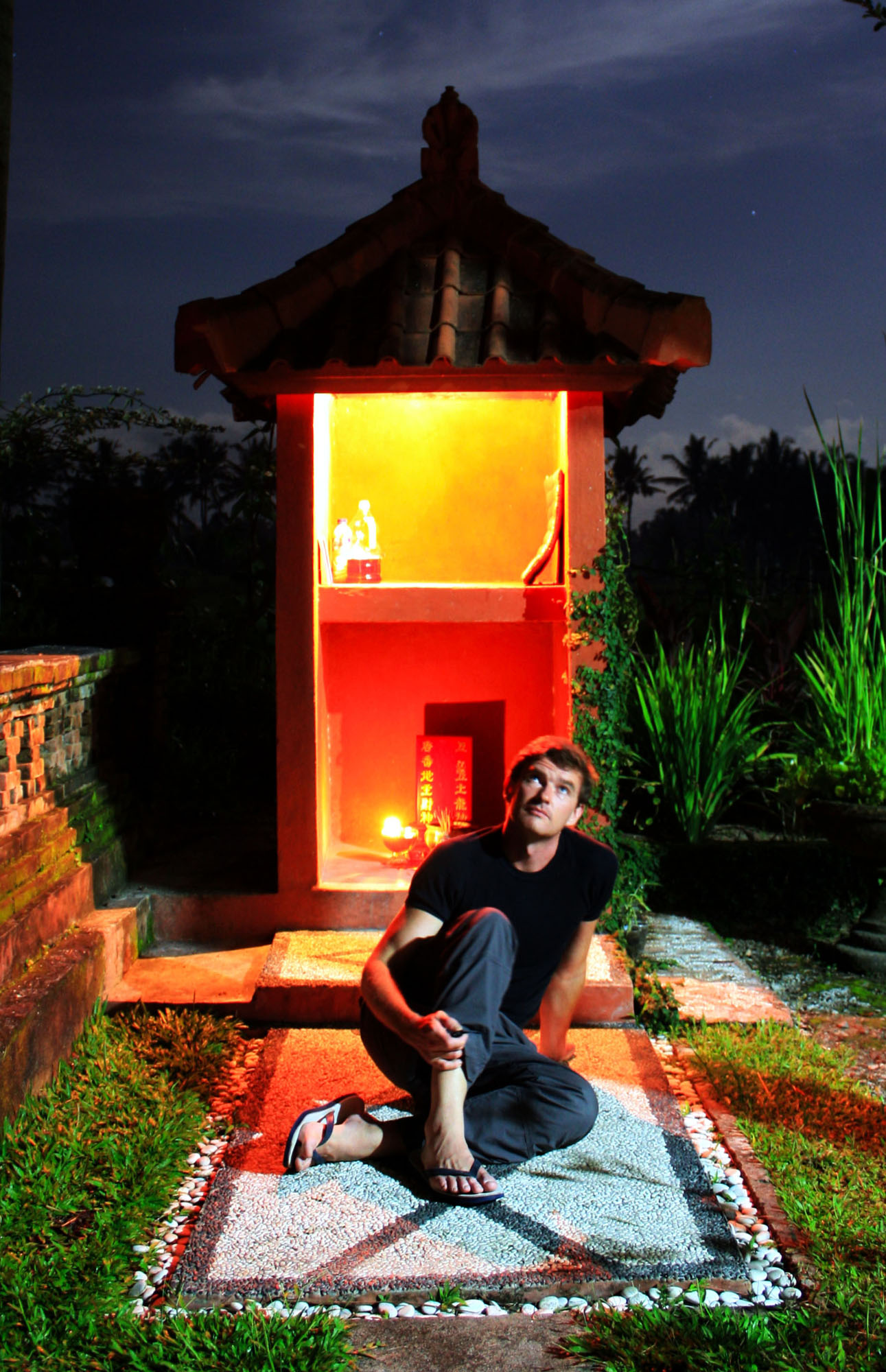
Self portrait by shrine in hotel grounds, Ubud - somewhat ironic as an atheist

Breakfast at Ubud

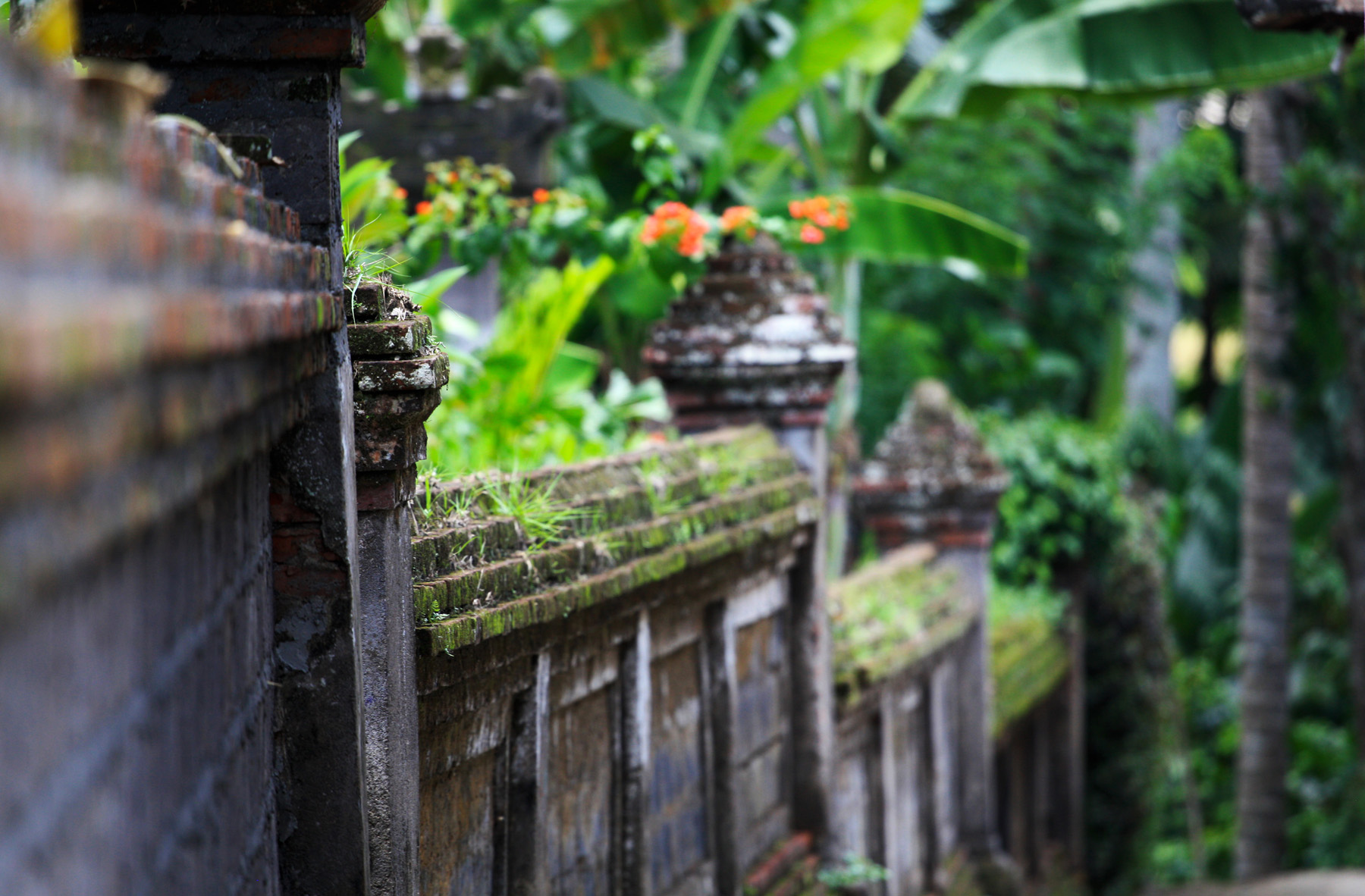
The “resorts” often mirror the arrangements of a local family compound, but on a grander scale. Behind the decorated stone and brick walls lies a cleverly landscaped mix of flourishing, immaculate gardens, pools and water features and traditional stone and brick-built bungalows and standalone two-story villas, often with high, thatched roofs.

Sidemen Road

The buildings are rarely dull and blocky as so many hotels can be, but rather they have an elegant simplicity or sport the intricate busy-ness so apparent in Balinese religious architecture. This baroque, Hindu-influenced style combines the humble commonsense of the village house with the strident decadence of a palace and blends marvellously with the colourful gardens. Even where the adornments have been stripped back to a more minimalist presentation, the effect is still a pleasing marriage of the humble and palatial.

Hotel, near Seminyak

I don’t generally like overly busy architectural or decorative styles – take the Corinthian bombast of the later Antonine Pax Romana or the garish flounce of the Rococo, or, for that matter, the overwhelming intricacy of Hindu temples – but in Bali the rendering is apposite. It has an organic, natural quality, especially in its unpainted masonry, which, whilst texturally in contrast with the limpid green of the vegetation, rises from it like a finely crafted termite mound. This organic quality is also ever-present in the woodwork and thatching.

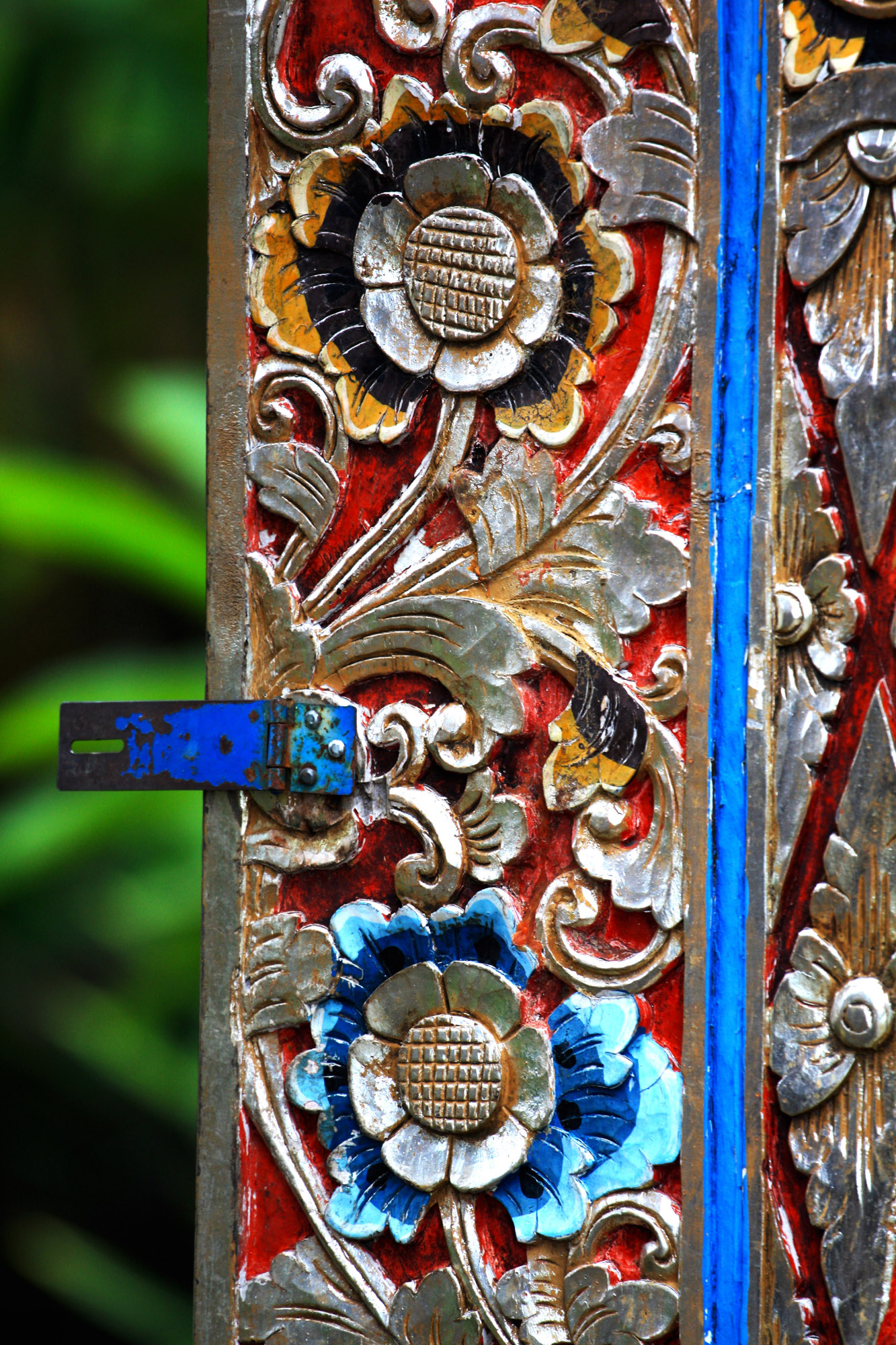
Door, near Ubud

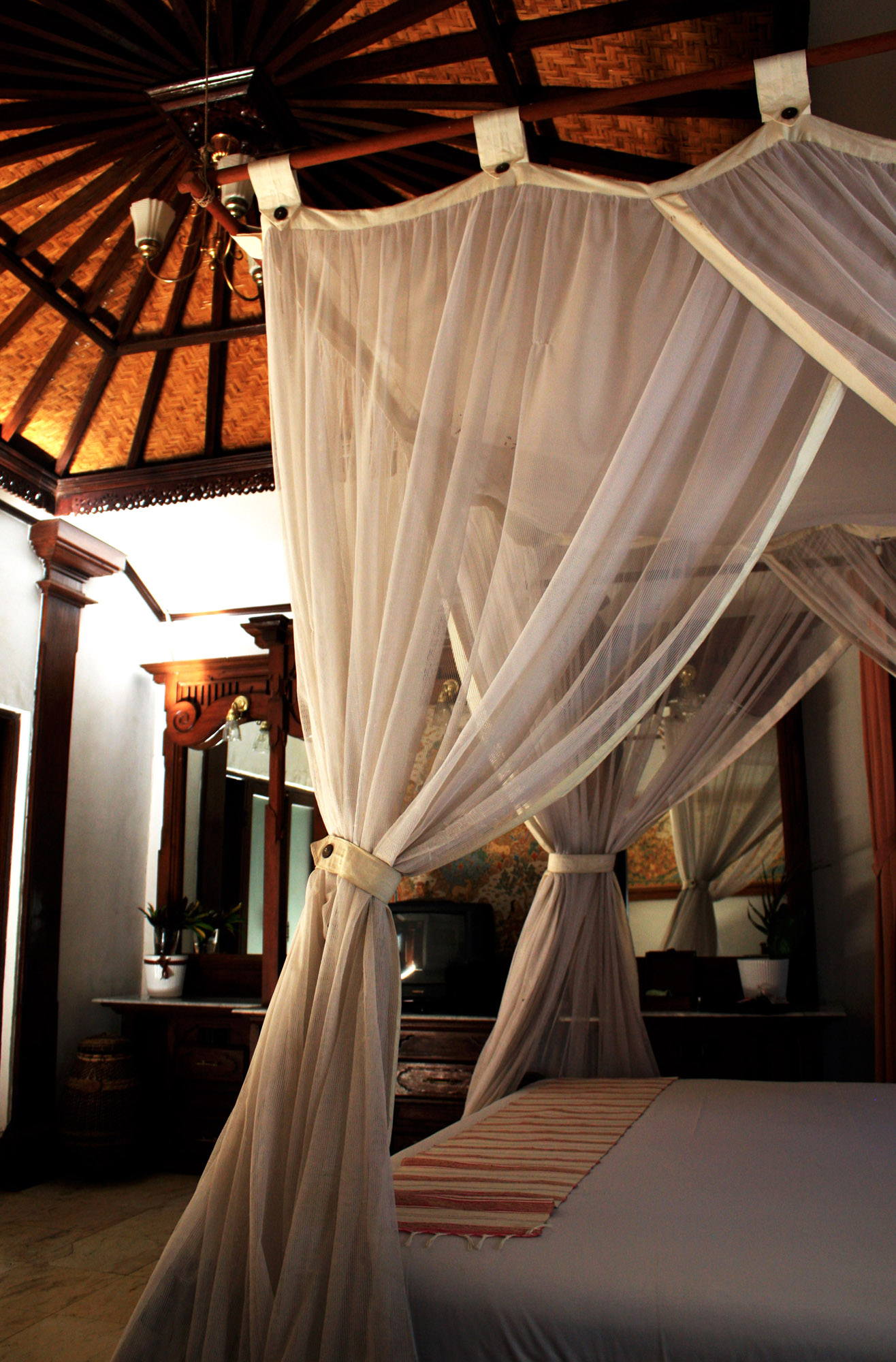
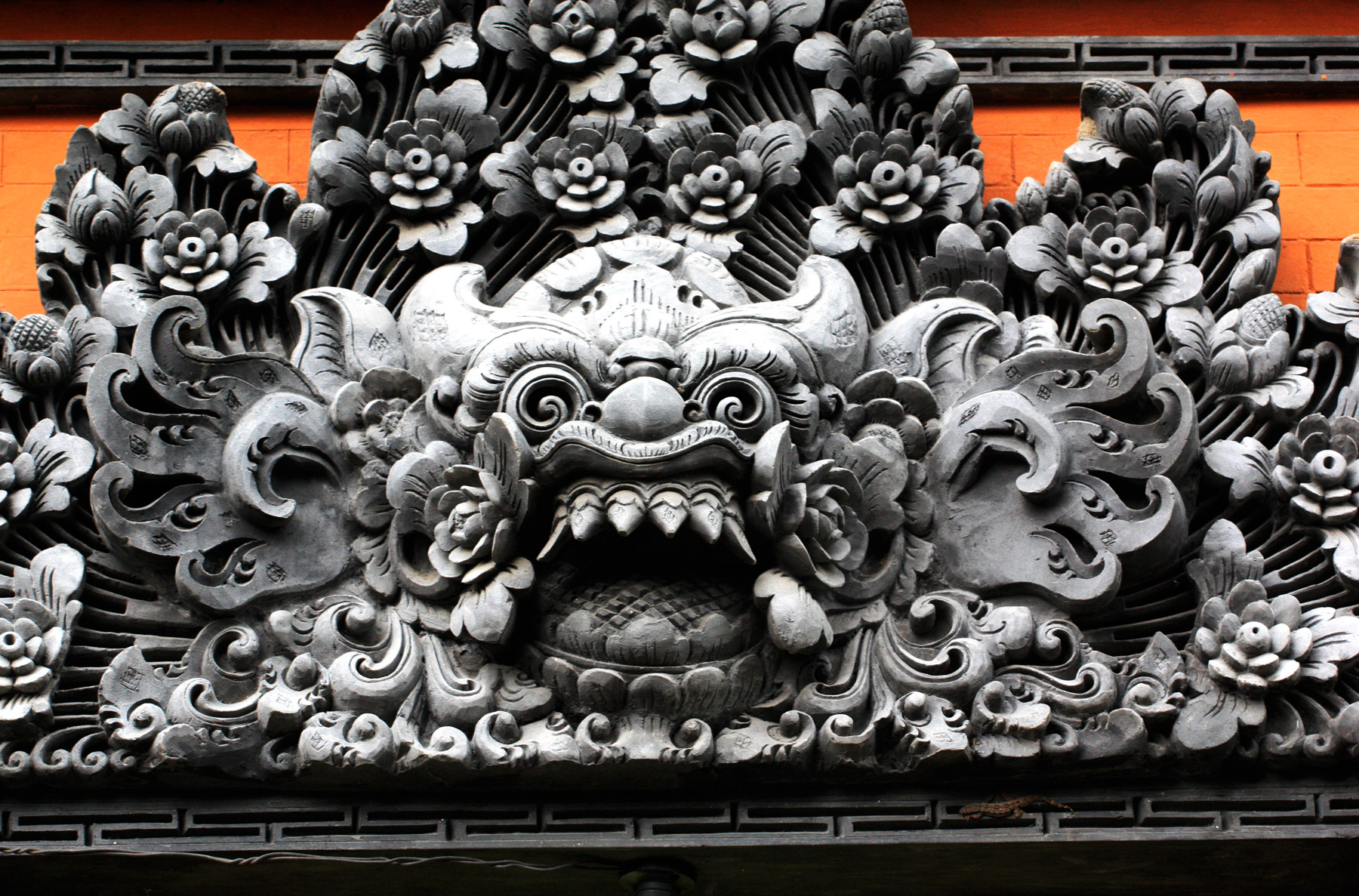
The floral and bestial carvings in the stone and wood – intertwined curlicues – run the eye gently round in the mesmerising manner of a celtic manuscript illustration, or indeed, an overgrowth of creepers. Inside, more often than not, the rooms lack ceilings and, rising above the high walls, the tall, pointed thatched roofs lend the rooms a sense of immense space, as well as keeping them cool in the tropical conditions.

Bedroom, Ubud 40 bucks a night

For someone who prides himself as a lefty with strong socialist tendencies (though I don’t pretend not to be a bloody hypocrite at times), such luxury usually comes with the added moral and ethical price of guilt. It is a price all people with a social conscience pay when they travel in the “developing” parts of Asia, or indeed, any country where the locals earn considerably less money and have fewer opportunities. Yet, sitting there on the balcony that evening, drinking beer and watching the sunset sky, V and I both expressed the same conclusion – that in Bali, this feeling did not take hold as it did elsewhere. What seemed different about Bali, in comparison to, say, Cambodia, Vietnam or India, was that the locals seemed far more content and most people appeared to live well. The power relationship, so often dictated by money, was still to my advantage, yet I didn’t detect the same degree of envy, jealousy or desperation in exploiting the fact that I had money to spend.

I don’t mean to suggest that there aren’t plenty of people in Bali who are struggling to make ends meet, nor that there aren’t people out to make a buck from the tourists, for there certainly are, yet the living standards and way of life seem adequate to allow for contentment and harmony. I come to this question from a completely amateur sociological / anthropological perspective, yet my encounters and observations suggest that generally people are happy in Bali. This might be a consequence of their religion, rituals, close family relationships and their solid, largely village-based social framework, yet I suspect it is also on account of the beauty of the place and the constant climate. That both V and I had arrived at the same conclusion independently could purely be a misleading coincidence, but it gave me some confidence that there might be at least some truth in this.

Temple guardian

When I travelled in India for the first time in 2010, I also encountered many people who seemed content in getting on with their lives. Yet there was the unmistakeable feeling of being constantly pursued and receiving constant attention. It is understandable in a country where the gulf between rich and poor is so much greater than in Bali, and where the sheer size of the population dramatically increases the competition for resources, but the end result is that simply by being there, I felt I had in some way destroyed the equilibrium of the place. Poverty is very relative and people don’t want things if they don’t know about them. They are also less likely to feel jealous or in anyway inferior or inadequate if not exposed to the wealth of others. Yet, even when travelling on the cheap with a day-pack and a pair of thongs in India the amount of money I had to spend on luxuries and services far exceeded the capacity of most of the locals and I was constantly aware of this fact. Without trying to cut too many corners, nor deny myself too much, and yet, trying to stick to a pretty decent budget, I would end up spending around twenty dollars a day – a thousand rupees then, and now almost 1200. Consider, however, that those lucky enough to get the minimum wage receive roughly 160 rupees a day for skilled labour and a mere 100 for unskilled labour, and you get some idea of the vastness of the chasm between even a poor tourist like myself and the local people.

India – hard slog for peanuts

On this note, I once had a conversation with a man in India where I tried to explain that although I came from one of the richest countries in the world and was far wealthier than he was in real and relative terms, back in Australia my income placed me in the bottom fifteen percent of the population and I could afford neither a house nor a car. It took some time to get the message across, but we got there in the end. Even bearing this in mind, however, which, for simple practical reasons, meant I couldn’t afford everything India had to offer, it never stopped me feeling guilty about how much easier life was for me.

In Bali, however, despite a relatively similar disparity in spending power, I never felt the divide as greatly. Again, I must reiterate, this is not because there are not poor or desperate people in Bali, there certainly are, yet their lives don’t seem anything like so harassed and stressful as the lives of poor people in India.

One thing V and I had noticed was the apparent contentment of the rural population. Despite rural areas often being poorer in real terms, in Bali the rural population appeared mostly happy. The locals certainly worked hard in the fields and in many and various other manual tasks, yet the villages were clean and organised, with good housing, nice gardens, easy access to running water etc.

Sideman Rd area

On the first trip I took to Bali with my brother, we drove through countless villages as we cruised across the island, and we were constantly impressed with the quality of the houses and how attractive these small urban environments were. So much so that I kept thinking how wonderful it would be to live in such a house for some time and write a novel.

Sideman Rd area

Ubud

This was in contrast to the experiences I’ve had elsewhere. One thing I’ve noticed over the years, about the difference between rural and urban areas in poorer or developing countries, is that whilst in cities people will offer services simply because they can, in rural areas, they are more inclined to ask directly for money. I first noticed this in Turkey back in the nineties, where, outside of the cities, children would often approach me and asked for what sounded like “Boom boom”, whilst rubbing the forefinger against the thumb. The expression itself might be misconstrued! though there was no mistaking the gesture. Some children actually used the word “money”, saying nothing else. “Money?” “Money?” This was repeated in Cambodia and India on many occasions, but only very rarely in Bali. It could simply be a consequence of greater comparative wealth, in which case, I’m not entirely sure what my point is, but either way, the absence of this direct appeal for money help to ease any possible sensation of guilt.

Doing alright

This was the subject of our conversation, sitting there watching the sunset. It wasn’t the most impressive of sunsets, but the beauty and serenity of our surroundings hardly needed the help of an elaborate lightshow on the horizon. It is worth pointing out that V’s observations and opinion on this front were founded on greater travel experience than my own. Having been to South and Central America five times, often for lengthy periods, having travelled extensively in Asia, India, the Middle East and the poorer parts of Eastern Europe, I trust her opinion and judgement. She had also spent more time in Bali than I had, visiting the place, as I had, just a few of years before. The people of Bali, we both agreed, had a softness, warmth and generosity of spirit that stood out.

Ubud

Cycling boy, Ubud

Another difference we noticed in Bali was the high quality of customer service. Certainly at times things are a bit ad hoc – which is fine with me as I don’t like formality and fawning attention – yet nearly everyone in Bali that we had any dealings with – drivers, waiters and waitresses, hotel staff, shop assistants, ticket vendors, you name it – were polite and attentive and professional, or enthusiastically and charmingly amateurish. This seemed to be the case even when there was no direct incentive to be so – no commission, expectation of a tip, etc. One thing I was later to notice when we arrived in India was that the service varied wildly, and often veered into total rudeness and indifference, depending on the degree to which the person with whom we were interacting was to benefit from it. In the first six outlets of Café Coffee Day which we were to visit in India – so desperate were we for espresso coffee that we kept going back – the staff practically ignored us completely, even when standing at the counter, and then were surly, unfriendly and not especially professional. It must be said that we were to have a very different experience in Kolkata, where we found very lovely people who were totally on the ball, yet by this stage the damage was already done. I’m not sure what it was, but despite our cheery hellos and attempts to be friendly and engaging ourselves, the staff were almost universally indifferent and acted as though they had been massively put out by our coming into the café in the first place.

Bali Kopi, Ubud

Customer service is not the most important thing in the world by any means, and while it is unreasonable to expect a certain standard of professionalism, friendliness and politeness leave a lasting impression and have a universal appeal. The way one is treated by people makes a huge difference to how the experience is remembered; rudeness and negativity can sour the memory of a place. If there is one thing that seems to truly stand out about Bali, it’s how bloody nice everybody is when they don’t need to be. This friendliness goes a long way towards creating a much more equal relationship, rather than one that is all about extracting money, which is too often the case elsewhere and which creates a very uncomfortable situation. Some of the few other places in developing countries where I’ve had such a sense was Darjeeling in northern West Bengal and in Chiang Mai in northern Thailand.

Worshipper, Pura Besakih

Temple statue, Sideman Rd area

Offerings aplenty, Ubud

Was it culture? Was it religion? Was it the environment? Or were their lives simply full enough and rich enough not to need much more than what they could afford and had available to them already? In these places I didn’t feel the resentment and envy that tourists in poorer countries will almost inevitably attract.

I don’t doubt that people will have had very different experiences and I repeat that these are just casual observations that are in no way scientific. It also must be said that in and around Denpasar, as in many big cities, the pace of life is faster and business a little more cut-throat, so here one might find a very different vibe.

Night markets, Denpasar

Shop sign, Sanur

It is also necessary to point out that when we went to the temple complex at Pura Besakih the day after having had this conversation, we had a pretty unpleasant experience. The Lonely Planet had forewarned us that the hawkers here were most aggressive and that tourists were often subjected to scams wherein local men would tell them that they were not allowed into the site without a guide, despite having already bought a ticket.

Cranky hustler, Pura Besakih

It seemed as though this might be quite easily gotten around, but when we arrived at the place we were not only lied to by a number of people at the entrance, but they were very aggressive about it and even tried to block our path. When we decided to ignore them and push on through they still didn’t drop the ruse, but continued to shout rudely at us. This might have been amusing if their tone wasn’t so ugly and aggressive and instead it made me so angry that it spoiled the experience of the place, which was pretty unfortunate. Though, to be honest, so far as temple complexes go, it’s not that much to write home about.

6999 Watching the ladies, Pura Besakih

6926 Pura Besakih

7080 Pura Besakih

7059 Pura Besakih

This negative experience, however, was an isolated one. During both of my visits to Bali I have found the people to be very friendly indeed, as has V on both of her trips. It is a gross generalisation, but I was left with the impression that people live happy lives and they are mostly content just to get on with things. Whilst going there in the first place is a somewhat disruptive thing in itself, so far as local balance is concerned, the overall feeling we had was not one of guilty privilege and yawning disparity, but one of more equal interactions. All of which makes travelling there more relaxing and fulfilling.

We finished our beers as the light vanished from the sky and the mosquitoes began to close in. Below, under a thatched canopy, on a beautiful deck beside a patch of jungle, calmed by the trickle of a fountain, the smiling staff were waiting to serve us, the only guests. It all seemed so utterly decadent and quite ridiculous for the price, but at least we didn’t feel guilty in allowing ourselves this indulgence. And, as is so often the case in Bali, precisely because there was no pressure to do so, we were happy to leave a generous tip.

Forbrydelsen Season 1

The following review contains some spoilers…

Last week V and & finished watching the first series of the renowned 2007 Danish crime drama Forbrydelsen, aka The Killing, written by Soren Sveistrup. I’d heard a number of anecdotal reports about what a great show this was from my parents and various others, but hadn’t quite separated its potential stand-out quality from my general dislike of crime dramas. The sheer amount of second-rate CSI-type pap out there has, quite rightly, made me extremely wary of the genre. Indeed, I’ve long been spmewhat disgusted by the pornographic and gratuitous manner in which they titillate their audiences with lurid details of rape and murder; so akin to the base and irresponsible reporting of the commercial news channels and rags we foolishly grant the title of newspapers in Australia.

From the moment we began watching Forbrydelsen, however, it was clear that something very refreshingly different was going on. If there was a spectrum of quality, measured primarily on realism and characterisation, then this show sat roughly eight miles along from the best English crime drama, with its American counterparts so far behind those as to be only detectable by their own implausibly neat forensics techniques. Forbrydelsen, it was clear from the start, was not merely good, it was the shit.

When we first sat down to watch it, we were a little baffled. Wasn’t this show Danish? If so, why did all the names sound so un-Scandinavian? We watched the opening thriller sequence in which a woman is chased through the woods to her impending, yet unseen demise, followed by an introduction to what was no doubt our blonde, good-cop female protagonist, looking strong, capable, quietly determined, fit and utterly in control of her life, out for a morning jog. Then she opened her mouth. Oh dear, this was the American version. Yep, and it showed.

A few peers and seeders later and we plugged in the USB to fire up the Danish version. Within seconds the vast gulf between quality European television and American drama was revealed. After a repeat of the frightening and chilling chase through the woods, we meet our brunette female good-cop protagonist – waking up from a disturbed sleep, tired and worn out, staggering around the house in her pyjamas, checking on her teenage son who is sleeping on the lounge in front of a static-filled television screen. A single mum, we soon meet her Swedish partner, also in his pyjamas, also waking up tired and worn out, stumbling through the dark amidst the boxes of her and her son’s belongings, all packed and ready to move to Sweden for a new life. Our protagonist, Sarah Lund (Sofie Gråbøl) smiles warmly when reassured that everything about the move will be ok, but we can see in her relief the fear and vulnerability that she carries with her; her anxiety and tension, the complexity and disarray of her domestic circumstances. None of it is glamorous, none of what we see establishes her as anything other than a real person who, like everybody else out there, has to deal with the banal and quotidian demands of real life.

We paused a moment here and let out a collective sigh of relief. Wow, how much more engaging and promising the original version seemed. Even after just four minutes of viewing the American remake, it was clear that it was going to be Forbrydelsen lite, the airbrushed, sanitised version in which its audience would not be challenged to accept that the flaws of the protagonist were not big ticket things like, for example, Carrie Mathison’s bipolar disorder in Homeland or the utterly contrived and unconvincing OCD of Hannah Horvath in the disappointing second half of Girls season 2, so clearly tacked on for want of a decent plotline. Instead, in Forbrydelsen, we were going to be treated to everyday pressures.

I should digress at this point to say that I found Homeland and Girls to be excellent, high quality television. Both of these shows also have great characterisation and, particularly in the case of the latter, elements of gritty realism. Yet whereas the former does this within an overtly sensational story in an airbrushed, suburban and upper-echelon America and the latter does so in an occasionally all too smug, convenient and self-congratulatory potpourri of zeitgeist, Forbrydelsen had the balls to develop its characters and story with the slow and almost painfully intimate realism that fans of quality Scandinavian cinema, drama and lit will recognise. Like a good Lukas Moodysson film or a Knut Hamsun novel, Forbrydelsen, made an epic not just of the crime investigation itself, but of the domestic turmoil that surrounds such a shocking crime and its toe-treading, home-invading investigative process.

For the uninitiated, here is a juicy detail about this show. There are twenty, one-hour episodes to cover ONE CRIME. I can’t pretend to have the numbers, but within that roughly twenty hours there must be almost two hours total spent in the homely kitchen of the devastated family whose daughter, Nanna Birk Larsen, was the victim. Their tears are real, their emotions utterly genuine, the detail of their experience is deliciously heart-breaking.

There is no one thing which makes this show so great. It is the writing, the direction, the acting, the music, the muted colours and dull uniformity of Copenhagen in November. The performances throughout are almost universally excellent. No one character is two-dimensional; all have their flaws, conflicts, quirks and idiosyncrasies, none of which seem cheaply contrived or tacked on to create some shallow show of complexity. These characters are simply convincingly real and complex, and not in the way that characters have complexity, but in the way that real people do:

Troels Hartmann, the mayoral candidate, who soon falls under suspicion, bearing up under the weight of hiding his loss and depression, is an alluring mix of ambition and self-doubt; of integrity and political game-playing.

Troels Hartmann, aka Lars Mikkelsen

Jan Meyer, Lund’s mercurial partner, whose initial rough edge is ultimately contrasted with the convincing softness of a father desperate to hold down a job and provide for his family.

Meyer

Pernille, the mother of the victim, whose face is always grippingly pregnant with withheld or unleashed emotion, the longing for revenge or satisfaction, the need for answers, juggling her husband Theiss’ flaws, her children’s needs, the pressures on their removal business and her family’s apparent duplicity.

Pernille Birk Larsen

And of course the very excellent Sarah Lund, our struggling protagonist, whose decision to stay in Copenhagen until the case is solved puts immense pressure on her family and relationship, and whose determination and stubbornness constantly rub against those with whom she works and is trying to help. The hardness of her character is extraordinary and constantly compelling. Her rough edges, her mistakes, her clever instincts, her obsessive nature, all emerge as the convincing traits of a plausible character.

Sarah Lund in one of her excellent jumpers

In Forbrydelsen, even the cast of supporting characters is excellent. Take, for example, the Mayor of Copenhagen, Bremer, whose smug sniping and cutting quips leave the audience constantly wondering what lies behind the mask of bemused confidence. Lund’s long-suffering mother, concerned and interfering, at times bitchy and cruel, at times deserving of great sympathy on account of her daughter’s thoughtless impositions. The list goes on, but the conclusions are the same throughout. With no exceptions that come to mind, these are masterful performances by skilled and naturalistic actors working with clever, plausible dialogue.

The show is certainly not without flaws. There are holes and apparent inconsistencies in the story that are not all satisfyingly wrapped up. Why did Holck, an otherwise seemingly well-adjusted career politician commit such serious crimes to hide his potential exposure for a crime that was far less serious? What exactly was going on between Troels Hartmann’s advisor Rie Skovgaard and the Mayor’s advisor? What actually was the connection between the murder of Nanna Birk Larsen and the other girl murdered 15 years earlier? Would Troels’ campaign leader Morten really go to the lengths he did to cover up what he thought was Troels’ role in the murder? I was left with a lot of questions about which I am still thinking, questions that no amount of googling has managed to satisfy, other than to confirm that others have wondered the same things as I have. Yet, having said that, the fact that I am still thinking about this show and still feel gripped by its story, despite having reached the end of it, says bucketloads about its sheer excellence. I miss the characters, I miss the setting, I miss the details of the investigation, none of which can really be made up for by the second season which may be as excellent – I have yet to watch it – but will follow a different crime with a different cast of support characters, give or take the ones around whom Sarah’s life closely gravitates.

Enough said. If you’ve not seen it and enjoy watching a show that cooks slowly without ever being boring, then I can’t recommend it highly enough. Fill the fridge, keep the phone handy to call in sick, drug the kids, close the curtains and brace yourself for a serious case of “just one more episode” syndrome. It really is that good.

My first trip to Bali was with my brother in 2009. Apart from family trips as children and my visits to him in Brisbane and vice versa here in Sydney, it was the first dedicated holiday we’d taken together and the first time we’d hung out overseas. I was piggybacking this trip on top of five days in the Northern Territory with my then girlfriend and met my brother at Darwin airport late one afternoon.

To say we enjoyed those next five days in Bali would be a massive understatement. It was not only a great pleasure to have such an excellent trip, but also something of a surprise. Both of us had been deeply suspicious of Bali on account of its being the destination of choice for hordes of pissed-up Australians – people we snobbishly call “Bogans” and try to avoid. Once we’d booked the tickets, however, and I began to do my research, including some lengthy sessions on Google Earth, I was very excited about seeing this island.

Bali occupies quite a unique place in the region for being predominantly Hindu. Buddhism and Hinduism both took root here, most especially during the 9th and 10th centuries, with increased traffic from Javanese and subcontinental traders. The culture that developed from this period onwards is a mix of traditional Balinese culture and a local interpretation of Javanese and Hindu influences.

Ceremony

Ceremonial box

The structure and rhythms of this lifestyle have proven very enduring. Bali is a very religious island, yet the religion, despite its occasional ostentation, is a friendly and private affair. The observance of often quite simple religious ceremonies and practices is so intrinsic that people simply go to it with hardly a mention. All of which makes Bali stand out distinctly from the Islamic Republic of Indonesia of which it is a part.

Thus, by the time we met in the airport in Darwin, the two of us were very excited. I was especially enthusiastic about getting some good shots as I’d just been trying out my new L series 70-200mm lens in NT and was loving it.

Green-Bottomed Ant

Florence Falls

Near Nourlangie

We arrived in Denpasar quite late, got a cab straight to our hotel and went out looking for a restaurant. My brother had actually booked us into Seminyak, right in the heart of the scene, but it was a Tuesday night and not especially busy. We found a nice place on the beach front, ate fresh fish, and that was that. The only incident of note was when my brother was approached by a very large and masculine transvestite who said “Mmmm, you big strong man,” in a trés seductive voice.

The following morning we hired a car and set off relatively early, keen to get out into the countryside and see more of the landscape. That first day was largely spent getting completely lost in the warren of lanes and villages that are woven into the rice-fields. We were attempting to reach a famous seaside temple, Pura Tanah Lot, then to find the town of Ubud itself. We found the temple after many picturesque wrong turns, but when we set off to reach Ubud, we really took getting lost to a whole new level. My brother, who was driving like an absolute champion, weaving in and out of the scooter-traffic, was struggling to retain his equilibrium as we repeatedly failed to orient. The lack of signage, the apparent sameness of so many villages, the absence of vantage points from which to make sense of the landscape, all meant it was almost stupidly difficult to be sure where we were. What made it all still a bloody great drive, however, was that everywhere we went was either fascinating or astonishingly beautiful.

I was struck most of all by the lushness of the place and the wonderful traditional architecture. On that first day alone we must have passed through thirty-odd little villages, most of which consisted of a main street lined with elaborately-carved stone-fronted houses and temples, bristling with flowers and trees. The amount of quality masonry and the quaint, cosy beauty of the houses – which was almost universal – fascinated me, partly because they reminded me of the streets of stone houses I’d seen in Roman Pompeii and Herculaneum. I wondered how long these villages had looked like this – and felt I was visiting a living, ancient form of urbanisation.

Balinese lane

Architectural detail 2

Over the next five days my brother and I made our way north, first to Ubud, where we spent a couple of nights, and then on into the mountains around Munduk with its amazing views across to the volcano, Gunung Raung, on the island of Java. Every day brought new surprises and pleasures. The food we ate was almost universally excellent; the people were outrageously nice; the landscape was breathtakingly beautiful. We drove high up into the misty hills, through foggy, wet farms of hydrangeas; looked down on wide, splendid vistas, visited waterfalls and lake-side temples, rode elephants through the jungle, and finally reached the north coast around Singaraja.

Men at Ceremony

Into the mountains

West Bali at sunset

Macaques!

Temple truck

Temple drummer

Solid gold elephants

Lovina Beach boats

Munduk Waterfall

West Bali, Java Sunset

It was just a pity we did it all in a Suzuki Katana. This vehicle must have been named ironically on account of the great contrast with the refined workmanship of its Japanese sword namesake. It was a cramped and rattly piece of junk, with ill-fitting doors, ass-breaking seats and a dashboard that looked like it was a mock-up for kids to play at driving. The air-con was an epic fail and the leg-room negligible, so we sweated it out somewhat crampedly, the windows right down and the breeze blowing in more of the sticky air. Still, at a meagre cost of $92 for five days, it was indeed a bargain.

Katana at Singaraja

Without wishing to provide an exact chronology of our journey, two incidents stand out. After buying a proper Bali road map in Ubud, Matthew and I thought all our navigational troubles were behind us. Yet, as we tried to leave Ubud and make our way to an elephant sanctuary somewhere to the north, we struggled to find the road which we had decided was most appropriate on the map. The problem was that it simply wasn’t there, though at first we thought it was our mistake and that perhaps we needed to re-examine our expectations of what this road should look like. The nearest thing we found was a drive-way that ran past a boutique hotel and plunged sharply towards a gully. I became enthusiastic when we saw that it seemed to continue into the forest and urged my brother to drive down the steep hill. He did, and soon we found ourselves at a dead end on a little square terrace overlooking a steep drop into a river.

Ubud action

This might not have been such a problem if a) there had been enough room to turn the vehicle around and b) the Suzuki Katana had enough power to reverse up the hill. There wasn’t and it didn’t. Despite several attempts at backing up the very steep incline, the car just wouldn’t go. Not only was the engine pissweak, but there was no space for a run-up.

In a very short time, I was blanching with guilt and my brother was seething with frustration and rage. Feeling responsible, I looked desperately around for a solution. If we could create more turning space – perhaps by placing logs and stones along one edge of the little terrace, then we might just be able to swing the vehicle around and punch on up the hill. I set off into the forest and climbed down to the riverbank, yet there simply wasn’t the right sort of material to pull it off.

My brother tried reversing a few more times, but there was no room. He was convinced we had no choice but to get on the phone and organise a tow, which was likely going to be a lengthy and expensive process. It was at this point that I came up with the crazy idea of us pooling our strength and lifting the car to turn it. After all, we are both pretty big blokes and such a flimsy excuse for a tin biscuit box couldn’t possibly weigh that much. Matthew was keen to give it a go, and sure enough, when we braced and heaved a moment later, we got the back end off the ground and swung it around about a foot before having to drop it. A good start indeed.

It was as we heaved the thing up the second time that we heard the excited shouts from the road. Looking around, we saw three young Balinese guys running towards us waving excitedly. They had seen we were in trouble and come to offer help in that wonderful, eternally hospitable manner of seemingly all Balinese.

Friendly local chap

We laughed and shook hands and opened our arms and joked about the situation in gestures and broken English. Then the young men joined us in the heave and again we lifted and swung the vehicle. This time it turned around just enough to make the rest of the manoeuvre. Keen as ever to help, one of the men now jumped in the front and made this very tight turn, with barely an inch to spare. As soon as the car was facing the slope, he revved the engine and charged off with a screech and whiff of burning rubber. The Katana hit the hill at speed and shot on up the slope like an excited pup. After driving in the thing for a couple of days, we hadn’t exactly been confident. There was a great flood of relief as it zoomed back up the hill.

Afterwards we both felt a mix of thankfulness and embarrassment, so, unsure what to do, I pulled all the money out of my pocket and gave it to the guy who drove the car. I think he was quite surprised. As we drove off along the main road we’d hoped to avoid, we really had a very good laugh about it all.

The second incident I mention was of a less salutary nature, though with a similarly happy conclusion. Driving just north of Ubud, we passed a view of bright green rice terraces stacked across the other side of a valley. In the foreground were a few pockets of jungle with tall palm tree sentinels through which the wide curving decks of rice could be seen. The land sank deeply away from the road which lent our vantage point a taller scope. Both my brother and I had been eager to see and photograph such a picturesque scene and this stood out like a postcard.

Rice terraces

We cruised slowly until we found a wide gap and a place to pull over, then prepared to get out of the Katana. There were a few hawkers around along the roadside, and we figured it must be a popular viewing spot. One woman waved to us from the other side of the road, offering a large bunch of small, sugar bananas.

“Might get some bananas,” said Matthew, feeling peckish. Still sitting behind the wheel, he made a gesture and nodded to the woman, and she began to approach the car. As soon as she reached the window, the other hawkers, who seemed suddenly to have multiplied, made straight for the vehicle at pace. The speed with which they surrounded us was astonishing. I was still in the front passenger seat changing camera lenses when the wave struck.

In total, there must have been nine or ten people around us, roughly five on either side. The window was down and through this portal a flurry of hands was now thrust, offering a variety of artefacts. To say that these men were like seagulls fighting over chips seems undignified, and yet so it was – much pushing, shoving and shouting accompanied this keen offering of goods. A number of carved wooden objects were dropped in my lap as prices were yelled into my ear. Overwhelmed and amused, and yet slightly alarmed by this invasion of our space, I slapped the door lock and stuffed my camera into my bag at my feet.

On the other side, my brother now sat with a whole bunch of bananas in his lap and a porcupine of hands reaching in through his window. Both of us were too busy fending off the vendors to give each other much attention. Feeling the pressure and concerned that things might suddenly go very badly, I picked up one of the objects in my lap, one half of a set of carved wooden bookends, and said “Okay, okay, how much?”

The price was negligible – around five dollars – and I hoped that as soon as I’d given the guy the money I could justify closing the window and saying enough was enough. Yet, just as my brother’s interest in the bananas had sparked the initial frenzy, my apparent interest only intensified the efforts of the others and the pushing and shoving reached a new crescendo. I bent forward, feeling increasingly less comfortable with the whole business. I got the money for the bookends out of my wallet and pushed my bag as far under the seat as it would go. When I held up the notes they were promptly whisked from my hand. I smiled at the people who were all pressing in, smiling at me too, but with an odd sort of mania.

My brother, having finished his banana purchase and being similarly assaulted, turned to me and said, “Fuck it! Let’s roll.” He put his foot to the pedal and let the car jolt forward, just enough to get the message across. There was a collective gasp of alarm and a new flurry of activity as the hands collected the things they’d dumped in our laps. They were all very fast and accurate. My brother pressed the pedal again lightly, just enough for a quick lurch. Our assailants finally backed off.

“Let’s go!” I said, excited that we were all clear to make our getaway. Slowly at first, my brother got us going and the Katana, now our protector, rolled forward onto the road. A moment later we were sailing away from the scene.

It took about thirty seconds for the laughter to begin. At first it came on a great wave of relief, for both of us had felt slightly threatened by the insistent nature of the hawkers. But in a moment the sheer ridiculousness of it all became apparent as we looked to our laps and saw the big bunch of bananas and the wooden bookends. This set us off into fits of hysterics and we laughed until our eyes were flooded with tears. We laughed so hard we could barely breathe and my brother had to pull the car over again and stop a while.

I hadn’t laughed that hard in years and I haven’t laughed so hard since. It was intense, even painful – the gasping for air, the clench in the stomach – and every time I saw the bookends in my lap I just laughed harder and harder. We must have sat there for five minutes. The doors locked, the windows rolled up, emitting little gasps and piping hoots through the tears and spittle. Even once we’d finally gotten control of ourselves and started driving again, we continued to laugh. It just kept coming, bursts of laughter, eruptions of cackling, even further fits of hysterics. By the time we made it back to Ubud we were completely exhausted.

In a way these two incidents seemed to sum up the conflicting elements of Balinese life. Most people seemed relaxed and content with their lives, pleased with its rhythms and generally in good spirits. They were friendly, accommodating, polite and helpful. Yet that there were also people who were genuinely desperate was apparent, along with people who, perhaps inevitably, saw the wealth disparity between tourists and themselves and sought to tap it. It made me feel guilty that I might be a cause for envy or resentment, that perhaps in coming here at all we were destroying the balance. As it was, there was much to ponder on returning from this most excellent jaunt. And indeed, much to ponder when I returned to Bali three years later.

HatGirl, Seminyak

Temple

West Bali, Java Sunset 2

Man at Ceremony

Man at Ceremony

Self portrait, lost somewhere...

Ceremony

West Bali, Java Sunset

Tourist

Banana ladies

Ubud, ricefields

Balinese splendour!

Ubud outdoor shower

Misty Mountain Hop

Scarecrow, Ubud

Macaques! 2

Breakfast flower arrangement

Farmer 1

Traffic between Lovina & Singaraja

Chilling on the balcony, Ubud

Kuta action

Legian Beach

The sombre mood began with the dog. V and I were on Sideman Road in Bali, eating and taking a break from an afternoon rain shower in a roadside shop. Ever adventurous on the food front and keen to try some of the truly local offerings, V had asked the lady for “a bit of everything” in the small cabinet. We finished up this hot and sour mix of rice, vegetables, nuts and chicken, licked our fingers clean and stepped back out onto the road.

There, to the left, were the dogs. And there, bearing down on them with unstoppable momentum, was one of the many trucks that plied this narrow but busy highway. Bright yellow, yet with an almost apologetically sad face, the truck came on and the dogs began their dance. One, a matted grey-haired bitsa, made the right call immediately and sprang from the truck’s path with a deft leap. The other dog, a youngish, clean-looking, tan-coloured beauty, panicked and skipped not away from the truck to the pavement, but away from one wheel towards the centre of the road. There was a collective gasp in that long second as the truck passed directly over the dog and the dog, terrified yet unscathed, made its second mistake. Having landed on a diagonal with its back towards the rear of the truck, the dog failed to notice the approaching rear wheels and stepped directly into their path.

Tough guy

The small body of the dog, crushed under the great bulk of the truck, sprang up from the wet bitumen, impossibly contorted, emitting a series of heartrending yelps. On went the truck, seemingly unawares. I turned away in a flinch, grabbing the shocked and tearful V by the arm and pulling her with me. To look at the dog was unbearable, that it lived at all seemed both incredible and cruel. It had staggered into a sort of bent crouch, as though its body were frozen in the midst of a drying shake.

I had to get V away from the sound of it, and I had to get away myself. The image of the double wheels rolling over the dog had already fixed itself firmly, like sunglare. The temptation to look again, as if some new information might counter my worst thoughts, was too great.

We hurried up the side street, not sure where we were going, only knowing that it was away from the awful yelping.

“Someone has to kill it, they have to kill it now,” I said, wondering who might do this or just how exactly. Both of us were crying now and so was the sky. The rain began again, harder than before, hard as it can in the tropics. Fifty metres down the street we paused, the cries still audible, the rumble of passing trucks a brutal reminder.

There was nowhere to go. We were at a dead-end and on the wrong side of the road from our hotel. I didn’t know what to do, only that getting back to the hotel now seemed the only goal. We hugged, huddling under my umbrella.

“We have to go back.”

“I know. I know.”

“Quickly.”

We hurried down the lane, the dog’s cries now quieter, less frequent. How was such a tight little body, however lithe and resilient, supposed to contend with such a blow? Was anyone doing anything at all? I did not know and nor could I look as we stepped back out onto Sideman Road. We ushered each other across and into a small lane opposite. Our own turn-off was too close to the dog to risk, so we blundered on through the pouring rain, thankful of the sound on the umbrella that masked everything else.

Soon we were lost in a warren of narrow lanes. The paving was slippery with mud and moss. We rounded a corner and found a village temple. The courtyard was full of ducks. We took refuge under the gate’s stone lintel and held each other. The ducks approached making curious quacks and now, we both really started to cry.

“I hope it’s dead, I just hope it’s dead.”

“Would someone kill it?” asked V.

“I don’t know. I hope so.”

“But what would they use?”

“God knows. A knife, a sickle. A club.”

I shuddered as these images were conjured up, but they could only briefly trump the vision of the dog bending under the wheel. In fact, I could not stop thinking about it. It wasn’t merely involuntary. I had to picture it to make sense of it. Had it really happened? Did the dog really have no chance? It still seemed that perhaps if I looked hard enough at the replay in my head I’d see the dog move differently; step the other way and emerge alive and well with its little heart pounding.

When the rain eased a little we stepped our way through muddy paths and bamboo groves along the edge of the rice-fields. Sideman is a largely agricultural area; farms, hills, forests, ducks, cattle, temples and the ubiquitous resorts amidst the abundance. All around was lush green life and a scattering of roosters and dogs. We stepped cautiously down the slippery road, trying to shake off the feeling of horror, trying to comfort each other. It was nigh impossible not to talk about it, yet without much to say beyond simple, shocked expressions.

“I still can’t believe it happened.”

I felt an urgent need to pat a dog. I wanted to find one of the many strays and give it some comfort; show warmth and kindness to dog-kind as a whole, reassure one of the poor wandering beasts that it needn’t face the same fate. Each dog we passed seemed more fragile and vulnerable than before. Against a truck, what chance did they have but for their wits and dexterity? Yet, cunning as they were, the dogs took so many risks; dancing across the traffic, sleeping on the bitumen’s edge. Here at least, on this rural side road away from the main thoroughfare, there were no cars.

Soon a woman came chugging along on a scooter. Behind her skipped an eager young whelp, happy for the game of chase and the exercise. Its joyous, panting face reassured me that other dogs were still okay. I realised it wasn’t the dogs I was worried about so much as myself. I wondered if I would ever be able to remove that image from my mind. The big wheels, the great weight, the little body.

We were saved by the volcano. Passing a field of chilli and tapioca, V paused a moment to take a drink of water and turned to look behind her. There, massive against the horizon, was Mount Agung, finally visible through the cloud and mist. Since arriving the day before, we hadn’t even realised it was there at all, so muggy was the atmosphere. The heavy rain had cleaned the sky and left just a few clumps of cloud floating near the mountain’s peak. At just over three thousand metres, it hardly rivalled the world’s tallest, yet still it was epic in presiding over the landscape. Both of us are very fond of mountains and we stood watching it for some time, only turning away when the horizon began to cloud over. The sight of it lifted our spirits.
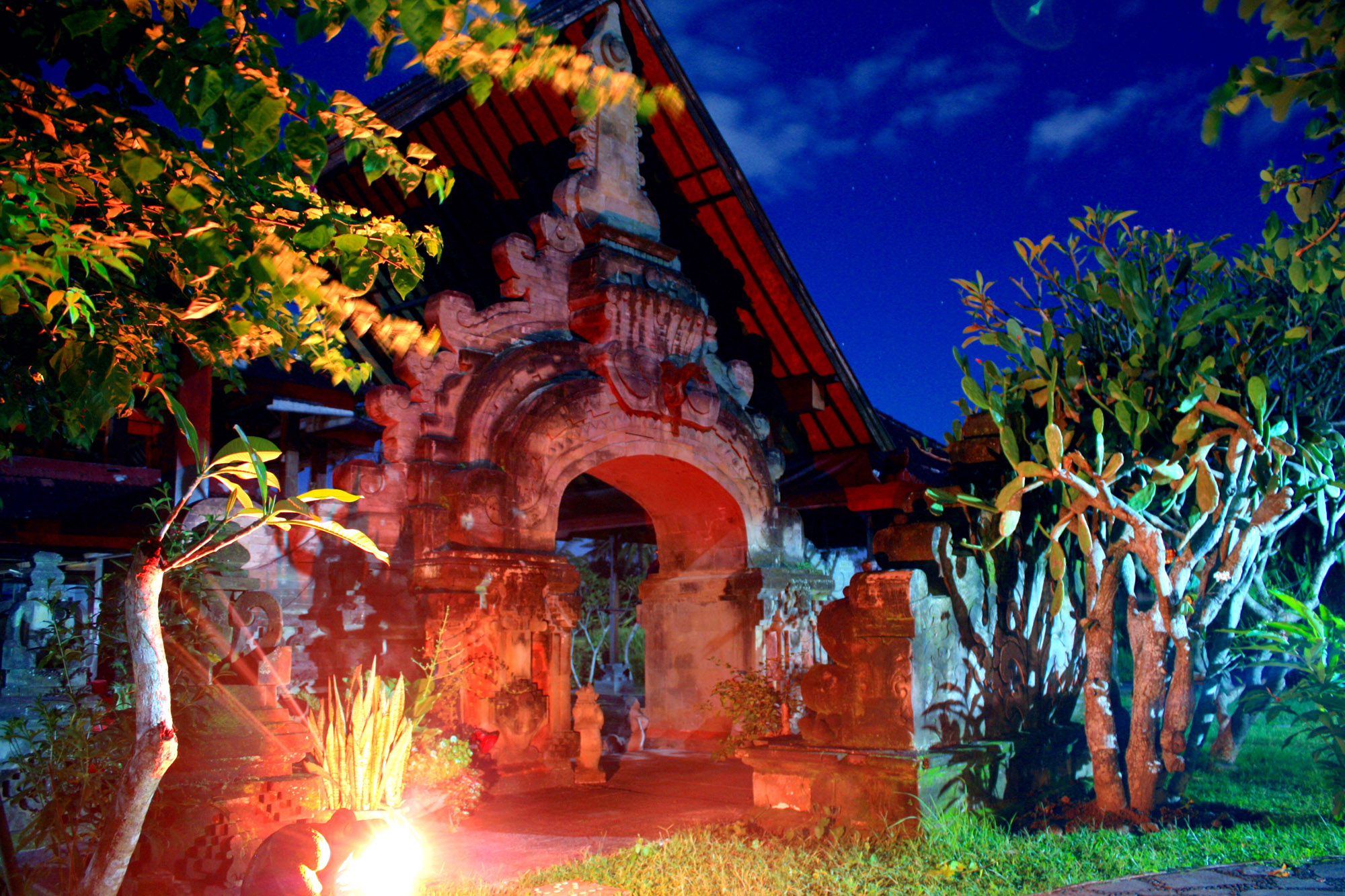
Mount Agung

Later that afternoon, having swum in the pool and cooled several beers in the fridge, we sat on our balcony talking. Though I couldn’t quite stop my thoughts returning to the image of the dog and shuddering, both of us felt greatly relieved. The beer certainly helped to cushion the blow and it finally loosened our tongues. Yet it wasn’t the day’s events of which we spoke, but rather the bigger picture. Bali itself, the place, the people, and how exactly we felt about being there at all. The rawness of the dark event had opened our emotional vents, and there was much to discuss…

Scooterists

Local soccer, Sideman Rd area

Sideman Rd

Sideman Rd area

Tile factory, Sideman Rd area

Bali

Loom

Pineapple

V, Sideman Rd area

Sweeping

Tile factory, Sideman Rd area

Drying rice

Coconuts

Bali

Two women

V on the bridge

Man on roof, Sideman road area

Mount Agung

So, it’s goodbye to Eggs, aka, Pope Benedict XVI. I can’t say I’ll miss him a whole lot, but that’s not surprising considering I’m an atheist with a strong dislike for religion and unscientific “belief” in all its forms. In the aftermath of his rather unexpected decision to resign, we’ve been subjected to the usual preliminary obituaries of his papacy, with all manner of people voicing their opinions about whether he was successful or otherwise. Today was his last day in office and now we have the rare and beautiful breathing space of an interregnum or interpontificatus (?)  as it were, during which time the papacy can choose the next man to annoy and frustrate the hell out of us secular non-believers.

"Eggs" Benedict

I have a strange relationship to the papacy, it must be said. Having done a PhD in early medieval Italian history and had a long obsession with the late Roman Empire and the cultural and religious transformation that took place during that period, I have long been fascinated by this ancient institution. It is worth remembering that Julius Caesar himself once held the title of Pontifex Maximus, the chief priest of Rome, a position that came exclusively to be held by Christians in the fourth century once the Empire had made Christianity its official religion. The transition was not quite as smooth as this, but I’m not about to go into that sort of detail. Even in Caesar’s time, the position of Pontifex Maximus was already centuries old, which does lend the Papacy a certain cred for sustaining such an ancient institution.

Caesar

As an unabashed fan of Roman civilization, culture and law, with apologies for the slavery and warmongering, I found a certain sympathy with the popes of Late Antiquity. With the slow decline and ultimate collapse of the Western Empire (a process by which they practically delegated themselves out of existence) the popes came to the forefront of Roman affairs, playing an increasingly important role in protecting Roman interests. People Leo I “The Great” even went so far as to confront Attila the Hun when he invaded Italy in AD 452 and persuaded him to turn back.

During the sixth century, after the devastating reconquest of Italy by the Eastern Roman Emperor Justinian (527-565), the papacy became the major player in the organisation and defence of the much reduced city of Rome. Presiding over the depopulated, overgrown wreck of the once-great city, with only one of ten aqueducts still functional, the popes did their best to mitigate the chaos that ensued shortly after the reconquest when the Lombards invaded to find inadequate resistance and easy plunder in the derelict metropolises of the Italian peninsula.

Perhaps the most outstanding figure of this age was Pope Gregory I, also “The Great” (c. 540 – 12 March 604) who held the position from AD 590 until his death in 604. Gregory, a Roman aristocrat with an at times almost desperate nostalgia for the long-passed glories of Roman dominion over western Europe, lamented the moribund state of present affairs and did his best to make a difference. Gregory attempted to re-energise the Church’s missionary work and to re-establish closer contact with Catholic bishops in Visigothic Spain and Frankish Gaul. He is most famous for sending Augustine of Canterbury to spread the word amongst the pagan Anglo-Saxons, who had invaded formerly Roman and Christian Britain in the 5th century. The mission was successful, and it was from England that missionaries later set out for the Netherlands and Germany. The culture of education and learning promoted by the church during this period, helped significantly to spread literacy and preserve much of the dwindling knowledge accumulated during the heights of Roman power and civilization. On that score, props.

Gregory I "The Great"

During the seventh and eighth centuries, the Papacy worked hard to shore up the pockets of territory it held in Italy, along with those still directly governed by representatives of the Eastern Roman Empire – based at Ravenna – against the further incursions of the Lombards who had established themselves throughout Italy. It also found itself increasingly at odds with and slowly divorced itself from the policies and administrative demands of the Eastern Empire. Indeed, there was a most curious instance in 663, during the time of Pope Vitalian (657-72) when Emperor Constans II (641-68) actually visited Rome from Constantinople, allegedly considering moving his court there in the wake of a string of Islamic conquests of Roman territory in the Middle East and North Africa. In the end he stayed a mere twelve days, during which time he stripped the city’s churches of their valuables, including the gold gilding from the roof of the Pantheon. It’s hardly necessary to say that this did not leave a good impression.

Map of Italy, 7th century

When, in 726, the Emperor Leo III (717-741) decreed a new policy of Iconoclasm, banning the veneration of images, he faced revolts not only in Greece, but in the Italian territories as well. The defiant attitudes of Popes Gregory II and III soured relations with the Eastern Empire even further. Gregory II’s decision to excommunicate iconoclasts in Italy resulted in Leo’s retaliation by which he, on paper, transferred the provinces of southern Italy and Illyricum to the Patriarch of Constantinople. He further attempted to put down an armed outbreak in the Exarchate of Ravenna by sending a large fleet, but its destruction in a storm marked not only the failure of his attempts to bring Italy to heel, but also marked the final separation of the Italian territories from the Eastern Empire. From this period onwards, the destiny of all Italian territories was tied to that of the Papacy.

Likely the most significant figure of this period, however, was Pope Steven II (752-757) who first engineered an alliance with the Franks to protect against the constant Lombard threat. With the fall of Ravenna in 751, the Lombards began to look to Rome to complete their conquest of Italy. Not only did Stephen II prove himself extremely agile in negotiating with the Lombards and preventing further incursions, but he went so far as to travel to Paris to persuade the Franks, under Pepin the Short (752-768), to cross the alps in 756 and chastise the pesky Lombards in a manner they weren’t likely to forget in a hurry. The Franks forced the Lombards to surrender their recent conquests and guaranteed the lands between Rome and Ravenna should remain under the rule of the Duchy of Rome, now very much an independent entity.

It wasn’t, however, until 774, during the papacy of Adrian I, that the Lombard problem was solved once and for all. Distrustful of the intentions of the Lombards, Adrian appealed first to the eastern emperor, who was unable or unwilling to assist, and then to the Frankish King Charlemagne (768-814). Charlemagne saw it as a great opportunity both to obtain the support and legitimacy offered by the papacy, expand his territories into Italy, and get rid of the nuisance that was the Lombards once and for all. He did all of this and more of course, which is why his name is so well known into the present.

Charlemagne

From here on in the fortunes of the Papacy are far too complex and lengthy to narrate, suffice to say that towards the end of the ninth century, a period of decline set in which resulted in the period between 904 and 964 being referred to as a saeculum obscurum, or dark age. One scholar went so far as to refer to the Papacy of the 10th century as the “pornocracy,” so corrupt and seedy were its affairs.

So, in a nutshell, the early medieval period in Italy saw some rather extraordinary characters fill the role of pope, some of whom had very interesting names. Consider the following monickers:

Hilarius I, 461-468

Simplicius, 468-483

Gelasius, 492-496

Symmachus, 498-514

Hormisdas, 514-523

Agapetus I, 535-536

Pelagius I, 556-561

Sabinian, 604-606

Adeodatus, 615-618

Severinus, 638-640

Donus, 676-678

Agatho, 678-681

Conon, 686-687

Sisinnius, 15 January, 708- 4 February, 708

And the list goes on. All we get these days is boring old John Paul and Benedict. Indeed, I’m desperately hoping the new Pope will have a peculiar fascination with one of these early figures and take on a name not spoken for centuries. How great would it be to have Hormisdas II giving the Christmas homilies instead of the likely inevitable John Paul III or some equally dull name?

Not all of the Popes during this period were Italian either. Some came from Syria, Palestine, Constantinople. Perhaps, should another non-Italian Pope don the mantle and pick up the sceptre or whatever they get up to, we might see a more creative choice of name.

Speaking of the future, one cannot help but keep one eye on the past. It seems ironic, considering how many popes have proven so divisive throughout history, that the title “Pontifex” has a curious metaphorical meaning. It literally means bridge-builder, on account of the fact that the position originally also included these duties. It is fair to say that in more recent years the papacy has attempted to build bridges between itself and other religions, or those who have felt themselves victimised, hurt or excluded by its policies. Of course, it moves with the pace of continental drift, although the shake up of Vatican II was, historically speaking, the earthquake that broke the Richter Scale.

Either way, I don’t hold much hope of any significant change taking place and, on this front, without wishing to sound illiberal or reactionary, I’m not entirely sure I want the Catholic Church to change at all. Not because I support their backward policies on abortion, contraception and er, believing in God etc, but precisely because I want them NOT to be relevant to the modern world. These sorry bastards have persecuted people throughout history, burning them at the stake, sending them to prison, exile, condemning the cultures and religions of whole peoples as worthless pagan shite and brutally enforcing their own dogma, how dare they turn around and say, oh, perhaps we were wrong about that? They should stand by all their sorry and misguided beliefs, especially where people have died opposing them, and be shown up for the uselessly effete bunch of medieval paedophile-protecting snobs they actually are. My fascination with the survival of an ancient Roman institution does not necessarily mean I wish to accommodate its continuation into the future.

One thing I will say about the Pope, which I do consider to be a sort of positive, is that despite the relative hypocrisy of the institution’s history, at least he regularly goes around preaching peace in the world these days. That at least, is a nice thing, and I’ve often wondered if present tensions between “the West” and Islam wouldn’t be tempered by the presence of a similar central figure preaching peace to Muslims the world over. Not to suggest that Islam is intrinsically warlike or even an aggressor, but if such a message were broadcast by a figure of equal authority who garnered an equal degree of respect and deference, then perhaps there would be a few less instances of people resorting to violence. Of course, it is important to note that considering the degree of hostility to Islam offered by Israel, the USA and various other nations including my own, Australia, the anger is justified. But still, non-violence is always preferable and allows one to retain the moral high ground. Controversial as it might sound, and in lieu of people just quitting religion altogether, an Islamic Pope might not be such a bad thing.

So, in brief conclusion, bring on Pope Hormisdas II, I say, and may you oversee a rapid decline in membership and faith in your antiquated institution.