Feeds:
Posts
Comments

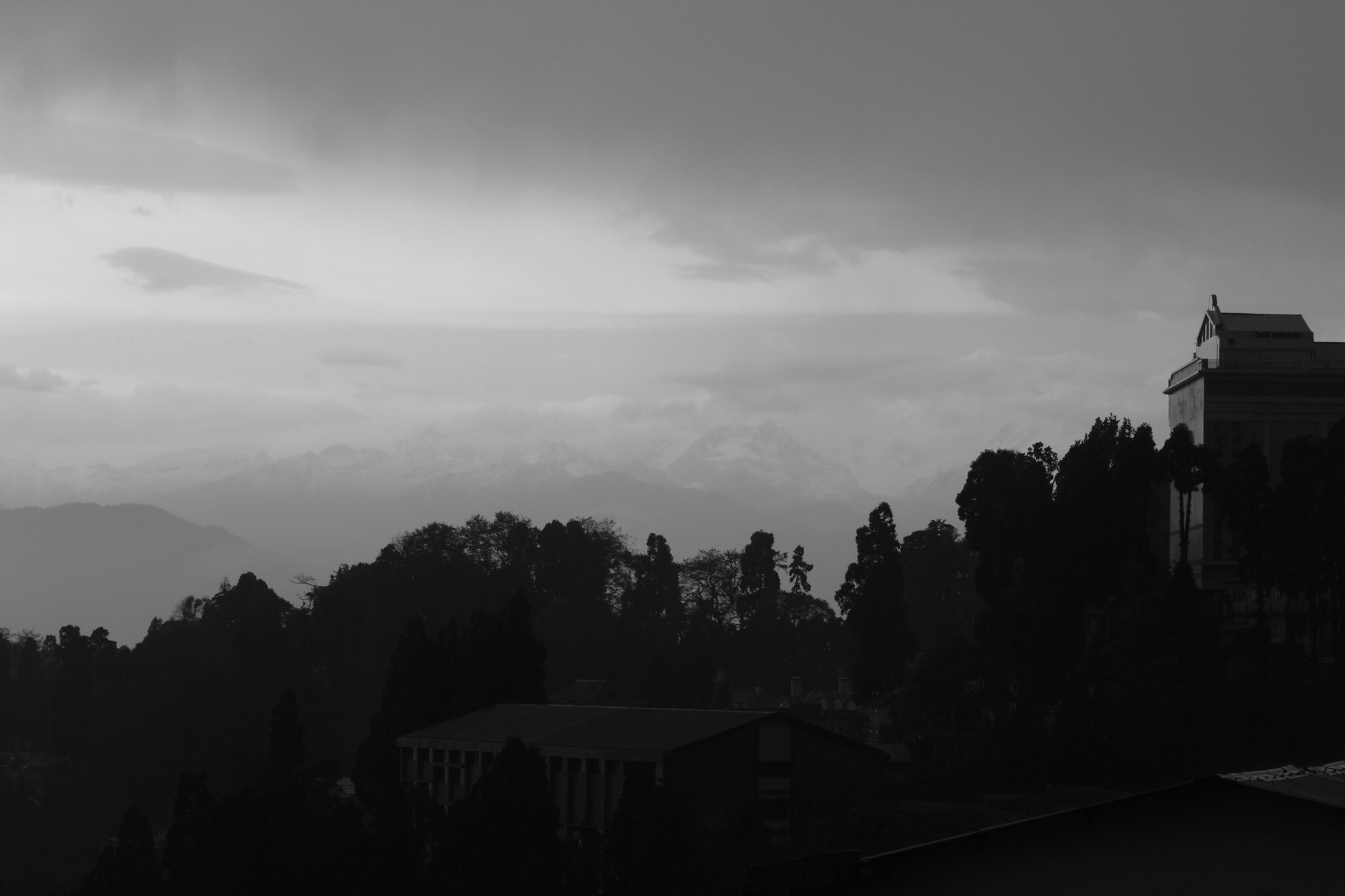
Having come to Darjeeling in part to see its views of the Himalayas, I felt frustrated when the horizon proved to be continually covered in cloud. Only in the late afternoon of my first full day did I manage to catch a glimpse of the mountains; when heavy rain cleared the mist and fog from the sky. The break in the clouds was brief, however, and by the time I reached a decent vantage point, the view had vanished.

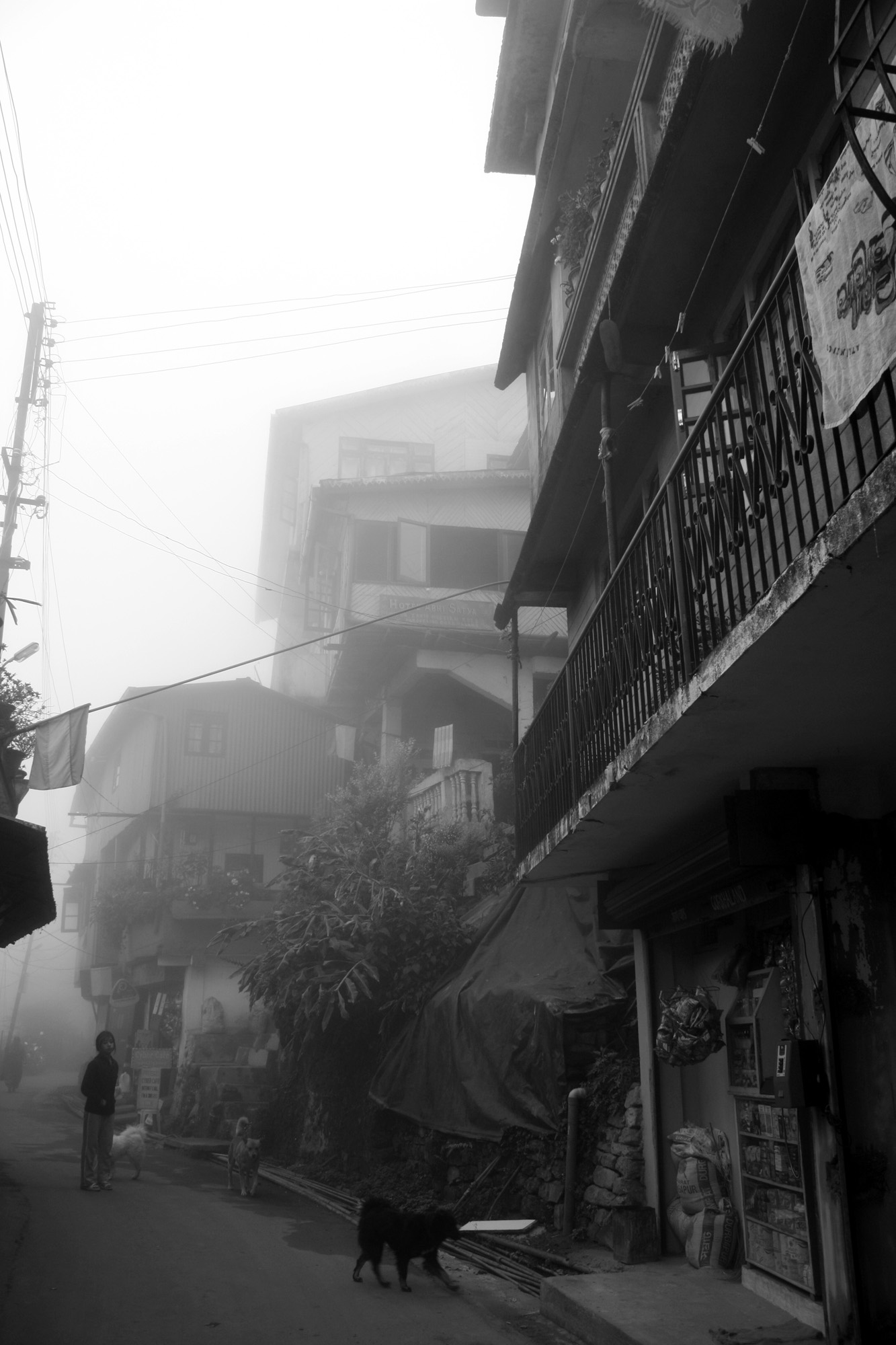
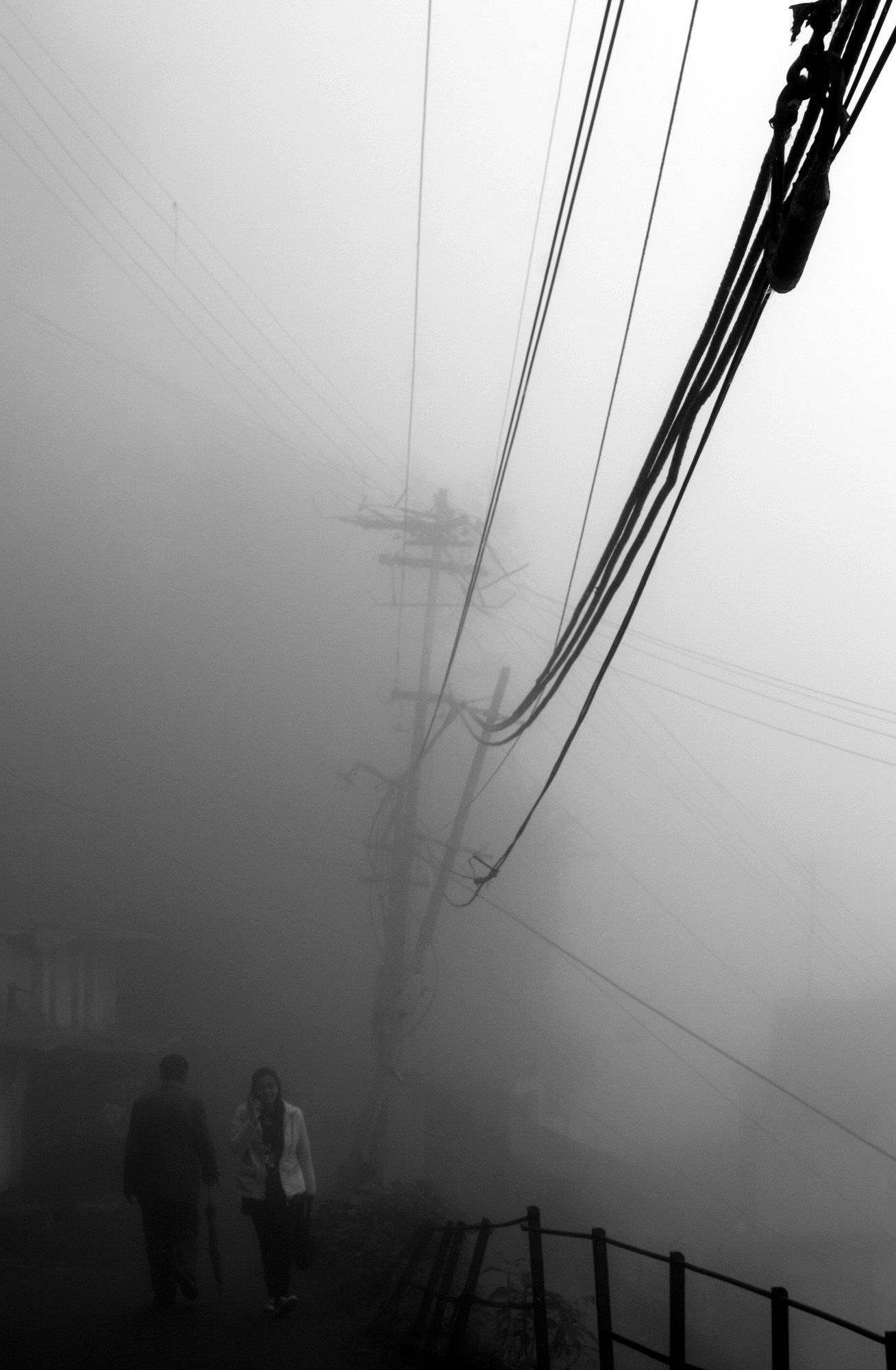
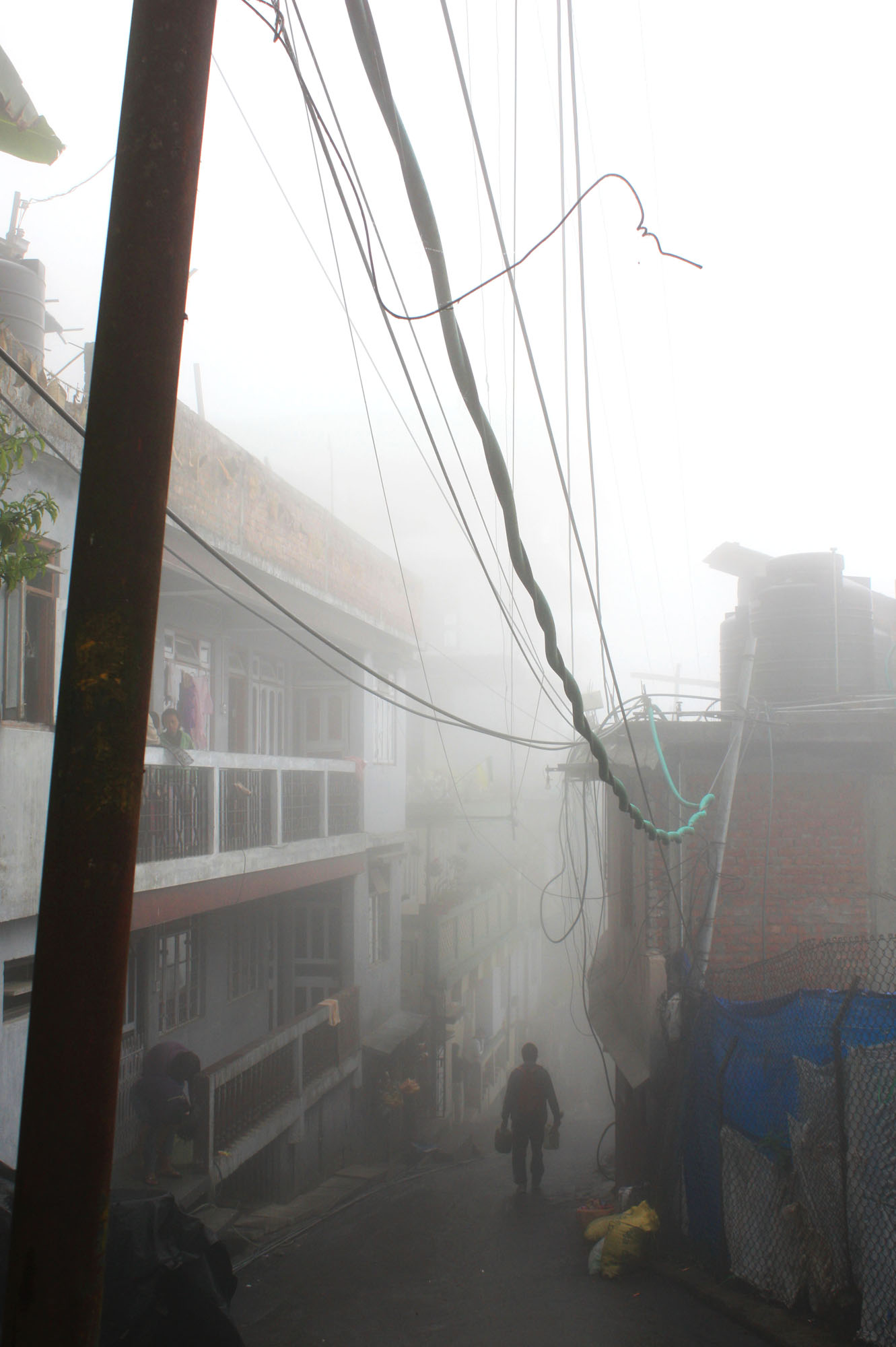
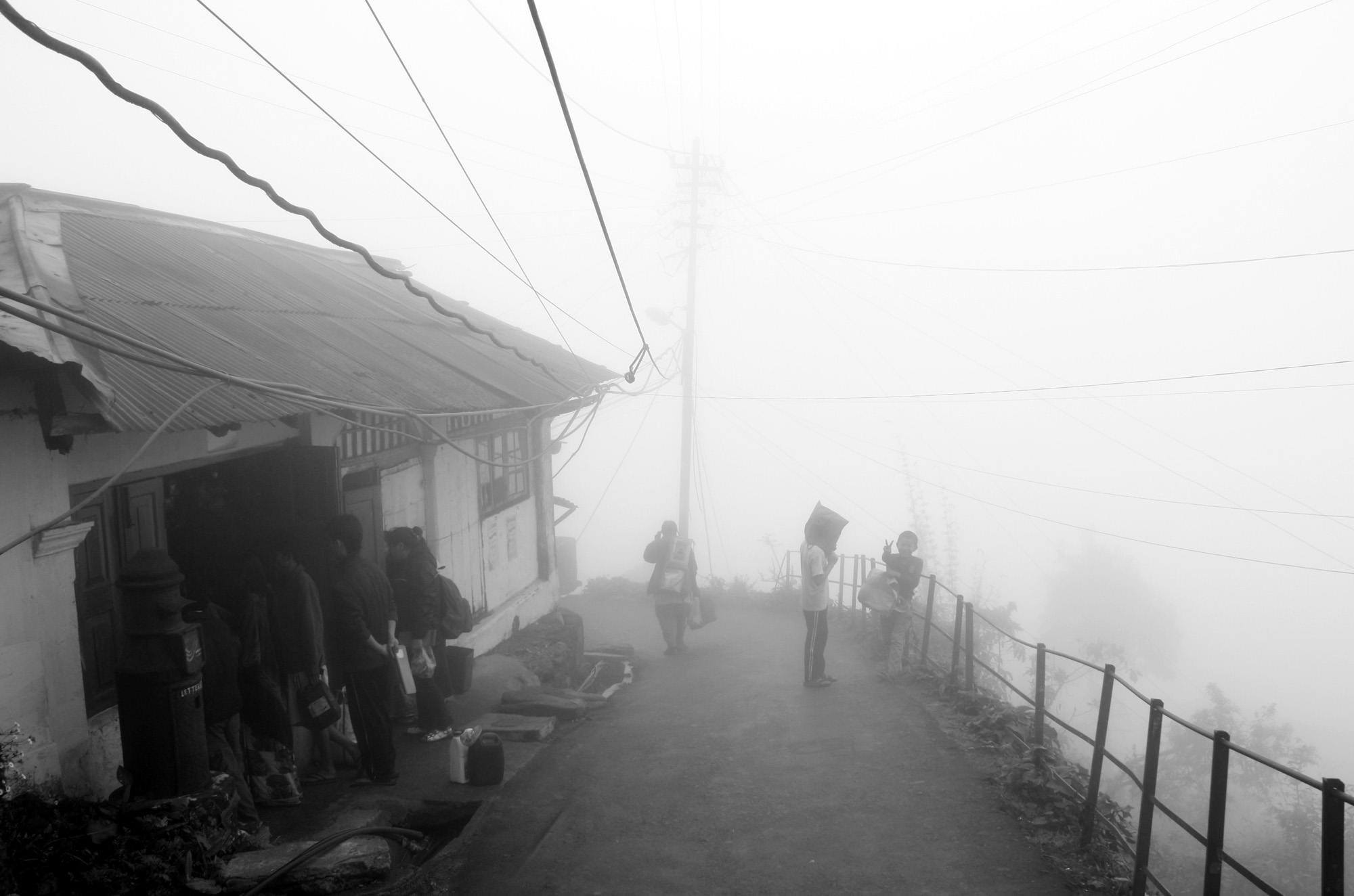
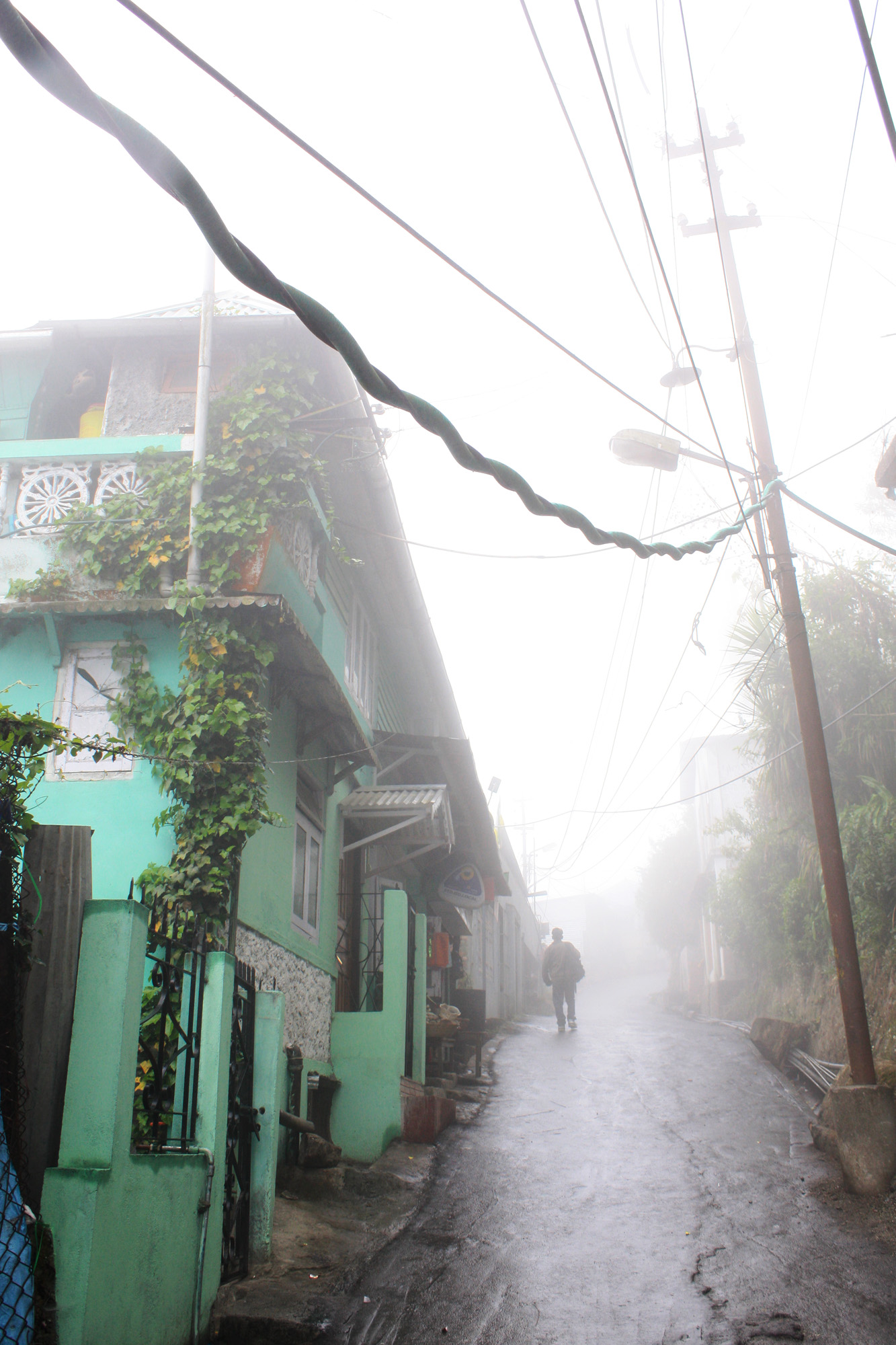
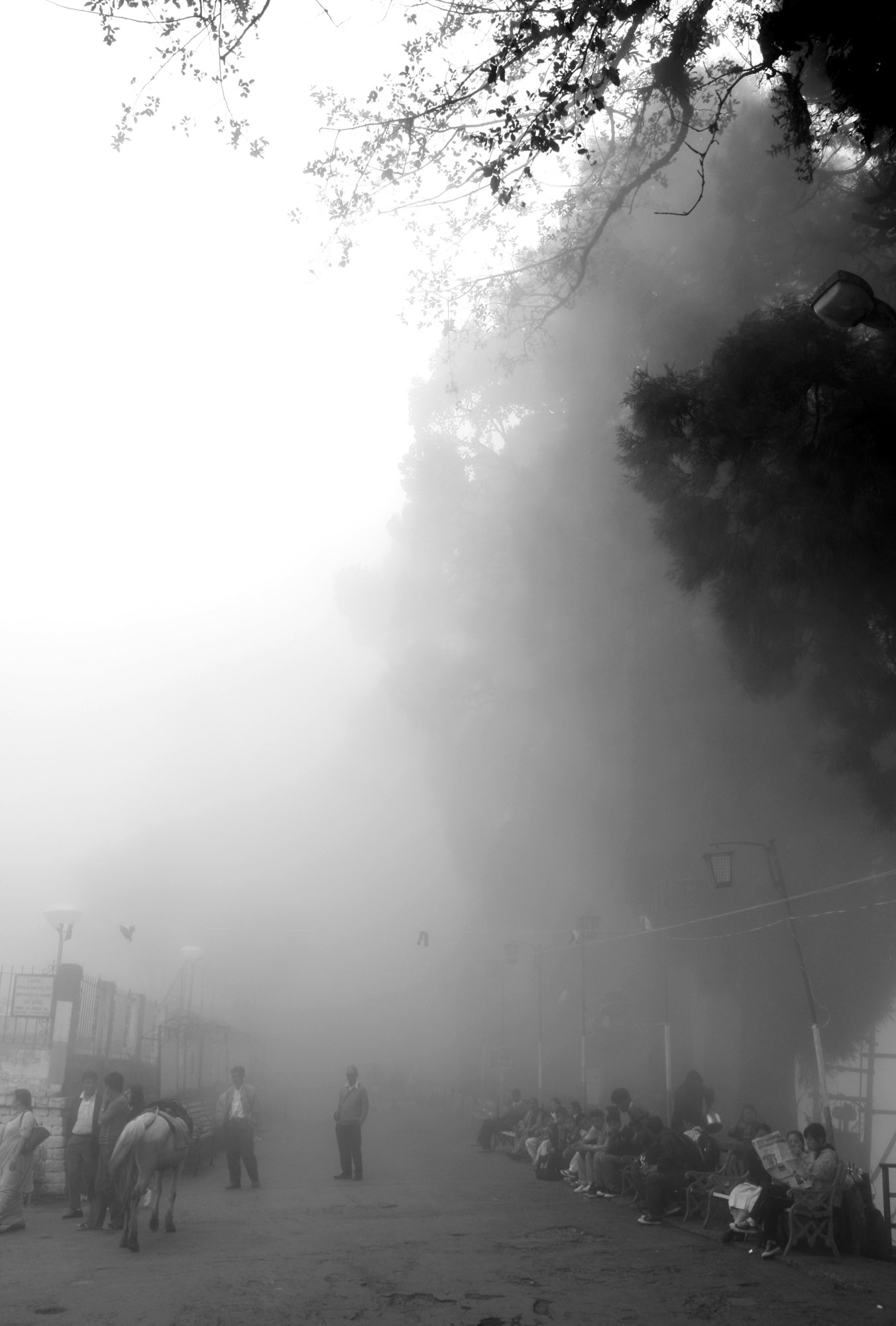
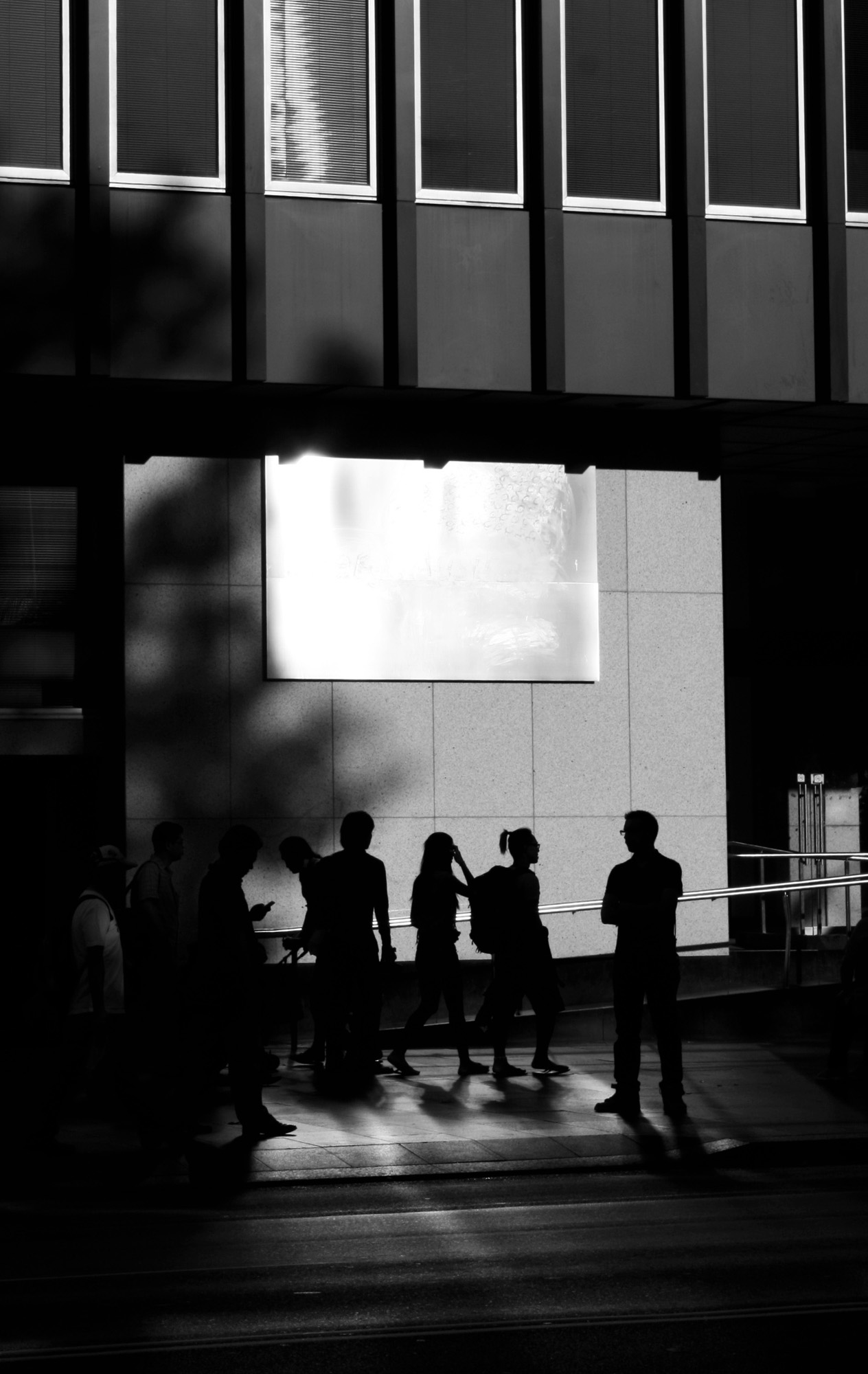
This was, by no means cause for despair. For, by way of beautiful compensation, the following two days had seen the town entirely shrouded in heavy fog. The beauty and wonder of it were ample entertainment and I could probably have continued to photograph the silhouettes and shadows without ever getting bored. Indeed, the fog proved so beautiful and entrancing that I almost forgot about the mountains altogether. Almost.

I have always had a great love of mountains and snow, possibly because of Australia’s relative lack of them. There are the Snowy Mountains in southern New South Wales, with a roughly eighty to one-hundred day ski season. Yet the highest mountain, Mt Kosciuszko, is a mere 2228 metres, and lacks the drama of other, more elevated peaks. There is, of course, the Great Dividing Range, a vast line of mountains stretching for roughly 3500 kilometres down the east coast of Australia, making it the third longest mountain range in the world. Yet, the Great Dividing Range formed some three hundred million years ago during the Carboniferous period and has suffered significant erosion since. These are very old mountains on the planet’s oldest and flattest continent.

If Australians want to see high mountains and better skiing, they traditionally duck across the Tasman to New Zealand. Still, despite the significantly more impressive peaks of New Zealand and their year-round snow-caps and glaciers, the highest mountain, Mt Cook, or Aoraki, is only 3754 metres tall. If New Zealand does not suffice, then Japan, Canada, or the European Alps are the likely choice for skiing, with The Andes, Rockies and, of course, the Himalayas, also featuring prominently on the mountaineering circuit. For most Australians, therefore, snow and high mountains are exotic – and elsewhere. For some, no doubt, they have little appeal against the perhaps more obvious attractions of paradisiacal beaches, yet for me, who was never especially fond of the hot climate, high, snow-capped mountains are the ultimate dream. They are impressive not merely for their staggering reality, yet also for their fantastical implications; being so long evoked throughout my role-playing childhood as the home of dragons, frost giants and hard, uncompromising barbarian folk. Just looking at mountains is enough for me, and I could likely do it all day without ever getting tired.

So, despite the great beauty of the fog, I was dying to see Mt. Kangchenjunga, which, at roughly 8500 metres high, is more than six kilometres higher than Mt Kosciuszko. This very thought – eight and a half kilometres, up into the sky! – was enough to give me goose bumps, and the brief glimpse I had caught of it had confirmed for me that it looked uncannily tall against the Earth. Determined to see the mountain properly, on the evening of day three, after another gorgeous day in the enveloping fog, I decided to stay in Darjeeling until I had done so. If it took a week, then so be it. But one day surely, perhaps just one morning, the horizon would be clear and the full glory of the snow-capped peaks revealed.

On my fourth morning in Darjeeling, therefore, I rose at 0500 AM and parted the curtains. It was still very dark outside, yet the sky had lightened just enough to see that it was clear. The dim stars overhead faded towards the horizon, from which the day was beginning to spread. The mist that had cloaked the town for the last few days had lifted, and whilst it was still too dark to make out the line of mountains in the distance, I felt confident that I should get lucky on this occasion. I ran to the shower, washed up and dressed, then set off with my kit into the cold morning.

Darjeeling was quieter than ever at this time of day, but once I neared Chowrasta, the main square at the top of the town, there were signs of activity along the street. Shop doors stood open with the owners sweeping their floors; on the wooden stalls hugging the road, vendors were already laying out their wares: fruit, vegetables, poultry and the like. On the edge of Chowrasta, in their ramshackle tarpaulined shelter, the tea-wallahs I’d become so fond of the day before were setting up. I checked my watch – it was still only five-thirty. How hard these people must work, for they continued serving until almost ten at night! Opposite them, the concrete stables were, for once, full of horses. Several of the handlers dozed on the steps, and I wondered if they were stoned already.

Being, shall we say, rather naughty, I had, just two days before, purchased a bag of marijuana from these so-called Pony Boys, who provided joyrides around Chowrasta, and along the road that ringed Observatory Hill. The night before I had prepared a couple of joints in hopeful anticipation of a clear morning, or as a form of consolation should things prove otherwise, and it was with one of these tucked behind my ear that I crossed the square and set off down the road beside the hill.

I expected it to be very quiet and largely free of people, yet, walking around Observatory Hill on its eastern side, I was astonished by the number of people exercising. Many of the locals were out running already; men and women of all ages. I passed a lot of joggers and groups of people doing stretches and aerobic exercises against the metal railings. Despite having been a keen runner for many years, even when I’m in an early-rising phase, I’ve never been able to exercise this early in the morning and have long been jealous of people who woke up feeling so energetic. The people were all very friendly, both to me and to each other, and I was surprised by how many used English greetings amongst themselves: “Hello” and “Good morning.”

When I rounded the corner to the northern side of the hill and saw the horizon, I felt a sudden slump in my hopeful mood. The sun had not yet risen, though now the sky was light and clear, but the mountains were dressed in cloud and remained invisible in the distance. In their place were great stacks of cumulus of varying heights. I imagined the shape of the cloud might somehow reflect the size of the mountains underneath, yet without any real sense of scale or proportion at such a distance, I might have been horribly wrong. Either way, the mountains were not to be seen.

I did not want to give up hope just yet, for in truth I knew very little about the meteorological conditions and reasoned that perhaps the sun might rise and burn away the cloud. There was obviously less moisture in the air today, which felt much more dry and crisp. It had a mild sting in it, as cold, clean air will do, and this gave me further hope that the day would not be so humid and thus less foggy.

Unable to see the mountains, I continued walking and focussed on photographing the valley below and the locals performing their exercises. When I reached a lookout I had discovered a couple of days earlier, I stopped, deciding this would be the best vantage point should conditions prove favourable. It was a shelter of cast-iron, with a corrugated sheet-iron roof, under which sat long, old-fashioned park benches. One of these bore the inscription Darjeeling Health and Fitness Club (I think), and it was a very popular place to congregate for early morning exercise. Around the shelter and benches, before a steep, wooded descent into the valley below with its rounded slopes of tea, were roughly twenty men and women performing stretches, jumps and running on the spot. To the side of them stood a Buddhist monk with a large, round, hand-held drum, like an outsize tambourine. He was humming and banging on the drum, facing the east where the sky was ever lightening, singing in the dawn, I can only imagine.

I figured there was likely another twenty-odd minutes before the sun actually rose, so I walked to the back of the road, where Observatory Hill rose steeply, and began to climb a steep watercourse. Before long I was thirty metres up above the people below, with an excellent view to the hidden mountains on the horizon. I took the joint from behind my ear and, feeling ever the fugitive, crouched behind a shrub to smoke.

I was soon joined by a friendly dog; a healthy and clean stray who was scavenging for food in the trees on the hill. She nuzzled in and sat down beside me, deciding we were to be friends. I patted the dog just a couple of times, not wishing to encourage her too much for fear of having her sit outside the hotel for the rest of my stay. It was difficult not to show more affection to this attractive, light-brown bitsa. I hadn’t had much in the way of company for some time, and as the marijuana put me once again into very high spirits, I wanted nothing more than to play and wrestle with this lovely dog, then buy the poor thing a great feast and give it a bath.

The sun, however, was rising and I needed to focus my attention on getting the shots. I took some from where I sat; switching lenses repeatedly for a wider or longer focus, then descended back to the road. The dog followed me down, but had the decency not to hang off me. She skirted the exercisers nervously, wondering which way to turn.

The monk’s drumming and droning was all the more intense now in my heightened state, and I felt completely in the zone for shooting, targeting people and scenery alike. Just above the layers of cloud in the distance, long, bright rays of sun were spreading in triangular fans. The cotton wool, popcorn clouds, beautiful in themselves, were rimmed with a fiery gold that burned in the back of eye. Below, on the slopes and in the valley, the tin and iron-roofed houses nestled in a light mist that blew like puffs of smoke. Where the hills spread out in lower undulations, the rich green of the orderly tea plantations was washed with drifting coils of mist.

The monk continued his slow beat and droning, and I, taking refuge behind my sunglasses, watched from a short distance, shooting video. I wanted more stability for the long-range focus and, not having brought my tripod this morning, I soon moved to one of the benches, alongside the shelter, and rested my camera on the rail in front. On either side the locals continued their exercises; huffing and breathing loudly, but otherwise, doing their routine without a word. The valley below made a pleasant subject for study, and I spied on the activity of tiny distant people and dogs, drifting through the light cloud that brushed the tree tops. I could hear the happy singing of children from a school a couple of hundred metres down the slope; a dawn chorus of upbeat, unbroken voices, both energetic and joyous. What time did school begin here? Such happy singing seemed a very positive way to start the day.

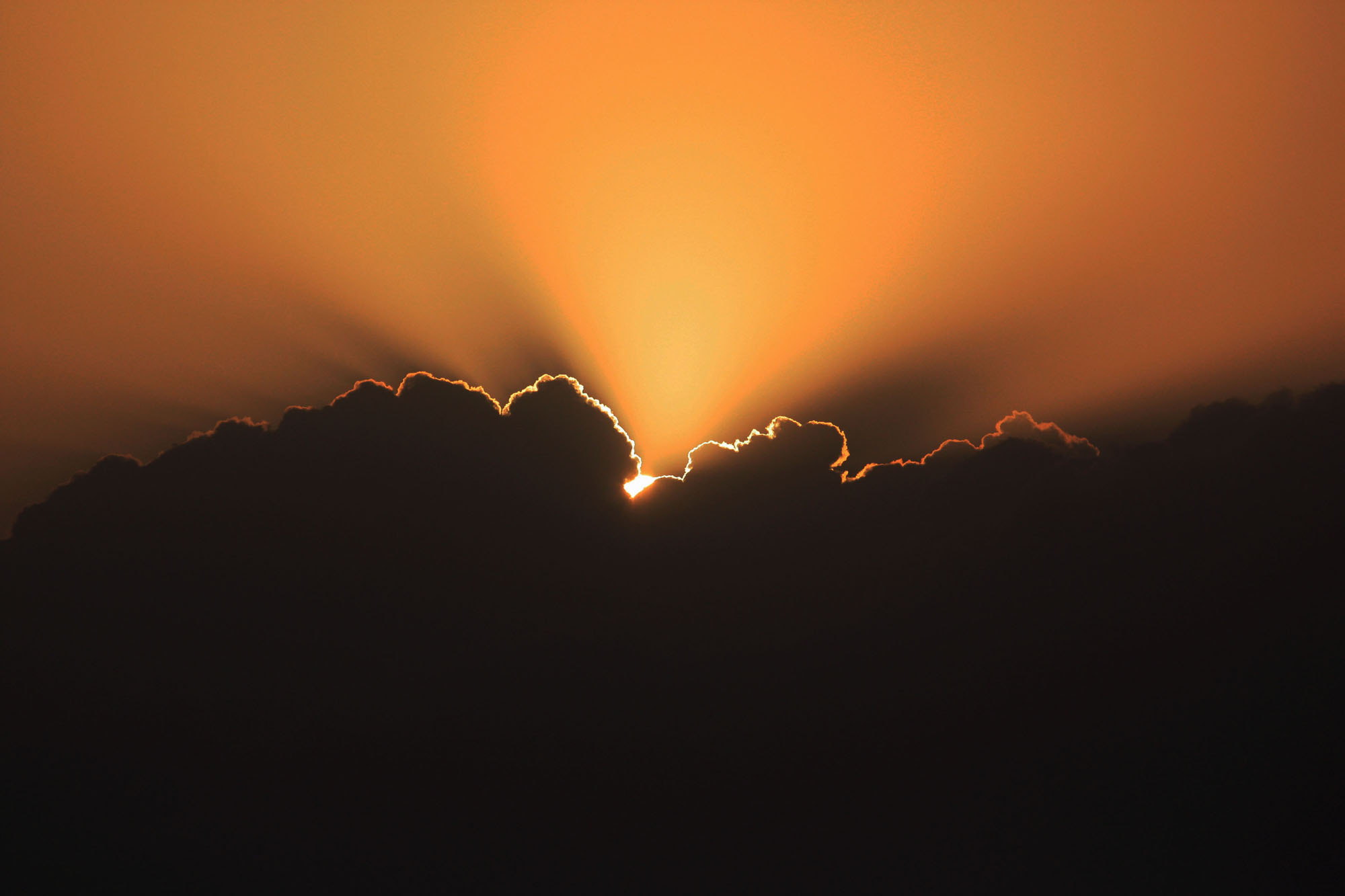
When, at around 0630, the sun climbed atop the rounded crenulations of cloud, there was a splendid murmur of excitement. The lens flared with the light that shot in clear beams from the small orange arc of sun. The sun rose rapidly and the light fanned quickly across the hills and valleys below. The tree-tops lightened, the fog shone white, and the locals doing their exercises seemed to find an extra spring in their step. It was a powerful and uplifting vision, without a hint of anticlimax and, though I longed to see the mountains, I was happy indeed with this burst of sunlight.

I sat and stood and sat again, photographing the scenes around me in the growing brightness. I continued to hope that as the sun grew higher and hotter, it might burn away the cloud below and reveal the snow-capped peaks of the mountains. Was this the beginning of a dry, warm, clear day in Darjeeling? Was I about to be treated to that mountain view at long last?

It was now that I noticed a change in the valley below. The mist that had, until recently, been sparse and thin, began rapidly to thicken. In the warming sunlight, the abundant moisture was evaporating and gathering into pockets of cloud above the vegetation. Slowly the iron rooves and tea plantations became more difficult to see as these blooms of mist spread and floated until, after about ten minutes, with the sun now well clear of the clouds on the horizon, the scene below was almost entirely shrouded.

This gathering cloud now sent up a long, thin coil of white mist. It rose in a tall column that stretched up high above the tallest trees near where I sat watching. This column of rising moisture began to widen, fattening until it grew dark and dense, like a pillar of thundercloud. At the top of the column the mist very abruptly spread sideways, like a flat mushroom cloud, colonising the sky with fog.

Once this process was underway, the speed with which it continued was astonishing. The sun, it seemed, rather than burning off the cloud, was having quite the opposite effect; vaporising all the moisture in the valley and lifting it into the air. From a meteorological perspective, it was absolutely fascinating. The spreading cloud soon covered the sky immediately above, blocking all direct sunlight. The treetops began to dim, the golden wash turned silver then grey as the hills and valley below vanished completely from view.

Soon the entire sky, as far as I could see, was covered in haze and cloud. Great waves of fog rolled up the slopes and onto the heights where I sat, brushing my skin with cool moisture. By the time the clock struck seven, the fog had smothered everything. I could see no more than twenty metres.

This marvellous meteorological event was too exciting to allow for disappointment. So much for the mountains – I was perfectly content to spend another day in thick fog and try again the following morning. I took another joint from my packet and wandered back along the road I had followed to the look-out.

Silhouettes appeared against the wan backlight, and the trees, now full of enticing shadows through the filter of fog, seemed especially fecund with their newly wetted leaves. I smoked took photos, looking back towards the “Darjeeling Fitness Club” where several locals were still doing exercises. Their shapes made excellent subjects and I kept the camera trained on them for some time.

I drifted back into Chowrasta, towards the chai place on the edge of the square which I had adopted as my own over the last couple of days. The man and two women were all there, and the place was fully operational. I ordered tea and a chilli egg bun and sat down on the bench to watch them at work. It was sad how much I loved what they did, yet could not possibly love their life. To work such long hours and to be so constantly busy was not something to which I could relate. It was hardly a new sensation, this wonder at the workers of the world who slog it out all day. Yet, sitting so close to this dynamic trio, who gave me such pleasure with their excellent tea and lovely, simple food, I felt a passionate hope that they should find enough time to be happy outside of work. At least they were their own bosses, and perhaps this was the life they chose, but it didn’t exactly look easy. I stayed there almost an hour, and drank three cups of the best tea in the world.

Over the next five days, I repeated that morning almost exactly. I rose just before five AM, showered, dressed and set off towards the same look-out. There was, at Ghoom, the highest railway station of the Darjeeling Himalayan Railway, a very famous and better situated lookout called Tiger Hill, to which many people ventured in the morning to see the mountains. This, however, was equally contingent on the sky or horizon being clear and, without such conditions, it seemed pointless for me to take one of the many early morning jeeps there.

Every morning over the next five days, I carried the same hope around Observatory Hill: that today would be different; that the sky would clear completely for a spectacular view. Sadly, however, on every single occasion, the entire horizon was covered in fog.

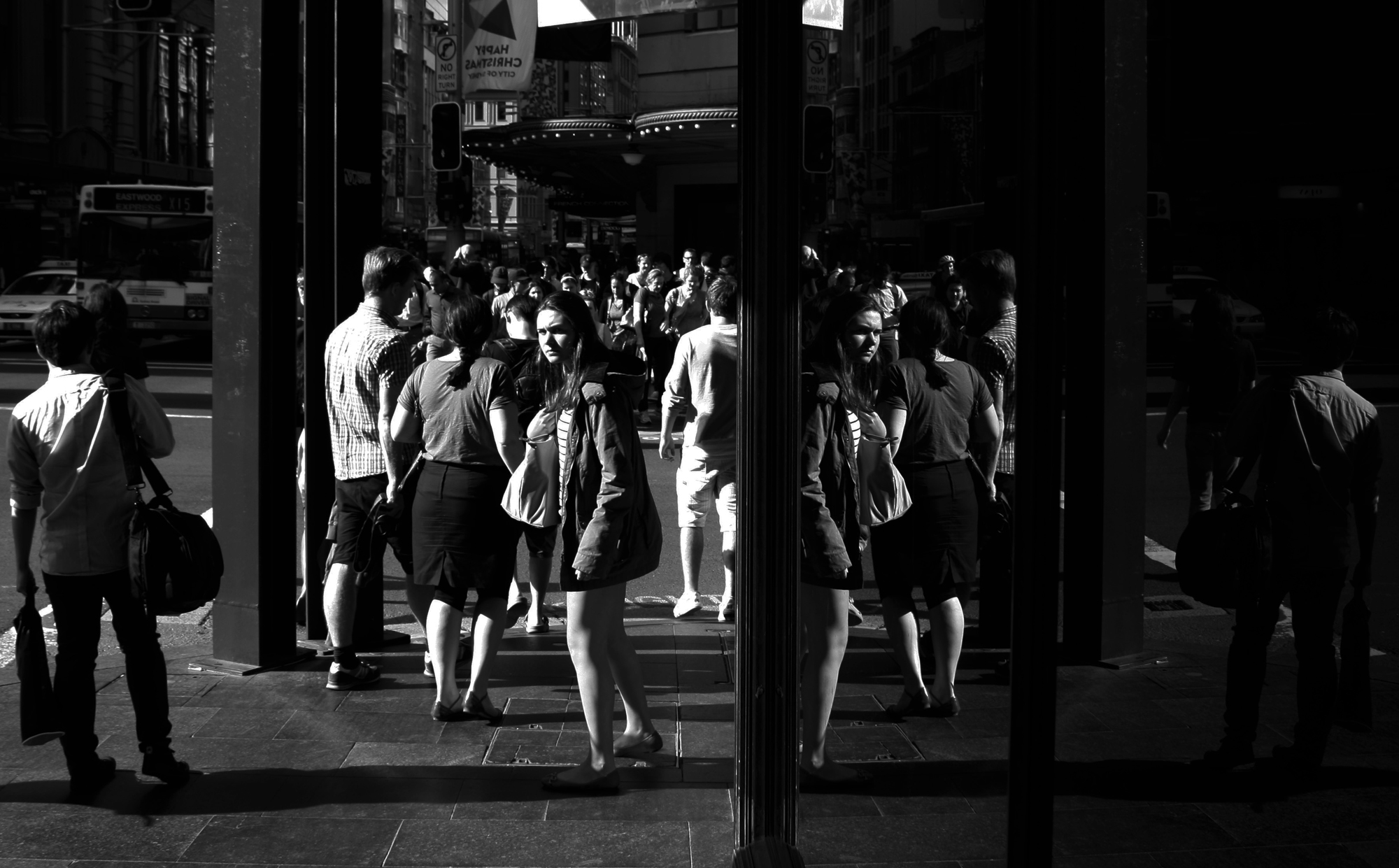
In the later mornings and afternoons, with never a sign of the distant cloud lifting, I wandered around town, photographing the workers, shops and the closer views.

I spent some time up on top of Observatory Hill, stoned, lost in thought, watching the colourful flags of the Buddhist monastery flap in the persistent breeze.

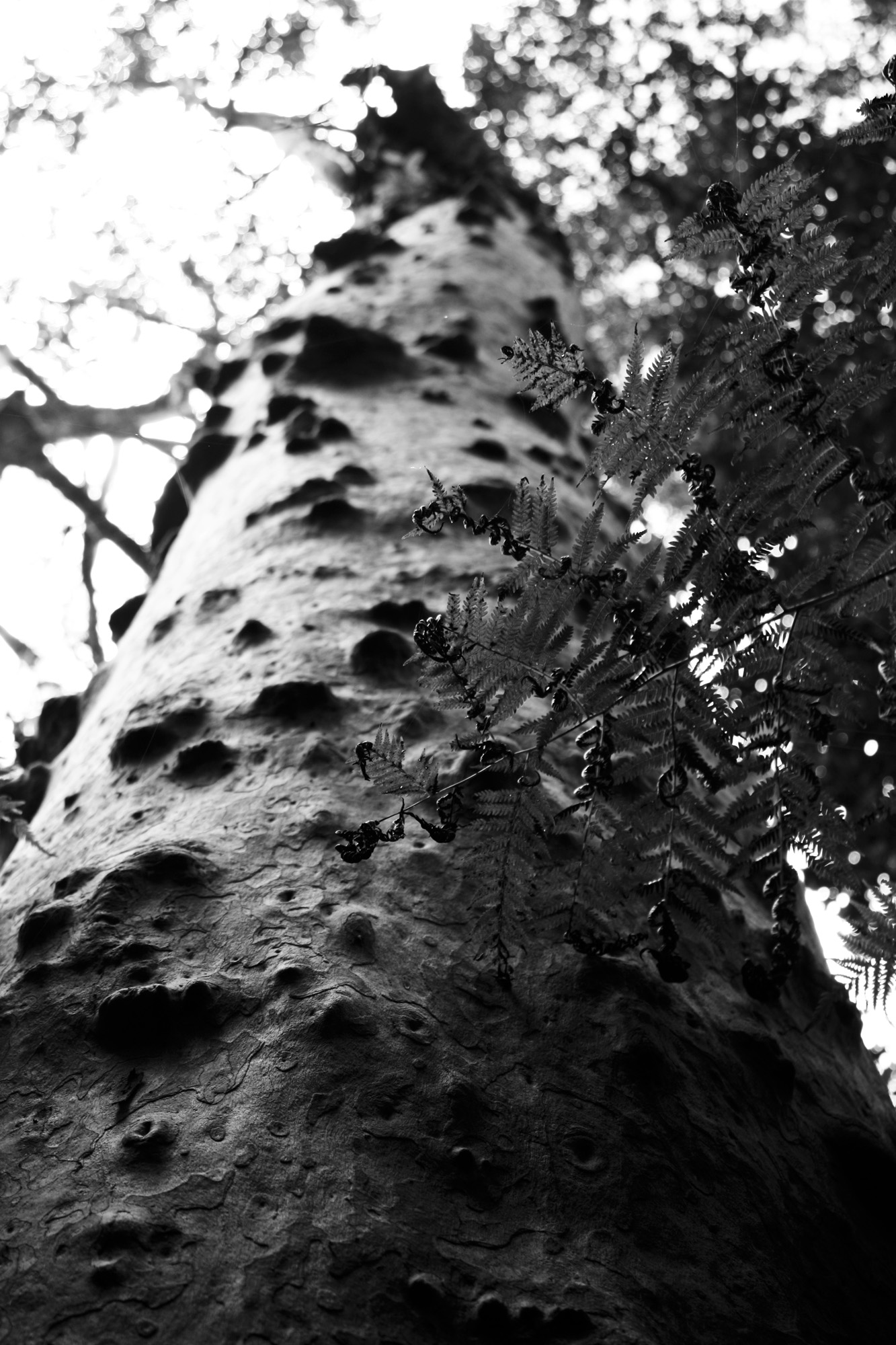
I spent hours sitting with the monkeys at the back of the monastery, watching their antics, squabbles, grooming and occasional surliness. Some days I wandered quite a way out of town, floating along the curving roads through the smaller, surrounding villages. I walked up into the forest and sat amongst the trees; smoking, reading, dozing, lying, thinking, thinking, thinking.

I saw a man with a prize pig, a most flamboyantly feathered chicken, women breaking rocks for a roadway.

I walked all day, looking for photographs and vignettes. I followed the railway out of town into some of its slightly grubbier quarters.

A small, quiet man showed me around another monastery. He told me its quaint, unassuming history, then a story of the school they hoped to build if only they had the money. I made my donation on cue, then left, feeling disappointed with both him and me.

Every breakfast lunch and dinner was spent at my favourite chai wallahs. I never learned their names, and we hardly ever shared a word, but we had an unspoken friendship that lived in our genuine smiles. I was certainly curious about their lives, but, knowing how much I value my own privacy, I did not want to pester them with a bunch of personal and anthropological questions. I figured that if I just kept ordering tea and food, and they kept making it so well and serving me in so friendly a manner, then we already had a strong enough relationship.

When, on my ninth morning in Darjeeling, the horizon was once again covered in cloud, I gave up all hope of seeing Kangchenjunga. Two days before, I had booked my ticket – from Siliguri to Delhi – and I wasn’t about to miss my flight. I sat and watched the mist rise from the valley once more, then walked back to Chowrasta for a final breakfast.

On the way there, I passed the very Pony Boy from whom I had bought a bag of marijuana almost a week earlier. He was standing holding the reins of his horse, grinning enough to show his blackened teeth. He recognised me and said:

“Are you going riding again today, sir?”

“No. Thankyou!”

I laughed and smiled at his conceit. How sad and happy this little encounter made me feel. When I sat down on the bench and ordered tea a few moments later, I felt a choking thickness in my throat. How could I leave Darjeeling, having become so used to the place, and with my mission still unaccomplished? Did I not feel as though I were stagnating, perhaps even on the brink of a sort of dissipation, I might well have stayed on.

I knew that there could be only one cure for this growing burden of loss: to get back on the road and find new places and people. From Delhi I was flying on to Amritsar, right across India in a day, and after that, it was anyone’s guess. That morning, sitting there for the last time, I drank four cups of tea and made a new plan. From Amritsar, I would head north up into the mountains of Himachal Pradesh and see the Himalayas around McLeod Ganj and Manali. If the road was open and I could make it all the way to Leh, then so be it.

As many attractions as India might hold, the need for mountains was in my blood, and anyway, I preferred the cooler climate of higher altitudes. My mission in Darjeeling was indeed as yet unaccomplished, but if I couldn’t see the mountains here, then I would travel until I saw them somewhere. I had at least another month up my sleeve, and nothing, whatsoever, was calling me home.

Dirk watched the foam churning round the propellers. It washed to and fro from the wharf. He watched the people milling on the docks; smoking and waving. There were no familiar faces. He toyed with a cigarette before lighting it. The ferry bobbed in its turbulence, roaring and vibrating. Then the ropes came in and they were off; away from Samothraki.

Dirk stayed on the rear of the upper deck to watch the island shrink. It soon fit within his field of vision, fading to a ghost in the late haze. He stayed and watched as it sank beneath the curve of the earth. Then it was gone altogether and he had only the dust on his sandals and dirt beneath his nails. He shivered. The breeze was beginning to go through him.

The sun set and it grew colder still. Dirk wandered outside along the decks, before heading into the cafeteria. It was full of people, standing and sitting, craning to watch a big screen. He looked around for any pretty girls. There were too many men. The film Gladiator was showing; English with Greek subtitles. The name Maximus appeared at the bottom of the screen. Μαξιμος. It looked like the parallel translations he often read in ancient works. It seemed somehow more authentic. The Roman army was gearing up for war. “On my command, unleash hell.” Dirk smiled. The accent was familiar. He too was Australian.

Dirk went for a walk. He needed to find somewhere to sleep for the night. Deck class was no misnomer. He’d been out there in a storm before, out with the banshee wails and the rain devils. The evening was clear. He had a sleeping bag. He bought a toasted cheese sandwich and a carton of milk, then went back out on the deck.

Dirk poked around until he saw a space under a lifeboat. It was out of the way; no one would disturb him. He unfurled his sleeping bag, unzipping it from end to end. He laid the sleeping bag under the boat and slipped himself onto it. There was only two feet of space beneath the boat, but it was shelter and seclusion. He got in and pulled the sleeping bag together, zipping it up halfway. He lay staring up at the base of the boat, thinking about the last five days on Samothraki. He weighed up the mix of loss and relief. It was a good basis for a sort of happiness; fulfilment and expectation, the end and the beginning, though it wasn’t exactly happiness. He soon fell asleep.

_______________________________________________


Dirk woke up at three thirty. He wasn’t sure if he’d slept, but could not account for the hours. He was still tired; warm and tired. The breeze was thin and chill and he did not want to get up. Getting up would be like being born all over again. People walked past him on the deck, talking loudly. He leaned out from under the lifeboat to see what was happening. Across the deck towards the prow were the lights of the shore, of a harbour, a mere hundred metres away.

“Lavrio,” he said. “It must be Lavrio.”

Dirk lay back down and stretched and yawned. The deep horn of the vessel sounded right through his body. He smiled and rubbed his face then ran his hands through his hair. He recalled how one cold morning before a camping trip he and his brother and his friend Gus had lain in their beds, reluctant to get out from under the covers. Then, of a sudden, his brother had hurled back the blankets and leapt out of bed, defying the cold. Dirk tightened himself, unzipping the bag. He too could call on that same spirit. It was just like diving into the surf first time in summer.

He washed up in the bathroom, working cold water into his eyes. He took off his shirt and rubbed himself down with the damp corner of his towel, getting the stickiness out of his shoulders and off his forearms; the dried sweat, the clamminess of sea salt. Dirk slicked his hair back and cleaned behind his ears. He felt proud of his efficiency. He thought of himself as a seasoned traveller.

_______________________________________________


Dirk stepped slowly down the gangway. He was in no hurry. The sun would not be up for another three hours and, the longer things took, the better. He walked along the concrete wharf and stopped in the wide car park. It was full of cars with their lights on, waiting for friends and relatives.

Dirk was glad to be walking. He watched people standing around and getting into cars. He looked closely, counting the passengers, but no one had a spare space. While he was sleeping, others had made their advances. He was uncertain. Despite the freshening up and the cool air, he still felt trapped in the timidity of tiredness. It was a while since he’d spoken and he did not trust the sound of his voice. On Samothraki he had asked some Greeks if he could puff on their joint and they had told him no. It was the first time it had ever happened to him. In every other way, Greek hospitality had been unparalleled, yet since then he had had second thoughts about asking for anything.

Still he hung around. Maybe some cute girl would take pity on him. He might get to lie on a couch for two hours, then take the metro to Piraeus. He might even get a blow-job! He might fall in love. He laughed. He waited and watched until there were only a few left. No girls approached him. No one approached him. He recognised one couple from the ferry. The young man was noticeably tall, almost six and a half feet. He looked awkward, but friendly. Dirk could not hear their voices but he was sure they must be English speakers. He could see it in their mouths. He watched them as they drifted on the edge of the docks, near the roadway. They too must have no rides.

Dirk stayed a while more. He no longer knew what he was waiting for. He guessed that there must be no buses until later in the morning, but he felt a creeping stubbornness. He was determined to be the last to leave. That way he would know he had not missed any opportunity.

_______________________________________________


At four-thirty Dirk walked over to the road. The couple he had spotted earlier were there, sitting on one of the barriers. He nodded to them and they nodded back. They avoided eye-contact. He looked down the length of the road. Some of the last few passengers from the ferry were still walking away from the docks. They were moving slowly, as though resigned. He wondered if they really knew where they were going.

The couple were sitting and talking just out of earshot. Dirk was sure they were waiting to get into Athens just like him. He watched them out of the corner of his eye, then looked back up the road at the other disappearing passengers. He knew he should go and talk to the couple. It was easier not to have to do things by yourself. Some things, that is. It took courage to ask questions in a foreign country and if he teamed up with others, they would have the courage of numbers. Then they could laugh when their words fell on deaf ears; they could joke instead of curse in the face of intransigence. He looked back along the street at the last of the passengers. Athens seemed a long way off. He shrugged and set off after them.

_______________________________________________


After checking the timetable, Dirk walked to the middle of the square. He had an hour to kill before the first bus. It was cold and he was tired. The lights were filtered by the feathery branches of the trees. The remaining passengers were resting around the periphery; sitting and lying on benches. Dirk did the circuit, keeping his distance from anyone. He felt shy. He felt reluctant. He did not want to impose.

The square spilled into a pedestrian mall. There were more benches along its length. Dirk put down his pack and took off his fleece. He put on another tee shirt then replaced his top. He stretched out with the sleeping bag for a pillow and set the alarm on his mobile phone. He placed his beach towel over himself like a blanket, then hooked his arm through the strap of his bag. There were two other guys with backpacks only fifteen feet away. Safety in numbers. He had never considered other travellers a threat. Same species.

Dirk closed his eyes for a while. The light was too bright, but he did not want to cover his face. He preferred to appear more alert. He heard footsteps in front of him and opened his eyes. The couple he had seen by the road were walking past. They moved on to the next bench and sat down. Dirk watched them. They were watching him. He smiled at them and they smiled back. No one spoke.

_______________________________________________


Dirk was awake when his alarm went off. It was five thirty. The bus was at a quarter to six. He switched off the alarm and looked across the square. There were people standing down at the bus stop but no sign of the bus. Dirk pulled his smokes out of his bag and stuck one in his mouth. He felt in the pocket of his jeans for his lighter then decided he wanted to use a match. He got the matches from his bag, took one out and, leaning up on one elbow, stabbed the match against the rough. He smelled of dog. He smelled of a campfire. He liked who he was and what he was doing. He felt cool lighting his cigarette this way. He was an adventurer. He was beat. He lay back and smoked up the early purple light.

The couple from the next bench walked past him. The young man was speaking loudly. He was speaking English with a South African accent. Dirk smiled. He’d just spent five days with a bunch of South Africans. Couldn’t he bump into someone else for once? Perhaps they were Zimbos. Dirk took a drink from his water bottle and stood up. He gathered himself quickly and picked up his pack. He felt a compulsion to hurry after them.

At the bus stop Dirk put his back against a tree. He stood with his knees locked, tilting like a buttress. He watched the twenty-odd people there a while, then closed his eyes and chewed his cheeks. He was worrying now about making it to Piraeus in time. He knew it was a long ride, but he didn’t know just how long. There was also the metro to take. He couldn’t afford to miss the ferry, if there even was one.

The bus was right on time. Dirk let the others get on first then paid his fare and walked down the aisle towards the back. The South African couple were also sitting towards the rear. He passed them on the way down and nodded. They both smiled at him and he smiled back. Dirk tore his eyes away quickly, settling them on where he was going. He had a practical excuse, but he wondered why he was such a nervous character at times. He missed having comrades on the road.

_______________________________________________


It was a dirty dawn through the unwashed bus windows; pale grey sky above pale blue smog, backlit by seeping orange. Dirk had his head against the window, enjoying the little bangs and bumps of the road. He thought of the buses in Sydney, how they rattled when they were idle. There he liked to press his head as hard against the perspex as possible, giving his teeth a good shake-up.

Dirk felt tired and oily. He wanted a hot shower and a sleep. An orange, an apple, a banana and a bottle of Coke. He watched the couple in the seat in front. They spoke quietly and he only heard one word in three. Nothing made sense. They were talking about relatives. After forty minutes, the tall man leaned across the aisle and addressed another young man sitting opposite.

“Excuse me,” he said. “Do you know where this bus stops?”

“I don’t know,” said the young man. “I only know it goes into Athens.”

“Do you know how long takes?”

“I think it is one hour and a half. I don’t know.”

Dirk watched them with a nervous apprehension. He had left it so late to make contact, despite the numerous chances.

“Syntagma,” said Dirk. “I think the bus goes to Syntagma.”

The couple turned around. The man across the aisle nodded, but turned away.

“Or Monastiraki,” said Dirk. “Both are central.”

“It goes where?”

“To Syntagma,” said Dirk. “It’s a square in the middle of Athens. Do you know Athens at all?”

“No, not at all.”

“Where are you heading? Are you staying in Athens?”

“No,” said the man, “we’re heading out into the islands. To the Cyclades.”

“So am I,” said Dirk. “I’m trying to get to Mykonos.”

“Excellent,” said the girl. “We were thinking about going to Mykonos.”

“I’m Dirk, by the way.”

“Gerard, bru, and this is Melita.”

“Cool. Do you know what boat you’re taking?” asked Dirk.

“No,” said Gerard, “we’re not even sure which island we’re going to. We were just going to head down to Piraeus and check out what’s on offer.”

“Did you know that all the ferries leave really early? At eight o’clock in the morning?”

“No, I didn’t know.”

“Some even go at seven. I’m heading straight there now. To get a boat.”

He looked at his watch.

“Put it this way – you better head straight down there unless you want to wait until tomorrow.” He sounded too dramatic. It was his exhaustion amplifying the emotion.

“Really?” said Gerard.

“Trust me,” said Dirk. “I’ve been there a good few times and almost all the ferries go by eight o’clock. I can take you,” he added. “I know the way.”

“That’d be cool,” said Melita.

“Ya, please,” said Gerard.

Dirk was wide awake now. He was full of purpose. The consequences of failure had just become greater, though the consequences of success troubled him too. He was not sure he wanted to take them to Piraeus if they wound up on the same ferry. He wanted to be alone on the ferry so he could listen to music. He wanted to stare into the Aegean and think about Homer and Thucydides; think about the Peloponnesian war.

The bus went carelessly fast. It dipped and bobbed at the corners, the standing passengers swayed and swung. They were tearing into Athens; ripping through the morning.

“You were on Samothraki as well, were you?” asked Dirk.

“Yeah,” said Gerard. “It was top notch, eh?”

“It sure was. I had a great time.”

Suddenly Dirk missed his friends so greatly that his head swam. He had not been alone for five days; five days surrounded by people and then the lonely bosom of the ferry. It was good to have companions. Until the ferry. Then he would need loneliness again, to sadden himself into an epic.

_______________________________________________
 

They stepped out in Syntagma. It was just after seven and the sun was still full of dew. It was damp in the shadow of the buildings; cold blue light below the spreading yellow sky.

“Have you got all your kit?” asked Dirk.

Gerard and Melita nodded. They had humped their packs on board.

Dirk clapped his hands loudly.

“Right!” he said. “Follow me.”

He led them down the paving towards the metro. He had a view of himself, rushing in his mind; a view from outside of himself. If they were slow he would want to leave them behind, so he must not let them be slow. It was his role now to be urgent; he must be entirely in character.

“There should be plenty of ferries going,” said Dirk, “but likely only one on each route. If you want a particular island, you might only get one chance.”

He didn’t have much of a contingency plan. He was thinking aloud; building up pressure to make their Piraeus decisions quick. Gerard and Melita were smiling in pursuit. He was doing them a favour; already he had saved them from uncertainty and given them direction; he might yet save them from disappointment; launching them into the sea.

Dirk stepped up the pace. He indicated the entrance to the metro and jogged towards the steps. He would get them tickets, for he knew how. He ran down the stairs to the machine; liquid with excitement. He could not work fast enough through the checklist. He pumped in the euro coins. He missed the old Drachma; Pericles, Alexander, Athena, the Olympic flame. Now they were modern heroes.

Gerard and Melita puffed down the stairs. They were fit, but tired; bemused but urgent. Dirk waved the tickets.

“Come on,” he said, “we have to change at Monastiraki.”

_______________________________________________


At Monastiraki they walked fast along the edge of the crowd. On the second train they tucked themselves into a corner. The carriage was full. All they saw were close-packed heads and up-thrust arms – tired and sleepy Greeks; sombre, but free of scowls. Dirk ticked off the stations; Thissio, Petralona, Tavros, Kalithea, Moschato, Faliro. He was burning for Piraeus, restless by the orange sliding doors.

Dirk had been to Piraeus five or six times, but had never really seen the place. He was always caught up in a hurry or a set back. Once it had stormed so hard they closed the sea. He was only thinking about the ferries now. He liked Gerard and Melita, and sometimes it was easier to travel with others, yet really it was faster alone. It just took courage. He needed one ticket and one ticket only; not three; not information on more than one ferry; not multiple timetables and options. It was all about Mykonos. Dirk rehearsed his questions. Kalimera, do you speak English? Mykonos, Mykonos, any ferries to Mykonos? And what if it was just the one ferry? They would ride with him.

They were one stop from Piraeus. Gerard and Melita were talking and had been for some time. They were talking about islands.

“Where are you going, do you think?” asked Dirk.

“I’m not sure,” said Gerard. “It depends.”

“I want to go to Samos,” said Melita. “Or over to the Dodecanese. We think the Cyclades might be too touristy.”

Dirk nodded. “They probably are,” he said. “But I want to see Delos. It’s a really important ancient site.”

In truth he didn’t care a fig if it was touristy. After camping on Samothraki, he could use some touristy places. Hot, stupid women; hot, stupid men. He wanted to sit in bars and chat up girls; he wanted creamy cocktails and brazen beers, cold, in sweating bottles. He wanted to eat fatty meat. He wanted to slump and pout and scan the scene. After five days with a bunch of hippy ravers, he longed for neon decadence; the best and the worst of civilisation; debauchery in the sluice of the temples.

The metro pulled in with a soft squeal. The sun shone straight through the dirty glass of the narrow station. It was a quarter to eight; the ferries would be warming up their engines, churning their propellers. Dirk was ready to go. His pack was on, Gerard and Melita had their packs on. If need be, Dirk would leave them behind. He had already helped these people enough.

“There are offices all around,” he said, stepping quickly off the train. “Over here.” He pointed outside to the sunlit pavement.

“I’ve got to run,” he called, “I don’t want to miss out.” But he was running already; quick walk, slow jog, and running through the station exit. Melita and Gerard followed in a skip.

Dirk ran across the road to a window in a wall of signage. Ferry boats, tickets, passage. “Passage!” he shouted, surprising himself. The man at the window was ready. At a quarter to eight, the customers always ran.

“Kalimera, kalimera, do you speak English?”

The old man at the counter nodded. “Yes,” he said deeply.

“When is the next boat to Mykonos?” asked Dirk.

“The boat goes now. At eight.”

“One ticket please, thank you. Deck class, efharisto.”

Melita and Gerard pulled up behind him, scanning the lists of departures.

Dirk handed over the money. The man moved slowly but surely. He printed and stamped the ticket.

“I’m going to Mykonos,” said Dirk. “I have to run as soon as he hands me the ticket.”

“That’s cool, bru,” said Gerard. “If you gotta go…”

“I gotta go.”

“Best say goodbye now then,” said Melita.

“Sure,” said Dirk. “Where are you going?”

“To Samos, then on to the Dodecanese.”

“Thank you,” said the man behind the counter. He handed Dirk the ticket.

“That’s it, gotta split. Goes at eight.”

“No sweat, bru. Thanks for helping us.”

Melita was already at the counter while Dirk shook Gerard’s hand. She ordered their tickets then turned back to Dirk.

“Really gotta go,” said Dirk.

“Go then,” she laughed. He thrust his hand at her and she took it firmly.

“Right then,” he said, and began to run.

“Hey,” Gerard called, “we might be on the same ferry. But don’t wait up, bru, just get on board!”

Dirk ran backwards, he nodded, waved his ticket in the air, and then he turned and fled. Different island, same ferry. It hadn’t ever occurred to him. He ran and ran along the docks. The big ferries stood many storeys tall, with a long, hammock slouch from bow to stern. The sun was bright and he was on his way, alone enough for now. He would get up onto that deck and sleep in the sun. He had a good book, good music and plenty to think on. He came to the dock where his ferry was waiting. He walked down to the edge of the wharf where the cars were being driven up its belly. There was no queue at all. Dirk looked down as he stepped aboard the boat. He watched the foam churning round the propellers. It washed to and fro from the wharf.

It is not especially easy to find cigarette papers in India. This first became apparent in Jaipur, when I wanted to roll up a little something. I had just returned from ten days travelling around Rajasthan and my contact, Sunny, had been kind enough to donate a small rock of hashish. I crossed the street that afternoon to the local general store near my hotel, which sold cigarettes, assuming they would also sell papers. Yet, when I inquired of the man behind the counter, I was told otherwise. Baffled but by no means thrown, I walked around the corner where there were two small, free-standing booths which also sold cigarettes and chewing tobacco.

“Do you sell cigarette papers?” I asked.

“No, sir,” said the vendor. “Up the road. Near the roundabout.”

“And the other guy?” I asked, pointing to the other booth.

“No, sir. Roundabout.”

He pointed up the street.

The roundabout of which he spoke was a couple of hundred metres down a long road. On the way, I passed quite a number of small businesses and stopped in at three general stores, thinking surely someone must sell cigarette papers. Again, my plans were thwarted. When I did finally reach what was a colossal roundabout, beneath an overpass, with small shops and booths circling it, I expected to be at last rewarded for my efforts. Yet, when I asked the shopkeepers, all of whom sold cigarettes, not a single one of them sold papers.

Now I was indeed thrown. Did no one in India roll their own cigarettes? It seemed like just the place for it, considering how popular rollies were amongst the budget minded, and India, sadly, is not exactly a rich country on a per capita basis. If no one sold cigarette papers, and not having spotted any shops selling chillums, I had little choice by to compromise. I bought a cheap twenty-pack of Navy Cut, resigning myself to carefully emptying and repacking the cigarettes, after having “enhanced” the tobacco.

When, roughly three weeks later, I went looking for cigarette papers in Darjeeling, the situation proved no different. Walking back through the heavy fog, armed and dangerous after a successful and picturesque score in Chowrasta, I asked in every single shop I passed, only to be told no. Oh well, I sighed, there’s always that battered packet of Navy Cut in my bag.

Upon reaching my hotel room, I lay down on the bed and took out the bag of weed I’d collected from the so-called Pony Boys, or, rather, the horse-handlers down in the square. It was a large if lightweight parcel, roughly the size of a very healthy potato, full of stick and twig and seed, and lots of dry, leafy marijuana. It certainly didn’t look impressive, but it had a fresh and natural smell which was a refreshing change from the heavy, pungent, hydroponic wipe-out buds circulating round Sydney in this day and age. Either way, there was plenty of it, and it had, after all, been recommended by a gruff Queenslander, who seemed to know his business.

It was not yet ten o’clock and, having risen early, the day seemed destined to be a very long one. Lying there, with the curtains wide to a view of faint outlines in cloying fog, I pulled some sprigs of weed from the bag and began diligently to remove the small, oval seeds. There were so many of the little buggers, that this task took me the better part of forty minutes, after which I had produced an impressive pile of mix. I hopped up and emptied three cigarettes by carefully rolling and squeezing them between my fingers. Then, having blended some tobacco with the marijuana, proceeded to re-stuff the cigarettes, ably aided by a pen. By ten forty five, I was ready. I took a warming shower, dressed and gathered my things.

Just before leaving I paused by the window, taking in the limited view. Since arriving in Darjeeling two days ago the town had been shrouded in mist and visibility did not extend much beyond the foreground. Only on the afternoon of the day previous, when it had rained heavily, had the sky cleared for long enough to catch a glimpse of the Himalayas in the distance. It was an impressive glimpse, but very brief, for the dispersal of the clouds lasted just a short while, and soon they had reformed their ranks.

On the street below a family of carpenters rested on the pavement outside their shop; at their feet a carpet of shavings. I watched them a while and photographed them, before deciding that I could likely get away with smoking a joint there and then.

I tested the wind direction with a licked finger, took a smoke from my packet, struck a light, and crouched by the window. Feeling rather deliciously naughty, enjoying this fugitive act, I inhaled as Bill Clinton never did, with zeal and gusto. The smoke went straight to my head and I wobbled a little on my heels, but, determined to do things properly, I diligently smoked my way to the filter, exhaling in carefully directed puffs, guiding the smoke away from the closed, neighbouring window.

When, two minutes later, I stepped out into the roiling fog, I was as high as a weather balloon.

“Sensational,” I muttered, and set off towards the carpenters. Feeling rather louche and chummy, I couldn’t resist a rather baroque greeting as I walked past, and waved with both hands, spewing forth hellos. The two men and a young boy responded warmly, and it was at this point that I realised just how ridiculously happy I was. The high I was experiencing was of the most rare and upbeat variety, and its effect was growing in strength with every passing minute. For the last two days the mist had fascinated me and already its beauty had won me over. Yet now, intensely stoned, feeling marvellously fit and rested, having been travelling for a month already, full of wonder and curiosity, the magic of what I was seeing exploded inside me like a bomb.

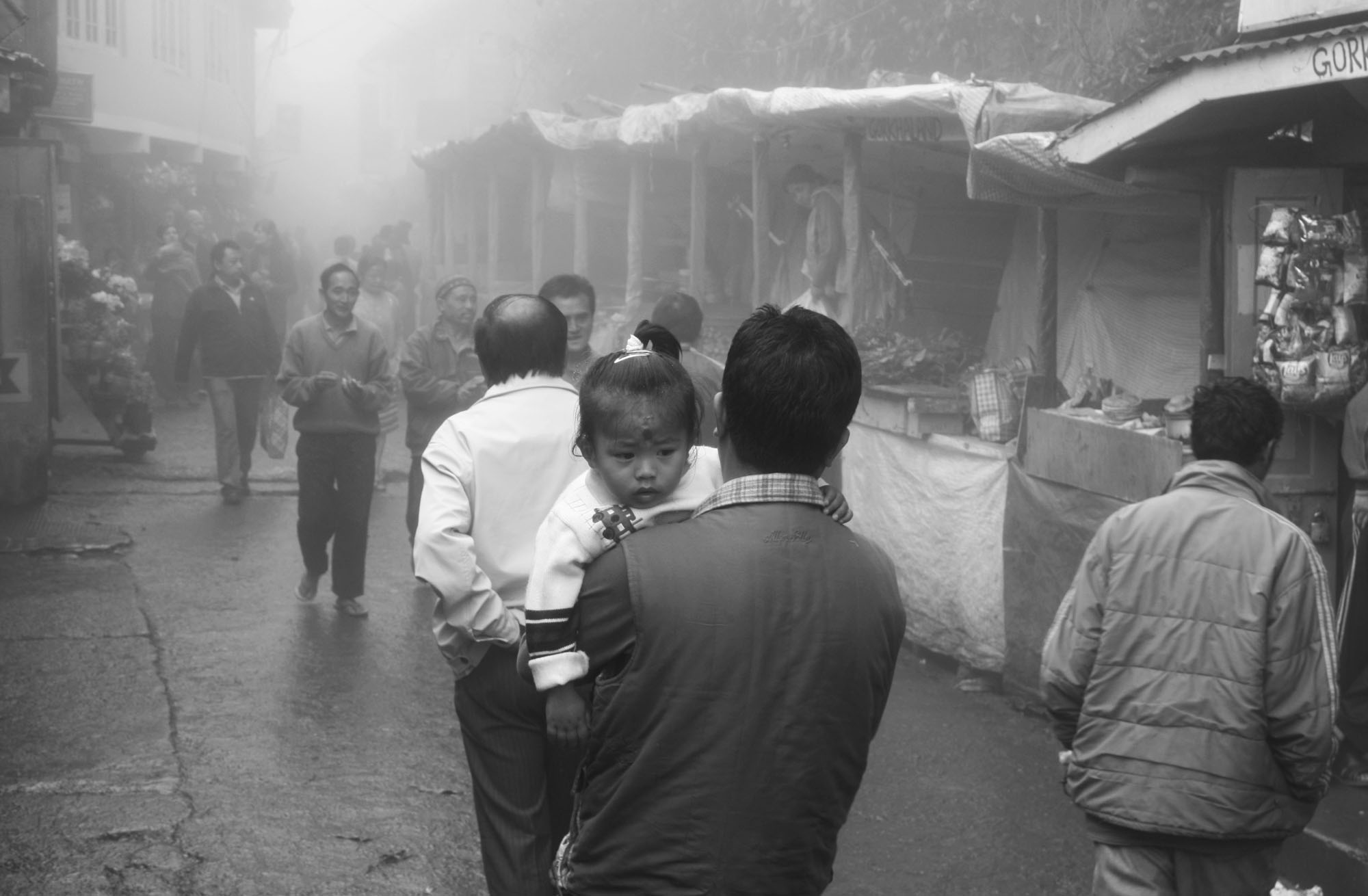
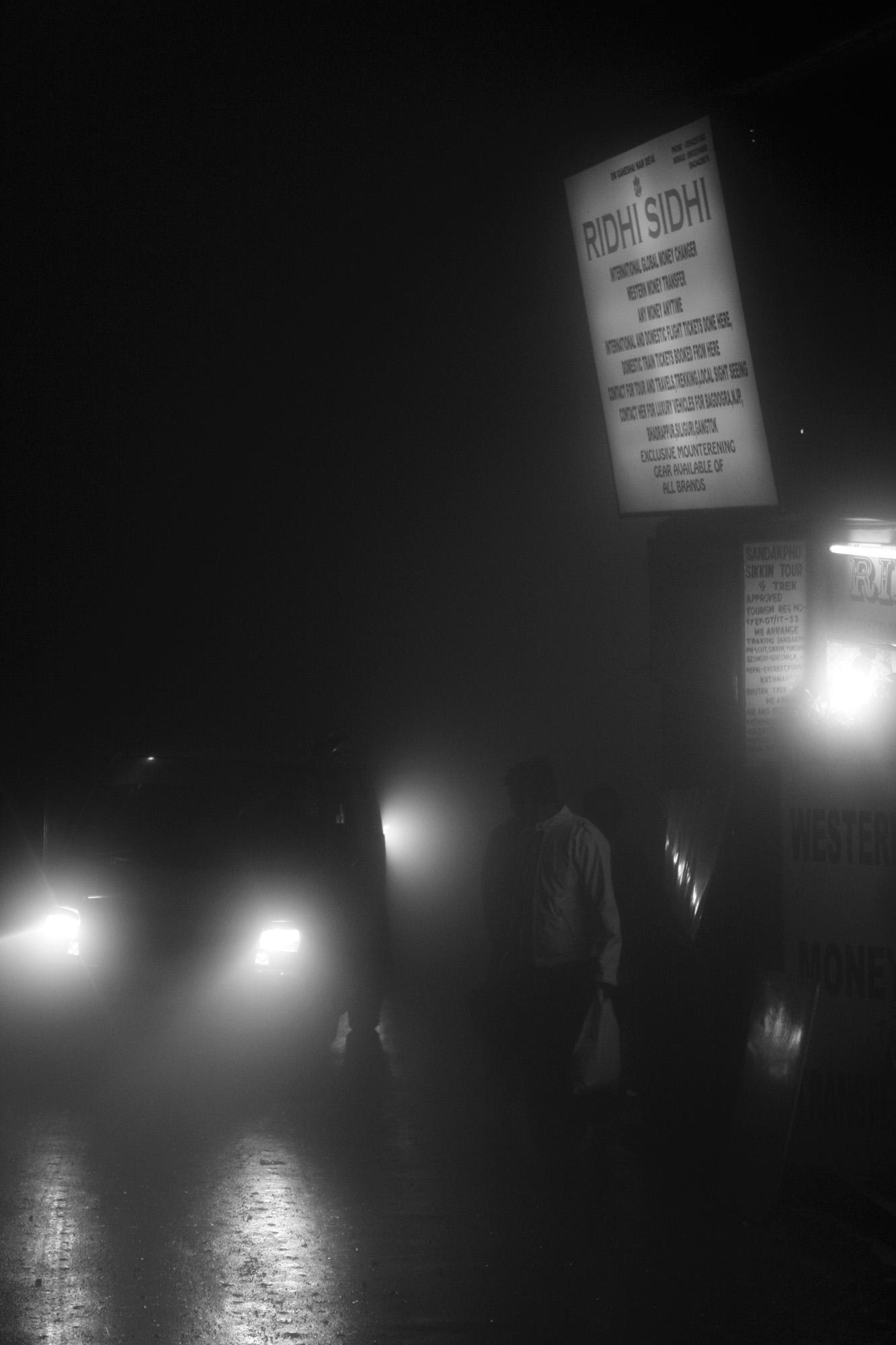
Despite six years spent living in Cambridge, which could, on occasion, become enveloped in mist rolling in from the fens, I had never seen fog anything like as thick as this. Since the blanketed morning it had increased its hold over the town, turning even the most derelict and mundane subject matter into something breathtakingly beautiful. Tears welled in my eyes and my jaw-dropped; I was thankful that in the thick mist, the few people I passed could not see my face clearly, for I could barely control my expressions. My throat was thick and my lips wobbled. I felt a burning in my heart and was flooded with a feeling of love; love for the fog, love for the cool air, love for the buildings, love for the passers-by and the curled-up dogs. The world was a pencil sketch, viewed through tracing paper. It shifted and whispered itself through the droplets, soft and muted.

I strolled onwards through the moist air; my camera at the ready and Sigur Ros in my ears. The houses, shacks and shops, huddled together along the route, loomed in and out of focus. The figures in attendance, crouched inside their stalls, seated cross-legged next to their wares, were quiet and patient. They seemed in many cases very poor, and I hoped that their lives were happy and their hearts at peace.

The mood and pace of Darjeeling was so very unlike the insistent whirlwind of the India I’d seen so far. Perhaps it was the influence of Buddhism, the cooler climate, the different ethnic blend, or their relative isolation from the weight and competition of the population at large, but whatever the case, it was a pleasure to be left alone.

I passed the stables and the tea-wallahs I’d visited that morning.

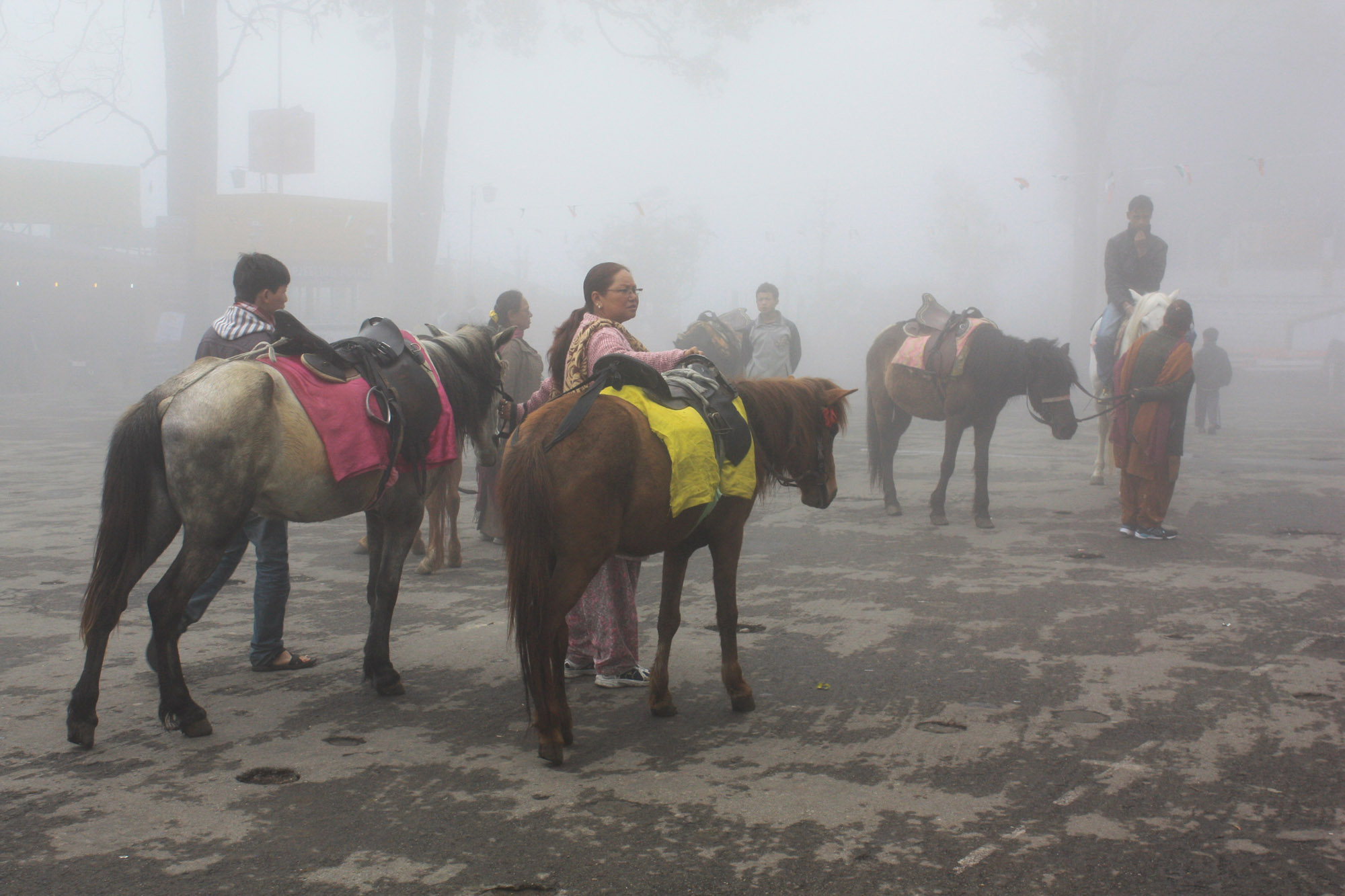
Only now did I feel slightly conspicuous, as though the so-called Pony Boys, from whom I’d bought the weed in the first place, might soon be pointing and laughing at me. Feeling far too positive to allow any paranoia to take hold, I shrugged away the sensation and wandered out into the middle of the square, where the horses stood calmly about. Despite the relative cool and the heavy fog, the square was very busy. The orange and white-striped benches along its edges were full of locals relaxing; reading newspapers, drinking tea, smoking cigarettes and in one case, playing a game of chess. People milled about in the centre and periphery; tourists, bringing children for a pony joyride or shopping in the stores along the western side of the piazza, and locals, trudging back and forth, carrying loads and pushing carts, or simply taking a stroll.

It was a pleasure to photograph these people, but having hung around the square on several occasions already, I wanted to explore further and see new sights. On the eastern side of Chowrasta was an alluring road that led down the less-developed side of the mountain. It was impossible to see where it went in the heavy mist, yet, considering how incredible everything looked and having no specific goals other than to revel in the beauty of the day and take as many photographs as possible, I set off down this narrow street.

The fog so far had been very thick indeed, yet once away from the mass of people and the tightly packed houses and shops, it grew thicker still. Without the warmth of the people and kitchens, the moisture did not disperse so readily and, a mere two hundred metres down this side road, the world closed in as never before.

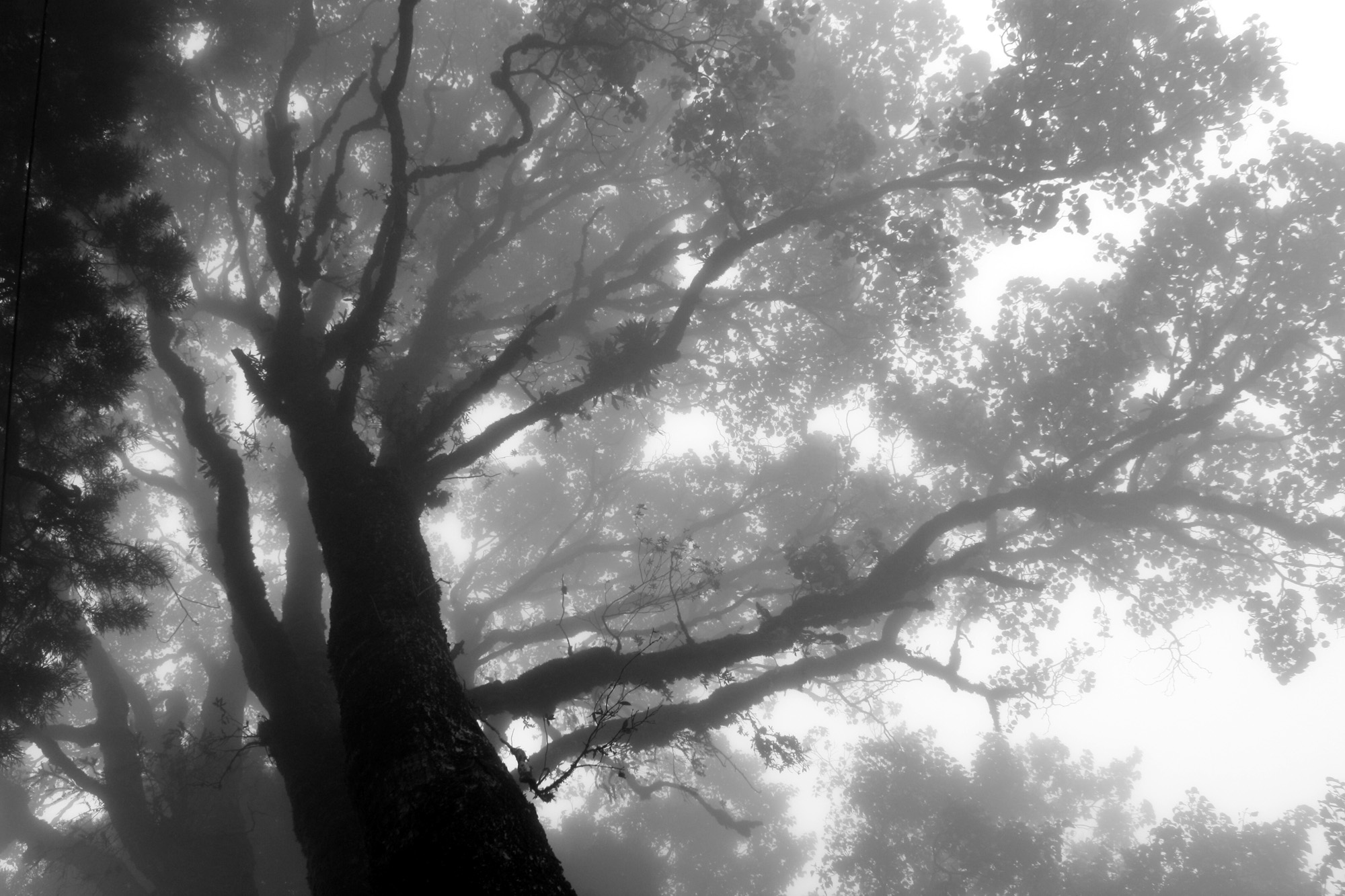
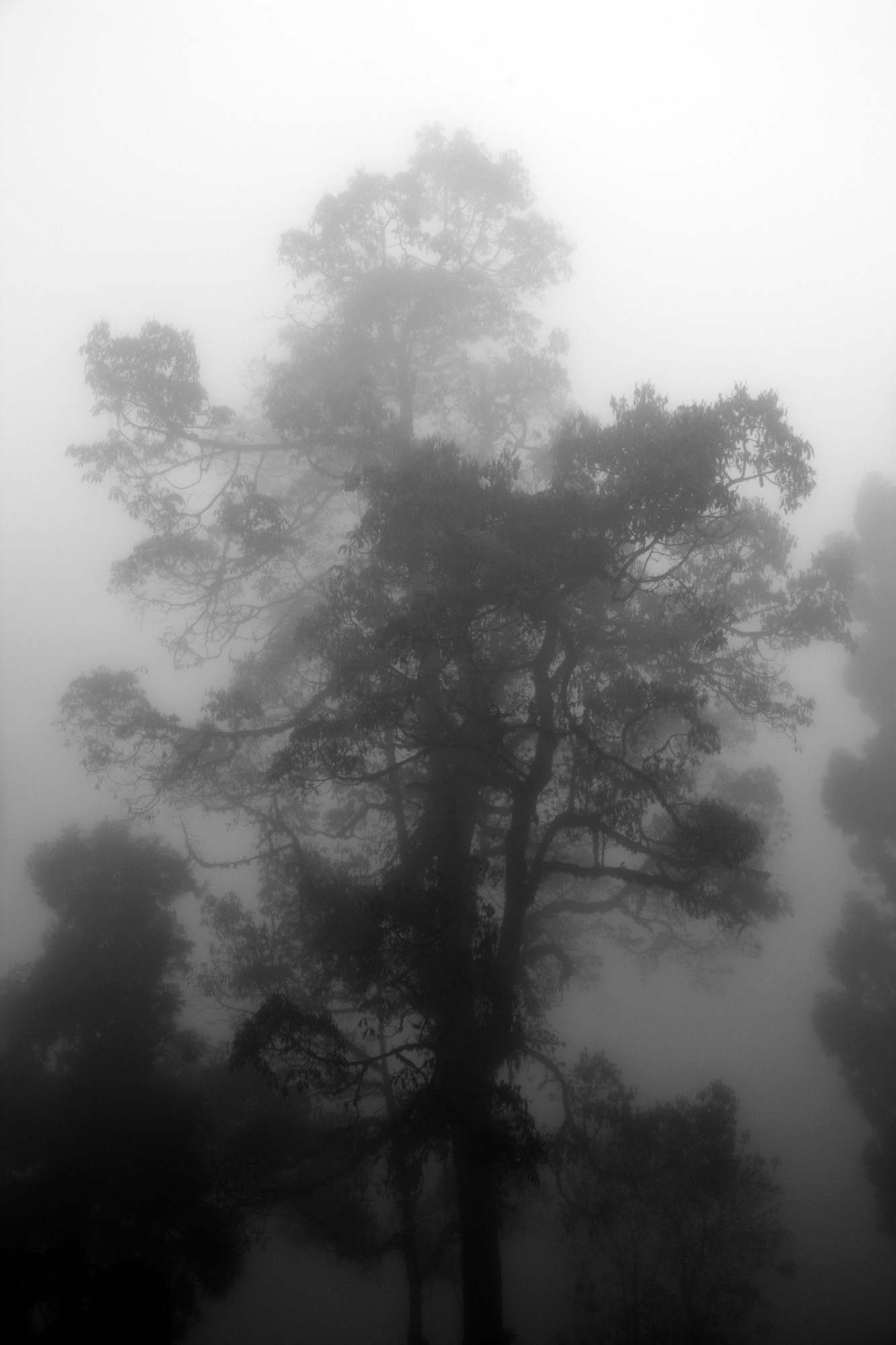
I was stopped in my tracks, breathless with excitement. Above me the trees were embraced by cloud, rising up in ever-paler shades of grey.

The density of the air was such that within small spatial increments visibility dropped alarmingly until the merest ghosts of branches could be seen. I stood there, overcome, looking up into the branches, shaking my head and muttering expressions of disbelief. I took out my video camera to film the mesmerising trees, trying to comment on what I was seeing.

I soon stopped talking, for there was too much emotion in my voice and it kept cracking with pending tears. How could anything be so beautiful? How lucky was I to be right here, right now, completely off my chops?!

A family of three – an older couple and their adult son – all wrapped in bright orange or yellow shawls and blankets, stopped me to say hello.

“We are here, on holiday, from Kolkata,” the younger man told me. “It is very nice to get away from the heat!”

We shook hands and I took their photograph. When I showed it to the old man and said, “Very handsome!” he seemed extremely pleased. We all laughed and smiled and shook hands again, and in less than a minute, I was on my way, smiling at just how much warmth and friendliness the Indians had shown me since arriving in their country.

The road wound down along a natural contour, passing Buddhist shrines, tall trees and occasional houses and shops.

After a stretch, I came to a cluster of buildings – too close to town to be called a village, but otherwise so in its likeness.

The steepness of the road made its vanishing point more daunting, as though this were the last stop before the end of the world. I passed between these silent houses, again surprised at how quietly and patiently the locals sat in their doorways and shops.

An old man emerged from the fog, wearing two large square tins on his back. I followed him slowly, through the village and down to a bend in the road where a lone shop perched on the brink of oblivion.

The man took one of the tins from his back and placed it on a low concrete wall. At first I thought he was resting, but then a young boy approached from the shop to buy some of what he was carrying. I watched from a distance, but could not see what he was selling through the fog; perhaps milk or oil, or even cheese?

After taking more photographs, I continued down the hill. Slowly, but surely, the number of houses diminished and the road grew increasingly lined with trees.

Five minutes later found me standing beside a row of cute wooden houses, their weathered boards and unsquared lines only magnified their beauty. I have long fantasised about such small, cosy dwellings; for their privacy and intimacy and simple provision of basic necessity. The houses didn’t look especially warm, however, and the man of whom I asked if I could take his photograph, looked cold. I felt a somewhat hypercritical taking this shot, suspecting that thousands may have done so before me. So much for my vision of privacy and intimacy!

The road soon turned in a hairpin, with a dirt road running off the bend. With an hour and a half having passed since leaving my hotel and thinking that now might be the time for another joint, I stepped off the bitumen and walked twenty metres up the dirt road. The road was backed by a wall of dripping ferns and dew-laden grass clumps, whilst in front was the swirling nothingness. I took out the cigarette packet, extracted a joint and stuck it in my lips. Again, feeling excited and ambitious, I smoked the whole thing. As I stood exhaling into the cold air, looking over the edge of the road, I blinked in amazement as a faint outline revealed itself. I tried to focus my eyes through the fog as it shifted and rolled and saw what looked like a monastery below. Then the intensity of the fog diminished in the face of a momentary breeze, revealing what was indeed a Buddhist monastery.

I hurried back to the road and followed it down the hill. It soon turned again, back in the direction of the monastery, and I walked quickly towards it, keen to have a look. The monastery slowly materialised to present a bright face, veiled and wan with mist. It was a tall, square building, with a tower at each corner, painted with lavish designs in blue, red, green and gold. The curling patterns and images had a floral, almost organic quality, as though a colourful, symmetrical mould had grown on the structure. The flair of the portico and façade, with its rounded columns, gave the monastery a slightly garish, yet beautiful stateliness.

I kicked off my thongs and wandered inside. The wooden floor was satisfyingly worn, and the rich interior contrastingly cold. I noticed a monk in the corner and, not being sure of the protocol, decided not to take any photographs. Instead I merely stood for five minutes, hardly moving, slowly turning my head to follow the many bright images on the walls and ceiling; peering from the low light.

Once outside again, I felt inclined to press on. I’d taken off my headphones, but now decided I wanted music again and chose the Guo Brothers, performers of traditional Chinese music. The haunting and exotic mood of the music combined well with the atmosphere, and I set off away from the monastery with renewed purpose.

Just around the corner from the monastery the road steepened and spilled away into a another small cluster of houses and flats. I paused on the top of a small rise, suddenly feeling very hungry indeed. It seemed that after all this walking in the mountain air and two brilliantly uplifting joints, the good old munchies had finally kicked in. Not wanting to distance myself too much from the momos and tea of Chowrasta, I turned around and headed slowly back up the hill.

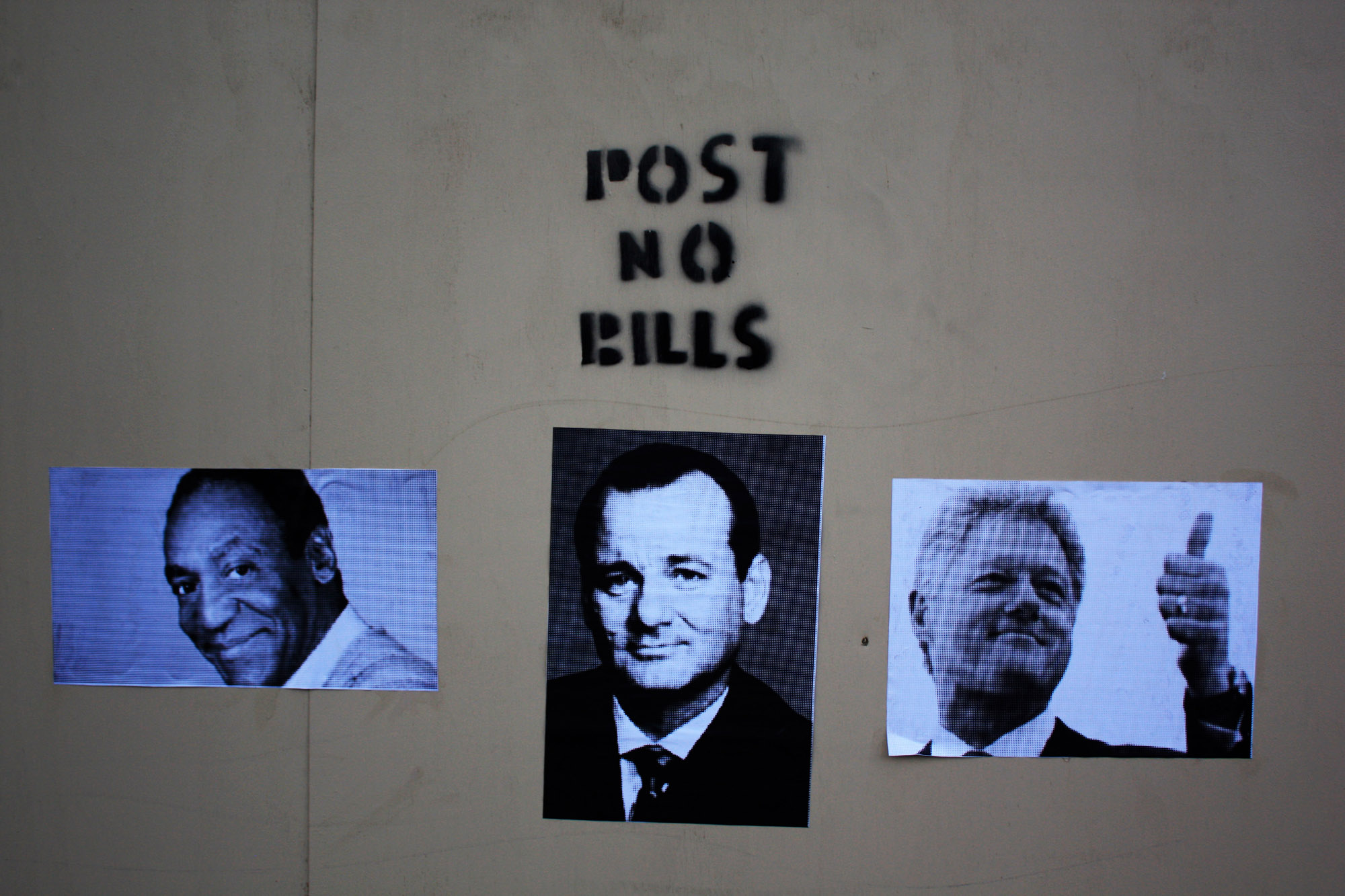
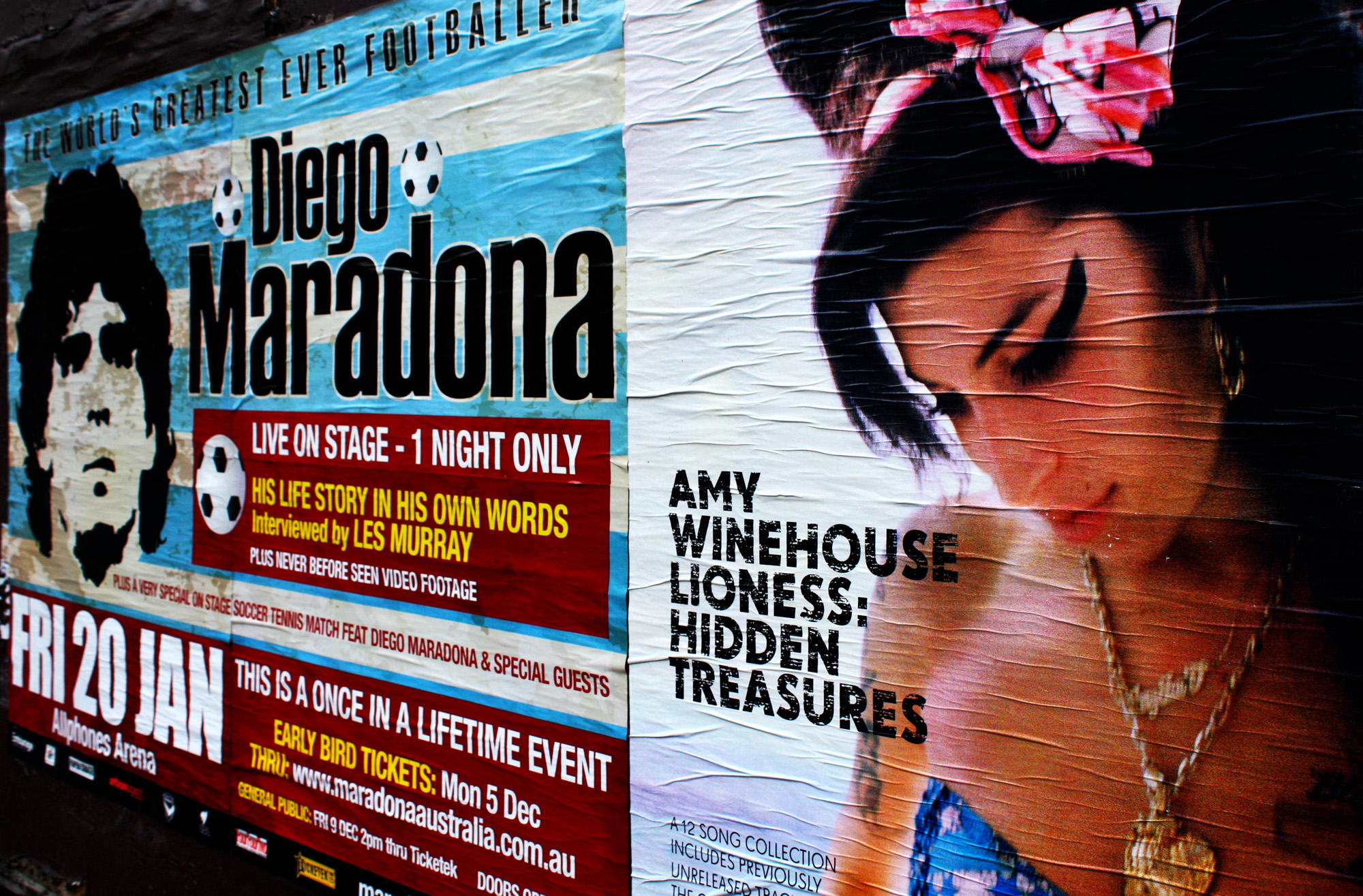
Post no Bills

The Pony Boys

When I woke up the on my second morning in Darjeeling, it seemed as though the day had been cancelled. I pulled aside the curtains to a view of next to nothing. A pea-soup fog had settled over the town and visibility was reduced to the powerlines outside my window. The eerie, wan sunlight at the back of it leant the fog a disquieting luminescence; a sheet of pale gold leaf behind the swirling, moist air.

I stared in wonder and caught occasional glimpses of the ghostly satellite dish and the iron rooftops; their outlines seemed characteristically oriental, like the tops of pagodas. Darjeeling’s quaint brand of orientalised colonialism made it the most distinct indication of the long tenure of the Raj I’d yet seen in India.

I peered out into the corridor was greeted with curious sight. Down the other end, the door to the fire stairs had been left open and the fog had seeped into the passage. It too was lit by the glary white of the hindered sun and the corridor, cold, tiled and light blue, brimmed with arcane mystery.

I walked to the end and looked out from the landing. The road below offered up the occasional silhouette; a dog, a person, a rooftop, a passing car, but little else. It was a quiet world; the sound damped down by the heavy air.

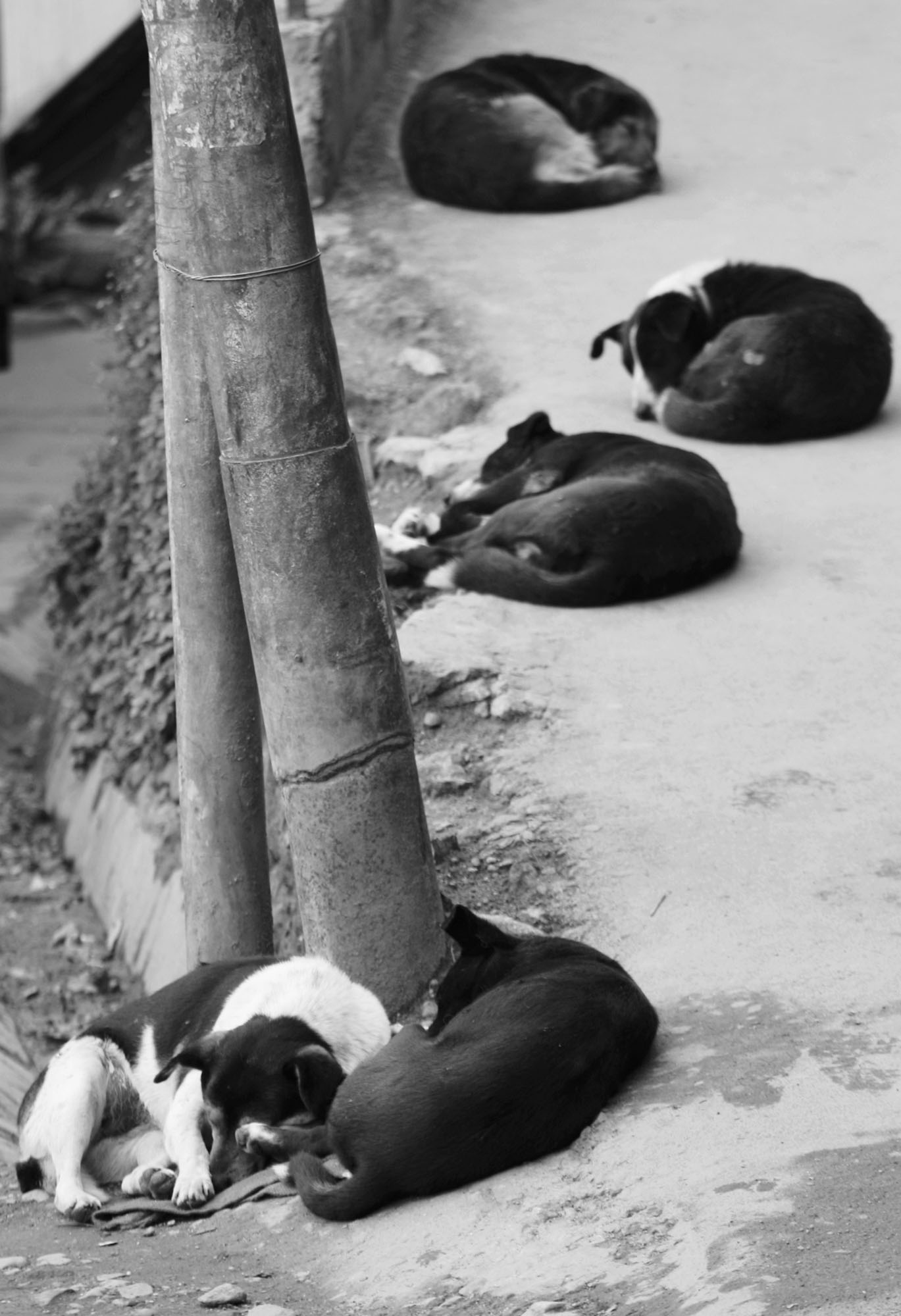
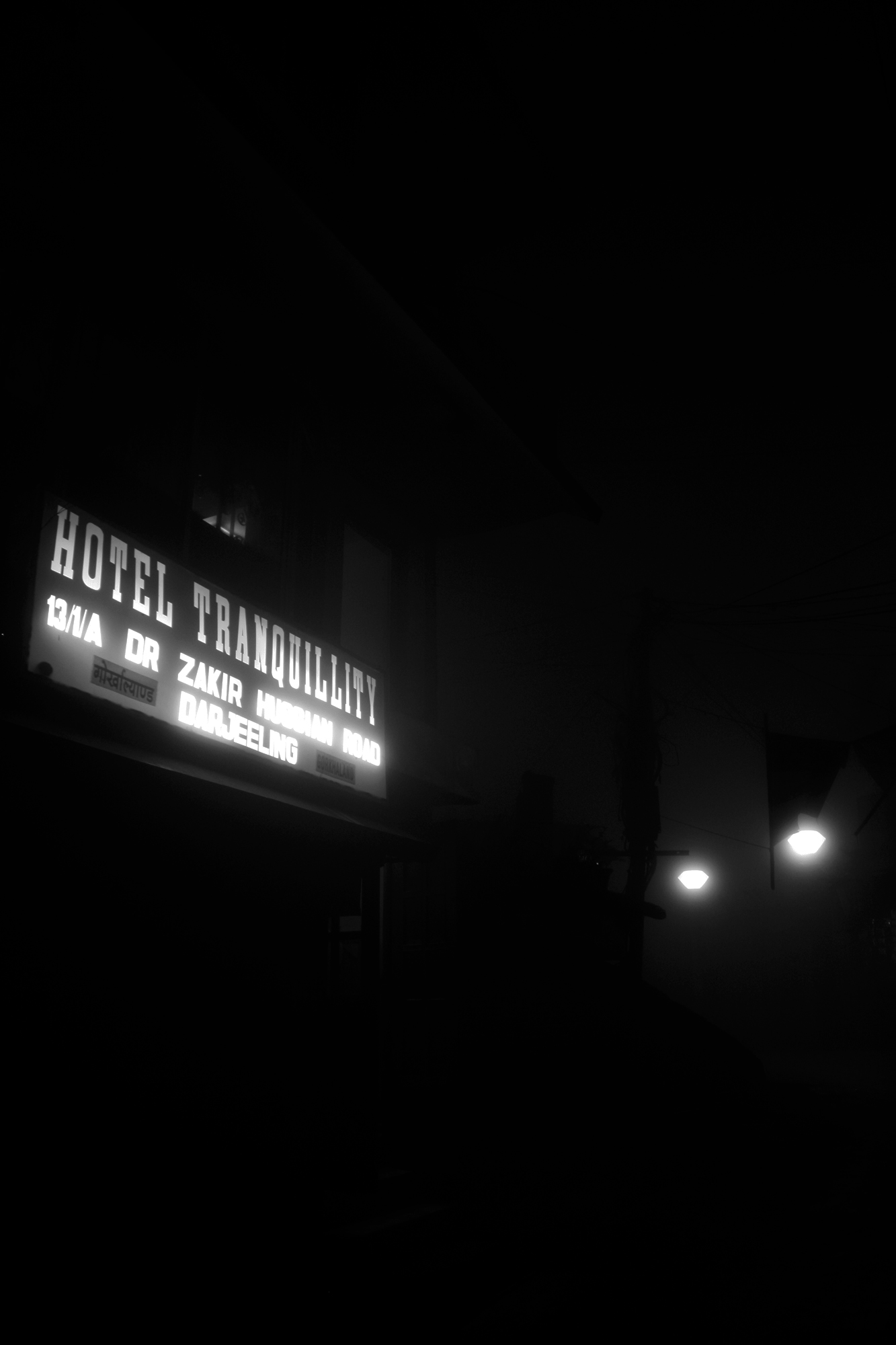
I hurriedly got my things together and set off into the fog. It was seven AM and the street was eerily silent but for the squeaky sound of a panda bear-like dog mauling a foam box. I patted this playful beast and continued down Dr Zakir Hussain Street which ran along the ridge towards Chowrasta, the main public piazza on the top of the town. There was no one about, but plenty of dogs; huddled together against house and shopfronts, curled into balls along the road, nestling on door-steps.

They all seemed friendly and not cowed; their worn faces and matted hair were less saddening when one considered their general robustness and apparent, ruddy good health. For the dogs of Darjeeling were certainly the healthiest, if not the cleanest, I’d seen as yet in India.

The street passed many a wide-open vista, where a view of the valley and mountains beyond opened out. Yet, with the rolling fog, so constant and thick and the peculiar, seemingly paradoxical heavy wetness and icy dryness of the air, all light and white like smoke, all cloying and dense like fallen clouds, it was impossible to see beyond the wire fence that hugged the street’s edge. Here and there a local emerged from a shop or house, transformed until just a few feet away into a pale outline.

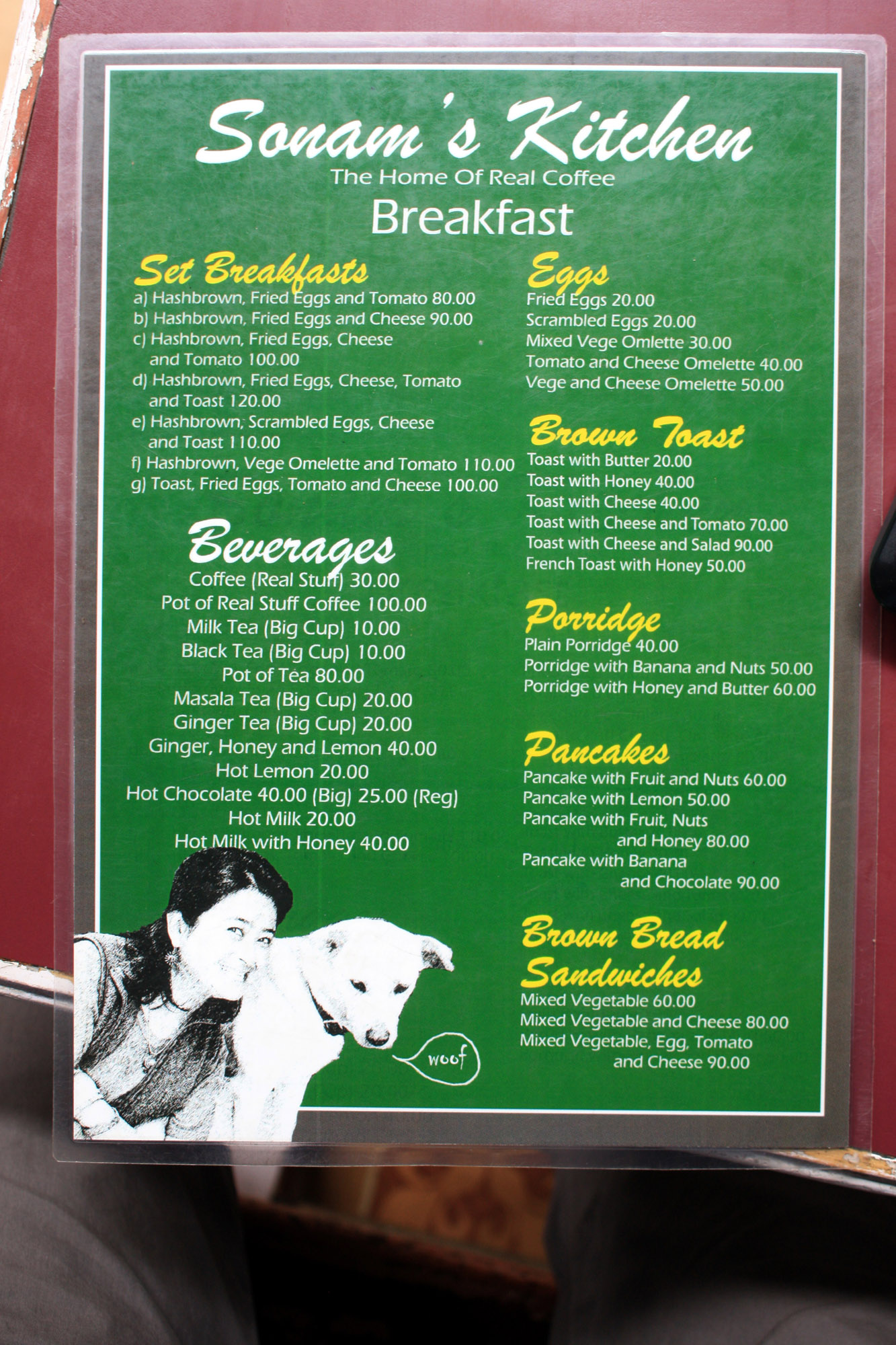
Less than half a kilometre down this muffled street, it dipped steeply towards a junction and there I spied a café called Sonam’s Kitchen.

I had seen the name in the guidebook and, as is usually the case, it had all the hallmarks of a place that catered almost exclusively for tourists. I was reluctant to try it, but paused outside just long enough to catch a whiff of their excellent filter coffee. I realised how hungry I was and just how much difference a good coffee would make. A moment later, I was seated inside studying the menu.

I ordered a pot of what they called “real stuff” coffee, along with eggs and hash-browns. It was comparatively expensive for India, but with fried eggs at just fifty cents, who on earth could complain? The lady who took my order was the same as the one featured on the laminated menu – Sonam herself. She spoke great English and was effusively friendly. I felt, as the name of the place suggested, that I was in someone’s home rather than a café or restaurant. Clearly this place was favoured with good reason.

I pulled out my laptop and surfed the internet, all the while eavesdropping on the conversations around me. When travelling I tend to be rather shy about approaching people, but once drawn into a conversation, I relax more readily with company than I would in my daily life. I spent some time playing the accent game; guessing where people were from. The tables were communal and around the time my food arrived, I was joined by an American, an Israeli and a Queenslander.

All three of them were travelling independently but, having been in town for a fair while already – two weeks in the case of the Queenslander – they all recognised each other. When they greeted me and asked where I was from, I was happy to be drawn into a friendly chat. They were good people and genuinely interested in the town and region, all with their own, quasi-anthropological zeal. They also seemed curiously as they ought to; the handsome young American, well educated and scholarly, with an old world politeness only the new world can produce; the glowing Israeli, tanned and well-fed, full of questions about the spiritual nature of the locals; the gruff and rugged Australian; realist, pragmatist, egalitarian. Rather unexpectedly, within five minutes the conversation turned to girls and growing marijuana. The American had experience of it in California; the Israeli had grown his own and liked a smoke as much as the next man, but, most importantly, the Australian knew where to get it.

“All this talk is making me want to smoke,” I said.

“Not hard in this place,” said the Queenslander.

“Really? How so?”

“Just talk to the pony boys.”

“The pony boys?”

“Yeah, the pony boys. The guys down the road.”

“You mean the dudes with the horses. In Chowrasta?”

“Yep, the pony boys.”

I had passed the so-called pony boys many times the day before, strolling up and down Dr Zakir Hussain Street which, along the stretch before it met with Chowrasta, was a popular thoroughfare lined with stalls and shops. Right on the edge of the square was an old concrete stable with space for roughly ten horses. These horses, traditionally used for transportation and communication, were now primarily used in giving joyrides to children and tourists. They weren’t exactly what I would have called ponies, in the miniature sense, but they were certainly small and slightly-built horses. According to the Queenslander, the pony boys also made a little extra from the sale of marijuana.

“Just look at their eyes,” he said. “Like piss-holes in the snow.”

“Goodness! I hadn’t noticed. Are they all baked?”

“Yep. They’re off their chops. Go have a look.”

“I think I will.”

I took a big sip of coffee, thinking how delicious it would be to get smashed in these winter wonderland conditions. I had smoked a little hashish in Rajasthan and Rishikesh, but had kept things pretty clean since then.

“So,” I pressed, lowering my voice. “Have you actually bought some from them?”

“A couple of weeks ago.”

“And?”

“It was great. Very dry and seedy, very natural, wild stuff. But it’s got a great high on it and it’ll have you giggling like a little girl.”

“That is very tempting. How much did you pay?”

“Five hundred, for a bag like this.”

He shaped his hands to indicate a pretty serious nugget, about the size of a decent potato.

“It’ll take you forever to get the seeds out of it. But fuck it, you’re on holiday.”

I laughed at his laconic humour and knew my mind was already made up. Until I scored, I’d be salivating for a smoke like Pavlov’s dog.

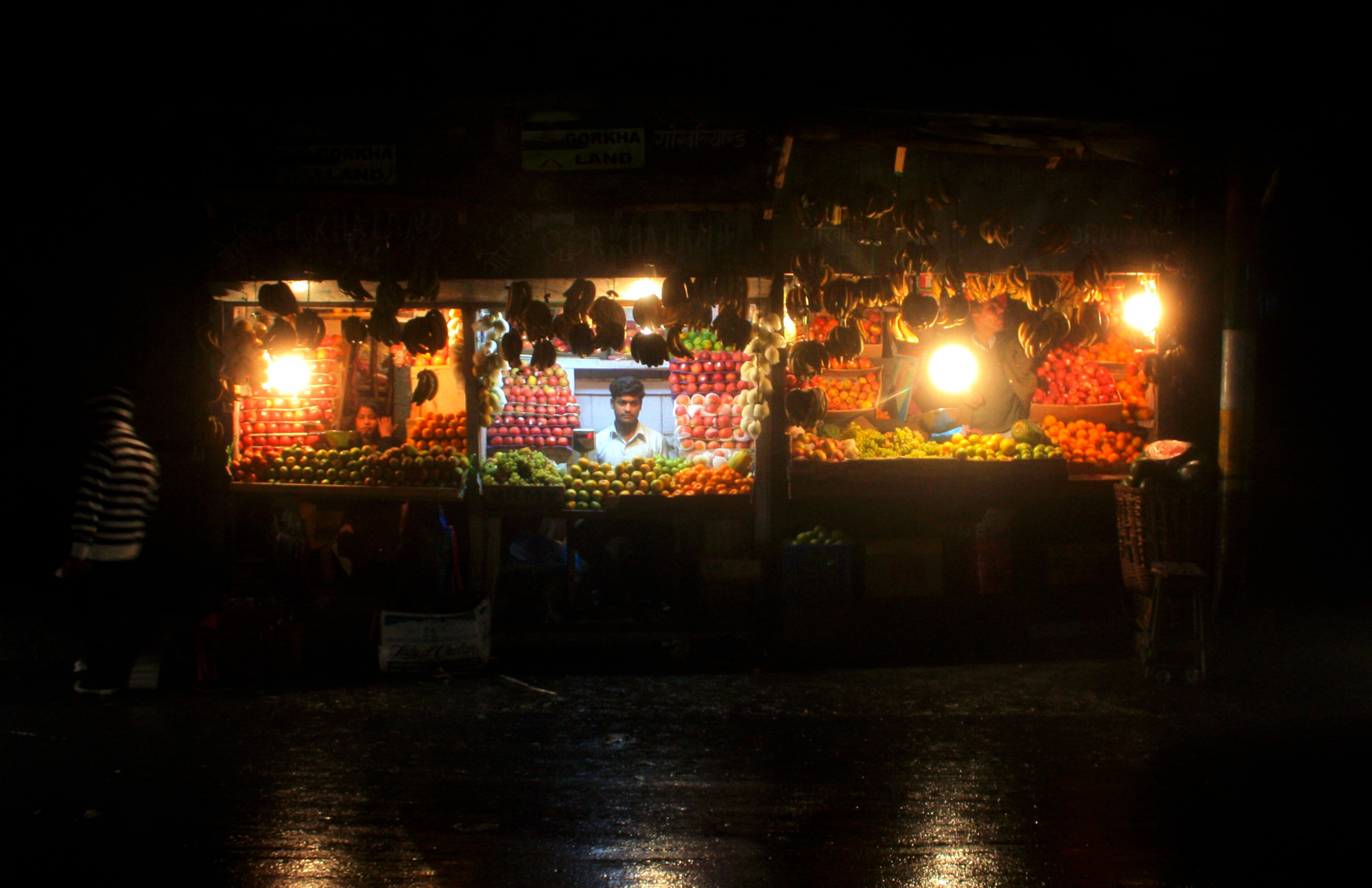
I finished my breakfast and stayed chatting until my seat was required for someone else. When I left the café, I walked straight down the street to where the stables were, through a fog even heavier than it had been before breakfast. Only when I reached the line of stalls at the bottom of the hill, where the collective human warmth had caused the mist ever so slightly to dissipate, could I begin to see more than twenty feet. The stalls were a great spectacle in themselves. Mostly selling vegetables, these simple wooden huts, roofed with tarpaulins and plastic sheets, were attended by people who often sat cross-legged next to their wares.

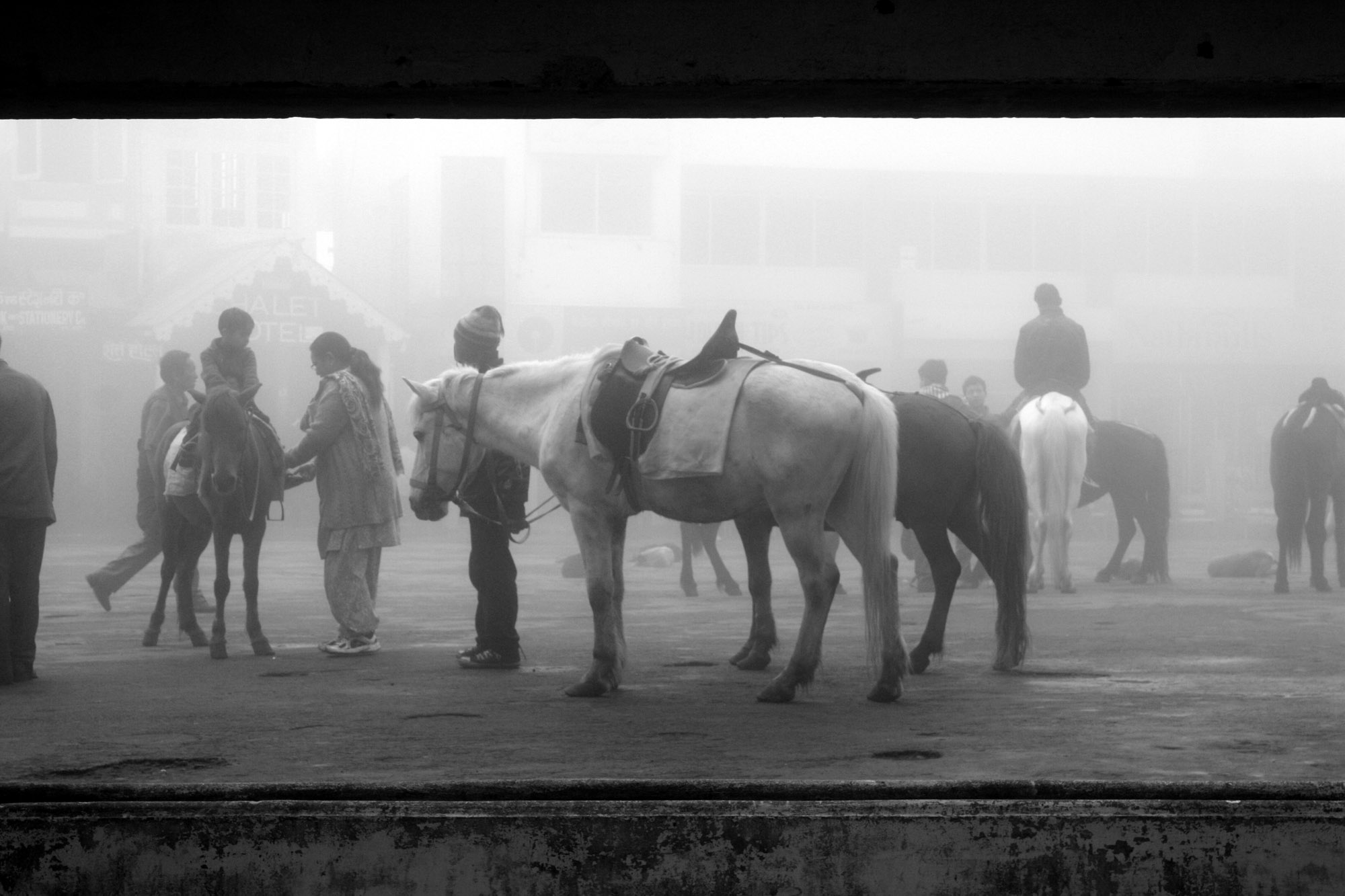
The stables sat directly opposite two most excellent chai wallahs, who also cooked simple local cuisine in a steamer and wok. I sat down beside some locals on the long bench at the corner chai stand and ordered a cup of tea. I then turned my attention to studying the scene. There were just two ponies currently in the stables, the rest being out offering rides to children. Only an old man, whom I had seen there throughout the day before, was present, sitting on a step. Out in the square were the dim outlines of people and horses.

There was little hope of seeing their eyeballs, let alone their faces at this distance, in this weather, so I turned my attention to the tea, which, upon my first sip, sent me into paroxysms of pleasure. It was, without a doubt, the best cup of tea I’d had since arriving in India. It was only really at this point that my location hit home. Darjeeling – one of the tea capitals of the world!

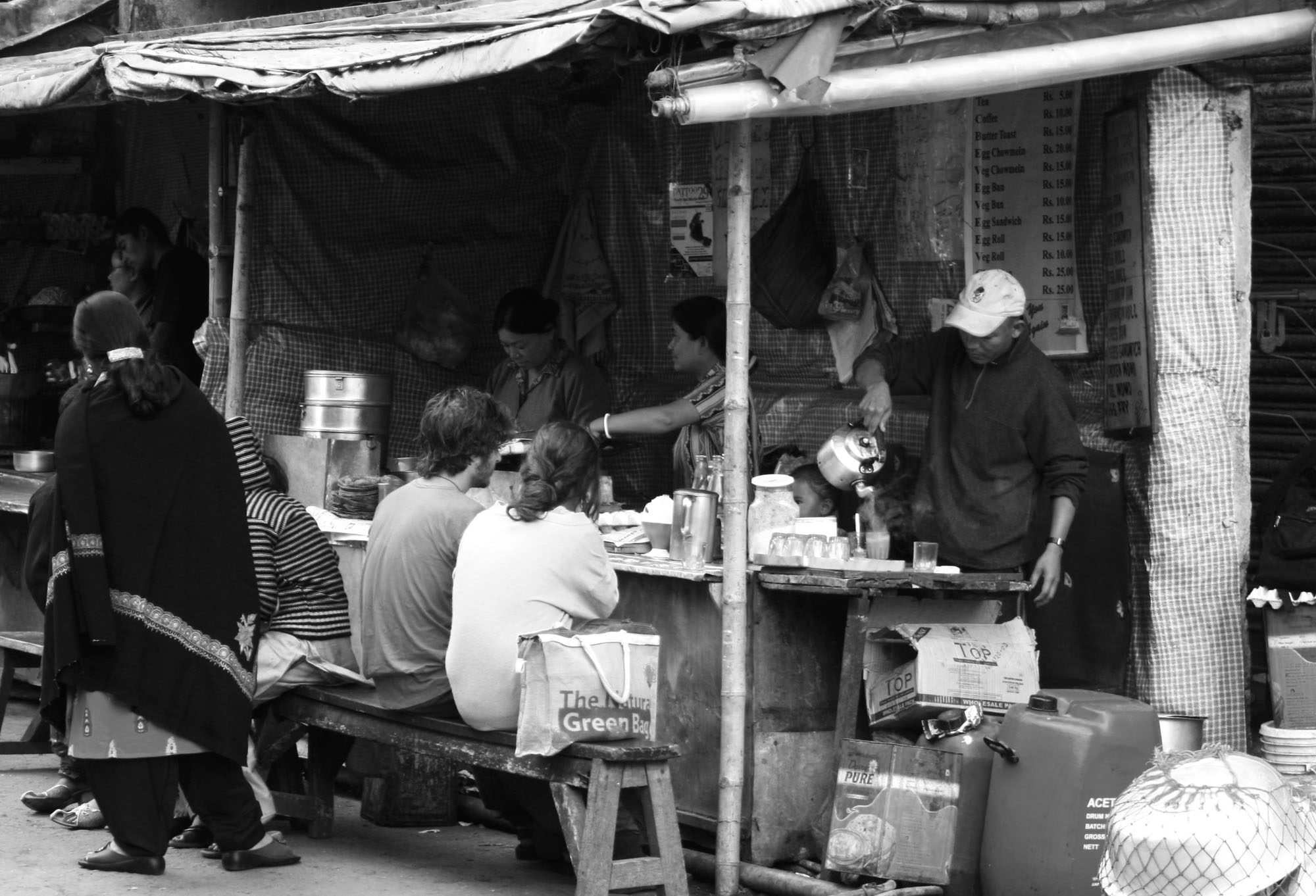
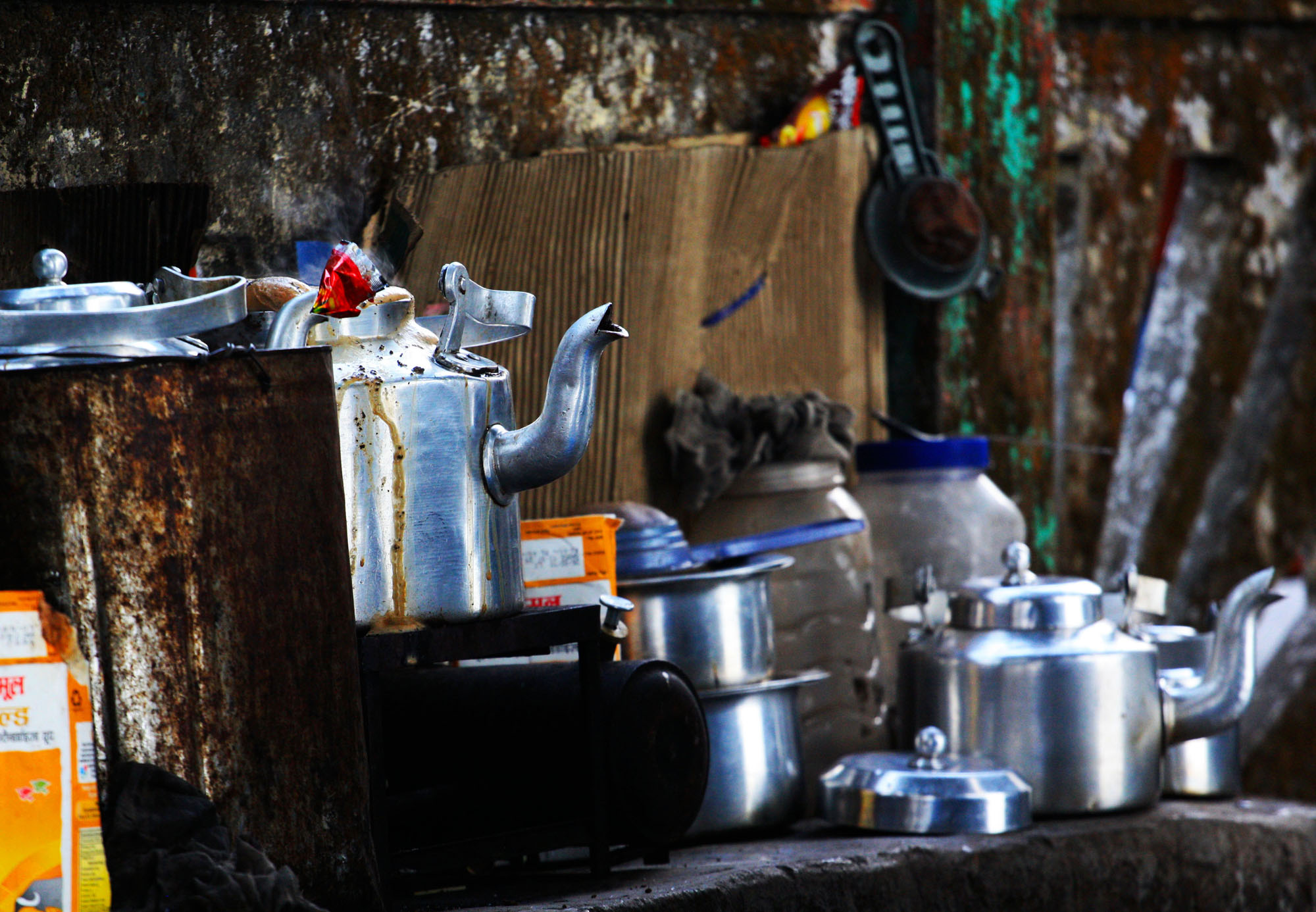
I now studied the people behind the counter. There were three of them, two women and a man, all Nepali, likely in their mid thirties. They seemed to have their own particular role behind the stall. The man was in charge of the tea; using a large tin kettle in which he placed what looked like a home-made tea-bag the size of an apple. From this steaming hot kettle he would pour the tea into the regulation small tumblers one found right across India, mixing in sugar as desired and powdered milk. I was, initially, disappointed to see him use powdered milk, but by the time I’d finished the cup I was convinced that I’d never drunk anything so delicious in my life. I ordered another cup – at five rupees a piece, a little less than twelve cents – and watched the two women. One, whom I suspected was the wife of the tea man, was in charge of the cooking. She stood behind a large wok on a gas cooker, cooking noodles, frying eggs with chilli and heating buns by pressing them against the hot wok. The other lady, whom I guessed, again with very little evidence, might be a sister of one of the other two, was in charge of the momos. She stood marshalling a tall pile of tin and bamboo steamers, filled with what looked like delicious dumplings. I was astonished to realise that a mere fifteen rupees bought eight to ten of these soft, hot, fresh momos. Whatever was to come, I knew I’d be coming back this way for lunch.

When the tea was done, I thanked the people and stood up. Now fully fortified against the cold air, I had to work on my resolve to make an approach. I walked straight past the stables and out into the square, slowly walking towards the group of pony boys with their horses. The mist was especially thick out in the middle of the square and the Japanese cedars that lay behind the ring of orange and white park benches were lost a mere half-way up.

I hovered about for a while, feeling somewhat apprehensive. I wasn’t so much nervous as reluctant; not wanting to get involved in a misunderstanding that had the potential to turn sour. I watched the fellows for a while. They made very photogenic silhouettes in the fog and I took some photos whilst observing them. Many Indians come to Darjeeling when the weather heats up and this year was already particularly hot. In recent days Delhi had seen the temperature sore to fifty centigrade. The holidaying families were very distinct amongst the Ghorka, Nepali and Tibetan community. Several lucky children were being treated to rides.

I edged closer to the unengaged horsemen, wondering how much English they might speak. Would it be too confusing to begin with “I was told…?”

I tried to see their eyes. Who looked the most wasted? Fortunately, the first one I approached – a short, curly-haired man with a dark brown pony in tow – looked completely and utterly stoned. The whites of his eyes were the colour of lightly-flavoured chocolate milk and his pupils were hardly to be seen. I nodded to him and had his attention.

“I heard that if I wanted bhang, I should talk to the horsemen.”

The man said nothing, but examined me closely.

“I want to get some bhang, some grass… I was told to speak to the horsemen.”

He continued to look at me, clearly totally oblivious to my cryptic remarks. I knew I had to word things more simply, but was nervous and verbose.

“Marijuana,” I said.

“Marijuana?” said he. “Marijuana, three thousand.”

“Three thousand? No, no, not that much. Less.”

“Three thousand.”

“No, less.”

“Ten grams.”

“Smaller, smaller.”

“Ten grams, one thousand.”

“Ten grams, one thousand? Deal.”

Considering that twenty-five bucks usually bought one gram in Sydney, it seemed a pretty decent deal.

The pony-man gave me a big, slow, stoned smile.

“You go here.”

He pointed down the street that ran from the southern end of Chowrasta. “Down here. I talk to boss.”

With that, he was off, suddenly energised, with a distinct and unexpected spring in his step. I felt quite pleased with myself and couldn’t help smiling. I was going to get baked after all! I drifted down the side road as instructed and lifted the camera to my face, returning to my disguise as a regular tourist.

The side road was especially misty and it was clearly a good place in which to make a deal. There were some local carriers resting with their loads underneath one of the tall cedars, and I walked down past these, stopped and turned back to face the town. I reached into my bag to find my wallet and got the money ready in my hand then took a few photographs of the shapes in the mist.

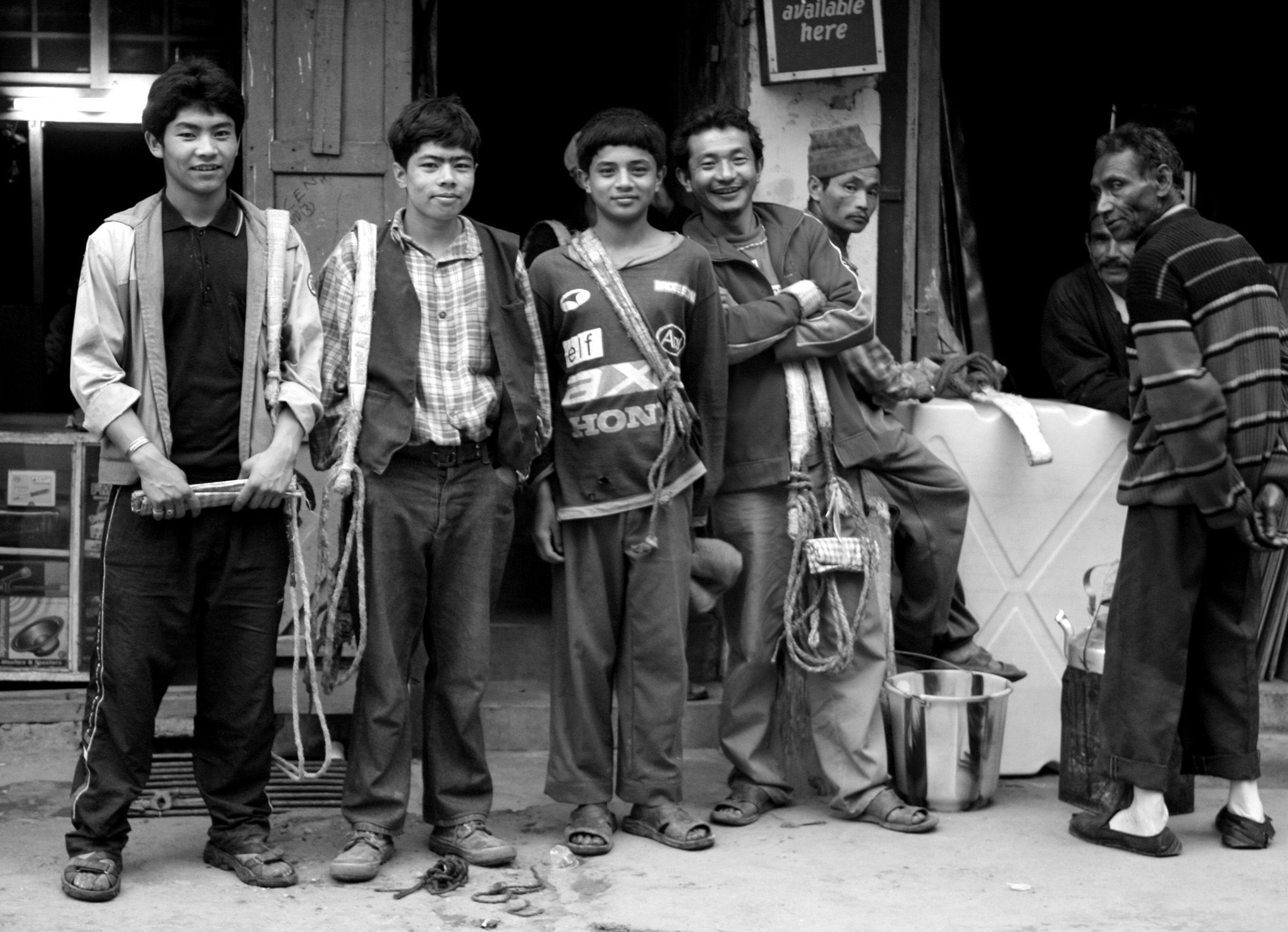
The carriers picked up their loads, slowly rising, a little stiff. They walked bent forward, stepping like giants, their parcels supported by ropes around their foreheads. How strong their necks must be! When the carriers disappeared from sight, I heard the rapid clop of galloping hooves. Through the swirling mist, the shape of the mountain pony-man appeared, a mere ghost at first, but soon he burst through and materialised in front of me. He pulled up his reins and brought the horse to an abrupt and dancing halt. He had a broad smile on his face and seemed to spring in tune with his mount on the saddle. I knew instantly that he was profiting handsomely from this and figured I should be paying about five hundred, as my informer had done. Still, it was a mutual happiness, as we were both about to make each other’s day.

He guided his horse until he stood right next to me.

“Here,” he said. He reaching down, holding a plastic bag tied with a rubber band. I held up the thousand rupees and took the weed from him. It was a large bundle. Light, springy, and leafy, I suspected, but certainly copious. Finding out whether or not it was actually weed would have to wait.

“Thank you very much!”

I shoved the weed quickly into my pocket and offered the pony man a salute. He said nothing, merely smiling and nodding, then wheeled his horse and rode off into the oblivion of the fog.

I walked away quickly, firstly away from the square, feeling an urgent need to get away from the scene of the crime. A moment later, I gathered my wits and turned around, heading back towards Chowrasta. The time had come to buy some papers and get on with it. I began a determined march back to my hotel room. Why wait after all?

Had I known what the weather would be like for the next eight days, I might have acted more promptly. I had come to Darjeeling not only to see the marvellous hill-town, but also for its famous views of the Himalayas. It never occurred to me that seeing them would prove so difficult.

The first morning I awoke in Darjeeling the horizon was shrouded in a veil of haze. The room was cold with the seeping air outside and for the first time since arriving in India, I nestled under the blankets, feeling deliciously comfortable. The last two days had been exhausting days of travel – from Rishikesh to Delhi, across to Siliguri courtesy of Kingfisher Air, then up to Darjeeling by jeep – and I was happy to take it easy. I sat on my bed and snacked on biscuits, reading about the town.

Darjeeling had only come into prominence in the second quarter of the nineteenth century. The locale first came to the attention of the British East India Company (BEIC) in 1828, when a delegation of company officials stayed in the town and realised how suitable the site would be for a military sanatorium. In 1835, the company leased the area west of the Mahananda River from the Chogyal of Sikkim, traditional rulers of the region. Over the next fifteen years, the population of Darjeeling grew one-hundredfold, thanks to the company’s policy of attracting workers to the region, mostly of Nepalese origin.

When, in 1849, the British East India Company Director Arthur Campbell was imprisoned by the Sikkim Chogyal, the BEIC sent a force to free him, resulting in the annexation of 1700 square kilometres of territory. In the following decades, the BEIC strengthened its grip on the region, gaining control of the passes through the hills, the town of Kalimpong and the area east of the Teesta river, from the Sikkim. In 1864 the town became the official summer capital of the Bengal presidency and by 1866 the district had assumed its current shape and size.

Commercial tea cultivation began in the region in the 1850s and many schools were set up by missionaries. In 1881 the Darjeeling Himalayan Railway was opened, connecting the town with the plains far below and further increasing the pace of the town’s development.

When, after independence in 1947, Darjeeling was merged with West Bengal, tensions began to increase between the largely Nepalese population of the hill towns of Darjeeling, Kurseong and Kalimpong, and the Bengali population of the plains below. The Nepalese population agitated for an autonomous state and the recognition of the Nepali language as the official language of the region. The latter request was granted in 1961. When, in 1975, Sikkim was recognised as an independent state, it again brought calls from the people of the mountains for a separate state of Gorkhaland, with occasional eruptions of violence. In 1988 an agreement between the government and the Gorkha National Liberation Front resulted in the creation of the Darjeeling Hill Council. This, however, did not quell calls for a separate state, and agitation and protest continue to this day. In 2011 the government granted further concessions, with the creation of a new and autonomous elected body called the Gorkhaland Territorial Administration, which, whilst not governing a separate state, has more powers than its predecessor.

I found myself quite fascinated by the town’s history and was keen to explore further. Not only did Darjeeling offer exciting views, amazing geography, fascinating architecture, great tea and an interesting ethnic blend, but, perhaps most importantly, the large Nepali population guaranteed one thing: momos – and I love eating good momos.

At half past nine I found the housekeeper in the corridor outside my room. As soon as she saw me, she said:

“Your room is ready.”

“Great. Can I move now?”

“Yes, yes. Come, I’ll show you. It’s here.”

The room was diagonally opposite, across the hall – a mere ten feet away. She opened the door and presented it to me. It was smaller than the previous room, but with a double bed, coffee table and chairs, wall-mounted television, a bedside dresser and a stunning, wide-angle view of the drop into the valley below and across the foothills. At four hundred rupees, a mere ten dollars Australian, it also came with a large en suite. I stood by the windows and thought of the views I might expect when the sky cleared. For now, the horizon was covered in cloud and haze, and I could barely see into the floor of the valley below. The mist rested like hands upon the hilltops, fingers stretching down the wooded slopes.

It took two minutes to shift my few belongings and, at ten o’clock I set off in search of breakfast.

I followed the road down the hill, past the little restaurant and shop in which I’d dined the night before. After a steep and winding leg the street levelled out at what appeared to be another informal jeep-stop. Here the road split into two tiers and, at this junction of climbing streets, stood a triangular building with a rounded prow: Keventer’s restaurant. I’d seen the name in the guide book and knew it to be rather famous, as a shop, in the downstairs section, but primarily for its café / restaurant upstairs. What made this Raj-era throwback popular, apart from its relative antiquity, was the amount of meat on its menu.

Since arriving in India, I hadn’t eaten any meat whatsoever – this despite ordering a mutton biriani in Rajasthan, which contained two large pieces of gristle that I promptly discarded. Here at Keventer’s they offered a variety of meat products, almost all made from chicken and pork: meatballs, sausages, bacon and the like. I sat right near the kitchen – a counter behind which men cooked methodically – in the run-down old interior. Around the walls hung pictures of the views across to the mountains, which only served to whet my appetite for the peaks I’d come to see.

I ordered pork meatballs and bacon and eggs, drawn wholly in by the old world atmosphere. The view offered a splendid fore and mid-ground of rusted, corrugated rooves and wonky wooden frames stacked down the forested hillsides.

The coffee was not great, but passable, and I soon fell to chatting with two young Indian guys; students up from Calcutta. They were friendly and charming and curious about the photos I ’d been taking. After a while they invited me to drinks that evening, and I said I’d certainly consider it, though I knew somehow that I wouldn’t go and felt an early regret at this. Having spent most days walking and taking photographs through the daylight hours, I was almost always too tired to be sociable at the end of the day. I was also enjoying staying completely off the booze on this journey.

After breakfast, I took a long walk around town; down to the bottom of the town, where I’d arrived the night before.

I wandered through the back streets, up and down long flights of steps; found a lane with closely packed stalls behind which men and women worked with old Singer sewing machines. I shook hands with locals, answered their friendly inquiries as to where I was from, and eventually wandered into the meat market. There, in this dirty old shed hung with carcasses, I chatted with several of the butchers and asked them about their work.

One man approached me and said:

“Come with me. I’ll show you how I make mince.”

He led me to a corner of the shed, where, on a heavy, round wooden chopping block, using only a machete, he threw down pieces of meat and hacked them into mince with swift, strong blows.

“How long have you been doing this for?” I asked; a little squeamish from the proximity of his fingers to the blade.

“For twenty years,” he replied. “I am the mince man!”

I watched him hack away at the mince for a couple of minutes; lifting the blade just a short distance and bringing it down with surprising force and accuracy. I took out my video camera to film his impressive action, and it wasn’t long before he had turned the large chunks of fatty meat into finely chopped mince.

“There,” he said. “Mince.”

“Bravo!”

I thanked him for showing me his trade and farewelled him.

I continued my wandering about town, plunging into the tight alleyways of shops and stalls. As with so many places in Asia, the businesses tended to group together according to what they sold: spices, shoes, tea, vegetables. I drifted in and out of the lanes, taking photographs here and there. Most people were friendly and generous with their smiles. Unlike other places I’d been in India, rather than trying to sell me things, they seemed merely to want to be acknowledged.

I took a walk around the circuit of Observatory Hill, then returned to Chowrasta, the main piazza at the top of the town. The horizon remained shrouded and I could see only the foothills. These, however, were beautiful in the dull light; wet and fecund, cool and, here and there, dressed with tea.

Three o’clock found me sitting in another Raj-era café, Glenary’s bakery and restaurant, situated just a little up the hill from Keventer’s. The pale mint walls, white wooden beams, wicker chairs and corrugated iron roof gave it a classically colonial appearance. I sat in the back section, like a wide, closed-in verandah, where a bay of windows faced the valley and the still-obscured mountains. I surfed the internet, ate pastries and drank two rather disappointing cups of tea. As the afternoon had progressed, the air had become increasingly damp with pending fog, until finally, at around a quarter past three, it began to rain.

Having been in India a month during the dry season and having seen no rain for some time, the idea of rain had hardly occurred to me. Perhaps some uprush of humid air from the Sundarbarns had met with the chill mountain breath and dropped its bucket, but whatever the case, once the rain began, it came down hard as hell. It poured for two hours, with little let up, striking hard on the iron roof. It was as beautiful as it was surprising, and for a long while I sat and watched figures darting through the wet below, with torrents in the gutters and cascades from the rooves. The pigeons opposite, huddled under the eaves, were positively ruffled on their multi-generational pile of droppings.

When the rain did finally stop, something extraordinary happened. I was sitting, face pressed close to the glass, watching the play of mist and light across the valley, when suddenly the clouds parted and opened a clear view to the horizon. All the haze had been washed from the sky, which was transformed to a pale blue, dotted with cotton wool clouds. I tried to shoot through the window but the curve of the hill blocked the bulk of the view. I wanted a clear line of sight, for I was dying to see Mount Kangchenjunga, the third highest peak in the world at nearly 8600 metres tall.

I stood up, stuffed my lap top into my bag, sorted myself out and hurried off. It was still drizzling a little, and, worried about my camera, instead of going straight to find a vantage point, I decided to head back to the Hotel Tranquillity (sic) to pick up the small but sturdy umbrella I’d packed in a moment of boy-scout foresight. I raced back to the hotel, which took a good ten minutes, grabbed my umbrella and was about to head off, when I heard voices from the roof, just up the next flight from my room. I walked up the stairs where a door opened out on a flat concrete roof, flooded with rain. Here I found Tenzing, the hotel’s owner, talking with two other guests.

“Hello!” said Tenzing. “Come to see the mountains?”

“I hope so!”

The two other guests were also Australian and we smiled and nodded at each other. Their attention, however, as mine was soon to be, was rooted in the distance. And there, sure enough, was Mount Kangchenjunga. I gasped when first I saw it, amazed by its sheer size. How high up it seemed to go into the sky. It had an unnatural quality to it, as though its extension from the Earth was somehow impossible. How could anything be so big? The towering peaks of stone and snow were nothing short of fantastical. The only problem was that much of the view was blocked by an inconveniently placed radio antenna, a hill and trees. I could see roughly half of the mountain, and that through a tilting of the head and shifting of angles.

I looked as well as I could, but the lack of a clear line of sight was simply too frustrating. I needed a new vantage point, for now clearly was the time to go shoot the mountain. I took a few snaps, made some cheery remarks, then fled down the stairs and out onto Dr Zakir Hussain Street, figuring I should make for the road that circumnavigated Observatory Hill. I scurried down the street towards Chowrasta, past all the stalls, butchers, fishmongers, bakers, fruit and vegetable sellers, chicken and egg sellers; many of them seated up on the boards of their wooden stalls.

When I reached Chowrasta, however, I could see already that I was too late. The sky in the distance was thickening again with white mist and soon everything would be hidden. I broke into a run, down along the side of this hill with its famous monastery and tall Japanese cedars. Yet, by the time I reached the far end of the road, the mountains had once again vanished behind haze and cloud. I stood cursing, deeply regretting having gone back to get my umbrella, and shook a fist at the sky. I wasn’t sure quite how long I was planning to stay in Darjeeling, but figured that some time in the next couple of days I ought to see clear skies. The rain began to come down again and I popped up my umbrella. Stuff it, I thought, there’s always tomorrow.

When I stepped down from the back of the jeep in Darjeeling, I found myself in the middle of an intersection. This was no formal station, just a central location which the streets attended from what seemed to be unplanned angles. The lights were a very dim orange, barely illuminating the shuttered and shabby shop-fronts and the greasy road.

It was half-past eight in the evening and I was pleased to be on my feet again. The prolonged journey up the mountain had been very beautiful, but being two and a half hours behind schedule, I was concerned that my room might not still be available at the Hotel Tranquillity (sic).

Overhead hung countless lines of multi-coloured triangular flags; the green orange and white of India barely discernible in the sapping light. I turned a slow circle to take it all in. There were a few stalls lit by kerosene lamps and tapers in bottles; on one a steaming wok in which noodles were tossed, the cook’s face visible in flashes of fire. On one side of the road two wide-fronted fruit and vegetable shops remained open; shallow holes in the wall, the wares bathed in low-wattage lamplight, each tended by a patient, smiling man. The air was damp and a thin fog lurked above the corrugated iron roofs, threatening to descend as the day’s last warmth was leeched into the night. It was comparatively chilly after the stifling humidity of lower altitudes, but the close air and absent breeze kept me from shivering. Cars and jeeps rolled slowly out of shadow, their headlights blinding in the mist.

I looked around for street signs; any indication of where I was and where I needed to go. The light was so poor, I had to take the small bicycle light from my pack to read my inadequate guidebook map. There was no signage anywhere, and rather than finding out where I was, it made more sense to ask after my destination. I approached one of the fruit sellers to enquire where Dr Zakir Hussain Street was. The man spoke just enough English to tell me it was up the hill.

“Up, up,” he said, waving vaguely down the street to my right. “Go up the stairs. Then go up more.”

He was struggling to articulate exactly where to go and I rightly guessed it was because the town sprawled up the hill and the streets wound back and forth on lines that followed the natural contours.

I thanked him and walked away down the dark street. Had I not already been in India for a month, I might have found the darkness more forbidding. There were groups of dogs curled up against the closed shops and lone men shuffling through the night. The damp and weathering had rusted, blackened and warped almost everything, and nothing seemed new or recently renovated. It had, of course, a derelict charm which I appreciated, but having no knowledge of what this part of town or its inhabitants were like and, uncertain as to whether or not I was in any danger, I remained on my guard. I walked slowly, not knowing where I was going, and after a moment, felt bold enough to take out my video camera and film my journey.

Presently I rounded a corner whereon stood a late night chemist shop; illuminated with bright, white light, which shone across the narrow street. Three men stood out the front, chatting with the man behind the counter. I approached them and asked if they could tell me where Dr Zakir Hussain Street was. They pointed to a place directly opposite, where I now noticed a long, steep flight of steps that creeping up the hill between the tall, leaning buildings.

“Go up, up,” the man said, much as the other had done.

“Do you know the Hotel Tranquillity?” I asked.

“Yes, yes. It is up the hill. Go up the stairs. Then up again. Up to the top.”

Clearly, I had to go up! I took the stairs which cut a significant shortcut through the winding, contoured streets. About half-way up, as I walked filming with my camcorder in one hand, my thongs slipped on the wet stairs and I fell on my hands, just managing to avoid damaging my camera. I cursed and dusted myself off, feeling clumsy and stupid and pleased no one had witnessed me stumble. This, however, was as nothing to what greeted me at the top. I stepped out onto the road, and, in the near total darkness, put my foot into an open sewer, filled with a sucking muck. The muck was so grotesquely thick and clinging, that I had to reach down to extract my thong. My foot was covered in slime to above the ankle. I couldn’t bear to think what bacteria lurked in that drain, particularly as I had many cuts and cracks on my battered feet. I tried to wash it off with the last water from my bottle, but this was inadequate to the task, and the only other option that presented itself was to stick my foot into the water flowing down the street’s gutter. It was, at least, decidedly cleaner than the gunk I’d collected, but the whole experience left me with a deep feeling of disgust and I longed to reach my hotel to shower and soak my foot in the Dettol I carried for emergencies.

I pressed on up the hill, soon arriving at another intersection of zig-zagging streets. Cars pushed past and edged me onto the narrow pavement. The headlights lit up the rolling fog that was seeping down the slope.

I turned on my camera again and began to narrate as I walked, feeling a mix of discomfort and relief that I would soon be in a hotel room. Where the streets levelled out, I asked directions again from a man behind the wheel of a jeep. He pointed to the steep road leading up to my right and said, as all had done before, “Go up. To the top of the hill.”

It was some time before I reached the top of the hill. The street wound back and forth and grew ever steeper, stacked on either side with wooden houses and concrete apartments. It was so dark in places, I narrowly missed falling into a vast pot-hole. When I finally did reach the summit at a quarter past nine, I felt surprisingly short of breath. Even at an elevation of just over two thousand metres, the air felt thinner in my lungs. I paused beside a large satellite dish, backlit in pale orange light, a mere silhouette in the fog. On either side of the road were closed wooden stalls; booths that sold fruit and vegetables, snacks, cold drinks and cigarettes.

I was about to ask about the Hotel Tranquillity, when I saw its sign just ahead of me. The two ells were quaintly attractive, curiously welcoming, and I rubbed my hands together with glee.

The chap in reception was very tall indeed; around six foot five. He was a Ghorka man, with high and wide cheekbones and a strong jaw. I never caught his name and for the rest of my stay in the hotel, just thought of him as Tenzing. He stood behind a closed-in counter, rather like a toll-booth. The room around it had the aspect of a cheap European ski lodge, the décor of which had not been updated in years. If somewhat unattractive, it certainly felt very homely and the smile on the man behind the counter was reassuring indeed.

“We do have a room for you,” he said. “But it is a triple room. Three beds. There is a bathroom, of course, and tomorrow morning I can put you in a double. Also with a bathroom.”

“That sounds excellent.”

“How long would you like to stay.”

“I don’t know. I’ll say three nights for now.”

The room was only six hundred rupees, fifteen dollars Australian. Despite being more than I had recently been paying, it was ridiculously cheap. Towering Tenzing showed me up the stairs to a large, carpeted room with three single beds. Noticing how cold it was in the room, I chose the bed furthest from the window and threw down my bag. Tenzing showed me around and switched on the hot water.

“Do you have a restaurant here?” I asked.

“No, I’m sorry. Have you eaten?”

“Not at all.”

“Ah,” he said, in an oddly disconcerting manner. “Then you must hurry if you want to eat. In Darjeeling, everything shuts very early. You might not find a restaurant.”

“Oh dear. Thanks for telling me.”

As soon as he mentioned this I felt ravenously hungry and dreaded the idea of snacking on crisps and biscuits for dinner as I’d done once or twice when so caught.

“The front entrance will be closed at nine thirty. If you go out, you must come in through the back. There is a small door, up the driveway. It leads through the kitchen. The door will be closed, but you can open it. Just make sure you close it behind you.”

After a much-welcomed, but brief shower, I dressed again and went in search of a restaurant. I first stopped at the stalls and bought some crisps, fruit and biscuits, water and mango juice. If I did get caught short, I’d at least have something to eat.

I walked down the steep slope in the descending fog, determined to enter the first restaurant I found that was open. One hundred metres down, where the road turned in a hairpin, I found a small shop with a restaurant attached. The space inside was cramped and triangular, with wood board panelled walls that gave it a very dated look. The tarnished glass counter was full of packets of sweets and biscuits, of crisps and chewing tobacco, old toys and mobile phones. The old furniture – linoleum-topped tables with metal rims in which lurked ancient grease, attended by wooden benches – reminded me of the old diners and cafés of Sydney which seemed no longer to exist. I sat down and picked up a sticky menu, quietly loving this place for being so enticingly run down; honest, simple and, as was so often the case in India, unbelievably cheap. It felt like the past.

The menu was a little like Darjeeling in microcosm. The Indian staples were joined by Chinese, Nepalese and Tibetan dishes; momos, spicy soups, noodles. I ordered hot and sour soup, dhal with paratha and a bottle of Coke to cleanse the palate. The man who served me kept quietly busy, and when I placed my order, he disappeared through a curtain into what appeared to be his home. I caught a glimpse of his wife in the back room, standing before a stove. The dim sound of a television snuck through into the restaurant.

I took the chance to photograph the shop, particularly interested in a very old public phone upon a stand. Many times in India I had been reminded of my holidays to the Blue Mountains as a child. For, whereas Sydney had, even in the late 70s and early 80s, kept somewhat up to date, the small towns like Katoomba, Leura and Blackheath had always been well behind the times, both in style and facilities. My brother and I had found endless satisfaction in the relative cheapness and antiquity of things, and such was the case in much of India.

The food was not long in coming, and when I tasted it, I was surprised by how good it was. I felt briefly guilty for suspecting otherwise, but had often found restaurant food to be not as good as that of the street. My father had always said that the best sauce in the world is hunger sauce, so perhaps my ravenous appetite coloured my opinion. Either way, I felt very content when I farewelled the quiet man and left to walk back up the hill.

On arriving at the Hotel Tranquillity, again finding myself out of breath, I did as instructed and walked around the back of the hotel. The door opened into a tiny kitchen, and in it I encountered a lady whom I assumed might be Tenzing’s wife. She was sitting on a stool in an upright posture, resting it seemed, and enjoying the peace of the quiet and shrouded night. I nodded in greeting, grimacing a little to convey an apology for disturbing her. She gave me a big smile in return and gracefully motioned towards another door which led to the hotel stairwell.

Later, as I lay back on the bed with my feet soaking in a bucket of hot water and disinfectant, I found myself pondering how utterly different this place was from everywhere else I’d seen in India. The cool, the damp, the faces and architecture, and here, at the foot of my bed, several extra blankets neatly stored in clear, zip-up plastic bags. That I should feel cold at all, after a month of forty degree heat, was a clear sign that this was a whole other world altogether. Being one born to suffer greatly in hot weather, though less so in the dry than in the humidity, I was excited by the chill feeling and the cold, clinging damp. It reminded me of living in Cambridge and I felt a clear-headedness I’d not felt for some time.

Most of all, however, I was excited about what the next day would bring. For then I should see what I had come here to see. The Himalayas!

I’ve been working on this piece on and off for years, not entirely sure where to go with it. Too long for a short story, too short for a novella. I could develop the characters further and intensify the drama, but I rather like it as it stands, not too deep, not too shallow… Anyways, here it is after a final buff and polish, enjoy!


Dirk slumped in the early morning. So he had come to Rafina for nothing. There was no ferry today or tomorrow and he was dog tired. The sky was lightening up mauve and the orange street lights coloured everything sickly. It didn’t look real, like blue screen in a film. But it was real – an hour out of Athens at the wrong port and no ferries.

He put his pack down and leaned his back against a wall. If he was going to make a decision, he figured he’d better rest first. He watched the seagulls and the men. They all had a role, even the ones doing nothing. Some made scraps and some cleaned them up. There were guys hauling on ropes, guys smoking cigarettes, guys drinking coffee. All the shutters were down. It looked like a big, noisy fraud. There were clanks and thumps and hisses and men raised their voices, but for all that, nothing was happening. They were just shifting stuff about.

Dirk got fed up pretty fast. He was supposed to be in Samothraki that day; miles north, off the coast of Alexandropouli, and he hadn’t even left Athens. He hadn’t even been to Athens. It was a bum steer. He hauled himself up like a big old sack, shouldered his pack and made for the bus stop. He was too tired to deal with foreignness and a language he did not speak. He pulled himself together and read the timetables calmly. He figured correctly. Money talks: when the bus showed up and he held out the cash, it was obvious enough what he wanted.

_______________________________________________
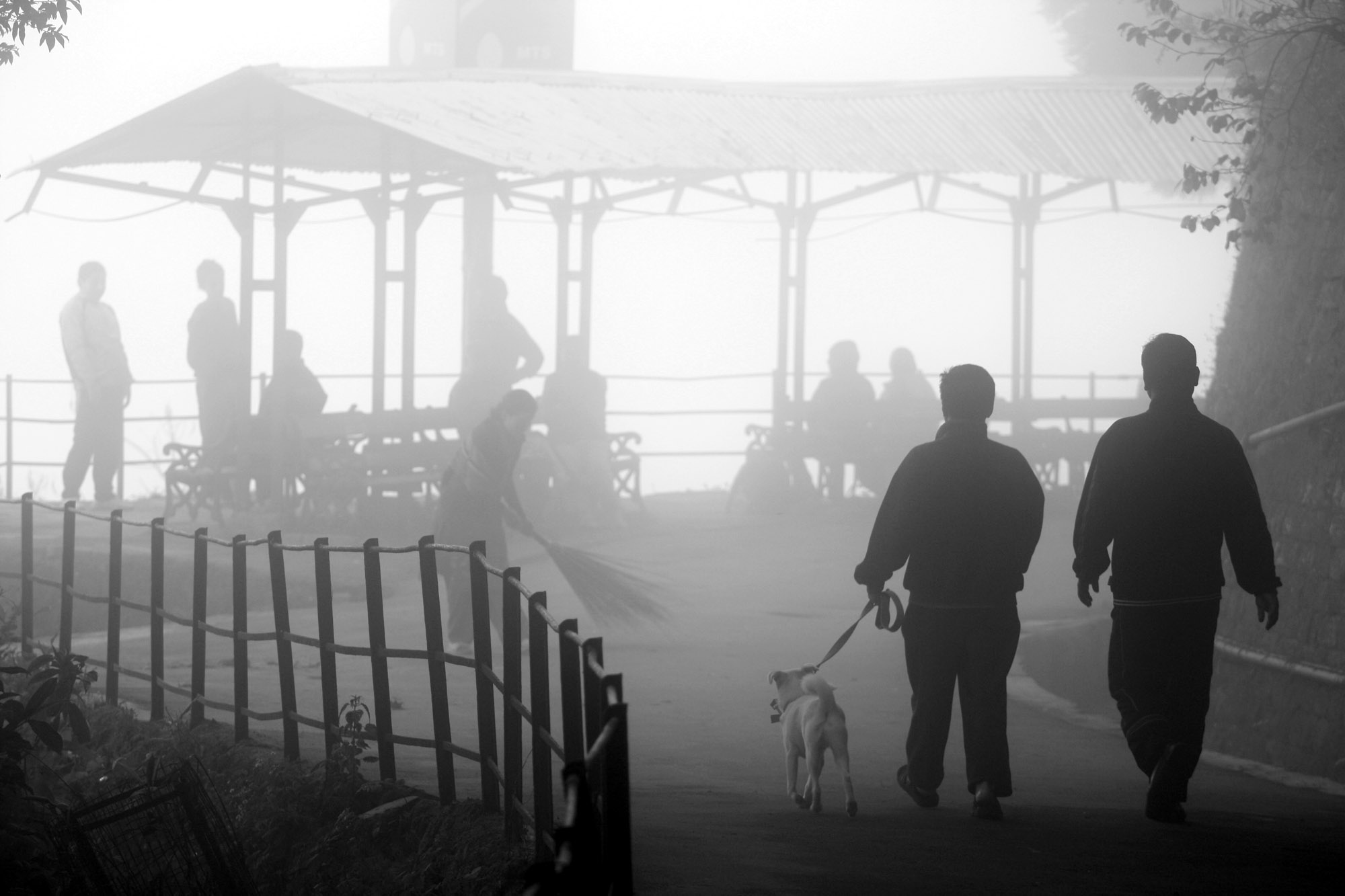
From a distance Athens looked like a dirty, smoggy pile of old white Lego. It was stinking hot at nine in the morning and Dirk’s eyes stung from the fumes. The sunlight was tungsten and sepia, and it was hot, damn hot. He was sweating as he reached the train station. There weren’t many trains in Greece, but there was a line heading north and that’s all he cared about. The train station was dismal. Birds shat through the heat wobbles on the burning lime of the tracks. He felt it all in his skin, like a car had been blowing exhaust on him for half an hour.

“No tickets here,” said the lady at the window. “No sell tickets.”

“This is the train station?” asked Dirk. “But you don’t sell tickets?”

“No sell tickets. Ticket office in town.” Dirk thought he was in town. She waved her hand several times back the way he had come. If she’d waved it only once he might have thought it was just around the corner, but it was like she was counting off the blocks.

Dirk couldn’t believe it. The heat was driving him nuts. His flight had been at four in the morning and he hadn’t slept a wink. It was a hell of a time for a flight. He got out his guidebook and tried to work things out. There was a place that sold train and bus tickets about six blocks away.

He followed the map and crossed the road. He walked up a long, wide street. There were cross-streets heading off all black and bronze in the sunlight. The air was thick and hazy. People were rushing about and the cars were noisy. All the horns sounded high pitched, like they’d been knackered. Dirk didn’t know what he was looking for. He just stumbled on, feeling more out of the loop than ever. He was so tired that every time he was checked he felt desperate, but he was too tired to panic so he just kept going.

Dirk walked six blocks and found the place. They sold tickets for everything; trains, ferries, buses; a state enterprise of some kind. He walked down the granite steps. It was dark. The lights must be real dim, he thought, or he’d been blinded outside. His eyes began to adjust. The only light came through the back windows, bounced from a dirty, pipe-veined wall behind. It was all dark wood and thick, old glass. It was dusty and the floor a scudded, maroon linoleum. It had “communism” written all over it. He walked up to one of the counters where an old man was sitting.

“Do you speak English?”

The man shook his head.

“Train?” said Dirk.

“No light,” the man said.

He made a gesture, moving his hand up and down like he was holding something, then shrugged.

“Huh?”

“No light,” said the man, making the gesture again, this time accompanied by a clicking sound.

Dirk stared dumbly, like a dog shown a card-trick.

“No light,” the man said once more, but by now Dirk had understood. He was mimicking flicking a switch. There was a power failure.

Dirk walked over to the worn, studded, leather-bound benches across the room and took off his pack. It was ten o’clock now and he was truly beat. It was only half as hot as the outside inside, but still a good deal cooler. He sat down a while, then shrugged and pulled up his feet. He stretched out in the dark corner and closed his eyes. Two minutes later he was asleep.

_______________________________________________
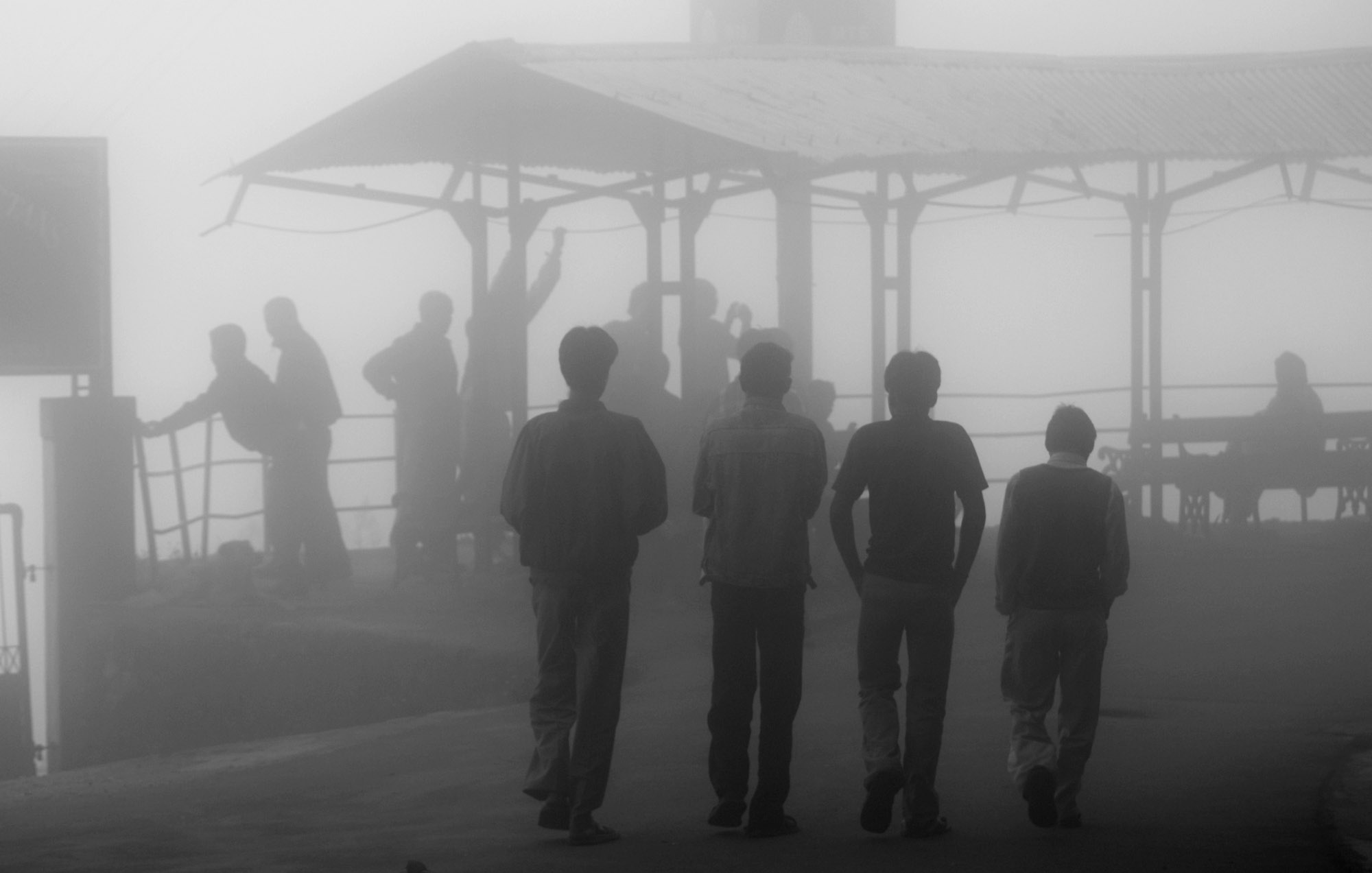
Dirk woke up drooling. He wiped off his mouth and looked around. The lights were still out. He looked at his watch. Midday. He stood up and walked over to the counter again. It was the same old man. Same old game.

“Train?” he said to the man.

“No lights,” the man replied.

Dirk walked away. He was fed up already and he’d just woken up. He took out his guidebook and looked through it again. Athens – Getting Around. He sure was getting around. There was another ticket office eight blocks east. He could take the subway. It was nearby.

He bought a Coke in the subway and gulped it down. He was sticky as hell with humidity and dirty air. He rode down the line and came out in a square he liked the look of. There were palm trees and neo-classical buildings; museums, galleries. Across the square he found the ticket office. The lights were on; it was air conditioned; the place was modern; the staff were young.

The Coke was dragging him up and pulling him through. He waited in the line. The girl spoke English; she was cute, black hair with a square fringe. Dirk fell in love with her in about two seconds, he was that stretched. She sold him a ticket all the way to Thessaloniki. From there, if he couldn’t get a ferry, he could take a bus to Kavala or Alexandropouli. The train didn’t leave for another hour. He would have time to get back to the train station. He walked out of the office, smiling for the first time all day; smiling, just like she loved him too.

He looked around the square, took a bunch of photos, then realised he didn’t have his guide-book. He ran back to the office, burst through the doors and shoved his way through to snatch it off the counter.

“Fuck it,” he said, when he received a few rude looks. He’d never see any of them again anyway.

_______________________________________________

From the subway Dirk walked to the station. His pack was settling in now. It was carry-on sized; a glorified day-pack. A couple of changes of clothes, a pair of flip flops, a Latin dictionary, some translations he had to make, his diary and The Golden Ass, by Apuleis. He travelled light and washed things as he went. That was the way he liked doing it.

At the station it was hotter than ever. He saw a sign saying thirty-nine degrees. Crikey. The air was acrid, unpleasant; a flatulent pall. Dirk went into the washrooms and cleaned himself up. He washed his face and slicked his hair. He wet his arms and legs and worked all the sweat and fuel and dust off. He dried himself with his beach towel and went back outside to wait. He felt good now. He bought two Cokes, three bread rolls, two apples, a block of chocolate and a packet of smokes from the station shop. He sat on a bench and smoked. The cigarette gave him head-spins, but it tasted great. He noticed people were buying tickets from the ticket office. The shock left him briefly unseated, but he soon ceased to care.

The train was only ten minutes late – one thirty-five. There weren’t many people at the station, but the carriages were near full. It was an old train and smelled of old train; soot and diesel and hot, greased metal. Dirk climbed up and walked by the compartments. They all looked full. He kept searching for an empty one. He didn’t want any conversation, just to smoke and look and put some music in his ears. He found one with just two people in – a pair of young Greek blokes. They looked hip and Dirk wondered if they were going where he was going, all the way to Samothraki. They were sitting by the door, not the window. Dirk went through and took the view. He was stoked to get the window.

_______________________________________________
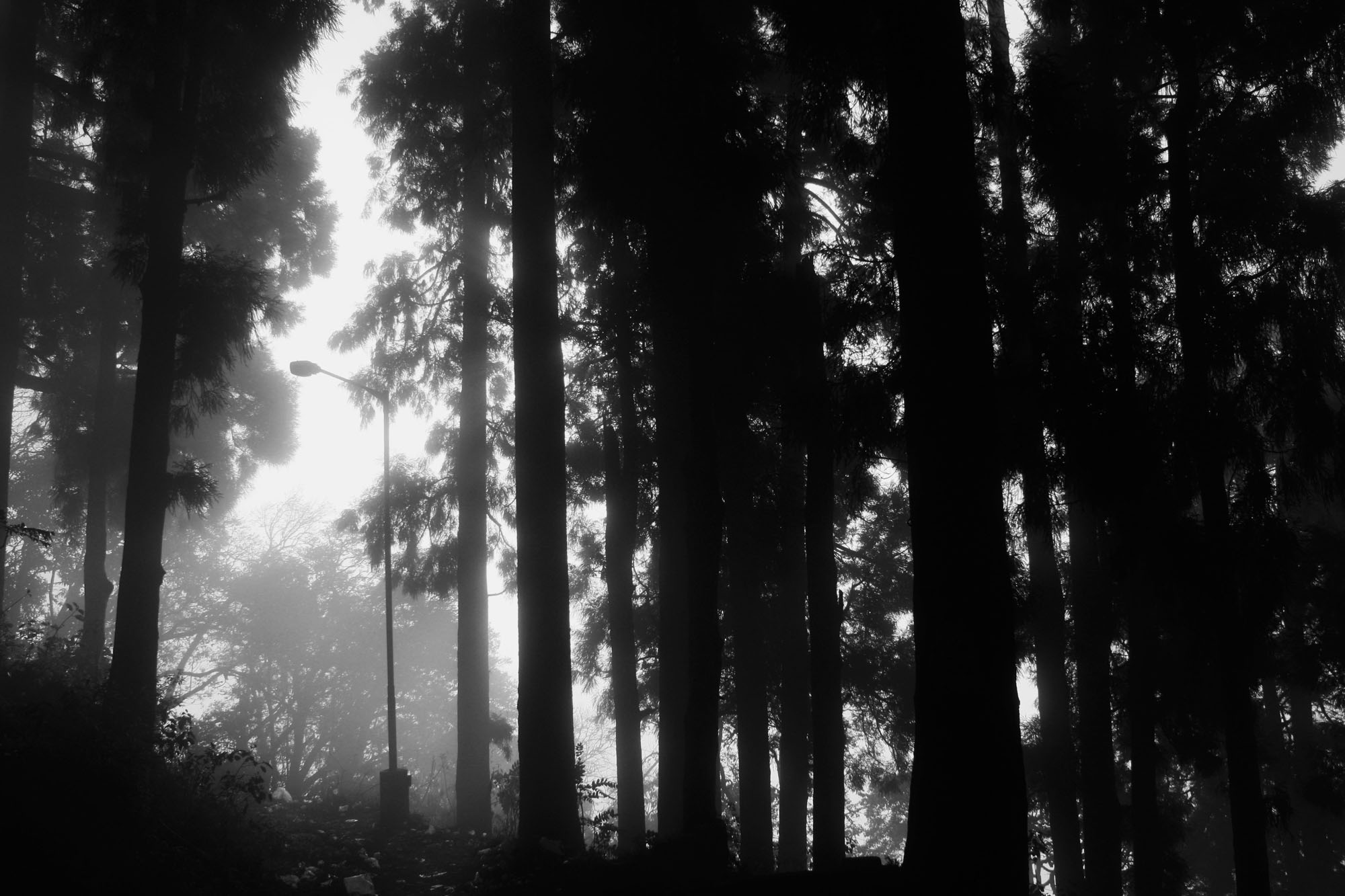
Four hours later they were high up in a rocky land and everyone in Dirk’s compartment was asleep. It was full now and the guy sitting opposite had slumped like a dead man. He was covered in sweat; completely drenched with it. Dirk had never seen a bloke sweat so much in his life and it made him uncomfortable just looking at him. His clothes were dark with it, dripping.

Dirk got up with his walkman, his smokes and a Coke and went into the corridor. There were guys leaning out the windows down its length and Dirk pulled down one of the long, rectangular windows. He lit up a cigarette and leaned his elbows on the frame. It was just the right height. The wind blew in his hair and he rested his eyes across Thessaly. Dirk had been around Greece before, but never up through Thessaly or Thrace. He was excited about the terrain and thought a lot about hoplites and partisans. He also thought a lot about donkeys.

They passed over a gorge on an iron bridge. The soil was white and orange and the rocks white and orange too. The trees were spindly; hardy and evergreen. There were clumps and spills of shrubs and bushes, with the white rock and soil in between like bald patches. The land rose and fell with this forest and scrub and rock and Dirk caught glimpses of distant, cultivated plains through the gorges.

He watched the train ahead as they took the turns. Rafina was another day, another life. When he looked back on the dawn’s disappointment, it wasn’t real after all. He smoked his cigarette and a guy up the front looking back gave a wave. Dirk brought his hand up in a salute. Hey, they were all comrades here. Everyone on the same trip. The camaraderie of the road. Dirk was smiling now. He lit up another cigarette and put on his walkman. Dark Side of the Moon. He wanted something epic; something to reflect the day’s quiet desperation. There was still a long way to go. He would eat some chocolate now.

_______________________________________________
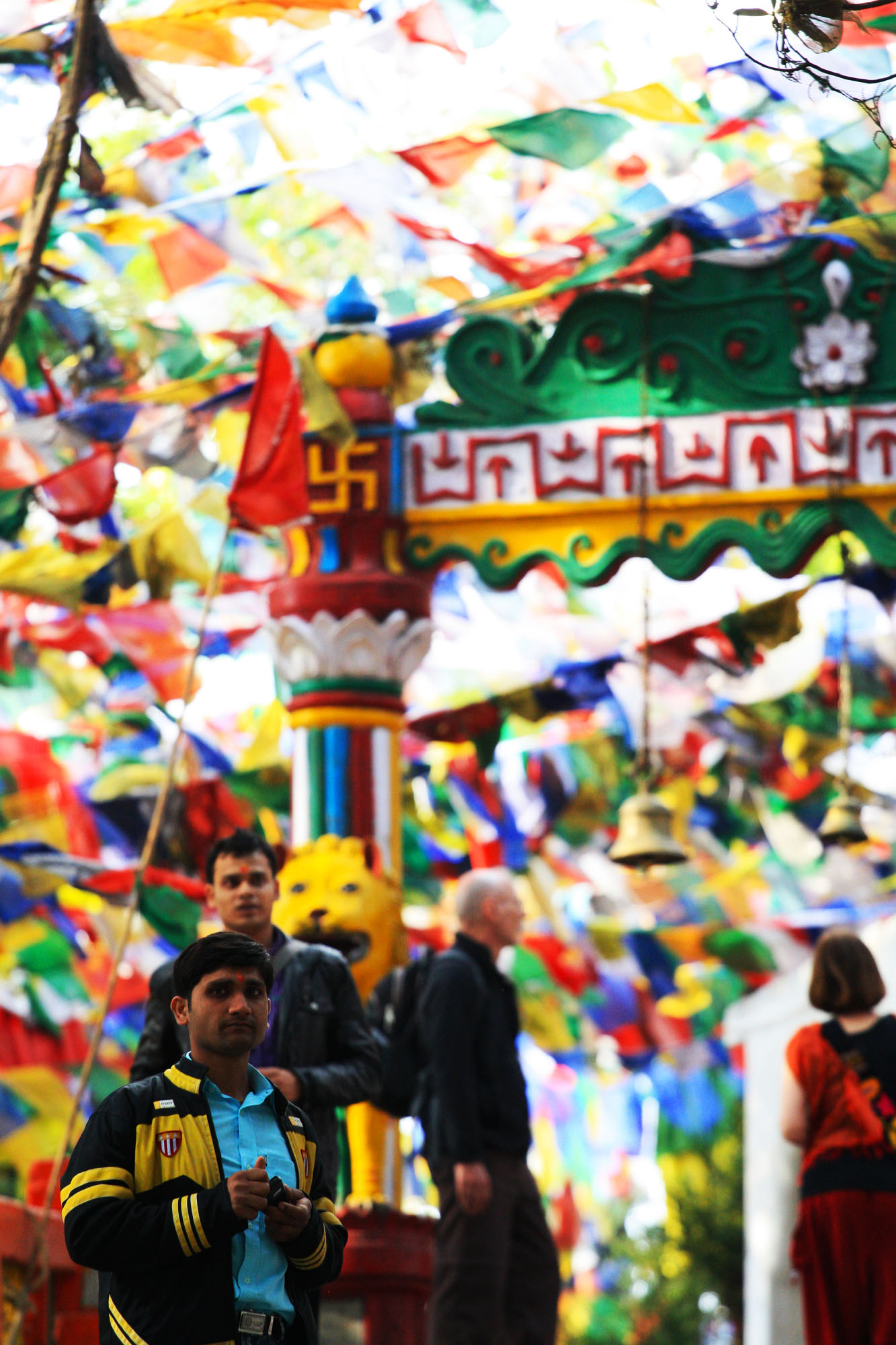
At Thessaloniki Dirk took a hotel right by the train station. He was all washed up and wanted an easy finish and an easy start. The town was boiling hot. The concrete and bitumen and stone still poured out the day’s heat. The air was thick with pollution. Unlike the acid sting of Athens, it was a roiling, eggy flatulence. Dirk took a shower and lay down in his towel for five minutes. He stared at the ceiling blinking.

Though it was dark, Dirk hauled himself up and went out to see some Roman remains. The Arch and Rotunda of Galerius were a good leg from his hotel. He was pleased not to have to carry his pack. He followed his map along the main drags and took a couple of detours to look into the harbour. It wasn’t so neat, he thought, but the air was cooler. There were palm trees. He always liked palm trees.

Dirk stopped by the clumsy, weathered reliefs on the arch and smoked cigarettes. He hated the late third-century style. It was too thickset and graceless. It wasn’t just the way the stylization robbed the figures of detail, but the compositions were poor; cluttered and syncopated. Dirk smoked and thought about rhythm. He never liked Galerius anyway. “You were a bit of a cock, Galerius,” he said. Then he went back to his hotel and went straight to sleep.

In the morning Dirk rose early. He felt travel-fit after a day of errors. He was rested and sharp. “On the ball,” was about the only thing he said all morning. He took a walk through town to look at the churches and see the Roman structures in the daylight. The rotunda was closed this early so he missed the mosaics. He found a fifth-century church that had been so rebuilt and renovated, it might as well have been late medieval. He gave up and went to a café. He ate eggs, toast, coffee and fried potatoes. He mopped up the grease with heavily buttered bread. He drank a second coffee and smoked two cigarettes. This morning was cooler, clearer. It felt like he’d pulled all the stuffing out of his lungs. He walked down to the harbour and asked about ferries. There were no ferries to Samothraki. He would have to try Kavala or Alexandropouli. He’d figured on that anyway and left town.

_______________________________________________

Dirk reached Kavala at noon. It was the prettiest place he’d stopped so far. There were a lot more older-style houses. Up on a hill, on the northern side of the harbour, was a fortress, with pre-gunpowder battlements and crenulations. The sun shone clear, without haze. The air was fresh. There were palm trees amongst the red roofs. He liked the colours. The sun on his face made him smile.

Dirk walked around all the ticket offices and asked about ferries. There were two ferries a week to Samothraki and the next one was two days away. He asked about a boat to Alexandropouli. It would be nicer than the bus, but didn’t go for three hours. He was getting impatient again. He didn’t want to get to Samothraki and find all the good stuff was gone. It might take him a day just to find his friends. Hopefully they would have the right gear.

He boarded the bus and sat by the window. There were others milling about outside, finishing cigarettes, saying farewells. Dirk noticed one bloke in particular. His hair was closely cropped and he was wearing an orange and red tie-dyed tee shirt and cargo pants, carrying a large pack. He looked a couple of years older than Dirk – about thirty. He looked like a raver. He was talking to a couple of young girls in an animated, friendly manner. Something about him made Dirk think he was a good bloke.

The bloke boarded the bus with the two girls and two other guys in tow. He was still talking and spoke in English English. They sat down just in front of Dirk and kept up the conversation. The two girls sounded French. Dirk figured they’d not all known each other that long, that they’d met on the road. He liked the look of the two French girls. One of them reminded him of a girl named Juliet he’d had a crush on years ago. The other one just looked French, in a good way. He was certain they were all going to Samothraki. He decided to wait until he was sure.

After five minutes he still wasn’t sure, but he wanted to talk to someone.

“Excuse me,” said Dirk, leaning forward. “Are you going to Samothraki? To Solar Lunar?”

“Yeah,” said the Englishman.

“Yes,” said the girl who looked like Juliet.

“Cool, me too. Do you know about the ferries? I was hoping to get a boat at Alexandropouli.”

“Hope being the operative word,” said the Englishman. “You can definitely get the ferry there, but it’ll be busy.”

“That figures. I don’t suppose you know the times?”

“I don’t. But there’s a few each day. They’ve put on extra.”

“Oh, good, good. That’s relief. I’m Dirk, by the way.”

“I’m Sean.”

“I’m Annette,” said the girl who looked like Juliet, “and this is Milene.”

Dirk smiled. He waved around and through the seat backs. Across the aisle, in front of Sean the heads of the two other guys popped up. “Hello,” they said.

“That’s Numa and Tom,” said Sean. They smiled and sat back down.

“Are you travelling solo?” asked Sean.

“Yeah. I’m meeting up with some friends on Samothraki. I just have to hope I’ll find them.”

“You ought to stick with us. We could use an Australian. I’m sure it’ll all work out.”

“Cheers,” said Dirk. “I feel like I’m finally getting there.”

_______________________________________________

They arrived in Alexandropouli around four. Dirk and Sean talked the whole way. They got off the bus and went straight across the square to a café. They ordered Nescafé frappes.

“I’ve only been in Greece two days,” said Sean “but I can tell you that this is all they drink.”

“So much for Greek coffee.”

Numa and Annette were an item. Numa was from Marseilles. He was thin and darkly tanned, with long black hair tied back. He looked like a pearl diver; pointy, like a spear gun. Annette was thin and pale and from Orleans. She too was thin, sinewy, but when she smiled she fleshed out with the softening. Dirk liked the way her hair fell. Milene was Annette’s best friend, also from Orleans. She didn’t speak much English and acted like a sidekick. Dirk’s French was poor. He knew he had some work to do, but he wanted to do it. She wasn’t wearing a bra. He could tell she was nice.

Tom was from Hamburg. He was quiet and kept his eyes down. He wasn’t so trusting, but he was learning to be. Dirk figured he fancied Milene as well. Fair enough. She might well sting them all. Sean was from Sheffield. He was an ex-army private; a mechanic; a writer. He D.J.ed in clubs in Liverpool and Manchester. He knew what he was doing and was organising the others. He and Tom had been travelling alone. They’d all met in Kavala. They finished their drinks and hit town.

At the ferry ticket office, the queue was out the door and down the street. It was a real bustle. They drank tinned beers and everyone checked each other out. They got tickets at sunset with the lights on in a hot press: two PM the next day. Dirk looked about for his friend Julian and his brother Jason, but couldn’t find them. He thought about a hotel room. He didn’t have a sleeping bag. It was a hot August. He’d been promised a tent berth on Samothraki. He figured he could pull through till then. He chose to save money and sleep rough with the others.

They bought supplies and walked to the harbour beach. It was thick sand and scrubby clumps. They laid out groundsheets and foam rolls and sleeping bags. Dirk lay down nothing. He put on two tee-shirts and a jumper. He figured he’d be fine if it stayed warm. They talked about life and work. Dirk liked them all and they seemed to like him. They got half drunk then called it quits.

At ten o’clock the sun was gone and with it went the heat. The moon was thereabouts full and lights shone bright from a shipyard further down the beach. Dirk took a walk to look at the yard. There were hungry dogs barking all around, but they always sounded far off. He came to a wide wire-mesh gate in a tall, shabby iron fence. The light was orange and yellow and leeched the colour from everything. The only colour he could see was rust; rust and dirty sand; rust and dead yellow grass. There was a great pile of iron and chain and junk. Scrap. He stared into it and listened to the junkyard dogs. He took a piss on the fence and walked back.

That night he shivered like hell on the sand. He put on another shirt and borrowed a sleeping bag cover for a cap. He lay in the light breeze, thinking how he’d done this twice before, in Turkey, in Sardinia, and both times it was stupid without a sleeping bag. Then Sean pulled him in and said, “get under here, you dill, and don’t get any ideas.” Backs together under a plastic sheet, heads on a pillow of sand, Dirk slept.

_______________________________________________

Seagulls skimmed the flecked wake of water, hunting the fish chased up in the foam. The day was bright and everyone felt happy. Sean was at his best, cheery and jibing. Dirk was smiling, but thinly spread, too much so to chase Milene. He leaned on the rails and stared at the sea, throwing in his odd two cents worth. He’d spent the morning baking and thawing in the sun. Now the sea was clearing out the drowse. He was thinking about Julian. How would he find his friend? Soon Samothraki’s tall Mount Fengari arose from the haze with its forested crest.

Kamariotissa spread with the wash of arrivals. They gushed out into the car park and broke against the shops. Dirk and the others flowed with them, down to the main promenade.

“The shopkeepers can’t believe their luck,” said Sean. “Two and a half thousand people on the whole island, and bang, seven thousand customers arrive in a couple of days.”

“They probably hate us,” said Dirk.

“Only the spoilsports.”

The buses were ready and waiting. It was a few miles to the campsite and the fare was next to nothing. The bus was jam-packed full of ravers; a mess of colour and language and accents. It took just twenty minutes. The land was olive green and ochre, with yellow and pink-red flowers. The sea was both blinding and dark. Where it did not foam or glint, it was deep bruise blue – how it should look in its belly; how it would look to the drowned. It flashed through the trees as they sped.

They got off at a dirt road that led into a forest. There were rainbow banners and police out the front. Through the gate and down the road was an open space swarming with people. There were low concrete buildings and dust in the air. The ground was rocky, clay, dirt. There was hot food and cold snacks, hot drinks and booze, massages and aromatherapy, candles, tarot, first aid, come down, pick up, meditation and left luggage.

“It’s all happening,” said Dirk.

They looked at the message board by the cafeteria and found nothing. They walked into the forest, down towards the beach.

“If I don’t find my friends today,” said Dirk, “can I crash with you guys somewhere?”

“I have a space in my tent,” said Tom. “You can stay with me.”

“Thanks a lot, man. That’d be great.” Dirk had bought a cheap sleeping bag that morning.

They walked for a mile through the forest. Tents were pitched everywhere; hammocks, lean-tos, wigwams, tarps; there were hardly any gaps between the trees. It was a new settlement, the largest on the island, more populous than the main town. They soon came to one of the two main stages. There was just a small clearing before it, and the trees formed a swaying canopy overhead. There was music playing, but things were still being set up and only one lone tripper was dancing. The party was to begin that evening.

They continued through the forest until they came to a much larger clearing, almost a hundred and fifty metres wide. Here the main stage had been set up, roughly a hundred metres from the water. Tall, triangular sails formed a clever and colourful roof above the speakers and equipment. Flags fluttered from the tops of poles, and, behind it all, rose the forested crest of Mount Fengari.

They finally found a spot between the two stages and began to set up camp. It was dark and surrounded by trees; just enough room for two tents. Sean planned on sleeping in the open. In fact, he didn’t intend to sleep at night at all. None of them really did.

_______________________________________________

It was dusk when Dirk spotted Julian. He was walking to the beach, coming up a rise from a grassy dip before the shoreline.

“Hey Julian!” he shouted.

“Dirk,” called Julian, “I thought you’d never make it!”

“Here I am.”

They walked over and embraced. Julian wore red and black board shorts, a black tee shirt. He was dark-haired and tanned. His face was slim, though his frame was built and full.

“Well done, man,” he said.

“Well done yourself,” said Dirk.

“Where you at?”

“I met a bunch of cool people on the road and pitched in with them. Not too far from here. Over that way. Where’s your lot?”

“Over that way. We’ve got a top spot, bru. You should move on over.”

“So there’s room?”

“Of course, bru. We’ve been expecting you.”

“Excellent. I might get my stuff right now. It’s not far.”

“For sure. I’ll come with you. I was on my way to get Jase, but he’ll be cool.”

“Okay, let’s do it now then.”

“It’s good to see you, bru!” said Julian. He slapped Dirk on the back.

“It’s a hell of a relief to find you. It’s been a bit of a mission so far.”

“You love missions, don’t you?”

“There’s nothing else.”

Julian laughed.

“Let’s get your stuff.”

They set off back to where Tom and Numa had pitched their tents.

“Have we got, you know, the wherewithal?” asked Dirk. “Are you equipped, with the goods?”

“No problems there, bru. We’ve got the lot. Liquid acid, ecstasy, hash, Ketamine, mushrooms.”

“Wicked. How did you pull that off?”

“Friends in low places.”

“Top notch.”

“It’s all back at the camp. Just sorted today. I’m holding off for tomorrow though. I’d like to start fresh in the morning. We’ll talk about it later.”

They found Tom alone, organising his tent. Dirk introduced Julian and explained that he was moving.

“Sorry, man, I feel like I’m abandoning you,” he said, pulling his bag from inside the tent.

“It’s no problem,” said Tom. “I’ll come with you. Show me where you’ll be.”

“Yes, make sure to tell the others.”

They set off through the forest.

_______________________________________________
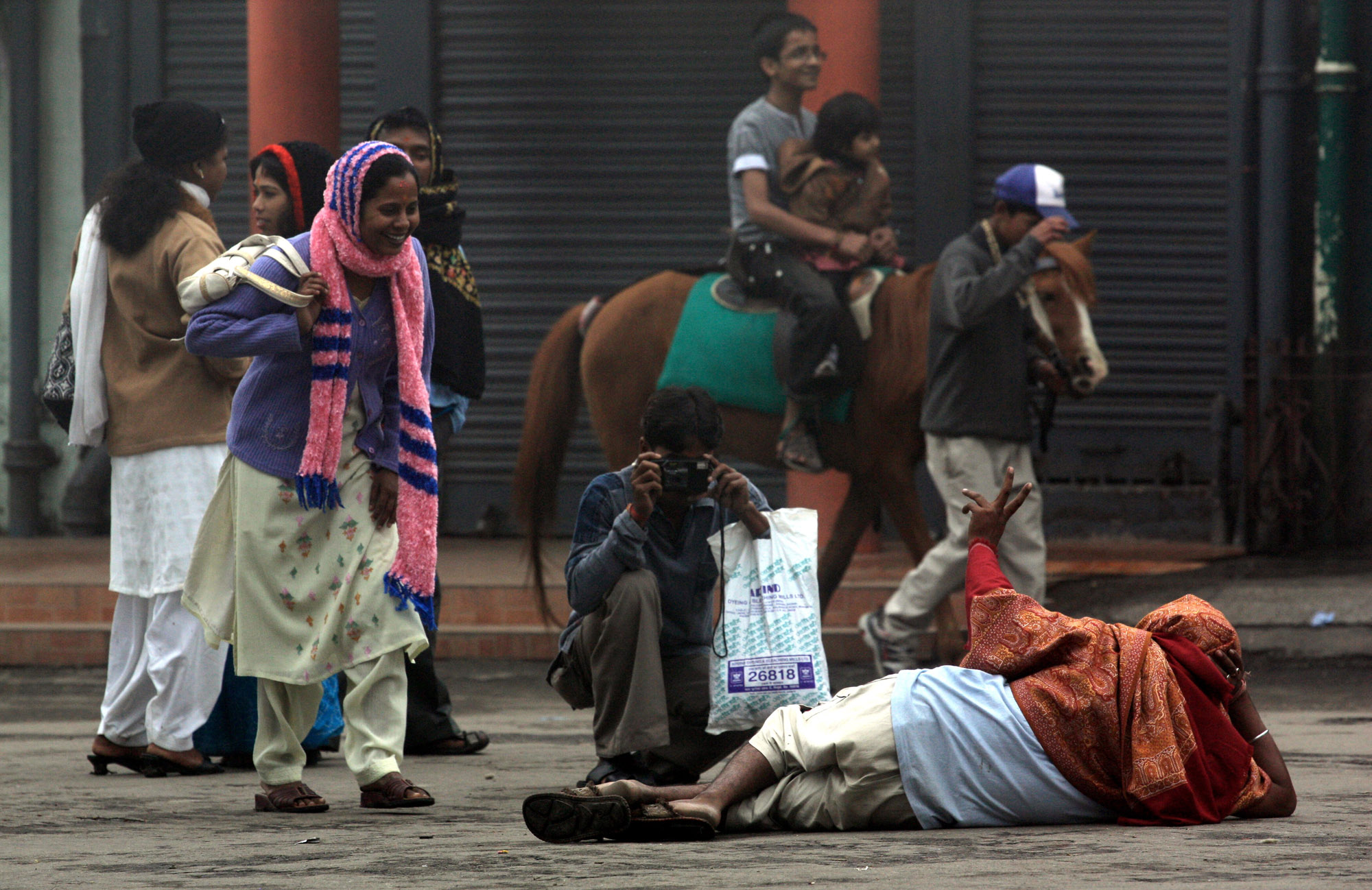
“This is the laager,” said Julian.

“Cool spot.”

They were just a few hundred metres from Stage One. There were five tents, all facing into a circle; a hammock, a clothes line, a stone fire circle and some wide, woven dog blankets. There were also three men and a dog.

“This is Ian, Andrew and Pieter,” said Julian, “and this is Dirk and Tom.”

“Hi.”

“Hello.”

Everyone smiled. It was genuine.

“And that, my friends,” said Julian, “is Brutus the dog. He likes a bit of hard trance, but mostly he likes sleeping. Speaking of dogs, my brother should be along sometime soon. You know Jase, Dirk. There’s some other people staying here too, you’ll meet them soon enough. We all got here yesterday morning. Prime real estate.”

“It sure is.”

They talked for a few minutes and shared their adventures so far. It was almost dark, so Tom stayed just a short while before excusing himself.

“I’ll tell the others where you are,” he said as he left.

“Make sure you do.”

“So,” asked Dirk, once Tom had left, “is anyone here not South African?”

“Brutus,” said Julian. “And Hilda, who owns him. She’s Dutch.”

“That’s pretty close.”

“Don’t worry,” said Andrew, with a sinister lisp, “we’re non-discriminating.”

“Et tu, Brute? Non yarpie est?” asked Dirk, sitting down with Brutus. He was a big, piebald mutt with a thick skull and slow manner. Dirk took an instant liking to him and patted him a good deal. Brutus put his head in his lap and Dirk lay down on the blanket. He was feeling beat again and decided not to go anywhere or do anything for a while.

“So you’re from Cambridge too?” asked Ian.

“Yeah, same college as J. Where are you guys all from?”

“In England?” said Pieter. “We’re all from London.”

“In our own way,” added Andrew.

“Different parts,” said Ian.

“Otherwise, Capetown or Durban.”

Everyone had their shirts off and were tanned. They were all good-looking men; handsome, fit and toned. Dirk could tell just looking at them that they were capable. It was a good tribe to join and he was happy right where he was. He felt safe. The trance music pumped across the Stage One clearing and through the trees. The music would never stop. How would they ever sleep? Right now he was so tired he figured he’d drop off anyway. He closed his eyes.

“You off to sleep already, boet?” asked Julian.

“Looks like it,” said Dirk. “Just give me a bit. I’m spent.”

“Sure thing. There’s plenty of days ahead. I’ll wake you in a bit.”

“Do that.”

“You want some of this?” asked Ian.

“What’s that?”

“Hashish. The world’s best painkiller, bru.”

“Sure, thanks, man.”

Dirk sat up and leaned over. He took a few pulls on the joint and handed it back. He lay down again.

“Say, it’s damn nice here. I might just sleep out with Brutus tonight. It’s lovely.”

“Go for your life,” said Julian.

Dirk felt the hash come on like a massage. Up through the trees he could see the stars emerging. The sun had dipped below the fading, orange horizon. There was no breeze and the earth was dry and warm. There were soft needles on the sandy forest floor. He reached out a hand and ran it through them. He was on a nice flat stretch. Brutus nestled in with a meaty grunt. He’s a first-rate dog, thought Dirk. My new best buddy.

The stars grew brighter. Dirk closed his eyes and listened to the voices about him. Julian was off to find Jason. Andrew and Pieter sounded gay. Ian was smoking a cigarette. Was it just ravers, he wondered, or had some great good fortune thrust him in amongst the nicest, most welcoming, friendly and easy-going people on the planet? And dogs, he thought. Easy-going dogs. He emitted a high little giggle and fell asleep.

_______________________________________________

It was Jason who woke Dirk. “Laka, bru, it’s good to see you,” he said, pulling him from his slumber to his feet. They had met previously in the thick of some hard-core nights and had the bond of having seen in dawns together. They were both younger brothers and knew just what this meant.

“It sure is good to see you, Jason.”

Once he was up, Dirk decided he had better find Sean and co. He walked the twenty metres to the beach, washed his face and hands, walked back, changed clothes, then led Julian, Jason and Ian to find his other friends. It was Tom who sent them on to the cafeteria, by the entrance to the site.

Dirk did the introductions, then sat at the head of the table and watched everyone mingle. He smiled at the way Sean and Julian singled each other out. They were similar beings. It was animal; both of them leaders. One ex-army, the other ex-Olympics. It was not in any way macho, but diplomatic. They both held assurance and wisdom; could sense the other’s inner disciplines. Instead of boasting or posturing, they praised. Dirk admired them both. He tried to admire all the people he liked and felt he could learn from. He watched as these people enmeshed. It was he who had brought them together. Perhaps he too was a leader.

Milene sat at the other end of the table with Annette; still the sidekick. They were like Ernie and Bert in their stripes. Dirk watched them as he spoke to Ian and Numa. He felt further away than ever from Milene. Across the table, across the language. He had thought about her a lot because he knew the advantage of introductions. Proven safety; vouchsafed goodness. She had already seen that he was at least okay; a good person.

Dirk took up his camera to take a photograph of the group. He wanted to record this coming together. It meant a lot to him. He saw Milene watching him. He saw her looking into the camera when he peered through the viewfinder. He saw how she was the only one who had noticed. He saw how she smiled at him. He took the photo and roused everyone with the flash. Milene continued to smile and he smiled back. She really was sweet. It was her manner. Her eyes. That’s where you look for intelligence, for kindness. He wished to god his French was better. His moves were all conversation. Without the words, she was totally out of reach. He’d never been with a girl without a spoken understanding. He put away the camera. He knew he’d already given up. He knew that he would not dance with her, in case it came down to it. He could not be so mute and then physical in love.

_______________________________________________
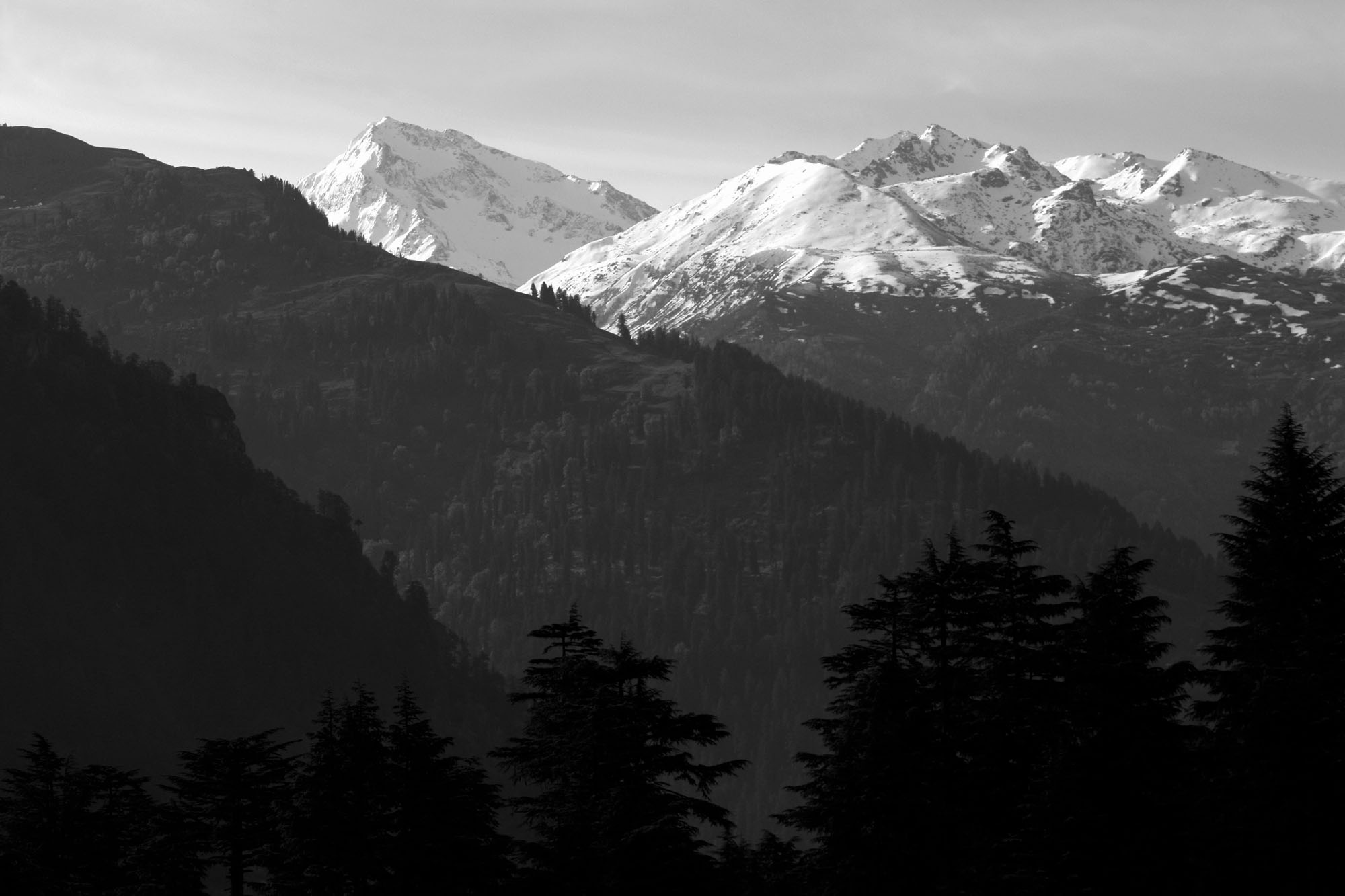
The water was still. Dirk and Julian were sweaty from dancing. To their hot bodies, the sea was a lukewarm bath. They swam beyond their depth and back, scoured clean with salt. The full moon hung over Mount Fengari. It was so bright and the sea so still they could see the rocks underwater for thirty metres. The air was warm, much more so than the previous night. They sat on the round rocks dripping.

“I want to go up to the mountain tomorrow,” said Julian. “We should get up early, bru, go for a swim, take some acid and walk into the mountains.”

“Have you been up there yet?”

“Not yet. But I spoke to people who went up there today. There’s cool mountain pools up there. Streams and pools called ‘Vathres’. There’s ancient trees and goats, man. Goats.”

“Excellent. I love goats.”

“This is ancient Greece, bru. Up there it hasn’t changed. Just set your mind back.”

“I already have. I’ve been thinking a lot about the ancient world since I got off the plane.”

“Tomorrow we’re going back in time. We’ll go into the mountains and look for the past. Not in monuments, but in nature. The one thing from the ancient world that is exactly as it was. At least here, anyway. This used to be the home of the ancient gods, bru. There is a shrine to the old gods on this island.”

“I know, I know. The Shrine of the Great Gods. But it’s miles away from here.”

“It wouldn’t be the same anyway. Just a ruin. The Greek gods came from the landscape, from the mountains, from the forest. From nature. That’s no ruin, let me tell you. Tomorrow we’ll go in search of the ancient world, bru. The landscapes of Heroes and gods.”

“On acid,” said Dirk.

“On acid.”

Dirk rubbed his hands together. He was excited. He shivered.

“We’d better get some kip then,” he said.

_______________________________________________

Dirk woke at six thirty, at sunrise. The beats were pounding out as hard as ever. No one else was up; not even Brutus. He smelled curiously fresh, like a warm bread roll. Dirk smoothed the dog’s ears and gave him a kiss on the forehead. He slid from his sleeping bag. He picked up his towel and walked down to the beach. He was still in his board shorts.

He walked down into the water and lowered himself in its coolness. He lay on his back to float and look up at Mount Fengari. There was a thin mist around it so the top was a ghostly outline. He could just make out the textured layers of forest. Beneath it all, right before him, was Stage One with its kites and sails canopy. In front of that was the hoard of non-stop dancers.

Dirk looked along the beach. There were three huts constructed from branches and fronds. They had a feathery look, like crouching beasts. Scattered people sat and smoked or swam. Many still slept.

Dirk looked again up to the mountain.

“See you soon,” he said, then swam back to the shore.

He walked back into the laager to find Julian and Jason were up.

“Morning, sport,” said Julian. “I was just heading down myself.”

“It’s beautiful. Today is going to be a scorcher.”

“Come have another swim, bru,” said Jason. “Then we’ll get some breakfast.”

“And after breakfast,” said Julian, “we can begin our initiation into the mysteries.”

Julian smiled a luscious, suggestive smile, replete with the prospect of physical and intellectual decadence.

“What the hell,” said Dirk. “Another swim can’t hurt.”

_______________________________________________

They came off the burning bitumen into the shade of the sycamores. There was a trail through the dry scrub leading to a riverbed. The hot air followed them in. They were five: Jason, Julian, Ian, Andrew and Dirk.

Dirk breathed in all the crackles and clicks. The sandy soil turned to gravel as they stepped into the dip of the river. There was no water at all, yet once in the bed itself the space was cool. It came not from the shade but from the blue-grey boulders. They were soft in the mottled light; as soft as blu-tack. The riverbed was thick with roots that clasped these rounded lumps.

“Awesome,” said Jason. “These boulders, eh?”

“Yeah,” said Dirk. “The place is strewn.”

The acid was climbing in all of them. Ian, who had chased his drops with mushrooms, was coming on quicker than the others. Dirk, who had taken ecstasy as well, felt a nervous, fervid ripening. All their eyes were widening, their perspectives shortening. Time was slowing down; the world was tinged with a lush desperation. It was accruing a tantalising intensity.

Andrew was soon engrossed in his own game. It was his birthday and he wore a purple shirt. All morning they had called him Augustus, yet now he was crouching and slithering, hands spanned. As they drifted silently up the gully, he prowled and hissed amongst the rocks. It’s Gollum, though Dirk, not the emperor. Gollum looking for his precious.

Dirk came to a ten foot high rock about which the river had split. To the top of it clung a tree; a crooked, gnarled sycamore. Nursed in its thick clutching roots, heaved above the dry river, was another of the blue-grey boulders. Unlike ancient cities where the layers accumulate, here the ground had been lowered, eaten by the river. Dirk stood before it in awe. It was natural history. The tree coiled upwards like smoke, roots spreading in ringlets. He had never seen such curly trees; the gnarls were like twists of bread, the boulder a set gem. The roundness of both; river-smoothed rock, weather-rounded tree. Already he was thinking too much. He was moving forward, slowly, across the mottled light, descriptive words unfolding in his mind; the dappled light, the ochre leaves. The words had a tangibility. Of course they did, the things they described were actual. Dirk had never seen a place so dappled. “So dappled,” he sang. Sunlight lay like dropped gold coins.

They walked on up the riverbed, beneath the spotted canopy. The acid was powerful; the ecstasy and mushrooms were powerful, were growing more powerful. The men were all engrossed and hardly spoke. When they did it was exclamations, exhortations to come see what they had just seen; were seeing. This tree. This rock. “Look at this. At this!” They all looked. They were all in agreement. It was all incredible.

They soon spread out; walking at their own pace. Gollum stayed back. He was taking his time. His birthday. He stopped and went even lower to the ground. He lay down, gathered up leaves and pulled them over himself like a blanket. He found the earth so close and wonderful. It was an embrace, a burial, a return. The others soon lost sight of him.

Dirk forged on ahead. For him it was everything; the trees, the leaves, the light, the blue-grey rocks. His hearing grew more acute as his eyes rolled. He was breathing in colour, inhaling the things that he saw, hearing the colours, each had a different hum, smelling the colours, tied to times and scents. His nerves were crossing over into the bliss. The transition had passed, the come-up, the rise. His body had ridden the shock of the drugs. He was starting to soar. He was blissing out. He was peaking.

Dirk came to a large pool of water. At the other side of it the gorge rose up sharply in sheer rock walls. The cover of the trees ended. The pool could only be crossed on foot. At the other side they would have to begin climbing up the rock through the path of a stream. Dirk took off his sandals and put his feet in the water. It was silken, thrilling. He shivered as his body pulsed and rushed. He sat down to wait for the others. He wanted a cigarette, yet it was complicated. He took off his shirt and put it in the small satchel he was carrying. He wet his hands and washed his face, ran water through his hair.

Julian caught him up. “Where’s Andrew?”

“I don’t know,” said Dirk. “Last I saw he was hissing about the rocks.” He laughed nervously. The thought of it, the sight of it, was so ridiculous. Just what was Andrew playing at?

Ian was beaming, rubbing his hands together. He’s elsewhere, thought Dirk, but he knows to stick with those who have a purpose.

“Let’s go on,” said Jason. “Keep climbing. Follow the stream. There are more pools up ahead.”

He pulled off his trainers and plunged straight into the pool.

“Come on, you oaks,” he said.

Julian followed, Dirk and Ian followed. The bottom of the pool was smooth mud and rock. They came out between narrow walls of rock. A tumble of boulders led up through the gorge and without stopping, led by Jason, they began to clamber up the rocks.

They came to a tall slope of granite. Water rushed by its foot. They walked crab-like up and along it to emerge at its rounded top. On the other side the blue-grey rock sloped down in smoothed humps and ridges to a pool.

“Jesus,” said Ian. “Look at that.”

There was a small waterfall spilling into the pool. Dirk shook his head in wonder. He felt tearful. It was so beautiful. And then they heard it, the sound of a light bell clanging. Dirk looked to his right and there, just fifteen feet above the pool, on a narrow ridge running along the side of the gorge, were three goats.

“Goats!” shouted Dirk. “Look, Julian, goats!”

“Goats!” shouted Julian.

“Goats!” shouted Jason.

Dirk was near hysterical with excitement. The goats were plodding along, not minding at all being spotted. Their shaggy coats hung down between their legs in brushes, their ears bounced and flopped; their narrow faces soft as felt. One of them stopped and sniffed the air. Then it began to descend the slope, towards them. It was not afraid. It angled away, aiming for a place a mere ten feet from them. There they saw an orange lying on the rock. Someone must have dropped it. The goat went to it and sniffed. It began to jaw away at it; lips rippling in a curious, rolling motion.

“I love goats,” said Dirk. “They’re just so classic.”

Julian erupted in a great laugh. Once he was started, he was off; laughing loud and long. He laughed so hard he was clutching his belly. Ian and Jason began to laugh too, though they did not know at what.

“Classic?” said Julian. “Of course – classic! They’re the most classic thing here!”

“Oh my god,” said Dirk. “Of course!”

“This is it, bru,” said Julian. He sent an arm flying out and slapped Dirk heartily in the chest. “We’ve made it. We’re in ancient Greece!”

“Fucking brilliant!”

“We just need a goatherd or two,” said Julian. “And an eclogue. You can’t have an eclogue without goatherds.”

“What about a parable?”

“The parable of the goats?”

“It could work,” said Dirk. He was snorting and giggling, hysterical little laughs. It was all too much.

They fell silent, watching the goat again. The goat was well into the orange. It was lapping up the sweet juice, gnawing through the rind.

Jason, meanwhile, put down his shoes. He shed his satchel and moved to the water’s edge, then hopped in.

“Woooo!” he shouted. “Check it out.”

He was up to his neck in the water. It was deep and pure. He swam over to the waterfall and let it spill down on his head.

“Paradise,” he said, “it’s perfect.”

The others were very quick to follow. They soon forgot all about the goat.

“This is paradise, alright,” said Ian, once they were all in the water.

“It sure is,” said Dirk, emerging, head dripping from a plunge.

“Though I have to say, it’s a bit nippy in paradise.”

_______________________________________________

They reached the top of their climb. They could go no further without more equipment or daring. The rock they were climbing poked out like a triangle, above a deep pool, forty feet below. On either side the walls were sheer. Across the other side of the pool was another sheer wall. Walking along its edge was a stunning blonde in a yellow bikini. She was tall, lithe, busty. Dirk was astonished. They were all astonished; reduced to an awed snickering.

“Jesus Christ,” said Julian. “I can’t believe it.”

“Is she really that beautiful?” asked Dirk.

“I think she is.”

She moved about playfully, unafraid of tripping or falling. They had passed other people in the last stages of their climb; a man, meditating furiously, cross legged on a ledge; another tanned and soft where he lay, asleep. They had stopped and watched and people caught them up.

“She must be a nymph,” said Julian. “Look at how well she walks along the rocks. She’s so natural.”

“But in a yellow bikini!” said Dirk. “Gods, man, it’s killing me. I just can’t believe what I’m seeing. I don’t think I’ve ever seen anyone that beautiful in my life.”

“She looks Greek,” said Jason. “She’s just glowing. Check her out, bru. She’s really, seriously fucking good.”

“Nymphs,” said Julian. “Nymphs!”

The nymph in yellow sat on the edge of the cliff, beaming. She looked across to the men and smiled. Her eyes were shining; her face shifted blissfully about. The men looked on in admiration. It was lust, but it was also art. The rocks, the trees, the pools, the sky, nothing came close to the nymph.

Julian began to pace.

“I’ve got to get over there,” he said.

“What are you going to do?” asked Dirk.

“I just want to…”

“It’s madness,” said Dirk. “Madness!”

“Look at her!”

“I know, I know,” said Dirk. He wanted to cry.

Julian moved to the edge of the drop. He looked over, looked down at the lowest point above the pool.

“I want to touch her,” he said. He started laughing, a giggly, fragile laugh. “I want to roll around with her.”

“Oh, god man, so do I,” said Dirk. “But it’s madness!”

Ian, who had been smiling and picking dirt from beneath his nails, burst out laughing. Dirk began to laugh too, and Julian, who was already snickering, began to bellow. Big, gulping, laughs. Dirk rubbed his face with his hands. He squeezed his eyes. Was this a sort of torment – the world of myth, yet they could only look?

“I’ve got to look away,” said Dirk. “I can’t stand it any longer.”

He turned and walked back down the slope. He sat on the rock and watched the man who was meditating. He looked cranky. Other people were coming up from behind him, talking loudly. Why shouldn’t they? Who was this prick who thought he was so superior? Dirk was soon joined by the others. They could not stand it either.

They had come as far as they could. What now?

_______________________________________________
Dirk and Julian were in front as they began the descent; both of them caught up in longing. They passed a group of people; more shirtless men. A middle-aged Greek in sandals stood aside to let them through where the passage narrowed. “Yiassou,” he said.

“Yiassou,” said Dirk and Julian.

“Pleasure is art,” said the man, smiling, as he stepped down and walked on.

Julian and Dirk were agog. Had they heard right?

“Did you hear that?” asked Julian, walking on.

“Did he say what I think he did?”

“Pleasure is art. My god.”

“I know. I mean, what a thing to say.”

“What a genius thing to say. How Greek of him!”

“You’re right,” said Dirk. “Think about it. It’s incredible. It’s like some carry-over, some cultural embedding of the ancient philosophies in the people. The man must be an Epicurean!”

“We have to think this through.”

They continued talking along the stream-eked course. They climbed down rocks, swung around tree branches, swam again through pools, talking. Twenty minutes later, as they reached the first pool they had crossed, Dirk grabbed Julian by the arm.

“Hell, man, it just hit me. What if we misheard him? What if he actually said, ‘pleasure is arse’?”

Julian laughed so hard he nearly fell over. He wheezed, barely able to breathe, doubled up, heaving out bellows. His face went red and his eyes were wild and wet.

“Brilliant,” was all he could manage. “Brilliant!” Then his eyes narrowed, his mouth straightened, his face fell cold with realisation.

“Bru, bru – what if what he actually said was ‘pleasure is ars’ – ars, ars, the Latin for art.”

“My god, Julian. That would be about the most perfect Epicurean double entendre in history!”

They shook with the ideas, their hands dancing in gestures.

“What is Greek for art?” said Julian. “Christ, how could I not know?”

“I don’t know, I don’t know,” said Dirk.

“Fuck it, bru,” said Julian. “But we’re going to find out.”

But it was all around them.

_______________________________________________

The canopy thinned and the air grew drier. Before them, over a rise, was a bitumen road. They had emerged from the forest.

They started out down the road. They were in the open air, under the shadow of the mountain. The sun was low and close to setting. It was still warm.

There was a taverna just a hundred metres away. It was built above the road with a wide patio. They walked up the stairs and sat down at a table. The waiter came over.

“Should we put our shirts on?” said Dirk.

“Women wear very little at trance parties,” said Julian, “so why not the men?”

“Can I help you?”

“A bottle of wine, please sir. Red. Anything,” said Dirk.

“Red wine,” said the man then walked away.

“I hope it’s rough. I want something rustic.”

The waiter was back in a flash with the wine and four tumblers. He put the bottle on the table.

“This feels like the end,” said Dirk. “The sun is setting.”

“It’s only because we’re in the shadow,” said Jason.

Ian just kept smiling.

Dirk filled the glasses.

“We’ll drink this and split. Straightaway. Come on, drink!”

They picked up the glasses and tipped the wine straight down. Dirk poured another shot. “Drink this and let’s leave. It’s too dark here, it feels like the end of everything.”

“What’s the rush, bru?” said Julian.

“I just don’t want to sit somewhere dark. Look, across that way, you can still be in the sun there.”

“Okay.”

They drank the wine straight down and Dirk rushed over to pay.

“Let’s move,” he said. “There’s the little village down the road. We’ll get a drink there. This is dead. No nymphs.”

“No nymphs,” giggled Ian.

“No nymphs,” said Julian.

They walked for a kilometre, away from the base of the mountain and onto the plain. The low sun was lighting up the houses and shops. They reached a taverna, white and blue and covered with vines. It was a rustic Greece postcard. They went inside and smiled and smiled. The wine had warmed them. They had the taste for it now. The waiter led them to the yard. There were trellises overhead, coiled with grapevines. They sat down, shirts off. Julian took charge and ordered two bottles. “The best wine,” he said, “I’ll pay,” he reassured the table. “I’ve just got more funding.”

When the wine came it was the lady of the house that brought it. She spoke better English and recommended the lamb.

“My thoughts exactly,” said Dirk.

“I’m not vegetarian today,” said Julian. “Not in ancient Greece.”

“Lamb,” said Ian.

“Lamb,” said Jason.

“Four lambs,” said Julian.

Dirk laughed. Four lambs indeed.

“Salad,” said Julian. “Tabouli, humus, taramasalata, olives.”

“Haloumi,” said Dirk, “fried Haloumi.”

The lady smiled as she wrote it all down. The four men smiled back at her; tanned and southern, fit and smiling men.

“We don’t have any cutlery,” said Dirk, when the food arrived.

“You’re supposed to eat without it,” said Julian.

“No you’re not. They’ll think we’re barbarians.”

“We are barbarians. Dionysian barbarians.”

“They have cutlery,” said Dirk, pointing to another table where a family of four ate cautiously, eyeing them.

“They’re old fashioned,” said Julian.

They ate with their fingers. Lamb, yoghurt, potatoes, olives, dolmades, and great gulps of wine. Their appetites were furious. They laughed, they roared. The place filled up and hid them better, but not quite well enough. The sun went down and the vines lit up with fairy lights. They were hot and tipsy, full and blessed.

“How can this day ever end?” asked Dirk. “It’s my favourite so far. I mean, ever.”

“Well,” said Julian, “I have one or two suggestions. We take some more acid drops, smoke some hash, pop a couple of pills, go to the world’s best trance party on the beach, and dance in the sea.”

“That’ll do nicely.”

_______________________________________________

Dirk shook and stamped, entranced, in a scuffle of dust. He could not dance hard enough, though he sure was trying. It was a form of fury, a dance of artful dodging. His arms pumped to counterbalance the bouncing of his feet. He was ducking, switching, jinking; with his elbows out he imagined himself describing a hexagon. All about him bodies heaved and leapt. Dirk saw thighs and calves and feet that caught the light. They loomed close then trailed across his eyes.

Dirk was right at the front and had been for hours. It was partly that he wanted the volume; partly that he felt it was heroic, but mostly because it was where the few lights were shining. He had a point of reference for the swimming visuals behind his eyes; the shimmering rainbow Mandelbrot sets tossed up by the acid. The music came in snapping, neon colours. Driving it all was the constant beat; a mosquito hardened into a bounce. “Dugga da dug, dugga da dug, dugga da dug,” it had been at him all night beneath the trumpeting of elephants and roaring of tigers; animal trance.

Dirk turned to look behind him and gasped. It was getting light. Low, just above the horizon, pale peach and orange bled into wan turquoise. It went on, right up into the stars. Dawn had arrived. Awareness of time came flooding back. The short, full moon night; that manic, heaving, tribal episode was coming to a close.

Dirk was still as high as a kite. His energy had not diminished. When he saw the sky his mouth hung open. He stepped forward, walking awkwardly, like he might after a long bicycle ride. He soon gathered pace and weaved through the dancers. Animal sounds ripped into the dawn; squawks and shrieks in shades from the towered stacks.

“Dirk, Dirk!”

A shape loomed before him, an orange man in a yellow and purple hat.

“Sean!” shouted Dirk, “Sean!”

They walked into an embrace and bear-hugged each other.

“How you going, man?” asked Sean, stepping back. “Big night?”

“Yeah, man, yeah,” said Dirk. “Mate,” he added. “Truly, man, this is the best day of my life, ever. I really mean ever! Give us another hug, man, this is a day of miracles.”

They embraced again.

“This is the best day, man, the very best day!”

“That’s a big claim,” said Sean, smiling. “What the hell are you on?”

“Oh, man, everything. Bloody everything.”

“Sounds about right.”

“Where are the others?” asked Dirk. “Annette and Numa and Milene and…” he knew there was someone else, but the name had gone.

“They’re switching to day shifts,” said Sean. “They got real messed up last night.”

“Classic.”

“Dirk, over here!” Dirk turned left then right, seeing no one he recognised.

“Dirk, over here.”

This time he pinpointed the voice. It was Julian calling him, waving to him, standing on the rise just before the water.

“Julian, Julian!”

Dirk threw his arms wide and stamped ahead through the dusty grass. Sean followed in his stumbling wake.

“Where have you been?” asked Julian.

“Right up there, man, right at the front.”

“Hey, man,” said Sean, catching up.

“Sean, classic,” said Julian.

Dirk grabbed the two of them by the arms.

“Come on,” he said. “Look – sunrise.”

He walked over the small rise and onto the stones of the beach. They shifted beneath his sandals with a ceramic clink.

“Look at this,” said Dirk. “Look at this!” He spread his arms wide and presented the dawn to them. He was getting a big rise from the light and space.

“This is perfect, perfect.”

The beach ran straight for miles on either side, a diminishing line of stone; behind it the forest, pine, cypress and sycamore, rising into the mountain. In front of Dirk stretched the still and filmy sea. The water was pale lilac and mauve; closer to the shore a blue rinse filtered the stones, as weightless as spirit.

Dirk walked on to the water’s edge. He sat down on the rocks, feeling a great stiffness in the back of his legs. It was chilly, but he was sweating. He shifted until his bottom was comfortable on the stones, then he looked at his feet.

“Jesus,” said Dirk. “Sweet Jesus.”

His feet were bleeding and covered in dust. Both of his big toes had worn themselves raw; the blisters having popped long before. Several smaller toes were also blistered and bloody. He had felt no pain at all.

The stones clinked behind him.

“Wow, bru, look at your feet,” said Julian.

He and Sean sat down either side of Dirk. Dirk undid his sandals and pulled his feet free. Now that he had noticed them, they felt very tender. He stretched and placed his feet in the water. It was cool and thrilling. The heat in the raw patches diminished with a sting. He leaned forward to rub free the dirt and expose the wounds. How had they gotten like that without him noticing?

“The salt water will be good for them,” said Sean. “Give them a good soak.”

Dirk looked beyond his feet to the horizon. He had watched the sun rise on beaches before, but this had a different character. He had never seen the sea so still and softly coloured. A dog ran into the water to his left. It swam out twenty metres then turned and swam back. Dirk’s blisters rippled through the mauve. How could he have not known? God, he had wrecked himself. Really wrecked himself. It would be a hell of a comedown and no peace to be found. Buy now, pay later.

Sean produced a packet of cigarettes and offered them around. They all took one and began to smoke. Behind them the music was soaring. Then Julian spoke.

“Many don’t realise that Zeus had a father,” he said. “Before Mount Olympos he lived on this rock. This is the home of the first pantheon, of the sanctuary of the great gods. In that place the stones remember what the poets glossed over. The beginnings of time.”

Dirk rubbed his feet. How white they looked now that the skin was beginning to prune.

“There’s not a lot left from those times,” said Julian. “Just enough to be tantalising. It’s all bound up, into myth. Bound into myths, in an overgrown glade.”

Dirk nodded along with Julian’s words. He was sure he was right, that here was the ancient world, all bound up in the stones and the trees. He looked back to his feet. It was shocking. Stiffness was spreading up his legs as his muscles cooled, finally allowed to rest. How much he had asked of his body!

Dirk looked at Julian, about to say something. He stopped himself and his mouth grew slack. Instead he looked back out to sea, where the dog was once again swimming through the filmy water. Before the orange core of the sunrise drifted a cabin cruiser. It looked like a holiday poster. Dirk turned to Julian again, once more hoping to say something. He longed to think about the ancient world, but his feet were shouting about the present. Still, he wanted to press on. He brought his hand up to emphasise his point, then realised he had forgotten it. He looked back to his feet. They pulled him up short. Despite the obvious magnitude of everything they had discussed, it was all so bloody unimportant. The final truth resided in his blisters.

“I’m lost,” said Dirk. “Lost forever after this. That was the highpoint of life.”

He lay on his back like a ship-wrecked Odysseus, bracing himself for the future.

_______________________________________________