Feeds:
Posts
Comments

Paddington, 1983

Pug, the bull-terrier, cattle-dog cross, was straining at the leash, half-strangling himself in the process. I had often asked why we didn’t get him a harness, instead of the leather collar he wore, so that he wouldn’t choke himself all the time, but my father argued that it would only maximise his strength and give him more pulling power. It didn’t seem entirely logical to me, being far more concerned with the dog’s comfort. What I really wanted to know was why Pug insisted on pulling at the lead perpetually; he certainly did not seem concerned about his own comfort. Perhaps he liked the pain.

Poppy, on the other hand, border collie, mother of eight, was on a choke chain, and she too was no stranger to self-strangulation. On several occasions she had lunged forward so suddenly as to snap her chain and break free, almost invariably incensed by a motorbike or lawnmower. Indeed, anything with a two-stroke motor was sufficient to get her riled. For me, aged eleven, holding Poppy and pug was a tough assignment, not unlike having a Wookie try to pull both your arms out of their sockets.

We approached the house on Moore Park Road. My father had come to pick me up from school and as ever, brought the dogs. My older brother, who had recently started high school at Sydney Boys High, insisted on walking home by himself now that he was relatively grown up and, since my father couldn’t pick us both up, only I received the privilege of the canine escort.

As we reached the front fence, I looked up and saw a youngish, fair-haired man with a blow-wave and mullet, skip lithely down the steps of our house with a hessian bag over his shoulder. I had no idea what to make of this, expecting he had made a delivery of some kind, and stood dumbly watching him. My father, preoccupied with hooking the dog leads onto the fence so he could fish the keys out of his pocket, had failed to notice him altogether.

Then, my father looked up and saw the man walk straight out the gate. Instantly suspicious, he looked to the front door and noticed it was ajar. My father exploded into action.

“Stop!” he shouted, as the man broke into a sprint. My father threw the dog leads from his hands, shouting, “Benny, take the dogs!” and ran like hell after the man. Pug and Poppy yelped and barked at this sudden activity, and I had a right job getting control of them. I grabbed their collars and held them as tightly as I could manage, just catching a glimpse of the burglar disappearing around the corner, past the Olympic Hotel and into Regent Street, with my father in hot pursuit. My father had recently taken up running marathons and he was as fit as a fiddle. He was also a hard man who had been in several warzones. I figured that if my father caught him, the burglar was, to put it mildly, fucked.

I struggled to get the dogs inside the gate and through the front door, but once inside the house they seemed to forget all the excitement and run off in search of food. There, in the hallway, sat one of our suitcases. I tested the weight to find it very heavy, and rightly guessed that the recently acquired and, then, very valuable, video recorder was inside. Clearly we had arrived just in time. I tried to spring the sliding button locks on the case, yet they wouldn’t open. For some reason, getting the suitcase open struck me as a matter of the greatest urgency.

I ran upstairs to my bedroom to fetch the Swiss army knife my mother had brought back from Switzerland the year before. Taking out the awl, I plunged it into one of the locks on the suitcase, trying to prise it open. I worked it as best as I could, yet the mechanism still would not shift. I applied more strength, working the awl under the sliding button of the lock in an attempt to gain extra leverage. I tried as hard as I could until, suddenly, the awl snapped. I was terribly upset by this, and somewhat disillusioned with my prized tool. I gave up, called Pug to join me, and went to my room to sulk.

Fifteen minutes later my father returned home.

“Benny,” he shouted? “Are you alright?”

“Yes. What happened?”

“I chased the bastard all the way to the town hall, but he was fast as lightning. Then I got worried about you, so I gave up. I thought there might have been another bloke.”

“No,” I said. The idea had never occurred to me.

I pointed to the suitcase. “He was trying to steal the video. I can’t open the suitcase.”

“Son of a bitch,” said my father. “Anyway, everyone’s all right, that’s what’s important. Is Matthew home?”

“Nope.”

“Well, that’s good, I suppose, that he didn’t come home sooner.”

I hung around and helped my father set up the video again, something he did not, in fact, know how to do himself. The whole incident had seemed very exciting, and when my brother returned home half an hour later, it became briefly exciting again. I took great pleasure in recounting the incident, after which we soon forgot about it altogether and went upstairs to play Dungeons & Dragons.

It was not until my mother arrived home from work, however, that the burglary assumed new and greater proportions. The upstairs bedroom had been, to a degree, ransacked in the search for jewellery and valuables, and the thought of it upset her enormously. It was not, initially, the loss of any valuables that made her so distressed, as the invasion of privacy. The idea of some total stranger going through her things left her shuddering with a deep sense of violation. Then, when she discovered that an old jewelled watch of her grandmother’s had been stolen, she became quite distraught.

“Oh, Benjamin,” she lamented. “I’ve been meaning to have that watch fixed for years and now I never shall.” She burst into tears, and, being only eleven and a mere pinch or punch away from tears at the best of times, I joined her in weeping for this loss.

My mother spent the rest of the evening going through her drawers to see what else might have been taken. I hung around and mapped the highs and lows as she discovered things she thought might have been taken, and realised what was missing. My father, though not unsympathetic, was more inclined to manifest a “what the hell, nobody died” mindset, and he was principally annoyed that he hadn’t caught the burglar and sorted him out. “Fucking junkies,” he muttered over dinner.

In the days that followed, I found myself wondering what I should do in future should I again encounter a burglar. I spent a whole week of afternoons in the backyard, diligently practicing archery with my home-made, high-tension bamboo longbow. After nailing countless cardboard boxes on which I had drawn the faces of Orcs, I felt my aim was sufficient to take out anyone who came through the front door from the top of the stairs. This knowledge was enough to arm me mentally, and, over time, I began to long for the opportunity…

____________________________________________________________

Glebe, 1998

Edward heard the doorbell ring and paused a moment in his typing. He wasn’t expecting anyone and didn’t particularly want to be interrupted, so he shrugged and sipped his tea. It was probably his landlady who ran the video store a couple of doors down the road. She often dropped by to make a spurious announcement of some kind or another. Perhaps he was due for another rent increase.

Edward tapped a few keys noncommittally. It was two weeks since he had seen his supervisor, and having knuckled down and made some good progress after their last conversation, he found himself coming up against another barrier; he had only a vague idea of what it was he was trying to say. Nothing felt right. “Always stick with your gut instinct,” his father had told him. “If it doesn’t feel right, it probably isn’t.” Great advice, but while it was a good start knowing what was not right, knowing what was right was another thing altogether.

The doorbell rang again, and Edward shrugged again. It definitely wasn’t Pandora, for he knew all too well the way she knocked or rang his bell and Rickets the cat knew her footsteps. Rickets remained impassive at his feet. Edward looked back to the screen. Fifteen minutes ago he had given up on his thesis and turned his attention to his novel, Mr Tracey, Grocer. He had since written nothing but nonsense.

 “A double Jack Daniels thanks, mate,” he demanded politely of the bartender.

“Ice?”

“Yep.” Mr Tracey grabbed the drink, took a strong sniff of it and, clenching a fist, he sipped it.

“Nah, there’s no reason to be angry,” he mumbled, smiling wryly and taking another sniff of his drink. “What’s it to be cross? What boots it to maunder?”

“What’s up, mate?” asked the bartender.

“No point worrying about things, mine honest tapster.” said Mr Tracey. “All’s well in love and war.”

The doorbell rang again. Edward’s attention was hanging by a thread. He could feel his mind drifting into the opiated visions of his daydreams, suckling from the fecund nipples that had nurtured his first novel, Moscow Gherkin on the Rocks. The doorbell rang twice more and he ignored it with new fervour. He had sworn he would write until midday at least and nothing was to get in the way. He paged up and down rapidly, watching the words leap into streaks, spotting vocabulary like fleeting fauna. Then he heard a banging sound that seemed to be coming from the kitchen. He paused and listened, feeling sure that someone had entered the house. The sounds were muffled and indistinct, for, being the first cold day in autumn, he had closed all his internal doors to keep warm.

The banging continued and Edward grew certain that it was coming from the kitchen. Then he remembered: the landlady’s brother, Ali, was coming over to fix the tap sometime this week. It had an annoying leak and he wanted it seen to. Edward really wasn’t in the mood to talk to Ali. The last time they met Ali had enthused interminably about what a visionary Muhammad was for predicting the invention of the aeroplane in the Koran. It was alright when the Jehovah’s Witnesses came knocking, at least he could challenge them on their historical knowledge of the rise of Christianity and the textual validity of the New Testament. With his landlady’s brother, a modicum of diplomacy was required to ensure that he didn’t end up out on his ear for being an evangelising atheist.

The banging continued; a dull, soft, reverberating thud. He’s probably hammering away at the sink, thought Edward, with the Koran stretched out beside him, open to the plumbing section; a vision of the Arab armies at the battle of the Yarmuk coursing through his mind…

Then there came a loud smash – quite clearly that of breaking glass. Alert at once, Edward kicked the cat off his foot and stood quickly. It was close to ten in the morning and he had not bothered dressing yet, being attired only in a knee-length flannel night-shirt his mother had bought him. He opened his bedroom door and walked through to the kitchen. Seeing no one there, he walked on into the front room, where he was greeted by a most unexpected sight, almost amusing for its absurdity. A man, possibly in his forties, was trying to squeeze himself through the tiny rectangular window above the door. In doing so, he had pushed it inward as far as it could go so that it pressed against the decorative flange on the top of the stately, built-in cupboard. The pressure on the frame had bent the window and caused the glass to break, which now lay in shards on the carpet. So intent was this man on gaining access, that he neither saw nor heard Edward approach.

“What the hell do you think you’re doing?” asked Edward.

“Er, what?” said the man, startled. He stared at Edward fixedly a moment, and paused, his shoulders still half through the gap.

“I said what the hell do you think you’re doing?”

“Er,” said the man, trying to climb down, “I thought this was my friend Mick’s place.”

Edward advanced right to the door, and opened it as far as the chain-lock allowed, the man scrambling onto the landing.

“What?” he demanded through the gap.

“Yeah, I thought this was my friend Mick’s place.”

“That’s bullshit!” Edward was quite definitely incensed now. This was, after all, a terrific imposition on his time. He took the chain off the door and opened it more fully.

“Nah,” continued the grey-haired man, who seemed surprisingly well-dressed for a burglar, “I honestly thought this was my friend’s place.”

“Rubbish!” Edward shouted again. “That’s a lie. You’re a fucking burglar, that’s what. Go on, fuck off!”

And the man turned and ran as fast as he could.

Edward stood shaking with fear and anger as he looked at the broken glass beside his bare feet.

“What a bullshit artist,” he said, closing the door.

He walked back into the kitchen and put the kettle on, more out of habit than anything else. A moment later he remembered he had a cup of tea beside his computer, so he went and sat down to continue writing, shaking his head in disgust. It wasn’t long before he knew he would never regain his concentration that morning. He dressed, put on some shoes, and went to see his landlady at the store next door.

____________________________________________________________

Cambridge, UK,  2001

Dirk was woken by a loud bang. It was followed by the clink of dragging metal. He turned his head to the French doors and was surprised to see one of them wide open, its latch scraping on the gravel path outside. Seconds later, he was very surprised indeed and sat bolt upright in his bed. There was simply no way the door could be open.

What time was it? He looked to the stereo; 0634. Too early for bedders, cleaners or porters to come around; it could only be a practical joke or something more sinister. Dirk threw off the covers and stood quickly. It was a cool morning at the end of April, and the night before he had returned from Turkey with a head-cold. His ears were blocked and he shook his head to try to clear it.

He moved to the door to inspect it; somehow it had come off the latch and swung wide open in the wind. Only a person, or a monkey, could have done such a thing, surely. The snout of a dog? A wild pig? A curious cat? A squirrel? There were often deer in his front garden, though they were so timid as to never approach the house. Dirk made straight for his desk to look for his wallet. It should have been there, yet it was not. He cast his eyes about the room; it was not on top of the television, not beside his bed, not on the floor, not on the chair. He looked for his shoulder bag and it too seemed to be missing.

“Christ,” he whispered, realising he had been burgled. Someone must have snuck into his room while he was asleep. The thought was so awful that he shuddered in fear of his life. He might have been murdered! His blood ran cold with an intense feeling of violation, before flushing hot with the adrenalin of a dawning crisis. Then he heard a footstep outside on the gravel. Then another. Someone was standing very nearby, just around the corner out of view.

Without thinking further on the matter, wearing just a small pair of shorts, Dirk walked straight out the open French door and stepped barefoot onto the gravel. He marched with purpose, unblinking, determined. He was not afraid and asked of himself no questions. He was going to retrieve his wallet – it was as simple as that.

Dirk rounded the corner of the house and there, standing under the bike shelter, going though the contents of his shoulder bag, was a pale, blonde-haired man in a dark green army jacket. Dirk could not see his face clearly, as he was staring downward, intently looking through Dirk’s shoulder bag. Dirk walked steadily towards the man, who was so preoccupied that he neither saw nor heard Dirk’s inexorable approach. Dirk picked up the pace, closing the distance in a matter of seconds. He had only sufficient time to think “fuck you, arsehole” before punching the man as hard as possible in the guts.

The rogue had the wind knocked out of him and doubled over with a strangled cry of pain. Dirk didn’t hesitate to take him in a headlock with his left arm. With the bandit thus accosted, struggling and kicking, Dirk used his right arm to deliver repeated punches to his stomach, hoping to stop the felon from recovering his composure altogether. The man stank of neat vodka and cigarettes; he was of similar size to Dirk, though clearly lacked the tone and strength to throw him off. The two stood there a moment in an awkward embrace; the burglar struggling to free himself, to protect his stomach from the incoming buffets, and Dirk working hard to subdue him.

Only now did Dirk have time to think. Engaged thus in a struggle, with no one about at such an early hour, he had no choice but to win. It was an ancient and grim contest and losing was not something he could allow. The gravel cut into Dirk’s bare feet and the pain gave him a new lease of strength. He heaved with all his might and hurled the burglar into the wall. He was still putting up a strong resistance, and Dirk knew he had to get him down and pin him. He swung the man out from the wall, and swung him back in, slamming his body hard up against the plaster. The burglar shuddered with the impact and some things spilled from his pockets; a long screw-driver, Dirk’s passport. Dirk slammed him into the wall again. There was no talk, no swearing, no shouting, no cries of pain. Dirk only had one thought in mind, “I must monster him and never let him gain the advantage.” But then what? Hold him until security arrives? Shout for help and hope the police come quickly? He tried to wrestle  him to the ground, yet the burglar kept his feet.

Then, without quite knowing why, Dirk released him. He let go his hold, stepped back, and put his fists up. The burglar stumbled forward, sped away from the wall, and began to run on the gravel. Dirk stood watching, wondering why he had let him go and what he should do next. The burglar kept running until he was twenty metres away, then he turned and looked at Dirk over his shoulder. That look was, without a doubt, the greatest look of terror Dirk had ever seen. The man’s pale face, framed by lank blonde hair, was twisted in shock and fear. Dirk stood watching; the burglar reached into his army jacket and pulled out a large bottle of vodka, which he then hurled into the bushes before fleeing towards a purple bicycle leaning against the hedge.

Dirk picked up his passport, he picked up the screwdriver, then ran around the corner to where the bag had been dropped. He expected that he would find his wallet here, but within seconds of picking up the bag realised that it must still be with the burglar.

He ran inside and tossed the things on the bed.  He picked up his keys, ran back outside and, still wearing only a pair of shorts, unlocked his bicycle and ran with it out onto the driveway. The house, one of many fine properties owned by St John’s College, Cambridge, was surrounded by other college houses with spacious, attractive grounds. He wasn’t sure which direction the burglar had gone in, and there were many in which he could go; through the gardens, cutting through hedges, down the drive, out the back fence into the tennis courts of St Edmunds College. The purple bicycle was gone, so Dirk felt certain he must have ridden out onto the street.

Dirk hopped on his bike and rode out onto Madingley Road. Like a goalie in a penalty shoot out, he had to make a call. Left or right, yet there were still other possibilities. Dirk chose right and pedalled furiously down the pavement. The cool autumn air was freezing on his fingers and his cut and bleeding feet stung on the rough pedals. He swung around the corner and rode down the street, hoping to catch a glimpse of his quarry. Yet, the burglar was nowhere to be seen.

Dirk made several circuits of the neighbourhood over the next half hour. He hoped he might find something discarded, something tossed aside and abandoned. After all, what could the chap do with his Australian bankcards? He rode in all directions, even out into the wheat fields of the farms that ringed the town. Soon, however, the cold got the better of him, dressed as he was in just a pair of shorts, and it being a cold April morning in East Anglia. He took a last look across the rising heads of wheat, then rode home to contact the college and the police. On the way home, he began to wonder if he shouldn’t have just demanded the return of his wallet from that beggardly scoundrel…
August 21, 2011

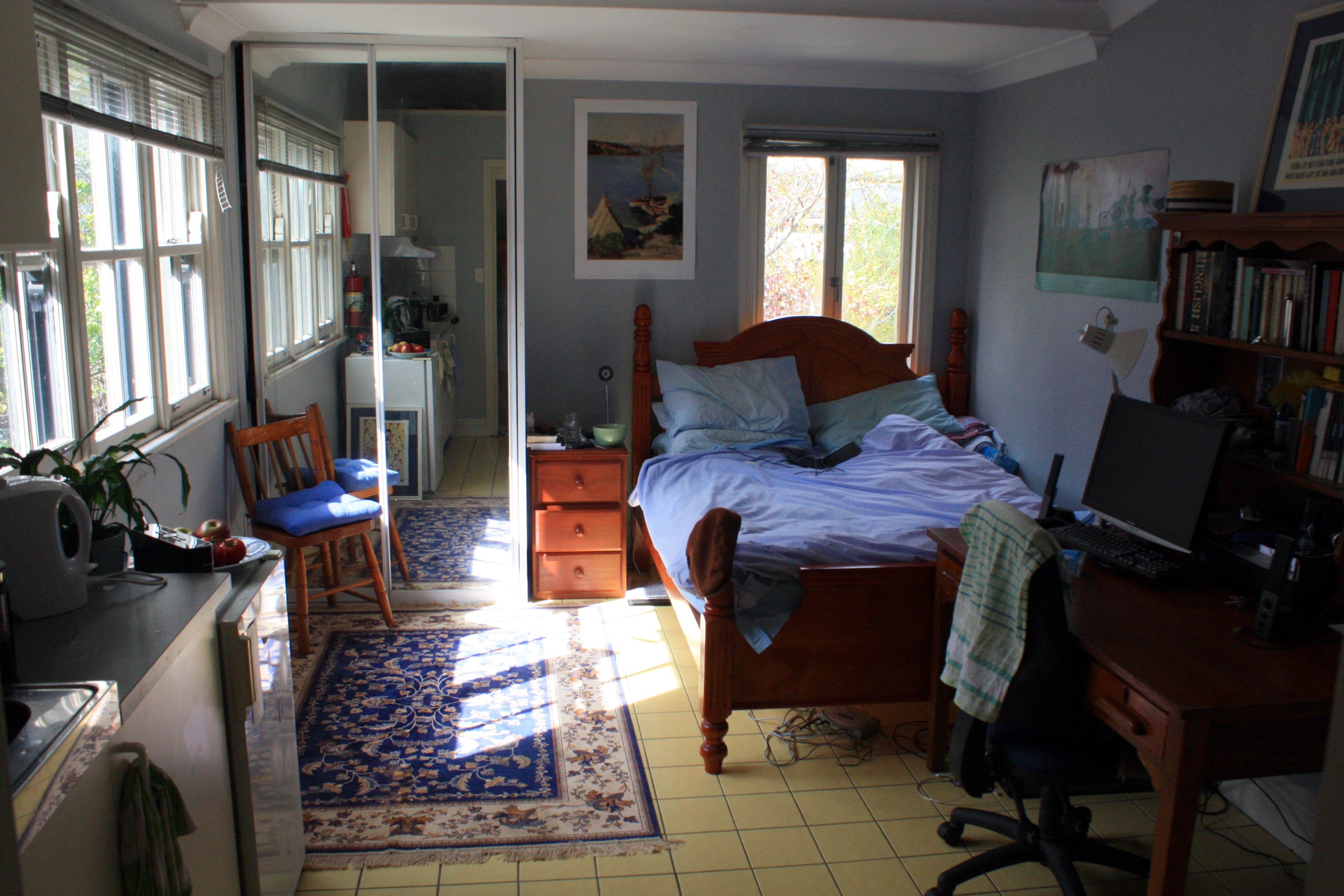
It’s a grey day, but I’m bathed in abundant natural light. The morning sun, having shifted across the Dijon mustard tiles and the royal blue Persian rug, now hides behind the clouds yesterday was supposed to bring. Outside my wide, elevated, east and south-facing windows, is a peaceful expanse of back yards and flourishing trees; their branches gearing up for spring. Being at the back of the building, the traffic sounds reach me like a distant, muffled wind. It’s peaceful enough that the birdsong is paramount, and my little old fridge keeps largely to itself.

I moved here just yesterday, to this sweet little studio in Glebe, and already I’m in love with the place. After a month of searching, considering many options, of sharing or flying solo, I inspected this place last Saturday morning and instantly saw the potential. I had actually come to inspect this unit the week before, yet in a moment of folly wrote the address down as Glebe Point Road and found myself wandering into someone’s house. Having missed the inspection time, I was ready to give it up for dead. When no one subsequently applied, I was further inclined to pass pre-emptive judgement that the place was, in fact, undesirable. Yet my at times insatiable curiosity got the better of me, and thank goodness it did.

The previous situation, a large, friendly share-house on Queen’s Park, had been good in every regard with the exception of its outlook. The room, whilst nice in itself, faced onto a brick wall which made it oppressively gloomy during the day. The neighbours’ front door was also a short distance from my window, and their constant comings and goings, their children’s tendency to practice recorder badly and bounce basketballs outside on the path, and their recent acquisition of a small, yappy dog were driving me bonkers. When I returned from visiting my brother in Brisbane, where I had slept on a wide, comfortable, solid wood queen-sized bed in a room gold with morning sunlight and myriad magpies singing like squeaky swings outside the window, I knew instantly that I could wait no longer. I had to get out, and so I did, fleeing briefly to the ancestral home so I might find a new place at leisure, without the pressure of having to fix a departure date. The Workers’ Socialist Democratic Republic Paradise (hereafter, WSDRP) as our family home is known, proved again to be both wonderfully welcoming and convenient in a time of transition.

Today is my birthday and it is very pleasing to wake up in such a lovely place. Even the onset of heavy weather only fills me with a greater sense of romance. There is nothing quite so well suited to making a place feel homely, than to sit reading by a rain-lashed window. The move here was very smooth, and my regular helper and good friend Paul again deserves my great thanks for his efforts in driving me and my belongings. I ought also to thank the Holden Commodore, which impressed me with its capacity – especially when I slotted my half-sized fridge across the back seat; a fridge, incidentally, which my much-missed French Nana gave to me in 1993 when she moved into my old room at the WSDRP. It still works like a charm, despite having been left on in the laundry for the last six years to form a vast, solid-core iceblock around the small freezer compartment. Paul helped me to load and unload the car, whilst I did all the carrying work. My zeal, pace, energy and efficiency, earned me the nicknames Conan the Removalist and The Removalator. There is definitely something to be said for keeping fit and developing one’s upper body strength!

Moving into a place has always been one of my very favourite activities, whilst, conversely, moving out is one of the least enjoyable. This move had in fact begun on Wednesday, the day I signed the lease. After finishing teaching at one, I went straight to Surry Hills to purchase a bed and a desk, the core furniture I lacked, having lived since returning from England in furnished houses. I was in something of a hurry to do so as I was signing the lease in Concord at three o’clock, and I wanted the furniture delivered later that afternoon. It made sense to have the furniture delivered directly to the new address, and thus obviate the need for a removal truck, which I would not otherwise require.

The range of furniture available in the store proved disappointingly small. The business had relocated from Bronte, and, having been to their previous store, which covered three storeys, I had expected a wide range of beds and desks. Yet instead I found a single storey, quite sparsely stocked. It was in this that I was unexpectedly and unknowingly fortunate. The choices lay at either end of the  scale and, remembering one of my favourite Chinese proverbs, “The bitter taste of poor quality lingers long after the sweetness of a good bargain,” I knew I would regret the cheaper, aesthetically poor choice. After all, what had been lacking in my last place was aesthetics.

So it was that, after wandering around the shop floor, stepping repeatedly past the big, grey-beard drowsy dog, I knew I had no choice but to buy the solid and stylish wooden queen bed I had been eyeing for the last five minutes.  Not far from it was a wonderfully weathered old wooden desk of epic size, yet slender legged and not too brutish. The one seemed the natural corollary to the other, so I mentioned my interest and cut a deal with the chap, who gave me a very nice discount. On top of this, he promised he would deliver at six thirty, and since I was to be his sole helper in unloading the goods, he would not charge for the delivery. It was, after all, a sweet bargain, but for quality.

I took a train to Burwood and walked out to Concord to sign the lease. It rained all the way – which one of my Korean students tells me is a good sign when moving house. As someone who loves the rain, I felt quite content as I returned via a long and congested bus-ride down Parramatta Road to Glebe. The brake-lights hung through the humid window in a world as sullen and grey as lamb fat. I felt an oddly peaceful eagerness, knowing I had time to kill before the delivery.

Here’s a poem I once wrote about Parramatta Road in 2005, which I throw in here by way of diversion.


Parramatta Road

These tired shops will never bring

slow-walking couples, blithe and entwined,

such is the hustle, the bash and the hiss;

heaves of freight, rubber and metal,

rolling petroleum, fog of exhaust.

And,

every morning,

as the bitumen warms,

as this smeared, groaning gully

fills freshly with urgent trumpets,

this stretched fan-belt girdle,

this gasoline funnel, this road

is like Christ risen

on a noose.

_________________________

Having arrived at the apartment and determined which keys were which, I found it ever so slightly smaller than I remembered. I realised now that the bed was not going to fit where I had originally intended it to go, and felt a momentary uncertainty about my decision both to purchase such a large bed and to rent this flat in the first place. I became concerned about sleeping in the same space as a fridge. Were they not prone to groaning and rumbling throughout the night? Was I not someone who could not bear the almost inaudible hum of a device on standby; someone with a phobia of ticking clocks – who on earth wishes to hear their life disappearing like that? Would sleeping with a fridge be impossible? Would it unnerve me, disturb me, send me bats? I pushed this fear aside. The space was very nice, with great light; it was clean, peaceful and harmonious, and I trusted my ability to make it very nice indeed. Sleeping with a fridge, bah! If it bugged me, I could always turn it off at night and no doubt all would keep til the morrow.

With two hours to kill, I set off for Vinnies on Glebe Point Road and proceeded to buy up all the floral granny plates I could find. I also bought some cups, saucers, mugs, glasses, a milk jug, silver sugar bowl and a large painted tray with a lacquered fruit fresco as its base. Using this tray, I carried my collection of crockery and utensils back through the rain to the apartment. After washing and stacking it on the sink, I sat down to read The Butcher’s Wife by Li Ang; a gripping, yet very visceral novel which I would recommend, though not without reservations.

At six thirty the chap was outside with the furniture. Together we brought the various parts of the bed in without any difficulty. The desk however, being all of one piece, proved more of an obstacle. Unable to fit through the door, the only option was to haul it up through the back window. What followed was equal parts comic and heroic. With me at the top hauling on the ropes, and the chap from the store standing below on a piece of backyard furniture and trying to hold the desk steady over his head, we managed to get it through the back window after much straining. Sadly, in my wrestle to drag the desk through, I cracked the glass of one of the window panes.

Come Saturday, I finally had the chance to put everything in order and decorate my new home. It took only two hours to order the furniture, put books on shelves, hang clothes, fill drawers, make the bed, lay the rug, stock the kitchen cupboards and bathroom cabinet, and set up my computer. The next few hours were then spent decorating; arranging photographic prints, hanging poster reproductions of artworks, deciding which tea-towels to display…

And so here I am on Sunday morning, feeling almost indecently pleased with myself. The birds are singing, the light is glorious, the outlook soothing, the drizzle calming, the bed exceedingly comfortable. In such a short space of time I have already recovered a long-lost sense of equilibrium. The absence of pressure or interruption, the freedom from other agendas, the serenity of complete overlordship over one’s domain, have flooded me with relief. For years previously I had lived alone in apartments and houses, and it had always given me a far stronger sense of self. The last time I lived alone was in Glebe, just eight doors down the road from my current address. Indeed, if I look out the back window, I can see the balcony of my old flat. That was famously given the nickname “Cornieworld”, and it was a most excellent place in which I wrote a great deal, including my second-last novel. Funnily enough, the above poem was also written whilst living there. I was extremely happy in Cornieworld, though I stayed only a year as my growing disappointment with John Howard’s Australia inclined me to move back to Cambridge.

Since 2006 I have shared houses with others, and whilst this has been largely a pleasurable experience, I have not in all that time felt entirely at home. Even in the most relaxed and friendly of households, there is a need to keep up appearances. Even with the most open-minded and casual people, there is an awareness that one is observed in one’s own home. Occasional inconveniences and disturbances occur that are beyond one’s control; the bathroom is busy, the stove-top full, the oven in use, the kitchen is full of people when one is really not in the mood for conversation, and does not wish to be seen looking so tired and frumpy. All these things take their toll, and despite the good company of housemates, it is not possible to choose at which times one has this company.

Already, just one day into my new house, on the first day of the 39th year of my life, I feel transformed. There is no one above me and no one below me, for despite being on the second floor, below is the laundry and a store-room. I can step as heavily as I please, play music loudly, speak without fear of being overheard, and nor do I seem to hear anyone else. My new, old furniture looks magnificent; the pot plants, the rug, the photographs, the book spines, the tea-towels, cups and saucers, the wooden chair, the bedside table, the trio of soft toys, Bilby, Platty and Bünchen sitting beside me, all fill me with a sense of wholeness.

When I said I was moving back to Glebe, my old friend Simon, knowing how much I love the area, said “Ah, you’re going home!” And, for the first time in years, I really do feel as though I am at home. And that little old friend of mine, that ever durable, long-lasting fridge, makes barely a sound at all.

Happy days indeed! Cornieworld 2 is born!

Hong Kong

Rain and ocean spray blurred the entrance to Hong Kong harbour. The ferry windows were near opaque with streaks of water, and the low, heavy clouds cropped the horizon. I was coming in from Macao, on a choppy sea, with an English chap whom I suspected of having Tourettes. As the express boat bobbed and slapped on the waves, I wandered up and down the aisles, looking for photographs and trying to avoid any further conversations with my odd companion.

The night before a typhoon had struck and my flight from Bangkok to Hong Kong had been cancelled. There was the usual chaos at the airport with passengers being unnecessarily rude to staff and the airline being unnecessarily unhelpful to passengers. I sat it out with a Coke and let the more enraged customers do the hard work. One American lady, whose name was Rebecca, performed admirably. She locked horns with Air Asia and ensured that we would all be compensated with standby flights the following morning. Her next trick was to make sure we got accommodation for the evening, at a significant discount, in a hotel near the airport. Nice.

I was so impressed, I went and congratulated her and, next thing, we were a team. It was at this point that the English chap, let’s call him Harry, joined us. He did not cease talking for the next few hours, irrespective of whether or not someone else was speaking at the time. Whilst he did not actually exhibit the random swearing associated with Tourettes, his continuous, involuntary and very pronounced talking and blinking was suggestive of the condition. At first I liked him, and I tried very hard to continue liking him, but after a few hours, I was ready to lose him at the first opportunity. Rebecca soon became his best friend as well, and when the three of us, plus several others, arrived at our hotel in a minivan, it was a real tussle to avoid being his chosen interlocutor.

When we arrived at the airport the following morning, the best they could do was fly us to Macao. This was fine with me, except that I wound up sitting next to Harry. I was working hard to be friendly with him and felt guilty that I wasn’t enjoying his company, but he was genuinely getting on my nerves.

As we neared Macao, we passed through the very typhoon that had caused all the trouble in the first place. Sitting beside the wings, I watched the heavy rain rush violently over the engines. It was a little unsettling, especially with the turbulence, but this was as nothing compared to the reaction of my companion. Harry became utterly terrified, and curled up in his seat, flinching keenly at every bump. He talked his way through the entire experience, saying over and over things like “we’re going to die, we’re going to die,” “I should have stayed in Bangkok!” “Why did we have to catch this flight!” “That wing’s going to fall off!” “Tell me we’re not going to die!” and so on. I felt a mixture of pity and embarrassment on his behalf, especially when two Chinese girls across the aisle began giggling at him. I tried my best to reassure him, offering soothing phrases such as “come now, we’ll be all right, chin up”, but in truth, he’d gone and put the fear of crashing in me and, for the first time ever on a flight, I too thought we might actually die. I was pleased that I managed to remain so cool.

Needless to say, we landed safely in Macao a short while later. Our bad buddy movie did not stop there, however, for we still had a long bus and ferry ride together, followed by a taxi to Nathan Rd in Kowloon, where, it just so happened, we were staying in adjacent hotels. Fortunately, however, I had lost my mobile phone on the ferry and there was little hope of me making any further efforts to continue our acquaintance. I did indeed feel guilty, after all, we’d been through a lot together, but Harry had almost driven me entirely bonkers and I couldn’t risk going all the way.

So there I was in Hong Kong. For the five weeks previous, I had been travelling through Singapore, Cambodia, Vietnam and Thailand and I was pleased to be in the presence of some startlingly different subject matter. Most of the places I’d visited, with the exception of Bangkok, which had astonished me with its modernity, were nothing like this. They were either shabby and run down, places where urban neglect weighed heavily, or they were simply small towns, often picturesque, but with no real high-rise development. Hong Kong had the immediate promise of arresting landscape and architecture, and I rubbed my hands together in anticipation of this contrast.

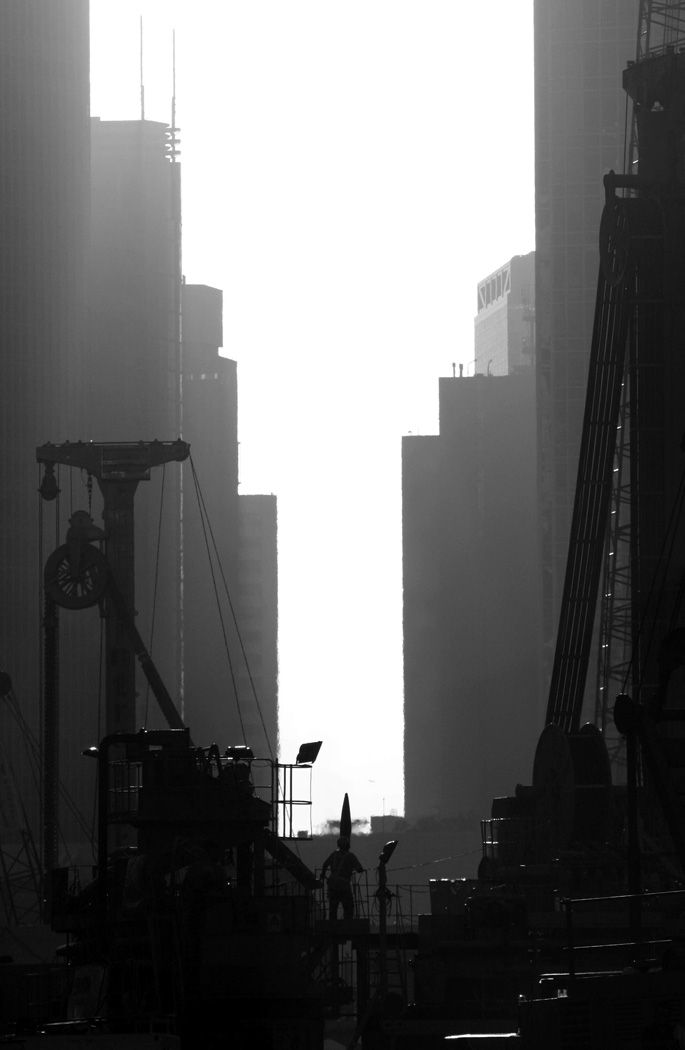
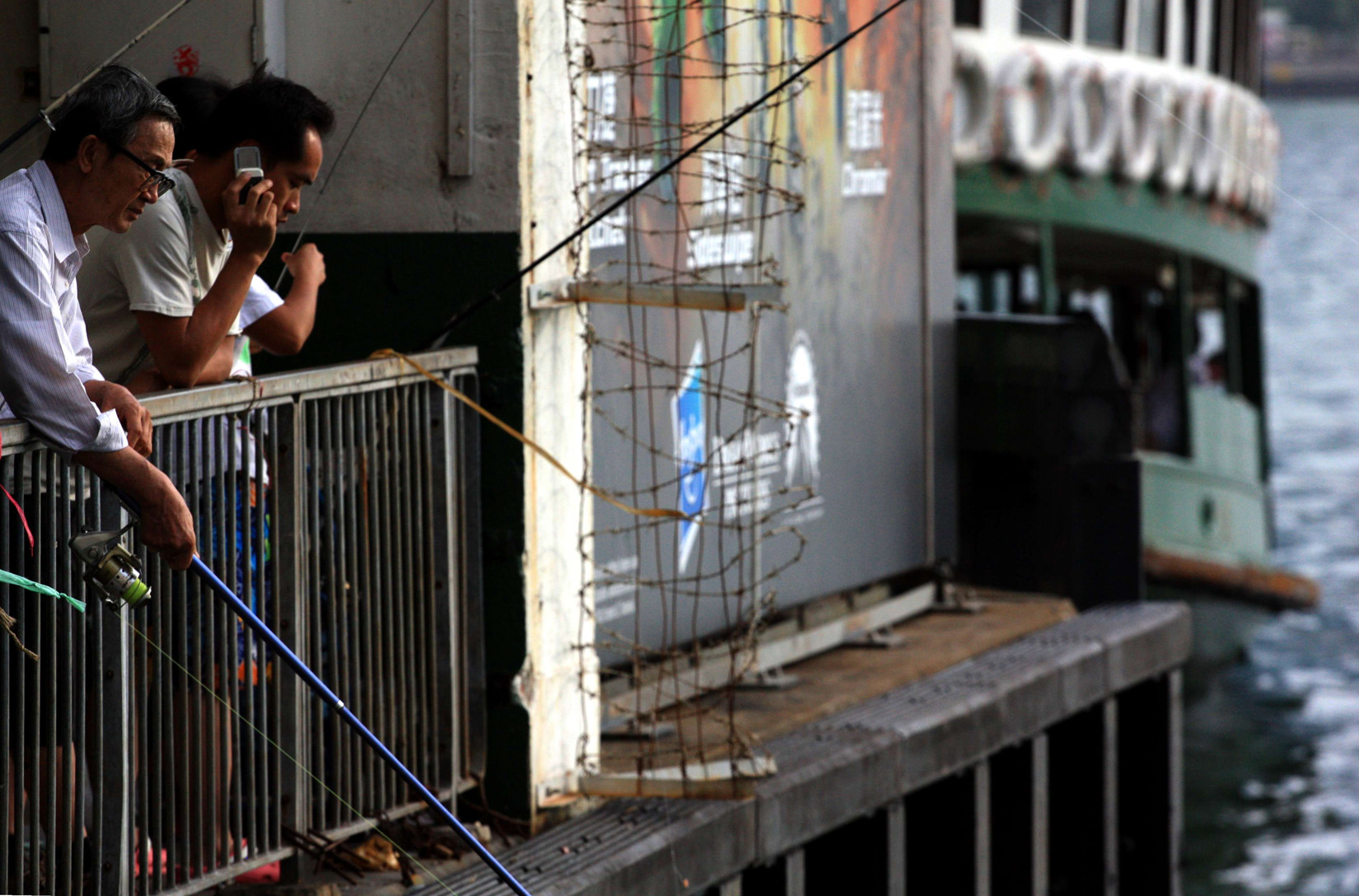
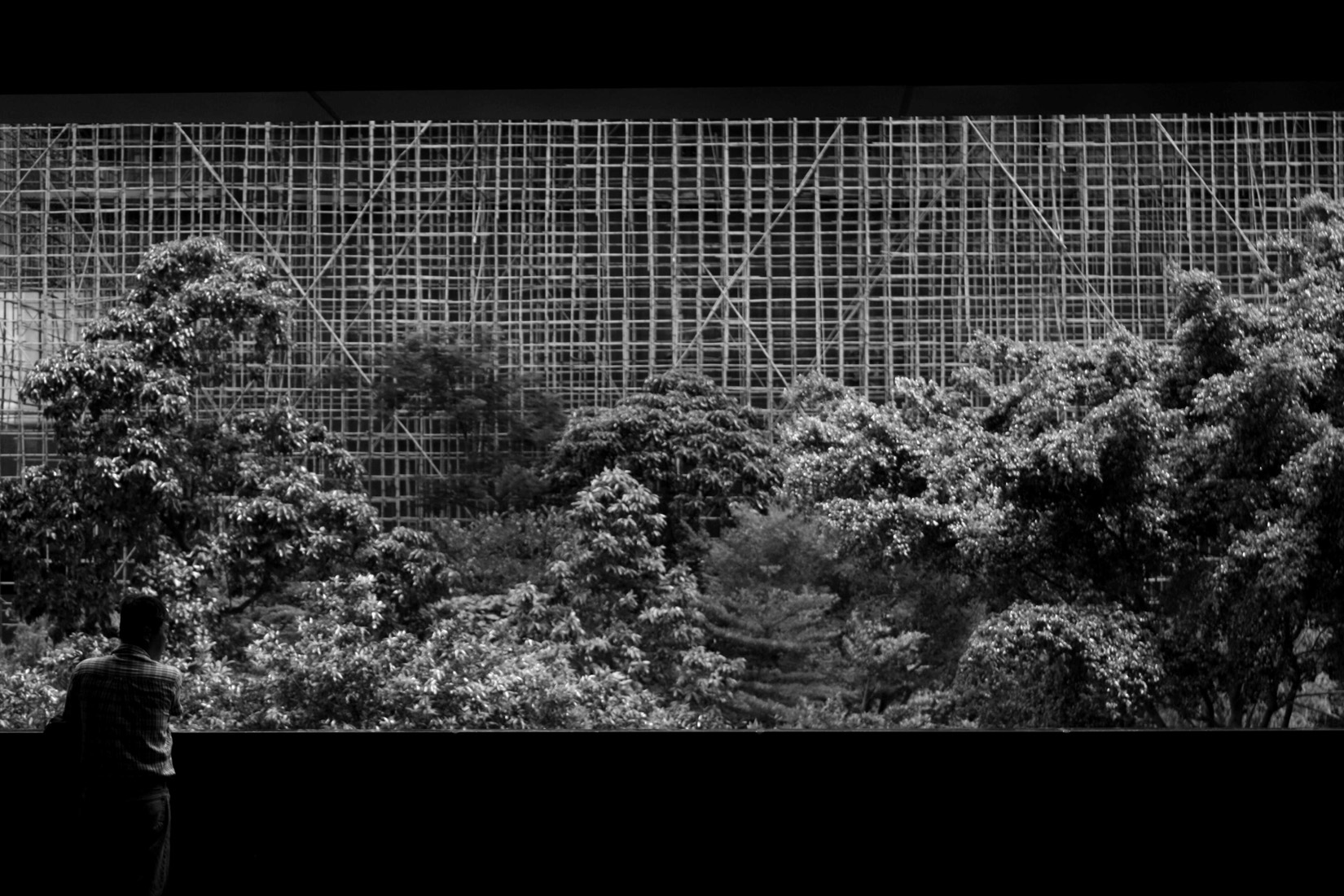
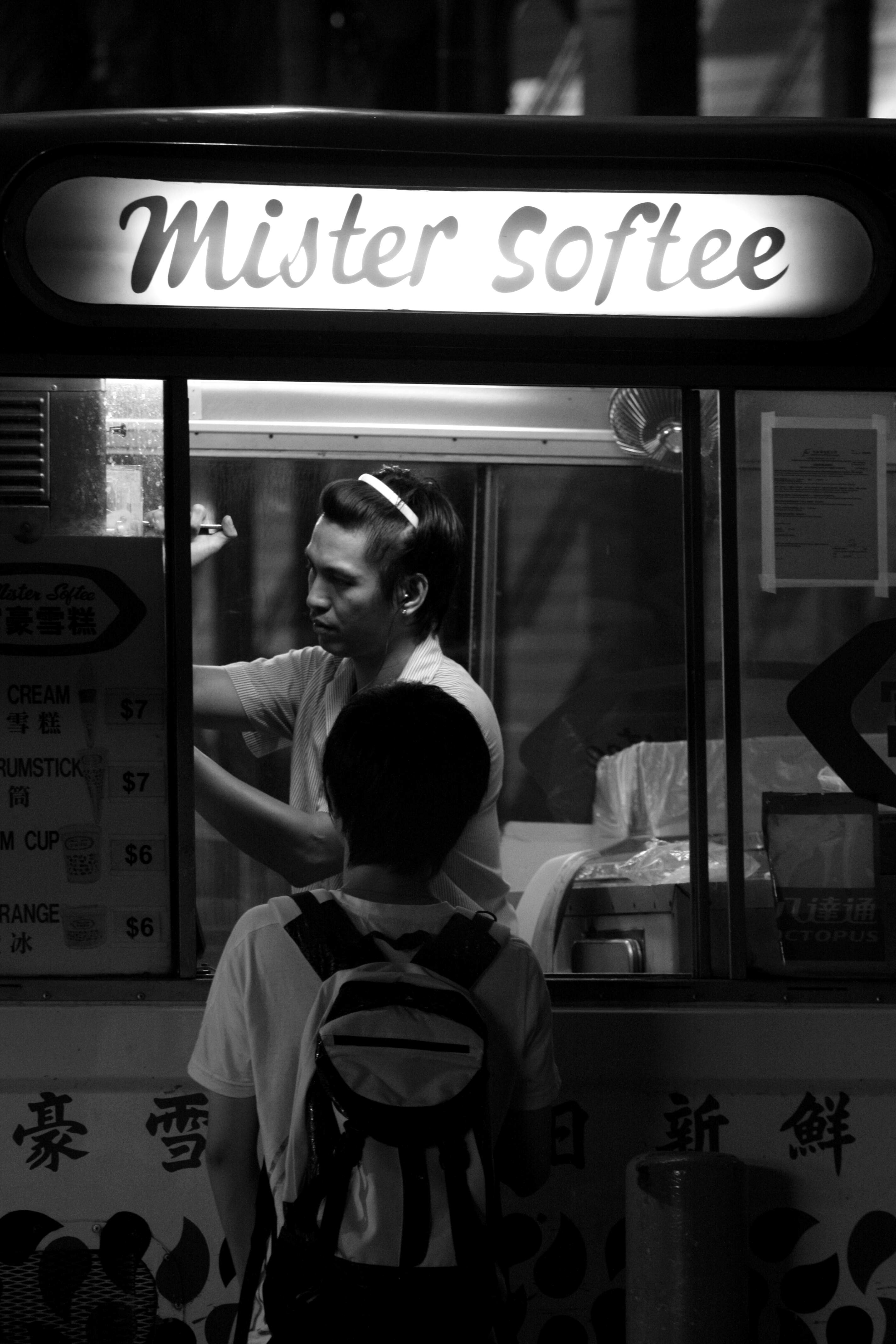
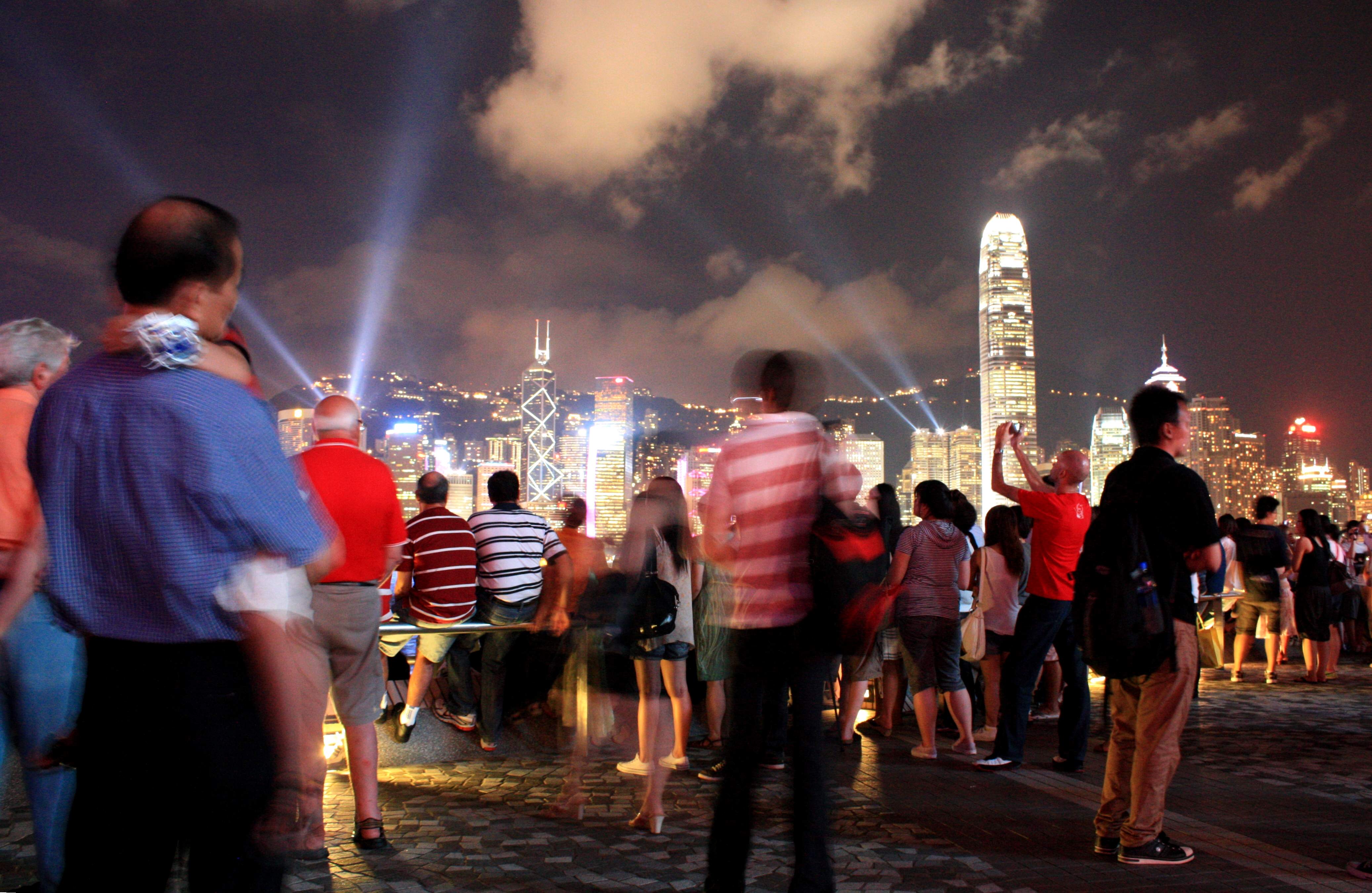
Over the next few days I spent my time wandering around Hong Kong, shooting everything of interest. At first I found it hard to make the most of the subject matter. Architecture makes a great subject for geometrical compositions, but without living subjects it lacks a sense of scale and humanity and risks appearing too sterile. For all the high-rise modernity around me, some of it rather old and weathered, I struggled to find the right tone, angles and themes to give import to the metropolis. It took a while to dawn on me that the abundant great architecture, alongside the dire, and the special geography of Hong Kong, were, in effect, a grand distraction. The sharp jab of the The Peak, the tall, forested hills, the wide embrace of the harbour – at once brooding and light-hearted – and the serried needle apartments, were all an elegant backdrop for the people. It was people I’d focussed on in Cambodia and Vietnam, and, just as in those countries, I soon found the people of Hong Kong to be priceless subjects.

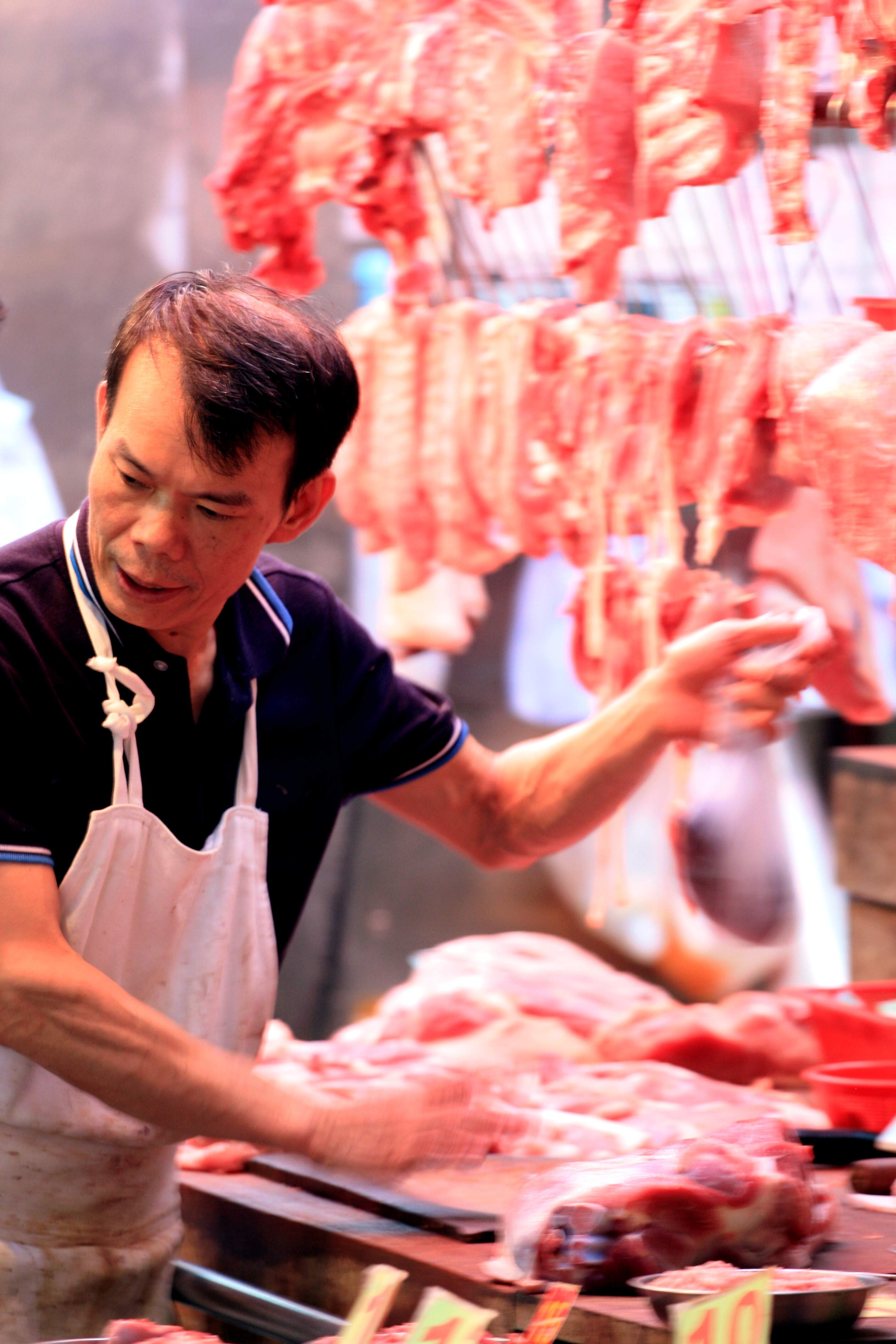
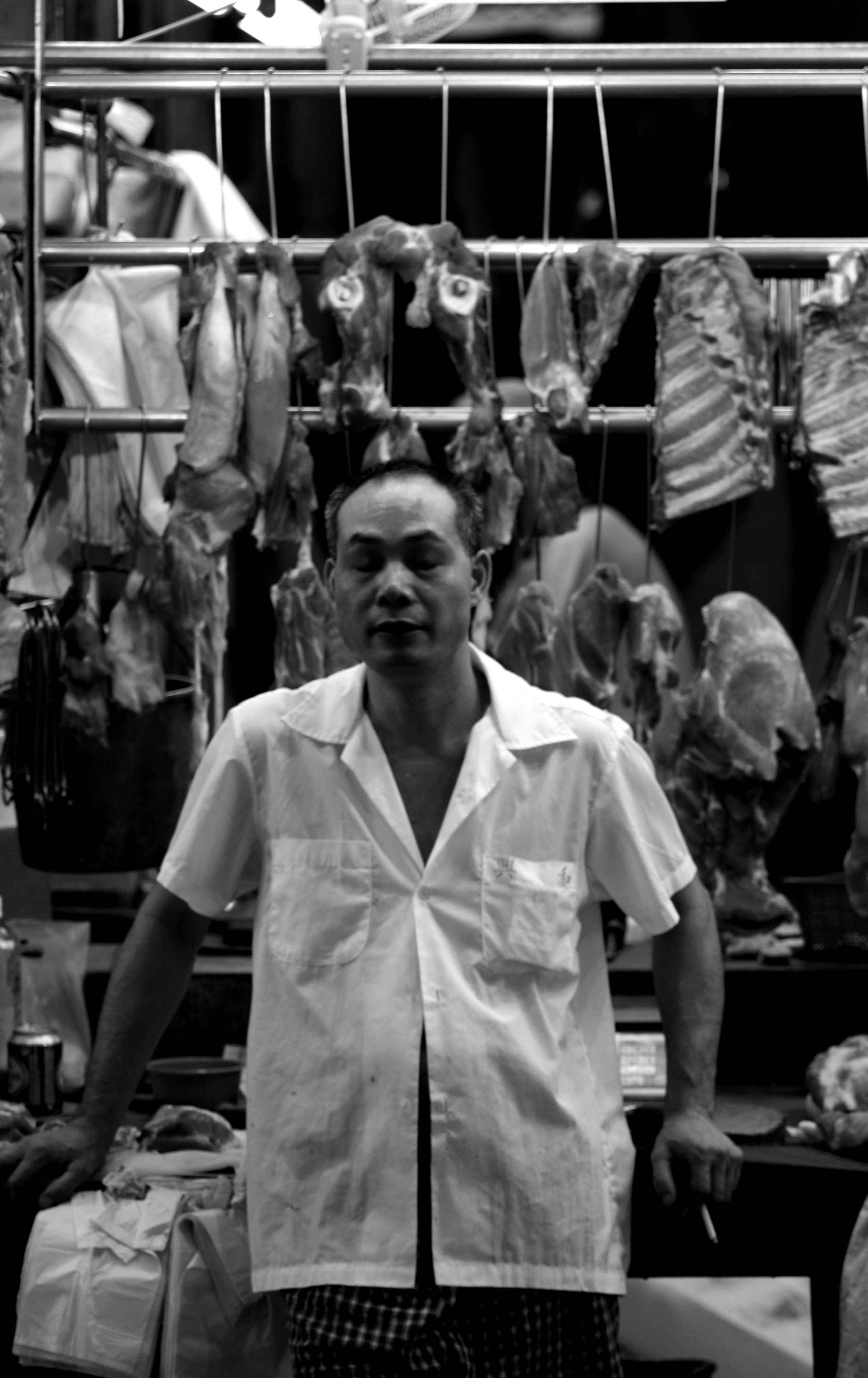
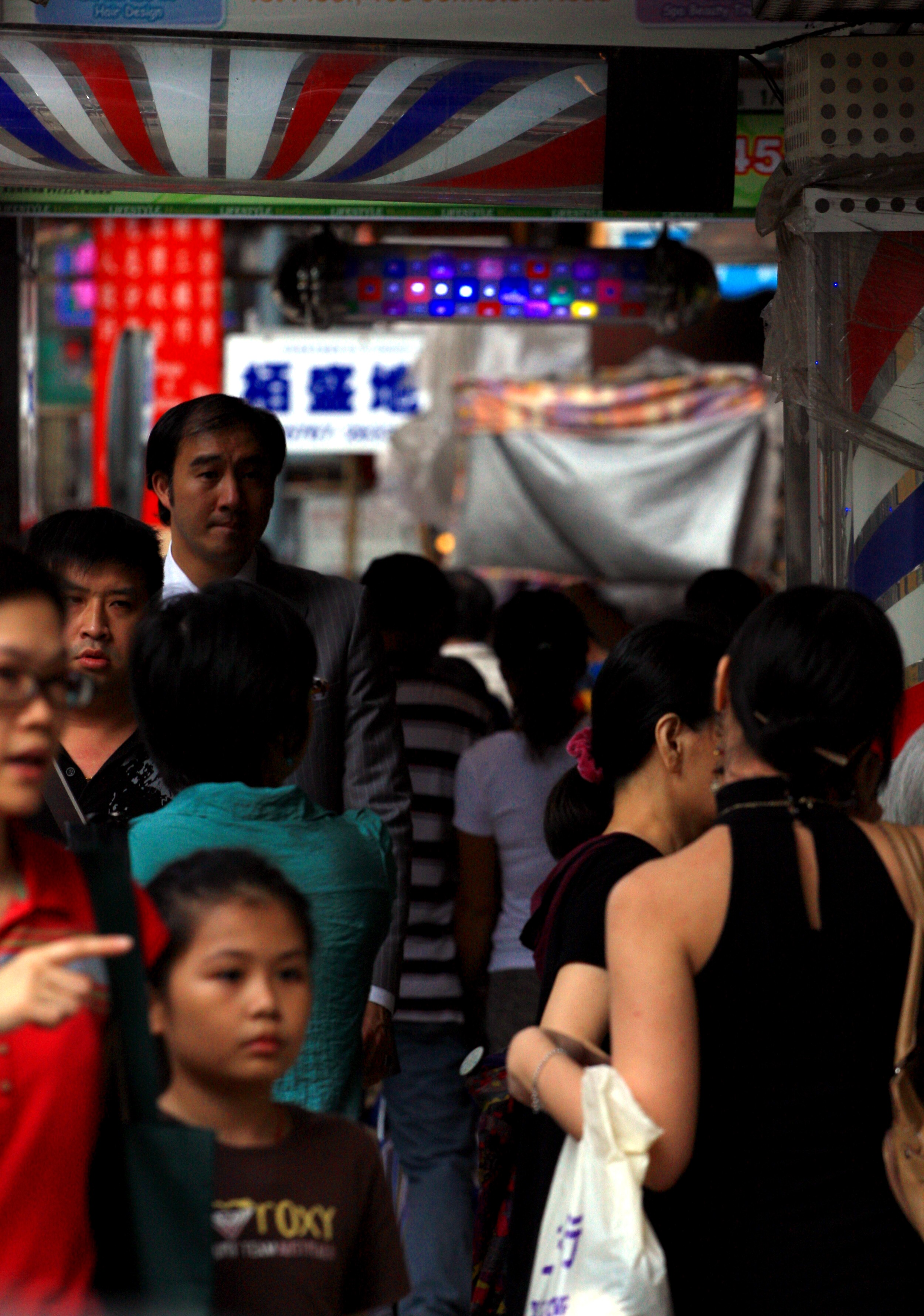
On the second morning of my visit, having moved very early across the water from Mon Kok to Wan Chai, I took a long walk around the neighbourhood. The sidewalks provided a constant stream of locals and visitors and, as is always the case with so many people, it was a great chance to capture diverse narratives within a single frame. It was a golden morning and I got off to a pleasing start in what ultimately proved to be one of my favourite shooting days ever. I began locally, doing laps of the blocks, then drifted off along Hennessy Rd and started trawling all the side-streets. I soon stumbled upon a glorious meat market. An entire street of butchers, with shirtless men in white aprons, surrounded by hanging cuts of beasts, dangling globes and a circus of shoppers – it was heaven. I have always had a love of shooting in markets, especially meat and fish markets. In Venice, Siem Reap, Hanoi, Darjeeling, Chiang Mai, New Delhi, New York, Singapore, Sarajevo, Tokyo and Jodhpur to name a few, I’ve gotten some of my favourite photographs.

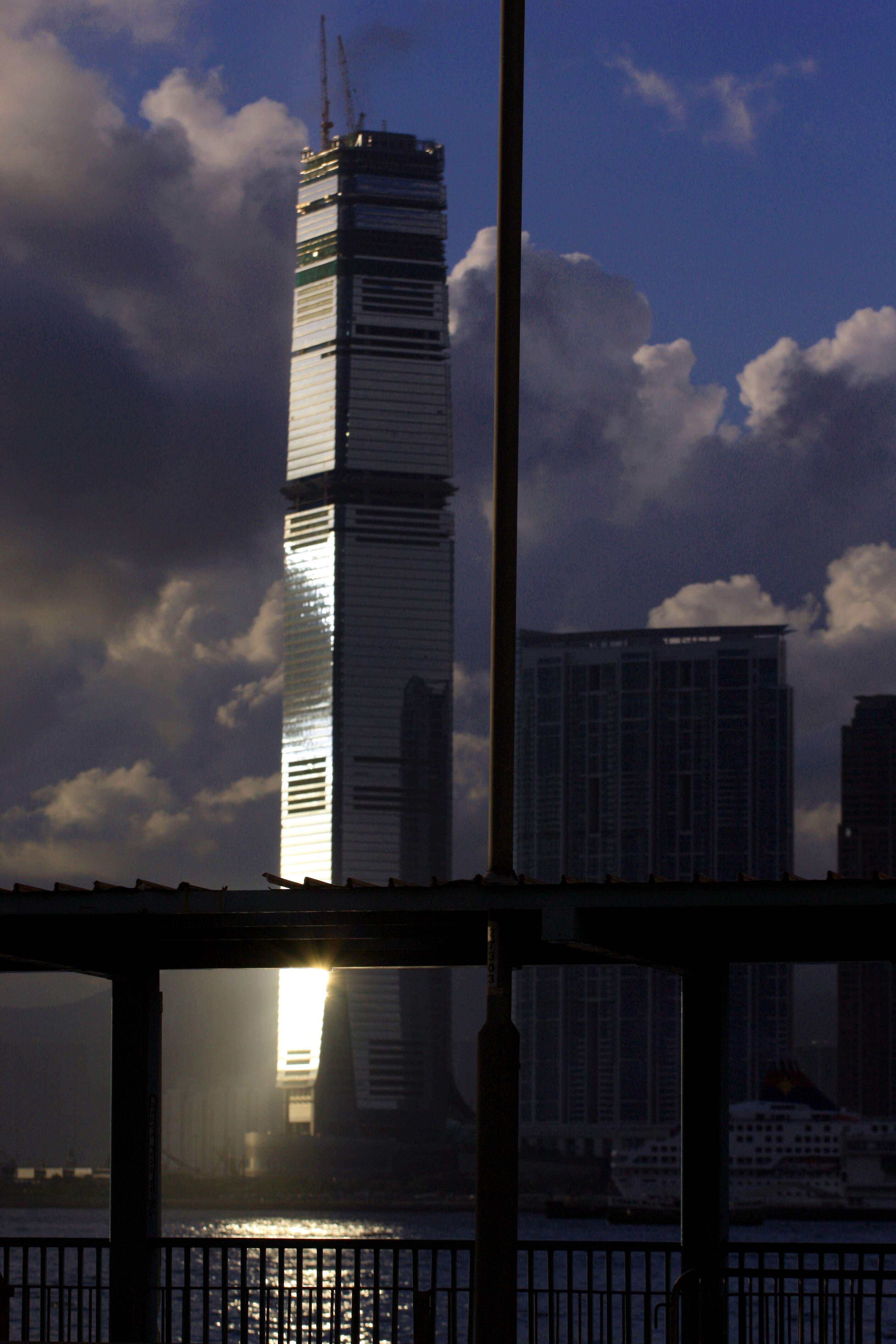
On this day I spent about forty minutes with the butchers, then made my way up towards The Peak. I had not expected to be so impressed by the view, but it was powerful and wide. The clarity of the light and the grandeur of this seemingly smog-free hive lifted me into a thrill. Before me was one of the greatest cityscapes on the planet, a place of chaos, romance and legend. A hot bustle of enterprise and slog, a fracas in perpetual motion, it was stunning. When I left The Peak, I made my way down to the harbour, which now seemed easier to interpret. The weather was proving an unexpected boon. For weeks on end I’d been shooting in a haze, with glaring off-white skies and washy sunlight. Here at last the sky was a rich blue and the sunlight clean and sharp. I took the ferry across the harbour, back and forth a few times, and wandered along the overpasses looking for vistas. When the afternoon finally drew down and the sun hung low in the harbour mouth, I was fortunate to witness some magnificent illuminations and plays of light.

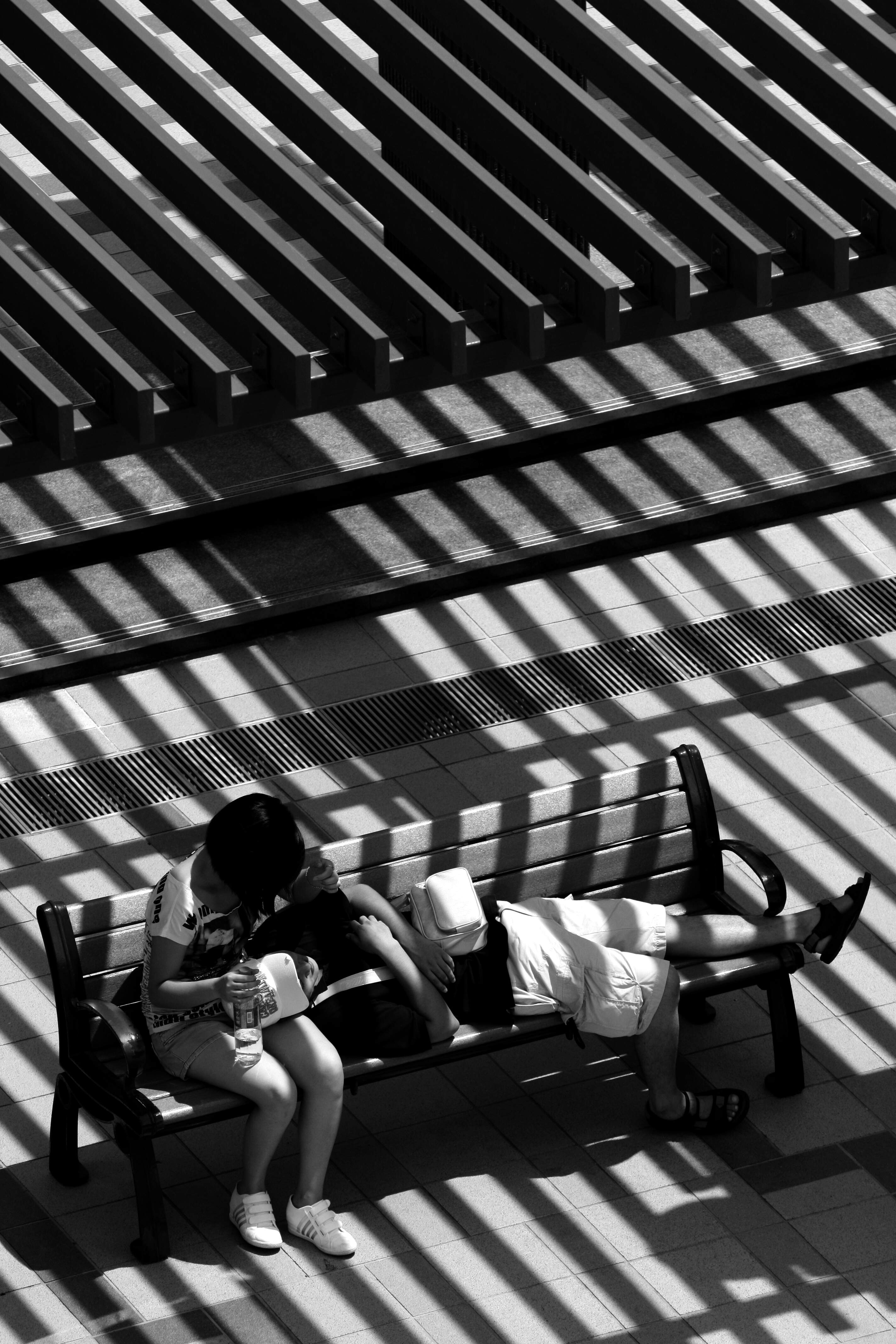
Anyway, enough out of me. Enjoy the photographs, all of which were taken Monday, July 20, 2009. They are not in chronological order.


The assassination on Thursday, July 27, of top rebel general Abdel Fattah Younes, has caused considerable consternation about the integrity of the National Transitional Council (NTC) and the rebel movement in Libya as a whole.

Initial reports suggested that the assassination was carried out by Islamists loyal to Gaddafi, who accosted the general after he was recalled to Benghazi to discuss the situation at the front line. This rumour was denied by the NTC’s leader, Mustafa Abdel Jalil, who on August 1 issued a statement to the effect that a warrant had been issued for General Younes’ arrest by his deputy Ali Essawi, on grounds of suspicion about possible links with Gaddafi loyalists. Initially there was no mention of a warrant. It was after Younes’ release last Thursday that he and two aides were gunned down, allegedly, by two of the men assigned to escort him.

According to the account of a rebel figure who spoke anonymously to AFP, one of the men who shot Younes shouted that he was a traitor who had killed their father in Derna. He also claimed that the men were members of the February 17th Martyrs Brigade, a claim later rejected when the blame was transferred to the al-Nidaa Brigade. Despite Jalil’s assertion that the assassins were not Islamists, suspicion still hangs over a group of men from the religiously conservative town of Derna.

Gaddafi’s son, Saif al-Islam recently told the New York Times that he was seeking ties with Islamists in the east to turn them against their more liberal allies amongst the rebels. Ali Sallabi, a senior rebel figure, confirmed that there had been dialogue with Gaddafi’s son, but that any claim of a split amongst the rebels was baseless. “It’s a lie that seeks to create a crack in the national accord,” Sallabi said. He went on to claim that the dialogue has always hinged on three points: “Gaddafi and his sons must leave Libya, the capital must be protected from destruction and the blood of Libyans must be spared.”

With so many military and political figures having defected from Gaddafi’s regime to the rebels, there have long been questions about the degree of dialogue between the NTC and Gaddafi’s regime. Younes himself was a very high profile defection when he joined the rebellion in February, having long been a close ally of Gaddafi’s and having served as interior minister in his government. He was initially given command of the rebel forces, yet, unable to shake the taint of his association with Gaddafi, despite a four million dollar bounty on his head, he was later moved to Chief of Staff.

Some commentators have downplayed the importance of Younes to the rebel movement, pointing out that it has never relied upon a single charismatic figure to sustain its momentum. Yet the rebels have not only lost a significant military leader, they have also turned violently inwards in an attempt to root out suspected fifth-columnists. The rebel forces and vigilante groups, particularly the February 17th Martyrs Brigade, have, from the start, been arbitrarily arresting, imprisoning and murdering suspected Gaddafi supporters, yet the ferocity has intensified in the wake of Younes’ killing.

On Sunday, July 31, several suspected Gaddafi loyalists were killed and at least 63 arrested, following a battle lasting several hours at the stronghold of the al-Nidaa brigade, in the city of Benghazi. Ismail al-Salabi, the military leader of the rebel faction, February 17 Martyrs Brigade, the de-facto internal security force in Benghazi, said the operation was “100 per cent successful”. He went on to claim that they had not only found explosives and military equipment with which they intended to carry out terrorist attacks in Benghazi, but also documents clearly linking the al-Nidaa Brigade to Gaddafi.

With so much paranoia in the rebel camp, it is difficult to confirm such claims, let alone know who to believe. The February 17th Martyrs Brigade is known to contain members of the Libyan Islamic Fighting Group (LIFG), renowned for their complete distrust of anyone linked to Gaddafi, and before the al-Nidaa Brigade were blamed for Younes’ killing, suspicion rested on them. The NTC has established an investigative committee to look into the assassination, yet just how free and objective this will be is anyone’s guess.

There are thus many legitimate concerns about the arbitrary justice being applied to suspected Gaddafi loyalists. Ultimately the rebel forces and the NTC must be held to account for their methods and practices and foreign governments must remain vigilant to human rights abuses. Just how much influence the military brigades have on the NTC’s political decisions is also a matter of significant concern.

On the 30th of July, the head of the NTC, Mustafa Jalil, announced a clampdown on these informal groups.

“The time has come to disband these brigades”, said Jalil. “Anybody who refuses to take part in this decree will be tried with the full measure of the law.”

The ultimatum includes an offer to join the rebel armed forces on the front-line or be incorporated into the Benghazi security forces, otherwise, to lay down their arms. In recent months a better trained, equipped, uniformed and hierarchical armed forces has emerged, allowing the rebels to co-ordinate their troops and materiel in a more professional manner, with effective command and communications structures. The presence of the brigades has increasingly become a liability, both militarily and politically.

This is clearly a testing time for the rebels, whose recent gains in western Libya suffered a blow with the loss of the village of Al-Jawsh at the foot of the Nafusa Mountains and whose attempts to recapture the key eastern oil town of Brega have proven slow, despite sending a considerable army of men and equipment to the purpose. Last Tuesday the rebel forces, who had advanced into the suburbs of Zlitan, a key town on the approach to Tripoli, suffered a fierce counter-attack from well equipped and heavily armed pro-Gaddafi forces. Having been given covert assurances that they would be welcomed in the town, the rebels soon suspected they had been lured into a trap. Yet, despite repeated fierce attacks from Gaddafi forces, the rebels have shored up their positions, reinforced their troops significantly, brought up more equipment and held their lines. The fighting continues daily. As Al Jazeera’s Andrew Simmons said, “would you believe this is Ramadan?”

Irrespective of these difficulties, most commentators agree that the broader strategic, tactical and political momentum is firmly on the side of the NTC. At a meeting in Turkey on July 15, the United States and Turkey joined no less than thirty other nations in recognising the NTC as Libya’s legitimate government. Last Monday, France released US $259 million dollars of frozen funds to the NTC. NATO’s continued airstrikes have been effective in degrading Gaddafi’s forces, along with his command and control infrastructure in and around the capital, Tripoli. Despite widespread and legitimate concerns about “collateral damage” from NATO’s air campaign, there seems little inclination on behalf of the nations involved to scale back the campaign until it has achieved its purpose, which, despite protestations otherwise under the guise of protecting civilians from Gaddafi’s forces, seems to be, quite unambiguously, regime change.

In the meantime, we must not forget the humanitarian crisis that has emerged. As of 14 June, the number of Libyan refugees in Egypt stood at 346,113, with a further 543,003 in Tunisia and another 30,825 in Chad. The conflict has disrupted the entire country and displaced almost a million people, causing immense economic and infrastructural damage, as well as leaving many long-term emotional scars. Casualties, both military and civilian, are now estimated at more than 12000 people.

What will happen in coming weeks is anyone’s guess. There remains the possibility of an internal coup as the pressure mounts on Gaddafi, yet for now he appears secure, if threatened and paranoid, in the capital of his shrinking fiefdom. There seems little likelihood of a political solution without Gaddafi’s removal, and hence the increasingly deadly and costly conflict is likely to continue for some time. Soon, no doubt, there will be further pressure on the rebels, particularly insofar as scrutiny of their future intentions and capabilities are concerned. If they are ultimately successful in this conflict, many further questions will be asked as to what process will emerge for the construction of a new Libya.


This article was first published in New Matilda on 08/08/11:

http://bit.ly/RebelsAtCrossroads


Porto was a real surprise. Nothing had prepared me for how beautiful the city was. My timing was fortunate for I came into town in the late afternoon and caught a magnificent sunset. The train station was antique, painted blue tile; encased in the blemish of anti-pigeon gauze. The hotel was unexpectedly deco and chic, the locale was cramped but stately. The streets were grubby, but jammed with interesting angles. I checked in, showered quickly and left in a hurry to catch the sinking sun. I reckoned there were two more hours of light.

I walked down through the once squalid and fishy Ribeira district, now much restored and heritage listed. The steep cascade of tall facades slid like dirty ice to the banks of the Douro. I shot the buildings and people and stood watching the old barcos rabelos bobbing up and down before the long, terracotta-roofed warehouses across the water.

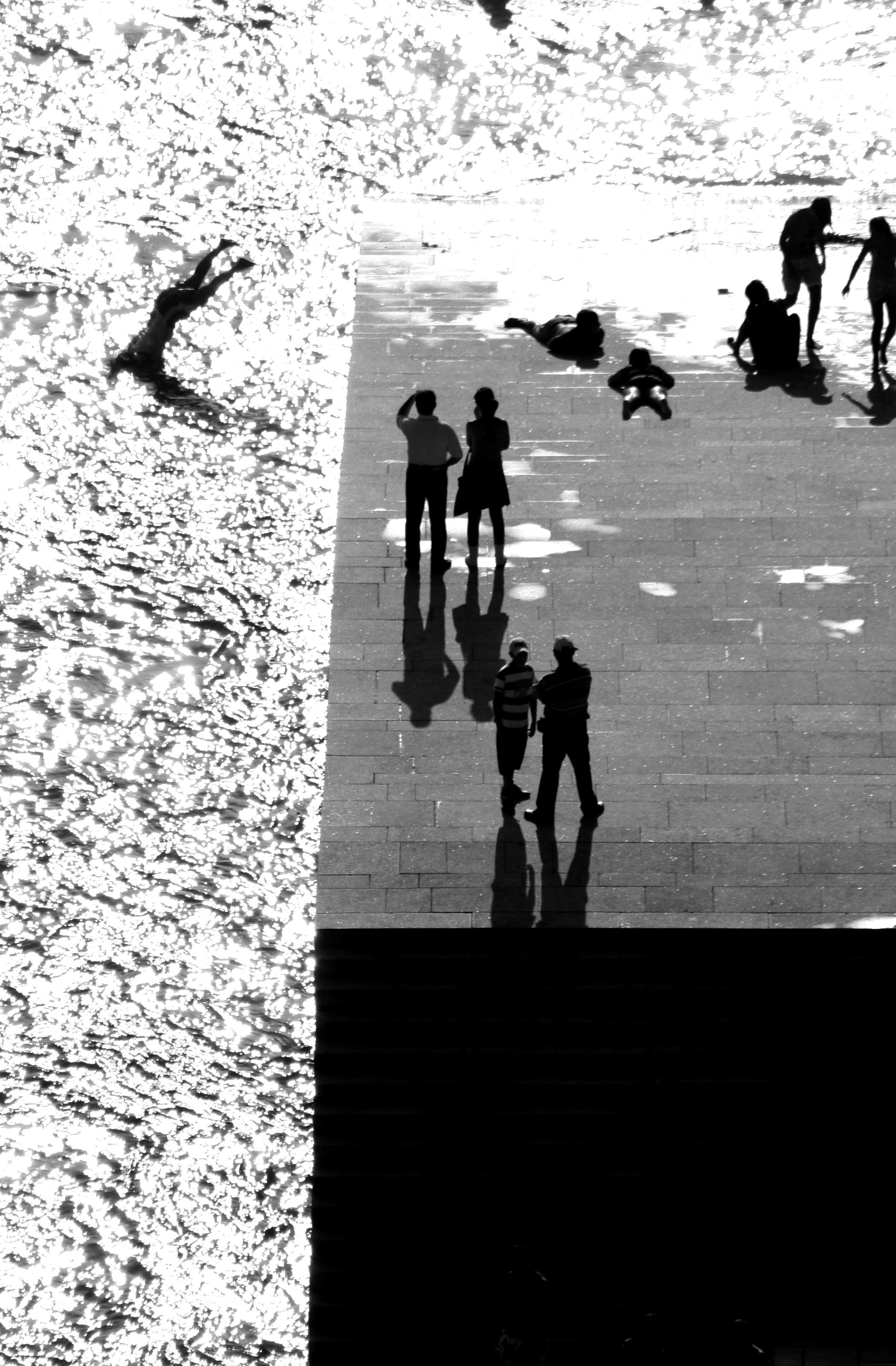
I was waiting by the water, looking up to the grand iron arch of Ponte Luis I, shooting the bridge when it struck me that I should be shooting from the bridge. Photographically, it was one of the best calls I ever made. When I reached the top of the bridge and saw the angles such a steep perch afforded, the shadows and silhouettes cut in ink and silver, I was knocked for six.

This is one of my very favourite photos, one that I simply must look at from time to time to remind myself why I like taking photographs. It was an extraordinarily lucky shoot, and this shot perhaps my luckiest. The sandstone platform by the river anchored all the shots I took. On account of its slope and my position, it obtained a slightly odd, almost geometrically impossible place in the photographs. The combination of sunshine and wet footprints was also an unexpected bonus. I have to confess to being very fond of shooting directly into sunlight in black and white. Silhouettes make excellent subjects, but it’s rare that they offer up as much drama as they did on this occasion. Apart from the fact that they were fit, young shirtless men wrestling each other in the sunshine, that they happened to be beside a gleaming river into which they were also attempting to throw each other, made it all the more picturesque.

This was, in fact, one of the last photographs I took in this sequence. I had not had time to download the photos from earlier in the day onto my laptop, and shortly after this shot, I ran out of space on my camera. I desperately tried to delete a few things, but I was very reluctant to do so and rued not having brought my laptop with me on this shoot, as I almost invariably did on all others. I ran to the hotel, but by the time I made it back to the top of the bridge, the sun had set behind the headland and no longer shone down the length of the river. I had, all the same, managed to get close to 100 shots. It still pains me to think that I could have taken 500 had I unloaded that drive.

Shortly afterwards, I began to write a poem about the shoot, but it wasn’t especially grand. Still, I’ve included its first two, rather unpolished stanzas here, as it will otherwise reside in the discard pile.


Boiling water, sea of ink and silver,

children of mercury. The gods, it seems,

have made a little scene

of prancing shades, wrestling,

lithe, supreme beneath

the press of sunset’s heavy

gold. In the uplift of glare,

each snap a minted coin

of martial art

children clamber dripping light and dark.


Footprints sink like fluid into gauze;

stains, a moment, patch the heated stone.

They shift, through lucent silver,

back to chrome. In the outdoor rooms of shadow

lies detail, safe beneath

this city’s grand

distraction. Late afternoon

dissolves in bronze the promenade,

the simmering river, bromides

and black figures…

Here’s a shot I had taken earlier. And yes, it is indeed the source of the banner.

A fuller gallery of shots from Spain and Portugal can be found here:

http://on.fb.me/PortugalSpain

It was late afternoon when I climbed into the back of the jeep in Siliguri, having paid a mere 92 rupees ($2.25 Australian) for my seat. After settling in and stretching my legs on the surprisingly comfortable bench, I was soon forced to shuffle over to make room for someone else. It seemed that, in fact, 92 rupees bought only half a seat. This was going to be a fun ride.

I had flown into Bagdogra airport that afternoon, one of the few destinations in West Bengal for  budget airlines. The flight was stunning. Heading east from Delhi, the plane’s path tracked the line of the Himalayas, bathed as they were in bright sunshine; below, the yellow dust and fecund green of the great Gangetic plain lay dry, flat and ancient.

From Bagdogra, I had taken an autorickshaw into Siliguri – the nearest major town, situated roughly twenty minutes away. The drive took me past tea plantations and the roadside workshops of countless cottage industries; carpenters, woodcutters, masons, banana sellers. It was a lush and moist landscape; a welcome sight after the dusty dryness of Rajasthan and the baking heat of Delhi.

It took roughly half an hour for the jeep to fill and we set off immediately afterwards; around four in the afternoon. There were thirteen people inside: four across the front seat, four in the middle, including a pedigree Pekinese called Nora, and four huddled into the back with me. They were an interesting mix of Bengalis, Gorkhas and assorted other ethnicities. Already, just waiting around in Siliguri, I had noticed quite a number of people with very Asiatic features; some passably Chinese and others who struck me as ethnically Nepalese or Tibetan. A young Gorkha couple sat opposite me, the lady wearing a gorgeous bright blue sari, and something told me they were newlyweds. They had an air of amorous conspiracy that made one want to wish them well. I sat quietly in the back, smiling and nodding to everyone, then got on with listening to my iPod and shooting video through the open window.

After half an hour driving through a forest flashing with sunset, we reached the foothills of the Himalayan mountains. The road narrowed and began to wind, and very rapidly, the landscape changed in character. The dry, bright green and yellow-leaved forest had been cleared from the slopes and terraces to make room for tea and wheat. The rich soil was dotted with quaint, modest dwellings amidst fields made tropical by the occasional spray of banana leaves. Behind it all, the sharp rise of the mountains halted in a nightcap of fog.

Soon our driver brought us to a roadside bungalow, crowded about with other jeeps. He pulled in and hopped out, muttered something, then set off with his henchman into the bungalow. I climbed out from the back of the jeep, walked over and peered inside. It was a diner of sorts and, despite having stood around in Siliguri for half an hour before our departure, it seemed our driver was about to have his dinner. I shrugged and smiled at the ways of the world, then followed the lady with the dog as she wandered off down the road.

The slope rose sharply to the left of our heading; huddled with squat, dark and damp tea-bushes. Even here, at less than six hundred metres elevation, mist had begun to creep down in the cooling mountain shadow. A few workers were still in the fields, though they seemed, at this time of day, to be merely passing through. I took some photos, watched the men waiting by the jeeps, then sat down on the roadside to stare into the valley below.

I was soon roused by the sounds of an argument. It seemed our driver had finally returned to the vehicle after forty minutes and something was up. I assumed it was the length of the delay causing trouble, as none of the passengers had wanted to eat and were all waiting to leave. I wandered back over and stood to the side, watching. Despite not understanding what was being said, with the argument being conducted mostly in Hindi, Gorkha and Bengali, I soon determined that the dog cage of the Pekinese had fallen from the roof of the vehicle at some point on our journey and now seemed irretrievably lost.

The driver and his henchman were very defensive at first, almost dismissive. Yet, when the argument was joined by several other passengers, who cornered the driver and his sidekick to press their demands for justice, the response changed dramatically. One chap in particular, a very tall man with Han Chinese features, took up the lady’s cause and argued a strong case against the driver. I could only determine this from his gestures, from his tone and air of authority, yet whatever he was saying, he was saying it very well. It was his championing of her cause that really got the driver scared. Being lectured in his native Gorkha tongue seemed to turn the tables on him, and, when he realised that he might be held financially accountable, he seemed to panic. He ran across to all the other jeep drivers, asking if any had seen a dog-box. He got on the phone, frantically calling people in Siliguri to see if the dog box had been left behind there. I gleaned from occasional English usages that the box was valued at around 2500 rupees, almost 75 dollars; a princely sum for any working-class Indian. Needless to say, the dog box was not to be found.

With all the passengers now deeply restless, we finally piled back into the jeep and set off again. The tall man had been sitting next to the driver in the front seat, and so he was for the rest of the journey. The multi-ethic, multi-linguistic debate had not stopped at all, but continued for another hour in the vehicle. I was impressed by the quiet dignity of the woman whose cage had been lost. She never raised her voice, and spoke with a polite and stern measure. The driver went very quiet; clearly downtrodden and pondering his liability. I began to feel sorry for him as it was a debt he could never afford to pay, and I doubted his bosses were likely to take responsibility. I still wonder whether or not he was ever held to the debt, or indeed, if the box was found.

Meanwhile, I returned to my iPod and stared through the jeep’s back window. Now almost five thirty, the equatorial sun was in rapid descent and, as the elevation rose sharply, we entered the mist and cloud. The mountain road was potholed and open to a steep slope; crisscrossing it at various points ran the tracks of the so-called toy train; a narrow-gauge steam-engine which began operating in 1881. It was now merely a tourist attraction and slowly chugged its way from Siliguri to Darjeeling. The journey could take up to ten hours, and I’d read that it moved so slowly it was possible to hop off and shop, then catch up and hop back on.

The darkness settled in rapidly, as did the mist. By six o’clock, we were driving through a cold, white fog, backlit with the last reflected light of the sky. Through the back of the jeep, the road swung and wended, and soon the headlights of other jeeps began to sweep across the bends in the road. As the night took hold, we reached the half-way mark; entering the town of Kurseong. It was little more than a single strip of houses and shops, backed against the rising slope of the mountain. The wooden doors and stock bins of the shop-fronts sat tight on the railway tracks; barbers, grocers, cobblers, knitwear vendors, chai wallahs, and the ubiquitous general stores of India. Everything was just a little shabby like the road; damp and plundered daily by the weather.

The main, and seemingly only street, was clogged with traffic and we slowed to a crawl. I watched bearers carrying huge loads alongside us; straps hoisted up around their foreheads to take the strain on the heads. I watched a young man being shaved in a faded pale-blue barbershop; his face padded softly with a large sponge. A young Gorkha man did his hair in the window, checking and re-checking his fringe. The moustached hot-food seller behind a glass case full of samosas eyed the jeeps suspiciously, wondering why we stared yet did not stop to eat. It was clear that we had entered a different ethnic zone. This was the beginning of Gorkha-land, something broadly proclaimed in neat, functional graffiti on various walls.

We soon edged past the toy train’s shed; the only place where the town appeared to spread out across the small, flat ridge along the slope. As we left the town, the shops and houses rapidly thinned until there were no permanent dwellings on the roadside. In their place sprang up a line of small wooden stalls; mostly covered in fruit and vegetables; lit only by oil lamps and candles. It had an ancient quality about it; such oil lamps and tapers have been lighting market stalls for thousands of years. The heavily shadowed faces that peered in chiaroscuro were mostly local Gorkha people, yet occasionally the darker-toned, heavier features of the Bengalis were apparent.

With Kurseong behind us, the road became once more a potholed, narrow curve around the mountain. I went into an even quieter mood, skipping the more upbeat tunes on my iPod and settling instead for more meditative music. Beethoven, Mendelssohn, Bach, Chinese traditional musicians, Pink Floyd. I felt a great welling of emotion within me as I stared through the scratched glass of the back window, watching the swinging headlights from those following. I was missing a girl I had farewelled in Rishikesh; I was missing the lost possibilities of a girl; I was missing something so utterly different to where I now was, that I felt only the loss but not the desire for what was lost. For in truth, nothing had prepared me for the beauty of this ride. That it could be so uncomfortable, so cramped, so cold, so dark and so much longer than expected, and yet, so compellingly beautiful, was a fortunate paradox.

When my iPod randomly offered up “This is Hardcore” by Pulp, this new, sad mood reached its zenith. The brooding, almost menacing creep of the keyboard – melancholy tinged with anxiety – the sexy noir of the lyrics, the sadness of a loss from which there is no return – all these elements were apparent. As the lengthy song reached its quiet break before concluding, I was overcome with emotion.

“This is the eye of the storm.

It’s what men in stained raincoats pay for.

But in here, it is pure, yeah.

Oh this is the end of the line.

I’ve seen the story line

played out so many times before…”

Indeed, I whispered to myself. “This is hardcore. There is no way back for you.”

And the jeep drove on through the thick fog; spotlighted in the sway of those jeeps that followed. The train tracks that had for so long, resolutely stuck to the side of the road, now seemed regularly to cross it, from one side to the other. Then, just as the tracks settled once again against the inner slope, we caught up with the train. Its steam engine chugged and puffed, and as we passed, the driver let out a great whistle; an ancient train in a more ancient land, singing like a lost soul in the heavy fog. Unexpected, and, in the dark, unseen by the others, I began quietly to shed tears.

A short story set in the Crimean War. I can’t really decide where or why to submit it, so decided to publish it here. I thought it might be worthwhile trying my hand at an historical piece. Apologies to Steve Kilbey and Marty Wilson-Piper of The Church. I initially used their names as temporary place-holders, but got so used to them, I couldn’t imagine any alternatives.


“Quietly,” said Piper.

Kilbey took his hands off the boat and looked straight at Piper.

“I am bloody well bein’ quiet,” he hissed. “Keep your own noise down.”

“Push slowly,” said Piper, “so it don’t rasp on the gravel so much.”

Kilbey put his hands back to the boat. If there was one thing he knew, it was how to be quiet. It was, after all, he who had gotten them out of camp. Still, Kilbey didn’t mind. Piper was just a nervous lad who got wound up about everything. He’d been blubbering all week. He was afraid, but who wasn’t, and Kilbey liked him all the same. He was a good lad – a couple of years younger – and he seemed to think the world of Kilbey.

“There we go,” breathed Kilbey, as the stern of the rowboat took float.

The two young men were at the base of the cliffs just a few hundred yards outside the British camp at Balaclava, on the eastern side of the harbour. For the last half hour they’d picked their way through their own lines, surprised by the ease of it all. Keeping low on the slopes that rose steeply from the narrow inlet, they had worked their way down to the sea.

“You ever rowed a boat before?” asked Kilbey.

“It can’t be too hard,” said Piper.

“Lucky for you it isn’t.”

Kilbey held the boat by the prow and motioned to Piper to get in. Piper climbed aboard then Kilbey ran it out the rest of the way and hopped over.

“You keep your head down and I’ll get us out.”

Piper did as he was told and ducked down into the stern where they’d placed the rifles. Kilbey took up the oars and turned the boat so it faced west. With measured strokes he rowed away from the cliffs. About a hundred yards out he turned to follow the coast.

“Do you really reckon we can get a proper boat up Sevastopol way?” asked Piper, sitting up when the shore was no longer so near.

“Like I told you, there’s plenty of ‘em. Skiffs, yachts, fishers, the lot. Some of ‘em come just to watch poor bastards like you and me dying. Plus, there’s plenty others mooring up full of wares. If we keep our heads screwed on right, we can nick ourselves a nice little number and make off for warmer seas.”

“South, you reckon?”

“Yep. South.”

“But where?”

“I dunno. South is where ducks go, innit? South is where it’s warmer. It don’t matter where exactly, we just keep going, down into the south.”

“But what’ll we do when we get there?”

“Try to stay alive, that’s what.”

“But where?”

Kilbey took a deep breath. They’d already been over this several times. He was like a child sometimes, Piper: why this, why that, what now? Still, Kilbey was so pleased to have made it this far that he was willing to humour him. As his shoulders spread wide with the strokes of the oars, he felt warmer and looser than he had for weeks.

“Well,” he said, “like I told you, I hear old Greece is down there somewhere. Greece and all them islands. Once we got ourselves a proper boat, we head south and find a nice spot.”

“Then what?”

“We live off the land and sea, I suppose. See if anyone needs a spare pair of hands. I know all about fishing, and it ain’t that hard to pick fruit. Two years from now you’ll be speaking the lingo, drinking wine and lying in the sun with your blooming missus like all them other lazy bastards.”

Kilbey forced out a laugh. Piper said nothing, but turned his eyes into the wake of the boat. He wanted more than anything to believe Kilbey’s optimism wasn’t misplaced. He needed to believe it, if only for the sake of believing something, yet recent events had shaken all belief from his system.

“We can go anywhere we like,” said Kilbey. “Now get up here and lend us a hand.”

Piper moved up beside Kilbey and took the oar from him. It took him a few strokes to get the hang of it, but soon he was matching Kilbey for pace and strength. He was, for the most part, a well-built young man. Despite having gone half-hungry for the last two weeks, his constitution remained strong.

Kilbey fell silent for a while and Piper watched him from the corner of his eye. There was a restrained urgency beneath Kilbey’s stroking. He looked to Piper like he was holding something big inside; something he was trying to leave behind. “It’s like a rope of terror coiled up in his breast,” thought Piper; “a rope tethered at Balaclava and slowly paying out. He’s just as scared as I am, but he’s gaining strength from his fear. He doesn’t show he’s afraid, but he acts on it, acts with it. He’s more decisive; he’s made a choice and he’ll stick to it, believe in it, no matter what.”

It occurred to Piper that only something truly awful could make a man so decisive. “Perhaps I’m right to be this scared,” he mused. “Things really must be that bad after all. I’ve got to turn the fear into strength; eat it all up like food.”

A sweat now broke on Piper’s brow. He felt his armpits flooding. Already his spirits were lifted by the rowing. His thinking was clearer, more rational, without the clouds of panic.

“If you’d seen what I’ve seen,” said Kilbey, after a long silence, “you wouldn’t give a tinker’s cuss for where we’re going. Just so long as it’s away from this place.”

Piper nodded as he pulled back on the oar.

“I guess,” he replied. “I reckon I’ve already seen enough myself.”

The past month had been a long and traumatic one for both young men. Just over two weeks ago, on the fifth of November, Kilbey had fought at the Battle of Inkerman. He didn’t like to talk about it and he liked to think about it even less, yet he couldn’t stop thinking about it most of the time and sometimes that got him talking. It was when things slowed down that his mind went back there, when he didn’t have much to do. At night, when he should have been sleeping, pictures flashed up that would tense his hands; memories that made his eyes twitch.

Inkerman was a bloody nightmare. The officers had been expecting a Russian attack for days, but no one thought it would come on a Sunday morning. Shortly before dawn all the bells of Sevastopol rang out. It was the most beautiful cacophony Kilbey had ever heard. He thought it must be a festival day; the feast for some Orthodox saint. He was up in the trenches, in the front lines, lying half asleep and half frozen in his dug out. As his mind echoed with the metal harmonies, his heart was carried off to the luxury of cities. The mud and mess and frost resolved itself into a peacetime urban morning. The stones of a street, the tilt of a hill and a wide vista of chimneys stacked before the sea. He heard amidst it all the ring of a shop bell; thought of glass and wrapping, of horses, carts, straw and stale ale; the footfalls of churchgoers. He could have lain listening like that for hours on end, seeing a different coloured gleam in every chime. Those were the last fine thoughts he remembered having. Shortly afterwards the day erupted with hot and bloody action.

Kilbey had nothing to be ashamed of. He’d fought like a demon, bracing and stabbing and fending with his bayonet. They were calling it a soldier’s battle; a battle decided by the bravery and steadfastness of men. In the gloomy fog and swirling showers they had fought their own fights, unaware of how things stood about them. Kilbey only knew that they were outnumbered, beset all day by poor brave devils with ancient muskets. They came on in the old-fashioned way and he and his comrades threw them back in the old-fashioned way. It was a day of seemingly endless duels; the slashing witchery of melee with all its freakish luck. Kilbey had seen how hard it was for the wounded. He’d seen men lying in the squalor of the battlefield – messes of men; muddied, bloodied and mostly come a cropper.

When it was over, in the late afternoon, victory found him so exhausted as to be nigh incapable of reflection. The need to stay alive had insulated him against the worst of it. He closed up and shut down and felt a great sleep settling on his shoulders; a sleep of forgetting, of disbelief, of abnegation. He hoped things might stay forgotten in the future just as easily as they were forgotten that very day. Yet later, when he was rested and had the energy, his mind called back all the terror. When he did speak of it, it was difficult to miss the quaver that entered Kilbey’s voice. Piper had certainly noticed it; the little quake in his throat, the way his eyes looked away then came back, creased with the intensity one sees before tears. Yet, he never cried.

“I saw what happens to people,” said Kilbey, in a whisper. “I saw how it’s going to end for us all.”

Even before being shipped across to Balaclava, Piper had been hearing such stories. They had not done him any good; denting his morale and feeding his fears. He was only twenty and had never been brave as such; more naïvely willing. Like so many others he took the King’s shilling because he was down on his luck, but also because he believed there might truly be something noble in it. He did not think that anything could be as degrading as poverty, yet from the start the army had proved to be an ugly experience. He was not callous enough to condone the bullying and could not stomach the bluff indifference of so many to open cruelty. It was a harsh environment and his sentimentality did him no favours. Yet, despite his many misgivings, it would never have occurred to him to desert. If not for the hurricane, that is, for it was the hurricane that broke him.

Like everyone else who lived through it, Piper would never forget the awful air of apocalypse that cursed that entire day. It had begun eerily enough: the moon was still up when the sun rose flanked by bright red clouds. Woken by a draft of chilly air, Piper left his tent to urinate. He stood by the ditch in the steam of his piss, watching as the sky thickened into black thunderheads. It had rained the night before, rained for nearly a week. Everything was damp and miserable in the camp, with little solace to be had from shortened rations. Piper took one last look at the fading red cloud bank, drinking up the rare, warm colours, then crept back to his tent.

A quarter of an hour later the rain began its drumming. All around the camp men were woken by the roaring of the canvas. The rain gathered quickly into rivulets and soon the ground was laden with water, spitting with heavy drops. As the fall grew heavier, so the wind grew more fierce; flapping and whipping and howling so loudly that voices were lost in the din. Then, as though some magician had pulled the lever on a great weather machine, the hurricane struck in full.

Tents were torn from the ground and blown away like tissue. Tins and bottles flew through the air like leaves. Rocks were picked up and hurled like sling stones, cutting and bruising the men. Heavy barrels and boxes skipped across the ground. Horses broke their tethers to run panicked through the camp; wagons rolled free and crushed men in their wake. Many of the men were caught undressed and lost not only their shelter but their clothes. Barely able to stay on their feet, bent double in their underwear, they chased their possessions on the plateau.

In the harbour the devastation was even more pronounced. Pots and pans, crates of medical supplies, sacks of flour, boxes of ammunition were smashed and strewn about; driven into piles at the base of walls, stacked in heaps behind wind-blown ridges of mud. The sea was a mess of splintered wood and rope, full of dead and drowning men and beasts. Several ships went down in the heaving waters – the Resolute, the Wanderer, the Mary Anne, the Marquis, the Rip van Winkle among them; splintered on the rocks and reefs. Many rescues were attempted, many rescues failed, many of the rescuers themselves were lost to the sea.

Though he lost his tent, Piper was at least fortunate in having dressed. His uniform, sodden and filthy as it was, protected him from the lacerating wind. He staggered through that day in terror, silenced by the screaming gusts. In the chaos it was every man for himself. They took shelter where they could; backs against the walls of the few buildings in the harbour, crouched in ditches, curled up behind rocks. For some there was simply nowhere to hide; they wrapped themselves in their blankets and lay in the driving rain and wind. The hospital tents collapsed to leave the sick and dying exposed. Officers, weak with dysentery, lay in pools of frozen water. Ghastly, ghoulish figures, clawing their way through the mud.

It was not until the middle of the afternoon that the winds slackened. The troops tried to put things in order, without knowing where to begin. Most looked first to the recovery of their tents. Like many other men, Piper, who spent most of the storm huddled in a freezing, shallow trench, went all day without food. In the early evening the coffee ration was distributed; a handful each of raw, green beans, with no means to roast or grind it. Some threw the beans away in disgust while others chewed them in resignation. Piper put his in his sodden pocket then went back to picking through the mud. Shortly after five o’clock the heavy rain turned to snow.

In the days that followed his despair quickly deepened. Piper was not alone in fearing that the Russians would come and throw them back into the sea. They did their best to put things to rights, but the camp remained a scene of complaint and exhaustion; full of injured, broken men. The dead were carted off to shallow graves; their bodies heaped in wait.

It was in this bleak aftermath that Piper found himself bedding down with Kilbey. They found camaraderie in their despondency. For Kilbey, with the acrid glory, the intense savagery of Inkerman still ringing in his blood, the foetid filth of Balaclava seemed far, far worse. The apparent pitilessness, the hunger, the cold and the sickness, hung in his chest like a carcass. It was then that he made his mind up to escape. When he confessed to Piper his plans to desert, he found a willing accomplice. So sure was Piper that he would die if he stayed in Balaclava – if not in battle, then of sickness, cold or malnutrition – and so incapable had he become of seeing any future for himself in the bleakness, that the very suggestion of an alternative opened a door in his mind. It did not matter what sort of future Kilbey was offering; the mere fact that there might be one at all was enough for Piper to count himself in.

They rowed steadily, with unhurried rhythm. Both men steamed in the mild, still air. Kilbey estimated that it might take them a good three hours to reach the Bay of Sevastopol. After an hour and a quarter, however, he realised he had no way of judging the distance. Their hands began to grow raw upon the oars.

“It’s a bloody long way,” said Piper, as they stopped to sip from their canteens.

“Not much choice now,” said Kilbey. “It can’t be too much longer. Maybe another hour.”

“Isn’t there some other way?”

“Well, if you got strength to row for god knows how many weeks and you’ve got food and money and all else, then let me know and off we go with what we got. Otherwise, I’m telling you, it’s up that way we’ll get a decent boat. There’s boats like big old larders up there.”

Kilbey nudged him with his elbow. “Some of ‘em even have their women on board.”

Piper whistled. It was a long time since he’d been with a woman, and even then it was just three times over a couple of scented days. In his lowest moments the only woman he’d been able to think of was his mother. He did not believe Kilbey about the women. He wasn’t sure he believed Kilbey about anything much any more.

“What makes you think it’ll be so easy getting a boat?”

“I didn’t say it was going to be easy. I just said it’s our best hope of getting away.”

Piper frowned.

“All I know,” said Kilbey, “is I saw loads of ‘em anchored out there from where we were dug in. Boats of all different shapes and sizes.”

Piper shook his head, his sore hands resting on the oar. He wondered what he was doing. Now that he was away from the camp, out here on the water, warmed up and sweaty with work, he felt strength in his mind and body. The quiet, flat sea and the queer broad light of the moon filled him with a calm sense of freedom. For the first time in weeks he was in control of his destiny. His head was clear at last. The more he thought about Kilbey’s plan, the more it struck him as an utterly mad idea. What could they possibly hope to do even if they did get hold of a boat? Sail to Greece? He wondered how on earth he had ever agreed to this madness. Would he ever see England again?

“Come on,” said Kilbey. “Let’s get going.”

Piper took up the oar and began to row. At least it was better to take action than to do nothing. He should have realised that once they escaped there would be a new set of obstacles. Still, he couldn’t exactly go back now. Or could he? He thought about this a moment, but soon ruled it out on account of Kilbey. Kilbey would never go back; he was as mad as his bloody plan. Piper had just better keep going forward and hoping.

They continued around the coast. In places the cliffs slumped into beaches, yet mostly they stood straight and square. Kilbey, who had thought it a simple matter of rowing a few miles up the coast, was beginning to have doubts himself. He knew he was going the right way, but was surprised by how long it was taking. He had figured on the distance between Balaclava and Sevastopol as being around six miles, whereas in fact it was closer to eleven. He also hadn’t reckoned on the triangular shape of the promontory, which practically doubled the distance by sea. Little did he know that they were less than a tenth of the way there. Kilbey, who had never seen a map of the area, was working from inaccurate observations.

Then he spotted something.

“There,” he whispered. “Look at that.”

Piper turned to look forward over his shoulder. Ahead of them, perhaps only a couple of hundred yards off, anchored in a small rocky bay, was a boat.

“Look at that,” said Kilbey, emitting a whistle. “That’ll do nicely, I reckon.”

“Bloomin’ hell,” said Piper. “There’s a bloody boat alright.”

The boat was Turkish; a two-masted Gulet, around forty-odd feet in length. At the sight of it Piper’s blood raced. He never expected they’d find a single, isolated boat like this. The way Kilbey had described things, he’d imagined sliding quietly in amongst a whole flotilla of boats. It was the other boats that had worried him; that they’d all be looking out for each other. If anything went wrong, the alarm would go round and they’d be sitting ducks, out on the sea, to be caught and shot or worse. This boat was a real chance. It was waiting there like a prize.

Kilbey felt fate congealing around him. Two years before, after the tragic drowning of his father, he had walked away from the coastal village where he was born. There his fate as a fisherman would have been sealed, yet a dispute with his uncle had brought forth his latent stubbornness. It was a long process of protest and denial, combined with his hatred of navy types that led him to the army. It was not something he had ever imagined himself doing, but as with so many others, finding himself short of coin he had taken the shilling. Once he was in, his skill and vitality served him well. His ready wit and jocularity made his an easier ride than that of many others, yet his heart would forever remain on the glittering sea. Despite Piper’s protestations, Kilbey had never doubted himself enough to feel vindicated on finding a boat such as this. It seemed to him instead to be the resumption of a lost destiny.

Both men lay low in the rowboat, peering over the side. They edged slowly closer; the water was flat and still.

“So,” said Piper, “how do we do it?”

“Firstly,” said Kilbey, “I’m going up front.”

He reached down into the stern and picked up his rifle, then edged up against the prow.

“Right,” he said. “You row us in, nice and quiet. Easy strokes, mind. Don’t drop the oars in the water. We don’t want no splashing. When we get close, you hold the boat off the hull and I’ll try go up the side. As soon as I’m up, take your rifle and get ready to shoot any bastard who shows his face. Any bastard who isn’t me.”

Piper swallowed. He didn’t like the idea of shooting anyone.

“How am I supposed to aim right with this thing bobbing up and down?”

“Just do your bloomin’ best.”

“I hope it’s as easy as you say.”

“It’ll be as easy as you like. It’s all about surprise.”

Kilbey lay down in the front of the boat, while Piper sat hunched at the oars. He took a last look at where he was heading. He could see only the outlines and none of the detail. The danger was always in the detail. A cliff is one thing, but a cliff with a man hidden on it was something else. Same with a boat. How was he supposed to know there wasn’t a man on deck? He felt exposed sitting there on the thwart, his back to the land. He was afraid of being shot.

They soon pulled in close. The boat had taken a battering in the storm; the rigging was a mess and the gunwale bruised and splintered. How and where it had weathered the recent hurricane was anyone’s guess. Still, it was afloat and the masts looked intact. Kilbey found it just to his liking and he spat on his palms. His blood was up. He felt the energy in his hands; the nervy quickness that had come when he was fighting. At Inkerman his hands had been strong all day, holding tight his rifle; locked to it like clamps. Now, warm and red with rowing, fuelled by fear and excitement, they felt once again like tools.

Piper slid the oars in, then he and Kilbey leaned out to stop the boat thudding against the hull. Piper held the boat away from the side while Kilbey reached up for the gunwale. It was a low gunwale and he reached it easily. Once his right hand had a grip, he steadied himself then flung up his left arm as the rowboat slid out from under him. He pushed off with his feet and got his elbows up on the deck, his body bouncing lightly against the hull. With both arms up, he rested on his elbows a moment, gathering his strength. Then, working himself into a swing, he threw his leg up and over. He balanced a moment on the edge, adjusted his holds, then pulled himself up onto the deck.

Once Kilbey was up, he leaned back over the side and Piper passed up his rifle. Piper sat down again and pushed the boat away a little, taking hold of his own Minié rifle. He sat back down on the thwart and propped it against his shoulder, ready to fire if need be. He knew he wasn’t much good with it, but, despite what they were doing, it had never occurred to him that he might actually use it. He watched intently as Kilbey crouched on the deck.

Holding his rifle, Kilbey crept towards the cabin entrance. Until this point he hadn’t felt any fear of what was to come. Buoyed by his own positive assertions to Piper and the surprise of actually finding a boat out here, his confidence had held. Yet now, standing before the door and knowing how close and quick things would be inside, he was afraid to go ahead. He crouched and examined the door in detail; the grain of the wood, the hinges, the jamb. He told himself that he was searching for how best to deal with the lock, if it was indeed locked, but really he was staring at the wood. He hovered a moment longer, waiting and expecting his body to move, yet it did not move, and he continued to hover. Now he began to wonder if he had made too much noise coming over the side; if the rocking of the boat had alerted anyone who might be on board. He was sure there must be someone on board.

He tried the small knob on the door. It turned easily, quietly, but the door would not open. He pushed gently against it, but it did not budge. It must be bolted on the other side. He grew nervous now, knowing that he would have to do it all in a rush; get the door open and plunge straight in before they could pull themselves together. He could only take one shot, so he’d have to make sure he got it right and do the rest with his bayonet. He thought of getting Piper up on deck, but in truth he didn’t think much of Piper’s ability. He was a good lad, but he was lily-livered and he wasn’t sure he could trust him in a fight.

Kilbey’s bayonet was fixed. He took a deep, sharp breath, braced himself and turned his rifle around. He held the butt just above the door handle where he suspected the bolt might be, then rammed it against the wood. The door flew open with a loud crash and Kilbey charged down the stairs, eyes scanning the darkness ahead. He couldn’t hear a thing beyond his own breathing and clatter, but he thought he could make out two bunks to his left and right. His rifle was ready, his bayonet sharp and deadly, and with his arms primed for a thrust, he charged at the bunk and plunged his bayonet into the dimness. In the second in which his bayonet made contact there was a loud bang and a flash behind him and Kilbey was sent sprawling on the floor.

“Jesus,” was all he managed to say. The flesh of his breast was open and hot; he felt as though a burning lance was thrust right through him. A moment later something heavy and wooden began to clobber into him. A blow struck him across the back of the head and he blacked out. With the next blow, Kilbey was dead.

When Piper heard the shot, he jumped so much he nearly fell over backwards. In a flurry he stood up, half lost his balance, sat down then tried to stand again. He was shaking so badly he could not steady himself and, sitting down once more, he picked up the oars and began to stroke hard, away from the boat. Kilbey, Kilbey, Kilbey, he thought, then, rowing a few strokes more, he let go the oars. He stared at the boat ahead, feeling vulnerable in the filtered moonlight. Where was Kilbey? Was there a fight going on? Why hadn’t he emerged yet?

Piper remained seated, slowly drifting, peering through the hazy light. In the cold air, he flushed with prickly heat, knowing he must act immediately, but uncertain of what to do. Every second that he failed to make a decision his anxiety and his helplessness grew. Kilbey still had not emerged. Something was terribly wrong; awfully wrong. It could only be the very worst, thought Piper, surely only the worst.

Christ, how he couldn’t stand not knowing!

Piper waited on. He figured almost a minute must have passed since the gunshot. He sat, fretting on the thwart, clutching his rifle. The boat had continued drifting and now lay some thirty feet from the Gulet. He could hear nothing at all. Why had Kilbey not yet come back on deck?

“Kilbey!” he cried. “Kilbey!” His voice took him by surprise in the stillness. That muffled gunshot was still echoing in his mind, yet save from the odd plash against the side he could hear nothing else.

“Kilbey!” he called.

He put his rifle between his legs and picked up the oars, determined that he must row across and find out for himself. It was then that he saw a man, running up onto the deck, a quick rush of silhouette; the outline of a man with a rifle.

“Kilbey!” shouted Piper. He tried to stand up, yet again his legs were shaking so badly he could not get to his feet. He fell back heavily onto his bottom, just as the silhouette on the deck reached the gunwale and took aim with Kilbey’s rifle.

“Kilbey,” he called one more time. But now he knew the silhouette’s shape was wrong.

Before he could duck the gun went off. Piper saw the flash and flew backwards into the belly of the boat. The lightning touch of the bullet struck a spark behind his eyes, and it was this light that shone through the arc of his fall. When his head struck the stern sheets it sparked again like a bolt of hot glass, then he felt a stifling blankness and a strange smell of static, as when once he was punched in the nose; the stench of biff. For a while afterwards there was nothing. The boat drifted slowly away and the cloud overhead, which was already thinning, grew thinner.

When Piper opened his eyes again he was lying in the dip of the tub, his legs hanging over the thwart. He flinched and blinked, for the hazy moonlight was very bright. His head was throbbing all over. He reached up and rubbed at it. There was a lump just above the base of his skull that hurt dreadfully. Touching it, he recalled the flash; the twin sparks of glass and heat, but not quite anything else. He felt his forehead. There was a stinging welt that ran a short distance from his hairline. He rubbed at this and it hurt, god it hurt.

Piper turned on his side, reached over and dipped his hand in the water, then brought it up and washed his face. He reached again, this time throwing the water across his eyes, massaging the damp hand into his forehead, then into the back of his head. He lay a moment with his eyes closed, breathing steadily and trying to stay relaxed. When he shook his head he felt the thickness of his lump, but otherwise, he felt strangely rested.

Piper let his eyes search the sky. It looked to him as it had before. The moon seemed hardly to have moved. That was one thing he remembered, the moon and the stars. He lifted himself slowly on his elbows and peered down the length of the boat. He could see nothing beyond his feet. He sat up again, looking to the left and right, but before he could see a thing, it all came back to him. He ducked down in fright.

Kilbey! he thought. Blooming Kilbey.

Slowly Piper began to lift his head by inches, peering left and right. He could see nothing at all, just open sea and the cloudy sky. He lifted his head higher still, but in a bolt of paranoia pulled it straight back, afraid of something behind him. He cursed and pulled his legs down off the seat, curling up in the base of the boat. Then, lifting himself into a half-crouch, he looked out over the stern.

At last he spotted the cliffs and the shoreline; directly behind where he had lain. He held the side of the boat with both hands and studied the scene carefully. There was no sign of the Gulet, nor the small bay where it was anchored. The boat must have drifted away as he lay unconscious.

Piper breathed a sigh of relief. Thank Christ he was still alive. He pushed himself back up onto the thwart and rubbed his head and shoulders. He was surprised to find himself so intact. The pain in his head was dull and constant, but it was not more than he could bear. His shoulders and back felt very stiff.

Kilbey, thought Piper, poor bloody Kilbey. He was sure he must be dead.

Piper sat with his lips pursed, blinking. He wondered why he wasn’t crying. In the tent with Kilbey, at the height of his terror, he’d kept the worst of his despair to himself, yet now that there was no one to see him and make him feel ashamed, and now that he had more reason than ever to feel desperate, he felt no inclination to cry. Perhaps it was the bang on the head, or perhaps it was the pointlessness of despair in these circumstances, but when he failed to cry, he knew that the fear had been shaken from him. He was beyond being scared.

Piper washed his face again, then took up the oars and began to row. He steered the boat towards the cliffs. There was little wind and the sea was still. He felt no impediment and he made smooth progress. He rowed on across the easy still water, clear in his decision. There was, after all, only one place to which he could now go.

Two hours later, exhausted, his hands wrapped in his socks to keep them proof against blisters, Piper ran the boat up against the rocks just outside Balaclava. Following the route that Kilbey had picked so carefully, he snuck his way back around the harbour, up onto the plateau and into the camp.

The sky was beginning to lighten in the east as Piper pulled back the flap of Kilbey’s dishevelled tent. He no longer felt afraid of anything. Whatever the Russians or the very earth itself might throw at him, all he needed was a rest now. He had his own plan for staying alive. The lump on his head would explain his lack of complicity in Kilbey’s desertion. He pulled together the two filthy blankets and lay down to rest at last. He soon fell into a deep sleep.

With help from: Christopher Hibbert, The Destruction of Lord Raglan; a tragedy of the Crimean War, 1854-55, Longmans, 1961.

This is a short assignment written in 2004 as part of my Masters in Creative Writing, for the compulsory unit in Culture and Writing. The aim was to take an anthropological approach to a personal experience in which one had been made to feel marginalised either deliberately or inadvertantly by a dominant narrative.

This brief essay is essentially an examination of the effects of assumed complicity in a form of mass identity and the difficulty in asserting an alternative voice in such a context. By assumed complicity, I refer to a situation where it is assumed by others that I share their identity and as a consequence am understood to share the same values and ideas. I wish to illustrate what I consider to be a tribal phenomenon with three examples. The first of these is an example of my assumed complicity in a shared masculine identity; the second my assumed complicity in a combined masculine and national identity, and the final example, by way of contrast, is a brief examination of the silencing of the masculine narrative and liberation from its identity constraints. I wish in all instances to highlight the difficulty or awkwardness in voicing an alternative attitude when confronted with a narrative that is strongly asserted by a group in a way that assumes my complicity and agreement with its basic tenets.

1. Assumed complicity in Rejection of the “Feminine.”


One such occasion was when I had reluctantly agreed to attend a double bill of the extended versions of the first two Lord of the Rings movies. I say reluctantly because I knew it would be an arduously lengthy experience at just over eight hours, but had decided to come on the grounds that I rarely had the opportunity to see two of my oldest friends whose idea it was that we should go. There were six of us in total, including three people I had not met before who were friends of my friend Mike. Having already purchased our tickets, we were queuing to enter the cinema itself when, pointing to a poster advertising the then upcoming release of Love Actually, Richard Curtis’ new film, one of these guys proceeded to remark: “By the people who brought you Four Weddings and a Funeral, Notting Hill and Bridget Jones’ Diary, as if anyone’s going to want to see that.”

My hackles rose instantly and I made no comment whatsoever. I had seen all three of these films and enjoyed them immensely, and as the other men chuckled around me in agreement, I turned away and pretended to be distracted by something else altogether. I was greatly angered that in making this comment, this chap expected my automatic complicity. I was also highly annoyed that my two old friends, who I had previously thought to be less prone to stereotypically negative masculine knee-jerk responses to romantic themes, were more than happy to share in this group derision.

I was about to speak and voice my dissent publicly when I realised that I honestly did not wish to engage in conversation with these other three guys I did not know, whom, in all likelihood, I would never see again. Not usually one to allow my opinion to go unheard, at the first opportunity I voiced my enthusiasm for these films separately to my friend Mike, and made clear my intention of seeing Love Actually, yet publicly I felt silenced by this aggressive masculine derision, however casually and playfully it was initially voiced.

As a consequence of my annoyance at having this narrative imposed upon me, the rest of the crowd seemed to take on a more menacing form. Here suddenly were devotees of the action movie genre, not people with a romantic imagining of Tolkien’s books as they might possibly have been only a few moments ago. As a consequence, I ended up leaving after the first film, feeling out of place in this group and no longer wishing to participate in this popular event.

2. Assumed Complicity in a Muscular National Identity

It was the opening night of the Rugby World Cup and Australia was playing Argentina. I had originally made plans to see a film that evening, but soon after arranging this I received a phone call from a friend urging me to go and watch the match at the Nelson Hotel in Bondi Junction. I pointed out that I already had plans and was going to a movie, and was then subjected to playful derision over my priorities. “Mate, you’ve gotta be joking, it’s the first night of the world cup and Australia’s playing. You can see a film any time.” This conversation continued for some time, and in the end I reluctantly agreed to go to the pub. I was not averse to watching rugby, but rather my reluctance stemmed from the desire to avoid large groups of drunk blokes shouting at a television and engaging in mind-numbing forms of chanting. Having worked in a pub for three years in England, I had been shocked by the zeal of sports fans and what I considered to be the rude and barbarous behaviour they exhibited. It had filled me with a strong distaste for English sports fans, and yet, in a sense, it was not as confronting as seeing my own countrymen behave in the same way, for in the latter instance, they were likely to assume my complicity in their behaviour.

Upon entering the pub, I was instantly plunged into an environment in which the hegemonic narrative was nationalism, and the sub-plot, jovially aggressive masculinity. I was not in any way afraid of the environment, I simply had a distaste for its lack of sophistication – a consequence of my own pretension. Here was a tribal environment, mostly white males wearing Australian colours and already boisterous. I was not out of place, and it was in fact partly for this reason that I felt disappointed, for I did not want to be included in the tribe. I considered myself to be a disinterested observer of a contest, and may the best team win.

It was hardly surprising therefore when, once the game was under way, all decisions by the referee that went against Australia were greeted with mass, loud shouts of protest, however reasonable the decision. I felt as though my reason had been silenced by this tribal identity in which I was expected to be complicit, because, with the exception of two Argentineans, no one wanted to hear me state that the decision was in fact fair and reasonable. By the time the game was over, I had had more than enough of this type of asserted mass identity and was quite determined that it would be a very long time before I again attended an event in which national fervour was paraded at the expense of reason and in which I was expected, by my presence, to share values and interests with people I felt I had nothing in common with at all and did not wish to associate with.

My internal reaction within this setting was a consequence of my own prejudice and I was aware that my distaste for this type of behaviour was unfair. It was a common enough, often entirely harmless celebration of unity, and as much an act as anything else. It was an opportunity to perform as a part of a common narrative with a recognisable structure, yet it was a narrative in which the protagonists were stereotypes and caricatures; the product of self-imposed reduction. It was unreasonable to turn up and expect otherwise, but the singularity of purpose and degree to which people took the matter seriously astonished me. In the end I had little choice but to participate passively, for the simple fact that no one really wanted to talk about anything else.

3. The Silencing of the Masculine Narrative: A Liberation.

The final example is particularly close to home, but one that struck me as worth some discussion; namely, the phenomenon of my being the only male in my particular class for this course.

I had not realised the scale of the gender imbalance until I sat down and the lady sitting next to me stated, “gee, you’re a bit outnumbered here.” At this I took a good look around the room and realised that I was in fact the only male present. Four more students entered after this point and they were also all female. When later I came to think about the class composition in more detail, I realised that my reaction to this situation was complex and occurred on many different levels, almost all of which were positive.

At a most basic level, it was titillating to be the only man in a room full of women, and the absence of other males ensured precisely the sort of monopoly I was genetically programmed to desire! Yet I was also marginalised in a way that gave me a heightened awareness of my gender. Whilst everyone proved open and welcoming, there was still a sense initially of being an outsider and I was concerned that I might feel isolated should the debate concern gender issues and I were to find myself at odds with general opinion. This was not something I expected, and fortunately did not prove to be the case. Instead, in assessing my position in the class it became clear that I was, in fact, made more comfortable by the absence of other males.

There were a number of reasons for this, the most prominent of which was the absence of another individual that I might be expected to bond with at the level of gender. Not having any natural ally in this sense made it more much more difficult to adopt a masculine attitude. There was no one whose natural agreement I might seek, or who equally might seek mine.

Viewed from another angle, however, as the only man present there was a certain pressure to appear representative, either broadly, or typically. This was another form of imposition whereby it might be assumed that I was a party to the extant masculine narrative. Yet, the significant difference was that I had more freedom to undermine and circumvent that identity, for here there was not so much a direct assumption of complicity, but rather a sort of challenge to prove a lack of complicity. Without the cacophony of an imposed masculine identity and its attendant necessary exchanges, I felt more at ease to project a masculinity with which I was comfortable.

I began writing this article in 2000, whilst still researching my PhD at Cambridge. It was largely finished, but with significant holes which I have finally decided to fill in. I originally intended to research it more intensively and submit it for publication to an academic journal, but ultimately the style seemed more journalistic and its prohibitive length ruled out any hope of publication in a newspaper or magazine. So, after all these years, here it is!

Gladiator

The recent release of Ridley Scott’s film Gladiator has once again sparked interest in a genre that seemed doomed never to be revived. Prohibitive costs and questionable appeal were the enduring memories after the hugely expensive and unsuccessful Cleopatra and the ponderous The Fall of the Roman Empire. After 1964, no one was either rich enough or stupid enough to invest in a project of this scale.

Cleopatra

Gladiator, the first Roman epic for almost forty years, whilst receiving mixed reviews from critics, has proven very popular with cinema-goers the world over. The story of Maximus’ fall from the slippery heights of power as a conquering Roman general, to his being sold as a slave and his evolution as a great gladiator, certainly makes for great matinee entertainment. The exotic locations, vast battles, splendid sets, and epic scenes are true to form of the “sword and sandal” epic, and with the assistance of modern technology and greater attention to close detail, Gladiator sets a new benchmark for a raw and “realistic” evocation of the Roman world. Yet what is so frustrating about Gladiator is its lack of contextual historical accuracy.

The fall of the roman empire

The genre to which Gladiator belongs has always been a flawed one. Roman epics have attracted criticism for both their historical accuracy and dramatic qualities. Roman epics aren’t so much historical films, as vehicles for other, often anachronistic moral or ideological themes; Italian nationalism and fascism, for example. Otherwise they have tended towards ponderous, opulent romance.

Gladiator is an interesting product in the context of film history, for it picks up almost directly where the Roman epic left off. Gone are the moralising voice-overs which introduce the historical context; gone is the typical demonisation of the Roman Empire; gone is the anachronistic emphasis on modern Christian concepts of ethics and morality. In their place we have a secularised film which does not seem to carry any message whatsoever. This absence of any clear moral purpose behind Gladiator is, in part, what makes it a better Roman epic than many of its predecessors.

Historical films can also have a very powerful effect on an audience, imaginatively and emotionally, but often very particularly on account of national identity. This is especially the case when the film depicts the actions of a national group, and particularly in the context of an international conflict. The film Braveheart, for example, generated very heated debate about its depiction not just of certain historical personalities, but also ofEngland’s relationship toScotland. It was not at all well received by the English.

Braveheart

It seems extraordinary that a cinematic interpretation of events which took place almost seven centuries ago could cause such rancour, yet such they did. Some film-makers might therefore be wary about alienating potential audiences, which raises the question as to whether or not historical accuracy in the cinema depends upon the degree to which there is a risk of upsetting members of any social group which could identify with the characters and events of the film. Inevitably, where national identities are concerned, someone is bound to be upset, and the director or author of the screenplay are likely to find themselves forced to justify the reasons for their portrayal.

The Roman epic, however, occupies a special place in the broad spectrum of historical films. This is because the period it depicts is sufficiently distant in time to avoid arousing the ire of any political or ethnic group by an historically unfair or inaccurate portrayal; thus neutralising any possible social antagonism such as that generated by films such as Braveheart. This might go some way towards explaining the flights of fantasy into which Roman epics are capable of delving. The recent and appalling television production of Cleopatra was a perfect example of the quite extraordinary degree to which history can be manipulated.

Gladiator is another production in which there is very little historical truth. It need only be pointed out that Maximus did not exist, that Commodus was already co-opted as co-emperor in 177, three years before the death of Marcus Aurelius in 180, and that he ruled until 193 when he was strangled to death by a professional wrestler as he lay in a drunken sleep, to illustrate the quite ridiculous historical inaccuracy of the film. Can Gladiator therefore rightly be called an historical film?

Gladiator, mounted

On some levels, namely those of costuming and interior design, the makers of Gladiator have made an impressive effort to achieve historical accuracy. It is perhaps counter-productive to quibble about the exact appearance of the Roman urban landscape at the time; which facades loomed, which statues stood where, which aqueducts had been completed, and about the decoration of the interior of the senatorial curia. That neo-classical facades were shot, cut and pasted to create the backdrop of the city of Rome should not trouble us too greatly, for the effect is at least successful in conveying an impression of the scale, and, it might be said, the  “modernity” of Roman development at the height of the Empire’s power. Perhaps more importantly, the attention to detail in military hardware, costumes, furniture, personal effects, and so on, is a considerable advance on previous cinematic depictions of theRoman Empire.

Another positive of the film is that it attempts to create a less anachronistic intellectual, social and cultural context. Often, due to the need to acquaint the audience with the historical context, period films tend to be packed with informative dialogue and exposition, which at times stumbles uncomfortably from the lips of the protagonists. Gladiator is somewhat more successful in contextualising this background and making it incidental to the film.

Still, it is reasonable to wonder why so much effort has been put into minute detail, when the broader context in which all the detail is conveyed is almost completely fictional?

Director Ridley Scott provides the best answer to this question. When asked what attracted him to the film, he described his first encounter with the producer Walter Parkes, in which Parkes simply threw down a rolled-up print of Jean Leon Gerome’s famous painting of a gladiator in the Colosseum. “That’s what got me,” said Scott, “It was a totally visceral reaction to the painting.”

Gladiator by Jean Leon Gerome

Gladiator is probably best described as a visceral experience. Rather than being an historical film, Gladiator is a “human” film in a fictive historical context, whose historicity is supported by a careful reconstruction of the appearance of the world being represented. If we were to try to define Gladiator further, then it would be as the story of an individual’s struggle against injustice, and of loyalty to a threatened ideal of enlightened despotism or republican government.

It is tempting, however, to be more cynical and say that considering the lack of regard for the historical narrative, it is essentially a vehicle for great special effects and innovative action sequences. After all, the project began with only the arena in mind. The script, which needed a great deal of work, ran to a mere thirty-five pages and underwent a number of transformations throughout the shoot. Perhaps as a consequence of the simplicity of its original conception, it is difficult to find any serious message in Gladiator. If one were to look for a historical message in it, all one really finds is that Marcus Aurelius was a good man, Commodus was a bad man, life was hard and tenuous, and that Roman Republican government, namely rule by the Senate, was a cherished ideal.

commodus-is-bored

It could also be misconstrued that the principle message of the film is to reveal the horrors of gladiatorial combat, for Gladiator depicts gladiatorial contests with very startling realism, although what we see is as nothing to the vast and elaborate slaughter which often took place in the Colosseum and other arenas around the Empire. The horrors of slavery and the staging of fights to the death, resonates strongly with our modern outrage at such “entertainments.” The assertion of the humanity of the slaves and gladiators is deeply moving to us who so greatly value freedom and human life. Yet this is not really the concern of Gladiator. Indeed, if one looks at the web-site, it becomes quite clear that the film is more concerned with glorifying the arena than anything else.

This is not necessarily a bad thing, as it is less of an anachronism. Indeed, one of the problems with the film Spartacus is that it makes too much of the slave revolt as a type of ideological movement against an oppressive and evil empire, and establishes Spartacus as a sort of proto-communist revolutionary. We cannot ignore that slavery was something almost irrevocably intrinsic to the ancient world; the Persians, the Egyptians, the Greeks, the Carthaginians, all had slave-based economies, and it would be difficult to say that any of these civilisations were more inclusive, more tolerant, or provided a better system of social infrastructure than did Rome. Though we are appalled by slavery, to vilify theRoman Empire for employing it is rather like vilifying a child for adopting the habits of its parents, and of society at large.

Spartacus

Yet whilst Spartacus might be too redolent with Marxist overtones it is one of the few Roman epic films which attempts to remain true to the understood historical narrative of what it depicts, with the exception of its fabricated conclusion.  (Spartacus’ body was never recovered from the battlefield.) It is an excellent, humane, and deeply moving film, which has a greater “historicity” than many of its predecessors.

When asked why he thought Roman epics had vanished for forty years, Ridley Scott said that: “They reached a saturation point and then they simply went away because every story seemed to have been exhausted.”

This response might go some way to explaining why Gladiator is essentially fiction. Yet, at the same time, it might be the very thing which will allow the Roman epic to re-emerge as a genre. No one had ever heard of Maximus before, and the vast majority of the audience will never have heard of Commodus either. This has in no way hindered Gladiator’s success. Not many people outside of the United Kingdom, and probably only a limited number within it would have ever heard of William Wallace before the release of Braveheart. Roman history is so rich that countless stories could be artfully extracted without much need to change the context. Rather than turning to fiction, the time is now ripe for screen-writers to plough deeply the very rich and extensive soil of Roman history for future epics. Apart from all the smaller, human stories of individuals caught up in the events of Roman history, there is vast scope for movies on a grander scale. The late Roman empire in particular begs attention. Why is there no epic about Constantine, or of Alaric’s sack of Rome in 410? What of Attila’s failed invasion of the ailing western empire in 451 and, in particular the epic battle of the Catalaunian Plains?

The release of Gladiator is a very exciting and important event in film history. It has the potential to bring about a rebirth of a dead genre and to set a new direction for that genre. For, one of the most promising aspects of Gladiator is that it avoids the polemics against Roman rule which were characteristic of so many of its predecessors. It empathises much more successfully with the period in offering a fairer cross-section of Roman society and ideas. In the opening battle scene, Maximus’ Tribune Quintus says with derision; “People should know when they’re conquered.” To which Maximus replies, “Would you Quintus, would I?” In conversation with Marcus Aurelius, Maximus acknowledges that the world outside of Rome is dark and forbidding; “Rome is the light,” he says sincerely. The means by which the greater complexity of the Roman world is conveyed is more subtle than many other epics of this genre and less dominated by modern political, religious and ideological concerns.

Cabiria

The earliest Roman films were often rooted in a strong ideological agenda. , The 1914 Italian film Cabiria, set during the Second Punic War (218-202 BC), was produced by the ultra nationalist Gabriele d’Annunzio and was released shortly after the Italo-Turkish war, in which Italy conquered the Ottoman provinces of Tripolitana and Cyrenaica in North Africa. Similarly, the 1937 film Scipione l’africano, depicting the life of Scipio Africanus, Rome’s most successful general during the Second Punic War, followed in the wake of Mussolini’s Ethiopian conquest.

Scipione l’Africano

The 1964 Hollywoodfilm, The Fall of the Roman Empire, reads like a positivist moral essay; striving to put across a more explicit historical argument. Starring Alec Guiness as Marcus Aurelius, and Christopher Plummer as Commodus, it has many parallels with Gladiator in that it too focuses on the accession and reign of Commodus. It essentially argues that the reign of Commodus and what took place immediately afterwards, namely the auction of the Empire to the highest bidder (it ignores the brief reign of Pertinax) was the beginning of the decline which was to lead to the Empire’s eventual “fall”, though this did not happen in the west for another two hundred and fifty years. This particular interpretation of the narrative of Roman history dates back to Gibbon, who first identified the reign of Commodus as a significant turning point after the more enlightened rule of Marcus Aurelius.

One of the central themes of The Fall of the Roman Empire, namely the social experiment of settling barbarians as farmers in Roman territory, was a massive oversimplification of an issue which, in fact, was dealt with at a painstakingly academic and philosophical level in the late Roman Empire, the consequences of which were central to the gradual devolution of Roman power in the west in the fifth century.

The Fall of the Roman Empire

It is inevitable that political and social complexities have to be glossed over in an historical film – no audience is going to sit through a film which depicts with arduous detail the mind-boggling intricacy of Roman bureaucracy – yet such complexity can be hinted at through thought-provoking ambiguity, rather than being arduously explicit. Ideally, the Roman context should be incidental to the film and less explicit, especially where long-established clichés are otherwise the only resort. Typically the Roman Empirehas been portrayed as a vicious, cruel organisation, run by ruthless madmen. Gladiator at least went some way towards suggesting that Commodus was just an example of a very cruel, weak, and over ambitious megalomaniac in a world of otherwise sane human beings with complex identities.

The 1951 MGM film Quo Vadis, however, opens with a startling and lengthy diatribe against the nature of Roman power, based entirely upon modern, Christian concepts of ethics and morality, and which is to put it mildly, anachronistic in the Empire of the 1st Century AD. Such criticisms of Roman power as did exist in the 1st century, rarely focussed on the immorality and inhumanity of gladiatorial contests or slavery, rather upon an antique perception of freedom and self-determination, which, sadly, often translated as the freedom of another aristocracy or religious oligarchy to run its own exclusive autocratic regime.

Indeed, the degree to which the Roman state is vilified in the cinema is probably only paralleled by post-war portrayals of Nazi Germany. Certainly the Roman Empire was a physically coercive entity which encouraged practices we find abhorrent, but considering the context from which it emerged, it was the paragon of ancient civilised states of the Mediterraneanand near Eastern world. The Roman Empire was an inclusive, not an exclusive system which encouraged religious freedom, (with the exception of certain troublesome dissidents who worshiped a dead carpenter), which provided immense and sophisticated public services, sanitation, education and security, which championed free trade, and which, under the pax Romana, also championed peace.

The great eighteenth century historian Edward Gibbon once wrote:

“If a man were called to fix the period in the history of the world during which the condition of the human race was most happy and prosperous, he would, without hesitation, name that which elapsed from the death of Domitian to the accession of Commodus. (AD96-180).”

During Gibbon’s lifetime such an observation had much greater currency, especially when we consider that theBritish Empirehad not as yet abolished slavery by the time of his death. Clearly there is no excusing slavery in any context, but this is a modern sensibility. Even the much vaunted Athenian democracy was heavily dependent on slave-labour, and they did not offer to extend their citizenship to outsiders as the Romans did.

It is largely for this reason that Gladiator makes a departure from its predecessors. Rather than critiquing theRoman Empire as an entity, it highlights the folly and wickedness of certain individuals. It marks a turning point in the portrayal of Roman history and offers, without being especially cerebral or historically accurate, a less explicitly moralising theme and context. If its success results in the making of further such historical epics, then there might be something of a rebirth of the genre. Either way, and perhaps most importantly, enrolments in ancient history courses both at high school and university have risen dramatically in its wake. If the cinema can still inspire students to take an interest in the very distant history that underlies the culture, identity and institutions of modern western society, then this is surely a positive.

Dirk thanked the man for the soup. He picked up the spoon, stirred the soup, then took a sip. It was hot, it was sour. It tasted like a real hot and sour soup.

Loud voices came from across to Dirk’s right. There was a table of five young locals, slightly obscured in a back corner of the restaurant. All Dirk could see was the backs of two men. They sounded drunk, but seemed to be having a good time. Fair enough, he thought. The people around here worked very hard. He was glad they got a chance to unwind.

Dirk stirred the soup and let go the spoon. It was very hot, so he turned his attention to his chai. He’d been spoiled for chai in Darjeeling, and this one was OK, but nothing special. There was too much milk and it tasted disappointingly bland. The chai in Darjeeling, along with the street food, had been the best he’d found in India. He picked up the soup spoon again. The dumplings hadn’t arrived yet. All in good time.

Outside the rapid sunset was in its final phase. The touristy streets of McLeod Ganj were already a good deal colder. The day had been quite remarkable; a blazing morning then an afternoon sun-shower, followed by a double rainbow from the valley to the snowcaps. Once the rainbows had gone, Dirk had stayed to watch the play of light and dark clouds, stretched across the rocky peaks. The altitude of the view, the contrast of the green grassed hills before the grey, snow-dusted strata of the peaks had erased his inner disquiet. Before such natural drama he could not but feel reassuringly small. He had come here to work on his patience; to get back his concentration. Not one for meditation or yoga, he was teaching himself to sit and watch.

Dirk sat and watched the drunk Tibetans. In India, people always stared at him and often approached him, but he was inclined to watch much more cautiously; sidelong glances, subtle flicks. Apart from wanting to avoid attracting attention, he was wary of offending anyone.

Two more customers entered the restaurant; a pair of Tibetan monks. They wore the deep maroon robes so prevalent in this home away from home for the Dalai Lama. Dirk felt reassured about his choice of restaurant. The new arrivals stayed in the front entrance area, near the counter, with two small wooden tables. The wooden chairs honked on the tiles as they sat down. Dirk watched them surreptitiously. He was fascinated by the local people; Tibetans, Nepalese and Ghorkas, Indians of the Himachal region, darker skinned migrants from the great Gangetic plain, all here, in the cool, clean mountains. How vast and diverse India was!

The voices of the drunken group grew louder. One of the men was clearly angry about something and banged his fist on the table, rattling the plates. They were more drunk than Dirk had originally suspected. Something was up with someone, and their mood had an urgent air.

Dirk turned away, took a sip of his soup and heard a great shout, accompanied by a crash. One of the young men was on his feet, swinging wildly, and suddenly all the others were engaged. The angry man’s chair flew back on the floor as he lunged across the table at his companions. A glass hit the deck and smashed across the tiles. The table jostled as the men all surged to defend themselves.

The angry young man – the most handsome of the bunch – tall, black-haired and with fine features now distorted by rage, threw a wild punch across the table that was dodged by his would-be victim. Another man grabbed the lunging arm and held it firm, helped a moment later by the target. The angry man was shouting loudly now; a drunken voice full of wild, impassioned rage. He was livid and convulsed with violence. The two other men got hold of his other arm, and, resisting, he thrashed about in their midst, held awkwardly across the table.

The salt cellar now hit the floor and smashed, and a moment later, another glass. The restaurant owners rushed around the corner, having been slow to react at the first crash. They saw as clearly as Dirk did how dangerous the situation was, and did not venture in, but stood watching. Dirk stood up in his chair and moved closer to the wall. He pulled the chair across in front of him and placed his back against the cold plaster. He picked up his soup and continued to sip it, watching the struggle unfold.

All the men were shouting, insisting that the man stop fighting. For a moment it seemed he might do so, and slackened slightly in their grip. Then, after a few seconds’ pause, he erupted again, thrashing his body to break free. It was a clumsy situation, with two men on one side of the table holding his right arm, and two men opposite holding his left. The angry man bent his body forward and rammed his head into the table in protest. Sweeping it from side to side, he managed not only to cut himself, but to send the remaining condiments to the floor.

Slicked now as it was with soy sauce, his feet slid on the tiles and he went down kicking, held up by the other four men. The restaurant owners were saying nothing. They must have seen how little could be done. It was simply a matter of getting the man outside without further harm to the restaurant. Yet, he was strong as an ox, and even with four men holding him, the slippery floor, the table and chairs all about made him difficult to control. They tried now to drag him towards the door, moving thus in Dirk’s direction. Dirk put his soup down and placed his hands firmly on the chair in front of him. If trouble should come his way, he wanted to be ready to defend himself. He tried to keep his face as impassive as possible; looking neither shocked nor curious. The last thing he wanted was to provoke this fellow in anyway.

Again the man tried to thrash his way out of the grasp of the four men. His eyes were red with anger and alcohol, his mouth contorted and chin hung with spittle, blood lined the crease of his frowns. He went down again, sliding to his knees, and this time took one of his minders with him. Another chair went down, and the table next to where they had been seated took a hit, sending another glass soy-sauce container to the floor. It too smashed, adding to the shards and the slipperiness. The man who had fallen cut himself on the glass and shouted angrily. He picked himself up and looked at his hand, then slammed his shoulder into the source of his woes.

The wild-man took the hit in the ribs and seemed to lose his wind momentarily. The other men holding him were talking all the while; angry and soothing, panicked and surprised. Clearly nothing they said was working, for his anger did not diminish.

They now had a good hold of him again, and were keeping him on his feet. They shifted him forward, legs kicking out at the tables. Soon they were onto dry floor, away from the tangle of chairs and tables. The angry man looked ahead at Dirk, whom he was now approaching. He stared straight into his eyes, his rage seemingly magnified, and shouted:

“Foreign devil!”

Dirk stood flat and square against the wall and let no emotion cross his face. He did not want eye-contact with the man, but he needed to know exactly what he was doing and was compelled to watch him closely. Finally his captors got him past Dirk’s table and into the entrance area. The Tibetan monks had vanished; having slipped out whilst Dirk’s eyes were elsewhere. The owners of the restaurant, three local men, stood calmly shaking their heads. They seemed more disappointed than anything else; clearly they were wise to human nature.

The group of drunken men now spilled out onto the street. The shouts continued for a moment longer, accompanied by scuffles, then vanished into the quickly cooling night. Perhaps the air would work to heal their tempers. Dirk wondered about the offence and scale of regret.

He looked at the owners and shrugged. He felt sorry for them and had a strange desire to apologise, but merely smiled in sympathy, shaking his head. The demon drink, he thought. The demon drink. He had witnessed such rages before, and had some years ago given up on alcohol as the source of too many woes. Having worked for several years as a barman, he had seen too much folly and bravado to have any time for alcoholics.

The owners moved in to begin the clean up. They worked slowly, almost timidly, still shaken by the incident. No one returned to offer recompense, nor assist with the mess. Dirk stepped forward to offer his help, but one of the men waved him back to his chair.

“Your soup is cold,” was all he said. “This is our problem.”

Dirk hovered a moment, then bent to pick up a chair and straighten a table. The man smiled at him and shook his head, before another man appeared with his dumplings.

“Eat,” said the man. “Eat.”

Cold air blew in from the doorway as the Tibetan monks returned. Dirk felt the wind go right through him, to the sadness he had been trying to fill with majesty. In the night, with the view now invisible, he must instead fill the hole with food.

He sat down and began once more to eat.