Feeds:
Posts
Comments

If you had told a teenager playing PONG back in 1972 that one day computer games would be the most profitable entertainment industry on the planet, they might just have believed you – but few others would. That computer games could become so completely entrenched in society, that we should find ourselves discussing the game-ification of life itself, might also have been difficult to fathom some forty years ago. The evidence is clear however. Not only do people love games, and computer games in particular, but they have embraced them on an utterly breathtaking scale.

Computer game and console revenues have continued to show steady growth globally since the 1970s, with the market showing periods of accelerated growth in the mid to late 80s, mid 90s and again from 2006. Initially a very expensive luxury item, the speed of technological development, steady advance of miniaturisation and the vast up-scaling of production has made computers and consoles both easily affordable and ubiquitous.

Much of the growth has been driven in recent years both by emerging markets and the further expansion of already established markets in Asia, Europe and the United States. Even in the developed world, where the inevitable maturation of the market saw a levelling of revenues in the first half of the previous decade, there were strong forecasts for growth and the industry was tipped not only to outstrip both music and movie revenues, but to double them by 2011. Sure enough, in 2006/07 revenues in the United States grew by a staggering 28.4%. Indeed in that year, on average, according to Entertainment & Software Association (ESA) CEO and president Michael D. Gallagher, “an astonishing 9 games were sold every second of every day of the year.”

In 2007 total global sales for consoles and games hit $41.9 billion. Compare this with roughly 30 to 40 billion for music sales, 27 billion for movies and around 35 billion for books in that same year. Also consider that in 1994, the entire gaming industry generated just $7 billion in revenues, and in 1982, a mere $1.5 billion.

In 2008, Grand Theft Auto IV became the most successful entertainment release in history. In the space of 24 hours, the game had grossed $310 million US in sales, compared to the book Harry Potter and the Deathly Hallows and the film Spiderman 3 which grossed $220 million and $117 million respectively in their first 24 hours. In 2008, video games revenue smashed all predictions, with the industry selling more than $54 billion. In 2009, Guitar Hero 3 became the first single computer game to generate more than 1 billion dollars in sales. Total global computer game revenues, despite the economic downturn and an 8% correction in 2009, are projected to reach as high as $68 billion in 2012. Should the rapid expansion of the middle class in India and East Asia continue for some time as many predict it will, then this will almost certainly ensure further significant growth in this industry.

Even if these projections are not met, the computer games industry is already, far and away the fastest growing entertainment industry in history. In both the United States and the UK, video games revenue is already considerably larger than music or movie sales. In the UK, gaming revenues are now greater than music and DVD sales combined and four times greater than cinema box office takings, with further expansion predicted. The above statistics take into account many different formats and platforms, including different gaming consoles, mobile phone and PC games, games rentals and online gaming subscription fees, so it is arguably not a single phenomenon in itself. Yet, what unifies them all is, inarguably, a single phenomenon – gaming.

These figures might perhaps give a skewed conception of the industry’s scale, and it must be remembered that much of the income derives from the sale of expensive consoles and hardware accessories. It is necessary to look at the scale of participation to get a clearer idea of the industry’s penetration. For online gaming alone, not including gambling, there are an estimated 500 million gamers; a number predicted to grow to 1.5 billion in the next decade. Zynga, the company responsible for social games such as Farmville and Mafia Wars, boasts a total of 266 million active monthly accounts, with Farmville alone having 62 million players at last count.

In the developed world, the average age for video game players is roughly 35, a number which is slowly increasing. This trend is less surprising when one considers the age and maturity of the industry; those who grew up playing arcade, console and PC games in the 80s have largely stayed in touch with newer formats and continue to do so. Globally the average age ranges from mid to late 20s. Just over 20% of gamers in the US are over the age of 50. This is a very cross-generational phenomenon.

The gender distribution of gamers is also now approaching parity. A 2009 study showed that 60% of gamers were male and 40% female, though the distribution varies considerably by format, with almost 80% of female gamers preferring the Sony Wii compared to only 41% of males. It is estimated that female gamers now constitute a majority of online social gamers. Gaming has also increasingly become a family activity, especially with the introduction of consoles such as the Wii and Microsoft’s new Kinect controller for the Xbox 360. In the developed world, over 70% of children aged between 8 and 18 have a video game console, not including other platforms such as personal computers and mobile phones.

In the US, where an estimated 67% of households play video games, depending on whose statistics you accept, the average amount of time spent by players is between 8 and 18 hours per week. A 2007 study in the US found that 97% of boys and 94% of girls aged 12 to 17 played video games regularly, with little variation according to ethnic or economic background.

Not only is the video games industry the fastest growing entertainment industry in history, it is also one of the fastest growing cultural phenomena in history – a phenomenon that has been subject to a great deal of stigma, condescension and negativity. Computer gaming has long been derided for the prevalence of violent themes, with all manner of claims being made about its social and personal impact. Yet, social research has repeatedly exploded myths about the influence of computer games on people’s lives, particularly with regard to violent behaviour.

In the United States, a country where almost the entire youth cohort has been exposed to computer gaming, often with violent themes, juvenile crime-rates are now at an all-time low. Indeed, violent criminals have been shown to consume less popular media before offending, with causes of crime being more closely linked to parenting, mental illness and economic status. Psychological studies indicate that violent computer games do not turn otherwise non-violent people into violent criminals. Indeed, gaming has been shown to be a highly effective outlet for aggression. Considering that roughly 90% of males play video games, it is dubious at best to cite this as a cause without examining broader crime trends, which indicate a reduction in criminal behaviour.

This is all perhaps less surprising when we take into account that studies of primate behaviour suggest that apes are capable of making clear distinctions between play fighting and actual fighting. Just as children who stage mock sword fights with sticks know the limits of contact and engagement, and almost all such play will end with first blood. Again, both with apes and children, those who fail to make the distinctions between play and combat tend to be those who have a psychological predisposition to violence, either through mental illness or traumatic socialisation. As with many such influences, violent movies being paramount, we must ask – do we legislate for the norm, or for those rare exceptions?

The games industry has been notorious for its stereotyping of women and there has been much valid criticism on this front. Traditionally a pre-occupation of young men, computer game designers made often very unsophisticated appeals to their pre-occupation with sex and sexual imagery. Gender typing in games tended to reflect chauvinistic attitudes with two-dimensional characters with exaggerated proportions presented as subservient objects of titillation. This trend has, however, shifted significantly in recent years with the introduction of far more well-developed, powerful and independent female characters. The Tomb Raider series marked an interesting turning point, wherein a strong, intelligent and capable female character not only allowed female gamers to feel empowered, but also provided the requisite titillation to keep male gamers interested. Increasingly computer games have catered to women and also to men who preferred more interesting and intellectually appealing female characters. Indeed, in the 2005 release, Tomb Raider: Legend, Lara Croft’s breasts were reduced from a DD cup to a C cup. Bioware has long been leading the way on this front with its more deeply-drawn female characters in games such as Baldurs Gate 2, Mass Effect 1 & 2, Neverwinter Nights 1 & 2, and Dragon Age Origins. Many girls who play computer games now cite a sense of empowerment through their online avatars, an empowerment which extends into their everyday lives. Games designers have also recently begun to introduce sympathetic homosexual characters, such as Zevran in Bioware’s Dragon Age Origins.

Gaming has also been derided as a mindless pre-occupation with little personal or social benefit, yet increasingly research indicates that games are extremely effective educational tools. Gamers have improved hand-eye co-ordination, are better at multi-tasking and have considerably increased ability to process information from their peripheral vision compared to non-gamers. In his book Everything bad is good for you, Steven Johnson argues that computer games both demand and reward more than traditional games like Monopoly. Many games serve as a sort of ethical testing ground, with genuine choices and consequences. We can feel deeply guilty about the actions of our avatars, or our treatment of other characters, be they the avatars of other players, or computer-controlled bots. The way gamers play often mirrors the way in which they interact with people in real life, and games where actions and choices have moral consequences offer a chance to learn about social interaction.

There are many different genres of games such as shooters, simulators, adventure, action adventure, Role-playing, action role-playing and strategy, to name a few. There are also a wide variety of goals within games. Some games merely hone our skills at a particular, often meaningless reflex task. Others engage with stories, sometimes linear, sometimes open ended. Some games are merely about acquisition, a sort of “cumulomania”; others have more noble goals, such as saving lives, helping the disadvantaged or slaying monsters. Some games have a difficult learning curve, others a simple, easy learning-curve. Some games are especially literary with seemingly endless detail about the game world; its history, culture, politics and landscape; other games simply require shooting as many things as possible. What is almost always present in every game, however, is some form of competition and some form of goal, quest, outcome or reward. This can be played out as either PvP (Player vs Player), PvE (Player vs. Environment), or a player competing against their own standards. It can be a race against time, or a strategic, tactical battle against sophisticated AI. The pace will vary significantly, as will the pressure, but most successful games present challenges to players that are not beyond them, but might, ultimately, be difficult to achieve.

Jane McGonigal, a games designer, researcher and author of the book Reality Is Broken: Why Games Make us Better and How they Can Change the World, has made many strong arguments in favour of computer gaming. She cites four positive factors associated with gaming: Urgent Optimism, Social Fabric, Blissful Productivity and Epic Meaning. She states that gaming involves the desire to tackle difficult obstacles, the willingness to create communities, the joy of working hard to achieve goals, and the sense of a great story or meta-narrative.

She cites the example of World of Warcraft (hereafter WoW), where over twelve million players have, since its beginning in 2004, spent a grand total of more than 6 million years playing the game. In WoW, complete strangers from across the globe team up in groups of up to six (with larger groups for raids), and co-operate in solving quests and achieving particular goals and outcomes. Knowing their role, according to the class or profession of their avatar, players will join together and help each other in a common cause, often communicating through speaking, or simply typing in often very basic English, the lingua franca of online gaming. The enjoyment of the exercise and the need to co-operate makes it not only a fun experience – although of course, things can go horribly wrong – but also a very social, diplomatic experience.

This type of co-operation is significant when we consider just how much people in the developed world and beyond are gaming, especially in MMORPGs (hereafter MMOs). In a 2010 TED talk, Jane McGonigal stated that: “The average young person today in a country with a strong gamer culture will have spent 10000 hours playing online gaming by the age of 21… the same time spent in school from fifth grade to high school graduation with perfect attendance… what we’re looking at, is an entire generation of young people who are virtuoso gamers.”

She sees this as a parallel education creating a virtually unprecedented human resource, and asks the question “what exactly are gamers getting so good at?”

Principally, it seems, energetic and willing co-operation in solving problems in teams with complete strangers from different cultural and geographical backgrounds. If such skills can be harnessed to solving legitimate social, economic and logistical problems, she argues, then this would be of immense benefit to global society as a whole. With this idea in mind, McGonigal has been a driving force behind the development of games designed to mirror global problems and find solutions, such as World Without Oil, a sort of participatory economic and environmental simulation set in a time of peak oil. This type of grand narrative is a commonly recurring theme in computer games and is potentially compelling for all gamers, but particularly so for those engaged more by stories than mere action or accumulation.

In his book, The Study of Games, Brian Sutton-Smith writes, “Each person defines games in his own way — the anthropologists and folklorists in terms of historical origins; the military men, businessmen, and educators in terms of usages; the social scientists in terms of psychological and social functions. There is overwhelming evidence in all this that the meaning of games is, in part, a function of the ideas of those who think about them…”

Games can make us feel proud of ourselves, they can make us feel more capable and more determined. They can also leave us with as intense a recollection of story and experience as any film or book. Already games have become one of the dominant modes for conveying narratives to people of all ages. Their storylines are often old myths and narratives rehashed, but by making the player the protagonist, they achieve a unique level of emotional investment in the story. Just as some books are un-put-downable, or as a movie keeps us glued to the screen, games can be equally mesmerising, often over considerably longer time spans.

There are of course many problems that derive from gaming, largely on account of them being so compelling. This is particularly the case with MMOs such as WoW, though it manifests itself in many ways – be it obsessive playing of Patience, Bejewelled Blitz or Farmville, or the infamous “just one more move” syndrome associated with Sid Meier’s Civilization series.

Whilst not actually certified as a psychological disorder, video game addiction displays many of the symptoms of compulsive disorders and impulse control disorder. Players of MMOs are considerably more likely to suffer from addiction or overuse, playing on average two hours a day more than regular gamers. A 2006 poll suggested that roughly 12% of online gamers displayed addictive behaviour. A 2009 survey in Toronto of 9000 students from grades 7 to 12 showed that roughly 10% spent 7 or more hours day in front of a screen. Other studies have indicated that problematic gaming behaviour effects roughly 4% of regular computer gamers, and this often corresponded with other underlying mental health issues.

There have been notable cases of addictive gaming leading to death, either indirectly through neglect or directly through derived health problems. In 2009, in an ironically tragic incident, a three-month old baby died of malnutrition whilst her Korean parents spent hours in an internet café raising a virtual baby in the online game Prius. In 2005 a Korean man suffered a cardiac arrest and died after spending 50 hours playing Starcraft in an internet café.

The reasons for the addictive nature of MMOs are many and complex. The term “grinding” refers to playing continuously, often without pause, and often repeating the same process to achieve a result as quickly as possible or to harvest loot or other items. There are so many possible goals in MMOs, such as levelling, crafting or making money, that players can easily become obsessive about achieving these outcomes at the eclipse of other concerns. Owing to the need to co-operate and participate in parties of players to succeed in quests, many players also see playing as a social obligation to their fellow gamers, particularly those players who are closely involved with a guild. There is also pressure to continue playing in order to stay in touch with other players, some of whom advance very rapidly on account of devoting so much of their spare time to playing. Once a significant level-gap has opened between two characters, it is no longer worthwhile teaming up on quests.

There are also many players who enjoy acting in a deliberately anti-social manner within MMO gameworlds. Different situations can develop different attitudes. There is often a stark contrast between PvP servers and PvE servers, with the former attracting people who can only, based on their in-game behaviour, be classified as psychopaths. The much vaunted but ill-received and poorly populated Age of Conan MMO became infamous for the behaviour on its PvP servers. It was common for players to camp near area transitions and, in effect, to assassinate travelling players who were unable to defend themselves while they loaded into the new zone. Thankfully, for every “troll” there are usually three or four community-minded gamers, and PvP servers can also bring out the best in people, with powerful characters seeking to defend the weak from the ravages of more bloodthirsty players.

The sheer proliferation of MMOs has created hundreds if not thousands of often tight-knit global communities. Recent statistics indicated up to 12 million registered accounts at World of Warcraft, and roughly 3.5 million for Aion, a game mostly popular in Korea and east Asia. The server populations can vary dramatically, with the science fiction space-trading game EVE Online holding the record of 54,446 players simultaneously active on a single server in 2010.

Players on the same server will often band together to assist each other, and many develop a very community-minded spirit. Educating new players can also be a real pleasure; not only in the technical aspects of the game and various styles of gameplay, but also in the social mores and ethics of the gaming world or particular server. Experienced players will often make the effort to advise players about what will be required in particular scenarios, for it is foolish to assume, when going into an instance, that what one has learned through hard experience is common knowledge. Such assumptions will often result in disappointment and embarrassment. The more investment experienced players make in new players, the more one might expect such things in return. It also helps to ensure a better crop of players, especially in PUGs (Pick-up Groups), which can otherwise be a very hit and miss experience.

MMOs also benefit those who are shy or who have socio-phobic tendencies. Whether they are uncomfortable with their appearance or some form of disability, the internet can provide a suitably anonymous means through which to interact with others successfully. Avatars are more often than not an approximation of how we wish to look, realistically or otherwise, and few people will look as good, or, for that matter, as ugly and formidable in real life as they might in the context of a game.

Video games are also a wonderful vehicle for a sort of “identity tourism”. In video games, players often assume another race or gender. Terry Flew, associate professor of Media and Communications in the Creative Industries at QUT, in Brisbane, suggests that much of the appeal of MMOs lies in the ability to assume the role of someone or something that is not possible in real life, and then to step into a virtual social context. In many cases, the online identity may become more acceptable to the player than their real-life identity. This can even lead to tensions between gamers and the game-creators, the former considering their avatars to be theirs, with the latter considering all content to be the property of the manufacturer. Male and female gamers regularly gender-bend and most experience excitement rather than discomfort at doing so. Negative responses to men playing female characters are generally frowned upon and considered out of step with the game-world’s mores. In games which originate from an Asian context, strongly influenced by Anime styles, male characters often have a feminised appearance, with large, round eyes, soft, pale skin and delicate features.

Another fascinating internal dynamic of MMOs is their economies. Much has been made of players selling virtual goods and services for real money: levelling characters, the sale of rare items, or indeed, the sale of established characters and whole accounts to other players. Such actions are, in almost all cases, a breach of contract and are punished heavily by account suspensions or character deletion. Yet far more fascinating is the workings of the virtual economies in-game, most significantly through the auction houses. Here players can choose to set a starting bid and a buy-out price for literally anything they find or craft in game. It takes some time for economies to get started, but once an MMO has been up and running for some time, market forces take over. Rare items, weapons, armour, clothing, crafting materials, reagents, components, minerals, decorative attire, anything and everything has a potential buyer and prices will fluctuate accordingly. Learning what sells well adds a whole extra dimension to obtaining loot, herbs, minerals, components and what have you. In most MMOs there is a surge of players logged on over weekends – a convenient time for crafting in particular, and the more savvy players will list items required for these processes in anticipation of a buying spree.

The in-game economy is a real economy and mastering it is no mere adjunct to gameplay – it is a practical necessity. To put it bluntly, players who don’t know how to generate income are an underclass. Their inferior weapons and armour, lack of accessories such as mana potions, salves and healing wands, can often prove costly when a party is stretched to the limit. In Dungeons & Dragons Online (DDO) a cleric who cannot heal is a grave liability. Similarly, tanks and DPS (Damage per second) toons in DDO fronting up against, for example, a clay golem, without appropriate weaponry to beat its resistances and damage reduction will be of next to no use. Learning to make money in game ensures a better playing experience for all involved, and discerning players will blacklist those who are not well enough equipped to perform their role. The learning-curve of an in-game economy is often a significant educational experience in financial management.

Other virtual phenomena have startling parallels in reality. Take for instance the proliferation of psychologists in Second Life. Here one can talk to an accredited analyst, whilst sitting on a virtual couch. And outside, in the real world, psychologists are now using virtual simulations to help with phobias by putting people in the virtual presence of situations they fear, whilst providing structured reassurance. Consider also the “Corrupted Blood” plague incident in WoW, possibly the most fascinating glitch in the history of gaming. The Corrupted Blood plague, a debilitating, and potentially fatal debuff which was supposed only to affect players in a raid instance, made its way into the game-world through player pets and minions. It was then transmitted from pets and minions to players, who transmitted it to other players and so on. Within hours of the first outbreak, major cities in game were heavily affected because of strong player concentrations, with lower level characters being killed almost instantly. The reactions of players and the rapidity of the spread of the disease has since been studied by epidemiologists.

The debate continues about whether or not computer games can ever be considered to be “art”. One objection is that, on the grounds of player involvement, a sort of co-authorship is taking place. Yet are not installations often an interactive experience requiring the presence and, occasionally, the participation of an audience? If we are to judge games on the basis of artistic merit, then we must ask does all cinema, music and painting automatically achieve the standard by which we define art from commercial product, or just plain junk? Computer games are another genre, another medium, with many different levels of design and expression. One could focus on the components, such as the art of story-telling, the art of design of both the engine and the skins that clad it, the art of writing, both dialogue and in-game descriptions, or one could focus on the package as a whole.

Computer games have also generated a vast amount of creativity amongst their devotees. Many games that can be customised have large communities of highly skilled, literate and artistic modders. Bioware’s Neverwinter Nights games encouraged people to use the toolset to create adventures. Using the the same virtual components – landscapes, buildings, trees, monsters, character models, etc –  used in making the original game, players constructed their own complete game-settings and plots. In one collaboration, a Hungarian science-fiction author wrote a module entitled Tortured Hearts, with over 400,000 words of dialogue, and a complex array of possible role-playing interactions in an extensive world. Playing it in its entirety required almost 150 hours of game-time. This was one of many thousands of modules, several of such exceptional quality they were rated by community members as superior to the original game. These hobbyists are not only giving pleasure to themselves and others, but also honing their skills, and in some cases, finding subsequent employment as game designers.

Whether we like it or not, computer games are already deeply embedded in modern society and will likely become even more so in the future. Theorists, noting the readiness of people to engage with gaming in so many different contexts, have began to postulate on the game-ification of life, where people are encouraged to do public good or improve themselves by game-like reward systems, or via game-like mechanisms. Just what the long-term social implications will be are difficult to predict, but the initial scare of a grossly negative impact appears not to have materialised, and the appeal of gaming has increased dramatically.

The long antiquated idea that video-gaming is essentially an anti-social pursuit is no longer supportable in the era of MMOs and social network-based games. It was always something of a misconception when one considers the nature of console-gaming – gamers have been competing and cooperating with their friends and family since the the days of the first consoles. On a smaller scale, the LAN party, in which players bring their computers to a friend’s house and connect via a local router, is another example of socialising both physically and via an interface.

Perhaps in the not-too distant future, more affluent houses will contain a room, let’s call it the “iRoom,” where the entire space is utilised for the sake of gaming. A central, ceiling-mounted, 360 degree projector turns the space into a completely immersive environment of interiors & exteriors; speakers embedded flush with the walls provide surround sound, whilst receptors collect both movement and voice data from the player or players who stand in the midst of this space. Such a space will ultimately be a luxury product, but ever since consoles provided steering wheels and handguns, we have been moving towards this level of immersion.

People who treat games lightly and dismiss them as an ugly, crass, superficial and violent form of popular culture, will be disappointed to learn that not only are they not going to go away, but they are on target to become the supreme entertainment format and a dominant cultural phenomenon in the developed and developing worlds. Artists need not fear them, but instead, they should get on board. This vast gravy train is steaming ahead and writers, composers, painters, designers, voice artists and actors will find many opportunities for gainful and satisfying employment in this unstoppable industry of the future. It seems that for video games, the only way is up, and with the diversity of the market, there is, quite literally, something for everyone.
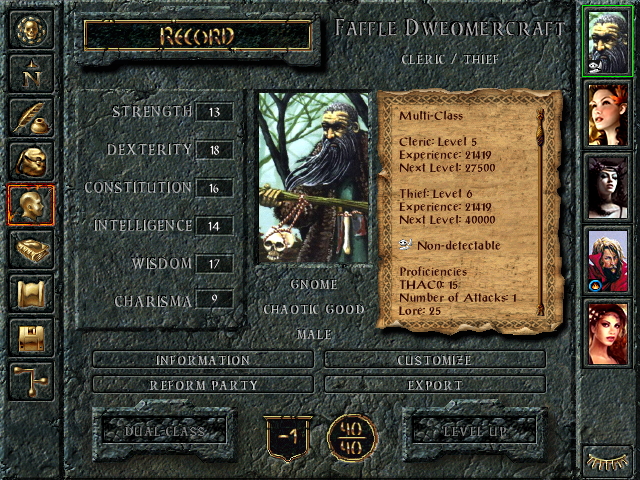
When I was a child and had little to do, I would often pull out the Players Handbook and whip up a few characters. It was fruitless task really, for I never expected to use the characters at all. The truth is I just loved rolling dice and poring over the tables and charts. I also loved naming characters and equipping them from the very limited starting gold they were permitted at first level. It was an especially effective strategy for a sorrowful Sunday afternoon.

This urge to create characters never left me and was later transferred to fiction writing. Come to think of it, I was keenly writing fiction as a child, albeit heavily-derivative genre fantasy and the odd scrap of science fiction. When I tried my hand at genre writing in later years, I found I was often more creative in inventing characters than I was with non-genre fiction, where I tended to model characters on people I knew in real life.

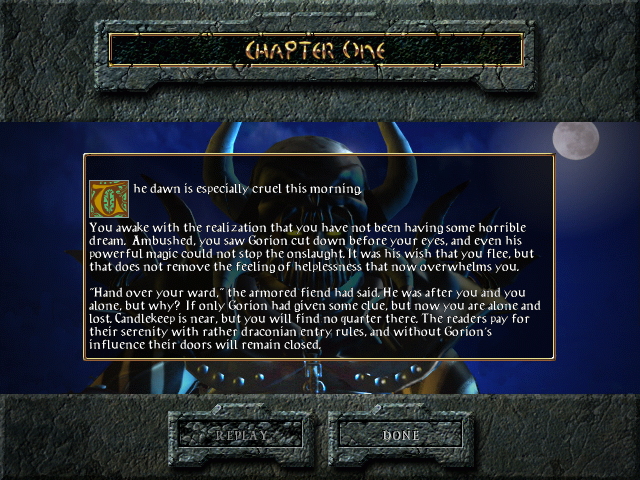
After my first encounter with Baldur’s Gate in 2001, I found myself once again drawn to creating Dungeons & Dragons characters. Baldur’s Gate only allowed for the creation of a single character (though I was later to discover that by starting a game in multi-player mode one could in fact create an entire party) and as a consequence, I didn’t initially have the chance to indulge myself. I did, however, re-start the game several times just for this purpose, bringing back to life such luminaries as Luven Lightfingers, and an Elven Ranger by the name of Yessir Eldith, who may have the good fortune to be commemorated in this series of character portraits.

When I finally got hold of a copy of Icewind Dale, however, which required the creation of an entire party of 1st-level adventurers, I had the opportunity to really go to town. Sadly I have lost the old saved games from that initial burst of character creation and cannot recall the names of my first party, suffice to say that the barbarian, Arnalde Holdfaste, a name I revived from the final campaign I played with my brother back in 1989, featured. There was also a Halfling Fighter/Thief with the name of Whistler Skilift. I do recall having had some fun with the alpine themes.

In 2003, shortly after returning to Cambridge from four months in Rome, I bought Icewind Dale 2 (hereafter IWD2) from the Lion’s Yard Game store. The game was the last of the old Bioware Infinity Engine games and suffered in its reception for having adhered to the old Bioware Infinity Engine. It was considered rather outmoded in time when the FPS was finally coming to full fruition, but as has ever been the case with all Bioware products, the artwork, writing, soundtrack and gameplay were all first class. It was also the first official product to implement the 3rd Edition Dungeons & Dragons rules – a welcome advance on the somewhat illogical and impractical 2nd Edition ruleset.

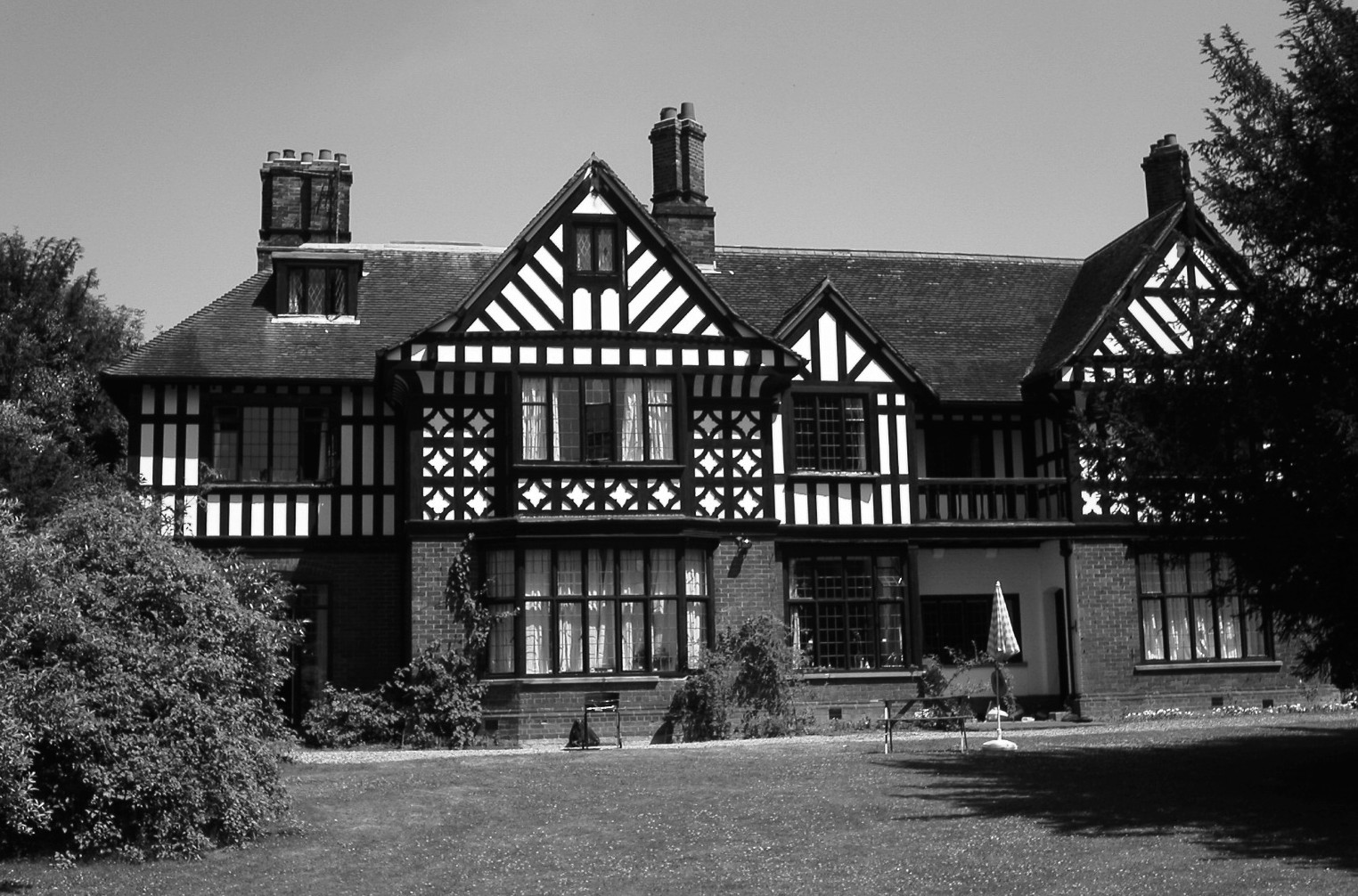
I sat down that afternoon and installed the game on my crappy little laptop. It was the first laptop I ever owned and wasn’t actually all that bad, considering the times. Running Windows XP, it had a 6gig hard-drive, a 499Mhz processor and 196MB RAM. It could just about handle Civilization III and had more than enough to run IWD2. I was living at that time in a small room at the very top of number 12 Madingley Rd, next door to my eccentric American friend Edward. Number 12 was a veritable mansion, built in the mock-tudor style and owned by St John’s College, and my room looked from on high across a large front lawn surrounded by yew trees and redwood cedars towards number 10, where I had lived for my first three years in Cambridge.

It was a strange time in my life. Having submitted my PhD some five months ago and still waiting on a date for my viva voce, I was working part time at the Anchor Pub where I had worked for two and a half years already. I spent my days re-working volume one of my autobiography, Sex With a Sunburnt Penis, applying for jobs, and playing computer games.

Sitting thus beside the small lead glass window with its diamond panes, I fired up the game to discover that, s with it predecessor, IWD2 also required the creation of an entire party. This meant a few hours of undiluted joy for me were on the horizon, though it also meant that role-playing elements in the game would be limited as there would be no scripted interactions between NPCs.

The group I came up with consisted of the following personalities: Milla Sorrow, Amra of Aquilonia, Freya Stark, Laurie Nosgrit, Zorl Bankie and Summer Thingis. Apart from having been a real person, Freya Stark had also been the name of my oldest friend Gus’s first character, which he had the presence of mind to choose at the age of 10. Amra was a blatant Conan ripoff, whilst Laurie Nosgrit was another resurrection from that final 1989 campaign, a Halfling Fighter/Rogue. Zorl Bankie was a name inspired by my South African friend Chris, who had told me that in SA a banky of zorl (sic) was a very large deal of marijuana, usually wrapped up in a sheet of newspaper. Milla Sorrow is a name I find I still rather like, but of course, most important here is the long-delayed subject of this already overlong narrative, Summer Thingis. Her name was the last chosen and it was created in an act of desperation, as I wanted to finish and get started. The name was taken from the English title of a French film that was playing at the Art House Cinema at the time – Summer Things. An extra ‘i’ and I was good to go. I chose a very fetching portrait for her and made her a pure-class cleric. After all, every group needs specialist healers. Thus was Summer Thingis born. Needless to say, she performed admirably well as the party’s principal healer and I developed a real attachment to her, as I did to the others in the group.

Largely on account of my being so fond of her portrait, I later made use of her name in a variety of other games, though she had to wait until 2006/07, after my return to Cambridge. Firstly in Neverwinter Nights 2 (Hereafter, NWN2), then again in The Elder Scrolls IV: Oblivion. I had a different vision of her by the time NWN 2 came around and remodelled her as a multi-class Ranger / Rogue / Wizard. I had a rather bad habit of making unwieldy multi-class builds in NWN2, simply because I could and Summer was no exception.

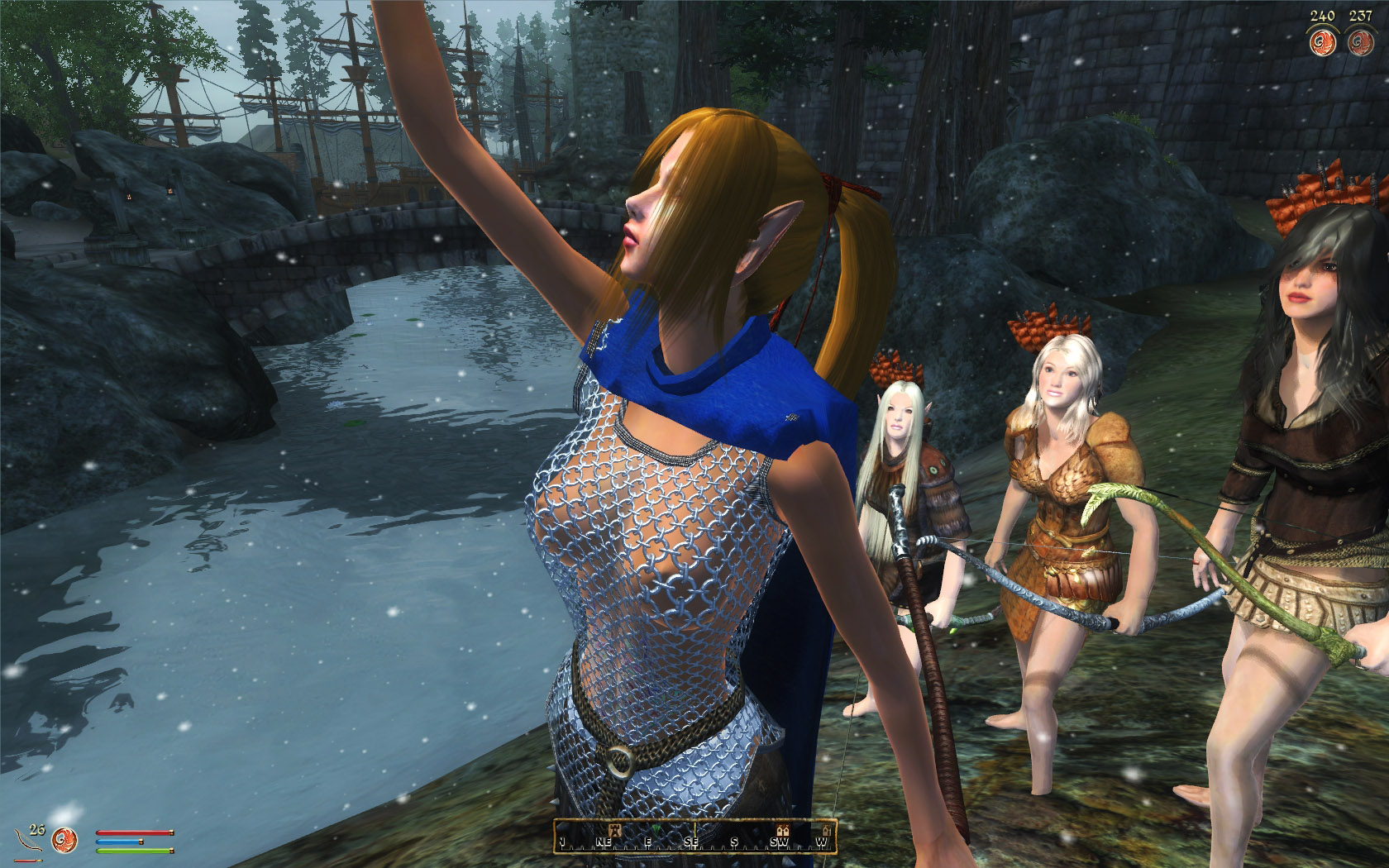
It was really, however, with Oblivion that Summer came into her own. With its far more customisable character creation system, allowing for much greater versatility in builds, I made a custom class called a Rainsinger. The name bore no relationship to her role, but rather celebrated my love of both rain and bards. She was a rogue-based blade, light armour and caster class, born under the Sign of the Lady.

I first played with her whilst I was in England, then, in 2008, when I returned to Sydney, I began to mod Oblivion. This became something of an obsessive process wherein I spent weeks completely customising the game. I replaced nearly all the textures and meshes, tweaked the game mechanics, added hundreds of user-created mods including new quests, quest and gameplay overhauls, a new user-interface, new equipment, locations, NPCs, including companions who could be recruited as party members.

I expanded the sound-track, slowed the levelling speed to one-tenth its original, slowed down time so that it was merely half that of the real world, added weather effects, transformed the shape of all the cities and towns, installed new cities and towns, removed the borders of the massive world and exploited the unused land out there and added many other new features to the game. I say that I did this, but it was all the work of the amazing modding community wherever they might be in the world. From websites such as TESNexus and Planet Elder Scrolls, I downloaded these at times quite extraordinary modifications and improved the game dramatically.

It was a lot of very hard work, but the results were astonishing to say the least. When you consider that the original skin textures on characters were 128×128 pixels, and these were upgraded to 4096×4096, you can get some idea of just how much more detailed the features of the characters in the game were. In most cases, however, the textures were merely four times the original size, yet this still gave the game a dramatic facelift. Some notable mods were Quarl’s Texture pack III, Exnem’s EyeCandy Body, Ren’s Mystic Elf Remake, the CM Companion mod, Growlf’s Hot Clothes, Improved Trees and Flora 1 & 2, Animated Window and Lighting System, Let the People Drink, Better Cities, Enhanced Magic Effects, Natural Environments, and the essential Oblivian Script Extender and Oblivion Mod Manager, to name a few. Two particular favourites on the quest front were the incomparable Lost Spires and the very engaging and useful Origins of the Mages Guild.

The sheer number and size of mods did cause some problems. The game was not entirely stable and crashed when minimised, and occasionally, but rarely, just plain crashed. It also tended to cause some quite heavy lag in populated areas and I did at times, particularly in cities, suffer a significant drop in FPS (Frames per second). This was not such a problem, even when the FPS dropped to a nadir of 12, compared with the standard 60, as I tended to walk through towns for the sake of role-play, thus improving reducing load pressures, and without combat, spell-casting or action sequences taking place in towns, it in no way hampered game-play.

The original Oblivion folder was four gigs in size, but the additions took it out to a total of nineteen gigs. Ouch.

I played this modified version of the game intermittently, but over a two-year period. I’d fire it up here and there and immerse myself in the province of Cyrodiil, with its lush, swaying foliage, long grass, rolling hills, high mountains and quaint medieval towns. It looked so good and the new mechanics made it play so well, that I was especially inspired to take the game as slowly as possible. I made Summer and her three companions walk or ride horses everywhere, only occasionally using the modded transport network to take a ship from say, Leyawiin to Bravil or on to the Imperial City. I was so enamoured of the new look of the game and the sheer vastness of the world that I nicknamed it The Beautiful Game. And it was, indeed, beautiful. Especially when under the influence of a certain cannibinoid, I found I could sit amongst the trees and watch them thrash around during a heavy thunderstorm for a very long time. I often did nothing other than wander around in the forest, pitch my portable tent in a clearing and sit beside it.

One of the great advantages of having installed so many mods, especially new lands, buildings, forts, castles, houses, estates, villages and what have you, was that I often stumbled upon things I had no recollection of installing at all. This made the game doubly enjoyable as having already played the game thoroughly and become very familiar with the landscape and quests,  it had become almost entirely novel again.

Sadly all this work came unstuck when my operating system developed some fatal errors and I was forced to do a complete overhaul, including finally making the switch to Windows 7. I rescued all the files, but the game would require a complete rebuild. A hobby I have only recently, one year on, found the time to pursue. It’s a work in progress.

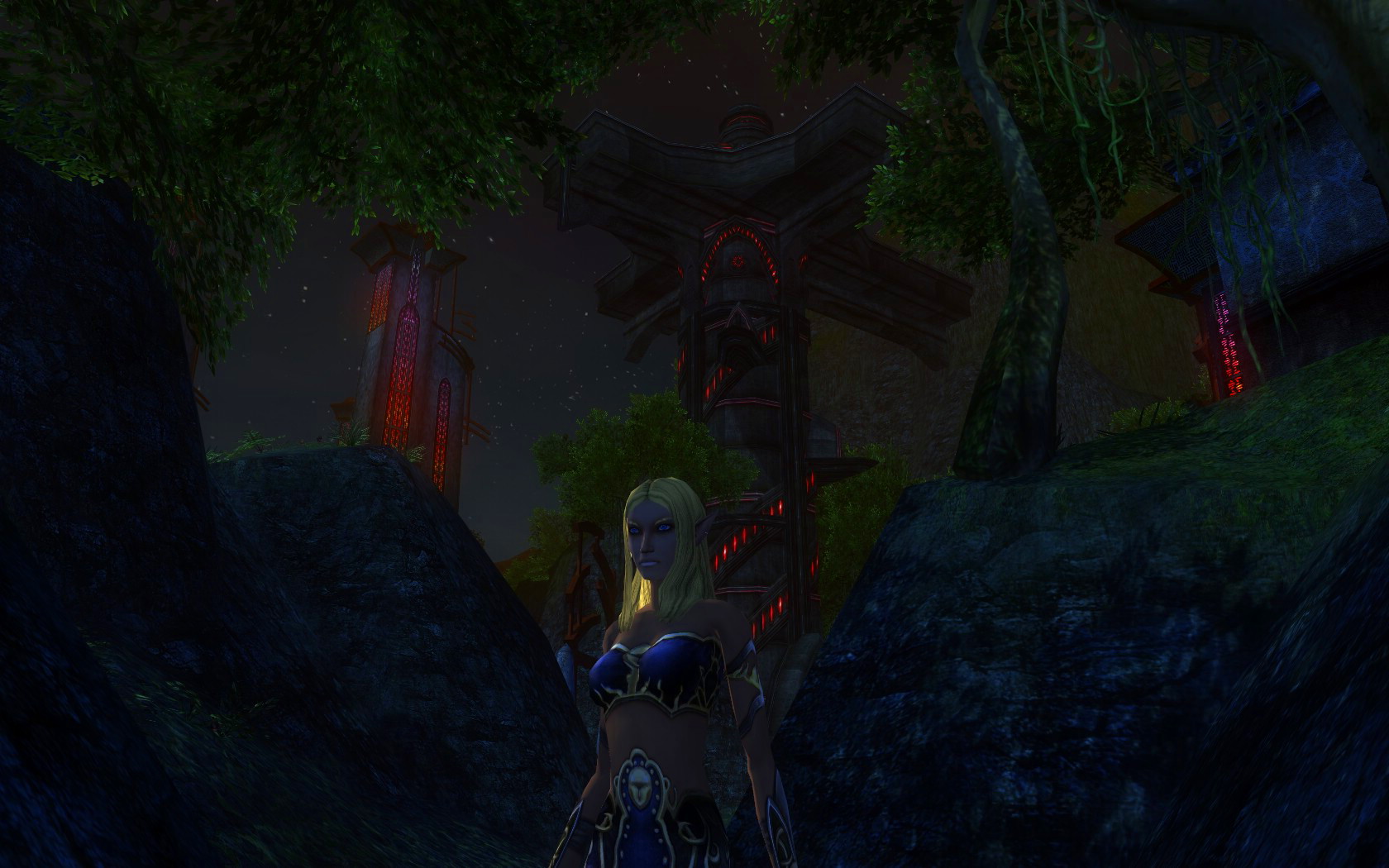
Meanwhile, Summer continued to see action in the MMO Dungeons & Dragons Online.

Using the 3.5 edition rules, DDO again gave me licence to make her a multi-class build. I recreated Summer as an Arcane Archer – a Ranger / Wizard / Rogue – levels 9/3/1 respectively at last count. The final build, bearing in mind the game cap of level 20, was to be 14/5/1. I doubt this shall ever come about as I have since deleted the game in accordance with my new years resolution to stop wasting time and start doing more productive things with my spare time. I’m pleased to say, this has achieved the desired result.

Long live Summer Thingis!

The first love of my life, apart from Jason the dachshund, was Dungeons & Dragons. It was 1981 and I was nine years old when my brother came home from school one day raving about a game he had watched some chaps playing in the playground.

“Several people can play. There’s not even any board. One guy is the Dungeon Master and he explains everything to the other people and they have to decide what to do. The Dungeon Master has maps and books with all the descriptions and rules in them. The players all pretend to be someone and they have to fight monsters and stuff. And they use these dice, with like twenty-sides and twelve and eight sides. It’s a fantasy game. It’s untold!”

He had, in fact, been watching people play for several days, sitting under a fig tree in the senior playground. His enthusiasm had grown steadily and, once he was hooked, he decided to recruit me so we could play at home. Naturally I was curious, and being the younger by two years, I often looked to my brother to introduce new things to me.

Aged nine and eleven we didn’t exactly have enough pocket money to rush out and buy the game rules, so to begin with my brother wrote an adventure, based on what he had seen at school. It was called the Keep of Terror and was, in every regard, what would later become known as a classic dungeon crawl. He drew a map of corridors, rooms, stairwells and underground caverns with an accompanying booklet defining the contents, replete with monsters, pit traps and even a pendulum blade trap. He had obtained a sufficiently rudimentary understanding of the rules to be able to help me create a character, and thus was my first ever avatar born: A Fighter by the name of Heedik. Without the appropriate dice, he approximated everything on three six-sided dice (3d6) and we sat down one afternoon in his bedroom to play.

I was instantly, and I mean, within seconds, totally and utterly engrossed. As I began to explore my first dungeon, armed with a long-sword, wearing leather armour and carrying a shield, my imagination came alive in a way that no story or film had ever managed to achieve. For first time ever, I was the protagonist. In the flickering torchlight and haunted illumination of the cobwebbed arrow-slits, my life depended not only on the decisions I made, but also the dice-rolls. When I opened a door to be attacked by three skeletons armed with rusty old weapons, I was thrilled, terrified and delighted, especially once I crouched over their shattered remains to pilfer a valuable gold necklace. My long, long, long and ongoing fantasy adventuring career had begun.

We replayed the Keep of Terror twice, then, that same week, pooled every cent we had managed to save, just under twenty dollars, and set off for Mind Games in Bondi Junction. We weren’t entirely sure what we should buy, but for some strange reason, rather than simply buying the Dungeons & Dragons Basic Rules, we bought two adventures instead. In Search of the Unknown and The Palace of the Silver Princess, B1 and B3 respectively.

I had a few dollars more than Matthew and bought two dice as well – a D20 and a D8. We rushed home and got stuck into reading these “Modules”. In no time flat, my brother, ever the Dungeon Master, was taking me through In Search of the Unknown.

Like most modules back then it too was a classic dungeon crawl – the long-abandoned lair of a vanished wizard. After years of neglect, the place had been overrun by monsters and overgrown with strange, in some cases sentient plants. Other adventurers had tried and failed to explore this musty hideaway and the entrance corridor was grisly with their decaying corpses.

Feeling it was time to move on from Heedik, and now more aware of just how makeshift my brother’s initial crack at the rules had been, I picked a character from the pre-generated list at the back; a first-level cleric called The Mystical One. It was a crap name, it must be said, but I rather liked it at the time. Accompanied initially by a few more robust NPCs (non-player characters for the uninitiated) The Mystical One survived the challenges of In Search of the Unknown and, believing at the time that it was only possible to have one character at a time, I stuck with him.

It wasn’t until our birthdays came around that we finally got hold of the rules and things became a lot clearer. My brother also succeeded in recruiting his best friend Shah, and I got my best friend Gus on board, thus significantly increasing the player roster.  Of course, they could hardly be there on a regular basis, but my brother and I played almost every day after school. One weekend, whilst the two of us were staying at Shah’s house, The Mystical One finally met his demise at the hands of a village of enraged Lizardmen on The Isle of Dread. I was somewhat upset about this, but also felt ready to move onto another character.

Needing a new avatar, I again turned to the long list of pre-generated characters at the back of In Search of the Unknown and chose a thief by the name of Luven Lightfingers. This time he stuck, and, despite being somewhat pissweak, he proved more capable at keeping himself alive. Within a year Matthew and I had bought the Advanced Dungeons & Dragons rules, in the first edition of course, and we simply adapted our game to this far more complex and ultimately satisfying rules system. Luven, survivor that he was, would go on to reach 9th level over the next few years of gaming.

More than just a character in a fantasy role-playing game, Luven Lightfingers was my first true alter-ego. Cunning and resourceful, dextrous and skilled, intelligent and sharp, he was my hero. But, best of all, he was me. I imagined him looking rather lank and devious. The shady guy in the corner, a pick-pocket, a pilferer, yet he was also one who favoured helping the disadvantaged and tyrannised. He would, if at times in an underhanded and unconventional fashion, always try to put an end to evil where he found it. He had the common touch and was not fond of the excesses of the aristocracy. He was himself no assassin, was not an evil man, and appropriately this was reflected in his alignment – chaotic good. The Players’ Handbook, and here I quote from the 1989 2nd edition, has the following to say about the chaotic good alignment:

Chaotic Good is known as the “Beatific,” “Rebel,” or “Cynic” alignment. A Chaotic Good character favors change for a greater good, disdains bureaucratic organizations that get in the way of social improvement, and places a high value on personal freedom, not only for oneself, but for others as well. They always intend to do the right thing, but their methods are generally disorganized and often out of alignment with the rest of society. They may create conflict in a team if they feel they are being pushed around, and often view extensive organization and planning as pointless, preferring to improvise. While they do not have evil intentions, they may do bad things (even though they will not enjoy doing these things) to people who are, in their opinion, bad people, if it benefits the greater good.

Around the age of twelve, with Luven rapidly approaching tenth level, my brother, who had started to display an increasingly mean streak as a Dungeon Master, tried to kill off Luven in Against the Giants. Having snuck his way deep into their compound in the mountains, Luven came upon a treasury, the centre-piece of which was a large, iron-bound chest. Naturally excited at the prospect of some quality loot, he proceeded to search for traps and found none. The chest was locked, yet the lock was not beyond his skill and Luven sprang it without difficulty. Sadly, however, there was in fact a poison spike trap which he had failed to detect, and as the lid popped open, a spike shot into his arm, tipped with a lethal poison.

I needed to roll a 10 on a d20 to make the “saving throw”, but when I threw that die I rolled a 9. My heart sank, and I looked at my brother as though to say, “Surely, no?” Yet I received no sympathy.

“Too bad,” he said. “Luven’s dead.” Indeed, he seemed almost to revel in the demise of my beloved Luven. We fought, there were tears, and I ran away and locked myself in my room.

The following day, however, still mourning his death as much as I had the death of Jason the Dachshund that same year, I remembered that Luven was in fact wearing a Ring of Protection +1, which gave him a positive modifier on his saving throw dice-roll and thus should have seen him survive the deadly poison. I took this information to my brother, but he refused to accept it.

“It’s too bad, he’s dead,” he said, re-iterating his cold response of the day before. “But,” I kept pushing, “we forgot about the ring. That’s the rules,” yet my brother would not budge. He must have decided he had had enough of Luven Lightfingers and wanted him to stay dead. Again, there was fighting, anger and tears and this time the situation prevailed for several days. Ultimately, my father was forced to intervene to try to convince Matthew that it was in the best interests of family harmony that he allow for the resurrection of Luven. My brother would not quite agree, but I at last decided that I didn’t, in fact, need his say so on this one. So far as I was concerned, Luven was still alive.

My attachment to Luven Lightfingers never quite diminished and he has enjoyed further resurrections over the years in various fantasy settings; especially in the many later iterations of Dungeons & Dragons, be it 2nd or 3rd edition, or in computer games such as Baldur’s Gate I & II, Neverwinter Nights I & II, Icewind Dale 1 & II and Dungeons & Dragons Online. I have, of course, used many other avatars, some of whom will be featured here, but so deeply nostalgic do I feel for Luven that here and there I can’t resist bringing him back to life in some form or another. I suspect he will crop up again in the future, in some as yet unforeseen campaign, although the pleasure I receive from naming characters will likely ensure he won’t be my first choice.

Dungeons & Dragons has shaped many aspects of my life and, since I was a child, role-playing has been my escape. When I didn’t like my situation, I would pretend to be somewhere else or go somewhere else; when I didn’t like myself, I would pretend to be someone else; and when I didn’t like someone else, I would pretend to take them out with an arrow. Dungeons & Dragons was no mere game and it rubbed off on me as a way of looking at the world. Ever since I first embarked on In Search of the Unknown I’ve never ceased to view people, including myself, as “characters”; some friendly, some hostile, some worthy of love. Just as I developed my characters during my obsessive childhood until I grew bored of their capability and started afresh with a new character, so it was with me and my associates. Characters in life have often seemed like commodities and when people, through overexposure, became reduced by waning interest to caricatures of themselves, I am often forced to go back out in search of the unknown in the hope of finding the novel.

When I became unhealthily obsessed with the MMO, Dungeons & Dragons Online in recent years, I found myself constantly switching “toons”. One character would have a good long run from 1st level up, then sit for a while as I grew restless with them and wanted to run a different build. So it was that I went through Hallifax Bender, Bethanie Brinsett, Jaspar Krait of Luskan, Snowfell Vanish, Summer Thingis, Honeydrop Sundew, Lusetta Sorrowdusk, Lucessa Rainsinger, Applefrost Loveblossom, Jyzze Badajon and the indomitable Yardley “The Scissors” Bruce, to name a few. Each of these toons had their own style and personality, and though hardly a game that inspired role-playing, being in groups, miked up and chatting with five other random strangers from faraway places such as Brazil, China, the US, Spain, UK and Israel, inspired a certain role-play in itself. Still, I could never quite work out who I wanted to play – healer or assassin, tank or buffer, crowd control or hardcore caster of arcane magics.

I found this restlessness with characters also translated to people, especially once I started using online dating websites. The profiles looked to me just like character sheets and I was torn in deciding which one I’d either like to “play” or have in my party as it were. Indeed, I soon realised that my obsessive switching between toons had shortened my narrative attention span so that I couldn’t date someone without already thinking about who I’d like to date next. Most people I met had a certain appeal, but perhaps it was insufficiently broad to warrant whole-hearted enthusiasm. I have always played multi-class characters, and I guess I expect people to have a wide range of interests and to be extremely versatile thinkers and conversationalists. They can judge me however they like too! I also have a tendency, both in life and in roleplaying, not to give much thought to the endgame. I’ve always far preferred the beginning with all its immersive excitement and novelty. I’d like to think that I have moved on from this phase now – one can but hope.

So, here we have it, the avatars. Luven first, as there could be no other first, despite his predecessors. I’d like to think that, unconstrained by the forces of entropy, they might live on forever. And so it is that I have chosen to commemorate them here.

I’ve been meeting with Dr Fantasy a lot lately. He and I are writing a TV show together and we have a lot to talk about: the plot, the characters, the arcs, the tone, the mood, the aesthetics. Number one, of course, is the plot and working out what happens in each episode. We have completed six so far, all of which have been the result of a process of lengthy discussion. Dr Fantasy makes his suggestions, and Mr Plausibility makes his. Oh yeah, that’s me, Mr Plausibility.

Workshopping is a common enough approach in writing. Many writers use their friends as sounding boards – simply beginning to discuss something can highlight issues of story or character. It works rather in the same way that tossing a coin does. It comes up heads, but then you know you wanted tails. It’s not the result that matters, it’s just that tossing makes you feel the right answer in your gut. I don’t want to draw too many parallels between talking and tossing, but there you go.

I have a lot of experience in workshopping from doing a Masters in Creative Writing along with many hours spent discussing work with other writers outside of university. It’s also fair to say that I learned a very great deal about process and structure through discussions with my PhD supervisor, Professor Rosamond McKitterick, irrespective of the fact that my PhD was in late Roman / early medieval Italian history. She deserves credit as my first real editor. Dr Fantasy too has a great deal of experience in workshopping through his studies in communications and later drama at NIDA. No longer precious about our work or ideas, we can make all manner of bold suggestions for our characters, reject them, pick them up again, rework them, and perhaps discard them altogether, or in they go.

Dr Fantasy, whose show it is, and who has kindly taken me on as co-writer, is fond of the expression “It’s television!” I’m fond of it too, for it allows for all manner of melodramatic situations.

“Why not? Who cares? It’s TV, that shit happens on TV.”

And, indeed it does.

Dr Fantasy, like a sorcerer, conjures scenes from the great miasma of television and Mr Plausibility refines them, within the bounds of reason. Now I don’t mean to suggest that Dr Fantasy isn’t also a realist. His concern for plausibility, for characters to remain true to their personalities, goals and motivations is no less strong than mine. Yet, Mr Plausibility’s job is, like the devil’s advocate, to ask every question there is to be asked about why a person would say a particular line, take a certain course of action, do one thing and not another.

The process always starts with a question. Sometimes as big as: “What’s going to happen in Episode 6?” A blank canvas can be daunting, but two people can circle this very effectively if they’re thinking clearly. I like to lie down, Dr Fantasy loves his notepad, but either way, we make ourselves comfortable and just talk. The important thing is to keep talking. Thinking too much can be detrimental – you can get bogged down. Pause, certainly, but keep talking about ideas. What’s good about them, what’s bad about them. Even seemingly irrelevant tangents can flavour the vision of the characters, so it’s worthwhile voicing some of the more peculiar ideas which seem initially unworkable.

“How about this,” says Dr Fantasy. “Let’s take it out of Sydney – focus on Frederic (our main character). Get some different settings. Like a country house or a big mansion somewhere.”

“The Blue Mountains could be the go,” I suggest. “It’s misty, cold, winter. There’s a big wedding he’s shooting and someone goes missing.”

“Yeah, I like that. Maybe Bowral or something, you know, southern tablelands. It’s a big wedding, like some media mogul or something – his daughter is getting married.”

“She looks like Miranda Kerr.”

“Tasty. She’s marrying a guy called Brady.”

“American?”

“Why not?

“How about this. The old media guy is like Citizen Kane. He calls his elderly wife Rosebud. He’s a bit of a Murdoch figure, but perhaps less, I dunno, sinister.”

“Good, good. But how does Frederic get to the wedding? Who gives him the job?”

“I dunno. Maybe he meets some old cougar in a bar. Hell knows.”

“Ok, how about this,” says Dr Fantasy. “An old friend of Frederic’s is in town. A real heroic, Hansel-type dude. He’s American, called something like Cory McFlynn, or something.”

“I like it.”

“The opening scene is him and Frederic, paintballing. They’re chasing each other, maybe a montage over the intro. Then in the cafeteria – Cory invites Frederic to the wedding. He knows the daughter. Maybe he’s been banging her on the sly.”

“Or maybe he knows the dad, the old media mogul. Roland. Roland Chandler. Maybe Cory worked for him for years. When he was starting out he was a rising star of a photographer, Roland was still hands on, editing the newspaper or whatever. He was a bit of a maverick like Rupert, and then he sold out. Cody’s an old family friend, he’s the best in the business.”

“Cody? or Cory?”

“Hey, Cody, why not? They want him to shoot the wedding.”

“Maybe,” says Dr Fantasy, “he likes to suck a dick here and there and he’s Roland’s old bum- chum.”

“It got him that feature.”

“Moved him up the ranks.”

“Maybe Roland’s a bit of a media guru, when he was younger, he lectured in journalism. Cody was one of his students.”

“His wife is very sophisticated. She’s French, she doesn’t care that he likes boys on the side.”

The above is a pastiche of a considerably longer conversation held only recently during which the plot of episode 6 was taking shape. It’s always a genuinely collaborative process with each of us refining each other’s ideas as they emerge, taking them to extremes and then trimming them into plausibility. Once a pool of information has been put together, such as that contained in the above exchange, we filter it for clichés and give people names that sound less like they derive from cheesy sitcoms or Restoration dramas.

Once we had developed a working framework for the episode, the debate found its biggest point of contention: the timing of a blow-job.

“Look,” said Mr Plausibility, “if Miranda’s going to catch this chap Cody giving her dad a BJ and then go riding off on her horse at dawn, only to get lost in the heavy fog of the southern tablelands, then surely we have to ask the question of why in hell has this old chap stayed up all night only to have a fire-side brandy-fuelled blow-job from his sycophantic former bumchum at five thirty AM on the morning before his daughter’s wedding?”

“Hey, who cares,” says Dr Fantasy. “Does it matter? They’ve been talking all night, sitting by the fire – maybe a little saucy line of coke or two. They’re hardcore night owls with plenty to talk about. Maybe all the men were sitting up late, playing cards, smoking cigars, the odd game of chess. Then, just after everyone goes to bed, down comes Miranda, all bleary-eyed, on her way to get a restless snack from the kitchen, when bingo – she sees Cody crouched over her dad’s lap working his magic for that next promotion.”

“But, dude, the guy’s like sixty. Is he really going to be up that late? Wouldn’t the saucy old fruit retire a good deal earlier, say one o’clock, which would still constitute a pretty late night? He’s got a wedding on the next day.”

“Maybe it’s not dawn then. Why does it have to be dawn anyway?”

“Because we want Miranda riding off at dawn – it’s a visual thing, we want that silver grey morning light through the fog, so we need to have moment of shock in the morning. You know that’s how you want it.”

“Of course. But why can’t she ride off in the middle of the night, and then Frederic and others go looking for her in the morning?”

“But, that’d be crazy. I mean, who would go off on a horse in the middle of the night in winter in a nightie when it’s freezing cold and dark out in the country? She’s a sensible girl. Yes, she’s in shock, but at one or two in the morning, she’s far more likely to go flop on her sister than hop on her horse.”

“Why not? She’s upset, she’s crazy. She’s not thinking. It’s a brain-snap. Hey, come on, it’s television!”

“But…”

Anyway, you get the drift. The debate continued over two further sessions. How could we make the timing work? How could one event lead to another in a smooth and ultimately plausible transition? Often it seems as though one is patching over things, looking for any means of bridging the distance, of establishing a suitable flow. Timing has always been one of the biggest issues with writing, especially when all the events of a story or show are stuck within the tight constraints of a weekend or even a single day. There is always the option of a complete overhaul of events, but having seen the dramatic possibilities of one course of events and having already worked characters and situations to fit around these, it seems as though finding a way through is the first priority.

Dr Fantasy certainly recognises the need for tight scheduling, but he is perhaps more willing to use larger bandaids than Mr Plausibility.

“Sometimes, you take this plausibility thing too far, you know,” said Dr Fantasy. “Sometimes you’ve gotta let it go.”

“Well, they don’t call me-

“Mr Plausibility –

“Mr Plausibility for nothing.”

Either way, we got there in the end, and of course, I have no intention of revealing further details of the plot – not to suggest that the above is especially accurate. What’s important here is the process. Talking, putting out feelers, wrestling with possibilities, asking questions of all the characters, from their point of view. Dr Fantasy is a master of the raw materials, and I’d like to think that in my small way, Mr Plausibility is something of a craftsman.

The response to the uprisings in North Africa and the Middle East has been varied to say the least. Initially underestimating the scale of the revolts in Egypt and Tunisia, many governments favoured a pro status quo approach for the sake of political, strategic and economic stability, which slowly, then more rapidly moved towards support for regime change. In the case of Libya, there was little disagreement amongst the international community that Gaddafi’s actions were worthy of condemnation, and instead the debate centred around how strong the response should be and whether or not some form of intervention was necessary. Why, however, in the wake of ongoing deadly crackdowns against protesters in Bahrain, who have equally compelling reasons to demand regime change, has the international response been so muted?

The protests in Bahrain, led by Shia parties and activists demanding more representative government and greater equality, which began in earnest on the 14th of February across Bahrain caused immediate alarm when heavy-handed policing led first to the death of a protester and then a further death at the funeral which followed. The situation changed dramatically in tone after the February 17 crackdown on protesters gathered at Pearl Roundabout in the capital Manama, which left 6 people dead and hundreds injured. Undaunted, protesters returned to Pearl Roundabout where they continued their sit in, refusing to accept offers of dialogue and calling now for the end of the monarchy.

On March 14 hundreds of Gulf Cooperation Council (GCC) troops and police, from Saudi Arabia and the UAE, arrived in Bahrain at the government’s request. The following day a state of emergency was declared and, on the 16th of March, Bahraini security forces again drove protesters from the symbolic Pearl Roundabout and from surrounding streets. Public gatherings and marches were subsequently banned. The Salmaniya hospital, where most of the dead and injured protesters had been taken, was raided, medical staff were arrested, and the tents set up by protesters were also removed.

On the 18th of March the Pearl Monument was torn down by the government in an attempt to deny the protesters what had become their rallying symbol. Concerned about violent repression, the opposition parties called off further protests for fear of more deaths. Last Friday, a call to action via independent protesters through Facebook and Twitter drew large crowds in towns across Bahrain, but the protests were dispersed by a heavy security presence.

In total, at least twenty people have been killed, including two policemen, and hundreds, possibly thousands injured during a month of heavy-handed security crackdowns. The security response has included house raids and arrests of human rights activists, dissidents and members of opposition parties on charges of sedition, murder and contact with foreign states. Perhaps the most shocking image to come from this is a video showing protesters marching towards security forces holding flags and chanting “peaceful, peaceful,” being gunned down in cold blood. One man appears to have been killed instantly by a shot to the head. http://bit.ly/gcjinZ

Bahrain is a society that is significantly segregated along sectarian lines. The ruling Al Khalifa family is part of the Sunni Muslim minority, who constitute roughly 35 percent of the population. Bahraini Shias are heavily discriminated against in politics, employment and services. Yet, unlike Egypt, the protests in Bahrain are not largely driven by poverty, but by inequality and lack of representation. Unemployment stands at close to 20%, but this is largely amongst the Shia population.

The Al Khalifa family have been refusing more participatory government since the 1950s. Significant constitutional reforms were again promised in the 1970s and then abandoned. King Hamad, who has been in power since 1999, promised reforms in 2002, but the new constitution which did emerge gave considerable new powers to the Consultative Council of Bahrain, which is handpicked by the king and has powers of veto over the lower house. Despite the largest opposition party holding 18 of the 40 seats in the lower house of the Bahraini parliament, this does not translate into legislative power. Protesters have avoided taking a sectarian stance and have instead stressed the need for equality and unity, to little effect.

The Prime Minister, Prince Khalifa bin Salman Al Khalifa, has held his position since 1971. In recent weeks, opposition Shia parties have opted to boycott parliament in support of the popular protests. The crackdowns have been seen as a victory for hard-liners in the regime.

It is for these reasons that the opposition groups, led by Wefaq, have repeatedly rejected offers of dialogue and instead demanded the establishment either of a republic or constitutional monarchy. In the wake of the increasingly violent crackdowns, however, they have eased their demands that the royal family step aside from politics altogether, and have shown some willingness to engage in negotiations.

What makes the situation of the protesters in Bahrain so difficult is that there is next to no chance of either the security forces or military siding with them. The Al Khalifa regime has for some years now been recruiting exclusively Sunni personnel, both from within Bahrain and also from other countries such as Yemen, Jordan and Pakistan, including Iraqis formerly employed under Saddam Hussein. Most of the Pakistani recruits speak neither Arabic nor the local dialect and are seen by the Shia majority as hated mercenaries. The foreign recruits are given housing and citizenship, creating further resentment amongst the local Shia majority. Often, the recruits are hardline Sunni fundamentalists with strongly anti-Shiite sentiments.

“Our army are not really native Bahrainis,” said Sayed Ahmed Alwedaye, a Bahraini activist, speaking to Al Jazeera. “They are all brought over from different countries. So their loyalty is not really to the country. The army is fully controlled by the king himself and his agenda is the agenda which has to be followed.”

http://bit.ly/dKBQog

The exact figures are kept secret, but the policy is part of a broader attempt to shift the demographics in favour of the Sunni minority, who constitute just 35% of the population.

In a country with such a clear sectarian divide, which has until now, managed to avoid much sectarian violence and unrest, there is grave potential for Shia-Sunni relations to worsen dramatically. This will not only have domestic consequences, but regional consequences as well. Some analysts are concerned that should the situation drag on, it will lead to greater radicalisation of Bahrainis and might potentially result in civil war. Bahrain may be small geographically and population-wise, but then so is Gaza and the impact of events there cannot be downplayed. Iran and Syria, who already support and arm Shia groups in Iraq and Lebanon for example, may seek to do so in Bahrain as well. Iran has made it clear that it regards the deployment of Saudi troops in Bahrain as an “occupation”, making full use of the circumstances to promote further its regional leadership amongst Shias. Iran has demanded the removal of GCC troops and recalled its ambassador. Bahrain has expelled the Iranian charge d’affaires, whilst Iran has ordered out a Bahrainian diplomat.

The United States finds itself in a bind because the US Fifth Fleet is based in Bahrain. All Secretary of State, Hillary Clinton had to say after the brutal crackdown on March 16 was that Bahrain and the GCC were “on the wrong track.” The United States seems more concerned about Iranian influence in the Gulf state than the implementation of reforms. Even with the very muted pressure the Obama administration has placed on Bahrain, its relations with Saudi Arabia have become increasingly strained. The Saudis have several times warned both Iran and the United States not to interfere in Bahraini affairs.

It is not merely the United States who have taken a soft approach on Bahrain, but response of the international community has been decidedly cautious. Despite expressions of outrage, with the exception of Iran, little real pressure has been applied. After a recent fact-finding visit to Bahrain, Robert Cooper, a special advisor to EU foreign Policy chief Baroness Ashton was defensive of the Bahraini security forces saying “accidents happen.” He stated that “the exceptional nature of recent events is part of the problem, because… it’s not easy dealing with large demonstrations in which there may be violence.” Despite some strong criticism of his comments by EU colleagues, there seems little willingness to consider the application of greater diplomatic pressure.

The United Nations has made clear its displeasure at the situation in Bahrain, and in Manama in particular, but again there seems little appetite for stronger measures. UN High Commissioner for Human Rights, Navi Pillay, expressed concerns about “arbitrary arrests, killings, beatings of protesters and of medical personnel, and of the takeover of hospitals and medical centres by various security forces.” She described it as “shocking and illegal conduct.” UN Secretary General, Ban Ki-moon, expressed his “deepest concern over reports of excessive and indiscriminate use of force by the security forces and police in Bahrain against unarmed civilians.”


The Middle East has long been a strategic balancing act for the United States and the international community at large and it seems that in the case of Bahrain, the old paradigm still stands. The overriding concern is to maintain economic and strategic stability. The US will be reluctant to damage further its standing with Saudi Arabia, and has little room to move because of its naval base. The EU seems reluctant to engage with the situation and whilst the UN has used strong language, it has done little else. It begs the question as to what ultimately caused the world to recognise the need for change in Tunisia, Egypt and Libya? Because it was morally right, because regime change had become inexorable and thus inevitable, or was it out of concern to garner positive relations with the newly emerging leadership? It seems that in Bahrain, strategic and economic concerns have outweighed any moral imperative to pressure the regime to make significant reforms. What happens next is likely to happen internally, though external mediation is still a possibility. A new offer by Kuwait to mediate in talks with the regime has been welcomed by Wefaq, but it remains to be seen whether the Al Khalifa regime is willing to consider reform. If the government is not genuine about dialogue and the unrest continues, there will likely be regional implications that may force an unwanted shift in the world’s relationship to Bahrain.


This article was first published in New Matilda on 28/03/11:

http://newmatilda.com/2011/03/28/bahrain-not-quite-top-list


On Monday, in scenes reminiscent of Portugal’s Carnation Revolution in 1974, protesters on the streets in Yemen’s capital, Sanaa, handed out flowers to soldiers and posed with them to have their photographs taken. Earlier that day, Major-General Ali Mohsen Al-Ahmar, commander of the first armoured division and head of the north-west military zone, had declared his support for the protestors in the wake of Friday’s crackdown by the security forces of President Ali Abdullah Saleh, which left at least 52 people dead. Four other high-ranking military officers have also announced their support for the protesters in recent days and the soldiers, along with tanks and armoured vehicles, have now been deployed by Mohsen on the streets of the capital to protect the protesters.

The defence minister, Mohammed Nasser Ahmed claimed that despite these defections the president still had the support of the army, yet the situation is extremely volatile with support for the embattled president rapidly eroding across the country. The defecting soldiers join more than 15 foreign ambassadors, including the ambassador to the United Nations, China, Egypt and Germany who have resigned in recent days over the heavy-handed security crackdowns. President Saleh, who has offered a considerable number of concessions in the last few weeks, including the offer of a new constitution, has declared a 30-day state of emergency, sacked his entire cabinet and announced that he is willing to step down at the end of the year. Yet the protesters will accept nothing other than his immediate resignation, having seen many broken promised in the past.

Despite the mounting pressure against him, President Saleh still retains strong support in certain sectors of Yemeni society and the military. As the wave of protest and revolution spread across the Middle East, his supporters were quick to seize the initiative and, realising its symbolic significance in the wake of the Egyptian revolution, occupied Tahrir Square in the capital Sanaa, setting up camp before protesters could claim the site. Consequently, the protesters set up their own camp in Taghyeer Square, out the front of Sanaa University. The name means “change.” Since establishing themselves there, they have been subject to numerous deadly attacks by security forces and plainclothes thugs.

Many both inside and outside of Yemen believe the president is finished. The editor-in-chief of Yemen Post, Hakim Al Masmari, speaking to Al Jazeera said that “For Ali Mohsen to announce this, it is a clear sign to president Saleh that the game is over and that he must step down now.” Ali Mohsen was described, in a 2005 US Diplomatic cable, as “Saleh’s iron fist.” He is said to control over 50% of the country’s military assets and has long been seen as the second most powerful man in Yemen. It is for this reason that, despite his assertion of support, he is unlikely to be trusted by the protesters.

“Ali Mohsen Saleh will not be accepted by the youth,” said Masmari, “He is also very corrupt; he is not respected here in Yemen.”

The regional response has also been strong. On Tuesday, The Arab League strongly condemned “the crimes committed against civilians,” and called for  “concerted efforts to safeguard national unity and the right to free expression.” The League re-emphasised the need for dialogue and “democratic methods” to address the demands of the people.

Even the United States, long a supporter of the Yemeni president, has become increasingly uncomfortable with its former protégé. A willing accomplice in the US government’s practice of “extraordinary rendition”, the Yemeni regime has allowed the United States military to conduct actions against suspected Al Qaeda militants and been a beneficiary of their financial and military aid. Stopping short of calling for Saleh’s departure, the Obama administration has emphasised the need to allow peaceful protest, to engage in genuine dialogue and has refused to accept the president’s paper-thin excuse that the deaths of protesters were caused by a backlash from local residents, in effect, laying the blame Saleh himself.

France has again taken the initiative as the first western power to call for the removal of the president. Alain Juppe, the French foreign minister, speaking in Paris, said that the president’s resignation was “unavoidable.” He has made clear France’s support for the pro-democracy protesters.

President Saleh has also faced calls for his resignation from various tribal leaders. Whilst tribal affiliations are strong in Yemen, and President Saleh has made a point of including leaders from different tribes in the running of the state to ensure loyalty to the ruling party, the party is not broadly representative of the tribes and nor are they especially loyal to the ruling party. The leaders of the opposition also have broad tribal representation, but again those affiliated leaders are not necessarily seen as representative of the tribes. Saleh has tried to rally tribal leaders, and whilst numerous sheiks have pledged their support, he has been abandoned by many others and criticised for encouraging militarisation and polarisation.

Abdulghani al-Iryani, a Yemeni political commentator, points out that strong tribal affiliation applies to perhaps only 20% of the population, with the rest being peasants or city-dwellers who lack strong tribal links and identities.  http://english.aljazeera.net/programmes/peopleandpower/2011/03/201131612514814636.html The tribes are “hardly monolithic” he writes, and loyalties are not as clear cut as some might expect. The dominant tribe in the north, the Hashed tribal confederacy, from which Saleh and his family come, have members in both the ruling party and the opposition. Even they have issued a statement asking the president to leave peacefully and accede to the demands of the protesters. The larger Bakeel tribal confederacy have ostensibly sided with the regime, but there is significant division within the confederacy and they too have members in the opposition parties. Perhaps unsurprisingly, the Houthis in the north, a group who has, periodically, been fighting a civil war against Sanaa since 2004, have sided with the protesters. The long-neglected south of the country, where a strong secessionist movement has existed since losing the 1994 civil war, has, remarkably, put aside their secessionist agenda to support the opposition.

As to the nature of the opposition, it consists of several political parties, the two largest being the Islamist ‘Islaah’ party and the Yemeni Socialist Party, along with  Baathists, Nasserists and an assortment of smaller parties. Ironically, in a country in which women have few rights and are heavily marginalised, the most prominent activist is a woman, Tawakkol Karman, founder of the group Women Journalists Without Chains. She has been pivotal in organising the protesters in Taghyeer Square and ensuring that protesters do not bring weapons to demonstrations.

So where does all this leave Yemen?

Yemen has long been a troubled nation. It ranks 149th out of 177 countries on the Human Development Index, only a third of the population has access to safe drinking water and most people are poor. Literacy amongst women is a shocking 29%, whilst for men it is more than double at 69%. Roughly 35% of the population is urban, whilst the rest are rural. The country has a very small middle class and unemployment is high across the board. In Aden, the largest city of the south, youth unemployment stands at 40%, though that is only the official statistic. Access to employment is largely based on favouritism, bribes and political or familial connections. The country suffers from terrible corruption, lack of equality, failure to enforce the law and little oversight or regulation. It is estimated that the country’s oil reserves will run out in 2017.

The state in Yemen is especially weak. It lacks much of the hard and soft infrastructure required to sustain a strong civil system, and any hope of moving forward in Yemen should a political transition take place, will, to all intents and purposes, require building a state system from the ground up.

The country has also been neglected by the western media, whose attention has largely remained focussed on Tunisia, Egypt and Libya. Despite increasingly strong condemnations, very little real pressure has been applied against Saleh, unsurprisingly drawing cries of hypocrisy against the international community. Even more so than was the case with Egypt, the United States has been extremely cautious in its criticism of Saleh’s regime, despite the killings. There is little likelihood of any intervention taking place, especially considering the divided, mixed and volatile nature of the country. It seems the world is watching and waiting for an internal solution, which appears increasingly likely.

The question is, however, what will that solution be? Neither the tribes nor political parties will want a civil war, though this bleak prospect remains. Further military and diplomatic defections are likely, in the long or short term, to result in the downfall of President Saleh, but there is much uncertainty about what happens next. Will there be a genuine democratic process, or will it result in a military dictatorship, a fear the president has been keen to promote? And if a democratic transition takes place, how successful will it be in avoiding the taint of corruption or being hi-jacked by religious extremists? It seems that in this case, the world is happy to wait and see.


Originally published in New Matilda on 23/03/11.

http://newmatilda.com/2011/03/23/yemen-brink-what


When the Libyan foreign minister, Moussa Koussa, called a ceasefire last Friday, only hours after the UN Security Council voted in favour of establishing a no-fly zone in Libya, it seemed for a brief moment as though Gaddafi’s campaign against his own people had been brought to a halt. This unforeseen move by the Libyan government caused much speculation as to whether this was merely a time-buying bluff, a genuine fear of imminent attack, or evidence of internal divisions in the regime. Within hours it became clear that far from observing the ceasefire, Gaddafi’s forces were not merely continuing their assault on the rebels holed up in the western city of Misurata, but were also making a concerted advance on Benghazi. Thus, late Saturday afternoon, on the back of swift preparations, the no-fly zone entered its operational phase and operation Odyssey Dawn, the largest military intervention in the Middle East since the invasion of Iraq almost exactly eight years ago, was underway. Rarely has there been such a swift move from resolution to action.

Resolution #1973 gives wide scope for action against Gaddafi’s forces. After a strongly condemnatory preamble, paragraph 4, concerning the protection of civilians, “Authorizes Member States… to take all necessary measures (my italics) … to protect civilians and civilian populated areas under threat of attack…while excluding a foreign occupation force of any form on any part of Libyan territory.” With its expressed desire to protect civilians “in places exposed to shelling”, the resolution, in effect, has authorised attacks not merely against Gaddafi’s air force and air defences, but also against ground forces. Malcolm Shaw, professor of international law at the University of Leicester, said the resolution gave “the broadest powers for intervention” since the UN resolution in the wake of the 1990 Iraqi invasion of Kuwait.

Whilst the US was for a long time keen to avoid intervention, Britain and France have been forthright in calling for action. More cynical observers have questioned the motivation behind British and French determination to intervene, whilst others have argued it is as much an effort to make up for their reluctance and blundering at the start of the “Arab Spring.” The French initially offered riot police to the now-overthrown Tunisian regime. David Cameron was heavily criticised for attending an arms trade fair in Abu Dhabi, and stung by accusations that his response to the evacuation of British nationals from Libya was too slow.

The strong nature of the resolution is in part due to a very recent hardening of American lines on this matter. The U.S. Secretary of State called the decision by the Arab League to call for a no-fly zone a “game changer.” More recently, the United States has further clarified their demands from the Libyan government and armed forces, with President Obama stating that Colonel Gaddafi must not only observe a ceasefire and stop his troops from advancing further, but also restore water, electricity and gas supplies to the rebel cities of Misurata and Ajdabiyah, restore communications, and allow the passage of humanitarian aid. Terms which Obama emphasised were “not negotiable.”

Colonel Gaddafi’s bellicose rhetoric suggests he is unlikely to comply with these requests. “If the world is crazy, we will be crazy too,” he said, threatening attacks across the Mediterranean. “Libya is not yours…The security council resolution is invalid,” he wrote in an open letter to David Cameron, Nicolas Sarkozy and Ban Ki-Moon. “You will regret it if you dare to intervene in our country.” Despite his earlier railing against Al Qaeda, Gaddafi has begun to play the Islamic card, calling the intervening powers “Crusaders.” It appears that no one, either in or out of the Arab world, is buying it.

Whilst the resolution does not call for the removal of Gaddafi, there is broad agreement inside and outside of the coalition that his removal from power is essential to achieve a conclusion to the Libyan crisis. And whilst the resolution explicitly omits the use of an “occupation force”, many commentators have noted that even this wording is ambiguous and that it might not rule out ground attacks by special forces. What has been described as a “multi-phase operation” will likely continue until compliance is achieved or another solution is found.

Despite hopes across the board for a swift conclusion, the outcome of this operation is still very uncertain. Will the air campaign be sufficient to sway those forces loyal to Gaddafi either to flee or switch sides? Will revolt come from inside the regime? Will the people return to the streets? Even if a ceasefire were to be observed, it is unlikely that either Gaddafi or the rebel council would accept any power-sharing arrangements. Gaddafi has promised “a long war with no limits,” whether or not he can sustain it remains to be seen.

Despite all appearances, and despite Libya’s tribal nature, this “civil war” lacks the ferocity of hatred seen in previous conflicts such as those in the Balkans. The people are essentially all Sunni Muslims and the state has maintained a strong national identity for more than 70 years. We can only hope that if a prolonged conflict ensues it will not create deep and irreparable divisions in Libyan society.

It is often said of a film that the landscape is the real star. In Libya, the landscape has done and will continue to prove pivotal. With the vast bulk of the country’s population living in cities stretched along the Mediterranean seaboard, linked by long, open highways, the terrain of northern Libya has until now played into Gaddafi’s hands. Unlike the mountainous terrain of Afghanistan, the flat, dry desert and scrub does not lend itself to guerrilla warfare and the absence of any rebel air-cover has made it easy for Gaddafi to move up tanks and artillery and to transport men. Outnumbered and subject to far superior firepower, the rebels could only retreat to their towns where their inability to control the hinterland made them vulnerable to siege tactics, such as cutting off supplies of water and electricity.

The lethal air power and missile assault brought to bear by the coalition forces has made Gaddafi’s heavy weaponry extremely vulnerable. It is likely for this reason that his tanks tried, unsuccessfully, to push their way into Benghazi, not only in an attempt to capture the town swiftly, but also to make them harder to target for fear of civilian deaths. The NATO intervention in Kosovo, initially conducted against Serbian airpower, was constrained in its ability to operate against ground units, with each target requiring approval by all nineteen member states. No such constraints exist in the Libyan context and, indeed, the first strike of the military intervention was against Gaddafi’s tanks as they encroached on Benghazi. Having failed in his initial assault, in part due to French airstrikes against his armour, Gaddafi’s supply lines are now stretched and subject to air attack.

Given the nature of the terrain, the conflict could well bog down into  stalemate with opposing sides bunkered down in their respective strongholds, unable to move in the open either through fear of air-strikes, or lack of capability. As the conflict centres more around urban areas, accurate intelligence will be essential to avoid civilian deaths and maintain goodwill for the coalition forces. Yet time will ultimately be against Gaddafi, with the long-term prospect of being a pariah state, encased in sanctions and blockaded by air and sea, no doubt playing on the minds both of citizens, soldiers and Libyan government officials. Ideally, the solution will now come from within. Whatever the case, we can only hope that the wounds this war will leave can quickly heal.


This article was first published in New Matilda on March 21, 2011.

http://newmatilda.com/2011/03/21/resolution-action-libya

I scabbed a smoke off a Japanese traveller at Charles de Gaulle airport. Lise was standing on the other side of the glass, but I had to wait for my luggage. She looked ecstatic and a little slimmer and seeing her, I felt rested after the flight from Sydney. We motioned and blew kisses through the glass and I sucked my cigarette with the force of an old habit regained after three weeks of parties. Back in Europe, en route to England, I felt like a conquering hero.

After many kisses the first thing I did was have Lise take my photo. Selecting a point in the bright concrete ring that provides, with such airy modernity, access to the gates, I wanted to look like Bono on the cover of All that you can’t leave behind. In the fever of travel and a tad self-conscious, I lingered just long enough for one take; the backdrop, uncannily, in near perfect alignment. The photo done, we moved to the transport and waited in glee for the bus.

I was on the final leg of an extraordinary four months of travel. In August I’d flown to Berlin, then hitched a ride many miles south into France to meet Lise in Strasbourg. From there we’d ventured around Alsace and into Switzerland, crossing into Germany via Freiberg and spending my birthday in Baden Baden. I finally returned to Cambridge via several drunken nights with old friends in Paris. In November I attended a medieval history conference in The Netherlands, then, the morning after returning, flew to Vienna and took a train to meet Lise and her parents in Budapest for a Nato conference. At the end of the month I flew to Northern Italy to see an exhibition of Lombard artefacts in Brescia and travelled on through Verona to Venice. In December, Lise and I flew to New York and then on to Toronto to spend Christmas with her family, returning to a Cambridge covered in snow. We made straight for London and spent a crazy new years high on piles of coke and champagne at Circus Bar in Soho and later at a party at Rolf Harris’ old house. A couple of days after that, I flew out to Australia for three weeks, whilst Lise moved into a friend’s apartment in Paris where she planned to conduct further research. Life had been unbelievably kind to me; to the both of us, in fact.

Lise’s Parisian flat was on Rue des Quatre Vents in the 6th arrondissement. It was a beautiful apartment, not far from the Odeon and within easy walking distance of Notre Dame or the Luxembourg Gardens. It was small, but very tasteful, with polished floorboards and simple, comfortable furniture. It had an aspect of the old and new. It was very quiet, being set back from the road, down a passage protected by old, dark green, wooden doors.

I was exhausted, but far too tired to go straight to sleep. And anyway, it had been a while since we’d seen each other, so the loft bed, up the ladder, was initially put to more energetic use. We hit the streets of Paris and wandered about. I smoked cigarettes and felt strung out, drank coffee and dreamed of being drunk. Paris can make anyone feel cool, unless you’re prone to status anxiety and feel oppressed by how effortlessly cool everyone else is. I was so full of confidence, fun and bravado at the time that I felt especially cool, even more so than the Parisians. Perhaps I genuinely was at that time; it was a rare window in life in which to feel magnificent.

That night we went out for an assiette grec, which was decidedly Turkish. We returned to drink a bottle of wine, and after that I was spent. There was no chance for me to stay awake any longer, and anyway, I’d already made it into the evening; a first step on resetting the circadian clock from the southern hemisphere. We climbed up the loft ladder and, mid conversation, I fell into a deep sleep.

At four o’clock in the morning, I was suddenly very wide, bruisingly awake. I felt a momentary disorientation and initially wondered where I was. Sydney, Cambridge? Ah, Paris. Beside me Lise slept and I had no wish to wake her, so I tried to remain still as possible. I lay in the loft staring at the close ceiling. I smiled, feeling the residual warmth of my close friends who had gone the distance in those last, frantic days. We had squeezed every drop for a final hoorah and, now, feeling fully rested, my emotions were at liberty to indulge in nostalgia.

Perhaps it was the inevitable comedown from the ecstasy I’d taken two nights before, or perhaps it was just the terminal distance, but, very suddenly I felt enormously sad and before I quite knew what was happening I began to cry. A yawning chasm had opened in my heart.

Only now did it dawn on me just how far away I was from Australia. For a year and a quarter I’d been living in England and at times my heart had burned. I had missed my friends and family and I had missed the climate, but most of all I had missed the history I had with people. I was fortunate to have established very deep friendships at Cambridge with people I knew would be my friends for life, yet in Sydney my relationships had an antiquity that lent itself so naturally to nostalgia, and I have always been cripplingly nostalgic.

Lying there in the loft, I realised how long it would be before I was back in Sydney again. A year, perhaps even two years, I couldn’t be sure. Oddly enough, it wasn’t that I didn’t want to be here. I loved Europe, was obsessed with it. The experience of going to Cambridge was the highpoint of my life. The year 2000 was the happiest of my life, and I knew it then and there. And this happiest year had occurred up here, in the northern hemisphere, in England, in Europe. I wanted to be here in Europe and had even begun to wonder if I shouldn’t stay here forever; albeit in the UK. The only problem was, I wanted to be in Australia as well.

I plunged wholly into sadness and reflection. The glint of the ocean, the broad camaraderie, the hugs and the handshakes, the dinners and drinks; cigarettes borrowed while shouting my tales. I confess that life had been working to tickle my ego. I was the centre of attention, I had all the yarns to spin, I had gone away and become somehow exotic. Sydney had been even more fun than I remembered because I was there this time as a tourist, and everyone came out of the woodwork. I revelled in my time and, high on pills, drunk on wine, smoked up to the clouds, I rolled through it all with a robust good humour. And then, I had to leave.

I also remembered the kisses to which I had almost succumbed. An old friend, with the unfortunate name of Beryl, a person I’d kissed before, loomed back into my life from a long obscurity. I watched those lips swell luscious before me, and in the throes of some rare, first-rate ecstasy, we sat close the luxurious staff lounges in an office behind the Martin Place clock-tower, full of desire. It was all born of a longing for everything. I had become so accustomed to things going my way that I could resist nothing, not even things my timidity might once have forsaken. With other friends gathered round, high as kites, we drank all the office beer and shot pool. At 0600 AM, I phoned the city council and spent ten minutes politely complaining to the nice man on the other end that the clock was two minutes slow, and could they please fix it.

In Tokyo, sleeping between flights in an airport hotel, I wrote a letter to Beryl on the hotel paper. At last I found a use for the Emperor’s yen that my old friend Marcus had given me five years before, and which had ridden my hip for so long. The note I posted was slightly dark with the oddness of flying; the introspection, the philosophy and the urgency of travel. I told her how strange it was that I was thinking of where I was leaving and not where I was going. That I should be looking forwards, not backwards, that I felt half in love, but wasn’t sure what the other half was up to. There was no question that I was in love with Lise, so what had I fallen for in Sydney? It was, in truth, the whole package; the city and its lights, the living postcard, the friends and stories, the emotional history, the scents, the water, all gleaming in the midst of a northern winter. Beryl had, rather unexpectedly, come to symbolise it all. She was the muse of Sydney just now, and so my heart went out to her as I felt the desperate loss in leaving.

I soon erupted in weeping. Another year at least would have to pass before I saw those faces again. A whole other year of waiting and missing things. I had already missed two weddings and the birth of my best friend’s daughter. It was as though people had waited for me to leave before taking these important steps. I lay there still, under that close ceiling, and the tears kept coming.

Soon, Lise was awake.

“What is it, Snail, what’s the matter?”

“I don’t know, it just hit me. I feel so far away.”

There was little she could do, though I wanted her there. She held me and I held her. There was nothing else for it but to seek comfort. Truly, I was very happy to be here, which made my sadness seem so oddly out of place; yet it was the consequence of coming out of such a deep immersion. My synapses hadn’t reconnected with Europe. Home had shifted back south in my head and I was severely disoriented.

I sat up as best as I could. I was wide awake and I felt awfully restless. What should I do? It was January in Paris and still dark. The dawn would not come until near eight o’clock. I needed to sit alone for a while; to compose myself with some sobering cold. Not even the central heating could keep the chill from the tiles. I hugged Lise and kissed her.

“I’m OK,” I said. “I’m just sad to leave my family and friends. I’m glad you’re here.”

I climbed down the ladder to go to the lounge. Little did I know that what I was about to do would have such far-reaching consequences.

There, sitting on the table, was Lise’s new laptop. I had gone with her to buy it in Toronto and it was, for the year 2001, a state of the art machine. Whilst in Sydney, my brother had flown down to visit, and during his stay he brought with him a computer game he wished to give me. It was called Baldur’s Gate; an epic-length role-playing game based on the 2nd Edition Dungeons & Dragons rules. My brother and I had grown up doing little else but gaming. Strategic board games, role-playing games, tabletop miniatures, naval warfare simulations, you name it. Between us we owned something like 31 different role-playing rules systems and I had even written my own role-playing system, consisting of more than 100 pages of rules, at the age of eleven. My brother owned around 30 Avalon Hill military strategy games; complex and involved board games and now much coveted in the first edition. Yet pride amongst all of these games was taken by Dungeons & Dragons. We had once locked ourselves in my room out of protest for being made to stop playing and go down to dinner. My father thought there was something dangerous in our obsession, whereas he should rather have marvelled at the exponential expansion of our vocabularies in learning these sophisticated rules systems.

Despite not playing the game for many years, I had never lost my love for D & D. The last sessions had been conducted between 1994 and ’95, when I was still an undergraduate and living in Darlington in Sydney. My old friend Cody created an excellent campaign; political intrigues in a small regional capital, replete with wear-rats in the sewers. I was a feisty 17 year-old female ranger by the name of Trissa Slondar, ably assisted by my friends Ventris and Faldor, aka, Mike and Malakai, and a very peculiar NPC wizard who chose to join us here and there. It was always fun. Has there even been a better reason to roll dice?

I reached into my bag and pulled out the discs of Baldur’s Gate. Computer games were still relatively primitive at the turn of the century, yet they had come a very long way from the text-based, 2D graphics and simple engines I had begun with. Baldur’s Gate was a multiple award-winning piece of work, both for its narrative qualities, its neat and functional engine and interface, and its incredibly epic scope. Not only did it boast up to 200 hours of playing time, but it was, within the bounds of commonsense, very replayable on account of the wide variety of characters on offer as potential henchmen.

My brother had raved to me about the game in Sydney, and I had been impressed immediately.

“Bro, it’s totally Dungeons and Dragons rules. It even simulates dice-rolls. It’s a TSR product. It’s the real deal.”

The strength of my nostalgia for the game cannot be taken for granted. It had been the great comfort of my childhood. I had stared every day into those lengthy rule books, reading descriptions of magic spells, ancient items, the lore and legends of different races and professions. The illustrations, the fantastic settings, the at times disturbingly adult nature of the content had awed me. Being thrust daily into dangerous situations, striving either for loot in an ancient temple or some desperate rescue; pitted against an incredible array of foes in deserts, jungles, snowy mountains, in quaint and corrupt medieval fantasy towns, was a rare privilege. To play through a quest could take several days and each had its own narrative, its own settings, its own heroes and villains. Solving all manner of problems, making moral, tactical and strategic choices, conducting interrogations, investigations; the variety and versatility of the role-play seemed boundless. Of course, it was often just good hack and slash dungeon-crawling, but this too had its merits as old-fashioned fun.

“Hey, Lise,” I said, walking back into the bedroom, before she had a chance to fall back to sleep. “Can I install this game on your computer? I’ll delete it later. I just need something to do.”

“Of course, Snail. Go for it.”

“Thanks a million.”

I ran up the ladder and kissed her sleepy face. Already I felt considerably better. Wasn’t I really happier in Europe anyway? Hadn’t the last year been the best of my life? For someone obsessed with history, there was simply nothing for me in Australia. It was an empty land, full of fat, rich, vapid people growing more conservative by the minute. Did I really want to be there when I could be here in Europe – in Paris, for god’s sake! There was more culture in Paris alone than in the whole of Australia. What had I been thinking? I smiled, trying to shut out my sense of loss by rationalising my good fortune in being where I was. It was working.

I slipped in the first of the six discs and began the installation of the game. I rubbed my hands together in the light of the lamp. I closed the door and put on the kettle, making a cup of tea. I could see nothing outside the frosted window, except a few muted stars. The cars were sparse enough that each had an individual tone. I checked the time. It was only 0430. The world was going to leave me alone for a good while yet. It was exactly how I wanted it.

I put in my headphones and started the game. The title music was slow but insistent, bombastic and dramatic. I watched the opening animation of a man in armour being thrown from the top of a tall tower by some great brute with an evil voice. This brute must, ultimately, be my nemesis. The body struck the ground and the blood flowed between the cobbles, finding its way to the title, written on the medieval pavement. BALDURS GATE. I was excited to say the least, but far more so when I entered the character creation screen. Just as my brother had so enthusiastically assured me, in every way the game seemed true to the rules of Dungeons & Dragons. My troubles were behind me now as I basked in the rich colours of the interface.

When, some three hours later, Lise finally arose and joined me in the lounge room, I was in another state of being altogether. I had rediscovered a happy place to which I thought I could never return. Baldur’s Gate was simply marvellous, it was enthralling, it was like cocaine. It was the computer game for which I had been crying out for many years, it was that good it was better than sex. I didn’t want to stop playing. I couldn’t bring myself to stop playing. I had to request special indulgence from Lise to let me go through until lunchtime. Everything about it tickled my nerdy fancy and my deep nostalgia for the game. The character classes, the potions, the magical items, the simulated dice-rolls, the sense of adventure, the mission, the quest. Sure, it could hardly replicate the freedom of movement within the pen and paper game, especially when it came to dialogue, but everything else was absolutely spot on. When, from a scroll I’d found, I cast my first Stinking Cloud spell for perhaps 12 years, I nearly wept afresh.

Such was my enthusiasm, that I managed to enlist some from Lise. She found the game cute at first, with its entertaining voices, its artwork and themes. In the days ahead, however, when I continued to wake up at four in the morning, and could not be easily pried away from the computer, my obsession with it became a burden to her.

And this obsession did not diminish upon my return to Cambridge. I continued to play the game, completing it, then restarting it and running it through again, and just when I had finally walked away from it, Baldur’s Gate 2 was released with its far greater complexity, detailed character work, lengthy dialogues and more engaging and coherent story. If Baldur’s Gate was cocaine, then the much lauded and still highly regarded Baldur’s Gate 2, was heroin.

There came a time, further down the track, when things between Lise and I became more strained. We were used to spending a lot of time apart, and when she moved back to Cambridge, we didn’t adapt so well to being together all the time. One day she turned to me, teary-eyed, after I had frustrated her once more with my apathy, and said. “It’s all gone wrong.” It was a dark joke we had often made to each other, that there would come a time when it would “all go wrong.” Then, as if to clarify, with, I’m afraid to say, deadly accuracy, she said, “It all went wrong with Baldur’s Gate.”

Though I don’t regret the beauty of those mornings in Paris, the truth is, it did all go wrong with Baldur’s Gate. And later, with others who were yet to come, it went wrong with many other games as well.

ps. Have you ever seen anything so universally well-reviewed in  your life?

http://www.metacritic.com/game/pc/baldurs-gate-ii-shadows-of-amn/critic-reviews

The United Nations Security Council has finally approved a no-fly zone over Libya after a lengthy debate on the subject. The resolution was passed with five abstentions, from Russia, China, Germany, India and Brazil. To those of us calling for such a measure in the past few weeks, this announcement comes as a very welcome show of support for the rebels struggling against Colonel Gaddafi’s regime and renews hope that the rebels will not be defeated in their struggle. It may prove too little too late, and the member states who have agreed to participate in enforcing the No Fly Zone must act immediately to halt the advance of Gaddafi’s forces on Benghazi and to relieve the siege of Misurata.

Resolution 1973 makes a clear and unambiguous condemnation of Gaddafi’s recent actions in its lengthy preamble:

“Condemning the gross and systematic violation of human rights, including arbitrary detentions, enforced disappearances, torture and summary executions…”

It states that “the widespread and systematic attacks currently taking place in the Libyan Arab Jamahiriya against the civilian population may amount to crimes against humanity.”

It makes special note of the prior condemnations of the League of Arab States, the African Union and the Secretary General of the Organisation of the Islamic Conference against Gaddafi’s serious human rights violations. It references the decision by the Council of the League of Arab States to call for the imposition of a no-fly zone over Libya, and to establish safe areas “in places exposed to shelling,” and deplores Gaddafi’s use of foreign mercenaries. The resolution calls for an immediate ceasefire.

The most strident, and no doubt, ultimately, most contentious passage of the resolution lies in Paragraph 4, regarding the protection of civilians. The resolution “Authorizes Member States that have notified the Secretary-General, acting nationally or through regional organizations or arrangements, and acting in cooperation with the Secretary-General, to take all necessary measures (my italics), notwithstanding paragraph 9 of resolution 1970 (2011), to protect civilians and civilian populated areas under threat of attack in the Libyan Arab Jamahiriya, including Benghazi, while excluding a foreign occupation force of any form on any part of Libyan territory, and requests the Member States concerned to inform the Secretary-General immediately of the measures they take pursuant to the authorization conferred by this paragraph which shall be immediately reported to the Security Council.”

Consider this in combination with the resolution’s expressed desire to establish safe areas protecting civilians “in places exposed to shelling” and there can only be one conclusion. UN Security Council Resolution 1973, in effect, authorises the participating member states to enforce a no-drive zone upon Gaddafi’s military forces. It effectively authorizes attacks not merely against Gaddafi’s air force, but also against any heavy weapons, including tanks, artillery and mobile artillery, which approach within firing distance of rebel-held areas.

The strong nature of the resolution is in part due to a very recent hardening of American lines on this matter. The U.S. Secretary of State called the decision by the Arab League to call for a no-fly zone a “game changer.” On Thursday, in Tunisia, Clinton stated:

“We want to support the opposition who are standing against the dictator. This is a man who has no conscience and will threaten anyone in his way.”

The response of Colonel Gaddafi’s was, to say the least, typical.

“If the world is crazy, we will be crazy too,” he said. “Any foreign military act against Libya will expose all air and maritime traffic in the Mediterranean Sea to danger and civilian and military facilities will become targets of Libya’s counterattack. The Mediterranean basin will face danger not just in the short term, but also in the long term.”

Colonel Gaddafi’s threats are unlikely to do him any favours, and, if anything, will only confirm in the minds of those now pitted against him, that his regime must be shut down.

Meanwhile, in the Twitterverse, the debate continues between those concerned for the consequences of western military intervention and those who feel any measures must now be taken to prevent the defeat of the rebel forces and the capture of Benghazi. The vast majority of tweets, however, express support for the United Nations resolution.

@ShababLibya, a popular voice with over 28000 followers representing the “Libyan Youth Movement”, a loose coalition of people inside and outside of Libya, on hearing of the resolution tweeted: “LONG LIVE FREE LIBYA SOON GOD WILLING”

Other commentators have raised concerns about the spectre of western imperialism and the intentions of France and Italy in the aftermath of the intervention. There are also concerns for further damage to Libya’s infrastructure or threats to civilians from western attacks, yet these are dwarfed by the desire to see action taken against Gaddafi’s forces.

The question now is, how soon can the no-fly zone be implemented and will it actually work? Alain Juppe, the French foreign minister, emphasised the need to act as soon as possible. “We want to stop the attacks by the Gaddafi regime against civilian populations. And it’s a question of days or hours because the pressure against Benghazi, especially, is now very tough.” Italy has already opened its air force and naval bases in Sicily for operations against Libya. This is the most likely place from which to enforce the no-fly zone. Bloomberg reports that Egypt has already started to supply small arms to the rebel fighters.

Still, the situation is desperate for the rebels, though the exact nature of the situation, tactically, is difficult to determine. There are rumours of fighting still taking place in Ajdabiya, of skirmishes thirty miles beyond on the road to Benghazi, of a concerted advance against Benghazi by Gaddafi’s forces. There have also been rumours of fresh protests in Zawiya, the western city recently recaptured by Gaddafi’s forces. It is difficult to be certain exactly how quickly Gaddafi can move on Benghazi, with how much force and how effective any assault from his forces might prove to be. On hearing of the resolution he immediately made clear his intention of taking Benghazi within 48 hours. He claimed he would show “no mercy” in assaulting the city. “The matter has been decided … we are coming,” he stated in a radio broadcast on Thursday. Again he resorted to his earlier rhetoric calling the rebels “rats” and “gangsters” and urged Benghazi residents to “go out and cleanse the city of Benghazi.”

“We will track them down,” said Gaddafi, “and search for them, alley by alley, road by road … Massive waves of people will be crawling out to rescue the people of Benghazi, who are calling out for help, asking us to rescue them. We should come to their rescue.”

The residents of Benghazi, along with other rebel-held areas, have not been receptive to Gaddafi’s message. Their celebrations in the wake of the announcement of the United Nations resolution have been ecstatic to say the least. Their morale and likely their determination to repel any attack on their city should improve significantly now they know they will receive assistance, indeed, now that they have already begun to receive assistance.

The no-fly zone must be implemented immediately, and it must be implemented in a most robust manner. To prevent further civilian deaths, it will be necessary to knock out Gaddafi’s hardware, not just stop his planes from flying. The effectiveness of airstrikes has been proven in the past, though they alone have rarely been sufficient. The world has lost its patience with Gaddafi, has expressed the legitimacy of the rebels who seek a democratic process in their country and an end to dictatorship. They must now put their money where their mouth is and make this possible. We can only hope that robust action now will give pause to those units of the Libyan army still fighting for Colonel Gaddafi and encourage their defection. The game has changed again, only now Gaddafi finds himself pitted against forces far superior to his own. Allowing him to win is unthinkable. The world must take, as stated in the resolution, ALL MEASURES NECESSARY.

Here is the full text of the resolution, courtesy of The Guardian:

http://www.guardian.co.uk/world/2011/mar/17/un-security-council-resolution

There has been much debate about the pros and cons of intervention in Libya, particularly around the question of imposing a no-fly zone. Understandably, it is difficult to achieve consensus on such important decisions and the international community is right to question both the merits and possible dangers of intervention. One thing, however, on which there appears to be a very broad consensus is that Gaddafi must cease military action against his own people and step down. He has been roundly condemned by the United Nations, the International Criminal Court, the Arab League and the Gulf Co-operation council. The rebels are now in a very tenuous position and sure to lose if unassisted. They have admitted they lack the firepower to repel Gaddafi’s assault. So what on earth are we waiting for?

Despite what was taking place in Egypt and Tunisia and across the region, Gaddafi appears to have been caught off guard by the scale of the Libyan uprising and the speed and intensity with which it spread. For a man who has never trusted his own army and neglected it as a consequence, there was a difficult period in which Gaddafi could not take robust action, beyond sicking his security forces on protesters, because he simply did not trust the integrity of his defence force.

This situation has now changed in Gaddafi’s favour. It would appear that those who intended to defect have already done so, and either through fear of reprisal, handouts of stashed petro-dollars, gullibility in the face of propaganda, and even genuine loyalty, likely more tribal than personal, much of the army has decided to stay with Gaddafi.

Now, considerably more confident in the loyalty of his forces, Gaddafi has begun to deploy them in far more robust actions. The rebels have been driven from Ras Lanuf and now Brega, and their situation is worsening rapidly as Gaddafi’s advance gathers momentum. Despite their material, organisational and, likely, morale problems, the Libyan Army is still a far more effective fighting force than the ad-hoc army of the rebels. This advance may slow as they approach the city of Benghazi where rebel defences will be more concentrated, but should Benghazi come under siege, as it no doubt will, there is potential for terrific loss of life.

There is still much uncertainty about the balance of forces and the quality of the Libyan Army’s equipment has come into question. Long years of embargo and, in some cases, deliberate neglect, has ensured that much of the army’s materiel is not serviceable. This has also been compounded by the diversity of equipment deployed by the army; purchased from a variety of different manufacturers and with varying degrees of antiquity, it has been difficult to secure spare parts for repairs or upgrades. Since the lifting of the embargo in 2004, the European Union, spearheaded by Italy, has been Libya’s largest arms exporter, selling an estimated total of more than 800 million Euros worth of contracts. This has mostly consisted of small arms, missiles, electronic equipment, ammunition and fuses and military planes, along with crowd control equipment such as tear gas. Much of the army’s heavier equipment, however, is relatively ancient, consisting of Russian T55s, T62s and the considerably more effective T72s. The army has around one thousand BMP-1, armoured personnel carriers, over two thousand pieces of artillery, including 160 modern VCA Palmaria 155mm mobile howitzers, multiple rocket launchers, heavy and light machine guns, various types of rocket-propelled grenades, surface to air missiles, recoilless rifles, mortars. The air force consists of around 119 Russian MiG 23s, 25-odd MiG 21s and 39 Sukhoi 22 assault planes, 83 helicopters, including 37 Mil Mi-24 Hind assault helicopters.

This is just to name some of the military’s capability, and it must be stressed that this is on paper. No one is certain as to how much of this equipment is genuinely serviceable, just as no one is certain how much equipment has fallen into rebel hands, nor exactly how many of the army’s estimated 45000 soldiers have defected. The east is home to two of Libya’s seven military regions, containing several army bases and four out of the country’s seven air force bases. In a war such as this, heavy weapons will be significant, but perhaps more significant will be smaller-scale anti-personnel weaponry such as mortars, grenades, light and heavy machine guns, and anti-tank weaponry. A tank can be knocked out with a recoilless rifle or a molotov cocktail and they are vulnerable in urban areas, but they are still devastating against infantry and vehicles. If the rebels lack heavy equipment, then their best strategy must be to dig in and fortify the towns and immediate hinterland, not to combat the Libyan army in the field, where they will also suffer for total lack of air cover. The initial enthusiasm with which the rebels rushed west, a gamble they had to take, now seems decidedly naive; they are significantly under-gunned, overstretched and lack coordination. They must concentrate their forces for a concerted defensive effort. Still, all they can hope to do is hold out until help arrives.

The time to act is now. The Gulf Co-operation Council (GCC) has backed the imposition of a no-fly zone and has declared Gaddafi’s regime illegitimate. Amr Moussa, secretary-general of the Arab League, has stated he wants a no-fly zone over Libya, and wants the League to take a lead role in its imposition. These are significant developments considering the traditional reluctance of countries in the region to interfere in each other’s internal affairs. It is now not only the West who has condemned Gaddafi, but the Middle East, broadly speaking. NATO has been waiting for regional support before making a stronger case to the UN Security Council, and they now have it. This will perhaps be more difficult still, considering the general unwillingness of China and Russia to sanction intervention. In such a case, is a new resolution really necessary?

Despite the questionable legitimacy of acting outside of United Nations authority, the situation is sufficiently desperate to warrant it. But what sort of action? There is no room for semantic niceties here; the imposition of a no-fly zone in effect constitutes military intervention as it would require action against the Libyan forces, including scrambling to intercept fighters, transport planes and helicopters and targeting anti-aircraft weapons. If a no-fly zone receives approval, why not approve strategic, targeted strikes against Gaddafi’s tanks, artillery, transport vehicles and ammunition depots? Why not commit to equipping and arming the rebels? It brings to mind the famous quote of George Bernard-Shaw: “We have established what you are, madam. We are now merely haggling over the price.” In for a penny, in for a pound.

The real question, of course, is who will take action? NATO? With all the risks of American involvement? If the region supports more robust action, then why not have a regional response? Turkey won’t have a bar of it and no one seems willing to commit to putting troops on the ground, yet the Egyptian army, in spite of its current and not insignificant pre-occupations, could play a very important role here. They have the largest and most sophisticated force in the region, being able to call upon just under a million personnel and almost four thousand tanks, including a thousand M1 Abrams tanks, modified to the most modern M1A2 SEP Standard. This alongside countless other armoured vehicles including tank destroyers, personnel carriers and mobile artillery. The Egyptian air force boasts 220 F16 fighter-bombers amongst a wide array of Russian and French-made aircraft. A quick and ruthless strike against Gaddafi’s military hardware could well be sufficient to encourage his forces to turn against him. A ground incursion would be far more complicated, tactically and politically, but faced by well-trained and far-better equipped Egyptian forces, the wavering Libyan forces might be encouraged to defect. Is it unreasonably romantic, bearing in mind the messes in Iraq and Afghanistan, to suggest that strong action by Egypt might not only succeed, but ultimately bring the two nations closer together, as well as give the Egyptian military a heroic finale as they retire from public life?

Action by Egypt, or anyone, for that matter, would be fraught with dangers. The risks of becoming involved in a situation that could prove very stubborn are many. Apart from the cost and political consequences, invasion by a foreign power could be misconstrued as opportunistic and become a vehicle for regime propaganda. One is minded of the Vietnamese liberation of Cambodia in 1978. Also seeking to remove a repressive regime and, supporting more moderate separatists, the Vietnamese army made short work of Pol Pot’s regime, capturing the capital Phnom Penh in just two weeks. The upshot of this by no means entirely altruistic action, however, was a Vietnamese military presence in Cambodia for the following ten years. No external power would find such a scenario desirable in Libya’s case.

Still, something must be done and the time to act is now. Not “now” tomorrow or “now” next week, but now, today, this very hour. Gaddafi’s forces are encircling Misrata in the west and have driven the rebels from Brega in the east. The rebels are ill-equipped and many do not have any professional combat training. Their equipment is inferior and their ammunition is limited. The only advantage they have is their unquestionable determination and the rightness of their cause. We cannot forget that this began as a peaceful demonstration. It was Gaddafi who used violence, Gaddafi who fired the first shots against his own people. The international community, the Arab League and the GCC have shown rare consensus in condemning Gaddafi’s actions; sanctions have been imposed and the prosecutor of the International Criminal Court has initiated an investigation for crimes against humanity. In a world of uncertain truths and morality, largely run by hypocrites, has there been a more clear-cut scenario in recent times, in the time since Kosovo?

A no-fly zone is nowhere near enough. Gaddafi’s successes have not come through air power, but through increasingly relentless ground assault. Indeed, the air force has appeared suspiciously incompetent when it comes to hitting targets, prompting the question that these potentially sympathetic pilots are missing deliberately. Australia’s foreign minister, Kevin Rudd, recently said that we cannot allow another Guernica to take place, referring to the bombing of the town during the Spanish Civil War. In truth, we cannot allow another Spanish Civil War to happen.

What the rebels have begun can neither be undone nor stopped. The scale of the initial unrest, even inside Gaddafi’s loyal strongholds, made it clear how much the Libyan people want a democratic process and an end to dictatorship. How many people will die in the fighting if it is allowed to continue? How many people will be murdered in the aftermath if we allow the rebels to be defeated? And they will be defeated, given time. Unless further major defections take place, Gaddafi’s superior numbers, tanks and artillery will grind the rebel forces down, more quickly than most expect. What, do we imagine, will the aftermath be? A Libya led by a threatened warlord, encased in hard sanctions, reprisals and detentions, the people deeply distrustful of each other; growing bitterness and disorder, a general hardening of lines. Will the EU, America or anyone for that matter, seek to rehabilitate Gaddafi one last time? It is, quite simply, inhumane to take the risk of inaction. The British Foreign Secretary, William Hague said, on BBC Radio: “If Gaddafi went on to… dominate much of the country, well this would be a long nightmare for the Libyan people and this would be a pariah state for some time to come.”

The world must now follow France in recognising the rebel Council in Benghazi as the legitimate government of Libya and act quickly to make them so. The Council too must organise itself more centrally and effectively, mirroring important portfolios. With an eye to the future, the rebels must also guarantee not to undertake reprisals against Gaddafi loyalists if they are ultimately successful. An amnesty for foreign mercenaries will also be necessary to avoid further chaos and bloodshed. It will be difficult, given the strength of feeling, but if they hope to form a new, democratic Libya, they must avoid actions that will entrench divisions. Despite all appearances, and despite Libya’s tribal nature, this “civil war” lacks the ferocity of hatred seen in the Balkans. The Libyan people can be brought together ultimately, provided there is sufficient oversight to ensure fairness and equality of opportunity, and the distribution of wealth and power. If the world does not step in, countless more people will die. It’s an ugly and brutal expression, but what is needed in Libya now is a display of shock and awe to halt Gaddafi’s advance and buy the rebels time. It’s time to go in and go in hard.