Feeds:
Posts
Comments
Taj Mahal from Agra, March 20, 2010

Taj Mahal from Agra, March 20, 2010

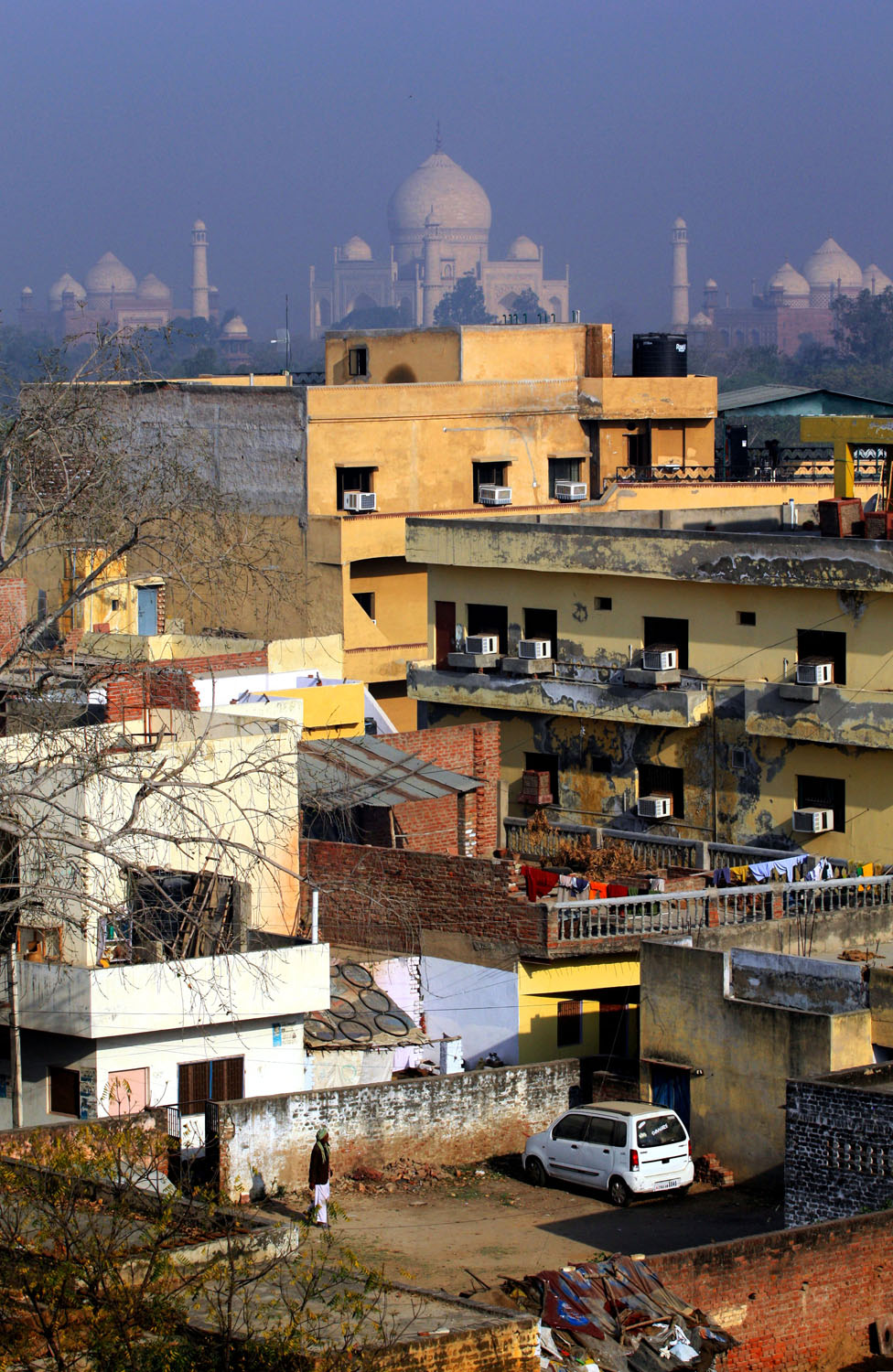
Most views of the Taj Mahal are from inside the complex – looking down the long rectangular, reflective pool towards the magnificent 17th century mausoleum to Mumtaz, wife of Mughal Emperor, Shah Jahan. This is the most obvious, symmetrical and, perhaps, from a certain perspective, the most pleasing way to view the Taj Mahal. Yet, as a colossal monument which far outdoes in size and scale anything in its immediate vicinity, it is visible from a considerable distance and can be seen towering above the comparatively low-rise city of Agra, beside which it sits.

The first shot presented here shows the Taj Mahal from the town of Agra – more specifically, from the roof of my hotel. I only came to appreciate this shot on closer study – the cascading diagonals of the buildings and walls in the mid and foreground create zig-zagging vectors which lead the eye down from the top to the bottom – or, perhaps the other way if you’re so inclined. The Taj Mahal itself, sitting atop these utilitarian concrete boxes, is like the crown of the image – even if something of a distant phantom through the heavy smog. It has strong connotations of the stratification of Indian society – at the bottom, the poor, the quotidian, exemplified by the shabby buildings and single, solitary figure – and at the top – unimaginable decadence and wealth, like a hazy dream of heaven.

Taj Mahal on the River Yamuna, March 20, 2010

Taj Mahal on the River Yamuna, March 20, 2010

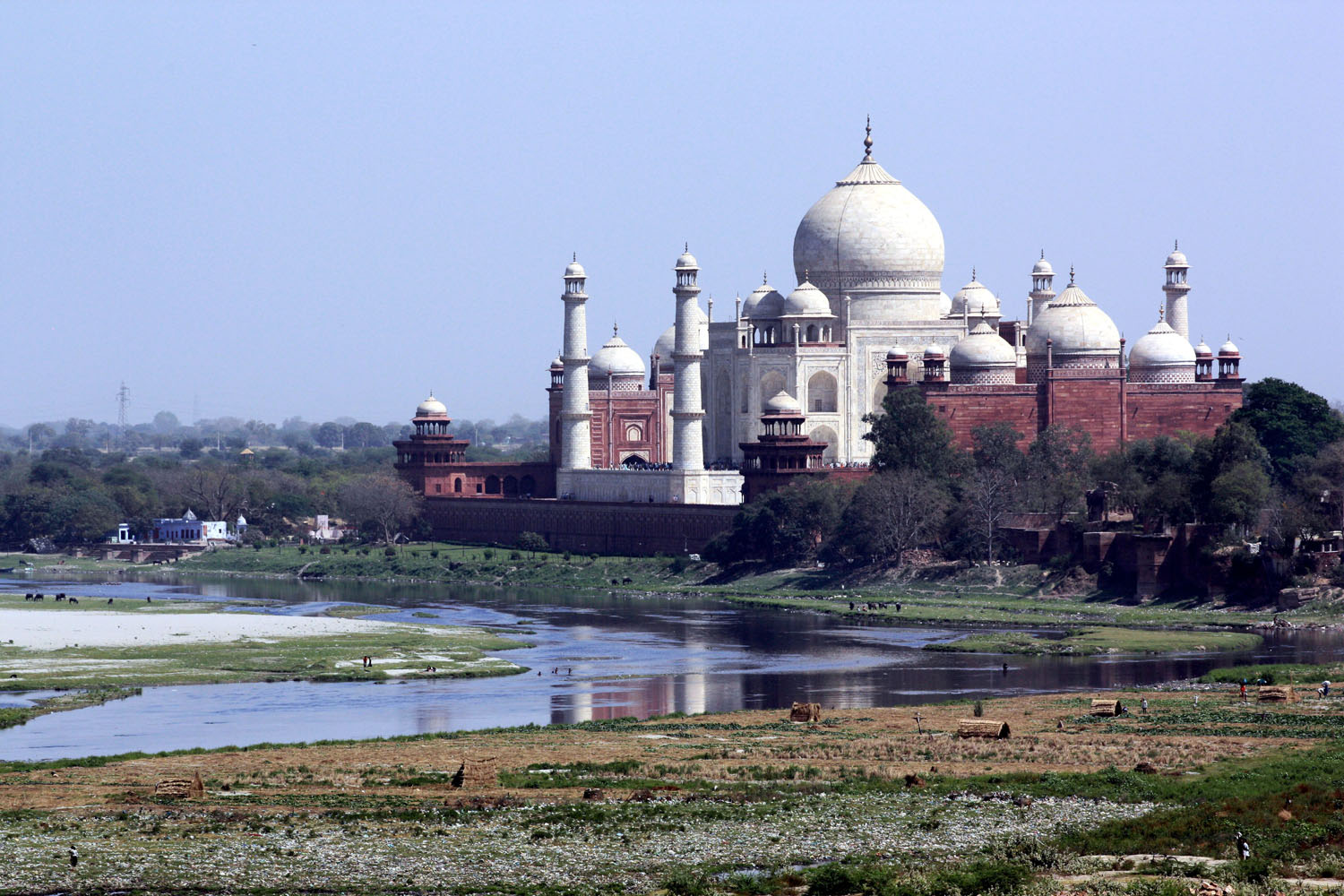
What is not often shown is that the Taj Mahal actually sits on a river – the Yamuna – which lies immediately behind the mausoleum itself. The presence of the river and the wide, open space it creates with its flat, shallow banks, allows beautiful views of the Taj Mahal, especially from the nearby Agra Fort. I’ve included two other views, both taken from Agra Fort, to show this different side to the Taj Mahal. As a backdrop, it creates a very powerful effect, and, when simply viewed as a riverside monument – it loses the protection of its orderly gardens and is forced into juxtaposition with natural asymmetry. Fortunately, however, the building is so organic in its soft curving, bosom-like domes and its thrusting phalluses, as to find a harmonious balance with nature. In a nutshell, whichever way you look at the Taj Mahal, it works.

Taj Mahal from Agra Fort, March 20, 2010

Taj Mahal from Agra Fort, March 20, 2010

5689 Cambridge

Parker’s Piece, Cambridge, July 9, 2006

This photo seems ostensibly to be a celebration, yet what draws me to it is a mild sense of loneliness and isolation. The solitary figure, with arms folded, watches the firework with studious interest, a certain patience and mild curiosity, as though supervising the phenomenon to ensure nothing out of the ordinary happens. The absence of other onlookers, the wan sky and soft palette all add to the loneliness of the photo, yet the onlooker does not seem lonely. Indeed, there is a sense that, friends or otherwise, they were, in an unhurried manner, quietly determined to go down to Parker’s Piece and set off a firework or two.

Clearly, this is a handheld shot and it was fortunate that the brightness of the firework arrested the exposure before too much of the background was lost to unfocussed blur. I’m never especially confident about out of focus shots – is it an accidental masterpiece, or just a poor photograph? Sometimes it can be difficult to be sure. In this case, however, perhaps in the way that a poem operates more indirectly, it has strong mood and atmosphere, precisely on account of its nature. Even then, it was another case of a friend’s comment on facebook when I posted this in 2007, which convinced me that what has since become a personal favourite, was a good one.

G’s comment also adds a nice little anecdote, on which note I conclude:

This… also reminds me in a pleasing way of those Bonfire Night paintings everyone did at school (everyone in England anyway, even at convent schools). The ones where you got your mind blown by being given a piece of BLACK paper, on which you had to make your mark with lighter coloured chalks or paint. A topsy turvy world! And if you wanted a silhouetted figure like this, you had to just be really careful to leave a space.

Fair Go

The recent public outcry across the Australian community at large about the Abbott government’s budgetary decisions have revealed one of this nation’s core values – the belief in fairness and egalitarianism – which has been absent from the general zeitgeist for some time – most especially in the case of asylum seekers. The decisions of the Abbott Government to impose significant cuts on education, health and welfare have caused outrage, not simply because of the fact that these cuts constitute broken promises, nor because of the utter contempt and hypocrisy that have been revealed by their rhetoric that all must do the “heavy lifting” and that this is the “end of the age of entitlement” but because they so obviously target the disadvantaged and leave the wealthy largely unscathed. This is hardly surprising considering it has long been the modus operandi of neo-conservatives, yet the measures contained in this budget are so patently unfair that they go against traditionally upheld core Australian values, at the heart of which is egalitarianism. It is the kind of breach of trust Australians generally do not tolerate.

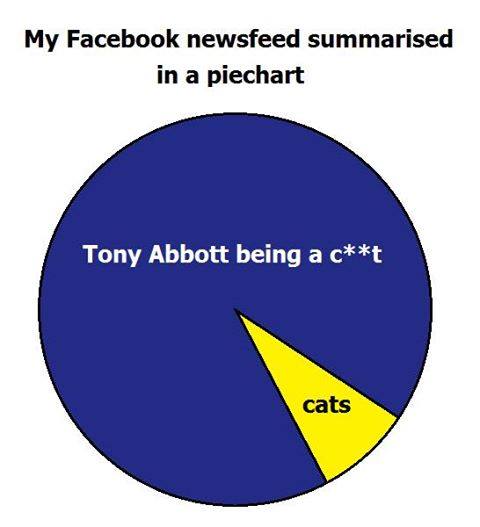
facebook feed piechart

Unfairness, in “the land of the fair go” is, to put it bluntly, un-Australian. The term is here used with ironic awareness that it is most often falsely deployed by nationalists and narrow-minded knee-jerk patriots with the least interest in the greater good. Fairness, or egalitarianism might be an abstract idea which can be realised in many ways, yet in recent decades in Australia it has been associated with equal opportunity and equality of access to services and welfare. Australians have long boasted of their good fortune in not being like America, something people of all political persuasions talk about with pride: our free Medicare; our decent, if not perfect education system with its relatively equal access, our social safety net which, despite its holes, is broadly adequate and at times generous; our better safety and health regulations and more sober judgements on issues such as gun ownership. This position is even reflected in the way this debate is characterised in the media, where the question has been repeatedly asked as to whether Australia is in fact turning into America: a United States of Australia. We inherited our social system from the British, yet we look to America for comparison to see its virtues, and its virtues are the fairness and egalitarianism encapsulated in the idea of universal access.

Forcing people to pay $7 for a visit to the doctor is clearly unfair and no amount of rhetoric about “price signals” is going to change the public’s view of what is clearly an unnecessary and highly unwelcome tax. It is an outrageous imposition on low-income earners and those dependent on welfare, yet even more galling is the dismissive suggestion that it is merely the cost of “a couple of middies.” For a start, there are many disadvantaged Australians who don’t have the opportunity to enjoy a couple of middies, because finances are so tight, but irrespective of that, the failure to empathise with the situation of these people, or worse, care about it, is indicative of the age-old conservative blindness to the actual cost of living. A man with Joe Hockey’s assets and income is not well placed to contemplate the incapacity of people to pay this fee – though he should be, or else, he should not be in politics. If we can accept that Hockey is, in fact, capable of such empathy (bearing in mind his student protest days) yet has chosen to pursue this policy anyway, then it merely highlights the government’s indifference to fairness and equality.

millionaire meme

The attack on unemployment benefits – cutting off payments after just six months – is not only unfair, especially in areas where work is not available, it is socially irresponsible and dangerous policy. On the ABC’s Q & A on May 21, a young Tasmanian man pointed out to Joe Hockey that there are roughly 18,000 job seekers in Tasmania, and around 500 jobs advertised monthly. How are those people expected to live when, still unable to find employment, their benefits are cut off? What kind of Australia are they trying to create? One in which crime and depression are more widespread? No one is suggesting it’s OK to exploit welfare, but to have a system which might deny support to people who genuinely need it is not remotely fair. You can’t have a watertight public system and feeding a few leeches is a small price to pay for security and dignity.
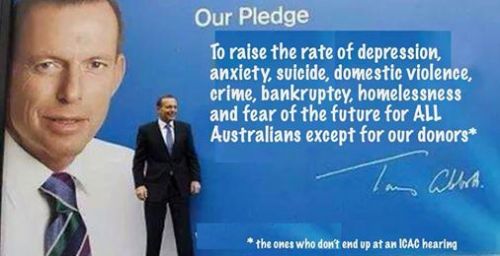
our pledgte

The public has already had a sniff of this government’s “un-Australian” tendencies with their unwillingness to save Holden and blithe indifference to a future foreign takeover of Qantas. This might not been the greenest polity in the world, yet they are deeply suspicious of the government’s lack of concern for the environment, most evident in their willingness to expose the Great Barrier Reef to risk. Irrespective of any cold logic or economic rationalism that might be argued in any of these cases, the gut response across the community is that Australia is losing its icons and its unique environment is directly threatened. Woe betide any prime minister who carelessly tinkers with the very soul of the nation and transgresses its core values.

This country might represent the richest and most decadent society in human history, but it is less stupid and complacent than Tony Abbott and Joe Hockey seem to believe. How do they think it looks to the average person when they move to cut billions from education and deregulate university fees, along with increasing the interest on student loans, in the light of the knowledge that Tony Abbott’s daughter was offered a scholarship that was clearly only granted on account of her wealthy, influential pater? How does it look when, on budget day, a day on which measures that would harm the livelihoods of millions of Australians were announced, the treasurer and finance minister are seen joking and smoking cigars? We are not a bunch of mugs, and, so far as doing the “heavy lifting” is concerned, such arrogant, hypocritical rhetoric will see this government picked up and tossed into Lake Burley-Griffin in the next election.

Tony Abbott Simpleton

These are but a few examples, yet the unfairness of this government’s agenda is evident on many fronts. Why push to remove the mining tax, perpetuate tax breaks for the fossil fuel sector, but cut welfare payments and services? Why claim to be a government for indigenous Australians, then rip more than 500 million dollars out of funding for indigenous programs? Why push for a ludicrously generous and expensive paid parental leave scheme which will primarily advantage high income earners, but not invest in child-care whilst at the same time cutting family support? Why spend $12.4 billion on foreign-built fighter planes, while offering no support for local manufacturing? There are so many clear inconsistencies coming out of this budget, but they all add up to one very clear and alarmingly loud message – the rich pay once (maybe, if the levy passes the senate) while the rest of society pay forever with an unaffordable, elitist education system, more expensive health care, under-funded services, inadequate childcare, slow, expensive internet, and a bleak environmental future. This does not reflect Australian egalitarianism, in fact, it is the most blatantly arrogant form of elitism we have witnessed in decades.

The government’s program might seem less cruel and vindictive if it was coupled to a sound vision for Australia’s future, yet their performance so far makes it clear that they are clueless. The Coalition never had any real alternative policies in opposition, only oppositions and disingenuous arguments about how to fund things, whilst pretending they would uphold the significant social infrastructure which Labor had put in play – particularly Gonski and the NDIS. It is now clear that this government’s only purpose is deregulation – creating an environment in which their donors can operate freely without red and green tape getting in the way. This is especially evident in their attitude to science, climate policy and the environment. Why dismantle the Climate Commission, as though climate change is not a real and present threat? Why fail to appoint a science minister for the first time since the 1930s? Why shut down the Clean Energy Finance Corporation, even when it’s turning a profit? The answer is simple – no matter how much they might pretend otherwise, Tony Abbott still thinks climate change is “crap” and the coalition have absolutely no vision for Australia’s environmental future.
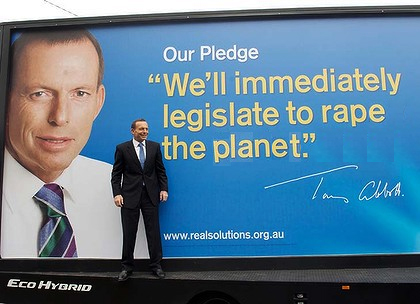
Pledge

What makes this all so stupid strategically is Tony Abbott’s failure to understand how greatly disliked he is across the community as a whole. He won the last election on the back of the most vicious and partisan propaganda campaign by the right wing media, and only because, despite their best efforts to sell him to the public, he was viewed incorrectly as the lesser of two evils. After such vitriolic rhetoric about lying and broken promises, after taking the moral high-ground so stridently against Kevin Rudd and Julia Gillard, he would have done well to adhere to those standards. By treating the public with such contempt, namely, in breaking almost every single promise he made prior to the election, he and his government have lost the small amount of credibility they had mustered. They now have no political capital left to spend whatsoever.
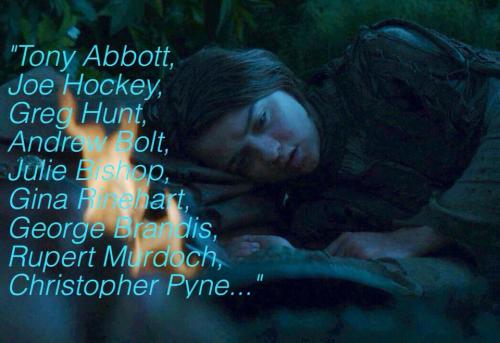
Game of thrones meme

Even Tony Abbott’s one big win in “stopping the boats” has become a slow-burning, potentially metastasising cancer that will eat away at Australia’s international credibility and come back to bite them as the situation inevitably deteriorates. In “solving” the problem they have, ironically, removed the one issue on which they might have argued competence, thus nullifying any positive effects on public opinion. The mainstream media has already moved on, and, increasingly, the focus is on conditions on Manus Island – a human rights disaster which no amount of whitewashing can disguise.

The very nature of this government’s broken promises also significantly undermines their credibility, because they mostly serve to punish people in need, without any net positives for the majority of the population. The lie that these cuts will improve Australia’s position economically and save the country from perilous levels of debt quickly evaporates with a glance at the comparative statistics on debt levels across the OECD. More importantly, however, the cruelty and short-sightedness of these cuts is readily apparent when we consider that there are other, far more effective ways of generating wealth without restricting the grass-roots spending power of the lower middle and working classes, or imposing unreasonable charges and debts on the most vulnerable socio-economic groups.
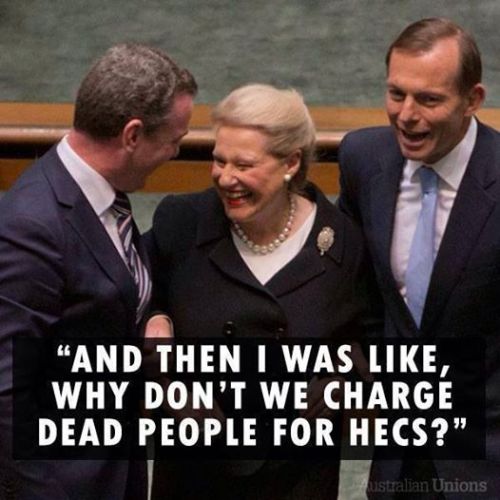
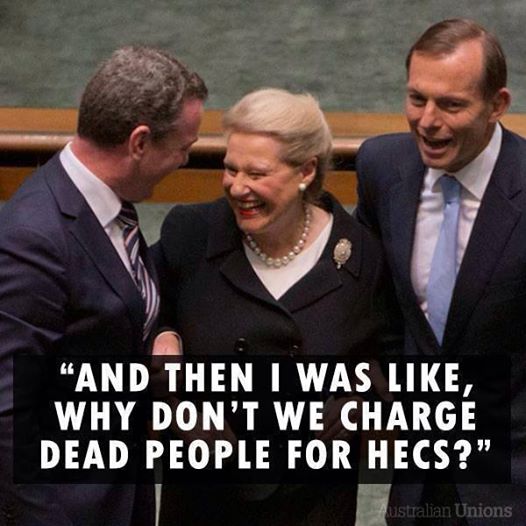
dead people hecs

The government’s attempts to sell this budget have been pathetic and contradictory to say the least – relying either on false dichotomies, blaming Labor, economic rationalist rhetoric and even bullying. One MP , George Christensen, had the temerity to suggest on Twitter that Australians should tour Asia and live like locals to put their “First World complaints” into perspective, going so far as to post a photo of a poverty-stricken street. The take-down was swift – “Aussie battlers should take a glimpse at LNP model for Australia’s future,” was one reply. Apart from the exploitative, disgusting sentiment expressed by Christensen, he might bear in mind that most Australians have visited Asia and already appreciate what they have and will fight to keep it. He might also bear in mind that many of us have been to Scandinavia too, and know only too well how much better things can be with even fewer resources if only the government has the balls to tax industry properly and make the people it was elected to represent its priority.

But of course, in reality, this is class warfare pure and simple. The government has been using a false premise to wage ideological warfare on behalf of its benefactors. The “incompetence” and “profligate spending” of Labor, resulting in a “budget crisis” are rhetorical constructs of right-wing ideologues. Yes, Labor at times appeared shambolic on account of their lack of internal discipline, yes their PR team is likely the most incompetent in history, but at least their policies (with the very clear and obvious exceptions of cuts to welfare for single mothers – the greatest betrayal of their heartland – and their pathetic and cruel policies on asylum seekers) were primarily geared towards providing the essential hard and soft infrastructure Australia requires to function as a progressive, competitive and fair society: the National Broadband Network, the Gonski School funding program, the National Disability Insurance Scheme, the Carbon Pricing Scheme, the Minerals Resource Rent Tax among many others.

Gonski

These are in some cases expensive, but arguably necessary policies, designed to promote fairness, equality and to raise revenue from areas that are inadequately taxed or require taxation to curb current practises. At least when Labor broke their promises about the Carbon Pricing Scheme it was, arguably, for a good cause. We do need to reduce our emissions and make an effective transition from fossil fuels to renewables. Other programs for which Labor have been pilloried, such as the Home Insulation Scheme, smack of a bad case of throwing the baby out with the bathwater. No one doubts that the deaths of those installing the insulation were an unmitigated tragedy and should have been prevented, yet the policy itself was implemented with sound intentions. Do we really need a royal commission, especially one that is ideologically motivated and has siphoned funding from the royal commission into child abuse? Labor made mistakes, but arguably their efforts were more broadly in the public interest – more egalitarian – than those of the present government, which are abundantly non-egalitarian.

NBN Policy

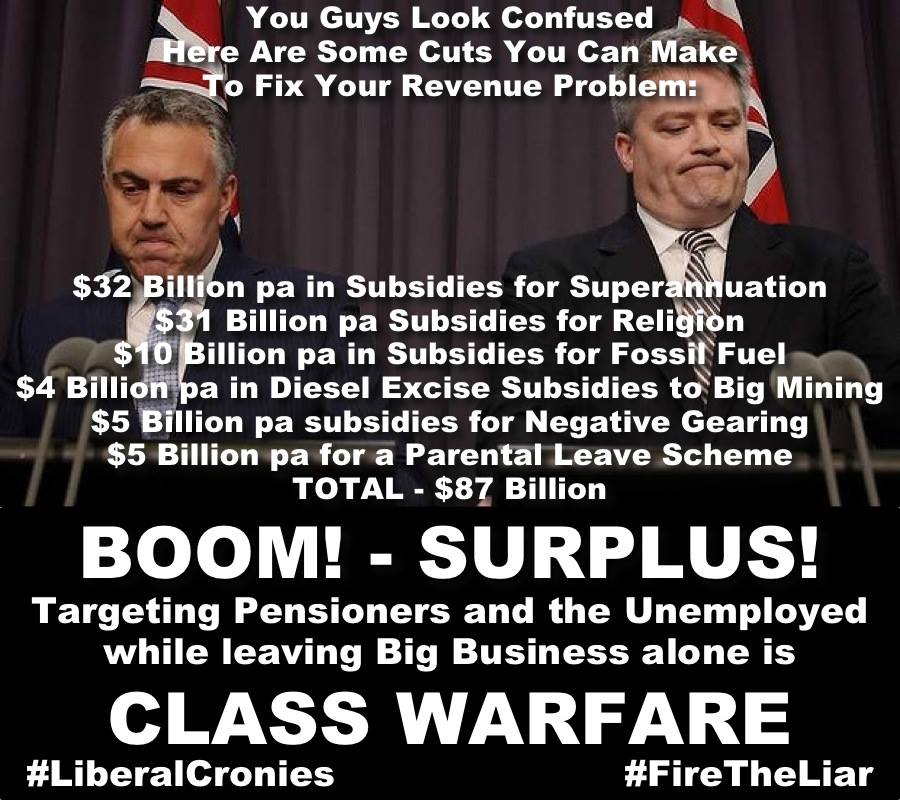
The real problem underlying Labor’s program – a problem which still prevails – was not how much they spent, but how little they taxed. If they truly believed these programs were necessary, then it was simply a question of raising revenue to pay for them. There were, and still are, plenty of ways to do that without cutting anything. In a recent article in The Guardian, Luke Mansillo outlined six means by which the government could raise revenue totalling $136.5 billion dollars: through removing unfair superannuation subsidies which are skewed in favour of the wealthiest; increasing taxation on the mining industry; abolishing fuel subsidies for the fossil fuel industry; defunding private schools; introducing more progressive income taxes and abolishing negative gearing.

Surplus - alternative savings

It is worth pointing out just how little mining is taxed – at present, it effectively equates to 13% . This amounts to revenue totalling around $17.6 billion from an industry that was worth $135.6 billion in 2010-11. As Mansillo points out, Norway taxes its industry at a whopping 78%, and it is a thriving, going concern. With a tax of 50% on industry profits, Australia could raise around $67 billion – single-handedly wiping out the deficit and paving the way for a future of generously funded public services. How long is this rort going to continue?

What is most astonishing about the present debate is that it focuses squarely and, to some degree appropriately, on the cruelty and suffering inherent in the budget proposals, but has not as yet centred around alternative measures of raising revenue. Why aren’t we discussing how much more we need to tax the mining sector? Why are we merely imposing a one-off levy on high income earners, rather than increasing income tax for high earners and thus locking this revenue stream into the taxation structure? Do we honestly buy the redundant argument that this will cripple the economy and drive mining investment away?
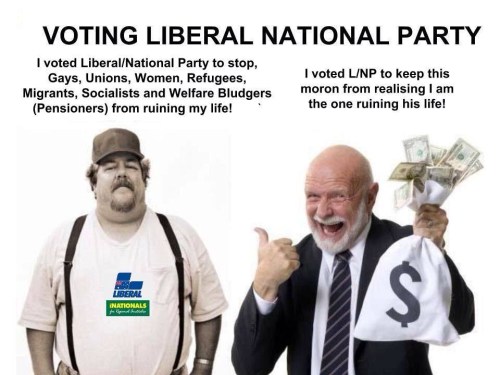
I voted Liberal...

Of course, with the next election still two and a half years away, Tony Abbott might just get away with it. The bounce for Labor will be unsustainable if they fail to remove the taint of their recent time in office and if Bill Shorten remains as uncharismatic as he is at present. The Greens and Palmer United are more likely to be the longer-term beneficiaries of the present storm – a storm which might herald the beginning of a new politics in Australia. After all, this has been the most volatile period politically since the sacking of the Whitlam government. Are we entering a new era of one-term governments, a far more diverse senate and the greater presence of minor parties in the Lower House?

One thing is for sure, Abbott must resign as minister for women. Winkgate has made his position untenable. It might seem trivial to some, but, wink aside, the contemptuous and disrespectfully glib smirk and body language expressed during the conversation, along with the patronising tone of voice, perfectly illustrate precisely why so many women are so suspicious of Tony Abbott and find him so contemptible. The very fact that there is only a single woman in Tony Abbott’s cabinet sends a clear enough message already.

Abbott on housewives

Right now as Bomber Harris once said, quoting Hosea: “they that sow the wind, shall reap the whirlwind” and Tony Abbott and co had better batten down the hatches, for they have been flagrantly tossing their seed into the wind for some time. Australians have traditionally punished those they see as elitist or arrogant, those who don’t believe in a fair go. There will be no exceptions for Abbott if he doesn’t win back the public’s trust. I for one, most certainly hope that he fails in that endeavour.
8285 Jaipur! Expecting someone else

Relaxed Goat, Galwar Bagh Monkey Temple, Japiur, March 21, 2010

Expressing a fondness for goats these days is a bit like telling people you breathe oxygen. It seems that everyone has discovered the beauty and wonder of goats. Be it through their gorgeous goggle eyes or eminently strokeable ears, goats have entered the affections of most who inhabit the internet. Perhaps this is inevitable. That more than ten thousand years co-evolution, since the dawn of animal husbandry when we first began to shepherd goats, has inclined us to like them.

Without any desire to boast, I can say that in truth I have long been a goat fancier. For me, it’s always been about the ears – the way they hang like the frame of a bob. There’s little doubt that one of life’s great pleasures is to stroke the silky ears of a beast – I strongly recommend dachshunds. Of course, it goes without saying that the eyes and smile of a goat are marvellous to behold, yet without the ears, I doubt the overall effect would be quite so sweet.

This particular beauty was just chilling on a concrete bench, with a sleepy, almost nonchalant insouciance. I would never have dreamed of disturbing such expressive, almost sultry repose and left it alone to enjoy the afternoon sunshine. I can’t help but mention how goats’ teats look like Kibbeh – tell me it isn’t so!

This shot was taken on the outskirts of Jaipur, by the gate at the foot of the hill atop which sits the monkey temple, Galwar Bagh. As is typical of India, there was a splendid selection of animals about the place: piglets, dogs, monkeys, cows and goats – a veritable open air petting zoo. I was very pleased to get this shot, with its great contextual colour continuity, which highlights the shiny blackness of the goat.

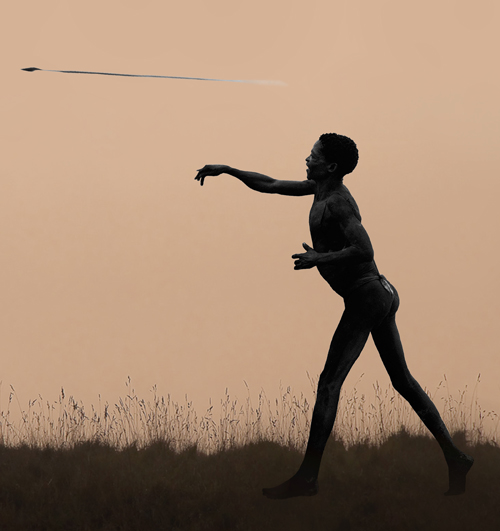
The ability to throw accurately and at high velocity is a uniquely human trait. Other primates don’t even come close to our range, speed and aim. The chimpanzee, despite being immensely strong physically, can only throw at around 20 miles per hour and is not especially accurate. A twelve-year-old human child, on the other hand, can achieve more than three times that speed and a far sharper aim.

bushman-throwing-his-spear-at-a-winded-gemsbok

Deadly ranged attack – Bushman throwing a spear

The ability to kill from a distance wrought changes in the lifestyle and diet of early humans by revolutionising their capacity to hunt and to defend themselves. This not only had significant physical and developmental impacts, it also had social, psychological and moral implications as well. The capacity for a weaker individual to slay a stronger one without engaging in physical contact must have transformed early human social relations.

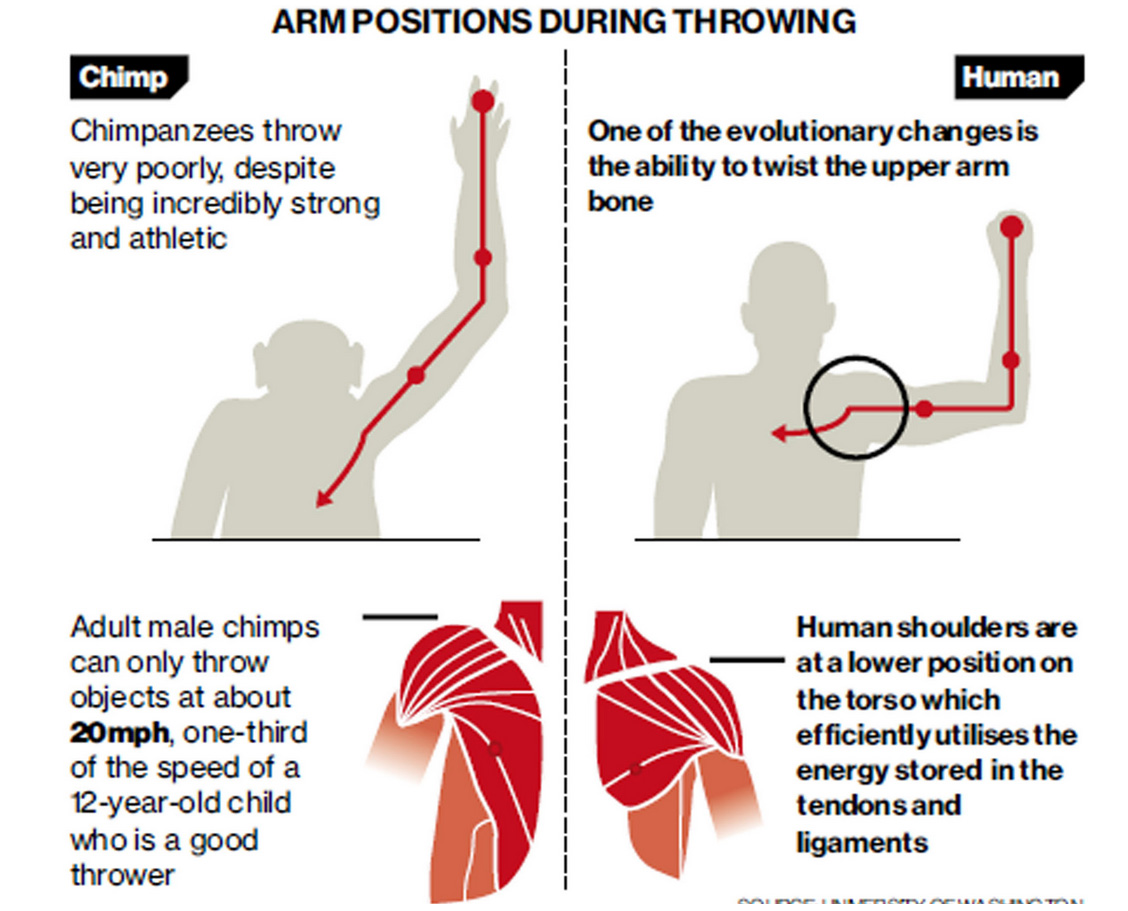
To be able to kill at a distance in the first place, early humans had to learn how to throw effectively, and this is something they did to a quite astonishing degree. The adaptations that enabled such fast and accurate throwing began to develop around two million years ago in Homo Erectus. The key changes, as identified recently in a study by Dr Neil Roach of George Washington University, were a wider waist, the lower position of the shoulders on the torso, and the capacity to twist the upper arm bone.

Humans vs chimps, throwing

Competitive advantage – Rotating arm, low shoulder, wide waist

Studies tracking the movement of American baseball players clearly illustrate how the human shoulder works like a slingshot by storing and releasing energy in its tendons and ligaments, allowing humans to hurl projectiles with incredible and deadly speed.

169919410_slideshow

Slingshot action – Baseball Pitcher

The action of throwing begins by first rotating the arm backwards, during which movement elastic energy is stored in the shoulder. When the arm rotates forward, that energy is released in a lightning motion and transferred through the arm to the missile.

Throwing diagram

The Art of Javelin Throwing

It is hardly surprising that this throwing action became so greatly refined and specialised, considering the enormous advantages that it offered. Indeed, one could argue that learning to throw quickly and accurately drove human evolution more powerfully than any single factor outside of upright walking and language. The morphology of organisms is determined by a number of environmental factors, and one of the most key is how they acquire their food and defend themselves. Hence long beaks and tongues for dipping into flowers; huge teeth for grinding bone; incredible speed for chasing or fleeing; sharp claws for climbing or rending flesh, venomous bites for attack or defence – the diet and the nature of external threats drives the design.

chimpanzee with machine gun

This never happened…

If you studied the morphology of hominids over the last two million years and asked, how do these creatures acquire food and how do they defend themselves? – the most obvious answers would be by running, climbing and throwing. Focussing on diet, we then might ask – which of these techniques provide the most protein? – and throwing is the obvious answer. Those more capable of throwing not only made considerably better hunters and had a wider variety of meat available to them, they were also better adapted to seeing off rivals in a dispute. Once humans began to rely on throwing as a key hunting technique, natural selection ensured that those better adapted to throwing passed on their genes.

Consider how natural the inclination is for people to practise throwing and to gain pleasure from it. Just as other animals chase, spar and wrestle in play as a kind of innate training program for skills they will need in adulthood, so almost all human children practise throwing from a young age and derive immense pleasure and satisfaction from their accuracy and skill. We are designed to throw – it is the only explanation as to why we are so good at it. Once early humans began to hurl rocks and spears, there was no looking back – it was, quite simply, the best means by which to acquire rich sources of protein.

Grass Silhouette

Designed to Throw – It’s a human thing

Being able to take down prey at longer range meant access to a great deal more meat, providing more fuel for growing brains and supporting larger social groups. The skill itself must have driven brain development through the complex calculations required to judge a throw – distance, angle, height, wind-speed, tracking the prey’s movement and knowing exactly when to release. The ability to make aerodynamic spears, or choose the most effective stones must also have called upon significant brain power and encouraged manual dexterity.

The range and variety of habitats available to early humans would also have changed dramatically. No longer required to stay near rich sources of fruit and vegetables, or to use the cover of the woods to surround and ambush prey, early humans were free to enter new habitats, acquiring their food through long-ranged attacks on the herds grazing the savannahs.

The point at which early humans first began to rely on missile weapons has long been debated by archaeologists. Whereas the evolutionary adaptations begin to appear almost two million years ago, archaeology can only provide much more recent evidence for the use of throwing spears, with dates ranging from less than 100,000 years ago, to half a million years. Indirect evidence derived from impact fractures on spear tips suggest people were throwing spears at least as far as 500,000 years ago, but this interpretation is widely disputed and it is difficult to determine conclusively whether spears were thrust or thrown. The failure of wood to preserve well means we lack sufficient evidence and, as the dictum goes, absence of evidence is not evidence of absence.

Chimpanzees are well known for using a variety of simple tools. Poking sticks into ant and termite nests to collect insects, breaking nuts with rocks, and, it seems, even attempting to spear smaller primates with sharp sticks.

chimpanzee-fishing-for-termites

Chimpanzee fishing for termites

This latter behaviour is, evidentially, rare, and chimpanzees are not known for throwing spears or using them in combat or hunting. Yet it doesn’t take much imagination to consider that if an ancestor with whom we parted ways some seven and a half million years ago uses such technology, then early humans might have taken the sharp stick a few steps further and started throwing them at creatures. On these grounds some anthropologists have suggested that hominids may have been using spears as weapons as early as five million years ago.

Whatever questions may hang over the archaeological evidence, it seems the only place we need look to determine when early humans began to use throwing as a principal means of hunting is the biology. If the adaptations were there two million years ago, then surely this is because early humans were increasingly throwing things two million years ago – it’s the only logical explanation. It is hardly likely to have just been for play, or courtship – the most logical driver is the benefits it offered in food acquisition and self-defence. As to what those early humans were throwing, it is hard to be sure. They likely began with rocks, possibly for dislodging things from trees, before graduating to more refined and aerodynamic missiles.

chimp with rock tool

Chimp with simple stone tool

The huge competitive advantage offered by this skill ensured that humans were able to dominate their environment. It may also have played a significant role in developing the codes of ethics and morality which kept inter and intra-clan strife to a minimum. Dominant males could no longer rely on brute strength and intimidation alone to see off rivals. The knowledge that a weaker, less dominant individual – male or female – could, through a carefully aimed spear, assassinate them, would have transformed the social landscape. More tact, more consideration, more rigid rules might well have emerged in the wake of developing such deadly capability.

chimp with stick

I wonder what will happen if I throw this…

From the humble rock and primitive throwing spear, humans later took their ranged attacks to new heights through the development of better spears, then spear-throwers – Atlatls and Woomeras – and ultimately, bows and arrows, for which the earliest archaeological evidence dates to roughly 13,000 years ago. Some have suggested that these technological advances might in part explain how Homo sapiens outcompeted Neanderthals, but, like so many theories on that front, it is based on a number of assumptions and guesses. Even without the use of spear-throwing implements, which have been shown in tests to have an effective, accurate range of between 45-55 metres, with a maximum range considerably longer, it is possible to hurl a spear a significant distance.

aboriginal spear

The Woomera and Atlatl (spear throwers) dramatically increase velocity

The Olympic javelin record is just under a hundred metres, and whilst no one would suggest such ranges were achievable or desirable with prehistoric weapons, light, wooden spears can be deadly at tens of metres, allowing the hunter to keep a very significant gap between prey – or predator for that matter – especially when the prey failed to perceive that such a distant human could be a threat.

Whatever the case, the development of throwing is one of the main reasons we are here today. It is one of our most refined skills, and for millennia, likely for millions of years, it remained our species’ preferred means of hunting and acquiring food. That we are so good at throwing is no accident – it is simply natural selection favouring the genes of the better hunters. The preying mantis uses lightning speed, the snake has deadly venom, the honeybee favours a suicidal sting and we humans have missiles – that’s just how we roll.

Slow Burn

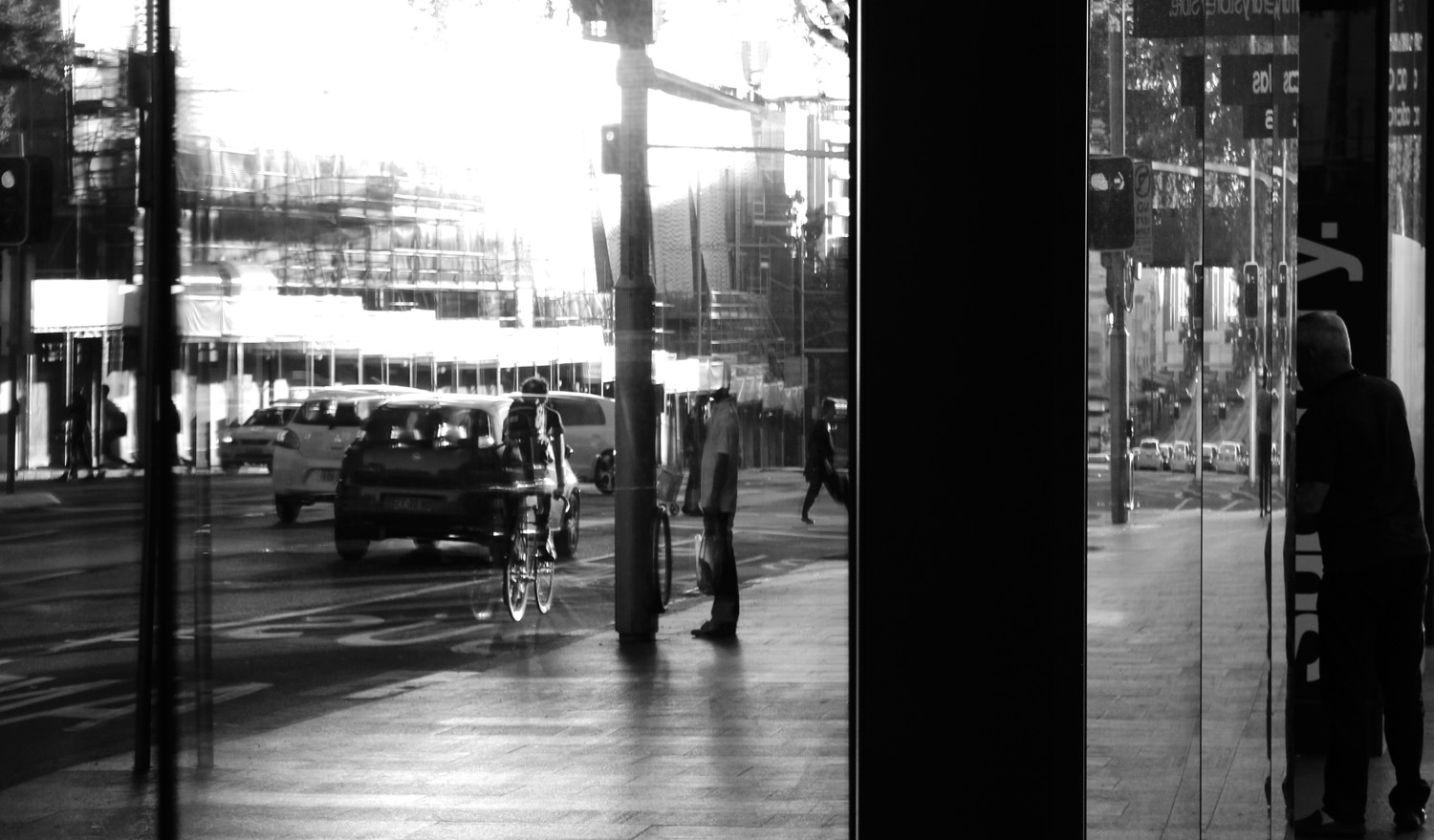
It’s been a while since I posted a collection of Sydney shots – as has happened in the past, I got tired of the subject matter. Having said that, subject matter is a pretty fluid thing, so perhaps the problem lay rather with context. Then again, context is transformed by so many factors that its appeal as a theatre of operations ought to be a fluid thing; different seasons, different fashions, different people – it’s a shifting scene sure enough. Before I deconstruct my own excuses further… these shots have come together over a number of months, though most are quite recent as I’ve dedicated more time to pursuing shots – hence the title – Slow Burn.

And it has been slow. The Golden ratio – my own reckoning, detailing the occurrence of “Gold” quality shots – has been disappointingly low; a lot of shots taken without result. In truth, however, I attribute it to a lack of patience. Random stuff is all very well, but often the best results come from sitting on a scene or pushing on relentlessly to find another. More such time has strengthened the focus of late, though having said that, most of these came from things stumbled upon. Enough! Here’s a few shots…

0275 Kale surprise

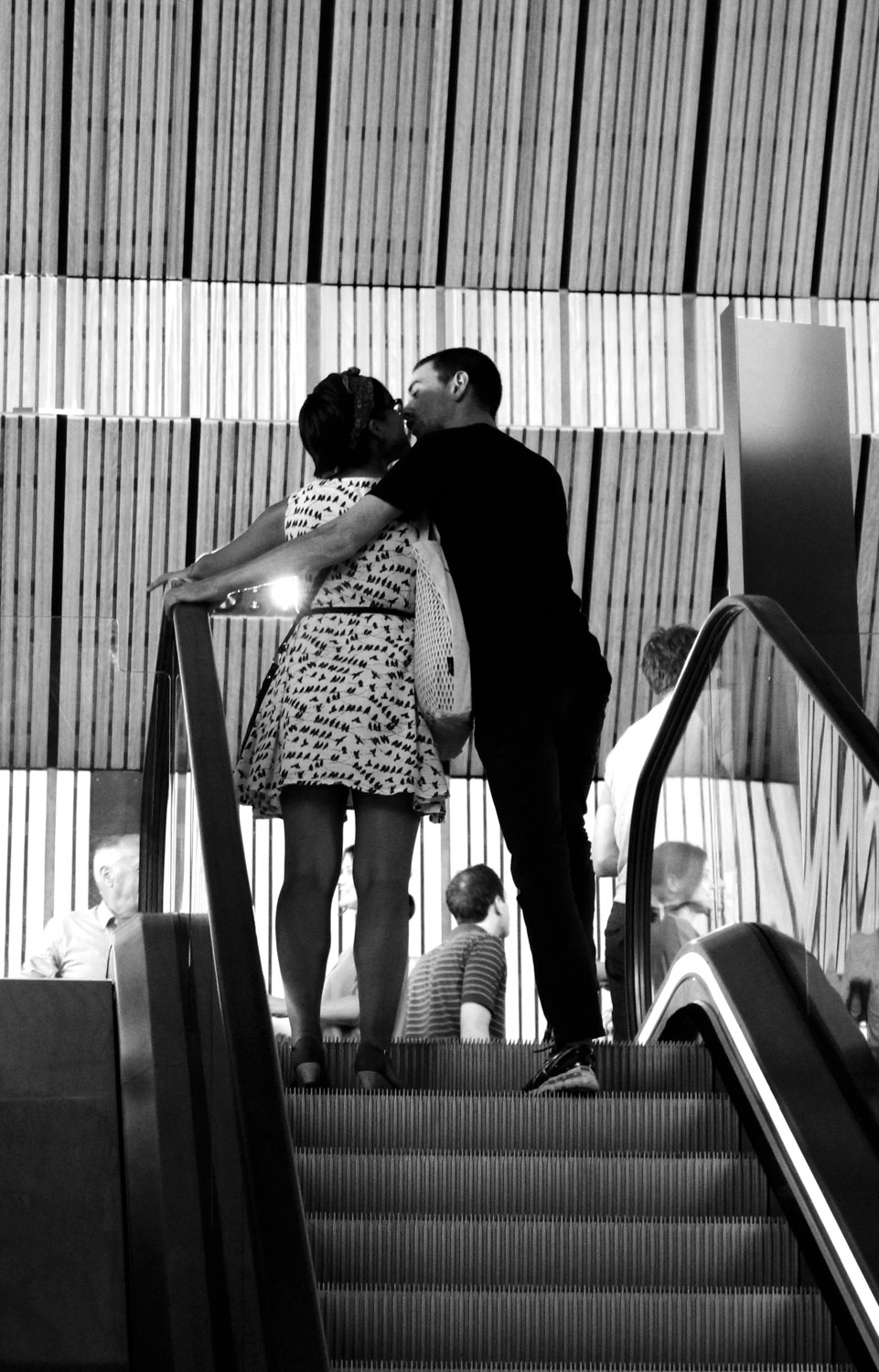
0967 Love on an escalator 2

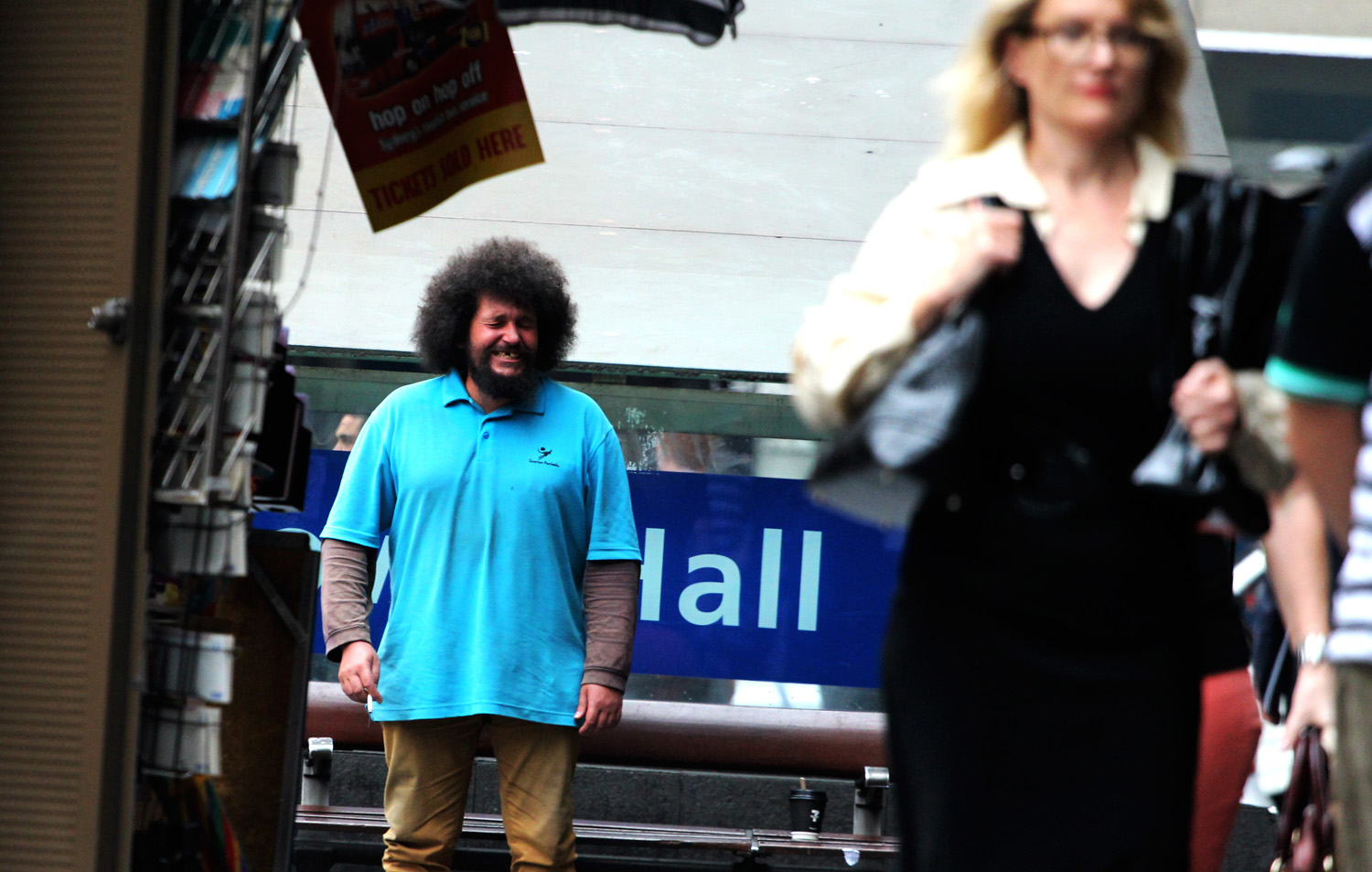
1299 Drama at Town Hall station

1143 Lightbulbs

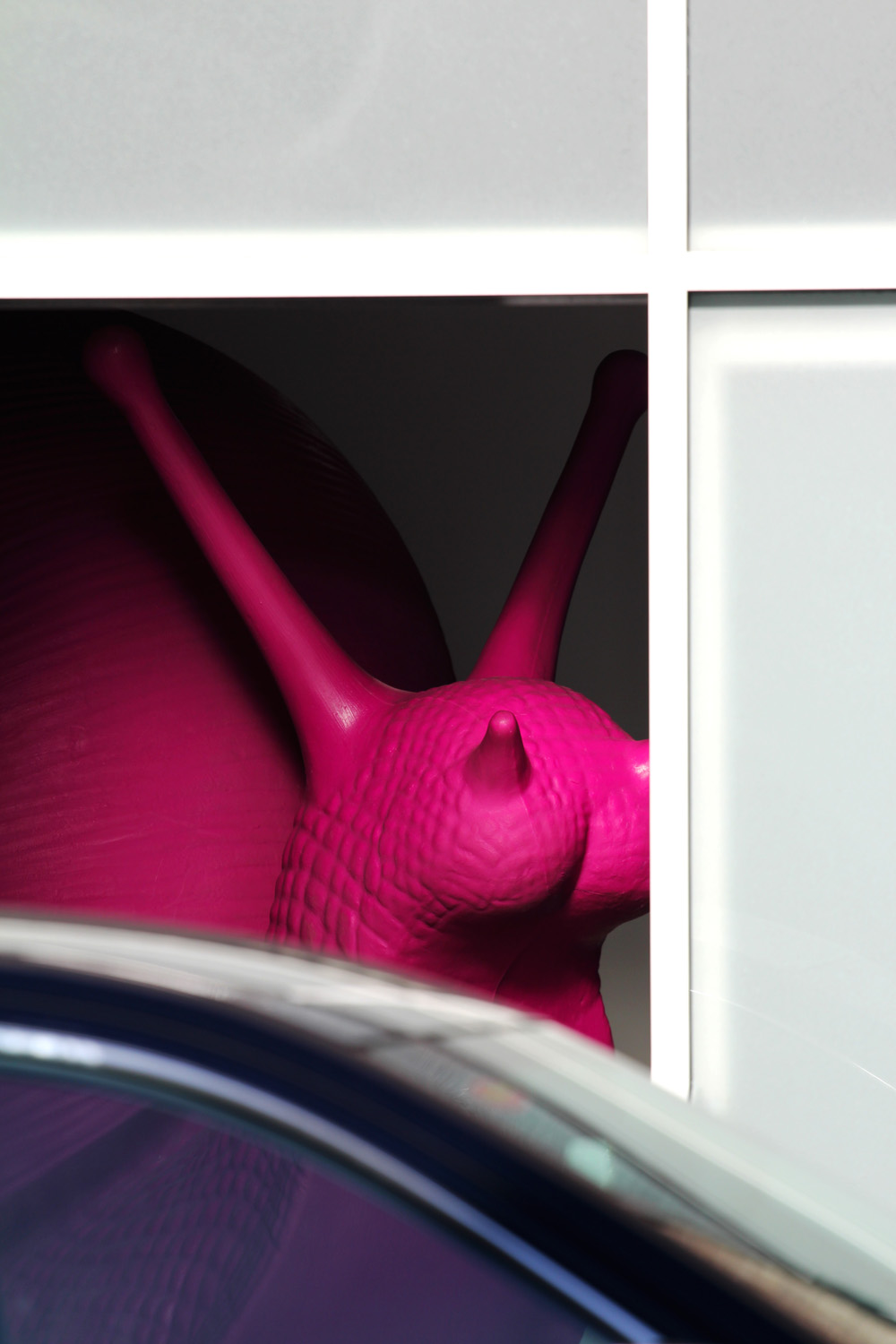
0907 Pink snail

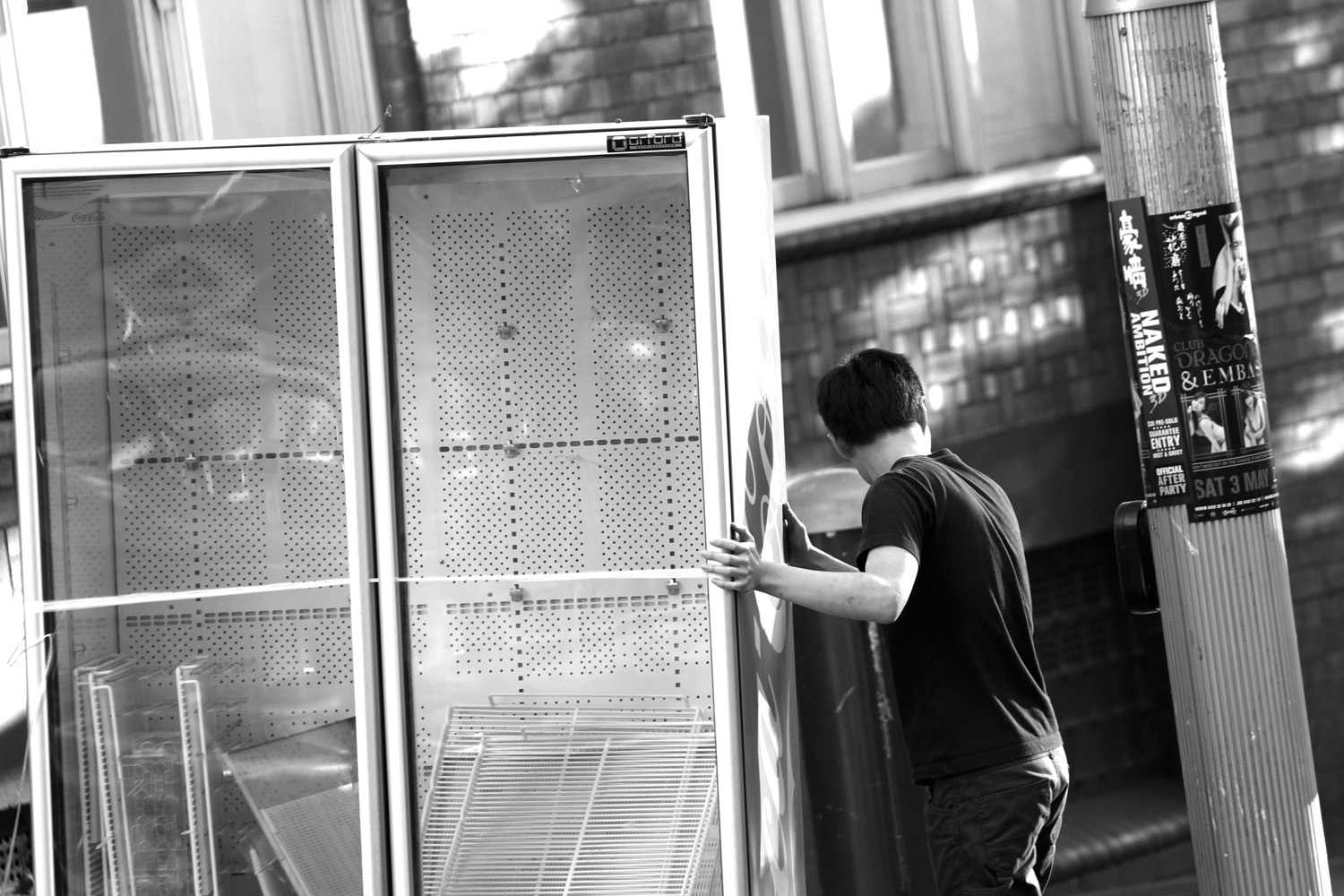
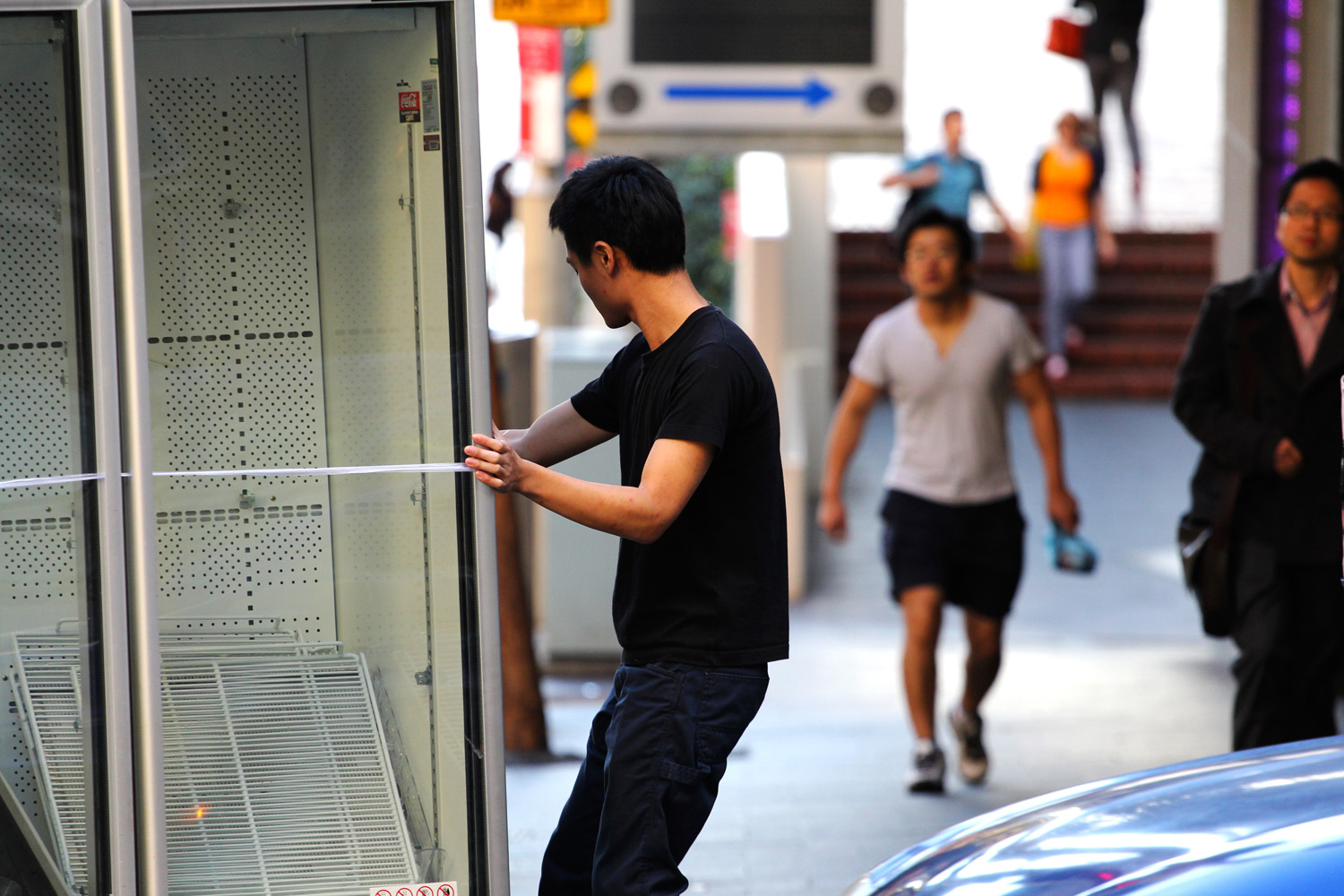
2150 Man with fridge

2157 Man with fridge

2161 Man with fridge 3

1032 Balloon chimp

0713 Dinosaurs!

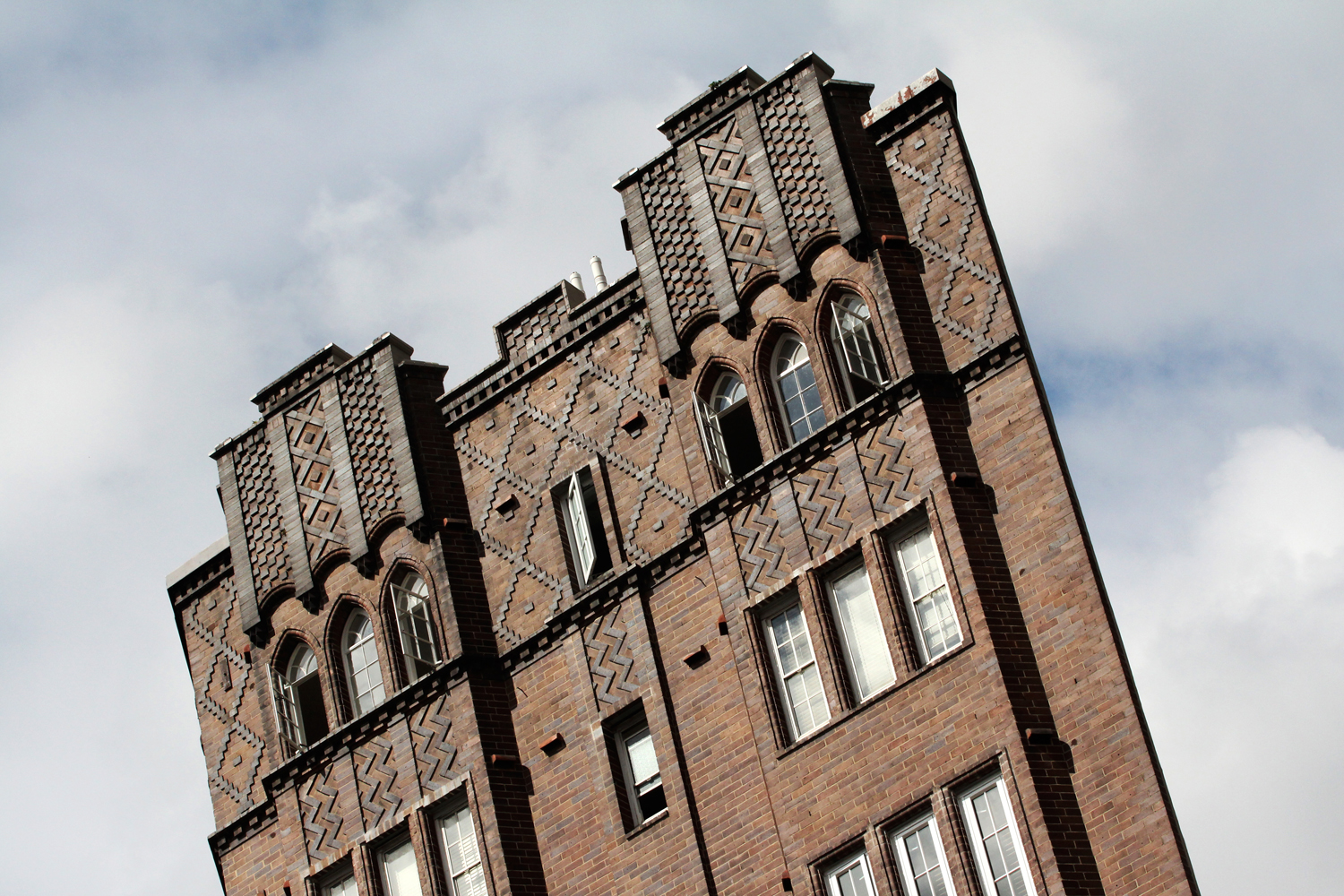
1447 King's Cross flats

8534 Tennis court

1103 Bricks

1979 Enmore selfie

8389 Broadway scene

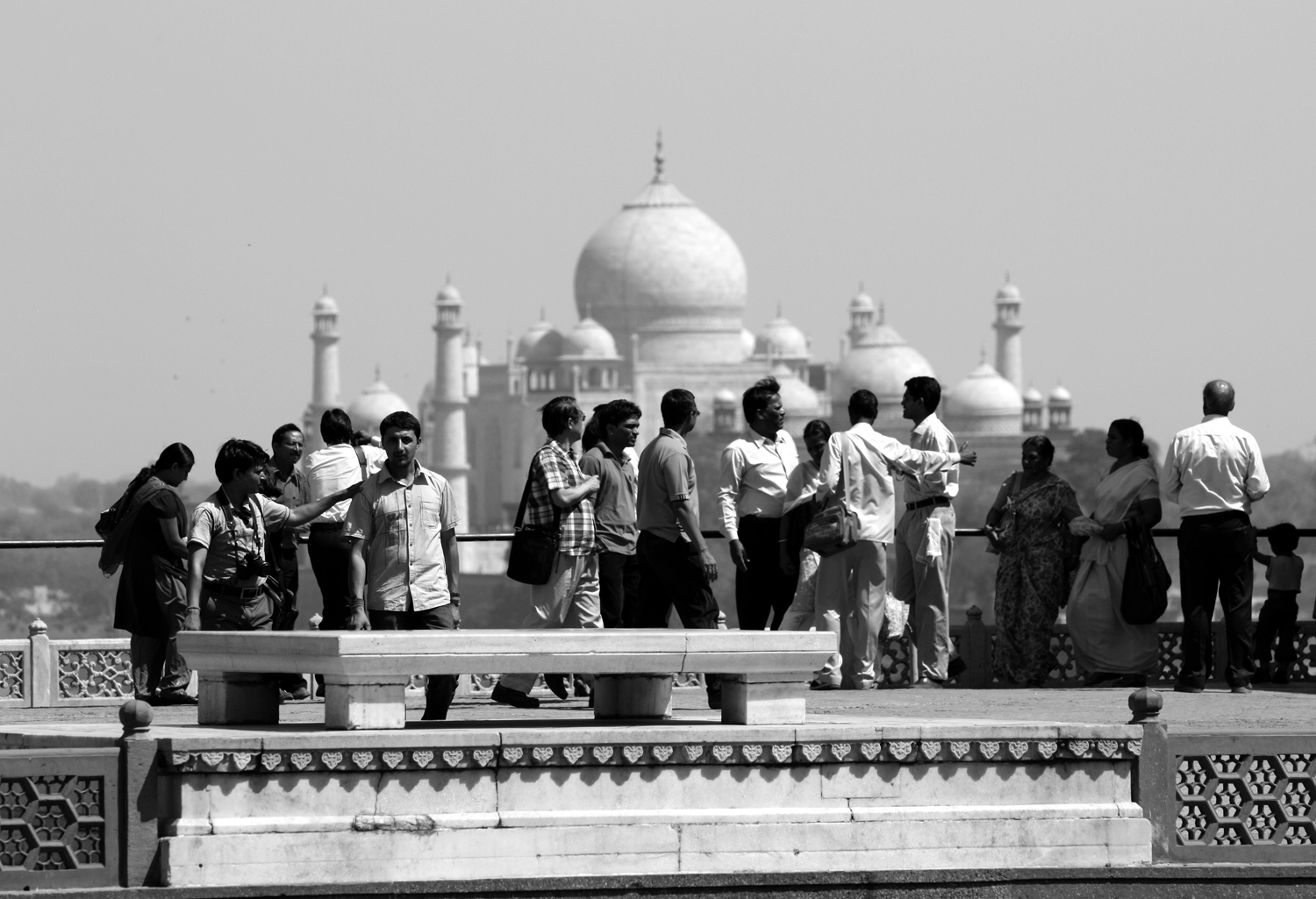
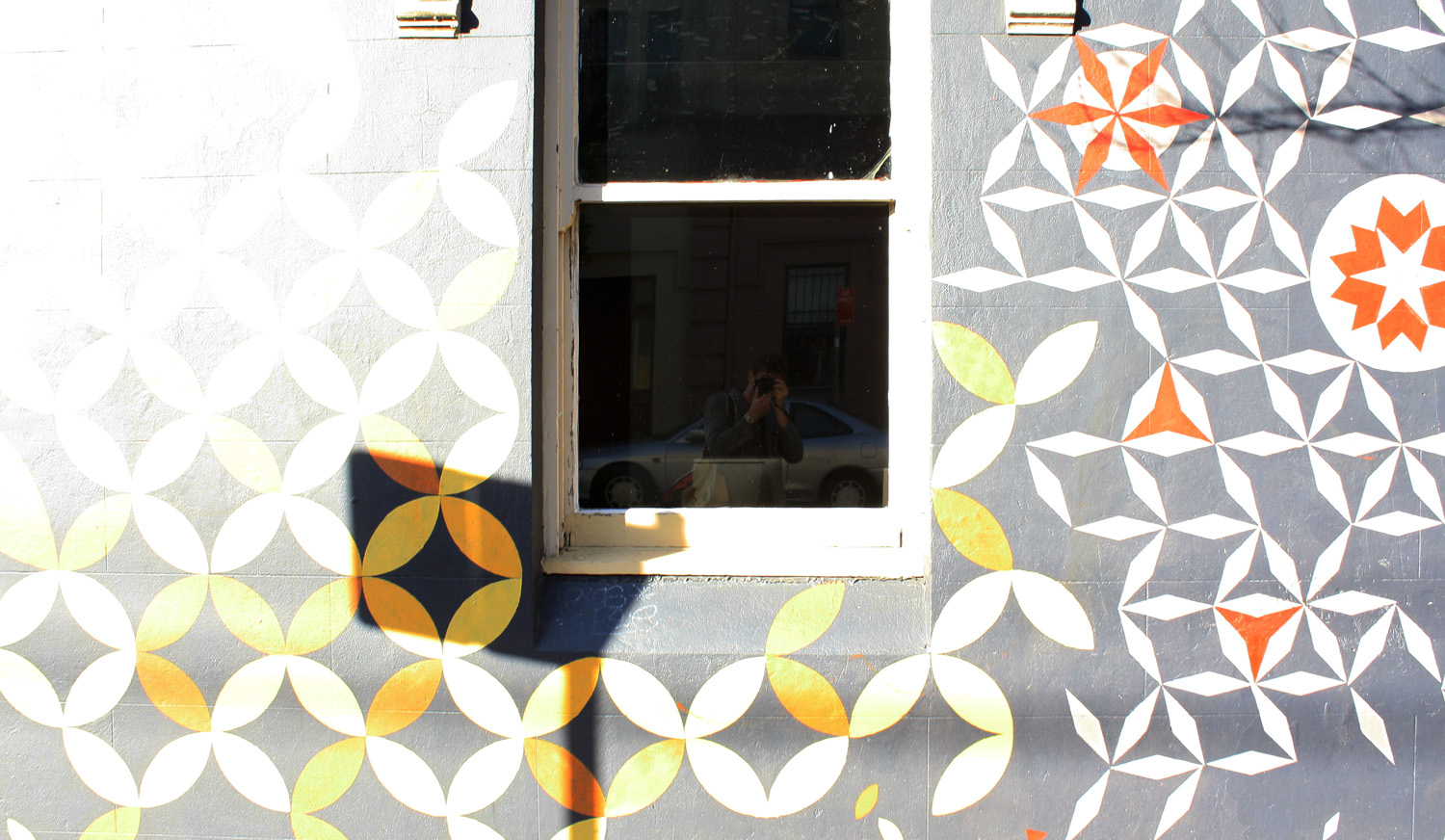
1300 Tourists on George

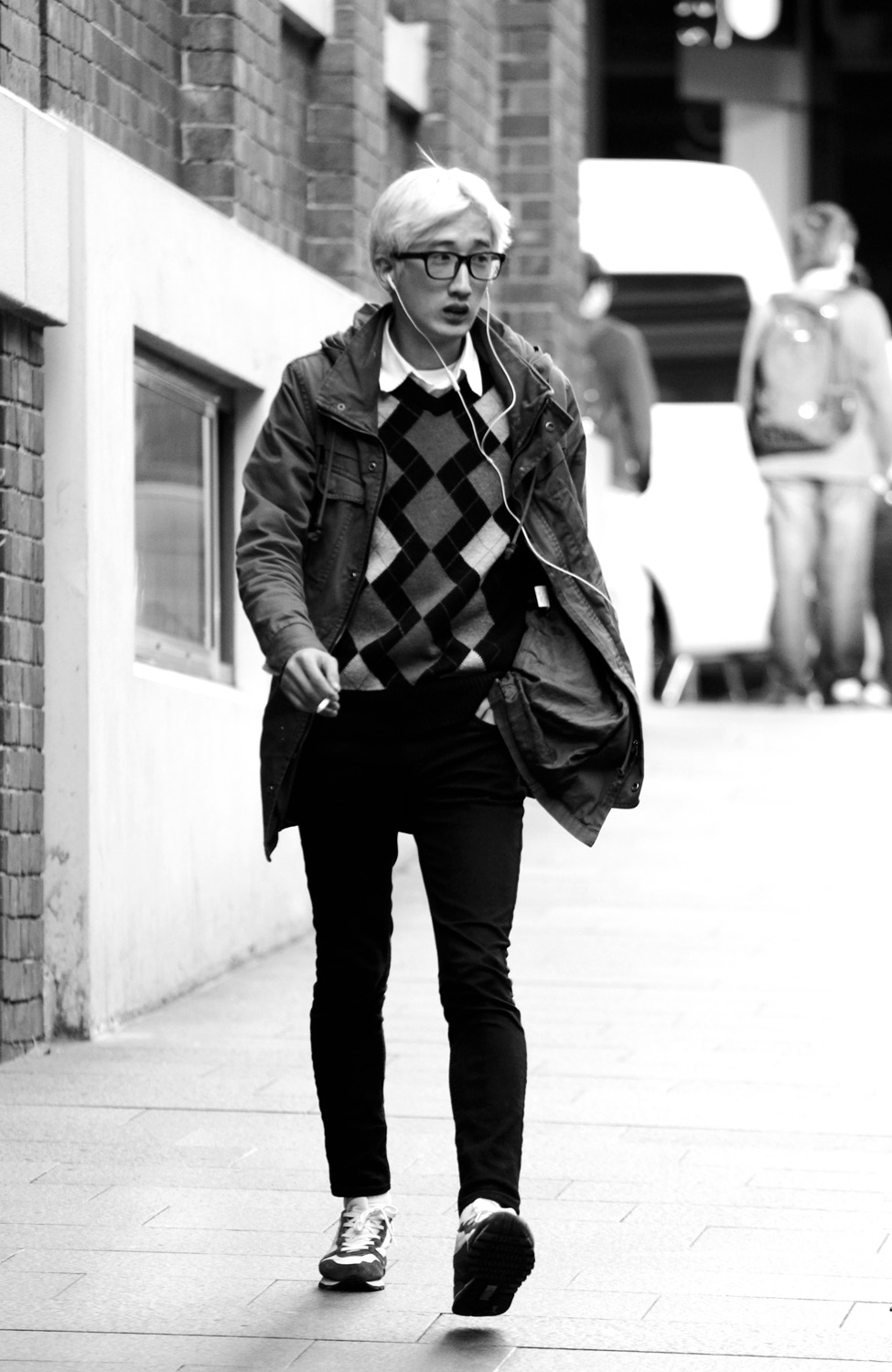
2108 Cool Korean

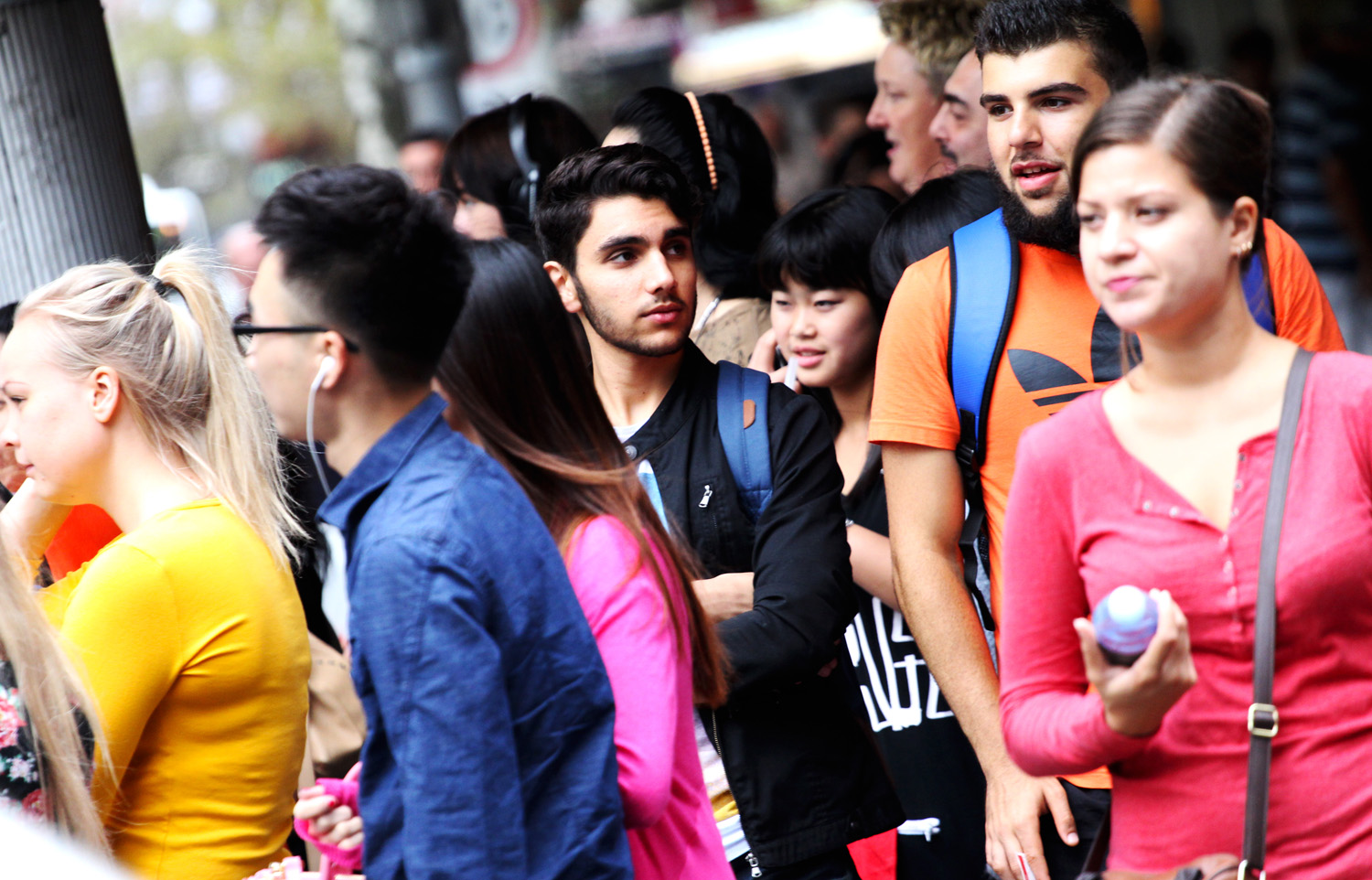
1236 George street faces

0953 Exit stage right

1221 Micro bureao de change 2

1932 Glebe Point

0675 Swing girl

2030 Lichen & Fern 2

2232 Distorting mirror

2235 Horse IV


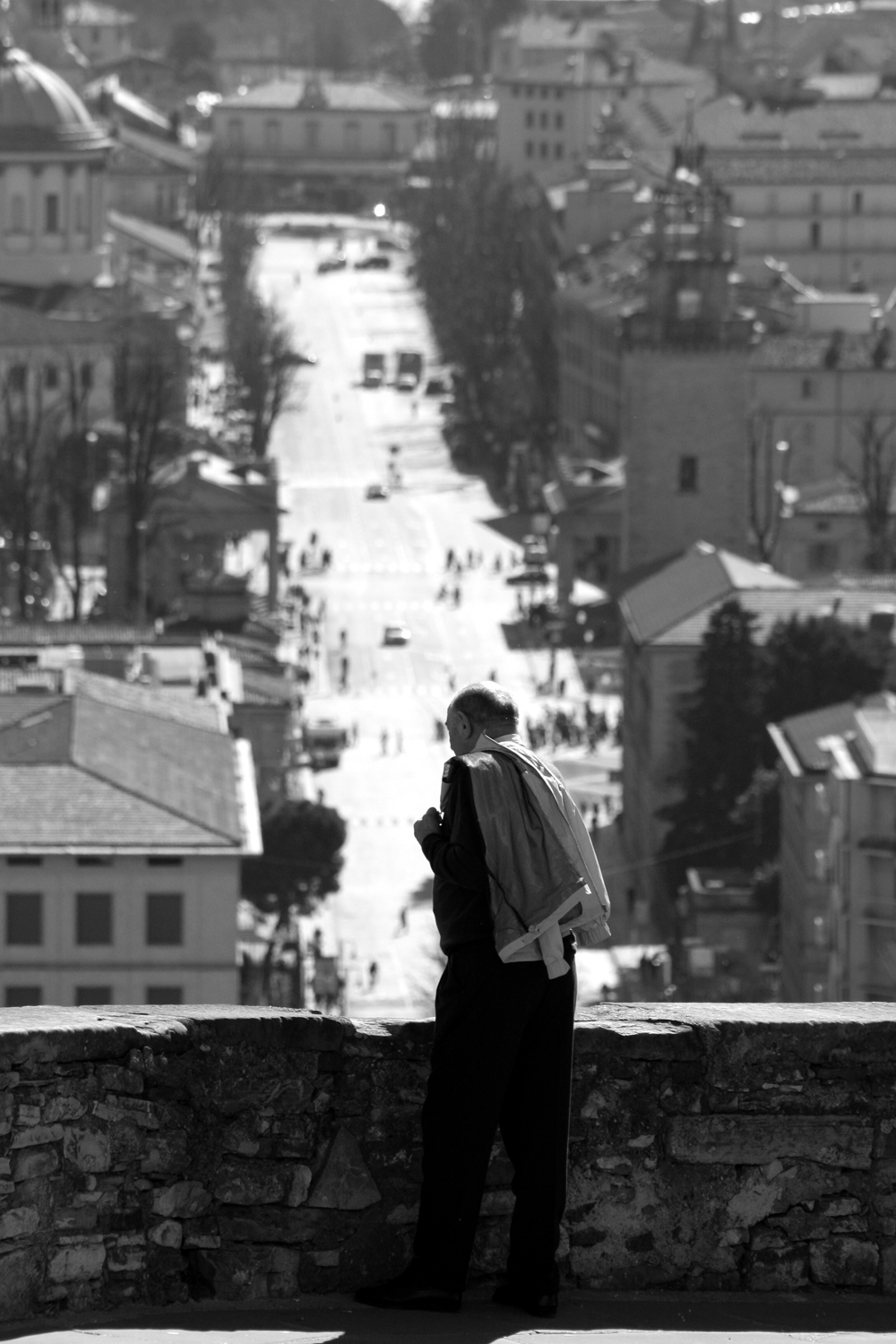
"My life is a counter-point, a kind of fugue and a falling away - and everything winds up being lost to me, and everything falls into oblivion, or into the hands of the other man" - Jorge Luis Borges. Bergamo, March 3, 2007

“My life is a counter-point, a kind of fugue and a falling away – and everything winds up being lost to me, and everything falls into oblivion, or into the hands of the other man” – Jorge Luis Borges. Bergamo, March 3, 2007

Bergamo was but a brief stop on the way to Como and beyond – a convenient destination in northern Italy courtesy of Ryan Air’s seemingly endless expansion. Situated at the base of the foothills of the Italian Alps, to the north of the flat plains of the Veneto – the hips of Italy’s leg, if you will – Bergamo was welcomingly dry and bright after some variable early spring weather in England. I recall very little about Bergamo, outside the photographs I took, and don’t remember how I arrived at this point, aside from taking a bus into town from the airport. I can only assume I was drawn to this vantage point from the views it promised to offer. Tired as always on day one of a trip from having had next to no sleep the night before, I felt almost high and elated from the bright light and elevation.

It was around 1030 in the morning and, being a Saturday, the town had a pleasingly slow pace to it. There were plenty of people about, but no one was in a hurry. The air was cool enough for most to be wrapped in coats, yet the sun had a clear, if entirely dry warmth to it – a welcome break from damp. This acropolis of sorts was a favoured place for people taking their constitutionals. A couple of old gents played chess, women waited as their lap dogs sniffed at things and some cool kids smoked cigarettes with the carefree air of not having anything else to do. Initially I had been impatient to get on my way to Como, yet the welcome sunshine and sense of space held me in thrall for a few hours.

This remains my favourite photo from that brief visit. Whilst I liked it from the start, as with so many photos, it wasn’t until, on Facebook, my friend Chris appended it with the quote contained in the caption that I really came to appreciate it. Sometimes, even when confident about a piece of work, it takes a second opinion to convince myself that I do truly like it. The quote from Borges may not actually suit the narrative of this old gent’s life, but it certainly goes well with the image, and for that I have Chris to thank. Cheers, buddy.

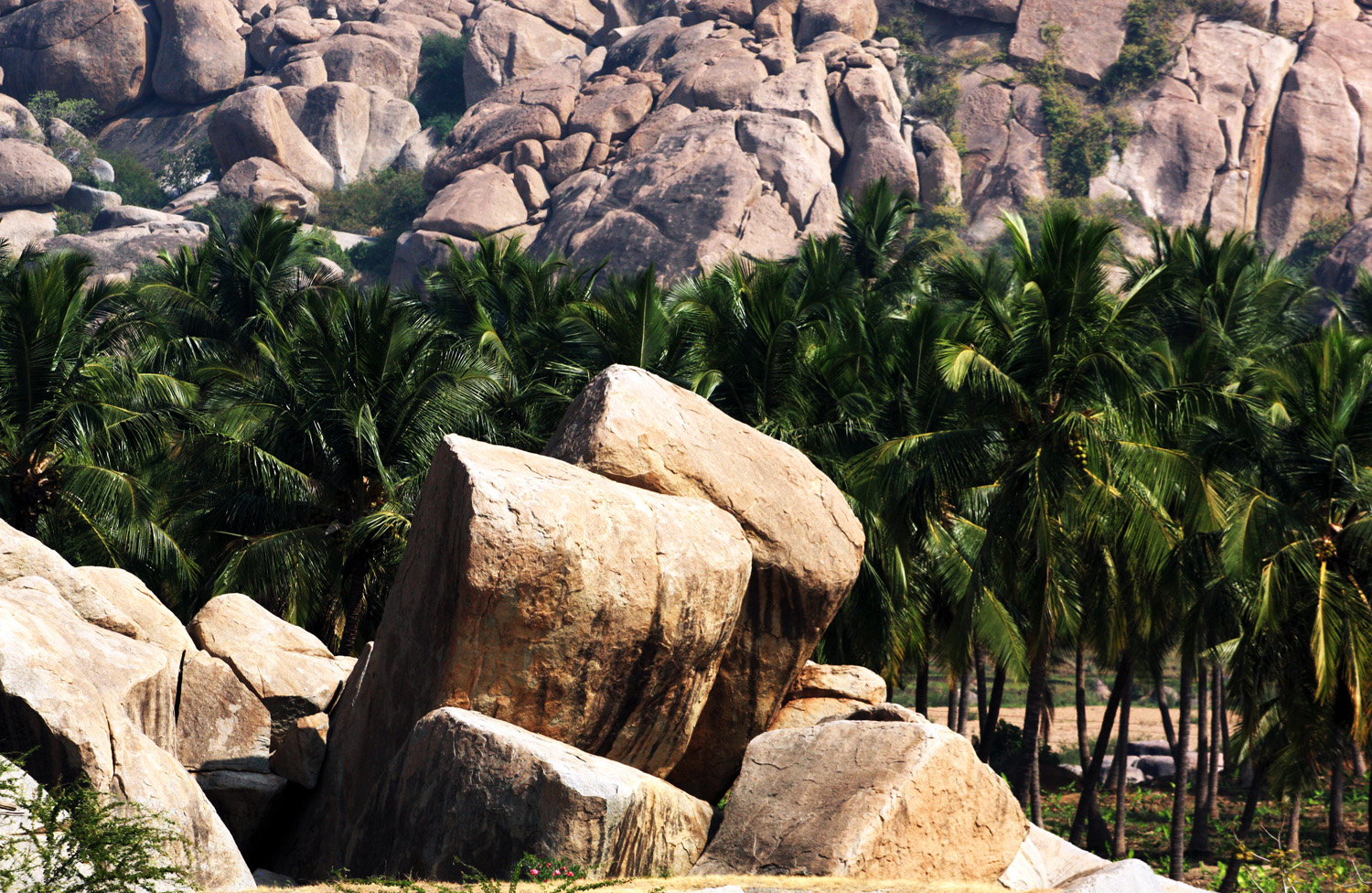
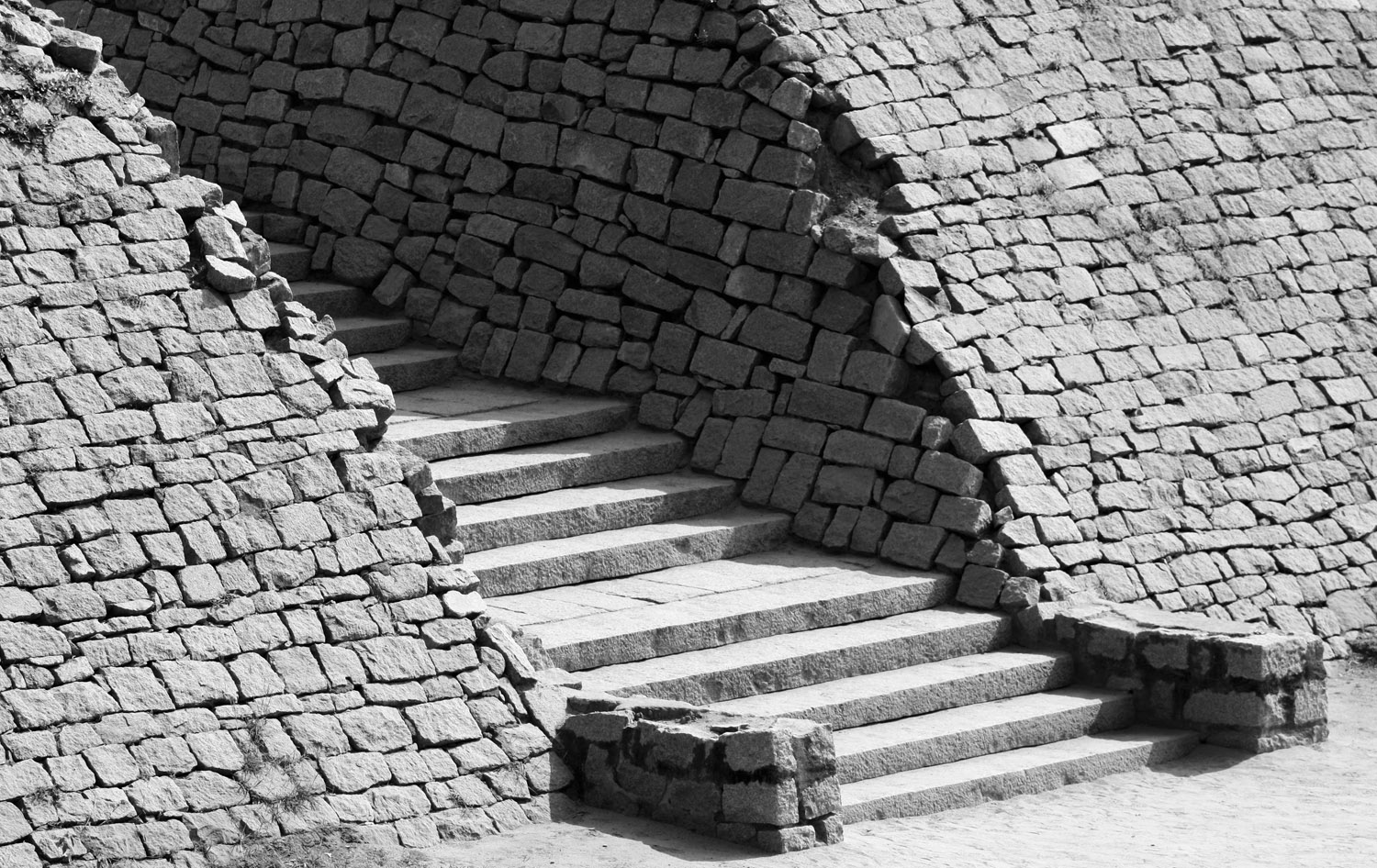
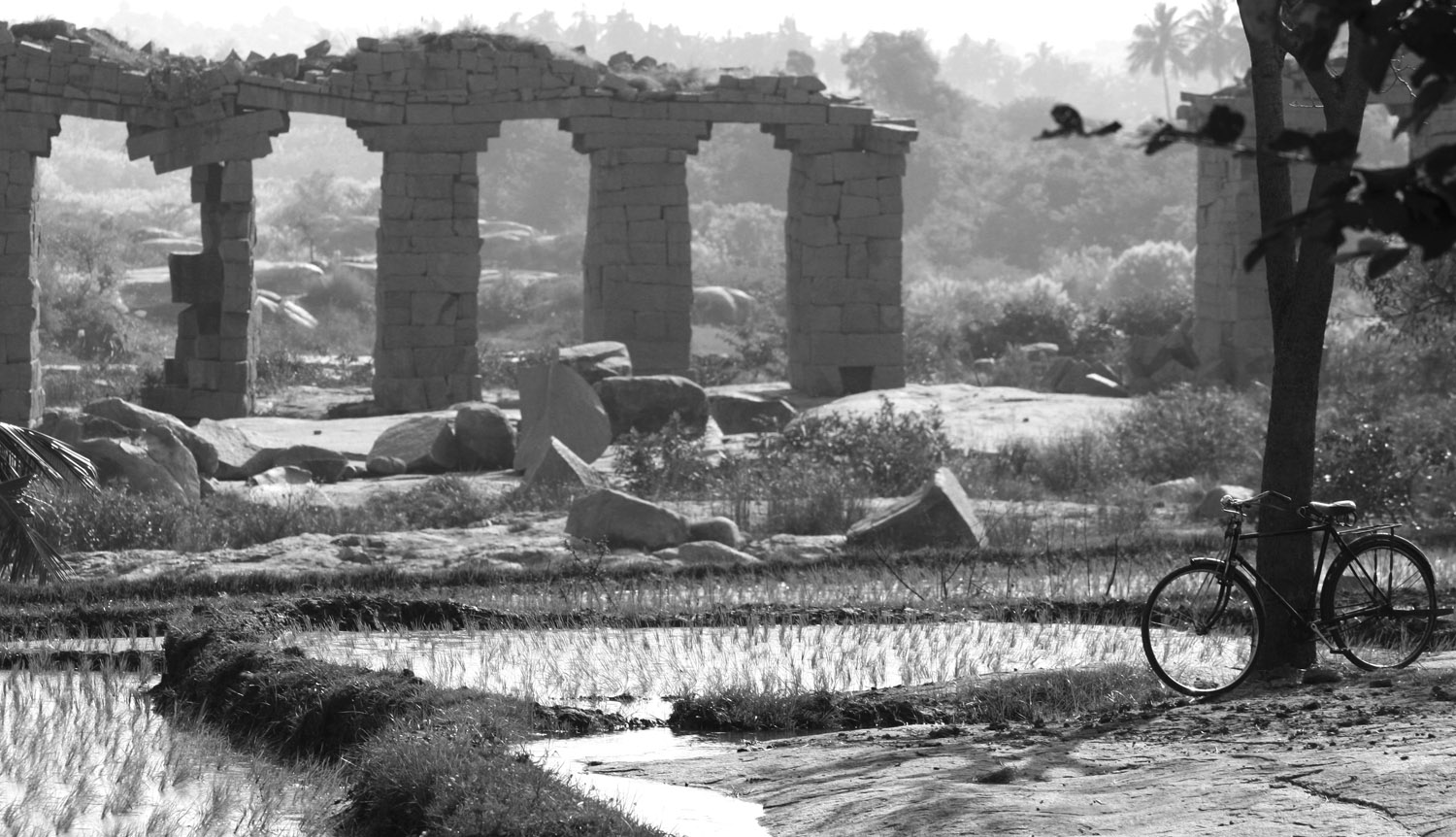
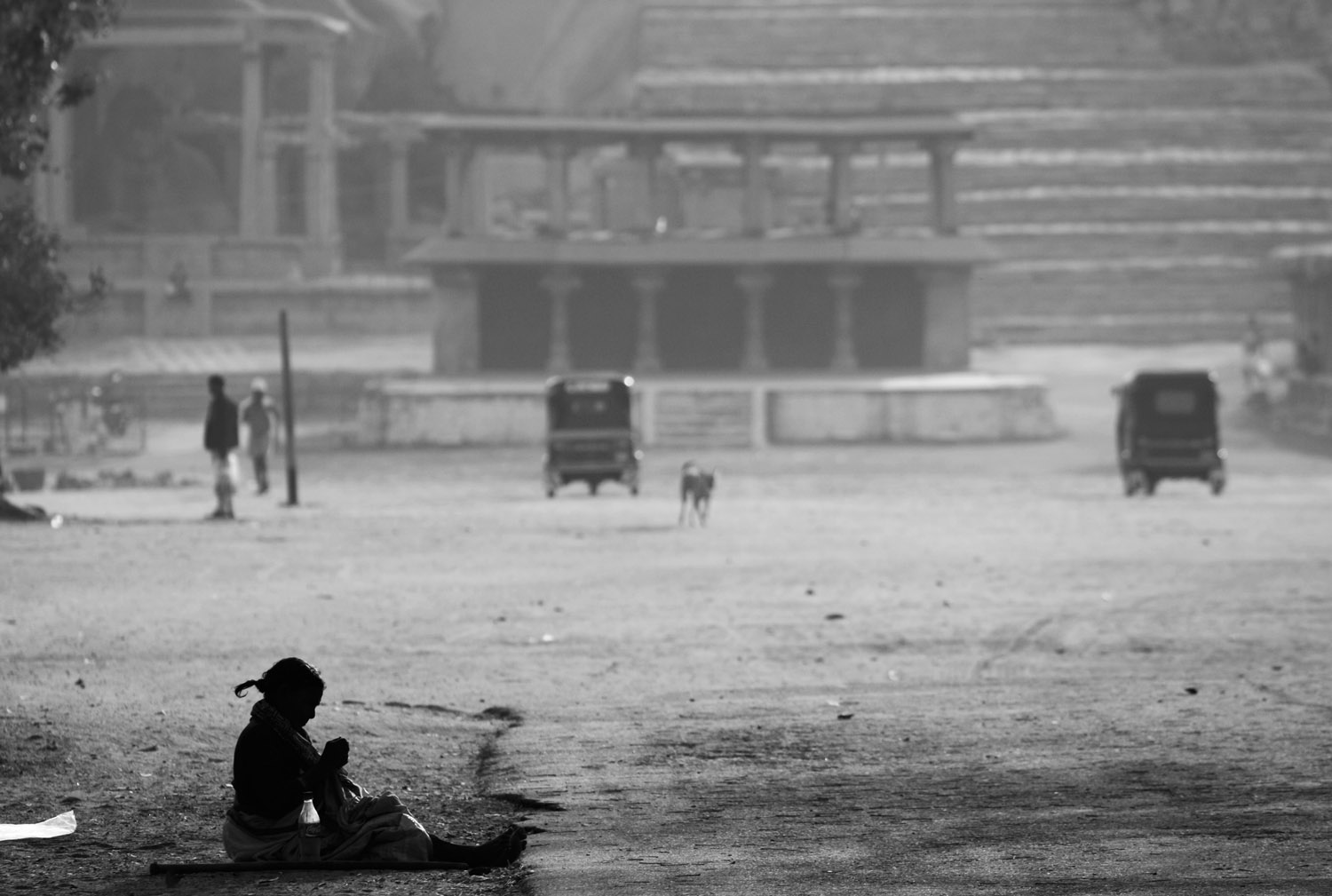
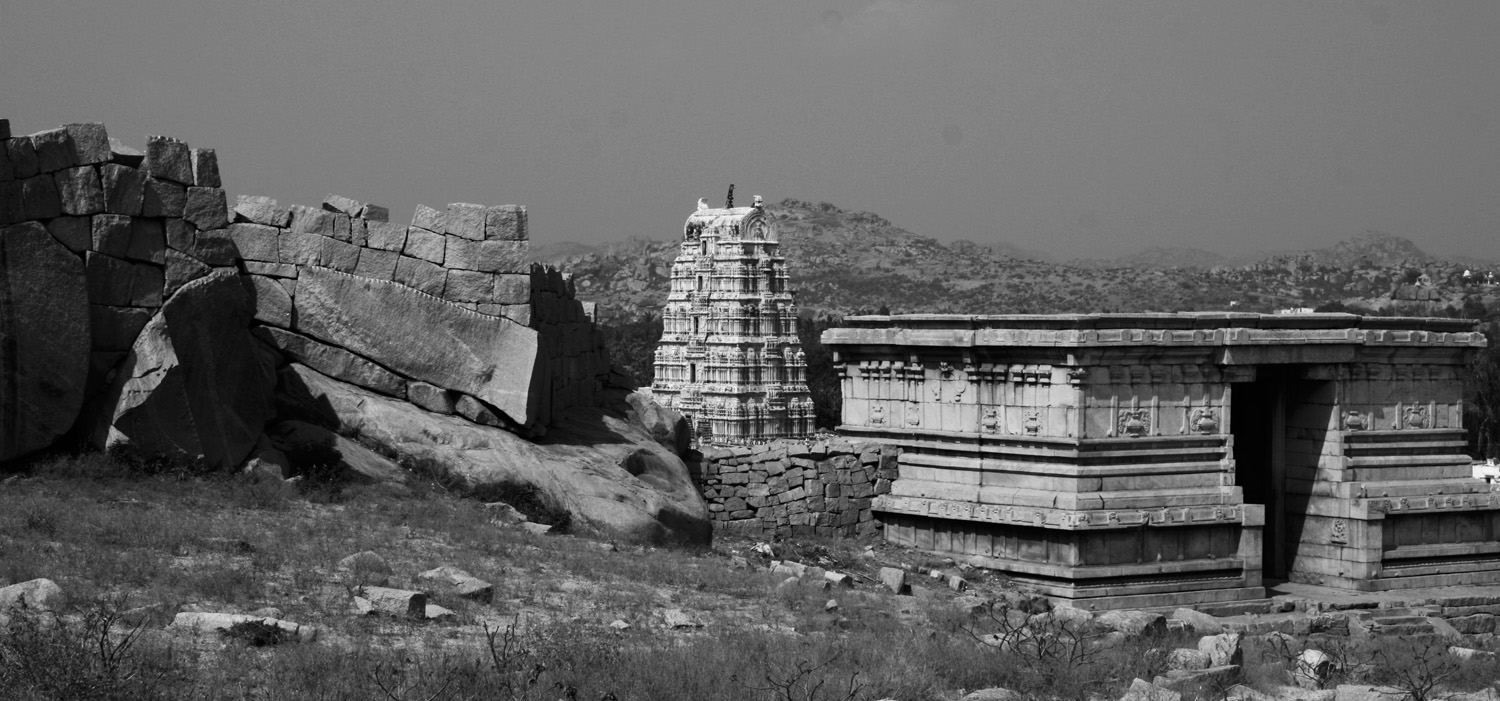
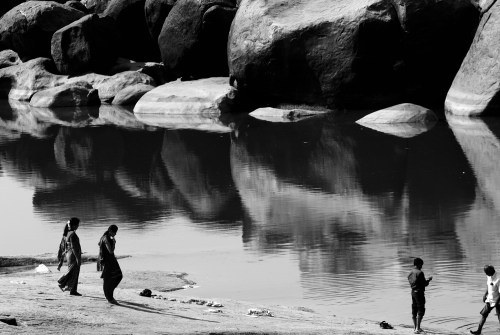
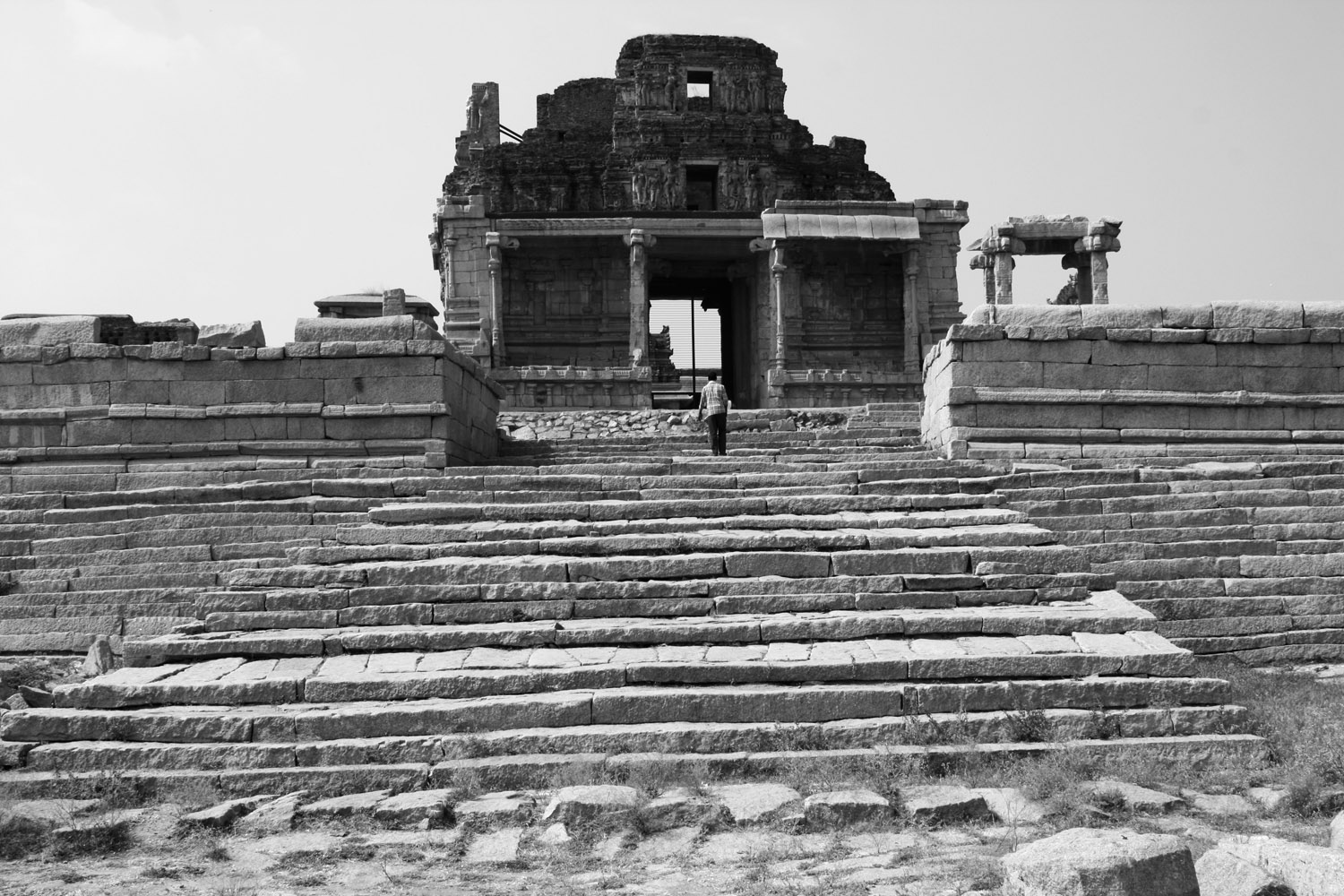
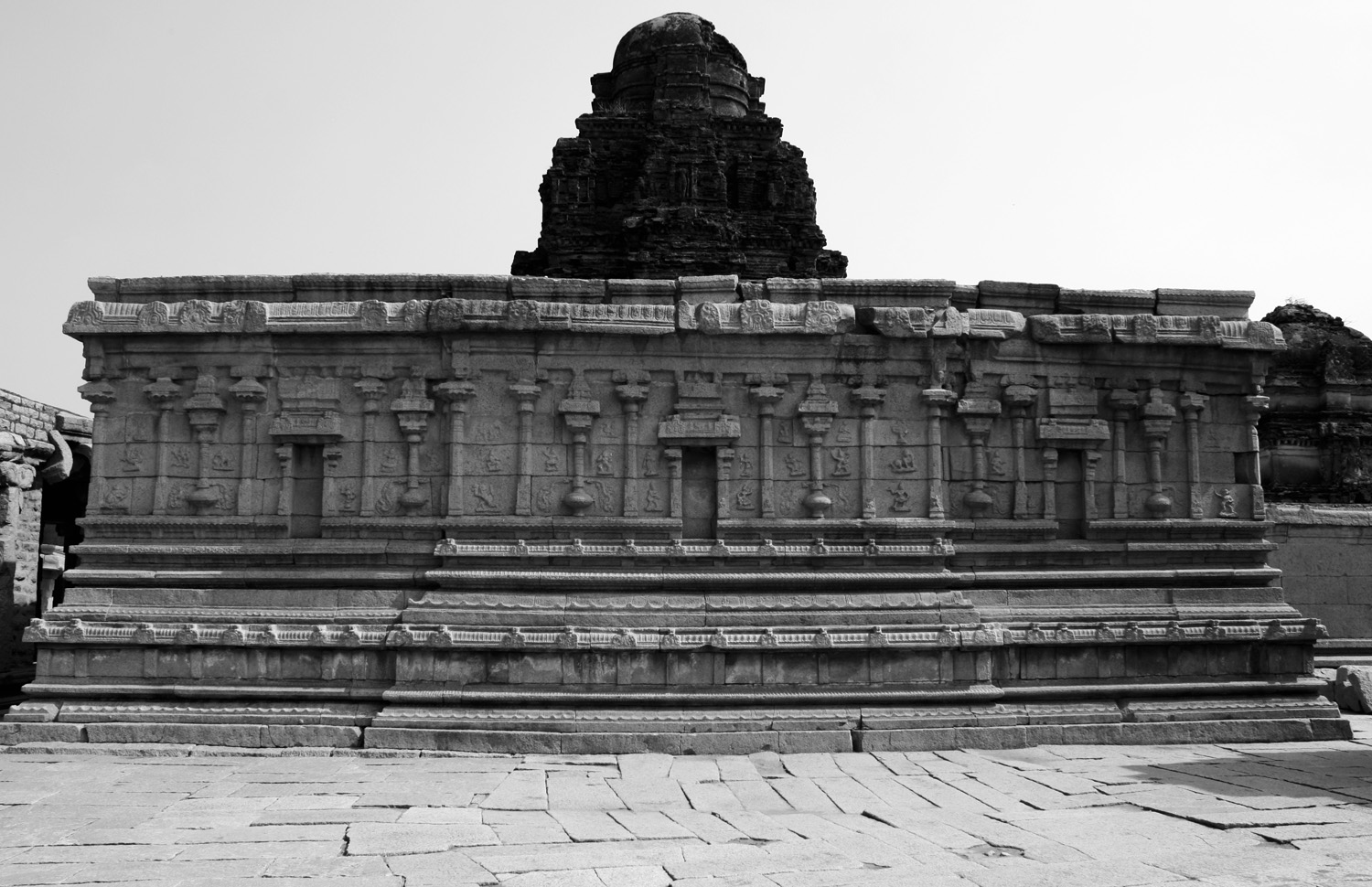
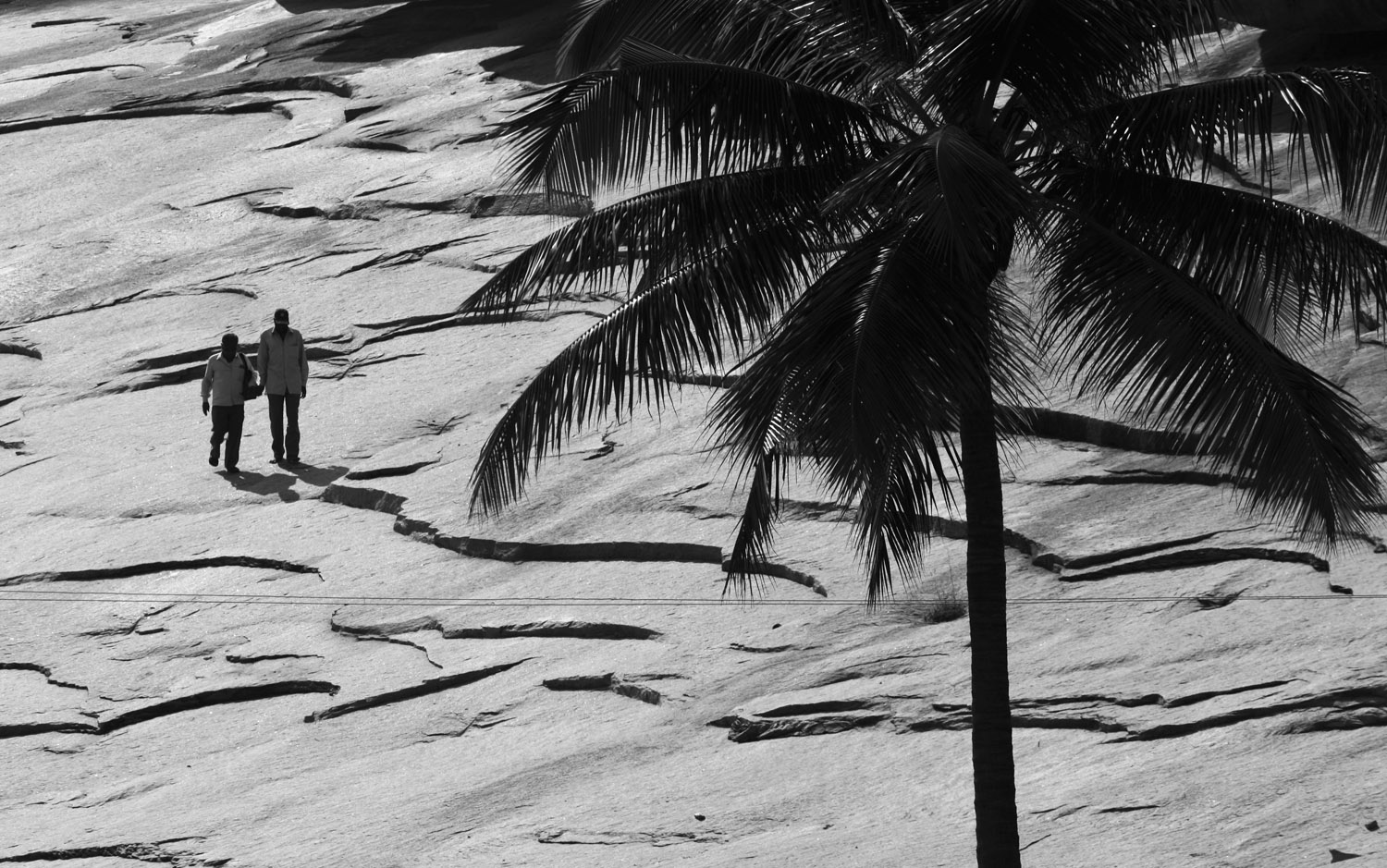
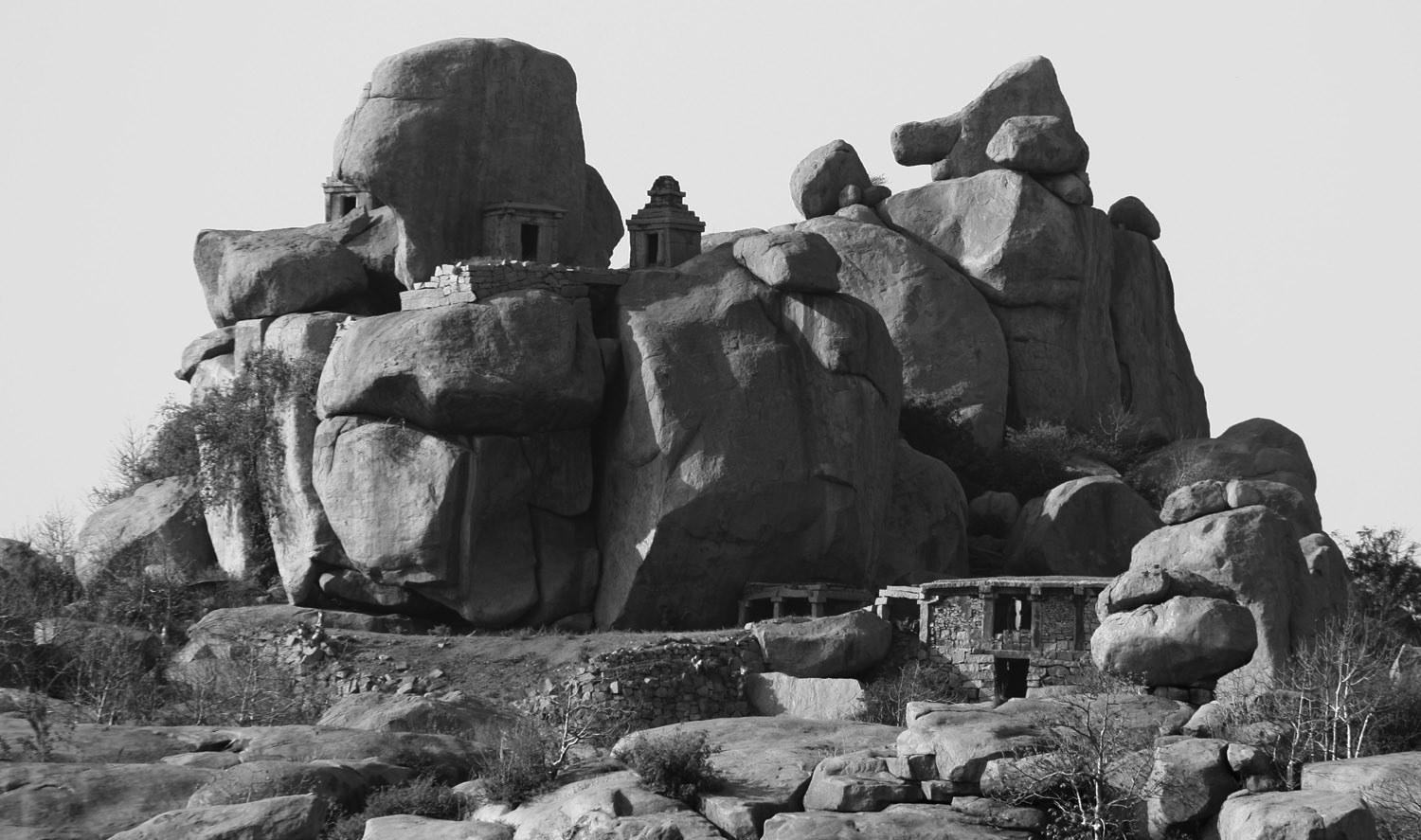
Hampi is a striking place – an odd landscape of giant, tawny granite boulders, strewn across dry river plains and low hills. The weathered, rounded rocks protrude from the rusty, orange soil like scattered marbles, giving the place an otherworldly feel. Hampi is not only a geological wonder, it is also an archaeological one. Having once been the capital of the Vijayanagaran Empire – at its height between the 14th and 16th centuries – the site is full of monumental stone ruins – covering a whopping 26 square kilometres.

Hampi Bazaar

2583 Hampi

2851 Hampi stones and palms

3030 Epic landscape

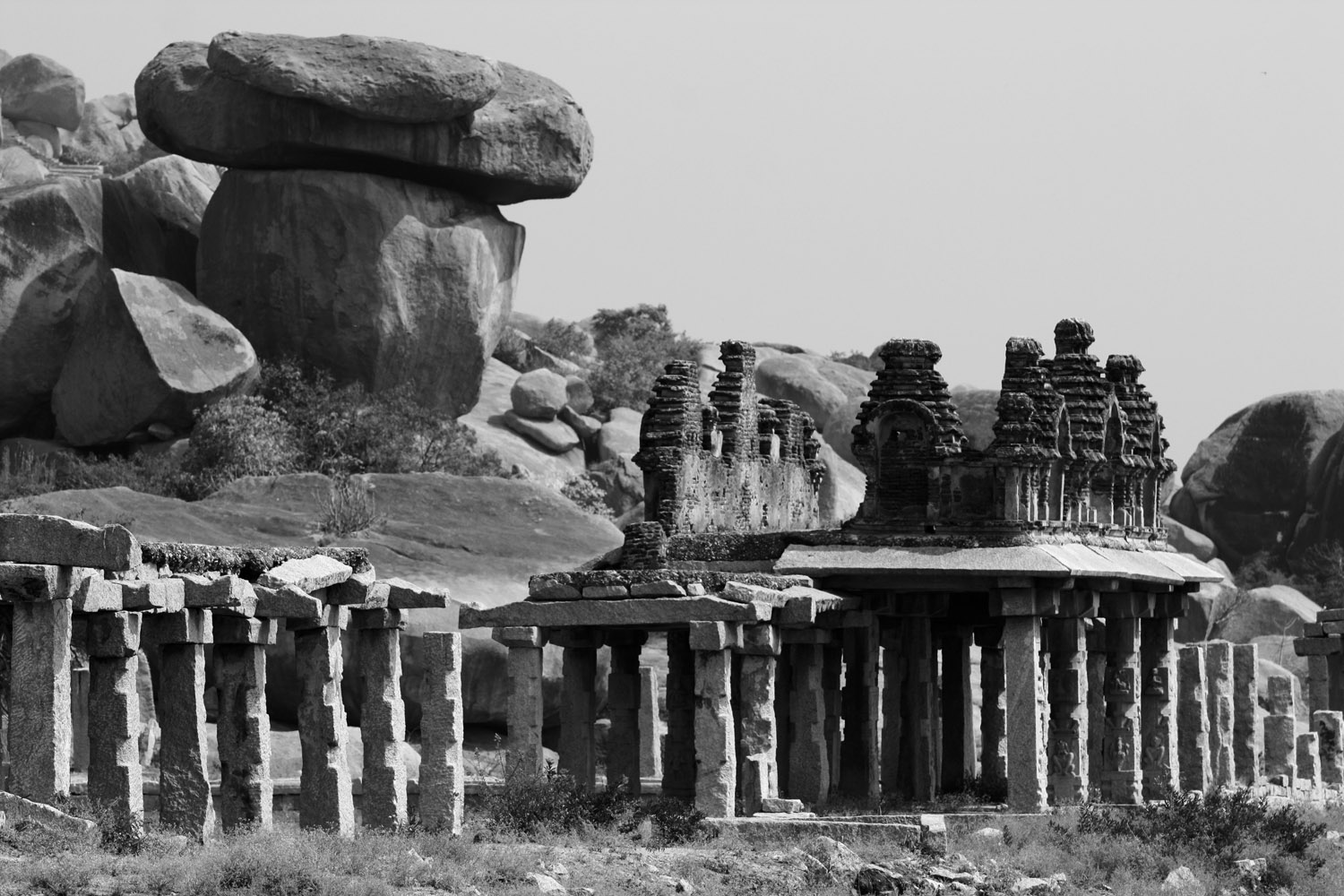
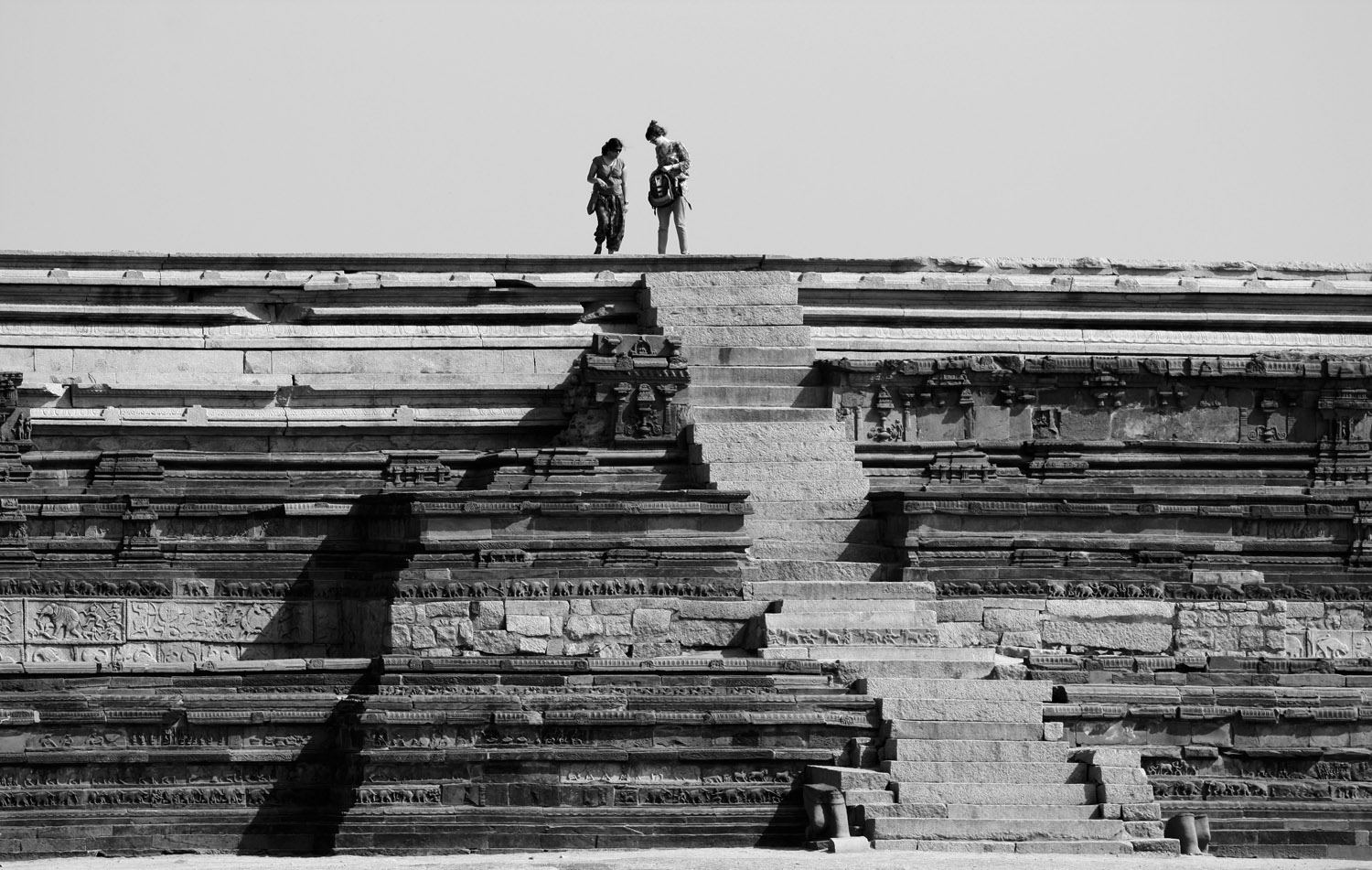
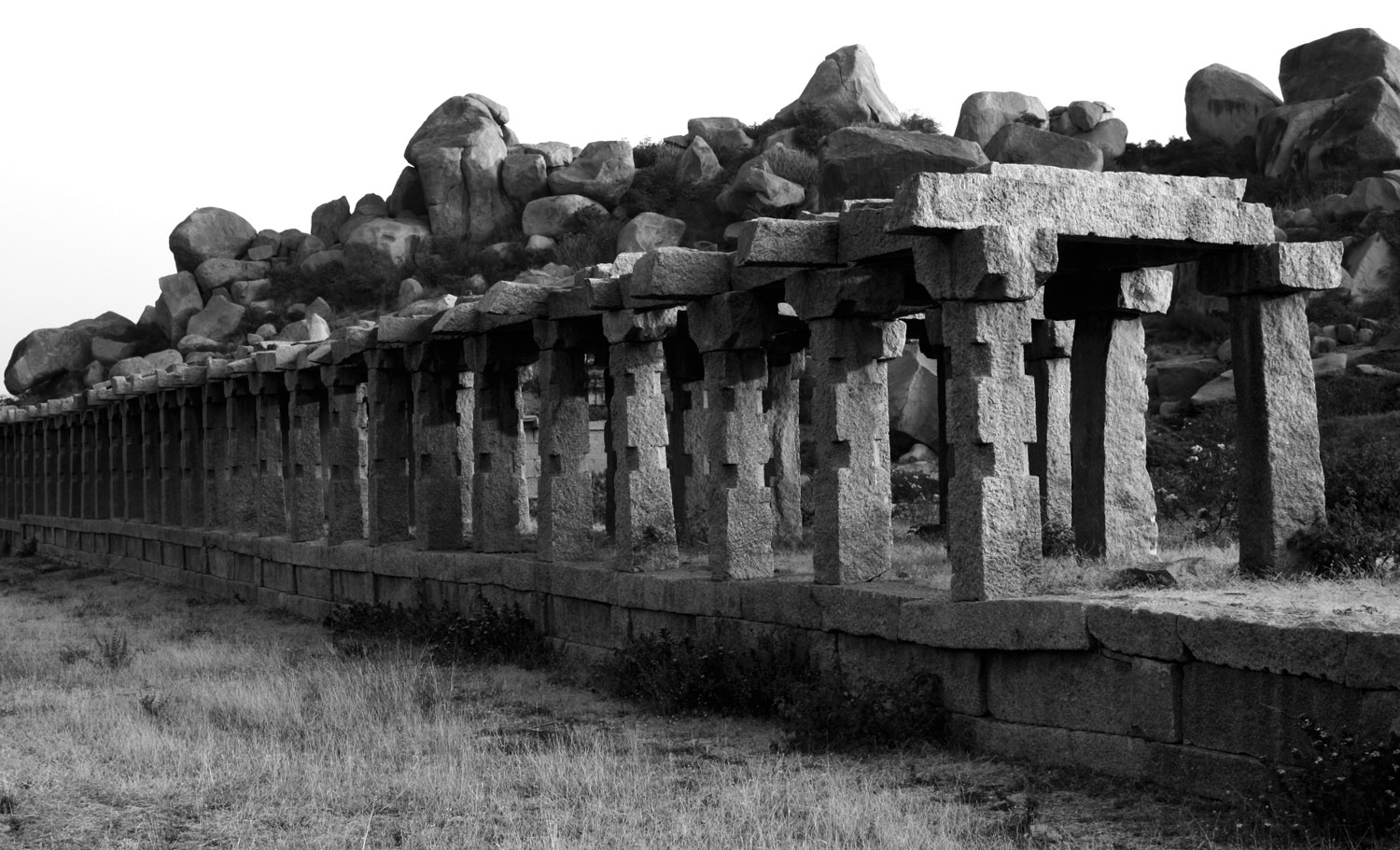
The city of Vijayanagara was founded on the Tungabhadra River in 1336 by two brothers – Harihara and Bukka, and quickly rose to become a major centre of trade and Hinduism. Its wealth came primarily from cotton and spices – a market monopolised by the local rulers to great effect. With such ample stone reserves to be quarried, Vijayanagara experienced an extended construction boom which peaked in the early 16th century under the rule of Krishna Deva Raya (1509-1529). It is from this time that many of the major structures are derived; vast temple complexes and colonnades, bath-houses, cisterns, aqueducts, palaces and elephant stables.

3352 Temple platform Hampi

3217 Hampi 2

3064 Hampi Temple

4393 Bicycle and ruins

3695 Elephant stables, Hampi

2720 Hampi

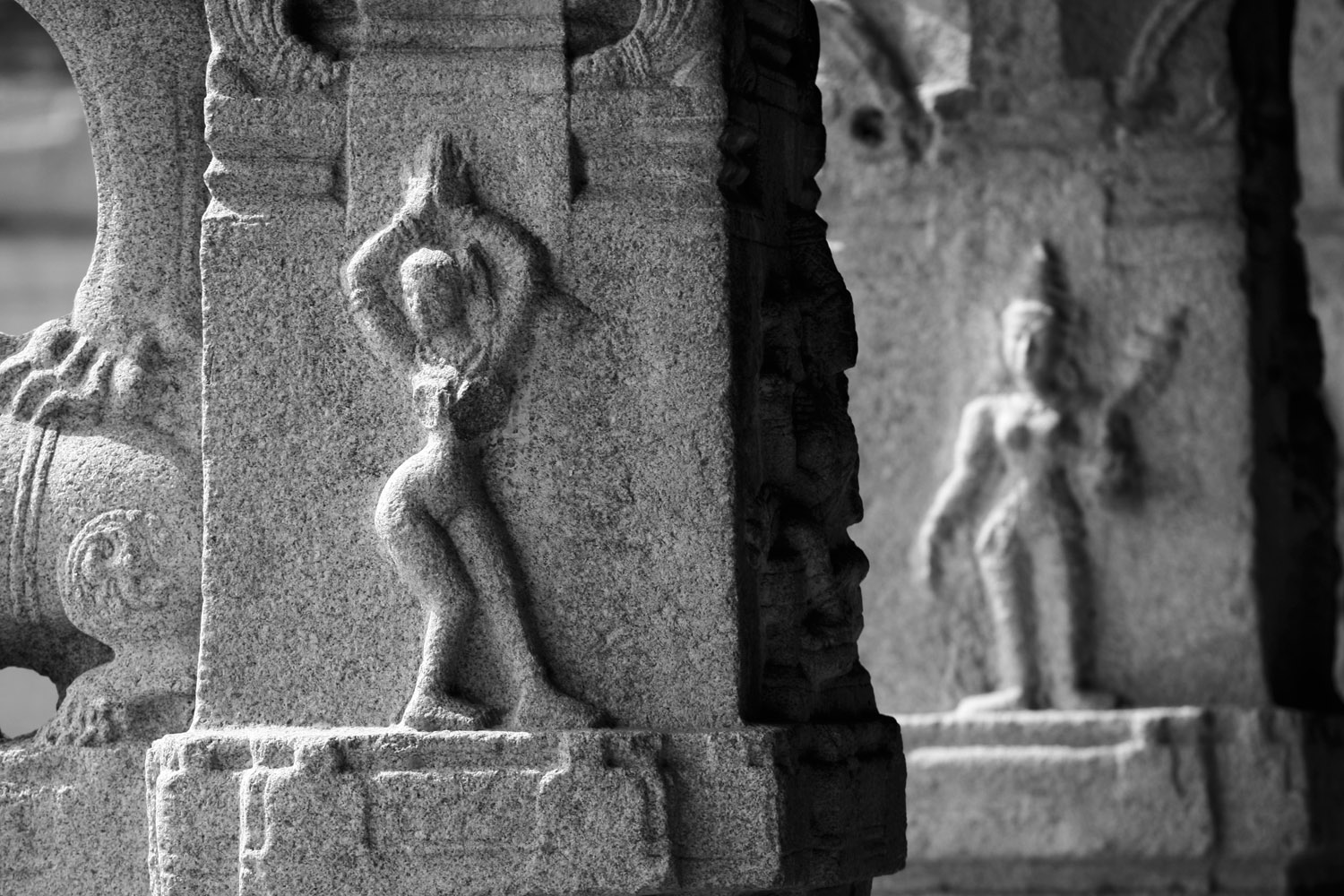
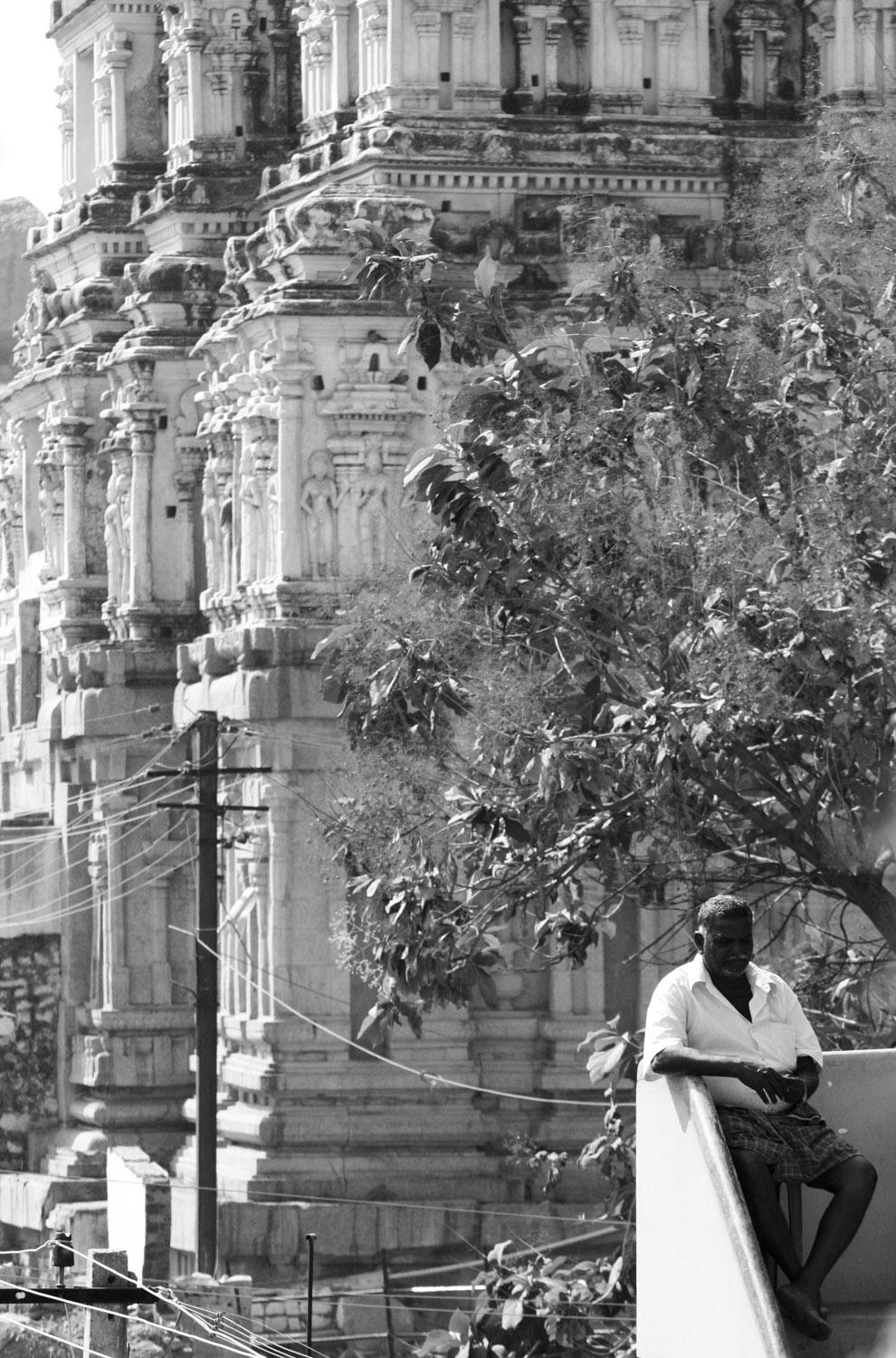
Much of the architecture bears similarities to Hindu structures elsewhere, particularly with regard to the temples, yet Vijayanagara also reflects a local bent for ingeniously blending its buildings into the rocky landscape. It is a busy style, sporting countless high relief carvings and patterned motifs which give the buildings an organic quality.

3112 world of Conan

3291 Horse with horse motif, Hampi

2956 Hampi

2859 Temple, Hampi Bazaar

At its height, Vijayanagara, which means, city of victory, had a population somewhere upwards of 500,000 people, making it the second largest city of its day – surpassed only by Beijing – and a rival to ancient Rome. Vijayanagara fell not long after reaching its peak – sacked by a coalition of Muslim rulers from the north – the Deccan Sultans, who defeated the Vijayanagarans at the battle of Talikota in 1565. After the 16th century, the city fell into decline and ultimately, ruin.

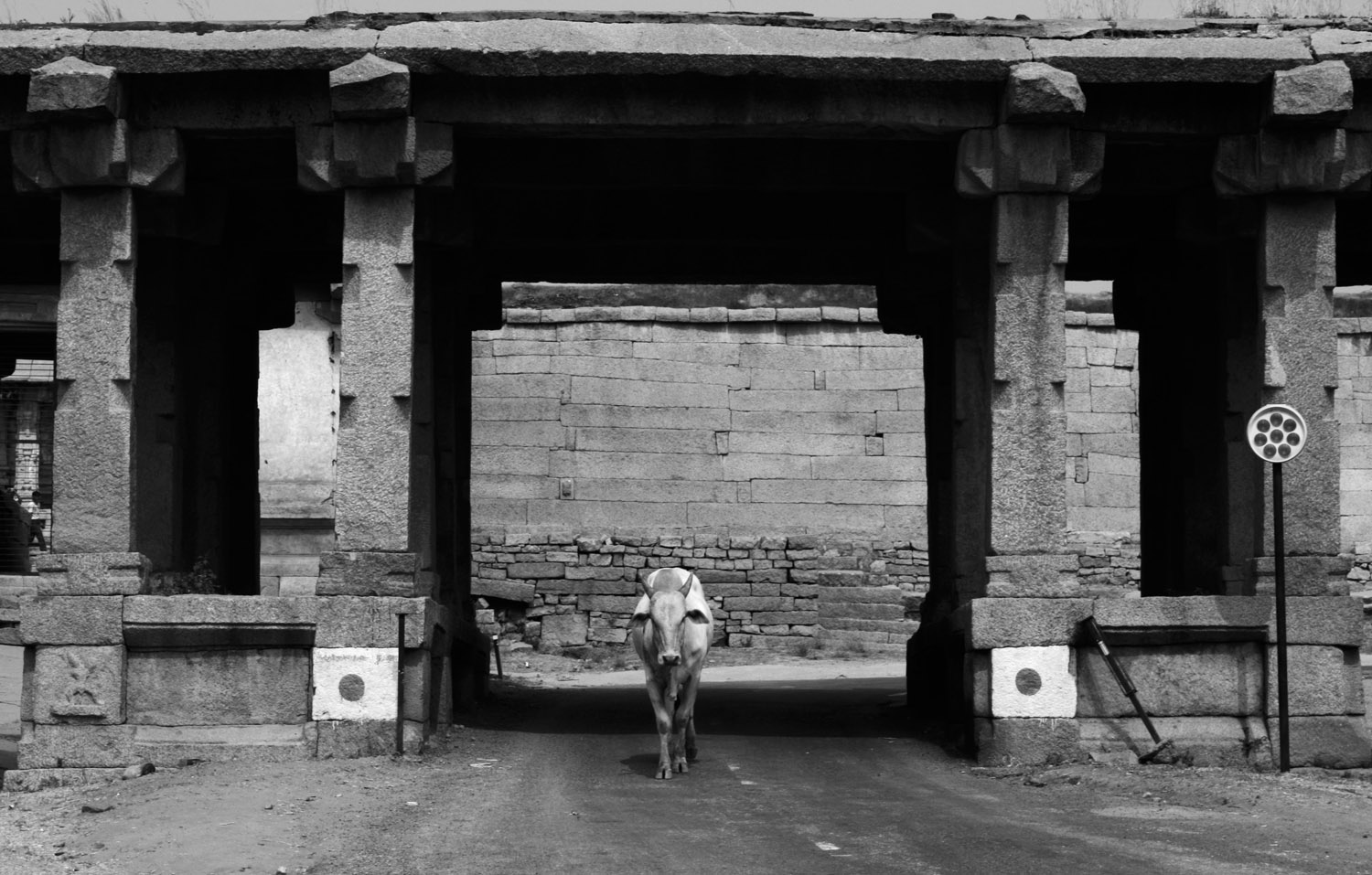
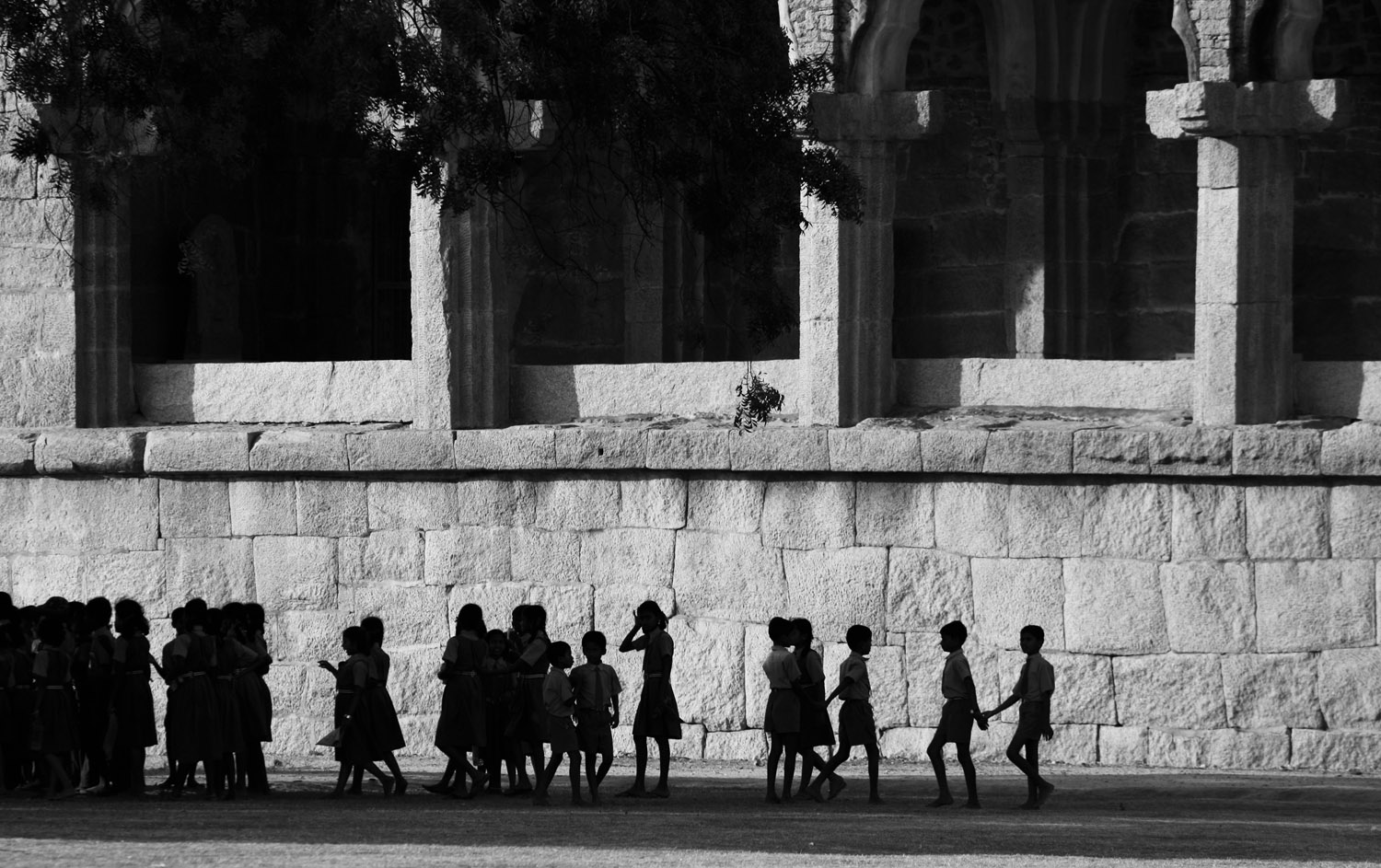
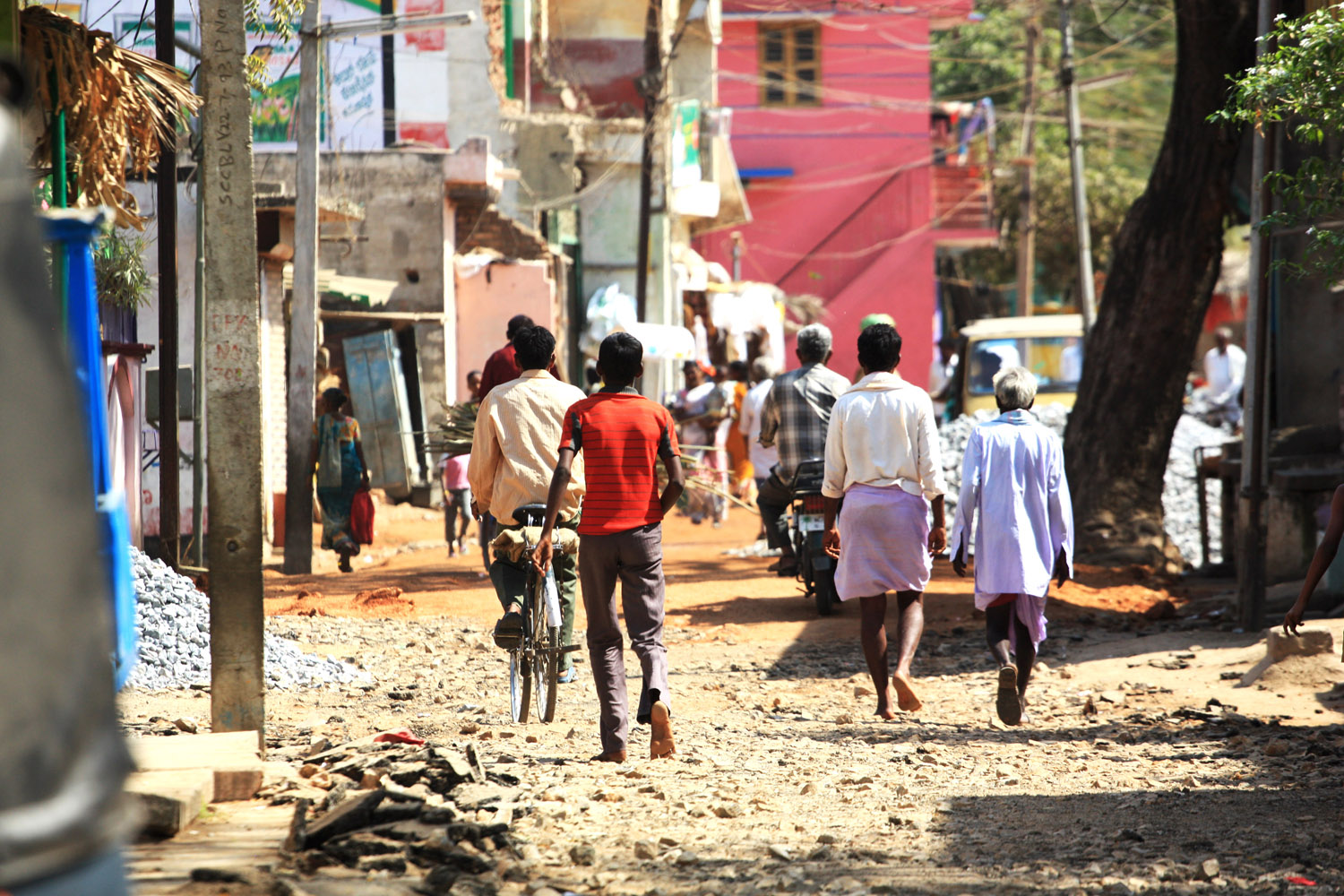
Vijayanagara, and modern day Hampi, are both major sites of ongoing archaeological activity and popular tourist destinations. The town itself – Hampi Bazaar – is tiny, a mere village of neatly swept dirt streets populated as much by animals as people. The town was, until very recently, a good deal larger. Concern about overdevelopment and the locals’ tendency to re-use the ruined buildings as dwellings or for commercial purposes led the local authorities to demolish a number of structures built in the last 50 odd years, and to evict people from re-purposed medieval buildings. Despite this, Hampi Bazaar still sits right amongst the ruins of Vijayanagara and the transition from one into the other is seamless.

2978 Medieval gate, Hampiu

3969 Hampi morning

2822 Ruined street, Hampi bazaar

2793 Clothes line

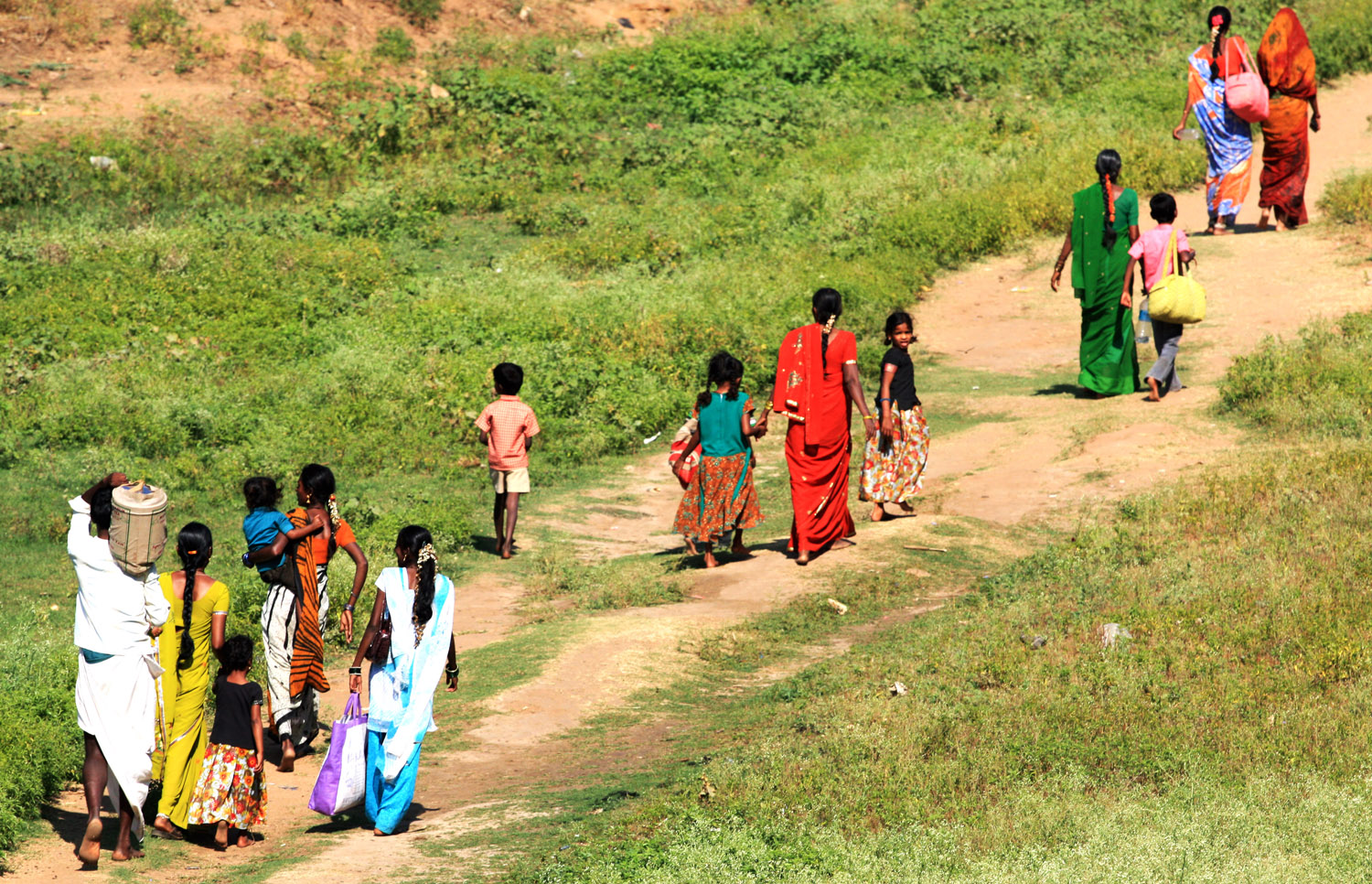
Hampi Bazaar, whilst by no means an inhospitable place, is likely not for those who are used to luxury – most of the hotels are very basic and some lack hot water and private bathrooms. Many hotel rooms are also quite musty and mouldy – a consequence of the humid conditions and walls apparently lacking damp protection from the earthy foundations. Yet it is a lovely place to stay – the colourful houses are intimately close together, and the local people can be seen getting on with their lives in the midst of the tourist hordes who inevitably fill this place.

2818 Dances with goats

3823 Hampi Bazaar

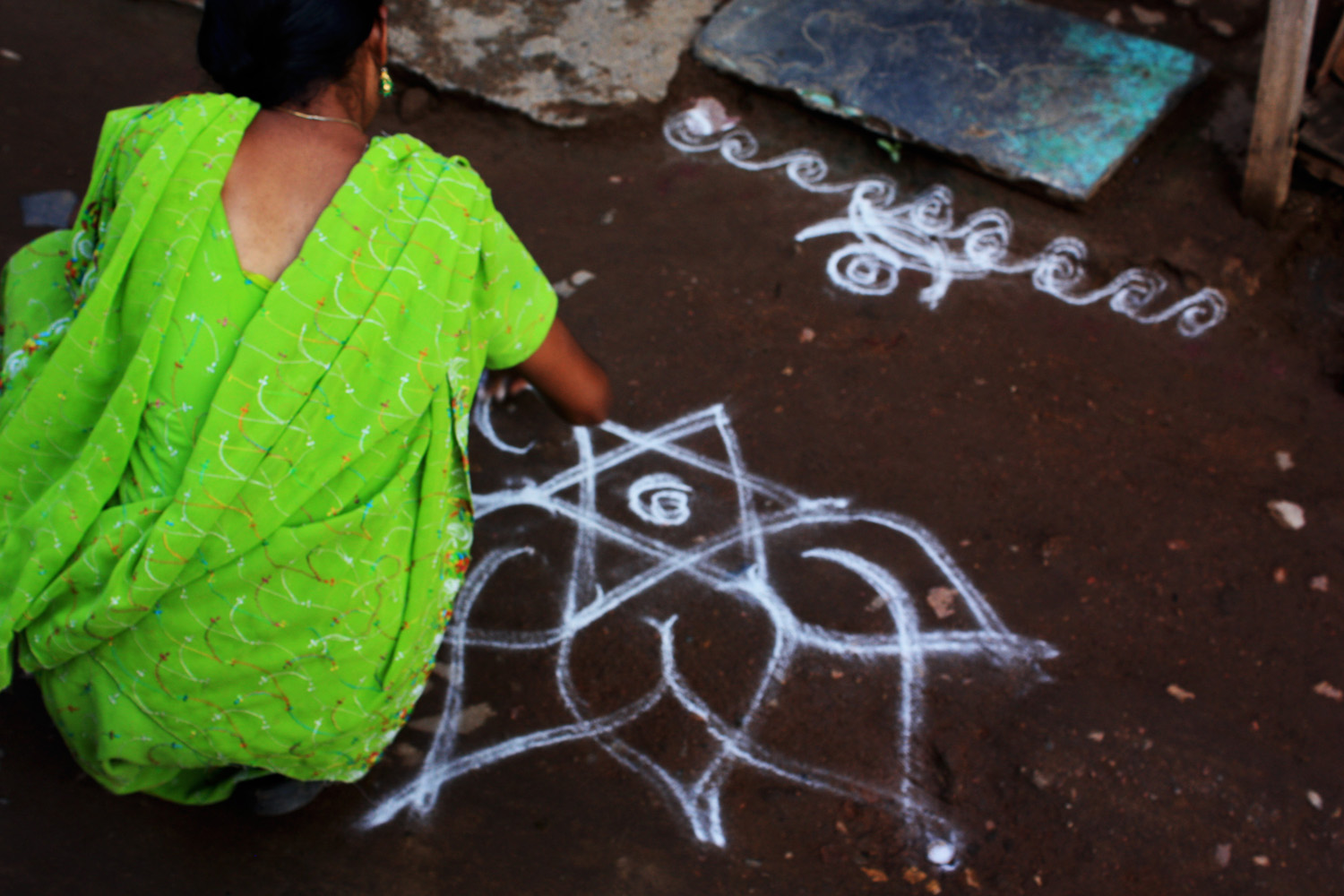
2799 Simple street Mandalas

3963 Hampi

It is especially popular with younger, more alternative travellers – some of whom come to Hampi and get stuck for days or weeks. It has a very chilled aspect to it and the many roof-top restaurants, despite the disappointingly average quality of the food across the board, are excellent places from which to view both the village and the surrounding landscape. The proximity of the torrential river makes the setting all the more idyllic and exotic.

2394  Temple, Hampi

4011 Tourist

3954 Hampi ruins

2599 Hampi

3867 Tourists, Hampi

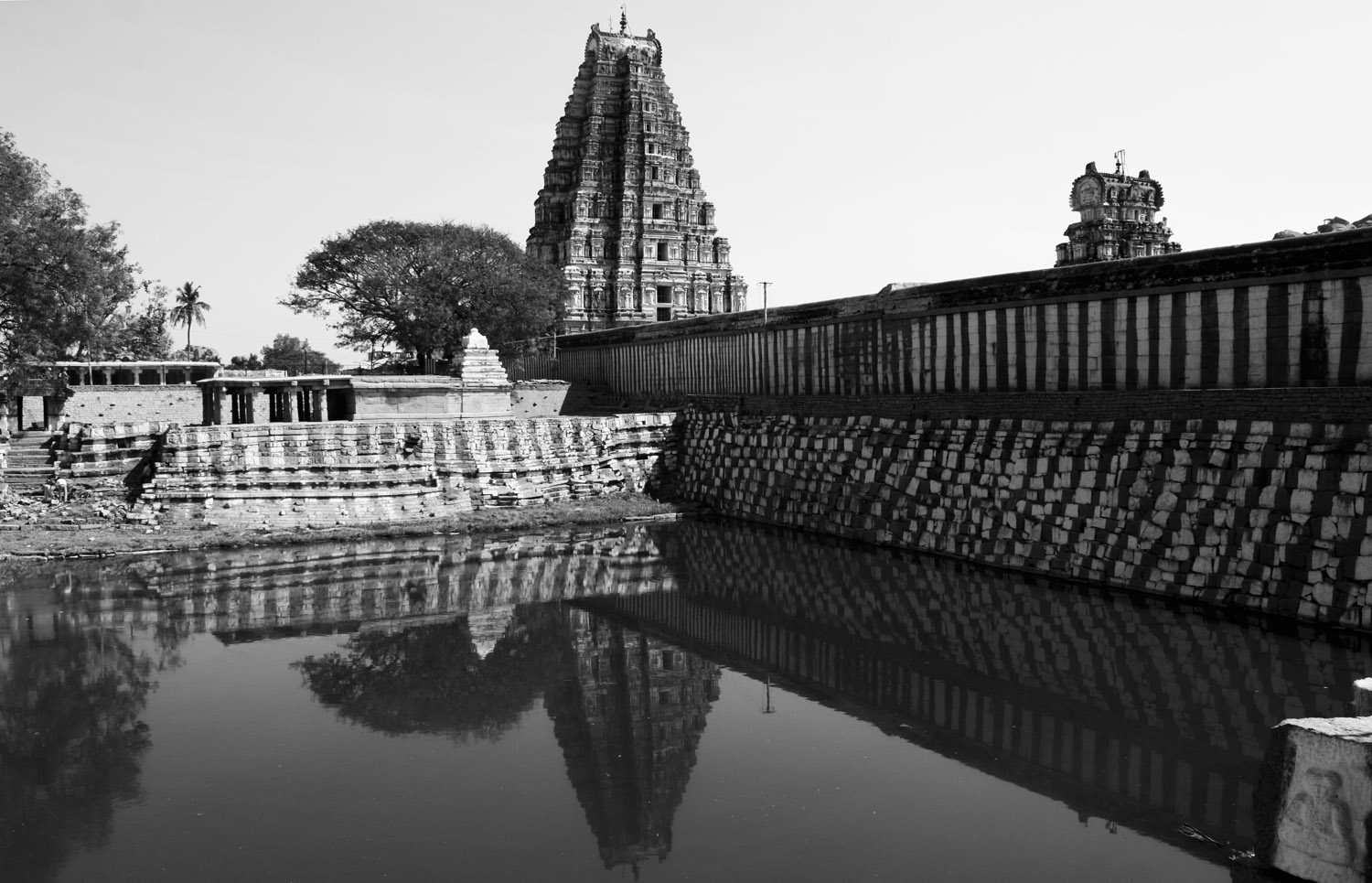
As noted above, Hampi Bazaar has its fair share of ruins and intact medieval structures. The monumental Virupaksha temple, flanked by an epic cistern, seems almost embarrassingly oversized for the modest village. Yet this but a taste of the wide array of impressive structures and temple enclosures dotted around the huge site. The number of temples is astonishing and their intactness gives some parts of the site the sense of a ghost-town, hastily abandoned. It is possible to walk for hours, for days and still only touch on what is on offer here.

2836 Virupaksha temple 2

2513 Temple and tank, Hampi

2895 Hampi Temples

Following the river to the northeast leads one through a glorious landscape, past a fantastical collection of ruined complexes to the immense Vitthala Temple with its famous stone chariot – the wheels of which still turn. Though it is less than five kilometres, one could spend at least an entire walking there and idling back, exploring the temples and enjoying the natural setting.

2761 Hampi, Age of Conan

2579 Hampi

2602 Hampi 2

2651 Hampi

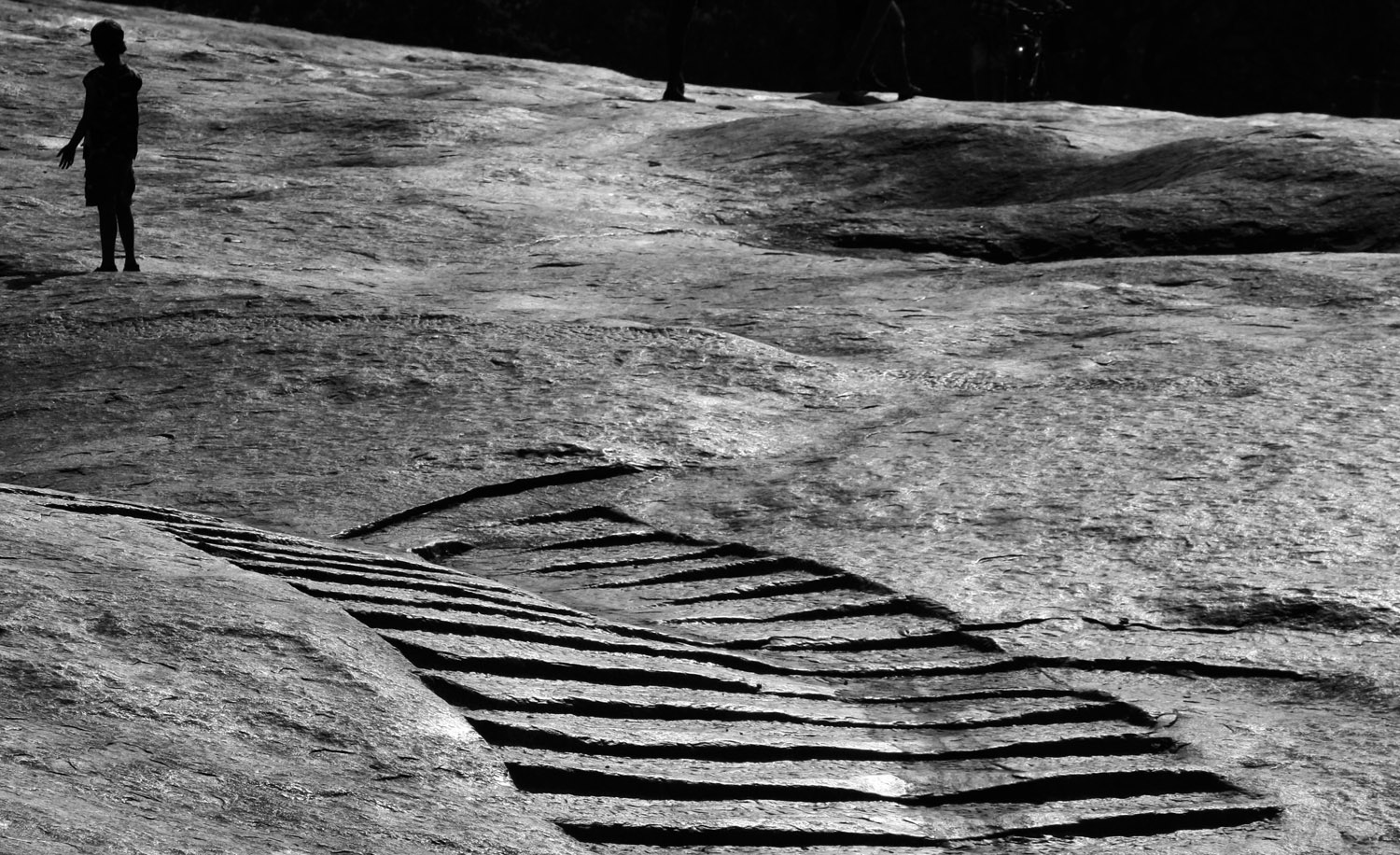
2586 Hampi, rock cut steps 2

2580 Hampi

The Royal Enclosure, to the south of Hampi Bazaar, marks the old centre of the medieval city. It is here that some of the most impressive monuments are to be found – such as the Lotus Mahal – said to be the queen’s pleasure palace, and the elephant stables. At least a day is required to satisfactorily explore this wide area, depending on your patience, curiosity and temperament. Either way, be prepared for a lot of walking, or else hire a motorbike or auto-rickshaw with driver as the massive scale of the site means many of these monuments are widely spaced.

3579 Vijayanagara

3044 Hampi temple

3720 Elephant stables, Hampi

3088 Hampi Temple

3083 Rocks and ruins

3794 School group, Hampi

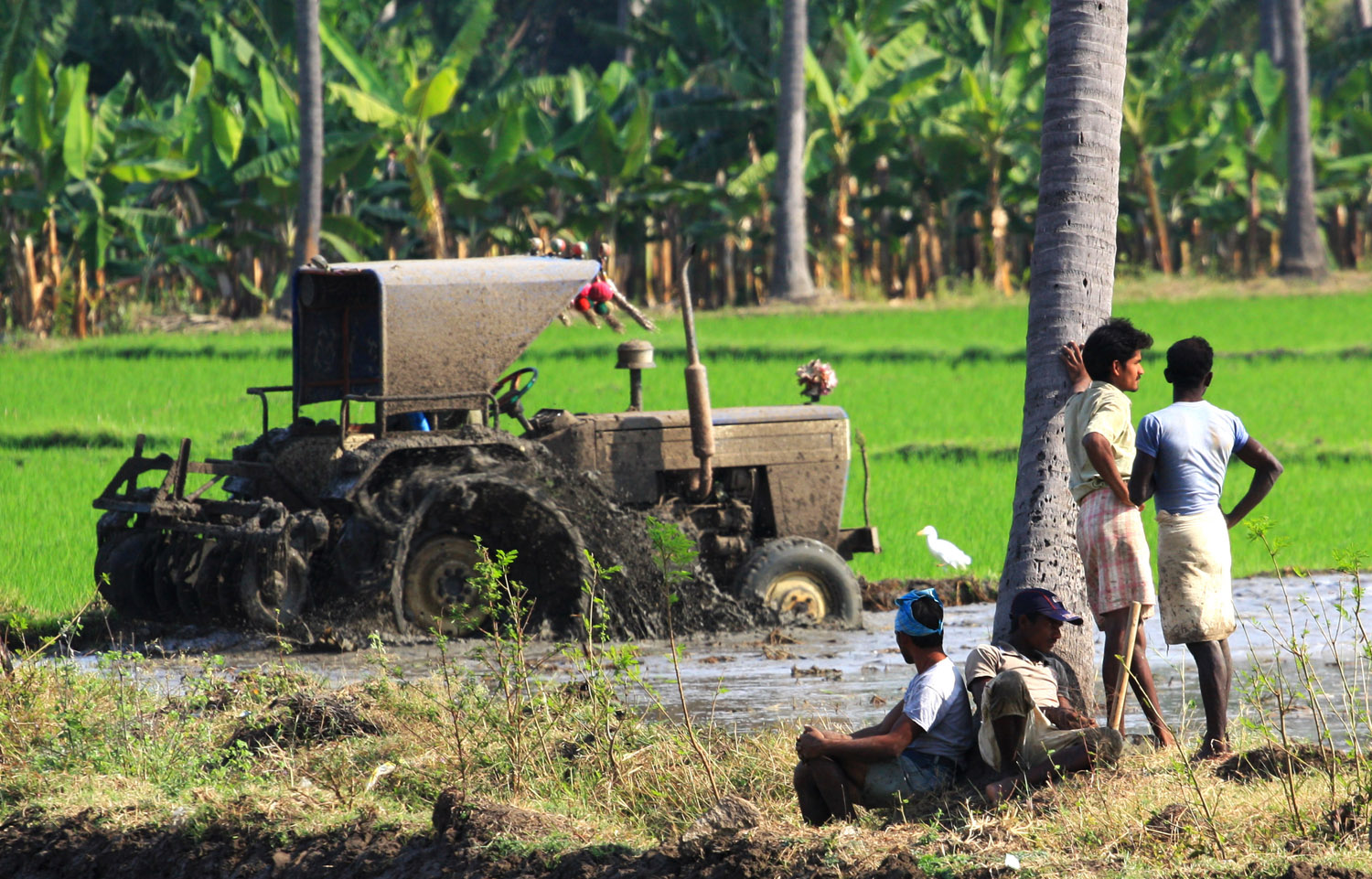
Whilst the landscape seems, for the most part, dry, rusty and scrubby, it is full of bright green palms and banana plantations. The rich, dark soil of the flood-plains also yields brilliant, emerald green rice-fields which illuminate the dry, toweringly smooth rocks with radiant verdure.

4349 Near Anegundi

3321 Sitting under the tree

3135 sensuous bananas

4257 Anegundi

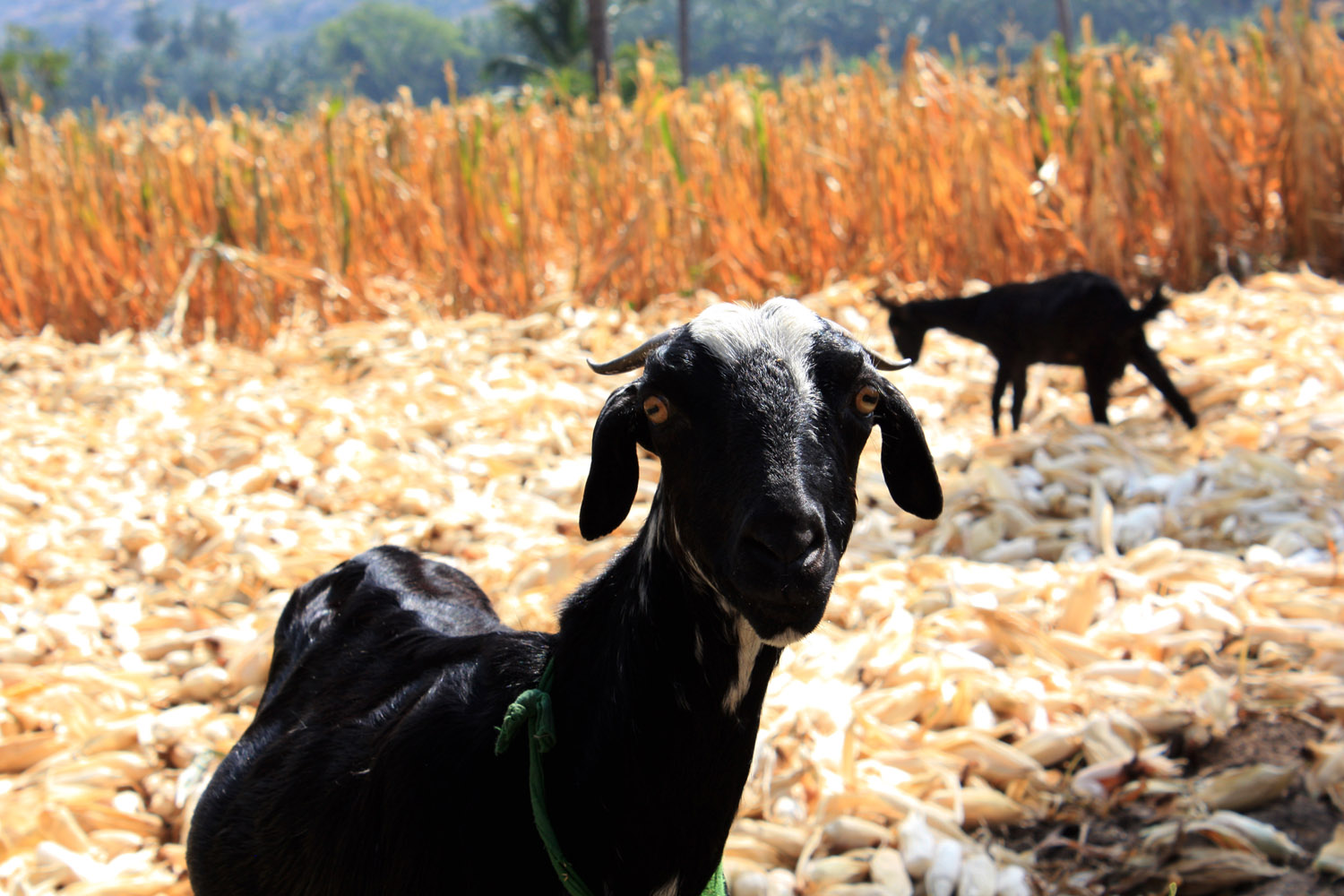
4218 Goats eating cornhusks

It is a curious mix of the lush and the semi-arid, and can also contain some nasty surprises should one venture off the beaten track. Hard, sharp white thorns, up to an inch and a half long and strong enough to penetrate a rubber sole, often lie in the undergrowth. I learned about these the painful way, when I put my full weight on one in a pair of thongs and nastily punctured my foot which then spasmed awkwardly for the next two minutes. The thorn went so deep into my foot that it nearly came through the other side and for days afterwards walking was a very tender exercise.

3141 Thorns

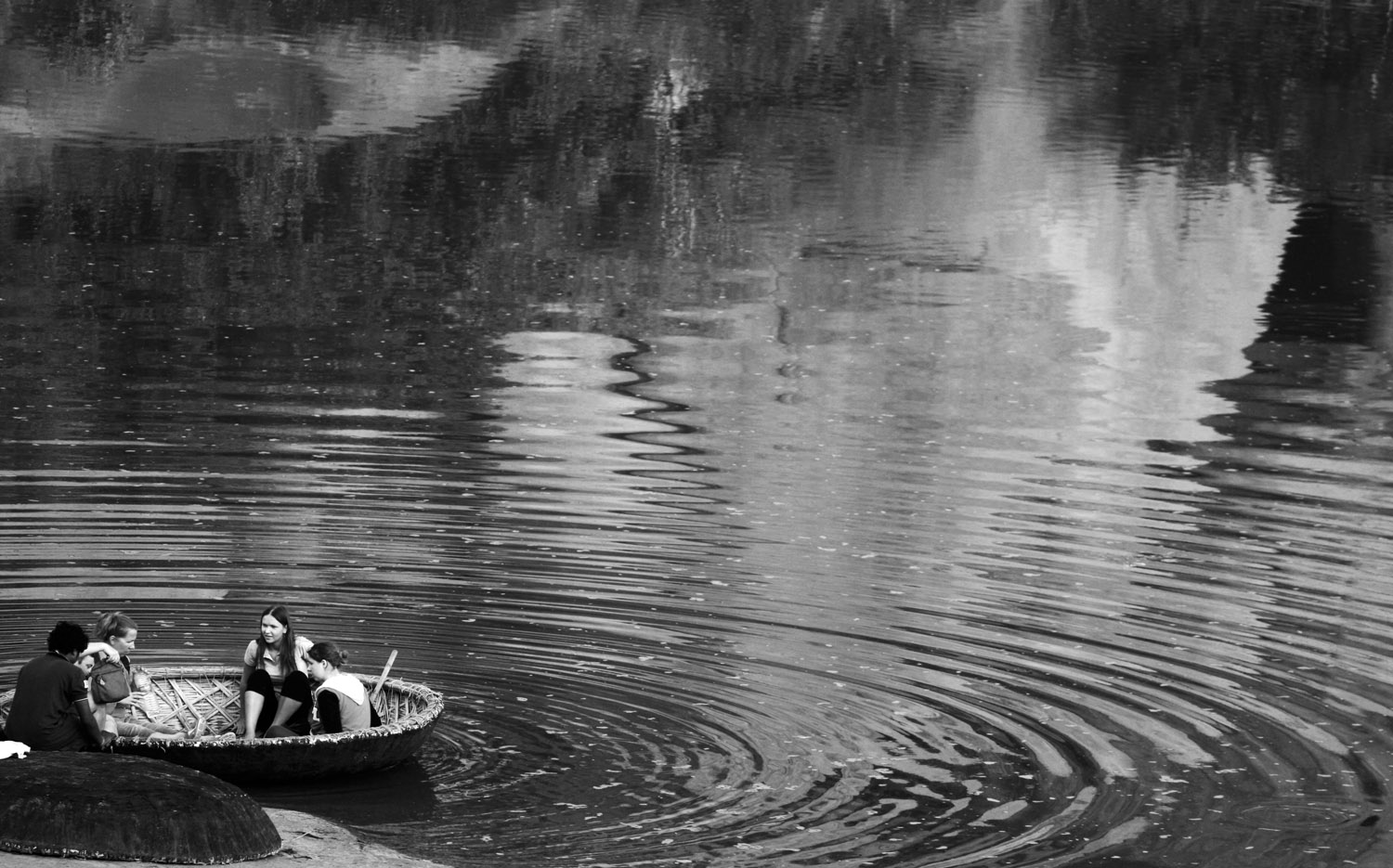
Another place worth visiting is the small, historic village of Anegundi. It lies a few kilometres to the north east of Hampi Bazaar and, without taking an enormous detour, can only be accessed by ferry.

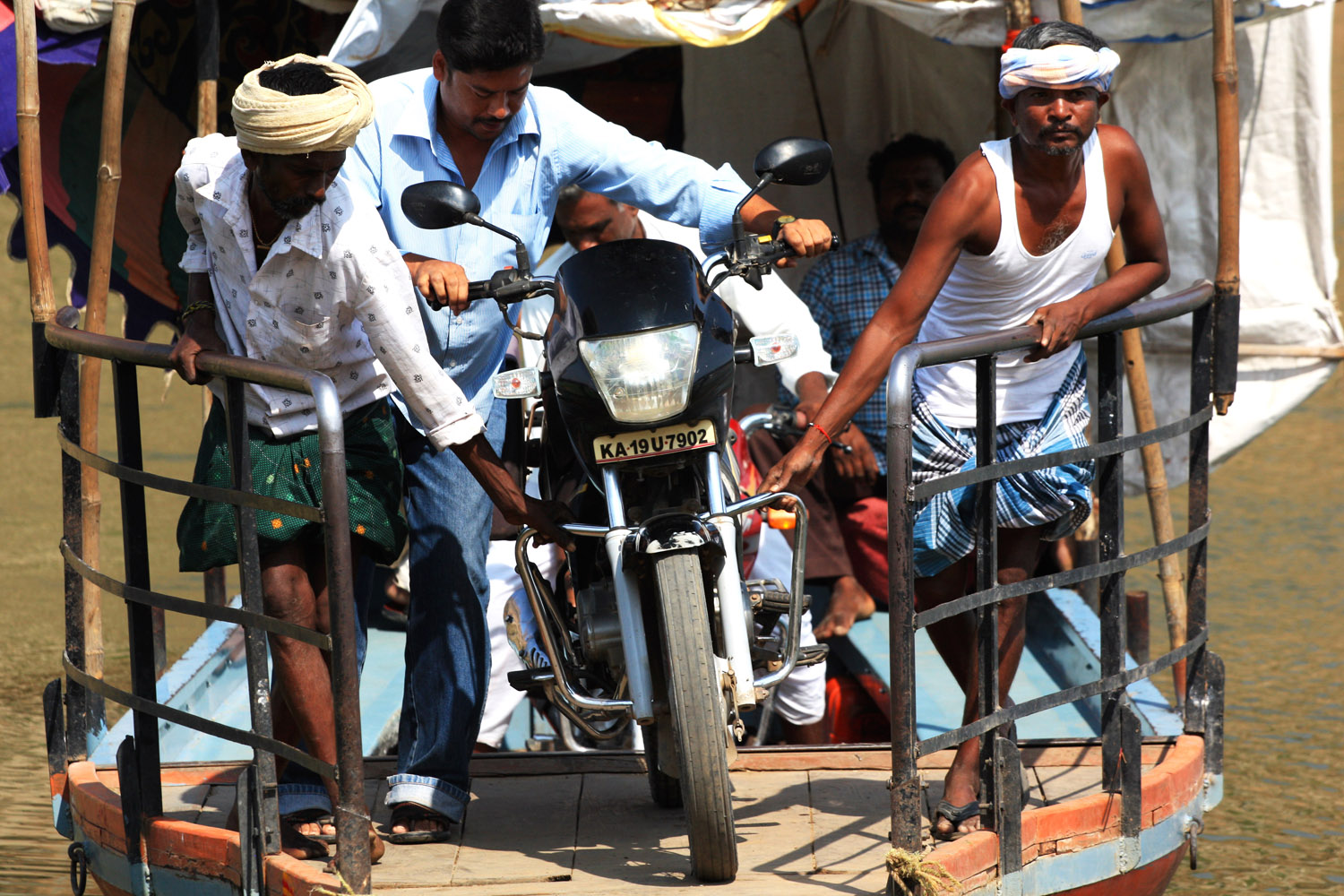
4113 Ferry crossing

Construction of a bridge crossing at Anegundi began in 1999, but was halted the following year over concerns about the impact on the site, both physically and visually. Shortly after reconstruction was resumed in 2009, the bridge collapsed, killing eight construction workers. It now lies like a crooked slippery dip, angled into the river – an interesting modern ruin.

4056 Collapsed bridge 2

The local people remain with no choice but to take the tiny ferry or another, private boat, across. A few motorbikes can fit aboard the ferry, but cars are forced to drive some forty-odd kilometres to access the nearest bridge.

4091 Off the ferry

A local guy from Anegundi with whom we spoke on the ferry was very vocal, if philosophical about the bridge. It was corruption, he said – poor construction due to cutting corners. “This is an India problem,” he said. So it seems.

4166 Anegundi

4135 Anegundi

4175 Anegundi

4202 Anegundi

4408 Happy locals

With such an unreal and captivating landscape, Hampi demands being seen at both sunrise and sunset. There are many vantage points which will yield a mind-blowing view, and the elevated places immediately outside Hampi Bazaar are some of the best. At these times of day the landscape’s colours are smoothed with an orange wash from the low-hanging sun. One morning, V and I set out before dawn to climb the rocky hill at the eastern end of the town. The wan light of morning was powerfully evocative of sunrise on another planet.

3903 Sunrise on Mars

3897 Sunrise, Hampi

When we descended from the boulder atop which we had been sitting, we came across another temple site we had not found yet, nestled between hills and palm trees. The heaviness in my heart and guts was the heaviness of awe – weighty feelings of eternity and mortality, fuelled by aesthetic beauty and the visceral freshness of the early morning grandiose. For four days Hampi had me under its spell – it is not something I’m ever likely to forget.

4270 Near Anegundi 2

4426 juicer

3956 Coracle crossing

4234 Hampi rocks

3938 Hampi 2

3643 Hampi

3746 Shrines on the rocks

2426 Street scene, near Hampi

3634 Islamic quarter, Hampi

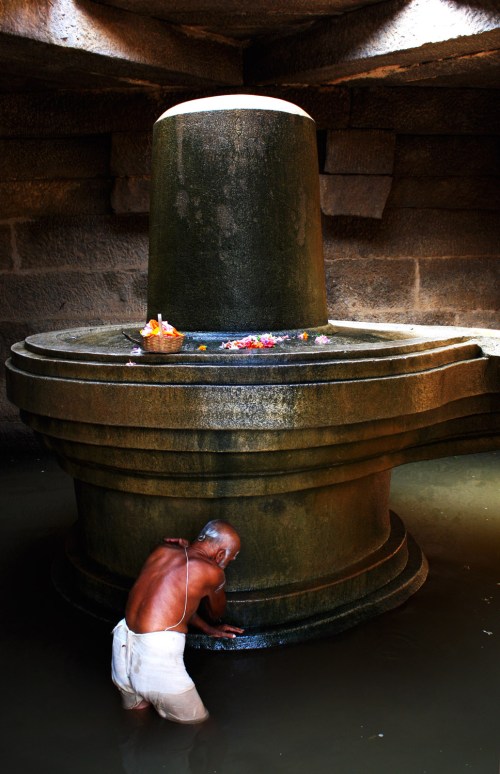
2965 Tending the lingam

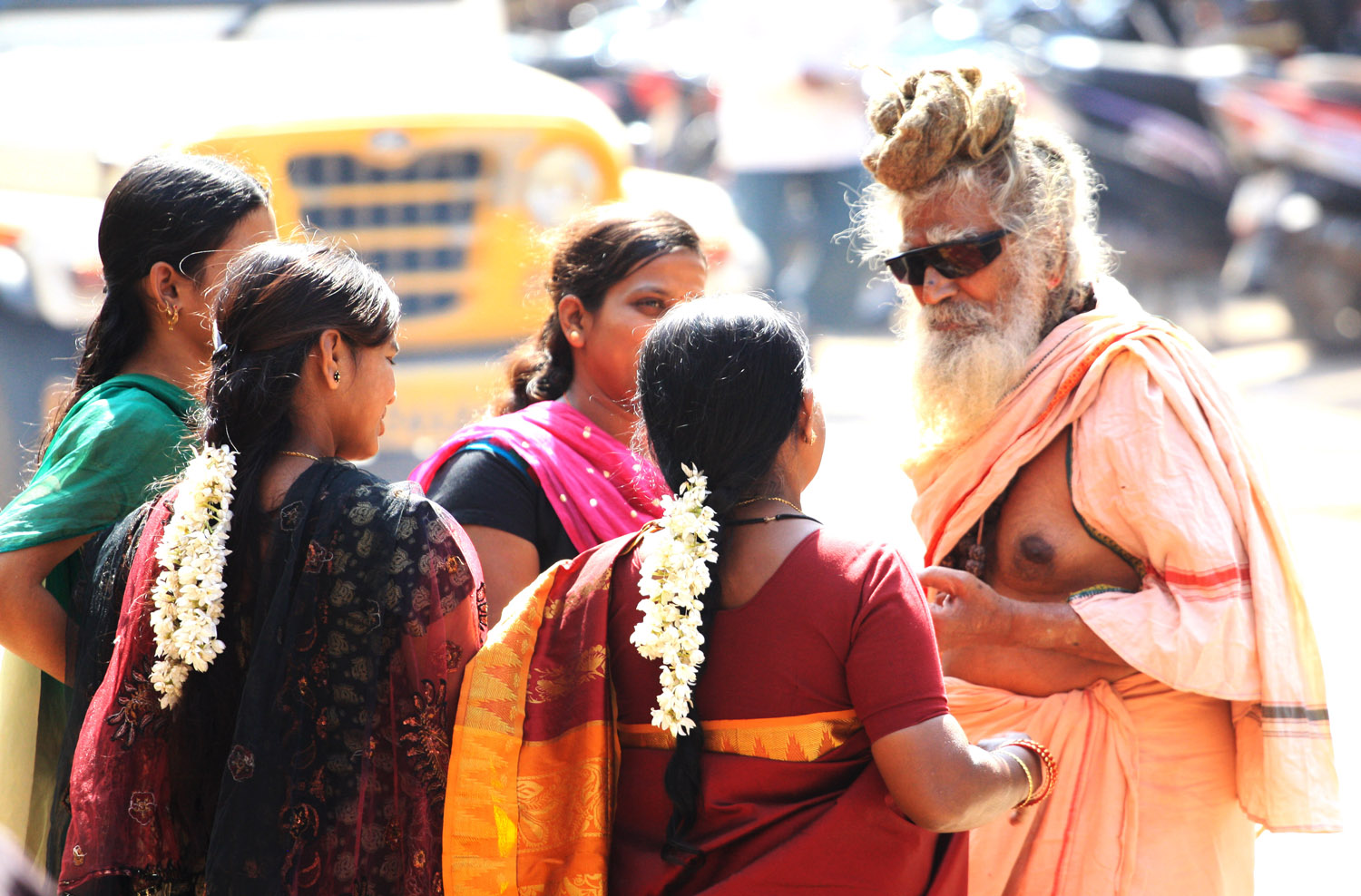
2461 Hey ladies

Macaques, Monkey Forest, Ubud, March 13, 2009

Macaques, Monkey Forest, Ubud, March 13, 2009

The Sacred Monkey Forest of Padangtegal village, on the edge of Ubud in Bali, is a natural highlight for tourists – attracting roughly 10,000 visitors a month. A 2011 monkey census put the monkey population at exactly 605 crab-eating macaques (Macaca fascicularis), a figure which has no doubt shifted since. It is a lush, dark and deep green place which, with its shrines, stone-carved animals, Hindu gods and hanging roots and vines, would not be out of place in an Indianna Jones movie.

Whilst the macaques are called “crab-eating,” you will likely only see them eating bananas, durian, cucumbers and watermelon. Perhaps some species of fresh-water crab inhabits the primeval stream which runs through a short, steep gulch beneath a fantastical stone bridge, though I saw no evidence of this. The monkeys are, as monkeys will be, cheeky and impudent and will quite happily snatch anything faintly resembling food from visitors. If they were any larger, this would be more intimidating, yet it is certainly enough to give a person a fright, should one of them run up your leg. On my first visit there my brother made the mistake of buying some bananas to feed them and promptly found himself with three monkeys running up his legs onto his head and shoulders, hanging from his arms and snatching at the bananas. His only option was to drop the bunch, which vanished quicker than chips in the beaks of seagulls.

At quiet times the monkeys can be mysteriously absent, then suddenly appear in a bunch, usually chasing each other or seeking food. Many sit around in small family groups, unafraid of people, though seemingly more concerned about the mischievous intentions of their own kind. The group of monkeys in this shot were placidly sitting, maintaining a sort of crèche with several youngsters. The light was very low under the forest canopy and the exposure time less than instant, hence the blurring effect on the adults. I was very fortunate that the young monkey remained so still, creating the pleasing effect of sharpness and clarity in the midst of the textured blur of the adults’ fur. It is a cute face presented by the little one, if a little ghastly – like a strange homunculus. I do, however, like his curious little mohawk.

One afternoon in 1977, a year before I began primary school, my mother and I went to pick my brother up from school. He was very excited about an upcoming school fete and couldn’t stop raving about it.

“There’s going to be a raffle,” he said, “which is this thing where you can win prizes. And the first prize is a Sound Pillow!”

“What’s a Sound Pillow?”

“It’s a pillow that talks!”

“A pillow that talks? Far out, no way!”

“Really. It’s a talking pillow.”

My mother, who was on the Parent and Teachers Committee, confirmed that there would indeed be a raffle with a whole range of prizes – including this fabled Sound Pillow.

“I’m not sure the pillow actually talks,” she said. “But you can listen to it.”

These words of caution, perhaps because they didn’t go far enough in detailing the exact nature of the pillow, failed to deter my brother from his belief that the pillow could actually talk. I implicitly trusted my brother in everything – because he was older and already at school, so it was only natural to assume he knew what he was talking about. Once the idea had taken root in my mind, I was utterly convinced that the words “sound pillow” could mean nothing other than that the pillow could speak. After all, what other sounds would it make? It wasn’t exactly going to bark or miaow, now was it?

For days before the event I constantly thought about the myriad possibilities of the Sound Pillow. Lying in bed, the sky still light in the early autumn, I would ply my brother with questions.

“Can you ask the pillow questions? Can it answer them?”

“I think so,” said Matthew.

“What does it sound like?”

“I don’t know. Like a person. An adult.”

“Does it know everything?”

“I guess. Or else it couldn’t answer questions.”

“Can it sing?”

“I suppose.”

“But how does it work?!”

When my brother got tired of answering, I lay quietly thinking of the incredible powers of the pillow. How great that it should be a pillow too, for pillows were such marvellous things; comfortable, comforting, soft and friendly. The idea of one that could converse on any topic was beyond my wildest dreams. If my brother did win the raffle, I’d have to make sure he let me have access to the pillow. After all, if it was as smart as all that, it would be just like a family member, like another brother – perhaps even more so than Jason and Lady, our dachshund and bitsa. It was only right that we should all share in the pillow.

When the day of the fete came, the only thing that mattered was the raffle. It was sunny and warm and we were gathered before a demountable table on the bitumen in the junior playground. Whilst we were all excited about the Sound Pillow, I had also noticed a large, red, soft-toy tortoise amongst the prizes. As a child, I was completely obsessed with tortoises and turtles and already had three stuffed ones of varying sizes among my “favourites.” The red “tort” would make a fantastic addition to the collection, and make a suitable wife for “Papa Tort.”

Fate must have been on the side of the Cornford brothers that day, or else my mother had rigged the raffle. For, when the ticket numbers came to be called, my brother won the sound pillow and I won the red tortoise. It is difficult to express the joy that my brother and I felt, suffice to say that if you’ve ever been to a children’s birthday party…

The Sound Pillow came in a light brown cardboard box with orange lettering, or so I recall, and as much as I wanted to rip it out of the box and start chatting with it immediately, my mother insisted we wait until we got home. Fortunately, I had “Mama Tort” to offer solace during the interminable wait.

When we finally did get home and open the box, my brother seemed to have already dismissed all his imaginings of the much vaunted pillow’s capability. In a disappointingly, yet still impressively pragmatic way, he showed me how you could plug the pillow into a television or radio and the sound would come through via a speaker inside the pillow.

“But doesn’t the pillow talk?” I pleaded.

“No, you can just listen to the television or radio.”

I was astonished. Not only by the revelation of the Sound Pillow’s less than spectacular abilities – though it was still worthy of some reverence – but also by my brother’s apparently cool knowledge of the reality of the situation. How long had he known? Had he worked it out days before, or had he just read the information on the box? If the former, why hadn’t he told me, or was it that he didn’t want to disappoint me, nor dispel the illusion himself?

Either way, that Sound Pillow, for a short time worshipped as potentially the greatest invention in the history of human ingenuity and a worthy rival to God in its infinite wisdom, was now just another curious item, hardly more amazing than a transistor radio. And worse, it wasn’t comfortable to lie on – having a rather chunky speaker inside which the stuffing and padding had not quite succeeded in softening. It was also, ultimately, practically useless. For, if my brother wanted to use it, it meant I could not hear the television, so it hardly saw any service. Indeed, the poor old Sound Pillow was even relegated from pillow fights – one hefty whack from the speaker could render a child unconscious.

Rather than fulfilling all our dreams and more, the Sound Pillow wound up stuffed in the corner of my brother’s bed, against the wall, and failed to live up to its role either as a (rather crappy mono) speaker or, indeed, a comforting headrest. The final indignity came when, during a bout of gastro, my brother vomited all over it and the Sound Pillow ceased to function. It lived on in the house for a while longer, a sad and sorry reminder of how brutally infinite possibility can be reduced to disappointing banality. Eventually, however, all sentimentality evaporated in the face of its growing tattiness and the pillow was out on the street.

Ah well, may the Sound Pillow rest in peace.