Feeds:
Posts
Comments

Archive for the ‘Gaming’ Category

The Search

20161130205342_1

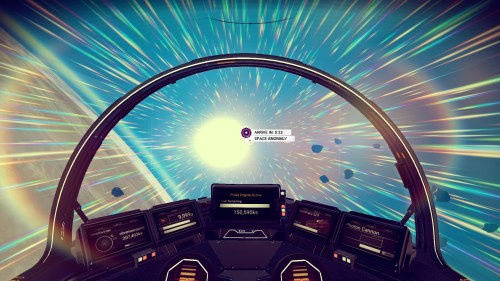
I eased out of hyperdrive with mild pangs of space-sickness. Too many dizzying rides through the waves of stretched starlight; too many juddering descents onto unknown worlds. My eyes, tired from scanning the systems for habitable planets, from gazing at landscapes both fertile and barren, from staring through the atmospheric haze of a hundred disappointments, now longed to rest once more on the soft, green grasses and gentle skies of Leura Falls.

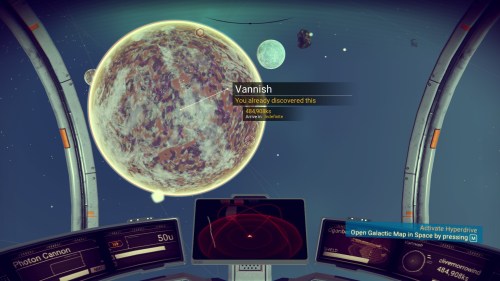
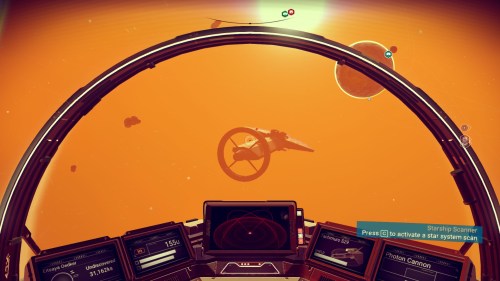
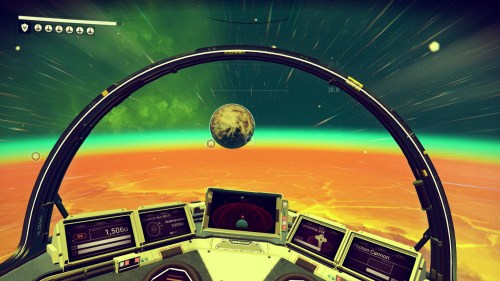
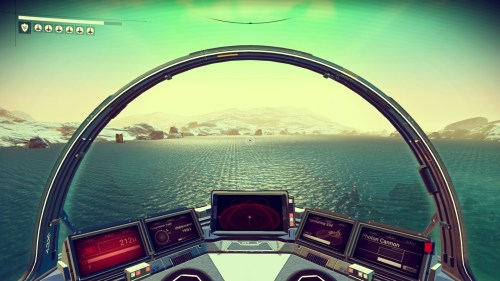
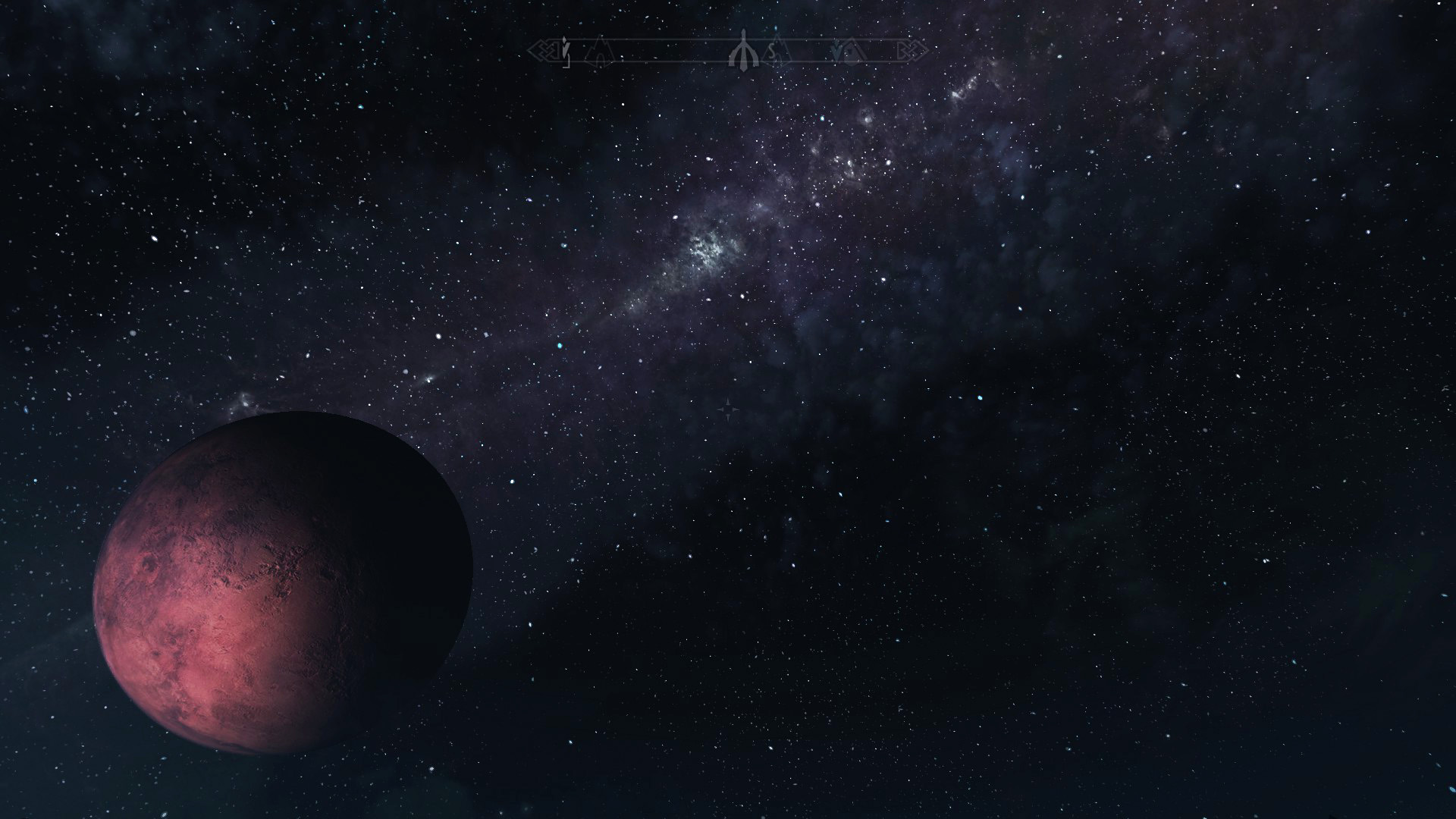
Looming before me was a familiar sight – the unloved furnace of Fustung. Through the gaseous blur of this reddish sphere, I spied my destination – a massive waterworld, a super-Earth with ninety percent of its surface covered in blue ocean. It was here, on one of the many green islands which dotted the briny waters, that I was determined to make my home.

20160821232020_1

Leura Falls – or so I thought

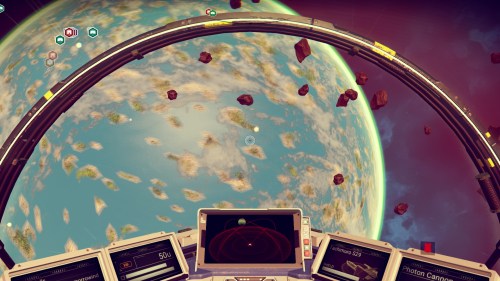
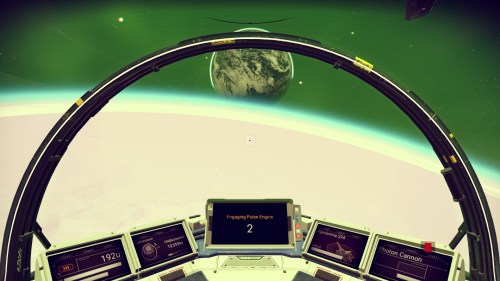
I pointed the nose around the apex of Fustung and punched in the pulse drive. One more bumpy skip through the asteroid belts and I would be home. As the planet lined up in my sights, the targeting computer locked on and planetary data began its read-out on the screen. At first I paid little attention to this, so that I was already familiar with this information. Then, taking another glance, I saw the planet’s name, and blinked: Injamiaogul.

I was shocked. Wasn’t this Leura Falls? Was I not in the right system? I checked the galactic charts to confirm my whereabouts, and there was no mistaking it: I was unquestionably in the Faren Sav system – a system in which I had discovered every planet and landed on their surface. What then was this other planet? There had been another water-world in the system – Three Sisters – was I mistaking the two? If so, why would its name have changed?

I pulled up abruptly, cutting the engine and bringing my ship to a barely perceptible drift. Turning in a circle, I visually scanned the system to see if my would-be home was elsewhere. Perhaps there been another planet here all along, hidden from line of sight by one of the others. I looked closely into the seemingly endless sphere of space that surrounded me, yet there was nothing; indeed, I could not see another water world at all. Leura Falls had somehow changed, yet Three Sisters had been erased from existence altogether.

20160819001905_1

As I hoped to find it…

I turned back to Injamiaogul, taking a closer look. Perhaps merely the name had changed, or the planet had reverted to its pre-discovery place-holder, which I could no longer recall. Perhaps if I flew down to the surface I would find things much as they been before and be free, once again, to name and claim the planet.

I kicked in the engine again and sped towards the surface. Upon closer approach, it was immediately clear that this was a different planet altogether. The colour of the islands had changed as well as that of the oceans, and my worst fears were confirmed when I broke through the upper atmosphere. Gone was the green grass and the swishing trees, gone were the docile grazing beasts I had spent some time studying. In its place was a lurid nightmare; a reddy, yellowy mess that felt wholly uninviting. I was, to say the least, gutted.

Such was my fate when I logged back into No Man’s Sky after its first major update – Foundation. The update has made significant changes to the algorithms that procedurally generate the planets, and, as a consequence, some have been re-generated from scratch altogether. The Foundation update had taken me by surprise – I was totally unaware of its release the day before I published my review of the original game, and was both shocked and excited upon discovering it.

no-mans-sky-foundation1

Reading through the notes, it was clear that much had been altered, making the bulk of what I had written about game strategies worthless. This was, admittedly, a little frustrating, but such was the promise of the swathes of changes to the game, that I was keen to get stuck in. Having just written about the game, and thus being on something of a roll, it made sense to play through the new material and review it as quickly as possible. The update has introduced the ability to claim planets as a home-world and build bases on them, and so it was that, upon logging in, I warped hundreds of light years across space, back to my favourite planet, in order to begin laying the foundations of a galactic empire.

20160822002923_1

I could not find this planet at all, or was it perhaps Leura Falls that had disappeared? Confusing


The loss of Leura Falls seemed a pretty rough fate. It never occurred to me that it might not be there anymore and thought I would always be free to return here. After all, weren’t our discoveries in No Man’s Sky supposed to have the integrity of a real discovery? That what we found would be there as long as the game’s servers continued to run? I felt so deflated that I was ready to give up there and then. How many other planets? Did the same fate await me in all the systems I had explored? It seemed logical to assume that this was the case. Why some and not others? The missing planets were still showing in my records; still listed as part of the Faren Sav system, yet they were no longer in the game world itself, certainly not as they were. It was only later that I noticed that all my discoveries on the surface – flora, fauna and mineral – had been erased from the planetary data.

"What happened to Buzz-Saw ?" "He had to split."

“What happened to Buzz-Saw ?” “He had to split.”

My first thought was that this was only going to piss more people off. No Man’s Sky has, since its release, become a favourite whipping boy of gamers with accusations of fraud, dishonesty and deception circulating alongside a general anger at the lack of communication from the studio. Was this potentially going to cause another public relations nightmare for Sean Murray and Hello Games? As a fan of the game, I certainly hoped it wouldn’t, though I did feel let down on this score. I took a deep breath and put things into perspective. Okay, losing my favourite planet sucks, but if this is the price of having a much better game, I’ll be willing to wear it. There was, after all, a huge amount of new material and changes waiting to be explored. It was time to get stuck in.

20161201222044_1

Time to get started again

Fortunately, the deletion of Leura Falls turned out to be a blessing in disguise. The tragedy of its destruction gave me pause. I didn’t want to found a base just anywhere, so I would need to find a suitable planet and this would take time. And anyway, what was the hurry? What was the rush to found a base? I had already learned to love No Man’s Sky for what it was – a game of exploration and discovery, of the freedom to visit quintillions of worlds, of the chance to sustain a restless, endless wandering. Settling down immediately might put an end to the joy of discovery. Could there possibly be anywhere near as much pleasure in construction and crafting as there was in discovering wholly new planets? Perhaps more importantly, I now at last had a real purpose to my quest; a real reason for this endless journey: to find a planet so utterly beautiful that I would actually want to live on it.

20161130114506_1

20161130105036_1

20161130004321_1

How many worlds would it take to find a new home?

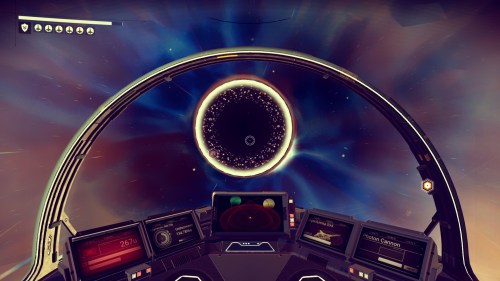
Thus began what can only be described as an epic journey across the cosmos. In three days I warped through more than thirty star-systems, flew through three black holes, caused the birth of a new star, visited more than a hundred planets, took part in numerous local conflicts, mined and traded millions of credits in minerals, and all the while I burned with a restless energy to find the perfect planet.

20161130123156_1

20161130125347_1

20161130172546_1

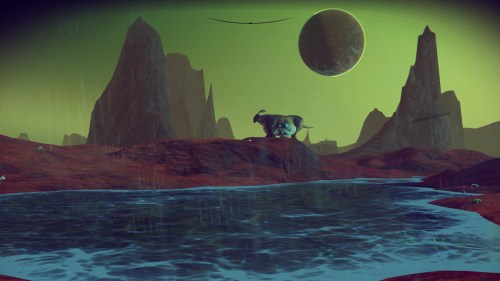
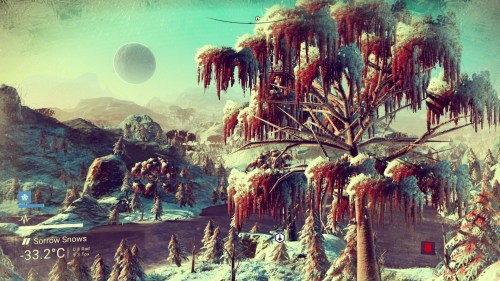
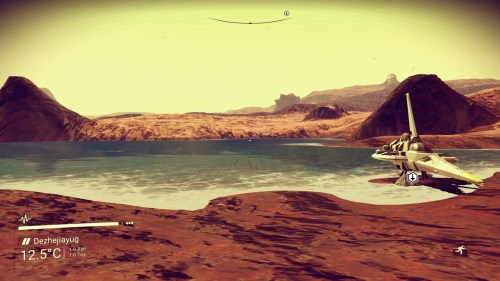
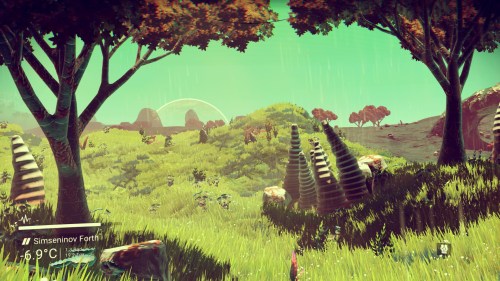
In retrospect, I can say this much; there is no such thing as the perfect planet. Yet there are many planets which are remarkable, indeed, jaw-droppingly beautiful, along with many that are, in their own sweet way, appalling. The new algorithms and the new designs in flora and fauna have expanded the richness and diversity of worlds in a welcome way. Water is more interestingly distributed on surfaces and can even be found in dry places, such as the squelchy floor of a rocky canyon on an otherwise parched planet. It pools in the lowlands in a wider range of depths; some lakes are so shallow they never even bother your knees.

20161130173721_1

20161130200013_1

20161130004902_1

20161130124533_1

20161130201622_1

All told, when it comes to planetary generation, the Foundation update is a huge improvement. In every other regard, it is practically a new game, very different in what it asks strategically and considerably better balanced. Nearly everything said before about mining and resources is now redundant, such is the manner in which they have been reworked: their frequency dramatically nerfed; the ability to mine them now contingent on technology; the range of elements significantly expanded; their distribution and appearance on the surface radically altered. They are also needed in new and more specific ways, along with being less interchangeable, as a source of recharging for example. Thus resources such as Plutonium and Thamium 9 become immensely valuable for survival, if not monetarily.

20161130173012_1

20161130180012_1

20161130174138_1

20161130172809_1

20161130195509_1

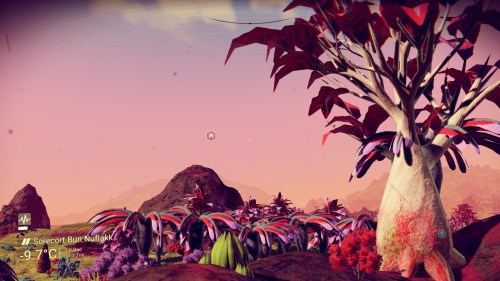
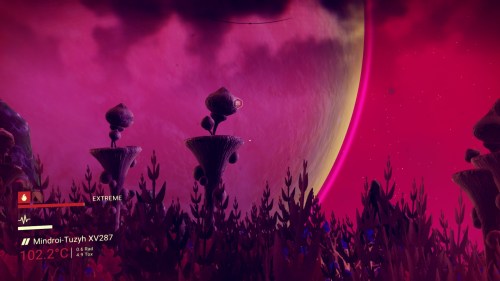
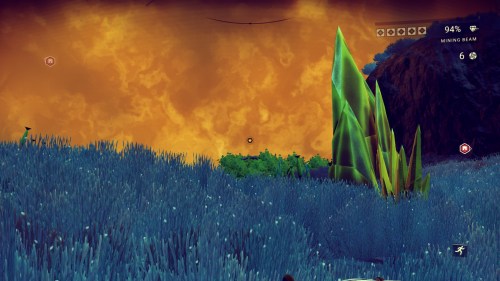
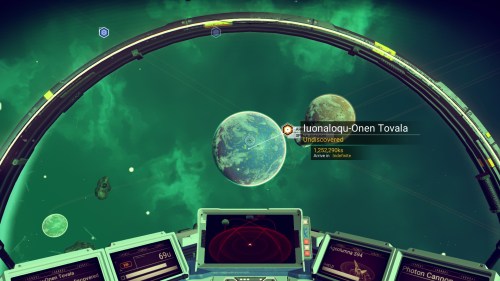
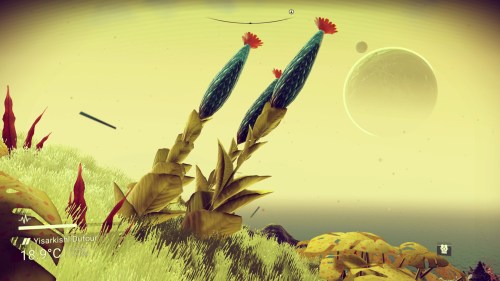
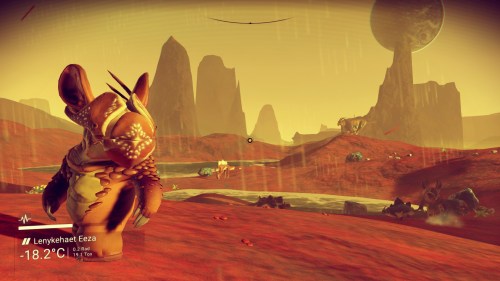
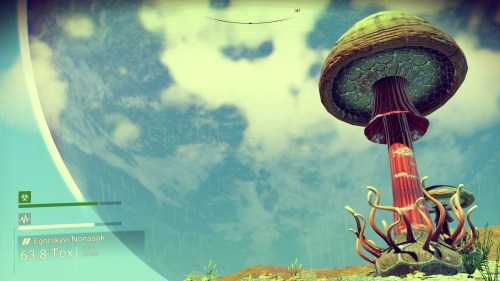
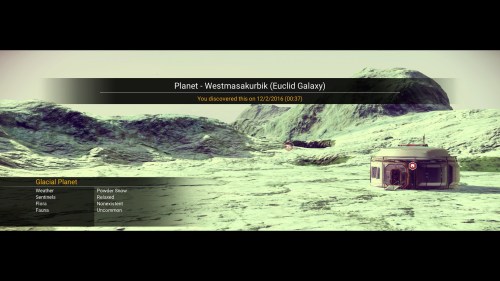
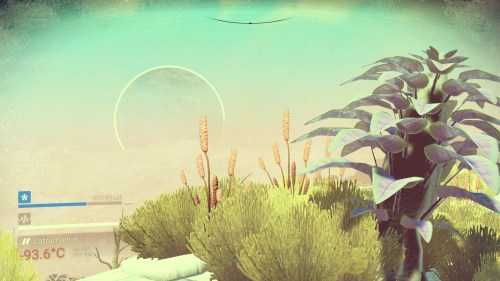
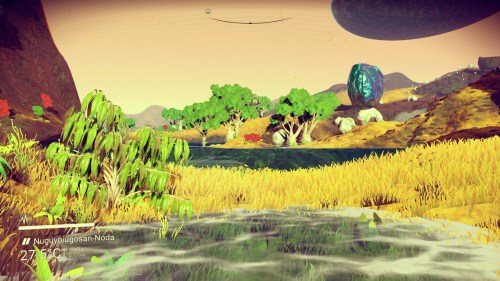
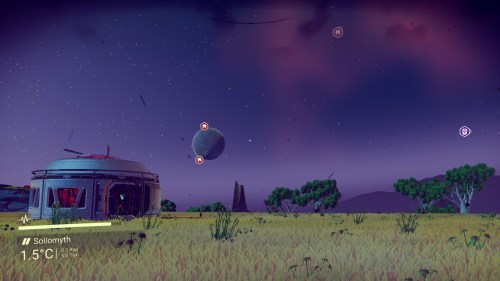
There is much more to be said, but I’ll save that for a review. This post is really a travelogue; a photographic journal of my desperate quest across time and space before settling on the planet Sollomyth. One of the great pleasures of No Man’s Sky is that it offers an immersive experience of travel at a time when, on account of having a two-year old son, I can’t easily go travelling. As a photographer, this game lets me shoot scenes I could never dream of framing, outside of being a citizen of some intergalactic empire. The gorgeous rendering of these incredible places is nostalgic in tone, born of a love of the dreamy visions that adorned the covers of space-race science fiction. Often, everywhere you look is a potential book-cover, a fine example of art by algorithm. And, while it ain’t exactly the real thing, this simulation is almost as good as a holiday, a key sign of which is that the photographs fill me with a similar, if less potent, form of nostalgia.

20161130180215_1

20161130124440_1

20161130200532_1

20161130180616_1

20161130203604_1

20161130195826_1

20161130205444_1

20161130204949_1

20161130213138_1

20161130203625_1

20161130211708_1

20161130195800_1

20161130202603_1

20161130210720_1

20161130211040_1

20161130211046_1

20161130213449_1

20161130212355_1

20161130213638_1

20161201113726_1

20161130211933_1

20161201114457_1

20161201214522_1

20161201115240_1

20161201214628_1

20161201111745_1

20161201212032_1

20161201222945_1

20161201230225_1

20161201225530_1

20161201230753_1

20161202000739_1

20161202111129_1

20161201223346_1

20161201235019_1

20161202005303_1

20161201234030_1

20161202000951_1

20161201225936_1

20161202003739_1

20161202002341_1

20161202005935_1

20161202112939_1

20161202113216_1

20161202113354_1

20161202120435_1

20161202114906_1

20161202124051_1

20161202123412_1

20161202122140_1

20161202130032_1

20161202123940_1

20161202133322_1

20161202005527_1

20161202132143_1

20161202144027_1

20161202132451_1

20161202144158_1

20161202145540_1

20161202145835_1

20161202145844_1

20161202213431_1

20161202220902_1

20161202222520_1

Home at last

Read Full Post »

In Defence of No Man’s Sky

NOTE: Within seconds of publishing this review, I realised that a new and major update had been released the day before, introducing many of the features people had complained were missing from the game and making significant tweaks that will radically affect game-play. No doubt, by the time I get around to reviewing these changes, it’ll change again, but it is certainly pleasing to see that the changes have been made and it vindicates my faith in Hello Games and their continued commitment to making this great game even better. The Foundation Update notes can be found here.
20160820195541_1

No Man’s Sky ended up having a pretty rough landing. Within the space of a week it went from being the most anticipated game in years, to making some of the most successful sales figures on release, to being flamed by users and put in its place by lukewarm reviews. Many players felt greatly disappointed, if not cheated and there has been a flurry of buyers asking for their money back. More recently the developers, Hello Games, were subject to a false advertising probe after claims that the content showcased in the trailer had not materialised in game and that the promotional material was therefore deliberately misleading. Company director and key designer of the game, Sean Murray, has seemingly gone to ground, with some speculating that his lack of communication suggests the independent studio has in fact been abandoned and that there is no intention of fulfilling the promises of further updates and expanded content, though this is unsubstantiated rumour and speculation.

20160822121224_1

What lies ahead for No Man’s Sky?

Much of this criticism feels unfair towards a game that, in spite of what it lacks, still offers a great many magical experiences and is an important milestone in procedurally generated game-worlds. It is also pretty rough on the developers, who are a small, niche company without the massive resources that usually underlie such ambitious game developments. Perhaps Sean Murray needs to learn a thing or two about public relations, but, considering the manner in which haters, trolls and flamers on the net make their feelings known, he can hardly be blamed for stepping back while this shitstorm of nastiness runs its course.
20160822122028_1

Looks like a shitstorm ahead…

Personally, I think Sean Murray and his colleagues at Hello Games should stand up and take a bow, for No Man’s Sky is a magnificent piece of work. For three weeks I wanted to do nothing more than explore this effectively endless galaxy and had no trouble in clocking up almost a hundred hours before running out of steam. Unfortunately, despite this seeming a worthwhile return from any entertainment product for a mere 50 odd dollars, (consider what you pay for a film at the cinema and how long it lasts) many people assume that the game should go on providing hundreds, if not thousands of hours of gameplay. Arguably such expectations are built into the game’s very premise. A galaxy that is, to all intents and purposes, never-ending, certainly suggests limitless play, but then again, arguably, the game delivers precisely that. Despite there being significant limits to what one can do in the game, there is absolutely nothing stopping players from continuing to explore this universe for decades.

So, where do you draw the line? There are many games which cost the same price and which can be completed in under ten hours. Do people ask for their money back with those titles? It all comes down to expectations, many of which were inflated not merely by Hello Games’ promotional material, but by players’ overzealous imaginings of what might indeed be possible.

20160823132934_1

Not good enough?

Having said that, there are many legitimate criticisms of No Man’s Sky’s core promise of seemingly infinite procedurally-generated variety. Reviewers and gamers have complained about the shallow pool of elements which go into generating the planets, their lack of flowing water and the universal climates which prevail, with no distinction between the equatorial zone and the polar regions. Others have complained about the simplicity of space-battles and the absence of the more grandiose encounters hinted at in the promos, along with the general lack of game-play. It is not possible to craft anything beyond upgrades for one’s ship, Exosuit and Multitool, and once these have been taken to a decent enough level, there is little incentive to find resources, except for fuel, survival and trading, which are really just ends in themselves.
20160829003029_1

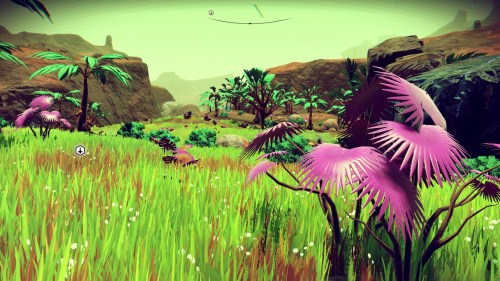
Maxed your equipment? Just relax and enjoy the scenery

No Man’s Sky is, essentially, a survival and trading game, and on both counts, it has its limitations. You will spend much of your time monitoring life-support levels, recharging your shields and equipment and firing your mining laser at crystals, vegetation and ore deposits.

20160829001701_1

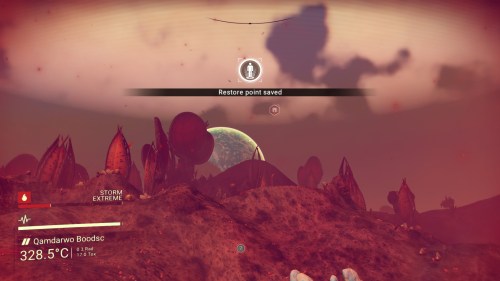
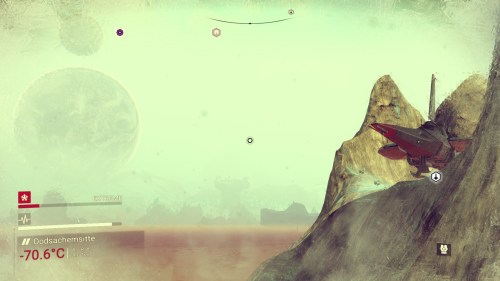
This sets up an at times tedious loop of resource extraction, finding a place to sell the goods, cleaning out your inventory, and then rinsing and repeating the whole thing over again. Survival in No Man’s Sky is also relatively easy, though this depends on the environment and climate. There’s rarely a shortage of elements to mine to recharge one’s suit and the biggest challenges usually come from the climate and weather. The good news is that it’s really up to the player to choose what level of challenge they are willing to accept. No Man’s Sky can be played slowly and safely on a clement world with mild temperatures and a hospitable atmosphere, where you can walk at your leisure and hardly ever have to charge your suit, or it can be played intensely in hostile environments where you are forced to seek shelter continually from radiation storms and icy blasts that send the thermostat below a hundred minus or up to 400 degrees centigrade.
20161126233252_1

Frozen goggles

20161002204058_1

328.5 Celsius – ouch

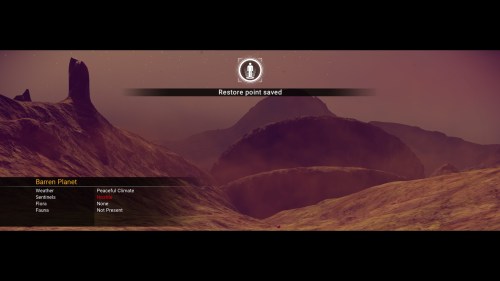
The challenge is also increased depending on the local attitude of the Sentinels. These are basically automated flying cameras with guns, which can be violently hostile on sight, or completely ignore your presence. Upon first landing on a planet, the relative degree of hostility is revealed by a rating, such as “passive”,  “hostile” or “frenzied”.
20160912215449_1

Sometimes even looking seems to set them off…

20161007215452_1

So much for paradise if you get attacked on sight

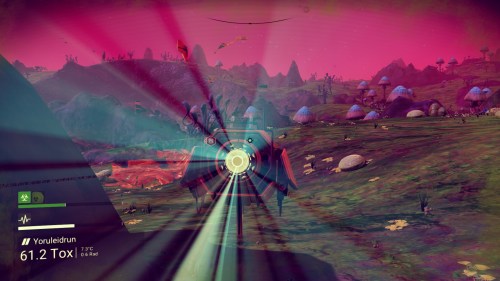
Much of the time they will ignore you, but mining too much of a material or destroying too much plant or animal life can really tick them off. There are also particular rare items that can be looted on planets such as Vortex Cubes or Albumen Pearls, and these will set the sentinels off irrespective of their attitude rating. “Frenzied” sentinels are, as the name suggests, cranky mofos and they will attack within five seconds of sighting the player. Either way, the sentinels are disappointingly easy to deal with and are more of an annoyance than anything else. They can also spoil immersion at times with their whirring gears and pulsing power sources intruding into the beautiful atmospherics.
20160820212311_1

Don’t scan me, bro

20160820202836_1

Careful what you harvest, it may anger the Sentinels

The ease or difficulty of play will inevitably appeal to different temperaments or moods. If you are happy just to wander in a pleasant, immersive environment and enjoy its beauty or bleakness, then the game offers such opportunities in spades. If you long for intensity and danger, it’s pretty easy to find a planet with an extreme environment to up the stakes.

The game begins on a random world, and consequently all players will have a very different starting experience, depending on the climate, environment, etc. The first job is to repair your ship, which offers a brief and not entirely intuitive tutorial-like opening, before moving onto the task of building a hyperdrive to allow you to travel between the stars.
20160814223524_1

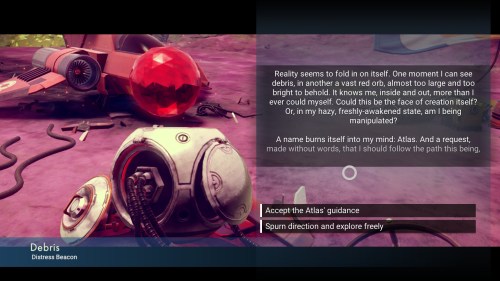
An early choice in the game, though the decision is by no means irrevocable

20160814235647_1

Struggled to find Zinc at first. It’s in the yellow flowers…

Each planet, however, is, well, planet-sized and initially offers a huge range of exploration options. It is entirely possible to remain on the one planet forever and continue exploring, crafting and improving one’s equipment as, it seems, one player famously did in the days immediately after release.

20160824210819_1

These pods can be used to purchase Exosuit inventory space

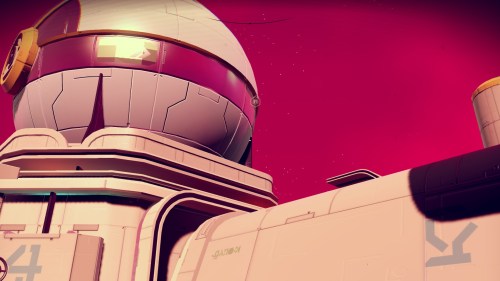
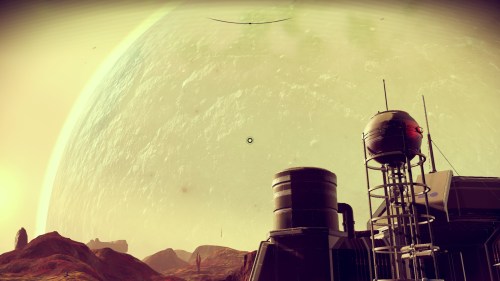
All planets contain a number of alien outposts, scattered about in densities that vary from world to world. These outposts come in a number of different forms; some being small research stations with a couple of shipping-container sized habitations, while others are more complete complexes – observatories, command centres, trading posts and spaceports.

20160822233132_1

Space station stock exchange

20160821220213_1

These trading interfaces can even be found floating at locations on the surface of a planet

These can be found simply by flying over terrain and looking for signs of structures, using the scanner on one’s ship, or, with the help of an easy-to-craft bypass chip, using the Signal Scanners which are often found at these outposts.
20160914211735_1

20160820210023_1

20160820224328_1

20160822021319_1

20160825113231_1

20160907235154_1

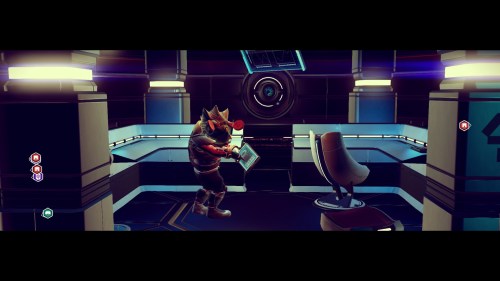
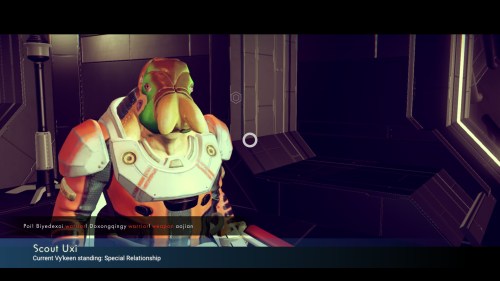
Some of the larger outposts are occupied by one of the three different alien races in the game: the Gek, Korvax and Vy’keen (shown below, respectively) none of whom are hostile, though they can get pissed off at times.
20160822215921_1

20160821235835_1

20160819225949_1

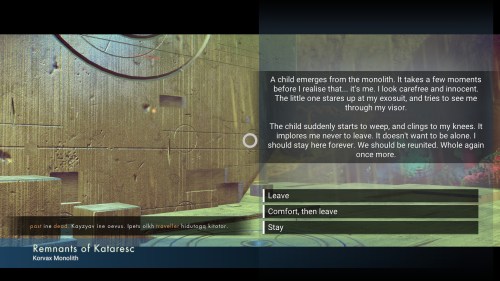
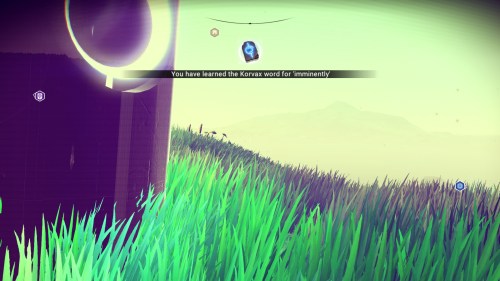
The encounters with the aliens are initially intriguing, if somewhat sparse and minimalist in dialogue, yet, limited though it might be, the dialogue is a puzzle in itself. One of the great innovations of No Man’s Sky is the ability to learn three different languages, which gradually improves your capacity to communicate. To begin with, they speak mere gobbledegook, but as you flesh out your vocabulary with key words, learned from Knowledge Stones, databanks, ancient alien sites, electronic encyclopaedias and encounters with other aliens, it becomes possible to make out enough of what they are saying to choose the appropriate response.
20160820235833_1

20160815010929_1

The learned words, should they be used, will appear in English in the dialogue transcript, giving you the chance to decipher the overall meaning. This process is aided by one’s intuition, for the player is offered text-based insights into the actions and possible desires or intentions of the alien interlocutor based on observation of things such as body language or mood. This can at times make it very easy to choose the right response, but certainly not always.

20160822121741_1

Say what?

The Alien ruins are attractive structures which allow the player to interact with them and usually face a choice with a chance for a reward. These often contain engaging story elements that can be quite emotive, but they also offer a chance for new equipment, upgrades, language learning and the chance to increase one’s standing with the alien races – a sort of diplomacy level that gives you more options in dialogues.

20160822010806_1

20160822012256_1

20160822131929_1

20160829225308_1

20160821214922_1

20160827171009_1

20160831112738_1

20160821222235_1

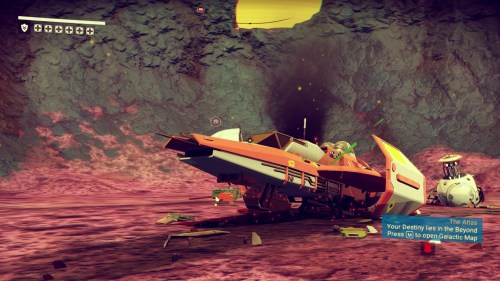
These encounters also allow the player to learn new blueprints for technology which can be crafted. Blueprints can be acquired in a number of ways – through aliens, from wrecked machinery, crashed spaceships and various interactive terminals inside alien buildings. The blueprints are essential for improving the capability of your Exosuit, Multi-tool and spaceship, though the number available is disappointingly limited. After a flurry of discovery, you will find yourself constantly being told that the blueprint you discovered is already known.

20160821223426_1

The only blueprints that seem almost impossible to find are those for the Atlas Pass 1, 2 and 3. Countless locked doors and containers in the game require one of these passes to open, and even after 100 hours of play, I’ve still only found the first pass, which opens practically nothing.

20160820172216_1

By contrast, within only around forty hours of play, I had already maxed out my tech knowledge for the suit, ship and tool, which rather made exploring seem a whole lot less worthwhile. And ultimately, this is the main problem with No Man’s Sky. There is a feeling that sets in rather too early that there is actually almost nothing to do.
20160831212025_1

20160819121419_1

Crashed ships can be claimed and repaired, though they are usually of a lesser quality than your own

There is certainly a lot of repetition in No Man’s Sky and this ultimately occurs in pretty well all aspects of the game. Outside of game-play itself, the terrain certainly has its limitations. The cave interiors on planets are universally built on the same template, with only minor variations in the undergrowth and shape of the mineral outcrops. They might be a great place to find valuable crafting materials, and initially very attractive, but they become all too familiar pretty quickly. Other frequent repetitions are the mushrooms which grow even on planets that are supposed to have no fauna, the large succulents which I call “jazz hands” and the iron ore outcrops, especially the ones that look like big upturned thimbles with shrooms sprouting from them.

20160828112631_1

Jazz Hands aplenty

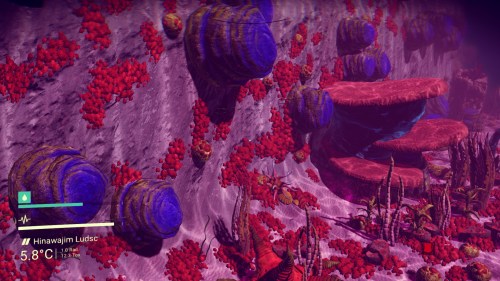
Underwater life is restricted to some very similar designs in flora, fauna and mineral deposits, though this does not in any way detract from the pleasure of swimming through these landscapes.

20160916212931_1

20161127141817_1

20160821233353_1

20160822005124_1

Beautiful and smooth; underwater life in the variously coloured oceans

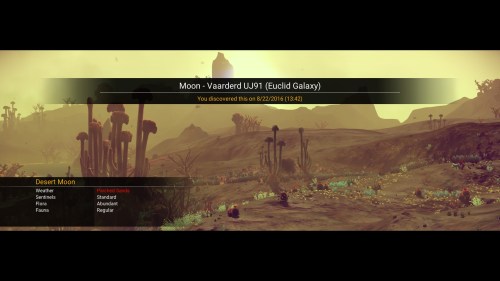
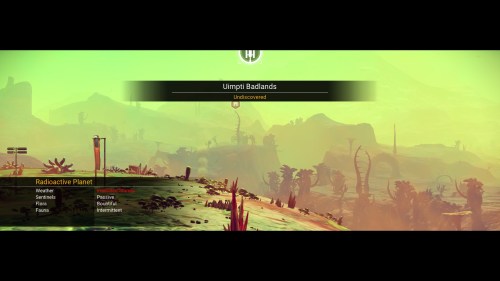
The range of surface temperatures also seems somewhat limited. Nowhere is really ever as cold as Pluto, nor do they get much hotter than a few hundred degrees, and then only during a fire storm.
20160822134235_1

20160822123618_1

20160908224105_1

Extreme Toxic rain and hostile creatures, best to get off this planet quickly

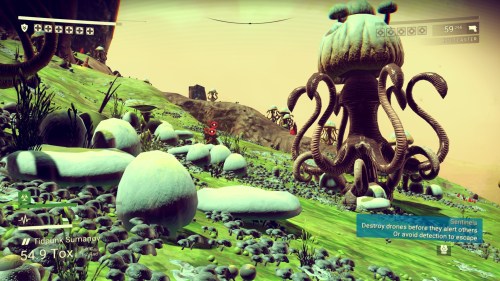
All these elements are thrown together in different ways on every planet, but once you’ve visited around forty or so planets and moons, most of the terrain, rock formations, flora and fauna will all start to look familiar. And yet, there is no denying that plenty of those combinations are breathtakingly beautiful or astonishingly bleak and planets can be a delight either to walk around or fly over.

20160824211304_1

20160823221303_1

20160831214606_1

20160822015130_1

20160824215751_1

20160820211818_1

20160824232925_1

20160824232321_1

20160820214013_1

20160822125458_1

20160821234453_1

20160821224524_1

20160820201007_1

20160822210254_1

20160822005445_1

20160829220220_1

20160822015222_1

20160831214224_1

20160824215112_1

How anyone could not find beauty in this game is beyond me

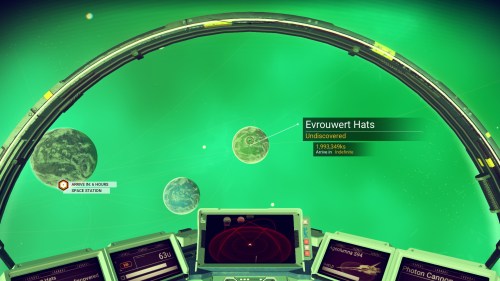
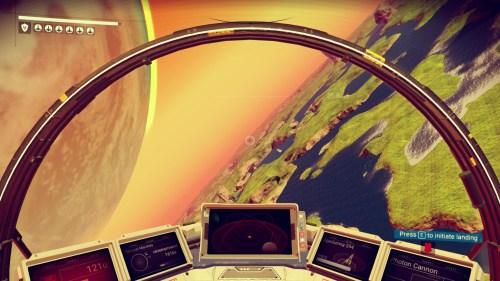
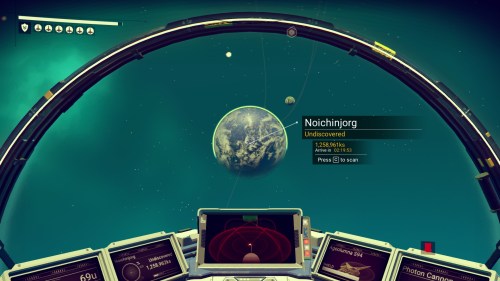
From space the planets seem majestic and inviting, or daunting, forbidding and mysterious. At times the nature of the surface only really becomes visible on close approach, or even during descent as the terrain resolves itself from the fog of the distant LOD. The first sighting of a world covered with oceans is thrilling, as are the green ones offering abundant life; such welcome and familiar sights.

20160822124515_1

Green oceans ahoy!

20160815011431_1

Another barren furnace?

20161007215138_1

20160818221332_1

20161127000251_1

Spoiled for choice

20160829002536_1

20160824221545_1

20160823222954_1

Breathtaking science fiction vistas abound

The star systems in the game come in different colours, Yellow, Red, Blue, Green which require different types of warp drive to access.

20160826125426_1

The more difficult to reach systems offer richer pickings with regard to exotic and rare resources, but might also offer a more hostile welcome. They tend to contain more water worlds, which seem rather prevalent around green Type E stars. I personally had some gripes with the make-up of planetary systems, which are entirely devoid of gas giants.

20160822234018_1

20160822003140_1

20160822010037_1

20160821232147_1

Many planets, but always just the one sun

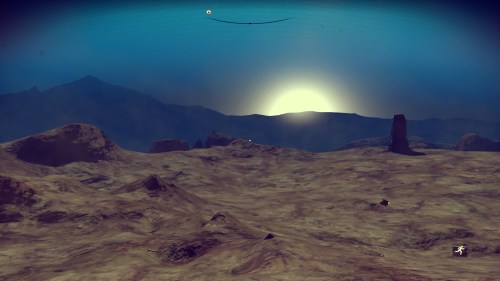
Perhaps it just seemed pointless including planets whose surface could not be visited, though it would have been fun to let us learn the hard way not to fly into the crushing pressure of such beasts. Either way, the game feels less realistic as a consequence. Would it have been that difficult to throw a few into the algorithm, or even allow players to visit asteroids? There are also no binary systems, despite the fact that roughly 85% (yes, that’s correct) of known star systems in the Milky Way are binary or multiple systems. Gravity is also identical on every world and, while I can accept that it might have been no fun at all trying to move around on a planet with gravity ten times that of the Earth, surely this could be rectified with an Exosuit upgrade, and, on the flip side, it would have been a hell of a lot of fun to bounce across the surface of a low-gravity planet. I accept that this is a different galaxy and possibly a different universe, and hence it is up to the designers to choose the physics of this universe, which, are, to say the least, odd, considering the number of floating rocks and minerals to be found on planets. Still, binary worlds would have been a chance for even more beauty in the game, of which there is plenty, and which is never a bad thing.
20160822011520_1

Wonderfully bleak

20160824203556_1

There is also very limited information about the planets and the arrangement of these systems. Could we not know the distance from their star more readily? This is only really shown when heading towards a planet, and then only with regard to the time it takes to arrive there from your present position. That’s great if you want time to smoke a pipe, but not so great if you would like to know which planets are closest to the sun, something that is not always obvious. Could the ship scanner not provide a map showing their orbital paths relative to each other, as in Mass Effect? And with that in mind, what is the mass of these planets? Their diameter? None of this information is available and it’s disappointing for people such as myself who are obsessed with the dimensions of exo-planets and the many new dwarf planets we keep finding in our own system. Sure, we can see that some planets are much larger than others, but I’d like to know whether I’m on a super-Earth or a Ceres.
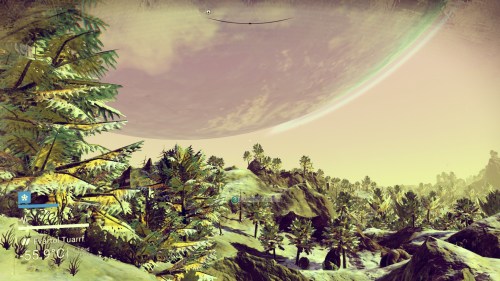
20160822014525_1

20160822210302_1

20160831215430_1

20160822204521_1

20160822133438_1

Some pretty super earth-like worlds

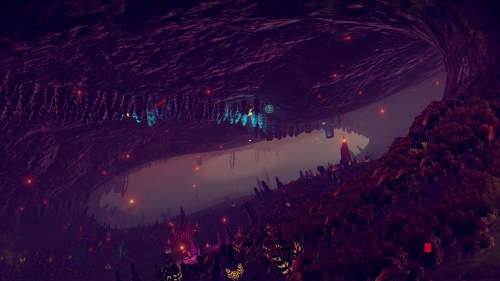
The malleability of the terrain on these worlds is impressive and offers a lot of freedom. I’ve gotten utterly lost in underground caves before, unable to find a way to the surface and ended up blasting my way through the cave roof. Your scanner becomes your best friend in such situations, as it also reveals objects that are above you, allowing you to judge roughly how much rock is over your head. If you pick the right spot, you can blow holes in the rock with plasma grenades and, when the sky becomes visible above, simply jetpack out of there and kiss your claustrophobia goodbye.
20160912213824_1

No way out? Blow a hole in the roof

Even when there is a lot of rock, you can blast a tunnel as high as your jetpack will allow you to fly, punch a ledge into the side of your shaft, and then get back to the job of blasting the rock above your head until the light breaks through. Now that’s cool. And, this strategy works both ways. Standing on top of a huge deposit, but unable to find an entrance to the cave system? Hey presto, just plasma grenade your way through the ground until you drop into the cave, or blast a tunnel as long as you need through the side of a mountain.

20161003210335_1

A tunnel I dug myself, from one cave to the next

Being underground, or even just out of the wind, ensures that any harmful environmental effects are negated and this makes blasting a hole in the rock and hiding in it a great survival strategy in extreme environments.
20160820230948_1

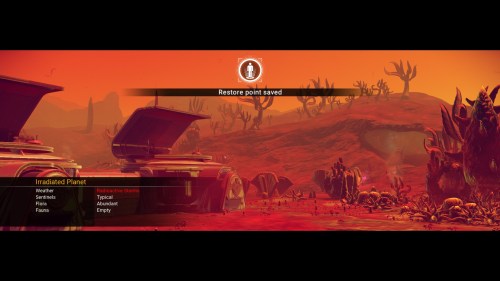
As if it wasn’t hot enough already – Radioactive storms!
20161126234047_1

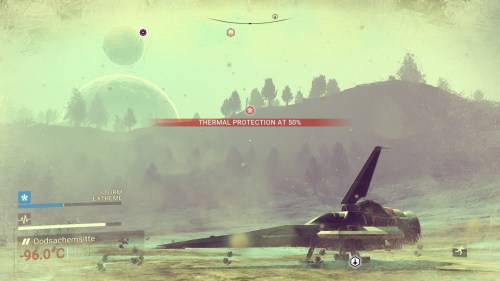
Don’t go too far from your ship or shelter on extreme worlds. Even the best protection won’t last long
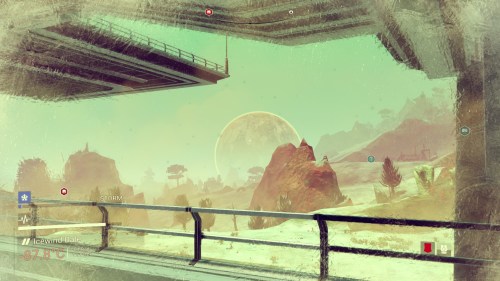
20160829230640_2

Another close call

In such hostile places, particularly when a storm strikes, the thermal protection bar will drop like a stone and you might well be caught in the open, too far from your ship to make it home. Many times I’ve had to run desperately underground, find a shaded windbreak, or blast my way into the rock, or the base of a mineral outcrop to create a sheltered cave. You can also exploit this terrain destructibility to mine safely in extreme environments.

20160820222824_1

This used to be a huge Heridium deposit. Time to put in a swimming pool…

If you begin by blasting away the base of a mineral outcrop, you can climb into the hole, stabilise your thermal protection, and fire your laser upwards to mine the wealth overhead. Fortunately, on account of the strange physics in this game, the material never collapses on your head, even when none of it is left touching the ground. It just hangs in the air, as do huge floating hunks of copper and occasional rock platforms on some worlds, reminiscent of the Hallelujah Mountains in Avatar.

20160928233503_1

20160820224803_1

Floating rocks!

As stated earlier, mining resources can become a little tedious after a while and it’s best to mix this up and not become too obsessive. Though mining is strangely compelling, it does get rather boring standing in the one spot and blasting, or “lazing” away at a gleaming chunk of aluminium, for example.
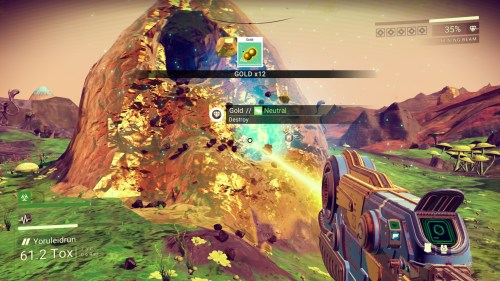
20160820212100_1

20160822114701_1

The Swiss-cheese approach to ore extraction

It is perhaps more exciting to venture into cave systems and head towards the grey treasure chest symbols revealed by the scanner, which indicate the most valuable metals. These cave networks can extend for very long distances and the further one ventures inside, the more one is rewarded with richer deposits, usually found in the green crystalline forms of Gold, Aluminium or Emeril.
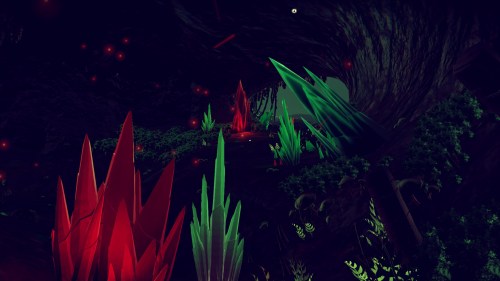
20160829002110_1

This at least makes the process of ore-harvesting more dynamic. It’s just a pity all the caves look pretty much the same, though they are, in their way, attractive spaces and there is something thrilling about watching the scanner burst like a wave through the tunnels.

Predators can also significantly raise the tension, particularly when trapped in a cave with them. Most of the time hostile animals will seem a mere nuisance, doing little harm and being easy to flee from. Yet, on occasion, when they appear in numbers in an extreme environment with other stresses already upon you, they can prove to be very dangerous.

20160823002937_1

This thing was annoyingly bitey

20160906230147_1

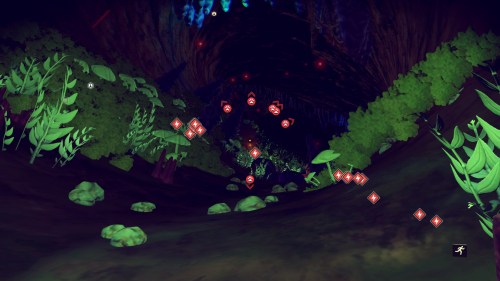
All those red paw symbols are hostile creatures

Such was the case where, trapped in a cave, hiding from a freezing storm, I was cornered by four scorpion-like creatures who bit the hell out of me before I managed to blow a hole in the wall and climb out of their reach. Of course, you can just kill them, but they take a surprising amount of damage at times and the gun can be frustratingly crap at hitting the target at times.
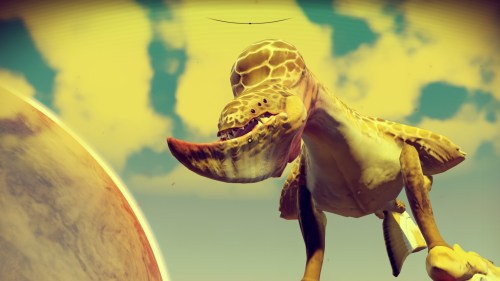
20160823213040_1

Fortunately, he was friendly

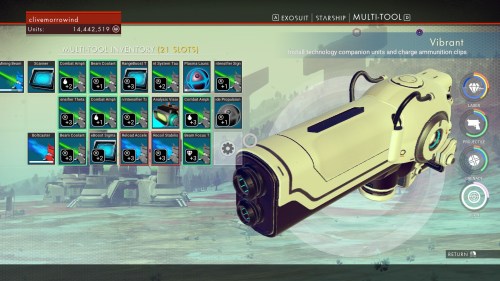
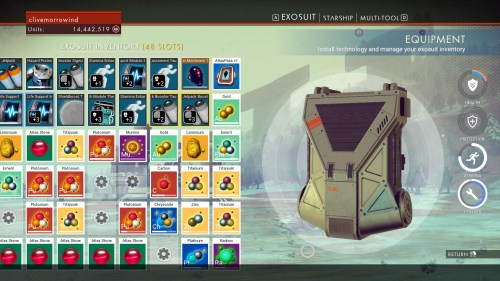
All this variation in the intensity of the game-play means that it can be heart-pumpingly challenging at times, and immersively relaxing at others. Yet, after a while, when one has discovered many worlds, fleshed out all the available techs and upgraded equipment sufficiently to overcome all challenges, it begins to seem rather pointless. At present, after a hundred or so hours of play, my Exosuit and Multitool are sufficiently maxed to overcome any challenges and I struggle to see any reason to upgrade my ship, which already has the best possible warp-drive and seems able to win any encounter with hostile spaceships readily enough.
20161126233516_1

20161126233526_1

Sure, I could improve my cargo capacity, but why? It’s easy enough to haul loot back to a space-station, or find a trader on the surface of a planet, which rather makes it an end in itself. This sense of pointlessness is not aided by the fact that it is not possible simply to start the game again. I thought I must be missing some fundamental option on the menus, but Googling this shows that there is no way to start afresh, without going through a relatively complex process of editing files and directories. You could of course just abandon your ship and start again with regards to your equipment, but you would still retain all your skills. The languages, fortunately, seem far more abundant in the number of words that can be learned. This must be a significant reservoir, because even after having learned hundreds if not thousands of words, the aliens still speak nonsense at me more often than not.
20160818120145_1

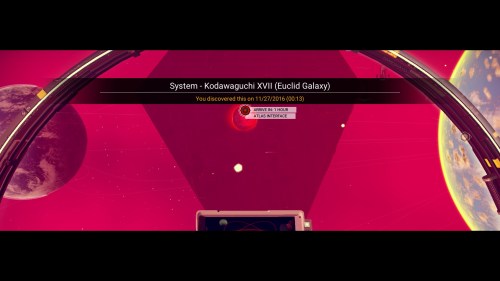
There is certainly a narrative to the game and one is encouraged gradually to find one’s way to the galactic centre, where I imagine some kind of endgame kicks in, but I haven’t made it there yet and refuse to spoil the surprise by reading about it. Your journey there is made possible by visiting the Atlas Interfaces which can be found in some systems. These also offer a chance to learn a large number of words from the glowing balls which occupy the gleaming floor inside the Atlas Interface and to gain Atlas Stones, which are apparently needed when one reaches the galactic centre.
20161127001347_1

20160819151119_1

20161127001706_1

Another magnificent and slickly rendered interior

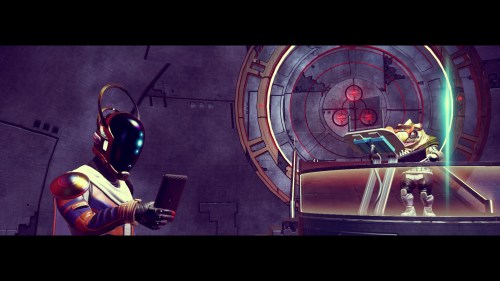
Some systems contain Space Anomalies – a kind of space station – all of which contain the same two entities: Priest Entity Nada and Specialist Polo, a Korvax and Gek respectively. These two cheery fellows can set you back on your path to the galactic centre, give you tech blueprints and other rewards based on your achievements so far. For example, having spent five or more days on extreme worlds will open up a reward for your intrepid exploration. The problem is, as always, that you will probably know the tech blueprint offered already. Polo can, however, on first encounter, give you the Atlas Pass blueprint, which literally opens a lot of doors.

20160908220802_1

20160822122430_1

20160820172052_1

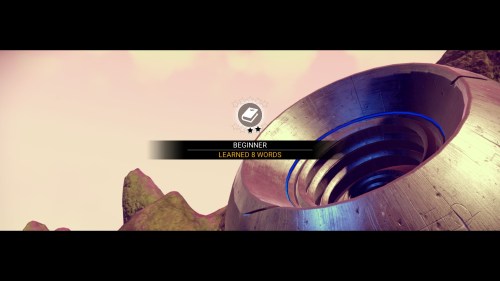
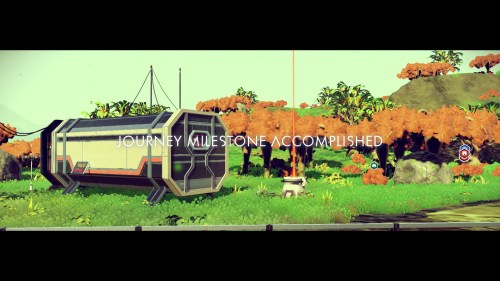
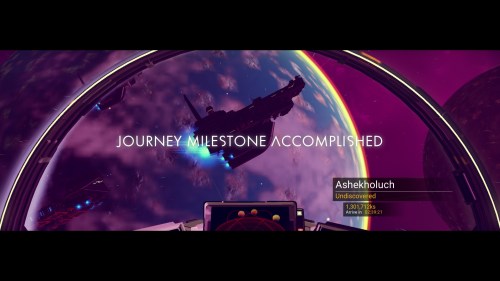
The Milestones and achievements offer some minor incentive to pursue certain targets, yet most of these are merely incidental to what you do and can be racked up easily enough without actively pursuing any of them. Also, as is the case with learning new techs, these Milestones – for things such as distance walked, number of warps between planetary systems, or alien ships destroyed – seem to dry up pretty quickly. There is, all the same, something special about these moments, which are nicely done.
20160822220510_1

20160817214559_1

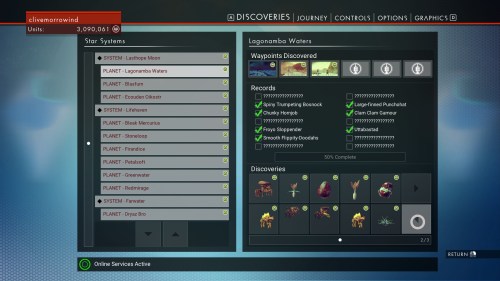
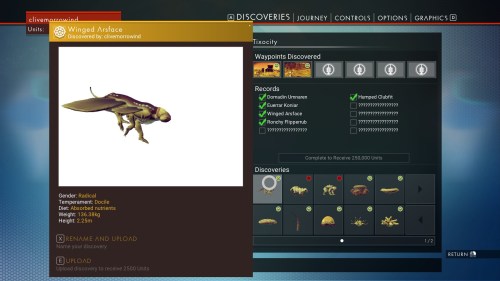
Yet, either way, the main idea of this game was always to explore and map at least some small part of this vast galaxy with its much vaunted 18 quintillion planets. The developers make it very clear in game that the main story is optional, and its intrusions into the game are minimal to say the least. Exploring, in itself, is great fun and there is a real joy to be found in naming planets, star systems, flora and fauna. After a while, however, this too becomes repetitive and feels a bit like a chore, somewhat akin to that old RPG bugbear – inventory management.
20160823003653_1

20160824125546_1

20160912215149_1

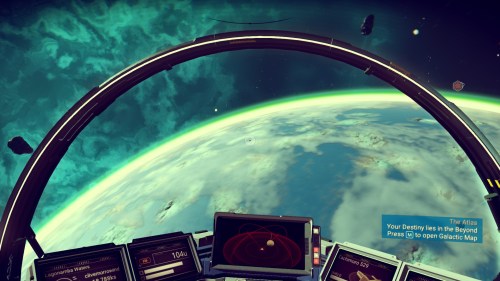
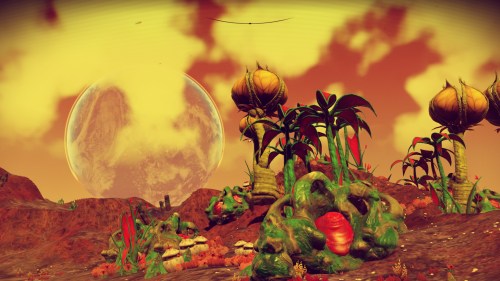
Much of this sounds rather negative and potentially off-putting, but I would still strongly recommend No Man’s Sky. The initial rush of discovery, the freedom and beauty, the ease and smoothness of it all is intoxicating, at least for a while. The game also looks spectacular. Yes, it’s stylised and not hyper-realism, but the colours, clean lines and aesthetic design make a gorgeous whole. It is also accompanied by a fantastic soundtrack by Sheffield band 65daysofstatic. Minimalist and unobtrusive, the music complements the loneliness and emptiness of this vast galaxy, offering eerie moods and subliminal cues that can set the tone of one’s imaginings. This is important because No Man’s Sky requires some imagination to give one’s actions and travels a sense of purpose outside of the very sparse and optional narrative elements of the game. At times you get as much from this game as you bring to it. There are 18,446,744,073,709,551,616 worlds, which, it has been estimated, would take one player 5 billion years to explore, and then only if they visited for one second, not counting travel times in between. That is, to put it bluntly, an effing big sandbox with a heck of a lot of sand. Even after a hundred hours of play, I still find great pleasure in visiting a planet for the first time, seeing its sights and knowing that no one else has ever been there before.
20160823131702_1

20160828111517_1

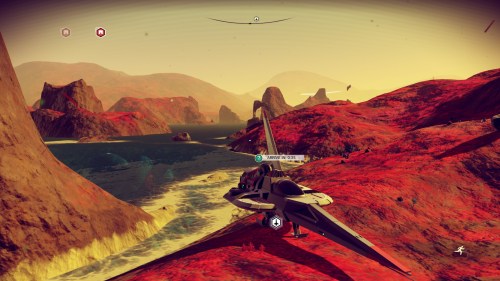
Another great aspect of No Man’s Sky is the smoothness with which one can transition from one environment to the next. With an easy, simple flow, it is possible to descend from space, rumbling through the atmosphere, cruise down and land beside an ocean, jump out and plunge straight into the water. The jetpack allows for easy avoidance of obstacles and dangers. It constantly replenishes itself and doesn’t need fuelling, but even with upgrades, the burst is relatively short-lived; enough to scale a height, get across a narrow canyon or break your fall on a long descent. Swimming underwater is also a pleasure, as much in its beauty as it is in the sense of relief from often harsh environments.
20161116134033_1

Fancy a dip?

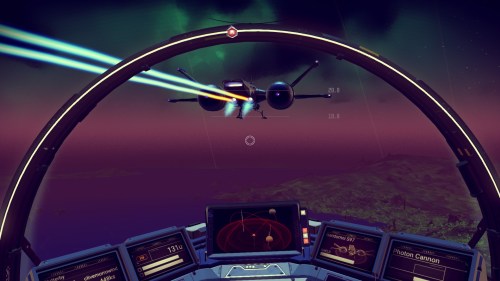
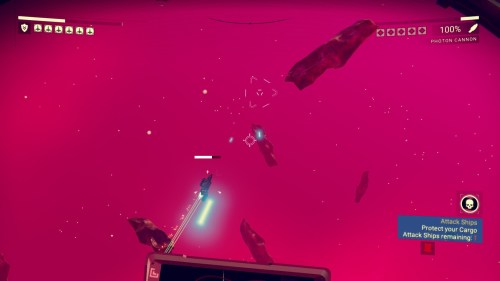
Flying is a breeze; a smooth and elegant ride. You can coast in a sort of crash-proof autopilot, or lean in and speed across the surface. Space has an easy driftiness to it; punch in the engines and zoom towards a planet, float about and pick off asteroids for minerals or even blow a hole in one of the bigger ones and fly straight through it. Space battles are hard at first, but soon become rather routine; yet they remain fun – a bit of sport before you get on with the job of trying to find some meaning in all this.
20161127142126_1

20161127000447_1

20160826130848_1

Eat your heart out, Dennis

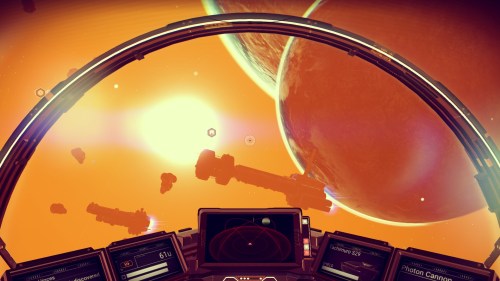
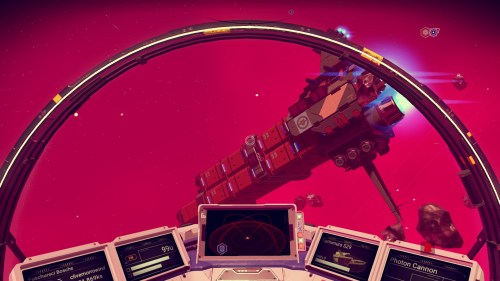
In space you will come across drifting freighters that warp right into one’s locality when you switch off the pulse engine. Occasionally they send distress signals; seeking help in dispensing with pirates. They can even be attacked if you are feeling brave or suicidal enough. Their hulking designs are attractively industrial, like the epic ships pictured in the sci fi books and games I fed on as a child, and it is a pleasure just to fly alongside them for a time.

20161014141815_1

20160928232506_1

20160828013032_1

20160820223102_1

20160824123616_1

20161126235223_1

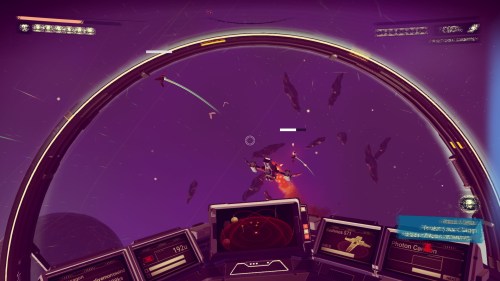
Careful where you shoot in a dogfight, as a few stray shots can bring retaliation

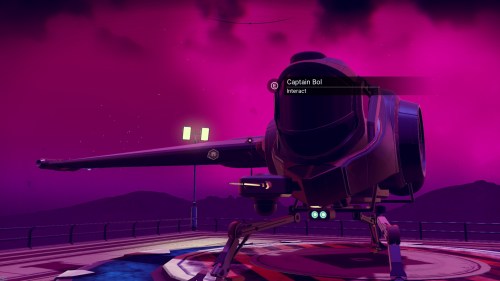
Equally the range of designs of individual ships offers some real curiosities. Many of the ships look awkward, asymmetrical  and un-aerodynamic, while others are sleek and streamlined. If you see one you like, in a space port, trading post or space station, it is possible to speak to the pilot and purchase their ship, if you have the vast sum usually required.
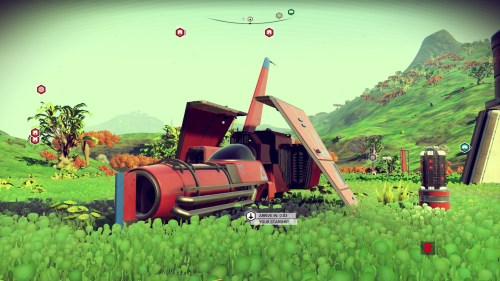
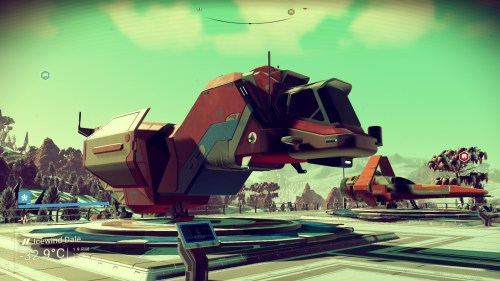
20160822212530_1

20160829231315_1

20160818001409_1

20160820174321_1

20160822214713_1

20161013211720_1

20160819130812_1

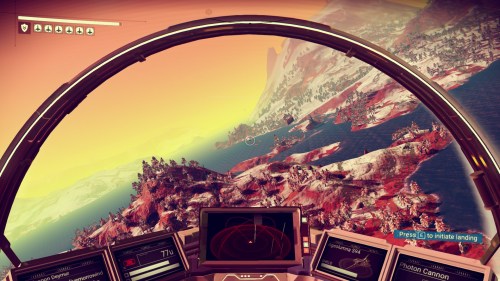
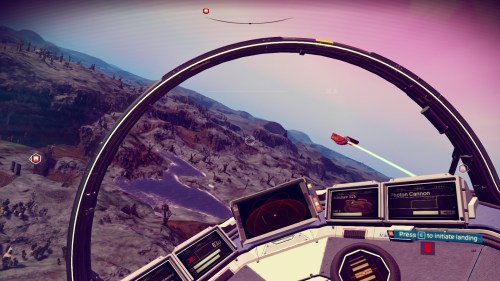
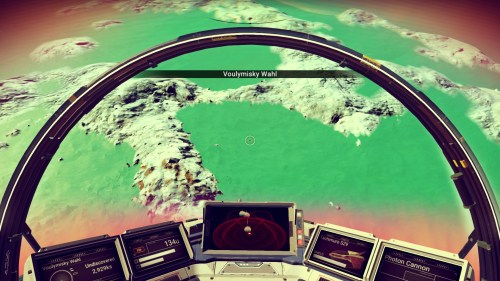
Entering the atmosphere of a planet, one is met with a roaring of wind, a reddening of the screen’s edges and a bumpy ride.
20160822124703_1

Atmospheric entry is very atmospheric

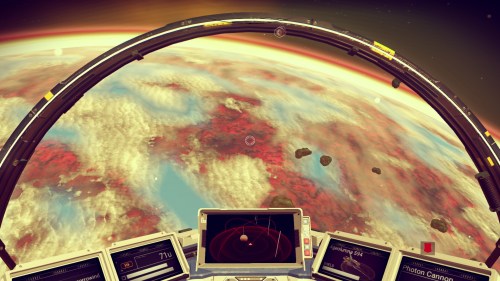
If you don’t get the angle right or slow down, you can bounce right off the atmosphere and veer back up into space, though this is easily corrected and hardly hazardous. As you near the surface, the features slowly resolve themselves into focus, often resulting in the vanishing of apparent features that were a mere mirage from the upper atmosphere.
20160831114210_1

Lovely lakes? Or is it just a mirage?

20160908221655_1

Oceans or clouds?

What one supposed were lakes might dissolve into valleys and canyons as the detail sharpens. This can be an exhilarating ride, swooping over oceans, mountains, forests, grasslands or sandy dunes. Humps of precious metals and geometrical towers of crystal poke from the surface; alien outposts can be spied, and every inch of it is open to visit.

20160829220813_1

20160822225550_1

20160825112729_1

20161002203345_1

20160822235123_1

20160822112818_1

Flying over the surface of a new world is a great pleasure

Such is the immersion offered by this game that one’s emotions are often affected by the nature of the environments. Hot and dusty places make me anxious and thirsty, the cold and windswept have me longing to turn on the heater, while in lush environments I feel relaxed and happy. The excellent environmental sounds in No Man’s Sky enhance the game’s immersiveness. Rushing winds, pouring rain, haunting echoes and the eerie cries of strange beasts lend the stylised visuals an authenticity that reminded me of The Long Dark. The calls of the wild are even more remarkable for the fact that they are modified according to the randomised throat structure of the procedurally generated creatures.

20160823131030_1

Hear the haunting bellows of the Long-finned Punchohat echo across this frozen world

An animal with a long, thin neck, will make a sound akin to such a creature on Earth, making the implausible seem, well, plausible. This is just another fine example of the many things that No Man’s Sky gets right. It really is a clever and beautiful game, slick, smooth, graceful, even sexy in its bold, futuristic colourings. It is one of the most immersive games I’ve ever played – high praise from a hardcore immersionista.

20160824111738_1

20160820210541_1

20161013215249_1

20160823222701_1

20160820221152_1

20160830122325_1

20160822010139_1

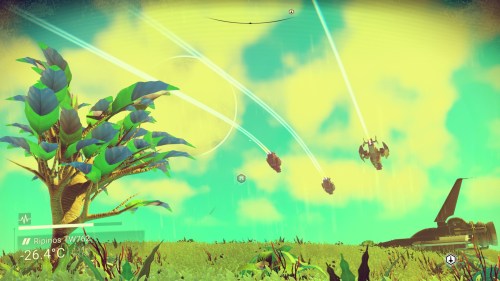
Already this game has provided me with some of my very favourite science fiction moments. On a world of blue oceans, iron-red rock and dunes, I chased three ships halfway across the surface, hoping they might lead me to a trading post. In that friendly chase we dipped and climbed over land and sea, cruising across mountains, skimming across the surface of the waters; colourful contrails streaking from the jets of this trio of attractive ships. I soon forgot about my overfull inventory and flew half-way around the planet in their wake.

20160821234126_1

20160821234728_1

20160824220231_1

20160824215118_1

Had I wanted to, I could have shot them down, but in such a lonely universe, without other players or anyone else who speaks my language, this random moment of bonding, entirely of my own generation, felt palliative.

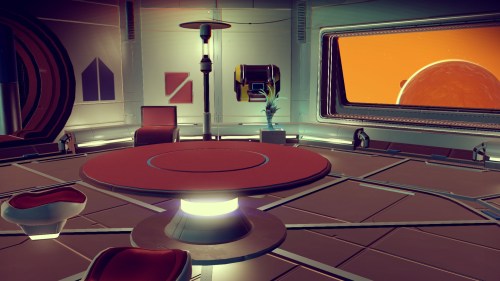
The sense of loneliness in No Man’s Sky is one of its strengths. Never encountering another of your own kind and spending much of the game in vast, open spaces, venturing into mostly empty buildings, leaves the player with a sense of loss as well as a sense of being lost. In the small, rectangular habitats which are always unoccupied, one can switch the light on and off or swivel the chair and watch as it spins slowly to a halt; actions which become symbolic of a yearning for familiarity, for comfort and company in all the emptiness. The aliens, despite their occasional warmth, merely add to the loneliness with their preoccupied distance.

20160819001942_1

20160821110803_1

20160819010404_1

20160827163609_1

Empty chairs and a light for no one. Evidence of habitation abounds, but not a soul to be found

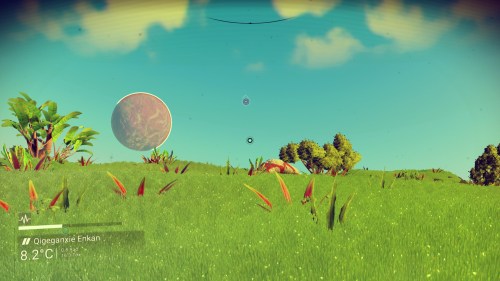
Yet there is much relief to be found in sheer beauty, though this too is tinged with the sadness of experiencing it all alone. On my favourite planet of all, Leura Falls, the most Earth-like yet discovered, I strolled through swathes of shifting green grass, admiring the pink trees and bright blue skies and the vast blue oceans with their sandy shores. With a comfortable temperature of around 8.2 degrees and a benign atmosphere, I could explore for very long periods of time without ever having to charge my life support. Even the frequent freezing storms, which sent the thermometer plummeting to -23, hardly bothered my thermal protection. The shifting colours from dawn to sunset were mesmerising, soothing, awe-inspiring. It was very difficult to leave, and, indeed, I went back there for a while, missing its easy-going mildness and abundant, attractive life. I would love for others to visit this place, yet what are the chances of this happening in such a vast galaxy?

20160819120238_1

20160820233750_1

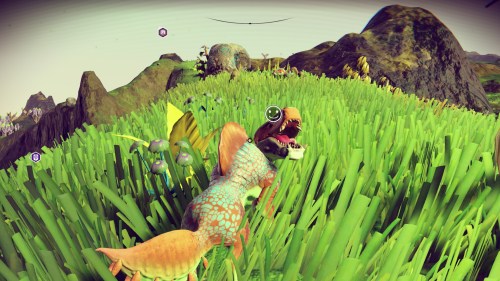
The strange beasts that inhabit the worlds can also be a delight and a source of comfort. When the creatures are not hostile, it is possible to interact with them and feed them. This makes them happy, as indicated by a floating happy face above them, and they will then lead the player to a reward of some kind – usually a rare isotope or somesuch, but of pretty meagre value.
20160829234052_1

The way to his heart is through his stomach

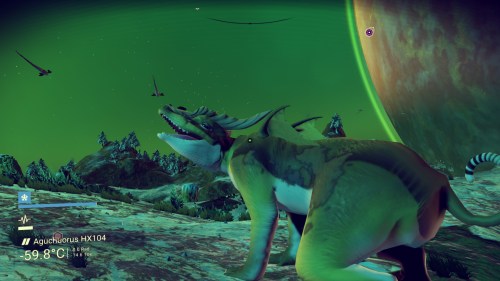
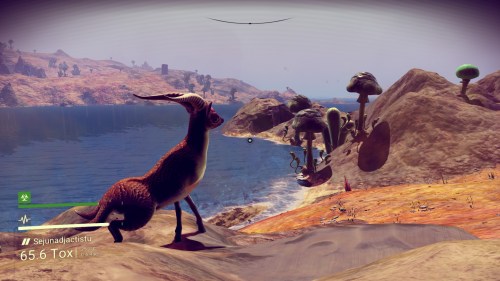
The fauna comes in different densities and some planets can be teeming with abundant life, while others contain a few scattered creatures. The variety of the animals is inevitably limited by the range of options available to the algorithms, but while many similar creatures have appeared, some of them have been wonderfully varied, amusing, and, at times, utterly ridiculous. The numerous species of “Sloppenders” (my name) had me laughing myself silly on first contact.
20160916212057_1

20160824232208_1

20160823000314_1

20161030143350_1

20160822115059_1

20160831212527_1

20160821214225_1

20160826211821_1

20160906222435_1

20160817022547_1

Strawberry Sloppender – named after the heavy pillow that was banned from childhood pillow fights

Some players have complained of glitches, crashes, issues with frame-rates locking up and the like, but from the day of release, I’ve had no such issues at all. Indeed, I was greatly impressed on first firing the game up at how seamless it all was. I saved the game frequently to avoid any catastrophes, but soon found this to be unnecessary as the game has never crashed. NOT ONCE. As with any game, there is a learning curve, particularly with regard to crafting and understanding what is worth keeping extracting or looting. You will also likely come out of your first space battle the worse for wear, if you don’t simply get blasted out of the sky, but this is ultimately an extremely smooth game with an elegant flow and ease of movement and play.

20160824124522_1

No Man’s Sky is a Milestone in itself

No other game has yet come close to No Man’s Sky in attempting to realise the incomprehensible scale of the galaxy, let alone the universe. No other game allows the exploration of so many fully-rendered environments. Our galaxy alone contains more than two hundred billion stars and an even greater number of planets yet to be discovered. It is unlikely that we will ever be able to explore it so freely as we can in a game, but by simulating such a vast and unexplored space and the wonders it must contain, certainly in geography, almost certainly in other forms of life, it might encourage us to try. Getting through the next hundred years is challenge enough, but if we are still stuck here in that unimaginably distant future when the Earth can no longer support life, then we’ll really be in trouble.

20160820204746_1

Future Earth?

If you are content with an open world (galaxy) that allows you to explore extensively, to construct your own narratives, pursue your own goals and to revel in the moments that come at random, rather than necessarily as another complication or climax of the narrative, then you will find a lot of possibility in this game. That one cannot construct a base or space-station or anything else beyond a ship does place some limits on realising your imaginings, though I suspect this is designed to encourage players to continue exploring and not merely bunker down on a single world. Such options, however, have been promised for future updates and the game’s critics may yet be answered with new and significant content. Yet, even without any further updates, the game is still worth playing in its present form. The joy I received across tens of hours was worth every penny and I continue to get pleasure from No Man’s Sky. It might be a flawed masterpiece, but it is, in fact, a masterpiece.

20160822005458_1

Read Full Post »

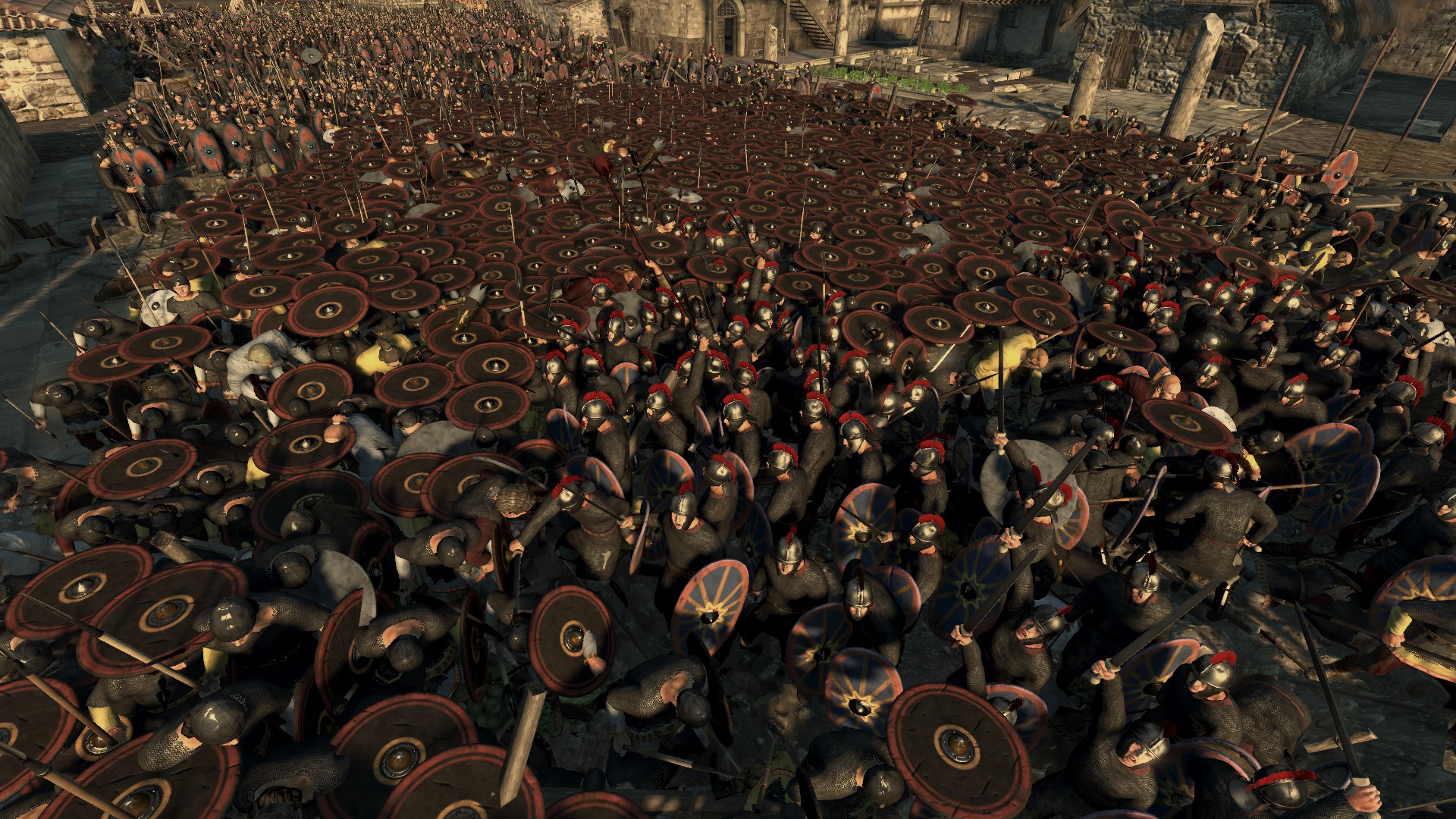
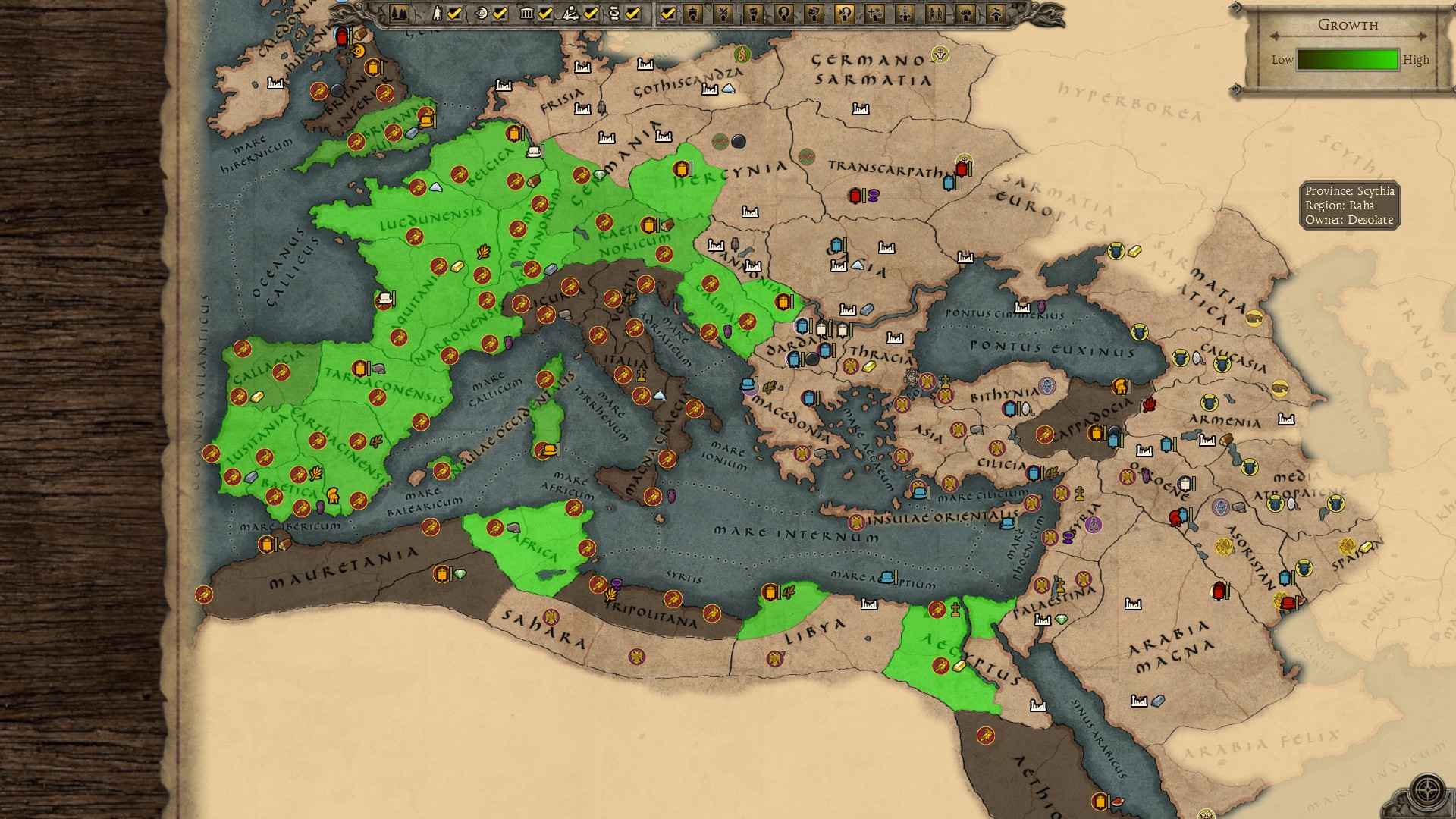
Playing the Western Roman Empire (hereafter WRE) in Total War: Attila can be a pretty tough assignment, and, some would say, nigh impossible. For the most part, everyone is out to get you and they will combine forces to take you down on many fronts. The opponents you will face initially, however, are as nothing compared to what the Huns bring later in the game. So, the one thing you need to bear in mind is that you have until around AD 420 to get your house in order before Attila descends on Europe. This is, in fact, plenty of time. The following strategy guide offers some important tips on how to survive and, indeed, prosper as the Western Empire. For fuller, general coverage, including a greater number of screenshots, see my review of the game.

2015-07-22_00090

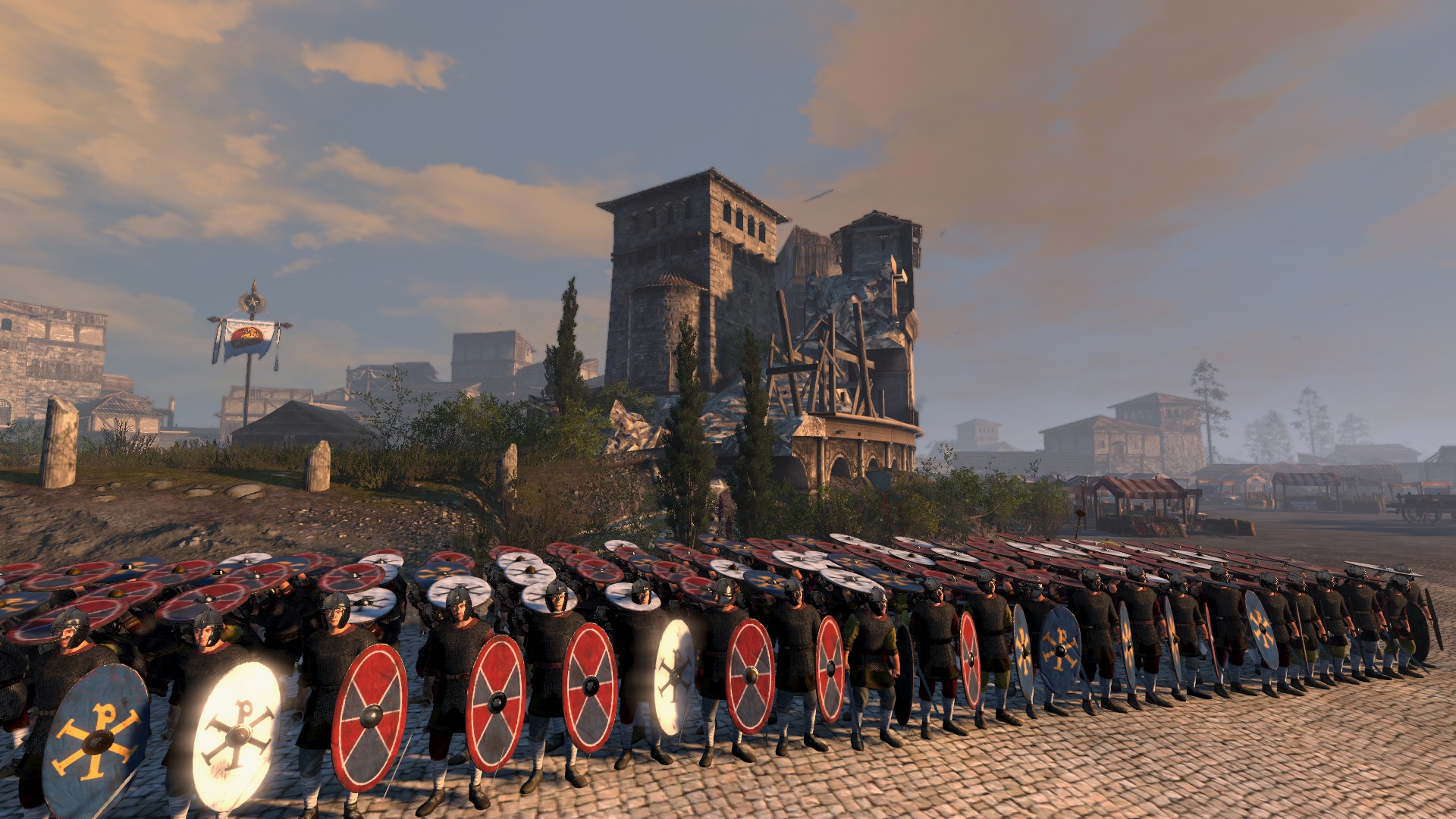
Keep the flag flying

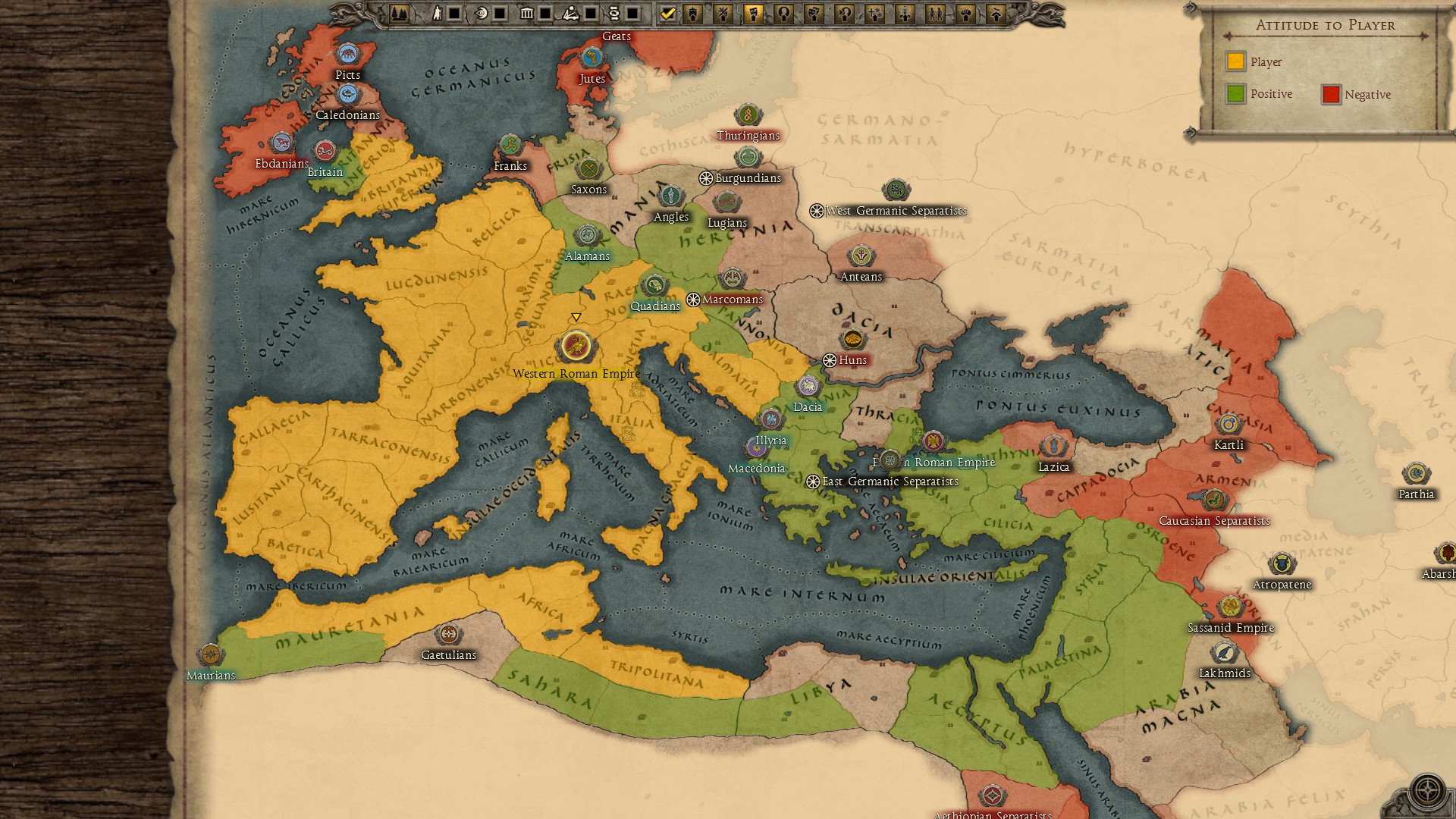
The first thing to do is study your empire in some detail. Take a good half hour to go through all your cities and regions and check out the position of your armies and the state of your economy. The WRE begins with 68 regions, many of which are already in a state of rapidly declining order and on the brink of disease, but they also present huge possibilities with regard to economic development.

Initially you need to focus on improving the amount of gold you earn per turn, otherwise, it will soon become impossible to fund armies and pay for vital city improvements. One slightly radical way to do this is to destroy every single religious building in your empire in your first turn, except for the one in Rome itself which is already capable of building priests. This may sound counter-intuitive, but religious buildings cost money to maintain and are not really worth the investment – certainly not in the early stages of the game. The maximum religious penalty in regions in which the dominant religion is not strong – in this case, Latin Christianity – was recently increased to -6 per province, which is wearable, especially as it will take some time for Latin Christianity to decline significantly enough in those regions to give you a real headache. You can far more easily suppress disorder through classical architecture – amphitheatres, theatres etc, which cost food to maintain, not money, and provide far larger bonuses to civil order than religious buildings. In the early game, food is much easier to come by while fertility is high and is the better option as a currency through which to maintain order.

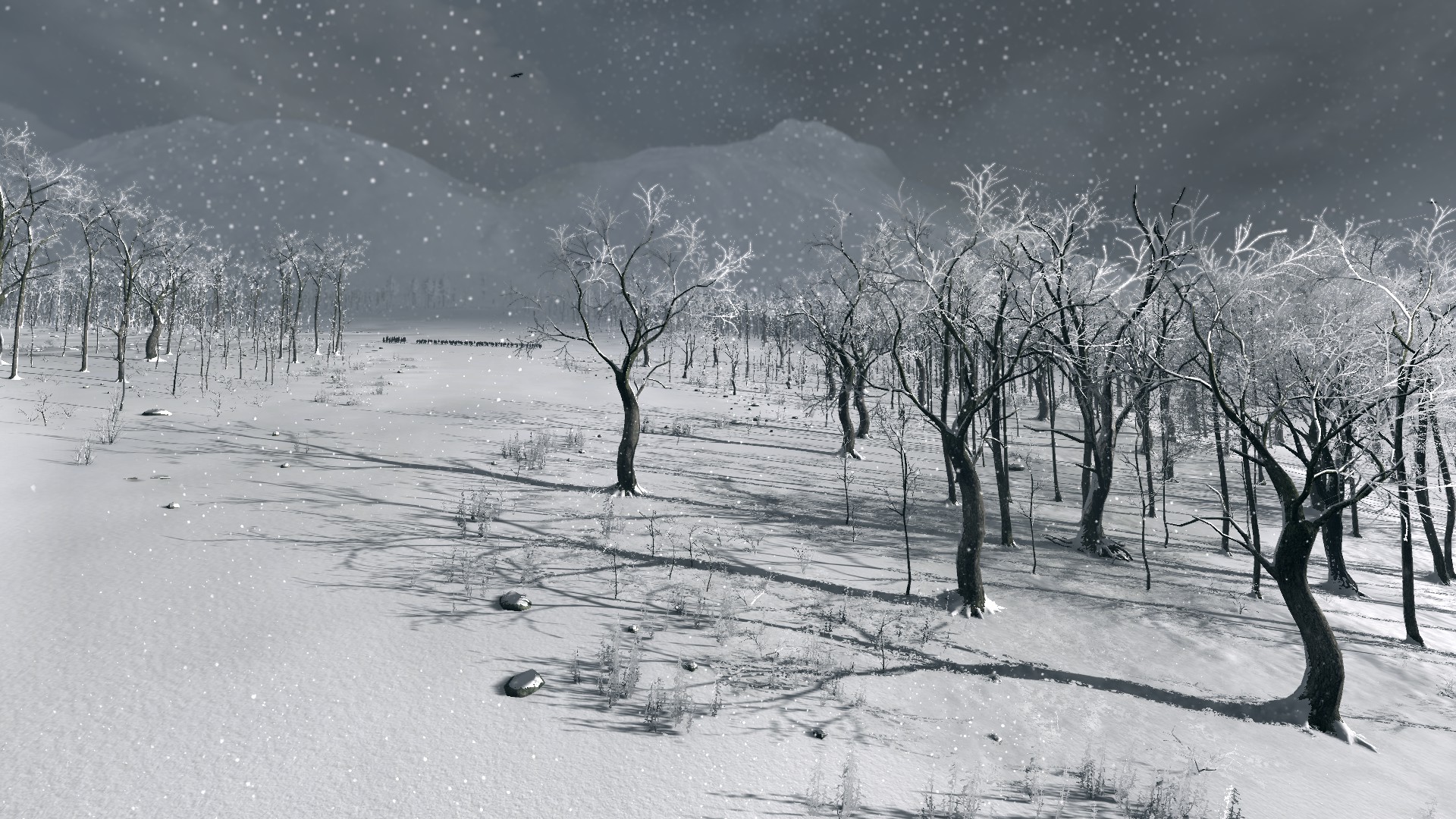
2015-09-05_00007

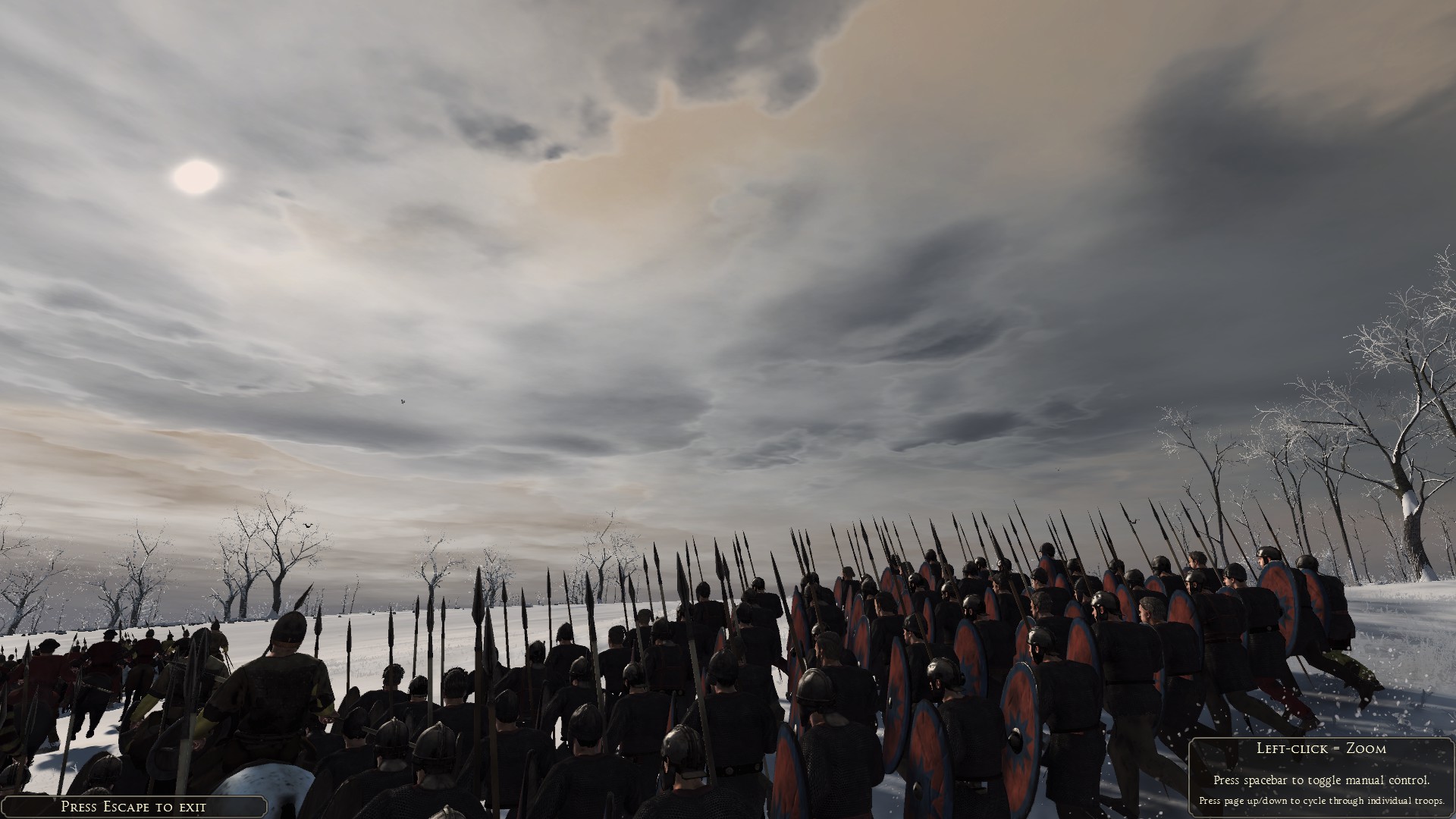
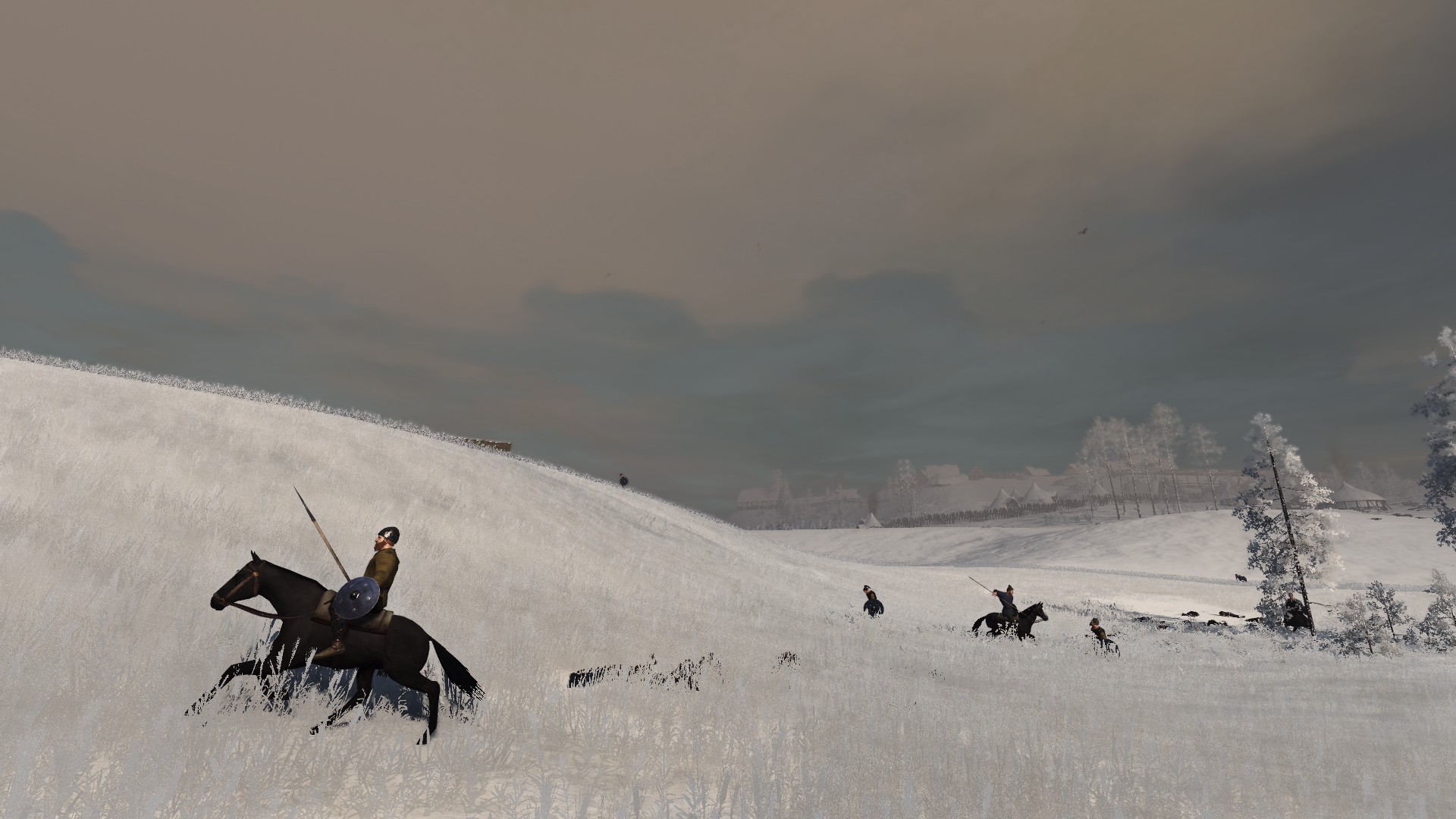
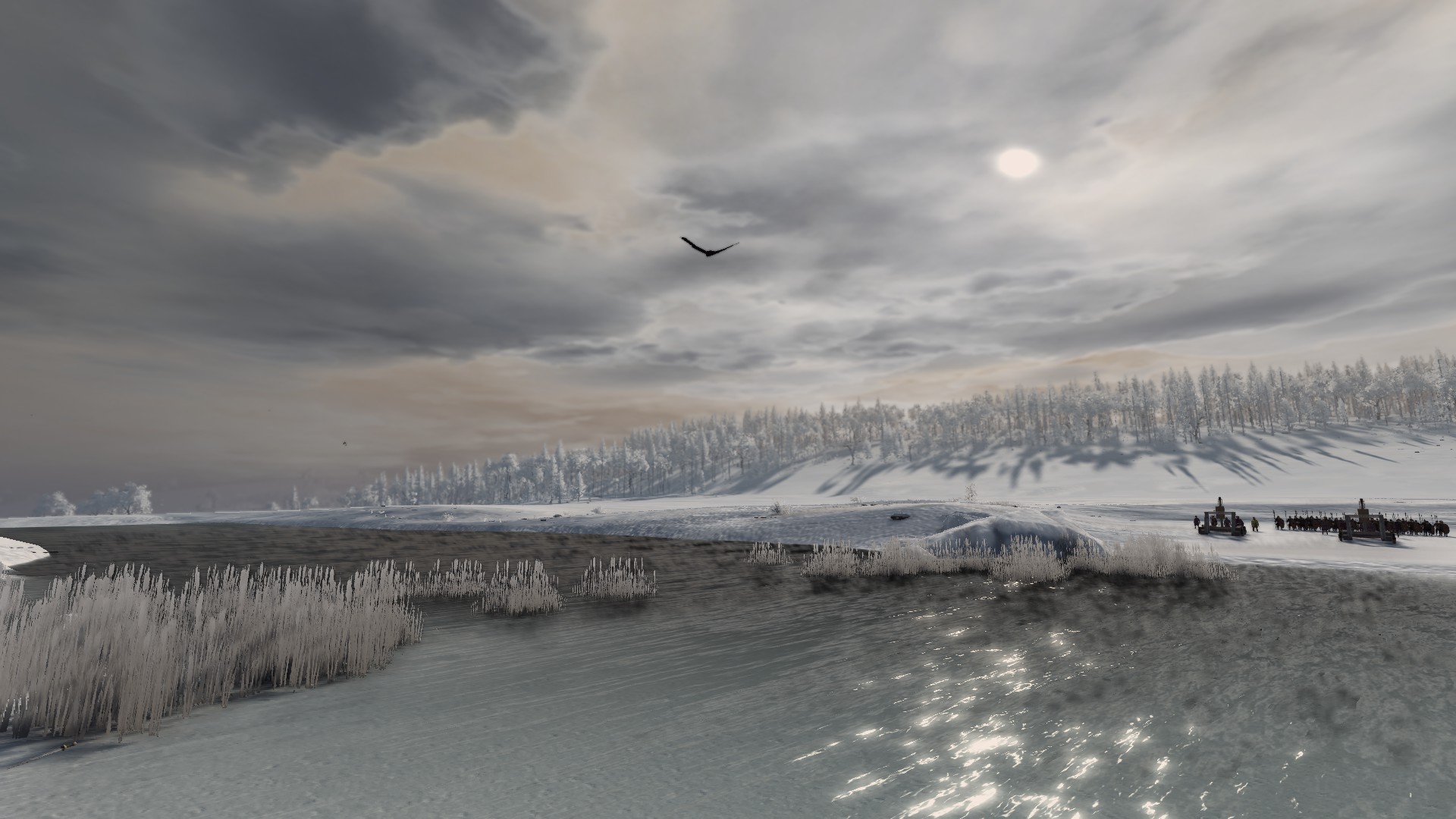
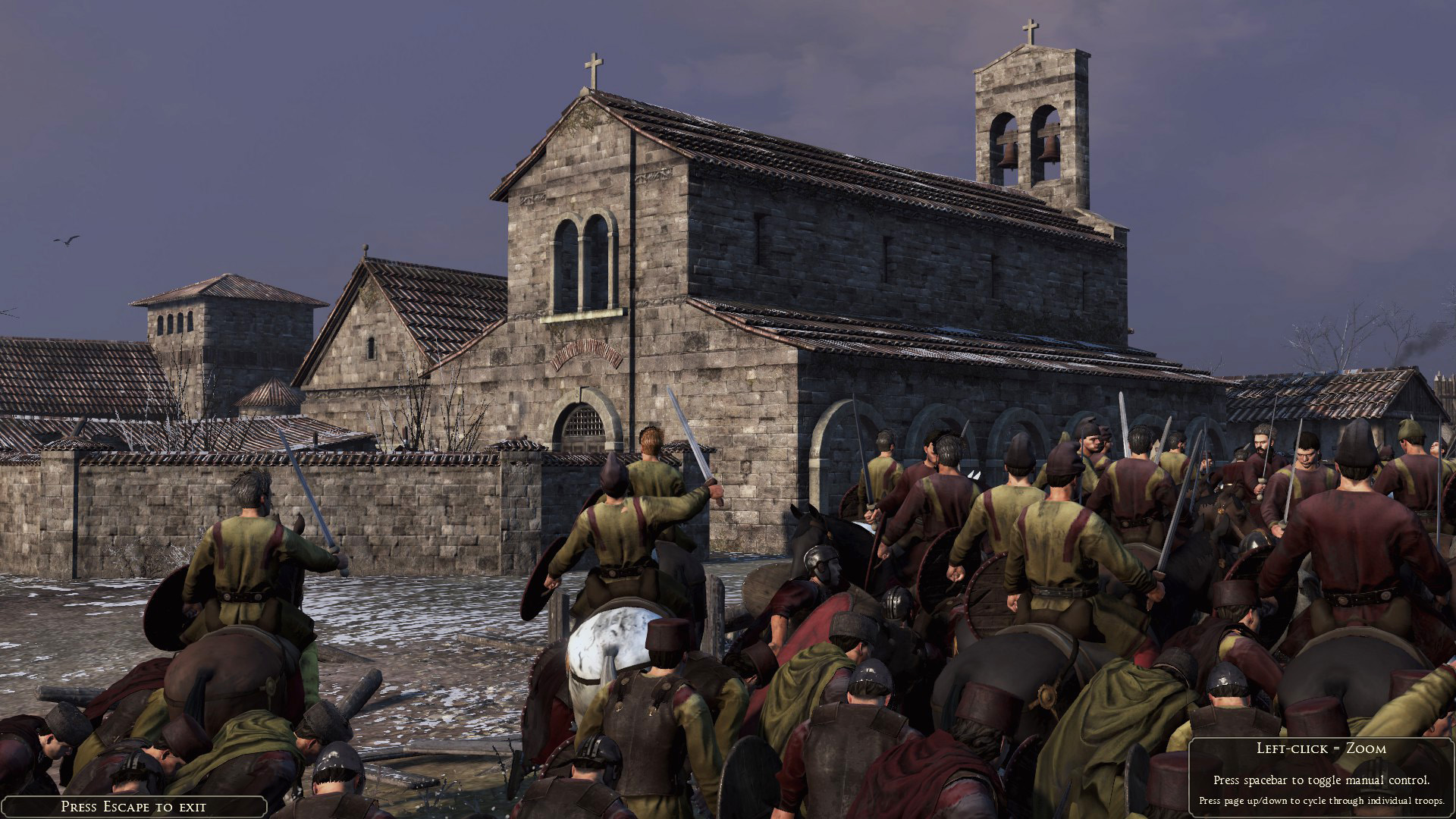
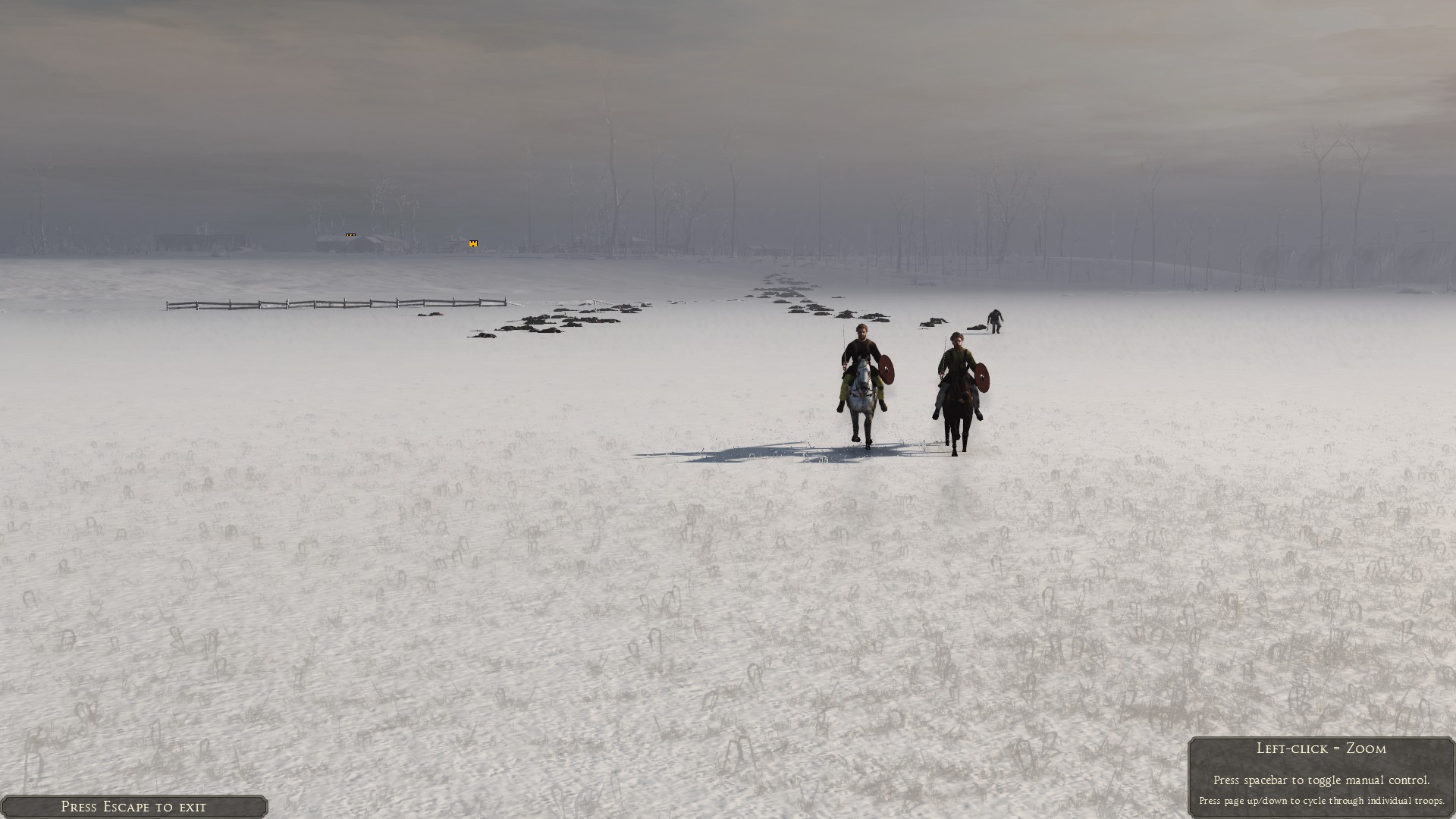
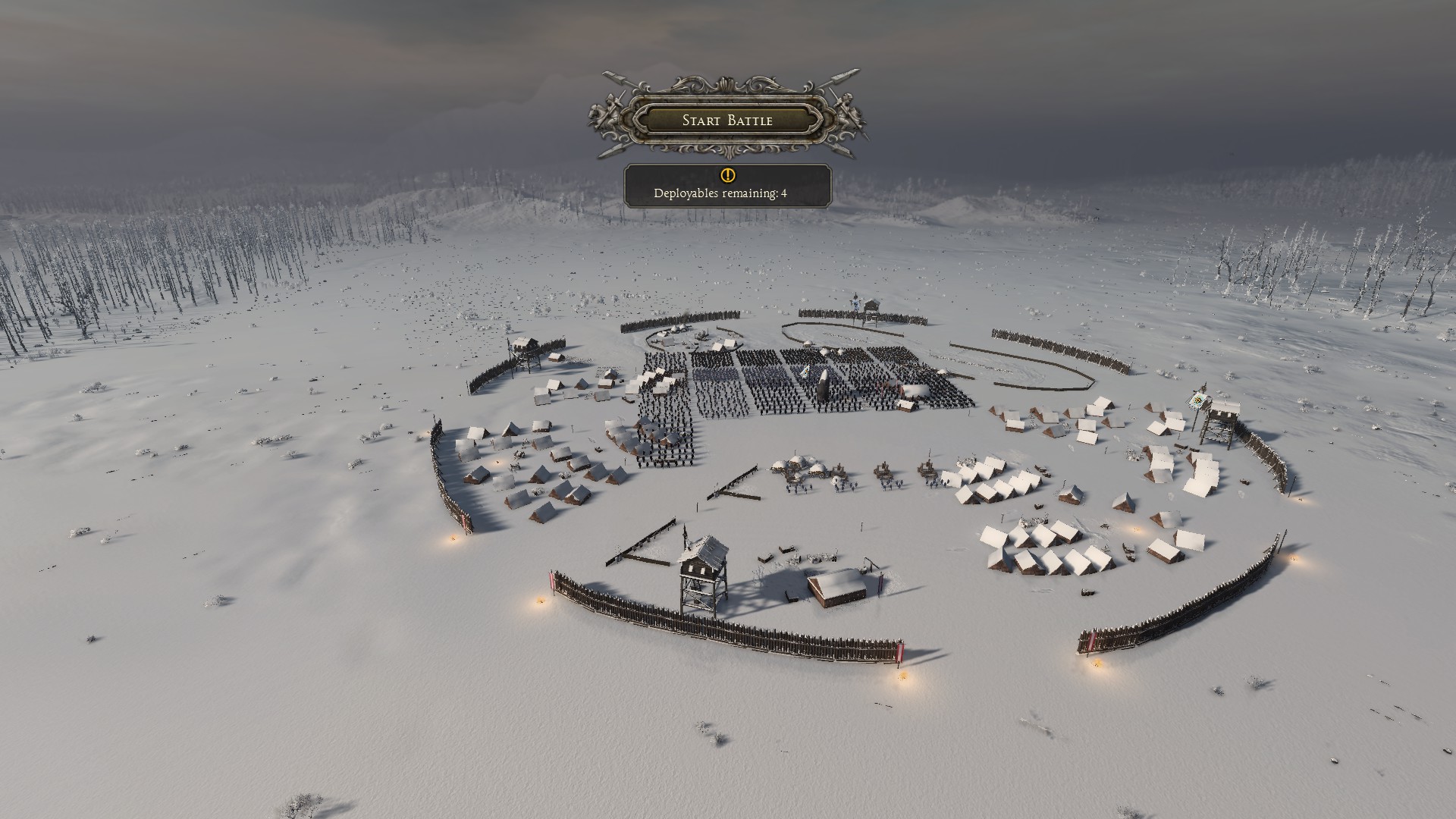
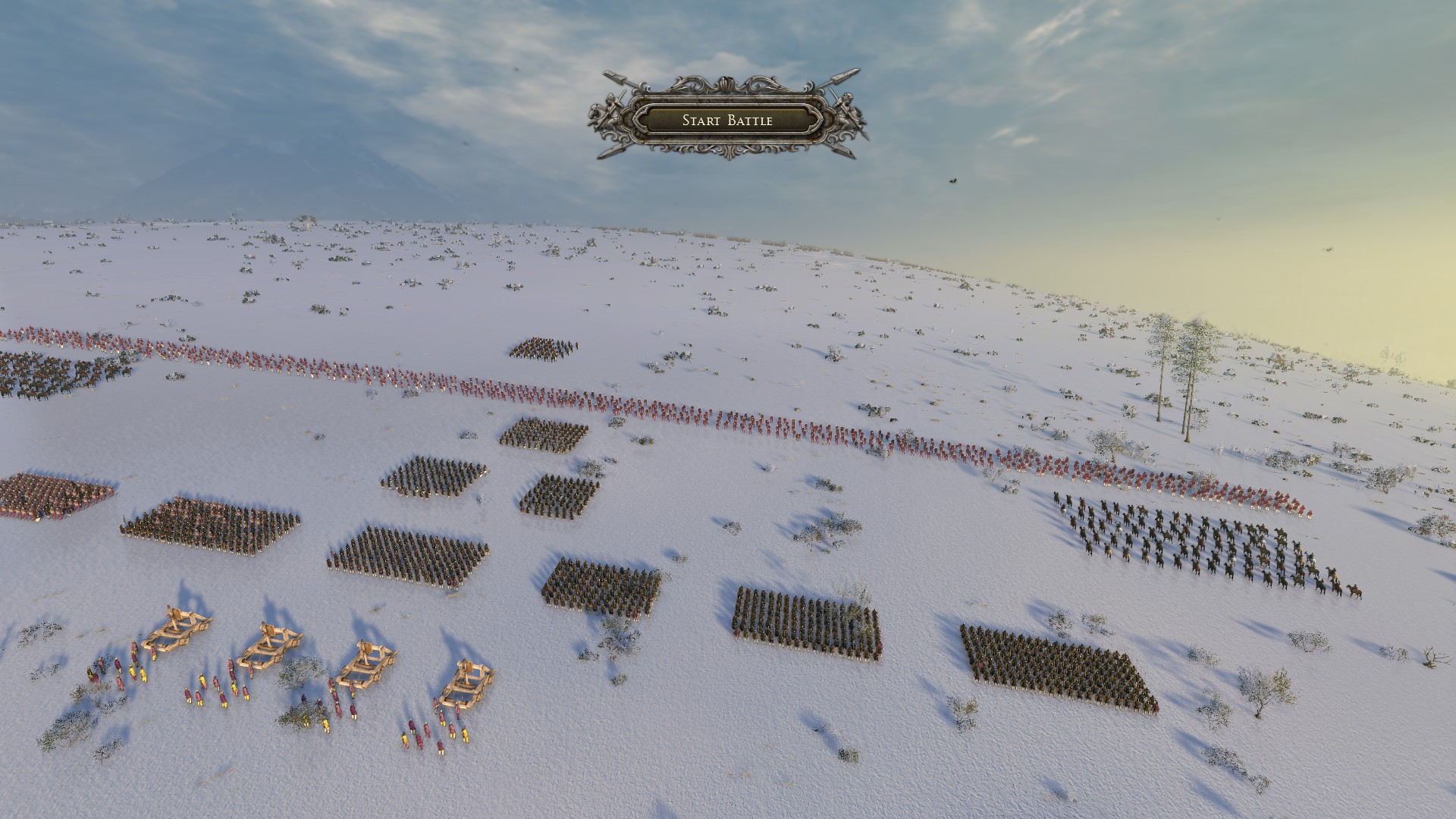
Roman army in the snow

Demolishing the churches will not only hugely increase money immediately – as demolition puts the value of the buildings in money into your  coffers, but it also removes significant maintenance costs for the buildings. This money could be far better spent maintaining aqueducts and paying for other vital improvements. If you don’t like the idea of demolishing churches, bear in mind that you can always increase your religious output and shift your city-development focus later in the game, but initially it is not a good investment and will hinder more than help.

While on the subject of religion, my very strongest piece of advice when playing the WRE is DO NOT, repeat, DO NOT research ANY of the religious techs. These cause you to forget earlier techs and thus lock out the construction of key infrastructure which is far more valuable, especially where sanitation is concerned. Instead of being able to build amphitheatres and aqueducts, you will have to rely on expensive-to-maintain churches, which provide less happiness and nowhere near enough sanitation. Another problem with the religious sanitation buildings that can be constructed in the capital cities is that their effects are local only, and not shared with the other regions of the province, unlike the aqueducts. Again, this might sound like a radical suggestion, but you can skip these techs altogether and it will not hamper your game, indeed, quite the opposite.

2015-07-25_00007

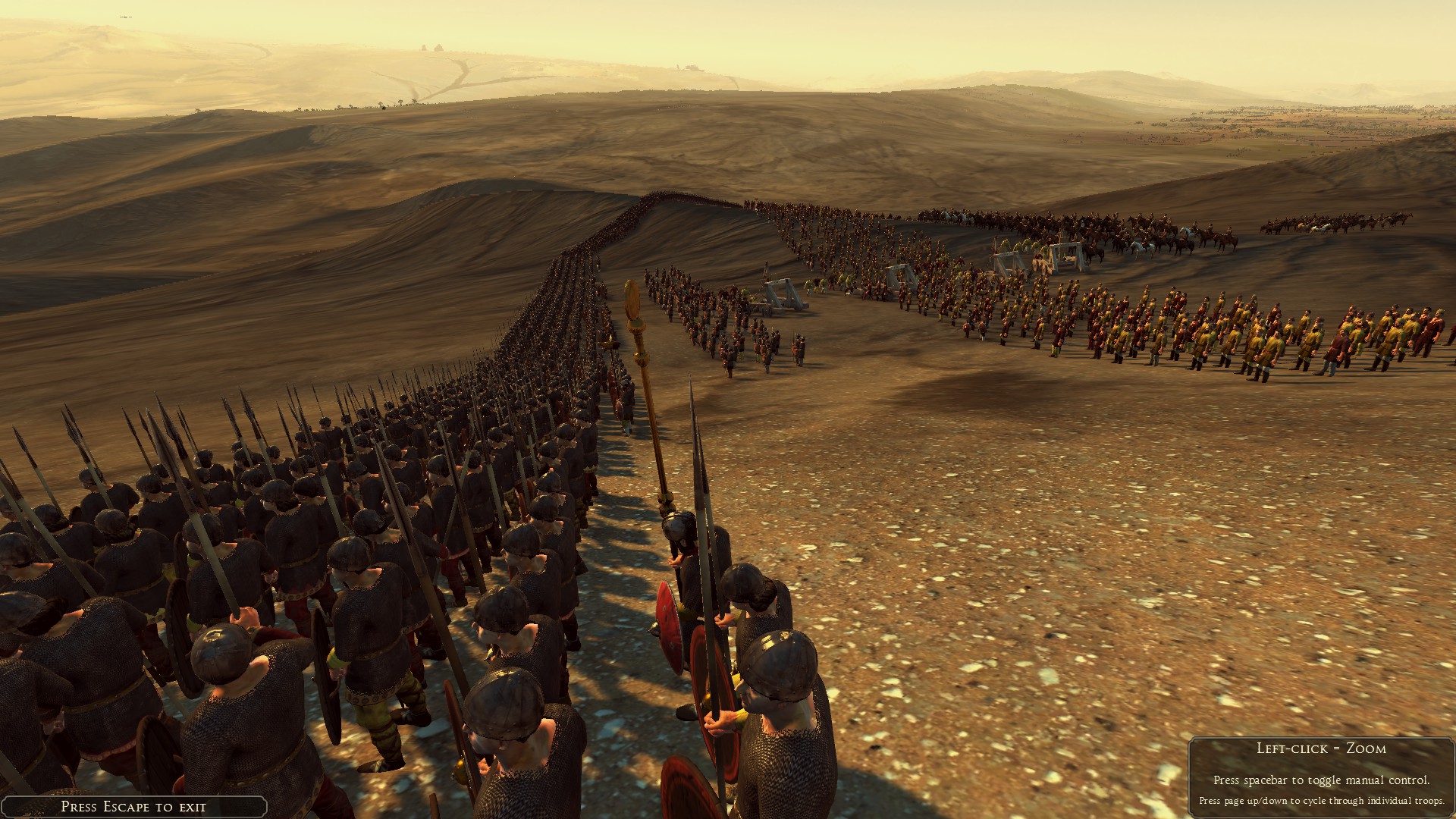
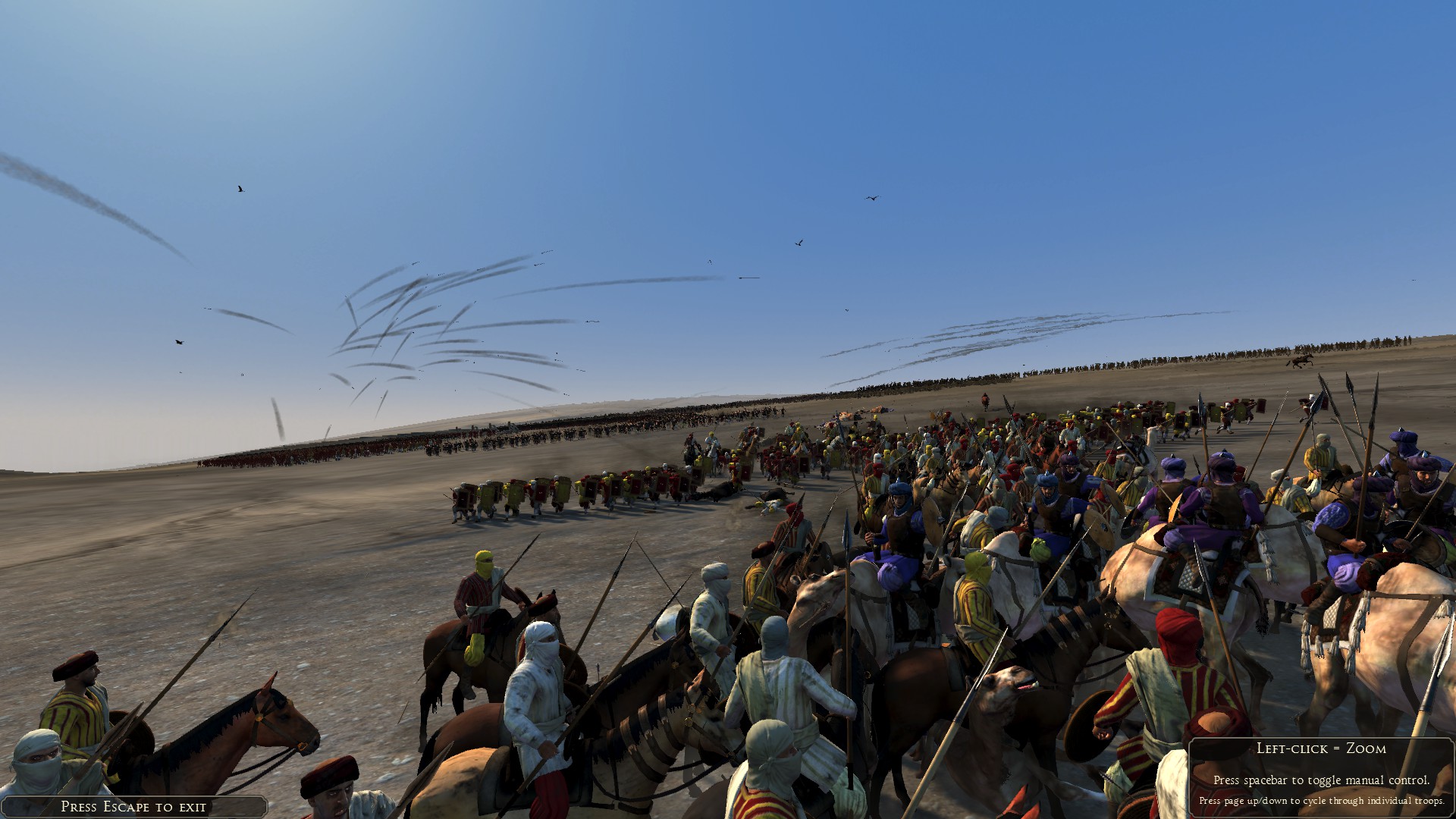
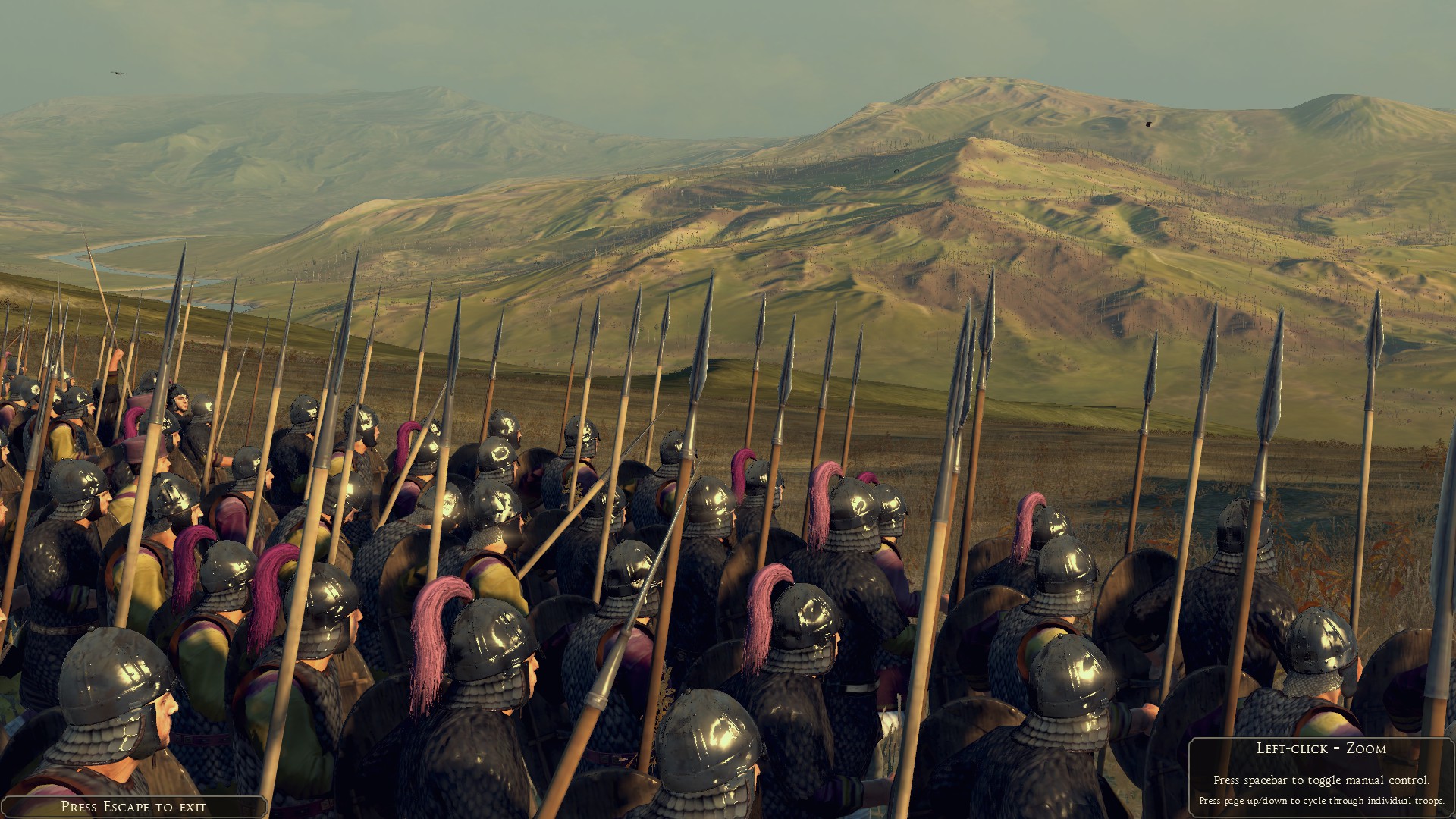
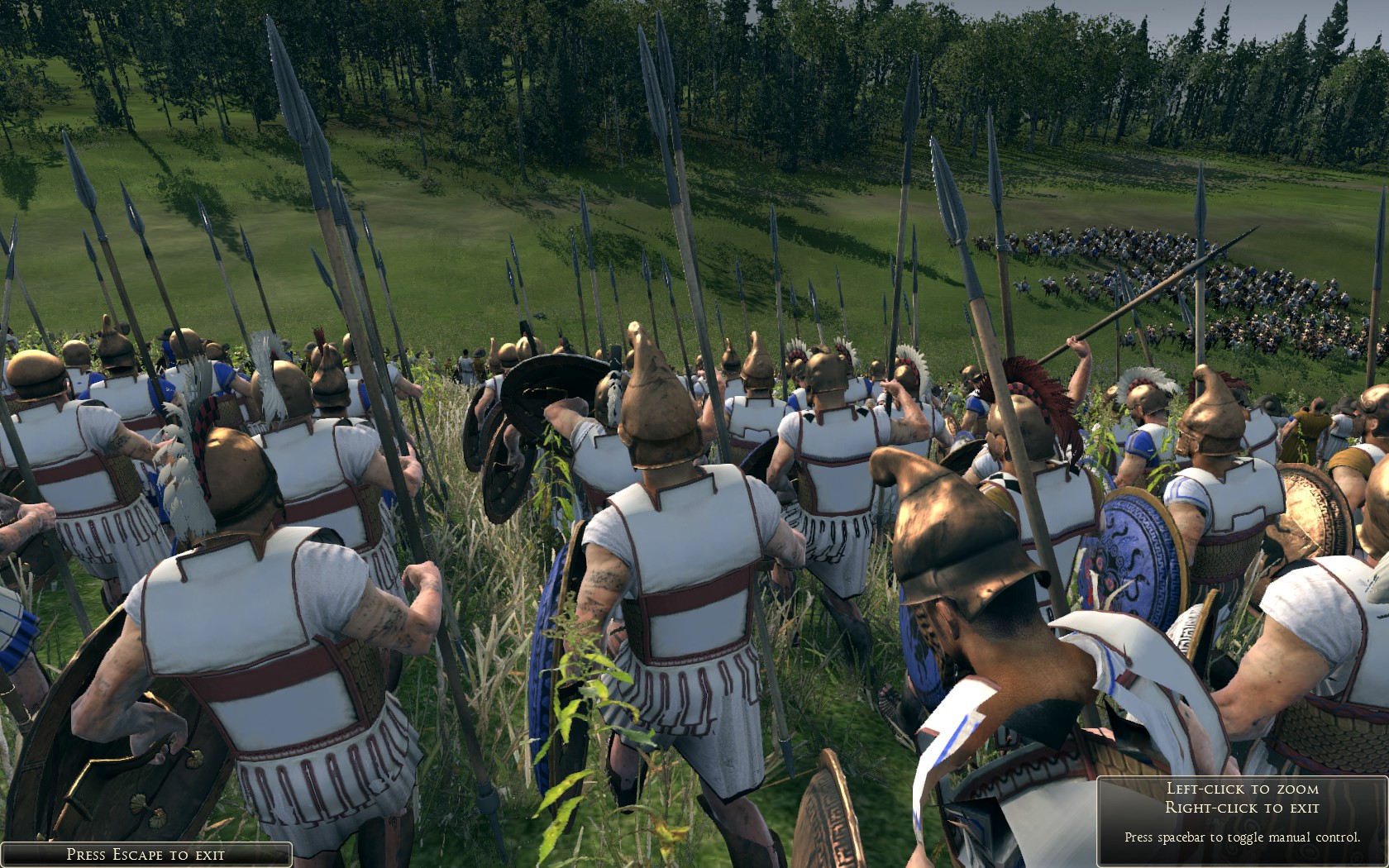
A long front line – spearmen in the desert

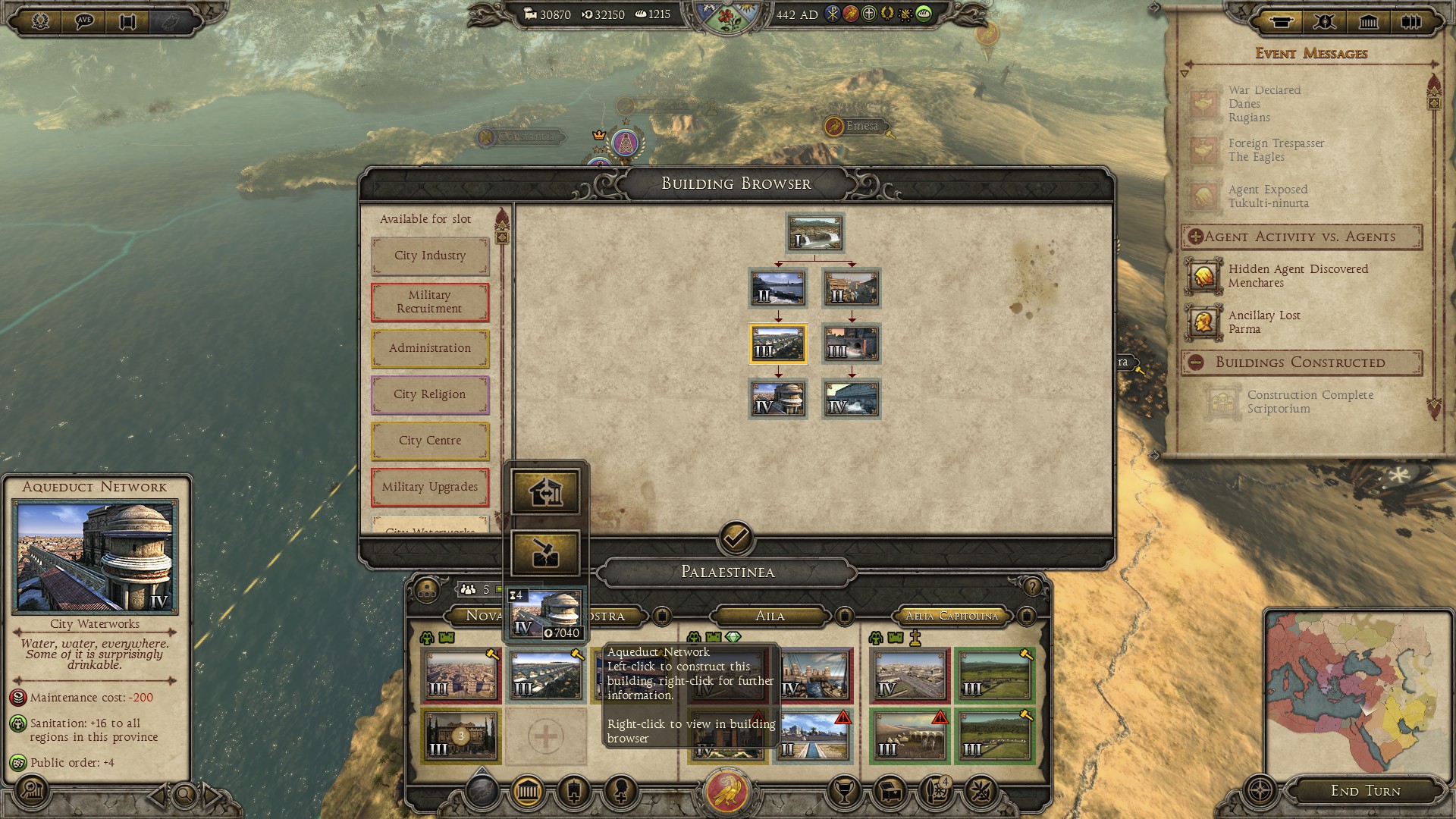
The first time I played the WRE I practically crippled myself by losing the ability to build aqueducts and tier three or four entertainment buildings. On the second run, things went much more smoothly, largely because I still had access to these techs and could build, for example, aqueduct networks will give +16 sanitation and +4 happiness to all regions in a province, but cost only 200 to maintain. On the happiness score, for 100 food, the top tier theatres and circuses are manageable provided you structure the region’s agricultural output to cater for this, offering between + 13 and +17 bonus to happiness. But the top tier religious building in a regional capital – the Patriarchal See, costs 3000 per turn to maintain.

2015-07-29_00008

Overpriced and best demolished…

2015-07-29_00009

A far cheaper way to improve sanitation, not something you can afford to do without

2015-07-29_00011

3000 per turn? Ludicrous

That is not just an outrageous price, it is a total rip-off considering they offer fewer bonuses. Not researching religious techs only means you can’t research more religious texts, and does not interfere with any other lines of research. Plus, you can always go back and research these techs at any stage in the game if you change your mind, though I can’t imagine why anyone would bother. It is, purely and simply, much easier to play without them altogether.

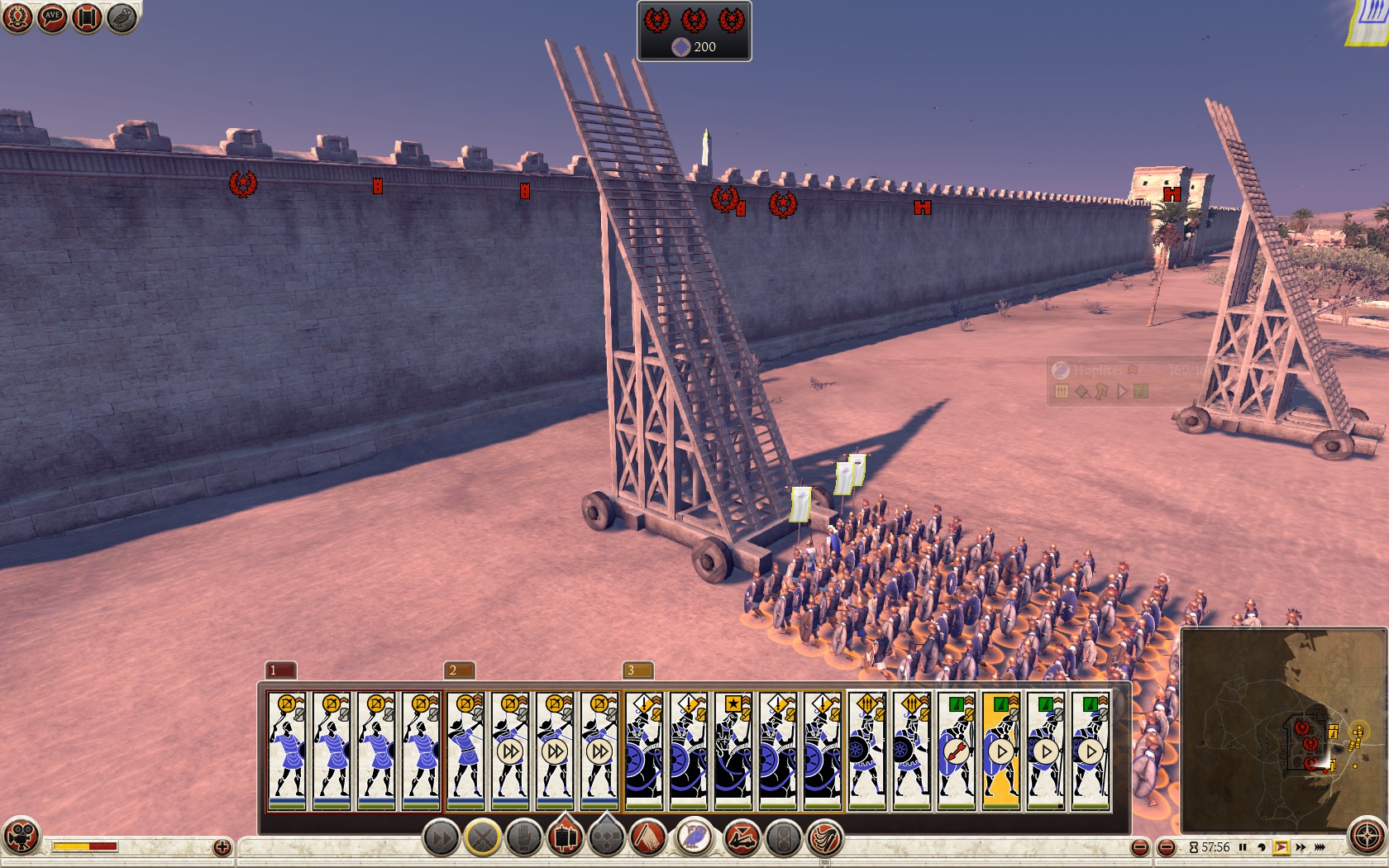
As might be gleaned from the above, Sanitation is a key focus early on in the game. This should be your first priority when it comes to construction. You need to build as many waterworks as possible in your capital cities until every province has healthy sanitation levels. If necessary, break down any military buildings in capitals that lack waterworks – in the early stages, your basic troops types will be sufficient against mostly tier 1 enemies, and you can find enough cheap to maintain barbarian archers, slingers and cavalry to supplement the testudo-capable spearmen, which are the bedrock of the Roman army. The one thing you really might need to build early on is a carpenter in one of your capitals. This will allow you to build onagers, and personally, I think every army should have at least one, as it allows for an immediate assault on a walled city and can be used to destroy forts when an enemy has bunkered down.

2015-07-19_00004

None shall pass

Sanitation issues will kill you early on because disease causes a huge loss of income and punishing happiness penalties, which become cumulatively worse as other cities in the region succumb; disease spreads from city to city and can also be carried by armies. If it gets into your troops, they will suffer attrition for a random number of turns, which can seriously weaken your forces and make them incapable of garrisoning without spreading the disease further. If disease gets out of hand, it can cripple your economy and will hamper your ability to solve the problems, thus creating a vicious circle. It is generally easier to build the major sanitation buildings in your capitals and not worry about fountains and bathhouses in the other towns – these are only really useful where you do not control the capital and, anyway, you will want those slots in the minor towns for food and the like.

2015-07-22_00030

Coastal raid

It is worth mentioning that however hard you try, you will suffer a lot of disease early on. This is because it springs up surprisingly often and then it spreads along roads and trade-routes from city to city, so it gets around.  Don’t be lulled into thinking a 1% chance of disease outbreak means it will not happen. This game seems to make the unluckiest of dice-rolls and those percentages are at best misleading and at worst, completely fictional. Inevitably, you won’t be able to build sanitation buildings quickly enough, so start with your richest provinces to ensure they are safe and sound first. They still might get disease even then, as seasonal penalties such as “Bad Winter” results in +5 squalor, which seems to make cities unreasonably vulnerable to outbreaks. Once you have your sanitation in place, the disease will gradually disappear from your empire except for occasional outbreaks. This will make maintaining happiness and income far easier going forward. Just make sure you pay attention to sanitation levels in each region when building improvements, as you will also need to upgrade your sanitation accordingly.

On the economic front, I would recommend focussing as much as possible on generating money. Thus, you should initially favour economic techs over military. In fact, over the first few turns, it’s a good idea to alternate between the military and economic techs, until the first tiers of each tree is fleshed out. This will both improve your income and also improve the standard of your baseline troops – allowing upgrades of the Limitanei Border Guards to Comitatensis Spears, which will be your key frontline unit throughout most of the game, as well as reducing their maintenance costs.

2015-09-09_00010

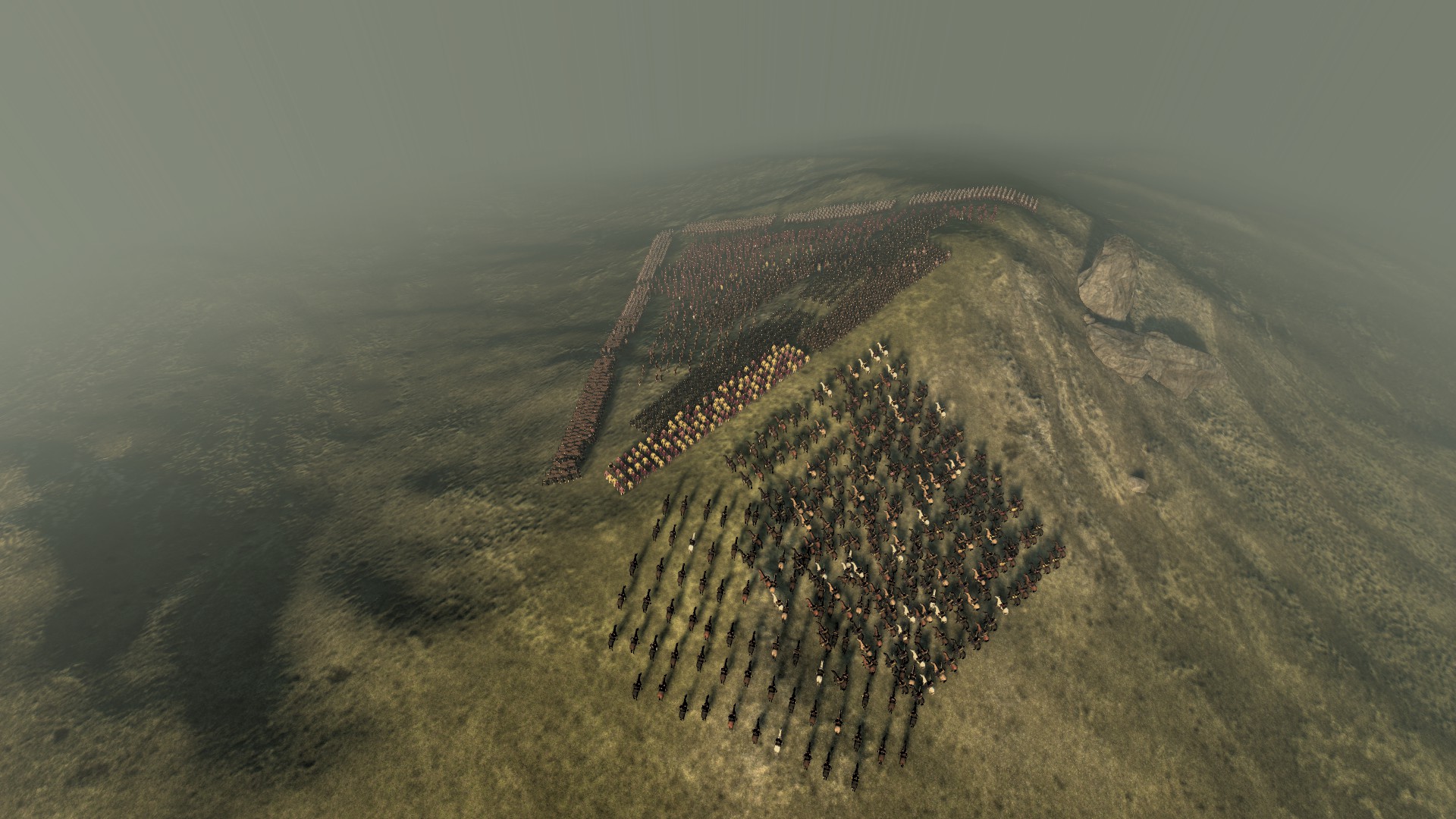
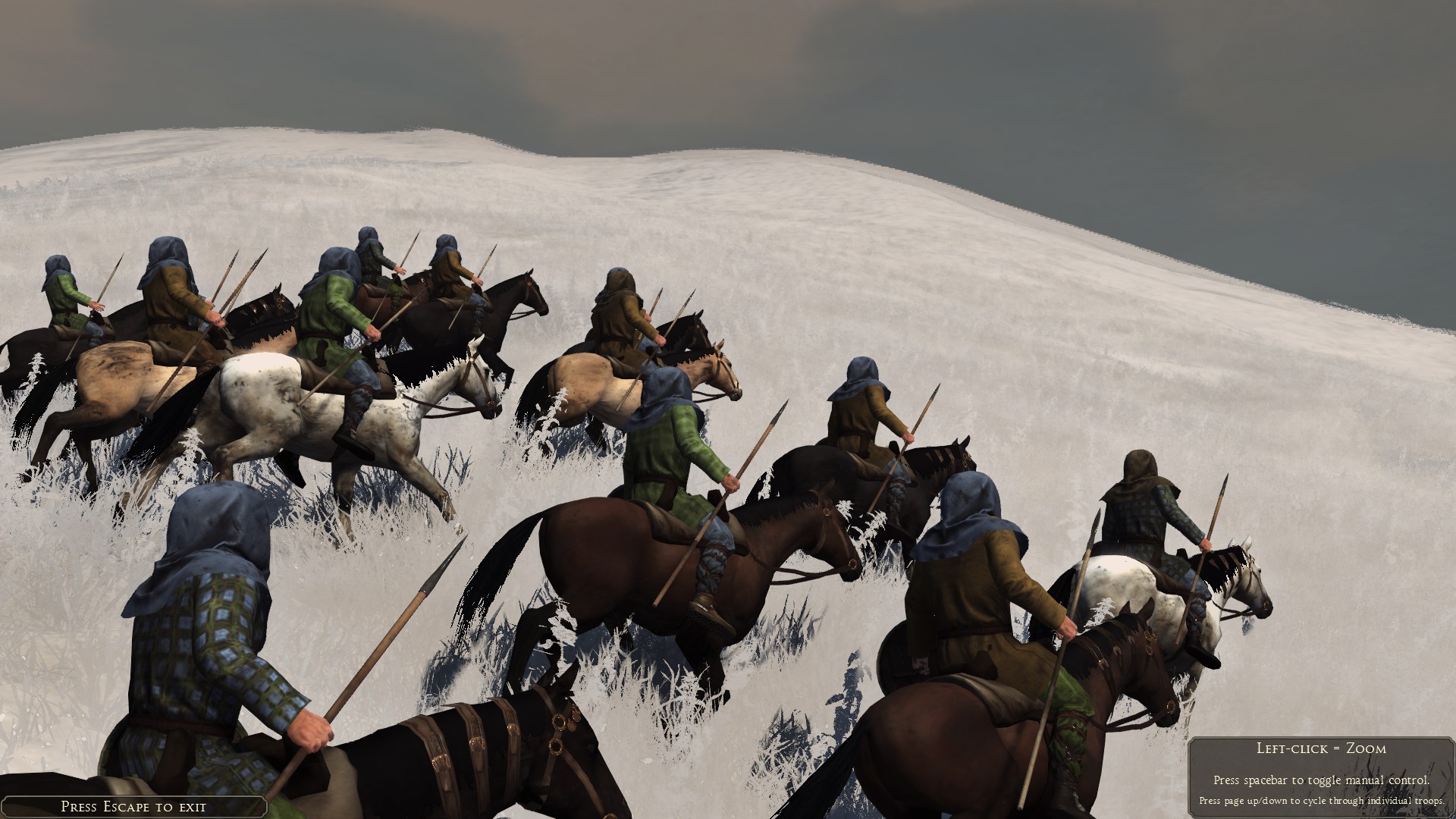
Defensive formations are key, especially against cavalry armies. Save your cavalry for flanking attacks and mopping up. Charge, retreat, rinse, repeat

Initially you can probably ignore the siege-related technologies, and, on the economic side, those relating to religion as noted above. After sharing between military and economic techs in the first tier of the technologies, you should primarily focus on economic techs for a good while. The reason is that your unit types will be sufficiently advanced to withstand your enemies for a good twenty-odd years, and later you can begin to research high-level military techs. Roman cavalry is generally not great, and I tend to rely primarily on barbarian mercenaries anyway, so you can ignore developing this line until much later. The key areas of focus really should be – Military techs which improve the baseline infantry troops and reduce maintenance costs, and economic techs which improve tax rate and income from buildings, primarily focussing on animal husbandry.

On the subject of food, it is vital that you don’t neglect to sustain a surplus across your empire. If your total production is negative across all provinces, your armies will all suffer attrition and will not replenish. Also, for each province that is short of food individually, there is a -25% penalty to income, which is hugely significant. It’s a good idea to really stay on top of your food situation. This won’t always be easy, but it’s a key strategic consideration.

2015-07-17_00001

Agriculture

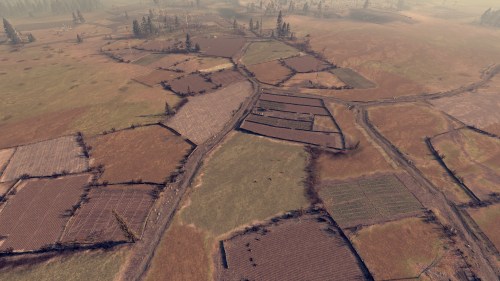
When it comes to food, the Romans are a little hard done by compared to others. Initially, many of your provinces will have wheat farms, as wheat produces by far the most food – when you have a fertility bonus to a region. However, the baseline food production of wheat is the lowest. Cattle Herds and Sheep Pens, on the other hand, produce more baseline food than wheat, but less bonus food, though they also produce more income. What you have to consider is that in AD 400, about twenty turns into the game, the first hit of climate change will happen, reducing each province’s fertility by 1. This means that while, initially, wheat farms will produce a lot of food, their output will gradually decrease and you will eventually have to switch them for cattle and sheep. It might be better to focus on cattle and sheep from the start, because these should still provide enough food for you, but also they produce more much needed income. Once a region reaches zero fertility, you can convert all the wheat to cattle, etc, which will ultimately be less food than when fertility was high, but will likely get you over the line so far as feeding the region is concerned. Food markets in the capital, fishing ports and special resources can supplement food hugely, so bear them in mind. Always bear in mind the food costs of any building you construct in your provincial capitals and, as with sanitation, plan accordingly to get the balance right.

2015-07-23_00003

Worth defending

2015-07-28_00020

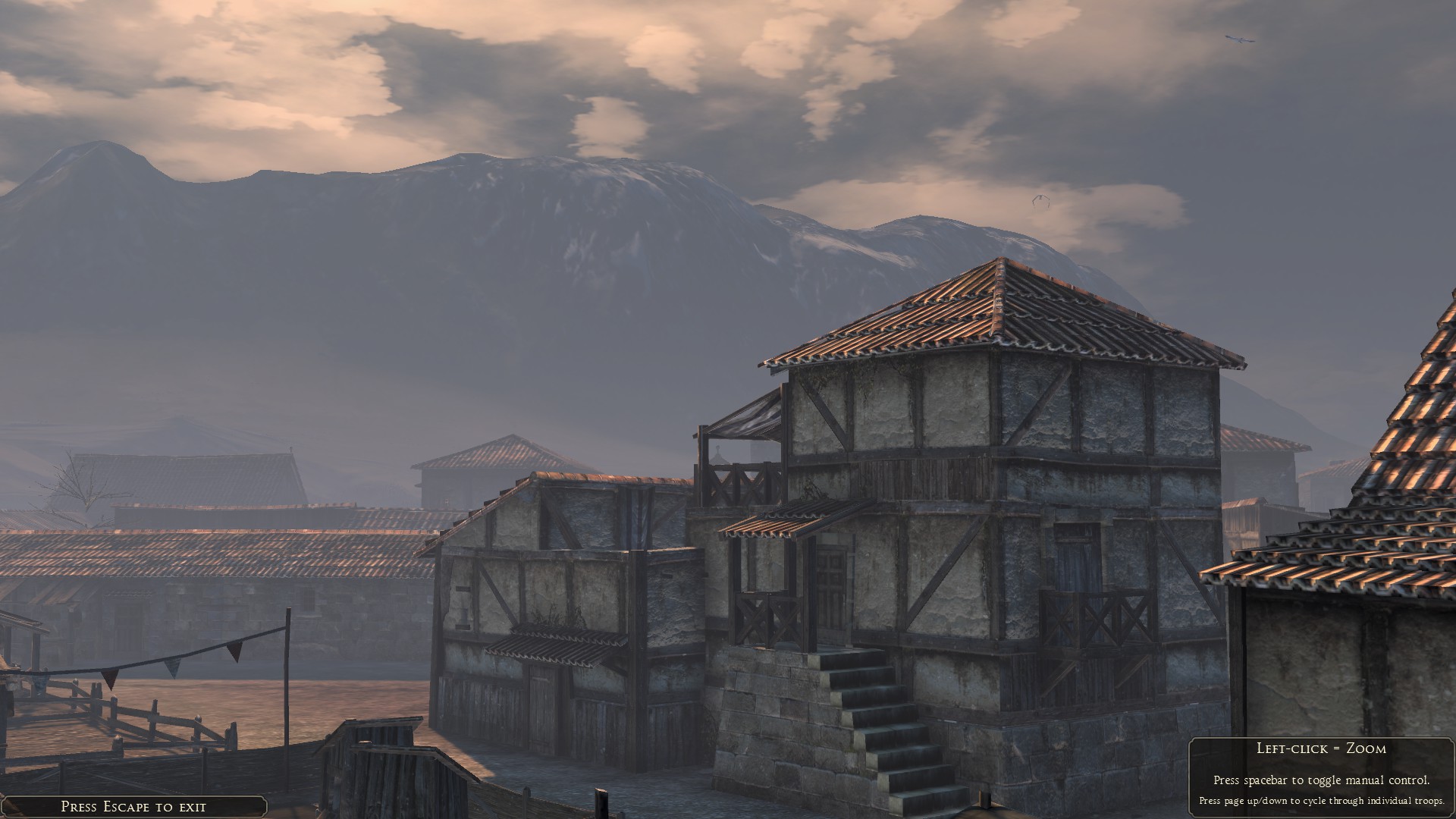
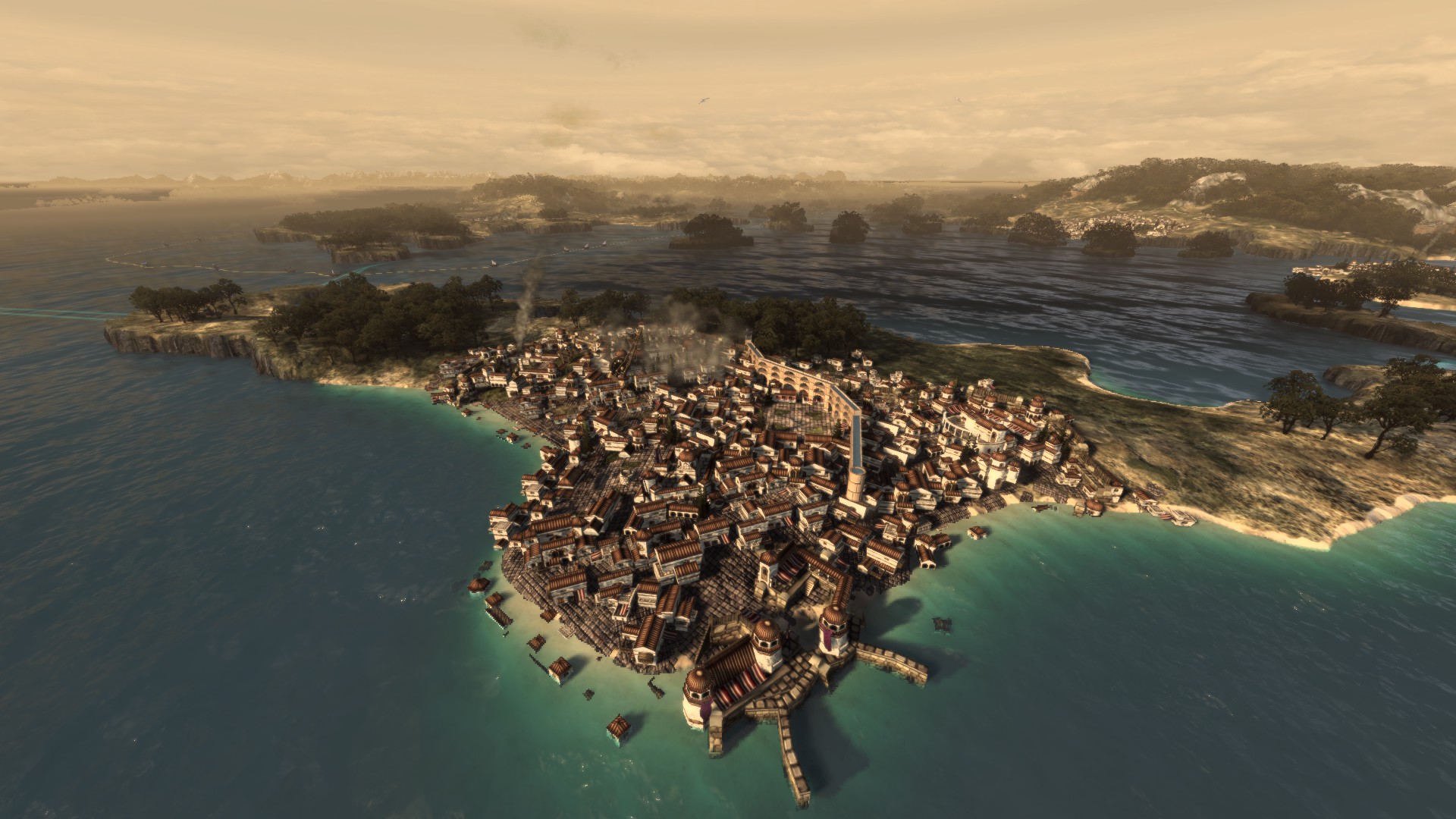
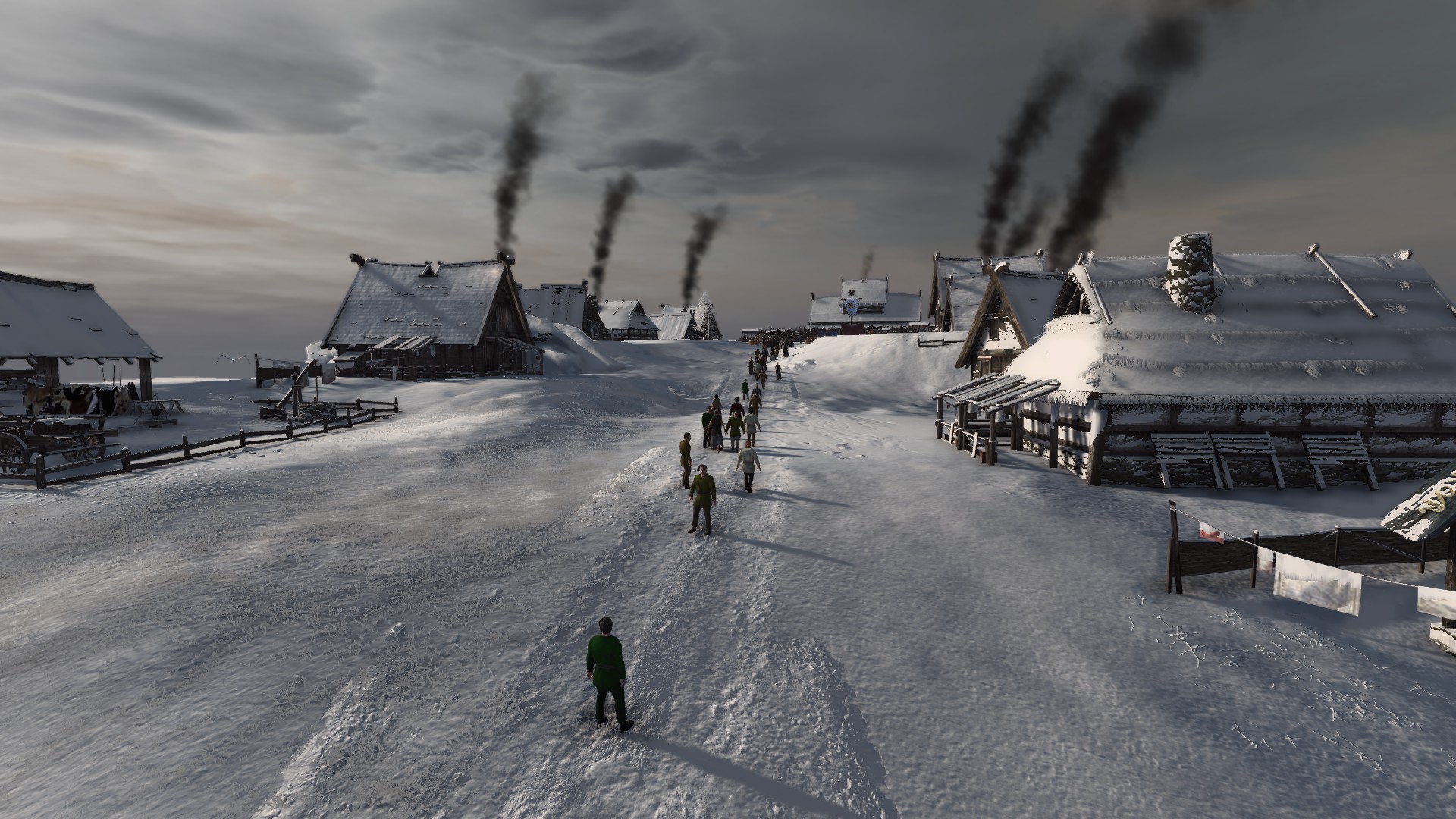
Winter in a Roman town

It is also vital to plan how much food you will need going forward, in order that building food-taxing improvements doesn’t suddenly leave your people starving. So, do the maths and plan well. In some provinces you will not be able to maintain a surplus, and it is often a good idea to dedicate one whole province to military improvements, for example, and rely on the overall surplus of food across the board. If, as I would recommend, you ultimately rely on animal husbandry buildings, then it is wise to pair these with tanners and leather-workers in the local industry building tree. These not only produce significant income themselves, but also add an incremental percentage increase to the wealth generated by the cattle, sheep and horse farms.

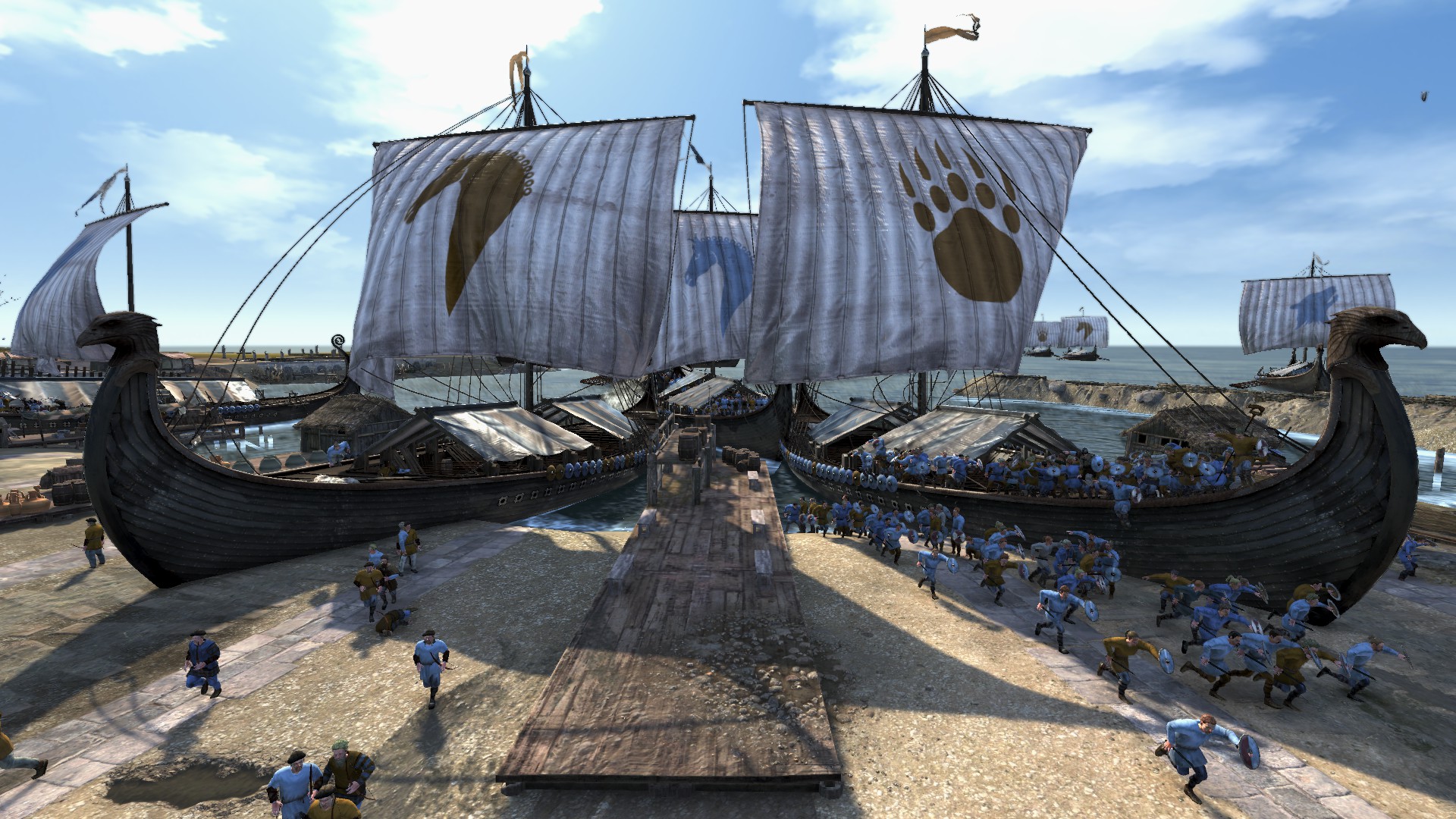
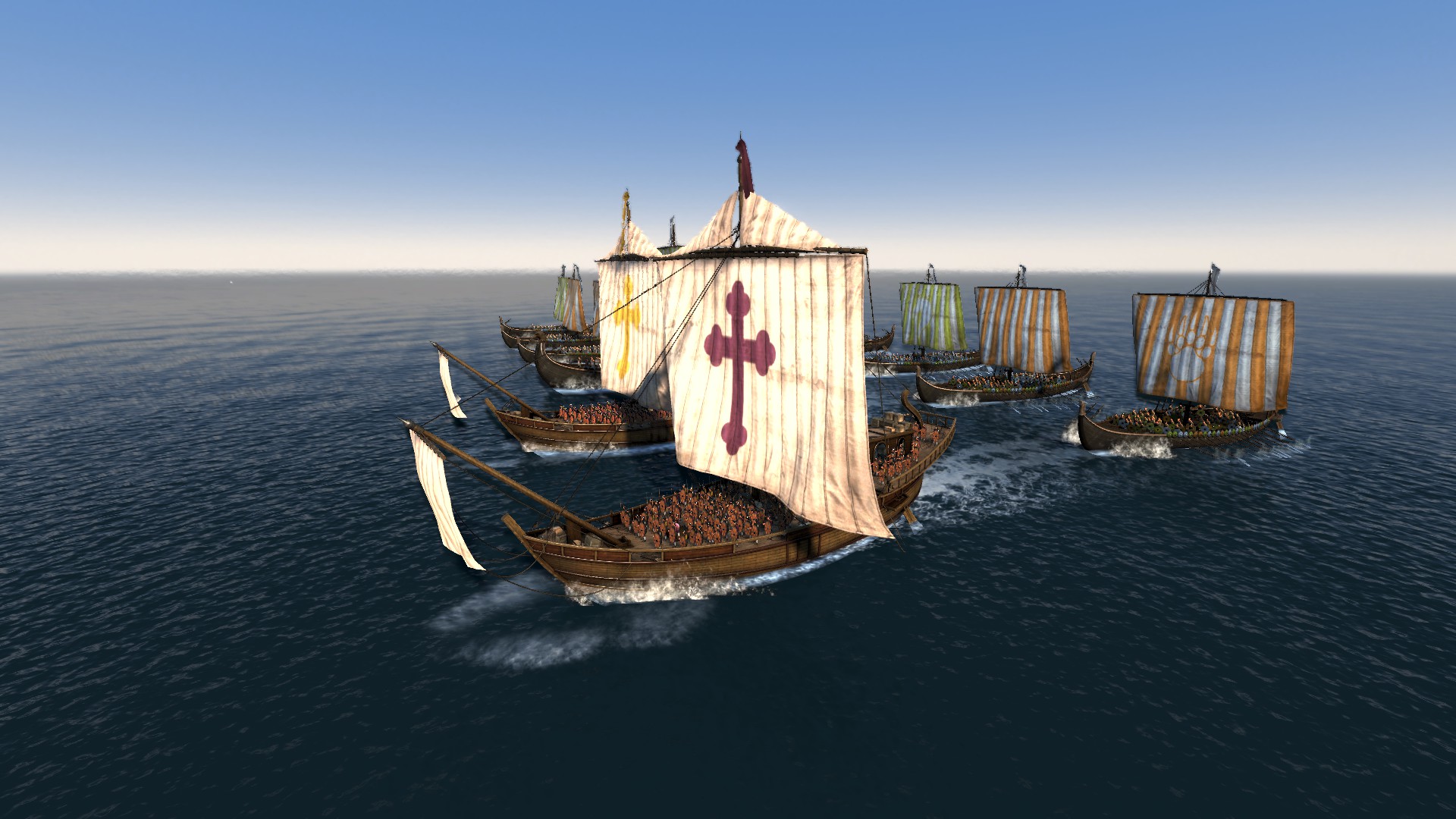
Another good way to make money early on is to build trade wharfs in every coastal city in which the region can maintain a food surplus without fishing. Trade wharfs are the lowest hanging fruit so far as income is concerned – the tier 2 building produces 900 gold per turn, and they also provide naval garrisons, as do all port-related improvements.

2015-07-18_00010

Trade Ports are a great way to increase income

2015-09-08_00009

Coastal defence against barbarian raid

In all three run-throughs as the WRE, I’ve neglected building industrial improvements in the early game, beyond any of the special resource related improvements, such as gold-mines, marble quarries, lead, iron and the like. This is largely because I prefer to prioritise food, sanitation and happiness improvements first, including garrison encampments, and there is rarely enough space to accommodate any industrial buildings. In an ideal world, industrial development could begin earlier, but being on top of the other areas is more important early on and enough money can be made from food, trade and specialist markets such as wine markets. In the later game, I tend to invest a lot more in industrial buildings.

As to military buildings for constructing more advanced units, again it might seem counter-intuitive to say so, but I rarely build them at all. Indeed, it is possible to dedicate a single region to military buildings for constructing different unit types, and have your armies fan out from there. This is not exactly practical, but in truth the armies already stationed in provinces can definitely make do in the early game with the baseline spear units and barbarian archers and cavalry. I’m a big fan of cavalry and like to have a minimum of four units in each army, which I do my best to keep in reserve until the enemy are engaged along the front line, then use them to flank and charge the rear of enemy infantry, or smash through a bunch of missile units, once they are no longer protected by infantry. Cavalry are also vital for mopping up after a battle. Most enemies use their cavalry suicidally, charging them onto turtled-up spearmen. The remnants can be picked off by your own cavalry, without much harm to them.

2015-07-23_00019

Mercenary Cavalry, taking fire

It is worth mentioning that when you win a battle, be sure to take the time to wipe out as many routing enemy units as possible. This is not necessary if they have no retreat option, but if they can retreat and you let their routing units get away, it means you will have to fight them again. When the white flag is up they cannot harm your units further, so hit the maximum speed button, switch to the strategy map, and chase down as many as possible. It can get a bit tedious, but this is especially important when your own troop numbers are low. Sometimes, you can destroy the entire enemy force in this manner. Just be careful not to shoot your own troops with archers and artillery, or towers, in the process. It is also a good idea, despite the negative effect on experience, to replenish your own troops at the end of a battle with captured enemies. This is a particularly vital way – indeed, the only way – to replenish when in hostile territory, and becomes especially important when you may need to fight again the following turn.

2015-09-09_00017

Very close indeed, thank goodness for that fort…

Moving on to all matters military and strategic, the key thing in defending the WRE is to keep your enemies at the frontier, and limit the number of frontiers you need to defend. Once armies get deep within your empire, it can be difficult to chase them down and this requires moving armies into the interior rather than keeping them at the frontiers where you will need them to keep out the enemies who will pour across the Rhine and Danube.

Your very first move as the WRE should be to take care of the Suebians, who begin inside your borders in Gaul. If you don’t sort them out they will almost certainly attack you within the first few turns, so you might as well confront them on your own terms. You can get three armies there by around the second turn and smash them, wiping them out, at which point you’ll be wanting to hurry those armies back to the frontier.

2015-07-16_00002

Boo-yah

The other possibility is to grant them a region in Gaul / Belgica and leave them in peace. This will likely lead to favourable relations within a few turns, as the gift of a region causes a huge diplomatic boost. Within just a few turns you will be able to trade with them and shortly after, form a defensive alliance. Once they become engaged in fighting the same enemies, the diplomacy system will ensure very positive relations henceforth. They could provide a very useful ally to bolster defences along the Rhine.

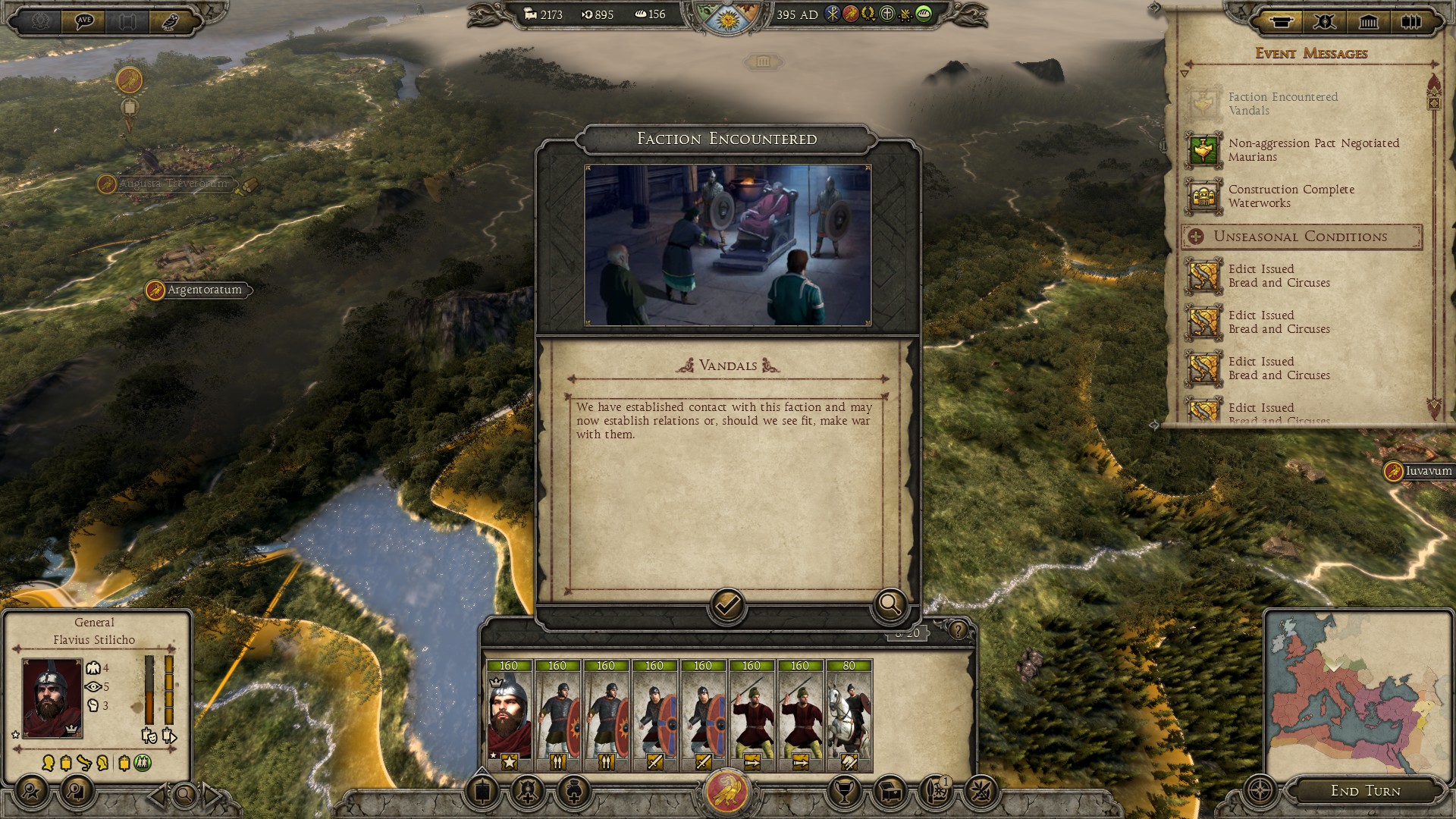
The same option is available with the Vandals, who will likely appear inside your borders in Pannonia. Pannonia is a difficult place to defend initially and it makes sense to sacrifice one region to a faction who will, as above, likely become a defensive ally and trade partner within a few turns. This is very helpful on the eastern Danube frontier, which is an area I choose to neglect partly, initially. The reason for this is that my principal concern is to stop everyone who threatens to get deeper into the Empire, where they will be harder to stop. If one or two regions on the Danube fall, it’s not the end of the world, and they are still at the frontier. You can always muster more strength later to take them out.

2015-09-10_00026

Fighting in light forest

In some cases, the loss of a region can prove surprisingly beneficial. I found it very helpful when the Illyrian faction sprang up in the region of Iuvavum. I swiftly subjugated them and, next to the Vandals, had very helpful and willing allies to manage that frontier while I focussed elsewhere. By no means abandon Pannonia, just play a defensive strategy initially, making sure Sirmium does not fall and switching between the frontier towns to support them defensively. It’s possible, but very difficult to do this with one army, but if you build those towns up and increase their garrisons early, they can usually survive the initial assault. Get them to size 2 as early as possible and put a garrison encampment in them. Managed successfully, they will hold off an army with their garrison until relief arrives, especially if you have a defensive ally / puppet state on the same frontier. When those towns reach size 4 and obtain walls, they will be impregnable, except to the Huns, by which stage you should have more armies in the region.

2015-09-05_00010

Gods, help me, I’m surrounded

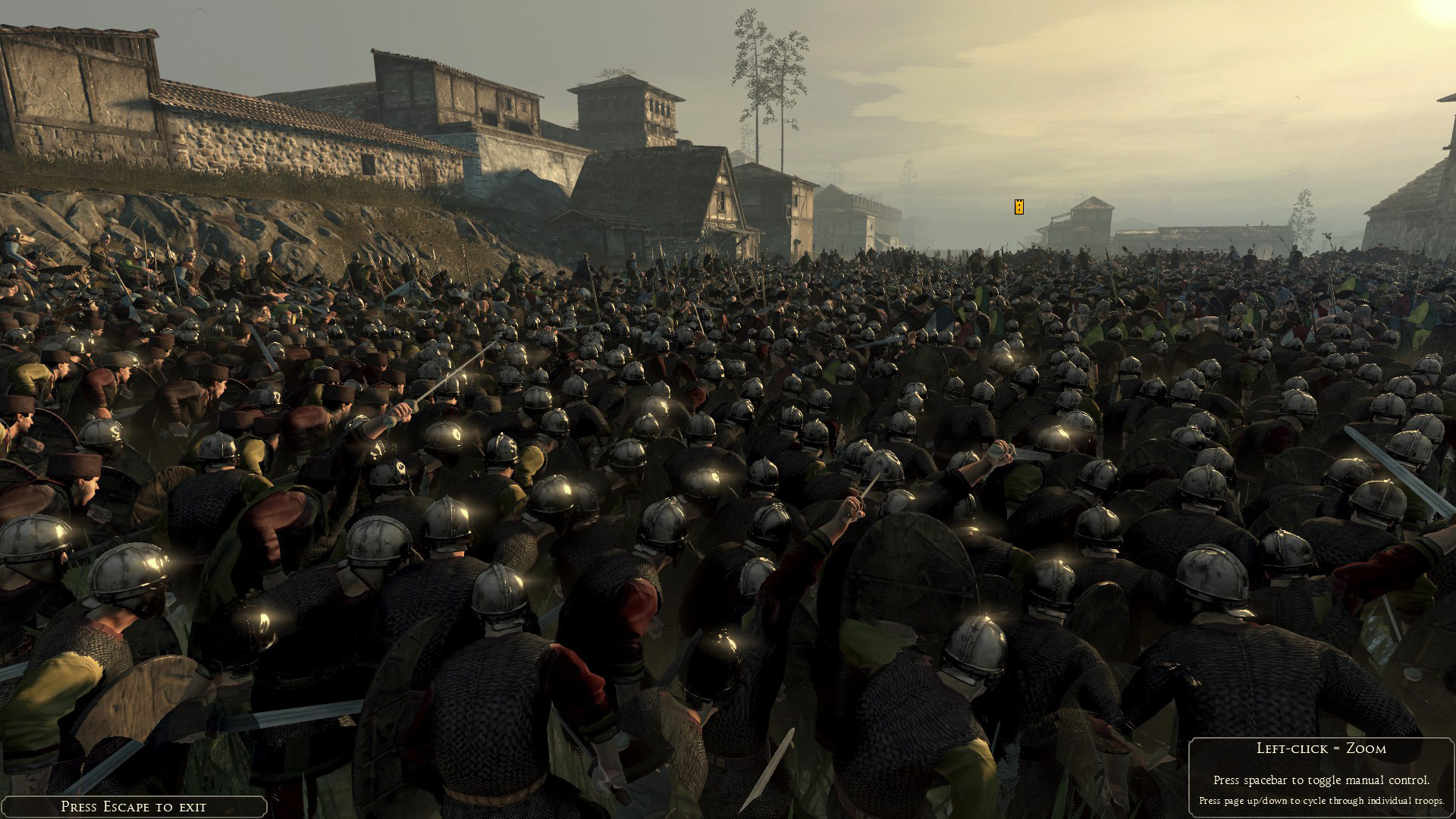
On the defensive front, you should always avoid auto-resolving defensive battles. The AI is awful at defending towns and if you are at all outnumbered, it will lose the battle for you. It is, however, possible to defend a town against a much larger force, if you defend wisely. This largely depends on the design of the town – some of them are a lot easier to defend, but the basic rule is to hold the centre, keep your units close and block entry to the main capture point. As soon as the enemy general is in range, switch any archers to heavy shot, and, if possible, use their special ability to increase damage. Often, in this way, you can knock off their general early and break morale. Just be careful not to shoot your own defending troops in the back, which can be avoided by ensuring a clear line of sight. The AI is, for the most part, a slogger, and will just drive up against your units. Thus, the comitatenses in defensive testudo formation is the way forward. Often one such unit can hold a narrow passage and see off several entire units.

2015-07-22_00025

Artillery, well placed, are devastating against naval units

2015-07-24_00011

Sally forth when the time is right

Another key strategic aspect is, inevitably, choosing the right technologies in the right order. After filling out the first two tiers in military and civil developments (avoiding, of course, any religious techs), I prioritise anything that increases income or reduces maintenance costs and then go straight for the techs which allow one to build larger-sized towns. Tier IV towns gain walls and more sturdy towers and are far easier to defend, especially as enemies need to siege or bring siege equipment in order to launch an assault. This not only allows the towns to hold off attacks more easily, but again, it buys time to bring up armies when you are overstretched and can’t garrison every town. Ideally, all your cities along your frontiers should hit tier IV before the Huns really kick off in 420. You needn’t worry so much about the regional capitals, as these already start with walls in place, though by no means neglect them – the Huns always bring artillery.

2015-09-06_00017

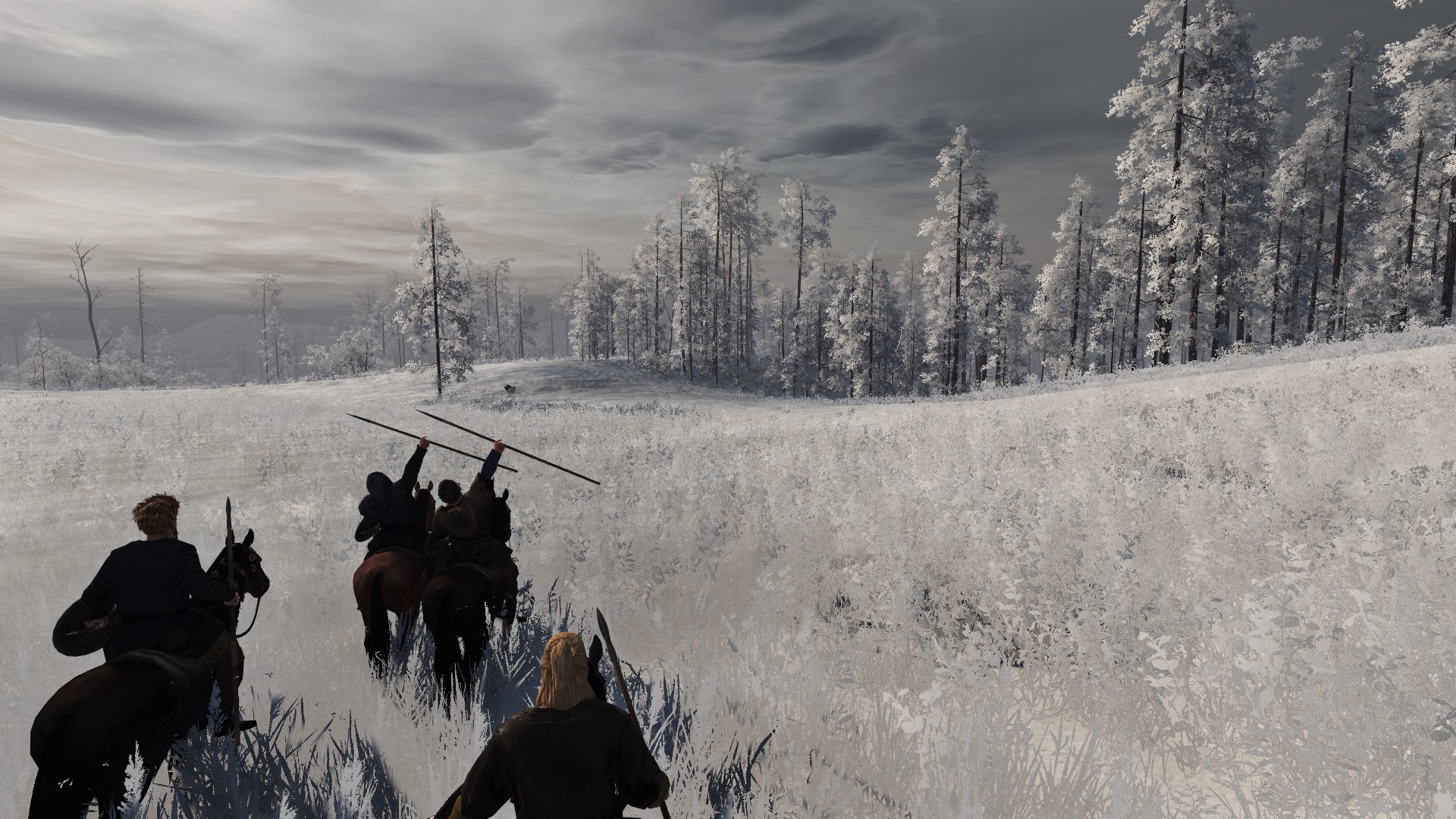
Another winter campaign

Returning to the subject of finding useful defensive allies, one of the key strategies for defending the WRE is to create as many puppet states as possible in the west. This isn’t always easy to do, especially as you can only subjugate enemies who have one single region, and it is not possible to subjugate hordes, unless they settle in a city. Yet, if you are patient, and have armies stationed along the frontiers ready to roll, you can wait for the right opportunity and attack. This is often best done after having been attacked. If the Franks have a shot at you, and you crush them as you should, send an army straight to their capital in Frisia and hit it while they are licking their wounds and desperately trying to rebuild. You can use similar strategies with the Allemans, for example, and potentially the Saxons etc. Once you subjugate an enemy, they instantly make peace with all your allies and declare war on all your enemies, turning your enemy into an instant ally. This is great for a number of reasons – you have friendly regions across the borders in which you can replenish; they lend battle support and will even attempt to expand by taking your enemies’ territory, and, if nothing else, they take the aggro much of the time, acting as a magnet which draws enemies away from your borders. You will also, within a few turns, be able to establish a trade route for more vital income.

The next most important strategic move – and this is absolutely key in my books – is to defend Britain to the death. Many players recommend abandoning Britain, but this is, without a doubt, the worst possible mistake you can make as the WRE for a whole range of reasons. Indeed, far and away the most sensible strategy is to complete the conquest of the British Isles before anything else. Once you have dealt with the Suebians in the first two or three turns, Britain should be your first real military focus.

2015-08-15_00001

To subjugate or not to subjugate. Best to knock them off altogether.

Build another army there and, if necessary, send one across before the rest of western Europe declares war and attacks you in Gaul, Belgica etc. Hit the Caledonians first with two or three armies and subjugate them swiftly. They will keep the Picts at bay or take the heat, allowing you the chance to send all two or three armies across to smash the Ebdanians. You can subjugate them, but personally, I’d take the territory to avoid ever having to think about it again. Once you have conquered Ireland, march back across into Scotland, smash the Picts and wipe them out. This will alleviate any worries in that entire region. The Caledonians will defend Britain for you pretty much for the rest of the game, and you will only have to keep a smallish army and navy in Camulodunum. The proximity of the cities in Britain means you can cycle your army between those southern cities to respond to any seaborne threat or plug a disorder gap. You will need to invest in improving civil disorder and a good trick is to make a priest in Rome early and send him all the way across. One priest in Britain, moved about strategically, can take care of the whole islands.

2015-07-17_00014

Britain, the way it should be – Roman

The reason Britain is so key to keeping the WRE intact is that it prevents any armies coming down the coast of Gaul while you are busy at the frontier. If Britain falls, for the rest of the game you will have the Ebdanians, Picts and Caledonians sending armies down the west coast of Gaul and into Spain, where you will be forced to keep armies to chase them out. If you stop this happening early, you can get away with keeping no armies in western Gaul whatsoever. It effectively means that there is no frontier in the west, and you have the edge of the map completely secured and protecting your rear, leaving you to focus solely on the Rhine and Danube. Any armies that try to come through that way can be stopped in the English Channel by your fleet in Camulodunum, backed up by your army if necessary. This frees up a huge number of regions that no longer require defending, nor defensive investments. You can keep one army in southern Gaul to take care of Gaul and Spain; quick-marching back and forth to deal with the rebellions that will spring up from public disorder issues. Even if you do lose a region to rebels, they usually just sit there and don’t expand, so can easily be dealt with at a later date. Some, however, will form new factions, and these are best subjugated ASAP as factions which spring up from rebellions are often the most aggressive when it comes to expansion and usually have Roman unit types, which are harder to defeat. If you get the timing right, the entirety of Gaul and Spain can be handled by one army, and all your other armies, with the exception of one in Africa and one in southern Britain (alongside a fleet), can move to the Rhine and Danube. With your initial allocation of 8 armies as a maximum, you will have just enough to stop anything at the border, and just enough to stop any rot spreading inside your borders. More likely, however, you will already be able to field 10 armies by the time you complete the conquest of the British Isles.

2015-08-19_00002

It can get messy in the British Isles, but worth persisting with

Another key strategy is to get as many agents as possible. I also ensure that my agents max up their extort, persuade and oppress ability as much as possible, so I can capture enemy agents and use them myself. If you keep this up you can end up with ridiculous amounts of agents, who can seriously hamper enemies, improve income, spot approaching enemies, increase public order and train your troops. You must also pay attention to the management of your faction. On this score, try to keep your faction strong through marriages and adoptions. It’s also a good idea to get your emperor into the field to increase his influence. This is not only key to maintaining a strong empire, but is a fun way to re-shape history. Who would ever have imagined the emperor Honorius weathering the tide of invasion in the west, overseeing a re-strengthening of the Empire, and then campaigning to recover Egypt from the hands of Ethiopian separatists after the collapse of East Roman power in those provinces?

2015-07-29_00001

Roman reconquest well underway.

The emperor, however, can also be a serious liability. If he develops cruel traits, such as Tyrant, Torturer etc, which cause public order penalties across all regions, sometimes the only thing to do is to get him killed in battle. This needs to be carefully managed, so a whole army isn’t routed, but just wait until the tide is turning in your favour and send him in suicidally while everyone else hangs back. It kinda sucks having to do this – and you must ensure you choose a good heir beforehand – but it can completely transform your fortunes in the game, particularly with public order.

On the subject of public order, you will have to learn to live with rebellion. It will be almost impossible to stop it altogether, and every so often, rebels will spring up and you will have to deal with them. The good thing is that the way disorder works, once a rebel army appears, you can a positive +20 bonus to public order every turn, which represents all the malcontents heading off to join the rebellion, leaving the happy people in the cities. Thus, in effect, the rebel army becomes the manifestation of the unhappiness. Often it can be beneficial to let the army grow for two or even three turns, and sometimes you will have no choice but to do this. This means that when you do wipe them out, you will be left with a much better public order situation, which will buy you enough time to hang on for the next rebellion, or find some other means of improving order. Be warned, however, rebel armies grow by four units a turn, and a twelve unit army might well be enough to sack and capture a city. Most garrisons, even of just 4 units, should be able to hold out anything of 8-strength and under – you just need to turtle up and let them commit suicide against your spearmen and in trying to capture and destroy your arrow towers.

2015-09-08_00004

We should struggle together! We are struggling together!

Strategically, the biggest unknown is Africa, which can go a number of ways. It all hinges on whether or not the Gaetulians, Garamantians or Maurians declare war. This seems to be a huge variable. I’ve had one of them declare war as early as the third turn and as late as some time after AD 420. It might be worthwhile trying to get away with just keeping one army in northern Spain to take care of rebellions, and hope that, should an emergency arise, you can get down there quickly enough to offer relief. I’ve run it this way successfully in the past, though you may have to pull off some pretty epic garrison defence battles and hope, in the case of a defeat, that they only sack you, thus allowing time to get an army down there to overcome them. The African factions are usually relatively easy to defeat as their units are not quite up to the same standard.

2015-09-06_00012

Hot and dry in the summer

2015-09-06_00003

A peaceful moment

Another possible strategy is to build an army early on in Africa and eliminate or subjugate these factions successively. If you’re a good enough general, one twenty-stack army should suffice to subdue the whole region. Judicious use of spies to delay or stop armies over successive turns can allow you to wipe them out in the field, then hit their capitals. Subjugation can eliminate the need for keeping any armies in the region at all, thus turning the presence of these factions into a defensive bonus. I find that at some point in the game they will almost certainly need to be dealt with militarily – exactly when, however, is pretty open. Of course, the longer you avoid war with them altogether is likely better. The Rhine, Danube border and Britain are the real front line initially and having one less army in the north is a significant enough disadvantage to be worth avoiding.

2015-09-04_00001

Winter trees

It will be a long hard road, frustrating and at times tedious, but such a strategy should get you over the line. Save at the start of every turn in case of disasters and be patient. Eventually, though it will seem like an eternity, you will bring order and stability to the western empire and be able to keep just a couple of armies on the Rhine frontier, and shift pretty well everyone else to the east, along the Danube. If you let Pannonia go, which is the one region I’d consider sacrificing, you will now be well placed to take it back. You will need a lot of armies to fight the Huns. Most armies will lose against them in a one-on-one because of the morale penalties the Romans suffer against the Huns, and also because the Hunnic units are hugely overpowered. Try to outnumber them always, or fight defensive battles, using towns or forts where possible.

2015-09-12_00011

Always take artillery to attack a fort. Switch off auto-fire and target the towers. Wait till it all burns down, then attack.

2015-09-11_00006

2015-09-11_00011

When Attila is defeated and finally killed, you have, in effect, won the game. Yet this is by no means the end and I rather love this later phase of the game. Without one monster enemy, it feels more like a traditional Total War game. There isn’t much left to do after this except perhaps recolonise the devastated regions or attempt to rescue the Eastern Empire.

2015-07-22_00001

Rebuilding in the East

2015-07-22_00021

The war never ends. More great battles await with the passing of Attila.

Taking on the Sassanids and reasserting Roman hegemony in the east can be a lot of fun, strategically, and it feels like a more even fight. I’ve made it as far as about 460 in one game, and in truth, I’m not sure how much further it is possible to go. I always imagined that if an end date were set, it would be 476 – the year in which the last Western Emperor was deposed. But, for all I know, it continues even beyond that. I’ve never given much of a stuff about the victory conditions, but prefer to focus instead on my own martial ambitions. By this late stage of the game, it’s really up to your own sense of whimsy as to how long you stick with it. If, however, you follow the advice I’ve given above, you should at least make it this far.

Read Full Post »

The fall of the Western Roman Empire in the fifth century is a problem I’ve spent far too much of my life thinking about, including doing a PhD on the subject. The what-ifs and may-have-beens are innumerable and incalculable, yet there was certainly nothing inevitable about what happened. Had the Empire collapsed during the third century “crisis” we might have assumed, with historical perspective, that this was no less inevitable. Yet it didn’t collapse then, and it needn’t have done so in the fifth century. The unique combination of internal and external pressures faced by the Western Empire, some of which were all too deliberately deflected from the east, were not insurmountable. Clumsy policy, poor leadership, lack of responsiveness, in-fighting were all factors which had plagued the Empire throughout its history. There were many turning points and missed opportunities. Even as late as the 450s and 460s, had the Vandals been driven from Africa, a task which should have been far easier than it was made to look, the west might have found its feet again, though things were already quite far gone by this stage.

Winter is coming

Total War: Attila is a game I have dreamed about for decades: a grand simulation of a period of history that is all too often neglected. The team at Creative Assembly have gone there before – the 2005 Barbarian Invasion expansion of Rome Total War I dealt with the same period of history and, indeed, contained many of the same ideas present in Attila, such as the existence of horde factions – groups with the ability to pack up and move as a group, thus not being rooted to a city or province. Yet it was, I felt, poorly balanced and unsatisfying. Total War: Attila makes up for all those shortcomings, including many of the shortcomings of Total War: Rome II – a flawed masterpiece in itself. This game too has its flaws and is not as perfectly balanced as it could be, yet its strengths are so great that it ultimately shines through.

The opening narrative is rather sanctimonious and moralising

It's all about the Huns

As with all Total War games, it is the attention to detail that makes Attila such a wonderfully immersive experience. We can’t expect complete historical accuracy – it’s impossible to simulate the complexity of reality – but with Attila we get a satisfying approximation of the initial set of circumstances and existing conditions. It is, of course, an approximation and it is also created with the idea of playability in mind, and thus liberties need to be taken. Many, for example, might question the logic of a technology tree in which the Romans almost seem to rediscover past talents from the earlier empire, and, in which, by adopting religious enhancements, older technologies are forgotten. I would certainly question the tone of the opening narrative, which is rather tiresomely sanctimonious and moralising. Still, we can’t have it all.

Don't research religion! You won't be able to build aqueducts or amphitheatres...

The game kicks off in AD 395, immediately after the death of Theodosius the Great – the last emperor to rule a unified Roman Empire before its division into East and West. In the west, Honorius is on the throne in Milan, whilst in the east, Arcadius rules in Constantinople. The player has the choice of playing a variety of factions; either half of the Empire, the Sassanids, the Huns and a whole swathe of barbarian factions depending on which DLC packs one has: The Visigoths, Ostrogoths, Vandals, Suebi, Franks, Alans, Burgundians, Saxons, Allamans, Langobards, Picts, Ebdanians, Caledonians, Jutes, Danes and Geats. Some might question the prominence and, indeed, starting strength of some of these factions, yet, after all, it is a game, not an accurate historical simulation. I mention this point again, because I had constantly to reassure myself of this in order to avoid frustration at numerous points with some of the liberties taken.

Choose your faction - Arcadius

Without a doubt, the toughest assignment of all is to play the Western Empire. It shouldn’t be as hard as it is, yet in this game, everyone will declare war on the west and most factions already have huge and powerful armies ready to roll in and cause havoc. Indeed, some factions actually start with armies inside Roman borders. The Romans, on the other hand, begin with scattered, weak armies which are already depleted of troops on account of the civil war which was recently fought to assert Theodosius’ rule. Depending on how rapidly the other factions declare war, it can be nigh impossible to stand up to this wave of invasion. Yet, it can be done.

Maybe things will go better this time...

Rome. Tired and sore, but ready to be awesome once again

Likely the easiest start is the Sassanids. They begin with a number of puppet states across the east and not only command a formidable force of their own quality troops, but are ably backed up by capable allies. They have the eastern edge of the map at their backs, thus limiting the frontiers they must defend and their economy begins in good shape – the coffers filled not merely through the economic wealth of the regions they command, but also through the trade and tribute from their puppets. They can give the Eastern Empire hell as war with the Sassanids inevitably means fighting all their puppets – an almost constant stream of armies will pour from the orient. For the Eastern Empire, it might be best to strike early, and go in hard and fast.

The map after an Eastern Reconquest after western collapse. Puppet Gallic and Britannic states in Gaul, and a rump few regions for the remnants of the Western Empire

The game begins with a cut-scene narrative of a world falling into darkness. Winter is coming and so is a wave of death, destruction and barbarism. The old world is on the brink of collapse and only a herculean effort will save it from being overrun and picked apart, or, indeed, razed to the ground. Appropriately therefore, the first mission issued is to “Survive until AD 400.” It sounds ominous, but then, the same mission is issued to all factions, irrespective of power or starting status. For those choosing to play a horde faction, the game can resemble a survival game. Unless one settles into a region and secures a base from which to grow an empire, you will constantly be on the run from the many potential enemies who don’t like you wandering through and raiding in their lands.

Dynamic fire - cities will burn

The narrative continues with cut-scenes at key historical milestones. In AD 400, we witness the birth of Attila, who, it is said, “was born from darkness and despair.” The scenes are engaging and evocatively atmospheric, yet Creative Assembly needs to abandon its habit of using its battle-field models as actors in these cut-scenes. They are wonderfully detailed for individual soldiers in a strategy game of massive armies, but look amateurishly rendered when viewed close up as protagonists in these animated dramas. In AD 420, Attila comes of age, and from that point forward, you will constantly be asking yourself: “What fresh hell is this?”

Er, can I see the Face Doctor in Riften?

Bad Omens are coming

More portents

And behold, a slightly silly narrative of apocalypse...

2015-03-18_00004

2015-03-05_00028

One of the eternal cities

The basic mechanics of the game will be very familiar to any who have played Total War games in the past. It is turn based strategy, based around managing regions, cities, armies and agents. One can make alliances and trade with other factions, subjugate factions and turn them into tributaries or foederati, and, of course, wipe them out altogether. What differs in Total War: Attila  is the ability to raze cities altogether, and, indeed, to refound them.

Expensive, but well worth it sometimes - resettlement of a devastated region

A new city emerges in the ashes of the old

What also stands out is the unique capabilities of the Huns, whose armies spawn repeatedly in the east and drive west and south, razing, pillaging and basically murdering everything in their sight. Their armies are initially comparable to those of other factions, yet, once Attila comes of age, their spawn rate steps up and all their units suddenly become tier 3 merchants of death. They are, without a doubt, far too overpowered for the sake of balance, and their ludicrously impressive units are made all the more devastating by the fact that they inflict a -10 morale penalty on all who face them.

Chosen Uar Warriors - Not one single dump stat on these mothers

That is, trust me, savage indeed, and fighting them can be so extremely frustrating that one is inclined to pile three armies in just to take out one Hunnic force, and hit the auto resolve button to avoid overly raised cortisol levels. The Huns inspire such a sense of utter hatred that I don’t think I can remember any other game in which I was so motivated to exterminate my enemies. And, in truth, the only way to defeat them is total extermination – because otherwise they will exterminate you. Until Attila is dead, the Huns will continue to spawn huge and powerful armies, and even after his death, any lingering hordes can cause havoc.

Attila himself! Just before I put a javelin in his back and trampled him to death

Using terrain wisely - Facing the Huns, you really better get it right. A Heroic Victory was here enjoyed : )

It might, therefore, seem a simple enough mission: kill Attila and then proceed to finish off the Huns. The problem is that Attila, most annoyingly, has a randomly generated number of lives, so even if you destroy his entire unit and watch him killed in battle, he will escape, wounded, and turn up leading another horde next turn. This can drive any player bonkers, especially as whether he lives or dies seems rather arbitrary. I’ve read many opinions in the forums stating such things as the need to kill him twice in non-autoresolved battles, but this doesn’t stand up to repeated experimentation – in one game I killed him six times in battle. It seems truly random. At some point, however, a message will pop up informing the player that Attila was, after all, Only a Man – and from this point forward he is vulnerable and will indeed die if killed in battle or assassinated. Once he’s gone it’s almost an anticlimax, but when he’s there, you cannot rest. This is not a game for the faint-hearted. You will swear a lot, trust me.

No more respawns after this. He's just one big Achilles Heel

The game does not end at this point, but it does lose a certain intensity - still, there is a whole world simulation to be getting on with...

No more Hun hordes after this

Post mopping up

As mentioned earlier, Attila only appears as an active agent in the game after about AD 420, and yet the world is usually already greatly destabilised by this stage and not well placed to meet him. This is largely because the western and eastern Empires often collapse in a balsa wood heap pretty early on in the piece – in some cases, even prior to AD 410 – so poor is the AI at playing these factions. If you want to see them survive at all, generally the only option is to play them, and that’s easier said than done.

Another desperate defence. Time to turtle up

In this regard, the game is problematically a-historical and is largely a consequence of the level of hostility of the barbarian factions towards Rome, and their significantly over-powered nature. When it comes to the Eastern or Western Empire, the AI runs around like a chicken with its head cut off; indeed, it is rather hopeless at defending large empires, but well suited to expanding small ones. It doesn’t know where or how to defend itself and continually makes stupid decisions. One particular frustration is its unwillingness to recapture its lost cities, even when they are undefended and they have sufficient armies sitting outside. More often than not they will sack the city and leave it to whoever presently holds it, even in situations where they could subjugate a faction with a single city, or recapture a vital choke-point and resource. Countless times I have attempted to support the Roman factions by moving armies close to their former cities, but instead of recapturing them, they either sack, raze or completely ignore them. In some cases they leave their armies camped outside pointlessly, turn after turn, and in one particularly shameful case, the Western Empire razed Rome which had fallen into the hands of the Visigoths. Really? I mean, come on. This really needs fixing – some algorithm to prioritise the recapture of former territory, rather than more futile expeditions across the Mediterranean, and some means to stop the Romans razing their former cities, which seems unnecessarily out of character if nothing else.

Barbarians at dawn

The game also suffers from a problem of time-scale, which affects the possible scope of the campaign. I had hoped things might carry on as far as the 6th or even 7th centuries – after all, Total War: Rome II begins in 273 BC and is playable right through to times AD. Yet with four seasons in one year, and thus four turns to a year, Attila moves through time at a much slower pace. This has two significant consequences; firstly, the family tree hardly advances through more than two generations, which robs it of some of the pleasures of creating a dynasty; secondly, far too much happens in too short a period of time, historically speaking. In a way this feels unsatisfying. Playing the Western Empire in my first hit out, I had wiped out the Visigoths, Ostrogoths, Vandals and Sueves before AD 405, which was curiously disappointing, and, as mentioned above, I’ve seen the Western Empire reduced to just a couple of regions as early as AD 408, from a starting point of 68.

The Western Empire, already like a Swiss cheese, about to topple altogether.

The completely a-historical effect of climate change, however, is my biggest gripe in this game. It is far too greatly exaggerated. Every time we have a cut scene – AD 400, AD 420, AD 432 and so on, the game increases its climate effects in a way that is savagely debilitating. Each region suffers a -1 to fertility for each change, which means by 432, you have a -3 fertility penalty to all regions, and it doesn’t stop there, but ticks over again in 445 and, I think, 460.

Er, okay...

Winter is here...

This turns some areas infertile, which affects food production and economic capability. Even more debilitating, however, is that the area of the map which is covered by snow in winter extends southwards with every increase in climate change, and the snow increasingly stays on the ground throughout spring. This means that troop movements anywhere north of the Mediterranean cause horrible attrition. This is certainly a problem for the player, but much more so for the AI which seems to take little notice of the situation and persists with wandering armies through snow until they are significantly depleted.

Yup, frozen Egypt

It’s all rather ludicrous, considering that whilst there were mild climatic changes during the period, they were certainly not this pronounced, and the most significant effect occurred much later – c. 535-6 – when an especially cold period is recorded, both in chronicles and in the archaeological record – a nuclear winter caused by an enormous volcanic eruption, perhaps Mt Tambora in Indonesia. It wasn’t a trend but rather an anomaly caused by a single incident, yet the game persists in this debilitating fiction. I understand that the idea of an increasing climate penalty is a mechanic to drive people further south and add an impending sense of doom to the scenario, yet it is also highly limiting in that its continued application and increasing severity mean that most of the map is designated “infertile” by the middle of the fifth century. That’s pretty stupid, let’s face it.

Stunning

Snow in Attila is divine

Winter wonderland

The other major issue is the aforementioned weakness of the Western Roman Empire and the strength and number of its foes. In the first few turns, most of the barbarian factions across the border, and the hordes both within and without, will declare war. As the Western Empire begins with a few small, depleted armies, and most of these factions already have twenty-stack armies ready to roll, the west hardly stands a chance. If it isn’t external enemies, it is internal rebellion, civil disorder, lack of funds, sanitation problems leading to multiple disease outbreaks and the like. It doesn’t help that nearly every single faction near the west declares war. The game’s diplomacy works on the principle that my enemy’s enemy is my friend, and as all the barbarians are fighting Rome, they all have very positive relations with each other and lend battle support with multiple armies, further making Roman victory a strategic impossibility much of the time and making it impossible to make peace with any single faction. It would be nice to see the Empire more able to hold its own, and a mechanism which encourages the barbarian factions to fight amongst themselves more, as they tended to do.

Defending the ruins of an ossified culture - note the re-purposed arena.

Gripes aside, and they are not insignificant, the game looks and plays magnificently. It is wonderful to see the return of the family tree, which makes the whole business of running one’s faction more engaging and personal. This requires some management to sustain loyalty and faction strength, whilst being relatively undemanding. Perhaps the most frustrating aspect of it is the high rate of infant mortality. Likely more than half of your children will die as toddlers, which is rather frustrating, especially considering it takes, in effect, around 72 turns for them to come of age. Best to reload the auto-save; after all, it is a random seed determined afresh each click of the turn button.

The family tree

Assigning governors

With a name like that, he never stood a chance

Ouch

Again we are treated to a gorgeous campaign map and stunning battle maps covering all the diverse landscapes of the entire Mediterranean, stretching as far west as Britain, as far north as Scandinavia, as far East as Afghanistan, and as far south as Sudan.

Hadrian's Wall is on the map now

Crete

Long-legged Italy kicked poor Sicily into the Mediterranean Sea...

A cold spring in Britain

As with Total War: Rome II, the game also offers lovely levels of detail with regard to demographics, diplomatic relations, region growth, fertility and the distribution of religions. These can both be vital aids as well as providing more immersion in the minutiae of this huge simulation.

Faction attitude

Religious distribution on known map

Note how infertile things are getting round the map

Getting harder to produce a surplus in some regions

The weather and lighting effects are achingly beautiful, and the usual attention to detail in troops’ outfits and equipment is laudable.

Gorgeous

Running up that hill

Stormy weather in the east

Gnarled tree

Dawn battle

Autumn forest

Magical snow

Hazy by the sea

Bleak forest

Autumn forest

The option to wait might bring better weather - or worse

Like Total War: Rome II, of which this game is truly a direct descendant, the troops in the armies have a diverse range of faces and emblems, and one’s generals can be seen sporting the face that appears in their portrait, on the battlefield. There are also many lovely illustrations to accompany event notifications which add variety and atmosphere to the setting.

Birth of Attila

Naval Blockade

Religious dilemma

Celtic storyline

Attrition - in desert as in snow...

One of my favourite elements in the game are the cities and towns, which are a real pleasure to witness. The designers have done a great job in capturing the architectural flavour of the late Roman period, as well as referencing some known phenomena such as the re-use of spaces like amphitheatres for residential purposes.

Just bloody splendid - the re-purposed amphitheatre

Interior view of amphitheatre

Vegetable garden in the snow

Fountain in the east

East Roman city

Eastern defensive tower

East Roman brickwork

A remnant of the classical style, still largely present in western cities

Waiting for the barbarians

Sweet little garden

Many cities have abandoned, ruined areas which contain ruins of an earlier, classical style

Wonderful building models

West Roman church

This is likely anachronistic in its rather early occurrence, but it adds great flavour to the image of Europe transitioning into its rather less grandiose medieval phase. This kind of minutiae adds a lot of colour to the game. It is worth taking some time and exploring the map, finding things such as vegetable gardens, laden carts, peristyles, cloisters, georgeous tiled floors etc. amongst the building models in the cities. Coastal towns are especially attractive, and, as in Rome II, the ship models are highly detailed and glide and bob majestically on the stunning seas.

My favourite shot - the harbour of Camulodunum

Coastal city in the morning mist

Longships!

Coming into port

Key river crossing

Maurian raiders!

Coastal city docks

Hillfort and approaching naval assault

Beautiful coastal longhouses

Cities are also now easier to defend, which is a relief. Many players complained about the inability to erect walls in Total War: Rome II, which has now been rectified in that non-capital cities which reach size IV automatically gain walls. All cities and towns now have defensive towers, which unleash flaming arrows of death at approaching foes. Many cities also have internal ramparts, which can really assist in defence by protecting defenders and funnelling enemies into corridors of death. There are, however, too few city and town models to choose from and I found myself, much of the time, fighting in one of a limited number of commonly recurring town designs in Western Europe. This is great for strategic purposes in that one develops an intimate understanding of how to defend each design, but not so great in terms of variety and diversity. The game does, however, do a wonderful job of rendering different cultural architectural styles. They are inevitably, too uniform, in that there is a Near Eastern and African style, west Roman, Barbarian, East Roman etc, but they’ve put a lot of love into each of these and they are beautiful to behold in their own sweet way.

Gates and broken towers

Barbarian hillfort

Snow in the east!

Sweet in the detail - wagon and amphorae

East Roman city in the rain

Fighting over a razed city's ruins

The chieftain's longhouse

Hazy day in the Eastern Empire

Just another splendid part of the battle map

Another most excellent building model

Celtic monument

A beautiful town I'd love to visit

A crumbling theatre

And of course, the game achieves its greatest levels of enjoyment when it comes to the battles. This is always what Total War games have been about, and it is absolutely key that you get in there and enjoy them first hand, rather than playing this as a strategy game and just spamming the auto-resolve buttons. After all, any good general should really be able to win a battle where they aren’t too ludicrously outnumbered, and often enough, with real tactical prowess, one should be able to win battles for which the auto-resolve options only offer ignominious defeat. As in Rome II, one can hit the insert button and get up close and personal with the troops by zooming the camera into a unit view. It’s not a practical way to view the battle as a tactician, but it’s a beautiful way to immerse yourself in the game. Battles in Attila, as in Rome II, can be absolutely epic in scale and duration and it is where the real pleasure of the game lies.

An epic clash with mountain backdrop

Stunning visuals throughout, don't skimp on that GPU

Such majesty and romance in what this game tosses up visually

Legions fighting in the desert

Mopping up after a bloody battle

We have some excellent polish in our cohort...

An epic fort defence. The towers on these things are so effective, you can defeat armies almost three times your size if you hold the gates.

Alans on boats!

Great mix of faces among the soldiers, and a wonderful ethnic blend mirroring the curious cultural mix of the late empire

Riders in the snow, moving to flank

An uphill battle

One of the most epic battles ever - note the size of the two opposing armies - Sassanids in the distance

Enemy ships on the horizon

Desert riders

Elite troops waiting in camp

A monstrous battle for a city

Christianity is now the dominant religion around the Mediterranean, including for many barbarian factions

Roman spearmen in the hills

A barbarian circular fort

Another bloody battle in a bloody world

Cavalry on the coast of Spain

Artillery hidden in the forest. Fire at will!

A lovely day for a ride

Coastal assault

Naval units backing up city defence

Eastern mercenary archers

An unconventional battle array

A hard-fought tussle on the beach

As stated above, cities can be razed to the ground and then rebuilt, though it costs a fortune and half your army’s troops to do the latter. Sadly, all too many settlements end up being razed to the ground. Particularly by the Huns who are the one faction that cannot capture cities and transition from horde mode to settled mode. For the life of me, I can’t imagine why anyone would want to play the Huns. I get no pleasure from being purely destructive, and, anyway, they are so overpowered it would not be a great deal of fun. I far prefer to take them on as the defender of civilization, crush them and see them driven before me. They do, however, create some splendid units available for hire as barbarian mercenaries.

Razing a city - it's pretty dramatic. This is one way to create a handy buffer for the Eastern Empire early on. Go hard and raze every city along the Tigris / Euphrates. It makes the frontier very manageable and buys time to prioritise other pressing business.

What I did particularly enjoy about this game was, as stated in the intro, the ability to take on the leadership of the Western Empire and face down the encroaching hordes. Honorius, a rather weak and ineffectual puppet in the west who ruled for far too long, in my game became a conquering hero, who, after defeating the Huns in eastern Europe, campaigned as far away as Egypt and led the Western Empire to renewed glory. This amused me no end, especially the idea of him leading resurgent western armies against the Sassanids and putting down rebellions across north Africa.

Honorius, the Conqueror, campaigning in the marshes of the Nile

Arcadius - a more than capable emperor in this version of history

The map is huge, the scope is huge, the odds of survival are initially slim, but if you love the idea of rewriting history, or seeing it rewritten before your very eyes, then this is the game for you. Attila Total War is not an easy game, indeed, it can be notoriously difficult and it takes a hell of a long time to play out a full game – possibly as much as 100 hours. It has its flaws and can be highly frustrating, and, on reflection, there are probably more complaints in this review than there is praise, but once you are in there, fighting to death against seemingly impossible odds, the stakes are raised so wonderfully high that victory offers a level of elation and rejoicing rare in strategy games. I can’t think of any previous strategy game wherein I have become so deeply invested emotionally. I complain about these frustrating elements, because I love this game so much – for its setting, atmosphere, scale, intensity and its attractive, if GPU-heavy look. The battles are ferocious, the music is epic, the addictiveness and immersion is supreme. You will shout, you will cry, you will swear and you will punch your fist in the air and whoop with pride and pleasure – but you will no doubt share my conviction: no matter what, that mofo Attila, the Scourge of God, must die.

Read Full Post »

Skyrim Revisited

Bethanie in Markarth

Bethanie outside Markarth

On the day of its release – the 11th of November 2011, I went straight out and bought a copy of The Elder Scrolls V: Skyrim. Few game releases have gotten me so excited, and they certainly hadn’t for a while. The sense of anticipation with Skyrim was palpable across the net and it was also widely advertised off the net. In a sign of how computer games are increasingly coming to dominate the entertainment industry, there were even advertisements on buses and stencils spray-painted on pavements around town. Fortunately, the game more than lived up to the high expectations.

Skryim Cometh, King St, Newtown

Skryim Cometh, King St, Newtown

I plunged into Skyrim with all the enthusiasm I could muster, and it was not misplaced. As I made clear in the review I wrote at the time, this is a very special game that offers hundreds if not thousands of hours of totally immersive enjoyment. As with all previous Elder Scrolls games, Skyrim’s key strength is the size of the world created and the complexity and skill with which it has been done. Few games ever give a player so much freedom to customise their character and direct their own playing experience. I quote again a passage from a review in PC Gamer UK, which makes this point so well:

“The games we normally call open worlds – the locked off cities and level-restricted grinding grounds – don’t compare to this. While everyone else is faffing around with how to control and restrict the player, Bethesda just put a fucking country in a box. It’s the best open world game I’ve ever played, the most liberating RPG I’ve ever played, and one of my favourite places in this or any other world.”

The Elder Scrolls games have always offered a welcome alternative to the more common RPG experience of being railroaded through a core storyline with a limited number of cookie-cutter sidequests . Even with the games that have come from Bioware’s incredible stable, there has been relatively little freedom to shun the main quest and explore the world freely. Baldur’s Gate I set an early precedent for this, but few games have followed up as successfully and impressively.

Go where you please, the choice is yours

Go where you please, the choice is yours

In Skyrim, as with Oblivion and Morrowind, it is easy enough to forget that there even is a main quest. After the initial introduction, it remains entirely up to the player whether or not they wish to engage with this storyline. It’s simply a matter of ignoring the quest and going wherever one pleases in this seamless, open world. There are hundreds of other, often extremely detailed, long and complex quest lines to engage with, some of which can span many locations and characters. One could even play the game without engaging in any questing at all. It is possible to spend all of one’s time hunting, crafting, exploring, fighting bandits and looting old forts and ruins. Skyrim allows you to role-play very freely, and, in a sense, to set your own limitations, goals and conventions for your character. Not only does this make for a very satisfying experience initially, it also hugely increases the replayability of the game.

Clive Morrowind in Windhelm

Clive Morrowind in Windhelm. Main quest? What main quest?

I don’t wish to go into too much detail about Skyrim here, having done so elsewhere, suffice to say that after an initial period of hardcore indulgence, I stepped away from Skyrim and took a long break. Skyrim wasn’t going anywhere in a hurry and I wanted to give the community time to come up with the inevitable thousands of mods to improve textures, models, interface, game-play etc, or just to add extra detail to the world. Sure enough, as any quick look at the Skyrim Nexus website will prove, there are thousands of amazing mods out there to download.

2014-04-05_00011

Hey ladies, come in, the water’s lovely

The range of mods is truly mindboggling: ones that alter the entire look of the game, introduce richly drawn quest lines and characters, add or significantly modify entire towns and regions, and the more purely whimsical – some of which are so outlandish, brilliant and, indeed obscure, that any attempt to provide examples is doomed to inadequacy. Great coverage of these can be found on MMOxReview, whose many Skyrim Mods videos review and highlight some of the best and most peculiar. The variety of mods caters for the variety of players – from sexing-up the game to increasing depth and immersion, from greater realism to the more fantastical, from those rooted firmly in lore to those which indulge in amusing postmodern intertextuality and pastiche. The process is made extremely easy now with the Nexus Mod Manager, which manages the downloading and installation of the mods and provides an easy interface through which to keep track of the changes and updates to the many mods one can layer on top of the vanilla.

Bethanie and temple interior

Bethanie and temple interior

I’ve always been a fan of high fantasy and the epic beauty conjured in books of the genre – Lord of the Rings being the most obvious example. It is the paradigm on which most modern fantasy has been constructed and Skyrim’s foundations just as surely rest there, as they do on the shoulders of Dungeons & Dragons, to which every modern role-playing game owes an incalculable debt. Visually, Skyrim continually conjures scenes of astonishing beauty and potent atmosphere and it is the beauty of the game and its immersive qualities that kept me going back. Few games inspire players to walk long distances across a vast world when there is a fast-travel option available, yet in Skyrim, I would frequently forego fast-travel and an entire play session might revolve around travelling from once place to the next, rather than just teleporting there to do the quest.

It is so beautiful to watch and listen to the environment and slow-travel is frequently rewarded with interesting random encounters, survival situations, hunting opportunities and the beauty of watching the day’s cycle moving from light to night. It can feel wholly rewarding just to find a nice, sheltered place to pitch a tent, build a fire and settle in for the evening.

Magical Tent, cast it where you like!

Magical Tent, cast it where you like!

I especially enjoyed the official Hearthfire expansion, which introduced the purchasing of land and the ability to construct a house on these plots. There could have been a wider variety of options so far as construction style was concerned, yet it was still satisfying to go through the stages. No doubt more options are now possible courtesy of the modding community, though I haven’t looked. This expansion also allowed one to adopt children, which provided a nice chance to help some of the poor orphans in the towns and villages of Skyrim. Another beautiful example of just how many different ways there are in which to play this game.

Lusetta Sorrowdusk marking out the foundations

Lusetta Sorrowdusk marking out the foundations

Adopted Daughter in her new bed

Adopted Daughter in her new bed

Having said that, I’m no longer playing Skyrim – having seen and done enough on various characters. I do, however, occasionally fire it up and go for a walk through the beautiful environments. I still feel nostalgic about Skyrim, as I do about Oblivion, and miss the sound of the wind whistling across the snow, the beautiful landscapes, the lulling, transportive soundtrack and, of course, the exciting and visceral action of the game. I certainly miss the sense of wow and wonder that struck me at times upon discovering new areas or being surprised by an element of plot. Sometimes it was the simplest things in the game which provided the greatest joy – like casting Magelight – a spell which sends a brightly glowing magic ball towards wherever one aimed it. As it flies over the terrain, down passages and tunnels or across vast caverns, it lights everything it passes and, upon coming into contact with something, be it a wall, tree, gate, or even a living creature, sticks fast and continues to pour out light. This was a beautiful way to see what lay ahead in the dark, or to provide a light source in the many dim places in the game. It never once lost its appeal throughout the many castings.

Distant Magelight illuminates the dark docks of Morthal

Distant Magelight illuminates the dark docks of Morthal

The following collection of screenshots is just a taste of the game’s variety and hardly representative of the crazy, diversity of mods such as Tropical Skyrim, which speaks for itself. When modding, I was mostly interested in improving the quality of textures rather than changing things completely, and so my Skyrim, for the most part, retains its classic appearance. Not all the textures have been upgraded to the highest standard to avoid reducing frame-rates – a seamlessly flowing game is not only far nicer, it has the added advantage of not inducing nausea. My principle focus therefore was on upgrading characters, clothing and equipment, along with clutter and vegetation.

Better looking clutter

Better looking clutter

2014-02-24_00013

Better looking floorboards

2015-04-28_00004

Better looking stonework

Without a doubt the most outstanding mod I came across was Vilja in Skyrim. This mod is a remarkable piece of work – a companion character with over 9000 lines of subtly voiced dialogue. Vilja not only engages in conversation, but responds to innumerable locations and encounters, offering her opinions on people, places and quests the player comes across. Not only are there a great volume of dialogue and interactions, but they are cleverly written, droll, amusing and touching.

Vilja – had a buggy habit of switching to her nightdress

Vilja in the background, waiting and watching

Vilja in the background, waiting and watching

An equally impressive mod is Interesting NPCs which adds more than 250 fully-voiced characters to the game. Some of these have quests, can be romanced, and can join the player as companions. Again, the quality and intelligence of the voice-work and characterisation is outstanding, adding many hours of interesting, entertaining and intriguing conversations. This particularly enlivens visits to taverns, to almost all of which (possibly all, I didn’t check) new characters have been added.

I am, of course, like the next man, a fan of sexy characters – be they male or female – which has become a requisite staple of the fantasy genre. Many of the mods revolve around enhancing the female and male body, often to rather ludicrous proportions, along with providing all manner of sexy clothing and armour. However one feels about the message underlying all this, the work is, in some cases, incredibly impressive. The Sweet and Sexy Lingerie Shop which can be added to the city of Solitude is a true masterpiece.

Perhaps black stockings are more appropriate...

Perhaps black stockings are more appropriate…

The costumes are highly detailed and, as a space, the shop itself is very cleverly designed. It was hard to resist indulging in some titillation whilst playing. My fantasy gaming motto has always been look good (or, at least, striking) and play gritty, and that certainly describes the story arc of those who appear below. After all, it is fantasy. The skill and detail of the costumes designed by modders across the board, sexy or otherwise, is astonishing and well worth a look. At present there are no less than 1027 clothing mods.

Japanese Onsen and matching garments

Japanese Onsen and matching garments

As I cautioned in my original review, these shots are all static, which rather diminishes their immersive capacity and allows one to see through some of the virtual illusions. The leaf textures, for example, often look alarmingly jagged in stills, an aspect that is disguised by their subtle motion during play. I spend a lot of time lining up and taking screenshots in games and see it as an extension of my travel photography. In essence, these are not merely captures from a game I played – these are photographs from a fantastical world in which I had the pleasure of spending many delightful hours. Skyrim will forever remain in my heart as one of my favourite holiday destinations.

2014-02-26_00028

2014-04-14_00025

2014-02-16_00012

2014-03-10_00048

2015-04-24_00026

2014-03-19_00024

2014-02-25_00024

2015-04-22_00028

2015-04-21_00050

2015-04-29_00039

2013-11-16_00013

2012-12-11_00026

2014-03-23_00002

2014-03-27_00006

2015-04-22_00021

2012-10-03_00039

2013-03-10_00006

2014-02-06_00002

2014-03-22_00043

2015-04-21_00098

2015-04-22_00033

2014-04-04_00023

2014-04-14_00031

2015-04-21_00097

2014-03-26_00084

2015-04-22_00013

2014-03-27_00017

2014-04-02_00042

2014-04-14_00026

2014-01-02_00081

2013-03-28_00012

2015-04-29_00038

2014-01-02_00033

2012-09-24_00004

2014-03-19_00061

2014-02-27_00004

2014-03-20_00042

2014-03-26_00094

2015-04-24_00010

2015-04-26_00004

2012-11-16_00016

2014-03-11_00011

2012-10-11_00012

2015-04-29_00012

2015-04-21_00064

2014-03-19_00093

2013-03-01_00002

2015-04-25_00003

2015-04-25_00032

2015-04-29_00024

2015-04-23_00028

2014-03-19_00077

2013-04-06_00022

2014-03-19_00134

2015-04-29_00042

2015-04-22_00034

2015-04-24_00050

2015-04-29_00021

2013-04-10_00008

2013-03-10_00013

2014-03-20_00105

2014-04-12_00014

2014-03-19_00052

2014-05-14_00012

2014-08-27_00009

2014-05-14_00022

2015-04-20_00018

2014-04-18_00020

2014-03-27_00012

2014-03-20_00123

2014-02-20_00054

2014-02-26_00026

2014-03-04_00074

2014-03-04_00042

2014-03-23_00012

2014-02-16_00009

2015-04-22_00062

2015-04-26_00015

2015-04-29_00018

2015-04-22_00036

2012-11-08_00013

2015-04-23_00026

2012-11-28_00002

2015-04-26_00011

2015-04-29_00009

2013-04-06_00022

2013-03-14_00001

2014-03-10_00003

2013-04-09_00024

2012-12-11_00027

2014-02-15_00004

2014-04-17_00023

2015-04-21_00073

2014-04-23_00006

2015-04-30_00033

2015-04-30_00015

2015-04-21_00061

2015-04-30_00027

2014-03-23_00001

Read Full Post »

The Long Dark

2014-12-06_00003

The Long Dark

When you’re not expecting it, permadeath sucks. It really hurts to die several hours into a game, only to realise that all saves have been wiped and all progress lost. Few computer games have permadeath (permanent death, requiring a fresh restart) – the vast majority allow the player to reload their previous saves. Much of the time permadeath is more of a niche choice by players – those who pride themselves on being able to complete something without a single loss of life. In The Long Dark, however, a survival game being developed by Hinterland, permadeath is just one of the many features that make the game so addictively engaging.

2014-12-03_00004

Shelter in a blizzard – don’t forget to check the glovebox

I say “being developed” because The Long Dark  is presently available in alpha through Steam’s Early Access facility. Early Access allows players to purchase a game in development, not only funding the game’s ongoing production, but also play-testing the game and thus helping to improve it through their feedback, should they choose to give it. As the development progresses, those who opted in early will automatically have their game updated to the latest version. All told, it seems a great way to support new game developers in particular – something I’m very happy to invest in considering how much great narrative and art is being generated across the industry these days.

2014-12-06_00007

Logging Camp, be wary of prowling wolves

The premise of The Long Dark is that after a geomagnetic anomaly all electronic devices have stopped working, causing the protagonist’s plane to crash in the Canadian wilderness. Starting as either a man or a woman, the only difference between whom is the voice (I much prefer the female voice), players must attempt to survive as long as possible in extremely harsh conditions. This requires a number of different strategies and techniques – a combination of finding shelter, foraging, hunting, looting, fishing, lighting fires to turn snow into potable water, repairing and crafting clothes and other tools, even using snares to catch rabbits. It is not an easy game at all, though you can certainly play it safe. Yet, however you do play the game, and wherever you go inside it, hanging over your head like the sword of Damocles is the ever-present risk of permanent death. It is this fact that gives the game its incredible intensity.

2014-12-02_00001

The Coastal Highway

The initial experience of The Long Dark will be very different depending on which of two areas you start in: Mystery Lake or Coastal Highway. Exactly where you begin within that area and at what time of day is also initially very significant. Sometimes the toughest part of the game is the first half hour – usually a desperate bid to get out of the cold, away from wolves, and into some kind of shelter. There is no hand-holding, no tutorial, no explanations of how to perform any actions in game, just the ever-ticking calorie count, increasing thirst and fatigue, and the dropping temperature. It is, however, extremely intuitive and anyone with a capacity for lateral thinking will rapidly adapt to the character’s requirements.

2014-12-06_00013

A rough start – injured and freezing

2014-11-28_00006

Mystery Lake

2014-12-07_00052

Warmth and protection

Mystery Lake is more difficult in that it offers far fewer available resources, fewer houses to loot and a great deal more empty wilderness. If you don’t starve to death, you may well die from the weather conditions as it is tough to find enough materials to repair clothing sufficiently to face the cold. The Coastal Highway offers far more abundant loot from the greater number of dwellings along the road, yet it also contains a higher density of wolves – the biggest obstacle to survival in The Long Dark.

2014-12-04_00023

The Quonset Service Station

2014-11-30_00008

Abundant supplies to be found here

2014-12-04_00026

The fireplace – a great way to cook and produce fresh water

Survival can be achieved in a number of ways, but unsurprisingly it is about finding enough food, drinking water and clothing to stay fed, hydrated and warm, and finding safe places in which to shelter from the elements and the wolves. There are houses, huts, trailers and cabins from which to loot useful items and anyone who loves looting containers will enjoy the bittersweet process of entering a house and rifling through all the cupboards and drawers. Items can be found on shelves, in fridges, in cupboards, under beds, in medicine cabinets, chests of drawers, filing cabinets, toilet cisterns and, occasionally, on wall-racks. The sheer joy of finding something as simple as a can-opener can flood the player with a brief feeling of relief and respite in a hostile world where death seems just a matter of time.

2014-11-30_00014

The humble can-opener, humble no more

2014-12-03_00041

Water Purification tablets – not often necessary, but good to have

2014-12-03_00025

After fighting off a wolf, you’ll need bandages and antiseptic

What The Long Dark offers in spades is immersion, immersion, immersion. I haven’t felt so completely entranced by a game since the launch of The Elder Scrolls V: Skyrim in 2011. That’s not to say there aren’t plenty of very immersive games out there, but The Long Dark is almost entirely about immersion. In sandbox mode, without any script or clear goal other than survival, from the very outset the narrative is entirely up to the player. There are no quests, no quest-givers, indeed, there is no one at all to interact with. The only other people in the game are dead; frozen corpses, found very occasionally, lying in the snow or propped up against the furniture inside houses.

2014-12-01_00020

This guy didn’t make it. Don’t forget to check his hands, sometimes they can be found holding a hatchet

The atmosphere in the game is powerful, full of a determined despair. For much of the game there is no music at all, yet when it comes it is spacious and moving, quietly melancholic, a Scandinavian cool. When one stumbles upon a corpse in a house, an alienating and haunting theme quietly plays; a beautiful addition to the interior atmospherics of muffled footsteps on floors and the whistling icy wind outside. The game also looks beautiful and minimalistic. The landscape, structures and vehicles are all highly stylised, somewhere between a water-colour painting and a cartoon, yet the art is so consistent and effective symbolically, that it punches above its weight and delivers an experience the equal of higher-resolution games. Shadows shift as time passes, as does the lurid colours of the gorgeous skies – blue, orange, salmon pink and midnight blue in the alpine night.

2014-12-03_00020

Full moon rising

2014-12-08_00014

The frozen coast

2014-12-04_00007

Midnight Blue


2014-12-03_00030

Wide horizon

Wind and snow effects are entrancing, from mild breezes to blizzards, fogs, white-outs, swirling winds and slow-falling fat flakes of snow. Fires cast a warm light and send smoke spiralling upwards, flares light the world blood orange red and the storm lantern is a welcome source of illumination in all conditions.

2014-11-29_00001

Shelter

2014-12-07_00021

Sweet comfort

2014-12-08_00013

Jackrabbit Island

The mechanics of temperature are splendid and wonderfully intuitive. If a strong wind is whipping past, you will be considerably warmer standing behind something which blocks it. It is warmer in the middle of the day than at dawn and dusk. Interiors are usually warm enough without any source of heat, yet stripping naked can make one so cold as to even freeze to death indoors. Clothing carries both a warmth bonus and, in some cases, a wind-chill prevention factor. The weather varies frequently and, at times, very quickly. More than once I’ve been caught in the middle of a complete white-out and gotten lost wandering around on the frozen ocean, unsure whether or not I was going in circles.

2014-12-05_00013

Blizzard in the Ravine

On account of its capacity for intense immersion, The Long Dark should only be played at night, with headphones and lights out. This is to maximise enjoyment, but also for practical reasons. The dark interiors are lit only by wan light through the windows and one doesn’t want to waste one’s lantern fuel unnecessarily. It is also vital in the game to be sensitive to sound. Hearing a wolf’s growl above the howling gale can be the difference between life and death, and wolves can take even the most experienced player completely by surprise.

2014-12-04_00025

When shot, the wolves can yield a lot of meat, leather and gut

The Long Dark  is not a combat game; nor does it feature hordes of enemies in the form of zombies, mutants, psychopathic cannibals or any of the other stereotypical antagonists one finds in the genre. Arguably, the main antagonist is the weather and the constant wear and tear on one’s body and equipment, yet there are also savage wolves out there which can rip you to shreds in a jiffy. This is no exaggeration, for they are notoriously difficult to beat once they close in and attack. The game’s biggest flaw is its combat mechanic, which is messy and difficult and involves mashing the left mouse button to build up force to strike with the right. Getting it to work is seriously difficult and at best all that can be achieved is to drive the wolf off for a time, by which stage you will be so damaged and bleeding you’ll very possibly die of blood loss shortly afterwards. Frustration on this front is increased by the fact that it is possible to find a hunting knife and a hatchet, but these cannot be equipped as weapons. I accept that wolves should be difficult, and the character not necessarily a skilled fighter, but being able to take a swing with something would be nice. In truth, the best way to deal with wolves is to learn to avoid them, which often means giving them a wide berth, lighting a fire in the wilderness and staying beside it, or waiting and sleeping inside a house or hut until they wander elsewhere.

2014-12-07_00033

At long last…

2014-12-07_00025

Rifle Ammunition – most rare indeed

It is also possible to shoot wolves if you find the hunting rifle and some ammunition. Both spawn randomly in certain locations but rarely together, so one often goes for long periods with one but not the other. The rifle is certainly effective in taking down wolves, or deer, or rabbits – a head-shot will kill them, while any other kind of hit will see them flee yelping, often to be found some distance away, having died from blood loss. Animals now leave a trail of blood behind and can be followed. The problem with the rifle, however, is that ammunition is so rare and difficult to find that one often has no bullets at all, just a single round, or maybe, if lucky, a packet of five. This rather hinges on whether or not you can find the Prepper’s Cache in Mystery Lake – an old cold war nuclear shelter, the location of which shifts between five or so different locations and can be notoriously difficult to find.

2014-12-09_00001

I can’t possibly express what it took to find this – give me a needle in a haystack anyday

2014-12-09_00007

The bunker

2014-12-09_00004

Prepper’s Cache is a bonanza

You can also risk braving the wrath of Fluffy – a wolf which can spawn inside the Carter Hydro Dam building. Both of these locations can provide a decent cache of ammunition, though I’ve never found more than 25 bullets in a single game – a rare abundance. It is therefore highly advisable only to use the rifle when there is absolutely no other alternative. In those moments, when a wolf is coming at you, don’t hesitate to shoot.

2014-12-08_00022

Carter Hydro Dam – Beware of Fluffy!

I welcome these limitations so far as the rifle is concerned as they make the game far more focussed on basic survival, encouraging the kind of conservation of materials appropriate to the genre. It also leaves the player feeling far more at the mercy of this largely hostile environment, a bleak sense of powerlessness. And one is largely powerless before the elements. You can certainly improve your skills at fire-lighting, repairing and crafting, but it is not possible to level up in anyway, increasing, for example, durability and fighting prowess. The only statistics of concern are fatigue, hunger, thirst and condition, the air temperature and the protective bonuses given by clothing against the weather.

2014-12-01_00037

Cold in the morning. Many chores to choose from

2014-12-03_00046

Keep clothing maintained – always compare values

2014-12-03_00028

Harvesting clothing for cloth patches

These statistics do require regular monitoring. Never go to sleep for long periods or risk waking up dehydrated and losing condition. Don’t set out on a long journey if you are fatigued. Always be aware of the time of day and the air temperature. Make sure you have the means to start a fire if necessary. If it is -12 degrees and you wish to harvest meat from a frozen deer carcass, light a fire beside it first or risk freezing during the process. Try to get hold of a hunting knife, a hatchet, a can opener, a prybar, some tools and a number of sewing kits. These things will also need to be maintained, for items deteriorate at an unrealistically rapid pace, according to use and exposure.

2014-12-02_00002

Necessary for harvesting meat from carcasses. Can also open cans and cut through frozen fishing holes

2014-12-04_00033

Cooking meat to avoid food poisoning risk. With a long enough fire, can make litre after litre of drinking water.

Spending time outdoors degrades clothing very rapidly. A pair of jeans might lose 35 percent condition overnight in the wilderness. It is therefore always best to sleep inside. If you do sleep rough, always try to light a long-burning fire first and never, never, never, forget to pick up your bed roll when you’re done.

There are certainly a few flaws in this game, though none that really break it. Many people complain about the speed of item degradation, yet, without this, things might be just a bit too easy. The blocky nature of some of the landscape makes it frustratingly difficult to move around small obstacles at times. There is no jump key and consequently you can get stuck behind a foot-high fence or be unable to walk up onto a patio half a foot off the ground without taking the stairs. There are also some areas where it is possible to get stuck, usually between boulders when descending steep slopes.

2014-12-07_00037

The abandoned lookout

2014-12-03_00037

Fishing Hut on the frozen coast

One of the game’s inherent problems, however, derives from its greatest strengths. The knowledge that there is, ultimately, no escape from the sandbox, nor any way to win the game, coupled with the fact that death is permanent and perhaps inevitable, whilst creating an intense and immersive bleakness, can encourage an overly cautious approach to game-play, discouraging exploration except when strictly necessary. At one point, having harvested eight kilos of venison and four of wolf meat, equipped with plenty of ammunition, clothing, tools and medicine, I couldn’t see any reason or incentive for leaving the house in which I was holed up. It was easy enough to forage for wood outside, providing a virtually endless supply of water from melted, boiled snow, and the meat was sufficient to last almost a week of caloric demands. I could have picked up everything and set off encumbered, but I couldn’t help wondering, from both an immersive role-play perspective, and a meta-game strategy perspective, what possible incentive there could be apart from the avoidance of cabin fever.

2014-11-30_00004

Another quaint interior

2014-12-04_00034

Well stocked

2014-12-06_00034

Forestry Lookout – hard to get up here if the wolf is on the road

Perhaps this is the point of the game. Survival is arduous, exhausting, adventurous, yes, even romantic in some regards, but ultimately, it’s a slog. Sitting in a house for weeks until the food runs out would drive many people batty in the real world, and it can do so in The Long Dark. The desire for a change of scene, the thrill of risk, the determination to invent and pursue goals for their own sake all gnaw at the player, sending them back out into the wilderness, once more exposed to the fury of weather and wolves.

2014-12-05_00020

The mesmerising night

It must be possible to survive long enough to consume every processed edible on the map, and I do wonder if the game assumes a whole new level of awesome when hunting, fishing and foraging remain the only options. It must be possible to run out of matches as well, I suppose, though they are certainly abundant in houses and shops along the highway. There are firestrikers and even a magnifying glass to be found, so it might be possible to light fires indefinitely. Should anyone survive long enough to reach this point, it would be an incredible achievement in itself, given the savagery of the wolves and the rapidity with which the weather can change.

The Long Dark may only be in Alpha, but already it is one of the most enjoyable and memorable gaming experiences I’ve ever had. I’m still playing it and I feel nostalgic already. I’m not surprised to see that it rates 10/10 on Steam from 2,431 reviews at present. I cannot stress how wonderfully atmospheric this game is. If you enjoyed reading Cormac McCarthy’s The Road, then this is the game for you. There might be no cannibals roving the land, nor anyone else for that matter, but for a deeply immersive experience of bleak isolation, of loneliness and struggle, of beauty, terror and heart-pounding moments of intense action and fear, this game is a cracker. Well done, Hinterland, and keep up the good work.

Read Full Post »
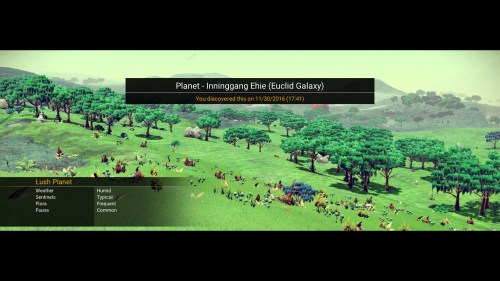
Hallifax Bender in Glenumbra

Recently I’ve been participating in the beta testing for the forthcoming and much anticipated Elder Scrolls Online MMO. Until now all players have signed non-disclosure agreements and hence it has not been possible to write a review of the game, post screenshots, or divulge any information about the game whatsoever. The e-mail I received last Wednesday, inviting me back to join the beta testing on the coming weekend, contained the following piece of good news:

We encourage you to post the best screenshots and videos from your adventure! You’re not required to follow a Non-Disclosure Agreement during this test, so share your favorite moments with the world.

Hence, I should like to take advantage of that opportunity and offer a preliminary review of the game.

First things first, overall, it is a marvellous piece of work. Though not devoid of flaws nor perfect in its design, the game exudes an impression of high quality and polish throughout; in its appearance, its sound, the level of detail that has gone into what appears to be a truly vast world, and, perhaps most surprisingly for an MMO, its narratives. The storylines might not all be that original, nor have that much depth and complexity, yet whereas in some MMOs narrative functions much the same way as it does in porn – a contrived and shallow shoehorn to the action – in the Elder Scrolls Online (hereafter ESO) it is more than window dressing.

Screenshot_20140210_223352

The quests all contain elements familiar to fantasy RPG players, and indeed, to those of the Elder Scrolls games. There are collections and fetch and carry missions aplenty, yet these are almost always couched in a rather more engaging and at times surprising story-line.

Screenshot_20140301_114906

Rarely did the process of completing quests feel like a chore; they were well-paced and not unnecessarily gratuitous with their objectives – rather than collecting 20 of something, in the Elder Scrolls Online, it is far more likely to be 4, and that process is, most often, not overly frustrating.

Screenshot_20140303_105749

This is not to say that the questing in ESO is merely adequate, for much of it is highly entertaining and quite moreish. At times the questing has a fantastic playfulness about it – like being asked to follow a firefly around as it leads to quest objectives, or that old Elder Scrolls staple – follow the barking dog.

Screenshot_20140302_182411

The game offers sufficient variation in its quest objectives to avoid the taint of grinding. It was difficult, once engaged, to step away from the keyboard. Often the quests reveal themselves to be part of a considerably longer chain, which has many chapters and relates to larger events in the world around the player. In Glenumbra, what began in one town as a mission to flush out werewolves masquerading as refugees from the recently captured city of Camlorn to the north, turned into a full-blown assault, first to retake the siege camp outside Camlorn, and then the city itself.

Screenshot_20140302_013739

Fans of Oblivion will see many similarities between this and the recapture of Kvatch, though minus Oblivion gates and daedra. In ESO, it is often rollickingly good fun pursuing these quests, in part because they have the power to reshape the world around you.

Screenshot_20140303_125937

Screenshot_20140302_025003

Screenshot_20140303_130629

The quests also work very intuitively in most cases, and make life considerably easier by ensuring that the next step is, much of the time, close to the last on the map. Thus, one rarely has to traipse across half the world in order to advance the story. Often the quest giver or an ally of theirs will appear after a quest objective has been completed, not only saving the player a return journey, but giving those in need of help a more dynamic role in the action. At times the player might be joined by an NPC both to guide and assist them, providing useful back up. This can make the storyline rather too convenient, which can rob it of the same intense immersion a lengthy Skyrim journey might entail, yet, in MMOs, the pace of the game is usually more frantic anyway and mostly it was a relief that quest objectives were not too obscure – though at times they were bugged. But hey, it’s Beta.

Screenshot_20140210_223124

The game begins in Coldharbour, one of the planes of Oblivion and the realm of Molag Bal.

The official description from the wiki informs any would be visitors that Coldharbour “resembles… Nirn, but the ground is nothing more than sludge; the sky constantly burns, and yet the air is beyond freezing.” It goes on to paint an even grimmer picture, and in the game, Coldharbour wears a suitably grim palette.

Screenshot_20140302_140817

I rather forget exactly how and why players have wound up in this awful place, suffice to say that somehow or other they died and have had their soul taken, along with thousands of others known as the soulshriven. The game basically begins with an escape aided by a mysterious man called the prophet and a very tall woman with the appropriate name of Lyris Titanborn. It’s not the most satisfying start, but it takes little more than ten minutes and could probably be zerged in about five by someone keen to get through it. Still, it serves its purpose of introducing basic gameplay, orienting the player, and kickstarting a story that gradually becomes more interesting. The run through Coldharbour likely won’t wow you, so don’t be put off, though it finishes in a splendid set – endowed with a kind of monstrous industrial chic.

Screenshot_20140302_141226

Screenshot_20140302_141355

Screenshot_20140302_141621

Screenshot_20140302_141314

From here one is able to go through a portal to Tamriel, where the game begins in earnest.

Screenshot_20140208_114917

Character generation takes as long as one is fussy about appearance, which in my case, can be as much as an hour. The menus offer a deceptively sumptuous array of customisation options – I say deceptively because it is impossible in most cases to change the base model of most features – eyes, nose, mouth etc – only to tweak a set model. Somehow this ends up making all the female Bretons and Nords look like glamorous Russian tourists, whilst everyone else looks like they come from the same family, within the bounds of their race.

Screenshot_20140302_135532

Screenshot_20140302_025201

Screenshot_20140209_134810

Rather like the many passport photos of Mr Nice, one can see the same person underneath that facial tattoo, hair style, accessory and facial hair option. All the same, so far as the face is concerned, the initial tweaking of the base model is a curious system, which works by choosing a point inside a triangle with Heroic at the top, and Soft and Angular on the bottom left and right respectively.

Screenshot_20140303_011250

Screenshot_20140209_232747

It’s a similar graphic for body size, though with muscular at the top, and large and thin at the bottom. Proximity to these particular points will adjust the features accordingly, which certainly does allow for a fair range of possibilities – yet again, always starting from the same base. It’s nice that they allow the player to adjust body shape and size to the point of being very short, tall, slender or rather corpulent. Most people veer towards the slim and muscular in build, but I did spot the odd fat and bald toon doing the rounds, which at least adds another dimension.

Screenshot_20140210_014229

Screenshot_20140210_015759

The hair styles are done wonderfully well, but again the range soon comes to feel limited, after an initial impression of abundance. I’m sure these will expand given time, and the existing styles are more than satisfactory, though the adjustable hair-length toggle is absent. Similarly with tattoos and facial markings – after a while, they all become very familiar, but it is fun to experiment. I was surprised by the complexity of the ear menu, which allows one to adjust the “ear-tip flare” – whether or not they stick out. It’s nice to be able to pin one’s ears back, or adjust the tilt of the smile for that matter, yet I would rather have been able to choose from a range of different mouth models than commence with the aforementioned Russian pout.

Screenshot_20140302_013423

Elder Scrolls Online offers the standard array of races familiar to most players. There are presently nine races available for selection, with the tenth, as yet un-activated slot being held by Imperials. The only difference in ESO is that the races have been divided into three separate factions: the Ebonheart Pact, which includes the Nords, Dark Elves (Dunmer) and Nords, and who are located in the provinces of Skyrim, Morrowind and Black Marsh; the Aldmeri Dominion, consisting of the High Elves (Altmer), Wood Elves (Bosmer) and Khajiit, in the Summerset Isles, Valenwood and Elseweyr; and the Daggerfall Covenant, including the Bretons, Orcs (Orsimer) and the Redguard in the regions of High Rock, Orsinium and Hammerfell. Each of these races has a different start area, to which they journey upon leaving Coldharbour, in accordance with the above groupings, though each race is free to choose from any of the four available classes.

Screenshot_20140301_112032

At this stage in Elder Scrolls Online there are only four class choices available: The Templar, Nightblade, Sorcerer and Dragon Knight. These, however, are designed to work flexibly with other build choices the character might choose to make, such as fighting style, types of armour, attribute and skill allocations, and other, perhaps more cosmetic choices. The Elder Scrolls series has always been famous for the degree of freedom players have in choosing the paths they take and the types of skills, powers and abilities they wield. ESO has limited that freedom significantly. It is not possible, for example, simply to learn a spell from any school – within skill level limitations – and cast it, indeed, it doesn’t seem possible to learn spells other than through levelling and selecting abilities. Only the Templar class has access to the restoration school initially, which sets them up as the only true healers in game, though I can’t say at this stage whether or not other classes can acquire access to this school or heal effectively through other means.

Screenshot_20140301_121436

My principal gripe with the game’s design is on account of the number of limitations that are placed on a player’s freedom of movement with character paths and their freedom to vary their weapon and ability choices easily. Firstly, there are no hotbars – or rather, there is one, though it functions by hitting the related numerical key, rather than via mousing. This admittedly makes for a less cluttered interface and improves the aesthetic of the game by limiting on-screen distractions from the visuals, yet it also robs the player of any real chance of indulging in what Elder Scrolls games have traditionally done best – allowing them to use as many skills, spells, effects etc as possible. Yes, there were no onscreen hotbars in Skyrim or Oblivion, but this was mitigated by the fact that during gameplay one could simply press TAB to pause the game and select an item or effect from the inventory or relevant directory – known spells, for instance. Or, if one was quick enough, it could be done live through the favourites list – enabling a player quickly to select an ability or item not presently hoy-keyed. There is, however, no opportunity to pause in a live MMO, and the favourites menu has been replaced by a clunky radial one. By level 6, my character already had more spells and abilities than I could set in the mere five places available, making the extra skills as good as redundant, since it was neither convenient nor desirable to keep switching those allocations.

Screenshot_20140302_232953

The lack of hotbars is also unfortunate in that it takes away much of the pleasure of being high level and having a seemingly vast array of curious abilities ready to deploy given the right situation. In Dungeons & Dragons Online a high level wizard might have 35 odd spells with a wide array of effects at their disposal, all within a mouse click, and ten of the most prominent available on a command hotbar. In ESO, until 15th level, it is only possible to have one weapon style set, and it is not at all convenient or easy to change this during a combat situation. What this means is that I cannot use my bow at range and then quickly switch to a melee weapon when the enemy draws near. Nor is it possible to switch weapons in combat with any ease. Thus, it is not possible to begin whacking something with a two-handed weapon, then switch to sword and shield for improved defence, without copping it sweet for a bit while fiddling in your inventory and interface.

Screenshot_20140303_005310

At level 15, a further weapon set becomes available, opening up another 5 hotkeys in effect, yet this still limits the player to a mere two weapon combinations, and, whichever weapon they equip, the player still only has space to set five abilities in conjunction with that weapon set. Are we really going to be using only five spells or special attacks for almost the entire game, despite potentially knowing many more? Will there only be two weapon sets available, or will it be possible to have three or four eventually? Is it really not possible, as in Skyrim, to begin with ranged, dual-wield in close combat, then switch to one-handed and shield should the situation require it? It’s frustrating, because this flexibility has always been a staple of Elder Scrolls games and it makes one’s character seem far less free to evolve down a variety of paths.

Screenshot_20140302_174003

On the subject of fighting styles, characters are welcome to choose freely which combinations they wish to use: two handed, dual wielding, one-handed and shield, bow, restoration staff and destruction staff. Each of these weapon styles has its own skill line with special attacks and abilities related to that weapon type. As many of the special attacks require the player to have that weapon set equipped, this further hampers the ability to switch in a combat situation, as even should one equip one’s bow, for example, the dual-wield attacks will still be the ones hot-keyed. As mentioned above, level 15 allows another weapon set, but this still seems an unfortunate hindrance in freedom of choice and movement.

Screenshot_20140302_030311

There are also issues with quickly using inventory items. Without hotbars, the only option for accessing potions during combat seems to be through hitting Q and bringing up a radial menu on which a range of inventory items can be accessed. Whichever one was last chosen remains as the set option, so a quick hit of the q key will use whatever it is, whereas holding the key will bring up the menu and allow the player to choose another option. The problem is that it’s not really easy, natural or intuitive to use in a combat situation as one cannot steer simultaneously, and, if you think about it, the only time you’re really desperately going through your inventory in a combat situation is when you are in trouble, need a quick fix, and need to put some distance between you and your opponent. How much easier to keep your finger on the w key and run like hell, whilst easily navigating the mouse to a hotbar. If it is the existence of consoles that have brought this about, then I have only one thing to say: Stuff consoles, they really destroy complex games. Can we have a PC version?

Screenshot_20140302_013047

Either way, I don’t really see the point in imposing so many limits on character progression and development. Is it kow-towing to consoles, or just good old fashioned dumbing down? Surely it’s not to do with balance, because, if anything, players who spread their skills more widely are likely to end up jacks-of-all-trades and masters of none, which will in effect gimp them rather than overpowering them.

Stealth also seems rather mysteriously absent in any sophisticated way. Anyone can use it, but I found no evidence of any existing skill-line, even in the Nightblade character class. If this is an omission, then it’s sure to annoy a lot of players who wish primarily to play stealth-based characters. Sure, there are stealth-style attacks and an invisibility spell, but no obvious means of judging your move silently and hide in shadows kinda capability nor improving it. I often crept past enemies, but the only factor that seemed relevant was proximity.

Screenshot_20140302_023735

Screenshot_20140302_023553

This is very much a wait and see situation, though at first glance, stealth appears to have either been massively simplified or utterly neglected. I admit that I may well be missing something, but I did test-run a Nightblade to see what skill lines were in fact available. Perhaps one can join the thieves guild, which might open up another skill line as joining any guild will do in ESO.

Returning to the subject of character generation, each class in ESO has three different skill lines in which further skills and abilities become available as the player’s skill level increases. As in other Elder Scrolls games, using a skill is the key to improving it, and one’s spells and special attacks become increasingly powerful as the skill level goes up.

Screenshot_20140302_020700

At certain points, it is possible to upgrade an already selected ability, a process which usually adds a further effect to that attack or spell. This might change a spell from a single-target spell to an area of effect, or add a snare effect to a melee attack, for example. It’s satisfying to upgrade one’s abilities, yet I wonder if this is compensation for the fact that so few can be allocated to hotkeys – a deceptive kind of progress in that you’re still using the same ability in effect.

Depending on which faction the player’s race comes from, they will journey to one of three different starter areas – Stros M’Kai, Khenarthi’s Roost and Bleakrock, all of which are islands.

Screenshot_20140302_172946

Screenshot_20140208_104807

In each case the game rather cleverly ensures that players must first complete a starter quest to get off the island and progress to the mainland, where they will have much more freedom of movement. Though there are options to cut this process short and clear out early, most new players should benefit from the training, levelling and loot. Each of the islands is relatively large and offers a variety of quest options for fresh characters to cut their teeth. Perhaps inevitably, there are some naff moments, yet it all moves along at a pleasant clip and many of the interactions are surprisingly good fun. New players are bound to experience that mix of curiosity and frustration that comes from not knowing the lie of the land. It is nigh impossible to know from the start what to keep and what to discard, what the numbers really signify and which class options will prove wisest in the long-run, but such is the case for noobs in any game.

Screenshot_20140302_142527

One thing I do really like about this game is the music. It is subtle and un-intrusive, adding huge amounts of new material to rehashes of previous Elder Scrolls scores, without pandering to the loud, brash battle brass, combat percussion and heavy-handed strings of some fantasy soundtracks, nor the overly saccharine and jaunty medievalism which too often prevails. Indeed, so pleasingly subtle and atmospheric was the ESO soundtrack, that at times I forgot that I hadn’t done what I used to do playing Dungeons and Dragons Online and put on Brian Eno.

Screenshot_20140302_173732

On the subject of sound, did I mention that every single line of dialogue from NPCs is voiced? It is a fine example of the level of detail ESO, at its best, has to offer.  The fact that many of the voices are familiar – clearly some of the same voice artists have been used who worked on Oblivion and Skyrim – links this game more closely with its single-player foundations. It is wonderfully familiar in places, whilst being excitingly new and different. One of the NPCs encountered in the starter area of Coldharbour, an elderly chap with a saucepan on his head called Cadwell, has been voiced by John Cleese.

Screenshot_20140302_140700

I’m unaware of any other famous actors participating – no evidence that Patrick Stewart is back for this one – but either way, the quality of the voice work is solid throughout. The dialogue, it is not badly written, if one accepts how genred this type of natter must necessarily be. There are a number of entertaining characters with recurring appearances in the opening stages, who help to guide the player through the early quests in what amounts to a continuation of the rather light-touch tutorial.

Jakarn, the loveable rogue...

The Prophet

Females and males are drawn equally well, and whilst archetypes abound, they often buck the trend. One thing I’ve always admired about Elder Scrolls games is the level of gender equality and liberal attitudes in their worlds – there are equal numbers of powerful, clever and successful women, sexism and racism are frowned upon and only occur in villainous types, and gender does not restrict the roles characters play.

Screenshot_20140210_235134

Screenshot_20140209_235757

Screenshot_20140209_132659

You are just as likely to be led into battle by a female sergeant as a male. The Elder Scrolls games have always flirted with adult pretensions and ESO doesn’t shy from occasional innuendo and suggestion.

Screenshot_20140209_133515

Graphically, bearing in mind that this is an MMO, which usually sacrifice texture and model detail to the need for high frame rates, ESO looks impressive. On the Elder Scrolls scale of visual excellence, it lies somewhere between vanilla Oblivion and Skyrim. Yet, perhaps it’s the light or palette, or the styling of the characters and objects, but it is a step down from the immersive realism of Skyrim. The environment does not feel as tactile or gritty, the winds don’t blow so cold, nor does it rain so hard, yet ESO presents some wonderful vistas and atmospheres.

Screenshot_20140302_031038

Screenshot_20140208_225204

Screenshot_20140210_005218

Screenshot_20140303_010633

Screenshot_20140302_174253

Screenshot_20140302_235224

Screenshot_20140209_123521

Screenshot_20140210_234901

Screenshot_20140210_001607

Screenshot_20140303_103746

Screenshot_20140302_013843

Screenshot_20140210_013318

Screenshot_20140302_003702

Screenshot_20140209_133331

Screenshot_20140302_184139

Your jaw might not drop, but now and then your heart will fill with that curious yearning to truly be in this world – to watch the sun set through the rainy forest, or stroll on the beach, staring across the glittering sand to the distant horizon. It has genuine atmosphere, and is pleasing enough on the eye. There are also attractive, water-colour style transition screens when entering new areas or important quest locations.

Screenshot_20140209_232645

Screenshot_20140302_235125

Screenshot_20140211_113916

Screenshot_20140303_133424

Screenshot_20140210_013012

Screenshot_20140210_235811

Screenshot_20140210_004852

Screenshot_20140210_023303

Screenshot_20140303_121007

Movement in the game flows very well and seems smooth at the best of times, though the over-pitched running style of the characters means that, in motion, they all seem to be mimicking running, as a mime might do whilst standing still, rather than actually running. I was disappointed by how this looks, especially after Skyrim did such an excellent job of implementing sprinting with such a visceral, tactile feel to it, even if it could make female characters run in a rather masculine style.

Screenshot_20140208_220702

Frame rates during play were always extremely high, even with the graphics maxed and a huge number of players and enemies present in an instance. Though I didn’t measure frame-rates, I never once had stuttering or lag and everything flowed with a most satisfying fluidity. This may well be due to having recently built a new top-shelf rig to cope with Rome Total War 2, but either way, it bodes well for performance on servers that will no doubt be packed. Despite occasional crashes of either the interface or the game itself, log in times were certainly far superior on this second Beta than the last, during which I had to queue to get on the server. Hopefully the game will continue to run with such smoothness.

There’s much more that could be said here about crafting, guilds, travel and questing, but it would be too exhausting to go into such detail, so I’ll say just a few words. One can of course collect reagents and raw materials for make potions, weapons and armour, though from my efforts so far, it appears to be a long and potentially painful road to skilling up sufficiently to make truly powerful items.

Screenshot_20140303_101725

Screenshot_20140210_234636

Screenshot_20140301_115240

Screenshot_20140302_184305

Screenshot_20140302_032407

Screenshot_20140301_111508

Screenshot_20140302_183825

Mounts are available to purchase, though these will remain out of the price range of all new players, unless financed by an alt or given a hand-out. Fast travel can be used in game at an initially not insignificant cost, though this can only transport the player between way-shrines, which act as teleport points.

Screenshot_20140303_015729

Screenshot_20140303_134004

As mentioned above, players can join game-world guilds such as the mages’ and fighters’ guilds which open up new skill lines for players to invest their points in, and I believe it is possible to belong to five at any given time. It is, of course, possible to players to join player-founded guilds and these have already begun to spring up in ESO.

No doubt like all MMOs, much activity in this game will eventually revolve around the auction house. This was not up and running as yet, to my knowledge, and it will no doubt take some time before market forces combine with game mechanics to set a price on things. Once the economy gets off the ground, I’m sure it will create a whole new range of objectives for players to pursue. There’s nothing like getting rich quick in an MMO once you know how to farm a rare and valuable reagent, for example.

As the wiki points out, the Elder Scrolls Online is set “roughly 1,000 years before the events in The Elder Scrolls V: Skyrim and the coming of the Dragonborn, and just before the rise of Tiber Septim, the first Emperor of Tamriel. Three Alliances have emerged across the continent, each struggling for supremacy over the land. As these great powers battle one another for control of the ImperialCity – and with it all of Tamriel – darker forces are moving to destroy the world.”

Map of Tamriel

This provides the overarching narrative of the game, which drives the world’s dynamics. Rather like the factions in World of Warcraft, each has their own realms in which to operate, though in this case, the three factions surround the central province of Cyrodiil. To my understanding, Cyrodiil in effect acts as a central battleground. Not having been there, nor looked into it closely, I know little about it, but believe that the entire province is PvP, whereas the rest of the game is not, and that players can not only engage in personal battles, but large scale sieges and raids. I’ve never been much of a fan of PvP, largely because it is the cause of some of the worst trolling imaginable. As much as I love grouping and co-operating with teamwork, I prefer to do this in a PvE environment. Maybe that’s lame, and I do hope ESO might make PvP a more attractive proposition. Yet again, it’s a wait and see situation. Having experienced all too much stupidity in the public Zone Chat window, I’m not feeling especially hopeful about how this community will turn out. Still, it’s always possible to find good people, especially when so many are likely to participate in ESO.

Screenshot_20140303_105536

On that front, it did get rather frustrating seeing how petty and troll-like much of the chatter was. Indeed, the vast majority of conversations seemed endlessly to recycle the same tiresome whinge about the cost of the game and the subscription price. My advice to anyone new to the game is to learn, as soon as possible, how to switch off the Zone chat so you don’t need to listen to a bunch of peasants complaining about spending all of, wait for it, fifteen dollars a month. It’s less than a movie ticket, less than an hour’s pay in a crap job, less than lunch – once a month – and yet this was all people seemed capable of talking about as though they were being asked to mortgage their future. Of course, with an MMO, you do mortgage your future, but its time not money on the line. Unfortunately, it distracted the conversation from far more important and relevant discussions such as the nature of the interface, the problems caused by having open instances and the like.

Screenshot_20140209_235154

The open instances of the game are, I think, its major design flaw. Most of the quests take place in public instances – there is no division between what the player is pursuing and what other players are pursuing, even if they are not grouped. This hugely spoils the pleasure of the game as one can never be free of other players trying to achieve the same goals. In almost all of the quests I ran in the early stages, I would, for example, enter the hold of a ship just as some other, unconnected players killed the very enemies I had come to destroy. Because I was in the same space at the same time, I would get quest completion, merely for turning up. There was no chance to use stealth, face any sort of challenge, or just enjoy the idea that I had been entrusted with this quest and was the one who had to carry it through. This would be less of a problem in an empty server, but it should not be such a problem on a busy one. In one quest, there were almost twenty other players in the same room, doing the same quest – I didn’t even have a single fight – everything was killed before I could even get to it. Where, I ask, is the fun in that?

Very busy indeed

Yet this is not merely a problem from an immersion / enjoyment point of view. In some cases, if I missed the moment when other players killed enemies who were necessary for completion, I had to stand around waiting for them to respawn, something which, though it may have been bugged, seemed to take forever. It also causes what I consider to be a serious imbalance in the opening scenes on Coldharbour – and a major source of irritation elsewhere. If other players have already looted the contents of containers – crates, sacks etc, then there is nothing there for anyone else who enters the instance. As a consequence of this, it is possible to come out of Coldharbour with the two extremes of an almost completely full inventory, brimming with armour and weapon crafting styles and recipes, reagents, potions, some extra gold etc – or absolutely nothing at all except the rags on your back and the crappy weapons pulled from the starter rack.

Somebody say "inventory?"

Players who bother to stop and search the utterly ludicrous (and this is not mere hyberbole) number of containers, should be rewarded for this, not find them all previously looted and entirely empty. On one character I acquired a range of recipes and crafting knowledge that my other players did not get – because all the crates were looted – and have not found since.

I really don’t see the point of making these areas public, or at least, quite so public. If the player enters a cave, mine, dungeon, building, ship, tomb or whatever, why not just lock that instance off to other players who are not grouped with the protagonist? This works perfectly well in Dungeons & Dragons Online, ensuring that the player or group and only those people are involved in completing that particular quest in their own private instance.

Not grouped, but still in it together

It seems rather stupid when you sneak into a building, excited about the chance of using some clever combat tactics, when another couple of players rush past you swinging swords and start killing the very people you were about to surprise. There’s little point emphasising the story and role-play elements, if you then completely trash the way that story plays out. The game loses all its immersion and gravitas and really, how many times can I say this, it is no fun at all when there is nothing to do and a quest completion is achieved without even a single fight or challenge. The one positive in all this is that sometimes when a boss is too difficult a fight, one can casually wait for another individual or group to show up, and then fight with these instant allies – without having to group at all.

Screenshot_20140303_013252

Despite these issues, some of which I think might ultimately annoy me greatly, I still found the game to be utterly compelling. It was fun to explore the world, the questing was enjoyable, surprising and amusing and the look and scope of the game promise hours of discovery.

Screenshot_20140302_175241

Combat was fun, if potentially repetitive, and whilst I only grouped in a relatively limited capacity and spent most of the time soloing, I did get the sense that this would be a cracking game to explore with other likeminded players. There are definitely issues that need to be ironed out, and quite a number of quests are chain-breakingly bugged – bugs which in some cases persisted from the previous beta. I’m sure these will be ironed out, though as stated above, it is more the fundamental mechanics of the game that concern me. Something tells me that despite all the whinging about cost, some of which is fair comment, but most of which seems like mean-spirited bitterness, this game is going to be a huge success. Whether it can rise to rival the global scale of World of Warcraft remains to be seen, but it certainly seems a worthy rival and I doubt ESO will tank in quite the same way that Conan did.

MMOs are perhaps best judged a year or two into their existence, as most worlds take a while to mature and iron out internal issues such as balance.

Screenshot_20140210_004006

With relatively limited experience of it so far, it’s difficult to predict what issues might hamper ESO or deter players, but I’m sure some will arise in due course. The game’s stamina will depend upon its ability to fix any problems that arise, and I’d like to think they’ll ultimately get it right. If it is still buggy on release, or you feel a little under-whelmed by the opening sequences, stick with it. There is plenty of fun to be had and I believe this will prove an eventual winner.

Screenshot_20140302_025258

Screenshot_20140211_000255

Screenshot_20140303_121652

Screenshot_20140302_182821

Screenshot_20140302_124834

Screenshot_20140211_121351

Screenshot_20140210_235052

Screenshot_20140210_235503

Screenshot_20140210_144049

Screenshot_20140302_175423

Screenshot_20140210_150013

Screenshot_20140302_175625

Screenshot_20140302_234615

Screenshot_20140302_175801

Screenshot_20140303_010145

Screenshot_20140210_013739

Screenshot_20140210_014149

Screenshot_20140302_030753

Screenshot_20140303_020856

Read Full Post »
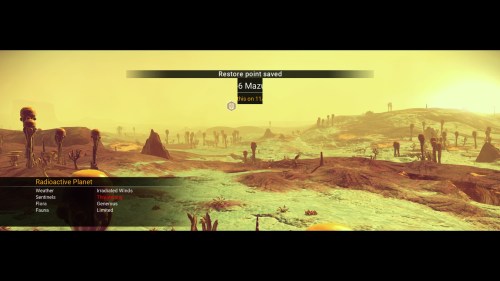
Buying Rome Total War II never quite seemed inevitable. I had followed its development with interest, but in truth, my brother was far more pumped about it than I was. When I told him I was off to Greece on the 12th of September this year, he replied; “Bro, the only important date in September is the third – the release of Rome Total War 2.”

Considering how much I’d enjoyed the first instalment of this game, released almost ten years ago in 2004, it was likely only a matter of time before I got hold of its long-awaited successor. There was, however, one significant hurdle to get over – the need to upgrade. For, Rome Total War II promised not only to be an amazing feat of game engineering, mechanical, tactical, strategic and graphical magic, but also to demand a nigh impossible amount from processors. I thought I might get away with my 3.33 gig E8600 dual core processor, having recently upgraded my graphics card to a GTX670. Yet when my brother and I first fired up the game a few days after its release, it was very soon apparent that a whole new rig was required to run this baby.

Sure, the graphics are difficult enough to render – after all, the “Extreme” settings really are quite extreme – but rather the problem lies with the sheer number of simultaneous calculations that the processor is expected to make. Upgrading your video card is unlikely to help, unless you already sport a top-shelf processor. So, sure enough, when I returned from overseas in October, I splurged and built a new computer from scratch, hopefully future-proofing myself for at least another couple of years by using top-shelf kit.

The good news is, it was worth the effort. When running at the highest settings, Rome Total War 2 looks stunning. The campaign map is captivatingly exotic across the many different regions of Europe, north Africa and the Middle East. The clouds and birds of prey which fly across the lush grasslands, snowy peaks, river deltas, dry deserts and rippling seas, give life to this world in a box.

2013-11-03_00013

2013-11-09_00011

The various other maps – diplomatic, strategic, economic, etc, are all tastefully rendered in a mix of the charmingly decorative and simply pragmatic.

2013-11-29_00025

The unit icons borrow from Athenian black-figure ware, and the small pop-up illustrations that accompany news and events are evocatively reminiscent of the best card-game art out there.

2013-11-17_00003

2013-11-18_00005

2013-10-31_00005

The factional icons are wonderfully done – colourful and curious, their rapid cycling at the top of the screen between turns can be quite mesmerising.

Yet it is at the ground level that the game’s appearance truly excels. The quality of the individual figures in each unit is not merely due to the high grade textures and meshes, along with, at times, perfectly fluid and natural movement, it is in their genuine individuality. Each soldier is, in fact, an individual – generated from a wide set of randomised features – face-shape, hair, facial hair etc. In some cases, for example, Greek phalanxes, the soldiers carry a wide variety of shield designs – sporting decorative emblems randomised from a large pool.

2013-11-03_00011

2013-11-19_00010

2013-10-20_00010

2013-10-16_00007

2013-10-09_00002

The landscapes are also magnificent; with highly detailed vegetation and attractive and immersive weather effects and lighting. The old option of of waiting for the weather to change when attacking is still present, yet when attacked, the aggressor gets to choose the timing of the battle. Despite its negative effects on the range of missiles, fatigue and cavalry movement speed, fighting in rain is quite glorious to behold, yet the most beautiful conditions I’ve yet witnessed is immediately after a storm. The game captures that peculiar, electrically-charged storm light perfectly.

2013-10-23_00022

2013-11-04_00005

2013-11-17_00004

2013-10-31_00002

2013-11-18_00012

2013-11-07_00009

2013-11-13_00003

2013-11-07_00020

The water looks great in the campaign map, yet it enters a whole new realm of beauty in the battle-maps. This, combined with the attention to detail given to the ships, makes naval manoeuvres beautiful to behold.  Rome Total War II also allows for battles combining naval and land units, and any coastal town is vulnerable to attack from the sea. When attacking a town solely with a fleet, it is necessary to beach the ships and have the units disembark. Clicking on the unit camera icon allows one to ride with the ships towards the shore, something well worth doing at least once or twice for the sake of immersion. From hereon, the units are used in exactly the same way as land-units, yet cannot return to their ships during the battle. Naval units are typically half the size of land units, though special assault ships can be recruited which contain full-sized units. When defending a town with a fleet, or using a naval garrison, the units begin on the ships and can then either be used as ships – to attack any enemy ships – or the ships can be beached and the unit used as a land unit to defend the town.

2013-11-20_00007

2013-11-21_00005

2013-11-21_00006

2013-11-21_00007

2013-11-21_00008

It is not only dedicated naval units that can make assaults in this fashion. Any army can turn itself into a fleet – effectively boarding transports – simply by moving onto the water. These ships will, however, be dangerously exposed unless protected by another fleet or used in an area where no enemy fleets are present. When attacking a coastal city in such a manner, the ships simply need to be beached in order to get the troops ashore. All in all, the co-ordination of land and sea forces in this manner is one of the greatest aspects of the game. It not only adds immensely to gameplay variety, but also to immersiveness.

2013-10-27_00014

2013-10-31_00037

Immersiveness is one of the game’s great attractions. It operates on two levels – the intense desire to keep playing the strategic game – known all too well to Civilization addicts as “just one more move syndrome” – and the ability to get right in amongst it with the troops. The different perspectives one can explore by selecting different units around the battlefield, the views and angles this offers, makes the game experience extremely cinematic. There’s nothing I love more than, at the end of a battle, taking the time to line up my remaining troops for a victory celebration, then ride past in first person mode, watching them cheer. If you let yourself go with this game, it can be very rewarding.

2013-10-16_00011

2013-10-29_00006

2013-10-26_00008

2013-10-22_00054

2013-11-03_00010

2013-10-22_00014

2013-11-24_00015

Having come to this game pretty much directly from Rome Total War I, with a detour via Medieval II, this was my first experience of the new Total War system for maintaining armies, significantly different from the first iteration. Rather than raising troops in cities and moving them about at will, units can now only be raised by generals. They can, however, be raised anywhere inside friendly territory, provided some kind of military building exists in that province to allow units to be recruited. This makes raising units a lot more convenient in some regards, though it can be a problem if an army is needed and no general is in the vicinity. Another great new innovation is the system of troop replenishment. Rather than having to move units into cities capable of producing a particular unit variety to restock the unit, once built, units of any kind will simply replenish their numbers when inside friendly territory, including the territory of military allies, client states and satrapies. This takes a lot of irritating fiddliness out of managing armies.

2013-10-29_00003

One major change is that number of armies and fleets that can be raised is now limited. This begins at 3 and increases incrementally as your faction’s Imperium increases. A recent patch changed the rate at which new armies become available, but the restrictions do make it more difficult to manage large empires. In my current campaign, in which for the first time I’m actually playing the Romans, I control a total of 42 regions, yet am only allowed to field 8 armies. This can make managing a large empire rather complex, especially when there are several frontiers that require defence or attack.

2013-11-25_00001

This limitation on the number of armies is compensated for by the garrison system. Each region now automatically provides a garrison determined by the size and type of town or city, and the other buildings present in that region. Smaller towns with fewer buildings provide smaller garrisons, often consisting of pretty low rent troops – mobs, javelin-men, etc, whilst the larger cities, especially the provincial capitals, can often have quite considerable garrisons, strengthened by better quality units. In the case of coastal towns, naval garrisons are also provided.

2013-11-24_00025

The garrisons are rarely sufficient to defend against a large invasion force, though this is made much easier in provincial capitals, all of which have city walls. The absence of walls in smaller towns has been roundly criticised and certainly makes defending those towns much more difficult, yet at times these garrisons can prove adequate if used well against a smaller foe. The regional garrison will also enter the field as reinforcements when an army is attacked in that region, and in such instances they can provide much needed assistance, sometimes with as many as 14 extra units – I’ve not yet seen larger.

2013-11-24_00030

As mentioned above, the campaign map itself is absolutely huge and beautiful to behold. It stretches from Bactria (Afghanistan) to Lusitania (Portugal) and from Caledonia (Scotland) to Garamantia (in the Sahara). It is divided into 173 regions, grouped into 57 provinces, each of which contains up to four regions, though some have as little as two. The regions can be conquered and controlled separately, but controlling an entire province confers the advantage of being able to pass edicts – providing bonuses such as increased happiness, growth, military recruitment, economic output etc.

2013-11-15_00008

The number of buildings that can be constructed is limited in most cases to four, with regional capitals having as many as six building slots available to them. These slots are not immediately available to a town, but more become available as growth in the province accumulates, providing an added incentive to sustain a good rate of growth. The benefits gained from each building are effective throughout the province and public order is determined on a province-wide basis, not on the basis of individual towns.

2013-11-16_00005

The amount of food available is also calculated on a province-wide basis, though the total food surplus accrues across one’s entire empire. This allows some provinces to maintain negative food production figures, with the overall surplus picking up the shortfall. If, however, total food surplus falls below zero, then those provinces which have negative food production will suffer first – both through civil disorder and military attrition. In other words, soldiers in armies and garrisons will begin deserting – a penalty also incurred by lack of funds.

As in all Total War games, successfully managing the economy is absolutely essential. My experience thus far has been that, alongside initial military and tactical challenges, the most important first step is to ensure that one’s regions are producing sufficient money and food to sustain development and expansion, as well as maintain existing forces and infrastructure.

Rome Total War II offers a mesmerising number of factions to encounter during play. In total, there are 117 different factions, each with their own unit roster and agenda. The initial game release offered eight playable factions, since which time six others have been made available for players.

2013-11-10_00001

The factions are divided into different cultural groups – Hellenistic, Roman, Barbarian and Eastern. These are then further subdivided into, for example, Germanic, Gallic and Britannic. The cultural status of a faction in part determines its relation to other factions. Though this is not necessarily a barrier to co-operation across cultural divides, it does often result in these groups acting as a bloc, when they aren’t busy fighting among themselves.

Many of the as-yet non-playable factions have been unlocked by modders, yet in such a form these lack the development and variety of the officially playable factions. The Romans offer an altogether different level of sophistication on account of their Auxiliary unit system. In a nutshell, the construction of an auxiliary barracks in a region can open up certain unique unit types specific only to that region: Auxiliary Persian archers, Balaeric slingers, Numidian skirmishers etc. This makes playing the Romans a great deal more fun as it allows the player to experience using a far wider variety of units – many of which are, in effect, the units available to the original faction whose land the Romans have occupied.

Unfortunately, however, the game is not without problems. The release of Rome Total War II immediately kicked-up a shit-storm of debate and protest about its relative merits and flaws. A quick look at the results on metacritic reveals as much about the mentality of gamers as it reflects the nature of the game. The reviewers’ metascore current sits at 76 out of 100, whilst the users’ metascore currently sits on 3.9 out of 10.

metacritic

Gamers tend to take pretty extreme positions and punish any perceived deviation from perfection. Here’s a sample of some of the comments, accompanied by scores:

On the day of release, and the week or so after this game was released. It was utterly broken. And while that is not acceptable. I am rating the game for how it stands right now as I type this. The game is now a title truly worthy of the Total War name. – 9

Horrible. Gameplay is extremely dumbed down, lack of family tree in campaign is obvious mistake and the greatest disapointment is the lack of online modes. Also, removing walls from cities is a horrible idea – 5

Just terrible. To purchase a full price game, pre-ordered I may add, and it’s clearly a beta test that other’s will benefit from our testing by buying it at half price 6 months away. The AI is bad. The FPS issues and graphics incompatibility issues (With a high end pc and gpu) are just ridiculous. The worst game release of the decade. Still not fixed! – 1

Really, I ask? Worst game release of the decade? That’s very harsh and not a reasonable reflection of its quality. As a teacher who regularly marks some pretty crappy homework, I can assure you that this game does not deserve 1 out of 10, or zero for that matter. Like an essay with some excellent paragraphs and evidence of strong analysis and interpretation, marred by a flawed overall structure, this deserves roughly 8 / 10 and would definitely score higher were it not for obvious issues with the campaign AI and the political faction system.

As to the official reviews, the reception has generally been favourable, but with reservations. PC Gamer gave the game 85%, praising the cinematic scale of the battles and attention to detail, calling them “stunning” and “the most marvellous moments of the fifty plus hours I’ve played so far”.

2013-10-16_00022

They were, however, critical of the apparent glitches on its initial release, including issues with the AI. Edge similarly praised the visuals and battles whilst criticising the bugs present on its release; “even as it topples, it’s glorious to look at, and to live through.” Daniel Starkey of GameSpot praised the variety of units and what it called “spectacular sound design and great attention to visual detail”. So far as the campaign was concerned, Game Revolution called the campaign map “a treat to look at” whilst praising the game’s  new features and depth, yet they were critical of the wait times between player and AI turns. Steve Butts of IGN complained that: “a single turn can take as much as 10 minutes… those little inconveniences add up. Don’t get me wrong; Rome II is a game worth savouring, but it also asks you to tolerate difficulties that don’t need to exist.”

2013-10-21_00005

There are other, perhaps more troubling issues with the game, most notably, the political system, which seems to bear little relationship to the rest of the game, besides offering an interface for keeping track of generals, admirals and statesmen and managing their retinues. Whilst one might pay close attention to the development and “levelling-up” of generals and dignitaries, there seems to be very little reason to focus on the degree of influence one’s faction currently maintains as it bears no impact on gameplay for the vast majority of the game. The only time it becomes relevant is when a civil war happens – something which seems to happen both spontaneously and rather randomly.

Indeed, there seems to be no way to avoid a civil war at some point during the campaign. Where the civil war happens in your empire is dictated by your level of influence on the faction list, yet gamers have noted that there is no mechanism by which to prevent it happening altogether. What essentially seems to happen is that one city will become an enemy faction and spawn a number of fleets and armies – all of 12 strength it seems – equivalent to the number controlled by the player. These will immediately fan out across the map and try to conquer as many cities as possible. The only real option is to crush them as quickly as possible – something made easier by the AIs apparent lack of common sense. When the civil war happened in one game, the AI immediately disbanded most of the units in most of its armies – perhaps some overcautious attempt to avoid bankruptcy in subsequent turns – rather than, for example, using them to attack the vulnerable nearby regions. It was a disappointing performance from what looked like being the most formidable challenge yet.

2013-11-09_00004

After a civil war has been crushed, the political system remains broken – in effect, it plays no further role. The game designers have made excuses about this – being forced to finish the game for an inflexible release date. Yet, the upshot of all this is that without some way in which to tie the player’s factional influence more closely to game-play, the whole political system seems irrelevant.

One of the biggest complaints about the game is that it has no family tree. I would like to add my voice to this complaint, as I did indeed love the family tree of Rome Total War I. The developers hastily pointed out to those complainants that all the other recent Total War products, like Shogun II and Napoleon, lacked a family tree. But many people appear to have transitioned straight from Rome Total War I, as I have done, and hence feel the absence more greatly.

What was wonderful about the family tree was how attached one could get to certain generals. In my longest and greatest campaign ever, I had a long line of succession, through six generations, of faction leaders coming from one branch of the family. This included what I always thought of as the “miracle child.” About three generations along, the only male heir in the line of succession not only developed the trait “impotent”, which greatly reduced his chances of having children, but married a woman ten years older than him and already in her late 30s. It wasnt until she was 48 years old that they finally had their first child – a son. The joy that it brought me at the time is embarrassing to admit, yet such it was. He went on to sire further generations.

2012-03-23_00049

2012-03-15_00010

The current system for managing one’s own faction lacks the same pleasure of continuity, though there is a new type of continuity to be found in the battle history of each army. As all armies must now be lead by generals and each army has its own name, the record sheet displays the history of that army’s campaigns – its commanders, their years of service and win / loss record. Beneath this it lists every battle that army fought and the outcome.

2013-11-24_00021

2013-11-17_00002

There are also significant problems with the AI, something most apparent on the campaign map. The decisions made by non-player factions are often bafflingly stupid and seemingly lack any sense of self-preservation. Often their armies and fleets flit about the board like chickens with their heads cut off, dashing this way and that on seemingly pointless ventures, and all the while, leaving their cities undefended or in a state of dire civil disorder. At times the AI nails it and mounts a challenging assault. At other times, one faction will clear out its orbital path, so to speak, knocking over a host of local rivals and building up an impressive empire, yet after the initial phase of expansion, they almost invariably fall into ruin through poor economic and military decisions, and then collapse altogether before another aggressor.

2013-11-22_00004

In every game I’ve played so far – when not playing as the Romans, both Rome and Carthage have capitulated early. Carthage have it tough as their empire is spread across north Africa, Southern Spain, Sicily and Sardinia, yet whereas this is perfectly manageable for a player, the AI gets it wrong every time. In the case of the Romans, having now played them and experienced how good their infantry is, I suspect the reason they always fail is that their cities do not produce a great deal of revenue early on, which makes funding expansion and maintaining territories more challenging than in some other factions.

2013-10-22_00058

Unfortunately, once past the initial phase of the game, whilst things might get hot on one frontier for a while, most enemies are relatively easily dealt with on account of their inability to maintain both forward attack and home defence.

Many have also complained about the battle AI, yet I find that in this regard the game is pretty sound. Troops are used far more wisely than in the past – missile units defended against cavalry with spearmen; when fighting more than one army, they often wait until they have joined before advancing – sensible decisions which make the battles more challenging and interesting. There are still some shockers, such as when a whole army sits in a town being peppered by missiles and doesn’t take any action in response, but much of the time, the AI uses its units relatively well.

2013-11-04_00002

Another area which the AI does get right is its use of agents. A faction may recruit a certain number of agents depending on their imperium – spies, dignitaries and champions. These can be used in various ways – to increase happiness and taxation, to carry out acts of sabotage or assassination, to cause military disruption, or to manipulate other agents. In this latter case it is possible to control more agents than one’s imperium would allow by way of recruitment. Getting enemy agents to defect is a useful and important way not only to increase your own capacity, but to decrease theirs.

2013-11-17_00012

2013-11-29_00023

 The diplomacy element of the game is certainly improved, yet many also have issues with this, largely on account of the way in which attitudes are calculated. Basically, attitudes are affected by cultural affiliation and past and present actions. Thus a war against one faction will cause a reduction in the level of friendliness of that enemy faction’s friends or allies, whilst simultaneously increasing your popularity with other enemies of your enemy. This is very incremental and increases or decreases with each action against or in favour of that faction. Personally, I don’t have a problem with the diplomacy screen and welcome the fact that, as in Civilization, once you have encountered another faction, they can be contacted at any time via the interface. My biggest gripe is that there is no option to request one faction to make peace with another – or am I missing something?

2013-11-27_00005

Despite all these ups and downs, many of which will, hopefully, be ironed out eventually in what seems already an endless succession of patches, this is an absolutely cracking game. Ignore those extreme reports of a game that is totally broken and focus on the fact that what they have essentially done is put the entire ancient Mediterranean world and its surrounds in a box. The complexity of the achievement is staggering, even if at times the complexity of the game-play seems underdone. Don’t expect it to be without some frustrations, but take the time to enjoy its attractions and become immersed. It’s easy after a while to become blasé about the battles and ignore them in favour of auto-resolve, yet my advice is to duck in there every so often and enjoy what really is the most fun part of the game. Rome Total War II is an epic game which creates its own epic narrative – a compelling story which emerges from this huge simulation.

2013-10-16_00025

2013-10-26_00005

2013-11-07_00004

2013-10-27_00007

2013-10-31_00057

2013-11-05_00003

2013-11-05_00020

2013-11-18_00017

2013-11-21_00003

2013-11-28_00011

Read Full Post »

For two years now I’ve been sitting on a half-finished continuation of my Confessions of an MMO Addict articles, which detailed (and yes, admittedly in quite arcane detail) my experience of playing the Massively Multiplayer Online Role-Playing Game (MMO) Dungeons and Dragons Online (DDO). The further in time I got from the experience itself, the less relevant and interesting it seemed to me. When last I left off in this series, I’d just returned from six weeks travelling around South East Asia. What lay ahead of me was an even more intense indulgence of my already dangerous gaming habit.

What follows is mostly from two years ago, with continuations. It is worth pointing out that I wrote this whole series with the idea in mind that I was creating both a personal account and a historical record. It might seem fanciful to imagine that my blog or its content will still be readable in, say, two hundred years time, or of interest to historians for that matter, but should it be the case, then it might prove insightful to anyone interested in the detail of game mechanics, online social habits and the psychological impact of online gaming. As someone with a PhD in history, I greatly appreciate the efforts of those who have made detailed records of their present in the past. It is for this reason that I included so much detail in these accounts. In several hundred years time this period will be seen as the time of earliest origins in an entertainment media – computer gaming – that is already well set to dominate the future as a means of narrative storytelling. If I can make some contribution that might furnish future history PhDs with primary source material, then I’ve to some degree justified my education : )


Confessions of an MMO Addict, Part VI

“God I’ve been asleep so long, I’ve been away

Back from software limbo the natives call today

I let their promises bind me

I let seductive logic blind me

I embraced a machine, I went through the routine,

And I hid from the people who were trying to find me.”

– The Church, Tantalised


I had hoped that my holiday to South East Asia would help me kick the Dungeons & Dragons Online habit, but I returned to Sydney a desperate junkie. My travelling EEE PC, bless him, had struggled to render the game at all and I had been forced to play solo, with the sound off and graphics turned down to minimum. All I could manage was to farm low-level dungeons on the easiest level for collectables, to buy and sell from the brokers and thus make money on the auction house. It had, in reality, been the very worst sort of grinding, but it kept me going on those heavy hotel-room nights on the road. I couldn’t wait to get back to my desktop, log in, team up with some random bunch of heroes and play the game on full specs in magnificent wide-screen. My New Years resolution had been 1680 x 1050 and I was aching to go from the grind to the grandeur.

Sadly, my return to Sydney also marked the end of my relationship with S. I hadn’t exactly been the best companion much of the time and I was, quite rightly, let go, so to speak. I was a terribly sad way to end things, though it was at least amicable. I was left feeling pretty awful all round – not entirely enamoured with myself. What, however, was most alarming, was that I didn’t really mind all that much. I was used to being mildly unhappy and at something of a low ebb. Nor did my response have much to do with S herself, but it was all about my being so utterly consumed by the game. Without a partner in real life and working part time, I was almost entirely free to game at will.

When I hadn’t been playing the game during my trip, I’d spent my spare time using the DDO Character Planner to experiment with multi-class character builds so I might build these characters upon my return. Now that I was back, however, I realised that my first priority must be to take Hallifax Bender, my long-standing stalwart bard hero and favourite alter-ego, to level 16, the then level cap.

This target was really part and parcel of a grander scheme, which was to achieve 1750 favour with the various representatives of the different Houses of the city of Stormreach. The city contained four different wards, largely populated by the different, major player races. There were the Elves of House Phiarlan, the Halflings of House Jorasco, the Dwarves of House Kundarak and the Humans of House Deneith. These different districts tended to specialise in different classes, and earning favour with them allowed access to certain privileges in the form of new vendor options, buffs and useful reward items.

The city of Stormreach was run by a group of people known as the Coinlords, and currying favour with the Coinlords was of particular importance as this granted extra inventory space. There were also the mysterious Twelve, the Free-Agents, the Church of the Silver Flame and the Agents of Argonnessen. If one achieved 400 favour on a single character, it unlocked the Drow race, whilst earning 1750 favour allowed one to build a character with 32 build points, as opposed to 28. This was by no means insignificant, and for those who have absolutely no idea what I’m talking about, I shall elaborate.

The six principal attributes of a Dungeons & Dragons character are Strength, Intelligence, Wisdom, Dexterity, Constitution and Charisma, and, in the original rules, these scores were generated by rolling 3D6, or 3 six-sided dice. This produced scores ranging between 3 and 18, with the higher score being the better. As it was such a significant disadvantage to have a 3 or, indeed, anything below 8 in an ability score, most players rolled 4D6 and ignored the lowest scoring die to generate their attribute scores. There were always other fudges allowed, such as rolling the numbers first, then allocating them to each particular attribute, or, for example, subtracting a point from one attribute score to be added to another. In the pen and paper days, as was so often the case, it all hinged on the famous “DM’s discretion.” In other words, if the Dungeon Master said it was OK, it flew.

The character creation system in DDO took the dice out of character generation altogether. It followed a similar pattern to that used in Neverwinter Nights and was designed to ensure game balance, so that players would neither roll a completely crap character, nor spam the generation process until they rolled an uncannily high set of numbers, as one could do in Baldur’s Gate for example.

The system worked as follows. Each character would begin with a base score of 8 in each ability, and be granted 28 points to allocate to the aforementioned attributes. The cost of allocation was one for one, until the score reached 14, at which point any subsequent increase would cost two points. After 16, however, any subsequent increase cost 3 points. Thus, for a human character, it would cost 6 points for a starting Strength of 14, but 8 points for 15, 10 points for 16, and 13 points for 17. One could choose either to focus on particular attributes or go for a broader spread. With non-human races, who had racial bonuses or penalties to particular attributes, say, for example, Elves, who have a racial bonus of +2 Dexterity and -2 Constitution, the starting score would be lower or higher accordingly, as would be the bar at which increasing the attribute began to cost more. Thus, the starting Dexterity for an elf was 10, and raising it to 16 would cost 6 points, whilst the starting attribute for Constitution was 6, and raising it to 12 would cost 6 points, whereas an increase to 14 would cost 10 points, with any further increases costing 3 build points per attribute point.

It therefore made a not insignificant difference to have 32 build points with which to commence a character, allowing the player either to increase a class’s most important attribute, such as wisdom for clerics, or to avoid penalising another less important attribute. It also gave one the option of increased specialisation or flexibility, the latter being particularly important with multi-class builds.

I have documented elsewhere my obsession with creating characters, and DDO was the most dynamic means yet for testing the efficacy of certain builds. It was not only the functionality of the characters that interested me, but the personality I’d give them through their name, style, appearance and, where I could be bothered providing it, their biography.

Before I could really go to town and start creating a whole slew of new characters, I needed to advance Hallifax to level 16 and hit that much coveted favour target. The process took me no less than a month and a half of solid play, every weeknight, every weekend, with occasional breaks when exhaustion became so overwhelming that I simply couldn’t concentrate any longer. Even then, I often pressed on, both impressed by and ashamed of my incredible ability to endure.

Yardley The Scissors Bruce in the Vale

As I ran Hallifax up through levels 12, 13, 14 and onwards, I was continually coming across new quests and explorer areas I’d never seen before: The Vale of Twilight, The Orchard of the Macabre, Ataraxia’s Haven, The Menechtarun Desert, The Ruins of Gianthold and The Reaver’s Refuge. The novelty of running these areas for the first time kept my enthusiasm for the game at a very high level, despite the hit and miss nature of the groups in which I found myself. One of the greatest attractions of computer games is the ability to surprise and to fascinate through exotic locations, interesting challenges, impressive artwork and terrifying opponents. DDO had a lot to offer on these fronts and sharing the experience with random people, especially when they too shared my enthusiasm for the task at hand, made it all the more pleasurable.

Dimension door in the desert

The higher level quests were, on the whole, more colourful and complicated than some of the low-end dungeon crawls, though there were certainly a few outright slogs. In so many ways DDO failed to live up to the true promise of Dungeons & Dragons. It was too fast-paced, magic items were as common as muck, most players were focussed on end-game builds, rather than the journey, which invested them with an impatient zeal to farm as much XP as possible. Almost no one tried to role-play in character, and those who did were generally ostracised for not acceding to the meta-game narrative. By metagame narrative, I mean talking about the game as a game, not as an immersive role-play experience; discussing the mechanics, the structure, the rules and parameters rather than the story or narrative.

The 3.5 edition Dungeon Master’s Guide states:

“Any time the players base their characters actions on logic that depends on the fact that they are playing a game, they’re using metagame thinking. This behaviour should always be discouraged, because it detracts from real role-playing and spoils the suspension of disbelief.”

It was, indeed, immersion breaking, to have some nerdy kid ramble on about his weapons, or whatever inane thoughts were on his mind. All too often it was this metagame narrative that drove the conversation; babble about character builds, favour-farming plans, crafting, magical items, the effectiveness of spells, special attacks, strategies, boasts about lucky loot hauls etc. Much of this could have been contained or disguised within a more theatrical role-play, yet almost no on in the game was interested in doing so. Add to this the fact that so many players were non-native English speakers, lacked microphones or were unable either to hear or interpret chat, and you had a situation where communication in the group was largely limited to the task at hand, discussed in the plainest possible meta-game language.

Once players knew the game well enough, metagame thinking became the only sort of thinking. This was, of course, very sensible as knowing the mechanics of the world and the tendencies of the game designers made it possible to make better predictions about what lay ahead. Also, for players who had run quests several, possible hundreds of times, there was, quite simply no mystery remaining, only the satisfaction of a swift, efficient, error-free completion. The game did not foster an environment in which role-play was at all practical or desirable for people joining pick-up groups, though it could be, if one were able to play regularly with the same, like-minded people. For the vast bulk of players, this was simply not possible.

Jyzze with an extravagant companion

Whilst in many ways DDO seemed very different from Dungeons & Dragons, it was oddly true to it in other ways. Many of the quests involved treks through long, complicated dungeons, replete with traps, riddles, tricks, monsters and loot, locked doors, secret passages and illusions. The impossibly long corridors under the city of Stormreach and in the ruins and settlements surrounding it resembled those of E. Gary Gygax & co.’s earliest dungeons. They were classic dungeon crawls, which, if mapped onto pen and paper, would not be entirely out of place in a pile of First Edition modules. The principal problem, however, was the pace at which they were run. If the quest Walk the Butcher’s Path were played as a pen and paper game, it might take an entire day of careful dungeon-crawling between mob fights to complete. Yet, in DDO, an efficient party could smash through it in nine minutes, possibly less, with everyone running the entire way, as is most often the case.

Winter in Stormreach harbour

This high-octane, fast-paced dungeon crawling was very much de rigueur on all servers and almost every group contained a player, if not several, with sufficient experience to spoil the surprises by giving advance warning of what was to come. It was a very useful preventative, but stripped the game of immersion and, at times, suspense.

Despite these short-comings, the game was still thoroughly enjoyable, especially when running quests for the first time. Some of the lower-level quests could seem quite bland, but things certainly became more diverse and colourful as time went on. The exciting newness of the locations and challenges, the landscapes and environments – be they interior or exterior – was sufficiently immersive in itself. As Hallifax Bender first began to make his way through higher level quests, I was also very fortunate in finding good groups who did not spoil the excitement, but rather encouraged it. I mentioned in earlier instalments one stalwart companion, a bard by the name of Holz, with whom Hallifax regularly ran. Though I had started playing the game some time before Holz, we both hit mid to high levels at roughly the same time, and thus experienced many quests for the first time together.

By the time Hallifax finally hit level 16, the in-game level cap had already been lifted to 20. I found some good people and made the final push for 1750 favour out in the craggy, burning wastes of Gianthold, with its depressing, relentless brown and purple landscape. Despite my great love of the character of Hallifax and my pride in his many achievements over what had now been more than a year of gaming, I knew that the instant I hit 1750 favour I would be abandoning him. So it was that, that same afternoon, I created two new characters; Barronio Morrowind and Snowfell Vanish of Mirabar.

Barronio Morrowind

Shortly prior to this, as Hallifax was clambering towards level 16, the Favoured Soul class had been introduced to the game. Favoured Souls were Divine casters, using essentially the same spells as Clerics, yet with a spell progression and spell point allocation similar to Sorcerers. Barronio was an attempt to create a versatile, combat-capable support character and, with my usual zeal for experimenting with multi-class combinations, I made him a Human Monk / Rogue / Favoured Soul. I’ve mentioned earlier that I don’t always get it right with multi-class character builds, but that depends on how you look at it. When it comes to the end-game, at level 20, they are unlikely to hold up as well as specialist characters, largely because in a twelve-member raid group, all the bases are already covered and such diversity of talents is not required by one single player. Indeed, in the end game they tend to be too compromised in all their fields to be as effective as the specialists. That doesn’t make them useless, yet it makes them seem somewhat second tier to the pros.

At lower levels, however, and, I would argue, all the way through to around level 15, their effectiveness was unquestioned. Barronio Morrowind, on account of his mixed talents, was not only a formidable combatant with great durability and incredible saving throws who regularly topped the kill count, yet he was also a maxed rogue splash who, with spells and a backpack full of wands, could act as a back-up healer and buffer. I should also give myself some credit for equipping and playing him with expertise and precision. His rise was meteoric and he was always appreciated as a standout character.

Snowfell Vannish, meanwhile, was another indulgence of my multi-class zealotry. An Elf Monk / Wizard / Rogue, I too saw him as a combat-capable support character. The plan was originally to take him to level 2 in Monk for the abilities, saving throws and armour-class bonuses, level 5 as a wizard to access haste and displacement on top of other protective spells, then put the rest in rogue. After several months of play, he finished up Monk 2 / Wiz 5 / Rogue 7, at which point I decided to retire him for a good long while.

Clive Morrowind, another multi-classing experiment

Snowfell’s effectiveness was also incredible, if I may say so myself. He regularly smashed the kill count using unarmed attacks, was practically unhittable, could boost the whole party with haste in moments of need and was a top notch trap-monkey and sneak artist. Playing him was also very satisfying in that, strangely, a lot of people didn’t see the point of the build, nor could they determine what his role was, but he never failed to impress. Indeed, he was the only character I ever had who made it past level 10 without dying a single time. Ultimately, I decided that, for the sake of durability, he should in future only level as a Monk, but even then, I suspected that his effectiveness beyond level 14 was doubtful.

The creation of these two characters was just the beginning of a massive expansion of the playing roster. I went to town coming up with further multi-class builds, most of them following more traditional combinations that were tried and true. There was my ludicrously named Elf Ranger / Rogue / Monk Applefrost Loveblossom; the equally keenly named Drow Rogue / Ranger / Bard Honeydrop Sundew, the specialist Elven wizard whose name I borrowed, Faffle Dweomercraft and several others, some of whom were ditched shortly afterwards as failed experiments.

Many characters came and went and the quality of my game-play rose continually with experience. I gradually became far more familiar with the higher-level areas which improved my capacity there at the cost of my sense of wonder and excitement. I met many excellent people and played with my fair share of irritating dead-shits as well. As time wore on I stopped caring about the outside world altogether. I lost interest in my friends, family and other activities. I was impatient whenever other responsibilities arose and often accepted invitations to things, to which I would invariably fail to turn up.

Once in the game, however, I was unstoppable. The insatiable desire to start new characters never went away, however, and so I rarely ever took my characters through to level 16 or beyond. I’d usually make it into the teens, or at the very least to level 8, then switch out onto another toon and run them up. I often sat there, staring at the screen, scrolling up and down my list of characters wondering – who do I want to play? Once the game had switched to free to play mode and the option was there simply to pay for additional privileges, such as extra character slots, I bought up a good few and soon had 15 different characters on the one server: Lucessa Rainsinger, Rhodon Froste, Lusetta Sorrowdusk, Yardley “The Scisssors” Bruce, Jyzze Badajon, and Swimm Lantern to name a few.

When new servers were opened and announced, I logged straight in and created a whole host of characters, in effect reserving names that were otherwise impossible to have as they had been taken from the start. Names such as Summer, for example, which can only be used once on any given server. On the Sarlona server, where much of my gaming took place, I’d had to run with Summerr – in the time-honoured tradition of variant spelling to get around the unique name issue. It was a fair compromise, I suppose. Most of these characters I never returned to and, I must admit, I feel a bit guilty in retrospect for denying those names to others. In some ways it was like having multiple personalities, and I would always, to some degree, try to be in character, at least in my own mind.

Bethanie, fresh off the boat at Sorrowdusk Isle

Time flew on by and, seven months after returning from South East Asia, I was more immersed in the game than ever. My first real attempt to break with DDO came in March 2010 when I travelled to India for two months. I had no intention of playing the whole time I was there and felt a wonderful sense of liberation once I was away. That trip to India, which I have written about elsewhere, was one of the key experiences of my life. I took over twelve-thousand photographs, wrote a lot, met great people and visited amazing places. I thought I had pretty much shaken off the DDO experience once and for all.

Upon returning, however, after a few nights of dedicated photo-editing, the desire got to m and I logged back in to DDO. As was typical of my habits, I instantly created a new character – Jasparr Krait of Luskan – who was a dual heavy pick wielding kensai fighter with rogue and ranger splash. I enjoyed being back so much, and was so enamoured of my character with his Tom Selleck Moustache, that I became lost in the game again for the next two months.

Jasparr in the Orchard of the Macabre

My second serious attempt to exit the game came in July, when I was asked to mind a friend’s parents’ house in Paddington. Despite the gnawing desire to stay with the game, I decided not to take my desktop with me and try instead to free myself of the addiction. I succeeded quite admirably and, were it not for a sinus infection that lasted a month, I would have used the time even more wisely to reconnect with friends etc. Soon after this, I briefly moved back to my own parents’ house before another move. I thought I might have shaken off the bug and logged in only intermittently. Yet, shortly after moving and settling into my new house, the bug got me again and I was back in Stormreach, hacking and slashing and zapping my way to glory.

The lovely Honeydrop in the Vale

There’s an advertising campaign about quitting cigarettes at the moment, which states that every time you quit, you get better at it. In the first instalment in this series, I’ve described that final moment when I deleted the game and never went back. It was a tough decision, but it was made a lot easier by having walked away so many times before. It ultimately came when I realised I was not getting the same joy from grouping any longer, as my patience had worn thin over the years. There were also too many elements of the game that required a lot of grinding. To be effective at the highest level required running the same old raids on scores of occasions in the hope of looting the desirable crafting materials, of which there was no guarantee. It was just too frustrating and nowhere near as much fun as the low and mid-level ambitions of levelling and developing the character build. When I realised I’d had enough of the low and mid-level game, and believe me, I did it to the absolute death, there was simply nothing for me any longer.

Minotaur fortress

One of the more curious bosses

Like any MMO, the game’s growth continued from its inception. As it progressed, I found that generally the updates improved elements of the game. The new quests, character classes and races, new look armours and outfits, the new prestige class options for clerics and sorcerers were all welcomed. There were, however, a couple of major changes that, in my mind, changed things considerably for the worst.

The first was the introduction of Guild Airships. This in itself was a fantastic thing – they made it easier to get around, provided an exciting place to visit and gave being a member of a guild some real oomph. Where they were flawed, however, was that the best airships offered characters the chance to buff themselves to quite a ludicrous degree, giving them so many simultaneous bonuses that people began to joke about it as God Mode. This also created a huge disparity in many quests between those with ship buffs and those with none. It also created an often long and frustrating wait to begin a quest because players would insist on getting ship buffs first. In the end, I got fed up with it all.

Airship interior

I did, however, create my own guild: The Frozen Spine. This might sound like an awful medical condition, but was actually an homage to Icewind Dale and the Spine of the World Mountains. It was fun to have my own guild and to buy an airship – the cheapest and least attractive to begin with as it was level-restricted. Yet, in the end, it just felt like something else to manage in game, when I was already busy enough with the auction house and so on.

The other upgrade that I especially didn’t like was the new crafting system. Indeed, this was the final straw. I would have welcomed this in theory, and did so initially, yet the consequences of it were, in my opinion, dire. Within weeks the auction house became flooded with countless replicas of the same item, and instead of selling their excess loot to the brokers in the market place, most players simply broke it down into magical essences etc. The items that were sold to the brokers were then bought en masse and deconstructed by wealthier players, so that the brokers never had anything left to sell. In effect, this killed one of my favourite in-game hobbies.: shopping for second-hand goods and finding overlooked treasures to sell at auction. In many ways, for me, DDO was like a grand, fantasy-themed episode of Bargain Hunt.

Dual-wielding +2 Tennis racquet holders of Greater Potency

When that pleasure was gone, I felt such a sense of loss that I didn’t really want to hang around any longer. I didn’t like the sort of rinse and repeat grinding and farming that it encouraged and the process itself was rather tedious to carry out. I’m sure I might have given it more of a go, but at that late stage, when I was already looking for an exit, it just seemed like a disappointing nuisance.

A fine day for getting your armour rusty

At least I had a good last hoorah. In my last phase of play, between February and April 2010, I spent a lot of time running as Jyzze Badajon, a sorcerer specialised in electrical spells. It was awesomely good fun and I was impressed with how much I nailed not only the build, but also the performance. Despite my lack of experience in the highest level quests, all of which I’d done at least once, I was pretty hard to beat in the rest of the game. Jyzze was a wonder, so good in fact that he often spoiled the fun by killing everything before anyone else could swing a weapon.

New quests, new locations

Jyzze with trees

Jyzze

Jyzze in Gwylans

There was something wonderfully visceral about using maximised Shocking Grasp and Ball Lightning and despite spamming these spells, I never seemed to get bored of them. Still, even this had its limits, and ultimately, it was the same old arenas, same old dungeons, same old mystical, magical settings. Perhaps it’s not at all odd to think how bland and run of the mill they could be after a couple of years.


As the game slowly became less appealing, so the outside world grew in stature for me. Then, over the course of a couple of months in 2011, I slowly emerged, blinking, into the real world. It was the Arab Spring that dragged me back to reality. I became so engrossed in the revolutions in Tunisia, Egypt and the subsequent civil war in Libya that I went from running DDO to live-streaming Al Jazeera full time. I also took up writing about the revolutions and spent a lot of time researching Middle Eastern affairs further. Suddenly the world was very exciting again, with the onset of what seemed like a major historical shift in that region. It was a long-overdue re-engagement with reality.

I got my life back on track with other new projects, a new partner and, leaving the dreadful embrace of the machine, embraced instead a more active life. I fell in love again and, when in June of that year, it all ended in tears, the revolution was completed. That break-up proved the best misfortune I’d suffered in years and, after some deep despair and depression, another move and frequent visits to a psychologist, I came out fighting and haven’t looked back. It all made me realise what a low gear I’d been rolling through life in, and just how much underlying depression there was after having spent so much energy in preceding years writing unsuccessful novels.

Since then, despite the occasionally overwhelming desire to re-install the game and log on just one more time, I’ve been, as my old friend Justin would say, “keeping it clean.” Ironically the strongest desire to play again hits me when I’m most bored with computer games. It’s because, deep down, I love gaming and likely always will, but what is missing most of the time is the human element. Online gaming might be anti-social with respect to the real world, but it’s a highly social activity within the context of the game. The game itself has moved on with new character classes, higher level advancement, new adventures and the like. In many ways I’d love to have a look at it, but the idea of going back and not quite knowing the deal helps keep the game at a further remove.

I can’t say definitively that I will never again lose myself in an MMO, and with the Elder Scrolls Online coming out some time this year, there are dangerous waters ahead. Yet, I learned so much from this experience and know how to manage my urges much better. There is too much to do in life that is too important, and I just cannot afford the time any longer for such devotion to a game. It seems a lot easier these days simply to say no.

Read Full Post »

“The games we normally call open worlds – the locked off cities and level-restricted grinding grounds – don’t compare to this. While everyone else is faffing around with how to control and restrict the player, Bethesda just put a fucking country in a box. It’s the best open world game I’ve ever played, the most liberating RPG I’ve ever played, and one of my favourite places in this or any other world.” – PC Gamer UK


SPOILER ALERT!


After such a long wait and so much anticipation, it was inevitable that the release of The Elder Scrolls V: Skyrim be prone to a dash of anti-climax. It was also inevitable that it would be subject to the usual responses – hopes and dreams either dashed or realised, depending on your outlook and the percentage of troll blood in your ancestry. Most people were expecting the game to be another masterpiece, based on the developer Bethesda’s incredible track record, but there have been all too many instances when things do not live up to the hype: Age of Conan, anyone?

Another inevitable hurdle in the game’s reception would be the way it was compared with its forerunners. As a massive fan of the immediate predecessors in the series, The Elder Scrolls III and IV, hereafter, Morrowind and Oblivion respectively, I was all too well aware of the ways in which these two games had often been pitted against each other in the realms of opinion. Most would argue that Morrowind was more cerebral, better, more complex and more realistic as a game-world, if less well realised graphically and physically, through its engine. Some people loved Morrowind and loathed Oblivion; the latter had less variation in its armour types, simplified weapon proficiencies, more generically generated interior decoration; whilst others preferred Oblivion, largely because it still matched Morrowind for scale and diversity and on account of its excellent, if now dated engine and its initially stunning appearance.

I can understand many of the specific criticisms, but, having been won over utterly by both games, I find the overall judgements difficult to understand. The pros and cons of either still amounted to an unbelievably satisfying whole. Whatever one’s individual opinion about the games, and many people, from all walks of life, have loved both dearly, there was certainly no injustice in both games winning Game of the Year among many other awards. They are, beyond the shadow of a doubt, two of the greatest open-world role-playing experiences ever created and rightly deserve their place in the pantheon. Only Bioware’s Dragon Age Origins has reached such heights in recent times; a game stronger on story, containing far superior voice-acting and, I feel, a higher standard of writing; both in dialogue and exposition, in books, scrolls, etc. But it was a game that lacked openness. The world, though big, was tiny by comparison to the vast open spaces of The Elder Scrolls games. Dragon Age Origins should be seen more as a long awaited and finally worthy successor to Baldur’s Gate 2. Both are games with closed maps, linked by area transitions, with no scope for exploration outside designated areas. The Elder Scrolls series, on the other hand, with their vast, free-flowing open landscapes, “Put a fucking country in a box,” as the PC Gamer UK review puts it.

Being thus aware of the various qualities and differences of Morrowind and Oblivion, I was prepared to be confronted by Skyrim’s differences. It was inevitable that there would be some frustrating changes, inevitable stream-lining and simplification, but also a lot of innovation, improvement and added complexity and depth in other areas. Time could only tell as to what the overall impression would be, but I knew that Bethesda were unlikely to make a substandard product, especially considering the incredible success and quality of their main interim vehicle, Fallout 3.

The Elder Scrolls V: Skyrim starts in media res.

You, the protagonist, have been captured along with a rebel leader and a few other randoms and are being transported in a wagon to a rendez-vous with a chopping block.

It’s a nice way to set the scene, which oddly reminded me of the taxi ride into Pala at the start of Far Cry 2. Upon arrival at the fortified town where the execution is to take place, one is called forward and asked to state one’s name.

Thus begins the process of character creation. Once this is done, one is led to the block, where one’s avatar exhibits a rather disappointingly passive acceptance of fate, and kneels before the executioner.

It is at this point that a dragon turns up and, quite literally, all hell breaks loose.

http://bit.ly/DragonAttack

My first response, unfortunately, was a rather visceral disappointment with the graphics and textures of the game. The skins seemed decidedly low-res in some cases, and the textures were large and clunky when viewed up close. These reduced nicely into finer-looking detail when using a more distant zoom, yet having spent so long modding the textures in Oblivion and replacing 128 x 128 pixel skins with 2048 x 2048, for a disturbingly photorealistic finish, it felt oddly like a step back from its predecessor. I also noticed early on that the palette seemed rather wan and muted; the colours were not rich and seemed washed out in the pale light of this northernmost province of Tamriel. This all came as a bit of a shock, especially considering that when Oblivion was released it was pretty much at the pinnacle of graphical achievement; I thought Skyrim might be the game to surpass everything, looks wise. I never expected to be so disappointed that my graphics card could run it smoothly, at 40 fps, with everything maxed!

My next response was that the characters felt a little flat. Not, thankfully, as pre-generated and soulless as the speakers of Oblivion, but still, not anything like as dynamic, passionate and emotionally engaging as those in Dragon-Age Origins. I had, ever since hearing Max von Sydow’s voice-over in the trailer, been expecting a game replete with very theatrical, naturalistic and emotive voice-work, yet the NPCs in Skyrim seemed to have a slightly false pitch in their voices. They sounded like actors, reading, whereas the voice artists of Dragon Age Origins were thrillingly human.

My next minor issue with the game arose in the process of character creation. I only have myself to blame, both for not reading the manual or checking the on-screen menus as closely as possible, yet when called forward and asked to state my name to the executioner’s scribe, I chose my race and name, and totally failed to notice the full range of other character generation options across the top of the screen. I had expected more prompting, as both Morrowind and Oblivion had guided one through character creation more closely and in a more staggered fashion. Naively, I assumed, as had been the case in Oblivion, that first I would be asked my name and later asked further details, such as class, appearance etc. Not so! Shoot me.

Indeed, I had to play the opening a second time in order to realise that this was, in fact THE moment when one created one’s character entirely, and that the absence of a choice of class or profession, was, indeed, real. There are no classes in Skyrim. It’s as simple as that. One’s starting skills are determined purely by race, and skills advancement happens according either to skill use, training with trainers or by finding tomes that teach skill increases. The rate of advance can, however, be effected by a particular blessing, say an enchantment from a moonstone, like the sign of the warrior, for example. This seemed rather annoying, as I had always enjoyed designing custom classes and selecting skills appropriate to my desired build. Still, I was willing to give it a go, and the perks trees now attached to each skill, which look suspiciously familiar to the feats and enhancements of MMOs like World of Warcraft and Dungeons and Dragons Online, acted in the stead of class and profession. Either way, as much as we all loathe tutorials in games, the absence of more explicit guidance at the point of character generation seems like an oversight in a game so long, involved and complex. I wonder how many others might click through and be stuck with a generic head and body set?

My initial impression of the interface was not exactly positive. It had the stench of console about it and, whilst generally smooth-running, it has some awful glitches in it that will take a patch or two to iron out. I had a lot of trouble with the loot-all R button, causing a CTD on many occasions. It was often difficult to scroll from one item or category to the next, as the mouse would not always highlight the desired option. Patches ought to fix this, so it’s unlikely to remain an issue. Yet I was surprised that something so fundamental, structurally, had not been ironed out completely. Ideally, a new user interface mod will remove all the console-like elements altogether and replace it with a more PC friendly UI.

Having said all this, I was keeping a very open mind. Dragon Age Origins had initially looked disappointing to me, again on account of chunky textures and OTT armours and weapons, which too often had a plastic or rubbery sheen and seemed to lack real, physical weight. Yet I grew to love that game quite unreservedly because of its many other amazing qualities. Indeed, in time, the look of Dragon Age Origins won me over as well. It moved well, the colours were rich and intense, it had just enough epic landscapes and vistas, the interface, was, I felt, quite beautiful, and, oh, the soundtrack was great. At times, a tad bombastic, but on the whole, it was entrancing and reeked of adventure!

The default volume setting for Skyrim’s music is a mere 70% of max, possibly less, and at first I found myself wondering, where is the music? As a massive fan of the soundtracks of Morrowind and Oblivion (Indeed, they are on my iPod!) I was looking forward to hearing Bethesda’s latest efforts on this front. Once I’d adjusted the volume and could hear things perfectly well, I was very impressed. The soundtrack is extremely unobtrusive. It is beautiful, cold and spacious, like the best efforts of twentieth-century minimalism. It is both haunting and lulling and segues almost effortlessly between disquieting and soothing the player. Where appropriate it comes on all epic and grandiose, yet most of the time it acts to create a mood and emotional space that fits the windblown, icy landscape. It is a very impressive soundtrack indeed, and one of the many things which come together to make Skyrim one of the greatest gaming experiences ever.

And the simple fact of the matter is, initial concerns aside, Skyrim really is an astonishingly beautiful and amazing game. The world is not only massive, but it is endlessly interesting and engrossing. There are, yes, a lot of snow-covered mountains, which risk giving it a very samey feel across the board, yet there are sufficient sunlit river valleys, stretches of coastline, marshes, swamps, glades, dales, caves, grottos, lakes, ancient ruins, forts, bandit camps, farmsteads, villages, towns, and, of course, great and beautiful cities to give the game a feeling of intense variety. It is surprisingly surprising, and one of the major improvements on both Oblivion and Morrowind is the diversity of the caves and forts one can enter. In Oblivion these locations, the old mines, forts and Ayleid ruins, tended to repeat the same types of interiors and encounters, though in a wide variety of lay-outs. Such locations in Skyrim, so far as I can tell after a relatively short playing experience, but also based on anecdotal evidence from other players, seem to be far more original and varied in their design and content. As one reviewer stated, Skyrim is also the best Indiana Jones game ever made.

After playing for a few hours, when I realised just how smoothly my avatar moved, how freely everything flowed, how vast and open the range of choices were to me, the initial reaction to the game’s appearance fell away and I saw it for the masterpiece that it is. So much effort has been put into this, and it shows. Yes, Bethesda pushed hard to meet their 11 / 11 / 11 deadline, but then, almost all new releases are at least slightly buggy these days, and if the designers don’t sort it out, the players will. Of course, we, the paying public should not be expected to beta-test games, but with something on the scale and complexity of Skyrim, a few issues here and there are inevitable. Nothing, as yet, has proven game-breaking, but then, I’ve clocked up a mere twenty-four hours and explored about one fiftieth of the map available to me, in which time I’ve accepted far more quests and undertakings than I have completed.

The game really does look beautiful. The landscapes are breath-taking, the cities fill one with a sense of awe and the mountains are a source of tireless eye-candy. Skyrim takes after its predecessors in many ways. Both Morrowind and Oblivion chose to focus on a particular province of the continent of Tamriel, Morrowind and Cyrodiil respectively, and Skyrim is named after the province it depicts; the northernmost, mountainous home of the Nords. We are thus treated to a lot of unashamedly Norse-themed architecture, clothing and local culture, which gives the world a rich cultural uniformity. The other races and people are all represented here again, though it took me a long time to find a Khajiit or Argonian! These two races look absolutely magnificent, particularly in the faces; though the feline Khajiit fur could certainly use a texture upgrade.

Like its predecessors, Skyrim also offers a main plot to give the player an overall sense of purpose, yet the game-world is so vast and the hundreds, if not thousands of often lengthy and fully-realised side-quests make it possible to play the game for literally hundreds of hours, without ever actually furthering this plot one jot. Indeed, on my second run-through of Oblivion, I entirely ignored the main plot entirely and engaged instead with all the other subplots, along with new quests and diversions made available by the vast community of dedicated modders.

Rarely will two playing experiences be the same. Comparing notes with a colleague at work, I learned that he is playing an Argonian (lizard-man) thief. So far, he has not furthered the central plot by a single step, but has instead joined The Companions and Dark Brotherhood and has been running quests for these two groups. The Companions are a group of do-gooding mercenaries who replace the fighters’ guilds of previous games, whilst the Dark Brotherhood return once again as a group of Daedra-worshipping assassins. There are further groups one can join in the game, each spawning a long, long list of often very lengthy and involved quests, right around the world of Skyrim.

The main plot itself offers real variation. The province of Skyrim, long ruled by the empire founded by Tiber Septim, has recently rebelled under a Nordic king and is in the thick of a civil war. The player can choose to support the rebellion of Ulfric Greycloak, or side with the Empire. In a sense, this a subplot to the principal plot whereby dragons are coming back to life and harassing the province of Skyrim; whilst the civil war rages, the province is weakened and some suspect a plot by the Thalmor, a group of evil elves, to take advantage of the situation.

No doubt the players chosen path will result in a very different journey through these central storylines; or, indeed, no progressing of the story whatsoever. After all, in a world where one can murder, pick-pocket, break into and rob pretty well every single NPC in the game, there are many other ways to entertain oneself. One can buy horses and property, decorate one’s house, acquire companions, and, I’ve heard it said, even marry in game. As with Morrowind and Oblivion, it is possible to pick up pretty well any of the millions of objects in the game; fruit, vegetables, cutlery; baskets, tableware, cooking pots, books (all of which can be read), scrolls, quills, inkpots, armour, weapons, clothing, jewellery… Just don’t get caught if it doesn’t belong to you. If you carry a pick-axe around with you, it’s possible to extract ores from seams and deposits in the mountains, caves or mines of Skyrim, smelt the ores, then use the refined metals to improve items. Indeed, one could focus entirely on crafting, alchemy, smithing, cooking, tanning and enchanting if one so desired; the pursuit of recipes and materials would, in itself, make a very satisfying game.

So, perhaps inevitably, once I’d gotten out there and really started running around looking at things, the game pulled me in like a black hole. When, after seemingly hours of climbing hostile, stunningly beautiful snowy mountains, skidding down snow drifts, crossing misty, sunlit streams, I caught my first sight of the ocean to the north, I felt tears welling in my eyes at the sheer beauty of the view. What followed is what makes these games so utterly unique.

I walked down to the water at sunset, noticing that my avatar, the latest incarnation of Bethanie Brinsett, here dual-wielding shock spells, with a bitey Orcish sword as a side-arm, was tired, on account of the intensity of the frowns on her forehead. It was seven in the evening and, whilst it was not essentially necessary, I decided to look for a place to sleep. Further along the coast I spied a shipwreck, lying on its side on the beach. I made my way along the sand, staying close to the water and keeping an eye out for mudcrabs, all the while admiring the beautiful sunset.

Just as I reached the wreck, a dragon, randomly thrown into the mix, flew overhead and began swooping on some Tuskers – large, bloated crosses between a walrus, an elephant seal, and the maw of oblivion. Soon after its first sweep, the dragon spotted me. Not yet aware of the relative ease with which one can take down a dragon using combat tactics, I decided to take cover. I sprinted to the wrecked ship, jumped up onto the deck and pushed my way through the tilted door into the cabins. Once inside, it seemed I was safe from the dragon’s attack, yet what exactly lay inside the ship?

I spent the next fifteen minutes cautiously exploring the cabins and the hold. It was a big, cargo-carrying longship, now populated by oversized mudcrabs, including one of the most massive and savage ever encountered. Indeed, it brought to mind and gave credence to that all too common insult from Oblivion, often shouted by enemies: “I’ve fought mudcrabs more fearsome than you!” I worked my way through, electrocuting all the crabs – they were hostile, after all – then, after looting the hold, especially pleased to find some salt piles (an important reagent in cooking food, one of many new elements in the game) and other rare reagents and ingredients, I made my way to the angled bunks and slept until 0430AM.

Feeling fully rested, frowns now gone, I snuck out of the ship just before dawn, the sky already beginning to lighten. The coastline looked more beautiful than ever; the stars still visible in the wan pre-dawn twilight. Over the mountains, dark clouds gathered and the threat of snow was evident.

Fortunately, the dragon had long since cleared off, leaving a bunch of dead tuskers on the beach. I jumped down from the ship, looted their tusks and began my journey again, turning back inland through the wetlands that seemed to dominate this region of coastline. It wasn’t long before I caught my first sight of the city of Solitude on the horizon. Built atop a vast natural arch of rock, the town’s solid stone structures were perched high above a river that flowed beneath the arch. The sight was, once again, breath-takingly epic. With the pale sunlight glinting from the pools of water around me, the city of Solitude and its mountain backdrop, hung like a fantastic vision through the haze. I forded the river and began my approach…

Such experiences give games like Skyrim their enormously immersive quality. The touches of detail are often nothing short of delightful. In another instance, when raiding a fort occupied by bandits, having snuck in and assassinated the poor sod sitting by the fire in the front room, I heard a number of voices coming from nearby. Wearing headphones and marvelling continually at how accurate the directional properties of the in-game sounds were, I could hear everything perfectly clearly. There were three voices, and two were talking about other jobs they were planning, whilst the other chap was moaning about a girl who’d said she’d wait for him, but didn’t. I listened for a while to their conversations, baffled as to where on earth the voices were coming from. The room just off the entrance proved to be empty, and the voices were not carrying down the flight of stairs. It was then that I walked past the fire-place again and realised the voices were in fact coming down the chimney from a room directly above!

It is difficult to articulate the inner rejoicing that comes at moments such as these and, all I can say is, full marks to Bethesda for such exquisite touches, which proliferate throughout their products. So far, so utterly great. Skyrim will almost certainly take its place among the greats of gaming history, and may ultimately find itself elevated to the top of the list. It is nothing less than a masterpiece; a vast and painstakingly detailed work that, alongside its predecessors, and, indeed, its rivals, especially Bioware’s games such as Baldur’s Gate 2, Mass Effect and Dragon Age Origins, makes an increasingly strong case for the acceptance of computer games as one of the highest forms of artistic expression and story-telling, alongside literature and cinema. Skyrim is certainly one of the most beautiful things I’ve ever seen.


It is worth mentioning that these screenshots appear quite static and, the surfaces somewhat flatter. The overall effect, including flickering shadows, shifting light sources, swaying foliage, dynamic weather, clashing weapons, sizzling magic, buzzing insects, rushing rivers, pounding falls, hammered anvils, snorting horses, huffing smelters, turning pages, pots and pans, clashes and bashes, singing birds and, indeed, singing bards, cannot be reproduced here.

Read Full Post »
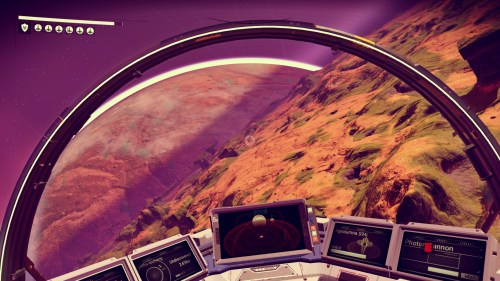
Older Posts »